




Abstract
A key question in scholarship on evaluation is the extent to which the role of social construction is constrained by objective reality. This question is addressed in an analysis of the evaluation of artistic excellence. In an online experiment, we manipulate the subjective social status (both artwork and artist) and the degree of aesthetic complexity of the artwork. The results confirm the independent role of the objective aesthetic factor in art evaluation. Most importantly, we document an interaction between subjective and objective factors whereby aesthetic complexity serves as a credibility lever, amplifying or attenuating the credibility of the status labels. Excessive praise (i.e., a masterpiece by a world-famous artist) tends to reduce the appreciation of aesthetically simple artworks when status labels are questioned. However, the association of aesthetic complexity with the capacity to provoke thought may encourage respondents to take the paintings more seriously. Complexity is typically discouraged for standard products, but it can be instrumental in the process of singularization by stimulating visual exploration and sustaining interest over time.
If it is sometimes difficult to tell a good work of art from a bad one, it might be easier to tell a great work of art from the merely good. The Mona Lisa, the Sistine Chapel, and Guernica appear to surpass standards of excellence by such a wide margin that they are elevated to the rank of a “masterpiece.” Masterpieces represent what standard products are not: unique and exceptional relative to everything else (Belting 2000). Their nature is paradoxical: standing for the best of a genre or an oeuvre, they are celebrated for their uniqueness. Masterpieces have received little attention in sociological research (Karpik 2010), but as an embodiment of excellence and a key reference point, they play an important social and economic role in markets and are fundamental in evaluation (MacGregor 2000).
The essential role of masterpieces in the history of art is a manifestation of the cumulation of preferences in the cultural industries (Caves 2000) whereby quality is inferred from popularity—more popular works tend to be perceived as higher quality (Lynn, Podolny, and Tao 2009; Sgourev and Althuizen 2014). It is well recognized that the operation of socially endogenous inferences may foster convergence in preferences (Correll et al. 2017) and accelerate social diffusion when the number of past adoptions is used as a proxy of quality (Bikhchandani et al. 1992; Rossman 2014). In these cases, markets create rather than simply reflect individual preferences.
The observation that social influence may lead to convergence of preferences around products that are not a true reflection of quality presents major theoretical challenges. As Zuckerman (2012) points out, by acknowledging the nature of evaluations as pure social constructions, we lose some of the moral and practical foundations for our professional and political projects. Indeed, how credible is a system of evaluation where attributions of excellence are not a reflection of objective quality but are based on subjective, self-reinforcing assessments? The problem is writ large when considering that examples of excellence are routinely used in setting the value of products of inferior quality. For many centuries, excellence in art was defined as the ability to recreate ancient and Renaissance masterpieces, and value was a function of the perceived extent to which a work of art approached the lofty standards set by the likes of Leonardo, Michelangelo, or Raphael (Vasari [1550] 2006).
The sociological literature tends to conceptualize value as a social construction of contingent assessments of quality, denying that quality is objectively definable (Beckert 2011; Heinich 1998). In this logic, the existence of a masterpiece category is inherently problematic. Masterpieces would stand for little more than tentative attributions of excellence if small initial differences in quality are simply amplified and perpetuated in the form of a masterpiece label. The key role of masterpieces in art history and cultural consumption implies that the attribution of this role is based at least partly on objective traits. After all, the reason we flock to see Mona Lisa or the Sistine Chapel is the conviction that they are objectively superior to anything else. In the absence of such conviction, the evaluation of masterpieces is reducible to the “Emperor’s Dilemma,” where one’s belief that others are better able to comprehend the true value of what is observed justifies its blind endorsement (Centola, Willer, and Macy 2005).
The problem of excellence is intrinsically linked to that of the ontological bases of evaluation—the extent to which success is anchored by objective conditions. The most systematic evidence to date is provided by the seminal “Music Lab” experiments of Salganik, Dodds, and Watts (2006), which demonstrates that objectively “good” songs are consistently evaluated higher even though the manipulation of market information (e.g., popularity ratings) can lead to differences in the success rate of the songs. Critically, this dependence is more tenuous at the level of excellence—the “best” songs (in terms of market share) are also the most unpredictable. This finding is unsettling given our expectation that the objective quality of products capturing professional excellence match their billing. If the attribution of excellence is even more unpredictable than regular performance, what does excellence truly stand for?
This question has theoretical relevance for social psychology. Judgments of excellence are fundamental in status-organizing processes. A core assumption in expectation-states theory (EST) is that high-status actors are treated as if they have greater performance capacity than low-status actors, linking competence and prominence (Ridgeway 2001). Cognitive links of this kind reinforce power and prestige orders through expectations of future performance based on past performance (Berger and Webster 2006). For example, a well-established artist is more likely to be given the benefit of the doubt in evaluating stylistic deviation (Sgourev and Althuizen 2014). In this regard, an important theoretical question concerns the conditions conducive to disassociating status advantages from actual performance and performance beliefs (Berger and Webster 2006).
These questions motivated a study of the evaluation of excellence in art that strives to better understand the extent to which subjective evaluation is objectively constrained (cf. Lynn, Walker, and Peterson 2016) as well as the underlying socio-psychological mechanisms (cf. Zuckerman 2012). The study investigates the interdependence of subjective factors—the status of the artist and the artwork (if a masterpiece)—and an objective factor—the aesthetic complexity of the artwork (the number and arrangement of elements). The contribution is twofold. First, we provide more robust evidence for the objective constraint by using a theoretically grounded, psychophysical parameter of perception (Berlyne 1974) rather than inferring objective quality from collective preferences (e.g., Salganik et al. 2006; Salganik and Watts 2008). We find that aesthetic complexity has a direct effect on artwork appreciation but also moderates the effects of status labels; namely, the endorsement of status labels is contingent on aesthetic complexity.
Second, we shed light on the determinants of the recognition of excellence. A key reason why aesthetically complex artworks are more likely to be viewed as credible representations of excellence is their capacity to invoke skill and stimulate interest. Complexity is typically discouraged for standard products (e.g., Hannan, Pólos, and Carroll 2007), but it can be instrumental in the social construction of excellence by maintaining relevance over time. Excellence is intricately related to the ability to sustain interest—as Mona Lisa might well attest.
The Role of Subjective and Objective Factors in Art Evaluation
Masterpiece is a core concept in art history, denoting a work of art that surpasses substantially the standards for what can be considered as merely “good” quality (Belting 2000). The question of what constitutes a masterpiece is fundamental in the domain of aesthetics but is also meaningful in sociological terms, referring to the problem of the objective validity of socially constructed evaluation (Zuckerman 2012). The theoretical problem is summarized by Galard (2000)—is the recognition of excellence attributable to its intrinsic properties or to extrinsic reasons, such as historical phenomena, social conditioning, or mere luck? Art historians traditionally consider specific properties (mimetic, expressive, or formal) as essential in aesthetic judgment. For example, for Beardsley (1958), aesthetic judgment is based on objective criteria, such as unity, complexity, and intensity.
However, the ascent of institutionalist theories of art in both art history (e.g., Davies 1991; Dickie 1974) and sociology (e.g., Becker 1982; DiMaggio 1987) redirected attention to social mechanisms involved in the consecration of objects as artworks. In this logic, what gives value to artworks is the status conferred to them by art world members with the authority to issue judgments of taste and shape selection processes (e.g., Becker 1982; Davies 1991). The value of an artwork does not reside in itself but is established by way of categorizations that link value to quality, reputation, and status (Velthuis 2003). Estimates of value emerge from contingent quality assessments (Beckert 2011), conventions (Becker 1982), and power relationships (Bourdieu 1993).
The distinction between evaluation as mental engagement with the objective features of an artwork, central to scholarship in art history, and as social construction, pertinent to sociological work (e.g., Heinich 1998), is increasingly blurred. The question is not whether value is socially constructed but whether it is triggered by objective properties or the endorsement by authority figures (Galard 2000), in other words, whether value is fully or only partly socially constructed (Salganik et al. 2006; Zuckerman 2012). Past research demonstrates the relevance of conventions and cognitive schemas for art evaluation (e.g., Becker 1982; Bourdieu 1993). Conditions of high uncertainty about the intrinsic quality of artworks (e.g., in abstract art) and limited expertise of the evaluating audience encourage the use of socially endogenous inferences that lead to convergence in evaluations (Correll et al. 2017).
However, there are also arguments in favor of the position that objective factors condition evaluative processes. For example, Waschek (2000) specifies three poles that determine the attribution of a masterpiece label—the authority attributed by a socio-cultural consensus, the impact of the work itself, and the sensibility of viewers. Recognizing the importance of social construction (“socio-cultural consensus”), Waschek attributes an independent role in the recognition of excellence to the visual impact of the work, which cannot be subsumed within a social mechanism. The purported role of visual impact is articulated more emphatically by Danto (2000:140): “Looking at a painting like Les Ménines by Velasquez, it is impossible to doubt that we are seeing a masterpiece.” This statement can be easily misunderstood as proclaiming that visual impact is all that matters. Rather, it exposes the doubt that is intrinsic in the process of evaluation of excellence and the need for the aesthetic experience derived from the observation of an artwork to match its billing as a masterpiece. A masterpiece should come across as credible to the viewer if the label is to stick.
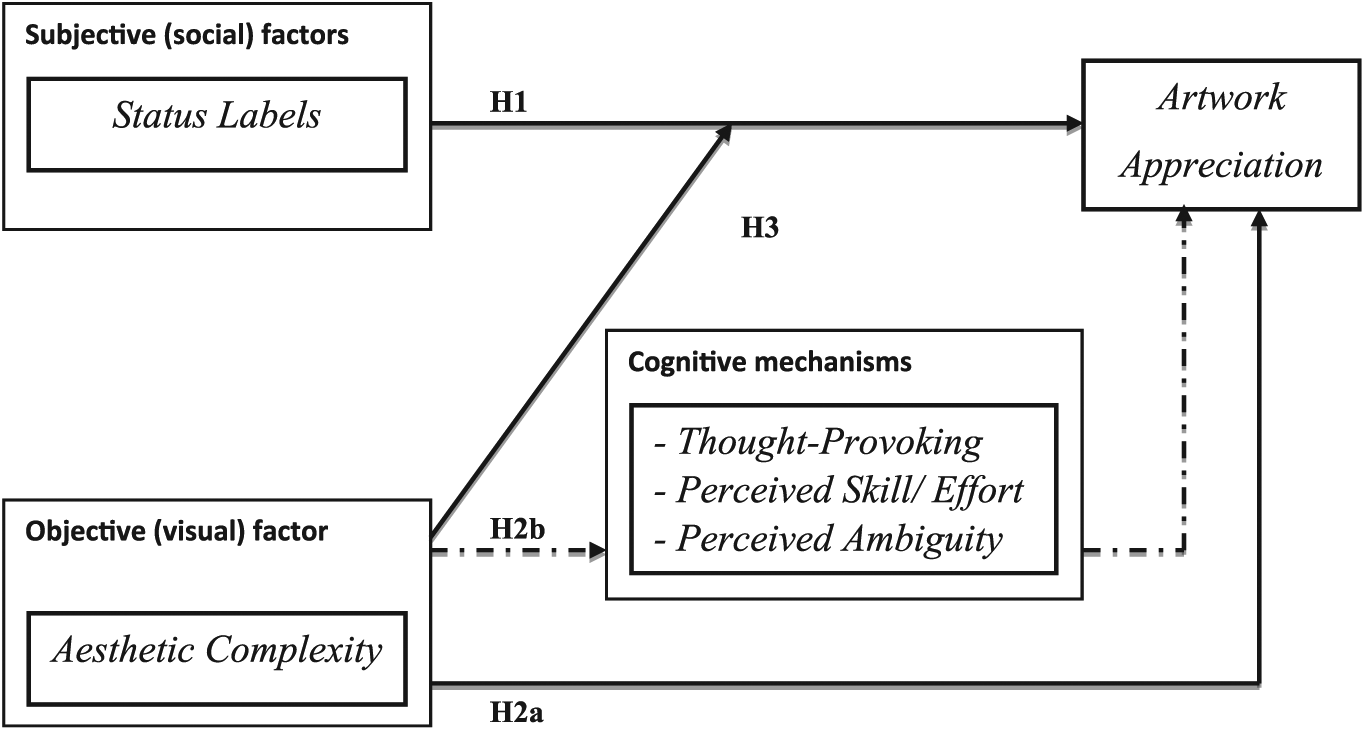
The idea that the credibility of labels attached to artworks depends on objective factors is the foundation of the conceptual model depicted in Figure 1. We assume that viewers apply status labels selectively (Correll et al. 2017), endorsing them for some artworks but not for others in a manner contingent on objective factors, such as the aesthetic complexity of the artwork. We expect that the objective factor influences evaluation directly but also moderates the effect of subjective status labels when a strong visual impact reduces the uncertainty over the quality of a painting, rendering status labels more credible to viewers. Objective factors thus moderate the social construction of excellence (Galard 2000). Next, we formalize our expectations concerning the effects of subjective status labels, objective aesthetic complexity, and their interaction in the evaluation of artworks.
Conceptual Framework
The Subjective Factor: The Effect of Status Labels on Artwork Appreciation
A core assumption of the sociological approach to evaluation is that excellence is not “an objective property of objects . . . but a value projected on these objects, the result of an operation of valorization” (Heinich 1998:25). The mechanisms of valorization are based on status distinctions (Bourdieu 1984). As evaluation in art is highly uncertain and lacks definitive criteria (Velthuis 2003), it reinforces the role of social status as a signalof underlying quality (Lynn et al. 2009; Podolny 1994). There is ample evidence that social status structures evaluation—high-status actors tend to receive better evaluations for their contributions than low-status actors and benefit from attributions of competence or authority in a process that links social significance, competence, and skills (Ridgeway 2001). Consequently, we expect that in evaluation of art, high status is more likely to be associated with competence and the capability of producing excellence.
When viewers are asked to judge the quality or excellence of an artwork, they are likely to rely on status cues in forming judgments (Sgourev and Althuizen 2014). The tendency for evaluating audiences to revert to status cues in making aesthetic judgments, lauding already famous artworks or artists, has long been observed. Consider what an amateur of art, by the name of Andrew McDougall, wrote in a letter from Florence to his friend Keith in 1782 (in Waschek 2000:146): I by no means pretend to be a connoisseur, but I believe some of my countrymen pretend to receive a great deal more pleasure than what is real, and wish to have the name of connoisseur, by praising the noted pictures [cf. a masterpiece label], but before they begin, they have the good sense to inquire the name of the painter [cf. an artist status label].
Our basic expectation is that status labels have a positive effect on the appreciation of artworks as higher status tends to be associated with higher quality or competence, thereby structuring perception. Using a status cue in the form of a label is also consistent with labeling theory, positing that labels can provoke positive or negative associations that reinforce distinctiveness (e.g., Becker 1963).
Hypothesis 1: Status labels positively influence artwork appreciation.
The Objective Factor: The Effect of Aesthetic Complexity on Artwork Appreciation
The test of objective factors of evaluation requires a measure that is irreducible to social construction. This may involve a physical-biological factor of human perception or cultural-institutional nature, changing slowly because of its taken-for-grantedness (Abbott 1988). In their experiments, Salganik et al. (2006) use as an objective constraint the intrinsic quality of songs, measured as their market share in the non-manipulated condition. As the authors recognize, this is not a true measure of “quality” as taste is largely a social construction (Becker 1982). But even if shared taste is socially constructed, when it is “fixed”—changing little over time—it can be treated as objective in a practical sense (Abbott 1988; Zuckerman 2012).
As an alternative to inferring quality from collective preferences, we propose a theoretically grounded objective factor of human perception. The strongest form of objective constraint on social reality is given by the laws of physics and biology that cannot be bent by the human will (Zuckerman 2012). As Abbott (1988) remarks, social construction is limited by nonsocial qualities of physiological nature. The objective factor that we use is “aesthetic complexity”—an important and empirically tractable factor, as specified by Beardsley (1958).
Aesthetic (or visual) complexity is one of several “psychophysical” factors or properties that have been found to affect aesthetic experience, along with intensity, brightness, saturation, and size (Berlyne 1974). The aesthetic experience depends on the complexity of artistic forms—we tend to recognize degrees of complexity in a perceptual process of pattern detection (Dodgson 2008; Wolfram 2002). There is robust evidence that aesthetic complexity plays an important role in the perception of visual stimuli and the formation of aesthetic judgments (Leder et al. 2004). Valued artworks are often visually complex, implicating the existence of various patterns at multiple levels (Birkin 2010). In agreement with past research (e.g., Berlyne 1974; Dodgson 2008; Leder et al. 2004), we expect that the objective psychophysical factor of aesthetic complexity, defined in terms of the number or arrangement of visual elements (Roberts 2007), positively influences artwork appreciation independent of the impact of status labels. 1
Hypothesis 2a: Aesthetic complexity positively influences artwork appreciation.
We expect several mechanisms to mediate the postulated effect of aesthetic complexity. One is the perceived effort of producing the artwork. This is related to the very origin of the concept of a “masterpiece,” which appeared in the Middle Ages, denoting a proof of technical ability by an apprentice or a journeyman. A committee decided if the work was up to the required standards, and if so, one was certified as a master and a guild member. The masterpiece system organized the market for centuries (Baxandall 1980). The association between excellence and craftsmanship or production difficulty reverberates in contemporary culture and scholarship. A core assumption in research on complexity is that something is complex when it is difficult to describe and to reduce to a clear pattern as it features various elements and links between these elements (Kolmogorov 1965). This is a key reason why complexity in art is typically interpreted as a sign of excellence, associated with effort and the difficulty of its production (Birkin 2010), and requiring more cognitive effort on the part of the viewer (Graf and Landwehr 2015).
Another reason why complex artworks may be appreciated more is related to their capacity to stimulate the interest of viewers by providing room for visual exploration, allowing for various interpretations (Birkin 2010). It is recognized in art history that one feature that makes a painting appear extraordinary—as distinct from a simply well-executed painting—is the plurality of meanings (e.g., Belting 2000). Galard (2000) views the ability to escape full explanation and give rise to multiple interpretations as fundamental to masterpieces. The coexistence of multiple meanings offers the prospect for discovery, which is a key factor in aesthetic preferences (Hekkert, Snelders, and Van Wieringen 2003). Interest in a visual stimulus arises when people have the feeling that they can learn more about it (Silvia 2005). The room for interpretation that complexity provides encourages viewers to “create” a masterpiece for themselves out of the presented image. This aspect is captured aptly by MacGregor (2000:77): The essential of the masterpiece is related to projection. A masterpiece has to serve as a vehicle for everything that we want to find in it. The spectator has to be able to find there everything that he or she is looking for. The painting has to be rather ambiguous to support interpretations that are not just different but contradictory.
The idea that masterpieces remain open to interpretation has gained currency among critics. For example, Utley (2008:270) argues that the aforementioned Les Ménines by Velasquez “fascinates younger generations of artists because of its mysteries of perception and reflection” and that artists are still “intrigued by the spatial and perspectival ambiguities” in it. Jacobs (2015) ascribes to it an aura of mystery and possibilities, of openness to interpretations mirroring the changing preoccupations of each historical period.
As these quotes illustrate, two related but distinct mechanisms are involved in situations of uncertain visual meaning—one related to open-endedness and the capacity to provoke thought, the other toambiguity—the lack of clarity by virtueof the coexistence of multiple ways of interpretation (Engel 1967). Open-endedness can be a valuable attribute as a source of enduring relevance for works of art by provoking pattern finding and stimulating interpretation and interest (Belting 2000, Birkin 2010). At the same time, scholars also attribute an important role to ambiguity in creative processes—it can be appealing to audiences by allowing for different, potentially conflicting interpretations of complex visual content (Sgourev 2013). As Weick (1995) notes, the multiplicity of meanings is conducive to a state of confusion, invoking social construction and invention. Our expectation is that aesthetic complexity enhances the appreciation of artworks through the capacity to provoke thought and to a more limited extent, through the multiplicity of meanings that complexity is associated with.
Hypothesis 2b: The positive effect of aesthetic complexity on artwork appreciation is mediated by the artwork’s capacity to provoke thought, perceived skill and effort, and/or perceived ambiguity.
The Interaction between Subjective Status Labels and Objective Aesthetic Complexity
Doubt is the natural attitude of a viewer vis-à-vis an avowed masterpiece, but this doubt can be increased or reduced by the objective properties of artworks. As art historians recognize, aesthetic factors can moderate the effects of social factors on the appreciation of art (Danto 2000; Galard 2000). A powerful visual impact can reduce uncertainty over excellence, rendering status labels redundant, while a weak aesthetic impact may have the reverse effect, reinforcing reliance on status labels. In this logic, objective factors condition the social construction of excellence (Galard 2000) by affecting the credibility of status labels. This argument reflects one of the ways in which aesthetic experience can be made theoretically compatible with mechanisms of social construction (Van Maanen 2009).
Actors react to status cues when they consider them credible (Correll et al. 2017). Credibility is essential in social diffusion (Kuran 1995; Willer, Kuwabara, and Macy 2009) and in the “leap of faith” required in the recognition of excellence in art. We posit an interaction effect between objective and subjective factors wherein aesthetic complexity reinforces or attenuates the effects of status labels in art evaluation. Aesthetic complexity thus serves as a credibility lever, making viewers either endorse status cues unquestionably or render these practically irrelevant in art evaluation. The association of aesthetic complexity with the capacity to provoke thought may enhance the credibility of status cues and make them stick better by stimulating viewers to take the painting more seriously. The credibility lever can also be observed in the condition of aesthetic simplicity, making the viewers rely even more heavily on status cues or deterring them from taking the artwork seriously (dismissing it as inferior in quality and the label as not credible). We thus expect that the aesthetic complexity of the artwork will moderate the effect of status labels on artwork appreciation, but the nature of this interaction depends on whether the viewer deems the labels credible. Assuming that viewers take the status label at face value, we hypothesize the following:
Hypothesis 3: The effectiveness of a status label (social factor) is conditional on the aesthetic complexity (objective factor) such that an aesthetically simple artwork benefits more from the presence of a status label than an aesthetically complex artwork.
Featured Artist: Kazimir Malevitch (1878–1935)
The artist Kazimir Malevitch was a pivotal figure in the Russian avant-garde and the founder of the Suprematist movement, seeking to liberate art from the constraints of direct representation. His most famous work, The Black Square (1915), was arguably the first fully nonrepresentational painting in history. He developed a new aesthetic language, marked by simplification of form and directness of expression.
There were several reasons to feature Malevitch’s work in our study (see Appendix). First, Malevitch is not as familiar to the public as Kandinsky or Mondrian. Only 5.9 percent of our respondents claim to know Malevitch’s work “rather well” or “very well.” This prevented the easy identification of the featured artworks (7.2 percent claim to have seen the displayed painting before), which could have jeopardized the success of the experimental manipulations. Second, the general audience tends to prefer realistic art to abstract art (only 14.4 percent express a clear preference for abstract art), which reduces the likelihood that our findings are driven primarily by idiosyncratic art preferences. The higher level of uncertainty in evaluating the intrinsic value of abstract artworks implies that the audience is more likely to resort to status cues, providing a more conservative test of the aesthetic complexity hypothesis.
Study Design and Participants
Based on two pilot studies, we decided to operationalize status labels at both the level of the artwork and the artist. The study design thus involved a 2 (artwork status label: masterpiece or not) × 2 (artist status label: world-famous or not) × 2 (aesthetic complexity: simple vs. complex) between-subjects online experiment. In total, 222 master students from a major French business school completed the survey in return for course credit (59 percent female, 45 percent French, with an average age of 24 years, SD = 2). Participants were randomly assigned to one of the eight experimental conditions (resulting in 26 to 29 observations per condition). Only 3.6 percent of the participants had not visited a museum or art gallery over the past year, and 30 percent reported more than five visits. Except for gender, χ2(7) = 8.2, p = .03, there were no significant differences across conditions in terms of citizenship (i.e., French or not, χ2[7] = 8.2, p = .32); age, F(7, 213) = .9, p = .52); self-reported art knowledge, F(7, 214) = 1.7, p = .11; art preference, χ2(21) = 19.4, p = .56; and difficulty of artwork evaluation, F(7, 212) = .8, p = .57. The covariates did not influence artwork appreciation significantly and were therefore removed from further analyses, except for the level of self-reported art knowledge and art preference.
Experimental Treatments
The Objective Factor: Aesthetic Complexity
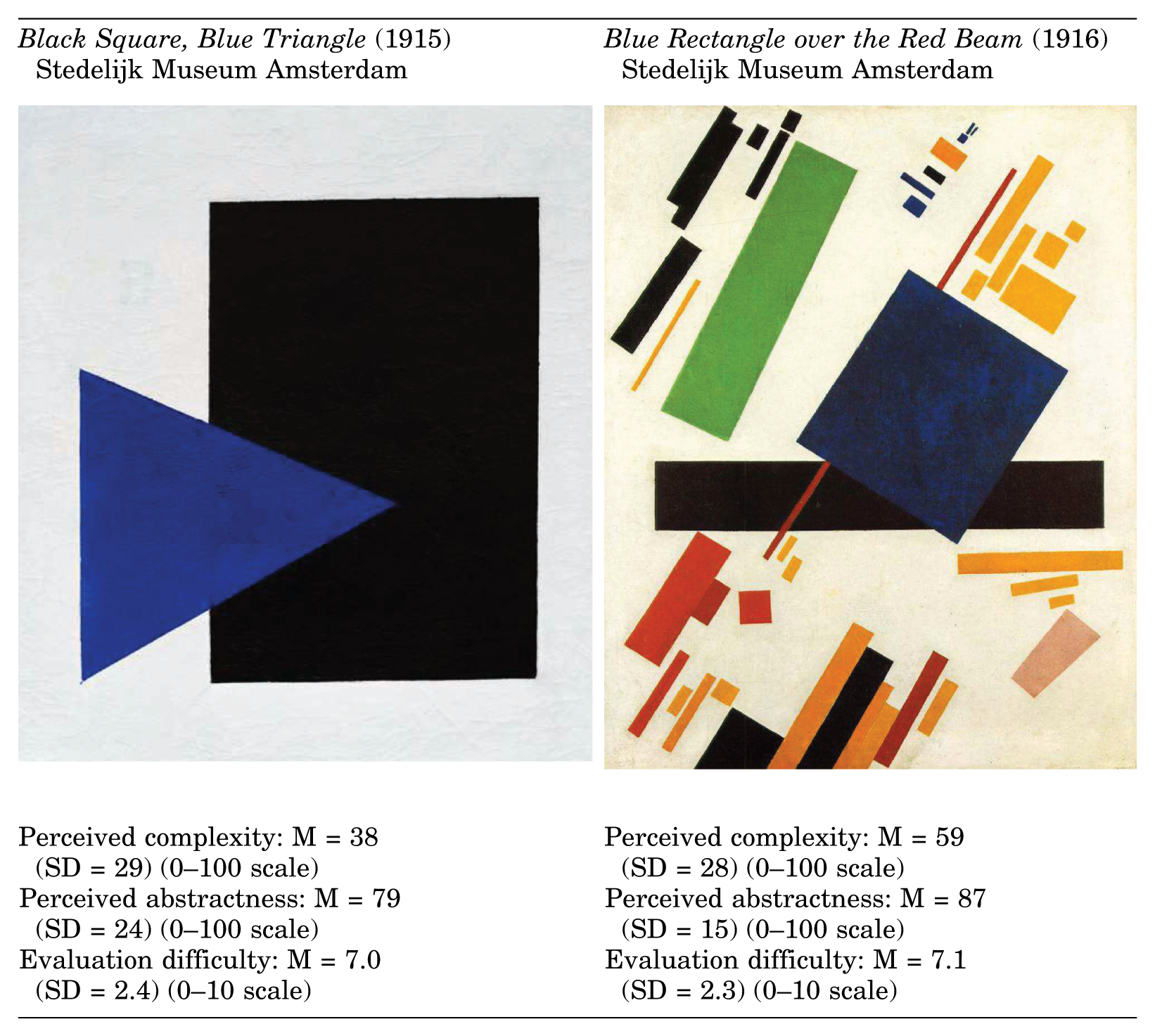
Guiding our choice of the paintings wasthe observation that the main factorsinfluencing perceived aesthetic complexity are the number, variety, and arrangement of elements that together make up the overall composition of the artwork (Birkin 2010; Roberts 2007). Other factors that may influence the perceived aesthetic complexity are basic properties such as proportion, size, resolution, color, and tone (Birkin 2010). Finding two artworks within an artist’s oeuvre that are identical with respect to these basic properties is impossible, but we managed to identify two paintings by Malevitch that differ markedly in terms of the number, variety, and arrangement of elements but match closely on the basic properties. The two artworks, executed in the Suprematist style, are shown in the Appendix. The first one, Black Square, Blue Triangle (1915), appears visually simple, while the second one, Blue Rectangle over the Red Beam (1916), displays a larger number and variety of elements that are arranged in a visually complicated manner while still forming a harmonious composition.
Produced in the same period, the paintings result from common artistic pursuits and common compositional decisions. The “simple” painting is subsumed within the “complex” painting—as attested by the centrality of the black-blue combination and the way the blue element is inserted into the larger black element. Art experts consider both paintings as well-executed, credible representations of excellence. A quantitative study of artistic creativity (Elgammal and Saleh 2015) ranked two Malevitch paintings that are similar to those in our studies as highly original vis-à-vis thousands of other paintings. Participants in our study designated both paintings as highly abstract and equally difficult to evaluate, but Black Square, Blue Triangle was viewed as relatively simple aesthetically, while Blue Rectangle over the Red Beam was perceived as moderately complex (see Appendix for the means). Accordingly, a JPEG compression of the images of the artworks (JPEG uses a default Kolmogorov complexity estimator), used in studies as an objective measure of aesthetic complexity (see e.g., Birkin 2010; Donderi 2006), results in different file sizes (100,000 for the “simple” artwork and 120,000 for the “moderately complex” artwork).
The Subjective Factor: Artwork Status and Artist Status
The status label manipulations were presented in the form of an accompanying text displayed above the featured (simple or complex) artwork. For the artwork status label, we specified that the painting was “widely recognized as a masterpiece of Modern art,” while for the artist status label, we mentioned that the work was by “one of the most famous painters of all time.” Depending on the condition to which the participant was assigned, the accompanying text thus reads as follows: “What you see on the screen is a painting [widely recognized as a masterpiece of Modern art] by [one of] the [most famous] painter[s] [of all time] Kazimir Malevitch (1878–1935).”
Measures
Dependent Variable
Participants were asked to rate their appreciation of the displayed artwork on the following items: aesthetic value (defined as “relative aesthetic worth or importance”), creative value (defined as “showing imagination, originality, and intellectual inventiveness”; both measured on a scale from 1 = low to 10 = high), personal appeal (1 = strongly dislike to 5 = strongly like), and perceived intrinsic quality (0 = not a masterpiece at all to 100 = a masterpiece). We took the average of the standardized item scores as a measure of overall artwork appreciation (Cronbach’s α = .87).
Mediator Variables
Participants were asked to rate the extent to which they considered the artwork to be thought-provoking, which was defined as “stimulating interest, serious consideration, or new ideas” (single item; 1 = not at all to 5 = very high), and the artwork’s level of ambiguity, which we defined as “allowing for different interpretations of its meaning” (single item; 0 = unambiguous to 10 = highly ambiguous). Participants also gave their assessments of how difficult it was to produce the painting (0= not difficult at all to 10 = very difficult), how long they thought it had taken the artist to paint it (1 = up to one week to 6 = a year or more), and the level of craftsmanship demonstrated (0 = very low to 10= very high). We took the average of the standardized scores of the latter three items as a measure of perceived skill and effort (α = .74).
Covariates
At the end of the survey, participants were asked to provide their age, gender, and education level. Considering the importance of knowledge and familiarity in the processing and evaluation of images (Kunst-Wilson and Zajonc 1980), we also assessed the participants’ level of art knowledge via the following items: number of visits to museums and art galleries over the past year (1 = 0 to 5 = more than 10), self-reported general art knowledge, knowledge of modern twentieth-century art (both measured on a scale from 1 = low to 5 = high), and knowledge of Malevitch’s work (1 = low to 4 = high). We took the average of the standardized item scores as a measure of overall art knowledge (α = .79). In addition, we asked participants whether they had seen the displayed painting before and which type of art they preferred (i.e., realistic art, abstract art, both, or neither). They were then thanked for their participation and invited to guess the study’s purpose.
Analyses and Results
We ran a three-way ANCOVA with artwork status label, artist status label, and aesthetic complexity as the independent variables and artwork appreciation as the dependent variable, controlling for art knowledge, F(1, 212) = 13.5, p < .001, η2 = .06, and the preference for realistic art, F(1, 212) = 38.7, p < .001, η2 = .15. In line with Hypothesis 1, we find a significant main effect of the artwork status label, F(1, 212) = 3.9, p = .048, η2= .02, such that the presence of the masterpiece label enhances artwork appreciation (Mmasterpiece_label = .12, SD = .87 vs. Mno_label = –.13, SD = .80). The main effect of the artist status label, however, is not significant, F(1, 212) = .1, p = .71. Consistent with Hypothesis 2a, we find a significant main effect of aesthetic complexity, F(1, 212) = 39.3, p < .001, η2= .16, such that the more complex artwork is appreciated better than the simpler artwork (Mcomplex = .29, SD = .85 vs. Msimple = –.28, SD = .73). However, these main effects are qualified by a significant three-way interaction, F(1, 212) = 5.0, p= .027, η2 = .02, which provides support for Hypothesis 3. 2 Table 1 presents the mean (standardized) scores and standard deviations per experimental condition.
Means and Standard Deviations of Artwork Appreciation per Experimental Condition (N= 222)

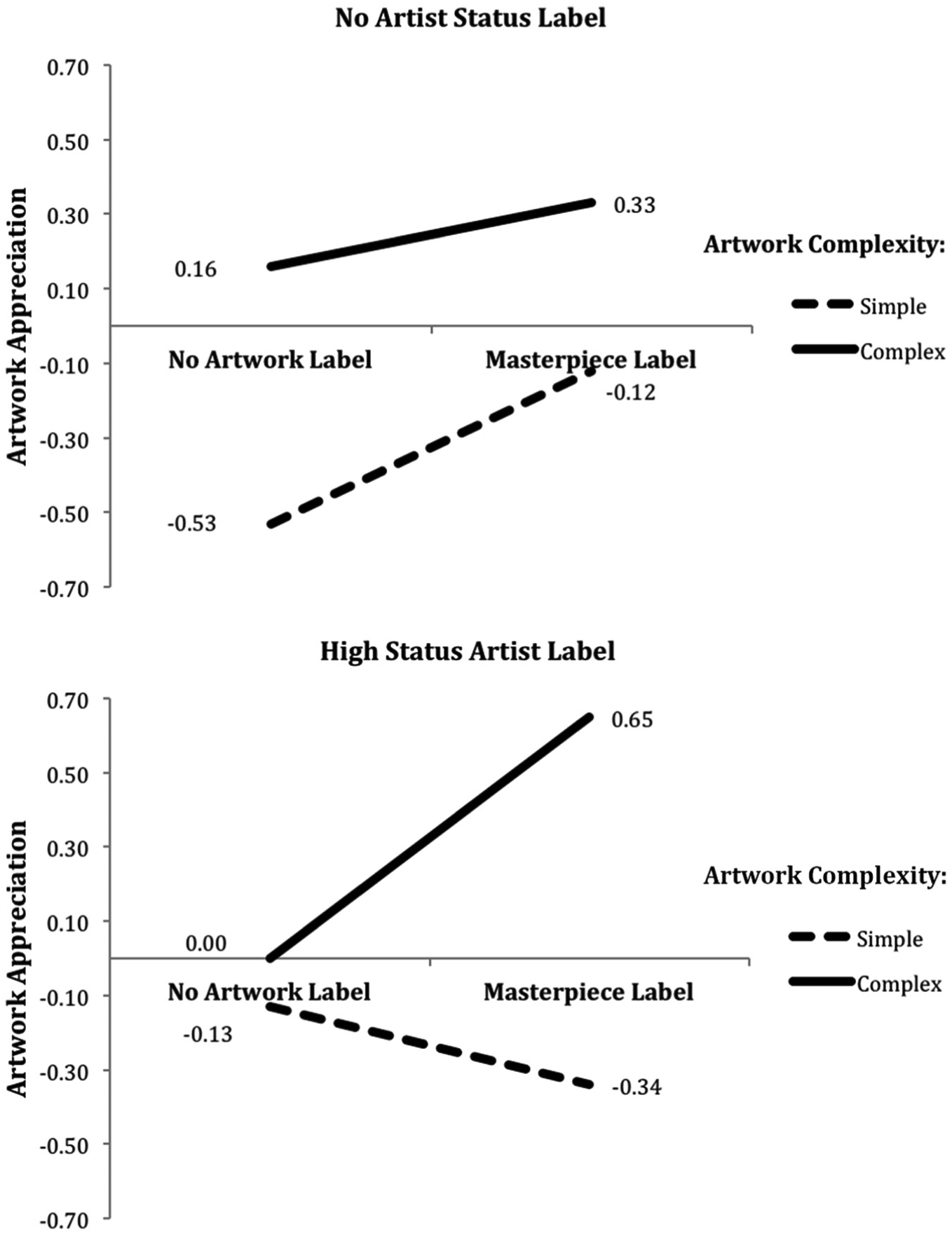
Post hoc analyses show that in the absence of any status label (see upper part of Figure 2, left side), the more complex artwork is appreciated more than thesimpler artwork (Mcomplex = .16, SD= .73 vs. Msimple = 2.53, SD = .72; p = .001). Adding a masterpiece label (see upper part of Figure 2, right side) increases the appreciation of the simpler artwork (Mmasterpice_label = –.12, SD = .76 vs. Mno_label = –.53, SD = .72; p = .044), but it does not enhance the appreciation of the more complex artwork significantly (Mmasterpice_label = .33, SD = .82 vs. Mno_label = .16, SD = .73; p = .44). Adding a high-status label for the artist when the artwork itself is not labeled as a masterpiece (see lower part Figure 2, left side) reduces thegap in appreciation between the simpler and more complex artwork (Mcomplex = .00, SD = .85 vs. Msimple = –.13, SD = .76; p = .59) by increasing the appreciation of the simpler artwork (Mhigh_status = –.13, SD = .76 vs. Mno_label = –.53, SD = .71; p = .048). However, when the high-status artist label is combined with a masterpiece label for the artwork (i.e., double praise), it does reinforce the appreciation of the more complex artwork (Mmasterpice_label = .65, SD = .90 vs. Mno_label = .00, SD = .85; p = .008) butreduces the appreciation of the simpler artwork, albeit not significantly (Mmasterpice_label = –.34, SD = .65 vs. Mno_label = –.13, SD = .76, p = .27). This suggests that overpraising a simple artwork can raise suspicion in the credibility of labels.
Interaction Effect between Status Labels and Aesthetic Complexity
Next, we ran a mediation analysis to investigate what is driving the effect of aesthetic complexity on artwork appreciation. We followed the procedure proposed by Hayes (2013) and Preacher and Hayes (2008) to test for mediation effects. This method involves bootstrapping to generate 95 percent confidence intervals around the estimated indirect effects. Mediation is said to occur if the confidence interval does not include zero (Preacher and Hayes 2008). Considering that the effects of the status labels on artwork appreciation are conditioned on the artwork’s aesthetic complexity, we performed moderated mediation regression analyses (Hayes 2013) with the artwork’s capacity to provoke thought, perceived skill/effort, and perceived ambiguity as potential mediators of the effect of aesthetic complexity on artwork appreciation (see Hypothesis 2b), controlling for the influence of art knowledge and art preference.
Only when there are no status labels provided (see the first row in Table 2), the indirect effect of aesthetic complexity on artwork appreciation is significant via the artwork’s capacity to provoke thought (b = .06, 95 percent CI .02, .13) such that the more complex artwork is considered as thought-provoking to a greater extent than the simpler artwork, which enhances the appreciation of the artwork (in line with Hypothesis 2b). There are no other significant indirect effects for the capacity to provoke thought, perceived skill/effort, or perceived ambiguity. The results (based on 5,000 bootstrap samples) for the capacity to provoke thought are shown in Table 2.
Indirect Effect of Aesthetic Complexity on Artwork Appreciation via the Capacity to Provoke Thought for Different Combinations of Status Labels

Note: N = 211 (1 missing value). Estimates based on 5,000 bootstrap samples.
Hypothesis 2b is only partially supported—there is confirming evidence for the capacity to provoke thought but not for perceived skill/effort and perceived ambiguity. The indirect effect of the artwork’s capacity to provoke thought is conditional on the presence (or absence) of status labels (see Table 2). Both the capacity to provoke thought (b = .19, p < .001) and perceived skill and effort (b = .54, p < .001) exert a positive direct effect on artwork appreciation. For perceived ambiguity, none of the direct or indirect effects is significant at the 5 percent level. 3
In sum, social construction via the presence of a status label can significantly enhance the appreciation of a simple artwork, whereas a more complex artwork appears to be less reliant on such mechanisms of social construction. However, there are limits to the power of social construction. We find that double praise for a simple artwork (i.e., a masterpiece by a world-famous artist) produces no significant effect and may even backfire. But such high praise appears credible for a more complex artwork, enhancing appreciation. When social construction is muted (status labels are absent), the difference in the appreciation of the simple and complex artworks stems from the latter’s capacity to provoke thought.
Main Findings and Contributions
It is well established that cultural markets exhibit self-fulfilling prophecies, making it difficult to predict what products would be viewed as best in quality (Caves 2000; Salganik et al. 2006). However, this observation contradicts the assumption that masterpieces are objective examples of excellence (Belting 2000; Danto 2000). Motivated by this contradiction, we used excellence in art as a context to address the broader theoretical issue of the objective constraints of social construction (Lynn et al. 2016; Zuckerman 2012). The advantage of art as a research setting is the high level of uncertainty, related to the fact that no two artworks are identical and that “true quality” is difficult to establish (Beckert 2011; Heinich 1998). These conditions facilitate social construction and the use of uncertainty-reducing status cues, thereby making more compelling the evidence collected on the role of objective factors in evaluation.
The main contribution of our paper relates to recent efforts to ascertain objective constraints of social construction (Lynn et al. 2016; Salganik et al. 2006; Salganik and Watts 2008). Controlling for self-reported art knowledge and preferences, we find robust evidence for the role of an objective psychophysical factor in evaluation. Aesthetic complexity influences artwork appreciation (1) by moderating the effect of status labels and (2) through the association of aesthetic complexity with the capacity to provoke thought (mediator). Recognition of excellence is inherently subjective, but objective factors can amplify or attenuate the credibility of status labels. In contrast to prior studies (Salganik et al. 2006; Salganik and Watts 2008), our measure of objective constraint is irreducible to social construction and is not derived from collective preferences.
In agreement with sociological frameworks that treat quality as a social construct and link perceived value to reputation and status (e.g., Becker 1982; Bourdieu 1984), we find that social cues that signal professional recognition—such as a masterpiece label for the artwork or a high-status label for the artist—can enhance recognition of excellence, mostly for aesthetically simple artworks. A core assumption in expectation-states theory is that status functions as a prism through which competence is judged (Berger and Webster 2006; Ridgeway 2001). The findings confirm that status labels tend to activate beliefs of competence, becoming a basis for evaluation and inequality in rewards.
Against the evidence for stability in status orders, our results also highlight conditions under which status advantages can be disassociated from actual performance (Berger and Webster 2006). In the art field, status orders can be vulnerable when appearance does not align with status labels. The assumption that inequality is driven by status and not by objective differences holds in many contexts (Wood and Karten 1986) but only partially in ours. Status orders determine inequality in evaluation, but the dependence of evaluations on performance may attenuate the stability of status orders when the quality of performance deviates markedly from expectations.
The popular adage that people tend to accept at face value what is said or written about an artist instead of relying on their independent judgments (Lang and Lang 1988) does not mean that anything goes. Our analysis attests that status labels do not always stick—objective factors may determine what can credibly pass as excellent. Hence, attributions of value are neither arbitrary nor fully reducible to the “Emperor’s Dilemma.” Not everyone can recognize artistic excellence, but not everything can pass as excellent either. The consecration of excellence is partly based on objective features that cannot be subsumed within social mechanisms.
As Rossman (2014) observes, the finding that individuals are less susceptible to the opinion or expectations of others than our theories tend to predict should be neither surprising nor unwelcome for sociologists. It is not clear why the default expectation should be that evaluation is fully socially constructed when research in adjacent fields, such as psychology or aesthetics, provides evidence for skepticism in this regard. The experiments by Salganik and Watts (2008) show that market permutations affect the success of songs, but as the authors recognize, “the effect on the overall market ranking was not as dramatic as we had anticipated” (Salganik and Watts 2008:351). That “good” songs recouped their popularity after the manipulation and the fact that objective quality matters appeared to surprise the authors, who attribute it to “the relatively small number of songs.” The results of our experiments imply that their findings are not contingent on the number of evaluated songs. That we arrived at a similar conclusion with different operationalization of objective constraint reinforces our confidence in a key substantive implication of the analysis—that excellence in cultural markets is more predictable than is typically thought.
Our theoretical contribution concerns the conceptualization and testing of the interaction between the objective and subjective factors. The aesthetic complexity of a painting can serve as a credibility lever, amplifying (or reducing) the uncertainty over the excellence of a painting, thereby rendering the status cues as more (or less) credible to viewers. The leap of faith required in attribution of excellence is conditioned on the objective properties of the artwork. Between a status label and an estimate of aesthetic value lies cognitive work. Depending on the aesthetic complexity of the artwork, which shapes perceptions of its capacity to provoke thought, viewers endorse status labels and rely on them in their evaluation. When the presented image lacks credibility, the probability of attributing excellence is dramatically reduced and the artwork may even be penalized, as in the case of the aesthetically simple artwork labeled as a masterpiece by a famous artist. This result offers a rare glimpse into the “bursting of the bubble” moment when status cues are judged as lacking credibility. These moments are implied in past research (e.g., Centola et al. 2005; Willer et al. 2009) but rarely demonstrated. Our results imply that these moments are more likely to occur at the high-status level when the work falls short of what is expected of a high-status artist and the audience is not well versed in the normative expectations that regulate art evaluation.
This analysis emphasizes the key importance of credibility in social construction. Complex artworks appear more credible as examples of excellence than simple ones. The role of complexity as a credibility lever in social construction is consistent with research in psychology, art history, and aesthetics, showing that cultural and personal factors jointly influence emotional responses to art (Shimamura 2013). The idea that an objective factor acts as a trigger for the social construction of excellence (Galard 2000) supports the argument that aesthetic experience and social construction are theoretically compatible (Van Maanen 2009).
Implications and Suggestions for Theory and Research
An intriguing finding that we did not hypothesize explicitly is that “double” praise, namely, the presence of both a masterpiece label for the artwork and a high-status label for the artist, worked well for the complex artwork but had no effect—and even seemed to backfire—for the simple artwork. When a product or a producer is labeled as standard and another one as superior in quality, it seems logical to expect that the audience would be more likely to attribute excellence to the former than the latter. Although status distinctions at the level of the artist and the artwork often tend to be aligned, with the artwork carrying the status of the artist (e.g., Durand, Rao, and Monin 2007), this need not always be the case. Even famous artists may have atrociously bad works in their portfolio. Evaluation may occur in two stages, where one looks at the product label first and if still in doubt makes use of additional cues, such as the status of the producer. The relationship between product and producer labels and its effect on product evaluations provide an intriguing avenue for future research, for example on the degree to which the labels reinforce or complement each other.
Our study does not address the eternal question of whether Mona Lisa is justifiably lauded as a masterpiece but sheds further light on what makes such a painting more likely to be viewed in this way. One part of the answer is thecapacity of complexity to provoke thought, encourage discovery and invention (Hekkert et al. 2003; Weick 1995), and engage the interest of the viewer (Silvia 2005). For abstract art, this is facilitated by an intricate visual configuration featuring multiple links between diverse elements. We found that in the absence of status labels, the aesthetic complexity of the artwork was associated with the capacity to sustain interest. The artworks that keep on drawing viewers or the books that keep on being read typically feature images or themes that encourage reinterpretation (MacGregor 2000). From this angle, masterpieces are works that prove to be malleable and capable of riding the shifting tides of ideology, theory, and fashion.
The argument that aesthetic complexity facilitates visual exploration and pattern finding and as a result reinforces excellence recognition can be applied to better understanding cultural and historical processes, such as the rise of abstract art. The sudden escalation of aesthetic complexity in the first decades of the past century, most visibly in the Cubist style, is typically discussed as an obstacle to its diffusion (e.g., Cowling 2002). But it is possible that the complexity of Cubism worked in its favor by invoking highly intellectual pursuits. The intuitive understanding of artists that complexity can be a valuable feature possibly reinforced their experiments in the absence of strong market demand (Sgourev 2013). This argument should not be taken to mean that artworks can afford to be inscrutable as very high levels of aesthetic complexity are difficult to make sense of and may lead to the outright dismissal of an artwork as meaningless (Berlyne 1974; Kuwabara, Anthony, and Horne 2017). Thus, the challenge at the product level is to appear sufficiently complex without being prolix.
Standard and singular products are not judged according to the same principles (Karpik 2010). Our experiments suggest that an attribute that is appropriate for singular products may not be so for standard ones. Aesthetic complexity can be lauded for singular products when interpreted as a sign of or an incentive for intellectual engagement, but it can be penalized for standard products (Hannan et al. 2007). The substantive implication is that complexity can be a valuable attribute and a source of enduring relevance at the high end of the market where incommensurable, unique products are usually found. Aesthetically complex artworks are more likely to feature that elusive je ne sais quoi that accompanies excellence in any professional domain. This points to a complex equation to solve for cultural producers, namely, what level of product complexity to pursue for success at the industry mean versus the level of excellence.
As art historians observe, masterpieces are difficult to compare as they create their own standards that make direct comparison ineffectual (e.g., Dantzig 2013). The incommensurability of masterpieces violates a core assumption in evaluation, namely, that products and producers can be compared and differentiated on a set of characteristics or dimensions (e.g., White 2002). If standard products derive credibility from conforming to category expectations (Hannan et al. 2007), singular products are characterized by their misalignment with existing categories. The process of singularization is dual in nature, including evaluation relative to standard products, where singularity is established, and then relative to other singular products, where finer distinctions emerge (Karpik 2010). Future research can investigate the bases of judgment at these stages and the attributes associated with them.
Our research design incorporates a situation common in the experience of art, namely, a visit to a museum where the viewer passes judgment on an artwork. As MacGregor (2000:77) observes, “nowadays the museum proposes and the people decide if, yes or no, a work of art is a masterpiece.” Naturally, scholarship can examine other situations where social influence is more direct (e.g., Willer et al. 2009), such as art auctions. We focused on individual assessments of excellence, but an auction setting would allow for an assessment of individuals’ opinions of how others (i.e., the market) judge the value of the artworks.
Our results are generalizable to books, films, songs, and most other forms of cultural production where the complexity of the content is a factor in its evaluation. We believe our findings extend to any context where product excellence is difficult to ascertain and is not directly inferable from observed characteristics. It is customary in scholarship on status to assume that “true” quality is observable (e.g., Lynn et al. 2009; Podolny 1994), but this is a problematic assumption in the creative industries where quality is a largely subjective construct in nature (e.g., Beckert 2011; Heinich 1998). In such a context, we find confirming evidence that status labels are effective as signals of quality but their impact is less straightforward than typically assumed, conditional on factors of objective nature, such as the degree of aesthetic complexity. As Salganik and Watts (2008) note, the higher uncertainty of product evaluation in these contexts is conducive to convergence of opinions and the formation of “bandwagons.” The finding that too much praise may backfire is a reminder of the contingent and potentially curvilinear dependency between status and performance whereby high status can reinforce as well as attenuate credibility (Phillips and Zuckerman 2001).
A limitation of our study is not capturing the highest level of aesthetic complexity, where inflection in perceptual impact might be expected to occur (cf. Birkin 2010). Future studies should capture the full range of aesthetic complexity, testing for nonlinear effects. Considering the major difficulty of finding artworks by the same artist in the same period at low,medium, and high levels of aesthetic complexity, these studies may require a different research design using computer-generated images.
Despite the uncertainty over the nature of masterpieces, they continue to play a critical role as repositories of economic and aesthetic value. The masterpiece is unlikely to lose its relevance anytime soon—this may be the only remaining concept to connect the fine arts to their tradition as everything else has been revolutionized, eradicated, or transformed (Danto 2000). This study confirms the observation that masterpieces remain a standard in art but not a golden standard (MacGregor 2000)—if they count for more than the rest, they still have to work for it.
Footnotes
Appendix
| Black Square, Blue Triangle (1915) Stedelijk Museum Amsterdam |
Blue Rectangle over the Red Beam (1916) Stedelijk Museum Amsterdam |
| Perceived complexity: M = 38 (SD = 29) (0–100 scale) Perceived abstractness: M = 79 (SD = 24) (0–100 scale) Evaluation difficulty: M = 7.0 (SD = 2.4) (0–10 scale) |
Perceived complexity: M = 59 (SD = 28) (0–100 scale) Perceived abstractness: M = 87 (SD = 15) (0–100 scale) Evaluation difficulty: M = 7.1 (SD = 2.3) (0–10 scale) |
Acknowledgements
We would like to thank Ezra W. Zuckerman – Sivan, Jan Stets, Richard Serpe, and three anonymous reviewers for their helpful comments and suggestions. The responsibility for any errors in the text is solely ours.
1
To this expectation, we add the caveat that extreme levels of aesthetic complexity may negatively affect appreciation by straining viewers’ cognitive abilities (e.g., Berlyne 1974; Kuwabara, Anthony, and Horne 2017). The evidence in this regard remains inconclusive (see Birkin 2010;  ).
).
2
Controlling for whether the respondents had seen the painting before the experiment does not influence the results substantively. Having seen the painting before has a marginally significant positive impact on artwork appreciation, F(1, 211) = 3.4, p = .069, which is due to a basic familiarity effect. Most importantly, the three-way interaction, F(1, 211) = 5.2, p = .023, and the other reported effects remain significant in these models.
3
It should be noted that causality cannot be reliably established with variables measured at one point in time. Effects could go in the opposite direction so that art appreciation could provoke thought (stimulate interest or new ideas) or enhance perceived effort (difficulty in producing the painting or time to complete it) just as much as thought-provoking art and perceived effort could enhance art appreciation. The causal ordering needs to be tested in future research.