




Abstract
The relationship between generation and memory instantiates a theme central to sociology: the intersection between history and biography. This study addresses two gaps in the literature. First, whereas the dominant approach uses a cognitive concept of memory operationalized as naming events, I focus on autobiographical memory represented in life stories, in which members of a generation understand the meanings of their personal past as part of a historical event. Second, whereas the dominant approach stresses intergenerational differences of memory, I draw on a Bourdieu-Mannheim theoretical framework to use class—including class positions and habitus—to describe and explain intragenerational differences in autobiographical memory. The two theoretical goals are achieved through theorizing an important case: the autobiographical memories of China’s “sent-down youth” generation, the 17 million youths (zhiqing) sent by the state to the countryside in the 1960s and 1970s. Drawing on a qualitative and quantitative analysis of life-history interviews with 87 former zhiqing, I describe how this generation reconciles two components of autobiographical memory: personal experience in their sent-down years and historical evaluation of the send-down program. Respondents’ present class positions shape their memory of the personal experience, whereas their political habitus formed in the political-class system in the Mao years molds their historical evaluations of the program. Their habitus may change as a response to the social transformation in recent decades. This article not only contributes to our understanding of generational memory but also brings class back into the field.
The relationship between generation and memory is central to the sociology of memory because it highlights the intersection between personal biography and history, a tenet of the field and even the whole of sociology (Corning and Schuman 2015; Halbwachs 1980). Members of a generation occupy a unique position in historical temporality and experience the same events and processes (Mannheim 1952 [1923]), but their individual life courses usually diverge; so do their memories. Studies of generation and memory can help us to develop the “sociological imagination”—the ability to “understand the larger historical scene in terms of its meaning for the inner life and the external career of various individuals” (Mills 1959:5).
The dominant approach to this topic draws on Karl Mannheim’s theory of generation (1952 [1923]) and cognitive psychology and examines how different age cohorts name different events as the most important. It connects individual experience to historical temporality and, thus, remedies the totalizing tendency implied in the term collective memory (Corning and Schuman 2015; Schuman and Scott 1989).
Nevertheless, two gaps in this literature remain. First, the dominant approach relies on a cognitive concept of memory and operationalizes it as respondents’ naming historical events, thus missing the rich meaning-making processes in people’s retrospective accounts of the past, on which most sociological studies of memory focus (Olick, Vinitzky-Seroussi, and Levy 2011). Second, this approach pays less attention to intragenerational differences, which Mannheim called “generation units” (Mannheim 1952 [1923]), without which we may risk perceiving generational memory as a homogenous whole. Members of a generation react to their common historical fate in different ways and form various memories of their lives and the events that shaped their life courses. Only when we carefully describe and explain the intragenerational differences can we get a full picture of generational memory and enrich our understanding of the intersection between biography and history.
This article aims to address the first gap by examining autobiographical memory: How do members of a generation understand the meanings of their personal past as part of a generation-defining historical event? The second gap is addressed through a Bourdieu-Mannheim theoretical framework, which describes and explains intragenerational differences in autobiographical memory. Both goals are achieved in an empirical study of a historically significant case: autobiographical memories of China’s “sent-down youth” (“educated youth” or zhiqing, as used in this article) generation—about 17 million urban youths sent by the Chinese government to villages and farms in the 1960s and 1970s. Although some members of the generation have become power elite, including President Xi Jinping (Bonnin 2006), many still carry the burden of negative impacts of their sent-down experience, such as delays in life stages, lack of education, and lower class positions. In this article, I ask, How do the zhiqing come to terms with the “difficult past”—a politically problematic, morally controversial, and socially detrimental event (Wagner-Pacifici and Schwartz 1991: 379)—and its effects on their autobiographical memories of their personal lives during and after the event? Do their memories vary? If yes, what can explain the variations?
I answer these research questions by drawing on both qualitative and quantitative analyses of 87 life-history interviews. The overall methodology is the theorizing process based on abductive analysis, which emphasizes the context of discovery, constant travels between theory and data, and heuristics (Swedberg 2014; Tavory and Timmermans 2014). The flow of the analytical narrative in this study reflects this theorizing strategy and presents the research processes between the case and the theory and between discovery and test.
Generation and Memory
Generation in this study refers to people in the same or adjacent age cohorts involved in or directly affected by the same historical event or process or, in Mannheim’s terms, “actual generation” (see Kertzer 1983 for other conceptualizations; Mannheim 1952 [1923]:303). Howard Schuman and his associates have made the most significant contribution to generation and memory by examining how people of different age cohorts name different historical events and processes as the most important (Corning and Schuman 2015; Schuman and Scott 1989). Borrowing insights from Mannheim and psychology, they raise two core hypotheses:
Intergenerational difference hypothesis: remembrance of important events varies across generations as a result of their different locations in historical temporality.
Formative years hypothesis: people tend to name the events they experience in their adolescence and early adulthood as the most important ones.
The Schuman approach highlights the importance of individual experience in remembering historical events and instantiates the sociological imagination: the intersection between biography and history. Hence, this approach remedies the reification issue implied in the term collective memory, which focuses on collective representations of the past at the expense of individuals’ remembrance (Crane 1997). Their studies have also generated some of the most methodologically rigorous findings in the field, which have been tested and supported by datasets from various contexts (Corning 2010; Schuman and Corning 2000; Schuman and Rieger 1992; Schuman and Rodgers 2004; Schuman and Scott 1989).
Nevertheless, our knowledge of generation and memory remains incomplete. There are two gaps in the literature. First, the Schuman approach defines memory as individuals’ remembrance of historical events and further operationalizes it as what historical events individuals can recall and regard as most important. This cognitive-psychological concept of memory has its merit of accuracy and high level of operationalizability. Nevertheless, it does not tell us much about how people interpret the meanings of their personal experience and the event that shapes their life experience. At the heart of the sociology of memory is not only what people remember but also how they remember; in other words, people often have different and even contested interpretations of the same events they have experienced (Olick et al. 2011).
The second gap is that the Schuman approach pays much less attention to intragenerational differences in memory, and this contradicts its theoretical reliance on Mannheim’s theory. Mannheim argued that members of a generation respond to the shared historical event differently and, thus, form different generation units. Without concepts of actual generation and generation units, Mannheim contended (Mannheim 1952 [1923]:311): we risk jumbling together purely biological phenomena and others which are the product of social and cultural forces: thus we arrive at a sort of sociology of chronological tables, which uses its bird’s-eye perspective to “discover” fictitious generation programs to correspond to the crucial turning-points in historical chronology.
Only when intragenerational differences in memory are examined in detail can we fully materialize the tenet of the Schuman approach that people remember their generational experience in light of their personal experience because such personal experience usually varies (Corning and Schuman 2015). Any research that misses the intragenerational differences in memory provides only a broad-brush snapshot instead of a high-definition image.
Schuman and his associates themselves have recognized the importance of intragenerational differences and have started to address the imbalance. For example, they have shown that education matters in how one remembers less publicized events in post-Soviet Russia (Schuman and Corning 2000). Later studies identified other explanatory factors, such as race and region, that shape generational memory of the Civil War (Griffin 2004). In a study of four counties in rural China, Jennings and Zhang (2005) showed that the impact of events that occurred during one’s formative years is especially pronounced among the villagers, and cadres name state-related events relatively more often than do the villagers. 1 Nevertheless, there are very few studies along this line; even the existing ones mostly rely on the cognitive concept of memory as naming events and have yet to release the theoretical and empirical potential of this idea.
In this study, I aim to address the two gaps by making a few theoretical and methodological moves. First, I shift the focus of memory from simple naming of events to “autobiographical memory”—individuals’ narratives of their experience in a historical event. Maurice Halbwachs, the founder of the field, argued that a historical event can penetrate an individual’s memory through remembering and retelling his or her living experience in a group (Halbwachs 1980:58). Recent work on autobiographical memory emphasizes its story-telling processes, its performative and dialogical dimensions, its embeddedness in contexts, and its uses on “autobiographical occasions” (DeGloma 2014; Vinitzky-Seroussi 1998). 2 For the present topic, autobiographical memory sheds light on how members of a generation connect personal biography to historical events in meaningful ways rather than merely mentioning important events.
A corresponding methodological move is to study individual life stories—including people’s accounts of personal experience and historical events and elaborations about what the past means to them now. Life stories “can illuminate the operation of historical forces and of public or historical narratives as they influence people’s motivations and their self-understandings as historical agents” (Maynes, Pierce, and Laslett 2008:44).
Second, I not only identify and describe diverse narrative patterns of intragenerational variations in their autobiographical memories (DeGloma 2014) but also explore and theorize the factors and mechanisms that can explain the variation in the narrative pattern.
To achieve the two goals, I start with an empirical case with historical and political importance: China’s zhiqing generation.
The Case: The Zhiqing/Sent-Down Youth Generation and Their Memories
The term zhiqing, or “sent-down youth,” most commonly refers to the 17 million urban secondary-school graduates mobilized or forced by the Chinese state to settle in the countryside in the 1960s and 1970s. Their migration was part of the “Up to the Mountains and Down to the Villages”(shangshanxiaxiang) program (“send-down” program in short). The program aimed to achieve several ideological and practical goals: to solve the urban unemployment problem, to re-educate urban youths with the communist ideology, to develop rural and frontier areas, and to end the mess caused by the Red Guards in the Cultural Revolution (Bernstein 1977; Bonnin 2013; Ding 2009; Gu 2009; Liu 2009). However, at the end of the 1970s, the program proved a dismal failure. Not only historical studies but also a 1981 report by the State Council Zhiqing Work Office presented problems with the program (Gu 2009): it used political campaigns to solve economic issues; it overpopulated the rural areas and created significant issues of food shortages and low productivity; the zhiqing themselves and their parents carried tremendous economic, social, and emotional costs; and even the central and local governments could not bear the huge financial and administrative burdens, without seeing significant tangible outcomes. Amid the great transformation of Chinese society after Mao’s death, the government acceded to the mounting grievances expressed in the zhiqing’s protests and allowed them to return home (Gold 1980).
The program ended, but its effects did not. Historian Michel Bonnin used the term “lost generation” to describe the zhiqing’s suffering in the countryside, lack of education, and difficulties in rejoining normal social life upon their return to the cities (Bonnin 2013). Sociologists also found that this forcible migration program had long-term impacts on the life courses, class positions, and health conditions of the zhiqing generation. Such impacts were more severe for people who stayed in the countryside longer (Fan 2016; Zhou and Hou 1999). But Zhou and Hou (1999) also showed that the sent-down youth with rural durations of fewer than six years reported the highest percentage that had obtained a college education. Their beneficial argument, however, was challenged by the studies conducted during and after the late 1990s, when the negative impacts on this generation were fully exposed in the state-owned-enterprise reform, in which numerous zhiqing-turned-workers were laid off. Hung’s and Chiu’s interviews with the laid-off zhiqing workers in 1999 showed that “at almost every critical transition in their life history—education, work, marriage, parenthood, and retirement—the state introduced policies that permanently affected their later chances in life by depriving them of certain opportunities” (2003:231–32). Qian and Hodson showed that the send-down program was less a passing structural turbulence than a “system shock,” which shifted the working of a social system and permanently shaped individuals’ lives. More specifically, the zhiqing suffered disproportionately at the end of their careers, with men suffering atypical levels of unhappiness and with both men and women being forced into early retirement (also see Lin 2013; Qian and Hodson 2011; for a neutral study in this debate, see Xie, Jiang, and Greenman 2008).
The zhiqing generation is an ideal case to study generational memory because they were in the same age cohort or two adjacent age cohorts (birth years in the second half of the 1940s and the 1950s) and have experienced the same historical event. The event, however, was not a glorious one. It inflicted damages on millions of individuals and families and overlapped with the catastrophic, infamous Cultural Revolution. It led to thorny questions about memory: how do the zhiqing remember their personal experience—their passion, fanaticism, pride, tears, and pains—in this failed program as well as other upheavals in the Mao years, especially the Cultural Revolution? Several important studies have started to explore this topic. Historian Michel Bonnin provided a snapshot of the zhiqing memory, from the 1980s to now (Bonnin 2016). Guobin Yang studied the zhiqing memoirs and argued that the zhiqing generation’s nostalgia functioned as their cultural resistance to the rapidly changing Chinese society in the 1980s and 1990s (Yang 2003). Jennifer Hubbert’s ethnography examined old zhiqing restaurants as a type of commemoration of the Cultural Revolution (Hubbert 2005). Yet these three studies are only ones on this particular topic, and all of them are about memory at the public level, including sites of memory, public discourses, texts, and activities. None of them intends to engage with the literature on generation and memory. We still know much less about autobiographical memories, an important form of memory at the individual level.
Data and Methods
As part of a larger project with multiple stages and mixed methods (2007–2017), the data reported here were collected through life history interviews—first-person accounts of the evolution of individual life courses through semi-structured interviews. Each interview included two parts. The first part entailed the interviewees’ narratives of their whole life course, from childhood to the present, including career, family life, coming-of-age experience, and so on, with a focus on their sent-down experience and their subsequent lives. The second part consisted of the interviewees’ evaluative views of their personal experience, particularly its meaning for their lives, and the send-down program, including its political implications and social impacts in general. The interviews lasted two to eight hours, mostly for about three hours.
I recruited interviewees mainly through snowball sampling or chain referral, with different key informants as entry points. The initial interviewees were identified at the pilot stage through my personal network. The response rate for chain referral was high (only five people whom I or my informants contacted said no). In selecting and analyzing interviewees, I used the sequential interviewing method (Small 2009), which is compatible with the theorizing method of this study (Swedberg 2014). Each interview was studied in depth immediately after it was done. When some interviews generated preliminary findings, for example, class, I tried to find another case with identical features in all important dimensions (literal replication) and another case differing in only one important dimension, such as class position (theoretical replication). The two replications aimed to identify and test the factors and mechanisms in the preliminary findings by examining their variations across the cases. In the process, other factors (gender, types of sent-down place, and length of stay) were also examined. No prescribed number of interviews was given, but the interviews stopped when the same patterns repeated themselves to the point that no new findings were yielded.
This journey between data and theory took a long time. The theoretical ideas (“class” as an explanatory factor) emerged in the pilot research stage (2007–2013, 5 formal interviews, excluding 13 exploratory, unstructured ones) and were tested and developed in two later rounds of interviews (2013–2016 and 2017, 82 interviews). I conducted all the interviews in the two later rounds and one formal interview at the pilot stage, and my research assistant conducted four interviews at the pilot stage. Most of the interviews were conducted with the zhiqing who went down from Shanghai (n = 81). Shanghai not only was a convenient choice, because of my previous research and personal networks there, but also was of substantive importance: it was the largest source city for cross-regional send-down (7,199,000), more than Beijing and Tianjin—second and third largest—combined (5,236,000; Gu 2009:261–62). The descriptive statistics of the interviewees are reported in Table 1.
Descriptive Statistics

I conducted both qualitative and quantitative analyses of the interviews. First, I drew on narrative analysis methods to identify patterns of the participants’ life stories, including sequence, character, evaluations, and so on (DeGloma 2014; Labov 1972; Maynes et al. 2008), and explained the variations in the patterns by linking them to major factors and theorizing the underlying mechanisms. Second, to further test the theoretical ideas, I switched my methodological focus from “context of discovery” to “context of justification” (Swedberg 2014) by drawing hypotheses from the qualitative analysis, coding and quantifying critical information of each interview, inputting the data into an SPSS data file, and testing the hypotheses in regression analyses.
Narrative Patterns of Autobiographical Memory: Personal Experience and Historical Evaluation
The first finding is a significant variation in the zhiqing’s autobiographical memory in two intertwined but different components of a life story: personal experience and historical evaluation.
Personal experience refers to “a report of a sequence of events that have entered into the biography of the speaker by a sequence of clauses that correspond to the order of the original events” (Labov 1997). Most zhiqing tell similar stories about their difficulties and suffering in the countryside, such as strenuous work, scarce food, isolation from cities, and interrupted education. What varies, however, is their subjective understanding of the meaning and consequences of the experience for their later lives.
Some zhiqing focus on the damages caused by their sent-down experience to their education, family, career, and even offspring’s life. For example, Mrs. Cai said she could have entered college because she was a stellar student in an elite high school, where most students got into college. Her college dream, however, was shattered when the Cultural Revolution broke out and classes stopped. In 1969 she had no choice but to be sent down. In the countryside, she could not bear the heavy workload and married a local man who could help her but turned out to be an abusive husband. She divorced the man. Since she returned to Shanghai in the 1990s, as a single mother with a son with cerebral palsy, she has done odd jobs and had a meager pension of 3,059 yuan ($470) per month in 2017. Her view of her personal experience follows a pattern that compares her life course to an alternative reality that was not realized—“If I didn’t go down, I could have got into college (or had a better marriage, etc.)” (Cai interview 07/10/17).
Others, in contrast, believe the difficult years built their character, expanded their scope, and contributed to their success. For example, when Mr. Zhou, now the chief financial officer of a state-owned company, went down to Jilin, his mother barely made ends meet for a family of five children and could only afford one set of clothes for him to bring to the countryside. Consequently, he sometimes had to be half-naked when working in the field. Nevertheless, he believes that the countryside was his “university,” an analogy borrowed from Soviet writer Maxim Gorky’s bildungsroman trilogy, in which my heart was extraordinarily purified, and my yearning for a brighter future and desire to change my situation was strengthened. I learned fortitude, resilience, optimism, and self-confidence. Once I had fulfilled all the requirements [of this university], what else am I unable to transcend and endure? (Zhou interview 06/21/14)
A metallurgical term, temper (duanlian), is often used figuratively in this type of narrative to suggest that difficulties in the participants’ sent-down years improved their resiliency like fire in a furnace tempering steel. It is the resilient “I” that appears at the front stage of this mini-drama.
The other component of their life stories is historical evaluation—an evaluative account of the send-down program as a historical and political event and of its social and political impacts. The zhiqing’s historical evaluations of the program also vary greatly. Some have unambiguously positive or negative views of the program, either praising it for nurturing a generation of tough people and contributing to the development of the frontiers and rural areas or blaming it for this generation’s unsatisfying present life and, in an interviewee’s words, “barbarian manners” (Wei interview 09/27/13). In between the two extremes are three types of views. Some confirm the ideological and moral values of the program, such as its tempering functions, but criticize its policy details, particularly length. Many who complained about the program liked the idea of an alternative plan with a limited duration, three or four years. An interviewee said, “I’ll raise my two hands to say ‘yes’ [to a send-down program with limited length]!” (Xu interview 06/18/17). This is the pattern of “positive with ambiguity.” The flip side is the pattern of “negative with ambiguity”: interviewees dislike the program but choose to be at peace with it or fatalistic about it. The real neutral or indifferent attitude also exists: some said, “I don’t care” or “I haven’t thought about it” or “It was just a period of history you had to live through.”
I coded both the personal experience and historical evaluations and categorized the narratives into the following narrative patterns (Table 2). 3
Narrative Patterns

Double ascending (12.8%, n = 12): one extends his or her positive evaluation of personal experience to a positive evaluation of the program, strongly identifying personal life course with the fate of the nation, as expressed in a popular slogan: “We share the same fate with the Republic!”
Contentment with ambiguity (14.9%, n = 13): this narrative remains positive about both the personal experience and historical evaluation but with a lower degree of positivity in the respondents’ historical evaluations (positive with ambiguity).
Single ascending/contentment with unconcern (10.3%, n = 9): stories about personal achievements or at least satisfying career and life are detached from respondents’ historical background and are not accompanied by explicit historical evaluations.
Success/contentment despite suffering (33.3%, n = 29): personal achievements are highlighted against an outright negative evaluation of the program as a “disaster” or a “wrong policy.” As a popular saying expresses, “What did not destroy me made me stronger!”
Nostalgia (5.7%, n = 5): this pattern presents the negative impacts caused by the interviewees’ sent-down experience but frames them as their contributions to or sacrifice for the country, which, however, were not appreciated or recognized. The years in the countryside were their “good old days” when they worked with passionate idealism and strong work ethics.
Single descending (5.7%, n = 5): this pattern recognizes the negative impacts of the sent-down experience on the interviewees’ present life and career but does not attribute them to the send-down program as a political event. Instead, the story often ends in a fatalistic sigh.
Tragedy (16.1%, n = 14): this type of story constructs an explicit causal link between the send-down program and the interviewees’ personal difficulties during and after their sent-down years.
Contrary to intuitive understanding, this analysis shows that a negative narrative of personal experience may not always be associated with a negative historical evaluation. In only three of the seven narrative patterns, both components go to the same evaluative direction.
Class in the Present: Explaining Personal Experience
What can explain these intragenerational variations? Through a long theorizing process, I discover that social class provides the best possible explanation for this case. This concept of class consists of two aspects: class in the present and class in the past. Both are derived from a Bourdieusian theoretical framework, which complements Mannheim’s theory of generation.
Let me start with “class in the present.”
At the pilot stage of this project, “class” emerged as the pivot of the zhiqing’s autobiographical memories. None of them used the Chinese word for class (jieji), which is too reminiscent of Maoist politics to be used in today’s everyday conversations. Nor did they have the same explicit expression of their class identities as Americans, such as “I’m a working-class person.” Nevertheless, they expressed just as clear a sense of where they are and how they have moved in the stratification system. Their stories revolved around their class positions and mobility, including opportunities for jobs, education, present class position, Party membership, career success or failure, and ups and downs in life. More important, they linked their present class positions to their “personal experience” part of the life story. Those with higher class positions now seem to tell an affirmative and redemptive story that past suffering has been redeemed into today’s satisfaction. Those who had lower class positions were less likely to tell such a story.
This variation makes much theoretical sense in Bourdieu’s class theory. The personal experience part of one’s autobiographical memory is an externalization of one’s classification, which functions like Bourdieu’s famous aesthetic taste, expressing and justifying one’s objective class position in the present and its trajectory from the past to the present (Bourdieu 1984). This self-expression of class positions in personal stories also makes historical sense because the influence of this generation’s troubled past mainly involved class-related factors, such as education, income, type of work, and so on (Lin 2013; Qian and Hodson 2011; Zhou and Hou 1999). Moreover, such impacts were unequally distributed: politically well-connected families might protect their children from this disaster (Zhou and Hou 1999); those who suffered most came from disadvantaged backgrounds (Fan 2016).
To develop and test this preliminary finding, I conducted more interviews through literal and theoretical replications to see how the personal experience narrative varies across different class positions and whether other factors have stronger effects (Small 2009). To make the replications more systematic, I operationalized “class” by including economic capital and cultural capital with a scale of 1–5 for each (Bourdieu and Wacquant 2013; Erikson, Goldthorpe, and Portocarero 1979; Lin and Wu 2009). 4 With this operationalization, “literal replication” entailed looking for and comparing interviewees with the same class position, and “theoretical replication” compared interviewees across class positions.
Overall, the results confirmed the preliminary finding that the zhiqing evaluate their personal experience according to their present class positions. All the 35 zhiqing with upper- and upper-middle-class positions today (8–10 on the scale) told stories of perseverance and resilience, ascending from difficulties and suffering in remote villages and inhabitable wilderness to today’s career success, comfortable living, and other personal achievements. In contrast, most of the zhiqing at the lower- and lower-middle-class positions (2–4) told stories with no such achievements as the happy ending to redeem the past suffering. The zhiqing in the middle (5–7) include people with different memories: those ambitious ones who reluctantly stay in a class position lower than their expectation and who tend to have negative views of their personal past; those content with their present life, including moderate but secure pensions, mortgage-free housing, and average healthcare benefits, who tend to have moderately positive views.
Class in the Past, Habitus, and Historical Evaluations
In the middle of the interviewing process, I found that historical evaluations, the other part of the zhiqing’s generational memory, cannot be effectively explained by class in the present. The narratives related to historical evaluations randomly distribute and are not correlated to the variations of the personal experience. Their “political views” certainly can be a convenient explanatory factor, but such an explanation basically repeats the description of the dependent variable since political views include their views of the send-down program.
Moreover, much evidence has shown that this generation’s political views, at least of the happenings in the Mao years, were closely related to their socialization in the Communist stratification, in which class (jieji) was a political category in both ideology and practices (Chan 1985; Gold 1991; Unger 1982). This possible link connects the inquiry back to class, with even richer and deeper historical meanings and theoretical potential. If Schuman is right about the importance of formative years, then it can be hypothesized that the zhiqing are still “Chairman Mao’s children” (Chan 1985; Yang 2016); their political mentality bears the imprints of the political class system into which they were socialized, has weathered the sea changes since the end of the Mao years, and remains a pivotal part of their social framework, which shapes their historical evaluations of the send-down program.
The hypothesis can be best warranted by Bourdieu’s class theory. First, Bourdieu’s concept of habitus effectively theorizes and upgrades Schuman’s cognitive theory of formative years. Habitus includes one’s dispositions of action and schema of perceptions, which are formed in a particular social structure and generate new practices in one’s constant interactions with social structures. It is a “structured structure,” largely shaped by the class structure in which one is socialized in his or her formative years. What is central to our inquiry here is the zhiqing generation’s political habitus because they came of age in a politics-centered, one-dimensional class structure in the Mao years. Their political habitus includes the schema of perceptions of political issues and dispositions for political actions.
Second, habitus is also “structuring structure.” Once taking shape in the formative years, habitus is fairly durable and continues to interact with the social structure in the present to generate practices. Bourdieu asserted that habitus is a “present past” and a “product of history” (Bourdieu 1990:54; italics mine): The habitus, a product of history, produces individual and collective practices—more history—in accordance with the schemes generated by history. It ensures the active presence of past experiences, which, deposited in each organism in the form of schemes of perception, thought and action, tend to guarantee the “correctness” of practices and their constancy over time, more reliably than all formal rules and explicit norms.
Third, habitus is “an open system of dispositions that is constantly subjected to experiences, and therefore constantly affected by them in a way that either reinforces or modifies its structures” (Bourdieu and Wacquant 1992:133). How much the initial habitus has changed or retained is an empirical and historical question.
Therefore, it is reasonable to hypothesize that the zhiqing’s political habitus, which was formed in the political class system in the Mao years, continues to shape their historical evaluations of the send-down program. To examine how the political class structure in the Mao years formed their habitus and whether the habitus remains robust to shape their historical evaluations, we first need to go back from theory to history, to the formative years when the respondents grew up.
Class, Habitus, and Coming of Age in the Mao Years
The class system in the Mao years, particularly the 1960s, when the zhiqing generation came of age, was centered on chushen or chengfen, which, for this generation, meant their parents’ occupation, properties, and political activities before and after 1949 (Gao 2004; Kraus 1981; Whyte 1975). In this caste-like system, youths were divided into three categories: those with good (“red”) chushen (their parents being officials, army officers, workers, poor peasants, etc.), bad (“black”) chushen (landlords, rich peasants, counter-revolutionaries, capitalists, the rightists, etc.), and “ordinary”(yiban) chushen (small enterprise owners, staff, etc.). The chushen system determined crucial opportunities for upward mobility, such as education, job opportunities, Party membership, access to important political positions (Unger 1982). In the Cultural Revolution, the system even affected individuals’ and families’ basic rights to live and work and provoked resistance from bad-chushen youths like Yu Luoke.
Nonetheless, the state left the door slightly open for those with black- or middle-chushen background to achieve upward mobility, as long as they could show political loyalty by making extra effort in their work, actively participating in political activities, taking an institutional role in the political system, demonstrating their adherence to the official ideology, and so on. An official slogan promised the youth that “you cannot choose your chushen, but you can choose your road,” despite the reality that chushen usually overrode political performance. The youths in the late 1960s faced a political class structure with asymmetrical duality: their predetermined chushen and limited opportunities of mobility through political performance.
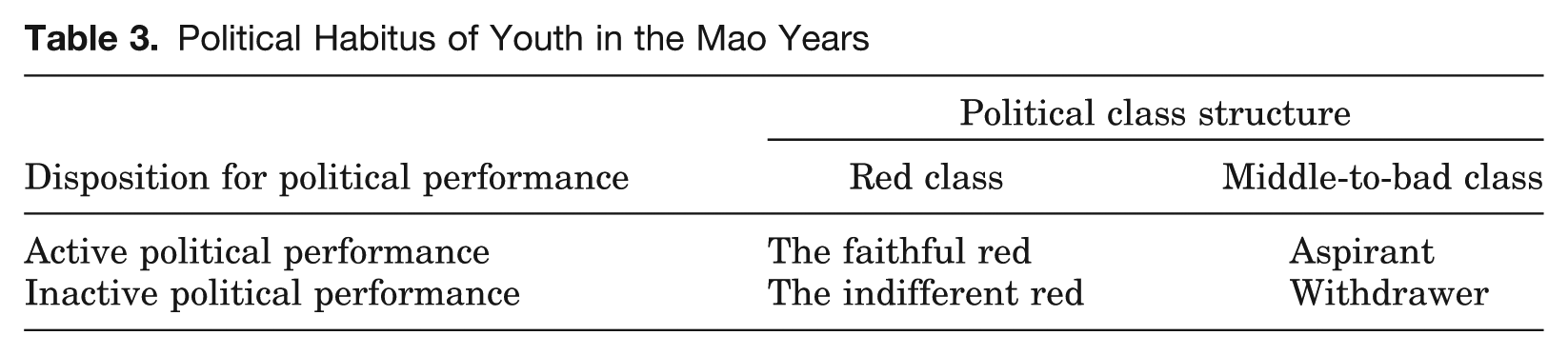
As a structured structure (Bourdieu 1984:170), the habitus of the zhiqing internalized this duality, through their political performance—their constant interactions with the political class structure. Each political habitus is measured by its two components. Disposition of actions describes one’s propensity for active political actions and aspiration in political participation, including holding institutionally sanctioned political positions, taking part in all kinds of political campaigns (especially the Cultural Revolution), everyday political performance, attempting to obtain Party or Youth League membership, and so on (Chan 1985; Shirk 1982). Schema of political perception is subjective adherence to the official ideologies related to or not related to the send-down program. In every specific class position, they may choose to have active or inactive political performance. Defiance was not an option. Their differential responses led to four types of political habitus (Table 3).
Political Habitus of Youth in the Mao Years
The Faithful Red
The good-chushen youths had a natural affinity with the political regime, and many developed adherence to the official ideology and disposition for active political performance. For example, Mr. Qian, from a working-class family, declined a factory job in Shanghai. He cut his finger and wrote an application essay in his blood to go to Heilongjiang, as a way to show his revolutionary passion. He articulated the formation of his habitus: “We were educated by Mao Zedong’s thoughts, heroism, and patriotism, so deeply that these things permeate our blood and bones” (Qian interview 05/18/17).
The Indifferent Red
Nevertheless, just as owners of higher economic capital have the privilege of being indifferent to material necessity—as Bourdieu (1984) famously suggests—some red-chushen youth enjoyed the luxury of being uninterested in politics, since they were protected by their chushen from political discriminations and did not have to worry about politics. For some working-class youths, such political indifference might also result from their primary concerns with their livelihood. For example, Mrs. Wang was occupied with her heavy housework and completely uninterested in political activities (Wang interview 10/29/13). Mr. Song voluntarily went to Heilongjiang largely because he was interested in the Corps’ stable wages, with which he could help reduce his family’s financial burden (Song interview 05/15/17).
Aspirant
Many middle- and bad-class youth had a strong sense of political insecurity and attempted to prove that they were also revolutionary despite their non-red chushen (Yang 2016:99). Mr. Ming, for example, with a capitalist chushen, developed an aspiration to demonstrate his revolutionary character by outperforming his peers, often in a desperate way. He promptly signed up to go to Inner Mongolia when his classmates were still hesitating, because “I had youthful enthusiasm, feared nothing, was more than ready to sacrifice my life for the country if the country needed me” (Ming interview 11/09/13).
Withdrawer
Other middle- to bad-chushen zhiqing chose to withdraw from political activities, mostly because of repeated denial of political opportunities, humiliation due to their chushen, and fear of getting into political trouble.
Class, Habitus, and Historical Evaluations
With this typology of habitus, I added one more dimension to the replications in the sequential interviewing and conducted more replications along both class positions in the present and habitus formed in the past. The interviews show a clear pattern of correlation between the zhiqing’s habitus and their historical evaluations and demonstrate the working of two underlying mechanisms that link the two.
First, there is a realist mechanism of experience and memory. The zhiqing with different habitus had dramatically different experiences before and during their sent-down years, for example, experiencing persecutions in the Cultural Revolution or not, viewing sent-down as a revolutionary pilgrimage or as a reluctant exile. Their differential experiences served as the foundations for today’s autobiographical memories. This mechanism shows the realist limitations to the malleability of memory.
Second, their political habitus remains robust today (n = 59, or 67.8%, had no significant habitus change, albeit less discernible in their daily life) and shapes their historical evaluations of the events they experienced in their youth.
Third, some zhiqing’s political habitus did change over their life courses (n = 28, or 32.2%), and consequently, their habitus today differs from that in their formative years and reconstructs and reshapes their memory. This mechanism demonstrates the classic constructivism of memory: individuals’ present views shape and reconstruct their memories of past experience.
Let me use specific life stories to illustrate those processes. I present mainly those with upper- or upper-middle-class positions to hold constant the factor of today’s class positions and highlight the mechanisms related to habitus.
The Faithful Red
A typical faithful red youth from an official’s family, Mr. Zeng now tells a double-ascending story (Zeng interview 06/03/14). He attributes his career success—a Party propaganda official—to his experience of surviving harsh living conditions and backbreaking field labor in his sent-down years. This personal ascending story serves as a footnote for his grand narrative, which highlights “great historical contributions” of the send-down program, such as providing impoverished areas with teachers. To connect the two parts of his memory, Zeng claims that the zhiqing shouldered glorious responsibilities and contributed their best years to the development of rural areas and frontiers.
Zeng’s double-ascending story results from both his experience in the past and his durable faithful-red habitus. An enthusiastic student activist during the Cultural Revolution, he organized a conservative Red Guard group and got involved in violent conflicts in which he was beaten and once was stabbed in his buttocks and sent to an emergency room immediately. In 1968, Zeng declined a factory job, cut his finger, and wrote an application essay in his blood to go to the Heilongjiang Corps. Zeng’s faithful red habitus drove him to go on the trip as a glorious mission. His present class positions and his job as a Party propaganda official reinforce this faithful red habitus and make it remarkably robust and even anachronistic—he is one of the diehards who openly express their admiration for Mao.
The Indifferent Red
Mr. Cui, with impeccably red chushen, is now the head of a Cultural Department in a city government in Heilongjiang, a reputable position with a comfortable living. When the Cultural Revolution started, he was briefly enthusiastic but soon lost interest and spent much time making and playing musical instruments. Because of his musical talent, only three months after his arrival in his farm, he was selected to enter the farm’s propaganda team and left field labor for good. He has experienced few physical difficulties due to his shorter stay in the countryside and experiencing no political persecution thanks to his red chushen. Thus, he has the luxury of being apolitical and taking his chushen for granted: “Since I didn’t have chengfen [chushen] problem, I didn’t even feel it.” With this indifferent-red habitus and smooth career, he tells a single-ascending story with a focus on his personal experience and successful career with only passing, neutral comments on the program, only when asked (Cui interview 10/17/13).
Aspirants
For Ding, whose father was convicted of being a counter-revolutionary element and sentenced to nine years in prison, being apolitical was impossible. Despite or because of his bad class background, Ding was an academically stellar and politically progressive student with a sincere belief in the spirit of Lei Feng and other Communist heroes. In 1964, he voluntarily signed up for Xinjiang, out of his belief that youths should contribute to the development of the frontier and his desire to prove that he was as revolutionary as his red-chushen peers. Before retirement, Ding was the vice editor-in-chief of a provincial-level state media, a vice-ting rank, rare among the zhiqing. Besides a personal ascending story, he has a grand narrative of national development, which closely follows the official ideology: “the zhiqing are the pioneers of the state’s frontier and border reclamation and defense” (Ding interview 11/11/13).
Ding was one of the luckiest bad-chushen zhiqing whose loyalty and effort was decently rewarded by the state. The pain brought by his class background had fewer substantive impacts on his career. This positive experience formed the foundation of his memory. Moreover, with a career path of a Party propaganda news official, his “aspirant” habitus remains robust even today without significant changes and continues to function as a schema of interpretation to shape his autobiographical memory.
Withdrawers
Mr. Yuan, now a full professor at a prestigious university, confirms the benefits of the difficult years in the countryside for his later successful career. All these benefits, however, he stressed, came at an exorbitant price: “The send-down program was definitely a waste. If someone still says the program was good, okay, an easy way [to test it] is that you send your children to the countryside. . . . Let me put in this way: if someone was simple-minded enough, [back then] he would have thought of killing himself” (Yuan interview 09/25/13).
Yuan’s typical narrative of “success despite suffering” with a negative historical evaluation can be explained by his withdrawer habitus. During the Cultural Revolution, because of his father’s historical problems, their home was raided several times and he was humiliated at school. To avoid trouble, Yuan stayed home and occupied himself with reading. This experience forged Yuan’s indifference to politics, introverted personality, and sensitivity to the bleakness of life. Unlike in the cases of “red indifference,” there was much pain underneath his forced timid solitude. His withdrawer habitus remains strong even today, largely because of his career as a professor, which is conducive to critical thinking and a cautious distance from politics.
In sum, in the cases where there was no significant change in habitus, those with faithful red and aspirant habitus tend to have more positive evaluations of the program than those with indifferent red and withdrawer habitus.
Habitus Change
At some points of the zhiqing’s life courses, which were also the moments of political transformations in China, the zhiqing’s political habitus dramatically changed through, as Bourdieu suggested, self-analysis or awakening experience (Bourdieu and Wacquant 1992:133), for example, after the Lin Biao incident in 1971 when many became disillusioned with the state propaganda and personality cult; right after the Cultural Revolution, the zhiqing joined the rest of the country to reflect on the political system and ideology in the Mao years. Habitus change also happened at “normal times” as a response to the loss of opportunities for mobility and as an attribution process in which one explains personal issues by the problems in the political system: one’s superb political performance met with chushen-based discriminations; one witnessed corruption and other misconducts of officials; and, as the ideological adherence gradually faded, one’s pragmatic concerns with life and career took priority. Consistent with overall societal changes, all the habitus changes led toward a declining faith in the official ideology and negative evaluation of the send-down program.
The habitus changes were most dramatic among aspirants (18 of 27 changed). The aspirants’ political adherence and active political performance were a reaction to the humiliation and discriminations imposed by the political class system. Their pain did not disappear but was suppressed. They were so invested in the belief that “you can’t choose your chushen but you can choose your road” that, once their “road” was blocked, they were deeply frustrated and could begin to question the whole system. In fact, due to the unequal distributions of opportunities along the political class line, most aspirants were not rewarded as duly as Ding. Frustration was the norm, and unshakable belief an exception.
For example, a typical aspirant in his formative years, Ming “hoped the Communist Party could embrace children with bad chushen like me,” but he was repeatedly denied accesses to various opportunities. After the Cultural Revolution, he was assigned a job in a local force task team to investigate the people purged in the 1957 Anti-Rightist Campaign. That was his moment of political awakening. He learned stories of the rightists’ miseries, which revoked his painful memory of his own family tragedies caused by their bad chushen. Infuriated and disillusioned, Ming quit the job and moved to Hong Kong, where he joined his mother and eventually became a private entrepreneur. Despite his ascending personal story, his evaluation of the program is unambiguously negative.
My interviews with the zhiqing with other present class positions also corroborate the findings presented above but demonstrate some interesting variations. For example, among those with lower- and working-class positions, the faithful red tend to tell life stories with the “nostalgia” pattern: a clear awareness of their present difficulties but an interpretation of difficulties as their “contributions” to and “sacrifice” for the country, which, however, have not been recognized by the state or the society. The blame is on the reformist government rather than Mao. They were the majority of “grassroots Maoists.” This finding corroborates Lee’s study of Mao nostalgia among laid-off workers in the 1990s, many of who were zhiqing (Lee 2000). The darkest memories came from the aspirants who skidded down to class positions much lower than their expectations or their parents’ and changed their habitus; they were doubly disadvantaged, in both class systems before and after 1978. They tell stories with the “tragedy” narrative pattern, expressing regret, resentment, and even outright challenge to the Party-state’s legitimacy.
Statistical Tests of the Findings
I draw hypotheses from the qualitative analysis and test them in a data file that includes thematic codes of narratives, class positions, and habitus, which are based on the operationalizations presented earlier, and basic information of the interviewees (see Table 1 for descriptive statistics).
Class Positions Today and Personal Experience
The main qualitative finding about the personal experience component of these autobiographical memories is stated as the following hypotheses:
Hypothesis 1-1: the higher the zhiqing’s present class positions, the more likely they hold a positive view of their personal experience in their sent-down years and its impacts on later life.
Hypothesis 1-2: the variation of the zhiqing’s political habitus does not correlate with the variation in the personal experience component of their autobiographical memory.
Both hypotheses are tested in several logistic regressions, which are to ascertain the effects of present class positions and habitus on the likelihood that the interviewee has a positive view of his or her personal sent-down experience, controlling for three relevant variables (type of sent-down place, years outside hometown, and sex) (Table 4). 5
Logistic Regressions of Personal Experience on Class and Related Variables

Note: Coefficients are odds ratios. Omitted categories are working and lower classes (in categorical class), withdrawer (in habitus), and corps (in sent-down place). Habitus change is a dummy variable (change = 1, no change = 0); sex is a dummy variable (male = 1, female = 0). “Years outside hometown” and “class (continuous)” are continuous variables.
P < .05. **P < .005.
The results summarized in Table 4 support the hypotheses. Today’s class position as continuous and categorical variables is statistically significant in all the models. In Model 1 (class as a continuous variable), a 1-point increase on the 10-point class scale is associated with the odds of having a positive view of personal experience increasing by 1.368. In Model 3 (class as a continuous variable), in which habitus variables are added, this number is 1.808. Models 2 and 4 (class as a categorical variable) show a similar pattern. In Model 2, other things being equal, those with middle- to upper-class positions in the present are 3.019 times more likely to hold a positive view of their personal experience in their sent-down years. In Model 4 this number is 3.832. In Models 3 and 4, political habitus and habitus change are not statistically significant; this supports Hypothesis 1-2.
Political Habitus and Historical Evaluation
Four hypotheses can be formulated from the qualitative findings to explain the historical evaluation part of the generational memory:
Hypothesis 2-1: the zhiqing with habitus of withdrawer and aspirant (based on black to middle chushen) now have more negative evaluations of the send-down program than those with red-chushen-based habitus.
Hypothesis 2-2: today’s class positions of the zhiqing have no impacts on their evaluations of the send-down program.
Hypothesis 2-3: the zhiqing’s habitus change leads toward a negative view of the send-down program.
Hypothesis 2-4: the aspirants whose habitus remain unchanged tend to have positive evaluations of the send-down program.
To test those hypotheses, I perform ordinal regressions to ascertain the effects of chushen, habitus, habitus change, and current social class (independent variables) on the likelihood that the interviewee has a positive historical evaluation of the send-down program (dependent variable with five categories: positive, positive with ambiguity, neutral, negative with ambiguity, and negative). The results support the hypotheses (Table 5).
Ordinal Regressions of Historical Evaluation on Habitus and Related Factors
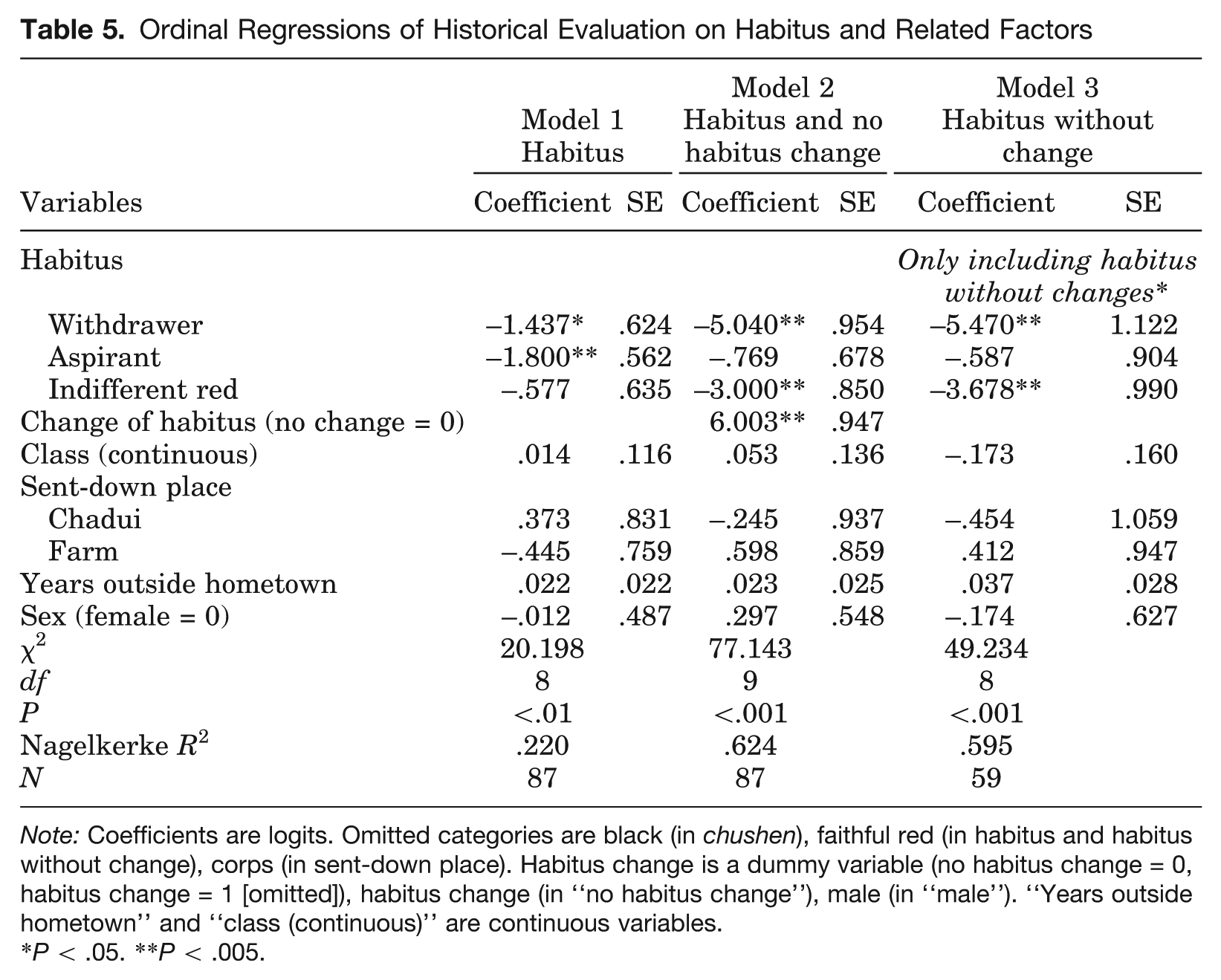
Note: Coefficients are logits. Omitted categories are black (in chushen), faithful red (in habitus and habitus without change), corps (in sent-down place). Habitus change is a dummy variable (no habitus change = 0, habitus change = 1 [omitted]), habitus change (in “no habitus change”), male (in “male”). “Years outside hometown” and “class (continuous)” are continuous variables.
P < .05. **P < .005.
Political habitus shapes historical evaluations of the program. Model 1 shows that the ordered logit for withdrawers having a positive historical evaluation of the send-down program is 1.437 less than a faithful red zhiqing, the “reddest” habitus; for aspirants, it is 1.800 less. The same pattern appears in Models 2 and 3. All these findings support Hypothesis 2-1.
Habitus change has a negative impact on historical evaluations. In Model 2, those without habitus changes are more likely than those with habitus change (omitted category) to have positive historical evaluations. This supports Hypothesis 2-3. Also, in Model 2, the statistical significance of the aspirant habitus, which exists in Model 1, disappears, while the withdrawers’ association with the negative view remains strong. This means that aspirants without habitus change shared with the faithful red adherence toward the official ideology in the Mao years and were more likely to have positive evaluations of the program, a result that supports Hypothesis 2-4. This is further supported by Model 3, in which I retain only the cases without much habitus change (n = 59): the aspirants do not differ from the faithful red significantly (no significance), while withdrawers and the indifferent red are still less likely to have a positive view of the program.
Class positions in the present (continuous variable) have no statistically significant relationships with historical evaluations. This supports Hypothesis 2-2.
There are some additional findings in the results of the statistical analysis. First, gender, a control variable, has statistical significance in the “personal experience” models: men are more likely to have more positive views about their personal experience in the countryside than are women. This might have to do with women having lower present class positions (5.750 in continuous class) than men (6.825) (t = −2.334, p = .022). But the significance does not exist in the models on historical evaluations. This suggests that the significance of gender relies on present class positions: when present class positions are statistically insignificant, gender also loses its significance. In the qualitative interviews, I do see nuances of gender difference in life narratives, combined with class. For example, when women talked about ups and downs in their lives, they tended to weave family and marriage into a story revolving around class positions: they started with a story about their abusive husbands or family problems, together with their complaints about the unsatisfying living conditions today.
Second, the two components of autobiographical memories (personal experience and historical evaluation) are not statistically correlated (χ2 = 5.955, df = 4, p = .203, not in the regression models). This further confirms the findings of the qualitative interviews that the two components do not vary in the same direction.
Conclusions and Discussions
Drawing on a Bourdieu-Mannheim theoretical framework, my qualitative and quantitative analyses have shown a significant intragenerational variation in the zhiqing generation’s autobiographical memories. The variation is along class lines, including “class in the present” and “class in the past.” Respondents’ present class positions play a decisive role in shaping their retrospective views of personal experience during and after the sent-down years. Their class in the past, including their chushen in the Mao years and their corresponding habitus, a key class concept of Bourdieu, shape their historical evaluations of the program. Their habitus may also change as a response to the dramatic social and political transformations in China from the Mao years to the reform period and lead toward more negative historical evaluations. All these processes constitute a colorful mosaic of autobiographical memories and show how this important generation’s personal biography has been entangled with historical processes.
With this empirical case, I attempt to address two gaps in the existing literature on generation and memory. First, I have shown the meaning-making processes in autobiographical memories, in which members of a generation make sense of their personal experience in light of the historical event that has significantly shaped their life courses. This finding goes beyond the cognitive conception of memory in the dominant approach to generational memory. Second, whereas the dominant approach focuses on intergenerational differences in memory, I have described and explained intragenerational differences in autobiographical memory as a way to fully realize the potential of Mannheim’s “generation unit” concept. This move does not mean to nullify intergenerational differences. Rather, inter- and intragenerational differences are two sides of the same coin: different intersections between biography and history. An analogy can further illustrate this point. Imagine the send-down program—or any significant historical event—as a huge tidal wave. Some people who happened to be caught in the wave were submerged, while others were tossed to beaches. Some lucky ones may have been able to ride the wave. When the wave passed, they ended up in different locations and had different stories to tell about the wave and themselves. A careful observer not only formulates a general idea about the people in this tidal wave (this “generation”) vis-à-vis those in the last wave but also listens to how the people in different locations talk about their fate in the huge wave. Only when we examine how people react to their collective fate differently can we fully understand the inextricable relations between generation and history in people’s inner lives.
In explaining the intragenerational differences in autobiographical memory, this article also brings “class” back into the sociology of memory. Although class is the theme of the longest chapter of Maurice Halbwachs’s classic The Social Frameworks for Memory (Halbwachs 1992), it then almost disappears. It is not in the index in several popular introductions to collective memory (Erll 2011; Misztal 2003; Olick et al. 2011). Even when class is sporadically studied, the focus is mostly on memory’s function in forging class identity in political activism and processes (Bauman 1982; Hobsbawm 1983; Lee 2000; Samuel 1981). The finding in this study reconnects to Halbwachs’s theoretical idea of class by emphasizing class as part of one’s “social framework” (Halbwachs’s term) for individual remembrance, a social category for autobiographical memory. The central role of class also makes much historical sense in this case. When the zhiqing recount their personal past, they follow the rules of winning and losing in today’s class system. When they evaluate the send-down program and relate events that happened in their formative years, they follow their habitus formed in the political class system in the past, unless such habitus has changed. The zhiqing’s generational memory is a result of their collective and personal effort to reconcile the two parts. The two are more often in conflict than harmony. Thus, this generation is indeed a generation between two eras, two class systems, and two political cultures.
This finding about class-based intragenerational differences of memory suggests a research agenda that sheds light on memories in other contexts. In the cases where “class” largely means the economic capital, the Bourdieusian theory of the class-habitus-memory link is even more comprehensible. For example, children from wealthy families are able to forget a major economic crisis because their families’ economic capital protects them from its detrimental impacts and because they develop a habitus of indifference to daily material needs. For children from lower-class or working-class families, forgetting an economic crisis that made their parents unemployed and their food scarce is an unaffordable luxury. This line of research is promising if we include other class-related factors in our future research, such as education and aesthetic tastes, and examine various configurations of capitals without losing sight of historical specificities.
This study certainly has several limitations, which may indicate some points for future research. First, for a quantitative study, the sample drawn from the interviews is a nonrandom sample. Ideally, for future research, some statements can be extracted and quantified from the qualitative interviews to be tested in a larger, random sample. Second, although Shanghai is an obvious choice of site due to its importance and its large zhiqing population, the findings still need to be tested in other major source cities. For example, in less developed cities like Chengdu, the zhiqing may or may not have less painful experiences due to the less marked rural-urban divide; and in Beijing, China’s political center now and then, where the youths’ coming-of-age experience could be more political, the political habitus might be a bigger factor than in Shanghai in the past and present. Third, the finding of a gender-class relation remains largely tentative, and the sample has a gender imbalance. It can be further examined and developed in more special, representative datasets. Future research can also explore other factors of social inequality and their intersections with generational memory, including gender, race, and ethnicity, some of which prior studies have started to examine (Griffin 2004).
Footnotes
Acknowledgements
The author thanks the following people for their helpful comments on early versions of this paper: Weihua An, Debbie Davis, Tom DeGloma, Tim Dowd, and Pengfei Zhao.
Funding
This work was supported by the Fund for the Advancement of the Discipline (2012) from American Sociological Association/National Science Foundation.
1
Some important works outside the sociology of memory also draw on Mannheim’s idea of generation units to examine the intersections between generational effects and political divisions and other factors (Jennings 1987, 2002;  ).
).
2
Psychological studies of autobiographical memory focus more on construction of self through personal life narratives (Berntsen and Rubin 2012; also see for a discussion of the disciplinary difference).
3
The reason for the dichotomous “positive-negative” code of personal experience component instead of a three-code set with a neutral view is more empirical than theoretical, because no interviewee does not care about his or her personal experience or does not stress one side of the dichotomy.
4
For each form of capital, I pay close attention to the historical specifics and inductively glean information from interviews and existing studies to determine the number assigned to one’s capital volume. For example, in measuring one’s cultural capital, unlike , I do not merge polytechnic or associate degrees (dazhuan) into “college” because polytechnic diplomas were relatively easier to obtain (such as through evening schools) than formal four-year college degrees. I also add noneducational cultural capital (engagement in cultural practices and a position in a cultural institution) because the generation under study generally suffered from a lack of formal education, and, thus, using only formal education may not be differential enough. Moreover, the class positions here are “relational class positions”—not their positions in the national population but their comparisons with other zhiqing, because, as my interviews show, what matters in their autobiographical memories is their social comparison: “I’m better off than other zhiqing/my fellow zhiqing in the same farm.”
5
“Type of sent-down place” was measured because some places like the Heilongjiang Corps required better chushen and gave the zhiqing more opportunities for upward mobility. “Years outside of hometown” was measured because prior studies show that the longer one stayed in the sent-down place, the lower one’s class position is ().