



Abstract
Identity theory (IT) and social identity theory (SIT) are eminent research programs from sociology and psychology, respectively. We test collective identity as a point of convergence between the two programs. Collective identity is a subtheory of SIT that pertains to activist identification. Collective identity maps closely onto identity theory’s group/social identity, which refers to identification with socially situated identity categories. We propose conceptualizing collective identity as a type of group/social identity, integrating activist collectives into the identity theory model. We test this conceptualization by applying identity theory hypotheses to the “vegan” identity, which is both a social category and part of an active social movement. Data come from comments on two viral YouTube videos about veganism. One video negates prevailing meanings of the vegan identity. A response video brings shared vegan identity meanings back into focus. Identity theory predicts that nonverifying identity feedback elicits negative emotion and active behavioral response, while identity verification elicits positive emotion and an attenuated behavioral response. We test these tenets using sentiment analysis and word counts for comments across the two videos. Results show support for identity theory hypotheses as applied to a collective social identity. We supplement results with qualitative analysis of video comments. The findings position collective identity as a bridge between IT and SIT, demonstrate innovative digital methods, and provide theoretical scaffolding for mobilization research in light of emergent technologies and diverse modes of activist participation.
Keywords
Identities are multifaceted and entail individual, interpersonal, and social processes embedded within social structures. Social psychologists from both sociology and psychology have developed robust theories of identity and related research programs. Two central research programs are identity theory (IT, sociology) and social identity theory (SIT, psychology). Identity theory explicates how individuals organize identity meanings, enact them in social situations, and respond to identity-relevant feedback (Burke and Stets 2009; McCall and Simmons 1966; Stets and Serpe 2013; Stryker and Burke 2000). Social identity theory is concerned with identity processes through inter- and intragroup dynamics (Abrams and Hogg 2004, 2006; Hogg 2018; Hogg and Ridgeway 2003; Turner et al. 1987). Forging ties between identity theory and social identity theory is a key step in constructing a general theory of the self (Stets and Burke 2000). We propose a concrete linkage between the two research programs by synthesizing activist collective identity, as theorized by SIT, with group/social identity, as theorized by IT.
Social identity theory encompasses multiple subtheories. One subtheory is collective identity, which focuses on identity as it relates to social movements (Brewer 2001; Polletta and Jasper 2001). Key works from both sociology and psychology point to collective identity as a potential bridge between identity theory and social identity theory, but one that has not yet been fully realized (Burke and Stryker 2016; Miller, Taylor, and Rupp 2016; Stets and Serpe 2013; Stryker, Owens, and White 2000; White 2010). Identity theory situates identities into three overlapping bases: person, role, and group/social (Burke and Stets 2009; Stets 2018; Stets and Serpe 2013). The key aim of this paper is to solidify the connection between IT and SIT through conceptual integration of collective identity into the group/social identity base. To this end, we position collective identity as a type of group/social identity that pertains to activist identification. We represent this conceptual integration as collective group/social identity and test its viability using computational tools and digital data sources. The project is both theoretically fruitful and brings clarity to the processes and dynamics of contemporary mobilization.
We apply the identity theory model to the collective identity of veganism, testing IT hypotheses as they would predict group/social identity outcomes. Data come from two viral YouTube videos about veganism 1 . Veganism is both an individual lifestyle and a collective identity category tied to social movements about food and consumption practices (Cherry 2015; Greenebaum 2012; Haenfler, Johnson, and Jones 2012; Ophélie 2016). One video portrays content that diverges from standard vegan identity meanings, and the second video is a response by a prominent vegan activist. We analyze the comments on each video to determine the emotional valence and behavioral response of vegan commenters. Based on the identity theory feedback model, we predict that vegans’ comments following the initial nonverifying video will have a more negative emotional valence and higher word counts than comments on the response video, which brings supportive identity meanings back into focus. We complement hypothesis testing with qualitative analysis, painting a picture of collective group/social identity processes in action.
If our hypotheses are supported, it will provide preliminary evidence that collective identity operates with and through group/social identity, solidifying ties between IT and SIT. The qualitative portion of our research attends to the performative and responsive element of identity in interaction, evoking classic works on the subject and highlighting their continued relevance (McCall and Simmons 1966). The use of social media data brings new methods to bear on IT and SIT research, expanding the research programs’ methodological repertoires and moving away from self-report measures (Burke and Stryker 2016). Crossing disciplinary lines, our case study and theoretical modeling place social psychology in direct conversation with a vibrant field of research at the intersection of mobilization and digital technologies (Boulianne 2015; Earl and Kimport 2011; Jasper and Polletta 2018; Rohlinger and Bunnage 2018; Tufekci 2017).
Theory
Identity Theory
From an identity theory (IT) perspective, identities are internalized meanings attached to the self as a unique person, an occupant of a role, and/or as a member of a group (Burke and Stets 2009; Stets and Burke 2014a; Stets and Serpe 2013). Person, role, and group/social constitute three bases of identity. Group and social represent two parts of the same base, broadly conceived as categorical membership. While group identity refers to membership in a community of specific others (e.g., family, school, political organization), social identity refers to status categories that denote one’s position within the broader social structure (e.g., race, gender, age). Because of their imbrication, group and social are presented as a single unit (i.e., group/social; Stets 2018). The three bases of identity overlap and inform each other such that individuals enact role and group/social identities in ways that correspond with each other and are guided through person identity meanings. Identities are organized into hierarchies of prominence, and persons are apt to enact more prominent identities when the situation allows (Brenner, Serpe, and Stryker 2014; Owens, Robinson, and Smith-Lovin 2010).
Once an identity is relevant within a situation, verification processes activate. Individuals seek to verify identity meanings through interaction. The identity verification process has four main components that operate in a cybernetic feedback loop (Burke 1991): the identity standard, perceptual inputs, a comparator, and behavioral outputs (Burke and Stets 2009). The identity standard is the set of meanings attached to an identity. Individuals generally perform in ways that support the identity standard and interpret feedback on their performance using cues from the interaction setting (perceptual inputs), including reflected appraisals. Reflected appraisals are a person’s perception of how others view the self within a situation. The comparator contrasts reflected appraisals against the identity standard. When reflected appraisals align with the identity standard, identity verification is achieved. When there is significant distance between reflected appraisals and the identity standard, persons experience nonverification. Identity verification elicits positive emotion. Identity nonverification elicits distress. The emotional effects of nonverification motivate behavioral outputs to bring situational meanings more closely in line with the identity standard (Stets 2006; Stets and Burke 2014b; Stets and Trettevik 2014).
The identity feedback loop has been tested and applied across person, role, and group/social identities (Stets and Burke 2014a). Identity theory has thus addressed the ways individuals perform and manage themselves as unique persons, role occupants, and group/social category members. We test the identity theory model on a case of collective identity, forging ties between IT and SIT.
Collective Identity in the Identity Theory Model
Collective identity is a subtheory that operates under the larger umbrella of SIT (Brewer 2001). SIT is a metatheory that addresses inter- and intragroup relations with attention to stereotyping, conflict, conformity, cohesion, leadership, and organizational behavior (Abrams and Hogg 1988, 2004, 2006; Hogg 2018; Turner and Oakes 1986). Rooted in social movement studies, collective identity is the set of identity meanings established and shared by activist collectives (Gamson 1992; Mattoni 2016; Polletta and Jasper 2001; Taylor et al. 1992).
Calls for theoretical and empirical synthesis point out that both identity theory and collective identity theory recognize social structures, social situations, and social networks as integral to identity processes (Stets and Serpe 2013; White 2010). Identity theory posits that identities are made salient and prominent through commitment to networks and relationships (Brenner et al. 2014; Owens et al. 2010; Serpe and Stryker 2011). In turn, collective identity centralizes group cohesion, emotional attachment, and solidarity as critical to activist identity formation and maintenance (Polletta and Jasper 2001) even when networks are heterogeneous, loosely connected, and dispersed (Brewer and Silver 2000; Melucci 1988, 1995). In this vein, social movements have been shown to play a powerful role in identity verification, providing “self-verifying opportunity structures” through participation and network formation (Miller et al. 2016; Pinel and Swann 2000). Similarly, identity and related emotional attachments can be a motivating force for social movement participation, driving individuals to contribute to collectivities (Melucci 1995; Simpson and Macy 2004; Stryker, Owens, and White 2000; White 2010). Connections between IT and collective identity are “ripe for empirical testing” (Stets and Serpe 2013:53). Our project integrates collective identity into the IT model with a preliminary test of IT hypotheses on the collective identity of veganism.
Convergences between collective identity and IT are especially clear in the overlaps between collective identity and group/social identity. Group identity pertains to membership in a network of specific others, social identity pertains to identification with others who share general status markers (Stets 2018; Stets and Serpe 2013), and collective identity pertains to identification with a social movement (Polletta and Jasper 2001). Both collective identity and group/social identity address identity processes as they relate to a larger categorical label. Collective identity is simply the special case in which that larger categorical label is derived from a social movement. We thus reframe collective identity as a type of group/social identity that applies to instances of activist-based identification.
Activist collectives can take multiple forms. They may have clear boundaries and tightly knit network connections, such as the local chapter of an activist organization (e.g., NAACP, Green Peace, National Organization for Women). Alternatively, activist collectives may be represented by dispersed individuals who share an agenda and identity label with little or no direct contact or organizational affiliation (Jasper and Polletta 2018; e.g., anti-racist, environmentalist, feminist). These “thick” and “thin” collective identity networks (Rohlinger and Bunnage 2018) map neatly onto group/social identity from IT. Group identity applies to membership in activist organizations, while social identity applies to broader movement affiliations. We thus propose collective group/social identity as a synthesizing concept.
Collective group identity refers to membership in activist organizations. Collective social identity refers to activism associated with general status markers untied from specific networks. For example, a university vegan club creates networks that form collective group identity among its membership. The club is a formal organization that embeds its members within a specific network of mobilization. Collective social identity applies to veganism as a lifestyle movement enacted by individuals. Collective group and social identities are neither mutually exclusive nor synonymous. For instance, an individual may be part of a vegan organization and define the self through relationships with other members (group identity), and also enact veganism through personal consumption practices and activist participation outside of organizational contexts (social identity).
Collective group/social identity is defined through its connection to activism and social movements and by the terms of identity verification as theorized by the IT model. Verification of group/social identity meanings relies on perceived support for identity performances (Stets and Serpe 2013). Verifying collective group identity entails ingroup and outgroup acceptance of organizational identity meanings (i.e., “Do others in the group accept me as a member?”; “Do others in society perceive me as a legitimate member of this group?”). Verifying collective social identity entails ingroup and outgroup acceptance of identity meanings associated with the activist status marker (i.e., “Do other activists define the label the same way I do?”; “Do others in society define our collective identity the same way we do?”).
The data from our study—comments on two YouTube videos about veganism—most closely represent a case of collective social identity. Vegans commenting on these videos are responding to feedback about the vegan identity label rather than navigating organizational dynamics. 2 The first video presents an extrinsic threat to collective vegan identity meanings, and the response video offers identity-verifying feedback from a fellow self-identified vegan. If the collective social identity of veganism operates in the ways predicted by the IT feedback loop, it will be evidence that collective identity can function as part of the IT model, integrated through group/social identity.
Conceptualizing collective identity as a type of group/social identity expands the scope and explanatory power of both IT and SIT. Social identity theory has focused on collective identity as a “we-ness” that emerges among activist collectives (Simon and Klandermans 2001). This emergent sense of “we” can be explicated using the processes laid out in the identity theory research program (Stets and Serpe 2013). At the same time, conceptual integration with collective identity strengthens the structural element of IT, building on recent advances that show identity processes operating through micro, meso, and macro social structures (Merolla et al. 2012; Stryker, Serpe, and Hunt 2005).
This theoretical synthesis has meaningful implications for mobilization studies. In particular, collective group/social identity offers a theoretical scaffold for understanding the complex dynamics between activist labels, activist organizations, individual activists, and mobilization behaviors. Grappling with this complexity in a systematic way is increasingly challenging given contemporary shifts in mobilization practice (Jasper and Polletta 2018). With the rise of digital technologies, “activism” and “activists” take a multitude of forms. Local organizations continue to persist, but they do so alongside distributed networks online. Some online networks have clearly defined boundaries and sustained network relationships, while others are loosely defined and fleeting (Rohlinger and Bunnage 2018); participation may entail picketing in the street, signing an online petition, sharing a status update, raising funds, creating and sharing content, and/or commenting on what others have shared (Earl and Kimport 2011; Tufekci 2017); activism may be highly orchestrated or impulsive. A firm theoretical grounding that attends to the interplay of individuals and social structures through processes of identity will help social movement scholars clarify how activism takes shape, for whom, and to what effect.
Hypotheses
We integrate collective identity into identity theory (IT) using data from the comments following two viral YouTube videos. Both videos target the vegan identity. We chose a vegan identity because it is part of an active social movement (Wrenn 2011, 2012), has a shared set of standard identity meanings and practices (Cherry 2006, 2015), maintains an active community of vegans online (Lupton 2019), and is the subject of public contestation (Cole 2015). These characteristics create opportunities to observe (non)verifying interactions for an activist collective. In addition, veganism is a “lifestyle movement,” which means activist identity and behavior can be incorporated into practices of daily life without the requisite of organizational affiliation (Wrenn 2012). As it is enacted in the comments section of YouTube, where individual commenters can participate without sustained relationships to other activists, vegan activism presents a case study in collective social identity.
Veganism is more than a personal lifestyle; it is also an active social movement. For this reason, vegan identity sits within the collective identity purview. In its broadest sense, veganism refers to the nonconsumption of animal products. In almost all cases, this pertains to food practices but may also refer to other consumables (e.g., toiletries, textiles, beauty products, furniture). Veganism may additionally extend to a general “cruelty free” ethic and opposition to enactments of violence. Veganism and vegans take diverse forms (Greenebaum 2012; Harper 2010). However, analyses of vegan narratives show common threads. Both health and ethics regularly feature in vegan identity narratives (Cherry 2015; McDonald 2000), as do discourses about “nature” (Adams 2000). Integrating the language of identity theory and social identity theory (SIT), we can think of shared meanings around nature, health, and ethics as part of the collective social identity standard. We are interested in how vegans respond to feedback that variously diverges from and converges with the collective social identity standard (i.e., nonverifying and verifying reflected appraisals of the vegan identity).
Our data come from two YouTube videos in which the vegan identity is central and key claims about nature, health, and ethics are subjected to debate. The first video, produced by the popular YouTube channel WatchMojo, is titled “5 Facts About Veganism” (5 Facts). 5 Facts claims that meat eating is tied to evolution, questions the health benefits of veganism, and leaves ethics conspicuously absent. The second video is presented by a prominent vegan activist on her Bite Size Vegan (BSV) channel and is a direct response to 5 Facts. The response video affirms veganism as natural, healthy, and ethical (BSV response). 3 As we explicate further in the Methods section, we selected these videos because they meet the tenets of IT as applied to collective identity, thus allowing for hypothesis testing.
We treat 5 Facts as an instance of collective social identity nonverification. IT posits that nonverification results in emotional distress (Stets and Burke 2014b). Using sentiment analysis to measure the emotional tenor of comments by vegans on 5 Facts, we predict that:
Hypothesis 1: The mean sentiment analysis score for the 5 Facts video comments will have a negative valence.
A mean sentiment score with a negative valence would indicate negative sentiment in response to collective identity nonverification, thus supporting a main tenet of IT as applied to collective social identity.
We treat BSV response as a situational input that brings reflected appraisals back in line with collective social identity meanings, moving closer to collective social identity verification. IT posits that identity verification elicits positive emotion (Stets 2006; Stets and Trettevik 2014). Analyzing vegans’ comments on BSV response, we predict that:
Hypothesis 2: The mean sentiment analysis score for BSV’s response video comments will be significantly more positive than the mean score for the 5 Facts video comments.
A significant difference in the positive direction would indicate a positive boost in response to collective social identity-verifying feedback. Note, we do not make a prediction about the absolute valence of the sentiment score on this video but instead, predict it will improve in relation to comments on 5 Facts. If the sentiment score for BSV response is significantly more positive/less negative than the score for 5 Facts, our second hypothesis will be supported.
In addition to testing the emotional effects of each video, we also measure and compare the mean word counts per comment. IT posits that nonverification elicits behavioral responses in which persons actively perform identity standard meanings. If 5 Facts represents collective social identity nonverification of the vegan identity, we would expect an active response from vegan commenters. Treating mean word counts per comment as an indicator of behavioral response, we predict that:
Hypothesis 3: Vegan commenters on the 5 Facts video will use more words per comment than vegan commenters on BSV’s response video.
A significant difference in word count in the expected direction would indicate active behavioral outputs following nonverification of a collective social identity, which becomes less active when standard identity meanings are reestablished through BSV response.
In sum, we treat 5 Facts as an instance of collective social identity nonverification and predict that the video will elicit negative emotion and active behavioral outputs from vegan commenters. We treat BSV response as identity-verifying feedback and predict that it will ameliorate negative emotion and attenuate behavioral outputs among vegan commenters. If our hypotheses are supported, it will be a systematic step toward integrating collective identity into IT, bridging individual and social processes of the self.
Methods
To test our hypotheses, we scraped and analyzed comments from WatchMojo’s 5 Facts and Emily Moran Barwick’s response video, posted on her Bite Size Vegan channel. We selected these videos because they instantiate conceptual properties of collective social identity and the conditions of identity verification processes. They also generate a sizeable data corpus due to substantial subscriber counts and the virality of these particular videos. 4 The direct conversation between the two videos and their opposing messages make them an ideal pairing for examination of all elements in the identity feedback loop.
Our use of these videos for theory testing follows a critical advance in digital methods, by which researchers generalize from social media and “big data” to theoretical propositions (Davis and Love 2019; Parigi, Santana, and Cook 2017). Theoretical generalization begins with a research question and clear theoretical parameters. Researchers then identify content that enables hypothesis testing (Davis and Love 2019). We selected these videos for their fit with the parameters of identity theory (IT) and the capacity to test IT hypotheses for a collective social identity.
Our analysis relies on two independent variables (collective social identity nonverification and collective social identity-verifying feedback) and two dependent variables (emotion and behavioral response). Collective social identity is defined as an identity category tied to social movement activism. Both videos address identity meanings about “veganism,” a lifestyle movement and social identity category. Identity verification processes initiate when persons experience identity-relevant feedback. The videos we selected provide identity-relevant feedback about veganism and elicited an active response in the form of video comments from persons identified as vegan. 5 Facts instantiates identity nonverification through claims about nature, health, and ethics that diverge from the vegan identity standard. BSV response instantiates identity-verifying feedback by negating the claims in 5 Facts and presenting counterclaims about nature, health, and ethics that coincide with the vegan identity standard. Comments provide data for sentiment analysis scores, which measure emotion, and mean word counts, which indicate behavioral outputs. Together, the videos allow us to test IT hypotheses about emotion and behavior as an outcome of verifying and nonverifying identity-relevant feedback for a collective social identity.
Videos
WatchMojo posted 5 Facts on February 15, 2016. At the time of data collection, the video had over 200,000 views and had amassed 8,891 comments and replies. 5 Facts runs for 5 minutes and 32 seconds. Importantly, the content does not have an obvious partisan agenda either for or against veganism but instead takes an impartial tone toward five data points related to veganism: (1) meat eating is tied to brain development and human evolution; (2) 6 percent of the U.S. population is vegan, the vast majority of whom are women; (3) veganism is highly effective for weight loss; (4) veganism has been linked to both increases and decreases in heart disease, depending on type of vegan diet; and (5) most people who attempt a vegan diet do not maintain it.
Although WatchMojo does not frame 5 Facts as an attack on veganism and the video maintains an innocuous tone, it does call into question central identity claims common in vegan activist communities—namely, that veganism is natural, healthy, and sustainable. Also, conspicuously absent from 5 Facts are claims about ethics, a fundamental element of vegan identity narratives (Cherry 2015). According to IT, reflected appraisals (how people perceive identity-relevant feedback) is the comparison point against the identity standard. It is thus irrelevant how WatchMojo actually perceives vegans/veganism. What matters for identity theory is how vegans interpret the video content. Based on viewer responses on YouTube and across vegan communities online in which the video was shared, 5 Facts elicited a swift and negative retort.
On February 22, 2016, the Bite Size Vegan channel aired a satirical response video. The response video is titled “WatchMojo Debunks the Vegan Diet!”. The video lasts 8 minutes and 14 seconds. At the time of data collection, BSV response had amassed 85,426 views and 1,043 comments and replies. The BSV response video is a parody tutorial that invites viewers to learn how to “craft lasting and effective propaganda” to “give veganism a kick in its collective gonads.” The video critiques 5 Facts for espousing non–research based claims, misconstruing empirical data, interspersing popular culture clips that mock veganism, propagating sexism, providing misleading health information, and ignoring the process of meat production and related ethics of consumption practices. The response video links to a series of studies that indicate a vegan diet was common among early humans, promotes the health benefits of a vegan diet, and displays imagery of animal production with reference to the cruel treatment of animals, juxtaposed against the ethics of a vegan lifestyle. BSV response thus undermines feedback from WatchMojo while reinforcing veganism as natural, healthy, and ethical.
Data Collection and Analysis
Data collection and analysis took place in three phases. First, we “scraped” viewer comments from the two videos of interest, identifying comments by vegans. Next, we conducted sentiment analysis and compared the mean word count scores. Finally, we engaged in interpretive qualitative coding of all retained comments on both videos.
Data scraping refers to the collection of content from a website or digital platform using automated tools. We scraped all available comments and replies from each of our two videos using the YouTube Comment API. Because we treat the videos as situational inputs, we are interested only in the direct comments and not the replies. That is, replies come in response to other comments rather than directly in response to the videos. We therefore removed replies from the data corpus. In addition, we are specifically interested in vegan responses to identity relevant feedback. We manually cleaned the data, retaining only those comments with one or more vegan identity markers. Markers include self-naming, disclosure of food practices, familiarity with prominent vegan figures, extensive knowledge of vegan nutrition, vegan-oriented user handles, self-inclusive language with reference to veganism (i.e., we, us, our), and reference to meat/dairy consumers as an outgroup. To err on the side of caution, we removed ambiguous cases in which vegan identity could not be determined with certainty. Three independent coders followed these criteria to categorize each commenter as vegan or not. The three coders had over 90 percent agreement with a Krippendorff’s alpha score of 0.93 (95 percent confidence interval of 0.83 to 1.00 after 10,000 bootstrap samples). In most cases, 0.80 is considered an acceptable level of reliability for Krippendorff’s alpha (see Compton, Love, and Sell 2012; Hayes and Krippendorff 2007). The cleaning process left us with 727 comments by vegans on 5 Facts and 184 comments by vegans on BSV response (see Table 1).
Total and Retained Comments by Video

We conducted sentiment analysis and mean word counts on the two cleaned data sets. Sentiment analysis draws on a dictionary of “emotion” words, called a sentiment lexicon, to determine trends in public sentiment toward some object (Hu and Liu 2004; Liu 2015). Sentiment scores for each comment are calculated by comparing the presence of positive emotion words (e.g., great, good, fun) against the presence of negative emotion words (e.g., bad, ugly, hate). Thus, comments displaying negative sentiments receive a negative value while comments displaying positive sentiments receive a positive value. Through sentiment analysis, we test IT hypotheses about the relationship between emotion and identity (non)verification for a collective social identity. We also calculated mean word counts per comment on each video to test our hypothesis about behavioral outputs following identity-relevant feedback. Existing measures of emotional and behavioral responses to (non)verification have been developed for face-to-face interaction (Burke and Stets 2009; Burke and Stryker 2016; McCall and Simmons 1966; Stets and Trettevik 2014). Sentiment analysis and mean word counts are novel approaches we adapted specifically for theory testing with digital, text-based data.
We supplement the quantitative findings by analyzing both video comment threads to discern how emotional and cognitive-behavioral responses take shape. Supplementing computational analyses with qualitative inquiry is a robust approach that captures broad trends and helps make sense of these trends with a more nuanced story (Davis and Love 2017b; Davis, Love, and Killen 2018; Love, Davis, and Calvert 2018; Love, Moloney, and Bunting 2018; Moloney and Love 2018). Drawing especially on McCall and Simmons (1966), our qualitative analysis explores how the identity standard is maintained. We thus use an abductive approach for our qualitative strategy, bringing a theoretical framework to bear on the data and utilizing the data to engage with the guiding theoretical perspective (Tavory and Timmermans 2014; Timmermans and Tavory 2012).
Findings
Sentiment Analysis
We set forth two hypotheses based on sentiment scores derived from comments on the two videos of interest. Table 2 shows sentiment scores for 5 Facts and BSV response. We treat 5 Facts as an instance of collective social identity nonverification and predict that vegans’ comments on the video will have an overall negative emotional valence. This prediction is based on identity theory’s feedback model in which nonverification elicits negative emotion (Burke and Stets 2009; Stets and Burke 2014b). We treat BSV response as a form of situational input that brings the collective social identity standard back into focus. We predict that the mean sentiment score for BSV response comments will be significantly more positive than the mean sentiment score for 5 Facts.
t Test Comparison of Mean Sentiment Score by Video
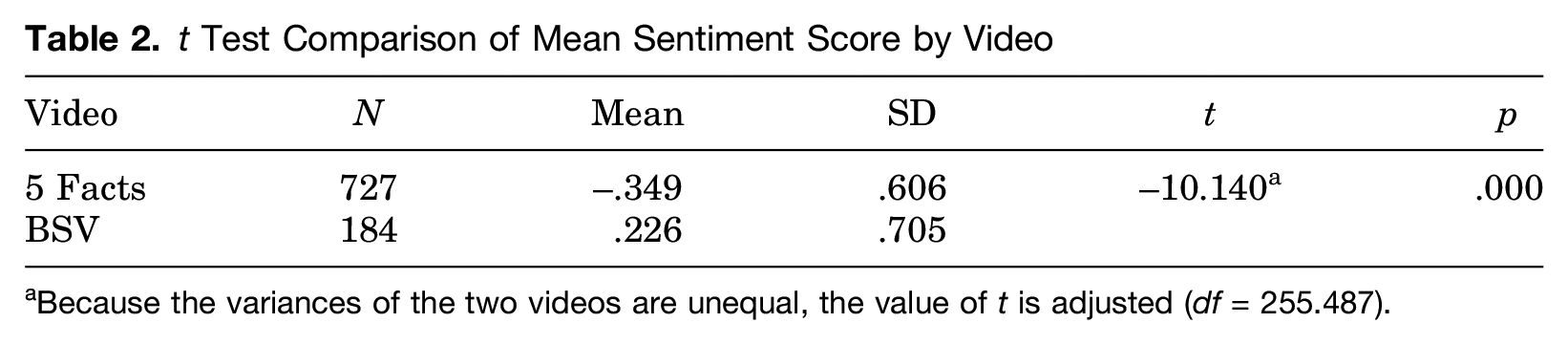
Because the variances of the two videos are unequal, the value of t is adjusted (df = 255.487).
Comments on 5 Facts show a negative mean sentiment score (–.349), indicating that overall, vegan-identified commenters expressed negative emotion to nonverifying feedback on a collective social identity. Our first hypothesis is supported. Our second prediction does not assume an overall positive or negative emotional valence but simply predicts that comments on BSV response will have a significantly more positive or less negative emotional valence relative to comments on 5 Facts. The mean sentiment score of the comments on BSV response is .226. The t test results show that this difference between the two comment sets is statistically significant and in the expected direction, thus supporting Hypothesis 2. Not only was this rather conservative hypothesis supported, the mean sentiment score of the comments on BSV was positive, indicating that the overall sentiment was indeed positive, whereas the reaction had been negative to 5 Facts. The movement of the sign from negative to positive indicates an especially strong effect of BSV response on identity verification.
Word Count
Our third hypothesis predicts that 5 Facts will elicit more active behavioral outputs than BSV response. Behavioral outputs aim to reduce the distance between the identity standard and reflected appraisals (Burke and Stets 2009). We expect more active behavioral outputs from vegan commenters following the nonverifiying 5 Facts video versus vegan comments on the verifying inputs of BSV response.
Table 3 shows that comments from vegans on 5 Facts contain significantly more words than comments from vegans on BSV response. This supports our third hypothesis and indicates that as predicted by identity theory (IT), collective social identity nonverification prompts active behavioral outputs, which diminish when identity meanings are supported.
t Test Comparison of Word Count by Video
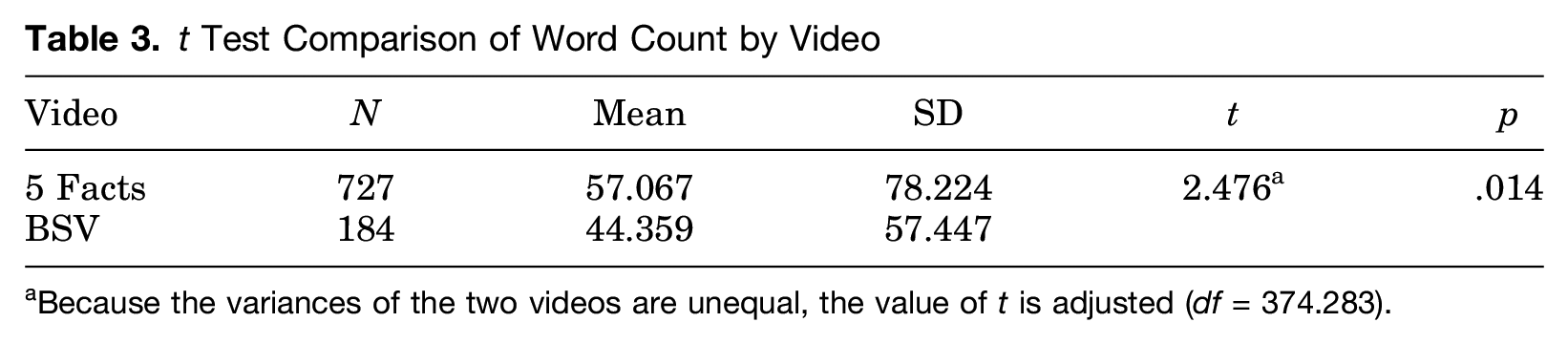
Because the variances of the two videos are unequal, the value of t is adjusted (df = 374.283).
In sum, we drew on key tenets of the IT feedback model to predict that collective social identity nonverification would result in negative sentiment, while identity-affirming inputs would reduce identity nonverification and ameliorate negative emotion. Both hypotheses were supported. Vegans expressed negative emotion following a perceived threat to collective vegan identity meanings around nature, health, and ethics. Emotion significantly improved after BSV response reinforced collective vegan identity standard meanings. We find further support for the identity theory model in the relative mean word counts, which we treat as behavioral outputs. As expected, vegans engaged in active “identity work” following nonverification from 5 Facts and were less active after BSV reinforced collective social identity meanings. These findings indicate that collective identity operates as expected within the IT framework. Confirmation of all three hypotheses offers strong support for the integral conceptualization of collective identity as a special type of group/social identity.
Collective Social Identity Processes in Action
Having supported our hypotheses using sentiment analysis and word counts, we are also interested in how emotional responses and identity work take shape. Qualitative analysis not only paints a more detailed picture of identity feedback processes for a collective social identity but also centralizes behavioral outputs, an understudied element of the identity feedback loop (Burke and Stets 2009; Burke and Stryker 2016; McCall and Simmons 1966; Stets and Trettevik 2014). The qualitative data include broad claims about veganism alongside specific claims about personal practices. The infusion of personal practices into collective identity claims highlights the relevance of theoretical integration between collective and group/social identity processes.
According to IT, nonverification elicits cognitive and behavioral responses aimed at minimizing distress. Responses to nonverifying feedback take three broad forms: intensifying identity-relevant performances, altering cognitive perceptions of feedback (Burke and Stets 2009; McCall and Simmons 1966), and when identity nonverification is persistent, changing identity meanings (Burke 2006; Davis and Love 2017a). Unsurprisingly, we do not see any evidence of identity change in either of our two comment sets. Identity change is generally slow and occurs over time. Our data represent only a single instance of nonverification, making identity change in this context unlikely. However, across both comment sets, there is evidence of identity-relevant performances as well as cognitive strategies that work to discredit the nonverifying source (i.e., WatchMojo) while affirming the source of identity- verifying feedback (i.e., Bite Size Vegan).
When an identity is not verified in a situation, persons may intensify their identity relevant performances (Burke and Stets 2009), as we saw in the mean word counts of our quantitative analysis. These behavioral outputs are a way to obtain feedback from others that more closely aligns with the identity standard. Across both comment sets, we saw performances of the vegan identity through declarations of veganism as natural, healthy, and ethical. Although we present these claims independently for purposes of clarity, the majority of comments interweave several claims together. We edit the comments for their relevance to a particular theme but include additional context in some cases to demonstrate commenters’ vegan identity and thus their inclusion in the data set. In these cases, we bold the thematically relevant content.
Countering claims that veganism is unnatural, vegan commenters on both videos highlight historical examples of plant-based diets and features of human physiology that favor plant consumption.
Stating that humanity evolved, thanks to the consumption of meat, is a completely redundant statement. Early humans ate meat because they weren’t intelligent enough to conjure the means to grow their own food and they didn’t even know that such things were possible. . . . Anti-Vegans, please don’t use this “fact” as an excuse to continue eating animals. That pre-historic struggle is over, the war is won. We don’t need to eat animals, anymore. (5 Facts video comment)
With regard to health, vegans commenting on both videos point to research by medical and nutrition experts showing the benefits of a plant-based diet while also sharing personal experiences of wellness through a vegan lifestyle.
Since I went vegan over a year ago I have only gotten more muscular and make my friends look like unfit slobs. Still love the bastards, but it is clear who has the superior health choices. (BSV response video comment)
Speaking to ethics, vegans juxtapose plant-based diets to normative omnivorous diets, citing the former as inherently less cruel. A commenter on 5 Facts states: No. 1 fact about Veganism. No innocent beings with nervous systems are kept in cages their entire lives, abused, neglected and violently slaughtered for a vegan’s meal or clothes. Unlike the non vegan who mindlessly contributes to this cruelty every day with their $$ while having the nerve to act like a victim when a vegan confronts them with the reality of what they are doing.
Similarly, a vegan commenting on BSV response details a personal journey into veganism and the centrality of ethics in his vegan practice: I am a 20-year-old man and I know I stopped eating meat and animal by-products for ethical reasons. I was sitting at my table and biting into some chicken flesh stuffed with cow rape and it just hit me I am eating the flesh of another, keeping in my mind that I myself could not kill a chicken and I love all living organisms (except most humans) I decided from that day I could no longer live with the hypocrisy so I stopped [eating meat] and never have since.
In short, vegans commenting on both videos perform collective vegan identity meanings. They do so through personal and categorical claims about nature, health, and ethics. These identity performances reflect behavioral outputs that bring situational meanings back in line with the identity standard, as articulated in the identity theory (IT) model (Burke and Stets 2009).
Along with behavioral outputs, nonverification can be mitigated through subjects’ cognitive responses. McCall and Simmons (1966) delineate several specific responses that can be summarized as ignoring feedback, reinterpreting feedback, dismissing the performance, discrediting the source of feedback, and leaving the interaction. Strategies that discredit the source of negative feedback feature in both of our comment sets. Using McCall and Simmons’ (1966) language, we see commenters “criticize” and “sanction” WatchMojo. We also see commenters leave the nonverifying situation in the form of unsubscribing from the WatchMojo channel.
Vegan commenters criticize WatchMojo for being ill-informed, socially irresponsible, and connected to animal production industries. For example: Oh dear hahaha! The meat industry is getting scared! And rightly so, we are starting to awaken. To all the people that make money out of other’s suffering . . . your time is running out. Learn how to grow veggies. (5 Facts video comment) I’m a new vegan but I already feel very irritated (to put it mildly) when some ignoramuses go and say utterly stupid things to keep others from not only doing the responsible thing but from protecting their health. (BSV response video comment)
Accompanying criticism, vegan commenters sanction WatchMojo through calls to boycott the channel, unsubscribing from the channel, and using the “dislike” or “thumbs down” button on the 5 Facts video. The “like” and “dislike” buttons are a stable feature on YouTube, and the ratio of like to dislike stands as a visible marker of a video’s reception. At the time of data collection, 5 Facts had 4,200 likes and 11,000 dislikes. One commenter on 5 Facts gloats that this may be “the most disliked WatchMojo video,” accompanied by an assertion of “Vegan Power” and a smile emoji. Another proposes that “All us vegans should unsubscribe.”
Although similar defensive strategies emerge across the two comment sets, a textual element remains that drives the collective emotional response to BSV in the positive direction. Remember, the comment set on BSV response was not only significantly less negative than comments on 5 Facts, it had an overall positive tenor. The qualitative data show that the positive tenor emerges from active affirmation of the Bite Size Vegan channel as representative of the vegan community and Emily Moran Barwick as a messenger of “true” collective vegan identity meanings. For example: i love you!! i was going to make a scientifically critical vegan channel but looks like you’ve got it covered :). (BSV response video comment) I just discovered your channel last week and you’re quickly becoming my favorite YouTuber of all time! Thanks to your videos, all three of my roommates went vegan. I absolutely love and look forward to all your videos!! Keep up the amazing work. (BSV response video comment) Emily, you’re Awesome! I Really love what you do. Love your witty responses and knowledge to overcome any adversity. You make me proud to be A Vegan. (BSV response video comment)
Thus, while vegan commenters work to mitigate the discrepancy between reflected appraisals and the identity standard using criticism, sanctions, and withdrawal, they engage in positive affirmations as well. These positive affirmations not only reduce the intensity of collective identity nonverification but, as indicated by an overall positive sentiment score on comments from BSV’s response video, help vegans verify collective social identity meanings.
Conclusions
Identity scholars have shown clear connections between identity theory (IT) and social identity theory (SIT) through the subtheory of collective identity (Miller et al. 2016; Pinel and Swann 2000; Stryker et al. 2000; White 2010). Solidifying the theoretical connection, this paper reconceptualizes collective identity as a type of group/social identity. Collective group/social identity bridges IT with SIT and provides a theoretical scaffold for social movement research that seeks to capture the interrelation between individual, interpersonal, and group dynamics in a multimedia environment.
We tested the viability of collective group/social identity through a case study of veganism on YouTube. Analyzing comments from two carefully selected videos, we hypothesized that vegan commentary following 5 Facts would have an overall negative sentiment, reflecting the emotional distress associated with identity nonverification (Stets and Burke 2014b) and that emotion would improve following BSV response, which realigned vegan identity meanings with the collective identity standard. We further hypothesized that 5 Facts would prompt active behavioral outputs from vegans and that these would reduce with identity-verifying feedback from BSV response. All hypotheses were supported.
In addition to testing our formal hypotheses, we drew a qualitative picture of collective social identity processes in action. The qualitative component provides a rich depiction of identity work and shows how vegans enacted emotion through their public expressions. Negative sentiment was reflected in both comment sets as vegans collectively criticized, sanctioned, and publicly ceased interaction with WatchMojo following the 5 Facts video. These defensive strategies correspond with cognitive and behavioral responses to nonverification as delineated by McCall and Simmons (1966). We also saw positive sentiment aimed at Barwick and the vegan community as vegans collectively affirmed the source of identity-verifying feedback. This latter trend of positive affirmation in response to identity verification opens new avenues in IT research, which has remained largely focused on defensive responses to nonverification.
The conditions of YouTube are such that our tests most closely aligned with veganism as a collective social identity rather than a collective group identity (though see Note 2). Online platforms have particular features and affordances that shape social engagement (Davis and Chouinard 2016). On YouTube, users can engage without a YouTube account, engage anonymously, and do not have clear mechanisms by which to form well-defined groups. As such, our data primarily represent veganism as a social identity category rather than an organizational or group affiliation. However, group and social identities are positioned together within the IT model (Stets 2018), and future studies should replicate our methods under conditions that more closely align with collective group identity. The Facebook platform would be ideal for such tests as Facebook enables group formation, embedding group members within a relatively sustained network of specific others.
Along with theoretical advances in social psychology, our work also shows benefit for mobilization studies. Identity is a key mechanism through which social movements operate. Fusing collective identity with group/social identity into a comprehensive concept (collective group/social identity) helps capture the interplay between individuals, organizations, and identity categories as drivers and outcomes of social movement participation. Identity theorists have a well-tested model that theorizes individual identity processes, with recent advances explicating the place of social structure (Merolla et al. 2012; Stryker et al. 2005). Incorporating collective identity into the IT model has explanatory power for social movement studies while bolstering the capacity of IT to address structural processes.
Methodologically, our work showcases exciting potentials ushered in with social media data sources for studies in social psychology (Davis 2016). Our use of naturally occurring data circumvented issues associated with self-report measures (Burke and Stryker 2016), while IT and SIT enabled us to generalize from social media data to theoretical propositions (Davis and Love 2019). Social media data thus combined with the IT and SIT research programs to form a symbiotic and productive union.
Advances in digital methods are of particular importance for the social psychology of social movements. Social movements are increasingly complex, taking place through street protests, social media posts, online petitions, email lists, and various combinations of online and offline networks (Earl and Kimport 2011), all with implications for collective identity processes (Earl and Kimport 2011; Rohlinger and Bunnage 2018). For instance, while politicized collective identity has traditionally referred to self-conscious power struggles among well-defined groups (Simon and Klandermans 2001), platforms like YouTube (or Reddit or Twitter) may usher individuals into fleeting activist encounters. Indeed, it is possible that commenting on YouTube videos about a collective identity is a formative process among individuals who identify under a collective label but have no formal activist affiliations. That is, social media may offer a gateway into activism and the formation of collective identity. This formative process and other implications of social media on social movements will benefit from theoretically informed analyses and innovative methodologies that trace mobilization across multiple sites of action.
Like all data sources, digital data and methods have limitations, and our findings should be interpreted with these limitations in mind. One limitation is that without rigorous screening and manipulation checks available in controlled laboratory settings, we had to rely on indirect indicators that the data represent our variables of interest. Thus, we cannot be sure about the identities of commenters or certain of their vegan practice. We hand-cleaned the data to include only those comments that signaled a vegan identity, but it is plausible and probable that we excluded some vegan-identifying persons and included at least a small number of nonvegans. We worked to mitigate this issue in several ways. We maintained conservative coding standards, retaining only those comments with unambiguous vegan identity markers. Misidentification was thus more likely to result in omitting vegans from the analysis rather than erroneously including nonvegans. Any potential misidentification of individual cases was likely buffered by analyzing overall scores rather than individual scores. The findings thus maintain integrity and set the stage for replication.
A second limitation has to do with the sentiment analysis measure. Sentiment analysis is a robust tool that captures broad trends based on lexical patterns. We optimized precision by adding common internet phrases to the sentiment lexicon (e.g., smh [shaking my head] and unsubscribe). However, sarcasm features prominently in social media discourse (Davis et al. 2018), so it is likely that sentiment analysis counted some content as positive when in fact that content had a negative meaning (e.g., “Oh great! WatchMojo told people that it’s totally fine to keep eating animals and supporting the meat-dairy industry. Fantastic!”). However, sentiment analysis does capture overall trends, and the significant and substantial difference between our two comment sets indicates that methodological imperfections do not undermine the overall story that our data tell. In this vein, our complementary qualitative analysis acted as a check on the quantitative sentiment analysis scores.
Overall, our findings advance the social psychology of identity by bridging two eminent research programs. We show evidence that identity theory is robust enough to incorporate collective identity into the model. Beyond individuals within social structures, identity theory can help explain the dynamics of communities in action. This theoretical synthesis serves scholars of social movements by constructing a conceptual tool (collective group/social identity) with explanatory power at multiple levels of analysis.
Footnotes
Acknowledgements
We are grateful for feedback on this paper from Jan Stets, Peter Burke, participants in the social psychology working group at the University of California, Riverside, and participants in the 2018 Advances in Identity Theory Conference.
1
YouTube is an interactive video hosting platform replete with active and dynamic communities.
2
We recognize that some vegans may be commenting on behalf of, or even in orchestration with, a specific organization and thus enacting group identity. However, as group/social identity are positioned together in the identity theory model, such entanglements are expected and do not detract from our larger theoretical point: collective identity is a special type of group/social identity.
3
Original videos can be found here: WatchMojo “5 Facts” (https://www.youtube.com/watch?v=JWIBTH7tJR8); Bite Size Vegan (BSV) response video ( ).
).
4
WatchMojo has over 20 million subscribers, and BSV has close to 180,000. Although there is a vast difference in these subscriber counts, they both well surpass the 1,000 subscriber mark, which enables monetization on YouTube, and also surpass the 100,000 mark, which is the level at which YouTube bestows Creator Awards. As such, both channels can be described as well entrenched and influential (see ).