




Abstract
Research in social psychology demonstrates that the sense of distributive injustice has emotional, health, and behavioral consequences. It is therefore important to assess how individuals come to perceive their earnings as unjust. I provide new insights to this question by integrating perspectives in distributive justice, the stress process, and the work-family interface. Specifically, I describe a model that delineates how excessive work pressures elevate workers’ sense of what they should earn through actions and strains in the work-family interface. Using data from a 2017 sample of Canadian workers, the results indicate that higher job pressure is associated with a greater expectation of rewards. Part of this association is indirect through role blurring behavior and work-to-family conflict, and this mechanism is intensified for parents. Collectively, these discoveries expand the scope of what counts as inputs in shaping employees’ sense of what they should justly earn.
Theoretical and empirical work in social psychology highlights the consequences of the sense of distributive injustice—the evaluation of unfairness in the distribution of outcomes (for reviews, see Colquitt et al. 2001; Hegtvedt and Parris 2014; Robbins, Ford, and Tetrick 2012). Following equity theory (Adams 1965; Walster, Walster, and Berscheid 1978), scholars have documented the influence of a prominent type of distributive injustice—the sense of unjust earnings—on a variety of emotional, health, and behavioral indicators. These include work-related outcomes, such as job dissatisfaction and turnover (D’Ambrosio, Clark, and Barazzetta 2018; Narisada and Schieman 2016), and also extend to indicators of well-being, such as anger, depression, and physical health symptoms (Hegtvedt 1990; Narisada 2017; Schunck, Sauer, and Valet 2015). Collectively, these results demonstrate that the sense of distributive injustice has significant costs for individuals and organizations.
Given the consequences of the sense of distributive injustice, it is important to understand its determinants. What factors shape what people think they should earn? I provide new insights to this question by fusing perspectives in distributive justice, the stress process, and the work-family interface. Specifically, I describe a model whereby excessive work pressures shape employees’ sense of what they should justly earn, in part, through the ways in which work takes away employees’ time and attention from the family role. The essential logic informing the present study is that work-related contributions and costs that form our sense of a just reward can be more fully understood by accounting for the nexus between work and family domains—roles that are inextricably linked in the lives of ordinary people. In this study, I ask two core questions:
Research Question 1: Are excessive work pressures associated with a higher just reward?
Research Question 2: How does role blurring behavior and work-to-family conflict mediate this relationship?
To answer these questions, I use structural equation modeling (SEM) to analyze data from the 2017 Canadian Work, Stress and Health Study (CAN-WSH), a national sample of Canadian workers from diverse occupations and sociodemographic backgrounds. My study seeks to elaborate the scope of inputs that shape employees’ sense of what they should justly earn.
Background
I draw on Jasso’s distributive justice theory as a guiding framework to understand the emergence of distributive justice perceptions (Jasso 1978, 1980; Jasso and Rossi 1977; for a recent overview, see Jasso, Törnblom, and Sabbagh 2016). According to this framework, there are three fundamental quantities in the emergence of the sense of injustice. The just reward is the reward that an individual thinks is just, whereas the actual reward is the reward that an individual actually receives. The comparison between the just reward and the actual reward generates the justice evaluation—the subjective assessment of whether an individual is rewarded unfairly and if so, the degree of perceived underreward or overreward. Understanding the emergence of the justice evaluation therefore requires knowledge of the factors that shape the just reward and the actual reward. Income-attainment studies document that factors that shape the actual reward (Bowles, Gintis, and Osborne 2001). A key question in this line of research is: “Who get’s what?” By contrast, the present study aims to elaborate on the factors that shape the just reward. Such examination addresses a central question in distributive justice: “Who should get what?” (Alves and Rossi 1978).
Distributive justice principles guide people’s ideas about the just reward (Jasso et al. 2016). In particular, the equity principle dictates that rewards should be proportional to individuals’ inputs (Adams 1965; Homans 1961, 1974). Individuals tend to regard equity (as opposed to equality or need) as fair when social relations are impersonal and when the goal of the group is to enhance productivity—such is often the case in formal paid work contexts, the focus of the present study (Deutsch 1975; Leventhal, Karuza, and Fry 1980).
Given the salience of the equity principle in the work context, a key question is: What qualifies as inputs? In his statement on equity theory, Adams (1963:422) argued: “On the man’s side of the exchange are his education, intelligence, experience, training, skill, seniority, age, sex, ethnic background, social status, and, very importantly, the effort he expends on the job [italics added] . . . they are what he perceives as contributions to the exchange, for which he expects a just return.” Adding to this, Homans (1961, 1974) made a distinction between two types of inputs. The first are costs, “what people gave to a job, or . . . what they gave up in order to do the job” (Homans 1974:245), which includes inputs such as effort expended and time spent at work. By contrast, investments refer to the status characteristics of individuals, such as age and educational attainment. This distinction is synonymous with Cook and Yamagishi’s (1983) conceptualization of inputs that represent contributions (e.g., effort) and those that represent attributes (e.g., age). As I will discuss in detail in the following, a key objective of the present study is to provide an updated account of the contributions—work-related efforts and costs—that shape contemporary workers’ sense of a just reward.
Prior research indicates the centrality of the equity principle in how individuals rate the fairness of others’ and their own earnings. Factorial survey studies demonstrate that individuals tend to rate hypothetical vignette persons with greater contributions (e.g., higher job performance) and certain attributes (e.g., higher educational attainment) as more underrewarded, ceteris paribus. These patterns demonstrate that individuals believe that greater contributions and certain attributes should entitle individuals to greater earnings—supporting the equity principle (Alves and Rossi 1978; Auspurg, Hinz, and Sauer 2017; Gatskova 2013; Jasso and Rossi 1977; for a recent overview, see Liebig, Sauer, and Friedhoff 2015). One potential limitation of these studies is in the restricted scope of work contributions that resemble effort—a central input according to Adams (1965), typically limiting contributions to the assessment of job performance and an omnibus measure of effort at work (Auspurg et al. 2017; Gatskova 2013; Shamon and Dülmer 2014).
Studies on the antecedents of reflexive justice evaluations—that is, the fairness perceptions of one’s own earnings—have elaborated on the dimensions of work-related contributions and also point to the relevance of social costs. Longitudinal studies of German workers indicate that employees whose contractual and overtime work hours had increased were more likely to report being underrewarded—suggesting longer working hours elevate reward expectations (Liebig, Sauer, and Schupp 2012; Valet 2018). In addition to working hours, Sauer and May (2017) show that working environments that represent social costs heighten reward expectations. Specifically, workers with poorer social relations with supervisors and coworkers—assessed as unfair treatment from supervisors and low coworker support—were more likely to report that they deserve higher earnings. As Sauer and May (2017:48) describe: When individuals feel deprived of the recognition that they believe they deserve and when they experience the social costs of low-quality relationships at the workplace, they think they are entitled to earn more money as just pay to compensate for a lack of recognition and for social costs in their relationships.
I extend this prior work by examining how conditions that span the work-family interface are associated with employees’ sense of what they should earn. Adams (1965) and Homans (1961, 1974) articulated the significance of work-related effort and costs in shaping the just reward. By focusing on the intersection of work and family roles, I seek to expand the scope of work-related efforts and costs. This consideration is important in contemporary times because work intensification, the globalization of work, and widespread use of communication technologies have facilitated greater permeability between work and family roles, enabling work pressures to more easily creep into nonwork roles (Bittman, Brown, and Wajcman 2009; Duxbury et al. 2007). In the following, I propose a model that specifies how the nature of work shapes ideas of what people perceive they should justly earn. Situating job pressure as a key starting point of this model, I discuss its link to actions and strains in the work-family interface—role blurring and WFC—that may function as mediators.
A Focal Antecedent: Job Pressure
The nature of job pressure is essential to the ways that organizations exercise influence on employees’ time, energy, and attention. Workers who report high job pressure express that demands exceed the time allotted to complete them, work on too many tasks at the same time, and feel overwhelmed by the amount of work (Schieman 2013). Technological innovation, the rise of “lean and mean” systems, and the declining power of unions have contributed to greater work intensification over the past few decades across industrialized Western societies (Green 2006; Kalleberg 2011; Ladipo and Wilkinson 2002). A 2011 sample of Canadian workers, for example, demonstrates that approximately one-third report being frequently overwhelmed by the quantity of work and that work demands often exceed the allotted time to complete them (Schieman 2013).
There are at least two reasons to expect a positive association between job pressure and the just reward. First, high levels of job pressure require substantial mental and physical effort in work-related tasks. Employees who face high levels of job pressure must therefore make considerable contributions to the work role. Second, excessive job pressure represents a burden and is an element of a negative work environment; it is a quintessential work stressor associated with negative personal and social outcomes (e.g., Karasek 1979). These features make job pressure a potentially important working condition associated with higher reward expectations.
Following the logic of prior research (e.g., Auspurg et al. 2017; Liebig et al. 2012), if workers with higher job pressure report a higher just reward, then the analysis should indicate that those with higher job pressure report more distributive injustice in the underreward direction—net of actual earnings. As Jasso and colleagues (2016:208) argue: “For given Actual Reward, the question whether a Rewardee characteristic is associated with the Justice Evaluation is equivalent to the question whether that Rewardee characteristic is associated with the Just Reward.” Applying this rationale to the present study, a positive association between job pressure and the sense of distributive injustice (controlling for actual earnings) would indicate that higher job pressure is associated with a higher just reward.
While I am not aware of previous population-based research that has explicitly examined the association between job pressure and the just reward, closely related research from specific occupations suggests this link. In a study of nurses and blue-collar workers in China, Hu, Schaufeli, and Taris (2013) show that higher job demands (a latent variable encompassing emotional, mental, and physical demands and interpersonal conflict) are associated with lower levels of perceived equity, meaning that workers were more likely to perceive that they were underbenefitting in the employer-employee relationship. We may infer from this result that higher job demands are associated with greater reward expectations. Given these theoretical and empirical points, I test the following:
Hypothesis 1: Higher levels of job pressure should be associated positively with the sense of distributive injustice in the underreward direction, ceteris paribus.
Mechanisms: Actions and Strains in the Work-Family Interface
Excessive job pressure may affect what individuals think they should earn, in part, through its influence on the family role. A key motivation for exploring this possibility stems from early qualitative interviews on distributive justice. In articulating the higher costs associated with ledger clerks’ work compared to cash posters in the Eastern Utilities Company, Homans (1961:241) noted: “When their day’s work was over they would go home still worrying whether they had handled their accounts correctly, while the posters did not need give another thought to what they had done.” This suggests that negative work-related thoughts beyond the spatial and temporal parameters of the workplace are costs that should entitle workers to greater rewards. Hochschild’s (1981) in-depth interviews on Americans’ beliefs about distributive justice sharpen this point. The interviewees discussed how high levels of effort justified higher earnings. A close examination of the interview responses suggests that some of this “effort” entails how work spreads into the home sphere. For example, one respondent reported that professors deserve their high earnings, in part, because their work is “more of a twenty-four-hours-a-day job than what I’m doing” (Hochschild 1981:118). Similarly, another participant noted that company executives deserve their high earnings because “they have more headaches [italics added] than the regular worker . . . they must bring homework home [italics added]” (Hochschild 1981:122). Yet, there has been little consideration of the ways in which the qualities of the work-family interface are relevant for fairness perceptions in earnings. Overwork and interrole dynamics suggested by Homans and Hochschild decades ago are even more relevant today given the changing landscape of working life and the proliferation of communication technologies. By specifying how dynamics in the work-family interface are associated with justice perceptions, I provide a twenty-first-century account of the nature of work-related inputs.
To understand how contributions in the work role may spill over into the family role, I draw on the concept of stress proliferation. The idea refers to how an initial “primary” stressor is often associated with multiple subsequent “secondary” stressors (Pearlin 1989). Importantly, a central way that stress proliferation occurs is through the occupancy of multiple social roles (Pearlin 1983). I apply this concept as a way to conceive of the ways that job pressure (a primary stressor) might be linked to strain in the family role (a secondary stressor) that ultimately shapes justice perceptions. The integration of the stress proliferation concept alongside distributive justice theory suggests that job pressure that necessitates a high level of effort should elevate one’s sense of the just reward, and it is possible that this effort is also experienced in the enactment of the interconnected role of the family.
In describing the specific ways in which job pressure is associated with secondary stressors in the family role, I first draw on the concept of work-family role blurring, the integration of behaviors associated with work and family roles. Scholars have conceptualized role blurring as entailing behaviors such as receiving and sending work-related calls, emails, and text messages outside of normal working hours (Desrochers, Hilton, and Larwood 2005; Glavin and Schieman 2012). Workers with higher levels of job pressure are more likely to feel that they must devote additional nonwork time to attend to those demands—blurring the boundaries between work and family. As Schieman and Glavin (2016:7) argue: “this kind of exploitation—excessively demanding work with insufficient time to complete it—requires increased efforts and attention [italics added] that extend beyond the conventional parameters of the workplace.” Continuous connectivity facilitated by communication technologies have increased the permeability of work and family roles, and work organizations have become more successful in extracting work-related contributions outside of the workplace (Chesley 2005; Sullivan 2005). In my analysis, I conceptualize role-blurring behaviors as additional contributions to the work role that are performed outside of the spatial, temporal, and psychological boundaries of the workplace. Therefore, compared to employees who are required to engage in fewer role-blurring activities, those who report more frequent role blurring should report a higher just reward.
In addition to its direct effect, role blurring may shape expectations of higher rewards indirectly through work-family conflict, “a form of inter-role conflict in which the role pressures from the work and family domains are mutually incompatible in some respect” (Greenhaus and Beutell 1985:77). Work-family conflict occurs in two forms: The work role can interfere with the family role in the form of work-to-family conflict (WFC), or the family role can interfere with the work role in the form of family-to-work conflict (FWC). While both directions of strain are important, WFC is more common (Bellavia and Frone 2005). For this reason, I focus on it in the present study to identify the ways in which work ensnares its employees. Work-related conditions have been found to influence WFC more so than FWC, and research demonstrates consistent evidence that job pressure and role blurring are associated with higher WFC (Glavin and Schieman 2012; Major, Klein and Ehrhart 2002; Schieman and Young 2010). Greater job pressure and more frequent role blurring elevate the risk that one must at least partially sacrifice one’s involvement in the family role; these costs—as Homans (1974:245) put it, what people “gave up in order to do the job”—should be associated with higher levels of WFC. Scholars identify WFC as a stressor with significant negative implications for health- and family-related outcomes (Bellavia and Frone 2005). The stress of being unable to devote sufficient time and attention to the family role could increase reward expectations. These ideas lead to the hypothesis that in addition to role blurring, WFC should also mediate the relationship between job pressure and the just reward. 1
Figure 1 illustrates the conceptual framework that summarizes the hypothesized interrelationships among the focal variables in my analysis. Based on the previous discussion, at least part of the total association between job pressure and the sense of distributive injustice (net of personal earnings) should operate indirectly through role blurring and WFC. There are three indirect paths in this framework: (Path A) job pressure → role blurring → WFC → sense of distributive injustice; (Path B) job pressure → role blurring → sense of distributive injustice; and (Path C) job pressure → WFC → sense of distributive injustice. Taken together, I test the following hypotheses.
Hypothesis 2a: Job pressure is positively associated with role blurring, which is positively associated with WFC. WFC, in turn, is positively associated with the sense of distributive injustice in the underreward direction.
Hypothesis 2b: Job pressure is positively associated with role blurring, which in turn is positively associated with the sense of distributive injustice in the underreward direction.
Hypothesis 2c: Job pressure is positively associated with WFC, which in turn is positively associated with the sense of distributive injustice in the underreward direction.

Conceptual Framework
A Supplemental Question: Do Gender and Parental Status Function as Moderators?
Beyond the aforementioned processes, I examine the supplemental question of whether gender and parental status function as moderators. There are two views regarding how gender might function as a moderator. According to one, the boundaries between work and family roles are asymmetrically permeable for men and women (Pleck 1977). Specifically, the traditional gender perspective that men should be the primary economic provider suggests that men are more likely to prioritize work and are therefore more likely to allow work to seep into the home. Based on this idea, work-related demands may be more strongly associated with role blurring and WFC for men (Duxbury and Higgins 1991; Schieman and Glavin 2016). An alternative perspective suggests that when women encounter high job pressure, they may feel a greater need than men to blur the boundaries between work and family because, despite women’s increased participation in the labor force, women still perform the larger share of domestic work (Bianchi et al. 2012; Schieman, Ruppanner, and Milkie 2018). This would predict that job pressure should have a stronger association with role blurring and WFC for women.
Alongside gender, it is also important to consider the role of parental status. Parents have more family role responsibilities than nonparents, and research suggests that parents have been spending more time with children than in the past, a pattern that may reflect the desire for parents to fulfill cultural expectations of intensive mothering and involved fatherhood (Bianchi et al. 2012; Dermott 2008). If parents perform more domestic work, then in the presence of higher pressure, they may be more likely to engage in role blurring and experience WFC. Based on these ideas, in supplemental analyses, I assess whether gender and parental status modify the extent to which role blurring and WFC function as mediators.
Methods
Sample
The 2017 Canadian Work, Stress and Health Study (CAN-WSH) is a national survey of Canadian workers. I use Wave 4 data of this biennial longitudinal study that began in 2011 because the survey items about distributive justice were added in this wave. The original Wave 1 sample in 2011 was obtained using regionally stratified unclustered random sampling using random digit dialing methods, yielding a sample of 6,004 workers with a response rate of 40 percent. Interviews were conducted by telephone (landlines and cell phones) in English or French to participants who were 18 or older and participating in the paid labor force in Canada. In 2017, the Wave 4 survey included 3,378 individuals, of which 2,654 were currently working. Following other recent population-based studies on distributive justice, I exclude those who are self-employed from the analyses (e.g., Schunck et al. 2015). The final analytical sample consists of 2,219 workers.
Measures
Job pressure
Job pressure is measured with three items, which asks about the following in the past three months: “How often did you feel overwhelmed by how much you had to do at work?”; “How often did the demands of your job exceed the time you have to do the work?”; and “How often did you have to work on too many tasks at the same time?” The response categories range on a scale from 1 = never to 5 = very often. Confirmatory factor analysis (CFA) indicates a scale reliability (ρ) of .87.
Role blurring
Role blurring is measured with three items, which ask about the following in the past three months: “How often were you called about work matters when you were not at work?”; “How often did you read job-related emails or text messages when you were not at work?”; and “How often did you contact people about work-related matters when you were not at work?” The response choices range on a scale from 1 = never to 5 = very often. The scale reliability (ρ) is .83.
Work-to-family conflict
Work-to-family conflict is assessed with three items, which asks about the following in the past three months: “How often did you not have enough time for the important people in your life because of your job?”; “How often did your work keep you from doing as good a job at home as you could?”; and “How often did your job keep you from concentrating on important things in your family or personal life?” The response choices range on a scale from 1 = never to 5 = very often. The scale reliability (ρ) is .87. 2
The sense of distributive injustice
I use three items that cover overall justice assessments, comparison processes, and equity perceptions in the sense of distributive injustice, where higher scores indicate more underreward. The first item (pay) is: “When you think about the pay you get for your work, do you feel you are . . . ” The response choices are coded: (–2) overpaid a lot, (–1) overpaid a little, (0) paid about right, (1) underpaid a little, and (2) underpaid a lot. The second item (just) is adopted from the 1999 and 2009 Social Inequality module of the International Social Survey Programme (ISSP): “Is your pay just? We are not asking how much you would like to earn—but what you feel is just given your skills and effort.” The response choices are coded: (–2) much more than is just, (–1) a little more than is just, (0) about just for me, (1) a little less than is just, and (2) much less than is just (ISSP Research Group 2012). The third item (fair) is from the U.S General Social Survey (GSS): “How fair is what you earn on your job in comparison to others doing the same type of work you do?” The response choices are coded: (–2) much more than you deserve, (–1) somewhat more than you deserve, (0) about as much as you deserve, (1) somewhat less than you deserve, and (2) much less than you deserve (Smith, Marsden, and Hout 2015).
In this coding scheme, 0 indicates fair reward, negative values represent overreward, and positive values represent underreward (Valet 2018). The mean of the composite index is .550, indicating that on average, Canadian workers in this sample perceive themselves to be slightly underrewarded. This result is consistent with recent studies of German workers (Sauer and May 2017; Valet 2018). Factor analysis results indicate that the three items load on the first factor with an eigenvalue of 2.23. Results from CFA indicate the following standardized factor loadings: .861 (pay), .850 (just), and .694 (fair), all of which are significant at the p < .001 level. The scale reliability (ρ) is .85. 3
Gender and Parental status
Gender is dummy-coded as 0 = men and 1 = women. Parental status is dummy-coded as 0 = no children younger than age 18 living at home and 1 = one or more children younger than age 18 living at home.
Control variables
All analyses control for socioeconomic status, job conditions, and demographic attributes. Education is coded as (1) eighth grade or less, (2) some high school, (3) high school or GED, (4) specialized vocational training or associate’s degree, (5) some college, (6) bachelor’s degree, and (7) postgraduate degree (MA/PhD). Personal income is measured as total pretax income from 2016. Occupation is coded as (0) nonprofessional/managerial and (1) professional/managerial. Work hours are coded continuously. Job sector is coded (0) nonprivate and (1) private. Basic sociodemographic controls include race/ethnicity (0 = white, 1 = nonwhite), age (in years), and marital status (0 = nonmarried, 1 = married). The online Appendix 4 Table A reports the descriptive statistics for all variables.
Plan of Analysis
I use structural equation modeling (SEM) in Stata 15.1 to test my hypotheses. SEM is well suited for this study because it enables mediation analyses with latent variables that accounts for measurement error. SEM estimates of direct and indirect effects are less likely to be biased than those from conventional regression techniques that assume that all independent variables are measured without error (Kline 2016). Missing values (9 percent) are addressed using full-information maximum likelihood that can provide unbiased and efficient estimates in the presence of missing data (Enders 2006). The main analysis examines the full sample and tests Hypotheses 1 and 2a through 2c. I begin by conducting CFA to assess whether the factor structure of the measurement instruments provide sufficient fit to the data. Then, I proceed to add structural paths to evaluate the full structural equation model.
Subsequent analyses use multigroup SEM to examine whether the structural paths differ by gender and parental status. SEM requires equivalence in the measurement model between groups (termed measurement invariance) before differences in the associations among latent variables can be assessed. There are three key forms of measurement invariance that progressively constrain parameters to be equal between groups. First, configural invariance requires that each latent variable is associated with the same set of indicators for each group. Second, metric invariance additionally requires that the factor loadings be equivalent between groups; indicating that the latent variables have the same meaning between groups. Third, scalar invariance additionally requires the intercepts to be equivalent between groups; indicating that the latent means can be compared between groups (Kline 2016). As the present study is concerned with group differences in the associations among latent variables and not the means of the latent variables, the key form of measurement invariance that must be established is metric invariance (Gregorich 2006). If metric invariance is established, the assessment of differences in the structural paths among latent variables proceeds in two steps. First, all paths are constrained to be the equivalent between groups. Then, Lagrange multipliers are used to identify paths that, if unconstrained, would improve model fit. Evidence of a significant improvement in model fit would indicate that the paths differ between groups (Acock 2013). 5
Results
These data contain multiple indicators for the focal variables—job pressure, role blurring, WFC, and the sense of distributive injustice—so I begin these analyses by fitting a four-factor latent measurement model. I consider a Comparative Fit Index (CFI) of greater than .95 and a root mean square error of approximation (RMSEA) less than .06 as indicators of adequate model fit (Hu and Bentler 1999). Based on these standards, the measurement model has an adequate fit to the data: χ2 = 161.577, df = 48, p < .001; CFI = .991; RMSEA = .033. Structural paths were subsequently added to estimate the full structural equation model displayed in Figure 2. Control variables are included in this model, but for the sake of presentation, their effects are not shown in the figure. The online Appendix Table B displays the direct, indirect, and total effects of the focal and control variables. This structural equation model has an adequate fit to the data: χ2 = 593.165, df = 128, p < .001; CFI = .968; RMSEA = .040. 6
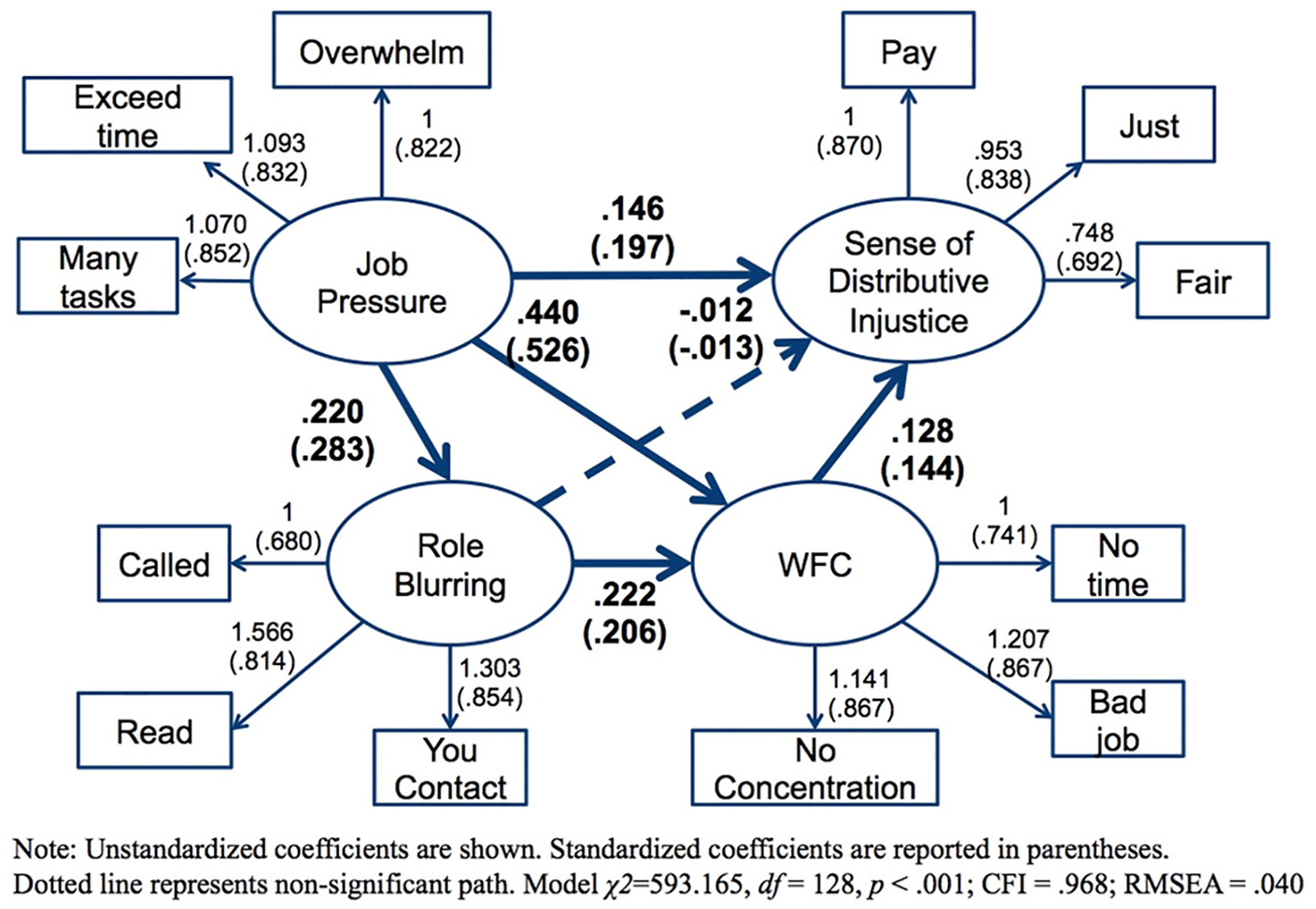
Structural Equation Model for the Full Sample (N = 2,219)
The path coefficients displayed in Figure 2 represent direct effects. Job pressure is positively associated with role blurring (b = .220, SE = .020, p < .001) and WFC (b = .440, SE = .021, p < .001). Role blurring is positively associated with WFC (b = .222, SE = .026, p < .001) but not with the sense of distributive injustice (b = −.012, SE = .027, p = .659). WFC is positively associated with the sense of distributive injustice (b = .128, SE = .030, p < .001). Finally, after accounting for its association with role blurring and WFC, job pressure is positively associated with the sense of distributive injustice (b = .146, SE = .025, p < .001).
Table 1 displays the significance tests of the indirect effects. As noted earlier, there are three indirect paths: (A) job pressure → role blurring → WFC → sense of distributive injustice; (B) job pressure → role blurring → sense of distributive injustice; and (C) job pressure → WFC → sense of distributive injustice. Path A is positive and significant (b = .220 × .222 × .128 = .006, SE = .002, p < .001), indicating that job pressure has a statistically significant indirect effect on the sense of distributive injustice through both role blurring and WFC. Path B is not significant (b = .220 ×–.012 = −.003, SE = .006, p = .660), indicating that job pressure has no indirect effect on the sense of distributive injustice solely through role blurring. Finally, Path C is positive and significant (b = .440 × .128 = .056, SE = .013, p < .001), indicating that job pressure has a statistically significant indirect effect on the sense of distributive injustice solely through WFC. Collectively, these indirect paths constitute 29 percent of the total effect of job pressure on the sense of distributive injustice. Most of the indirect effect of job pressure operates through Path C, which constitutes 93 percent of the total indirect effect of job pressure.
Total, Direct, and Indirect Effects of Job Pressure on the Sense of Distributive Injustice (N = 2,219)
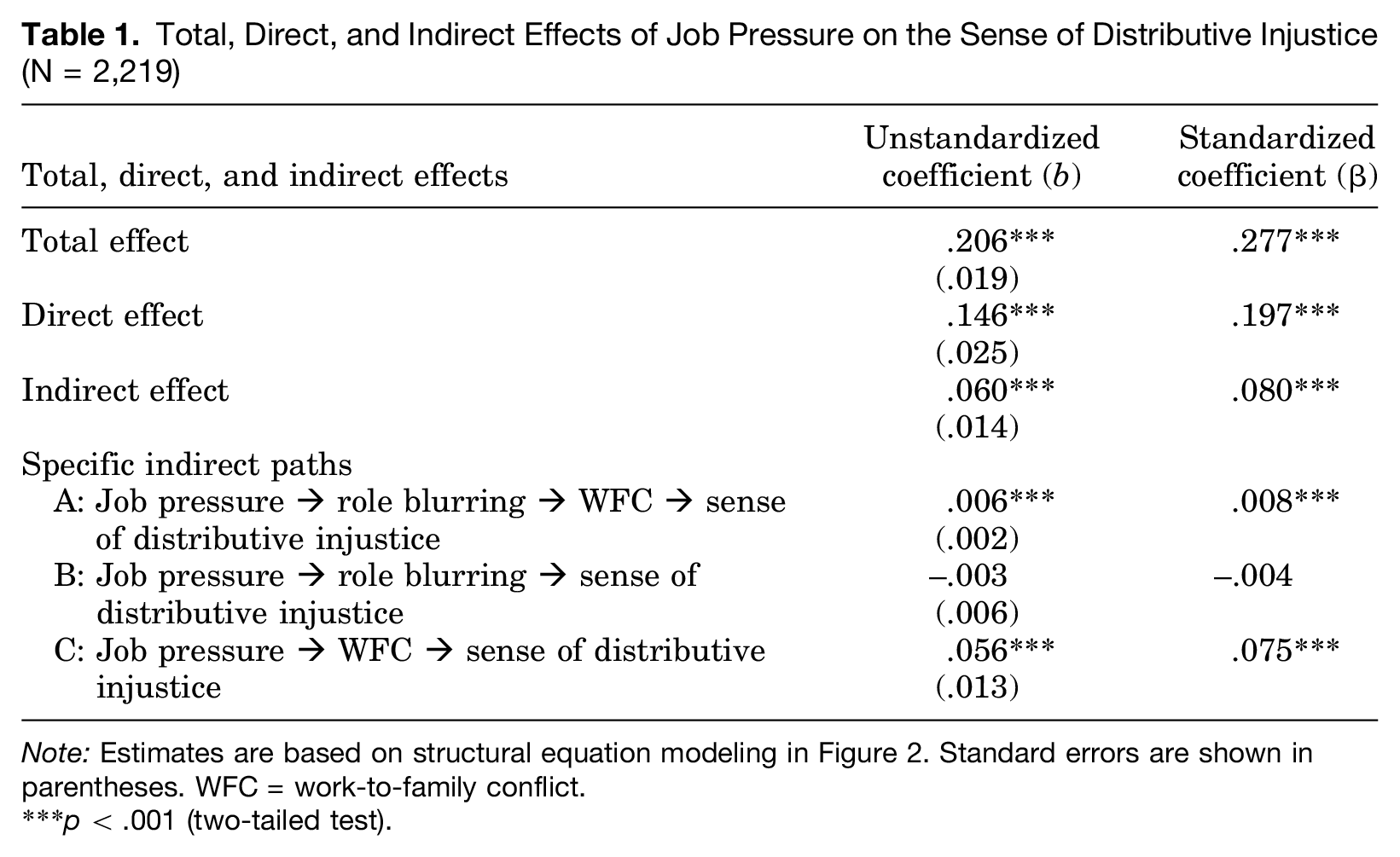
Note: Estimates are based on structural equation modeling in Figure 2. Standard errors are shown in parentheses. WFC = work-to-family conflict.
p < .001 (two-tailed test).
Taken together, these patterns provide support for Hypotheses 1, 2a, and 2c: job pressure is positively associated with the sense of distributive injustice—and part of this association is indirect through the role blurring and WFC, but primarily through WFC. As the analysis controls for personal income, these results indicate that higher levels of job pressure are associated with a higher just reward, mostly through WFC. Unexpectedly, the results did not support Hypothesis 2b: Job pressure is positively associated with role blurring, but role blurring is not directly associated with the sense of distributive injustice. Consequently, there is no indirect effect of job pressure on the sense of distributive injustice operating solely through role blurring. Note that role blurring does mediate the association between job pressure and the sense of distributive injustice—but only through WFC.
Do the Structural Paths Differ by Gender and Parental Status?
I now examine whether the paths identified for the full sample differ by gender and parental status. I present the results from tests of parental status differences first, which are reported in Table 2. The configural invariance model (Model 1) has an adequate fit to the data (χ2 = 226.349, df = 96, p < .001; CFI = .990; RMSEA = .035). The metric invariance model (Model 2) does not fit significantly worse, as indicated by the nonsignificant likelihood ratio test: χ2 = 4.33, df = 8, p = .826, suggesting the latent variables have the same meaning for parents and nonparents. Finally, compared to the metric invariance model (Model 2), the scalar invariance model (Model 3) has a worse fit, indicated by the significant likelihood ratio test: χ2 = 79.00, df = 12, p < .001. This indicates that means of the latent variables are not comparable between groups.
Multigroup Structural Equation Modeling by Parental Status
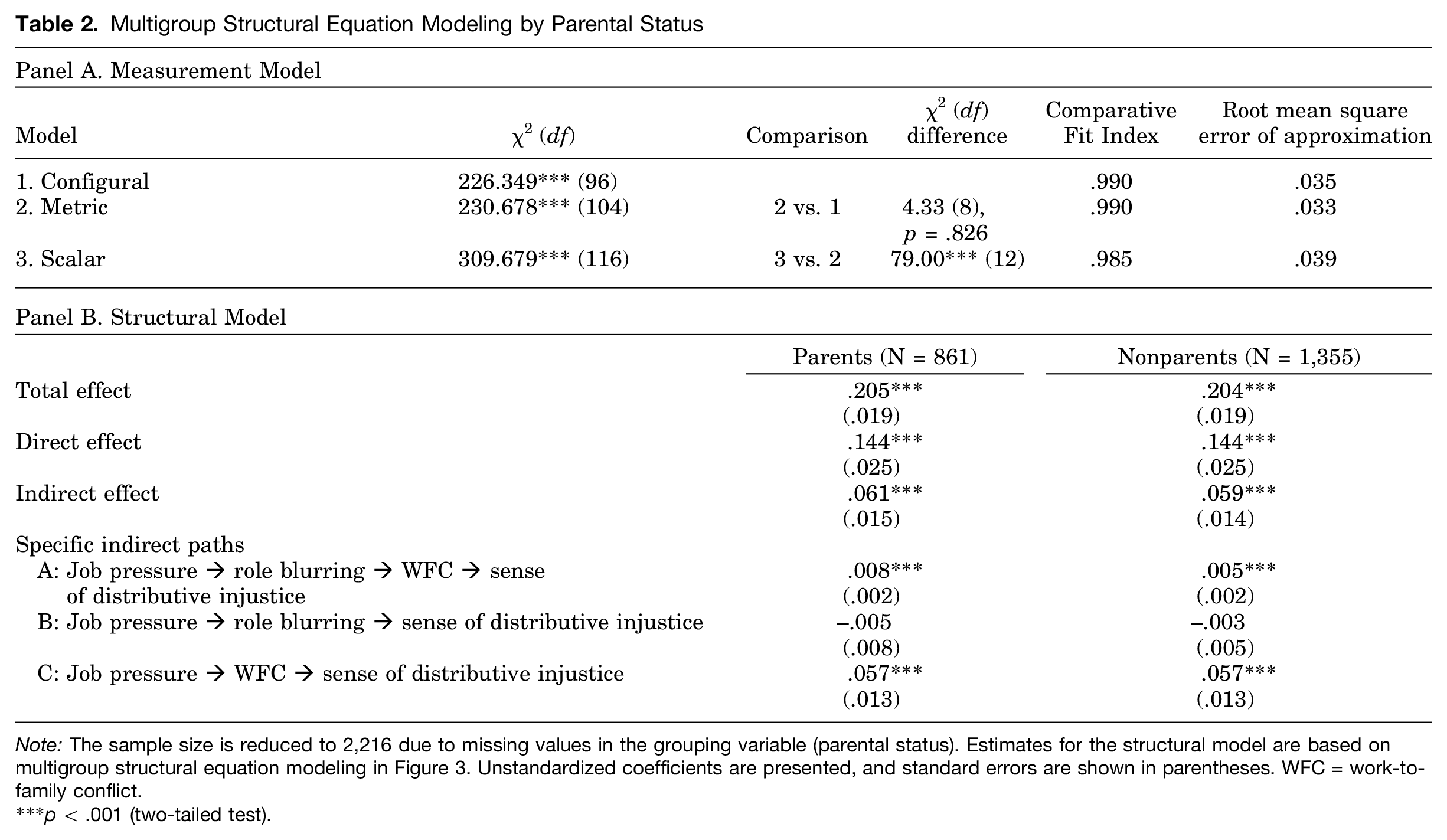
Note: The sample size is reduced to 2,216 due to missing values in the grouping variable (parental status). Estimates for the structural model are based on multigroup structural equation modeling in Figure 3. Unstandardized coefficients are presented, and standard errors are shown in parentheses. WFC = work-to-family conflict.
p < .001 (two-tailed test).
Given metric invariance, I proceed to assessing differences in the structural paths among the latent variables. After constraining the structural paths to be the same for parents and nonparents, Lagrange multiplier tests indicated that the model fit would improve by releasing the path from job pressure to role blurring: χ2 = 5.51, df = 1, p = .019. The direct paths among the latent variables for parents and nonparents are displayed in Figure 3. Multigroup analysis requires the examination of unstandardized coefficients—not standardized coefficients—because differences in group variances can affect differences in standardized coefficients (Acock 2013). Note that all structural paths are equivalent except for the direct effect of job pressure on role blurring. The unstandardized coefficient of job pressure on role blurring for nonparents is .184 (SE = .024, p < .001), while the coefficient for parents is .276 (SE = .032, p < .001). This difference has implications for Path A: job pressure → role blurring → WFC → sense of distributive injustice. Specifically, the coefficient for the indirect effect for nonparents is .184 × .227 × .130 = .005 (SE = .002, p < .001), while the effect for parents is .276 × .227 × .130 = .008 (SE = .002, p < .001). This difference is statistically significant (χ2 = 4.10, df = 1, p = .043).

Multigroup Structural Equation Model by Parental Status (N = 2,216)
The results for gender comparisons are reported in Table 3. The configural invariance model (Model 1) has an adequate fit (χ2 = 237.424, df = 96, p < .001; CFI = .989; RMSEA = .036). The metric invariance model (Model 2) does not fit significantly worse, as indicated by the nonsignificant likelihood ratio test: χ2 = 13.34, df = 8, p = .101. Finally, compared to the metric invariance model, the scalar invariance model (Model 3) has a worse fit, indicated by the significant likelihood ratio test: χ2 = 113.03, df = 12, p < .001. Given metric invariance, I evaluate differences in the structural paths among the latent variables. After constraining the structural paths to be the same for men and women, Lagrange multiplier tests indicated that the model fit would not improve upon releasing constraints on any of the paths, indicating no significant gender differences in the structural paths. In ancillary analyses (available on request), I examined whether the structural paths differ between mothers and fathers. These results indicated no significant group differences. This suggests that differences in the structural paths arise primarily from differences between parents and nonparents. 7
Multigroup Structural Equation Modeling by Gender
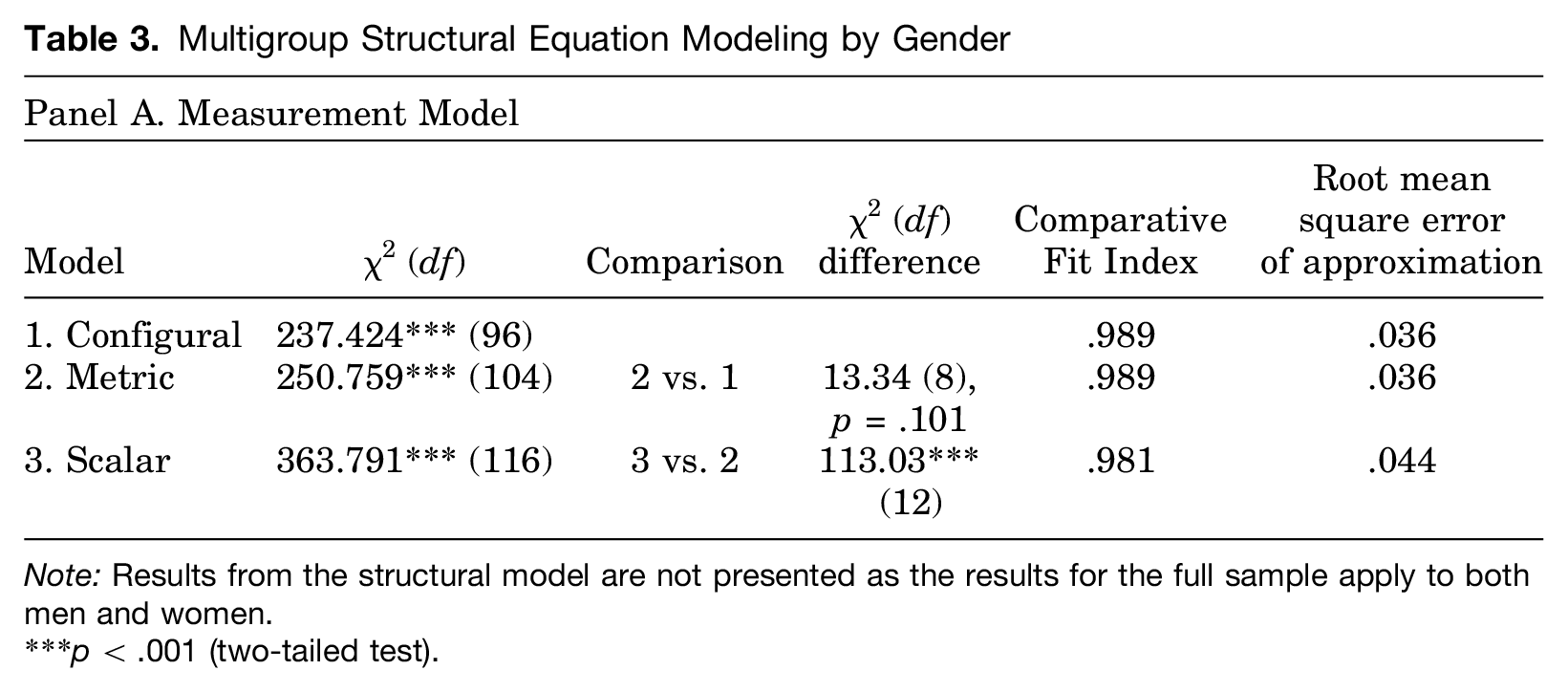
Note: Results from the structural model are not presented as the results for the full sample apply to both men and women.
p < .001 (two-tailed test).
Discussion and Conclusion
Research in social psychology indicates that the sense of distributive injustice has emotional, health, and behavioral consequences that entail significant costs for both individuals and organizations (e.g., Colquitt et al. 2001). It is therefore important to ask: What factors shape what individuals think they should earn? I provide a new answer to this question with three main contributions emerging from my discoveries. First, the main theoretical contribution pertains to the integration of perspectives in distributive justice, the stress process, and the work-family interface to expand the scope of what counts as inputs in shaping employees’ sense of what they should justly earn. Second, the finding that job pressure is associated with a greater expectation of rewards partly through role blurring and WFC demonstrates the relevance of the work-family interface for justice perceptions—a dynamic hinted at decades ago by Homans (1961) and Hochschild (1981) but has not yet been specifically investigated. Third, the patterns observed generalize to both men and women, but there are differences by parental status. In the following, I elaborate on each of these contributions.
A key distributive justice principle in the work context is the equity principle, which stipulates that the outcomes we receive should be commensurate with our inputs (e.g., Adams 1965). Factorial survey studies document the relevance of the equity principle in the evaluation of earnings, demonstrating that vignette persons with greater work-related contributions—in particular, job performance and effort at work—are rated as deserving higher earnings (e.g., Auspurg et al. 2017; Gatskova 2013; Shamon and Dülmer 2014). Recent research on fairness evaluations of one’s own earnings extend work-related contributions to include longer contractual and overtime working hours (Liebig et al. 2012; Valet 2018) as well as social costs as measured by poor social relations in the workplace (Sauer and May 2017). The integration of perspectives in distributive justice, the stress process, and the work-family interface presented here expands the sphere of work-related inputs that shape employees’ ideas of just earnings. Specifically, the notion of stress proliferation attunes us to the fact that a stressor in one role may be linked with subsequent stressors in another role to shape reward expectations. The work-family literature specifies the particular elements of the work-family interface that could intervene in the relationship between job pressure and the just reward. Collectively, the fusion of these perspectives encourages us to consider how employees’ work-related inputs are not restricted to the work role, but also experienced in the enactment of the interconnected social role of the family. This is important to consider given that the boundaries between work and family domains have become inextricably linked for many workers—and sometimes in tension.
Job pressure is the key driver of the process I describe. Job pressure is a potentially important antecedent of the just reward because it requires substantial mental and physical effort and by extension represents a potent work stressor with implications for worker well-being. My observations demonstrate support for this view by indicating that job pressure is positively associated with the sense of distributive injustice—net of personal income, other socioeconomic statuses, and demographic characteristics. While work hours represent one way to assess contributions (e.g. Liebig et al. 2012; Valet 2018), my results underscore that the perceived intensity and the amount of work to be done also represent a salient work input. As a side-point, the results indicate that job pressure mediates the link between working hours and the sense of distributive injustice: Working hours are positively associated with job pressure, which in turn is positively associated with the sense of distributive injustice (see the online Appendix Table B).
Homans’s (1961) and Hochschild’s (1981) early work on distributive justice provides clues that the ways in which work spills over into other roles are forms of effort and costs that should entitle individuals to greater rewards. To pursue these clues, I examined the ways in which specific elements of the work-family interface—role blurring and WFC—functioned as partial mechanisms by which job pressure is associated with higher reward expectations. The results show that approximately one-third of the total effect of job pressure is indirect through the work-family interface. While the observed patterns were mostly in support of the hypotheses, I did not anticipate two nuances. First, of the total indirect effect, most was attributable to Path C (job pressure → WFC → sense of distributive injustice). Second, role blurring had no direct effect on distributive injustice, and its association with the sense of distributive injustice was entirely indirect through WFC. These patterns suggest that WFC is the primary mechanism by which job pressure influences reward expectations. Excessive pressure from work erodes individuals’ available level of time and concentrated attention that they could dedicate to the family domain—and this process in turn is associated with greater expectation of rewards.
Based on prior research that suggests that the ways in which work-related conditions affect role blurring and work-family conflict differ by gender and parental status, I examined how these statuses functioned as moderators. The results indicated no evidence of gender differences in the structural paths, while there were differences by parental status. Specifically, the effect of job pressure on role blurring is larger for parents by approximately 50 percent compared to nonparents, which resulted in a larger indirect Path A for parents. Parents, especially those with younger children, have more family responsibilities than nonparents. In the presence of higher levels of job pressure, parents may therefore be increasingly likely to blur the boundaries between work and family roles. This has implications for their WFC, which in turn is linked to higher reward expectations. Ancillary analyses indicated no differences in the structural paths between mothers and fathers, suggesting that the primary difference arises from parenthood. This pattern may be interpreted as evidence that both mothers and fathers face pressures to spend large amounts of time and attention to raising children.
Study Limitations and Future Research Directions
The present study is based on cross-sectional data that restrict causal claims. My analysis was guided by (1) prior theorizing and evidence in the work-family literature that situate job pressure as an antecedent of role blurring and WFC, and role blurring as an antecedent of WFC and (2) distributive justice research that situates contributions and costs as antecedents of justice perceptions. Nevertheless, without longitudinal data, I am unable to confirm the causal ordering of the variables. For instance, it may be possible that part of the total association between job pressure and WFC flows in the other direction: Feeling that work is encroaching on family may cause someone to feel more time or task pressure at work. In addition, while I have specified one of the control variables, work hours, as a predictor of job pressure, it is also possible to conceive work hours—especially long hours indicative of overwork—as an outcome of job pressure. In future research, it would be important to replicate my analyses in a longitudinal design to address issues of causal ordering and examine any reciprocal effects.
Longitudinal data analysis could also extend the present study in other ways. First, building on efforts of recent population-based research on distributive justice (e.g., Liebig et al. 2012; Valet 2018), fixed effects regression models can be used to control for time-stable characteristics that may function as confounders (Allison 2009). For instance, those with particular employment histories may perceive more job pressure and also be more likely to report a sense of distributive injustice. While I have accounted for potential confounders assessed in prior research, future research would benefit from techniques such as fixed effects regression that can rule out other potential sources of spuriousness.
Second, longitudinal data would also be fruitful in examining how enduring and stable exposures to high levels of job pressure, role blurring, and WFC shape the expectation of rewards. The process I identified should be amplified for those who are chronically overwhelmed, engage in role-blurring behaviors, and feel that their work takes away their time and concentrated attention to their family role. In particular, these analyses could shed light on the implications of a type of role strain—role captivity (Pearlin 1983). Feeling “trapped” in a work role that continues to extract time, energy, and attention away from the family role could have especially significant effects for our sense of what we should earn.
Beyond the use of longitudinal data, another direction for future research pertains to elaborations of the model I described. Future studies might apply the model to investigate the mechanisms by which status in the workplace shapes higher reward expectations. For instance, prior research indicates that those with more job authority report higher levels of job pressure (Schieman 2013). Based on my findings, it is possible that those with more job authority expect greater rewards, in part, due to higher exposure to job pressure and ensuing stress in the work-family interface. Another way to elaborate the model may be to incorporate other outside-of-work costs that function as additional mediators. For instance, prior research indicates that WFC is associated with costs in the family role, including lower family role performance and increased family distress (Bellavia and Frone 2005). Future studies may incorporate these variables to examine whether family processes explain the relationship between WFC and greater expectation of rewards.
Before concluding, I discuss one practical implication of this study. As noted earlier, prior research indicates that the sense of distributive injustice has a wide range of negative outcomes. My results suggest that if employers fail to reward employees for their excessive work pressures, role blurring, and WFC, then this may have serious downstream consequences for both employees and organizations, including outcomes such as job dissatisfaction, higher turnover, and health problems. On the flip side, the results also suggest that policies or programs that facilitate a more reasonable balance or fit between work and family roles may be perceived as alternative work-related benefits that could lead to lower economic reward expectations.
Four decades ago, Blau (1974:206) argued: “there are men and women who selflessly work for others without any thought of reward and even without expecting gratitude, but these persons are virtually saints, and saints are rare.” Today, such saints may be even more rare as work has become more intensified and the boundary between work and family roles has become more blurred and prone to conflict. Work-related efforts and costs typically emerge in the work role, but they can also spill over to nonwork roles. Job pressure is associated with a greater just reward—and part of this association is indirect through work-related efforts at home and the diminished capability to perform optimally in the family role. Collectively, these observations expand ideas about what counts as inputs in shaping our sense of what we should justly earn.
Supplemental Material
APPENDIX – Supplemental material for Job Pressure, the Work-Family Interface, and the Sense of Distributive Injustice: An Elaboration of Work-Related Inputs among Twenty-First Century Workers
Supplemental material, APPENDIX for Job Pressure, the Work-Family Interface, and the Sense of Distributive Injustice: An Elaboration of Work-Related Inputs among Twenty-First Century Workers by Atsushi Narisada in Social Psychology Quarterly
Footnotes
Acknowledgements
Previous versions of this manuscript were presented at the 2018 conference of the International Society of Justice Research (ISJR) in Atlanta, Georgia, and the 2018 Legitimation of Inequalities over the Life-Span (LINOS) workshop at the German Institute for Economic Research in Berlin, Germany. I thank Scott Schieman, Alex Bierman, participants of the aforementioned conferences, the reviewers, and the editors for their helpful feedback on earlier versions of this manuscript.
Funding
The author disclosed receipt of the following financial support for the research, authorship, and/or publication of this article: Canadian Institutes of Health Research. A grant award from and the Canadian Institute for Health Research (MOP-102730; Scott Schieman, P.I.) supports this study.
1
Opportunity costs might be one way of interpreting these dynamics. However, this idea might imply that individuals are actively making a choice to spend excessive time and energy to the work role at the expense of the family role. While this may be the case for some, for others, there may be little choice but to accommodate high levels of pressure and engage in work-family role-blurring activities. Based on this consideration, I do not use the term opportunity costs to interpret the patterns.
2
These items are adopted from the National Study of the Changing Workforce (NSCW), and studies utilizing them have referred to them as work-to-family conflict ( ). However, these items may not only capture conflict between work and family but also the conflict between work and the nonwork domain more broadly. This is an important point to consider when interpreting my results. To remain consistent with prior work, however, I have decided to retain the work-to-family conflict label for this measure.
3
Jasso’s theory of distributive justice specifies a sophisticated justice evaluation function defined as J = ln (A/C), where A is the actual reward and C is the just reward. This is a quantity that I am unable to assess in the current study because the data do not contain values for C. Nevertheless, Jasso’s theory provides conceptual tools that are useful in understanding the arguments and analysis contained in this article. For example, Jasso stipulates that it is the comparison between the just reward and the actual reward that shapes the justice evaluation. Based on this formulation, Jasso, Törnblom, and Sabbagh (2016) argue that empirical assessments of the antecedents of the justice evaluation—net of the actual reward—tell us how inputs shape the just reward. I draw on these ideas to demonstrate how job pressure, role blurring, and work-to-family conflict shape the just reward. That is, these factors are associated with a greater expectation of rewards.
4
The supplemental Appendix is available online at
5
In assessing group differences in the structural paths, I do not constrain the paths from the control variables to the latent variables to be equivalent between groups. By allowing these paths to be specific to each group, this approach can provide maximal control.
6
7
I conducted robustness checks using a 2005 data set in the United States that has somewhat similar but more limited measures of the focal variables available in the recent Canadian data. These results were similar to those presented in this study. Job pressure was associated positively with the sense of distributive injustice. Role blurring and WFC accounted for part of this association, with WFC being the primary mechanism. Multigroup analyses indicated small but significant differences by parental status and gender, such that the indirect effects were slightly stronger for parents and women. These results are available on request.
Bio
References
Supplementary Material
Please find the following supplemental material available below.
For Open Access articles published under a Creative Commons License, all supplemental material carries the same license as the article it is associated with.
For non-Open Access articles published, all supplemental material carries a non-exclusive license, and permission requests for re-use of supplemental material or any part of supplemental material shall be sent directly to the copyright owner as specified in the copyright notice associated with the article.
