




Abstract
Participating in conflict may facilitate the acquisition of social status in a group. We build on theories about the sources of conflict and status to formulate propositions about how conflict affects status mobility in schools. Using two-wave panel data from over 20,000 students in 56 middle schools, we first examine the relationship between change in conflict with schoolmates and change in a network-derived metric of status, betweenness centrality, which is an indicator of being well known. More overall conflict with students is associated with increases in status up to a threshold. Additionally, students who perceive more conflict with others who do not perceive conflict in return also gain status. Finally, more conflict with friends does not increase status. Based on this evidence, we propose a mechanism by which conflict increases status through signaling integration in the school’s social scene rather than through establishing dominance over others, as previous literature suggests.
Social status hierarchies—orderings of individuals based on their relative standing—are a basic feature of groups, and groups vary in the nature and extent of their status hierarchies (Berger and Zelditch 1998; Martin 2009b; Ridgeway 2014). Because being higher status in a group allows individuals to pursue his or her ends (e.g., obtain resources in a group or exert influence over others), individuals compete to maintain or achieve higher status positions. Interpersonal conflict, a state of disagreement between individuals that can be manifest in both trivial and serious ways, is another common feature of groups that occurs alongside prosocial cooperation and expressions of solidarity. Scholars have sought to understand the conditions under which interpersonal conflict arises (e.g., Gould 2003) and the consequences of conflict for individuals and group dynamics (e.g., Collins 2009; Faris 2012).
Given that status orderings and conflict are two fundamental features of groups, scholars have examined the nature of the relationship between conflict and status broadly. Here, we examine how participating in conflict with others shapes social status mobility over time using the case of students in middle schools.
The foundation of our inquiry is theoretical work regarding the role of conflict in social life (Gould 2003) and the manner in which social status hierarchies develop and persist (Gould 2002). We use Gould’s (2002, 2003) work in the spirit of exploration (e.g., Faulkner 2009) to inform our own propositions; Gould does not theorize the relationship between conflict and social status mobility. Therefore, we do not attempt to test Gould’s ideas directly. We instead use Gould to orient our inquiry while also drawing on previous empirical work among adolescents to develop the logic of our propositions.
Previous empirical work in this area suggests that aggression toward peers may be perceived and used as a strategic resource for acquiring status through establishing dominance over specific others, like friends (Faris 2012; Faris and Felmlee 2011; Prinstein and Cillessen 2003), what we refer to as the dominance mechanism. While a large body of work addresses the topic of conflict and status broadly, we are aware of three studies that use longitudinal data to examine how conflict and aggression shape status mobility in schools (Andrews, Hanish, and Santos 2017; Faris 2012; Prinstein and Cillessen 2003).
These existing studies do not develop a theoretical framework to systematically inform and test predictions regarding the relationship between conflict and status. They also rely on smaller data sets (Ns = 383, 1,694, and 159, respectively) and measure status differently than we do (e.g., friend network proximity, yearbook accolades, and perceived popularity). In this article, we draw on Gould’s (2002, 2003) theories to address the question of how conflict influences social status using a large and diverse sample of students and a theoretically informed network measure of status in schools that captures being well known.
We apply Gould’s theorizing in three areas to formulate propositions for empirical examination: the role of interpersonal conflict in social relations, the role of reciprocation of status-conferring gestures (i.e., giving someone time and attention relative to the time and attention they give you) in reflecting and producing relative status between two people, and the role of status ambiguity in producing conflict. Though his main theory is about the origins of conflict, Gould (2003) suggests that conflict is also a way to challenge and renegotiate who is in charge in social relationships; we draw on this foundation to propose the first hypothesis: a positive relationship between participating in conflict and status mobility.
Second, we draw on Gould’s (2002) theorizing regarding the reciprocation of status-conferring gestures—that receiving more attention than one returns signals higher status—and extend this to examine the role of reciprocal conflict nominations between students. We expect that if conflict nominations as a measure of negative attention are status-conferring gestures, then receiving more conflict nominations from others (compared to nominating others as someone one has conflict with) should be associated with status gains.
Finally, we use Gould’s (2003) argument that conflict is more likely to occur in social relations where individuals are similar in terms of status, for instance, between friends rather than between bosses and employees, to formulate predictions regarding the relationship between conflict with friends and social status mobility. Since it is easier and more common to challenge others when there is not an obvious hierarchical relationship, we anticipate that having conflict with people of relatively similar status, like friends, should be associated with status gains.
To test our propositions, we first establish the basic relationship between change in the amount of conflict students have with schoolmates (assessed through nominations of other students as someone one has “conflict with”) and change in social status. We then examine the effect of nonreciprocation in perceived conflict relations (i.e., a student perceives conflict with a peer who does not perceive conflict with them in return) and conflict with friends on social status mobility among students in schools. We use a network measure of status (betweenness centrality, a measure of the number of times a student provides the shortest, or most direct, path between two other students in the network) that captures the brokerage position related to being well known by others (e.g., Faris and Felmlee 2011).
We find that students who report and are reported as having more conflict with schoolmates over the school year gain social status up to a certain threshold. We find limited support for the prediction that receiving more nonreciprocated conflict nominations (a status-conferring gesture) is associated with status gains; students who are nominated by schoolmates as someone they have conflict with (nonreciprocal incoming conflict nominations) may gain status, but up to a fairly low threshold, after which there is no status value to being nominated by others as someone with whom they have conflict. Furthermore, in contrast with our prediction based on nonreciprocal conflict nominations as status-conferring gestures, we find that students who perceive conflict with schoolmates who do not perceive having conflict with them (nonreciprocal outgoing conflict nominations) gain status throughout the year. Finally, in contrast to our prediction, we find that conflict with friends does not significantly affect status mobility.
Based on these findings, we suggest an alternative mechanism by which conflict might shape social status: through signalling participation in the social scene of the school, which we refer to as a social scene mechanism. Previous work largely assumes that aggression toward peers is a strategic resource for acquiring status through establishing dominance over specific others. We find instead that neither receiving status-conferring gestures nor having conflict with specific others, like friends, improves status. We argue that participation in conflict serves as a signal to other students that one seeks to be involved in the social life of the school, creating a social reality that improves students’ social status. We articulate how the evidence may support this type of mechanism later in the conclusion.
Background
Social Status and Conflict: Common Features of Group Life
We consider social status to be the prestige accorded to individuals because of the positions they occupy in the social hierarchy of the group (e.g., Goode 1978). Status orderings are supported and reproduced by collective beliefs within a group about relative status (e.g., Berger and Zelditch 1998; Gould 2002; Ridgeway and Correll 2006; Skvoretz and Fararo 2016). 1 Sorting out relative status positions and the drive to acquire more social status within groups are pervasive aspects of group life. Higher social status is associated with both material and nonmaterial rewards, such as respect and social approval (Gould 2002; Merton 1968; Ridgeway and Correll 2004). As a result, people compete to achieve or maintain higher status positions.
Interpersonal conflict, a state of disagreement that usually arises when individuals have incompatible, or opposing, behaviors and views (e.g., Laursen and Pursell 2009), is another common feature of group life. Interpersonal conflict, broadly defined, can manifest in acts of aggression or in more subtle behaviors. Given that status and interpersonal conflict are both important group-level processes, scholars have sought to understand the conditions under which interpersonal conflict arises and the consequences of conflict for individuals and group dynamics.
For instance, hierarchical relations between group members themselves can be a source of interpersonal conflict. Particular expressions of dominance, like malicious gossip or scapegoating, accompany specific status positions in a group (Collins 2009). For instance, aggressive youth, despite not being well liked, are seen as popular by peers (Prinstein and Cillessen 2003). Group members accept and allow expressions of aggression from individuals occupying high-status positions more than they do from individuals in lower status positions (see Magee and Galinsky 2008). Group members even interpret expressions of aggression differently depending on the relative hierarchical position of group members (e.g., Fiske 2010). Aggression can result from threats regarding status and reputation, particularly among men (e.g., Cohen and Nisbett 1996; Willer et al. 2013).
Aggression and jockeying for social status is particularly visible among adolescents in school settings. During adolescence, youth start to pay increasing attention to their social standing relative to their peers (Li and Wright 2014). As a result, schools are interesting sites for the study of status not only because adolescents spend a lot of time there but because these settings are characterized by informal status hierarchies that allow students to sort out status for themselves (Faris 2012). This makes it easier for students to make moves up and down that status hierarchy than in settings with more formal hierarchies where status positions are clearly determined and therefore harder to challenge. Not surprisingly, empirical studies have demonstrated substantial social status mobility in schools (Smith and Faris 2015).
Various forms of interpersonal conflict, including bullying and aggression, are also common in schools. Psychologists, who produce a bulk of the literature on school-based bullying, argue that aggression is a response to frustration, humiliation, or mental pathologies. Yet, serious conflicts are common in schools partly because they are “fiercely competitive” settings where students are continuously striving for greater dominance in social relations (Gould 2003:47).
Conflict and Aggression as Establishing Dominance: Previous Literature
A body of research has explored the relationship between social status and conflict, particularly among adolescents. Much of this work posits that conflict and aggression is a means of establishing dominance—the ability to elicit ritual signs of deference in contentious interactions (Martin 2009a)—over specific others. This research often assumes a dominance mechanism, such that a) adolescents perceive peer conflict and aggression to be a tool for gaining status through establishing dominance over others, and b) youth make calculations about which peers to target for dominance displays.
Establishing dominance over others may increase one’s relative standing in a group. By causing others to defer, an individual may establish a reputation that deters future aggression (Benard 2013, 2015). Biosocial accounts of group processes posit that dominance displays lead to higher subsequent status position (e.g., Mazur 2005). As Faris and Felmlee (2011) suggest, competition to maintain or gain status can motivate peer aggression. They find that increases in status are associated with increases in aggression among students up until a certain threshold, after which aggression and status are negatively associated. They, along with Faris (2012), argue that aggression is perceived by students to be instrumental for gaining status, and thus social status motivates the use of aggression.
This dominance account suggests that status gains are particularly likely when youth challenge or target specific others. For instance, youth who are aggressive gain status if they challenge highly liked students that they, the aggressors, personally dislike (Peets and Hodges 2014). Aggression directed toward high-status peers and targeting more peers in general is associated with increases in status (Andrews et al. 2017). Similarly, in schools, higher status attainment is more likely among those who direct their aggression toward peers who are high status, have a reputation for aggression, or are socially close, such as friends (Faris 2012). We use this body of research to supplement Gould’s theories in the following section.
Gould on Conflict in Social Life and Status Hierarchies: Orienting Ideas
We utilize Gould’s (2002, 2003) theorizing to formulate our propositions regarding the relationship between the amount and type of interpersonal conflict and social status mobility in schools. In particular, we use his work on the role of interpersonal conflict in social relations; the reciprocation of status-conferring gestures; and the role of status ambiguity in producing conflict. Gould (2003) argues that to make sense of conflict, we have to account for people’s positions in the social hierarchy, which is the starting point of our inquiry.
Interpersonal conflict is a feature of many social relationships because people continuously strive for greater discretion over what goes on in those relationships. Conflict results from disagreement between individuals about relative dominance within the relationship. Conflict may also serve as an opportunity to challenge existing dominance arrangements. Specifically, Gould (2003:38) suggested that “[violent] struggles are intrinsic to systems of dominance . . . because struggle is the primary means by which people individually and collectively set the terms of their relations with others.”
We thus begin with a simple examination of the relationship between amount of conflict and change in social status. If conflict serves as an opportunity to renegotiate dominance in a relationship and previous work finds that aggression can increase status in schools (e.g., Andrews et al. 2017; Faris 2012; Peets and Hodges 2014), more conflict with peers should be associated with status gains.
Hypothesis 1: An increase in perceived conflict with schoolmates from Wave 1 to Wave 2 is associated with an increase in social status over the school year.
In other work, Gould (2002) outlines a theory of status in which positions in the social hierarchy are modeled as the expression and result of status-conferring gestures. Status-conferring, or status-granting, gestures include gestures of approval or disapproval, such as giving someone your time and attention or withholding time and attention, respectively. Reciprocation of gestures of approval signals status equality, whereas a lack of reciprocation of gestures signals status inequality. For instance, if an individual devotes a lot of time and attention to someone who does not provide as much time and attention in return, that individual assumes a lower status position because he or she receives fewer gestures of approval than he or she gives out. Expressing excessive disapproval can also signal status inequality if you show intense dislike toward someone who is only mildly disdainful toward you.
Individuals, then, are deliberate about the amount of attention they give to others in order to manage their status positions (e.g., Love and Davis 2014). Since it is unpleasant to receive little or no attention from those one gives lots of attention to, individuals often adjust their behaviors accordingly. This insight is reflected in related work on exchange relationships, which finds that high-status individuals purposely delay reciprocation as a way of subtly claiming dominance in the relationship (Park and Kim 2017). According to Gould (2002), the distribution of status-conferring gestures leads to a self-reinforcing status ranking system in which actors reproduce social hierarchies.
If the nonreciprocation of negative status-conferring gestures, such as showing strong dislike for someone who does not show as much dislike toward you, can signal status inequality, then we anticipate that receiving more status-conferring gestures—in the form of conflict nominations that you do not reciprocate—is a signal of higher relative status. If individuals are deliberate about the amount of attention they give to others, then we expect that those who do not nominate peers who do nominate them can gain status.
Given that social status is a function of collective beliefs about relative social rankings (e.g., Ridgeway and Correll 2006), receiving more status-conferring gestures in the form of conflict nominations may both indicate higher status and serve to further improve one’s status position. There is empirical support for this principle: Park and Kim (2017) find that displays of dominance in interpersonal interactions become apparent to others in the group, who then collectively legitimate and uphold status hierarchies based on those interactions. Consequently, we expect that:
Hypothesis 2: An increase in nonreciprocated conflict nominations from schoolmates from Wave 1 to Wave 2 is associated with an increase in social status throughout the school year while an increase in reciprocated conflict nominations from schoolmates from Wave 1 to Wave 2 is not associated with an increase in social status throughout the school year.
Finally, Gould argues that conflict is a feature of many social relationships and particularly social relationships where individuals are similarly situated in terms of their status positions, such as between friends. In this account, conflict is more likely to occur in settings where there is more ambiguity about relative status positions or social rank has not been clearly established. It follows that conflict is more likely to occur in social relations where individuals are similar in terms of status, for instance, between friends rather than between bosses and employees (Gould 2003). Because status ranks are more clearly defined in the relationship between a boss and an employee, it is harder to challenge the terms of the relationship. Martin (2009a) and Felmlee and Faris (2016) find evidence of conflict occurring more frequently between relative status equals.
Conflict between people where relative status is ambiguous provides more opportunities for establishing dominance. Empirical work by Faris (2012) finds that aggression is more likely to lead to status gains when youth challenge peers who are socially close, like friends. Participating in conflict provides the opportunity to display dominance, which can be a signal to other group members, contributing to reputational or collective beliefs about relative social status (e.g., Park and Kim 2017; Ridgeway and Correll 2006). Thus, we would expect that:
Hypothesis 3: An increase in perceived conflict with friends from Wave 1 to Wave 2 is associated with an increase in social status throughout the school year.
Measuring Status: Betweenness Centrality in School Social Networks
Social network analysis offers a relational approach to defining individuals’ positions in a group. In this study, we use a social network measure of status: betweeness centrality. Betweenness centrality is a measure constructed by first determining the shortest, or most direct, paths between all possible pairs of actors in a network and then calculating the percentage of those paths that include the focal actor. Students with high betweenness centrality serve as “bridges” connecting other students and occupy brokerage positions in their school networks (Faris and Felmlee 2011).
These high-status students can control connections between those in the network who might otherwise be disconnected. Since others depend on these central students to make ties possible, these students are in advantageous positions; they can receive resources that flow through the network and stop others from gaining access to those resources (e.g., Burt 1992; Faris and Felmlee 2011). Students who occupy central brokerage positions are also likely to be highly visible members of their school communities. Therefore, this measure of status may allow us to capture how well known a student is using a network metric rather than students’ perceptions.
Unlike other measures of status such as social preference, betweenness centrality captures a more exclusive type of status within a group. While using this metric captures the extent of a student’s brokerage position in the network, as we describe in the following section, the measure is able to broadly capture the concept of social esteem and respect that social status refers to. Along these lines, Faris (2012) finds that betweenness centrality is associated with other metrics of social prestige among adolescents.
Methods
Data
Data for this analysis come from a year-long, randomized field experiment conducted over the 2012–2013 school year (Paluck, Shepherd, and Aronow 2016). The experiment tested whether students’ behavior, particularly the behavior of salient individuals, could influence other students’ perceptions of social norms of conflict and shift overall levels of conflict behavior at the school. The experiment randomly assigned half of 56 public middle schools (which include students ages 10–15 years old) throughout the state of New Jersey to receive an intervention program.
The intervention program consisted of a series of ten meetings with a group of randomly selected students in the school who were encouraged to be and assisted in becoming “change-makers” with respect to peer harassment at the schools. As part of the design and evaluation of the intervention, students in the 56 public middle schools completed a survey at the beginning of the school year, in fall of 2012, and at the end of the school year, in late spring 2013 (N = 21,124). Each survey included a network nomination section, a personal background and activities section, a section on perceptions of the norms of conflict-related behaviors at the school, and an attitudes and experiences section.
For the purposes of this study, we do not focus on the causal effects of the intervention on social status mobility because the experiment was not designed to alter social status. Results do not differ when we control for being a treatment student (participating directly in the intervention program), so treatment controls are excluded from the analytical models presented in the following sections.
Dependent Variable
Using a roster design, at both waves of the survey, students reported who they had “decided to spend time with (in school, out of school, or online)” from their school in the last few weeks. Nominations were capped at ten. The phrasing was designed to elicit a behavioral measure of social connections in contrast to role-based measures for eliciting relationships. This measure captures who individuals pay attention to and are exposed to in their group through actively choosing to spend time with them. The measure may be particularly useful for constructing a measure of status since status involves differential attention to some actors over others. This measurement approach also avoids the issue that common measurement strategies like popularity or friendship have, that the definition of popularity and friendship is subjective and can differ from student to student, producing noisy results (e.g., Bearman and Parigi 2004).
We assess status based on students’ betweenness centrality scores using the spend time networks. The measure of betweenness centrality (calculated using the igraph package in R) first determines the shortest paths between all actors in the network (in this case, each school independently) and then calculates the number of those paths that include the focal actor. The more times a student provides the shortest, or most direct, path between two other students, the higher his or her betweenness centrality score will be.
We report results in the following sections using betweenness scores normalized by the distribution of betweenness scores at each school (z-scores) to address possible differences in the scale of betweenness scores across schools of different sizes and instances where the meaning of change in betweenness from Wave 1 to Wave 2 is different from school to school, again based on school size. We use change in status measured as Wave 2 betweenness z-score minus Wave 1 betweenness z-score. The pattern of results we report in the following holds when we use betweenness scores without taking school-specific z-scores (whether adjusted for school size—normalized betweenness—or not—nonnormalized betweenness).
To verify that betweenness centrality corresponds to the concept of social status that we seek to capture, we examined the status-related characteristics of students in the top 10 percent of betweenness centrality (standardized by their school, then converted to z-scores for comparability). Using t tests, we found that these top 10 percent betweenness students reported thinking of themselves as well known, popular, a leader, outgoing, respected, a loyal friend, and friends with many types of students more frequently than other students, and as keeping to themselves less frequently than all other students (all significant at p < .0001). These characteristics are all in line with how social, well-known students might think about themselves. At the same time, top 10 percent betweenness students are more likely to report thinking of themselves as a drama queen, having enemies, and being a troublemaker than other students (all significant at p < .0001). This indicates the close coupling between being integrated in social life and being involved in the negative, conflict-related aspects of social life as well. 2
Independent Variables
Students also reported up to five students at the school they “have conflict with,” whether face to face, through texts, or online, at both survey waves. This is a measure of perceived conflict relationships: Students could nominate others as someone they had conflict with independent of whether those students also nominated them. The definition of conflict was left ambiguous to capture a broad range of students’ perceptions of conflict. We consider this measure to include instances of both minor disagreements, manifest in various forms, and more serious forms of interpersonal conflicts, including aggression. In contrast to data on specific contentious encounters between individuals, as explored in Martin (2009a), these data more likely capture students’ interpretations of the aggregation of many encounters with other students. In this article, we use these conflict nominations both as an indicator of a range of negative, peer-directed behaviors (Hypotheses 1 and 3) and of negative attention toward others (Hypothesis 2).
To provide some evidence of the relationship between the conflict nomination measure and other measures of peer aggression, we drew on administrative data that we received from 52 of the 56 schools regarding which students were punished for peer harassment–related infractions, whether physical (e.g., “physical aggression with a student”) or nonphysical (e.g., “biased comment” or “spreading a rumor”). When we create a binary measure for students who received any discipline for peer harassment (N = 1,998 across 52 schools with 17,626 students, 11 percent of students), these students have significantly more incoming conflict ties (i.e., other students nominating them; 2.93 vs. 1.24 nominations, p < .0001) and significantly more outgoing conflict nominations (i.e., their nominations of other students; 1.86 vs. 1.44, p < .0001) than students not disciplined for peer harassment.
Overall conflict
Incoming conflict captures the total number of times an individual was nominated by others as someone with whom they had conflict. The sum of an individual’s nominations of other students with whom they had conflict is outgoing conflict. An individual’s overall conflict is the sum of the number of incoming and outgoing conflict nominations. As with status, we use change in the number of overall conflict nominations from the beginning of the year to the end of the year as an independent variable.
Reciprocal and nonreciprocal conflict
We further specify the nature of conflict individuals have based on whether conflict nominations are reciprocal (the nominator is also nominated by the nominee; the mean percentage of reciprocal conflict nominations compared to outgoing nominations for all students is .11) or nonreciprocal. We construct three separate measures: the number of reciprocal conflict relations, the number of nonreciprocal incoming conflict nominations (where a student is nominated by others that he or she does not nominate), and the number of nonreciprocal outgoing conflict nominations (where a student nominates another who does not nominate him or her). At Wave 1, the correlation between the overall number of conflict nominations and the number of reciprocal nominations is r = .50, the number of nonreciprocal incoming nominations is r = .77, and the number of nonreciprocal outgoing nominations is r = .62. The number of nonreciprocal incoming and nonreciprocal outgoing nominations is correlated at r = .07 at Wave 1. Change in these three measures across time is not correlated (all less than r = |.10|), presenting no threat of multicollinearity.
Conflict with friends
We assess the amount of conflict with people with whom a student also chose to spend time (which we use here as a proxy for friendship), as opposed to conflict with individuals with whom one does not have an existing friendship. For each individual, we calculate the number of times they nominate another student as someone they have conflict with who they also nominate as someone with whom they recently chose to spend time. Sixteen percent of all outgoing conflict nominations are of students who were also nominated as someone with whom the nominator chose to spend time.
Control Variables
We include several time-varying control variables that may serve as markers or determinants of status in middle school.
Perceived age
At both waves, students reported their relative age appearance, a measure of relative physical development that is positively associated with participation in conflict (Batsche and Knoff 1994; Olweus 1993) by answering the following question: “People say that I look . . . younger than/about the same age as/older than . . . most students in my grade.”
Activities and dating
Using a series of questions that students checked off to indicate participation and left blank to indicate lack of participation, at both survey waves, students reported whether they participated in sports at school or outside of school (these were combined to represent any involvement in sports), dated other students at the school, and did lots of homework.
For each of these control variables, we created four sets of dummy variables to capture: no participation in either wave, participation in both waves, participation in Wave 1 but not Wave 2 (discontinuation), and participation in Wave 2 but not Wave 1 (adoption).
Analytical Technique
For each of the three main analyses presented in the following section, we use change score models, which allow researchers to examine the effect of events in two-wave panel data. When the focus of research is to understand the effect of an event or transition on an outcome and the researcher wants to control for the possibility that exogenous variables may be affecting the event and outcome, change score models are appropriate and yield more precise estimates than lagged dependent variable models (Johnson 2005). The estimates of change score models are unbiased by measurement error in the outcome or unobserved heterogeneity in time-invariant differences between individuals.
In each model, we control for status and conflict levels at the beginning of the school year. Because data are drawn from students in different schools, school-level fixed effects are included in all models to control for the potential influence of unobserved school-level variables. We tested for differences in these processes by gender and found none, so we report the results collapsed across gender.
Nonlinearity of relationships
The relationship between change in the key independent conflict variables and change in the betweenness z-score (the network measure of status) is nonlinear. 3 Given that standard exponential transformations did not result in the normal distribution of the residuals, we fit a series of linear spline regressions to the data (where the key independent variables are modeled as having a series of linear relationships with different slopes with the dependent variable). The cutoff points for the linear splines, selected based on inflection points, are described in the results tables, and the key results are robust to minor changes in the choice of cutoff points. We also tested the results using ordinary least squares (OLS) regression models and models with exponential transformations of the independent variables. The results are largely the same using these different models, and we note any differences in results between the models in the following section.
Addressing nonindependence of observations
A concern with using regression models with network data is that the assumption of the independence of observations is violated since observations in a network are interrelated by definition. The concern with violating the assumption of independence of observations is that standard errors will be biased downward. To address this concern, all results are reported using cluster robust standard errors, where the clusters in each school network are calculated based on different clustering algorithms (either edge betweenness or walktrap methods, calculated using the igraph package in R). The logic of this approach is based on the assumption, demonstrated in a large body of empirical work, that the characteristics and behavior of individuals, including status and perceived conflict, are likely to be more similar between people who spend time together and thus report ties to each other. Clusters represent groups within the school of students with more dense ties to each other, and we would assume that characteristics and behaviors are more similar within these network clusters. By clustering standard errors by those clusters, we attempt to account for the interdependencies between those observations.
The substantive results are the same regardless of the clustering algorithm, so we report standard errors clustered based on subgroups derived from the edge betweenness method. We also assessed the results of the analysis using the nonnetwork measure of conflict (self-reported conflict) to further demonstrate that the main results are the same when eliminating at least one form of network data from the analysis. 4
Missing data
Because we use change score models, we include students who were observed at both Wave 1 and Wave 2 (N = 21,124). Another 3,067 students took the survey at either Wave 1 or Wave 2, but not both. Other students’ nominations of these students (outgoing ties) were included in all measures described previously. For example, the mutual and nonreciprocal conflict variables were calculated accounting for whether the nominated student was observed in the data set or not. Fourteen percent of the sample is missing data on one or more control variables. We use listwise deletion for these cases, leaving 18,207 observations for the analyses when we use control variables. To ensure that the results are robust to missing data concerns, we reran all analyses using multiple imputation for the missing values on the control variables. The results (available on request) are the same as those reported below using listwise deletion. We also report the results without control variables below.
Results
Descriptive Statistics
Table 1 provides descriptive statistics for the key conflict variables used in the three analyses. On average, students have nearly three conflict nominations (their own nominations of others and others nominating them) at Wave 1; this increases to 3.44 by Wave 2. On average, students have .56 more conflict nominations at Wave 2 than at Wave 1.
Descriptive Statistics for Key Independent Variables, N = 21,124

Note: W1 = Wave 1; W2 = Wave 2.
For the dependent variable, across all students, the median betweenness z-score (the network measure of status) at Wave 1 is –.26, with a range from –1.50 to 7.09. At Wave 2, the median betweenness z-score is –.26, with a range from –1.46 to 11.07. The median change in the betweenness z-score from Wave 1 to Wave 2, the key dependent variable, is .009, range from –7.99 to 10.27. There is substantial stability in status across the school year but also notable mobility; for example, nearly a third of students starting in the middle tercile of status move upward, and nearly a third move downward.
How Conflict Affects Status: Overall Conflict
We now turn to the results from the key analytical models. Table 2 provides the results of the linear spline models, regressing change in status (betweenness centrality z-scores) on change in the overall amount of conflict from Wave 1 to Wave 2. All models include school-level fixed effects. Model 1 presents results with basic controls for Wave 1 status and the Wave 1 value of the independent variable; Model 2 includes the full set of control variables. 5
Linear Spline Regression of Change in Status (Betweenness Centrality z-score) on Change in Overall Conflict (Number of Nominations)

Note: Standard errors beneath coefficients, clustered by network clusters. Models control for school-level fixed effects. W1 = Wave 1; W2 = Wave 2.
p < .05. **p < .01. ***p < .001 (two-tailed test).
With or without controls, there is a significant positive relationship between more overall conflict nominations at Wave 2 than Wave 1 and an increase in status, up to having six more conflict nominations at Wave 2 than at Wave 1. Each additional conflict nomination received or sent at the end of the year than at the beginning of the year is associated with a .37 increase in status. After six additional conflict nominations at Wave 2, the relationship between change in conflict and change in social status becomes negative. At that point, each additional conflict nomination is associated with a .61 decrease in status. We find support for Hypothesis 1, up to a threshold, after which having more conflict is detrimental to status. The OLS models without splines adjusting for the change in the relationship after six more conflict nominations indicate a significant positive relationship between change in conflict and change in status (not shown).
How Conflict Affects Status: Reciprocal and Nonreciprocal Conflict
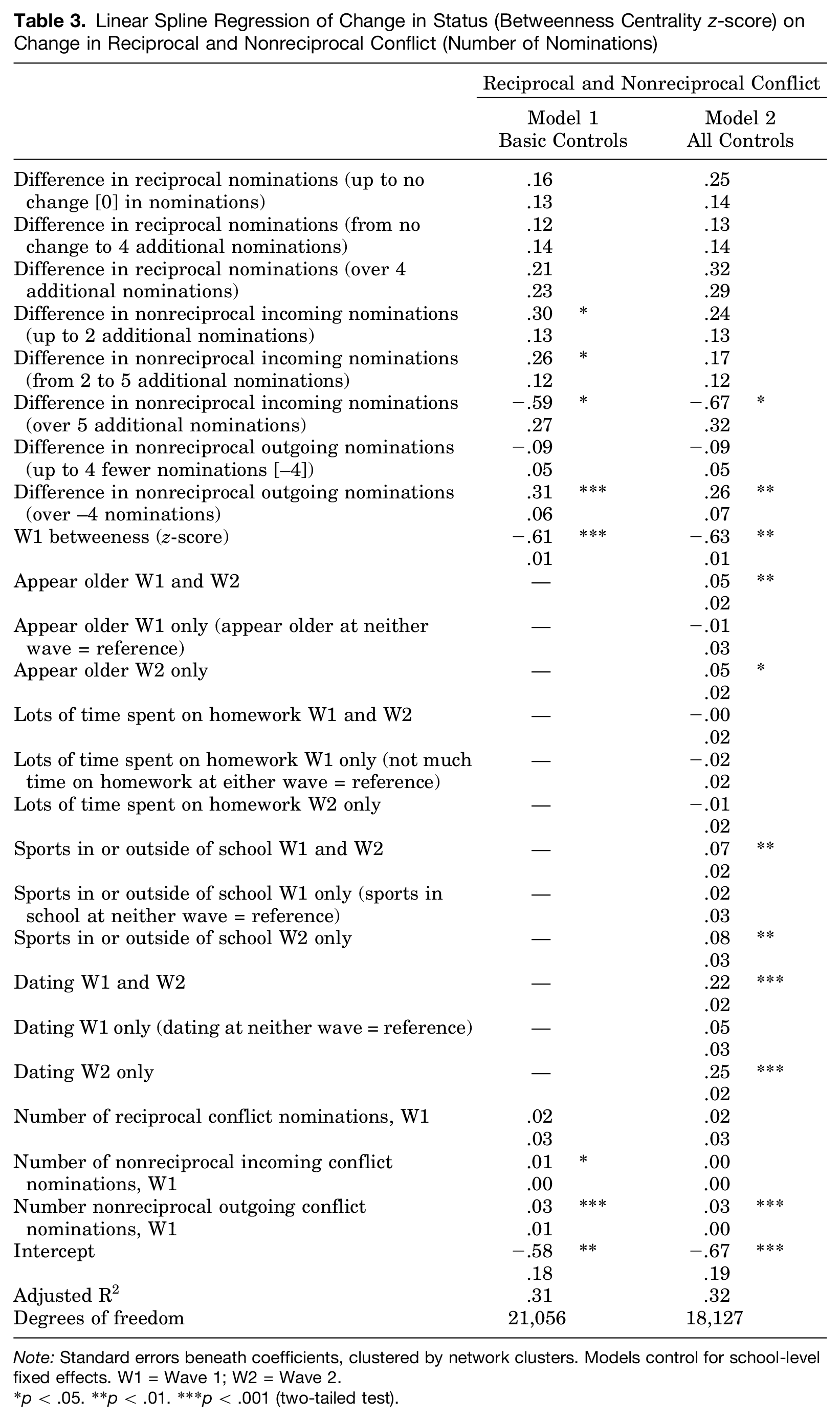
We next examine the relative value of changes in reciprocal and nonreciprocal conflict for changes in social status (Models 1 and 2 in Table 3, without and with controls, respectively). In neither Model 1 nor Model 2 do we find a significant relationship between change in the number of reciprocal conflict nominations. In Model 1, without the full set of controls, we find a significant, positive relationship between having more nonreciprocal incoming conflict nominations from other students at Wave 2 than at Wave 1 and status, between the lowest values of the range up to 5 more nonreciprocal incoming conflict nominations.
Linear Spline Regression of Change in Status (Betweenness Centrality z-score) on Change in Reciprocal and Nonreciprocal Conflict (Number of Nominations)
Note: Standard errors beneath coefficients, clustered by network clusters. Models control for school-level fixed effects. W1 = Wave 1; W2 = Wave 2.
p < .05. **p < .01. ***p < .001 (two-tailed test).
In Model 2, however, which includes the full set of controls, this positive relationship is no longer statistically significant. The only effect that remains significant is having five or more additional nonreciprocal incoming conflict nominations, which is associated with a .67 decrease in status. When using OLS models with a squared term for nonreciprocal incoming nominations to account for the functional form of the relationship, we find a significant relationship between the first order term for change in nonreciprocal incoming nominations and increase in status. Thus, we find limited support for Hypothesis 2, that an increase in nonreciprocal conflict nominations from schoolmates from Wave 1 to Wave 2 is associated with an increase in social status throughout the school year. There may be a limit on the value of this type of conflict for social status mobility.
Finally, we find a strong, positive relationship between additional nonreciprocal outgoing conflict nominations at Wave 2 and an increase in status (from –4 to +5 Wave 2 nominations compared to Wave 1 nominations). Within this range, each additional nonreciprocal outgoing conflict nomination is associated with a .26 increase in status (Model 2, Table 3). This relationship is significant and positive in a standard OLS model (not shown). We did not predict this finding based on the original proposition.
How Conflict Affects Status: Conflict with Friends
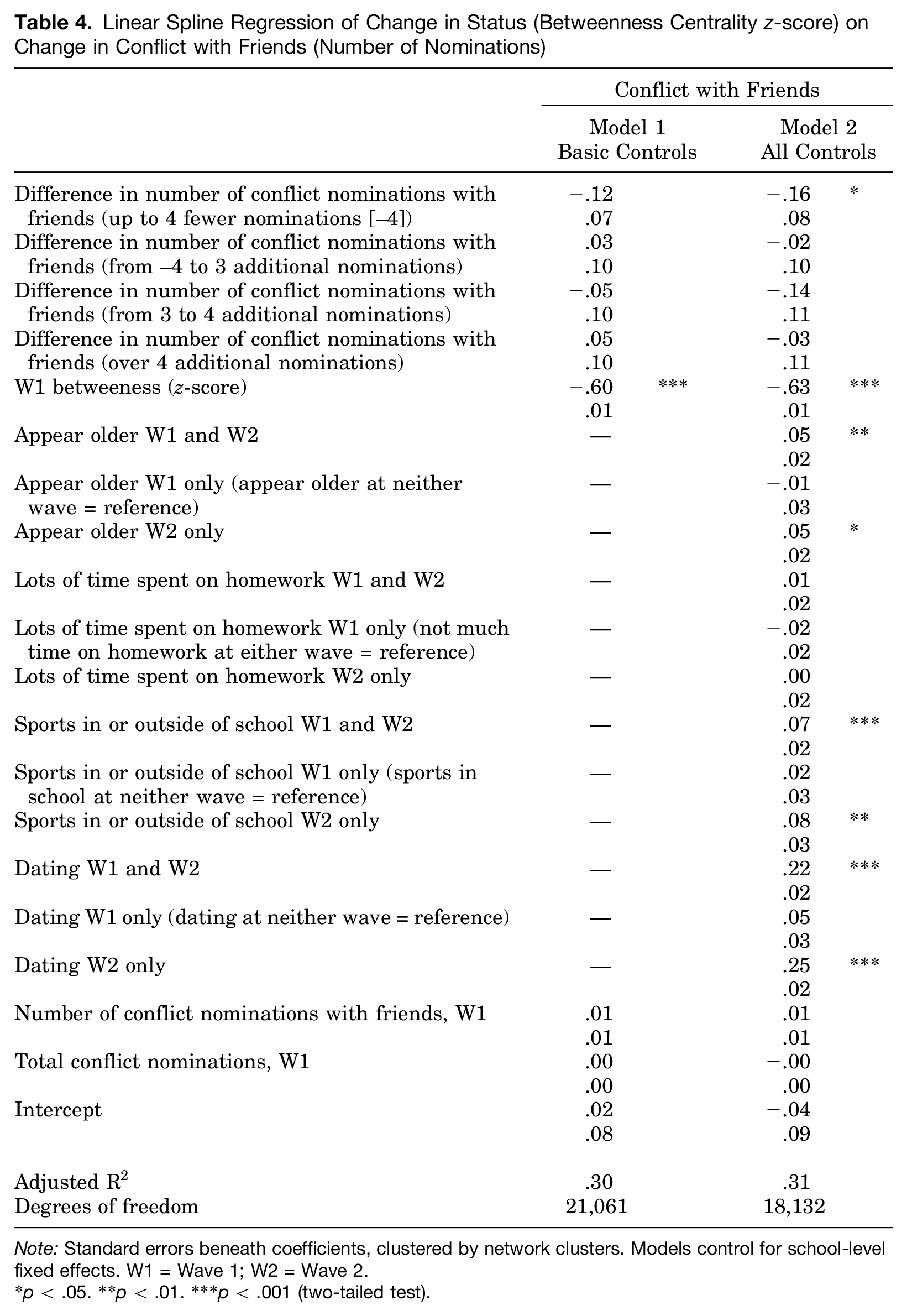
Finally, we turn to a test of the relative impact of having more conflict with other students who are also friends (people nominated as those one chose to spend time with). In Table 4, Models 1 and 2 present the results without and with full controls. For the section of the distribution between –4 and +3 Wave 2 conflict nominations of friends relative to Wave 1, in either Model 1 or Model 2, there is no relationship between having more conflict with friends and change in status. This result is the same using OLS models without the linear splines (not shown).
Linear Spline Regression of Change in Status (Betweenness Centrality z-score) on Change in Conflict with Friends (Number of Nominations)
Note: Standard errors beneath coefficients, clustered by network clusters. Models control for school-level fixed effects. W1 = Wave 1; W2 = Wave 2.
p < .05. **p < .01. ***p < .001 (two-tailed test).
As a robustness check of these results, we also examine models where conflict with friends is assessed using a different network generator, best friends (“This is my best friend [or these are my two best friends] at this school”). This generator question was capped at two nominations. When we replicate the analysis of the effect of conflict with friends using this measure of the number of conflict nominations with friends (not shown), we again find that there is no effect of conflict with friends on change in status over the school year. We do not find support for Hypothesis 3, that having more conflict with friends is associated with status gains.
Conclusion
Summary
Researchers have examined the relationship between status and aggression and general patterns of social status mobility in schools. This article uses Gould’s theories of the sources of interpersonal conflict (2003) and status hierarchies (2002) to develop three propositions about how conflict with group members shapes social status. We ask whether the relationship between conflict and status mobility in schools varies based on the amount of conflict youth report having with their schoolmates and type of conflict relations.
We find that change in the amount of overall conflict students have with schoolmates is positively associated with change in social status (in line with Hypothesis 1), but only up to a certain threshold. We suspect that this finding reflects the fact that conflict with peers is a common and normal feature of group life but that there are limits on the extent to which participation in conflict is common. Having too much conflict may be indicative of inappropriate or unwanted social behavior that becomes interpreted differently by peers. Since highly aggressive youth are not well liked by their peers (Prinstein and Cillessen 2003), too much conflict can result in loss of status throughout the school year.
We find only limited support for the proposition that receiving more nonreciprocated conflict nominations from schoolmates during the year is associated with increases in status (Hypothesis 2). The value of nonreciprocal incoming conflict nominations to improving social status is limited to a small number of additional nominations. Contrary to our expectations, we find a strong, positive relationship between additional outgoing conflict nominations of schoolmates who do not reciprocate those nominations and changes in status across the year.
In contrast to our expectations based on Gould’s observation of the relationship between friendship and conflict (Hypothesis 3), perceiving more conflict with friends (measured by deciding to spend time with someone and as “best friends”) does not significantly affect status.
Signaling Participation in the Social Scene: An Alternative Mechanism Linking Conflict and Social Status
Based on this evidence, we propose that while it may sometimes make sense to think of conflict as a strategic resource for acquiring status through establishing dominance over others, as suggested by Gould and other scholars, we should also consider a mechanism where conflict among adolescents serves to signal broad participation in the school’s social scene.
If conflict and aggression contribute to social status gains through the accrual of dominance over others, then students should gain status when they induce deference from socially appropriate targets. An assumption of previous work is that students make deliberate decisions about how much negative attention to give others relative to how much negative attention they receive. Previous work also assumes that students decide with whom to initiate conflict to maximize their potential social status. They can, of course, err in their calculations or in their execution, but this mechanism implies some type of rational decision making.
According to the dominance mechanism and our original prediction, we would expect that receiving more deference from others in the form of incoming, nonreciprocated conflict nominations should be associated with status gains. This differential attention can indicate that the nominated individual is higher status; the behavioral manifestation of this differential attention can create shared perceptions (by both the involved parties and by other students) that the nominated individual is indeed higher status. Similarly, if having conflict with friends provides an opportunity for establishing dominance because relative status is unclear, we would expect that having more of that type of conflict should be associated with status gains, assuming that more opportunities for establishing dominance elicits some displays of deference from others. We find, however, that neither of these is true. Instead, we find that having conflict, including unreciprocated outgoing conflict, a deferential gesture, and having conflict regardless of social proximity to the target, is associated with status gains.
Consequently, we propose a mechanism whereby conflict signals participation in the social scene. With whom you have conflict and the unreciprocated nature of conflict matters less than simply participating in conflict and “being in the mix” of school social life (Shepherd and Lane 2019). In this social scene mechanism of conflict, by perceiving and participating in conflict broadly—namely, not having strategic conflict with specific others or not avoiding unreciprocated status conferring gestures toward other students—students signal their willingness to be a player in the scene of school social life.
Being part of the social scene makes students more visible to others, making them better known in a school and someone worth forming a connection with. Qualitative evidence we collected along with this quantitative data set about how students experience conflict also supports this type of account. Students often experience conflict as lacking a clear instigator or a clear “winner,” and other students often pay more attention to the fact that someone was involved in conflict, instead of who “won” or “lost” a peer conflict. Therefore, whom you challenge, and whether you strategically calibrate the amount of negative attention you give others, matters less for status than simply participating in conflict.
Based on the social scene mechanism, conflict as an index of participation in the social scene leads to social status mobility through providing more opportunities for visibility and creating connections to others in school. Because Gould’s theories focus on the origins of conflict (and conditions that make it more likely to arise), but not on whether or how conflict affects status mobility, this research does not provide a direct test of Gould. This research also does not provide a definitive test of the dominance mechanism compared to the social scene mechanism. Indeed, the dominance mechanism may operate in some groups under some conditions, while the social scene mechanism may be more important in other groups under other conditions. Here, we suggest an alternative pathway by which conflict and aggression lead to status gains in the context of schools than has been proposed in previous empirical work. We expect that future work, especially qualitative work, can shed light on the conditions under which, or the students for whom, a social scene mechanism better explains status gains compared to a dominance mechanism. Specifically, qualitative research could provide insight into how students interpret and evaluate conflict and aggression by their peers.
Limitations and Future Directions
Our key contribution is to theorize and test the role of conflict in shaping social status. Other research has examined the reverse relationship, how social status influences the amount and expression of conflict. We acknowledge that it is likely that the relationship between conflict and status is bidirectional: Participation in conflict can affect status mobility, and a student’s new status position in turn may affect his or her subsequent involvement in conflict.
A small number of studies have empirically examined how conflict and aggression affect status using longitudinal data. A challenge to directly comparing the results of empirical work in this area is the multiplicity of measures of status and of conflict, aggression, and displays of dominance. Researchers who use student network data to measure status use different network centrality measures (e.g., proximity prestige, as do Andrews et al. 2017, or total incoming nominations). Researchers have elected to use nonnetwork measures of status as well: Faris (2012) used yearbook accolades. It is likely that these different measures of status, whether network-based or nonnetwork-based, are the source of divergent findings, suggesting that future empirical work should continue to explore the relationship between different metrics and social status in groups. 6
How to best measure conflict and aggression and how broad of a net to cast when assessing negative peer interactions and relationships are also not yet settled. Previous work asked students to nominate other students who exhibit particular forms of aggression (e.g., relational, reputational, or overt) in general or specifically toward the respondent, or asked students to identify students toward whom they exhibited aggression.
The measure we use here is particularly broad and open to multiple definitions by students. The survey question prompted students to think about a bidirectional relationship (“someone you have conflict with”), but the measure is not bidirectional in practice—there is a very low rate of mutual conflict nominations. Some students likely understood conflict to include minor negative interactions, while other students likely reserved the designation for only extreme negative relationships. This definition has the benefit of being expansive in a way that relationships involving displays of aggression may not be, but it also leads to imprecision about what specific manifestations of conflict may be most closely linked to social status mobility. For example, the measure cannot capture the distinction between reputational and physical aggression (e.g., Faris 2012).
Previous work has carefully documented different types of negative, peer-directed behaviors and their relationship to social outcomes using nominations. Measures of negative behaviors based on peer nominations are particularly valuable for understanding the contours of adolescent social life because they provide information about to and from whom these behaviors are directed. These peer nomination measures, by virtue of how they are asked and how individuals recall events while completing these types of measures (e.g., Freeman, Romney, and Freeman 1987), also elicit understandings of general relationships between students, in addition to specific behaviors.
Future work in this area might theorize not just about what types of negative behaviors matter in adolescent social life (e.g., physical compared to reputational aggression) but also how adolescents understand negative peer experiences in light of how they understand their relationships with others and vice versa. The operationalization of status and conflict, aggression, and negative relationships would benefit from additional qualitative work in schools to guide the choice of metrics.
We additionally acknowledge that there are alternative methods for modeling network data than the traditional regression methods we use here. We considered these other methods, including both static and dynamic exponential random growth models and stochastic actor-based models. For a variety of both theoretical and practical reasons, we elected not to analyze our data with them, and we instead account for the interdependence of our data in other ways. The use of these other types of models with the data we use here would provide important leverage on related questions of interest, including, for example, how school-level social hierarchies might be differently structured as a result of the amount and patterns of conflict within a school.
Another important question that researchers can explore is how contextual factors might influence the nature of the relationship between conflict and social status mobility in schools. For instance, given the influence of school culture on student behaviors, it is important to consider how the “culture of conflict” at the school level might matter for the relationship between conflict and status mobility in schools. Conflict with peers may be a reflection of active participation in the social scene and beneficial to status in schools with stronger cultures of conflict but not in schools without widespread social support for conflict behaviors.
Broader Implications
Because adolescents are particularly concerned with status and bullying behaviors tend to peak in middle school (Collins 2009), knowing how conflict affects status mobility is an important first step in understanding adolescent conflict. While psychologists suggest that youth who are aggressive are maladjusted and that aggression is antisocial, our study, among others, demonstrates that the relationship between conflict and status is more complex. Indeed, participation in conflict is associated with social status in school. Rather than being antisocial, participation in appropriate amounts of conflict with schoolmates may be an expression of social integration in school life.
School administrators and teachers would be well served to consider whether the amount and types of conflict relations in schools are a reflection of active participation in school life or a reflection of more serious instances of negative interpersonal behaviors. These distinctions are important in considering the types of interventions that might best benefit students in schools.
Supplemental Material
Supplemental_Material – Supplemental material for Conflict as a Social Status Mobility Mechanism in Schools: A Network Approach
Supplemental material, Supplemental_Material for Conflict as a Social Status Mobility Mechanism in Schools: A Network Approach by Laura M. Callejas and Hana Shepherd in Social Psychology Quarterly
Footnotes
Acknowledgements
We are grateful to Lauren Krivo, Paul McLean, the SPQ editors, and the anonymous reviewers for valuable feedback on this project. We thank Guang Zhu for research assistance. The data set used in this article (available at ICPSR,  ) was collected by Elizabeth Levy Paluck and Hana Shepherd and funded by grants from the W.T. Grant Foundation Scholars Program, Canadian Institute for Advanced Research, Princeton Educational Research Section, the Russell Sage Foundation, the Rutgers Research Council, the National Science Foundation, and the Spencer Foundation. Please contact the authors for analysis code and further study information.
1
2
When we perform these same tests using students in the top 10 percent of indegree centrality, an alternative measure of status, we find no significant differences between them and the remaining 90 percent of students.
3
4
5
See Appendix C in Supplemental Documents online for descriptive statistics of control variables used in Tables 2–.
6
When we replicate the analyses reported here using change in the number of incoming friendship nominations or eigenvector centrality, a weighted measure of nominations based on the relative rank of the nominees, as the outcome, we find the opposite results as reported here: More conflict is associated with a decrease in these measures of centrality over time. These reports corroborate the findings of , who use a measure of peer preference nominations as their measure of status. The authors suggest that youth do not like to hang out with highly aggressive peers, therefore being aggressive can lead to being less well liked by others.
Bios
References
Supplementary Material
Please find the following supplemental material available below.
For Open Access articles published under a Creative Commons License, all supplemental material carries the same license as the article it is associated with.
For non-Open Access articles published, all supplemental material carries a non-exclusive license, and permission requests for re-use of supplemental material or any part of supplemental material shall be sent directly to the copyright owner as specified in the copyright notice associated with the article.
