



Abstract
Social scientists widely believe that trust begets trustworthiness, meaning that persons reward actions that they view as expressing trust. But evidence from the trust game (also known as the investment game)—introduced by Berg, Dickhaut, and McCabe and frequently used to test this relationship—is surprisingly inconclusive. The present article therefore reexamines this hypothesis (Experiment 1), using the trust game but incorporating mediation analysis and distinguishing between trust and distrust effects. The trust game has been used to study the effects of trust within a relationship: when A trusts B, does this affect B’s behavior toward A? This research (in Experiment 2) extends the question: when A trusts B, is B more likely to trust another player C in a second (unrelated) game? If so, then trust relationships have a transitive structure. Taken together, findings from these experiments show that trust begets trustworthiness and also trust in others.
Social scientists recognize that interpersonal trust is necessary for high-functioning relationships and that “broken trust may mark the demise of social relations” (Balliet and Van Lange 2013:1090). Prior research has suggested that persons reward actions they view as expressing trust and, conversely, penalize actions they view as expressions of distrust. For example, a study found that employee performance improved and other-oriented behaviors increased when employees felt trusted by their supervisors (Brower et al. 2009). Trust is therefore said to beget trustworthiness. And there is corresponding evidence that monitoring and surveillance in organizations—expressions of distrust—can bring about resentment and retaliatory behavior (e.g., Cialdini 1996).
The trust game, introduced by Berg, Dickhaut, and McCabe (1995) and also known as the investment game, has been widely used to study the question of whether trust begets trustworthiness. But empirical evidence has been surprisingly inconclusive, possibly because these results confound trust effects with distrust effects and/or other motivations. For this reason, the present study revisits the trust game (in Experiment 1) but incorporates mediation analysis, distinguishes between trust and distrust effects, and includes a novel experimental condition. Additionally, we address a related but unexamined question (in Experiment 2): does being trusted in one relationship affect one’s other relationships? If so, then trust relationships would have a transitive structure.
Given the widespread use of the trust game, the present research can inform work in a number of areas within sociology, including the effects of social circumstances, reputation systems, and culture on trust and trustworthiness (Buchan, Croson, and Dawes 2002; Kuwabara 2015; Paxton and Glanville 2015). The second experiment, documenting the transitive structure of trust, has particular applications discussed briefly later.
In the trust game, player A begins with some amount of money and must decide how much to send to player B, an anonymous counterpart in another room. The amount sent (X) is tripled (both players are informed of this), and then player B decides how much of the tripled sum to return (Y) to player A. The game is played only once to remove possible reputation effects from repeated interactions and also potential punishment, and the players do not meet to remove possible contractual precommitments—all in an attempt to isolate the effects of trust.
Research using the trust game takes the proportion sent—X as a percentage of A’s original endowment—to operationalize trust (Johnson and Mislin 2011:868, 870), and it takes the proportion returned by B to operationalize trustworthiness (Camerer 2011). According to Berg et al. (1995:137), each player B who returned funds “kept [the corresponding player A’s, the sender’s] trust.” And, as Kiyonari et al. (2006) note, trust and trustworthiness are often conflated, but this experimental paradigm makes it possible to measure the two separately.
This way of measuring/operationalizing trust is consistent with different conceptualizations of trust, including the one most widely adopted in the social science literature, which is that one trusts by making oneself vulnerable on the basis of positive expectations about another’s actions or intentions (e.g., Rousseau et al. 1998). Others (e.g., Buchan et al. 2002; Paxton and Glanville 2015) take the trust game to examine generalized trust, which is “a rather abstract attitude toward people in general,” different from particularized trust in those known personally, such as family, coworkers, and neighbors (Freitag and Traunmüller 2009:784). And, taking the proportion returned by B to operationalize trustworthiness is consistent with the way that trustworthiness is widely conceptualized, in terms of whether one rewards or otherwise responds positively to the trust placed in him or her (see Ben-Ner and Halldorsson 2007; Jones 2012).
But, as noted, research using the trust game takes the proportion sent to operationalize trust and the proportion returned to operationalize trustworthiness, and so research on the hypothesis that trust begets trustworthiness can proceed with different conceptualizations.
Berg and colleagues (1995) introduced the trust game in part to test assumptions in economic models of human behavior: if B acts in his or her own interest (as economic theory assumes), B will return nothing, A should expect this, and as a result, A should send nothing in the first part of the game. But, participants both sent and returned significant sums, so Berg and colleagues concluded that trust must be included as a “primitive” factor in the rational choice paradigm (1995:123).
Much subsequent research on the trust game has focused on player B’s decision to reciprocate trust or not (i.e., player B’s trustworthiness). Experiments often compare the proportion or the amount B returns in the trust game (Y) with participants’ responses in another economics game—the dictator game. 1 In the dictator game, a player is given money and the option to send any fraction of that money to another player; the first player keeps the amount that remains. Trust is not involved at all in the dictator game because the first player’s initial endowment is not determined by the other player. For this reason, the proportion sent in the dictator game is taken to reflect unconditional motivations, meaning motivations that do not respond to or depend on the actions of another player, such as “unconditional kindness” (Ashraf, Bohnet, and Piankov 2006:198) and/or altruism (e.g., Cox 2004; Fehr and Gächter 2000). So, any amount sent by B in the trust game above the amount sent by players in the dictator game (each with the same amount to distribute) would represent the effect of trust.
Cox (2004) tried to isolate the effect of trust in this way, comparing outcomes in the trust game with those in a dictator game condition. In his experiment, Cox found that participants in the trust game returned $4.94 on average, but participants in the dictator game sent $2.06. Cox suggested that the additional $2.88 sent in the trust game demonstrates the effect of trust. Participants representing player B therefore reciprocated trust (equivalently, trust begets trustworthiness).
Although Cox (2004) reported a positive result (in the study just mentioned), he was unable to reproduce this finding among female participants in a separate study (Cox 2002). Furthermore, other researchers have reported inconsistent results with the trust game when using the dictator game as a control. Dufwenberg and Gneezy (2000) failed to find any evidence that participants representing player B reciprocated trust using the dictator game as a control. Kiyonari et al. (2006), using a variation of the trust game, even found that the amount returned in the dictator game was higher than the amount returned in their version of the trust game—the opposite of their expectation, though the difference was only marginally significant (p < .07). Kiyonari et al. concluded that participants representing player B were not motivated to reward trust.
Johnson and Mislin (2011) compiled results from 162 experiments using the trust game, with over 23,000 participants in 35 different countries. Their central concern was to quantify the effects of different experimental protocols and geographical variation on the amount sent (X) and the amount returned (Y). But, they also regressed data from trustworthiness (defined as the proportion of B’s total endowment that he or she returned) on trust (defined as the proportion of A’s total endowment that he or she sent), along with a battery of other variables. They found a positive and significant correlation between the proportion sent by A and the proportion returned by B. But the correlation does not show that B reciprocated trust because the analysis examined responses in the trust game only, without comparing them with participants’ responses in the dictator game (or other control conditions). The positive correlation could have been the result of other motivations besides trust, such as preference for equal outcomes. Indeed, Pillutla, Malhotra, and Murninghan (2003) found that participants representing player B in the trust game were motivated by a general concern for equal allocation irrespective of how much they were trusted.
So, in short, empirical demonstration that persons reciprocate trust, using the trust game paradigm, has been surprisingly inconsistent and elusive given the widespread commitment to the thesis that trust begets trustworthiness. These inconsistencies may be attributed, at least in part, to the fact that many prior trust game studies “are based on relatively small sample sizes” (Johnson and Mislin 2011:866). In contrast, the empirical work reported in this article involves large samples (1,000+ participants across two experiments), thus making it unlikely that the absence of any effect is due to sample size insufficiency.
Beyond this methodological improvement, the present research reexamines the effect of trust on B’s response—using the trust game, with the dictator game as a control—with three important conceptual additions.
First, we incorporate mediation analysis, which can help disentangle the various motivations involved. As mentioned, prior work on the trust game has attempted to demonstrate the role of trust indirectly, by comparing participants’ responses in the trust game with those in the dictator game—where trust should not play a role. By asking participants to indicate their perceptions of trust after their decisions, we can determine directly whether (perceived) trust mediates differences in responses between the games. This strategy is motivated in part by a comment in Berg et al. (1995:137): “Some of the [receiver] subjects who did not reciprocate [in their experiments] may not have interpreted [the sender’s] behavior as initiating trust.”
Second, we distinguish trust effects from distrust effects, where distrust is defined as “confident negative expectations regarding another’s conduct” (Lewicki, McAllister, and Bies 1998:439; see also Kramer 1999). In the context of the trust game, when player A sends a small proportion of his or her original endowment, we take this to represent distrust from B’s perspective. Such an action could also reflect low trust (positive but weak expectations) or uncertainty (neither trust nor distrust) on A’s part, both of which differ conceptually from distrust (negative expectations) (Bijlsma-Frankema, Sitkin, and Weibel 2015; Lewicki et al. 1998). But even if A’s behavior does reflect low trust or uncertainty, B will nevertheless feel distrusted because A sent a very small percentage of his or her endowment and will respond negatively. Thus, a negative response on B’s part would be a distrust effect rather than a response to low trust or uncertainty on A’s part. 2
Prior work on the trust game has not included separate trusted and distrusted conditions in combination with a (dictator) control condition. Including all three conditions in our first experiment allows us to distinguish between different effects: comparing the amount returned in the trusted condition with the dictator game control potentially isolates the effect of trust, and comparing the amount returned in the distrusted condition again with the control isolates the effect of distrust. Without a control, merely showing a correlation between the proportion sent by player A and the proportion returned by player B, as Johnson and Mislin (2011) do in their meta-analysis, cannot distinguish a trust effect from a distrust effect. By including all three conditions, we can potentially show that both effects exist and both are significant. We expect to find a distrust effect given observations in the literature (e.g., see the overview of effects in organizations in Bijlsma-Frankema et al. 2015).
Third, we include an “unknown” condition in our first experiment. Participants in this condition also played the trust game, but unlike participants in the trusted and distrusted conditions, they were unaware of the sender’s original endowment, and therefore these participants could not know if they had been trusted or distrusted. Incorporating this additional condition enables us to determine whether players bring to the game an expectation of being trusted or distrusted. If, for example, outcomes in this unknown condition resemble outcomes in the trusted condition, then we can infer that participants expect to be trusted.
In addition to revisiting whether trust actually begets trustworthiness, our Experiment 2 addresses the related but unexamined question mentioned earlier: when A trusts B, does this have a further effect on whether B trusts another player, C, in a second (unrelated) experiment? If so, this transitive structure would create further connections between our work and three distinct academic literatures.
First, work in social exchange theory models exchange in instrumental and transactional terms, with individuals exchanging to maximize their benefit (Lawler, Thye, and Yoon 2008:520). In doing so, social exchange theory treats trust as an outcome (e.g., Molm 2010). But the transitive structure of trust relationships, demonstrated in Experiment 2, suggests that when exchange between A and B generates trust, trust then could become an antecedent in B’s other relationships (e.g., B’s new relationship with C). Trust networks therefore have a dynamic quality of their own that must be integrated with the structural logic of exchange. Second, we take player A’s decision to trust B to function as a situational clue, establishing a norm and signaling the appropriate behavior for B to undertake in other situations (e.g., in B’s interactions with C) (Bicchieri 2005; cf. Cialdini 2001). Our findings raise important questions about the factors fostering or inhibiting the spreading of this collective norm. Third, this transitive effect may interest organizational scholars. The organizational literature describes a “virtuous circle” of trust, examples in which A trusting B begets trustworthiness on B’s part and, as a result, begets further trust on A’s part (Cardona Soriano and Wilkinson 2009). The transitive structure of trust suggests that A’s trusting B in an organizational context can—to stick with the geometric metaphor—spiral into other relationships and so magnify the effects of trusting behavior in organizations.
Experiment 1
The primary purpose of Experiment 1 was to reexamine the trust game, looking for separate trust and distrust effects (each measured against a control) and with the incorporation of mediation analysis to directly assess the role of trust, distrust, and other potential motivators in participants’ responses.
Data and stimuli for this study and the next one are available on Open Science Framework. 3 Sample sizes were determined in advance based on logistical and financial constraints.
Method
We conducted Experiment 1 with a sample of 602 Americans (mean age = 38.74, SD = 12.52, 53.32% female) recruited from Amazon Mechanical Turk. Participants were randomly assigned to one of four conditions (trusted, distrusted, dictator, and unknown). In order to increase participant involvement and to provide real monetary stakes, participants learned that depending on the choices they made in the game and the amount of money they had at the end (relative to others), they could earn an additional bonus equivalent to the amount that they were promised for completing the task. We adopted this incentive-compatible design because Johnson and Mislin’s (2011) meta-analysis showed that participants returned similar amounts when additional compensation was possible (but not guaranteed) as when playing the trust game with real money. This incentive structure also allows us to recruit far more participants than trust game studies have historically done.
All participants were asked to imagine that they were playing an economics game in which they had been given $20 in a sealed envelope. Once received, the amount would be tripled (to $60), and the participant was then tasked with deciding how much of this amount to send to another player.
Participants in the trusted and distrusted conditions played the role of B (the receiver) in the trust game. Specifically, they were informed that the $20 was given to them by another player (a fictional “A”). Those in the trusted condition learned that the other player had received $20 at the start of the game, all of which he or she had chosen to send. Those in the distrusted condition learned that the other player had received $2,000 at the start of the game and had also decided to send $20 (and had therefore chosen to send only 1 percent). 4 Participants needed to decide how much of the tripled amount ($60) they wanted to return to this other player.
Participants in our new unknown condition also played the trust game, but unlike participants in the trusted and distrusted conditions, they were unaware of the sender’s original endowment and therefore did not know if they had been trusted or distrusted.
Participants in the control condition played the dictator game and learned that the $20 came from the game’s coordinator (i.e., not another player), and it was up to them to decide how much of the tripled amount ($60) they wanted to send on to another player.
All participants were asked to indicate how much they wanted to return and to explain their rationale in an open-ended text box. Afterward, on a new screen, participants indicated the extent to which they agreed with each of the following statements (1 = completely disagree, 7 = completely agree): “The other player in the prior scenario trusted me/treated me kindly/behaved selflessly/treated me fairly.” Each of these items served as potential mediators in our analyses. Participants also encountered four negatively worded statements, but these came after their positive counterparts and were therefore excluded from our analysis because of potential order effects. 5
Results
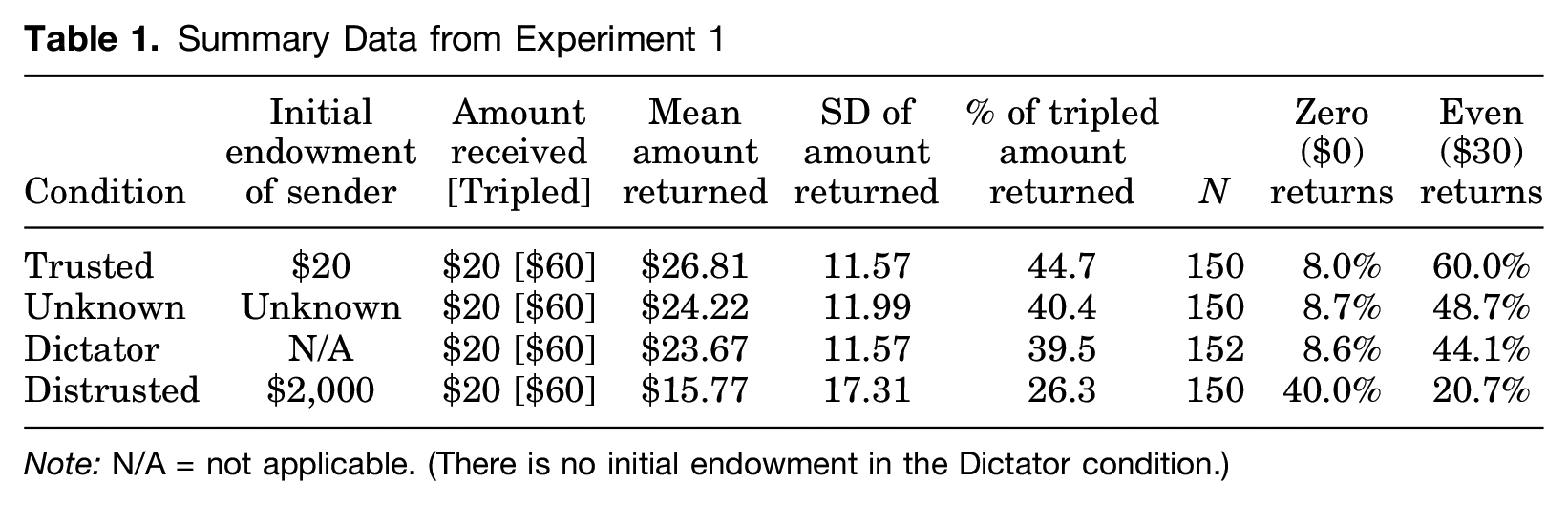
The results reported here include the full sample of 602 participants (no exclusions). A one-way ANOVA revealed a significant effect of condition on the amount returned by the participant, F(3, 598) = 19.29, p < .001, ηp2 = .088. Simple contrasts indicated that the amount returned in the trusted condition (M = $26.81, SD = 11.57) was greater than the amount returned in the dictator condition (M = $23.67, SD = 11.57), F(1, 598) = 4.18, p = .041, ηp2 = .007. And the amount returned in the distrusted condition (M = $15.77, SD = 17.31) was less than the amount returned in the dictator condition, F(1, 598) = 26.49, p < .001, ηp2 = .042. In addition, the amount returned in the unknown condition (M = $24.22, SD = 11.99) was greater than the amount returned in the distrusted condition, F(1, 598) = 30.53, p < .001, ηp2 = .049, and marginally lower than the amount returned in the trusted condition, F(1, 598) = 2.86, p = .092, ηp2 = .005. Participants in the dictator and unknown conditions did not differ significantly in the amount that they returned, F(1, 598) = .13, p > .71, ηp2 < .001. Participants returned more in the trusted condition than they did in the distrusted condition, F(1, 598) = 51.73, p < .001, ηp2 = .079. These results, which are shown in Table 1, demonstrate distinct trust and distrust effects relative to the control condition. Moreover, the size of these effects was asymmetric; on average, participants in the distrusted condition returned $7.90 less than participants in the dictator condition, whereas participants in the trusted condition returned $3.14 more.
Summary Data from Experiment 1
Note: N/A = not applicable. (There is no initial endowment in the Dictator condition.)
Furthermore, the results of our new unknown condition suggest that participants do not bring to the trust game an expectation of being distrusted. We interpreted the results in this way because participants in the unknown condition returned significantly more than participants in the distrusted condition. Participants in the unknown condition returned only marginally less than participants in the trusted condition, which suggests that players were more likely bring to the trust game an expectation of being trusted rather than being distrusted. However, our conclusion is tentative because outcomes in the unknown condition did not differ significantly from the dictator condition (where neither trust nor distrust is at work). Individual differences among participants in the unknown condition may have resulted in heterogeneous inferences (i.e., a majority of participants assumed that they were trusted, whereas the rest assumed they were distrusted), explaining why the average response resembled the dictator condition.
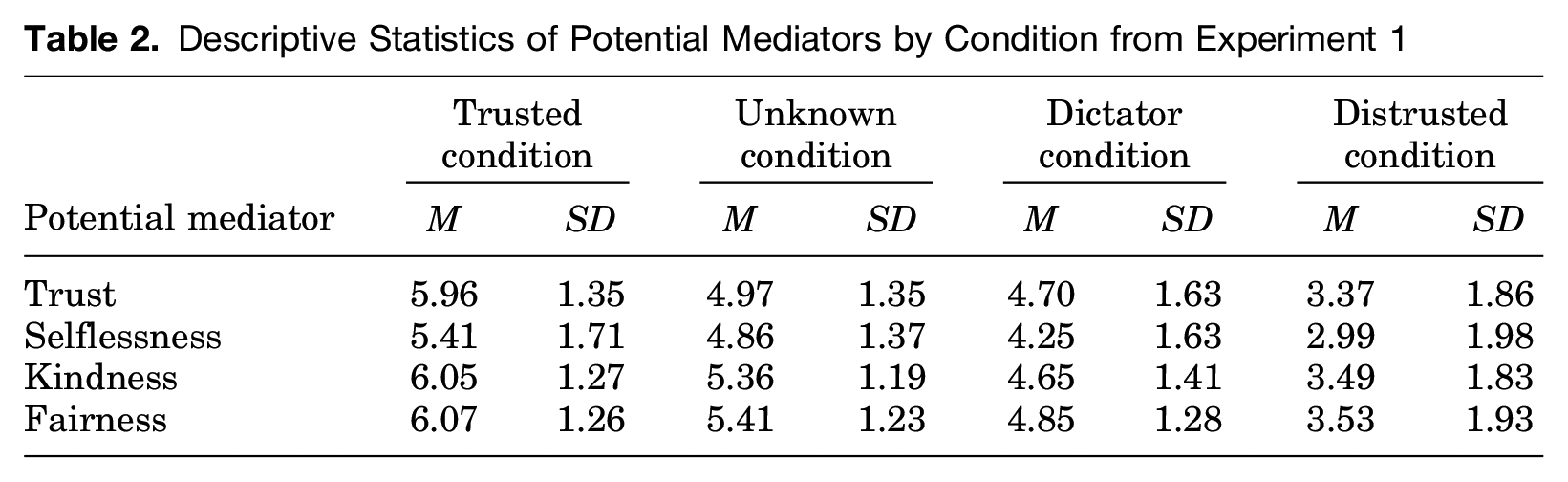
We examined the extent to which participants felt the other player in the scenario had trusted, treated them kindly, behaved selflessly, and treated them fairly. Mean ratings (1 = completely disagree, 7 = completely agree) appear in Table 2. Ratings for all items (i.e., trust, kindness, selflessness, fairness) were higher among participants who were trusted and lowest among participants who were distrusted. All ratings of participants in the dictator game and unknown conditions were in between the trusted and distrusted conditions but did not differ from one another.
Descriptive Statistics of Potential Mediators by Condition from Experiment 1
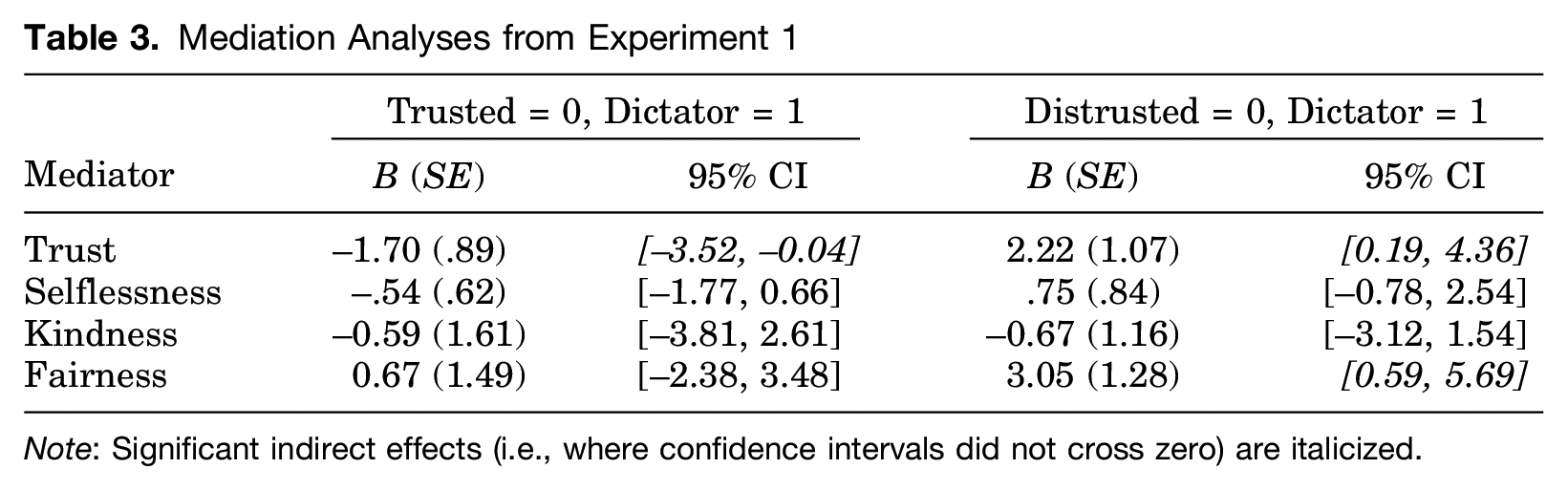
Next, we conducted mediation analyses using the PROCESS macro developed by Hayes (2017) to examine whether any of the four ratings mediated the effect of experimental condition on the amount returned. Each of these mediation analyses utilized bootstrapping with repeated extraction of 10,000 samples (Hayes 2017, Model 4). We ran two separate mediation analyses, in which the trusted condition or the distrusted condition (coded as 0) was compared with the dictator condition. In each mediation analysis, all four ratings (i.e., trust, selflessness, kindness, and fairness) were simultaneously included as potential mediators.
The mediation results are summarized in Table 3, with all significant indirect effects (i.e., where confidence intervals did not cross zero) italicized. The difference in amount returned between the trusted condition and the dictator condition was mediated by trust. Both trust and fairness mediated the difference in amount returned between the distrusted condition and the dictator condition. None of the other potential mediators produced a significant indirect effect in any of the mediation analyses. These results suggest that (perceived) trust mediates differences in responses between the trust game and the dictator game. Moreover, these results may suggest an explanation for the previously mentioned asymmetry in amount returned between the distrusted and trusted conditions, relative to the dictator condition. Participants in the distrusted condition were motivated by both perceived distrust and considerations of unfairness, which may have led to the larger gap.
Mediation Analyses from Experiment 1
Note: Significant indirect effects (i.e., where confidence intervals did not cross zero) are italicized.
Experiment 2
In Experiment 2, we attempt to replicate the finding that trust begets trustworthiness. And we investigate a further effect: when A trusts B, does this have a further effect on whether B trusts another player, C, in a second (unrelated) experiment? In other words, does trust beget trust in others?
Method
We conducted Experiment 2 with a sample of 420 Americans (mean age = 40.30, SD = 11.96, 49.29% female) recruited from Amazon Mechanical Turk. Participants were randomly assigned to one of two conditions (trusted, dictator).
Participants were asked to imagine that they were playing an economics game in which they had been given $100 in a sealed envelope. Those in the trusted condition played the role of B (the receiver) in the trust game. Specifically, they were informed that the $100 was given to them by another player (a fictional “A”). They learned that the other player had received $100 at the start of the game, all of which he or she had chosen to send. Participants in the dictator game condition instead learned that the $100 came from the game’s coordinator (i.e., not another player), and it was up to them to decide how much of the tripled amount ($300) they wanted to send on to another player.
Next, participants learned that they would be playing the trust game with someone else (i.e., not the same person as the first game). Their task this time was to decide how much to allocate initially. Participants learned that the second game was completely separate from the first one, with all decisions and payouts unrelated to the first game they had just played. Participants learned that they began with $100 (i.e., in the role of A) and needed to decide how much to send to the other player, who was in another room. Whatever amount they sent would be tripled, and B would then have the opportunity to allocate this total amount between A and B. Experiment 2 utilized the same incentive-compatible design that was used in Experiment 1.
Results
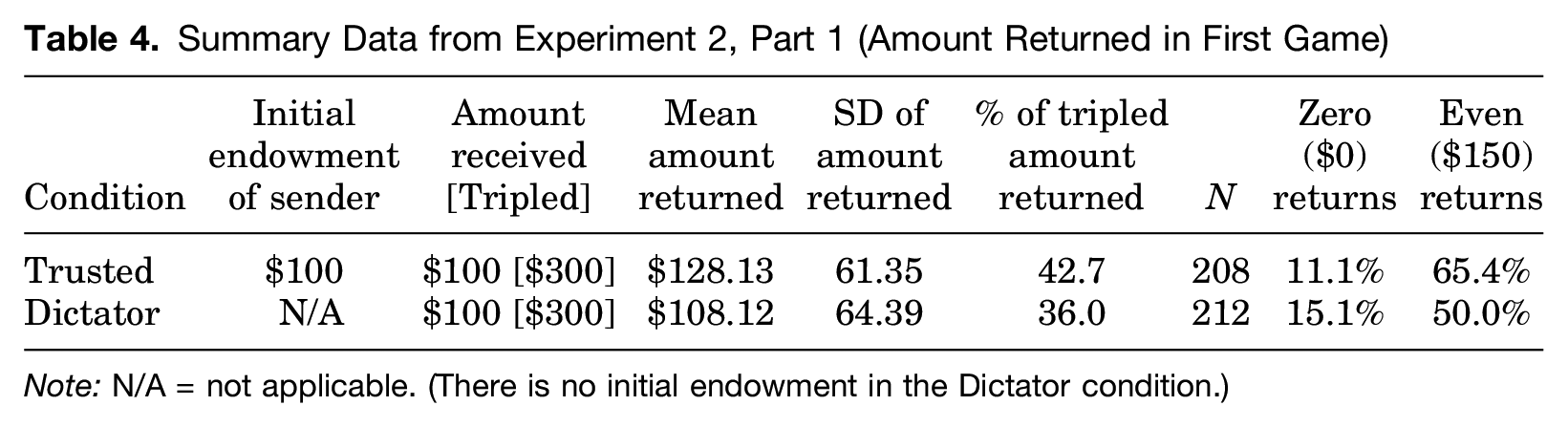
The results reported here include the full sample of 420 participants (no exclusions). A t test revealed a significant effect of condition on the amount returned by the participant in the first game, t(418) = 3.26, p < .01, d = .32. Receivers returned more in the trusted condition (M = $128.13, SD = 61.35) than they did in the dictator condition (M = $108.12, SD = 64.39). These results, which are shown in Table 4, replicate our findings from the same conditions in Experiment 1, in particular that trust begets trustworthiness.
Summary Data from Experiment 2, Part 1 (Amount Returned in First Game)
Note: N/A = not applicable. (There is no initial endowment in the Dictator condition.)
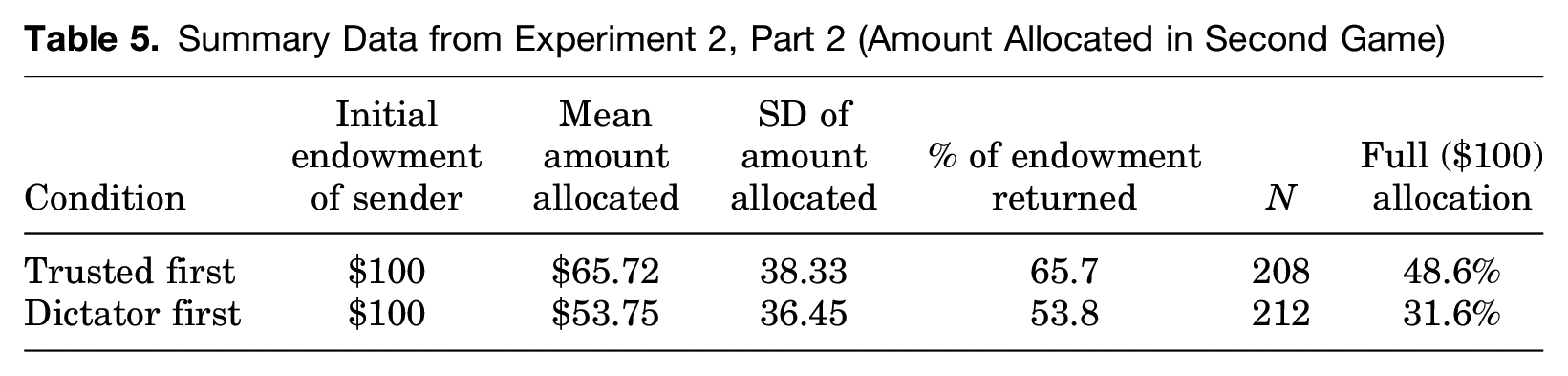
Another t test showed a significant effect of condition on the amount sent by the participant in the second game, t(418) = 3.28, p < .01, d = .32. Those who had been trusted in the first game sent more of their $100 in the second game (M = $65.72, SD = 38.33) than those who had played the dictator game initially (M = $53.75, SD = 36.45). These results, which are shown in Table 5, support our proposition that trust begets trust in others.
Summary Data from Experiment 2, Part 2 (Amount Allocated in Second Game)
We replicated this basic pattern of results with a separate sample of undergraduate students. Given the similar effect sizes across studies, these effects appear to be robust across disparate samples. 6
We also conducted a mediation analyses in Experiment 2 using the PROCESS macro (Hayes 2017) to examine whether the amount returned to the sender in the first game mediated the effect of experimental condition on the amount sent in the second game. This mediation analysis allowed us to compare the dictator condition (coded as 0) with the trusted condition (coded as 1). When estimated using 10,000 bootstrapped samples, the indirect effect was found to be significant (β = 5.78, SE = 1.77), with the 95% confidence interval excluding zero [2.28, 9.29]. This result indicates that being trusted leads to trustworthiness (i.e., reciprocating trust), which consequently increases one’s willingness to trust others.
Discussion
The trust game has been widely used to study the question of whether trust begets trustworthiness, but the empirical evidence has remained inconclusive. The present research makes three important contributions related to this question.
First, Experiment 1 distinguished between trust and distrust effects—each measured against a dictator game control condition. The control and the separate trusted and distrusted conditions were all essential: we found a significant difference between the amount returned in the trusted condition compared with the control and also a significant difference between the amount returned in the distrusted condition again compared with the control. Second, unlike prior work, our first experiment relied on mediation analysis to confirm our interpretation: perceived trust does indeed mediate player B’s decisions about how much to return in both the trusted and distrusted conditions compared with the control. The use of mediation analysis is itself a contribution because it provides more direct evidence for the role of trust than prior research has produced. Third, the results of our new unknown condition suggest that players were more likely to bring into the trust game an expectation of being trusted rather than being distrusted. Experiment 2 confirmed our finding that there is a trust effect.
These findings naturally raise questions about why past results involving the trust game were inconsistent and even contradictory. We can only speculate because past studies did not include mediation analysis and only inferred motivations—by comparing outcomes in an experimental condition against a control. As a result, we cannot rule out failed manipulations (perhaps participants in certain samples did not sufficiently attend to the stimuli and therefore did not notice the sender’s signal of trust or distrust). In addition, given that the overall size of the trust effect in our experiments was modest—Cohen’s d was .27 and .34 in Experiments 1 and 2, respectively—sample size differences could have also played a role. Our experiments involved 602 (Experiment 1) and 420 participants (Experiment 2) in the role of player B, while providing incentive compatibility, compared with much smaller samples in most previous studies involving the trust game. The sample sizes in those experiments could have been too small to find an effect.
With respect to the question of whether trust begets trustworthiness, the present work offers further theoretical contributions. Although we anticipated finding a distrust effect, we also found an asymmetry in that being distrusted has a greater effect on behavior than being trusted. Our mediation analysis suggested one reason for this asymmetry, namely, that motivations tied to both trust and unfairness affected the behavior of persons who were distrusted, but fairness did not play a role when persons were trusted. In addition, our results suggest that persons expect to be trusted more than they expect to be distrusted, so subjects in the distrust condition therefore responded more strongly when this expectation was not met. Though not anticipated a priori, this asymmetry has been reported in other articles (e.g., Chang and Fang 2013; Ou and Sia 2010). The role of expectations in determining how persons respond to being trusted or distrusted warrants further investigation.
Experiment 2 makes another theoretical contribution by documenting a further consequence of being trusted that has not been previously shown. The trust game has explored the effects of trust within dyadic relationships; persons reciprocate trust, and equivalently, trust begets trustworthiness. But our further question was whether B’s being trusted affects B’s willingness to trust others. Experiment 2 showed that B’s being trusted has a transitive effect and fosters trust in relationships with other persons. Our findings are consistent with a collective norm explanation of generalized exchange (e.g., Ekeh 1974; Takahashi 2000) and suggest that an initial act of trust can establish a group norm that shapes further interaction.
Our experiments demonstrate that trust begets trustworthiness and that trust begets trust in others. And these findings reaffirm the utility of the trust game in modeling trust and studying the consequences of being trusted or distrusted—both within and across relationships.
Supplemental Material
sj-docx-1-spq-10.1177_0190272520965192 – Supplemental material for Trust Does Beget Trustworthiness and Also Begets Trust in Others
Supplemental material, sj-docx-1-spq-10.1177_0190272520965192 for Trust Does Beget Trustworthiness and Also Begets Trust in Others by Marc A. Cohen and Mathew S. Isaac in Social Psychology Quarterly
Footnotes

1
To the extent that B receives the same amount to distribute, analyzing the proportion or the amount he or she returns will yield the same conclusions.
2
Note, Lewicki, McAllister, and Bies (1998) argue that trust relationships are multidimensional, meaning that there could be both trust and distrust within a relationship at the same time: A might trust B in the sense of being confident in A’s commitment to do X, but at the same time A could distrust B with respect to Y (perhaps because of past trust violations or perhaps because B lacks the skill to do Y). So for Lewicki et al., high trust (characterized by hope, faith, confidence, assurance, and initiative) is consistent with high distrust (characterized by fear, skepticism, cynicism, wariness, and vigilance), resulting in a “highly segmented and bounded” relationship described in terms of “trust but verify.” A multidimensional trust/distrust relationship of this sort is highly context dependent. The trust game is designed to remove all context; trust relationships are one-dimensional, and this leaves player B taking a small amount sent to represent distrust.
4
This design allowed us to ensure that participants across conditions had all received exactly $20, which adds experimental control and enables us to focus on the amount sent.
5
The four negatively worded statements were “The other player in the prior scenario distrusted me/treated me unkindly/behaved selfishly/ treated me unfairly” (1 = completely disagree, 7 = completely agree).
6
A sample of 105 undergraduate students from an American university (mean age = 19.95, SD = 1.59, 34.0% female) completed both games on paper rather than online. In the first game, receivers again returned more in the trusted condition (M = $138.13, SD = 60.87) than they did in the dictator condition (M = $116.92, SD = 64.62), t(102) = 1.74, p = .08, d = .34. In the second game, those who had been trusted in the first game allocated more of their $100 (M = $69.98, SD = 69.48) than those who had played the dictator game initially (M = $52.15, SD = 43.99), t(101) = 1.56, p = .12, d = .31. Although these differences did not cross the threshold for statistical significance, we believe this is primarily due to the limited size of our student sample particularly since the effect sizes were similar across studies.
Bios
References
Supplementary Material
Please find the following supplemental material available below.
For Open Access articles published under a Creative Commons License, all supplemental material carries the same license as the article it is associated with.
For non-Open Access articles published, all supplemental material carries a non-exclusive license, and permission requests for re-use of supplemental material or any part of supplemental material shall be sent directly to the copyright owner as specified in the copyright notice associated with the article.
