



Abstract
Affect control theory shows how cultural meanings for identities and behaviors are used to form impressions of events and guide social action. The theory’s impression formation equations are the engine of its predictions about events and the deflection they generate (i.e., how much they violate, versus conform to, cultural prescriptions). In this research, I examine the relationship between affective (deflection) and cognitive responses to events, with a focus on judgments of event likelihood. I present a series of analyses that show that event likelihood judgments are impacted by events’ perceived normativity, commonality in social life, and our personal experience with events like them and by the appearance likelihood of the actors, combinations of actors, and behaviors they involve and that likelihood ratings and deflection most often diverge for institutionally vague events. I additionally show that deflection computed using Heise’s 2014 impression-change equations strongly predicts event likelihood.
Affect control theory (ACT) is a formal, quantitative theory that shows how cultural meanings for identities and behaviors shape impressions of events and guide social action (Heise 2007). The theory’s impression formation equations are the engine of its predictions about events and the deflection they generate (i.e., how much they violate, versus conform to, cultural prescriptions for situated social action). First estimated more than 40 years ago (Heise 1979), ACT’s original models of impression formation among U.S. English speakers have been corroborated by survey, experimental, and naturalistic evidence from a research program spanning several decades (e.g., Heise and MacKinnon 1987; Robinson and Smith-Lovin 1992; Smith-Lovin and Douglass 1992). The models demonstrate the important role of affective processes in guiding social action, enabling us to rapidly assess and respond to social events without the need for significant cognitive work.
As a signal of affective misalignment between our situational circumstances and cultural sentiments, deflection plays an essential role in our ability to effectively tune our behavior to cultural norms and respond appropriately in even unfamiliar social situations. Yet, surprisingly little work has examined the relationship between affective responses to events (deflection) and event-specific cognitions, such as judgments of event likelihood—or the event characteristics that may influence each. ACT researchers have largely assumed that both assessments of event likelihood and deflection derive from the perceived normativity or appropriateness of an event, but this has never been formally tested. In addition, the relationship of event likelihood and deflection to the likelihood that particular event components (e.g., identity labels, behaviors, or actor pairings) will appear has not been previously explored.
In this research, I interrogate the interpretive bases of event likelihood judgments by examining the relationship between likelihood and deflection and the relationship of each to events’ normativity or appropriateness, commonality or frequency, and our personal familiarity or experience with events like them as well as the perceived likelihood of event components, including the appearance likelihood of given identity labels and behaviors and the likelihood of particular actor pairings. I replicate and extend Heise and MacKinnon’s (1987) analysis of events rated more or less likely than predicted by deflection, examining how these patterns are predicted by component likelihood and the institutional concordance and clarity of the identities involved. In performing these analyses, I provide a preliminary validity assessment of a recent update to ACT’s impression change models (Heise 2014) by testing the relationship between deflection as calculated with these equations and likelihood ratings for 128 events.
ACT
ACT is a formal, quantitative theory that explains how people process and respond to social events (Heise 1979, 2007). The theory offers a precise and generative model of situated social action grounded in cultural sentiments for identities and behaviors and culture-specific mechanisms of impression formation, which are reflected in the data and equations researchers use to model social events. In what follows, I will briefly introduce the three basic components of the theory: cultural dictionaries, impression formation models, and the affect control principle. For a comprehensive review of the theory, see Heise (1979, 2007).
Affect control theorists aggregate quantitative data on cultural sentiments in data repositories known as cultural dictionaries. Dictionary data are gathered through rating studies, in which respondents in a given language culture report their fundamental sentiments for identities, behaviors, and other concepts along three affective dimensions—evaluation (good–bad), potency (powerful–powerless), and activity (lively–inactive)—on scales ranging from –4.3 (infinitely bad, powerless, inactive) to 4.3 (infinitely good, powerful, lively). Known collectively as EPA, these three dimensions are foundational to human interaction and communication (Scholl 2013) across more than 20 cultures (Osgood, May, and Miron 1975; Osgood, Suci, and Tannenbaum 1957).
Impression formation models are used in conjunction with cultural dictionaries to run mathematical simulations of social interactions. These simulations generate predictions about the transient impressions produced by a given event as well as the resulting pattern of social action. Transient impressions are the event-specific impressions produced when identities and behaviors appear together in the context of an interaction. Events are characterized by a sentence-length vignette of the form actor-behavior-object (e.g., a mother hugs a child). A set of nine impression-change equations are used to predict transient impressions of the EPA of each event element. While our transient impressions of some events may be quite similar to our fundamental sentiments for the actors involved (e.g., a mother hugs a child), our impressions of others may diverge quite significantly from these sentiments (e.g., a mother abuses a child). While first developed for U.S. English speakers (Heise 1979), impression formation equations have since been created for several other language cultures.
ACT is a control system model (Robinson 2007) oriented around the affect control principle. According to this principle, we are motivated to align our transient impressions of events with our fundamental sentiments for the actors and behaviors involved. A mismatch between the two generates deflection and prompts us to take some action that will restore order and make the interaction sensible by bringing our impressions back into alignment with fundamental sentiments. Conceptually, deflection is the discrepancy between fundamental sentiments and transient impressions of the actor, behavior, and object involved in a given event. Mathematically, it is operationalized as the sum of the squared Euclidean distances between fundamental sentiments and transient impressions across all event elements. The greater the affective misalignment between our cultural sentiments and impressions of events, the greater the deflection.
Event Likelihood and Deflection
Heise (2014) recently estimated new ACT models of impression formation among U.S. English speakers, using analysis of variance and structural equation modeling to produce a more parsimonious and reliable coefficient structure than base model estimates. The techniques used to estimate these equations outperform those used to build prior ACT models (Morgan, Rogers, and Hu 2016). Yet, no study to date has systematically assessed the relationship of deflection estimates based on these models, which drive the theory’s predictions about social events, and judgments of event likelihood. While Heise’s (2014) impression formation models were estimated using the same data as earlier such models and include many of the coefficients found in these models, some coefficients were eliminated and the weights of those retained changed. These models are also collapsed across gender—a departure from earlier model estimates that recent work suggests is appropriate, as impression formation processes do not differ significantly for male and female U.S. English speakers (Rogers 2018). In this article, I compare deflection for 128 events, estimated using Heise’s (2014) models, to likelihood ratings of the same 128 events using methods that follow earlier ACT studies of event likelihood (e.g., Heise and MacKinnon 1987).
Deflection is the lynchpin of ACT’s control system model of meaning maintenance, yet surprisingly little research has examined the construct and how it relates to cognitions about social events. Prior research has linked deflection to event likelihood, broadly construed, showing that events low in deflection are seen as significantly more likely and vice versa (e.g., Heise and MacKinnon 1987; Smith-Lovin and Douglass 1992). Little is understood, however, about the predictors of event likelihood that are most relevant as an interpretive force in social action and meaning maintenance. The present research examines this important concept and helps to disambiguate its meaning and interpretive function by examining its relationship with event-specific cognitions.
Likelihood judgments relate to the ease of constructing a representation of an event in the mind. Events we can more readily imagine seem more likely (Heise and MacKinnon 1987). Cognitive psychologists have shown, for instance, that events involving actors and actions we encounter more often, events that conform more closely with cultural standards, and events that are more easily recalled are judged to be more likely than others (e.g., Kahneman, Slovic, and Tversky 1982). Judgments of event likelihood may also be affected by our perception that certain identity enactments, behaviors, or actor-object pairings are more likely to occur in social life than others due, for example, to the number of people we believe to possess certain identities or engage in certain behaviors, their relevance across diverse interaction settings versus institutional boundedness, their cultural prototypicality versus deviance, or the vernacular used to describe them. Cognitions such as these are an imperfect reflection of social reality, powerfully shaped by the institutional and organizational structures and networks of social ties in which we are embedded (Smith-Lovin 2007).
Given ACT’s symbolic interactionist foundations (see MacKinnon 1994), scholars have most often assumed that event likelihood and deflection have to do with how culturally normative or appropriate a particular encounter seems (Heise 1979, 2007). Yet the preceding suggests that at least two other factors shape our affective and cognitive responses to events: their rarity or commonality in social life and our personal experience, or lack thereof, with events like them. In addition, our affective and cognitive responses to events may be affected by our judgments of the likelihood of particular elements of the event, including the perceived likelihood of certain identities or behaviors appearing in events of any kind and the likelihood of certain identities being copresent in the same event. Likelihood judgments may also be affected by the cultural sentiments attached to particular identities and behaviors, with events involving more prototypical and socially desirable actors and actions seeming more likely. Each of these matters is explored here.
Finally, Heise and MacKinnon (1987) found, in their likelihood study of earlier ACT models, that the perceived likelihood of certain events was not especially well explained by deflection alone, particularly events involving institutionally vague actors—those without clear relationships to defined social institutions (e.g., law, medicine, family, sport, education). I close the article with a similar analysis, examining which events are rated significantly more or less likely than predicted by deflection alone and considering the relationship of this discrepancy to both institutional clarity and component likelihood.
The Present Research
As previously outlined, this brief article has several goals. First, I assess the relationship between deflection values as computed using Heise’s (2014) new impression formation models for ACT and respondents’ ratings of overall event likelihood for 128 events. Second, I examine the relationship of event likelihood ratings and deflection to judgments of an event’s normativity or appropriateness, its commonality or frequency in social life, and respondents’ personal experience or familiarity with events like it. Third, I examine how the likelihood of an event is influenced by our judgment that certain identities and behaviors are rarely versus often encountered in social life and by our expectation that some types of actors are more likely to interact with one another than others. Finally, I identify events for which likelihood ratings and deflection diverge and investigate potential predictors of this discrepancy, including institutional clarity and component likelihood. This research continues the important work of Heise and MacKinnon (1987), addressing unexplained variance in interpretive responses to events and explaining how cognitions about events and their characteristics contribute to these responses.
Method
Participants
A total of 205 respondents, recruited through Amazon Mechanical Turk, participated in this research. All respondents were U.S. born, lived in the United States at the time of the study, and were native English speakers. The sample was 59 percent male, 89 percent heterosexual, 76 percent white, and between 18 and 59 years of age.
Design and Procedure
Respondents answered a series of questions about a set of 128 sentence-length event vignettes typical of those used to estimate ACT impression formation models (see Heise 2007). Each event sentence takes the form of actor-behavior-object (e.g., a mother hugs a child). The event list was constructed using a Graeco-Latin square design, crossing all possible within-event combinations of positive and negative EPA profiles for the actors, behaviors, and objects represented based on EPA ratings from prior work (Francis and Heise 2006). This design efficiently maximizes variation across the events included in the stimulus set (see Heise 2010).
After providing consent and completing a brief demographic survey, respondents rated the likelihood that certain actors, behaviors, and objects would appear in an interaction of any kind (actor, behavior, object likelihood), the likelihood that certain actors and objects would appear together in an interaction (actor-object likelihood), and the overall likelihood of certain events (overall likelihood). Respondents also reported their judgments of an event’s normativity or appropriateness (normativity), the frequency or commonality of its occurrence in social life (commonality), and their personal familiarity with events like it (familiarity). Each of these ratings was submitted on a continuous slider scale ranging from 1 = not at all to 7 = extremely. 1 After completing all study measures, respondents were compensated for their time.
Respondents were randomly assigned to complete one of four study modules, in which they rated a subset of the overall stimulus list on the measures outlined earlier. The modules differed from one another only in the specific stimuli rated. This strategy was employed to minimize rater fatigue given the size of the stimulus set and to minimize multicollinearity by ensuring that respondents rated the component likelihood of event elements (i.e., actors, behaviors, objects, and actor-object pairs) that did not appear in events for which they rated normativity, commonality, familiarity, and overall likelihood. Approximately 50 respondents were assigned to each study module. No formal hypotheses were made in advance of data collection; the research was exploratory and inductive.
Analyses
In the following, I present the results of four sets of ordinary least squares (OLS) regression analyses that address each of my research goals. The first analysis examines whether deflection values computed using Heise’s (2014) impression formation equations predict respondents’ ratings of overall event likelihood. The second set of analyses examines three cognitive judgments about events that may contribute to event likelihood and deflection: normativity, commonality, and familiarity. The third set of analyses examines how component likelihood (i.e., the likelihood of the actor, behavior, and object appearing in an event of any kind and of the actor-object pairing) contributes to overall event likelihood and deflection. The fourth set of analyses explores discrepancies between event likelihood ratings and predicted likelihoods based on deflection to determine which event characteristics best explain why certain events seem more or less likely than would be predicted by deflection alone.
Results
Deflection as a Predictor of Event Likelihood
Following earlier research, findings support the idea that the perceived likelihood of an event is partly a function of affective processes. Deflection had a significant negative relationship with event likelihood ratings (b = −.174, p < .001). Events that generated more deflection (affective disturbance) seemed less likely. This provides evidence supporting deflection, as calculated with the new ACT equations (Heise 2014), as a predictor of event-specific cognitions, using the same metric as applied in earlier work. Notably, deflection explained 11.3 percent of the variance in event likelihood in this research versus 33 percent in Heise and MacKinnon’s (1987) research. Two design differences between studies may account for this discrepancy: Heise and MacKinnon examined a larger corpus of events (515) than the present research (128) and gathered likelihood ratings of the same events used to estimate the impression change equations employed in that research (Heise 1979). In contrast, the stimuli used in this research were distinct from those used to estimate the equations (Heise 2014).
Interpretive Bases of Event Likelihood and Deflection
My second analysis examines three potential interpretive bases of event likelihood and deflection: the normativity or appropriateness of an event, its frequency or commonality in social life, and one’s personal familiarity or experience with events like it. Respondents’ ratings of events on these measures were highly intercorrelated, for commonality and familiarity in particular (see Table A.4 in the online appendix). Therefore, analyses were run separately for each predictor and dependent variable, and results were Bonferroni adjusted for multiple comparisons. The strong correlation between commonality and familiarity (r = .956) suggests that these measures capture related event-specific cognitions, which are somewhat distinct from judgments of normativity (r = .734–.757).
All three measures were significant positive predictors of event likelihood. Events judged to be more common (b = 1.046, p < .001), familiar (b = 1.202, p < .001), and normative (b = .758, p < .001) were also viewed as more likely (Table 1). While the general pattern of results was the same for deflection, the effect of normativity did not reach significance (b = −.303, p > .05). Events judged to be more common (b = −.710, p < .001) and familiar (b = −.700, p < .01) elicited significantly less deflection. While researchers have tended to think of the normativity or appropriateness of an event as the key force shaping the affect control process and judgments of event likelihood, these results suggest that they are also explained by the frequency or commonality of an event in social life and our personal familiarity with events like it.
OLS Regressions Testing the Effects of Normativity, Commonality, and Familiarity on Event Likelihood and Deflection (N = 128)
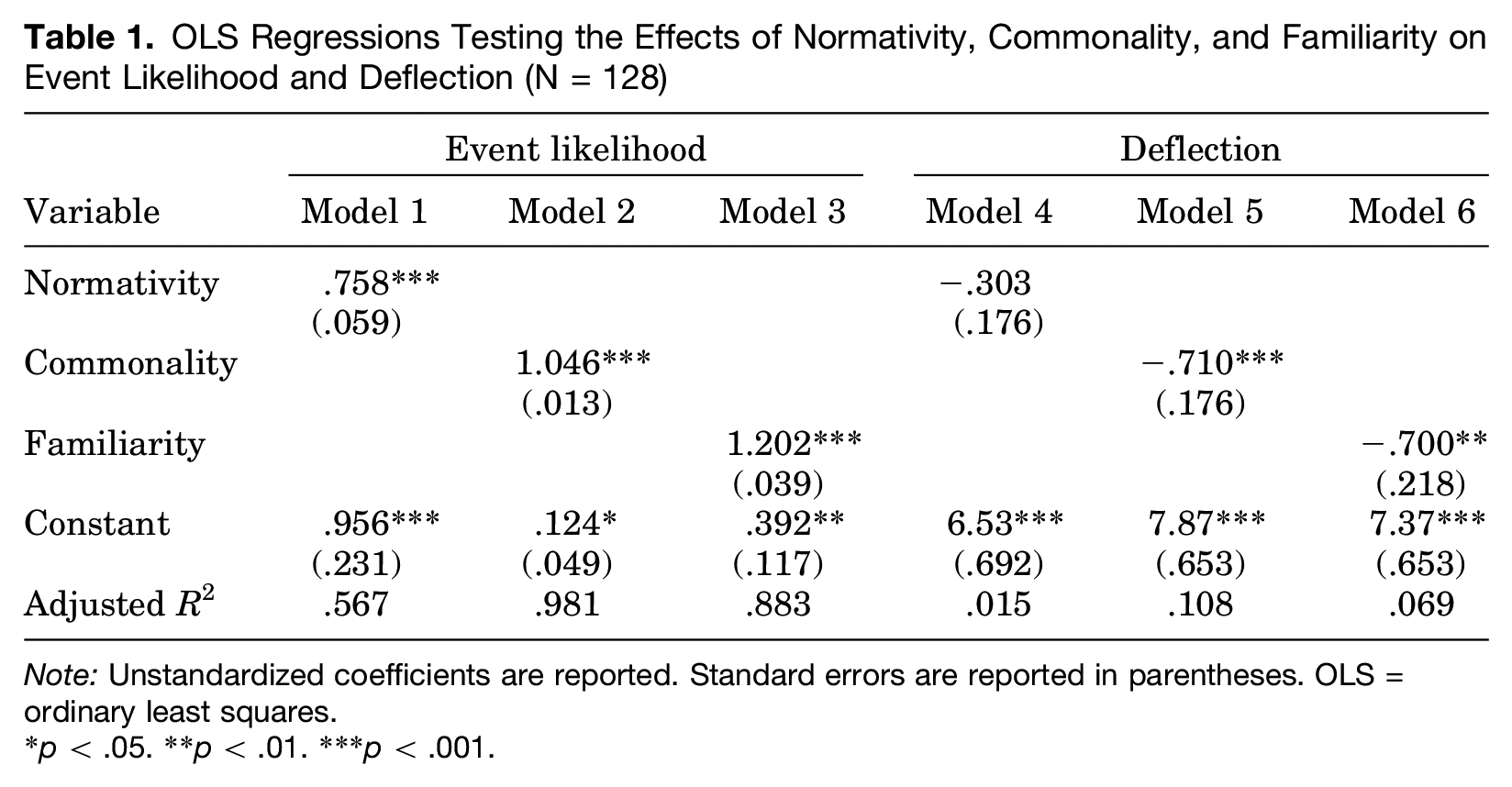
Note: Unstandardized coefficients are reported. Standard errors are reported in parentheses. OLS = ordinary least squares.
p < .05. **p < .01. ***p < .001.
Component Likelihoods as Predictors of Event Likelihood and Deflection
My third analysis examined how characteristics of the event in question predict event likelihood ratings and deflection, with a specific focus on the perceived likelihood that a given actor, behavior, or object will be involved in an event of any kind and that a given actor and object will appear together in an event. This analysis of component likelihood was accomplished through a series of OLS regression models wherein the perceived likelihood of each component of the event is examined as a predictor of the overall likelihood of the event. Models 1, 3, and 5 in Table 2 examine the effects of actor, behavior, and object likelihood ratings on overall event likelihood. Models 2, 4, and 6 add actor-object interaction likelihood as a predictor. Correlations among predictors were low and do not contribute appreciably to model collinearity (see Table A.5 in the online appendix). As a reminder, events in affect control theory are represented using a sentence-length vignette with three components, the actor (subject), behavior (verb) and object (e.g., a mother hugs a child).
OLS Regressions Testing the Effects of Component Likelihood on Event Likelihood, Deflection, and Likelihood Difference (N = 128)
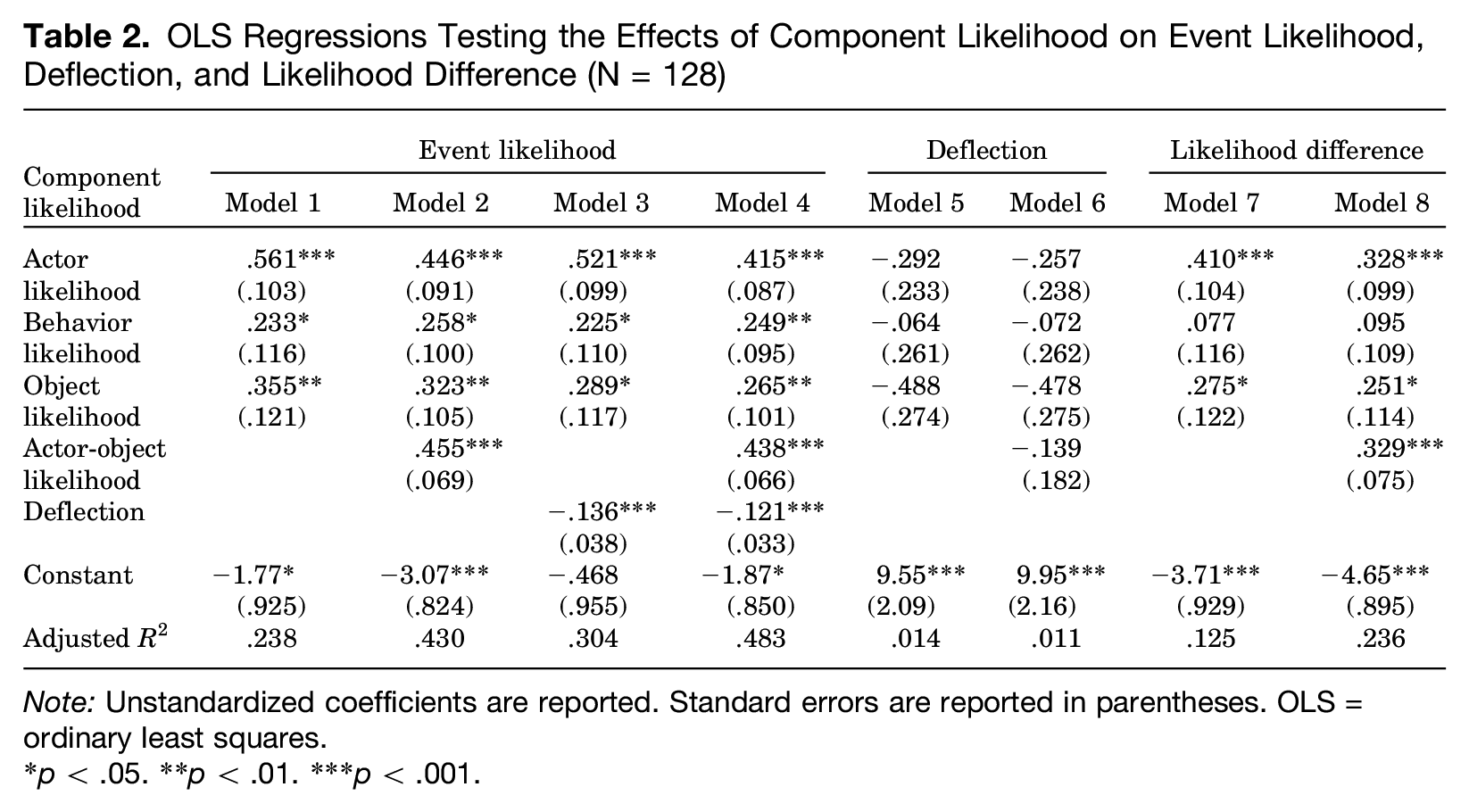
Note: Unstandardized coefficients are reported. Standard errors are reported in parentheses. OLS = ordinary least squares.
p < .05. **p < .01. ***p < .001.
Before running these analyses, I ran a set of OLS regressions examining the relationship between EPA ratings of identities and behaviors and respondents’ judgments of the likelihood that a given identity or behavior would be involved in an interaction of any kind (Table 3). Good (b = .330, p < .001), powerful (b = .144, p < .001), and active (b = .320, p < .001) identities were rated more likely to be involved in an interaction of any kind. While respondents rated good, active behaviors more likely than bad, inactive ones (evaluation, b = .459, p < .001; activity, b = .221, p < .001), they also rated weak behaviors more likely than powerful ones (b = −.392, p < .001).
OLS Regressions Testing the Effects of Concept EPA on Likelihood Judgments (N = 128)
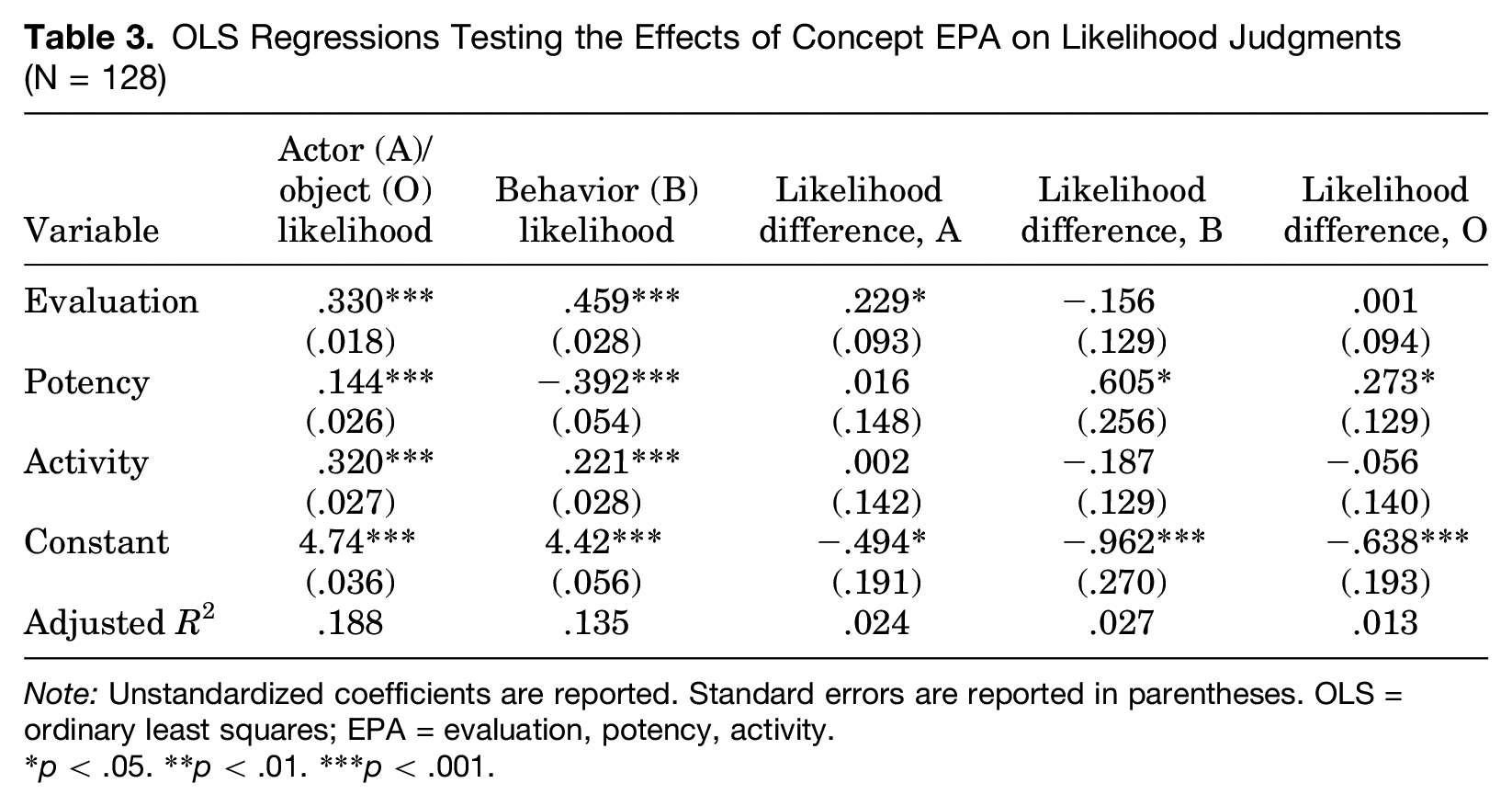
Note: Unstandardized coefficients are reported. Standard errors are reported in parentheses. OLS = ordinary least squares; EPA = evaluation, potency, activity.
p < .05. **p < .01. ***p < .001.
The perceived likelihood of the actor (b = .561, p < .001), behavior (b = .233, p < .05), and object-person (b = .355, p < .01) to appear in an event of any kind were all significant positive predictors of overall event likelihood (Model 1, Table 2). The likelihood of a given actor and object to appear together in an event was also a significant positive predictor of overall event likelihood (b = .455, p < .001), controlling for the effects of actor, behavior, and object likelihood (Model 2, Table 2). Thus, events seem more likely overall when they involve actors and objects we expect to be involved in interactions with others, especially one another (i.e., persons who are good, powerful, and active), and when they involve behaviors that are more commonplace (i.e., those that are good and active but weak). Model 2 explains 43 percent of the variation in event likelihood—19.2 percentage points more than Model 1.
Models 3 and 4 in Table 2 are structured similarly but add deflection as an independent variable in each model. Deflection had a significant negative relationship with event likelihood ratings in each model, and all component likelihood measures remained significant, as well. Thus, component likelihoods (cognitive responses to events) tell us something about events’ relative likelihood beyond what we gather from deflection (affective responses to events) alone. The model containing deflection and all dimensions of component likelihood (Model 4, Table 2) explained 48.3 percent of the variation in event likelihood, showing the combined explanatory value of the affective and cognitive responses to events studied in this research. When Models 1 and 2 were repeated with deflection as the dependent variable instead of event likelihood, each predictor had the expected negative relationship with deflection, but none reached significance (Models 5 and 6, Table 2).
Predictors of Discrepancies between Likelihood and Deflection
My final analysis compared predicted event likelihoods—calculated by inputting deflection values into the first model reported earlier, wherein event likelihood ratings were regressed on deflection—with observed likelihoods (respondent ratings of events). To identify events that were rated as far more or less likely than would be predicted by deflection alone, I calculated the difference between observed and predicted likelihoods for each event. Some interactions were rated as more likely than would be suggested by deflection levels alone (e.g., a registered nurse monitors a patient), while others were seen as less likely than predicted by deflection (e.g., a retiree monitors an executioner). I repeated the two component likelihood models described earlier with likelihood difference as the dependent variable in each model to determine which event characteristics were most predictive of these patterns.
As shown in Model 7 of Table 2, actor (b = .410, p < .001) and object (b = .275, p < .05) likelihood were significant positive predictors of likelihood difference. These variables remain significant in Model 8, which additionally identifies the likelihood of a given actor and object to appear together in an event as a significant predictor of likelihood difference (b = .329, p < .001). Events rated more likely than predicted by deflection alone involved identities we expect to appear in interactions (e.g., child, grandparent, athlete, registered nurse) as well as identities we expect to appear together in interactions (e.g., athlete–teammate, child–grandparent, registered nurse–patient, gangster–gunman, scientist–genius). Those rated less likely than predicted by deflection involved identities we do not expect to appear often in interactions (e.g., retiree, outlaw, lunatic, murderer) and identities we do not expect to appear together in interactions (e.g., murderer–divorcé, lunatic–applicant, retiree–serial murderer, gangster–priest, physician–outlaw).
These results suggest that events primarily seem more or less likely than predicted by ACT models due to the plausibility of particular identity enactments and combinations in social life. Events rated more likely than predicted by deflection alone often involved institutionally clear identities with a high likelihood of co-occurrence within a single institutional setting (e.g., law, medicine, family, sport, education, work). In contrast, one or both identities in most events rated less likely than predicted by deflection were institutionally vague, and co-occurring identities often spanned institutional settings. This pattern of results generally replicates the findings of Heise and MacKinnon (1987) and shows that the increased cognitive work required when processing institutionally vague events has partly to do with their low component likelihood.
Supplemental models examined the relationship between likelihood difference and EPA ratings of the identities and behaviors involved in events (Table 3). These models suggest that events were rated more likely than predicted by deflection alone when they involved nicer actors (b = .229, p < .05) and more powerful behaviors (b = .605, p < .05) and object persons (b = .273, p < .05).
Discussion
This article had several goals, each of which addresses a gap in the existing literature: to assess the relationship between deflection values computed using Heise’s (2014) new impression formation models for ACT and event-specific cognitions; to examine the interpretive bases of event likelihood and deflection, including their relationship to the normativity, commonality, and familiarity of events as well as our judgment that certain identity labels, behaviors, and actor-object pairings are rarely versus often encountered in social life; and to identify events for which likelihood ratings and deflection diverge and investigate potential predictors of this discrepancy, including institutional clarity and component likelihood.
First, my findings support Heise’s (2014) new impression formation equations for ACT, showing that deflection values computed with these equations strongly predict ratings of event likelihood. Events that generate more deflection seem less culturally likely. Second, although affect control theorists have typically considered events’ normativity or appropriateness to be the chief interpretive force shaping the affect control process, their frequency of occurrence in social life and our personal familiarity with events like them also shape judgments of event likelihood and deflection. The especially high correlation between commonality and familiarity judgments suggests that we judge the events with which we are most familiar as being the most prevalent in social life. In many cases, these are also the events we see as most normative.
Third, likelihood ratings are highest for events that involve good, powerful, and active actors and objects whom we expect to be involved in interactions with others and appear together in events as well as good, weak, active behaviors that we perceive to be more common in social life. Both deflection and component likelihood judgments have significant effects on overall event likelihood in combined models, suggesting that our cognitions about the prevalence of certain identities, identity combinations, and behaviors help to explain variations in event likelihood that are not well explained by deflection alone. Together, these affective and cognitive measures explain almost half of the variance in event likelihood judgments.
Fourth and finally, discrepancies between event likelihood ratings and deflection were explained by the probability of particular identity enactments and combinations in social life. Events rated more likely than predicted by deflection often involved respected actors, powerful objects and behaviors, and identities and actor-object pairings we expect to see in interactions. These events were also more likely to involve institutionally clear identities that co-occur within a single institutional setting than events rated less likely than predicted by deflection, which tended to be institutionally vague or span institutions. These results replicate and extend those presented by Heise and MacKinnon (1987), suggesting that events requiring significant cognitive work seem less likely than would be predicted by the affective disturbance they produce. This includes events involving institutionally vague or socially unexpected identities, institutionally or socially implausible actor-object pairings, bad actors, and weak objects and behaviors.
Taken together, these findings suggest that we experience lower affective disturbance and must do less cognitive work in social situations with which we are more personally familiar, that seem more culturally common and appropriate, that involve socially desirable identities and behaviors, and that involve actors, actor pairings, and behaviors that seem institutionally appropriate and socially likely. Events such as these readily unfold according to cultural scripts without need for much affective and cognitive work or behavioral modification. Events that do not have these qualities require us to restore order by either adjusting our behavior to fit our interpretation of events or reinterpreting events to make the interaction more sensible.
Because cognitions are an imperfect reflection of social life, it is worth noting that interactions involving deviant or underrepresented identity groups or uncommon actor pairings may be more affectively and cognitively disturbing than they are socially rare. Actors, actor pairings, behaviors, and events to which most members of our culture have routine exposure—either directly through interactions or indirectly through media representations, family and peer socialization, and so on—may seem more likely than they are in reality. These cultural dynamics are shaped by the demographic makeup of the population as well as structural forces, such as residential segregation and educational and occupational inequality, that bias our exposure to people and interactions of various types and shape our responses to events accordingly.
Future research should seek to identify additional factors that explain the residual variance in event likelihood judgments, evaluate whether these factors vary across cultures, and examine the contribution of deflection, as estimated using other ACT models of impression formation, to likelihood judgments. While deflection as estimated with Heise’s (2014) new equations was predictive of event likelihood judgments in this research, future work should also validate these equations more extensively by comparing the results of simulations run with these models to observations from experimental or field research.
Supplemental Material
sj-docx-1-spq-10.1177_0190272521997065 – Supplemental material for Event Likelihood Judgments Revisited
Supplemental material, sj-docx-1-spq-10.1177_0190272521997065 for Event Likelihood Judgments Revisited by Kimberly B. Rogers in Social Psychology Quarterly
Footnotes
1
More details on question wording, scale format, descriptive statistics, and the stimulus events examined in this research can be found in Tables A.1 through A.3 of the  to this manuscript. Study data are available upon request.
Bio
References
Supplementary Material
Please find the following supplemental material available below.
For Open Access articles published under a Creative Commons License, all supplemental material carries the same license as the article it is associated with.
For non-Open Access articles published, all supplemental material carries a non-exclusive license, and permission requests for re-use of supplemental material or any part of supplemental material shall be sent directly to the copyright owner as specified in the copyright notice associated with the article.
