



Abstract
Identity theory assumes that individuals seek identity verification in the form of consistency between the meanings implied by perceived feedback from others (reflected appraisals) and their own self-meanings (identity standards) during social interaction. When there is a lack of identity verification (discrepancy), individuals experience negative outcomes such as psychological distress. Most adults hold multiple identities, and discrepancies in certain identities may cause more distress than others. Moreover, reflected appraisals come from various sources, and discrepancies with certain sources may be more influential than others. Yet most research on identity verification has not included multiple identities or multiple sources of reflected appraisals. We use structural equation modeling to simultaneously investigate associations between identity discrepancies with four sources of reflected appraisals (spouse, family, friends, and others in general) and distress (depressive symptoms) in a sample of 735 respondents who occupy three identities (spouse/partner, parent, and religious). We find that discrepancies in more obligatory identities and those involving reflected appraisals from more proximal sources of feedback are most consistently associated with depressive symptoms. Implications of these findings for advancing identity theory and research are discussed.
According to identity theory, individuals have a set of self-meanings for each role, group, and person identity they claim (Burke and Stets 2009). During social interaction, they seek identity verification, which refers to consistency between perceptual input meanings (e.g., reflected appraisals) and self-meanings (identity standard), for each identity that is activated in a situation. Failure to align reflected appraisals and identity standards results in psychological discomfort and distress (Burke 1991, 1996). For example, if a father who considers himself a supportive parent harshly criticizes his son during a sporting event, he may infer from his son’s reaction that he is seen as unsupportive. To achieve consistency between his self-view and perceptual input, he may offer encouragement to his son and/or begin to see himself as a less supportive parent. If ongoing efforts to resolve the discrepancy are not successful, he is likely to experience distress.
Most adults hold multiple identities, which are activated together when they share meanings and role partners (Burke 2003). For example, family-based identities such as spouse and parent share meanings (e.g., love and support) and role partners (e.g., spouse and children). The religious identity may also be activated with these identities during religious activities and conversations about parenting. Thus, situations in which the spouse, parent, and religious identities are concurrently activated are likely common.
Despite overlap in meanings and context, these identities are distinct in their placement on the continuum between obligatory and voluntary. Relative to voluntary identities like religion, obligatory identities like spouse and parent involve longer-term, more affectively intense ties to others; more demanding mutual rights and responsibilities among role partners; and more constraint in that they are structurally and emotionally difficult to exit (Thoits 2003). Furthermore, obligatory identities are culturally important because their continuity maintains social structure, so discrepancies in them may have stronger negative consequences for distress (Burke and Stets 2009). Most identity research focuses on one identity at a time (Stets and Trettevik 2014), preventing tests of the relative influence of discrepancies in different types of identities.
Just as individuals hold multiple identities, they receive feedback from multiple sources. Reflected appraisals are individuals’ perceptions of how others respond to them (Sullivan 1953). The “others” implicated in a reflected appraisal range from specific people with whom one interacts (e.g., spouse) to groups of which one is a part (e.g., family) to the generalized other (e.g., cultural norms and expectations for the social position of spouse; Mead 1934). An identity discrepancy involving any of these sources should contribute to negative outcomes such as distress, but the amount of distress may vary by source. Compared to discrepancies involving a distal source like others in general, discrepancies with close, proximal others such as role partners and reference groups may cause more distress because of their direct implications for ongoing relationships and interaction (Burke 1991). Most identity research includes a single source of reflected appraisals (e.g., Kalkhoff, Marcussen, and Serpe 2016; Stets and Trettevik 2016) or averages reflected appraisals from multiple sources (e.g., Stets et al. 2017; Stets and Harrod 2004), leaving questions about the relative influence of discrepancies involving different sources.
In this study, we examine the relationship between identity discrepancies and depressive symptoms in multiple identities that range from obligatory (spouse/partner, parent) to voluntary (religious). We also extend previous research by simultaneously examining multiple sources of reflected appraisals including role partners (spouse), reference groups (family and friends), and the generalized other (others in general) among individuals who hold three common social roles that are often activated together in daily life. Distinguishing between identities and sources of reflected appraisals in one study will offer insight into the robustness of the relationship between identity discrepancy and distress and the relative influence of discrepancies involving different identities and sources of feedback in identity processes.
Background
Identity Theory
Identities are “internalized positional designations” (McCall and Simmons 1978:60), and individuals have an identity standard for every social position they occupy, group to which they belong, and personal attribute they possess (Burke and Stets 2009). Each identity standard is comprised of self-meanings related to a given identity. Identity theory specifies a process through which identities are managed during interaction (Burke 1991, 1996; Burke and Stets 2009), with a goal of maintaining consistency between reflected appraisals and self-views in the identity standard by “controlling” the input through behavior or cognition (Stets et al. 2020). When input is inconsistent with the identity standard, individuals attempt to change their behavior or modify their self-view so that subsequent feedback will be closer to their identity standard. This process typically operates smoothly, with minor adjustments happening without disruption to normal activities. However, when attempts to bring reflected appraisals in line with the identity standard fail, individuals experience negative emotions and distress (Burke 1991, 1996).
Distress responses occur regardless of the direction of discrepancy (Stets and Serpe 2013). That is, whether reflected appraisals are more positive than self-appraisals (overevaluation) or more negative than self-appraisals (underevaluation), nonverification produces stress and psychological discomfort (Burke and Harrod 2005; Stets and Burke 2014). Conversely, behavior and cognition depend on the direction of discrepancy in that different responses are required to address overevaluation versus underevaluation (Stets and Serpe 2013).
To restore verification, behavioral responses to overevaluation would seek to generate more negative feedback from others, whereas behavioral responses to underevaluation would attempt to produce more positive feedback. For example, suppose a student perceives that her professor believes that she is more diligent than she sees herself (an overevaluation). She might seek more negative feedback by decreasing her class participation. If that same student perceives that her professor sees her as less diligent than she sees herself (an underevaluation), she might try to get more positive feedback by attending her professor’s office hours. Likewise, cognitive responses to overevaluation would attempt to shift the self-image to be more positive, whereas cognitive responses to underevaluation would need to shift the self-image to be more negative.
According to Burke (1991, 1996), persistent disruptions to identity processes are expected to increase autonomic activity, which manifests as distress. Research supports the relationship between identity discrepancies and generalized distress outcomes. Specifically, studies show that failure to verify identities is associated with increased symptoms of depression and anxiety (e.g., Burke and Harrod 2005; Kalkhoff et al. 2016; Marcussen and Gallagher 2017; Marcussen and Large 2003). The model has also been extended to explain anger (e.g., Burke and Harrod 2005), negative affect (e.g., Stets and Burke 2014), and somatic symptoms (e.g., Gallagher 2017). We focus on the distress outcome of depressive symptoms.
Multiple Identities
Individuals are often engaged in efforts to concurrently verify multiple identities. Multiple identity standards are invoked during social interaction with others with whom one has multiplex ties (Smith-Lovin 2003, 2007). For instance, a married person with children has a multiplex relationship with his or her spouse because it involves both the spouse and parent identities. When that person interacts with his or her spouse, both identities are activated. Even when identities are not activated together, problems in one identity can disrupt other identities. For identities like spouse and parent that are interdependent and share meanings such as love, support, and commitment (Simon 1997), nonverification of one identity constitutes nonverification of the other (Cast 2004). Understanding relationships between identities is crucial to answering questions about role involvements, behavioral choices (Stryker and Burke 2000), and distress that occurs when identities are unverified (Burke 2006).
Multiple identities have been investigated in identity theory, but with few exceptions (e.g., Burke 2003), they are analyzed separately (e.g., Carter and Asencio 2019; Stets and Harrod 2004). Although that strategy elucidates processes within an identity, it does not explain relationships between identities or the relative effects that discrepancies in them have on outcomes. Role identities like those we examine here differ in their placement on the continuum between obligatory and voluntary. Because identities on the obligatory side of the continuum are culturally important and involve more responsibilities and constraints than identities that are more voluntary, discrepancies in them may produce more distress (Burke and Stets 2009).
Obligatory and Voluntary Identities
Distinctions between obligatory and voluntary identities are relative rather than absolute, and all identities are likely experienced as some mixture of obligatory and voluntary. Still, research has established characteristics that are shared by identities that fall closer to one end of the continuum versus the other. Obligatory identities such as spouse, parent, and worker involve more long-term, affectively intense ties to others, demanding mutual rights and responsibilities among role partners, and they are structurally and emotionally harder to exit (Thoits 2003). Voluntary identities such as religious, friend, and volunteer have fewer of these qualities, and they are relatively “discretionary” in that individuals can more freely move in and out of them (Thoits 2003:184). Some agency is involved in entering and exiting all roles (Hitlin and Elder 2007), but choices about voluntary roles are typically less constrained than choices concerning obligatory roles (Pavalko and Woodbury 2000).
Compared to voluntary identities, individuals report that obligatory identities are more difficult and upsetting to leave and that they involve more responsibilities and people who count on them (Gallagher 2016). Studies also find that the accumulation of obligatory versus voluntary identities and discrepancies in them differentially affect well-being. As individuals acquire more voluntary identities, their well-being improves, but accumulating obligatory identities does not affect well-being (Thoits 2003). Moreover, discrepancies in obligatory identities are directly associated with distress, whereas discrepancies in voluntary identities are indirectly associated with distress through their association with self-esteem (Gallagher 2017). 1
Burke and Stets (2009) explain the advantages of voluntary identity accumulation in terms of verification, whereby the benefits of holding multiple voluntary identities result from the tendency for people to keep verified identities and drop unverified identities. Because obligatory identities are harder to abandon, people often retain them whether they are verified or not. Additionally, because obligatory identities are culturally and personally more important, discrepancies in them may be especially distressing (Burke and Stets 2009). This explanation has not been tested in a study that compares obligatory and voluntary identities, but Burke and Cerven (2019) do find that accumulating highly verified identities is associated with less sadness and anger and more self-esteem and happiness.
Following prior theory and research, we classify the spouse and parent identities as more obligatory and the religious identity as more voluntary. Theoretically, the spouse and parent identities have many of the obligatory characteristics outlined by Thoits (2003). They involve long-term, emotionally intense ties to role partners (e.g., spouse and children) and many mutual rights and responsibilities (e.g., love, support, and commitment). There are also legal (e.g., marriage, guardianship) and practical (e.g., shared living arrangements, finances) constraints that make them structurally difficult to change or exit. By contrast, the religious identity has more voluntary characteristics. It is less constrained in that adults have more flexibility in their choices about whether they subscribe to a religion, specific religious beliefs and values they hold, the degree to which they participate in religious activities, and whether they change their religious affiliation, beliefs, or practices over time (Stets 2021).
Empirically, respondents place the religious identity on the voluntary side of the continuum near other theoretically voluntary identities such as friend and volunteer. The religious identity is also rated significantly more voluntary than the theoretically obligatory spouse and worker identities (Gallagher 2016). Notably, individuals attach more importance (Reitzes and Mutran 2002; Thoits 1992) and positive meanings (Reitzes and Mutran 2004) to their spouse and parent identities compared to their religious identity.
Identity theory predicts that discrepancies in all identities will be associated with negative outcomes, but the research described earlier suggests that discrepancies in obligatory identities may produce more distress than discrepancies in voluntary identities. Therefore, we expect that discrepancies in more obligatory identities (spouse and parent) will be associated with more distress than discrepancies in a more voluntary identity (religious).
Hypothesis 1: Discrepancies in the spouse identity will have a stronger association with depressive symptoms than discrepancies in the religious identity.
Hypothesis 2: Discrepancies in the parent identity will have a stronger association with depressive symptoms than discrepancies in the religious identity.
Sources of Reflected Appraisals
Sources of reflected appraisals range from specific to general (Mead 1934). Role partners are individuals with whom a person interacts because they hold a particular social position. They facilitate each other’s role performances and rely on one another for resources such as social support (Serpe and Stryker 2011). Among role partners, those who are significant, valued, credible (Rosenberg 1973), familiar (Asencio 2011), and control important outcomes (Kaplan, Santuzzi, and Ruscher 2009) have the strongest influence on self-image. A person’s spouse may have an especially large influence on their self-views because of the intense emotions involved in romantic relationships (Collett, Vercel, and Pierce 2019).
Reference groups are others who serve as a point of comparison and source of values for individuals (Turner 1956), and they vary along dimensions such as familiarity, frequency of interaction, size, importance, and attachment (Kuhn 1964). Among reference groups, those in which individuals participate directly (Shibutani 1955), those involving primary relationships (Cooley 1902), and those that are considered ingroups as opposed to outgroups (Frey and Tropp 2006) have the most influence on individuals’ self-views. For many adults, their family and friends possess these characteristics.
The most abstract level of others is the generalized other, which refers to roles, norms, and expectations shared by members of a given culture. Individuals can take the role of others in general and draw conclusions about how they are perceived relative to cultural standards (Mead 1934). In contrast to the extensive research documenting the influence of reflected appraisals from role partners and reference groups on self-views (e.g., Bouchey and Harter 2005; Markowitz, Angell, and Greenberg 2011), fewer identity studies have examined the impact of the generalized other on self-views (e.g., Gallagher 2021; Marcussen and Asencio 2016). Research that includes a single source of reflected appraisals finds that identity discrepancies involving role partners, reference groups (Gallagher 2017; Stets et al. 2017; Stets and Harrod 2004), or others in general (Kalkhoff et al. 2016; Marcussen and Large 2003; Stets and Trettevik 2016) negatively affect well-being and emotions. To our knowledge, no prior research has investigated the relative influence of these sources of reflected appraisals on distress when they are implicated in identity nonverification.
We simultaneously examine discrepancies involving reflected appraisals from role partners, reference groups, and others in general. Previous theory and research suggest that discrepancies involving close, proximal sources of feedback such as role partners and reference groups may have a stronger influence on distress than those involving more distal sources. Thus, we expect that discrepancies with more proximal sources (spouse, family, and friends) will be associated with distress to a greater degree than discrepancies involving a more distal source (others in general).
Hypothesis 3: Discrepancies involving reflected appraisals from a spouse will have a stronger association with depressive symptoms than discrepancies involving reflected appraisals from others in general.
Hypothesis 4: Discrepancies involving reflected appraisals from family will have a stronger association with depressive symptoms than discrepancies involving reflected appraisals from others in general.
Hypothesis 5: Discrepancies involving reflected appraisals from friends will have a stronger association with depressive symptoms than discrepancies involving reflected appraisals from others in general.
Methods
Sample
This study uses data from a 2016 cross-sectional survey distributed electronically by an online vendor to a random sample of 3,045 members of an opt-in, non-full-probability national panel. 2 Non-full-probability web samples have similar demographic representativeness to random digit dialing telephone samples (Braunsberger, Wybenga, and Gates 2007; Simmons and Bobo 2015; Yeager et al. 2011). Although they are not appropriate for generalization to the population, they can be used to investigate general processes within identity theory (e.g., Marcussen, Gary, and Serpe 2021), which is our goal here.
The panel includes subsamples of respondents with different combinations of family and religious identities: spouse/partner, single, parent, childless, religious, and nonreligious. The sampling protocol included quotas for each combination to ensure that subgroups were large enough to compare. The original study focused on individuals who may have children, a spouse, or partner and be actively involved in religion. Given that the median age at first marriage (Payne 2019) and the average age at first childbirth (Matthews and Hamilton 2016) fall within the mid to late 20s, eligibility was restricted to ages 25 to 65.
Screening questions asked respondents to indicate their current relationship status; whether they have a child by birth, marriage, or adoption; and whether they consider themselves religious or nonreligious. Our study includes 735 respondents who hold the spouse/partner (married or in a committed relationship), parent (at least one child by birth, marriage, or adoption), and religious (consider themselves religious) identities. 3 As Table 1 illustrates, 80 percent of respondents are white, 62 percent are female, and their average age is approximately 41 years. Seventy percent are employed, 86 percent of whom are employed full-time. Eighty percent are married, 3 percent live alone, and 87 percent have children under 18 years of age living at home. On average, respondents consider themselves to be quite religious (M = 7.57), based on responses to the question, “How religious do you consider yourself to be?” (1 = not at all religious, 10 = very religious).
Descriptive Statistics
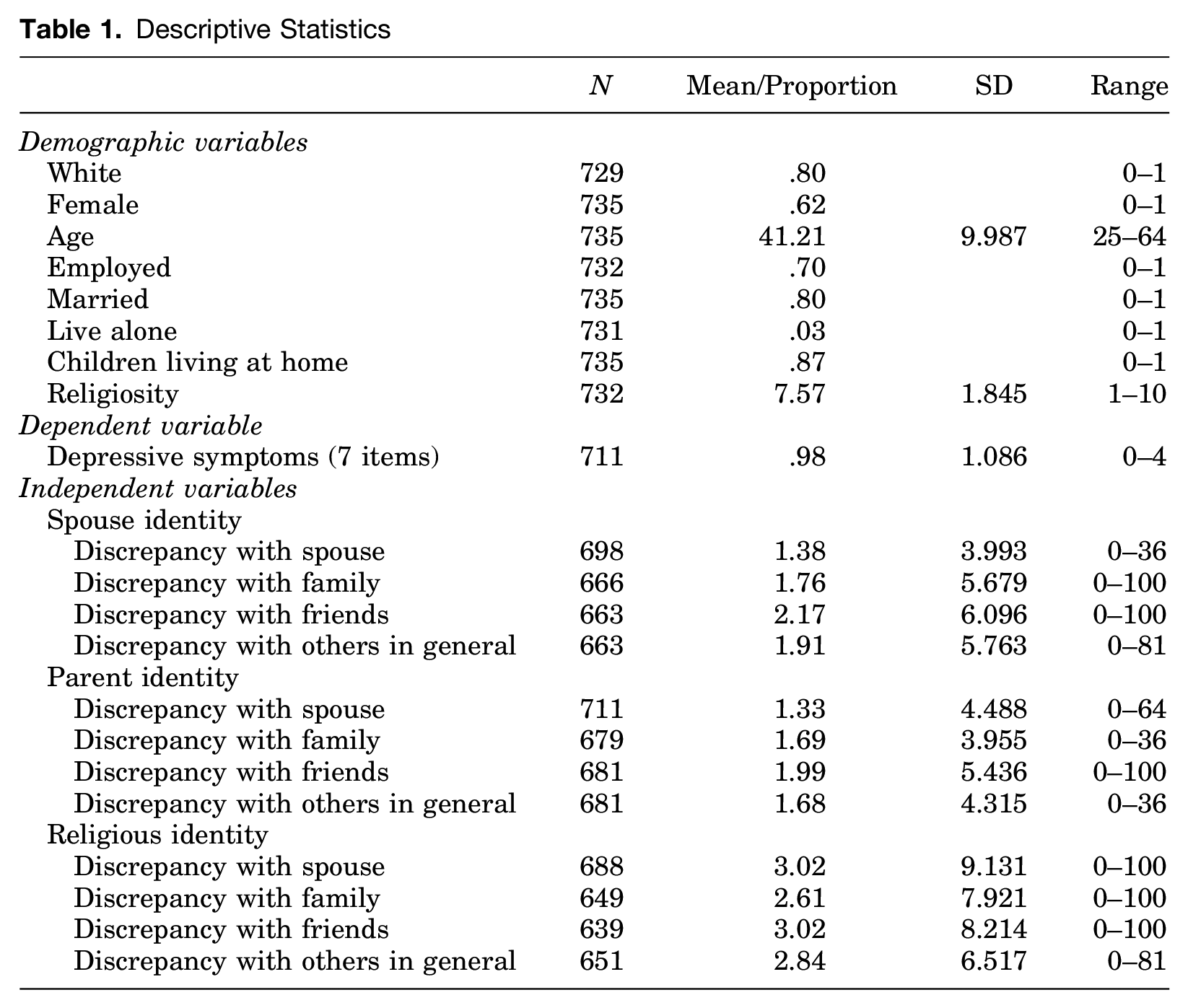
Measures
Dependent measure
Depressive symptoms are measured using the seven-item depression subscale of the Brief Symptom Inventory (Derogatis 1993). Respondents are asked, “In the past month, how distressed were you by each of the following?” Responses range from 0 (not at all) to 4 (extremely). Items include “feeling lonely,” “feeling blue,” and “feeling no interest in things.” Items are coded so higher scores indicate more depressive symptoms, summed, and divided by the number of items in the scale. Items load on one factor (eigenvalue = 71.479; factor loadings range = .691–.895) and demonstrate high reliability (Cronbach’s α = .935).
Independent measures
Identity discrepancies are inconsistencies between self-appraisals and reflected appraisals. For each identity, self-appraisals are measured by asking, “How positively do you view yourself because you are [identity]?” Responses range from 0 = not at all positively to 10 = very positively. Reflected appraisals are measured by asking the same question about how the respondent’s spouse/partner, close friends (“people who you know and can count on”), friends (“people who you know and do things with”), parents, family members other than parents, and others in general view them in each identity. Higher scores on appraisal measures indicate more positive evaluations of the respondent as an occupant of that social role.
Before computing discrepancies, we combined categories of reflected appraisals based on their theoretical and empirical similarities. Reflected appraisals from close friends and friends are highly correlated in the spouse (r = .957), parent (r = .917), and religious (r = .890) identities, so we average them for each identity to create a reflected appraisal rating for friends as a reference group. Reflected appraisals from parents and family members are also highly correlated in the spouse (r = .770), parent (r = .735), and religious (r = .794) identities, so we average them for each identity to create a reflected appraisal rating for family as a reference group. 4
To calculate discrepancies, we subtract the self-appraisal from the reflected appraisal and square the difference. All models include the linear and squared discrepancy terms, but we interpret only the squared term because the relationship between discrepancy and distress is theoretically curvilinear such that both overevaluation and underevaluation increase distress (Burke and Harrod 2005; Stets and Burke 2014; Stets and Serpe 2013). There are four squared discrepancy variables (hereafter referred to as “discrepancy”) for each identity: one involving a role partner (spouse), two involving reference groups (family and friends), and one involving others in general.
Background measures
Preliminary analyses controlled for demographic characteristics that may be associated with depressive symptoms and/or identity discrepancies. Race is coded as 1 = nonwhite, with white as the comparison group. 5 Respondents also reported whether they identified as male, female, or nonbinary. No respondents identified as nonbinary, so gender is coded as female = 1, with male as the comparison group. Age is coded continuously in years. Education is coded into five categories where 1 = less than high school and 5 = graduate or professional degree. Annual household income is coded into 12 categories between $10,000 and $15,000 apart, where 1 = less than $14,999 and 12 = above $300,000. Employment status is coded as 1 = employed full- or part-time, with unemployed as the comparison group. Marital status is coded as 1 = married, with unmarried but in a committed relationship as the comparison group. Living arrangements are coded as 1 = living alone, with living with someone as the comparison group. Children living at home is coded as 1 = children under 18 living at home, with no children living at home as the comparison group. Finally, religiosity is coded from 1 = not at all religious to 10 = very religious.
Analytic Strategy
We model associations between identity discrepancies and depressive symptoms using structural equation models (SEMs) in Stata 15 (StataCorp 2017). SEMs allow us to estimate relationships between multiple correlated independent and outcome variables, model error terms and their correlations, evaluate overall model fit, and compare the fit of models with and without certain constraints (Kline 2005). SEMs facilitate these tests in the “structural” side of the model. Our sample is not large enough to support latent variables, so all measures are modeled as observed variables. 6 All models employ full information maximum likelihood (FIML) estimation and robust standard errors. FIML utilizes all available data to retain as many cases as possible. It performs better than multiple imputation and listwise deletion (Allison 2012) and produces unbiased parameter estimates and standard errors when missing data are missing at random (Enders and Bandalos 200). 7 Robust standard errors produce appropriate estimates in nonnormal data (Chou, Bentler, and Satorra 1991). Our structural models are sufficiently powered, using the standard of at least 10 cases per parameter (Schreiber et al. 2006).
We estimate two sets of SEMs: between-identity and within-identity. In the between-identity analyses (Figure 1), we estimate separate models for each source of reflected appraisal (spouse, family, friends, and others in general) to investigate whether discrepancies in three identities (spouse, parent, and religious) are differentially associated with depressive symptoms. These analyses test Hypotheses 1 and 2 about the extent to which discrepancies in more obligatory identities are more strongly associated with distress than discrepancies in a more voluntary identity.
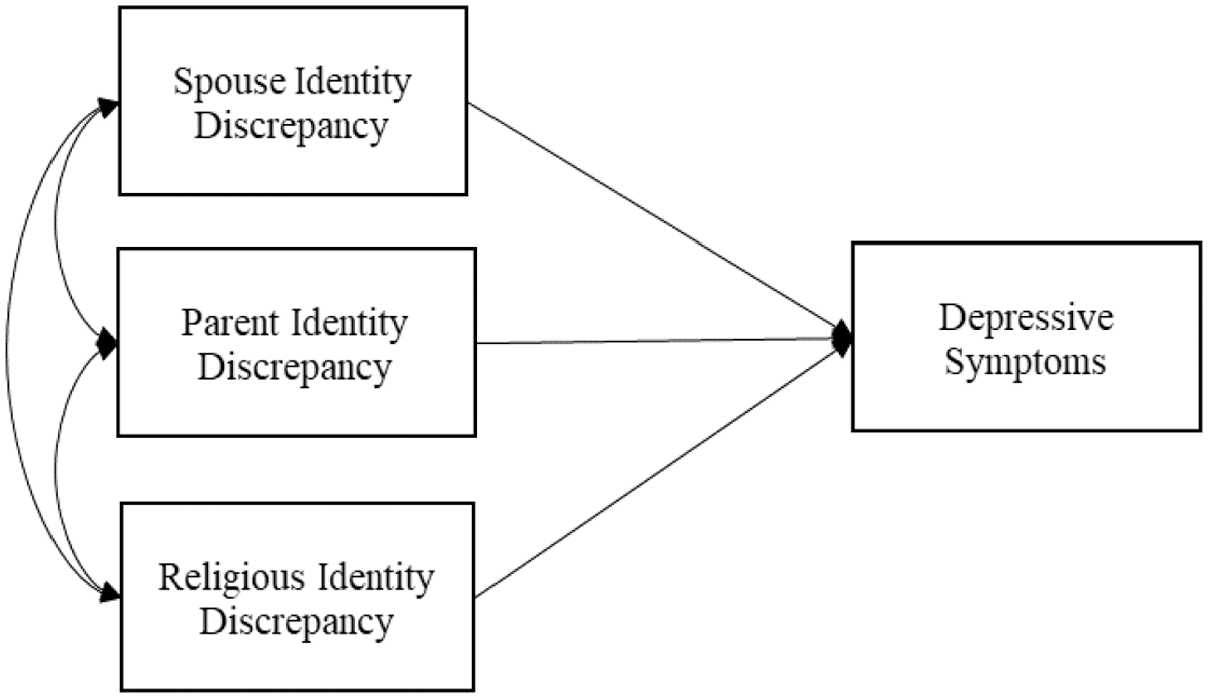
Between-Identity Structural Equation Model
In the within-identity analyses (Figure 2), we estimate separate models for each identity (spouse, parent, and religious) to investigate whether discrepancies with four sources of reflected appraisals (spouse, family, friends, and others in general) are differentially associated with depressive symptoms. These analyses test Hypotheses 3 through 5 about the extent to which discrepancies involving proximal sources of reflected appraisals are more strongly associated with distress than discrepancies involving a distal source.
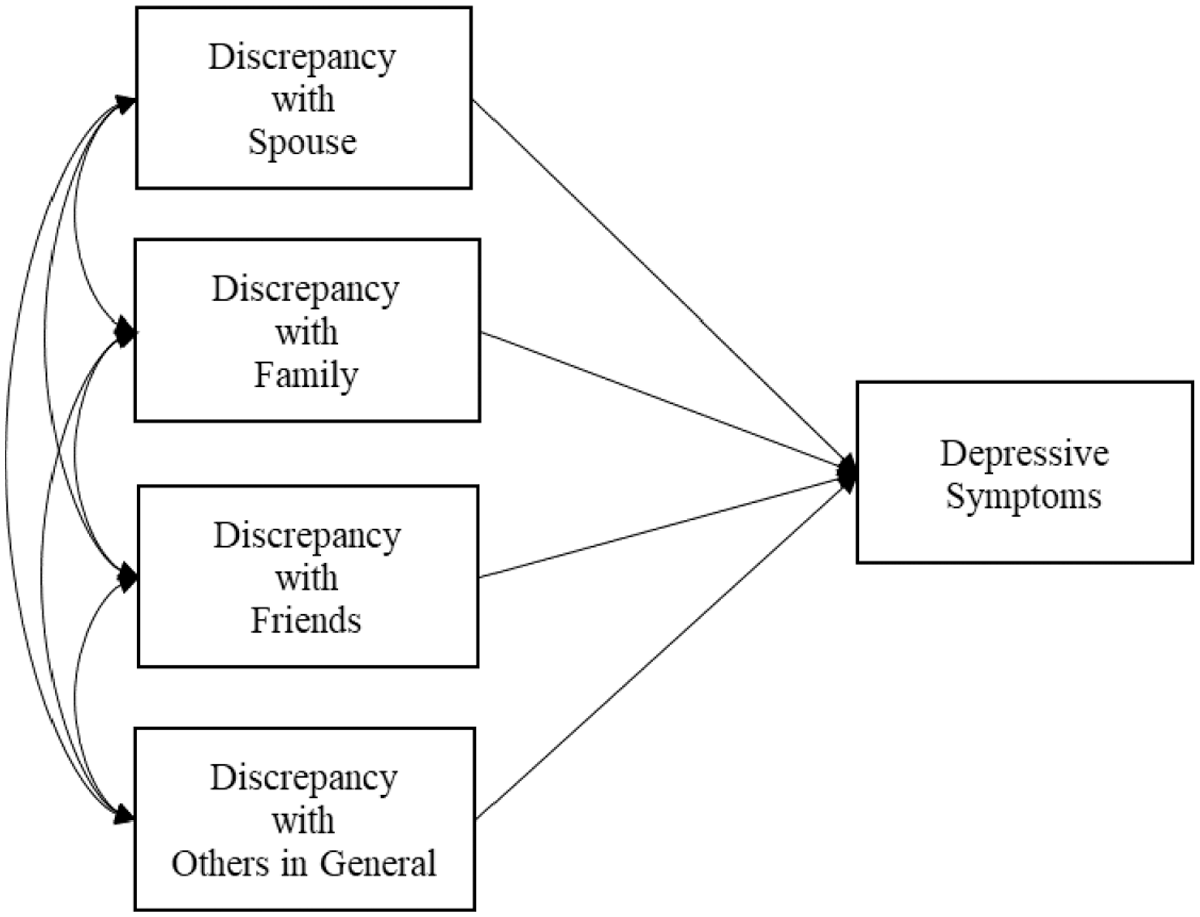
Within-Identity Structural Equation Model
The outcome in all models is depressive symptoms. Because the measure of depressive symptoms is well established, valid, and reliable (Derogatis 1993; Derogatis and Melisaratos 1983), we scale and model it as an observed variable. To simplify presentation of the structural models, background variables are excluded from the figures. In preliminary analyses (not shown), we included structural pathways from all background variables to discrepancies and depressive symptoms. The trimmed models presented here retain only background variables with statistically significant associations in at least one model. Thus, in addition to the associations shown in the SEM tables, all models control for structural pathways from the following background variables to identity discrepancies: employment status, marital status, race, children living at home, living alone, and religiosity. Associations between discrepancies and depressive symptoms are substantively identical in preliminary and trimmed models.
We evaluate our hypotheses using statistical significance, standardized beta coefficients, and chi-square difference tests. In general, we use p < .050 to determine the statistical significance of coefficients. To illustrate patterns, we also discuss discrepancies with betas that are similar in magnitude to other statistically significant discrepancies in each model if p < .100.
We conduct chi-square difference tests to compare the fit of models in which structural pathways between discrepancies involving different identities or different sources of reflected appraisals and depressive symptoms are freely estimated (unconstrained models) to models in which one or more structural pathways between discrepancy and depressive symptoms are constrained to be equal (constrained models). A statistically significant chi-square difference test indicates that the two models do not fit the data equally well, and the magnitude of the structural pathways that were constrained to be equal are, in fact, not equal.
Results
Between-Identity Analyses
In the between-identity models (Table 2), we test Hypotheses 1 and 2, which concern the strength of the relationship between discrepancies and distress across identities. We expect that discrepancies in more obligatory identities (spouse and parent) will be more strongly associated with depressive symptoms compared to discrepancies in a more voluntary identity (religious). All models fit the data well, based on the standards of comparative fit index and Tucker-Lewis index > .95 and root mean square error of approximation < .06 (Hu and Bentler 1999). Fit statistics are given after Table 2. Variance inflation factors (VIFs) that exceed 10 indicate problems with multicollinearity (O’Brien 2007). None of the VIFs for our models exceed a value of 2.
Standardized (β) and Unstandardized (b) Coefficients and Robust Standard Errors (SE) for Between-Identity Structural Equation Models of Discrepancy on Depressive Symptoms (N = 735)
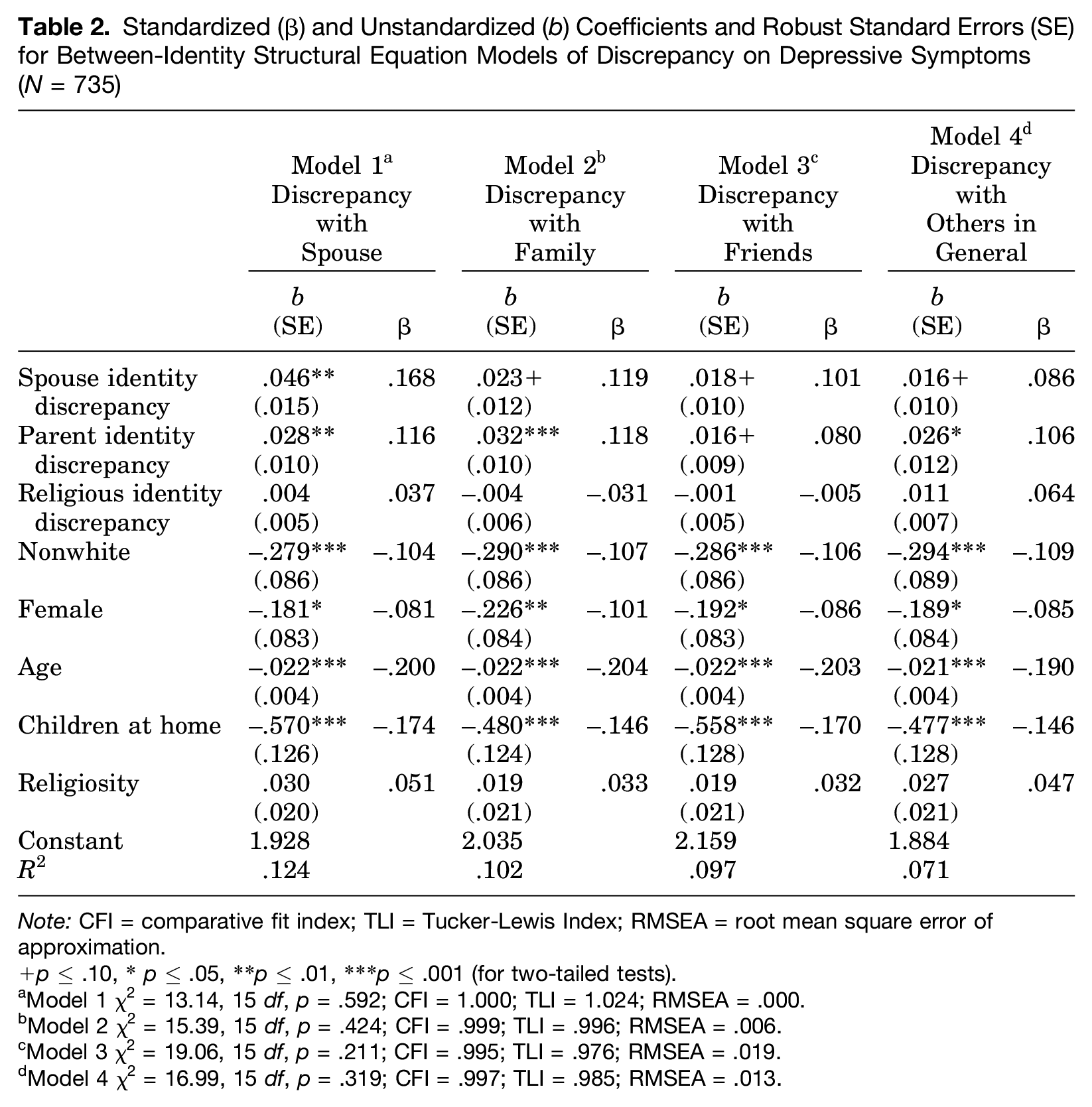
Note: CFI = comparative fit index; TLI = Tucker-Lewis Index; RMSEA = root mean square error of approximation.
p ≤ .10, * p ≤ .05, **p ≤ .01, ***p ≤ .001 (for two-tailed tests).
Model 1 χ2 = 13.14, 15 df, p = .592; CFI = 1.000; TLI = 1.024; RMSEA = .000.
Model 2 χ2 = 15.39, 15 df, p = .424; CFI = .999; TLI = .996; RMSEA = .006.
Model 3 χ2 = 19.06, 15 df, p = .211; CFI = .995; TLI = .976; RMSEA = .019.
Model 4 χ2 = 16.99, 15 df, p = .319; CFI = .997; TLI = .985; RMSEA = .013.
Starting with discrepancies involving reflected appraisals from a spouse (Model 1), we find that spouse (β = .168) and parent (β = .116) identity discrepancies are positively associated with depressive symptoms, but religious identity discrepancy is not. Chi-square difference tests demonstrate that the unconstrained model fits the data significantly better than a model in which coefficients for spouse, parent, and religious identity discrepancies are constrained to be equal (Δχ2 = 15.01, 2 df, p < .001), but there is no significant difference in fit between the unconstrained model and one in which only discrepancies in the spouse and parent identities are constrained to be equal. The unconstrained model also fits the data significantly better than models in which coefficients for spouse and religious identity discrepancies (Δχ2 = 10.83, 1 df, p < .001) and parent and religious identity discrepancies (Δχ2 = 5.46, 1 df, p < .050) are constrained to be equal. This suggests that consistency between self-views and reflected appraisals from one’s spouse in the spouse and parent identities is equally important for well-being, more so than in the religious identity.
For discrepancies involving reflected appraisals from family (Model 2), we find a similar pattern. Spouse (β = .119) and parent (β = .118) identity discrepancies are positively associated with depressive symptoms, but religious identity discrepancy is not. Chi-square difference tests demonstrate that the unconstrained model fits the data significantly better than a model in which coefficients for spouse, parent, and religious identity discrepancies are constrained to be equal (Δχ2 = 11.60, 2 df, p < .010), but there is no significant difference in fit between the unconstrained model and one in which only discrepancies in the spouse and parent identities are constrained to be equal. They also show that the unconstrained model fits the data significantly better than models in which coefficients for spouse and religious identity discrepancies (Δχ2 = 5.25, 1 df, p < .050) and parent and religious identity discrepancies (Δχ2 = 9.51, 1 df, p < .010) are constrained to be equal. This suggests that consistency between self-views and reflected appraisals from family in the spouse and parent identities is equally important for well-being, more so than in the religious identity.
For discrepancies involving reflected appraisals from friends (Model 3), we also find that spouse (β = .101) and parent (β = .080) identity discrepancies are positively associated with depressive symptoms, but religious identity discrepancy is not. However, chi-square difference tests demonstrate no significant difference in the fit of the unconstrained model and models in which each respective pair of identity discrepancies are constrained to be equal. This suggests that consistency between self-views and reflected appraisals from friends in the spouse and parent identities is important for well-being but not more than in the religious identity.
We find a similar pattern for discrepancies involving reflected appraisals from others in general (Model 4). Spouse (β = .086) and parent (β = .106) identity discrepancies are positively associated with depressive symptoms, but religious identity discrepancy is not. Chi-square difference tests demonstrate no significant difference in the fit of the unconstrained model and models in which each respective pair of identity discrepancies are constrained to be equal. This suggests that consistency between self-views and reflected appraisals from others in general in the spouse and parent identities is important for well-being but not more than in the religious identity.
In the between-identity analyses, we find support for Hypothesis 1, which predicted that discrepancies in the spouse identity would have a stronger association with depressive symptoms than discrepancies in the religious identity in two sources of reflected appraisal (spouse and family). Hypothesis 2, which predicted that discrepancies in the parent identity would have a stronger association with depressive symptoms than discrepancies in the religious identity, is supported in those same sources. We do not find support for these hypotheses in reflected appraisals from friends or others in general. These analyses highlight the importance of verifying obligatory identities like spouse and parent for well-being.
Within-Identity Analyses
In the within-identity models (Table 3), we test Hypotheses 3 through 5, which concern the strength of the relationship between discrepancy and distress across sources of reflected appraisals. We expect that discrepancies with proximal role partners and reference groups (spouse, family, and friends) will be more strongly associated with depressive symptoms compared to discrepancies with more distal others (others in general). Fit statistics are given after Table 3. Based on the criteria described earlier, all models fit the data well, and multicollinearity is not an issue.
Standardized (β) and Unstandardized (b) Coefficients and Robust Standard Errors (SE) for Within-Identity Structural Equation Models of Discrepancy on Depressive Symptoms (N = 735)
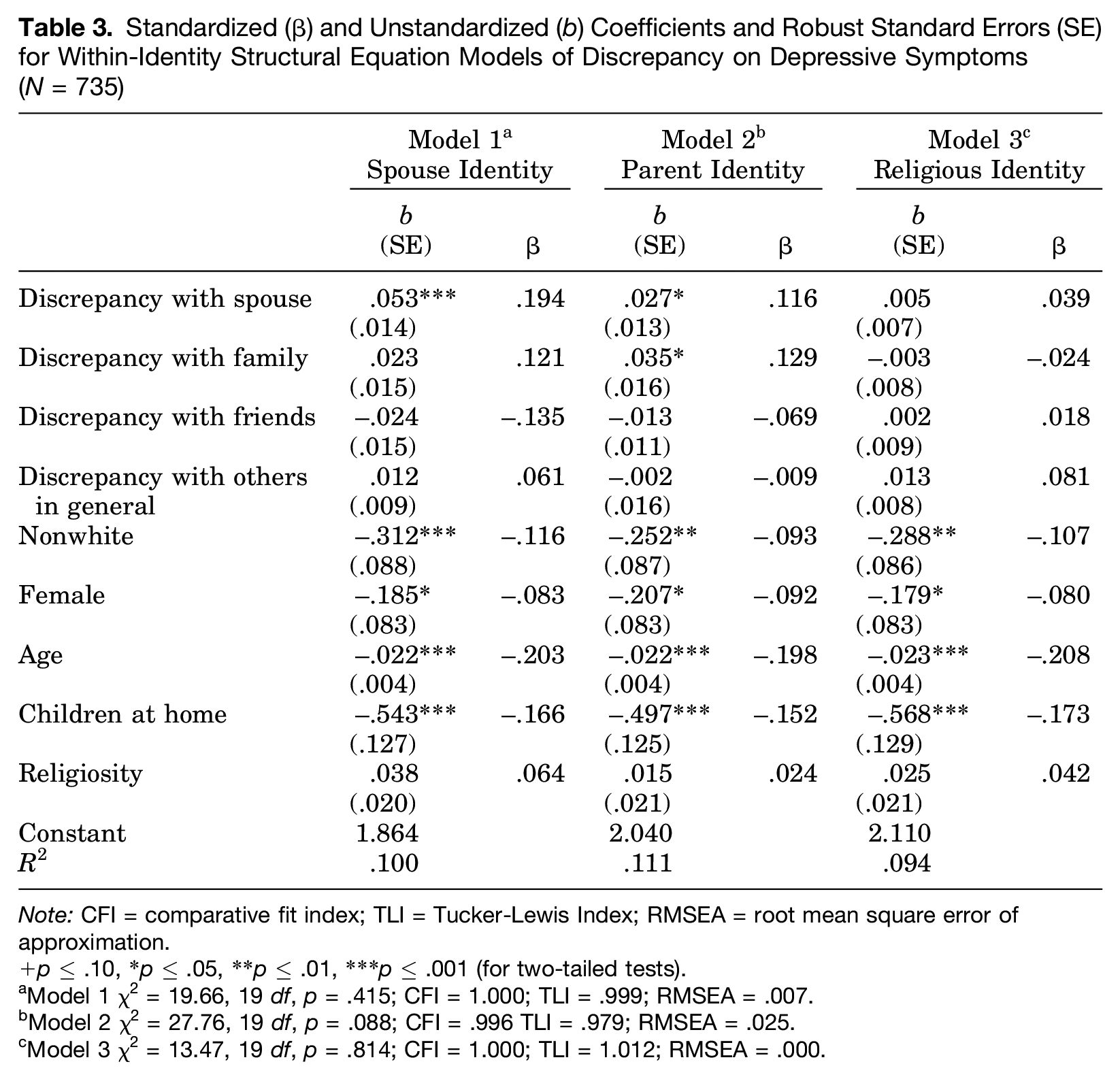
Note: CFI = comparative fit index; TLI = Tucker-Lewis Index; RMSEA = root mean square error of approximation.
p ≤ .10, *p ≤ .05, **p ≤ .01, ***p ≤ .001 (for two-tailed tests).
Model 1 χ2 = 19.66, 19 df, p = .415; CFI = 1.000; TLI = .999; RMSEA = .007.
Model 2 χ2 = 27.76, 19 df, p = .088; CFI = .996 TLI = .979; RMSEA = .025.
Model 3 χ2 = 13.47, 19 df, p = .814; CFI = 1.000; TLI = 1.012; RMSEA = .000.
Beginning with the spouse identity (Model 1), we find that only discrepancies involving reflected appraisals from one’s spouse (β = .194) are positively associated with depressive symptoms. Chi-square difference tests demonstrate that the unconstrained model fits the data significantly better than a model in which coefficients for spouse identity discrepancies involving a spouse, family, friends, and others in general are constrained to be equal (Δχ2 = 17.84, 3 df, p < .001), but there is no significant difference in fit between the unconstrained model and a model in which spouse identity discrepancies with a spouse and family are constrained to be equal. They also show that the unconstrained model fits the data significantly better than models in which coefficients for discrepancies involving reflected appraisals from a spouse and friends (Δχ2 = 17.52, 1 df, p < .001), a spouse and others in general (Δχ2 = 5.79, 1 df, p < .050), and family and friends (Δχ2 = 5.30, 1 df, p < .010) are constrained to be equal. This suggests that for the spouse identity, verification from one’s spouse and family is important for well-being, more so than verification from friends or others in general.
In the parent identity (Model 2), we find a similar pattern. Discrepancies involving reflected appraisals from one’s spouse (β = .116) and family (β = .129) are positively associated with depressive symptoms, and discrepancies involving friends and others in general are not. Chi-square difference tests demonstrate that the unconstrained model fits the data significantly better than a model in which coefficients for parent identity discrepancies involving a spouse, family, friends, and others in general are constrained to be equal (Δχ2 = 8.41, 3 df, p < .050), but there is no significant difference in fit between the unconstrained model and a model in which parent identity discrepancies with a spouse and family are constrained to be equal. They also show that the unconstrained model fits the data significantly better than models in which coefficients for discrepancies involving reflected appraisals from a spouse and friends (Δχ2 = 6.06, 1 df, p < .050) and family and friends (Δχ2 = 4.55, 1 df, p < .050) are constrained to be equal. This suggests that for the parent identity, verification from one’s spouse and family is equally important for well-being, more so than verification from friends.
Finally, in the religious identity (Model 3), we find no associations between discrepancies and depressive symptoms across sources of feedback. Chi-square difference tests demonstrate no significant difference in the fit of the unconstrained model and models in which each respective pair of identity discrepancies are constrained to be equal. This suggests that religious identity discrepancies are not associated with well-being for any source of reflected appraisals examined here.
In the within-identity analyses, Hypothesis 3, which predicted that discrepancies involving a spouse would have a stronger association with depressive symptoms than discrepancies involving others in general, is supported in two identities (spouse and parent). Hypothesis 4, which predicted that discrepancies involving family would have a stronger association with depressive symptoms than discrepancies involving others in general, is also supported in those same identities. Hypothesis 5, which predicted that discrepancies involving friends would have a stronger association with depressive symptoms than discrepancies involving others in general, is not supported. These analyses highlight the importance of feedback from proximal sources such as a spouse and family for well-being. 8
Discussion
We examined the perceptual control process in multiple identities and sources of reflected appraisals and found that discrepancies in more obligatory identities and those involving more proximal sources of reflected appraisals were associated with depressive symptoms among adults who simultaneously held spouse, parent, and religious identities. Our findings advance knowledge of the relative influence of multiple identities and sources of reflected appraisals in identity processes and suggest directions for future research that seeks to better understand identity meanings and their implications for well-being both between and within identities.
Multiple Identities
More obligatory identities like spouse and parent are structurally and emotionally demanding (Gallagher 2016; Thoits 2003) and personally and culturally important (Burke and Stets 2009). As a result, discrepancies in them should be associated with more distress than discrepancies in more voluntary identities like religion. Indeed, that is what we found. However, the lack of association between discrepancies in the religious identity and depressive symptoms is not entirely consistent with identity theory, which predicts a significant, but weaker, association for more voluntary identities.
One explanation for this pattern is that the religious identity may be more multifaceted than other voluntary identities. Depending on the context, religious identity meanings could be grounded in organizational or group expectations (e.g., participating in formal religious activities), interactions with others who share one’s religious beliefs (e.g., discussing ideology with friends), or personal characteristics that are carried into every interaction (e.g., being forgiving). These different dimensions of the religious identity may have implications for the meanings activated at a given time, the type of feedback that is most relevant, and the outcomes affected by discrepancies (Stets 2021).
The relationships between the religious identity and other identities not examined here may also help explain the patterns we found. For example, research shows race and ethnic differences in religious involvement, motivations for religious participation, the importance of spirituality (e.g., Chatters et al. 2009; Taylor, Chatters, and Jackson 2009), and race variation in the relationship between religiosity and well-being (e.g., Oates and Goode 2013). Exploring these associations will be important for research that seeks to clarify how the religious identity affects well-being.
Differences between obligatory and voluntary identities could also help explain identity change. Identity discrepancies are often resolved, but large and persistent discrepancies can cause identity change (Burke 1991, 1996). When two identities containing incompatible meanings are activated together, they cannot be simultaneously verified. Thus, the meanings of one or both identities must change to achieve verification (Burke 2006). People tend to remain in obligatory identities whether they are verified or not (Burke and Stets 2009) because they have more limited options for exiting or reducing time spent in them (Thoits 2003). Persistent discrepancy in obligatory identities may necessitate changes in more flexible voluntary identities, which could jeopardize the psychological benefits that voluntary roles typically provide (Thoits 2003).
Sources of Reflected Appraisals
Previous research has raised questions about the importance of reflected appraisals based on ambiguity surrounding the source of perceived feedback (Felson 1989). We found that identity discrepancies involving proximal role partners and reference groups were associated with more distress than discrepancies involving others in general, a more distal source of feedback. This pattern occurred for discrepancies with spouses and family. Individuals who belong to the group in which an identity is based are considered more important and credible sources of feedback about that identity (Cast and Burke 2002), which may explain why discrepancies with friends were not associated with distress, net of discrepancies with other sources.
Identities like spouse and parent involve well-defined responsibilities and obligations to specific role partners (Gallagher 2016). This may make spouses and family members more relevant sources of feedback about those identities because they directly observe and evaluate a person’s role performance in everyday interaction. Regarding the religious identity, individuals may be more concerned with feedback from religious leaders and others who share their beliefs (Wimberley 1989) or with self-evaluations of how well they exemplify religious standards. Our findings emphasize the need for future research to include sources of feedback based on their theoretical relevance to the identities being investigated.
Across all identities examined here, discrepancies with others in general were not associated with depressive symptoms, net of discrepancies with other sources. In supplemental analyses in which discrepancies with others in general were examined independently, we found that they were associated with depressive symptoms for the spouse, parent, and religious identities. 9 This is consistent with previous research that found that discrepancies involving others in general negatively affect well-being and emotions (Kalkhoff et al. 2016; Marcussen and Large 2003; Stets and Trettevik 2016). It may be that when reflected appraisals from others in general are modeled without other sources of feedback, they serve as a proxy for some combination of role partners and/or reference groups.
Identity theorists assume that measures of reflected appraisals from others in general represent “most people,” but studies are usually not explicit about their conceptualization of the generalized other (Gallagher 2021). Thus, we do not know which aspects of the generalized other are being assessed or how respondents interpret questions about it. For instance, third-order expectations (Ridgeway and Correll 2006) and fundamental sentiments (Robinson, Smith-Lovin, and Wisecup 2006) can be considered facets of the generalized other. There may be third-order beliefs representing most people’s expectations for those who hold a given identity. Similarly, for any identity that is recognized by others during social interaction, there may be culturally shared meanings concerning the characteristics, behaviors, and attitudes of a person who holds that identity. Studies that more explicitly define and measure specific aspects of the generalized other would help contextualize existing research and extend our understanding of the role of reflected appraisals in identity verification and other social psychological processes.
Limitations
Our findings should be interpreted with limitations in mind. First, the appraisal measures assess one dimension of meaning (evaluation). They are similar to measures in previous research (Gallagher 2017; Stets and Harrod 2004; Stets et al. 2017) and have the advantage of being applicable to any identity; however, multidimensional measures are preferable (Burke and Tully 1977; Stets and Trettevik 2014). Additionally, we measure evaluations of role occupancy (“because you are a . . . ”) rather than who a respondent is in a role (“as a . . . ”). Studies using measures that capture the multidimensionality of identities could substantiate our findings and examine the extent to which certain meanings are connected to distinct outcomes. For instance, Marcussen et al. (2021) demonstrated that two dimensions of the mental illness identity (dangerousness and weakness) were differentially associated with self-worth, self-efficacy, and distress. To expand the scope and application of identity theory, it will be important for scholars to consider how meaning structures vary within and across identities and how such variation contributes to the occurrence and manifestation of identity discrepancies.
Second, we do not have information about the contexts in which the spouse, parent, and religious identities are activated together. Respondents’ identities were activated during the survey in that they were called to mind through questioning. Still, studies of identities that are enacted in natural or experimental settings would help avoid potential issues with self-report methods and provide further insight into how discrepancies in multiple identities affect well-being.
Finally, the relationship between discrepancy and distress may be reciprocal, but we could not estimate a nonrecursive model with our cross-sectional data. The direction tested here is consistent with identity theory and has been supported in experiments that established causal order (e.g., Stets 2003, 2005). Also, respondents reported self-appraisals and reflected appraisals separately; they were not asked to consider discrepancies between them. To the extent that depressive symptoms influence self-appraisals and reflected appraisals, they would likely cause more negative ratings of both, resulting in smaller rather than larger discrepancies (as might occur if respondents were asked directly about inconsistencies). Thus, although reverse-causation is possible, its operation is more likely to lead to underestimates of discrepancies and more conservative estimates of their association with depressive symptoms. Future research could utilize longitudinal data to gauge the relative strength of each direction of association.
Conclusion
Our study highlights the utility of examining multiple identities and sources of reflected appraisals in identity theory and research. We suggest that the differences between obligatory and voluntary identities observed here could inform future research that seeks to advance our understanding of identity meanings and how they influence well-being and identity change. Additionally, our study has implications for which sources of reflected appraisals are included in identity verification research. We emphasize the importance of making theory-driven choices concerning which sources are included, depending on the identities being investigated and which individuals, groups, and/or generalized others are relevant sources of feedback about them.
Supplemental Material
sj-docx-1-spq-10.1177_01902725221081798 – Supplemental material for Multiple Identities and Sources of Reflected Appraisals in Identity Theory
Supplemental material, sj-docx-1-spq-10.1177_01902725221081798 for Multiple Identities and Sources of Reflected Appraisals in Identity Theory by Mary Gallagher, Kristen Marcussen and Richard T. Serpe in Social Psychology Quarterly
Footnotes
1
2
5
The race measure included nine categories. We coded race as white and “nonwhite” because there were very few respondents in categories other than white. Findings from preliminary analyses that separated nonwhite into black and “other” were consistent with those presented here.
6
7
Few respondents are missing depressive symptoms (3%), self-appraisals (2%–4% for each identity), or reflected appraisals (4%–11% for each source). Given no evidence of a systematic pattern, we assume missing data are missing at random.
8
Supplemental analyses (not shown) of 12 separate SEMs for discrepancies involving each combination of identity and source of reflected appraisal produced results that are substantively identical to those reported here, except for models with discrepancies involving others in general. When modeled independently, spouse, parent, and religious identity discrepancies with others in general are significantly associated with depressive symptoms (see  ).
).
Bios
References
Supplementary Material
Please find the following supplemental material available below.
For Open Access articles published under a Creative Commons License, all supplemental material carries the same license as the article it is associated with.
For non-Open Access articles published, all supplemental material carries a non-exclusive license, and permission requests for re-use of supplemental material or any part of supplemental material shall be sent directly to the copyright owner as specified in the copyright notice associated with the article.
