




Abstract
While significant scholarship has documented the prevalence of racial discrimination in hiring, less is known about the forces that exacerbate or mitigate it. In this article, we develop a theoretical argument about the ability of customers to influence racial discrimination in hiring, highlighting the role of direct customer communication and its intersection with online review systems. We deploy a novel method to test our argument. Specifically, we draw on original data from a two-part field experiment that first randomly assigned restaurants to receive one of three different email messages from customers and then audited the restaurants to test for racial discrimination in hiring. While our data collection effort was cut short and disrupted by the coronavirus pandemic, making our findings more exploratory than initially anticipated, our data provide evidence that customer communication can reduce racial discrimination under certain conditions. We discuss the implications of these findings for scholarship on organizational decision-making, discrimination, and methodological approaches for studying these topics.
The depth and persistence of racial discrimination in hiring in the United States has been well documented (see Quillian et al. 2017). Yet less is known about the forces that can exacerbate or mitigate discrimination. In this article, we contribute to the growing literature on the various factors that shape racial discrimination and racial inequality in the labor market (see Hirsh 2009; Hirsh and Kornrich 2008; Kalev, Dobbin, and Kelly 2006). Specifically, we argue that individual customers are important nonorganizational actors who can influence racial discrimination in hiring. 1 On the one hand, customers may exacerbate racial discrimination insofar as they express racist or biased attitudes to the companies they patronize or are perceived by those companies as holding racist or biased attitudes (Becker 1957). On the other hand, customers may be able to reduce discrimination and bias at the companies they frequent by articulating their own commitments to and desires for racial diversity.
We theorize and examine the second possibility—customers being able to reduce discrimination—in this article. We first test whether customer expressions of a desire for more diversity can reduce racial discrimination during the hiring process. Furthermore, we examine if customers’ influence is shaped by whether they mention broader public engagement when expressing a desire for increased racial diversity, in our case by indicating they may write an online review of the company. Online review systems—such as Yelp—offer individual customers a particular type of power and may lead customers who utilize them to receive more attention and have more influence.
To gain empirical traction on this theoretical line of thought, we deploy a novel methodological approach in the literature on labor market discrimination. We draw on original field-experimental data, where we randomly assigned restaurants to receive different customer messages and then conducted an audit study of those same restaurants to test for racial discrimination in hiring. Thus, we are able to measure the effect of different types of customer communication on direct estimates of racial discrimination. While to our knowledge, this approach is new to the literature on labor market discrimination, scholars have implemented similar methods in the realm of housing discrimination (Fang, Guess, and Humphreys 2018), amateur soccer training opportunities (Dur, Gomez-Gonzalez, and Nesseler 2022), and examining the responsiveness of government officials (Butler and Crabtree 2017).
The article proceeds as follows. First, we articulate prominent theories of discrimination and draw on extant scholarship to theorize why customers may be able to influence discriminatory hiring decisions. We then outline our empirical predictions. Next, we provide details about our data and methods and then present our results. We conclude by discussing the implications of our argument, findings, and methodological approach for scholarship on discrimination.
Theories of Discrimination in Hiring
Theories of discrimination—including racial discrimination in hiring—abound in the social science literature. One useful distinction among them is between “preference-based” and “statistical” theories of discrimination (Rissing and Castilla 2014). Preference-based theories of discrimination focus on the ways that decision-makers hold stereotypical beliefs or prejudicial attitudes about particular groups of workers and then include and exclude workers in ways that align with those beliefs and attitudes (for a useful discussion, see Rissing and Castilla 2014). Taste-based (Becker 1957), status-based (Ridgeway 2007), and normative (Benard and Correll 2010) discrimination, for example, would fall under the broad umbrella of preference-based discrimination. Statistical theories of discrimination, by contrast, emphasize the ways that decision-makers often have limited information and thus use expectations about perceived group-based averages to infer information about an individual who belongs to that group (Aigner and Cain 1977; Phelps 1972). It is important to note that perceptions of group-level averages may be biased by stereotypes and status-based beliefs (Correll and Benard 2006).
Preference-based and statistical theories of discrimination focus their attention on individual decision-makers. Yet scholars are clear that discrimination can be driven by higher level forces as well. Organizations and social structures can also produce and sustain discrimination (Pager and Shepherd 2008). Small and Pager (2020:52) usefully group these theories under the umbrella of “institutional discrimination,” which they define as “differential treatment by race that is either perpetrated by organizations or codified into law.” For instance, seemingly race-neutral organizational practices—such as hiring through referral networks—can lead to discrimination against workers of color.
In our study, we add to the burgeoning literature on how discrimination can be influenced by higher level forces outside individual actors. Specifically, our overarching argument is that individual customers have the power to shift employers’ discriminatory behavior, whether driven by individual or institutional forces, particularly when they emphasize their ability to communicate their message to a broader audience. Therefore, we do not aim to adjudicate between the aforementioned theories of discrimination. Rather, we develop a theoretical argument about the role of customers—key nonorganizational actors—in affecting racial discrimination in hiring regardless of the underlying discrimination-generating process. Thus, our theoretical argument highlights the ways that discriminatory behavior is more than an individual-level, psychological process. Indeed, our thinking underscores the social and contextual nature of discrimination.
Nonorganizational Forces and Organizational Decision-Making
Scholars of organizations, social movements, and the law have paid close attention to the ways that pressures beyond the organization influence decision-making within organizations (Baron and Pfeffer 1994; DiMaggio and Powell 1983). In this section, we highlight the ways that different nonorganizational actors—legal and regulatory institutions, social movement activists, and customers—can influence how organizations make decisions, including decisions that often give rise to inequality.
Legal and Regulatory Institutions
Organizational decision-making and change are subject to various types of isomorphic pressures from legal and regulatory institutions, such as courts and federal agencies (DiMaggio and Powell 1983; Hirsh 2009). The near universal adoption of anti-discrimination policies in business organizations can be partially accredited to the passage of laws that prohibited discrimination in employment (Dobbin 2009). 2 However, legal and regulatory institutions alone—enacting and enforcing anti-discrimination laws—are limited in their ability to exert sufficient coercive pressures on organizations to stop discriminatory practices. Effectiveness is often politically mediated and relies on wider cultural and economic forces. Examples of political mediation include significant monetary or rhetorical support for equality (by race, gender, etc.) and associated pro-diversity government programs (Stainback, Robinson, and Tomaskovic-Devey 2005).
Scholars have shown that business organizations are significantly less likely to comply with anti-discrimination laws without sufficient political pressure. For instance, businesses that were in legal environments with high industry-level enforcement of equal employment opportunity laws were significantly more likely to decrease gender but not racial segregation within their organizations in the 1990s when support and attention to gender politics was also high (Hirsh 2009). An important lingering question in this literature, however, is whether racial discrimination can be reduced in the absence of effective political mediation. In this article, we highlight the potential role of customer communication as a possible complementary force to traditional forms of political mediation in reducing racial discrimination at companies.
Social Movement Activists
While legal and regulatory institutions can be powerful forces, the aforementioned discussion shows how they are also limited without rhetorical, monetary, and oversight support from other types of nonorganizational actors, such as social activists. Scholars have documented how social movements play an important role in shaping and altering organizational behavior, particularly as they have shifted their efforts from state interventions to market interventions. King and Pearce (2010) outline several phenomena that account for this trend. These include that corporations play a large role in shaping contemporary social life, state actors are often more responsive to elite and business interests than marginalized groups, the liberalized global economy hampers states’ ability to regulate labor and capital, and identity movements commonly express their autonomy through intentional consumption.
Often, social movements derive their strength from the power of their collective membership. Unity, numbers, and commitment are essential to movement success (Tilly 2004). Social movement activists have successfully pressured corporations to change their behavior through a variety of confrontational or collaborative tactics, ranging from protests to boycotts to direct appeals to management (de Bakker et al. 2013; King 2011; Reid and Toffel 2009). However, the potential efficacy of individual activists acting alone has received less empirical attention.
In addition, extant scholarship identifies a few key factors that influence when corporations are more likely to concede to social movement activist demands. First, media attention matters. King (2008, 2011) finds that negative media attention increases the likelihood of corporate concessions to activists, and the impact of negative media attention is even stronger when the corporation previously experienced reputational decline. This pattern persists even though firms with good reputations are more likely to be activist targets (McDonnell, King, and Soule 2015). Moreover, corporations that have not had substantial media attention prior to being the target of activists are more likely to make concessions (King and Soule 2007). For both regulatory institutions and social activists, the media is an important mechanism that influences their efforts to successfully change organizations’ behaviors by increasing rhetorical attention around social inequities. As access to social media and other Internet forums have increasingly democratized, individuals acting outside coordinated movement efforts have the ability to communicate demands and ideas directly to organizations.
The nature of the social issue can also shape how corporations respond to movement pressure. Corporations are more likely to concede when activists target issues dealing with critical stakeholder groups such as labor or consumers (King and Soule 2007). Illustratively, after police officers killed George Floyd in 2020, nationwide protests spurred corporations to implement racial justice policies for their employees and customers (Friedman 2020). Thus, it is important to understand a social movement’s strategies and the nature of their demands as well as the broader social context to gauge how an organization will respond. With the rising strength of progressive social movements such as Black Lives Matter and #MeToo, an emerging question is what is the most effective way that social movements and individual activists can encourage corporate social responsibility and engage critical stakeholder groups in these efforts.
Finally, the relationship between the corporation and social movement members can impact movement success. Primary activists—that is, firm shareholders—are in a stronger position to influence company decision-making and behavior compared to secondary activists, who are not shareholders. However, it is critical to social movement strategy to recognize that while primary activists have a deep knowledge about corporate structure and mechanisms for influence, they can be hampered by their dependency on the corporation. Secondary activists often lack detailed corporate knowledge but are also unencumbered by organizational dependency. Partial members can have some mix of both (Vasi and King 2012). For our argument, we note that customers are external to the company or organization but can also have deep knowledge of the establishment, which may imbue them with a quasi-membership status. Yet there is significant work to be done to understand if and how individual customers have the ability to affect organizational decision-making.
Customers
There is a substantial and growing literature on how regulatory institutions and social movements, respectively, can successfully intervene in the marketplace. However, much sparser is research about what uncoordinated individuals–such as lone customers–can do to effectively pressure corporate change or alter company decision-making. Businesses rely on customers for their specific patronage, but also the patronage of customers’ wider social network when customers recommend products and services to their friends, family, and other contacts. Therefore, as the news media amplifies efforts by regulatory institutions and social activists to change organizational practices via rhetorical support, customers’ efforts might be mediated by both rhetorical (recommendations and referrals) and monetary (buying power) support. Here, we note that we are interested in whether customers can influence one organizational decision-making point—hiring discrimination—and not in identifying the specific mechanism through which customers can influence organizational decision-making.
Early theoretical work on discrimination by Becker (1957) is particularly instructive in thinking about the role of customers in shaping discrimination in hiring. In his broader argument, he suggests that customers are important actors in understanding why employers might discriminate against certain groups during the hiring process. Even if an employer did not have a “taste for discrimination” themselves—a preference-based mechanism of discrimination—if they thought that their customers would not want to interact with employees of a particular race or gender, for instance, the employer may discriminate against applicants of that race or gender in hiring to please their customers (Neumark, Bank, and Van Nort 1996).
There are a handful of studies that explore the role of customer-based discrimination. Roth’s (2004) study of Wall Street professionals working in the securities industry found that the perception that clients prefer homophily in their service providers led to White male employees receiving the most lucrative positions because most client organizations were White- and male-dominated. In another study, Black applicants were found to be more likely to face hiring discrimination in firms located in the suburbs than in the center of the city. Both Black and White employers in the suburbs hired fewer Black applicants than their same-race employers in the center of the city (Raphael, Stoll, and Holzer 2000). This finding is in line with Becker’s (1957) argument that even in the absence of a “taste for discrimination,” employers may discriminate based on perceived differences in the client demographics. Furthermore, Holzer and Ihlanfeldt (1998) show that more Black and Hispanic applicants were hired when the percentage of customers that were Black and Hispanic, respectively, increased. The relationship is stronger in jobs with direct contact with customers. It is important to underscore that all of the studies mentioned capture the effect of perceived customer-based preferences on hiring discrimination. Less is known about the consequences of direct communication of customer preferences to companies and their hiring practices.
Insofar as companies care about the preferences or perceived preferences of their customers, racial discrimination may be exacerbated, as some of the studies discussed suggest is possible. However, we can also imagine the inverse of this process occurring. If a company’s customer base is particularly pro-diversity or concerned about racial representation, companies may align their hiring behavior to meet those desires of their customer base. In other words, an active expression from its customers of a desire for representation of a particular group of employees—such as African Americans—may lead a company to discriminate less against employees from that group. Customers, especially loyal or frequent customers, are also uniquely positioned to effectuate change because they can have substantial knowledge about the company but are not dependent on it. They can act as a combination of both primary and secondary activists as these “quasi-members” to the company (Vasi and King 2012).
Online Reviews Systems
We further argue that companies are not likely to respond to all customer preferences in the same way. An individual customer expressing a desire for more representation of individuals from a particular race, for instance, would likely be less effective than a significant number of customers expressing the same desire or an entire social movement of customers joining together to pressure the company to increase representation of that group. As we discussed earlier, social movements can be powerful forces for change. Another way that companies may take customer desires more seriously, even if they are anonymous or infrequent patrons, is if they think a given customer may be particularly vocal or able to reach other customers or potential customers. One such avenue through which this sort of customer-to-customer exchange can happen is via online company reviews. Thus, customers who are active—in the sense that they review companies and express those views publicly—may have a greater influence on company behavior than those who do not.
A significant body of existing research investigates how consumers respond to online reviews (King, Racherla, and Bush 2014). A smaller literature studies how organizations manage and respond to criticism on online public forums (e.g., Zhang and Vásquez 2014). There is evidence, however, that decision-makers are responsive to the information provided in review systems. Cui, Li, and Zhang (2020) found that racial discrimination on the Airbnb platform was significantly reduced when African American guests had received prior positive reviews from hosts. However, this study cannot speak to how a guest or user can use the Airbnb platform to reduce discrimination against African American guests. And like many other studies in this area, it examines how review or other reputation systems affect discrimination in the sharing economy with nontraditional employer-employee-customer relationships (e.g., Abrahao et al. 2017; Nunley, Owens, and Howard 2011; Tjaden, Schwemmer, and Khadjavi 2018). Less attention, however, has been given to how privately communicated customer preferences—or privately communicated customer preferences that may possibly result in a less favorable evaluation of the company through an online review platform—impact organizations’ behaviors. The question of whether the rise of online customer review forums and privately communicated preferences impact corporate practices remains open. In the restaurant industry, among other sectors, customer review forums have, in many ways, supplanted traditional forms of media attention in shaping an establishment’s reputation. Negative Yelp reviews—particularly extensive reviews of nonchain restaurants—have been shown to negatively impact restaurant revenue (Luca 2016; Zukin, Lindeman, and Hurson 2017).
Individual customers have also started to use social media and online review platforms to condemn racial bias at restaurants (Vera 2018) and other domains of service (Dalmage 2019). There is evidence that online platforms recognize this form of activism and, in some cases, even want to assist users in harnessing their power. For example, partly in response to swarms of customer comments about racially biased behavior by companies, Yelp created a policy whereby businesses facing credible allegations will be tagged with a “Business Accused of Racist Behavior Alert.” The vice president of user operations at Yelp explained the rationale for the new policy: “As the nation reckons with issues of systemic racism, we’ve seen in the last few months that there is a clear need to warn consumers about businesses associated with egregious, racially-charged actions to help people make more informed spending decisions” (Malik 2020). This policy change at Yelp indicates that customers care about and notice racial diversity and equity issues at the businesses they patronize and suggests that companies may be responsive to online reviews and labels about their lack of racial diversity.
This discussion indicates that customers, and particularly customers who are connected to and who utilize online review systems, may be able to influence hiring discrimination.
Empirical Predictions
In its broadest terms, our theoretical argument is that customer communication can affect the ways that organizations treat White and Black job applicants during the hiring process. Specifically, we expect that relative to a control condition, the Black-White gap in callbacks will be smaller when a customer communicates their desire for more diversity at the organization. Furthermore, when the communication of that desire for diversity is paired with the possibility of the customer publicly expressing that desire (in our case, through an online review), we expect that the Black-White gap in callbacks will be smaller than in the control condition and, separately, the condition where there is a request for diversity but no public component. We will test these empirical predictions further.
In audit studies, hiring discrimination against Black workers is generally operationalized as the difference in the callback rates for Black and White job applicants (e.g., Gaddis 2015; Pedulla 2018b). Thus, implementing an intervention that lessens the gap in the callback rates for Black and White applicants would be seen as reducing discrimination. However, a reduction in the gap in callback rates can happen for different reasons. There could be a relative increase in the callback rate for Black applicants or a relative decrease in the callback rate for White applicants. Either one of those possibilities would reduce racial discrimination when it is operationalized as the difference in the callback rate between Black and White workers.
Adding complexity to this issue is that relative increases and decreases in callbacks can happen for multiple reasons with matched pair audit studies like the one we implemented. When each employer receives two applications, one from a White applicant and one from a Black applicant, a relative increase in the callback rate for Black applicants could occur because employers who would have only called back the White applicant decide to call back both applicants. Alternatively, employers who would have not called back either applicant could call back only the Black applicant. Similarly, relative reductions in the callback rate for White applicants could result from employers who would have called back both applicants only calling back the Black applicant. An alternative is that employers who would have called back only the White applicant—employers who would likely be deemed to be discriminatory—could not call back either applicant.
The empirical predictions that we outline here are about reducing the gap in the callback rates for White and Black applicants. Yet as our more detailed discussion makes clear, that outcome could occur through multiple processes. After presenting our main findings examining the effect of the customer communication messages on the gap in callbacks between White and Black applicants, we explore which of the aforementioned processes may be at play.
Data and Methods
Experimental Design
Our data collection effort was executed in two stages: (1) sending email messages (Stage 1) and (2) sending job applications (Stage 2). 3 These two stages reflect the two axes of exogenous variation in the experiment: customer interest in diversity and the race of the job applicant. In Stage 1, the restaurants in the sample were randomly assigned to one of the three email message conditions: (1) a parking inquiry (our “control” condition), (2) a diversity inquiry, and (3) an activist diversity inquiry. All of the email conditions were comments from a recent “customer” (i.e., our research team) and sent to the restaurant via the available online contact method (e.g., email or restaurant “contact us” page). The parking inquiry message states that the customer is wondering if the restaurant is planning to improve the parking situation at their location. The diversity inquiry message states that the customer is wondering if the restaurant is planning to increase the representation of African Americans on their server staff. Finally, the activist diversity inquiry message is the same as the diversity inquiry message and also mentions that the customer likes to reach out to a restaurant before writing an online review. The difference between the diversity inquiry and activist diversity inquiry messages is whether there is the possibility of a public component to the customer’s concern through an online review system. However, we note that our manipulation does not enable us to test the specific mechanism through which mentioning potentially writing an online review would increase a customer’s influence.
The customer email message was sent by a customer with a name that was likely perceived as a White man—David Salisbury—and provided an email and/or phone number for follow-up. The phone number of the customer was geographically specific for each metropolitan area. There are a few key reasons why we sent the messages from a customer who was likely perceived as White. First, White people constitute the largest or second largest demographic group in each metropolitan area we sampled. Therefore, we assume White customers are a core clientele at most restaurants. Second, while we cannot know whether restaurants’ customers are primarily White, there is theoretical support for the idea that restaurants might value their White clientele patronage over their non-White clientele patronage. Several studies have shown that stereotypes around tipping and dining behavior lead servers to provide significantly worse service to Black patrons than White patrons (Noll and Arnold 2004; Rusche and Brewster 2008). Third, a White customer advocating for more White servers (or a Black customer advocating for more Black servers) may not necessarily alter the hiring behavior of employers. Here we draw from social role theory, which theorizes that status beliefs only change once they are undermined (e.g., Diekman and Eagly 2000; Koenig and Eagly 2014). If most employers perceive that customers prefer homophily in their servers and act on that perception, then a customer who confirms that perception would not necessarily alter their preexisting hiring behavior. Thus, a scope condition of our study is that the results are limited to how White customers advocating for more African American servers can influence the hiring decisions of restaurants. Furthermore, our study results cannot answer how restaurants interpret the request and what complex factors influence their interpretation (e.g., racial composition of restaurant staff, presence of front- and back-of-house positions, casual vs. fine-dining categorization, and expectations for servers to perform aesthetic labor; Williams and Connell 2010; Wilson 2020).
In Stage 2 of our study, restaurants received the fictitious job applications two days after receiving the communication from the customer. This lag provided some time for the restaurant to be able to read the communication from Stage 1. When applying for jobs, we followed the application instructions detailed in the restaurant’s job advertisement. When prompted, we could provide a resume, cover letter, email address, local phone number, references, and so on. Each audited restaurant received a job application from what was likely perceived as a White male job seeker and Black male job seeker. The race of the applicant was signaled through racialized names. The “White” names were Robert Andersen and Seth McGrath, and the “Black” names were Darnell Jackson and Terrell Booker. The perceptions of the names were pretested in a survey experiment on Amazon’s Mechanical Turk (MTurk) platform, and the results provided strong evidence that respondents perceived the names as aligning with these different racial groups. Indeed, the names were perceived to align with a particular race at least 95 percent of the time. 4 All names had a unique email address, phone number, and a voicemail box with a gender- and race-specific voice recording.
We constructed two resume and cover letter templates for each metropolitan area. The education and employment background listed in each resume and cover letter indicates that the applicant is in their mid-20s and graduated both high school and community college locally. In addition, the applicant had their first restaurant server job for two years, a second restaurant server job for one year, and a third (current) restaurant server job for three to four years. The street addresses included with the application were located within a short, walkable distance of one another. The racialized names, format of the resumes and cover letters, and order of applications were randomized and counterbalanced across restaurants.
Traditional correspondence audits, while excellent at documenting racial discrimination, are limited in their ability to test the mechanisms that drive discrimination and identify potential solutions. Gaddis (2019) argues that more complex audit research designs are necessary given this limitation. In our study, we extend the traditional correspondence audit design, and to our knowledge, our research design has not previously been deployed to study labor market discrimination. However, we note that a similar research design was used by Fang et al. (2018) to study racial discrimination in the housing market, by Dur et al. (2022) to study amateur soccer training opportunities, and by Butler and Crabtree (2017) to study racial discrimination in the responsiveness of government officials. We see this type of methodological approach—experimentally varying a “treatment” at the level of the organization (or decision-making entity, more generally) and then testing for discrimination using audit study techniques—to hold significant promise for identifying solutions to discrimination in hiring (Gaddis 2019; Pedulla 2018a). This research design enables the researcher to recover direct estimates of discrimination while simultaneously increasing confidence that any variation in discrimination across groups is due to the effect of the treatment rather than some unobserved confounding factor. When thinking about policy interventions that can reduce discriminatory behavior, this sort of causal traction is quite useful.
Analytical Sample
The email messages and job applications were sent to restaurants that advertised for server, waiter/waitress, and front-of-house job openings on an online job posting platform (henceforth referred to as “JobSource,” which is not its real name) at some point between July 2019 and March 2020 and are located in one of six major U.S. metropolitan areas: Chicago, Washington, DC, Philadelphia, Houston, New York, and Los Angeles. We sequentially added metropolitan areas to increase the number of available job openings. If multiple metropolitan areas were sampled in a given week, the sampling order was randomized.
Prior to collecting the data presented here, in winter and spring 2019, we began fielding an earlier version of this experiment in the Bay Area of California. Given that this methodological approach is quite new, we encountered multiple challenges during the earlier fielding. First, on one of our fictitious resumes in the audit study, the restaurant that was listed as the applicant’s current employer shut down. This exogenous event undermined the validity of these applications by sending signals with unknown meaning for some of our applications. Second, as we progressed with the experiment, we became concerned that our email text to restaurants was too long. Thus, for the current version of the experiment, we shortened the messages and tightened the text to make it clearer. Third, we received some responses to our email messages about diversity from restaurants that were African American owned and had significant numbers of African American workers. These messages indicated that they were confused by our email. Thus, we adjusted our sampling procedures for the current experiment to exclude restaurants that were more likely to be owned by and predominately staffed by African Americans, as indicated by the restaurant’s food-type classification on a third-party website (e.g., Creole, Jamaican, African restaurants). Given these issues, we updated our experimental protocol, obtained IRB approval for modifications, and then began collecting the data presented here. Additional exclusion criteria for restaurants were the following: the restaurant itself was previously audited, the corporation to which the restaurant belonged was previously audited, it was an unopened or recently opened restaurant, it was an unnamed restaurant on the job posting site, or the job advertisement was not in English.
We restricted the analytic sample we drew from JobSource in four ways. First, we excluded any restaurant that did not receive the intervention email. Specifically, we excluded restaurants where there was no method to contact them online or there was a delivery issue (e.g., an email bounce back). Second, we excluded any restaurant that did not meet the initial criteria for inclusion but was erroneously included in the study. Third, we excluded any restaurant that did not receive a job application from both the Black applicant and the White applicant. For example, some job applications were not sent because the job posting was deleted in the two-day period between distribution of the intervention email and job applications or had prohibitory requirements (e.g., to submit a photo of the applicant).
Finally, one additional challenge we encountered with data collection was the onset of the coronavirus pandemic in 2020. By mid-March 2020, all geographic areas in our study admonished restaurants and bars to close their doors to dine-in patrons. Given the sudden and deeply negative impact of the pandemic on the economy, and the restaurant sector in particular, we ended data collection after the second week in March even though we had not reached our intended sample size. We also exclude data collected in March from our main analyses because hiring practices appeared to have changed significantly during the initial onset of the coronavirus pandemic. Indeed, we find statistically significant differences in the empirical patterns in our data before and after March 2020. We note that our findings are substantively similar when we include the data from March 2020 but generally not statistically significant at conventional levels.5,6
Thus, our final analytical sample includes 1,542 applications submitted to 771 job postings that received the experimental emails between July 2019 and February 2020. The experimental emails were randomly assigned to each job posting in the sample and are distributed almost equally across treatment conditions, with 262 parking inquiries (34.0 percent), 255 diversity inquiries (33.1 percent), and 254 activist diversity inquiries (32.9 percent) sent. Figure 1 summarizes our research design and provides sample sizes for each component of the study.
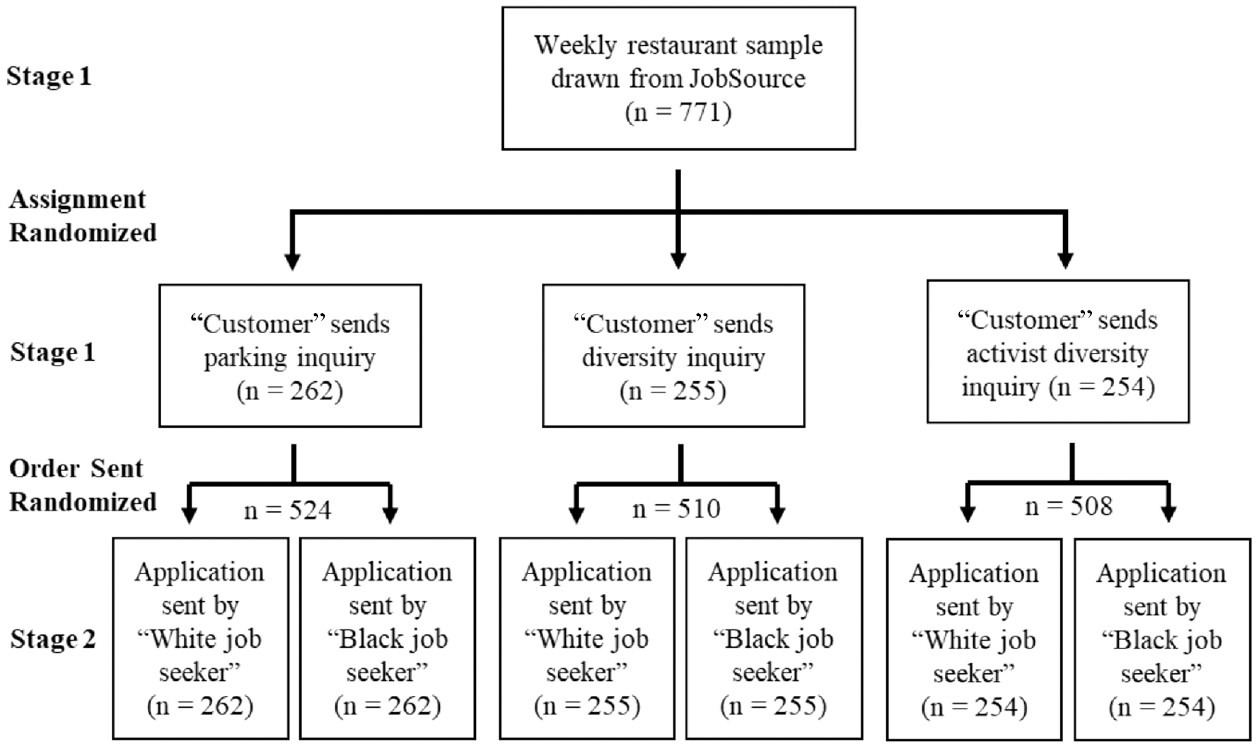
Flowchart of Experimental Design
Key Variables
The outcome variable indicates whether or not the applicant received a callback from the restaurant via email, phone, or text. Thus, it is a binary measure. Responses were coded as callbacks if the restaurant requested an interview with the applicant or sent a positive response about the application (e.g., wanting to discuss the position further with the applicant). Auto-generated responses were not coded as callbacks.
The two primary explanatory variables are the applicant’s race and the email message condition to which the job posting was assigned. Applicant race is a binary variable and was coded as Black if the name listed on the resume and cover letter was likely perceived as Black (Darnell Jackson or Terrell Booker) or White if the name listed on the resume and cover letter was likely perceived as White (Robert Andersen or Seth McGrath). The email message condition is coded as a three-category variable and indicates whether the restaurant received the parking inquiry, diversity inquiry, or activist diversity inquiry message.
Results
Field-Experimental Findings
We received a total of 402 callbacks from the 1,542 applications in our analytic sample. The callback rate, pooling across all conditions, was 26.1 percent, which is broadly in line with callback rates for field experiments in the low-skilled service sector (Mobasseri 2019; Pager 2003). Overall, White applicants received callbacks 28.3 percent of the time, and Black applicants received callbacks 23.9 percent of the time. Figure 2 displays the callback rate, with 95 percent confidence intervals, by email treatment condition and the race of the applicant. In the parking inquiry condition (our control condition), White applicants had a callback rate of 30.5 percent, and Black applicants had a callback rate of 24.0 percent. The callback rate by race was similar for the diversity inquiry condition: 30.6 percent for White applicants and 23.5 percent for Black applicants. However, the gap in the callback rate by race appears much smaller in the activist diversity inquiry condition, with a callback rate of 23.6 percent for White applicants and 24.0 percent for Black applicants. Descriptively, therefore, we see pronounced racial discrimination in the parking condition and the diversity condition but limited racial discrimination in the activist diversity condition.
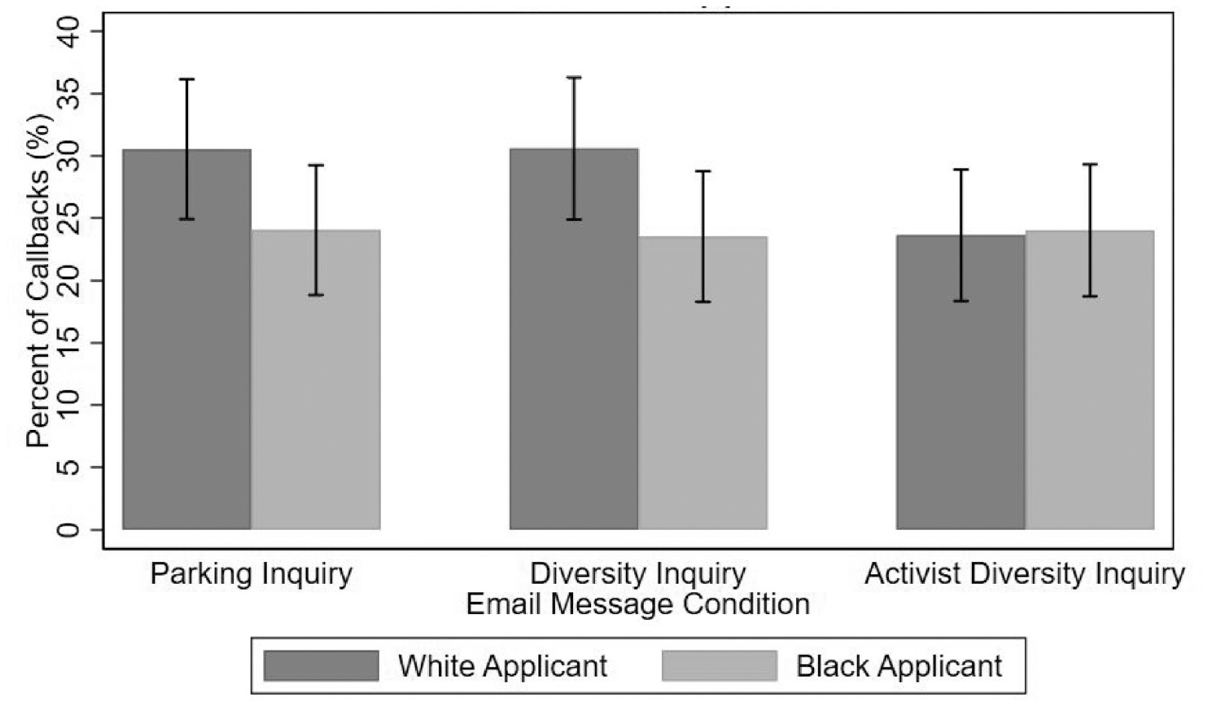
Callback Rate by Email Message Condition and Race of Applicant
Table 1 tests whether the differences by the race of applicant are significantly different overall and within each email message condition. We present results from linear probability models with standard errors clustered at the level of the employer. The results from logistic regression models are consistent, including the statistical significance levels. Model 1 pools data across email message conditions and tests for whether there is evidence of racial discrimination in the overall sample, controlling for email message condition. Indeed, we see that there is a negative and statistically significant effect of being a Black applicant on callbacks (two-tailed test: p < .01; one-tailed test: p < .01), demonstrating that we detect racial discrimination in the overall sample. 7 Model 2 displays the results for the sample of employers in the parking inquiry (control) condition, Model 3 for the diversity inquiry condition, and Model 4 for the activist diversity inquiry condition. The racial difference in callback rates was statistically significant at the .05 level for the sample of employers in the parking inquiry condition (Model 2), statistically significant at the .01 level in the diversity inquiry condition (Model 3), and not statistically significant (p > .10) in the activist diversity inquiry condition (Model 4).
Linear Probability Models of Callbacks, Race of Applicant, and Each Email Message Condition
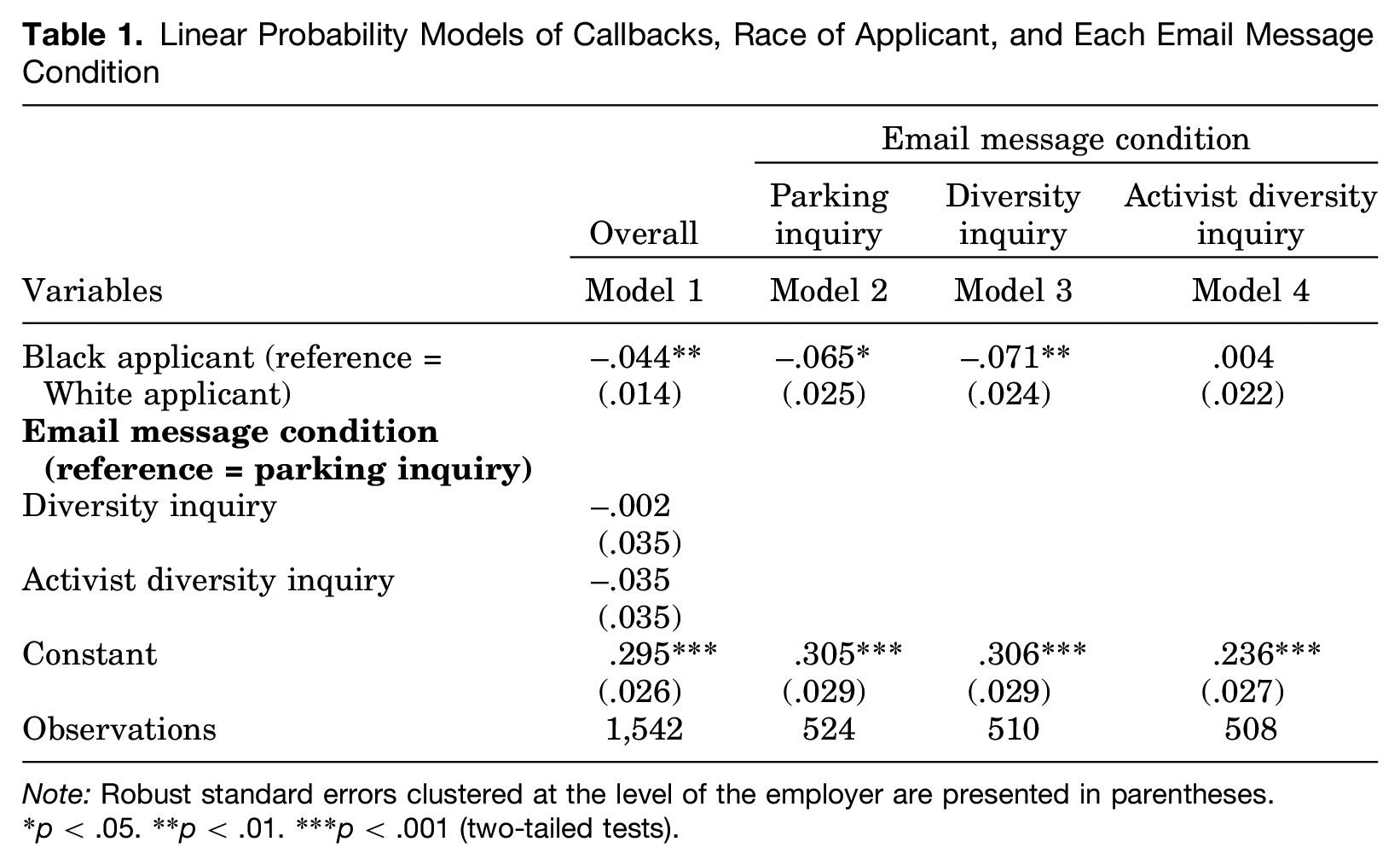
Note: Robust standard errors clustered at the level of the employer are presented in parentheses.
p < .05. **p < .01. ***p < .001 (two-tailed tests).
Next, we examine whether the differences in callbacks between White and Black applicants—our measure of racial discrimination—is different across the three email message conditions. To do this, Table 2 pools the sample of applications across all three conditions to test the interaction between the race of the applicant and email treatment condition in predicting callbacks. As with Table 1, for interpretability, we present results from linear probability models with standard errors clustered at the level of the employer, but logistic regression models produce similar results. The Black applicant coefficient in Model 1 of Table 2 can be interpreted as the difference in the callback rate between the Black applicant and White applicant (i.e., the reference group) in the activist diversity inquiry condition. It indicates that the Black applicants in the activist diversity inquiry condition receive a similar (p > .10) callback rate as the White applicants, and the size of the coefficient itself is close to zero. The interaction terms in Model 1 between the race of the applicant and intervention conditions test whether racial discrimination—measured as the difference in the callback rates between Black and White applicants—is significantly higher in the parking and, separately, the diversity inquiry conditions than the activist diversity inquiry condition. This would be indicated by a negative and statistically significant interaction term between the email condition and being a Black applicant. For both the parking condition and, separately, the diversity inquiry condition, the interaction terms are negative and statistically significant (p < .05). Importantly, this finding indicates that the Black-White callback difference is smaller in the activist diversity inquiry condition than the other two conditions. It does not mean that the callback rates for Black applicants increased in the activist diversity inquiry condition. We address this topic next.
Linear Probability Models of Callbacks, Race of Applicant, and Email Message Condition with Interactions

Note: N = 1,542. Robust standard errors clustered at the level of the employer are presented in parentheses.
p < .1. *p < .05. **p < .01. ***p < .001 (two-tailed tests).
Supplemental Analyses
Callback patterns
In the activist diversity inquiry condition, the gap in callbacks between Whites and Blacks is statistically significantly smaller than in the other conditions, which we interpret as a reduction in racial discrimination. However, as our earlier discussion indicates, a gap in callbacks between White and Black applicants could occur for multiple reasons. As can be seen in Figure 2, the Black-White callback gap is smaller in the activist diversity inquiry condition because the callback rate for Whites moved closer to the callback rate for Blacks rather than the callback rate for Blacks increasing to the level of the callback rate for Whites. Why might this be the case?
To gain some empirical traction on this issue, we examined the pattern of callbacks for each restaurant by email intervention condition. Specifically, we coded the pattern of callbacks at each restaurant into four categories: (1) neither applicant received a callback, (2) only the Black applicant received a callback, (3) only the White applicant received a callback, or (4) both applicants received a callback. Figure 3 presents the distribution of these four possible callback patterns by email communication condition. Comparing the distributions across the three email communication conditions reveals that the key difference in the activist diversity inquiry condition and the other conditions is the lower proportion of restaurants that only called back White applicants (5.9 percent, compared to 11.8 percent and 11.0 percent) and the higher proportion of restaurants that called back neither applicant (70.1 percent, compared to 64.1 percent and 65.5 percent). In other words, some employers that would likely be deemed racially discriminatory—those who only called back the White applicants—appear to behave differently in the activist diversity condition. One interpretation of this pattern is that the activist diversity inquiry email induced some employers who would have called back only the White applicant to limit that biased behavior and to not call back either applicant.
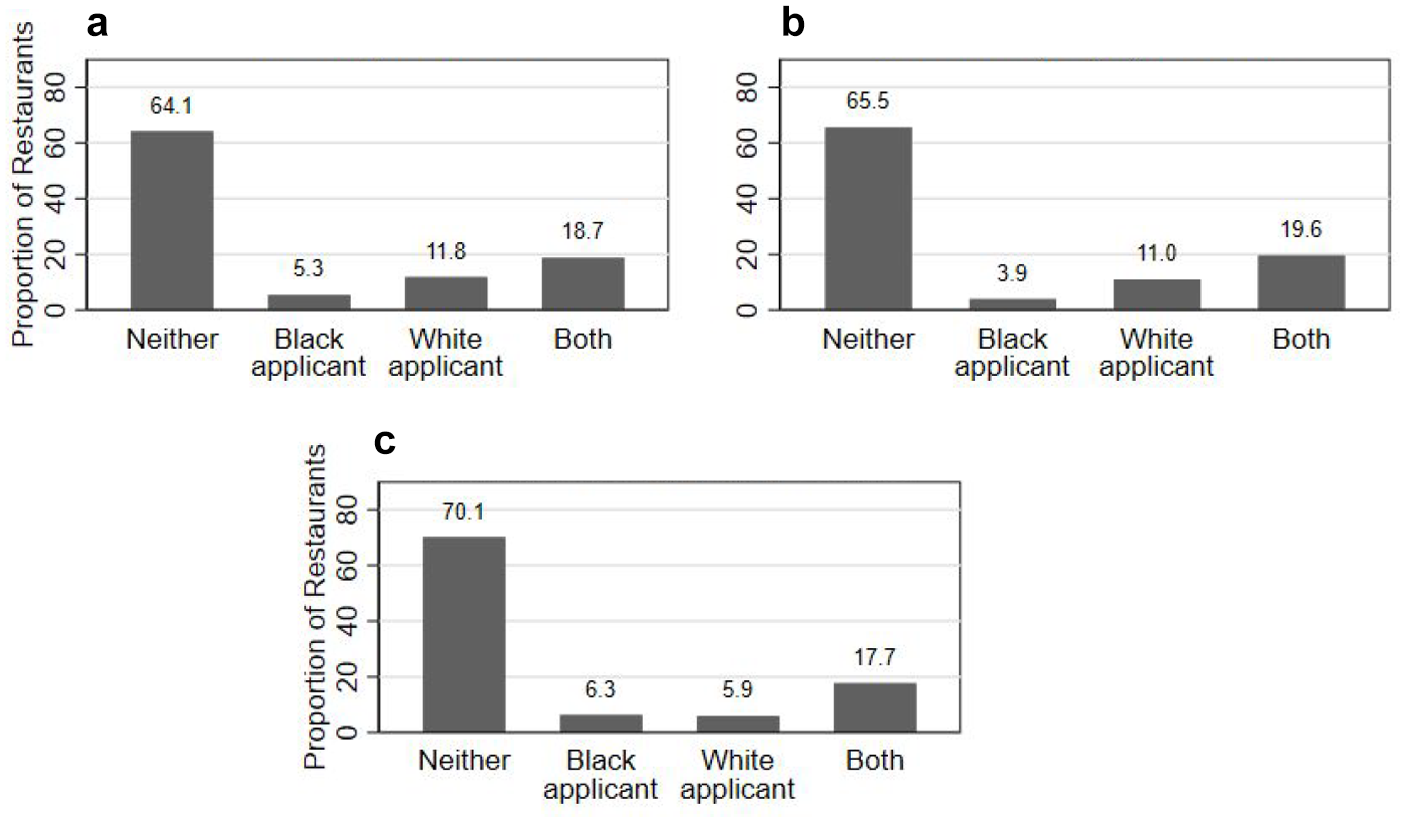
Patterns of Callbacks by Restaurant and Email Message Condition. (a) Parking Condition. (b) Diversity Inquiry Condition. (c) Activist Diversity Inquiry Condition
Employer email response data
Many employers responded to the emails we sent them. The email response rate in each treatment condition provides further context for interpreting our findings (see Figure 4). Indeed, it appears that there were fewer responses from restaurants in the diversity inquiry condition than the other two conditions. Estimates from a logistic regression confirm that the response rates in the parking inquiry (control) condition and the activist diversity inquiry condition are statistically significantly different than the response rate in the diversity inquiry condition (p < .01).
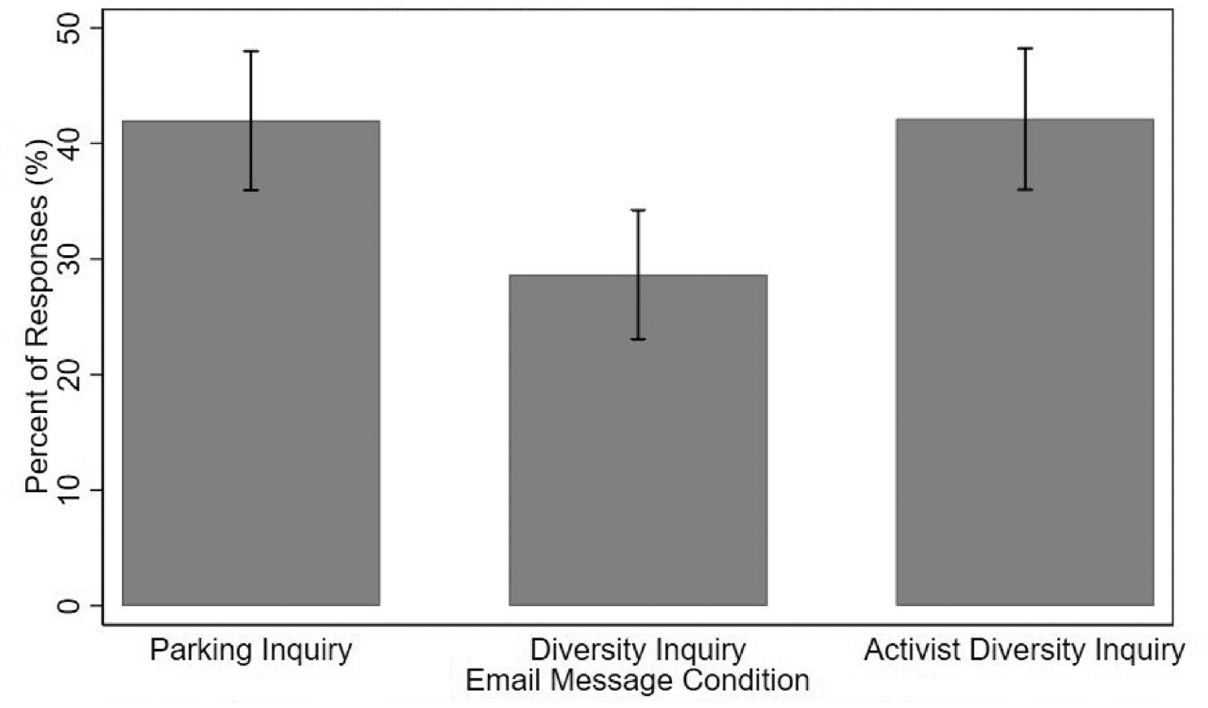
Restaurant Response Rate by Email Message Condition
While we cannot adjudicate the reason for different employer response rates with these data, it is noteworthy that employers engaged with the parking and activist diversity inquiries at similar rates but the diversity inquiry at a much lower rate. We can speculate that employers may be less inclined to engage with customers about their concerns related to diversity if the customer is just a single voice without a connection to an online review system. Furthermore, restaurants responding at higher rates to activist customers might be an indication that they are taking their diversity concerns more seriously due to the potentially public voicing of their concerns through an online review system. In turn, it may be this increased seriousness that results in a reduction in discrimination in the activist diversity inquiry condition.
Discussion and Conclusion
There is strong and consistent evidence that racial discrimination remains an important feature of the U.S. labor market (Quillian et al. 2017). The forces that influence discriminatory decision-making, however, have received less attention. In this article, we develop a theoretical argument about customers being able to influence organizational decision-making, including racially discriminatory decision-making. We argue that insofar as employers may discriminate against racial groups to align with their perceptions of customer preferences, employers may also be responsive to customers’ requests for more diverse representation. Furthermore, we suggest that customer efficacy is likely to be stronger when they clearly state their connection to other customers through forces such as online review systems.
We test our argument using a novel method that provides causal traction on whether customer communication can affect hiring discrimination. Although our data collection was interrupted by the coronavirus pandemic, we find evidence of racial discrimination in our control condition, which aligns with findings in existing scholarship (Bertrand and Mullainathan 2004; Gaddis 2015; Pager, Western, and Bonikowski 2009; Pedulla 2018b). We also find a very similar estimate of racial discrimination in the condition where the customer expresses their interest in the restaurant having a more diverse workforce (the diversity inquiry condition). Thus, a simple customer expression of a desire for more racial diversity does not appear to impact hiring decisions. However, we do not detect racial discrimination in the condition where in addition to expressing a desire for more diversity, the customer also notes that they like to reach out to restaurants before they write a public review (the activist diversity inquiry condition). Furthermore, we find that the racial gap in callbacks is smaller in the activist diversity inquiry condition than both the parking inquiry and diversity inquiry conditions, separately. Although, as we noted earlier, when we include data from after the start of the pandemic, our results are attenuated. 8 Together, these findings offer some evidence that individual customer communication—when embedded within a socio-technical environment such as online reviews—can shape organizational decision-making and discriminatory behavior. It is important to also note, however, that the reduction in discrimination that we detect comes from employers in the activist diversity inquiry condition being less likely to call back only the White applicant and to be more likely to not call back either applicant. While this reduces the Black-White callback gap—our measure of discrimination—it does not increase the callback rate for Black applicants.
Our findings contribute to the limited body of scholarship on customer-based discrimination. Indeed, our findings indicate that—at least under certain conditions—employers are sensitive to the preferences and “tastes” of the customers outside of whether they like and enjoy the product or service produced by the company. Even if employers do not act in a discriminatory way due to their own prejudices or perceive customers to hold certain prejudices, they may discriminate in ways that align their organizational demography with what they perceive their customers to desire. The evidence we present here documents a reduction in the Black-White callback rate gap—in other words, reduced discrimination. However, many individuals in the United States hold biased and discriminatory beliefs that could lead them to communicate with companies about desires for less representation of Black workers (or other types of workers). This could exacerbate discrimination. Future scholarship on this possibility would be useful for more fully understanding the consequences of customer communication on discriminatory hiring behavior.
These findings also speak to the important role of online review systems. They not only provide information to potential customers about the quality of a company, but they also imbue some level of power and influence to individual customers. This power and influence may not be limited to concerns about racial diversity but to other domains as well, for instance, improving access for people with disabilities or garnering support for labor organizing. Identifying and expanding on the conditions under which online review systems intersect with customer influence is an important avenue for future research.
Our methodological approach also offers a relatively new set of tools to scholars interested in understanding what can exacerbate or mitigate discrimination. To our knowledge, a limited number of studies—such as Fang et al. (2018), Dur et al. (2022), and Butler and Crabtree (2017)—have used similar approaches. We see this type of research design—randomly assigning different units of interest to receive different types of targeted messages (or other “treatments”) and then conducting an audit study to generate causal estimates of discrimination—as an important next step in research on discrimination. Audit studies are a powerful method to measure racial (and other forms of) discrimination because other experimental approaches (e.g., survey or laboratory experiments) often face issues with social desirability bias and do not find biases in respondents’ attitudes and behaviors that we know exist (Pager and Quillian 2005). A similar approach to ours could also be applied to other institutional domains, such as consumer markets and the lending markets, where discrimination and bias have been detected (Besbris et al. 2015; Harkness 2016).
While our study makes important advances in the understanding of racial discrimination in the labor market, it is not without limitations. First, the interruption and disruption of data collection due to the coronavirus pandemic means that our analysis and results are more exploratory than we initially anticipated. We thus see our findings as an initial pass at understanding the effects of customer communication on racial discrimination in hiring rather than the final word. We did not reach our target sample size, and the final two weeks of data collection were likely impacted by the beginning of the pandemic, which hit the restaurant industry—our empirical focus—quite hard. These challenges necessarily place important scope conditions on the interpretation of our findings and limit the ability to make as strong claims about the effects of our customer email messages as would be possible had the study been completed in the manner initially anticipated. Thus, we encourage future work to deploy similar methods to see whether these findings are consistent over time and to alternative types of customer communication.
There are also some limitations built into our research design. First, we only examine male job applicants and only compare applicants that are likely perceived as White and Black. Additional sociodemographic variation could be instructive. Second, the customer communication messages came from someone who was likely perceived as a White man and personally unknown to restaurant management. Whether and how the characteristics of the customer shape the impact of their concerns is also an avenue for future research. Additionally, we are not able to verify that the individual who received the message from the “customer” was directly involved with the hiring process for the position audited in the field experiment. In some cases, the recipient of the email may have been involved with the hiring process in the field experiment; in other cases, they may have communicated with the hiring team about the customer message; and still in other cases, the customer message may not have been communicated to anyone involved with hiring for the position in the audit study. This means that the effects we detect of our customer communication are likely a conservative estimate. Finally, our analysis is limited to server jobs in the restaurant sector in six metropolitan areas. Thus, it is unclear how other jobs, sectors, and cities may influence this set of findings.
Can customers affect hiring discrimination? In this article, we offer initial evidence on this question. Customers and their embeddedness in online review systems can influence company decisions and the types of applicants that get a foot in the door. Along with other systemic interventions within business organizations, this type of communication could be a useful tool in efforts to reduce bias and discrimination. However, as we already mentioned, there are also concerns that customer communication about racial representation at companies could actually exacerbate discrimination insofar as biased customers are communicating their desires to the organizations they patronize. Yet the findings presented and the methodological approach utilized here hold promise for continued work on understanding the forces that can influence discriminatory decision-making in the world of work, with important implications for processes of social inequality.
Supplemental Material
sj-pdf-1-spq-10.1177_01902725221109533 – Supplemental material for Can Customers Affect Racial Discrimination in Hiring?
Supplemental material, sj-pdf-1-spq-10.1177_01902725221109533 for Can Customers Affect Racial Discrimination in Hiring? by David S. Pedulla, Sophie Allen and Livia Baer-Bositis in Social Psychology Quarterly
Supplemental Material
sj-pptx-2-spq-10.1177_01902725221109533 – Supplemental material for Can Customers Affect Racial Discrimination in Hiring?
Supplemental material, sj-pptx-2-spq-10.1177_01902725221109533 for Can Customers Affect Racial Discrimination in Hiring? by David S. Pedulla, Sophie Allen and Livia Baer-Bositis in Social Psychology Quarterly
Footnotes
Acknowledgements
We thank Neehar Banerjee for research assistance. We thank Mike Bader, Genevieve Butler, Michael Gaddis, Alex Murphy, and Nate Wilmers for valuable feedback on earlier versions of this article. Any remaining errors are our own.
1
While our focus is on hiring, customers may be able to impact discrimination at multiple points throughout the labor process, including salary setting, performance evaluations, and promotions.
2
The widespread institutionalization of anti-discrimination policies, however, has also unintendedly made it harder to legally prosecute discriminatory behavior through what Edelman et al. (2011) refer to as “legal endogeneity.” Legal endogeneity is a process whereby as certain organizational structures become broadly or universally institutionalized (e.g., anti-discrimination policies), legal actors are more likely to associate those organizational structures with legal compliance. In addition, organizations that adopt anti-discrimination policies do not necessarily promote egalitarian attitudes and could actually activate stereotypical or prejudicial beliefs (e.g., Tinkler, Li, and Mollborn 2007).
3
This experiment was registered on the AEA RCT Registry (#AEARCTR-0003831). The project was approved by the Insitutional Review Board (IRB) at Stanford University and Harvard University.
4
There is some evidence that racialized names can also signal social class ( ). We attempted to select names that signaled race while limiting how much they signaled social class to avoid the confounding of race and class. One additional note about the names is that while respondents in the survey experiment responded that Robert Andersen and Seth McGrath were “White” names when explicitly asked about the race they associated with the name, it is unclear whether real employers actively think of applicants with these names as White when they are screening applicants. During the actual hiring process, these—and similar—names may simply default to assumptions of whiteness.
6
7
Because existing theoretical and empirical scholarship offers a clear prediction for the direction of the effect of being a Black applicant, we evaluated the overall racial discrimination effect in Model 1 of using both one-tailed and two-tailed statistical tests. We only present the two-tailed test in Table 1 for ease of presentation.
Authors’ Note
The second and third authors contributed equally to this work, and their names are listed alphabetically.
Funding
The author(s) disclosed receipt of the following financial support for the research, authorship, and/or publication of this article: Funding for this project was provided by the Sociology Department at Stanford University and the UPS Endowment Fund at Stanford University.
Supplemental Material
Supplemental material for this article is available online.
Bios
References
Supplementary Material
Please find the following supplemental material available below.
For Open Access articles published under a Creative Commons License, all supplemental material carries the same license as the article it is associated with.
For non-Open Access articles published, all supplemental material carries a non-exclusive license, and permission requests for re-use of supplemental material or any part of supplemental material shall be sent directly to the copyright owner as specified in the copyright notice associated with the article.
