




Abstract
Despite a steep rise in income inequality over the past five decades, Americans’ preferences for redistribution have remained stagnant. Previous research suggests that redistributive preferences are rooted in stable institutional and cultural contexts but can change with exposure to information. We investigate the role of understandings of the link between income and psychological well-being in shaping policy preferences. Further, we consider whether effects differ if similar information is framed in terms of disadvantages for the poor versus advantages for the affluent. In a large, preregistered online experiment (N = 2,751), we examined the effects of three common themes in scholarship on happiness and well-being: Money Prevents Unhappiness, Money Provides Happiness, and Money Doesn’t Matter. Results show that learning that Money Prevents Unhappiness (versus the other two themes) increased egalitarian preferences. Effects were moderated by political ideology, income, and subjective social class but not by race. We discuss the implications of these findings in light of the current cultural discourse about happiness, which often privileges non-income causes and positive emotions.
While income inequality has sharply risen over the past 50 years (McCall and Percheski 2010; Saez and Zucman 2020), Americans’ preferences for redistribution have remained largely unchanged (Brooks and Manza 2013; Johnston and Newman 2016; McCall 2013). Previous scholarship finds that redistributive preferences are grounded in relatively stable social factors, such as cultural beliefs about fairness, perceptions about levels of inequality, and institutional contexts (e.g., Kuhn 2019; Luttmer and Singhal 2011; McCall 2013; VanHeuvelen and Copas 2018). Nevertheless, experimental research demonstrates that these preferences can be influenced by exposing individuals to new information or other stimuli, for instance, by altering either perceptions about the prevalence of inequality and mobility (Alesina, Stantcheva, and Teso 2018; Heiserman and Simpson 2017), perceived relative advantage in a setting (Condon and Wichowsky 2020), or exposure to inequality (Sands 2017). In this article, we assess another potential influence on redistributive preferences: understandings of whether income matters for how happy people are.
Popular notions of “happiness” bring together various, conceptually distinct aspects of psychological well-being, life satisfaction, emotional experience, and positive mental health. Together, these are considered important features of a good life and ones to which we may have become particularly attuned in present times. Over the past half century, happiness and mental health have increasingly acquired cultural salience, which is reflected across multiple aspects of social life, including media discourse, organizational practices, health care, markets, politics, and popular culture (Cederstrom 2018; Davies 2015; Ehrenreich 2009; Fischer 2014). For at least as long, scholars have proposed that beliefs about how income impacts happiness may influence demands for income redistribution. For instance, Lane (1959) contended that the belief that more money does not imply more happiness helps explain why working-class adults are so tolerant of inequality. Likewise, Hochschild (1979) suggested that one reason why the poor do not demand more redistribution is because the “non-materialists” among them value things they believe money cannot buy, including a good quality of life. The sociologists Mirowsky and Ross (1986:24) have argued that economic disparities may seem more acceptable “if the poor were as happy and fulfilled as the wealthy.”
Such understandings align with propositions of the system justification theory, which suggests that people are motivated to believe that the world is as it should be (for a review, see Jost 2019). One prediction of this theory is that people justify inequality by believing (among other things) that “complementary justice” offsets the material consequences of inequality. For example, an experiment by Kay and Jost (2003) found that being primed by the common cultural script of “poor but happy” (vs. poor and unhappy) enhanced perceptions of fairness of the prevailing social system.
Academic research about mental health and happiness is widely invoked when these topics are discussed in newspapers, television, and online media. Indeed, a U.K. study found that, since the proliferation of happiness research in the 1980s, scientific ideas about psychological well-being have increasingly featured in newspapers (Frawley 2018). Leading academic experts have authored several books on well-being, some of which have become bestsellers (e.g., Dolan 2019; Gilbert 2006; Lyubomirsky 2008; Seligman 2002). Lessons from academic research can therefore become “public ideas” (Hallett, Stapleton, and Sauder 2019). In terms of their influence, academic ideas can be more powerful than claims unsupported by research, as individuals may defer to scientific authority when formulating their opinions on social issues (Brossard and Nisbet 2007; Malka, Krosnick, and Langer 2009). Thus it is plausible that academic research about happiness may have a nontrivial effect on cultural understandings of happiness, and these understandings, in turn, may have ramifications for social policy preferences.
Yet academic research can support different, not always commensurate, narratives about whether and how income and well-being are related. An analysis of television coverage about mental health found that one important axis of variation was whether the coverage focused on disadvantages or advantages (Myrick, Major, and Jankowski 2014), and a similar contrast can be drawn regarding narratives about well-being. Following language from Lowery, Chow, and Crosby (2009), a “disadvantage frame” focuses attention on how lower income is associated with various sources of unhappiness and how more money can improve well-being by helping people avoid or mitigate that unhappiness. Alternatively, an “advantage frame” would instead make salient the ways that higher income may be used to increase happiness. Besides the possibility of differing emphasis on disadvantage or advantage, however, research can be also marshaled for the narrative that income does not—or not much—matter for happiness, including by emphasizing instead the importance of other factors, like genes, values, or behaviors.
To consider whether and how exposure to these different characterizations of the research on income and happiness affects redistributive preferences, we conducted a large preregistered survey experiment. We also investigate if priming about well-being influences understandings of distributive justice in terms of equality of outcomes versus opportunity. Finally, we examine whether there is heterogeneity in observed effects by political ideology, subjective social class, income, and race.
Background
Three Narratives about Money and Happiness
As noted, academic research on income and mental well-being (broadly conceived) is heterogeneous enough in both focus and findings to support at least three broad themes. The first centers on the consequences of economic disadvantage. For instance, researchers have documented a relationship between poverty and negative psychological well-being (Boyd-Swan et al. 2016; Heflin and Iceland 2009). Some work on this theme pursues the causal pathways that connect low income and negative well-being. As examples, one line of research ties the higher rates of psychological distress among the poor to their greater exposure to adverse life events and everyday stressors (Businelle et al. 2014; McLeod and Kessler 1990), while another shows that socioeconomic disadvantage decreases sense of control over the environment, which in turn is linked with lower well-being (Mirowsky and Ross 2007). Other studies highlight potential mediating pathways, such as physical health (Link and Phelan 1995; Schnittker 2004) and the quality of relationships (Karney 2021), through which income indirectly impacts psychological well-being.
A second theme similarly proposes a causal link between money and well-being, but instead of focusing on unhappiness and distress caused by material deprivation, it focuses on the role of money in improving well-being. This theme draws on research that identifies positive well-being effects either for having more money in general or for specific ways that persons might spend their money. For instance, various studies have tied gains in personal happiness to gains in real income (Diener et al. 1993; Schnittker 2008), and some suggest that certain dimensions of psychological well-being continue to increase with income, even at very high income levels (Kahneman and Deaton 2010; Stevenson and Wolfers 2013; for a different result, see Jebb et al. 2018). Other research has expounded on causal mechanisms through which spending money might enhance happiness. For example, spending in order to save time spent on unpleasant chores, purchase memorable experiences, or develop meaningful connections by helping others has been shown to have a positive effect on one’s own well-being (Dunn, Gilbert, and Wilson 2011; Dunn and Norton 2013; Whillans et al. 2017).
A third theme reflects the opposite viewpoint, namely, that income is not a significant determinant of well-being. Some of this scholarship expands on the “Easterlin paradox,” which contends that despite improvements in material progress over time, aggregate happiness levels in society have not improved (Easterlin 1974; Easterlin and O’Connor 2022). While the paradox concerns populations, not individuals, some work it has inspired emphasizes the role of nonmaterial aspects of life in determining individual happiness (Headey 2008). Another line of research has examined behavioral interventions (for a review, see Sin and Lyubomirsky 2009) that seek to improve happiness without changing people’s objective conditions. Others have focused on the stability of well-being within individuals, including research on happiness “set points” that proposes that individuals have more or less stable baseline levels of well-being (Brickman and Campbell 1971; Luhmann and Intelisano 2018) and genetic research about the heritability of happiness (van de Weijer, de Vries, and Bartels 2022). By elevating the salience of competing causes (whether within or between individuals), these ideas can have the effect of undermining the extent to which money is viewed as an important cause (Morris et al. 1995).
How Happiness Narratives Can Influence Public Opinion
Narratives can provide frames that help us make sense of the social world (Entman 1993; Goffman 1986). This includes how we understand the nature of social problems, to whom we attribute responsibility, and our normative assumptions about which problems are worthy of collective action (Benford and Snow 2000; Campbell 2002; Shepherd and Stephens 2010). These interpretive processes affect attitudes. As examples, attribution of responsibility for poverty shapes public opinion of and attitudes toward the poor (Hoyt et al. 2021; Iyengar 1994:7), and understandings of the causes of income inequality influence opinions about it (Schneider and Castillo 2015).
The aforementioned themes about happiness vary in the extent to which disparities in well-being are attributed to income differences, which in turn may influence public opinion about inequality and redistributive policies. Different reactions to the narrative that money prevents unhappiness, versus information that money is less important for well-being, may be shaped by at least three distinct social psychological processes. First, narratives may influence judgments about the fairness of income inequality. For instance, assessments about fairness are influenced by claims about needs (Alves and Rossi 1978). The narrative that money prevents unhappiness implies a need-based claim for income equality, whereas that money does not matter implies no need-based claim. Second, the narratives may evoke different levels of compassion. In the context of collective action problems, compassion can become a “feeling rule,” structured by broader sociopolitical conversations influencing how people feel they should respond to the situation (Kleres 2018; Maestri and Monforte 2020). The narrative that money prevents unhappiness may thus lead to a compassionate reaction toward the poor, whereas the no-effect narrative may induce no such reaction. In turn, compassion can increase support for generous social policies (Petersen et al. 2012; Sohlberg, Esaiasson, and Martinsson 2019). Third, people’s reactions may also be driven by self-interest, often an important motivation behind redistributive preferences (Langsæther and Evans 2020; Sznycer et al. 2017). The consequences of self-interest may, however, be heterogenous in terms of whether individuals expect themselves to be beneficiaries or payees (Cavaillé and Trump 2015). We return to this issue in the following section.
As noted, the narratives that lower income causes unhappiness and that higher income provides happiness may be considered examples of disadvantage and advantage frames, which other work has shown can have different effects. For example, Lowery et al. (2009) find that people are more likely to support redistribution when inequality is framed as a subordinate actor having less (a disadvantage frame) versus an advantaged actor having more. Similarly, Dietze and Craig (2021) find that frames underscoring the disadvantage of the poor increase support for redistribution. However, findings are not consistent (e.g., Chow and Galak 2012). One recent study on support for inequality reduction conducted 12 experiments and found both greater effects for disadvantage frames and some null effects (Howlett, Jarvis, and Evers 2021).
These studies have all focused on presenting information about the material consequences of inequality rather than its psychological consequences for well-being. As suggested already, one reason the disadvantage frame might evoke support for redistribution is by triggering compassion, as it makes salient the suffering of others. Meanwhile, the advantage frame that money provides happiness focuses attention on the non-poor, and redistribution in this scenario may be perceived as inflicting harm on this group by reducing their well-being. If people are averse to causing harm to others, as suggested by some previous studies (Baron 1995; Royzman and Baron 2002), this mechanism could reduce support when an advantage frame is used. For these reasons, then, we may predict that the narrative that money prevents unhappiness will lead to stronger redistributive preferences than both that money does not matter and the narrative that money provides happiness.
Exposure to information about the income-happiness link may also have implications for what aspect of equality people consider important. Here research has focused on the distinction between the distribution of outcomes and the fairness of processes that generate those outcomes; that is, equality of outcomes versus opportunities. While of course there is no logical reason one cannot care about both, past research has suggested a lower correlation between the actual distribution of outcomes and opportunity than one might expect (Mitra, Bang, and Biswas 2015). Previous scholarship has often suggested that Americans’ understanding of distributive justice is rooted in the idea of equality of opportunity (Lipset 1992; McCall 2013; McCall et al. 2017). But belief in equal opportunity can undermine support for reducing inequality in outcomes (Magni-Berton 2019; Sugden and Wang 2020), and individuals tend to trade off between the two notions of equality (Saito 2013). To this end, priming individuals that the distribution of a key life outcome—psychological well-being—is affected by the distribution of economic outcomes might shift consideration more toward equality of outcomes. The specter of injustice in this respect may be made especially salient by a disadvantage frame—tying the lack of money to negative well-being—and so might be particularly likely to prompt a greater focus on equality of outcomes.
Potential Heterogeneity by Subjective Class, Income, Political Ideology, and Race
Earlier we noted a recurring speculation that the belief that money does not matter for happiness may promote tolerance for inequality among the poor (e.g., Hochschild 1979; Lane 1959). By the same token, one might propose that the information that money does matter might have its strongest effect on increasing support for redistribution among those with lower income. Support for redistribution tends to be stronger among those who perceive themselves as potential beneficiaries (Cavaillé and Trump 2015) as well as those whose rank in the economic hierarchy is not downgraded by the proposed redistribution (Xie et al. 2017). Socioeconomically disadvantaged individuals are also more likely to be moved by needs-based justifications compared with advantaged individuals (Evans, Kelley, and Peoples 2010). At the same time, self-interested preferences can also vary by subjective social class via mechanisms of identification with social class of origin and family socialization (McCall and Manza 2010; Piketty 1995). Taken together, this body of research suggests that both income and subjective social standing can moderate the effects of information about the relationship between money and happiness.
Effects of information exposure may also vary by political ideology. Previous research finds that partisanship influences media consumption, which in turn results in systematic differences in preferences about both political and cultural issues along ideological lines (Iyengar and Hahn 2009). Political ideology is a key axis of differences in distributive preferences, with liberals being more egalitarian (Brooks and Harter 2021). This higher baseline preference could lead liberals to be less responsive to further intervention in the same direction; alternatively, some research indicates that liberals may value emotional consequences more than conservatives (Choi et al. 2023), which might produce stronger treatment effects in our experiment among liberals.
Race is another source of cleavage in political preferences (Becker 2021; Keely and Tan 2008). In particular, mechanisms of racial threat (Wetts and Willer 2018) and stereotypes about ethnic minorities (Fox 2004) lower support for redistributive policies among White individuals. The U.S. public tends to view welfare programs as primarily serving Black Americans (Gilens 2000). As such, racialized sentiments color interpretations even in the absence of explicit racial information, as people tend to assume the race of beneficiaries from policy features (Ellis and Faricy 2020; Haselswerdt 2022). If the disadvantage frame in any way elicits racialized sentiments toward the poor, we might expect treatment effects to be weaker among White participants.
Hypotheses
Following the preceding reasoning, we preregistered three hypotheses (full preregistration available at https://osf.io/y7zr8):
Hypothesis 1: The Money Prevents Unhappiness narrative versus control will increase preference (a) for redistribution, (b) for income equality, and (c) for equal outcomes versus equal opportunity.
Hypothesis 2: The Money Prevents Unhappiness narrative versus Money Doesn’t Matter will increase preference for (a) redistribution, (b) income equality, and (c) equal outcomes.
Hypothesis 3: The Money Prevents Unhappiness narrative versus Money Provides Happiness will increase preference for (a) redistribution, (b) income equality, and (c) equal outcomes.
We will also discuss results from exploratory analyses examining moderation of treatment effects by political views, subjective social class, income, and race. As discussed further, a follow-up study was conducted to investigate further some exploratory findings from the experiment; this was also preregistered (https://osf.io/89kar).
Data and Method
Data
We conducted an online survey experiment on a sample of U.S. adults via Prolific (www.prolific.co), a crowd-working platform designed for academic research (Palan and Schitter 2018). Peer et al. (2021) compared four online panels and platforms and found that Prolific participants had the highest levels of attention, comprehension, honesty, and reliability. To further enhance data quality, we excluded “non-naive” participants, defined as those who had completed more than 500 Prolific assignments (Meyers et al. 2020), and those with less than a 95 percent approval rating on previous assignments. We recruited participants for an estimated time commitment of five minutes in exchange for $0.80.
The target sample size was 2,800. After removing cases that did not meet inclusion criteria or failed the pretreatment attention check (Kane, Velez, and Barabas 2020), the analytical sample size was 2,751. 1 Each respondent was asked two additional questions about the treatment to which they were exposed, to allow evaluating the quality of data and enhance participant attention during the treatment (Mutz 2011:87). More than 94 percent of participants answered both correctly, indicating overall reasonable attention levels. Respondents who failed post-treatment checks are retained in the analysis to ensure unbiasedness of treatment effect estimates (Aronow, Baron, and Pinson 2019).
Design
We sought to manipulate participants’ understanding of the causal relationship between income and psychological well-being. Participants were randomly assigned to one of four experimental conditions where they read short articles, mimicking the style of articles one might come across on a blog or a lifestyle section of a newspaper. In the three narrative treatment conditions, these articles summarized findings from previous peer-reviewed research studies. In one treatment, participants read an article claiming that higher income decreases unhappiness—we refer to this as the Money Prevents Unhappiness condition. Here, participants learned about the importance of economic constraints in generating well-being-depleting experiences and limiting the pursuit of well-being-enhancing experiences. Another treatment focused on the positive effects of money for happiness—the Money Provides Happiness condition. To ensure that any differences in the effects of advantage and disadvantage frames are not confounded by substantive variation, we kept the substance identical except for the focus on happiness or unhappiness. A third treatment—the Money Doesn’t Matter condition—indicated that higher income is not much related to happiness or unhappiness. The Money Doesn’t Matter treatment was designed to be comparable to the other two narrative treatments in terms of the quantity and potency of supportive evidence. However, substantive arguments provided in this condition are not direct rebuttals of the others—an inevitable consequence of the nature of the respective literatures.
While the articles were contradictory across conditions, this reflects the differing emphases and disagreements in the literature previously described. No deception or misrepresentation was used; participants were provided with a list of citations upon which the claims in the article they read were based. The complete text of all articles is available in Appendix A. 2
Control-group participants read an article of similar length on an unrelated topic. As part of the follow-up experiment discussed in more detail later, we considered the possibility that, even though the control text was not about the association between money and happiness, certain words in the control text may have evoked associations about this topic. The follow-up experiment randomized among three different control texts (provided in Appendix B), including the original, and we found no significant differences among them (see Appendix Figure B1).
After reading the text, participants were asked questions about their preferences for redistribution. Because we were interested in the difference between Money Prevents Unhappiness versus other conditions, we used an unbalanced design to optimize statistical power. Specifically, we assigned 1.73 times more respondents to Money Prevents Unhappiness than the other conditions (this being the square root of 3, where 3 is the number of comparison groups for the focal treatment; Bate and Karp 2014). Other conditions were approximately equally sized, and all treatment assignment was random. This sample assignment allowed us to detect a standardized difference of .15 with 80 percent power for our preregistered hypotheses.
Across experimental conditions, the sample was fairly balanced on demographic characteristics except for higher political liberalism in the control group (see Appendix C for descriptive statistics). 3 Our sample is younger, lower income, more educated, and more liberal than the U.S. population, as is usual for crowd-working platforms (e.g., Doyle 2021; Horne and Johnson 2022). Previous research shows that experimental effects tend to be similar across representative and nonrepresentative samples, especially after controlling for demographic differences (Weinberg, Freese, and McElhattan 2014). In addition to presenting estimates adjusted for respondent characteristics, we will also examine heterogeneity by political attitudes and socioeconomic status.
Outcomes
Our three outcomes of interest are two types of egalitarian preferences and preference for equality of outcomes (see Appendix D for full text of items).
Redistributive policy preference
We measure whether the respondent supports government intervention to decrease income differences between the rich and poor on a scale of 1 to 7. This is a long-running item in the General Social Survey (GSS; called EQWLTH), and a similar measure is also included in the European Social Survey. It has been widely used as a measure of redistributive preferences (Brady and Bostic 2015; Brooks and Manza 2007; McCall et al. 2017).
Income equality preference
We include an indicator of whether the respondent believes that income differences between the rich and poor are too large. This variable is adapted from an item included in six GSS waves (INCGAP) that has been used in previous studies about redistributive and equality preferences (Hoy and Mager 2021; Shariff, Wiwad, and Aknin 2016). Given concerns that the agree-disagree format of the GSS item may result in acquiesce bias (Saris et al. 2010), we use a self-description scale recommended by Timbrook, Smyth, and Olson (2021). The reworded question is, “How well does this statement describe your views: Differences in income in America are too large,” with the response categories ranging from 1 = not at all to 5 = completely. We include this question to capture the extent to which respondents might support income equality without necessarily also favoring government intervention.
Equality-of-outcomes preference
We measure whether the respondent favors promoting equality of opportunity or equality of outcomes. The item is adapted from the 1993 GSS (OPOUTCME). The following categorical responses were recorded: promote equal opportunity, promote equal outcomes, or neither. The observed proportion of neither responses is small (5.7 percent), and so, for ease of interpretation, our presentation of results focuses on the comparison of equal outcomes versus equal opportunities. Substantive results remain the same across different ways of handing neither responses (Appendix E).
Moderators
Political ideology
We adapt a measure of political ideology from the GSS. The question is worded as follows: “In general, do you consider yourself liberal or conservative?” The seven categories range from extremely liberal to extremely conservative; we code the variable so that higher values indicate more conservatism.
Subjective social class
We use a version of the Cantril (1965) ladder that was used in the Whitehall II study (Singh-Manoux, Adler, and Marmot 2003). Respondents are presented with a picture of a ladder with rungs ranging from 1 = bottom to 10 = top that is said to represent one’s standing in society based on money, education, and jobs; respondents are asked to place themselves on the ladder.
Family income (logged)
Annual family income is recorded on a categorical scale and converted to a continuous measure using midpoint approximation (Hout 2004).
Race
Participants’ race was measured by Prolific in terms of the following categories: White, Black, Asian, mixed, and other. Moderation analyses combine non-White respondents due to the small sample sizes.
Analytic Strategy
We define a treatment effect as the difference in the dependent variable between the Money Prevents Unhappiness condition and each of the three other conditions. We present estimates both for the simple bivariate comparison and controlling for gender, age, race, education, and political ideology. The former is what we preregistered, while the latter was suggested by reviewers and noticeably improves the efficiency of our estimates. Full results tables are provided in Appendix F.
Moderation analyses are based on linear regressions with interaction terms. We should note that the moderation analyses were not part of our preregistered hypotheses, and we expected that a larger sample size would be needed to detect significant moderation effects (Aiken, West, and Reno 1991; Carte and Russell 2003). As per the preanalysis plan, respondents who are missing data on a given variable are excluded only from analyses using that variable.
Results
Treatment Effects on Egalitarian Preferences
We begin by examining the differences in egalitarian preferences. Figure 1 summarizes treatment effect estimates for support for redistribution and income equality. Our preregistered hypotheses all pertained to expected differences between the Money Prevents Unhappiness condition and the other three conditions. Considering first the difference between Money Prevents Unhappiness and Money Doesn’t Matter (Hypotheses 2a and 2b), we predicted that exposure to research suggesting that money matters for unhappiness, as opposed to learning that money does not affect unhappiness, increases egalitarian support. We found significant results supporting this prediction for both income redistribution (β = .26; p < .01) and equality (β = .17; p < .01). These differences remain statistically significant after adjusting for covariates.

Effects of “Money Prevents Unhappiness” Treatment on Egalitarian Preferences
We also predicted that the disadvantage frame of being told that money prevents unhappiness would yield stronger egalitarian preferences than the advantage frame that money provides happiness (Hypotheses 3a and 3b). Again, significant results supporting these predictions were observed for both support for redistribution (β = .26; p < .01) and income equality (β = .16; p < .01), and the effects remained significant in multivariate analyses. As such, we found clear support for the conclusion that information about the usefulness of income for reducing personal unhappiness increases support for egalitarian preferences relative to describing the relationship between income and unhappiness as inconsequential or in terms of money increasing happiness. These results are robust to removal of respondents who failed post-treatment attention checks (Appendixes G1 and G2).
To put the magnitudes of the treatment effects in context, we considered how they compare with national differences in these outcomes by race and gender, which are well-documented sources of variation in American political attitudes (Alesina and Giuliano 2011; Becker 2021). In the 2018 GSS, the Black-White racial gap in support for redistribution was .62 points, while the gender gap was .36—both larger than our estimated effects of .26 and .27. However, in the case of income equality support, our treatment effects (.16 and .17) are larger than national differences by both race (.15) and gender (.11). 4
Meanwhile, even though egalitarian preferences were higher among participants in the Money Prevents Unhappiness treatment compared with the control, the differences between these groups were not statistically significant for either redistributive or equality preferences in bivariate analyses (Hypotheses 1a and 1b). However, estimates adjusted for covariates are statistically significant for redistributive preference (β = .14; p < .05) and marginally significant for equality preference (β = .08; p = .06). The difference in results is due to a combination of the smaller standard errors that result from including covariates and modest imbalance in those covariates despite randomization, particularly for political ideology (see Appendix C).
Treatment Effects on Support for Equality of Outcomes
Next, we tested whether these treatments also had any effect on support for equality of outcomes. In Figure 2, we summarize treatment effects on the probability of respondents to favor promoting equality of outcomes versus equality of opportunity in linear probability models. The only marginally significant treatment effect here is between the Money Prevents Unhappiness condition and the control (Hypothesis 1c; multivariate β = .05; p = .05). This difference becomes statistically significant when we exclude cases that failed attention checks (β = .05; p < .05; see Appendix G3). We did not observe any significant effects of the Money Prevents Unhappiness condition when compared with either Money Doesn’t Matter (Hypothesis 2c; β = .02; p = .39) or Money Provides Happiness (Hypothesis 3c; β = .0004; p = .98). The differences between narrative conditions remain negligible even after excluding failed attention-check cases. Taken together, while the Money Prevents Unhappiness narrative may increase support for equality of outcomes versus the control condition, we do not have any evidence that it does so relative to either of the other narrative conditions.
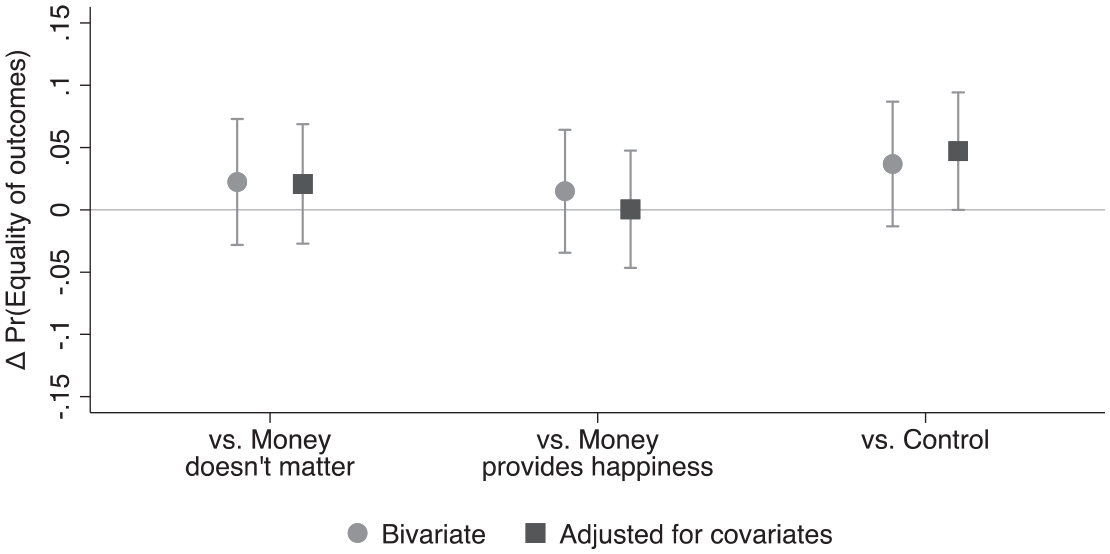
Effect of “Money Prevents Unhappiness” Treatment on Support for Equality of Otcomes versus Equality of Opportunity
Moderation of Treatment Effects on Egalitarian Preferences
We examined four potential sources of heterogeneity in the treatment effects: political ideology, subjective class, income, and race. Figure 3 summarizes the interactions of the moderators with treatment effects in linear regressions (full results in Appendix H). When exposed to Money Prevents Unhappiness versus Money Provides Happiness, higher conservatism increased support for both redistribution (β = .11; p = .07) and income equality (β = .12; p < .01). In the comparison of Money Doesn’t Matter with the Money Prevents Unhappiness condition, conservatism had relatively smaller moderation effects on redistributive preference (β = .06, p = .39) and income equality preference (β = .10, p < .02). When compared with the control, conservatism also appeared to increase egalitarian preferences in the Money Prevents Unhappiness condition. Given that all effects are in the expected direction, we consider this suggestive evidence that conservatism widens the gap between the disadvantage frame and both advantage and no-effect frames.

Moderation of Effects of “Money Prevents Unhappiness” Treatment by Political ideology, Class, Income, and Race
We also observe some evidence of heterogeneity by subjective social class and actual family income. In comparisons of the narrative treatment conditions, all coefficient estimates are in the expected direction, suggesting that the treatment effects of the disadvantage frame versus alternatives decreased with both subjective class and income. The interaction coefficients are at least marginally significant in multivariate regressions (p < .10) in six of the eight tests across outcomes and narrative treatment comparisons. In particular, the interaction effects for both class and income for the comparison of advantage and disadvantage conditions are statistically significant for both outcomes. Across these analyses, the control did not differ from the disadvantage frame, suggesting that heterogeneity by subjective class and income could be driven more by differential reactions to the advantage and Money Doesn’t Matter conditions than to the disadvantage frame.
Finally, we find no evidence of effect heterogeneity between White and non-White participants (ancillary analyses also indicated no differences between White and Black participants). Given the wide confidence intervals of these interaction effects, these estimates appear too noisy to glean any useful insights about the direction of effects.
Follow-up Experiment
Returning to the differences between treatments presented in Figure 1, we had not preregistered any predictions regarding either the Money Doesn’t Matter or the Money Provides Happiness condition versus the control. Both were associated with lower egalitarian preferences compared with the control, although neither was statistically significant. Post hoc, the direction of this result for Money Doesn’t Matter is perhaps unsurprising, given our earlier discussion of how scholars have recurrently suggested that the idea that money does not matter for happiness might discourage egalitarian preferences. Meanwhile, that Money Provides Happiness would produce lower egalitarian beliefs than the control is more counterintuitive: we were anticipating that the advantage frame would not be as effective in encouraging egalitarian preferences as the disadvantage frame but not that it might instead discourage egalitarian beliefs. If so, one possible explanation is that discussing the effects of income in terms of improvements to positive well-being might make more salient that redistributing resources away from more affluent people could reduce their happiness, which could lead to an even greater reluctance to endorse egalitarian beliefs than we anticipated.
Even though neither result was statistically significant, the study was also not intended to be adequately powered to detect differences for these comparisons, as our unbalanced design emphasized comparisons with Money Prevents Unhappiness. We therefore decided to preregister and conduct a follow-up study to test whether the Money Doesn’t Matter and Money Provides Happiness conditions differed from the control. 5 The follow-up was largely a direct replication of the original study that was streamlined to include only the measures and conditions needed for these comparisons. The only other difference in materials from the original study is that, to make sure that results could not be driven by the particular control text used, we randomized among three different, neutral control texts. We followed the same recruitment criteria as the original study, except we also excluded anyone who participated in that study. Full descriptive statistics and result tables are provided in Appendix I.
Figure 4 summarizes treatment effect estimates from linear regressions. While both the Money Doesn’t Matter and the Money Provides Unhappiness condition significantly differed from the control, both conditions were associated with higher egalitarian preferences, not lower preferences as observed in the original study. When adjusted for covariates, differences between the Money Doesn’t Matter condition and the control completely disappeared, although differences between the advantage condition and the control remained. The contradictory direction of differences from the control condition in the two experiments, when taken together, provides no reason to conclude that information either that higher income increases happiness or that income is unrelated to happiness affects egalitarian preferences in either direction.
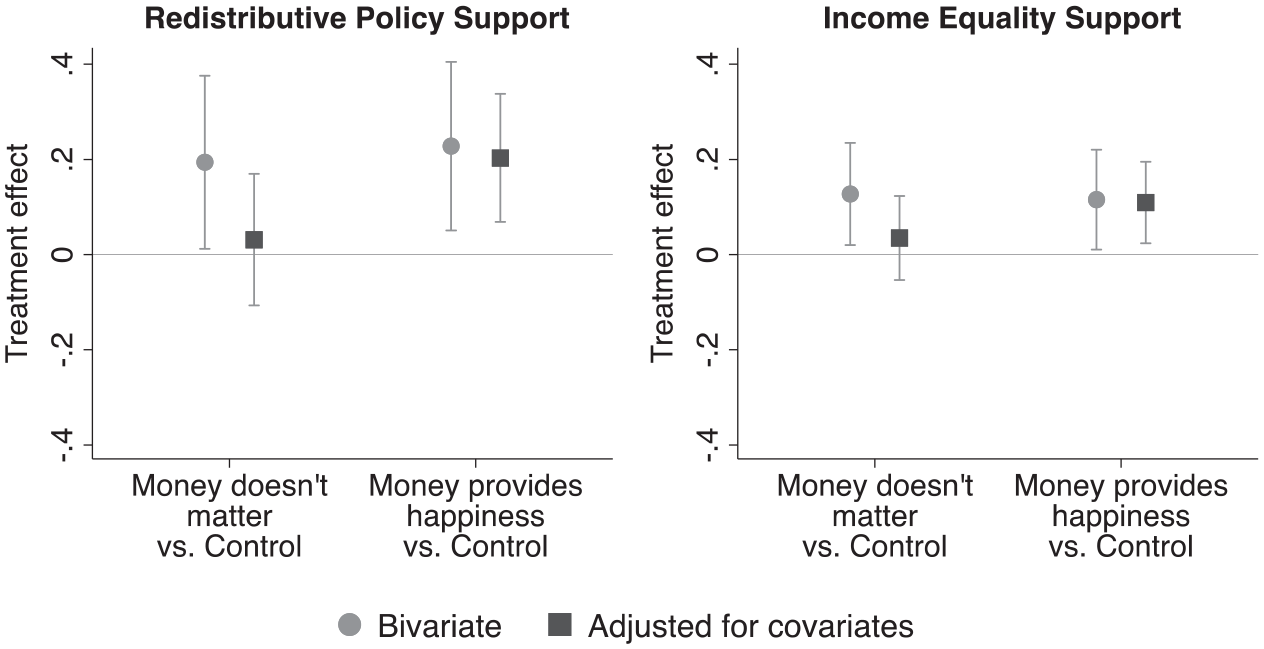
Effects of Narrative Treatments on Egalitarian Preferences
Conclusion
An important claim of political sociology is that public opinion matters for public policy (Burstein 2003; McAdam and Su 2002; Soule and King 2008) and that public preferences are in turn embedded in cultural logics (Brooks and Manza 2007; Gilens 2000). As such, understanding the factors undergirding cultural logics is crucial for apprehending why public opinion about an issue is what it is and how it might be changed. Given the growing salience of emotions and well-being in American society over recent decades (Cederstrom 2018; Scheffer et al. 2021), we investigated whether research-backed narratives about how happiness and income are related might influence support for redistributive policies.
This article examined the effects of three distinct narratives identified in the research, namely, that money prevents unhappiness, that money provides happiness, and that money is irrelevant to psychological well-being. A large preregistered online experiment tested how these narratives affect egalitarian preferences and understandings of redistributive justice in terms of equality of opportunity versus outcomes. There were three major findings: First, exposure to this research had a non-negligible influence on redistributive preferences. While a survey experiment can capture only immediate and short-term effects, these findings provide causal evidence that such cultural messages can move policy preferences. Second, factually equivalent messages that are framed differently (disadvantage vs. advantage) can have as large an effect as qualitatively different messages (disadvantage vs. no effect). And third, political ideology and subjective and objective class moderate the effects of learning this information.
It is also worth recapitulating what we did not find. Foremost, we did not find that the disadvantage frame increased support for equality of outcomes versus opportunity compared with the advantage and no-effect frames. This result appears paradoxical, given that by supporting greater redistribution in reaction to the disadvantage framing, respondents are essentially tethering their preferences to an outcome (i.e., psychological well-being). A possible explanation is that given the entrenchment of the “equality of opportunity” ethos in American culture (McCall 2013), most people side with this familiar script when given a dichotomous choice. In retrospect, perhaps separately measuring preferences for both equality of outcomes and that of opportunity might have been more informative. We also did not find heterogeneity by race. And finally, we did not find convincing evidence that the no-effect and advantage frames influenced distributive preferences.
While social science experiments are in many ways the ideal designs for testing causal claims, they are certainly not free of limitations. One concern pertains to ecological validity (Cicourel 1982)—in this case, the extent to which the experimental conditions mimicked reality. To address this concern, our treatments were presented to the participants as “articles,” imitating the writing style and vocabulary of materials on similar topics that one might encounter on a website, a blog post, or the lifestyle section of a newspaper; as such, to some extent we simulated the experience of reading an article on the internet. However, we cannot eliminate ecological effects that might accompany participation in an online survey experiment. Outside the experimental setting, the valence and context of social interactions typically accompanying exposure to such information can moderate effects of the information itself. Another concern relates to the extent to which we would expect similar effects in a nationally representative sample. Given stronger effects among conservatives (underrepresented in our sample), we suspect that effects might be larger in a representative sample. The implications of class differences are harder to extrapolate: while our sample is younger and therefore lower income than the U.S. average, participants are also more educated. A limitation in analyses of race is that small group sizes necessitated aggregating non-White participants, potentially masking subgroup variation; the absence of evidence for moderation by race is therefore not evidence of absence. Finally, articles used in the treatments aimed to provide equally potent arguments for each narrative, which inevitably induced variation in the topics mentioned in the no-effect and disadvantage treatments. While the topics in the advantage and disadvantage treatments were identical, we cannot rule out that differences in themes between the no-effect and disadvantage narratives may have driven the treatment effects. For example, preferences could have been influenced by a reference to genes in the Money Doesn’t Matter article (Shostak et al. 2009). Investigating effects of specific arguments may be a fruitful avenue for future research.
Our findings suggest that cultural narratives can have non-negligible effects on public opinion. It is therefore worth considering the nature of existing cultural discussions about mental health and well-being. While there are no hard data about the relative prevalence and popularity of the narratives we considered, previous research has found some systematic differences in discourse about mental health. For instance, local and regional newspapers tend to focus on “episodic frames” (that place responsibility on individual actors), whereas newspapers of national influence tend to use “thematic frames” (focusing on social causes and contexts) in discussions of depression (Zhang et al. 2016). Given that episodic themes are more consistent with the no-effect narrative, it is possible that cultural understandings about the link between income and mental well-being vary systematically between patrons of different types of media. Others have pointed to the presence of a “positive asymmetry” (Cerulo 2006) and prioritization of positive feelings (Ehrenreich 2009) in American culture. Indeed, since the last few decades of the twentieth century, positive psychological valence has consistently increased in cultural products, such as books (Hills et al. 2019), suggesting that happiness is a relatively more popular theme in American cultural discourse than unhappiness. In sum, the Money Prevents Unhappiness narrative, which had the most potential for moving redistributive preferences, might be less prevalent in the media than competing narratives about mental well-being and happiness.
Sociologists have long noted that ideas influence societies (Campbell 2002; Weber [1904] 2002). Over the previous half century, the proliferation of scholarship and the accompanying cultural movement toward a greater consideration of psychological well-being in our social institutions and everyday life might indeed have the potential to influence our collective priorities (Cederstrom 2018; Davies 2011, 2015; Frawley 2018). Our study shows that certain ideas—namely, that a lack of income causes suffering—can resonate with and augment existing political agendas, such as the demand for greater material equality, while other ideas do not sway such preferences one way or another. If so, then perhaps some happiness scholarship might help, while other research does not appear to undermine, collective strivings for a fairer society.
Supplemental Material
sj-pdf-1-spq-10.1177_01902725231189258 – Supplemental material for Happiness Scholarship and Redistributive Preferences
Supplemental material, sj-pdf-1-spq-10.1177_01902725231189258 for Happiness Scholarship and Redistributive Preferences by Tamkinat Rauf and Jeremy Freese in Social Psychology Quarterly
Supplemental Material
sj-pptx-2-spq-10.1177_01902725231189258 – Supplemental material for Happiness Scholarship and Redistributive Preferences
Supplemental material, sj-pptx-2-spq-10.1177_01902725231189258 for Happiness Scholarship and Redistributive Preferences by Tamkinat Rauf and Jeremy Freese in Social Psychology Quarterly
Footnotes
Acknowledgements
The authors are very grateful to the editors and three anonymous reviewers for their valuable feedback.

Funding
The author disclosed receipt of the following financial support for the research, authorship, and/or publication of this article: This study was funded by the Center for American Democracy and the Department of Sociology at Stanford University.
Supplemental Material
Supplemental material for this article is available online.
1
Respondents were excluded for the following reasons: no matching data on Qualtrics (n = 13); did not meet recruitment criteria (4), repeated entries (5), and failed pretreatment attention check (27).
3
4
We measured this item on a five-point scale, to make it comparable with the GSS measure. This question was worded slightly differently in our survey to minimize acquiescence bias, but standard deviations of the two measures are quite similar, allowing their comparison here.
5
We again used an unbalanced design, assigning 1.414 (i.e., square root of 2) times more respondents to the control (reference) group than to either treatment. This study was designed to detect a standardized effect size of .15 with 80 percent power. The target sample size was 2,100; 2,071 remained after eligibility exclusions.
Bios
References
Supplementary Material
Please find the following supplemental material available below.
For Open Access articles published under a Creative Commons License, all supplemental material carries the same license as the article it is associated with.
For non-Open Access articles published, all supplemental material carries a non-exclusive license, and permission requests for re-use of supplemental material or any part of supplemental material shall be sent directly to the copyright owner as specified in the copyright notice associated with the article.
