



Abstract
We investigate between- and within-country consensus about affective meanings of social identities along the evaluation, potency, and activity dimensions from the affect control theory research tradition. Ratings for 387 (194 male and 193 female) identities were collected from two samples representative of the French (N = 700) and German (N = 700) populations for age, gender, and region. Guided by two preregistered hypotheses based on previous cross-cultural research, our analysis points to considerable cultural consensus between French and Germans who seem to share a common “Carolingian” affective culture; yet some culture-specific patterns concerning the evaluation dimension and evaluation-potency interactions were found to be statistically significant. We interpret these results in terms of known cross-cultural features such as power distance and conceptions of power.
Keywords
Social identities and roles mediate social interactions between members of the same language culture. Throughout socialization, individuals learn to identify themselves and others with these categories, which are fundamental to forming social impressions and expectations (Berger et al. 1977; Heise 1979; Stets and Burke 2000). Affect control theory (ACT) posits that affective meanings attached to social identities and roles enable people to engage in smooth interactions aligned with cultural norms without engaging in much cognitive effort because affective meanings are largely shared among individuals within the same culture and, to some extent, even across cultures (Heise 1979, 2007, 2010). Following these ideas, the present research investigates patterns of consensus and diversification in affective meanings attributed to social identities in France and Germany, collected with the semantic differential technique along the dimensions of evaluation, potency, and activity (EPA). To our knowledge, this is the first ACT study in which EPA ratings were collected in France and the first cross-cultural comparison of affective meanings based on data from representative samples. Investigating patterns of consensus and diversification in France and Germany is of particular interest because these two countries do not share an official language and are not even part of the same language family (Romanic vs. Germanic). Nonetheless, they historically have close ties and as founding members of the European Union have been undergoing a process of economic, political, and—possibly?—cultural convergence.
Background
Affective Meanings
Being labeled as a hypocrite or a shyster or being introduced to someone as an engineer or a dental assistant does matter for social interactions. Individuals develop first-order expectations concerning the self and others and second-order expectations regarding one’s perception of others’ expectations regarding oneself (Berger et al. 1977; Ridgeway 2019). Those expectations rely on meanings transmitted—among others—by the language and that can be divided heuristically into denotative/cognitive meanings, which inform the practical knowledge of everyday activities (Berger and Luckmann [1966] 1991), and connotative/affective meanings, which shape the emotional experience of individuals (Heise 2007; Heise, MacKinnon, and Scholl 2015; Osgood et al. 1975; Osgood et al. 1957). Affective meanings accumulate to inform the sentiments and beliefs shared by members of the same culture. These beliefs and sentiments constitute the vocabulary enacted in social interactions (Heise 2007), which defines the backbone of the status hierarchy in society (Ridgeway 2019).
Empirical research has demonstrated the relative stability and ubiquity of the overall affective structure as measured by the EPA framework (Osgood et al. 1975; Skrandies 2011). The evaluation (E) dimension mainly captures the favorableness and friendliness of social concepts. The potency (P) dimension is a second orthogonal factor describing the perceived strength, power, or intensity associated with them. The activity (A) dimension refers to the perceived dynamism and livelihood of social concepts. Other prominent dimensional models and frameworks of socioemotional experience (e.g., Cuddy, Fiske, and Glick 2008; Mehrabian and Russell 1974) can be mapped onto the EPA space. 1
In addition, affective meanings as captured by the EPA framework are not only stable but also widely shared (Ambrasat et al. 2014; Heise 2010). Affective meanings are thus not simply the results of individual transient impressions, but they are, rather, fundamentally rooted in the language used by members of the same culture (hereafter referred to as “language culture”; Heise 1979). By carrying prejudices, associations, shared beliefs, and representations (i.e., the affective knowledge), language cultures inform and constrain the behavior of social actors in diverse institutional domains (DiMaggio 1997; Heise 2019). The shared affective meanings of roles and identities link individuals to culture, provide a basic structure for their selves, and are the basis for preserving and reproducing the social order (Heise et al. 2015; MacKinnon and Heise 2010).
Within-Countries Analysis: Great Consensus and Stability
Within this theoretical framework, empirical analyses were conducted to assess affective meanings attached to concepts and the degree of consensus about them. Using Heise’s cultural-surveys approach (Heise 2010), a great amount of consensus among members of the same culture has been demonstrated repeatedly using convenience (Heise 1979, 2007, 2010; Rogers 2019) and representative samples (Ambrasat et al. 2014). For evaluation, about 80 percent of individual sentiment is given by cultural norms. The potency and activity dimensions are slightly more idiosyncratic and culturally defined at a 60 percent level (Heise 2010). Building on the Q-methodology developed by Romney, Weller, and Batchfelder (1986), Heise (2010) also demonstrated that a single factor explains the evaluation, potency, and activity (EPA) judgments of all respondents. Hence, variance in connotative meanings as described by affective ratings can be explained as an individual or group-specific variation to a norm rather than the coexistence of polarized positions (Heise 2010). Considering the two countries relevant for our analysis, a consistent consensus around affective meanings attached to identities and behaviors was already reported by Ambrasat et al. (2014) in the case of Germany. To our knowledge, no similar studies have been conducted in France so far.
Besides being widely shared within cultures, affective meanings attached to identities are also stable over short and long time periods. Heise (2010) reported that ratings collected six weeks apart correlate strongly. Considering a much longer time span, MacKinnon and Luke (2002) found that EPA values collected in Ontario, Canada, in 1981 explain about 80 percent of the variance of EPA values collected 14 years later in the same province. Nonetheless, although most of the affective meanings attached to social identities are quite stable over time, important changes in attitude toward a few identities have taken place and could be explained by historical events. Similarly, Quinn et al. (2023) report that EPA ratings representative of the American population for essential and nonessential professions collected six months apart yet separated by the major event of the COVID-19 pandemic outbreak are statistically somewhat different.
Nonetheless, a major caveat of ACT research is related to the sampling approach used in cultural surveys. Because the main goal is to obtain a sample of participants who are culturally homogeneous and well inculcated in the culture of interest, surveys have been mainly conducted among undergraduate students (e.g., Heise 2010; Rogers 2019) or specific groups of interests, such as racial minorities (Sewell and Heise 2010). Therefore, claims of widespread consensus in society are not generalizable. Only recently, Ambrasat et al. (2014) combined the representative sample approach with cultural surveys to investigate patterns of consensus and stratification in German society, largely confirming the affective-consensus hypothesis. They only observed subtle variations related to socioeconomic status of respondents for specific clusters of identities and behaviors (Ambrasat et al. 2014). Replicating this methodology, Quinn et al. (2023) investigated cultural change in the American affective culture using multiple representative waves.
Focusing on specific target groups, further analyses have investigated patterns of variation that still exist within language cultures beyond the broad consensus in society. Skrandies (2011) investigated EPA ratings produced by children and teenagers; his results show that the connotative meaning of concepts changes as a function of age and gender. Thomas and Heise (1995) conducted an exploratory analysis of systematic variation in social sentiments and found evidence that cultural inculcation—defined as the competence that a participant has in a specific culture—varies following the number and diversity of social networks in which a person is embedded. Sewell and Heise (2010) investigated ratings provided by African American teenagers in Chicago in the 1970s and reported relative low levels of correlation with ratings provided by White respondents. Rogers (2019) considered similarities and differences between students from a predominantly White and a mostly African American college located in the United States. Her results show substantial consensus both within and between samples of racially different students. Nonetheless, patterns of variation concerning specific concepts and identities do exist and can be explained by racial differences. Finally, investigation related to specific subcultures revealed that members of these subgroups typically have a more positive sentiment about concepts crucial for their subculture (Heise 2007; Hunt 2012; Smith-Lovin and Douglass 1992).
To summarize, these results show that EPA ratings are consistent over time and widely shared among members of the same language culture and that social position does account for subtle deviations from the overall consensual patterns. In the present study, we aim to extend these findings by comparing the patterns of consensus versus variation in French and German cultures.
Cross-Cultural Analyses: Consistent Between-Countries Consensus versus Patterns Specific to the Language Culture
Although the data reviewed in the previous section suggest that affective language cultures are largely homogeneous, evaluation, potency, and activity (EPA) studies also suggest consistent cross-cultural patterns of similarity. Heise (2001) collected affective ratings of identities, behaviors, emotions, and traits through the internet across six countries and reported strong cross-national correlations. He also reported that correlations were slightly higher among capitalist countries and between English-speaking countries (Heise 2001); thus, he implicitly suggests that macro-cultural clusters influence affective meanings. These findings resonate with the analysis of American and Canadian ratings provided by MacKinnon and Keating (1989). Despite some differences in affective range and intensity, the data show that the United States and Canada do share affective meanings attributed to words describing emotions. Nonetheless, when countries with different official languages are compared, patterns of cross-cultural variation emerge and become more consistent. Schneider found differences between German and American affective ratings regarding sexual identities (Schneider 1996), neo-conservatism (Schneider 1999b), types of authority (Schneider 2004), and the clustering of meanings in affective space (Schneider 1999a). Schröder (2011) investigated affective ratings of social identities designating authority and found that they are rated systematically higher on evaluation by U.S. Americans compared to Germans. Moreover, Schröder et al. (2013) compared ratings of stereotyped social groups provided by U.S. Americans, German, and Japanese students and found between-countries consensus to be clearly lower compared to within-country consensus. Similarly, previous analyses by Smith, Umino, and Matsuno (1998) showed clear differences between Japanese and U.S. Americans affective culture.
All these findings suggest that although language cultures do share a relatively high amount of consensus around affective meanings, meaningful patterns of cross-cultural variation could be detected and interpreted as reflecting meaningful differences in the social order. Additionally, patterns of cross-cultural variation are mainly found when cultures are not expressed in the same language or part of the same cultural tradition.
The Present Study: French and German Cultures
Within- and Between-Countries Consensus: Does a French-German Cultural Space Exist?
Historically, France and Germany share a common history that traces back at least to Charlemagne in the eighth century. The Carolingian empire was eventually partitioned into different territories that later evolved into contemporary France and Germany. After centuries of ferocious rivalry culminated in the two world wars of the twentieth century, the two countries—founding members of the European Union—underwent a process of economic, political, cultural, and social convergence. Against this background, whether these two countries share a rather consensual Franco-German (“Carolingian”) cultural space remains an open question with possibly profound implications for the future of the European integration process. Thus, our first research question (RQ1) focuses on whether the level of affective consensus is higher within the single countries or when considering them together as part of the same culture. Although no EPA-based French-German cultural comparison is available, cross-cultural analysis based on data collected in the 1990s and throughout the 2000s and 2010s through the European Value Study (EVS), the World Values Survey (WVS), and the European Social Survey (ESS) provide interesting insights for developing the hypothesis.
Inglehart and Baker’s (2000) empirical analysis places France and Germany in two distinct macro-cultural clusters—corresponding, respectively, to Catholic and Protestant Europe—and they argue that the broad cultural heritage of a society does leave an imprint that resists the process of homogenization carried on by modernization. Following their analysis, cross-national societal value differences outsize those found within these two countries by a large magnitude. Similarly, Minkov and Hofstede (2012) show that national cultures can be distinguished by means of appropriate cultural indicators. Their analysis based on data from the ESS demonstrates that the administrative regions of most European countries—including Germany and France—tend to group into clusters corresponding to national borders. As such, the two countries must be considered as two clearly distinctive cultures (Minkov and Hofstede 2014).
Yet this latter claim has been intensively debated. Considering the multiple waves of the EVS and the WVS that have been conducted between 1981 and 2014, Akaliyski (2019) identified (1) a process of homogenization among European countries between 1992 and 2008 with new country members being increasingly closer to the European founding members, which (2) are by far the more homogenous group within EU states. Thereafter—because of the economic and migration crises—the EU homogenization process may have stopped, but only considering the cleavage between EU founding and new member countries (van Houwelingen, Iedema, and Dekker 2019).
Given these puzzling results, whether Germany and France should be considered as homogenous or separate cultures probably depends on the specific topic and on the corresponding indicators. van Houwelingen et al. (2019) considered core political values from the ESS and grouped France and Germany in two different clusters. van Vlimmeren, Moors, and Gelissen (2017) found that France and Germany in an EU comparison do group together when considering gender roles and family values. Bréchon (2020) reports that French and German people have a similar level of tolerance toward stereotyped categories and satisfaction with the political system.
In summary, cross-cultural analysis based on data from the EVS, ESS, and WVS suggest strong consensus about values between France and Germany (Akaliyski 2019; Bréchon 2020; van Vlimmeren, et al. 2017), at least when they are compared to other EU members. Yet other authors also pointed to the strength of national cultures and by means of cluster analysis report that cross-cultural differences are still expected to be larger than within-countries differences (Inglehart and Baker 2000; Minkov and Hofstede 2012; van Houwelingen et al. 2019).
Hence, we build on those cross-cultural analyses and advance the following hypothesis:
Hypothesis 1: Differences in ratings of identities should be bigger between rather than within countries and, conversely, the level of consensus higher within rather than when both countries are considered together.
Nonetheless, as suggested by cross-cultural EPA studies in general and by some of the research groups mentioned earlier, we still acknowledge that the magnitude of the expected differences should remain moderate.
Conceptions of Power: The German Peculiarity and the Comparison with France
Although Hypothesis 1 suggests differences in ratings of identities, it is unclear which specific patterns of differentiation should be expected. A hint is given by cross-cultural research on how different language cultures frame power. Mondillon et al. (2005) used surveys to compare the concepts of power between U.S. Americans, German, French, and Japanese people. Their results suggest that U.S. Americans and Germans do use a different conception of power and that French’s conception is rather similar to the German than to the U.S. Americans and Japanese one: “[T]he emotions elicited by powerful others were highly similar in Germany and France . . . high-power people in those two countries were believed to elicit largely negative emotions” (Mondillon et al. 2005:1117). Additionally, they report a peculiarity of German culture: “Generally, individuals in the two European countries, especially in Germany, tend to hold the belief that power is defined in terms of the liberty to violate social norms without sanction and to control the outcomes of other people” (Mondillon et al. 2005:1120). Hence, they suggest a common tendency of French and German people—but still stronger in Germany—to frame power in a negative and coercive way addressed to others rather than self.
The peculiar German view of power is confirmed by Hofstede’s (1984) cross-cultural research program. It points to the lower power distance of Germany compared to U.S. Americans and French society, suggesting that less powerful members of organizations and institutions in Germany should be less prone to accept unequal power distributions (Hofstede Insights 2022). As already mentioned, Schneider (2004) and Schröder (2011) already confirmed the fit of affective-meaning data with Hofstede’s results by pointing to the average higher evaluation of potent identities in the United States compared to Germany.
Moreover, Schauenburg et al. (2015) further explored the affective connotation of powerful identities in Germany by comparing evaluation, potency, and activity (EPA) ratings with an additional dimension describing authority and community. They found a positive relationship between authority and potency and, conversely, a negative correlation between evaluation and authority. Nonetheless, the latter effect disappears when concepts are rated high on the community dimension. Hence, Germans do have a negative bias toward authorities that vanishes when the source of power is rooted in the community (Schauenburg et al. 2015).
Building on these lines of research, we ask the question about (RQ2) country-specific patterns of differentiation related to the interaction between evaluation and potency and advance the following hypothesis:
Hypothesis 2: The positive correlation between evaluation and potency should be greater in the French data sets than in the German one.
Summary of Research Questions
We will investigate two research questions. The first one concerns the question of whether (RQ1) the level of consensus about affective meanings is higher within the single countries or when considering them together as part of the same culture, and we advance the hypothesis that (Hypothesis 1) differences in ratings of identities should be bigger between rather than within countries and, conversely, the level of consensus higher within rather than when considering both countries together.
Second, we ask the question about (RQ2) country-specific patterns of differentiation related to the interaction between evaluation and potency. We hypothesize that (Hypothesis 2) the positive correlation between evaluation and potency should be larger in the French data set. By contrast, we expect it to be weaker—or possibly negative—for German respondents. Given the fact that we are not distinguishing between sources of authority, we expect to find strong outliers to this pattern that should represent accepted and legitimate authorities. To foster transparency and increase credibility, we preregistered the hypotheses before the data collection, 2 and we offer full access to data and analysis scripts. 3
Methods
Construction of Stimuli
Traditionally, affect control theory (ACT) studies have relied on thesauruses (e.g., MacKinnon and Keating 1989; Schröder 2011; Smith-Lovin 1987) or on previous research (e.g., Schneider 1999a; Schröder et al. 2013) for the construction of stimuli. To our knowledge, only Ambrasat et al. (2014) adopted a bottom-up approach and asked student participants to identify seed words representative of specific semantic domains, which were then used to generate a corpus. The present study adopts a slightly new approach. We were interested in systematically comparing between France and Germany the affective meanings attached to social identities. We thus needed to build a dictionary of identities that can be reasonably expected to occupy the entire affective space. For this purpose, we sampled identities from the largest affective dictionary of identities available: the USA Combined Surveyor Dictionary 2015 (Smith-Lovin et al. 2016). Out of the 929 identities enlisted in this U.S. American data set, 195 identities were selected following the following steps. (1) A cluster analysis was performed, and five clusters with specific EPA profiles were identified. (2) Identities specific to U.S. American society were discarded, and 4 identities were added. (3) For each cluster, identities were ranked by the distance to the cluster’s centroid, and the closest identities were selected. 4
Because both French and German have grammatical gender, each identity was translated into a gender-specific version. For example, the social identity musician was translated into German as “ein Musiker” (male) and “eine Musikerin” (female) and into French as “un musicien” (male) and “une musicienne” (female). For some innately gendered identities (gentleman, imam, drag queen), there was only one variant. The final dictionary consists of 194 male and 193 female identities (total N = 387). 5
Translations were validated through back translation. First, English identities were translated into French by a native French speaker proficient in English. Second, a German coauthor proficient in French translated the identities into German. Last, a German coauthor proficient in English translated the identities back into English. In case of incongruencies, the project team discussed the translations to ensure the best possible alignment between French and German identities and used online automated translation tools for support.
The 387 identities were randomly divided across 10 subsets of 37 to 40. Each word set had a balanced distribution of female and male identities. Moreover, the affective clusters and the EPA classes derived from the U.S. American data were also evenly represented. The word sets were identical between countries.
Rating Procedure and Semantic Differential Scales
The ratings were collected as follows. Identities were presented one at a time to the respondents, who rated them by dragging a pointer along three bipolar scales corresponding to the evaluation, potency, and activity (EPA) dimensions. No skip option was given. The adjectives used as contrasting anchors in German were already well established (Schneider 1989; Schröder 2011). For evaluation, these were angenehm (pleasant), freundlich (friendly) and gut (good) versus unangenehm (unpleasant), unfreundlich (unfriendly), and schlecht (bad). For potency, these were kraftvoll (powerful), stark (strong), and groß (large) versus zart (gentle), schwach (weak), and klein (small). For activity, these were schnell (quick), lebhaft (lively), and geräuschvoll (noisy) versus langsam (slow), träge (inert), and still (quiet). Because we were not aware of previous EPA studies with French respondents, we carried out a pilot study (N = 152) to identify the French anchor pairs most representative of each affective dimension. 6 The resulting anchor words for evaluation were plaisant (pleasant), agréable (friendly), and bien (good) versus déplaisant (unpleasant), désagréable (unfriendly), and mal (bad). For potency, they were puissant (powerful), fort (strong), and grand (large) versus délicat (gentle), faible (weak), and petit (small). For activity, they were rapide (quick), vif (lively), and bruyant (noisy) versus lent (slow), inerte (inert), and silencieux (quiet). Finally, we employed verbal labels to mark the 9-point scale: etwas/un peu (slightly), ziemlich/plutôt (quite), sehr/très (very), äußerst/extrem (extremely). The center of the scale was labeled neutral/neutre (neutral).
Sample
We collected affective ratings through two parallel online surveys in France and Germany. The surveys were implemented in Qualtrics (https://www.qualtrics.com). Participants were recruited from a commercial volunteer access panel (Bilendi). We defined quotas regarding sex, age, and region to obtain a stratified representation of both countries for each word set. 7 Participants were randomly allocated to one set given the quotas’ constraints. The direction of the semantic-differential scales and the order of the words were randomized across participants.
As an attention check for quality control, participants were asked at the end of the instructions and before starting the task to rate a grandmother as extremely powerful regardless of their actual sentiment. Those who did not pass the check were excluded from the survey. We also excluded all participants who read the instructions in fewer than 90 seconds, which we considered the minimum for sufficient understanding of the survey. Seven hundred qualified German participants took part in the German survey (360 female, 340 male). Seven hundred qualified French participants took part in the French survey (360 female, 340 male). Before the rating procedure, we collected sociodemographic data for gender, age, and region; after the rating procedure, participants provided further information regarding profession, level of education, town size, income, and mother tongue.
Results
Exploratory Analysis
The distribution of identities
As a first step in our analysis, we computed for each identity mean values of evaluation, potency, and activity for each country separately. 8 Before investigating our research questions and testing our preregistered hypotheses, we investigated possible cross-cultural differences by comparing the distributions of mean ratings in an exploratory manner. In Figure 1, we plot the distributions resulting from the average ratings of the 387 identities. In Table 1, the basic statistical parameters describing the two distributions are reported. We used a distribution-free overlapping measure developed by Pastore and Calcagnì (2019) to further quantify similarity between the two samples. The index suggests that German and French distributions of identity ratings have 70 percent overlap for evaluation, although the overlap is much higher for potency (86 percent) and activity (84 percent). 9 Although the distributions of potency (P) and activity (A) ratings do not differ between France and Germany, for evaluation (E), there seem to be different rating patterns. The French distribution is wider and bimodal, whereas the German ratings appear more condensed and centered around one peak, pointing at larger “moral polarity” in the French culture compared to Germany. These patterns are robust even after standardization of data within-countries and follow a general pattern already present in previous affective dictionaries. 10 However, cross-country correlations of ratings are high, r(387) = .93 for E, r(387) = .86 for P, and r(387) = .84 for A, suggesting that the identities rank similarly along the affective dimensions in French and German culture.
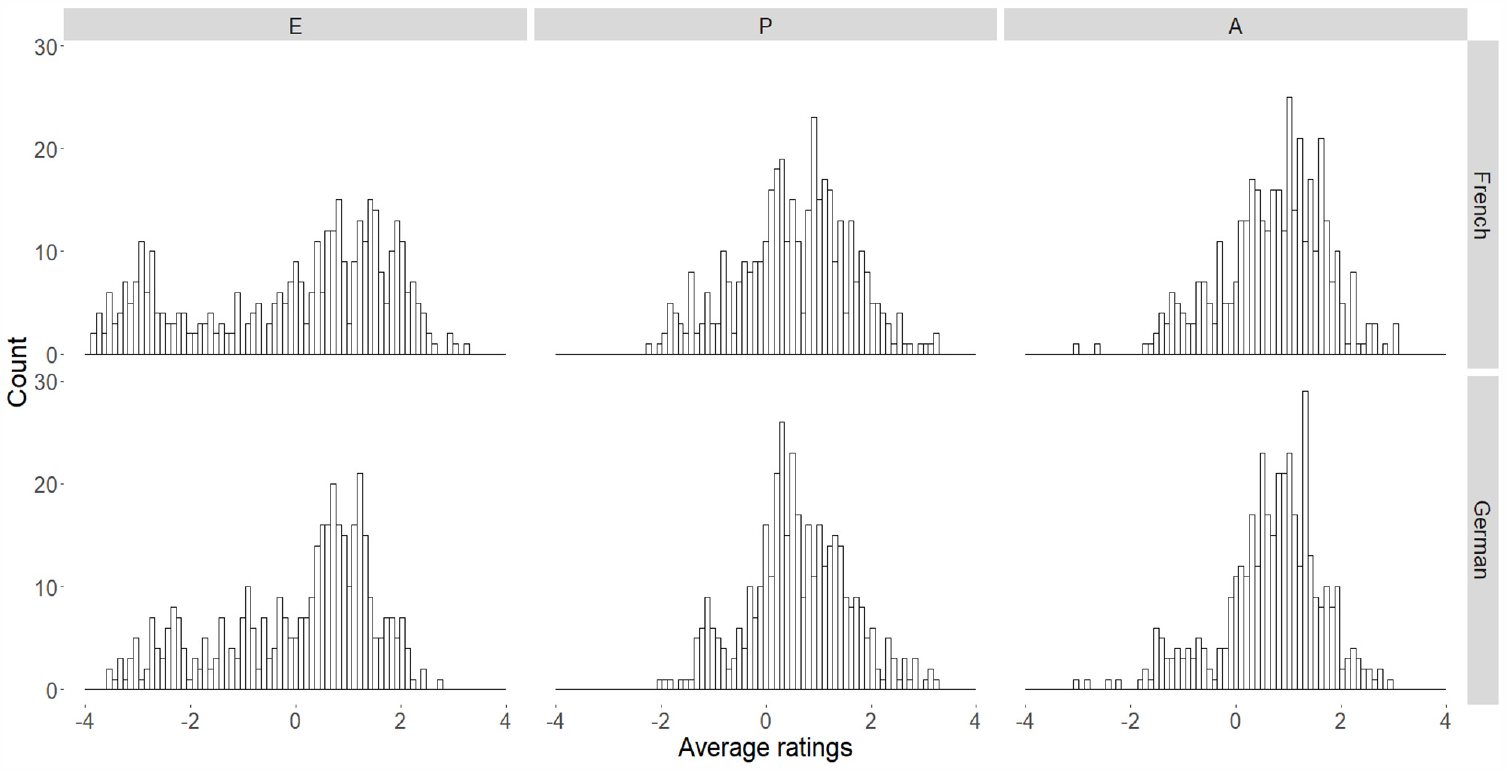
Distributions of Evaluation, Potency, and Activity Average Ratings by Language Culture
Descriptive Statistics of Mean Values for Evaluation, Potency, and Activity

Individual identity level
As a second step, we investigated statistically significant mean differences for E, P, and A identity meanings between countries. We calculated 1.161 (387 identities × 3 dimensions) t tests with Bonferroni correction, a conservative approach with α = .00004, resulting in 53 significant differences for E (14 percent), 11 for P (3 percent), and 12 for A (3 percent). As displayed in Figure 2, most of the significant differences in E by country are related to extreme ratings. French respondents tend to rate good identities (e.g., firefighter, athlete, artist, author) better than German respondents, whereas German respondents rate bad identities (e.g., criminal, pickpocket, shyster, malingerer) better than French respondents. This mirrors the aforementioned finding of larger moral polarity in France. The gender of identity does not moderate this pattern of results. For potency and activity, significant differences do not show any meaningful pattern.

Differences in Average Rating of Evaluation by Country
Affective clusters of identities
Our present results suggest that French and German respondents have similar affective cultures with differences mainly related to extreme evaluation ratings. Building on this finding, we conducted a cluster analysis of the average ratings computed over all respondents from both countries, aimed at investigating the organization of the affective space (cf. Ambrasat et al. 2014; Rogers 2019; Schneider 1999a).
The Gap statistic (Tibshirani, Walther, and Hastie 2001) suggests a four-cluster solution, which we computed using the k-means clustering algorithm and is represented in Figure 3 along the evaluation and potency dimensions. The first cluster (n = 76, ME = −2.58, MP = .29, MA = .83) is composed of very bad, somewhat potent, and moderately active identities. We labeled this cluster as criminals because the identities closest to the centroid are crook, scoundrel, pusher, hothead, and felon. Nonetheless, the cluster also contains some identities related to mental and behavioral issues, such as psychopath, lunatic, and shyster. The second cluster (n = 51, ME = −1.31, MP = −1.15, MA = −1.02) was labeled deviants. The identities in this cluster are rated as bad, not potent, and inactive. The identities in the dense area around the centroid are beggar, loser, failure, pessimist, degenerate, and bum. The third cluster (n = 127, ME = .72, MP = .42, MA = .43) contains identities that are slightly good, potent, and active. Closest to the centroid are located identities such as gay, foreigners, bisexual, transportation ticket agent, casual laborer, employee, banker, and computer programmer. Because most of the identities have ratings close to zero or centered around the mean, we labeled the cluster neutral identities. The fourth cluster (n = 133, ME = 1.18, MP = 1.52, MA = 1.50) is made up of identities that are socially esteemed for their skills and work and hence rated as good, potent, and active. Around the centroids are located identities such as tool and die maker, auto mechanic, manager, entrepreneur, butcher, truck driver, worker, and self-employed worker. 11
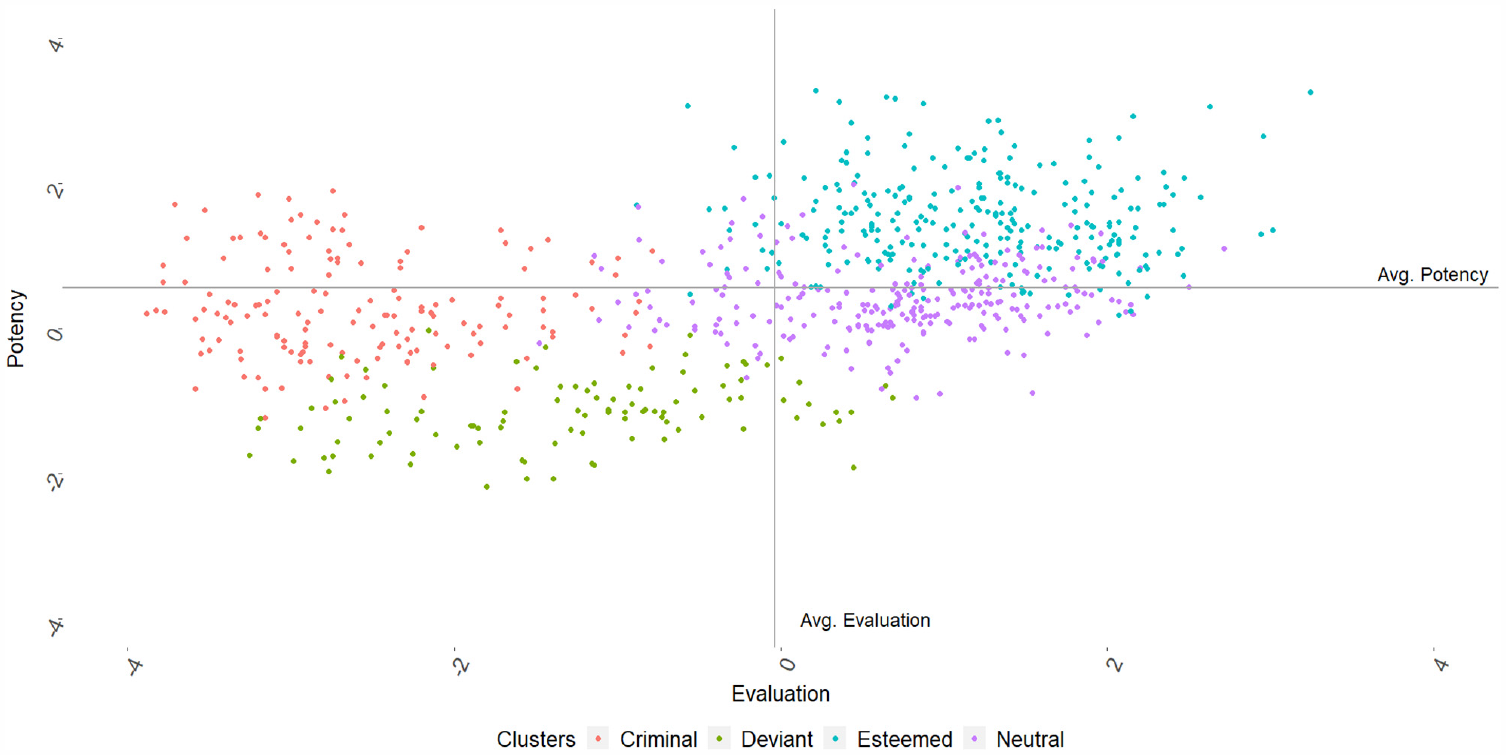
Identities Plotted by Evaluation (x-axis) and Potency (y-axis) and Colored by Cluster
As a second step, we investigated between-country differences of ratings by cluster. Germans rated identities in the criminal (ME German = −2.27, ME French = −2.89, MP German = .45, MP French = .12) and deviant clusters (ME German = −.88, ME French = −1.74, MP German = −1.01, MP French = −1.30) as better and more potent. By contrast, French respondents compared to Germans considered esteemed identities more positive (ME German = .97, ME French = 1.38). 12
Wrap-up—exploratory analysis
In conclusion, the exploratory analyses indicate that there is a notable similarity in the affective meanings considered between French and Germans, suggesting consistent between-countries agreement. The effect is much stronger when considering the potency and activity dimensions. Evaluation ratings are somewhat more influenced by the specific language culture. Especially when considering nonneutral identities, Germans and French do show country-specific patterns that reflect slightly different affective perceptions of the identities we considered. The results of the cluster analysis further buttress this latter finding. French respondents consider identities in the more positive cluster to be even better, whereas Germans report less negative evaluation and higher potency ratings when considering bad identities, in particular the bad and impotent ones.
RQ1: Consensus Analysis
In order to test Hypothesis 1, that differences in ratings of identities should be bigger between rather than within countries and, conversely, the level of consensus higher within rather than between countries, we used the Q methodology, a principal component analysis (PCA) performed on the correlation matrix between the respondents (Romney et al. 1986) and widely used in affect control theory (ACT) research (Ambrasat et al. 2014; Heise 2010; Rogers 2019; Schröder 2011). We computed Q correlations between respondents by word sets separately for each country and dimension. The loading on the first component is generally interpreted as the amount of consensus around a single common culture. The ratio between the first and second component eigenvalues is conventionally considered an indicator of whether a second culture exists besides the dominant one (Heise 2010). Our results—displayed in Table 2—show that the main component explains 67 percent of the variance in evaluation ratings in the French and 72 percent in the German data set. By contrast, the potency and activity first components are smaller for both countries. 13 A similar trend can be observed for the first-to-second component ratio. Evaluation ratings are clearly more dominated by a strong first component than potency and activity ratings, in line with previous findings under the ACT research paradigm (Heise 2010). For potency, a second consistent component seems to exist in France. 14
Eigenvalues of First Component Obtained from Principal Component Analyses of Respondents’ Correlations
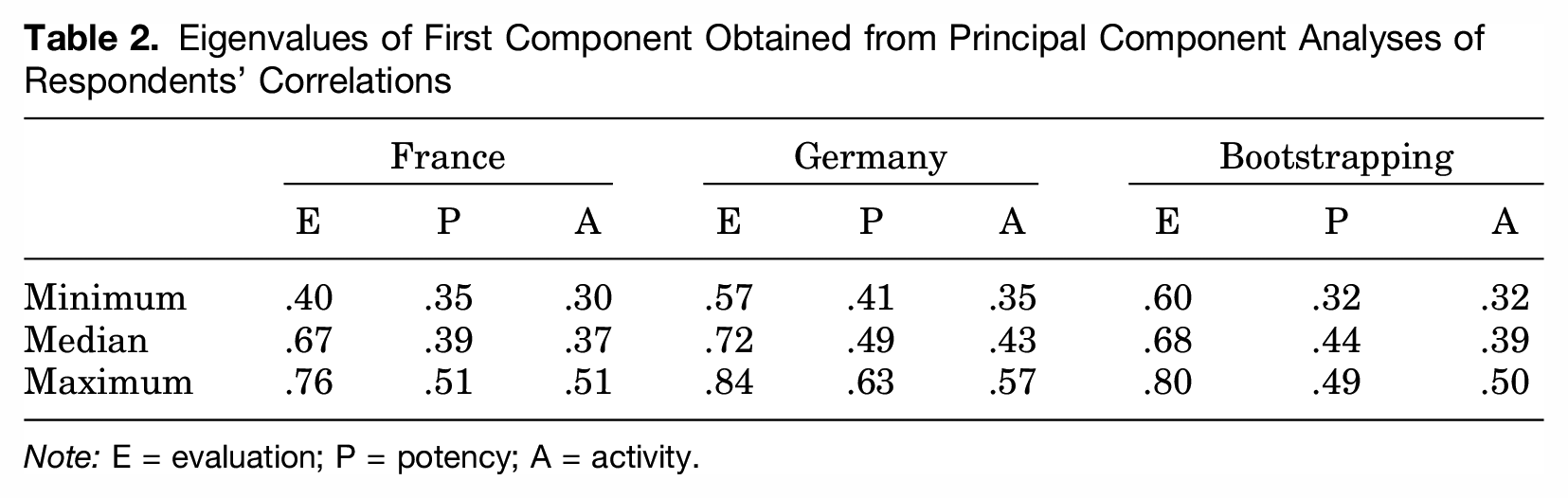
Note: E = evaluation; P = potency; A = activity.
To answer the question as to whether consensus is higher within or between countries, we conducted a second consensus analysis considering respondents from both countries. In performing PCA, the larger the sample size, the more stable are the results (DeVellis and Thorpe 2021; Kyriazos 2018). For this reason, we adopted a bootstrapping approach—typical of PCA studies (e.g., Costello and Osborne 2005; Shaukat, Rao, and Khan 2016). We sampled 150 times 35 French and 35 German respondents. After this number of repetitions, the results were clearly stable and reliable. 15 As reported in Tables 2 and 3, for all three dimensions, the eigenvalues of the first component and the first-to-second component ratio, computed by sampling recipients from both countries, are consistently smaller compared to the results of the consensus analysis on German respondents but bigger compared to the outputs of the consensus analysis on French respondents. The only exception to this pattern is represented by the median first-to-second component on the evaluation dimension. An additional analysis 16 confirmed that the results are consistent even when considering participants whose mother tongue is exclusively French or German. Thus, the lower level of consensus among French participants is not due to bilingual or nonnative French speakers but is already inherent in monolingual participants socialized in the French language culture.
First-to-Second Component Ratio of Eigenvalues Obtained from Principal Component Analyses of Respondents’ Correlations
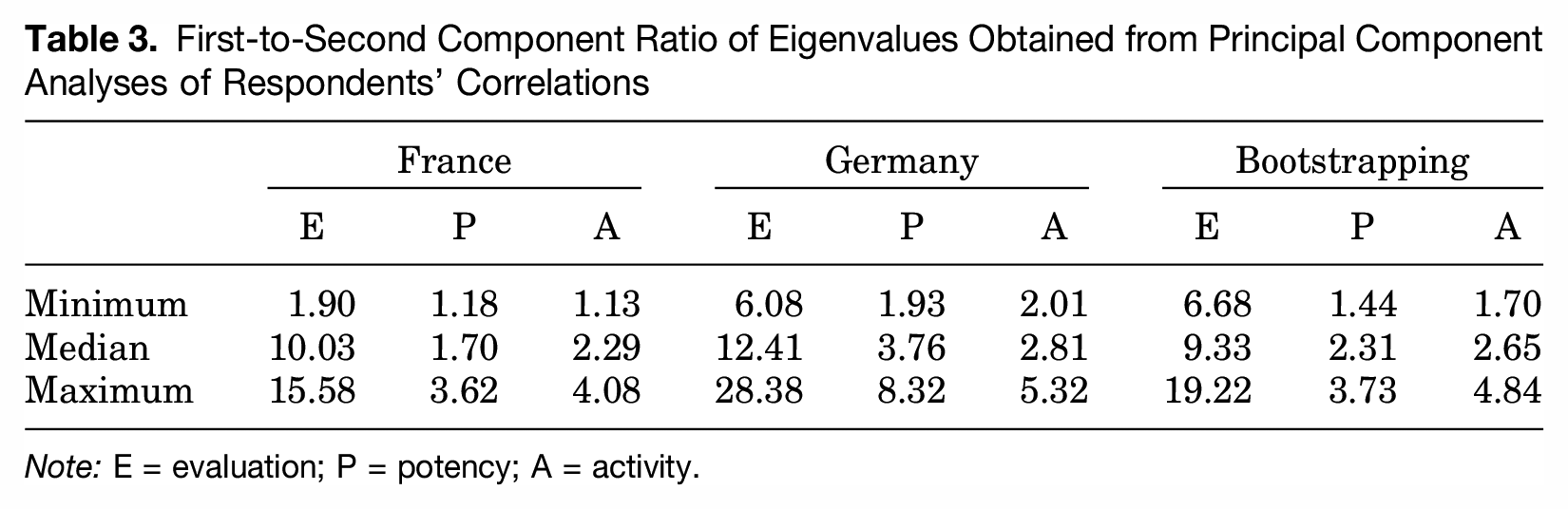
Note: E = evaluation; P = potency; A = activity.
Wrap-up—RQ1
All in all, the hypothesis seems to be only partially confirmed, and the answer to our research question is twofold. There is more consensus within countries than between countries considering the German level of consensus. By contrast, there is more consensus between countries than within countries considering the French level of consensus. Hence, the first hypothesis is only partially confirmed.
RQ2: Cross-Cultural Differences in Evaluating Potent Identities
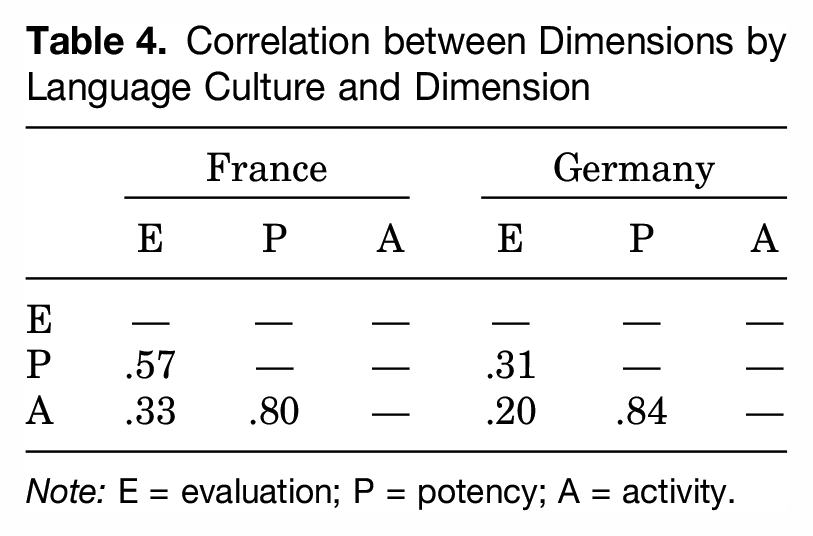
Our second research question concerns the relationship between evaluation (E) and potency (P). To test our preregistered hypothesis, based on existing cross-cultural research, that the correlation between evaluation and potency is higher in the French data sets, we computed cross-dimensional correlations within countries. This analysis (see Table 4) indeed shows that E and P have a stronger linear Pearson correlation in the French data set, r(387) = .57, compared to the German data set, r(387) = .31. Noteworthy is the fact that the correlations between E and activity (A) have a slightly smaller difference, r(387) = .2 for Germany and r(387) = .33 for France, whereas the correlations between P and A are very similar, r(387) = .80 for Germany and r(387) = .82 for France.
Correlation between Dimensions by Language Culture and Dimension
Note: E = evaluation; P = potency; A = activity.
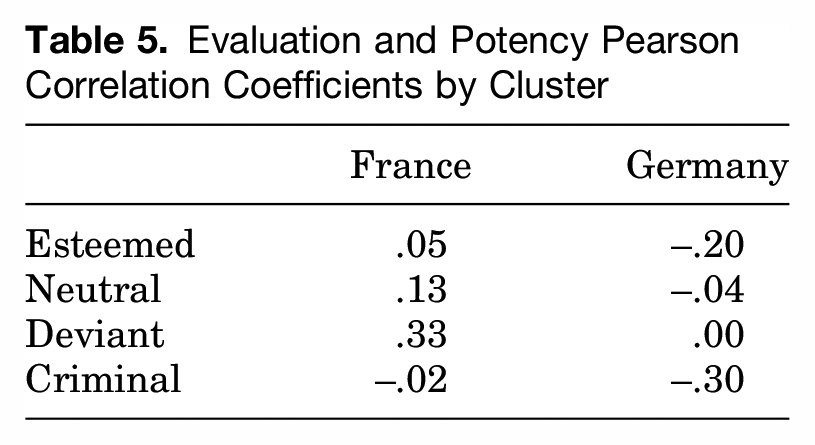
We extended the correlation analysis by considering the affective clusters identified previously to dig deeper into the relationship between evaluation and potency. German correlations between E and P are much stronger for identities with very high (esteemed) and very low (criminal) average evaluations (Table 5). In both cases, there is a negative correlation between the two dimensions. For the two central clusters—neutral and deviant—there is almost no correlation. By contrast, the opposite case is true in the French data set. Correlations are positive and higher in the central clusters and close to zero at the extremes.
Evaluation and Potency Pearson Correlation Coefficients by Cluster
As the last step, we performed regression analyses. First, we regressed the mean evaluations on the mean potency ratings of the identities and the language culture as fixed effects and their interaction terms. Although the resulting model (see Table 6) can explain only a limited amount of variation in evaluation, R2 = .237, F(3, 770) = 81.2, p < 2.2e-16, we observe a significant main effect of the average potency on the evaluation rating evaluation. Moreover, we also observe a significant main effect of language culture on the average evaluation: Germans generally consider identities to be slightly higher on the E dimension. Most importantly, as predicted by our hypothesis, the interaction effect between average potency and culture is significant. Hence, an increase in mean potency leads in the German as opposed to the French language culture to a smaller increase in mean evaluation.
Regression Analysis at Aggregated Level between Average Potency Ratings, Language Culture as Independent Variable and Average Evaluation Ratings as Dependent Variable

Note: P = potency; CI = confidence interval; LL = lower limit; UL = upper limit.
p < .01. ***p < .001.
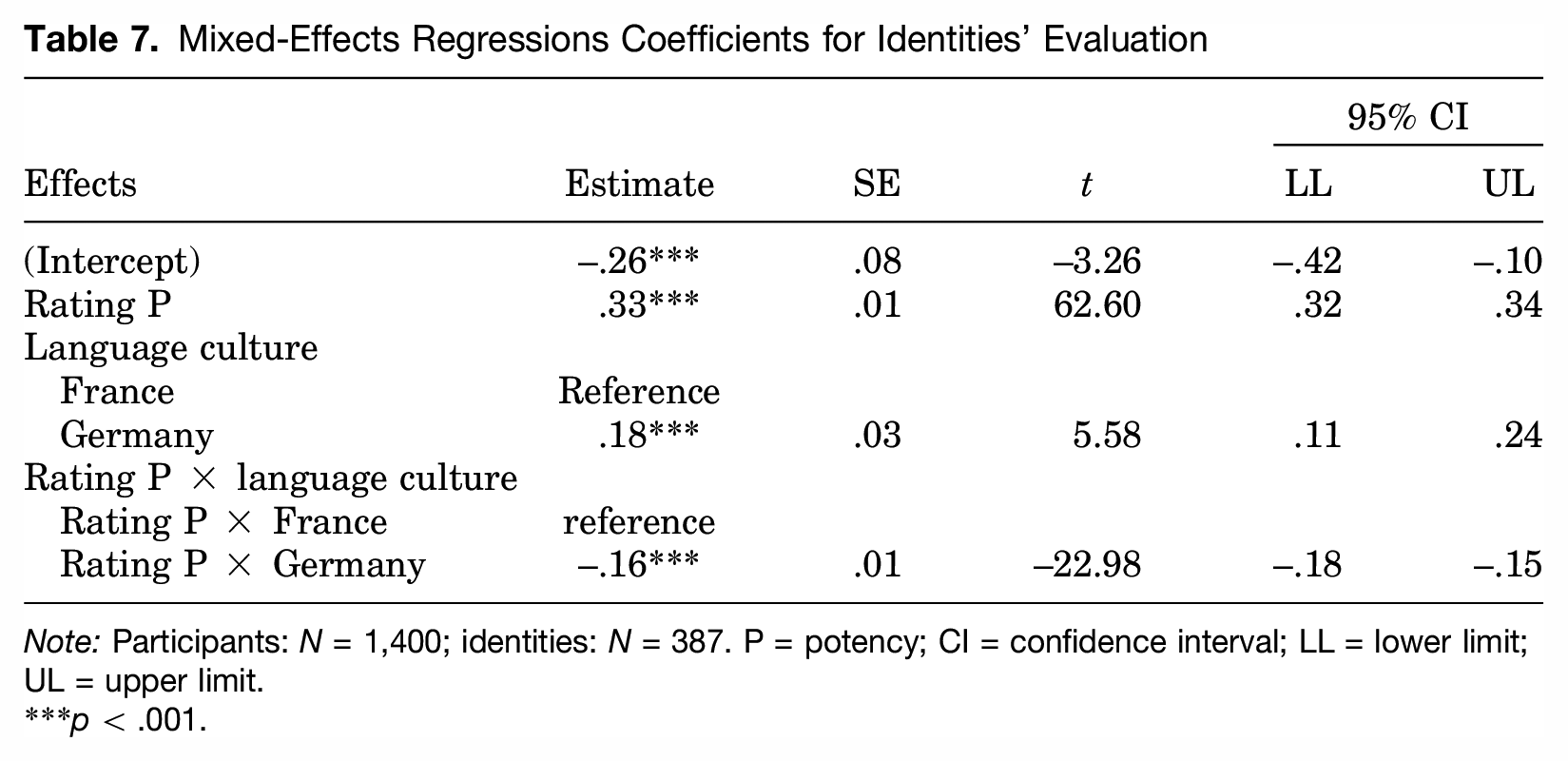
Second, we tested whether the individual ratings also reproduce the same relationship between evaluation and potency. Due to the balanced incomplete block design of the survey, we computed a mixed-effects regression model (cf. Ambrasat et al. 2014) with fixed effects for individual ratings of potency and language culture of participants and crossed random effects for participants and identities. Additionally, we also computed the interaction term between potency rating and language culture. Results confirm that Germans compared to French respondents react to an increase in the potency rating with a lower increase in evaluation rating. The interaction of potency ratings with language culture is significant and has the strongest effect among the interaction terms (Table 7).
Mixed-Effects Regressions Coefficients for Identities’ Evaluation
Note: Participants: N = 1,400; identities: N = 387. P = potency; CI = confidence interval; LL = lower limit; UL = upper limit.
p < .001.
Wrap-up—RQ2
We found that the correlation between evaluation and potency is stronger in the French than in the German data sets. The regression analyses confirm that compared to the French participants, for Germans, the more powerful an identity is perceived to be, the smaller is the increase in evaluation ratings. Hence, the second hypothesis can be fully confirmed.
Discussion
This research replicated the methodology proposed by Ambrasat et al. (2014), who combined the representative sample approach with cultural surveys (Heise 2010). We extended this methodology by comparing two countries, Germany and France, and considering cross-cultural consensus and differences in the organization of the affective space. Thus, compared to previous studies that either considered countries that share an official language (MacKinnon and Keating 1989) or used students as cultural informants (Heise 2010; MacKinnon and Keating 1989; Schneider 1996, 2004), this is the first cross-cultural analysis that systematically examines affective meanings and the consensus around them using a representative sample. Moreover, this is the first affect control theory study among French participants.
In our exploratory analysis, we found strong between-country similarities for the potency and activity dimensions and more dissimilarity along the evaluation dimension. Hence, we confirm previous cross-cultural studies suggesting that this latter dimension is more culturally determined compared to potency and activity (Heise 2007). Interestingly, between-country correlation levels of evaluation are higher compared to potency and activity; hence, how identities are evaluated in France has a strong relationship with the evaluation in Germany. Nonetheless compared to the other two dimensions, (1) the distributions of evaluation mean ratings have a relatively low overlap, (2) more mean ratings of social identities are statistically different, and (3) when considered together, participants have a lower cross-cultural consensus. Hence, although German and French participants do agree on the evaluative ranking of the social identities, they provide statistically different ratings resulting in discrepant distributions. Particularly, French mean ratings are bimodally distributed, and social identities are more likely to be grouped around a “good” or a “bad” cluster. By contrast, German average evaluation ratings are more normally distributed around neutral values. Such cross-cultural differences need to be first considered from a psychometric perspective: Do French and German cultures bias participants toward different response styles? Are French respondents more likely to adopt an extreme response style (ERS)? At present, cross-cultural research on this topic seems unable to provide a definitive answer. Johnson et al. (2005) implicitly suggest that French participants should be more likely to adopt an ERS due to their higher power distance. However, the same authors also associate ERS with higher scores on Hofstede’s masculinity dimension, which is higher in Germany than in France (Hofstede Insights 2022). By contrast, Peterson, Rhi-Perez, and Albaum (2014:104) argued that “there were no systematic relationships between ERS measures and Hofstede’s cultural variables.” More specifically, van Herk, Poortinga, and Verhallen (2004) reported no differences in the ERS between Germany and France. Overall, a clear difference in the ERS between Germany and France has not previously found, nor have correlations with known cultural dimensions been solidly demonstrated. Moreover, reducing the French bimodal evaluation distribution to psychometric effects is not supported by the facts that (1) we carefully aligned labels and scale anchors (2) and the effect is not present on the potency and activity dimensions, which have relatively similar shapes across cultures.
These arguments considered, we advance the cultural interpretation that French evaluation ratings are affected by a stronger moral component, which leads to a slightly more polarized perception than is the case in the German language culture. Because this finding is the result of exploratory analysis, we were not guided by any hypothesis and speculate post factum about some possible explanations. Still, our results are in line with Hofstede’s discussion of the uncertainty-avoidance dimension (Hofstede, Hofstede, and Minkow 1997; Hofstede Insights 2022). French culture is characterized by higher uncertainty avoidance than German culture, which leads French culture members to clearly distinguish between “bad” and “good” affective judgements. This pattern resonates with studies of affective polarization in political discourse. According to the analyses by Boxell, Gentzkow, and Shapiro (2022), France has a higher degree of affective polarization than Germany, suggesting that at least in the political sphere, French voters tend to make more radical judgments about “others,” a tendency also evident in France’s history of revolutions and public protest. In Germany, by contrast, there is a greater tendency to moderate judgments, an attitude ultimately encouraged by post-World War II educational reforms (Siedler 2010). In general, however, the differences between these two countries are a matter of degree. German and French people disagree only in relation to specific areas of the affective space and can be considered as two subcultures within the larger Carolingian affective culture that they share.
Answering RQ1, the consensus analysis confirms this interpretation and provides evidence for consistent consensus around the affective meanings attributed to identities not only within but also between countries. Our results show that although members of the French language culture do share less consensus among them, a consistent group of French respondents finds a broad consensus cross-culturally when compared to Germans. As such, the two cultures reveal a common core. Yet the cross-cultural consensus for the evaluation dimension is slightly lower than the levels found within both countries. This twofold pattern fits well with the results provided by the cross-cultural literature based on values surveys. The values that are shared within and between these two countries lead to similar cultural norms that inform the individual affective meanings reported in this study (Heise 2007) and that have led some authors to claim great similarity between the two countries (Akaliyski 2019; Bréchon 2020; van Vlimmeren et al. 2017). Nonetheless, disagreement around the evaluation dimension exists and points to some cross-cultural differences (Inglehart and Baker 2000; Minkov and Hofstede 2012; van Houwelingen et al. 2019). At a more speculative level, the implications of our findings may shed new light on the debate around European political and cultural integration: Germany and France show a consistent level of affective agreement, and the main line of disagreement passes within France rather than between France and Germany. Intercultural consensus—often seen as a challenge—seems to be no more problematic than intracultural agreement.
The levels of consensus, as measured by the eigenvalues obtained from the consensus analysis, for the potency and activity dimensions are in line with the ones reported in previous studies (Ambrasat et al. 2014; Rogers 2019; Schröder et al. 2013). Considering the evaluation dimension, the level of consensus was higher compared to those reported by Heise (2010) and Schröder et al. (2013), comparable to that obtained by Rogers (2019), and smaller than the one identified by Ambrasat et al. (2014). A possible reason why the levels of consensus we found are higher compared to the cross-cultural analysis of social identities conducted by Schröder et al. (2013) may be the specific stimuli we presented. By considering stereotyped social groups—defined by general traits such as nationality, religion, race, and political orientation—respondents may either comply with social desirability or openly express the prejudice they learned as members of a specific culture (Devine 2001). At the aggregate level, this will lead to higher variance and lower consensus (Schröder et al. 2013). By contrast, social identities such as professions and social roles are tightly embedded in specific institutional domains. In this case, the affective appraisal of identities is deeply intertwined with many semantic and affective associations related to behaviors, goals, and further co-interacting identities (Duncan and Barrett 2007; Madva and Brownstein 2018). Because of the strength of this embedding, affective meanings are less volatile across the population.
By answering the second research question, we dove deeper into the cross-cultural dissimilarities between the two countries by considering the relationship between evaluation and potency. Overall, the analysis suggests that evaluation and potency have a weaker correlation in the German data set compared to the French data set. This fact resonates with our preregistered hypothesis, confirming the expectations derived from Hofstede’s work on power distance (Hofstede Insights 2022). Nonetheless, the effect of potency on evaluation is not homogenous, suggesting that a closer look is necessary at how exactly power is interpreted by French and German cultural informants (Mondillon et al. 2005; Schauenburg et al. 2015). The negative correlations for the esteemed and criminal identity clusters in the German data set, which are the clusters highest on potency, respectively, in the positive and negative evaluation spectrum, suggest that in these cases, power is interpreted as the ability to coerce others. Criminals are bad and potent because they act negatively on others. Similarly, some esteemed identities are perceived in a less positive way when they have excessive power over others. By contrast, French ratings result in a moderate positive correlation, especially in the case of deviant identities. In this cluster, the more powerful an identity, the better is its evaluation. This fact seems to suggest that power is interpreted as the ability to control oneself and adapt to the social order.
Conclusion
We collected affective meanings for 387 social identities on the EPA dimensions using two samples representative of the German and French populations. We found a high level of consensus within country but also between countries. Hence, our first hypothesis was only partially confirmed, and a common French-German affective cultural space seems to exist. Yet especially when considering identities at the extremes of the evaluation spectrum, language-culture-specific patterns exist. In addition, patterns specific to national language cultures can still be identified with respect to the potency dimension and its interaction with the evaluation dimension. We found confirmation for our second hypothesis, pointing to the negative effect of potency on evaluation in German compared to French language culture.
Supplemental Material
sj-docx-1-spq-10.1177_01902725231205855 – Supplemental material for Charlemagne’s Legacy: A Consensus Analysis of Affective Meanings in French and German Culture
Supplemental material, sj-docx-1-spq-10.1177_01902725231205855 for Charlemagne’s Legacy: A Consensus Analysis of Affective Meanings in French and German Culture by Diego Dametto, Luc Vieira, Tobias Schröder and Christophe Blaison in Social Psychology Quarterly
Footnotes
Acknowledgements
We would like to thank Tanya Noël and Loic Miller for their helpful contribution to the implementation of the surveys.
(Correction December 2023):
This article has been updated to include the funding details from IdEx Université Paris Cité.
Funding
The author(s) disclosed receipt of the following financial support for the research, authorship, and/or publication of this article: This work was supported by the Agence Nationale de la Recherche (Grant No. ANR-20-FRAL-0008) and the Deutsche Forschungsgemeinschaft (Grant No. SCHR1282/6-1) as part of the collaborative French-German funding program for the humanities and social sciences. This study was also supported by the IdEx Université Paris Cité, ANR-18-IDEX-0001.
Supplemental Material
Supplemental material for this article is available online.
1
5
6
9
16
Reported in the online Supplementary Information (“S8 Consensus Analysis”  ).
).
Bios
References
Supplementary Material
Please find the following supplemental material available below.
For Open Access articles published under a Creative Commons License, all supplemental material carries the same license as the article it is associated with.
For non-Open Access articles published, all supplemental material carries a non-exclusive license, and permission requests for re-use of supplemental material or any part of supplemental material shall be sent directly to the copyright owner as specified in the copyright notice associated with the article.
