




Abstract
The social order of the current system has brought an increase in the public dissents and turned to a ‘normalized sociological pathology’ of the postmodern world. The unyielding public resistance examples in different cultural geographies, which are fragmented, limited and yet significant and expanding struggles, convey the message that the global order of the Powerful has entered the age of stagnation. This article aims to shed new light on the relationship between the social protests and global order that has given rise to new identities of local and global injustice. I argue that social protests in the last years display discernible patterns of a change in cultural perceptions of the activists in different public spaces. On the one hand, this signals the emergence of a new public order in the 21st century. On the other hand, the ravages of social catastrophe shape the very dynamics of the same public culture. ‘Enduring and resisting public cultures’ is introduced in this article as a benchmark to identify ethnographic struggles of the activists for the quest of a new public space, which represents ‘Another World’.
Mildred: Hey Johnny, what are you rebelling against? Johnny: Whadda you got? (The Wild One, 1953)
‘Revolution is not something fixed in ideology, nor is it something fashioned to a particular decade. It is a perpetual process embedded in the human spirit’, said Abbie Hoffman who was a well-known activist in the 1960s and one of the founders of the Youth International Party, which was established in 1967. The party was inspired by the ideas of anti-authoritarianism and anarchism while promoting free speech and counter-culture actions. Hoffman’s reference to the ‘human spirit’ at the end of the 1960s may sound quite idealistic. Perhaps this should be noted as one of the reasons in the decline of the 1968 student movements earlier than the expectations. However, as Hoffman put it righteously, a ‘perpetual’ resistance is a vital requisite to lend the silenced voice of the publics to democracy and to hamper malfunctioning democratic formations. If the revolution does potentially exist in the human spirit, how does the silence of the publics emerge and prevail in certain times and different geographies, and more importantly how does it spark the fears of a catastrophe? It is not easy to devise a satisfactory response to this question. Yet, the recent article of John Keane offers new insights by drawing our attention to the ‘silence’ and ‘catastrophe’ notions. 1 Deploying these terms, particularly with the recent historical ‘mega-projects’, opens new gates to question the tragedy of our humanity through the severe outcomes of technical mega-projects such as happened in Chernobyl and Fukishima. Keane mainly argues that the success of the political incapacity is encoded in the failure of silenced publics. The catastrophic events, therefore, would not be achieved if the inertia of the dejected citizens was not prevalent. The examples of these ‘mega-projects’ are the carbon filtration plants, under-sea tunnels, high-speed railway networks, new airports and airport extensions, the research and development of new weapons systems, liquid natural gas plants, new communications systems and nuclear power stations. 2 In hindsight, the argumentation of Keane is based on the evolution and outcomes of the mega-projects. These are the concrete examples of the technically oriented huge implementations of the states or the cooperative non-state representations that are enabled to construct, build and craft these projects with high technology and an enormous amount of budget allocated for their completion. From this point of view, mega-projects are the greatest reverberations that demonstrate the physical power of the dominant rulers in our everyday lives. The mega-project list of Keane can be extended if we consider inherently unsafe skyscrapers, massive military basements, under-sea oil pipelines and air-pressurized tunnels. The mega-projects eventually pose catastrophic natural and humanitarian risks when they collapse or cannot be kept under control safely at all times. In this regard, the aforementioned mega-projects help construe the mechanism of the global social order and its impact in our lives. The physical attribution of those mega-projects changes our existence by making the lives of certain people easier on one hand, and bringing catastrophe into the center of our lives on the other. These projects are the greatest devastating and discernible reflections that express why we should be seized with fear. Different from Keane, I put forth that these examples are the physical products of the one unified social mega-project. The operations of the Powerful are the outcomes of its ideological echoes within the social mega-project that disguises itself in multiple physical forms and spaces to guarantee its status and empower itself. Indeed, these multiple physical forms and spaces constitute Keane’s mega-project concept. However, ‘social mega-project’ is a solid, global and inclusive term. This principal argument shapes my following claim in this article which points out that the social mega-project and its local representatives have weak parts as well and can be challenged by the reaction of the public. These limited but significant challenges emanate not only from physical symbols of the mega-project concept of Keane. Additionally, but more importantly, these challenges stem from the source of those physical symbols when injustice, corruption, inequality and the violation of basic human rights prevail by way of the local representatives of the social mega-project.
The lack of public deliberation in the implementation of mega-projects has emasculated the success of the same projects. Most ominously, undermining public power and applying diverse methods for silencing the people have spurred the mega-projects and rendered those projects insuperable both in developed and underdeveloped countries. The crucial question arises at this point: is it possible to defy the social mega-project of the current social order – neo-capitalism and its diverse facets – by increasing the political capacity of people with social protests in different cultural geographies? I will respond to this question by arguing that the social protests against the social mega-project of the governments in the last decades of the 20th century and in the first years of the 21st century gave birth to a new public culture, which benefits enormously from the communication channels, social networks and cyber-world. In this context, I claim that socially evolved mega-projects, prominently neo-capitalism and its postmodern policies, are the principal venues to explore local and global injustice of different cultural geographies. More to the point, this perspective revitalizes silence and catastrophe phenomena within the context of the public cultures.
This article draws attention to the ‘politics of catastrophe prevention’ and the deficiencies of the social mega-project of the current global order by exploring the recent resistance examples in different human geographies. In doing so, I endeavor to conceptualize the resistance attempts and their relationship with the current global system through a critical perspective. In this respect, two essential questions aim to clarify the perplexity of social dilemmas that we are facing more seriously every year. (1) Is it functional to lead the resistance at home – in a local geography of injustice – by increasing political deliberation and hampering public silence through ethnographic practices? (2) Can public culture play a significant role between silence and catastrophe through different modes of resistance to break social omertà, which was created by the Powerful to defy resistance attempts? I argue that since the first decade of the millennium enduring and resisting public cultures of different geographies have been and are the most explicit and powerful rhetoric that expresses grievances of the people when they resist against the dominant authority. In line with this claim, it is not improbable to expect the emergence of new social protests in different parts of the world with different goals; however, the social and cultural roots of the main targets of the protests will remain the same.
The social protests that are presented in this article are diverse examples in terms of both geographic scope and local dynamics that led to the uprisings. This study explores violent, military, civil disobedience, paramilitary and peaceful resistance models. On one hand, it may be righteously perceived at the first instance that there are crystallized structural, ideological and methodological differences in the orientation of these resistance attempts. On the other hand, there are two significant parallel motives within all these social protests: civic resistance attempts and violent quests for a social, political, or cultural change. The first commonality is that all these examples are the reverberations of a public dissent whose initiators and participants claim that they are victimized by the power of authority and its pervasive injustice exercised in the political, legal, social, or cultural spectrum. The second commonality lies in the expectation of the activists that rendered the change, either radical or moderate, an attainable struggle to create a better world when they first resisted against the dominant authority or ruler. This expectation, which fosters the activists to take the initiative for uprising, is subject to either empowerment or defeat during the process of resistance. In the wake of this uncertainty, those activists did not choose the road of hopelessness and status quo when they first decided to participate in the protests. This particular dimension gains more importance when we consider that the antagonists of each social protest and the methods that were embraced during these resistance attempts were deliberately different from each other in the cases that are presented in this article. This commonality among different social protests shows that the common injustice and victimization at the local sphere are the pieces of an integral system of global injustice. The activists, the resistance models and the methods of resistance are different in these social protests, likewise the local rulers, the dominant culture of governance model and the repression methods. However, the means of that repression and the devastating accounts of victimization constitute the multiple and similar facets of social catastrophe. Hence, the increasing number of dissent masses conveys the message that the current hegemonic global system has failed. During this process, a critical thinking is of the utmost importance to elicit the people’s disappointments and to construe the social catastrophes at the local level which are the very parts of social catastrophes at the global level. First, I will analyse macro-social dynamics and deficiencies of the social mega-project. Next, I will endeavor to explore how the emergence of enduring and resisting public cultures is shaped by the different actors in different cultural geographies of contentious polity. I will particularly exemplify these resistance attempts through the social protests that occurred in England, Italy, Spain, India, Egypt and Turkey in 2011, 2012 and 2013. Finally, I will conclude why hope and action are the two remarkable instruments not only to understand the patterns of injustice in different geographies but also to underscore its importance when the resistance challenges authority in the quest of ‘Another World’.
Deficiencies of the social mega-project: The harbinger of a new public culture
Social justice, equality, class differences and human rights have recently set the agenda of the social powers in the throes of global social panic and financial crisis. Unsurprisingly, social upheavals, street protests and the resistance of non-state forces against the rulers and social injustices in the last decades of the 20th century and in the early years of the 21st century draw attention to the socio-economic gap, political inequality, racial and cultural discrimination. These concerns signify severe outcomes of the failed social mega-project of the global order. More alarmingly, juxtaposing the global hegemonic economy model and socio-cultural injustices shows that there is a great legitimacy in the uprisings of the people. We have found ourselves in the heart of a bewildering social context with the recent mayhem scenes from London to New York, Madrid to Istanbul, Damascus to Cairo and Kiev to Caracas at the helm of the recent financial crisis, political incapacity and the depth of despair about the future. The political and economic codes of the social crisis and public panic should be sought in the cultural formations, which hinge on the demarcation between the dichotomies of the Powerful and the Powerless. This is the reason that a culture of resistance in the public spheres festers exponentially where relentless impacts of the failed global economic system, austerity policies, corrupt political order and the violation of the human rights are endemic. The suburbs and inner cities are the most vulnerable public places. Even the people of an entire country from the deprived regions, who have been exploited for centuries by the colonial powers, desperately seek to leave their homelands because of hopelessness, war, famine and deprivation. These side effects of the social mega-project pose serious risks to the millions of people who become victims of the organized crime groups while moving to another country. What is more, these people are framed as ‘illegal’ immigrants by the countries that colonized their homelands. The silenced masses, the Powerless, are enforced to face off those vehement realities of the present and prevailing impacts of the social mega-project.
The resistance attempts in the last decade of the 20th century and in the first decade of the 21st century have facilitated ‘enduring and resisting public cultures’. A considerable number of resistance examples, which occurred in this two decades period, may be given as the raison d’être to understand the roots of these developments. Prominent examples of these resistance attempts are EZLN (Ejército Zapatista de Liberación Nacional, the Zapatista Army of National Liberation), the French public strikes of November and December 1995, the Seattle protests in 1999, the G-8 summit in Genoa in 2001 and protests against the invasion of Iraq in 2003. Those resistance attempts with diverse goals and motivations around the world before the end of the 20th century and during the early years of the millennium have opened new political and sociological vistas for the emergence of ‘enduring and resisting public cultures’. All these protests became milestones that paved the way for the enduring and resisting public cultures with the contribution of hundreds of thousands of people who are against the problems created by the mechanism of the current social mega-project and the banality of the dominant culture. Hence, the struggles have impelled a new age for the ‘enduring and resisting public cultures’. This fact is more crystallized when we reckon with the social protests that occurred after 2010. This is the reason that the last two decades exacerbated the aggravating conditions and paved the way for an era of social transition in the consolidation of resisting public cultures.
The ‘bourgeois public sphere’ notion of Habermas and its emergence and transformation in the 17th and 18th centuries gave a propulsive force to read the codes of a social change from the perspective of public culture and social order. 3 Different from previous centuries, the bourgeois public sphere in the 21st century has been slightly diversified in terms of the main actors who control the society. Nevertheless, the principal logic behind its mechanism has remained resilient while subjected to more risks posed by the publics and social resistance examples. The resisting actors utter slogans and demonstrate their grievances in the public spaces through a set of symbols in which emotional essentialization is highly valued. It was claimed that the peculiar relationship between emotions and affective spaces needs to be analysed through a comparative geographical perspective, especially to attain ideals of the ‘marginal’ or ‘radical’ groups. 4 Even though it is debatable to categorize resisting public cultures in this article as ‘marginal’ or ‘radical’, they are mostly called so by the governors of the current hegemonic order. Yet, the stance of the oppressed is a kernel of truth in the story of local and global injustice that is precursor of social dissents in each public space.
During the 1990s and 2000s, the transition period to the ‘enduring and resisting public cultures’ was completed and a new phase was ushered in to consolidate it. This new and hybrid phase is politically oriented and culturally disseminated so its roots hinge on both catastrophe and the quest for transformation. In addition to this, different from previous social movements, resistance of the publics in 2011, 2012 and 2013 signals a new long path in the endurance of the public resistance attempts against the deficiencies of the global order’s social mega-project. However, it is unlikely to expect either a long intervention or suspension of these resistance attempts.
From the deficiencies of the social mega-project to the enduring and resisting public cultures
Perhaps, more notably, the tragic death of 29-year-old Mark Duggan in the 2011 London ‘riots’ should be noted as the start of persistent social turmoil not only in the underdeveloped, developing and authoritarian countries but also in the developed and relatively more democratic nations of Europe in the 21st century. The street protests and social dismay first came to the surface in the first weeks of August 2011 in London. The mainstream media dramatically ignored the socio-psychological leitmotivs behind the ‘riots’; the roots of social inequalities and racial discrimination. The efforts rather focused on finding a scapegoat promptly. The screams and violence of the people in Tottenham gave the opportunity to the conventional representatives of the current social order in the media to detect ‘criminals’ while showing fire images and incidents that were induced by the protesters. At least, in doing so, the tip of the iceberg was unveiled whereas the deep rifts of the global economic order could not be deciphered fully. For that reason, the results of a recent study gain more importance reporting that disengagement in the public affairs of the citizens and mistrust of the politicians are two major reasons in ‘law’-breaking during the protests. 5 Similarly, in the London riots the attention was drawn to the social inequalities between the poor and the upper crust. It was aptly argued that ‘places are constituted not only by the social landscape found there, but also by what then ensues due to that landscape. These were not just any riots; they were the riots that constitute what it meant to be in London in August 2011.’ 6
Just a month after the convoluted and unresolved panorama in Tottenham, this time Zuccotti Park became the new public space of the dissent masses starting from 17 September 2011. The voice of the protests echoed against the financial hegemony, socio-economic inequality, lobby groups, and the power holders of the global companies, who are in the minority but bizarrely control major economic decisions that influence the lives of the millions vehemently. Wall Street, the financial district of New York, turned out to be a symbolic venue to name the movement with its same motto: ‘Occupy Wall Street’. The protesters elicited the voice of the silent masses with their catchy and righteous slogan, ‘We are the 99%’. The first slogans of Occupy Wall Street shared the same zeal of the protests in 1968 in which people expressed their demands to attain ‘an equal and free life in the public spheres’. Culture is not static and entails transformation to take its critical position in each crevice of the resolution of neo-liberalism. The scope of democratic gains, cultural rights and social equality has been widening since 1968 amid ongoing human rights violation and socio-cultural discrimination around the world from time to time. The deficiencies of the global economic system have been partially unveiled and solutions for those deficiencies have been postponed by short-term, belated and innumerable reform efforts. These reforms have recently come to the fore by subordinating lower social class groups with centralized welfare packages or austerity policies. 7
Cultural codes of the Powerful are embodied in the basic governance structure of the economic model. Unsurprisingly, such a model does not prioritize public benefits; however, the same economic model regularly overestimates itself through individual prosperity and economic advancement. The social mega-project of the current world purposefully hinders the power of the ‘silent masses’ and undermines public deliberation and public integrity. Attaining an equal and civic education is the basic determinant that profoundly constitutes the principles of social justice. However, the opportunity to receive free education is prevented by the present social mega-project. As Bourdieu pointed out righteously, the education system is the reflection of class hegemony of the Powerful both culturally and socially. 8 In this regard, the prevention of free education is another nail in the coffin of social equality. The recent structural changes in the education system set alarm bells ringing more than ever in the defiance of social equality. Westminster took significant steps to commercialize the education system by increasing tuition fees, which has been effective since 2013. Starting from 2010, numerous demonstrations erupted almost every month in different cities of England to protest the proposed regulation. These protests could not change the decision of Westminster. However, at least such a civic resistance has degraded the common belief, which is premised on the argument that the youth of the 21st century is too prone to show submissive behaviors towards political authority. More strikingly, the resisting attempts of young people against these critical watershed moments in the course of neo-capitalist policies give us a promising reason not to be hopeless about the future. Correspondingly, thousands of Italian and Spanish students gathered in the streets of Rome and Madrid respectively in 2012 to utter their disappointments in relation to the university system, to criticize harsh austerity policies and to show their distrust of the governments and the social order. Unfortunately, similar to the 2011 London protests, the violence of the participants took more attention than the main reason for their mobilization. Even Sweden, which has traditionally enjoyed the status of a more egalitarian society, has recently decided to charge tuition fees from non-EU students registered in higher education institutes of this country. The limits of the social mega-project daily penetrate lives of young people deeply and viciously by drawing boundaries for them with their limited resources and controlling their lives with the structural instruments of political and legal power such as criminalizing and punishing them.
The resources to change the social order are hedged by limiting free education and designing the curriculum mostly in line with the embodied codes of the social submissiveness to the current global order. Thence, one may eventually ask how the resistance of the publics can overthrow oppressive autocrats, corrupt bureaucrats, violators of the human rights and their cooperative agencies and institutions in different geographies of the world. The most concrete response to this dilemma can be derived from the social protests that occurred in 2011, 2012 and 2013. We witnessed the resistance of the silent publics with the amalgam of new media and limitations on protests. Despite those limitations, a social protest is not similar to a passivized democracy, which gives the practice of democracy only by going to the ballets in certain times. Putting it more bluntly, the revolutionary desires of the Arab Spring incited millions of people through the excelling force of the social media for a progressive society. The new media played an indispensable role as they have increased awareness by new cyber-spaces. In doing so, the social mass gave an impetus to the resistance by defending the idealized values of social justice and equality. Khaled Mohamed Said will be remembered as a symbol of resistance after he was beaten to death by Egyptian security forces. He became a model for his own people who chanted in the streets and he shared his name with a slogan, ‘We are all Khaled Said’, in social media. 9 The case of Khaled Said supports the argument that underlines the magnitude of cultural pragmatism in public paradigms as it plays a determinative role through public performances and creates its own cultural repertoire towards emancipation. 10
Egyptian women gathered in the streets of Cairo and demonstrated their grievances in the summer of 2012 as they were exposed to harassment and intimidation by the patriarchal behaviors during the protests in Tahrir Square to overthrow the regime of Mubarak. The women’s significant initiatives served the development of the idealized equality concept while enforcing us to reconsider gender equality in public deliberation and integrity to break the public silence. Yet, after the regime change in Egypt, one year later the failed office term of newly elected President Mohamed Morsi brought the people of Egypt to the streets of Cairo in the first days of July 2013. This insurgency fostered a tragic development. The military intervention occurred on 4 July 2013. Although any coup d’état is a deterrent factor for the advancement of democracy, hundreds of thousands of people celebrated the fall of Morsi rule with the fireworks in Tahrir Square. The celebration of the masses was dealing with toppling another ‘autocrat’ who aimed to rule the country with an Islamic agenda. The people who were against the rule of majoritarianism would be legitimate in their uprising against Morsi; however, this was a nominal change in the name of democracy because a pro-Islamic authority gave its place to a military authority. Besides, western democracies turned a blind eye to the violation of the basic democratic principles by recognizing the military rule in Egypt. The dramatic scene here is neither assuming the office of democratically elected Morsi nor the intervention of the army. What is more alarming is the power dictation of the social mega-project to offer only these two alternatives by closing the gates of public consciousness and democratic consolidation. Neither economic nor political motivations, as the principal resources of mass strike, can be separated exclusively on the route of social uprising because these two chief reasons are conflated to pave the way to make either a reformation or a revolution. The struggle for emancipation renders the outcome of that emancipation consequential. From this view, despite severe casualities, the resistance of the Egyptian people will not bring chaos in the future. They are experiencing a process of their potential power to topple a dictator. The emancipation of Egyptians and other peoples of the insurgent places depends on how they will sustain their struggle with a non-oppressive, continuous and non-hegemonic character.
A 2G spectrum scam revealed the notorious political-bureaucratic nexus in India in 2011 through corruption allegations against the Indian officialdom for the aim of gaining profits thanks to the abuse of political power. 11 The public reaction was intense and could not be satisfied with ease by the promises of the distrustful politicians. Indian society shattered in the wake of these allegations but did not remain silent. India Against Corruption, a prominent civil society, organized an event to protest the corruption scandal and make a call for the aim of empowering anti-corruption law. Shortly after this attempt, Anna Hazare, a social activist who strove for an anti-corruption law on 5 April 2011, became an iconic symbol for the following numerous social protest struggles against endemic corruption culture in India. His 4-day hunger strike and previous public reactions had fruitful outcomes as the government accepted his demand to prepare a strong legal measure to fight against corruption. 12 However, growing public reaction could have delegitimized the power of the government. Hence, the ongoing social protests should have been crippled. Following this verdict, Hazere and his supporters were arrested due to defying prohibitory orders on 16 August 2011. 13 Yet, like the Indian government, Hazare was persistent in his struggle; however, his effort was contrary to the pervasive reluctance of the Indian government to tackle the corruption as a serious social concern. After his release, Hazare started a new hunger strike, this time in Mumbai. A partially effective law was accepted in the parliament after the debates held in December 2011. The new bill was far from bringing a pure satisfaction for the concerns of the anti-corruption activists. The 2011 protests revived in March 2012 and resulted in the foundation of the Aam Aadmi Party in the midst of raised critical voices claiming that the anti-corruption movement should be apolitical. 14 The Indian case demonstrates that a highly corrupt political class can be challenged by the dynamics of non-state forces even though disappointment and dissatisfaction are the eventual sentiments that came out with that change. The case of India is particularly significant because of deep historical inequality that has shaped the very forms of cultural perspective regarding social class. These recent social protests in India show that the country’s enduring public dissents may re-emerge in a similar case conflated with corruption or a chronic social problem. This may not lead to a radical change in the near future but it will foster the accumulation of the efforts led by the communities that have remained traditionally less powerful but have openly dissented against the act of injustice in the public realms, with their imagination aimed towards creating a better world.
India is not a lonely planet of social deprivation and public dissent. Indeed, economic governance and social justice are interwoven in the codes of every political regime that either advances the citizens’ human development or violates the basic principles of social equality. Additionally, the same political regime may offer relatively better economic opportunities to the citizens while limiting certain basic liberties at the same time. This direct relationship between economic development and democratic erosion is glaringly evident in Saudi Arabia or the United Arab Emirates where the civic resistance and mass mobilization may reach their lowest ebb. Yet, the capacity of sustaining economic prosperity is not always the sole reason that precipitates social mobilization per se as it occurred in Turkey with the recent Gezi Park protests. The uprisings in Gezi Park erupted in the last days of June 2013 and sent the entire Turkish society into a deep state of shock with excessive police violence and human rights violation. There was a set of reasons in the success of mobilization of the millions against the government. The pro-Islamic Turkish government under the rule of Receb Tayyip Erdoğan demonstrated his government’s technical mega-projects under the deep influence of neo-liberal market economy. For instance, the Turkish Prime Minister and his AK Party government financed TOKI (Housing Development Administration of Turkey) to build new low-cost housing projects in the outskirts of the cities. This is not simply creating new opportunities for the low-income people. More vehemently, such an implementation of urban planning has severe results as it divides the city between the rich and the poor. The division of the cities between social classes exacerbates both the social and the cultural gap at the same time. Unsurprisingly, numerous forested lands were destroyed and historical buildings, which are in the heart of cities, were fired for some unknown cause in the expense of building an airport, implementing bridge projects, transforming the place into an hotel, or constructing a shopping mall under the AK Party rule in Turkey. The relation between space and privatization poses significant questions about nature, capitalism and liberty. What is more alarming is that Turkey is not the only geography that is under the rule of a regime eradicating common public goods in the conundrum of nature, capitalism and liberty. ‘The neoliberal conception of property is faulty not just for its failure to take into account inequality, but also its misunderstanding helps construe how the property works.’ 15 Erdoğan’s project for Gezi Park was the construction of an Ottoman-era military barracks and shopping mall by demolishing the trees at the park, which is in the central area of Istanbul. Dozens of peaceful protesters defended the park for a week. However, the violent attacks of the police forces on 31 May 2013 gathered hundreds of thousands of people in Taksim Square where the Gezi Park is located. Following the pernicious force of the state over protesters, the people in other cities of Turkey joined the resisting people of Istanbul. The people protested the authoritative AK Party government in almost every major city of Turkey. Taksim gained an iconic and powerful symbol of this uprising. There was one prominent slogan: ‘Everywhere is Taksim, everywhere is resistance’. The country descended into violence not because of the widely peaceful protesters but because of the police gas canisters and water cannons, and the physical violence in the police headquarters towards arrested protesters. At the end of June, around 700 people were arrested; over 4,000 people were wounded; and 3 protesters lost their lives – this number later increased to 8. The Gezi Park protests showed how neo-capitalism cooperates mutually with the opportunist politicians who promoted and presented themselves to the public as true Muslims. Conversely, a corruption scandal came to the surface on 17 December 2013 and included important figures from the ruling party who were accused of being part of the criminal organization. Even though Erdoğan rejected these claims furiously, his charisma and reliability were defied severely both in the nation and abroad after the claim that his son was involved as a principal actor in the corruption scandal as well was revealed. Gezi Park protests gained more importance after a set of corruption news-stories. This is why Gezi Park will never remain only a park’s name but it will continue to be an uncontested symbol of the oppression of the Powerful that recklessly sent the people to death. The park has become a more attractive place since then as numerous activists with different missions have a tendency to choose Taksim and Gezi Park for the organization of a social protest. This tendency hinders the ‘fragile senses of movement, meaning, and practice marked by distinct forms of mobile politics and regulation’ so the ‘constellations of mobility’ gain a solid and consistent character with those ritual performances. 16
Recent uprisings in Bulgaria, India, Brazil, Bosnia and Herzegovina and Ukraine vindicate the argument that curbing the rights of liberty and hindering social justice are the two principal motivations that lead to the mobilization against political, social and cultural exploitation by the states. Even though each country has a different historical path, socio-economic dissents, corrupt officialdom and political degeneration tersely express the major reasons of these uprisings. This is perhaps another reason that we will experience anti-establishment foundations more than ever in this century. For instance, the last election results in Italy gave birth to a new political party in the parliament, which is Movimento 5 Stelle – Five Star Movement – headed by Beppe Grillo. The party embraced a populist discourse and an anti-establishment agenda; however, it is the rising power of a new public discourse in ltaly which aims to renew the political landscape of the country with the motto of anti-corruption, participatory democracy and free internet. The party has chalked up a major achievement by receiving the most votes as a single party. What is more, the party did not receive any state funding and mobilized people mostly through its website. The social resistance examples increase and diversify in each year, so much so that social protests have dominated public domains regardless of political ideology. For example, ‘One Billion Rising’ is one of the most recent peaceful resistance examples. The participants protested the violence against women through dancing on 14 February 2013 in almost every big city around the world. The social movement achieved a certain level of success by using new media and social networks such as Facebook and Twitter. This social movement model once again shows the power of social media, which underpins the motivation of the participants by spreading information swiftly. Unsurprisingly, recent data show that the main targets of these protests are the hegemonic powers, first and foremost the governments and then the political/economic system and corporations (see figure 1). 17

Number of protests against the main target from 2006 to September 2013.
Social movements, which came to the fore in the last two decades around the world at the local, national and transnational levels, had more commonalities than differences. Furthermore, all these protests contain necessary constituents to defy the social mega-project of the current global order in principle. The social mega-project of the current global system, with its defective modernity approach and renewal struggles on the path of postmodernism, has brought an increase in the public dissents and turned to a ‘normalized sociological pathology’. On the other hand, what we have witnessed in the last three years is the termination of the transition period of the 1990s and 2000s and the beginning of a perpetual resistance era, which has been sustained since 2011. This is the last historical period in the history of social protests because it is unlikely to be interrupted unless the global order renews or changes itself radically in line with the ideals of the protesters and the oppressed. The current social mega-project has an uncontested influence in determining the reasons of the dissents in diverse communities. The confluence of these factors reinforces us to call the last historical period of our postmodern world an ‘era of enduring and resisting public cultures’. This new era is embodied strongly in the resisting cultures of peoples in different geographies. As a result, it shares similarities more than differences against the grim realities of neo-liberalism and postmodern capitalism. The impact of enduring and resisting public cultures is remarkable in every public sphere, each to a different degree. The unyielding public resistance examples around the world, which are fragmented, limited and yet significant expanding struggles, convey the message that the social mega-project of the Powerful has entered the age of stagnation. The 1990s and 2000s were the transition years to the new era in social movements, which has led to a perpetual tsunami effect since 2011. It was argued that seeking new opportunities through social movements is the outcome of ‘complex internationalization’. 18 Nevertheless, it bears emphasis that complex internationalization is still under the yoke of the social mega-project of neo-liberalism and postmodern capitalism, which has reached its limits through its key principles. These key principles are ‘militarized accumulation, frenzied worldwide financial speculation, and the raiding and sacking of public budgets’. 19 ‘Enduring and resisting public cultures’ is introduced as a descriptive notion in this article to plug the gap in the framing process of social dissents that we have witnessed exponentially since 2011. The silence of the dissenting social publics is leaving its cocoon, which is deeply colored with the codes of social omertà to remain indifferent to the forthcoming social catastrophes. However, ongoing social change attempts pertain to a new emerging public culture, which is promoted primarily by the people of upper- and higher-income countries (see figure 2). This new public cultural breadth of the 21st century can fill a lamentable lacuna in the approaching public tragedy to prevent the ‘politics of catastrophe’. Yet, of course, this does not mean that the situation in low- or lower-middle-income countries is much better as was shown through the Egyptian and Indian examples above. This diagram basically reflects the reaction of people when economic burden brings vulnerabilities into their lives and the opportunity to demonstrate this reaction is much better than in low or lower-middle-income countries. In the light of these remarks, we need two crucial instruments while fighting against the politics of catastrophe. These two instruments are hope and action.
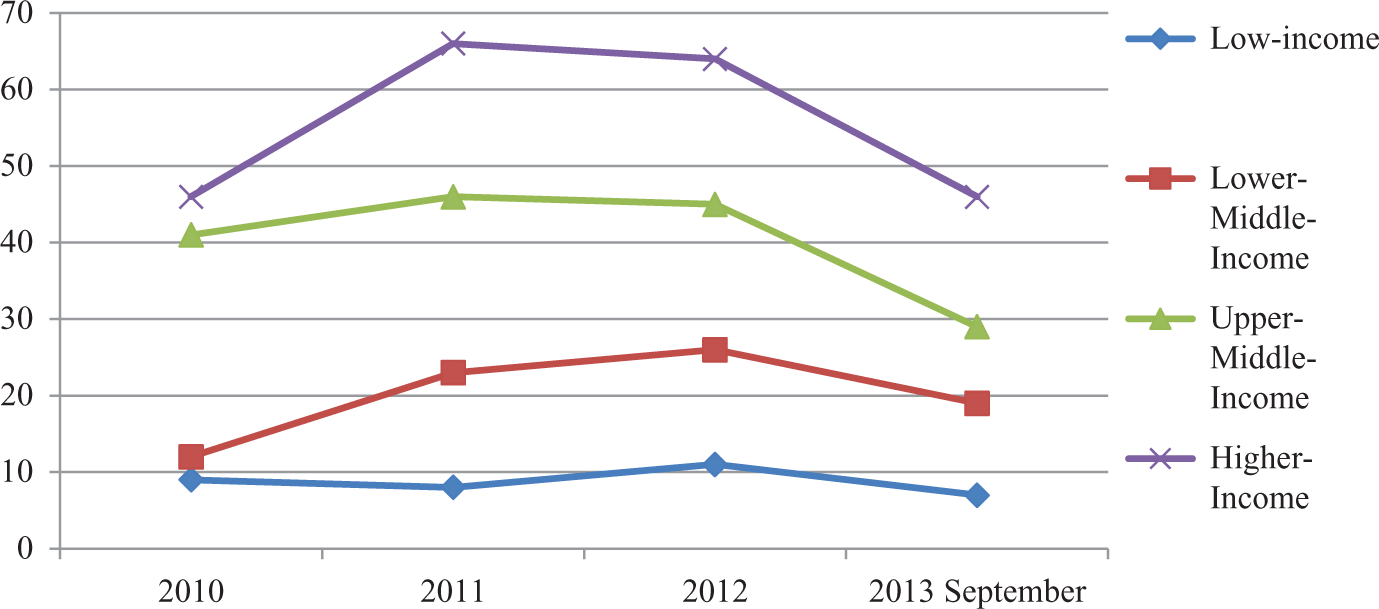
Number of main protests by income groups from 2010 to September 2013.
Conclusive remarks: Hope and action
The borders of the human geography between technically evolved mega-projects and socially evolved mega-projects become nebulous and erased from time to time. Accordingly, the lines between the publics and the state, between the citizens and the designers of the mega-projects, turn out to be very blurry while the social clash between those actors is surging. At this juncture, the response of human agency to the alarming local and global risks and injustice is the critical locus to determine the future of our social system. 20 Yet it begs the question, do we consent to protect the status quo or demolish it? The response that we devise for this question is indispensable to create new and similar formations in different cultural geographies. It is argued that if we would like to defeat the antagonist, we should consider our relationship with the system radically because ‘an antagonistic relationship with capital is still a relationship with capital … We want to destroy these relationships … We want exodus, autonomy.’ 21 On the other side, the path of this autonomy is a process of struggle in which power and resistance cannot be divorced but can drive together to attain the ideal. 22 The social protests in the last years were not revitalized by less idealistic motivations than the 1960s. Conversely, those resistance attempts, as it was noted above, were structured by more rational and concrete reasons because the severe outcomes of neo-liberal globalization, its modified imperialism and capitalist accumulation posed more risks to our lives than in the 1960s. Therborn defines the 20th century as ‘the age of working class’ from the perspective of the evolution of social history. 23 It is still a moot point who will lead the struggle of the Powerless in the 21st century; ‘the new middle class, or plebeian masses’. 24 However, the recent struggles against the social mega-project show that there is an increase in the rationally motivated principles of both the new middle class and the lower social class, to different degrees. Besides, both of the groups march in the streets shoulder to shoulder so as to hinder the grim realities of neo-liberalism and capitalism. Their mutual collaboration resonates in the public culture of different geographies. As a result, social protests of this century are transforming the public culture and turn out to be a more resilient frontier against the catastrophes of polity, even if eliminating those catastrophes permanently is not attainable at this early stage. The hope that we need is conflated with the dissents of the protesters who alter every public space with their slogans in their uprisings. In this respect, alternative transnational processes and agents in Brazil and Paraguay are good examples to halt the repression by neo-liberalism and its exploitive forms. 25 These new and innovative forms of social protests have revivified the desired projected society by surging ethnographic performances and by determining their own cultural codes. By the same token, those cultural codes are palpably evident in the actions, discourses and strenuous efforts of the activists who come from different social backgrounds and fight for their own social and cultural rights. Most importantly, their attempts serve the consciousness-raising among the masses against the deficiencies of the dysfunctional neo-liberal and capitalist system. Although those civic uprising attempts have not chalked up a major achievement to lead a radical social change in the world, a few local communes have managed to structure their societal projects such as Marinaleda in Spain and the village of Turgutlar in Turkey. What is more, the resistance of the people of Oaxaca, Mexico in 2006 is a notable example that inspires us to be hopeful. The uprisings disrupted the government’s activities of Oaxaca for 6 months due to the rampant corruption, subjugating them, and the human rights violations. Yet, the state authorities showed their notorious face against the protesters through violence, torture and arrests. 26 The failure of the social movements against hegemonic powers signals the importance of structural formations of the resistance. The organizations, which are evolved hierarchically, can be a barrier to attaining the ideals in the long run as occurred when a closed sugar mill in Mexico was governed by a cooperative, worker-run factory with the initiatives of a grass-roots movement. However, the sugar mill was declared bankrupt in 2009. 27 Nonetheless, student councils in the universities who have absolute independence in the selection of their rector candidates may create new hopes to infiltrate even the hierarchical organizations. The students of the University of Glasgow made a promising decision by electing Edward Snowden as the new Rector for three years on 18 February 2014. This is a strong example that underscores the importance of structural and internal factors to defy the codes of a hegemonic power. On the other hand, it bears emphasizing that every social movement against the widespread social injustice, human rights violations and domination of the Powerful ought to be seen as a nascent and concerted resistance example against the masses’ code of silence.
A local and single resistance example has certain limits to realize its ideals whereas the accumulation of those social resistance attempts as a unified voice may lead to the demise of the social mega-project in the first half of the 21st century at best, and at worst may induce quasi-radical changes in the neo-capitalist social order. The deficiencies of the current global economy and its severe outcomes will continue to stimulate diverse resistance examples in this century in every part of the world. Rampant corruption, a political-criminal nexus, authoritarian regimes and the predilection of the global economic system for the increase of those aforementioned deficiencies weaken the bond between hegemonic states and dejected citizens. Therefore, alarming outcomes at the societal level may leave the masses in limbo due to the historical process of the current socio-economic model. This is another example why global economy has exceeded its limits of functionality. The most recent economic crisis has concretized this argument. Unless a radical change is initiated from the bottom, proposing the models for a sustainable economy, ecology-friendly consumerism and reform attempts to extend the human rights at the global level will only defer the resolution of the catastrophes of polity. The limits to attaining free education, the increase of income inequality, exploitation of nature and violation of human rights are the prominent examples of these catastrophes. These social problems will surge the institutional dysphasia of the current social mega-project. The dissatisfaction with the current social mega-project, which is designed and controlled by the global economic governance model, will mobilize more people to express their dissent in the next decades. This is the reason that we will witness new and perpetual social resistance models in the world intensively throughout this century. However, these attempts should not be seen as a signal of social chaos. On the contrary, the public voice is the most influential instrument to increase public deliberation and public integrity, which are the two arms of functional and true democracy. The complete eradication of the deficiencies of the social mega-project hinges on two facts: (1) the strength of the silenced masses, particularly from the underdeveloped countries and the low and middle classes across the world; and (2) the awareness of possible micro- and macro-social catastrophes that may afflict millions of people.
There are promising reasons to be hopeful because the resistance of the publics is primarily prompted by the force of pragmatism. Next, it is entwined with romanticism for the quest of ‘Another World’. The same hope gives a strong basis for the fabrication of political discourses to attain social justice at the local, national and transnational levels. The clash of public discourses sharpens the lines between the hegemonic power and the resisting people. The antagonists of the dominant powers counteracted and resisted with strong legitimate motivations through using diverse communication channels against any forms of exploitation. Similarly, countervailing winds behind the resisting public cultures of this century are mightier than any social movement examples of the past in terms of establishing social networks through social media and challenging the authority through alternative modes of resistance. Nevertheless, it bears noting that if only the unification of multi-layered social resistance examples is attained under the same principal guide, we can start discussing how to bring about a definitive failure in the deficiencies of the social mega-project. Thus, we can build a new public culture to dominate our social world with the ideals of ‘global equality’ and ‘global justice’ from the bottom through public deliberation and integrity. This unity is a thorny path to emancipate the silenced masses. Giving a specific time for that moment would be prophetic. More disappointingly, the recent systematic oppressive methods of the social mega-project over the publics in different parts of the world may dampen our optimism. However, it is not a moot point to claim that this century will be the prevailing historical period of the enduring and resisting public cultures with more legitimate reasons to mobilize and fewer spurious barriers to their attaining goals.
There is a requisite to re-evaluate the cases that I presented in the previous sections since my two questions regarding the functionality of these protests at the local level and the role of public culture against the Powerful are pertinent to the principal arguments of this article. The well-planned policies have not been implemented to bring solutions to the concerns of the resisting people in the London riots. The increase of tuition fees was not abandoned either in the wake of social protests organized almost in every English city. Tragically, higher education in England is subject to more inequality and commercialization than ever. The chronic youth unemployment is still a big concern in Spain and Italy. The younger population of both countries is preparing to fill the squares of the big cities to protest their governments and their neo-liberal policies in the last months of 2014. Gezi protests led to the cancellation of the Turkish government’s provisional projects in Taksim. Yet despite this, Turkey’s authoritarian government has been employing more imperious policies while violating the basic principles of the constitution. The Indian government has recently passed a law to fight corruption but there is a common belief that this will not be followed by a series of systematic fights against corruption. This panorama can be seen as a portrait of pessimism at the first instance. It is true that these social protests could not bring about a devastating impact on the power of the social mega-project at the local level. On the other hand, these resistance attempts accumulated practical experience and demonstrated that the Powerful is not unchallengeable. This experience does not only pose politically significant outcomes but it may also incite the people in one location to support a social protest that occurs in another corner of the world. This is the reason we watched on TV in the summer of 2013 as the resisting people of Brazil, whose uprising against the pervasive inequality in the country was triggered by the increase in bus fares, carried placards to support the Gezi protests. The same support came from the resisting people of Turkey when they proudly waved the flag of Brazil to show their moral support for Brazil’s resisting. The sentiment of pain and loss creates a common code to understand and support the other’s struggle. If the similar trajectory of injustice shapes the source of pain and loss of different people around the world, it is not incomprehensible to figure out how thousands of miles between those people cannot be a barrier to their making a commitment for each other. The scenes of injustice, either social or political, galvanize debates in a similar route even though it occurs in two different countries. Therefore, the public dissent in Ferguson led by a racial and socio-economic discontent can take its place within the debates regarding religious and political conflict in Gaza through comparing the main dynamics of injustice directed by the Powerful. The local resistance around the world is far from changing the praxis of the Powerful but toppling the Powerful does not come all of a sudden. The practical importance of these multiple and diversified social protests raises the concerns to understand the main roots of injustice and that understanding is the determining force to create a common perception toward a global public culture in the process of persisting struggles.
The design of a transnational and yet popular project is directly related to public consciousness and taking an initiative for this. Turning to our call for the need of hope and action, the hope lies in the increasing public consciousness for the failed global governance model, and of course, action is the most significant attempt to give the required voice to hope. We should not only detect dysfunctional parts of the resistance examples but we should also employ hope and action together. I raised two questions at the beginning of this article. On this ground, in order to respond to these questions, it is pertinent to claim that resistance attempts in different parts of the world are the most functional method, if not the shortest way, to create and accumulate new public cultures and eliminate the social mega-project. If the attempts of local resistance act in harmony as the dynamics of a global resistance chain and spend more efforts to materialize a global public sphere, then those attempts may create a tsunami effect. The resistance examples in the last three years are the most concrete proofs for this claim. Yet, from the broad canvas of the public cultures, the absolute elimination of the current social mega-project and social omertà seems to hover in the struggle between the Powerless and the Powerful, and the Hope that we need is embodied in those uprisings of the silenced masses and the oppressed in different cultural geographies.