



Abstract
In this article, I discuss cases in which moral grievances, particularly assertions that a moral injury has taken place, are systematically obstructed by received linguistic and epistemic practices. I suggest a social epistemological model for theorizing such cases of moral epistemic injustice. Towards this end, I offer a reconstruction of Lyotard’s concept of the differend, comparing it with Miranda Fricker’s concept of epistemic injustice, and considering it in light of some criticisms posed by Axel Honneth. Through this reconstruction and a series of examples, I demonstrate that a basic formal structure recurs in cases of discursively repressed moral injury, namely, a particular kind of dilemma. I argue that appreciating this dilemma pushes us in the direction of a form of non-ideal ethical theory and I conclude by elaborating a conception of moral reflective judgement that begins from particular experiences of moral injury and moves towards the creation of new moral universals.
I Introduction
Certain experiences cry out viscerally for the need to be communicated to others, perhaps most of all when we experience that something has gone morally wrong. In giving voice to experiences of wrong we rely upon a set of shared expressive resources that enable the articulation of the wrong in a way that captures its moral meaning. Yet situations of injustice arise in which an individual or a group is left without adequate and authoritative expressive resources, particularly when an established moral framework serves to repress rather than express particular instances of moral injury. Remarkably, our response to such situations in many instances throughout history is not to remain mute, but to change radically the very conditions of moral expression by expanding and revising our moral vocabularies and styles of moral testimony. Think, for instance, of the development over the past half-century of hitherto unheard-of moral and legal concepts like ‘sexual harassment’ and ‘hate speech’ that express forms of moral injury that had been either silenced or seriously marginalized just years prior. We can understand these transitions as cases in which some initially inarticulate form of suffering is given a place in the moral space of reasons, the domain of rational moral demands we can both justify to others and view as calling forth certain forms of care and accountability. In this article, I examine the first stage of this process of moral discourse transformation, the stage in which some inchoate sense of injury or harm is registered yet remains socially inarticulable.
In recent years philosophical work has emerged that is beginning to explore what we could call the negative side of public reason, diagnosing and theorizing socio-epistemic conditions that play a substantive role in distorting or silencing efforts to give public expression to ethically meaningful experience. Feminist philosophers working in the politics of epistemology, like Miranda Fricker, have argued for an examination of the ‘negative space of epistemic injustice’, which occurs when individuals or groups are unfairly excluded from participating in the circulation of knowledge on the basis of various forms of identity prejudice, a disability that blocks self-development, self-understanding, and perpetuates the unequal status of significant portions of a society. 1 In a similar vein, with his concept of an ‘epistemology of ignorance’, Charles Mills has attempted to make explicit the epistemic dimensions of racial injustice, demonstrating how actively cultivated patterns of ignorance and false belief both underwrite and hide from view conditions of oppression. 2
This new work in critical social epistemology complements recent developments in moral psychology that focus on the essential role that publicly articulating one’s experience plays in the process of recovering from moral injury. For example, social theorists recommending a turn to a moral paradigm of restorative justice, like Margaret Urban Walker, have argued that victims tell their stories not simply for the sake of legal justice but for the sake of restoring a threatened sense of validation, a sense that a wider community shares the normative expectations one feels have been violated. 3 Others, like Susan Brison, combining moral and social theory with trauma studies and survivor narratives, have urged that a victim’s senses of self and belonging in a community can be shattered in severe cases of traumatic injury, and being able to tell a narrative of one’s experience that others comprehend can serve as an essential part of a victim’s reintegration of self and restoration of trust in a community. 4 Accordingly, the capacity to apprehend and express an experience of wrong as wrong to others is a fundamental aspect of moral life such that to take it away constitutes a significant and positive moral injury that adds to and compounds the initial injustice. When a victim’s appeals to others are met with silence, the original injury is worse than simply unaddressed. Rather, the silence constitutes a humiliating ‘second injury’ of indifference that prevents reparations, emboldens potential transgressors and alienates victims through a sense of ‘normative abandonment’ and alienation from the community. 5
My goal in this article is to contribute to this set of literature by offering a basic framework for theorizing conditions of discursively repressed moral grievances, one that emphasizes the recurrence of a particular kind of dilemma. By ‘moral grievance’ I mean some interpersonal assertion that a moral injury has taken place. For the moment we may leave open the parameters we might apply to determine what counts as a moral injury. At the outset it will be helpful to make explicit some implicit structural features of any instance of moral grievance-making.
Conceptually, a moral grievance implies at least three elements: (1) a specification of a victim; (2) a specification of a perpetrator; and (3) a specification of the action constituting wrongdoing. This need not be made explicit in the actual utterance of a moral grievance. One might say simply, ‘I have been wronged’, ‘I didn’t deserve that’, or non-linguistically communicate the grievance with a glare of resentment. A grievance may also be justified in murky cases in which the identity of an individual assailant is difficult to pin down. However, assuming that one can only be wronged by another culpable agent or group of agents, and assuming, moreover, that one is always wronged in some particular manner, then all moral grievances, implicitly or explicitly, imply a concrete form that specifies these three elements, taking some variation of the form, ‘X has been morally injured by Y’s doing action-A’. 6 Specifying the type of action that constitutes the moral injury is sometimes difficult in practice, particularly under conditions of epistemic injustice in which a moral injury occurs that is not easily sorted into an already publicly recognized action-type. To borrow one of Fricker’s examples, we can consider the predicament of a victim of sexual harassment attempting to issue a moral grievance in a time and place still lacking the moral and legal category ‘sexual harassment’. Under such conditions, the publicly recognized action-type ‘sexual harassment’ is rendered an indeterminate ‘this’, detracting from the performative force of the grievance. This speaks to the fact that a necessary condition of a successful moral grievance, i.e., one that allows a broader collective to share moral concern, is the availability of conceptual resources that permit an adequate description of the distinctive type of moral injury that has taken place. Call this the condition of conceptual adequacy, which is a necessary condition for a successful moral grievance.
Characteristically, a moral grievance is an appeal to another’s will, calling out not only for the epistemic acknowledgement that something has happened (though this is essential), but moreover calling for certain forms of practical response on the part of the addressee. This has important consequences for the normative shape of a moral grievance. Insofar as the issuer of a moral grievance attempts to make a special kind of appeal to another’s will, one that obliges the addressee in a particular way, she necessarily presupposes the authority to do so as well as the addressee’s capacity to recognize that authority as legitimate. 7 This requires the existence of conceptual resources that are not only adequate to the expression of the moral injury, but which are moreover mutually recognized by addresser and addressee as authoritative. Call this combination of authority and recognition the condition of normative authority, which, along with the condition of conceptual adequacy, is a necessary condition for a successful moral grievance. In practice, the conditions of conceptual adequacy and normative authority are not neatly separable. Part of what it means to issue a grievance with authority is to demonstrate a mastery of the concepts necessary for an adequate description of the moral injury qua moral injury. Yet they may also come apart. For example, we can imagine a time and place in which a concept of ‘sexual harassment’ has been developed that is adequate to the moral injury it purports to describe, which nonetheless has not yet gained recognition as authoritative in mainstream moral and legal discourse.
As we shall see, spelling out in advance these necessary conditions for a successful moral grievance allows us to identify with greater perspicuity the ways in which moral grievances can fail. The remaining sections of this article are dedicated to thinking through such failures and asking what they can teach us more broadly about the conceptual resources we rely upon when issuing a moral grievance. There are two hypotheses motivating this effort. (1) While critical social epistemologists like Fricker and Mills have analysed unjust epistemic practices in a wide variety of cases, it remains the case that instances in which moral grievances in particular have been stymied by conditions of epistemic injustice deserve their own distinctive treatment, as I hope to show here. (2) My second motivating hypothesis is that an analysis of such cases yields broader implications for moral theory, in particular, concerning our understanding of ‘thick’ ethical concepts that denote instances of wrongdoing (e.g. ‘sexual harassment’, ‘hate speech’, ‘lying’, ‘murder’, ‘genocide’, etc.). Focusing upon cases of moral grievances covered over by conditions of epistemic injustice will allow us to draw conclusions concerning the historicity of such concepts, by thinking through the ways in which such concepts are not simply given, but are the results of discursive struggles to bring initially private experiences of suffering into a publicly recognized space of reasons.
II The logic of repressed victimhood
In this section, I suggest that we can identify a recurring form in cases of unjustly suppressed grievances, namely, that of a dilemma in which the conditions of conceptual adequacy and normative authority stand in conflict with one another. In the examples I explore here, the fulfillment of one necessarily occurs at the expense of the other. In carrying out this analysis, I use as my point of departure the framework offered by Jean-François Lyotard in his book, The Differend: Phrases in Dispute, though as we shall see by considering Axel Honneth’s critique of that work, we will need to modify his position in order to render it defensible.
Central to Lyotard’s theory is a fundamental distinction between two types of conflict – litigation and differend – along with the types of injured party and injury that go along with each of them. 8
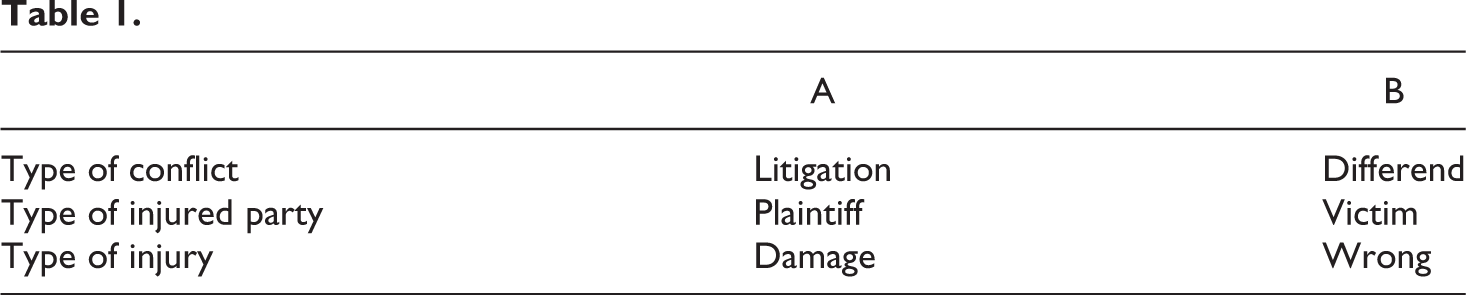
Litigation refers to a dispute (moral or legal) in which a party gives voice to a moral injury that is recognizable and reparable according to moral norms shared by both the injured party and the person or community to whom the injured party appeals. In such cases, moral concepts adequate to the expression of the moral injury in question exist, the injured party has the authority to employ those concepts, and a judge or tribunal recognizes the authority of the moral grievance such that some form of corrective justice is at least in principle available. Plaintiff refers to an injured party with the capacity to give voice to a suffered moral injury through a litigation, and a damage is a moral or legal injury that is in principle recognizable and reparable within the moral or legal community: one of its explicit or implicit rules has been broken, and justice involves the setting right of that transgression.
For example, within a society that recognizes private property, theft is positively identified as damage inflicted by one citizen upon another, and can be brought to a tribunal that can administer some form of corrective justice. In this case, the transgressed party can take on the status of a plaintiff with a legitimately recognized grievance.
In contrast to a litigation, a differend refers to the conflict that ensues when one is morally injured in a way that is neither recognizable nor reparable under current conditions, given the lack of a moral or legal framework shared by the injured party and the person or community to whom the injured party appeals. The differend may be generated by a number of different factors: a moral framework adequate to the expression of the moral injury in question may be lacking altogether, a framework may be available but lack sufficient authority or recognition, the injured party’s linguistic capacities may have been destroyed by the injury (in cases of murder or severe trauma), or were not available prior to the injury (in abuses of young children). 9 In a differend, a victim is an injured party who has been silenced for lack of an adequate and authoritative moral framework that could publicly articulate the moral injury suffered. Finally, as distinguished from damage, a wrong is a damage accompanied by the loss of the means to give voice to that damage.
For example, within a society that recognizes private property, certain grievances can be addressed by social and economic law, but not those concerning harms produced by the institution of private property itself. For instance, a worker can legitimately voice grievances over breach of contract, but not over the fundamental condition of having to subject oneself to a contractual obligation in the first place, i.e. to sell one’s labor-power. In this case the worker’s moral injuries become a wrong, the worker cannot take on the status of plaintiff and so becomes a victim, and the would-be litigation becomes a differend. This is one of Lyotard’s leading examples used in The Differend: ‘economic and social law can regulate the litigation between economic and social partners but not the differend between labor-power and capital.’ 10
Vittorio de Sica’s Bicycle Thieves (1948) vividly captures the differend at work here. The film follows a destitute working-class man, Antonio Ricci, and his son, Bruno, as they search the streets of post-Second World War Rome for his stolen bicycle. Antonio had pawned his family’s bed sheets in order to afford the bicycle, required for his job of posting ad bills around town, only to have it stolen on his first day on the job. As Antonio travels from institution to institution seeking help – his workers’ union, the marketplace, the police, the church, and his own home – he is only able to articulate to others that he has been the victim of a theft. What he cannot articulate, yet which the film makes tragically manifest, and which culminates in Antonio’s decision to steal a bicycle of his own, is the deeper structural harm inflicted upon the under-classes in this society such that the poor must steal from one another in order to survive. The fact that Antonio can articulate his suffering as theft but not in terms of unjust configurations of private property makes this film a paradigmatic example of an artistic expression of a differend. In this case, the differend is generated by the fact that the harming institution is able to impose its rules of discourse upon those it injures. That the worker’s labor-power is a saleable commodity is an essential presupposition of the authority to whom the worker appeals, and so cannot be called into question without a structural overhaul of the authority itself. If a worker protests by saying that he or she is forced to sell his or her labor-power, the capitalist tribunal can respond fairly easily that no force is in fact involved, since work contracts are, by their very nature, entered into freely by their signatories. This generates the ironic situation for the worker Marx describes when he writes: ‘[T]he period of time for which he is free to sell his labor-power is the period of time for which he is forced to sell it.’ 11
In this case it is important to see that the differend is specifically between the worker and the authority to whom the worker appeals, namely a system of social and economic laws that presuppose private property. Outside of this kind of failed attempt at litigation through existing social and economic law there exist alternative forums and critical vocabularies that attempt to give voice to the kinds of harms created by unquestionably treating labor-power as a commodity. The problem here is thus not that an adequate moral vocabulary is missing altogether but that those alternative vocabularies in circulation have not gained the kind of authority that could challenge a capitalist status quo with significant effect. In the differend between labor-power and capital, the latter is placed in a position of such dominance that it enforces its rules of discourse upon those it injures.
Consider a very different case, this time one in which a moral vocabulary adequate to the expression of a form of suffering is lacking altogether. Prior to the mid-1970s, ‘sexual harassment’ did not exist as a legal or moral concept within the USA, as the existing concept ‘harassment’ did not extend to the kinds of unwelcome sexual attention now widely understood as such. A woman at this time claims that an unwanted sexual advance constitutes a form of intrusion that counts as harassment. Yet she must make her claim within a community that lacks the sufficient moral and legal vocabularies to articulate her injury. Either she must show that she was transgressed in a way that is publicly recognized as damage, which will exclude the experience of intrusion constituted by unwanted sexual attention, or she must extend the concept of ‘harassment’ in a way that the community does not recognize. Either way, her experience of moral injury is repressed by the community to whom she appeals. 12
Her situation takes the form of a dilemma: she must articulate her grievance by drawing upon either authoritative yet inadequate conceptual resources or adequate yet non-authoritative conceptual resources. Either way, the addressee can deny existence of damages, for the conditions of conceptual adequacy and normative authority will not be fulfilled simultaneously. We can see the same dilemma-form in the first example: the worker can either attempt to give voice to the injury in the terms of economic and social law, which will be inadequate to the expression of the injury in question, or speak in a different language-game which will lack authority in the eyes of the tribunal to which he or she is appealing. Either way, the worker will fail to demonstrate to the tribunal the existence of a wrong.
Importantly, differends need not be generated by a legal structure as in the previous examples but can also be generated by implicit prejudices that structure a moral outlook. For example, in her book, Aftermath, Susan Brison briefly attacks a popular theory of trauma according to which the victim possesses an epistemologically privileged position with regard to traumatic experience, given its vividness and the victim’s passivity. According to this theory, later narratives of traumatic experience are necessarily distortions of the event given their status as mere representations of an unspeakable event. As Brison points out, ‘this theory of trauma makes it conceptually impossible for a survivor to bear reliable witness to the trauma’. 13 Either the trauma victim’s testimony is a distortion of the original event, and so cannot be taken at face value, or it is a clear and straightforward testimony, in which case no trauma could have occurred. Either way, trauma victims (according to the theory of trauma under attack) cannot bear witness to the original event. Brison adds that this is reminiscent of a dilemma faced by rape victims on the stand: either the rape victim is viewed as traumatized, hysterical and emotional, and so not a credible witness, or the rape victim is viewed as calm and reasonable, i.e. as someone who has not gone through any traumatic experience, and so not a credible witness. Either way, the rape victim is not a credible witness. 14
It is important to highlight that while the limits of existing moral and legal vocabularies are central here, differends are not simply matters of language, not simply cases in which the right words are missing and need to be formed. Rather, differends have their source much deeper in the material structure of a world of objects and social relations, as voices can be both privileged and marginalized by the economic, racist, sexist, familial, religious and political forces that shape a form of life and the social bodies within it. To bring this out, consider another complex example, specifically one explored in Cristian Mungio’s 2007 film, 4 Months, 3 Weeks and 2 Days. The film depicts two young women, Gabita and Otilia, who struggle to obtain an illegal abortion in communist Romania in the late 1980s, a time when abortions were legally and socially forbidden and often fatal. Having a child out of wedlock was no more socially acceptable an option than abortion, nor was the grim prospect of sending the child to a Romanian orphanage. The film paints a portrait of Gabita’s and Otilia’s lives in this world as lives of suffocation and isolation rooted in gender and class. When they meet Mr Bebe, the man who will perform the illegal procedure in a dilapidated hotel room, he makes clear to them that he expects not only the earlier-agreed-upon monetary fee, but also to have sex with both women before the procedure. Both women are raped, the fetus is hidden away in a trash chute, and they vow never to speak about the day’s events again.
The world in which they live transforms the decision to abort a fetus, almost by necessity, into an overwhelming experience of pain and horror about which they can never speak, even to each other, as Otilia says to Gabita in the closing line of the film: ‘You know what we’re going to do? We’re never going to talk about this.’ Otilia’s words do not simply convey a decision not to speak about the event, but, at a deeper level, express the differend that prevents them from making any kind of moral assertion concerning the pains they went through to receive the abortion. Here the silencing effect has a somatic basis: the kinds of claims Otilia or Gabita would have to make in order to have others acknowledge the moral injury they endure would necessarily involve claims about their bodies, claims about how women’s bodies have been violated, reduced to sites of economic and sexual exploitation by those whose bodies have been more fortunately determined. The oppressive politics and social taboos that converge upon Gabita’s body, upon all women’s bodies in the world depicted by 4 Months, systematically block the possibility of apprehending them as having been violated, for the reason that women’s bodies are not theirs to make claims about. In this case, the differend has its material roots in the social and political norming of citizens’ bodies: either Gabita makes a claim about her suffering by asserting a form of bodily autonomy her community does not recognize as authoritative, or she gives in to her lack of bodily autonomy, forfeiting her capacity to make a claim. Either way, Gabita’s claim will be suppressed in advance.
As these examples bring out, the differend encompasses a wide range of cases, while nonetheless repeating a similar structure, namely, the form of a dilemma: either I speak within the language-game recognized as authoritative by the person or community to whom I appeal, a language-game that cannot articulate my victimhood, or I speak within a different language-game (if one is available) unrecognized by the person or community to whom I appeal. In either case, my claim goes unrecognized. The dilemma-form at work in these cases captures a phenomenon that inhibits acts of moral grievance-making, namely, a conflict between the conditions of conceptual adequacy and normative authority.
III The differend and hermeneutical injustice
Part of what is powerful about the conceptual figure of the differend is that it is at once quite formal, capable of encompassing a wide range of cases, while nonetheless remaining radically context-sensitive. To bring this out, we can contrast the model of the differend with another model, one offered by Miranda Fricker in Epistemic Injustice. One of the special types of injustice Fricker outlines in her book is what she calls ‘hermeneutical injustice’, which occurs ‘when a gap in collective interpretive resources puts someone at an unfair disadvantage when it comes to making sense of social experiences’. 15 Her leading example is a case in which someone suffers sexual harassment in a time and place still lacking that critical concept. The main point of contrast I want to flag between the view defended here and Fricker’s is a difference in diagnosing the injustice at work: whereas a differend focuses on a conflict obtaining between the language-game that would articulate my victimhood and the language-game in which I am forced to speak, Fricker’s account focuses on there being a particular lacuna in our shared interpretive resources. Her formal definition of ‘hermeneutical injustice’ is as follows: ‘[T]he injustice of having some significant area of one’s social experience obscured from collective understanding owing to a structural identity prejudice in the collective hermeneutical resource.’ 16 This emphasizes that hermeneutical injustice is the result of a particular gap in our expressive and interpretive resources that disproportionately and discriminatorily harms some members of society rather than others. So with Fricker, we have an opposition between an inadequate yet authoritative moral discourse and a set of particular experiences whose latent moral meaning is covered over and neutralized. As some critics have pointed out, the concept of hermeneutical injustice requires an important amendment in order to capture the fact that such scenes of silencing depend greatly upon just who is speaking to whom. 17 For taking her model as it stands, hegemonic discourse operates like a smothering blanket that uniformly snuffs out attempts at particular kinds of moral grievance-making. What this ‘blanket’ image fails to capture, Fricker’s critics have suggested, is the existence of counter-cultural epistemic communities in which normally suppressed grievances have a chance to be successfully articulated. To borrow an example from José Medina: ‘[N]on-heterosexual subjects had ways of signaling to themselves and to others like them that they were being sexually oppressed long before terms such as “homophobia” and “heterosexism” were in circulation.’ 18 Our picture of hermeneutical injustice requires modification if we are to capture the dynamism and heterogeneity of epistemic communities Medina is flagging here.
The concept of the differend provides the necessary critical modification. ‘Hermeneutical injustice’ and ‘differend’ refer to related yet different socio-epistemic phenomena. Unlike ‘hermeneutical injustice’, which refers to an overarching climate of impoverished hermeneutical resources afflicting a linguistic community, a ‘differend’ refers specifically to a particular failed instance of moral grievance between an addresser and an addressee. Accordingly, the two concepts could work in tandem: we might say that a general climate of hermeneutical injustice increases the potential for differends between would-be communication partners. When the two concepts are used in tandem in this way, the critique of Fricker outlined above is satisfactorily addressed. For in contrast to ‘hermeneutical injustice’, ‘differend’ is an inherently relational term (it is helpful here to recall that Lyotard’s original French is le différend, which, unlike the neologism introduced by his translators, can be translated simply as ‘conflict’). The specific social relation between addresser and addressee shapes the particular character of each differend. For example, in voicing the wrongness of sexual harassment in a time and place still lacking the concept, if one’s addressee is an unsympathetic boss, a differend may be imminent. Yet if one’s addressees are fellow members of a women’s consciousness-raising group, which has worked to develop a shared vocabulary and spirit of epistemic trust and confidence, one’s grievance may more easily approximate the conditions of conceptual adequacy and normative authority without conflict, which is to say, without a differend. This difference in communicative efficacy remains even if the hermeneutical resource available to the victim is identical in both contexts.
Along this strand of thought, what the dilemma-form helps highlight is the fact that a differend implicitly contains the possibility of a struggle for articulation, a site of instability that could serve as the practical ground for the critical and creative activity of discursive transformation. Hence, the dilemma-form pushes us to look for potential resources in a very particular place: namely, the inchoate experiences and feelings of the victim. As Fricker points out in her analysis of hermeneutical injustice, the feeling of dissonance between one’s experience and one’s discursive context can serve as the ‘starting point for both the critical thinking and the moral-intellectual courage that rebellion requires’. 19 This means that the site of silenced victimhood can be viewed not simply as a paralysing discursive checkmate, but as a dynamic space in which counter-expressive voices are implicitly possible.
IV The core premise of The Differend and a universalist critique
Lyotard adopts an unequivocal moral stance towards all such dilemmas: they directly place on all involved – victims, bystanders and perpetrators – the moral imperative to ‘bear witness to the differend’, 20 that is, to reveal the ways in which certain language-games are repressive of victimhood, and to point towards ways in which our expressive resources might be expanded such that a differend can be transformed into a litigation. ‘Every wrong ought to be able to be put into phrases. A new competence (or “prudence”) must be found.’ 21 This, however, raises an urgent question concerning the normative justification of Lyotard’s project, namely, what gives force to the ‘ought’ in ‘Every wrong ought to be able to be put into phrases’? Lyotard rules out two possible normative grounds: a universalist principle on the one hand and a relativist basis in existing discursive commitments on the other. As we shall see, the unavailability of these options pushes us towards a dialectical view of the relation between moral universals and particular cases.
For Lyotard, differends occur when a dominating authority, whether knowingly or unknowingly, silences aspiring moral grievances by taking advantage of a feature endemic to language as such, namely, that no language-game lays claim to universal status such that its rules would be applicable and acceptable to disputants in any given case. Given this strong claim, the moral theory outlined in The Differend stands in contrast with ethical theories that attempt to outline universally applicable discursive conditions and procedures that can – by virtue of their universal acceptability – settle moral conflicts fairly without the use of force or coercion. We can think, for instance, of the rational conflict resolution procedures of Habermasian discourse ethics. 22 The deep appeal of such attempts is that, if successful, they will have provided rules of judgement that any rational participants in a conflict can be expected to maintain, thereby transforming all differends into litigations. If such a universal discourse were possible, those conflicts we thought were differends were always already litigations, yet ones that the conflicting parties failed to recognize as such.
Lyotard denies this can be the case, arguing that ‘a universal rule of judgment between heterogeneous genres is lacking in general’.
23
This premise serves as the core of Lyotard’s philosophy of language and concomitant moral theory. Here, the Wittgensteinian influence on Lyotard is most apparent, as his rejection of an a priori universal rule of judgement cutting across all language-games recalls Wittgenstein’s criticisms in the Philosophical Investigations of the idea that language has an essence that can be captured in terms of a unified and total structure. Calling into question the idea that such a structure could be developed by cataloguing the types of sentences that occur in a language and uncovering their implicit logic, Wittgenstein writes: But how many kinds of sentence are there? Say assertion, question, and command? – There are countless kinds; countless different kinds of use of all the things we call ‘signs’, ‘words’, ‘sentences’. And this diversity is not something fixed, given once and for all; but new types of language, new language-games, as we may say, come into existence, and others become obsolete and forgotten.
24
This is a contentious view, especially in light of a modern paradigm of viewing moral principles as precisely the kinds of universal principles Lyotard thinks are lacking, and Lyotard has been criticized for ruling out moral universalism too quickly. Axel Honneth has argued that, despite Lyotard’s insistence that no universal rules of discourse are possible, his own framework in The Differend implicitly rests upon a universal moral principle, in particular one present in Habermasian discourse ethics. Here is the core of Honneth’s criticism: [Lyotard must be committed to the idea that] the socially repressed, ostracized language games contain a truth claim that, unjustly, has not yet obtained recognition within societal communication. To be able to defend this conviction, Lyotard is dependent upon discourse ethics’ idea that every subject must equally get the chance to articulate his or her interests unconstrainedly – and that means: free from domination. Without moral universalism, which is present here in Kant’s sense, one cannot at all understand what having to defend the particularity of the suppressed language game against the dominant agreement is supposed to mean.
27
Honneth’s point is a dialectical one: Lyotard’s idea that particular and non-ideal cases of repressed moral injury call for the invention of new idioms presupposes, as the ground of the normative force of this call, some conception of a universal and ideal speech situation in which all wrongs could in principle find expression. Honneth refers specifically to Habermas’ view that we can identify, as the implicit presuppositions of all rational argumentation, norms that underwrite the ideal speech situation, such as the following rules:
Every subject with the competence to speak and act is allowed to take part in discourse. Everyone is allowed to question any assertion whatever.
Everyone is allowed to introduce any assertion whatever into the discourse. Everyone is allowed to express his attitudes, desires, and needs. No speaker may be prevented, by internal or external coercion, from exercising his rights as laid down in 1 and 2.
29
Honneth’s point is that in the absence of any appeal to these or some comparable set of rules establishing how the speech situation ought to be, it makes no sense to assert that one has been wronged by having one’s moral grievance repressed. While he appeals here to Habermas, Honneth could have launched his attack from the perspective of any number of moral theories that share the assumption that some positive vision of a moral regulative ideal is required in order to orient our concepts of injustice, exclusion and the progressive overcoming of injustice. He could have, for instance, leveled the critique from the perspective of his own theory of recognition as laid out in The Struggle for Recognition, which he asserts rests upon ‘the hypothetical end-point of an expansion of relations of recognition’ as the regulative ideal giving moral orientation to social struggles. 30 Both Habermas’ and Honneth’s hypothetical situations of inclusive discourse and recognition are variations on the Kantian Kingdom of Ends, regulative ideals of moral development that set the standard for what counts as moral progress. In this light we can see that Honneth’s challenge is funded by the broad assertion that non-ideal cases (differends, wrongs, epistemic injustices) cannot be identified as non-ideal, at least not in any sense that could underwrite an ethical or political demand, unless we already have in view some conception of the ideal, even if only as a regulative ideal or hypothesis.
V A response to moral universalism
The right response is not to reject Honneth’s point that the non-ideal is dialectically co-implicated with the ideal, particularity with universality, but rather to give the dialectical point one more turn, showing how the universalism Honneth suggests remains one-sided if not understood in light of the particular instances of harm and violation to which the moral universal purports to respond. We can accept Honneth’s point that ideal and non-ideal, positive and negative, universal and particular, are dialectically mutually informing, yet while maintaining that the non-ideal, negative and particular sides enjoy a priority over their dialectical partners. Call this the dialectical priority of the non-ideal, which maintains both (1) the reciprocal relation between these pairs and (2) a basic asymmetry in those relations in favor of the priority of the negative, the particular and the non-ideal over the positive, the universal and the ideal.
Now, we can start to bring out this priority by asking how it is that we come to formulate and be normatively bound by the demand that ‘Every wrong ought to be able to be put into phrases’, or that ‘Every subject must equally get the chance to articulate his or her interests unconstrainedly’. A passage in The Differend points us in the right direction: The differend is the unstable state and instant of language wherein something which must be able to be put into phrases cannot yet be…This state is signaled by what one ordinarily calls a feeling…A lot of searching must be done to find new rules for forming and linking phrases that are able to express the differend disclosed by the feeling, unless one wants this differend to be smothered right away in a litigation and for the alarm sounded by the feeling to have been useless.
31
Part of the reason this notion of feeling can be overlooked is a prejudice about practical reasoning pushing us in favor of universalism, or at least some principle-based account of ethics.
32
Very simply put, the prejudice is that practical reasoning necessarily takes the form of a practical syllogism of the following kind: Major premise = Moral principle Minor premise = Appraisal of my situation Conclusion = Course of practical action
For instance: Every wrong ought to be able to be put into phrases. X is an instance of wrong. X ought to be able to be put into phrases.
According to such a prejudice, value-neutral appraisals of reality (2) are held apart from value-saturated principles (1) that must be combined in order to produce a genuinely moral response to that reality as a deductive conclusion (3). As Onora O’Neil puts the point: ‘Principles without appraisals are empty; appraisals without principles are blind.’ 33 When we view practical reasoning as taking this form, it seems unavoidable that moral action finds genuine guidance only through the application of rules to cases, and that knowing how one should act is a matter of having the right rules, in the form of universals. Such a view underwrites the criticism that Lyotard must be presupposing some form of moral universalism when he urges that all wrongs ought to be able to be put into phrases.
Yet this prejudice is not forced on us and there exists an attractive alternative for thinking about the practical syllogism that does not resort to a view of practical reasoning as the application of value-laden rules to value-neutral cases. The dialectic of universal and particular gestured towards in Honneth’s critique gives us a significant clue here: specifically, that the content of the major and minor premises can be seen as co-implicated and mutually informing. Indeed, this is already implied by the thought that we cannot know what a moral rule means or demands of us independent of a moral sensitivity to the particular features of a situation that stand as opportunities to fulfill the rule. That moral sensitivity cannot, in turn, be determined exhaustively by the rule, since the application of the rule depends upon the guiding powers of the sensitivity as a kind of pre-determinative prudence. Habermas admits this much: ‘The principle of discourse ethics, like other principles, cannot regulate problems concerning its own application. The application of rules requires a practical prudence that is prior to the practical reason that discourse ethics explicates. Prudence itself is not subject to the rules of discourse.’ 34 This much already indicates that even in cases in which a rule is applied to cases, the appraisal of the case (i.e. the process of filling in the content of the minor premise) cannot be simply understood as normatively neutral. Rather, the prudence involved manifests a context-sensitivity of judgement that is normatively charged while not being the result of the subsumption under a principle. This much already opens the door for a context-sensitive, non-rule-based moral sensibility that gives content to what Lyotard vaguely refers to in the above passage as a ‘feeling’.
Once we admit the experiential content of the minor premise cannot be normatively neutral – since rule application would then be impossible – we can fill out this picture by suggesting that practical reasoning in general is characterized not simply by the subsumption of cases under rules, but by a dynamic process in which the normative content of experience (the minor premise) informs those rules that we have codified (the major premise), and vice versa. When a socially acknowledged rule is a good one, it is because it is genuinely responsive to particular instances, specifically to particular instances of moral injury, which the norm helps and urges us to articulate and address. Hence, when practical reasoning is going well, major and minor premise are not strictly separable, insofar as both general rule and particular cases call for the same kinds of ethical response to moral injury, and major and minor premises form a single movement. In contrast, normative dissonance occurs when the normatively charged content of the major and minor premises cannot be reconciled with one another without some shift: either my normative expectations or my experience need to change if the dissonance is to be overcome. The ‘feeling’ of the differend could then be understood as a dissonance within one’s experience between the morally charged content of the minor premise (one’s appraisal of reality) and the morally charged content of the major premise (moral frameworks currently available). The ‘alarm’ Lyotard describes would then refer to a feeling of the breakdown of practical reasoning in the face of a reality that cannot be accommodated by our received worldviews, insofar as it generates normative dissonance in precisely this sense. The demand that one give voice to the differend is the internally arising motivation to transform this inchoate engagement into something publicly communicable, contestable and addressable. The demand arises not from an externally imposed norm, but from an internally arising painful dissonance that calls for resolution through the possibility of public articulation.
The metaphor of ‘dissonance’ between major and minor premises of a practical syllogism can be understood concretely as a sense of conflict between a set of authoritative social constructions and the nascent moral meaning of some experience. This dissonance was implicitly at work in the examples considered above. Bicycle Thieves exhibits the normative dissonance between Antonio’s inchoate sense that he is the victim of an injustice and the limited ways in which he attempts to express his grievance through the channels of existing social and economic law. We find a parallel dissonance at work in the conflict between the experience of a victim of sexual harassment and a mainstream discourse that is inadequate to the articulation of her condition. In the practice of feminist consciousness-raising, we find a critical space in which this latent sense of normative dissonance between women’s experience and patriarchal social constructions is actively cultivated and articulated as a tool for social change. Stories of sexual harassment are shared and the growing sense of dissonance between experience (minor premise) and received moral-legal understanding (major premise) nurtures the collective conviction that the latter requires critical revision. Similarly, as viewers of 4 Months, 3 Weeks and 2 Days, we are presented with the normative dissonance generated by the need to assert a form of bodily autonomy in a space that refuses to acknowledge that very bodily autonomy. Whether in narrative artworks or historical practice, the normative dissonance between major and minor premises plays a necessary and crucial role in the moral learning of individuals and societies. Through this dissonance, an alarm is raised and we are compelled to reflect: Is this a false alarm, an indication that I must shift my normative expectations at an individual level in order to be at home in the world? Or is this an inchoate indicator of a genuine crisis in need of resolution? 35
If major and minor premises are co-implicated and mutually informing in the operations of practical reasoning, then we need to be mindful of the limits we face when we try to pull the major premise apart from this cooperative movement and state it as a codified rule, in the way that Honneth tries to isolate a principle governing the moral framework of The Differend. The isolated major premise needs to be understood against the background of the specific instances making up the content of the minor premise, for without these instances the major premise has neither meaning nor compulsion. An example of this is the isolation and codification of the principle that ‘All wrongs ought to be able to be put into phrases’. The principle is not a bad one, but it nonetheless needs to be kept in mind that its isolation and abstraction from the co-implicated premises of the practical syllogism are possible only on the basis of a history in which that major premise was formed and took on concrete meaning in light of particular experiences of silenced wrongs. What a codified moral principle is, then, is an abstracted and at best approximate snapshot of a moment in the changing life of a major premise in relation to the experiential content of the minor premise. In that snapshot, we do not perceive the impact of the experiences that went into its formulation, the complex genealogy that led to our adopting the rule as one we think is important enough to isolate and state in the abstract. The codified principle, ‘Every wrong ought to be able to be put into phrases’, is a perfect example of this, for while we might readily agree with what it says, this is only because we have in our experience and memory actual cases of silenced moral injuries, and a sense of the pain and suffering, the ‘second injuries’, that silence can produce. So we can state this moral imperative in a way that we find compelling and binding, without simply presupposing the abstract legitimacy of an a priori universal moral norm.
From this perspective, we can summarize three lines of objection facing universalism. (1) While it is difficult to show that a universal principle is worth upholding for its own sake, another more plausible account is that the universal principle is not a starting point for moral thought, but a result: it is for the sake of particular instances of moral injury that the universal principle is generated, upheld and recognized as valid. (2) Second, there is an ease with which differends appear to conform with the universal principle in question. A victim of sexual harassment prior to the concept’s development could make formal complaints, tell her story, present her grievances – in short, appear to have been given every possible opportunity to voice her interests without constraint – and still lack the capacity to prove the existence of a wrong. One can claim apparent conformity to universal principles of fair discourse while still being guilty of perpetuating a differend. (3) Third, instances of differend call for specific forms of moral responsiveness, and in this regard a universal principle is underdetermined. In the case of sexual harassment, what was needed was a combination of imagination, theory, legal work and more, all of which was specific to the moral injury in question. Here, the universal principle to give voice to unvoiced moral injury was certainly valid, but not of much help in determining the appropriateness of specific forms of moral response.
In sum, the right response to Honneth is not simply to reject moral universalism in favor of either relativist or particularist alternatives, but rather to advocate for a ‘universalism from below’. 36 According to this view, the kinds of ‘thick’ moral concepts (like ‘sexual harassment’) we rely upon in order to publicly address moral grievances with adequacy and authority are socio-historical results of struggles for articulation. Our modern commitment to the ‘publicity of reason’ is an emergent ideal, becoming increasingly concrete as new and previously unrecognized forms of moral address intrude upon and transform our received moral conceptions.
VI Conclusion
In this article I have offered an analysis of moral grievances suppressed or distorted by conditions of epistemic injustice, showing that they embody a particular form of dilemma. In particular, what we have examined are instances in which the conditions of conceptual adequacy and normative authority are pitted against one another. I also showed how this theoretical model, captured by the concept of the differend, allows us to make necessary critical amendments to Fricker’s conception of hermeneutical injustice, in particular by foregrounding the relational character of suppressed moral grievances. Finally, focusing on Honneth’s criticisms of Lyotard allowed us to formulate a version of the thesis that moral universals exist in a dialectical relationship with particular cases. On the one hand, as Honneth points out against Lyotard, the moral imperative to give voice to discursively suppressed moral injuries tacitly implies a universal ideal of inclusive discourse. Yet at the same time, the ideal to which Honneth appeals is rendered empty and normatively inert if held apart from the particular non-ideal actualities of unvoiced moral injury in response to which this ideal is posited. Accordingly, the view I have defended here is a form of non-ideal ethical theory which nonetheless takes moral ideals seriously, i.e. a moral universalism from below.
We can formulate the position defended here as emphasizing a primacy of reflective over determinative judgement in ethical thinking. Kant famously draws the distinction between these forms of judgement in the Critique of Judgment: Judgment in general is the ability to think the particular as contained under the universal. If the universal (the rule, principle, law) is given, then judgment, which subsumes the particular under it, is determinative…But if only the particular is given and judgment has to find the universal for it, then this power is merely reflective.
37
Footnotes
Acknowledgements
I am deeply indebted to the following individuals for the comments and criticisms on earlier versions of this article: Linda Martín Alcoff, Roy Ben-Shai, Jay Bernstein, Jacob Blumenfeld, Alice Crary, Grace Hunt, Rahel Jaeggi, Lukas Kübler, Alice MacLachlan, José Medina, Karen Ng, Dirk Quadflieg and Rocío Zambrana. Earlier versions of this article were presented at the Society for Phenomenological and Existential Philosophy, the Kolloquium für Sozialphilosophie at Humboldt University in Berlin, the Canadian Society for Women in Philosophy, the New School for Social Research philosophy department, and the Vanderbilt University philosophy department. I am grateful to the audiences on each of these occasions for their criticisms and suggestions.
Funding
Research for this article was supported by a grant from the Deutscher Akademischer Austausch Dienst (DAAD) during the 2012–2013 academic year.