




Abstract
According to the standard account of human reason, reason is a domain-general faculty that operates by drawing inferences from premises in an impartial and logical manner. Whether one subscribes to a Cartesian framework that attributes this property to the soul or one subscribes to a naturalistic framework that reduces this to neurological functioning, both parties have tended to agree that reason is primarily concerned with tracking truth and acquiring knowledge. However, Hugo Mercier and Dan Sperber set out to cast doubts on these claims, they complement a critical survey of the psychological literature on reason’s weaknesses with a speculative hypothesis that this cognitive capacity is not truly flawed but, rather, has been long misunderstood.
Signalling in the introduction that they will be approaching the topic from an evolutionary perspective, Mercier and Sperber argue that if reason is an adaptation that is supposed to enhance cognition, then we must conclude that it is ill-suited for this task since numerous experiments have exposed egregious and systematic flaws in its operations (p. 4). This is a serious problem for any theorist and researcher in the disciplines of epistemology, logic, psychology and even political and social theory. So many public policies proceed from the assumption that human beings are not only rational actors but also that we, on average, tend to reason ideally. Logicians, for instance, will find themselves frequently encountering students who fail to apply the most elementary of logical principles to test problems, inferring that any difficulty must derive from insufficient practice. Similarly, arguments within the gun violence literature commonly assume that bad actors are reasoning and strategizing about their targets; and within the literature on social welfare, we can find policymakers often assuming that punitive incentives will motivate the impoverished to take better responsibility for their plight (presumably by recognizing undesirable consequences and reasoning appropriately).
Indeed, academics from all disciplines have extolled the virtues of the rigorous application of solitary reasoning for acquiring knowledge. But it is The Enigma of Reason, by contrast, that invites us to revisit a thread of thought that can be traced back to the end of the Enlightenment, one situated firmly within the Kantian tradition of critiquing human cognitive capacities for the sake of securing social and intellectual progress.
In part one of their book, ‘Shaking Dogma’, Mercier and Sperber begin by reviewing the myriad ways that reason predictably misfires in statistically significant and consistent ways across the general population. They are careful to discuss only those studies whose conclusions are well-supported and whose results have been replicated.
For instance, there is the well-studied conjunction fallacy, first popularized in 1983 in the psychological literature by psychologists Daniel Kahneman and Amos Tversky (p. 22). In their initial experiment, Kahneman and Tversky discovered that, when contextualized with a real-world example, students were often assigning a greater probability to the outcome of a conjunctive event occurring rather than its constituent events individually. Logically and statistically, however, the probability that any event
Again, citing their own research along with psychologist Guy Politzer, Mercier and Sperber describe how another of reason’s idiosyncrasies reveals itself when exploring the ‘pigeonhole problem’. 2 According to the Pigeonhole Principle (a mathematical principle), whenever there are more objects than categories, if all objects are sorted into categories, then at least one category will contain more than one object. This is supposed to be a fairly clear rational intuition – if you approach five different recycling bins with eight different recyclable objects, then at least one bin will end up with more than one recyclable.
To test this intuition, Mercier, Sperber and Politzer constructed their own examples centred on farmers living in the village of Denton (pp. 23–24):
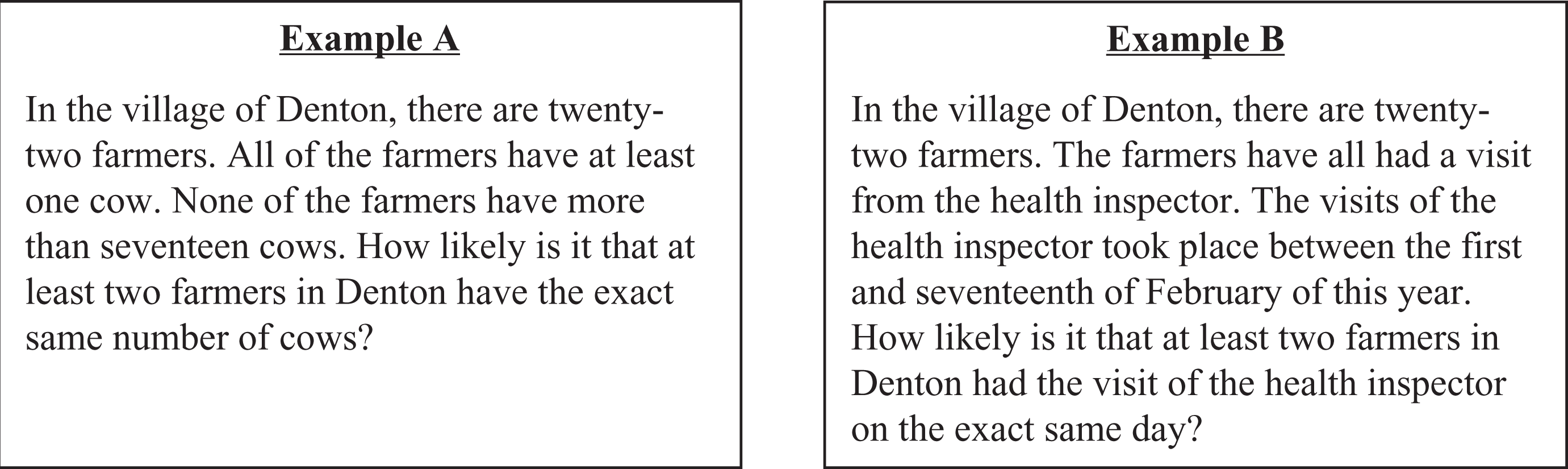
Because the two formulations are logically equivalent, the answer to each is the same: The likelihood is an absolute certainty. However, depending on how the problem is contextualized, respondents will systematically and predictably fail to draw the correct inference. When the problem was framed as Example A, participants answered correctly a dismal 30% of the time, but when it was framed as Example B, the total number of correct responses suddenly increased to 70% (p. 23–24). Given their logical equivalence and similar phrasing, why is reason frequently failing in one context but not the other?
There are also the recurring problems observed during the Wason Selection Task, invented in 1966 by psychologist Peter Wason. Usually the premise behind this experiment is to test conditional reasoning by presenting a participant with four cards, each having a side with a number and an opposing side with a letter. An experimenter ensures that two of these cards appear letter-side up, while the other two instead reveal numbers, leaving a participant to see a set such as the following (p. 40):
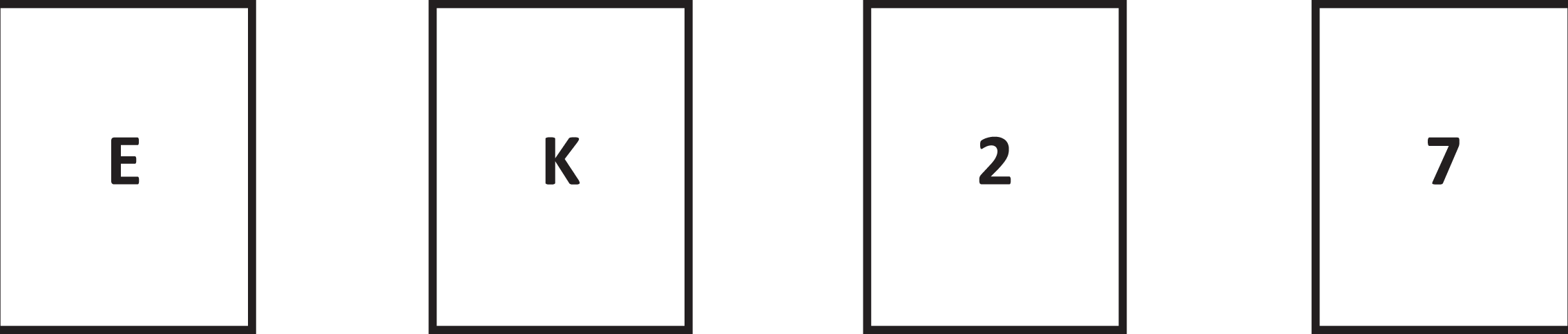
To challenge the ability of a participant to make straightforward conditional inferences, an experimenter will ask a question that requires using some standard logical rules to solve, such as modus ponens and modus tollens. The variant that Mercier and Sperber discuss is (p. 40): Which of the cards must be turned over to prove or disprove the following: If there is an E on one side of a card, then there is a 2 on the other side?
What is happening? Are we to assume that people reason better about health inspectors than they do cows? Are people better at making inferences with negations than without? How are we to explain these supposed flaws and inconsistencies in human reasoning?
Mercier and Sperber reject the idea that these are flaws in the first place. It is not so much that reason is malfunctioning as it is that reason is not being exercised in the proper environment. Using the example of how non-human cognitive mechanisms have evolved to deliver inferences to creatures that coordinate behaviour, they review the research of biologist Rüdiger Wehner, who studies Cataglyphis fortis, a species of desert ant located in the Sahara. These creatures meander in seemingly random patterns away from their nest at distances of 200 m and more. Amazingly, once they locate food, they take a near-straight path directly back to their nest (pp. 54–55). How is this possible?
It turns out that Wehner and his fellow researchers have isolated a few distinct cognitive mechanisms, each of which performs highly specific tasks of gathering information and performing computations. For example, two such mechanisms are the ‘celestial compass’ and ‘odometer’, each of which tracks changes in direction and distance between such changes, respectively (p. 55). Together, these computations effortlessly guide the ant as it makes its way back to the nest. From an evolutionary point of view, the mechanisms used by the desert ants are adaptations, suited for the environment in which they evolved, and it stands to reason that if we were to place these creatures in a wholly different environment ill-suited for the operations of these cognitive systems, their computations would proportionately suffer to the degree that the new environment differs from the Sahara in importantly relevant ways (e.g. no light to help compute directional changes).
Using the desert ant as a metaphor, Mercier and Sperber argue that reason itself has similarly evolved in a unique environment for which it is well-suited to execute its operations, and the so-called flaws that we discover with reason result from asking of it to perform tasks that go beyond the scope of its design, much like removing the desert ant from the Sahara. This environment is the social environment (p. 247).
After justifying why an evolutionary approach is important (pp. 176–80), Mercier and Sperber argue that it was the environmental pressure to cooperate that importantly drove the development of reason. Although cooperation can be found amongst animals, what makes human cooperation different is both its scale and its open-endedness (p. 183). When working together, human cooperators may differ in their understanding of the nuances of the common goal and the role that each is expected to play in securing the anticipated outcome, leading to moments of frustration and even conflict. Depending on the degree of the misunderstanding, a common outcome can be defection to another group whose interests more appropriately align with one’s own; and in some cases, provided one aims to retain the benefits of group membership while maximizing personal rewards, this can even result in cheating. Yet, because it has historically been more advantageous for human beings in small foraging groups to work together (and because cheating had generally been met with swift and severe punishment), we have developed another way of managing the disagreement that arises from working together. Human beings can evaluate and renegotiate the terms of the cooperation, a feat accomplished partly through the establishment and enforcement of social norms and the development of theory of mind (pp. 183–84). Furthermore, as social creatures who belong to groups that expect and even flourish with such coordination of goals, individuals develop reputations along with social pressure to uphold them – lest they be ignored, derided, punished, or worse, ostracized from the group. 3 So much of this negotiation and coordination is accomplished through reason, Mercier and Sperber argue, for it is through reason that we are able to justify ourselves and our actions to others as well as demand justifications from others for their own behaviour (p. 186).
It is thus the social demand of justifying oneself and one’s behaviour that has chiefly influenced reason’s development, and one of the primary sources of evidence for this is to be found in the study of the myside bias, 4 a form of confirmation bias in which people will provide a plethora of reasons for their own choices and beliefs while neglecting or distorting any reasons to the contrary (pp. 213, 218). This was observed during some versions of the Wason Selection Task, where participants were quick to use reasons to justify their selections, 5 and similarly, political scientists Charles Taber and Milton Lodge have discovered myside tendencies in studies that require participants to explain their positions on controversial political issues (pp. 218–19). What is more, when individuals are placed in groups with people who share their views, their beliefs become only stronger and more extreme, a phenomenon known as attitude polarization (pp. 243–44).
These cognitive biases and psychological tendencies are best explained when we recognize that reason’s job is to act as our own lawyer rather than a dispassionate scientist. Like a lawyer, reason zealously goes to work in defence of its client’s side – a view that helps explain the fact that it can be so difficult to find counterarguments to our positions (p. 220). If reason were concerned primarily with knowledge and truth for the individual, then we should expect it to abandon its endeavours when our positions appear unlikely, but study after study of the myside bias shows how difficult it can be for us to change our minds (p. 220). And yet, the optimism in The Enigma of Reason is that, contrary to appearances, these so-called systematic errors of reason are not flaws but features.
In a move that ultimately recommends that we replace our Cartesian fantasy of reason with a return to the messy, Socratic view of it, Mercier and Sperber recognize that if reason evolved and flourishes in the social environment, then the ideal situation for it to be exercised can be found in argumentative exchange. After discussing a handful of studies on disappointing group performance, they enthusiastically direct our attention to the marvel of dialogue and interaction. In these studies, groups routinely perform better, on average, than the individual, consistently finding the correct answer to problems far more often (p. 266). For example, in the Wason Selection Task, when psychologist Dave Moshman permitted students to work together on the problem, he found that 80% were selecting the right answers compared to just 15% of individuals (p. 264). Mercier and Sperber explain: That group performance should be disappointing in many domains only makes the successes of argumentation even more remarkable. When people argue, even about seemingly dull mathematical or logical tasks, there is no social loafing or cognitive disruption. Instead, their motivation is increased by the dialogical context. They respond to each other’s arguments and build on them. (p. 266)
While there is much to commend in this work, other reviews of the Enigma of Reason have tended to focus more critically on the most ambitious part: the hypothesis that reason might be a cognitive module. Given the amount of debate surrounding this particular claim, I have deliberately avoided its discussion out of concern that such a contentious claim detracts from an otherwise provocative and refreshing analysis of reason. While Mercier and Sperber have recently addressed their critics and defended this idea, 7 part of the issue might stem from a more fundamental problem that demands our attention – a lack of clarity on the topic of modularity in general.
Specifically, there is ambiguity surrounding Mercier and Sperber’s use of the term ‘module’ and other closely related terms. In general, modules are highly specialized mechanisms that perform very specific functions, and so to claim that reason is a module is to claim that there is a well-defined cognitive task that reason performs (namely, the creation and evaluation of justificatory relations between premises and conclusions). Beyond this well-established understanding of the term module, it is at times difficult to distinguish in The Enigma of Reason between occasional equivocations and meaningful distinctions. For example, they will use the term mental module to describe a module that implements ‘cognitive procedures’ without explaining what they have in mind or providing an example (p. 83). Elsewhere, they discuss cognitive modules, described as ‘biological modules having a cognitive function’, clarifying that what makes it a biological module is that its function is correlated with a physical state or region of the brain. The lack of attention given to these distinctions leaves the reader to wonder, for instance, whether mental modules should be regarded as synonymous with cognitive modules or even whether Mercier and Sperber are defending the eliminativist position that mental states are reducible to physical states.
The sorts of questions that arise from this ambiguity are further compounded by an additional distinction later. They explain that cognitive modules have evolved as adaptations whose jobs are to process domain-specific information and draw inferences (p. 75, 288); and yet, throughout their work, they discuss inferential modules, explaining that they aim ‘at providing a specific kind of cognitive benefit, 8 and at doing so in a cost-effective way’ (p. 165). What is the relationship, if any, between cognitive and inferential modules? Is the reader to assume they are identical, or is there a categorical relationship? Regrettably, it is unclear to what degree these types of modules overlap and in what ways they diverge from each other. There may be some fine-grained distinctions to make between mental, cognitive and inferential modules, but Mercier and Sperber fail to develop these distinctions, making it unnecessarily challenging to parse out precisely in which ways we are to be thinking about the operations of a reason module when they finally present their controversial hypothesis.
In spite of these issues, the book is otherwise admirably clear and engaging, and the arguments regarding reason’s functions ought to be taken seriously on the basis of their implications. The Enigma of Reason challenges us to mediate our myside biases by coordinating our arguments with a group of peers from opposing ideological backgrounds. Indeed, if solitary reasoning and groupthink truly perform a disservice to reason, then we all stand to gain by placing it back within its natural environment, the social world, where disagreements are welcomed and ideas freely exchanged.