




Abstract
The determinants of public opinion on foreign aid in donor countries have received little attention. This paper examines support for foreign aid with a large, multi-level, cross-national study. Hypotheses are tested with multi-level models, including both individual-level and country-level variables, to predict positive attitudes. Two datasets are used to measure attitudes in donor countries: (1) the 1995 World Values Survey, which has information from approximately 6,000 individuals in nine countries and asks a rich battery of questions at the individual level; (2) the 2002 Gallup Voice of the People survey, asks fewer questions of individuals but contains 17 donor countries. Using both surveys combines their distinct strengths and allows tests of individual- and national-level theories across disparate samples. Results generally support the predictions that attitudes toward aid are influenced by religiosity, beliefs about the causes of poverty, awareness of international affairs, and trust in people and institutions.
Foreign aid is an important issue for both developing and developed countries. Aid in the form of money, goods or technical assistance can develop infrastructure, strengthen institutions, or address humanitarian crises in recipient countries. Foreign aid can exceed 10% of a recipient country’s national income in many instances (World Bank, 2005). There is growing evidence that aid can produce positive outcomes, from democracy (Finkel et al., 2007) to economic growth (Burnside and Dollar, 2000; Roodman, 2007). Foreign aid can help donor countries as well. In donor countries, foreign aid may be viewed as a strategic foreign policy tool (USAID, 2011). When foreign aid is used by recipient countries to finance public goods, it can lead to welfare improvement both in the recipient country and in the donor country (Hatzipanayotou and Michael, 1995).
The supply of foreign aid to recipients is influenced by public opinion in democratic donor countries. Public opinion influences public policies of many types (Holsti, 2004; Jencks, 1985; Shapiro and Jacobs, 2000; see also Burstein, 1998 for an excellent review). In the area of foreign aid, Mosley (1985) demonstrates that states are influenced by citizens in determining the quantity (and quality) of distributed foreign aid. Other theorists view foreign aid as a public good with a market (Dudley and Montmarquette, 1976; Mosley, 1985).
The level of public support for aid affects not only the quality of aid but also the effectiveness of each dollar spent on aid. Paul Collier, in The Bottom Billion (2007: 183), asserts: ‘The key obstacle to reforming aid is public opinion’ in donor countries. Where there is relatively little support for aid, aid agencies are overly risk averse, according to Collier, and are constrained to deliver aid in sub-optimal ways – for example, on projects that provide photo opportunities for politicians.
For these reasons, it is important to understand public support for foreign aid. Understanding the determinants of support for foreign aid can help the aid practitioners make better arguments in favor of aid, and help a national aid agency design policies more consistent with public preferences, for example, with regard to objectives and the means of achieving them. An improved understanding of opinion on foreign aid can also inform the design of development education efforts, and ultimately reduce public opinion as an obstacle to creative and effective foreign aid policy. Further, attitudes about development cooperation and foreign aid constitute an underexplored area of international attitudes. Most literature on public opinion toward aid in donor countries is primarily descriptive rather than analytical (e.g. McDonnell et al., 2003; Stern, 1998). Two existing studies (Chong and Gradstein, 2008; Milner and Tingley, 2008) begin to explore the determinants of support for foreign aid, but the range of factors that could affect support for foreign aid remains underspecified. In this paper, we argue that individual-level factors such as attitudes toward poverty, as well as country-level factors such as a country’s existing level of aid, could affect public opinion in support of foreign aid.
We examine support for foreign aid with a multi-level, cross-national study. Guided by theory, we outline a series of factors that should affect support for foreign aid, including both individual-level factors and country-level economic and social structures. We introduce two separate datasets to examine attitudes to foreign aid in donor countries: (1) the 1995–1997 wave of the World Values Survey, which has information from approximately 6,000 individuals in nine countries and asks a rich battery of questions at the individual level; (2) the 2002 Gallup International ‘Voice of the People’ survey, which asks fewer questions of individuals but includes 17 donor countries. 1 We test our hypotheses with multi-level models, including both individual-level and country-level variables, to predict support for foreign aid.
Individual and contextual influences on support for aid
Citizens of donor countries have opinions on the provision of foreign aid, defined as the transfer of capital or goods from one nation to another. Individuals can support foreign aid disbursement by their country in general. Individuals may also believe that their country should provide more or less aid than current commitments. As argued by others (e.g. Mosley, 1985), we assume that the electorate is capable of forming clear opinions about their demand for foreign aid. Previous research has shown that public opinion about world affairs is structured and consistent (Chanley, 1999; Hurwitz and Peffley, 1987; Page and Shapiro, 1992; Shapiro and Page, 1988). Indeed, previous work has demonstrated that individuals hold ‘stable, internally consistent … generalized beliefs’ about global issues such as the trustworthiness of other nations (Brewer et al., 2004). Support for foreign aid can be seen as part of a general orientation to foreign policy labeled ‘cooperative internationalism’ as opposed to ‘militant internationalism’ (Chanley, 1999; Witkopf, 1990).
Support for foreign aid: individual characteristics
Characteristics of individuals influence orientations to foreign affairs. In this section, we draw on multiple literatures to introduce a set of factors that are likely to influence support for foreign aid. To begin, foreign aid is aid: surveys show that demand for aid is partly altruistic – individuals cite moral or humanitarian obligations to help others (Mosley, 1985, citing Bowles, 1978). Viewing foreign aid as aid requires linking to the existing literature on generosity and altruism. For example, the religiosity of respondents – their attendance at religious services and the importance of religion to them – should increase support for aid. Religion has been found to impact altruism of other types, such as philanthropy (Wuthnow and Hodgkinson, 1990) and trust (Delhey and Newton, 2005; Fishman and Khanna, 1999; La Porta et al., 1997), as well as a variety of economic attitudes (Guiso and Zingales, 2003). Most religions offer a compassionate orientation to the world and many religious teachings encourage or even mandate relief for the poor. Jewish and Christian Biblical teachings, for example, urge individuals and leaders to support the poor, the sick, widows, travelers, and orphans. In short, there are a variety of reasons to expect that those who are more religious will express greater support for foreign aid.
A range of other factors, including gender, income, an individual’s life course, and psychological characteristics, have been shown to influence various forms of altruism (Flanagan et al., 1998; Musick and Wilson, 2008). Beginning with gender, women typically rate themselves as more altruistic than men (Greeno and Maccoby, 1993) and are more likely to express concern for the well-being of others (Flanagan et al., 1998). Further, women and men differ in their opinions across a range of policy preferences (see Kaufmann, 2006 for a review). For example, women tend to be less militaristic and more opposed to war than men (Conover and Sapiro, 1993). Although Chong and Gradstein (2008) find no differences between the genders in support for foreign aid in looking across multiple donor countries, there are significant gender differences within many countries, with men more supportive of aid in some countries and women more supportive in others.
Income may also affect an individual’s support for foreign aid. Those with higher incomes have the flexibility to take risks and this is likely to encourage trusting and altruistic behaviors of all kinds (Musick and Wilson, 2008). Generally, some research suggests that individuals structure attitudes on economic issues along the rich/poor class schema (Hamill et al., 1985). In testing foreign aid directly, Chong and Gradstein (2008) and Milner and Tingley (2008) respectively find that support for foreign aid increases with income and with (self-identified) social class.
Another demographic factor that could change an individual’s attitude about foreign aid is the significant life-course event of having a child. The direction of effect is unclear, however. On the one hand, children may act to broaden an individual’s perspective, helping a parent to be more sympathetic to others, and thereby increase his or her support for foreign aid. On the other hand, parents may feel the need to focus resources on their own children and therefore favor more domestic policies over international ones.
Finally, certain psychological characteristics, such as a sense of agency or trust in others, have been linked to altruism of other types (e.g. Musick and Wilson, 2008) and should therefore affect support for foreign aid. Personality traits are understood to develop early in the life course, influencing both the perception and interpretation of events, and are generally stable, consistent, and enduring. Political psychologists therefore argue that ‘the influence of basic traits such as anxiety, hostility, or low self-esteem should be both pervasive and distinctive, exerting a consistent and unifying pressure upon a wide range of responses’ (Sniderman and Citrin, 1971: 402). Indeed, Sniderman and Citrin (1971) find that self-esteem is related to isolationism. Further, previous work links trust to public opinion about world affairs (Brewer and Steenbergen, 2002; Popkin and Dimock, 2000; Uslaner, 2002). Uslaner (2002: 196) argues that those who trust have ‘greater comfort’ with individuals unlike themselves, including those from other nations.
Helping others depends on the definition of ‘other’, so support for foreign aid is also likely to be influenced by an individual’s understanding of poverty. Individuals likely extrapolate from their beliefs about the poor, or their general ideological position, in making decisions about supporting the poor in other countries. If individuals feel that the poor are lazy, or that they can easily escape poverty, then they are unlikely to support aid, either domestically or abroad. The argument we make here is related to low-information rationality – that citizens use information shortcuts to allow opinions on politics even when they lack expert knowledge (e.g. Fiske and Taylor, 1984). Individuals ‘cope with an extraordinarily confusing world … by structuring views about specific foreign policies according to their more general and abstract beliefs’ (Hurwitz and Peffley, 1987: 114). For example, economic individualism has been linked to attitudes about welfare policy (Feldman, 1983). Overall, it is reasonable to assume that people’s positions on the left–right political spectrum, or their attitudes about the poor in general, can help predict their attitudes about the provision of foreign aid. 2
It is also important to recognize that foreign aid is foreign and therefore likely to be influenced by how people view the world around them, especially the unknown, foreign, world. Greater awareness of foreign and international affairs should therefore increase support for foreign aid. Individuals with greater exposure to events outside their own country’s borders are more likely to understand the depth of poverty in other countries, and to know that current levels of foreign aid are a tiny fraction of government budgets in donor countries (Kull, 2001). Some existing evidence suggests that an individual’s breadth of perspective matters for economic attitudes. For example, Mayda and Rodrik (2005) find that individuals who express stronger attachment to their neighborhood, county, region or nation are less favorable toward free trade than are respondents who express stronger attachment to their continent. Other factors should also demonstrate breadth of perspective. Certainly, education and media exposure influences the views that individuals have of other nations (Page and Shapiro, 1992). Certain occupations, such as being a teacher, or a member of the armed services, are more likely than others to expose individuals to international affairs.
Foreign aid is filtered through governments, so people’s trust in their own government and other international bodies is also likely to influence their support for foreign aid. 3 When people trust government or other institutions, they perceive those institutions to be working well and evaluate them positively. Those who distrust government are likely to advocate restricting its activities while those who trust the government should support its activities. Institutional trust will matter for the support or rejection of any government activity, including foreign policy. However, Hetherington and Globetti (2002) argue that trust in the government is particularly important when the benefits of the government’s activity accrue to others (as would happen with foreign aid). Further, citizens who are confident in their government’s abilities are more likely to believe it can successfully intervene in other nations (Popkin and Dimock, 2000). And previous research has related pride in one’s country with more positive attitudes toward trade (Mayda and Rodrik, 2005). 4
Besides trust in the government, trust in international institutions, such as the World Bank, UN or international NGOs, may also influence whether an individual feels that foreign aid funds will be used wisely or wasted (see also Brewer et al., 2004). The issue is particularly relevant for citizens of donor countries who channel substantial amounts of aid through these multilateral institutions. The United States channels only about one tenth of its aid through multilaterals. In contrast, in most years Italy channels over one half of its aid through multilaterals. Overall, nearly a quarter of Development Assistance Committee (DAC) members’ foreign aid is channeled through these institutions, making public trust in them particularly relevant.
Support for foreign aid: contextual effects
To this point, we have focused on individual-level influences on support for foreign aid. But the aggregate social and institutional features of a nation may also encourage or discourage support. We must distinguish arguments at the individual level (e.g. higher income increases support for foreign aid) from those at the aggregate level (e.g. countries with higher GDP per capita display more support for foreign aid). Countries vary systematically on political, economic, and cultural characteristics, all of which could influence individual levels of support.
To begin, at the national level, a country’s existing level of foreign aid could influence citizen opinion on foreign aid. On the one hand, citizens in countries with high existing foreign aid allocations may express more support for foreign aid in general. On the other, when considering marginal aid (the question of whether to increase foreign aid, as asked by Gallup International), citizens in countries with high levels of existing aid may express less support than citizens from other countries. Relatedly, military spending may affect attitudes toward aid in donor countries. Definitions of foreign aid often couple military and economic spending. 5 Where military spending is high, citizens may feel that their country is fulfilling its global citizenship duties through enhancing security. This logic is most likely to apply in the United States, but also to some extent in the UK and France.
A country’s population may matter as a country-level variant of the global awareness variables. Citizens of smaller nations are more likely to speak foreign languages, interact regularly with foreigners, and be informed about foreign affairs. In Norway, for example, the level of foreign aid provision is often a major issue in parliamentary debates and even in election campaigns (McDonnell et al., 2003). In contrast, in countries with larger populations, citizens are able to assist ‘far-off’ disadvantaged people without resources ever crossing national boundaries. As an example, even if Americans know as much about the way people live 500 miles away as an Austrian or Spaniard does, the people 500 miles away are still Americans, not Hungarians or Moroccans or Portuguese. The size of a country – measured by population and area – almost inevitably makes larger countries more provincial.
Similarly, citizens in donor countries with experience as a colonial power may have greater awareness about development issues in aid recipients. A history as a colonial power indicates sustained contact with a developing country. Citizens of colonial powers are likely to be better informed about the developing world, understand development issues facing other countries, and be aware of inequality between colonizers and the colonized. These citizens may also feel a greater sense of responsibility for the welfare of people in ex-colonies and other developing countries. Citizens of ex-colonial powers are therefore hypothesized to be more likely to support foreign aid. Finally, in an aggregate version of the income hypothesis discussed earlier, we might expect citizens of countries with higher average income to demonstrate more support for aid, controlling for their own household income.
Data and methods
Data come from two independent sources. First, the World Values Survey (European Values Study Foundation and World Values Survey Association, 2006) contains individual-level demographic information as well as a wide range of questions capturing religiosity, an international focus, left/right position, and individual psychological characteristics. The World Values Survey (WVS) includes information for 5,693 individuals in nine donor countries. 6 To measure the dependent variable, Support for Foreign Aid, individuals answered the following question: ‘Some people favor, and others are against, having this country provide economic aid to poorer countries’. It is coded with four response categories indicating increasing favor.
The second survey is Gallup International’s Voice of the People 2002 survey. This survey contains many fewer individual-level variables than the WVS. It contains demographic information, as well as questions about political interest and trust of individuals and various organizations. The strength of the Gallup International (GI) survey is that it includes information for 6,194 individuals in 17 of the 22 possible donor countries. 7 To measure the dependent variable Give More Foreign Aid, individuals answered the following question: ‘Do you think that the wealthier nations should give more financial help to the poorer nations or are they giving enough now?’ It is coded 1/0; or ‘should give more’/‘giving enough’. 8
There are two notable differences in the WVS and GI questions on aid. First, WVS ascertains the respondent’s support for aid from his/her own country, while GI asks about aid from ‘the wealthier nations’ more generally. Second, WVS inquires about support for providing aid, while GI asks about giving more aid. In principle, one could favor aid (i.e. affirmative response in WVS) while simultaneously opposing increases in aid (negative response in GI). However, the difference in wording – with one exception, explained below – does not have any clear implications for most of our hypotheses.
Individual-level independent variables
In the WVS analyses, the individual-level independent variables correspond to the four factors outlined above. Two variables in the WVS measure religiosity: Importance of Religion ranges in four categories from ‘very important’ to ‘not at all important’. How often a respondent Attends Services is coded as days per year.
Seven WVS variables capture a respondent’s attention to international affairs. Individuals who respond that they are a Member of the World are distinguished (1) from those who chose towns, regions, or countries (0). National Pride is measured in four categories from ‘very proud’ to ‘not at all proud’. Interest in Politics is coded in four categories from the question, ‘How interested would you say you are in politics?’ Television Consumption ranges from 0 hours of TV viewing to over 3 hours per day. Two occupations that might reflect enhanced familiarity with overseas development issues are identified: members of the Armed Forces (1/0) and professional workers including Lawyers and Teachers (1/0). Finally, respondents who were Born in Country (1) are distinguished from all others (0). While any one of these variables may be deficient, our use of multiple indicators captures various aspects of attention to international affairs.
The WVS analyses also include four variables to measure Left/Right Position. First respondents were asked to place themselves on a 1 to 10 scale indicating their Left/Right Position, where higher values indicate positions closer to the right. Next, three variables capture traditional left/right views on poverty. First, individuals who feel that others ‘are poor because of laziness and lack of will power’ (Poor Are Lazy = 1) are contrasted to those who believe others are poor because society treats them unfairly (0). Individuals who believe the Poor can Escape Poverty (1) are distinguished from those who believe they have very little chance (0). Respondents’ assessments of whether there are More Poor today than ten years ago are coded in three response categories.
Lastly, the WVS analyses include three psychological characteristics. Respondents indicated their Satisfaction with Their Financial Situation on a 1 to 10 scale with higher values indicating greater satisfaction. Agency is also measured as a 1 to 10 scale, with higher values indicating a feeling of ‘free choice and control’. Trust is assessed with the question, ‘Generally speaking, would you say that most people can be trusted or that you can’t be too careful in dealing with people?’
The WVS measures Income as quintiles within each country’s income structure. Three other demographic variables are included in the WVS analysis: a respondent’s Age, whether the respondent is Female, and whether a respondent has Any Children. 9
The Gallup International data contain fewer individual-level variables. Demographic variables record a respondent’s Age, whether the respondent is Female, whether the respondent is Employed, and an individual’s level of Education in three categories. Political Interest in the GI survey is measured with a question asking whether the respondent had contacted any public officials to provide an opinion on a public issue (1) or not (0).
More questions about individual trust are available in the GI survey. Trust is measured with the same question as in the WVS survey – ‘Generally speaking, would you say that most people can be trusted or that you can’t be too careful in dealing with people?’ But the GI survey also asks whether individuals feel ‘this country is run by a few big interests looking out for themselves, or that it is run for the benefit of all the people’ (Run for Big Interests). Further, GI asks respondents about their trust in a variety of specific institutions: Trust in Government, Trust in the United Nations and the World Bank, and Trust in NGOs (non-governmental organizations such as environmental or social advocacy groups). The trust in institutions variables are coded along a four-category scale, from ‘a lot of trust’ to ‘no trust at all’.
Contextual-level independent variables
Analysis is restricted to the 22 donor countries that are members of the Development Assistance Committee (DAC). Although results may not generalize to some of the emerging non-DAC donors – particularly those that are non-western or non-democratic – so far only a very small percentage of total aid is provided by these emerging donors. Of the 22 DAC members, 19 appear in either our analysis of WVS data (2), Gallup data (10), or both (7). Belgium, France, and Greece are missing from both surveys. 10
Country-level variables are all taken from the World Bank’s World Development Indicators dataset. Data correspond to 2002 in analysis of the GI data, and to 1995 for the World Values Survey analysis. ODA is measured as Official Development Assistance (ODA) as a share of GNP, or alternatively on the basis of aid in dollars per capita, using aid data collected by the OECD-DAC (Development Assistance Commission). Income per capita is measured using the purchasing power parity adjustments. Military Spending is measured as a share of GNP. In adding up the number of former Colonies, we consider only the most recent colonizing power (e.g. Philippines counts as an American, not Spanish colony). 11
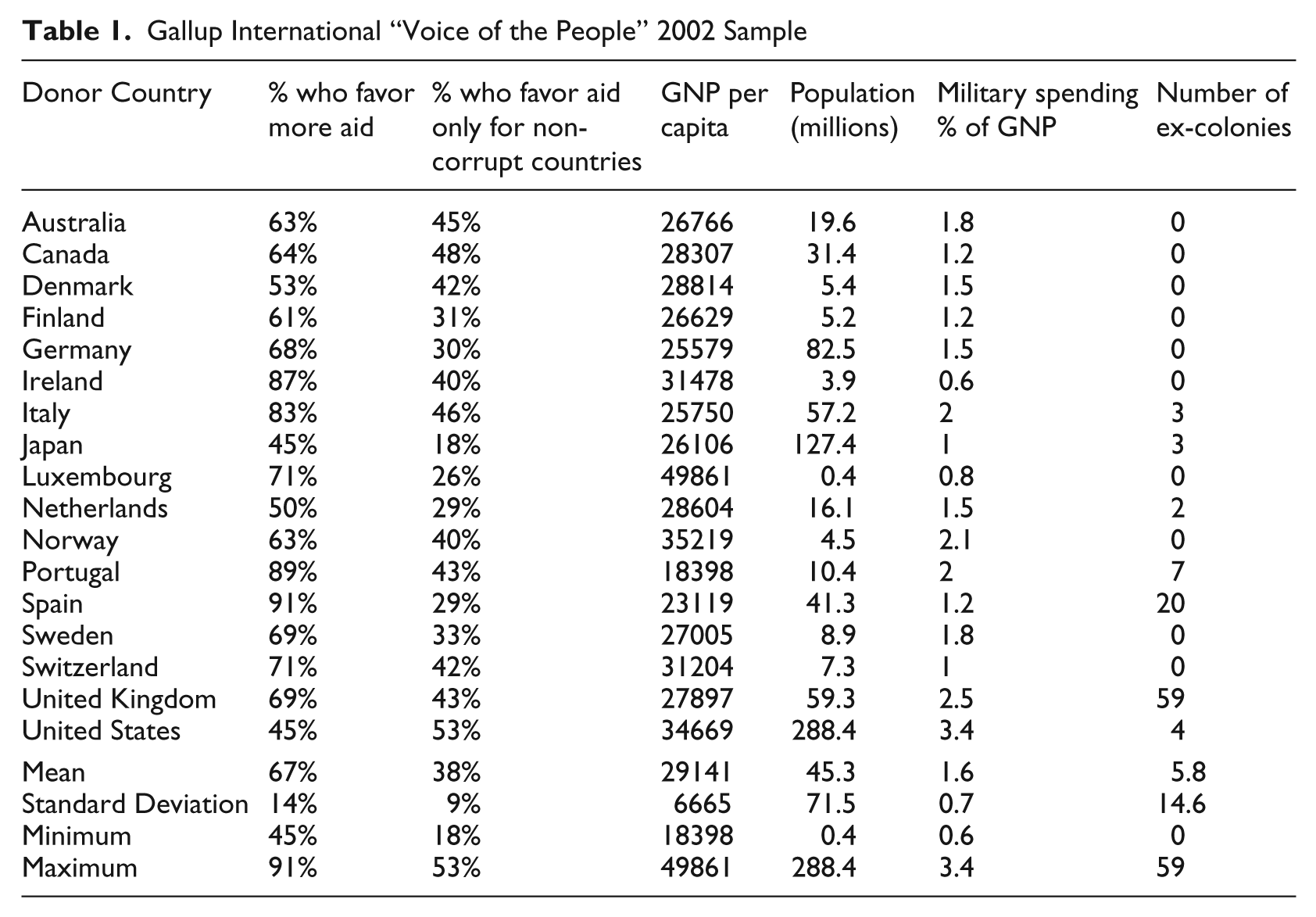
Table 1 lists the country-level variables for the larger 17-nation GI sample, the percentage of survey respondents in each country supporting increased aid, and the percentage of survey respondents who favor aid only to non-corrupt countries. Interestingly, the percentage of respondents who favor aid only to non-corrupt countries is always less than the percentage who favor aid in general, except in the United States. Table 1 also provides level-2 summary statistics for the GI sample. These rows demonstrate considerable variability across countries in all of these variables, including support for foreign aid. Actual aid levels, as a share of national income for each year from 1994 to 2009, are shown in Table 2. We use aid/GNI for 1995 and 2002, respectively, in the WVS and GI analyses; however, values tend not to change very much for most donors over the period.
Gallup International “Voice of the People” 2002 Sample
Aid Levels as a Percentage of National Income, 1994–2009
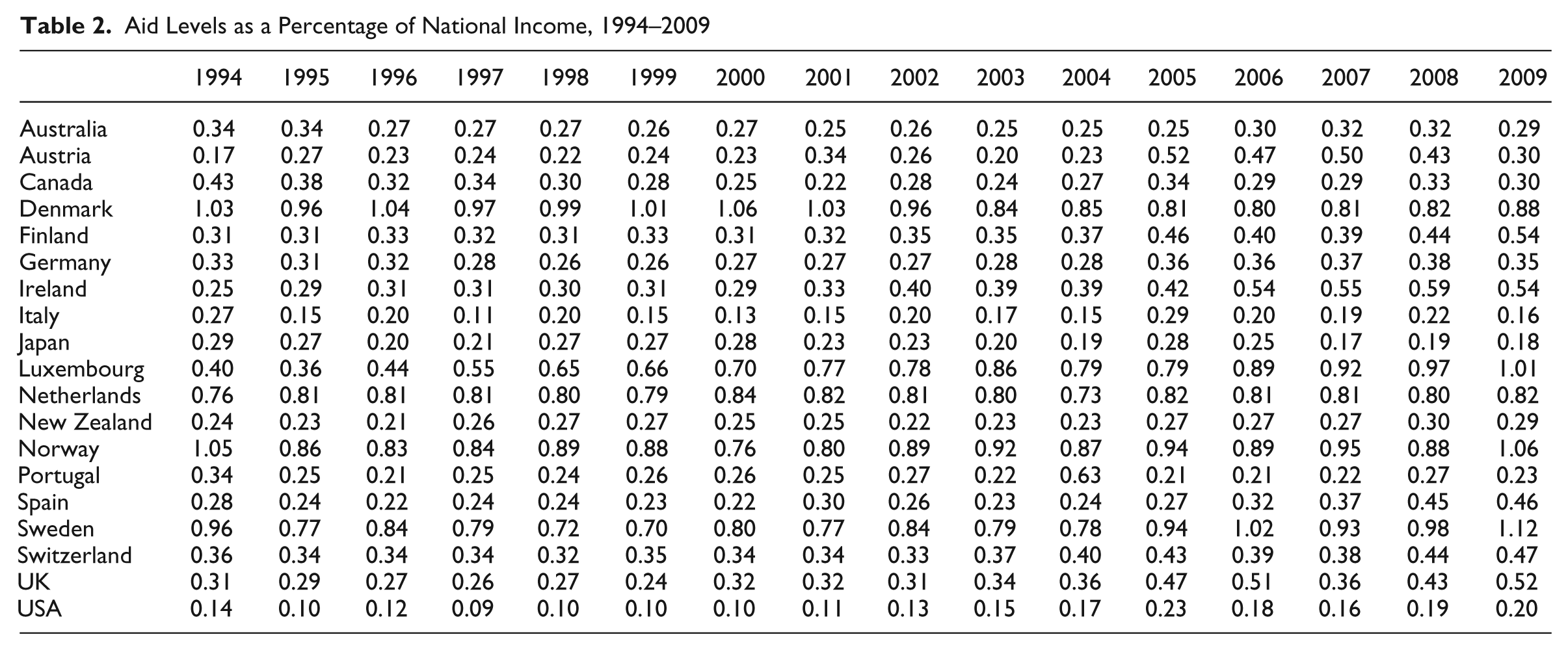
Table 3 provides bivariate correlations among support for aid and the country-level independent variables. Two of the significant correlations in this table show that survey respondents in larger countries tend to be less supportive of increasing aid, even though larger countries already tend to provide less aid, as a share of national income. Larger countries tend to spend a larger percentage of national income on the military, consistent with collective action theories of Olson (1965) and Olson and Zeckhauser (1966). Richer countries tend to provide more aid.
Correlations among country-level variables, Gallup International sample (N = 17)

p<.10, 2-tailed test; **: p<.01, two tailed test
The multi-level model
To test the theories outlined above, we use multi-level models that simultaneously estimate individual- and country-level effects. The data in both surveys are hierarchically organized with individuals nested within countries, and information at both the individual level and the country level is used to determine support for foreign aid. We use the statistical package HLM 6.04 for the analyses (Raudenbush et al., 2001). In the WVS analysis, the full specification of level one of the multi-level model is:
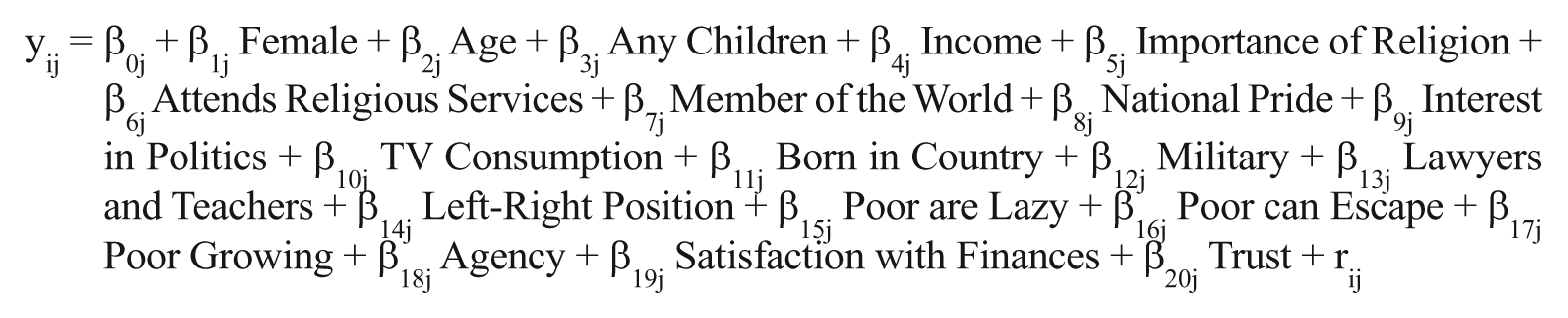
where yij is respondent i in country j’s attitude to foreign aid. Preliminary random-coefficients models (not shown) indicated that female, age, any children, income, member of the world, political interest, TV consumption, born in country, military, lawyers and teachers, and satisfaction with finances did not vary and were therefore fixed. All other coefficients were estimated as random (allowed to vary by country). 12
In the GI analysis, support for foreign aid is a 0/1 variable so we use a Bernoulli distribution with a logit link function for estimation. The full specification of level one of the multi-level model is:

where pij is the probability that respondent i in country j supports giving more foreign aid (Give More Foreign Aid = 1). Preliminary random-coefficients models indicated that employed and political interest did not vary and were therefore fixed. All other coefficients were estimated as random.
In analyses of both surveys, the specification of the first country-level model is:

With only 9 countries in the WVS analysis, the level-two variables are included sequentially. Subsequent level-two models include GDP, Military Spending Population, and Log Colonies in place of ODA. In GI, the same level-two variables are assessed.
In both the WVS analyses and the GI analyses, all non-dummy individual-level independent variables are grand-mean centered, creating a variable with a mean of zero across all the cases. Grand-mean centering holds compositional differences in individual characteristics constant and is appropriate when aggregate versions of the variables are not included in the model. Weights are included to compensate for sampling issues in the GI analyses. HLM 6.04 uses a weighting technique developed for hierarchical data (Pfefferman et al., 1998).
Results and discussion
Calculating the ICC demonstrates that approximately 10 percent of the total variance in support for foreign aid can be attributed to between-country differences (7% in the WVS and 13% in GI). 13 Thus, a non-trivial amount of the variance in support occurs across countries and it is important to explain this variation as well as the variation within countries. Indeed, a simple ANOVA indicates that there is statistically significant country-level variance in support for foreign aid in both analyses. That is, support for foreign aid varies a significant amount across countries.
We begin our discussion of the results with the WVS analyses. Table 4 tests individual-level theories of support for foreign aid. These five models consider only individual-level effects but account for the clustering of individual respondents within countries with a random coefficients regression model (Bryk and Raudenbush, 1992).
World Values Survey Individual-level Models, coefficients and standard errors
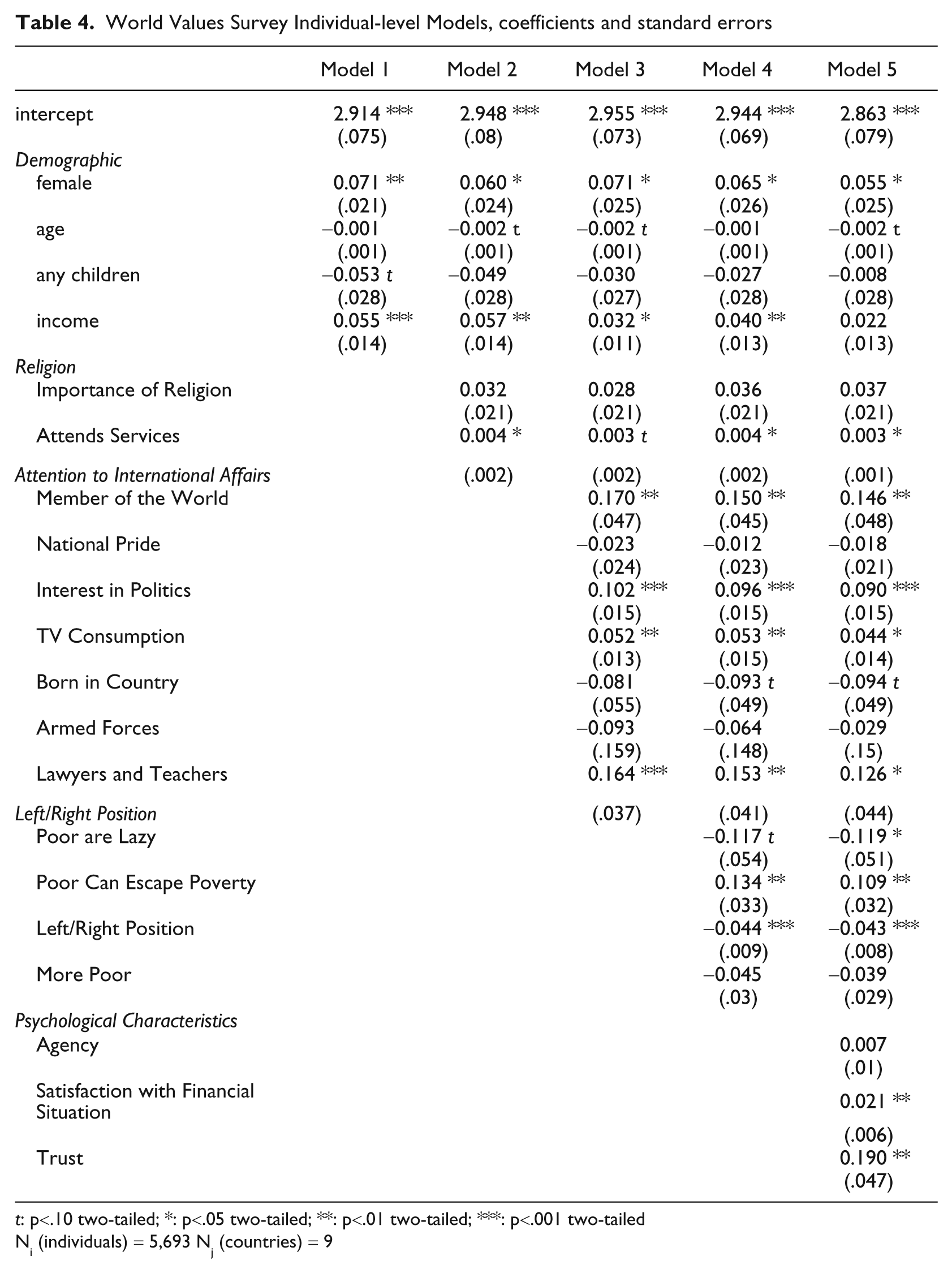
t: p<.10 two-tailed; *: p<.05 two-tailed; **: p<.01 two-tailed; ***: p<.001 two-tailed
Ni (individuals) = 5,693 Nj (countries) = 9
A preliminary look across the models in Table 4 suggests that all four theories of individual differences in support for foreign aid find some support. 14 First, although the Importance of Religion to an individual does not have a significant effect on support for foreign aid, Attending Services does have a positive and significant effect. Using the coefficient from model 2, compared with those who never attend religious services, individuals who attend at least weekly are expected to increase their support for foreign aid by .21, which across the dependent variable’s four response categories is approximately ¼ of a standard deviation. 15
Variables to assess an individual’s attention to events outside his or her own country find mixed support in Table 4. Individuals who respond that they are a Member of the World are significantly more likely to support foreign aid than those who state that they are a member of a town, region, or country. Interest in Politics is coded in four categories from the question, ‘How interested would you say you are in politics?’ and has the largest effect size among this set of variables. An increase in a respondent’s interest in politics from the lowest level (not at all interested) to the highest level (very interested) would increase his or her support for foreign aid by .36, or approximately ½ a standard deviation. Television Consumption has a significant but small effect on support for foreign aid, at least in the range considered in the WVS. Individuals who increase their television watching by an hour per day increase their support for foreign aid by .04. Finally, professional workers including Lawyers and Teachers are more likely to support foreign aid than individuals in other occupations while those who are Born in Country are less likely to support foreign aid than those born outside the country. The other variables intended to measure attention outside to events an individual’s country, National Pride and Armed Forces do not significantly impact attitudes toward aid.
Left/Right Position has a significant effect on support for foreign aid. A one standard deviation change toward the right (approximately two units on the 1 to 10 scale) decreases support for foreign aid by approximately .08. 16 The three other variables assessing left/right position have very similar effect sizes although only Poor Are Lazy and Poor Can Escape Poverty have statistically significant effects. For example, agreement with the statement that others ‘are poor because of laziness and lack of will power’ reduces support for foreign aid by .12.
Of the three psychological characteristics assessed in the final model, Trust has the largest effect size. Individuals who trust support foreign aid more than individuals who do not trust others. The effect size is approximately ¼ of a standard deviation on the dependent variable. Satisfaction with Financial Situation also has a statistically significant effect, but a smaller effect size. It would take movement from the bottom of the scale of satisfaction (1) to the top of the scale (10) to reach an equivalently sized effect. The psychological characteristics we consider are somewhat limited. Other psychological characteristics such as value priorities (Schwartz, 1992) may also matter to support for foreign aid. This is a potentially fruitful area for future research.
Finally, the demographic variables indicate differences in support for foreign aid by gender and age. Women support foreign aid more strongly than men, although the effect size (.06) is small. Increasing age decreases support for foreign aid, but again the effect size is quite small – a ten-year increase in age would only lead to a .02 decrease in support. Income also predicts support in four of five models. Once Satisfaction with Financial Situation and the other psychological characteristics are included in the model, however, the effect size of income is approximately halved and it loses statistical significance. Having children is unrelated to support for aid. 17
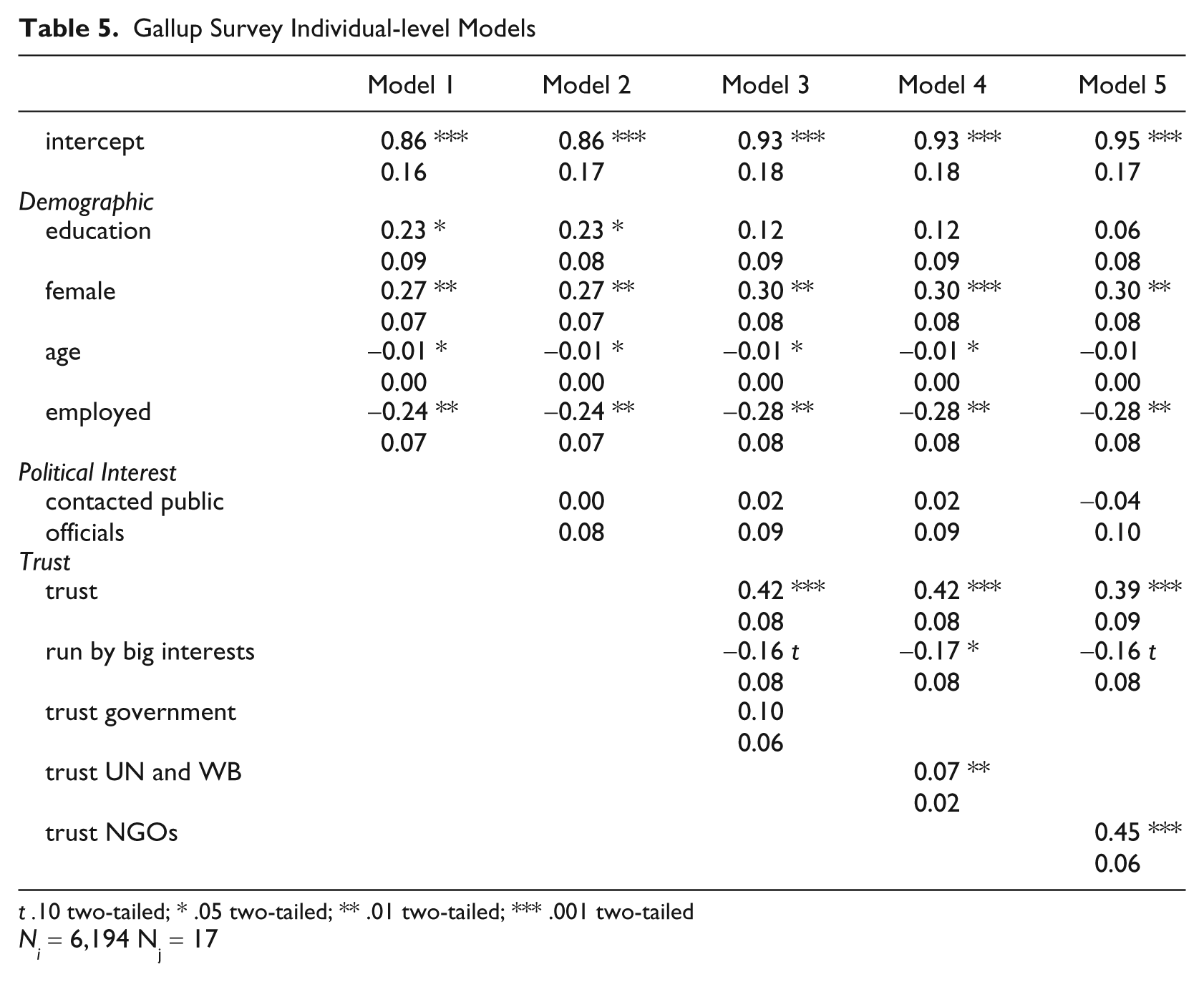
The more limited individual-level Gallup International results are generally consistent with the level-1 findings from the WVS. For example, Table 5 reveals that women are more supportive of wealthier nations giving more financial help to poorer nations. Remembering that the dependent variable in the GI analysis is a dichotomous variable (‘should give more’/‘giving enough’), interpretation of effect sizes requires transformation of the estimated coefficient. For example, in model 5, compared with being a man, being a woman is expected to increase the odds of favoring more aid by 35% ((
Gallup Survey Individual-level Models
t .10 two-tailed; * .05 two-tailed; ** .01 two-tailed; *** .001 two-tailed
Ni = 6,194 Nj = 17
Although the GI survey has fewer individual-level variables in general, it does have an expanded set of questions on trust. As in the WVS analysis, Trust has a positive and significant effect on support for more foreign aid. Declaring trust in others increases the odds of favoring aid by approximately 50%. Models 3–5 show substantial differences in the effect of trusting particular institutions – Government, the United Nations and the World Bank, and NGOs. Trust in one’s own government does not significantly increase an individual’s support for aid. Contrast the lack of effect of trust in one’s own government to the significant, but small, effect of trust in international donor institutions (the UN and World Bank) and the significant and large coefficient for trust in NGOs. Each one-unit increase in expressed trust in international donors leads to a 7% increase in the odds of favoring more aid to poor countries. Each one-unit increase in trust in NGOs, however, leads to a 57% increase in the odds of favoring more aid to poor countries.
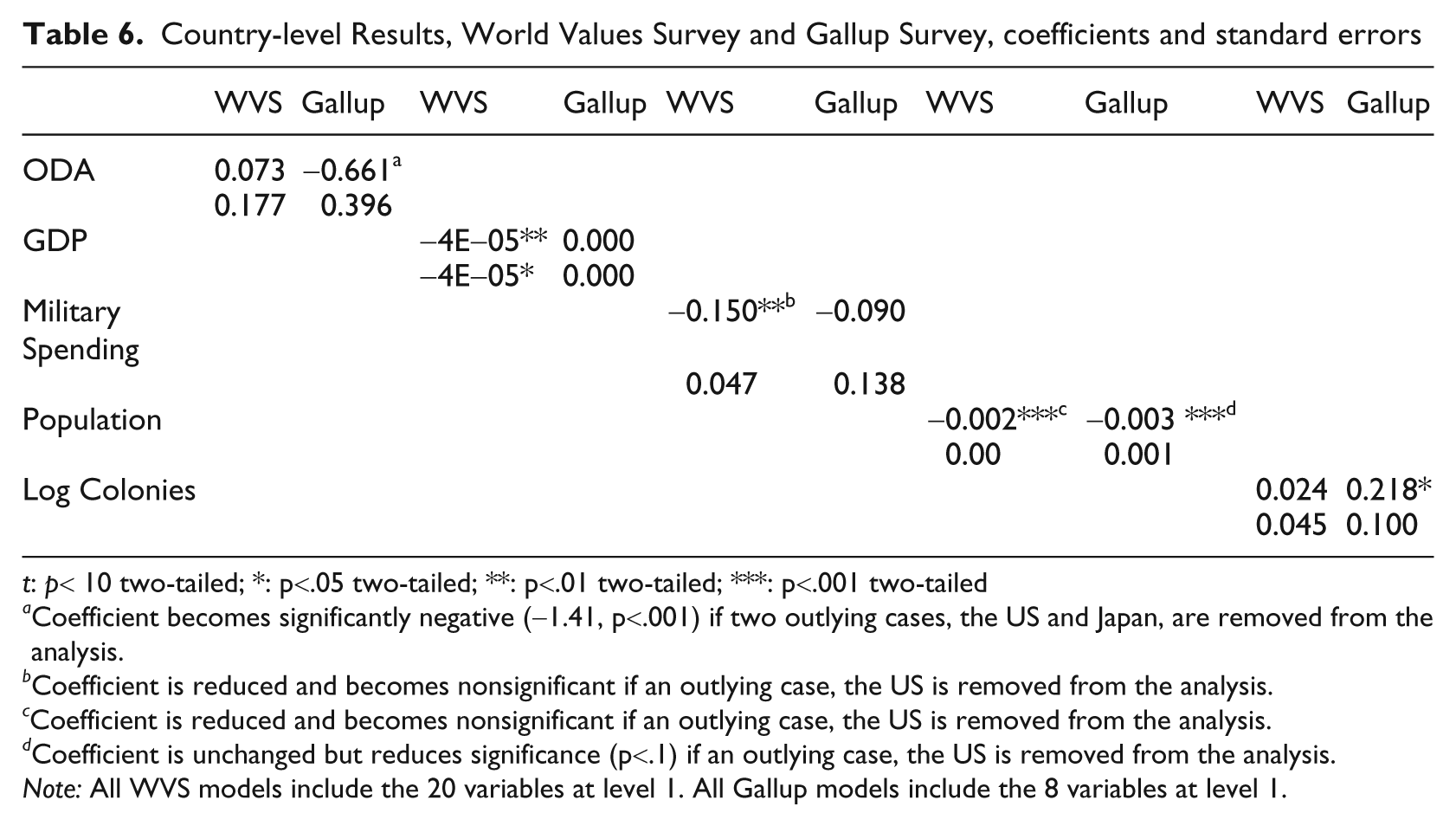
Table 6 introduces country-level effects on support for foreign aid as well as the individual-level effects. Theory suggests that existing levels of aid from donor countries may have differing effects in the WVS and GI analyses, in other words, the ODA coefficients may have opposite signs. The WVS question asks respondents whether they favor provision of economic aid to poor countries, while the GI question asks whether wealthy nations should increase such aid. To the extent that policies reflect public preferences, existing ODA levels should be positively associated with support for aid in the WVS analysis, with causation going mostly from preferences (i.e. support for aid) to policy (i.e. levels of ODA). In the GI analysis, in contrast, high levels of existing aid may reduce support for further increases in it, producing a negative coefficient on ODA. 18
Country-level Results, World Values Survey and Gallup Survey, coefficients and standard errors
t: p< 10 two-tailed; *: p<.05 two-tailed; **: p<.01 two-tailed; ***: p<.001 two-tailed
Coefficient becomes significantly negative (−1.41, p<.001) if two outlying cases, the US and Japan, are removed from the analysis.
Coefficient is reduced and becomes nonsignificant if an outlying case, the US is removed from the analysis.
Coefficient is reduced and becomes nonsignificant if an outlying case, the US is removed from the analysis.
Coefficient is unchanged but reduces significance (p<.1) if an outlying case, the US is removed from the analysis.
Note: All WVS models include the 20 variables at level 1. All Gallup models include the 8 variables at level 1.
Coefficients on ODA in Table 6 are consistent with these arguments. Although they are not significant at conventional levels, the ODA coefficient is positive in the WVS analysis and negative in the GI analysis. In the GI analyses it becomes highly significant if two outlying cases, the USA and Japan, are dropped (new coefficient = −1.41). 19 Interpreting this effect size suggests that if a country were to increase from an average level of foreign aid, about 0.5% of GNP, to 0.75% of GNP, the odds of a citizen’s support for foreign aid would decrease by 30%. So there is some evidence for the hypothesis that citizens in countries with high levels of existing aid express less support for increasing aid than citizens from other countries. 20
Across both surveys, the GDP of a society has a significantly negative effect on support for foreign aid. A US$1000 increase in income per capita is expected to decrease the odds of individuals in that country supporting foreign aid by 4%. A one standard deviation change in income per capita (US$6500 in GI) leads to a 23% decrease in the odds. Interestingly, therefore, in contrast to the generally positive effect of socio-economic status on support for foreign aid at the individual level, in the aggregate, richer countries do not exhibit greater support for foreign aid. Since we are controlling for respondents’ own income levels and psychological sense of financial security, it could be that living in a wealthier country leads them to oppose aid in favor of domestic redistribution.
The results for military spending differ across the WVS and GI analyses. Military spending negatively affects support for foreign aid in the smaller WVS sample, but not in the larger GI sample. Even using the WVS, however, this finding is highly sensitive to inclusion of the United States. The coefficient on Military Spending is substantially reduced and becomes non-significant if the USA is removed from the analysis.
In support of a ‘global awareness’ perspective, citizens in countries with larger populations show reduced support for foreign aid. The WVS and GI samples both show a significant negative effect of population size on support for foreign aid. That is, in countries with larger populations citizens appear less willing to assist disadvantaged people across national boundaries. But the WVS result is again heavily influenced by the United States – the coefficient is approximately halved and loses significance if the USA is removed from the analysis. The GI analyses are also influenced by the USA, but to a lesser extent. There, the coefficient remains largely stable but loses significance, reaching only p <.10.
Finally, we see the more expansive colonial powers exhibit greater support for foreign aid. A 10% increase in number of former colonies is expected to increase the odds of individuals in that country supporting foreign aid by 2%. While this effect may seem small, the implications are substantial for the more active colonizers, namely the UK, France, and Spain. Increasing colonies by 50% is expected to increase the odds of individuals in that country supporting foreign aid by 12%. 21
Overall, we see that both individual-level and contextual-level variables have effects on support for foreign aid. At the individual level, we find some support for a range of variables: demographic factors matter, as do religion, attention to events outside one’s country, left/right position and attitudes toward poverty, and psychological characteristics. At the aggregate level, national aid disbursement impacts public opinion, as do GDP and links to former colonies.
Conclusion
In this paper, we investigated public attitudes toward foreign aid across 19 donor countries. We argued that both individual- and country-level factors contribute to support for foreign aid. Using data from two sources, the World Values Survey, and the Gallup International Voice of the People Survey, we tested a range of potential influences using multi-level models. Using two surveys allowed us to combine their distinct strengths and provide tests of our individual- and national-level hypotheses across disparate samples.
Two previous studies on this topic (Chong and Gradstein, 2008; Milner and Tingley, 2008) have already demonstrated that individual-level factors matter to support for foreign aid. Our paper goes beyond those by testing a larger set of hypotheses related to a respondent’s religiosity, attitudes about poverty, attention to international affairs, and psychology. Models provide support for all proposed factors. For example, in the WVS, individuals who attend religious services, watch TV, believe the poor can escape poverty, and trust others are more likely to support foreign aid. Of note in the GI survey, individual trust in the United Nations and World Bank appears more important to support for foreign aid than trust in one’s own government.
Apart from these individual-level effects, the paper highlights the contextual embeddedness of attitudes about foreign aid. The country-level results suggest that wealth and existing development support matter for individual support of aid. For example, citizens in countries with high levels of existing aid express less support for increasing aid. Citizens from countries with a history of colonization express more support for foreign aid on average. Of course, as in any cross-sectional analysis, readers are urged to use caution in interpreting these results as causal.
In many ways the United States appears exceptional in these analyses. It is also the most important donor to understand, as it has the largest economy but provides a relatively low level of aid as a share of national income. The United States spent about 0.16 percent of gross national income (GNI) on foreign aid in 2007, compared with the average of 0.45% among the 22 DAC members. 22 If US aid as a share of GNI had been equal to that of France – the median value among the other 21 DAC members – total DAC aid in 2007 would have been increased by nearly one-third, from US$103.7 billion to about US$136 billion. Increasing US aid is challenging in the face of low public support. 23 Only 55.5% of American respondents in the WVS favored providing aid to poorer countries. Support in the other 8 donor countries in the WVS ranged from 69.3% (New Zealand) to 88.5% (Japan). Despite its relatively low levels of aid-giving, support for increasing aid, as measured in the GI survey, was also lower in the USA (tied with Japan at 45%) than in any of the 17 donor countries included in that survey. Our results can partially explain low support for aid in the USA, but it remains somewhat of a mystery. 24
The United States is an influential case for some of our level-2 variables; it is responsible for the negative coefficients for military spending and population size in the World Values Survey analysis. Military spending as a share of national income for the USA is about three times as high as for the other DAC donors collectively. Many Americans may view their international policeman’s role as a substitute for development aid. 25 The USA and Japan are easily the most populous donors, and one or the other has ranked first on aid volumes for a number of years, in absolute terms, as opposed to aid as a share of income. It is possible that in assessing how much aid is enough, many respondents in the USA and Japan (and perhaps in other donor countries) simply do not share the premise that a nation’s fair share of contributions for international development increases proportionately with aggregate national income (McDonnell et al., 2003). This conjecture is supported by survey evidence from recipient nations. When asked which country is doing the most to help poor nations develop (or helping in response to national disasters), the USA is overwhelmingly the most frequent response (PEW Research Center, 2010).
The large size of the United States, both in population and in area, may also reduce its citizens’ awareness of events and conditions in less developed countries, and cause a reduced sense of responsibility for the welfare of poor people abroad. Kull and Destler (1999) report that large percentages of Americans prefer to spend money combating poverty ‘at home’ before turning to foreign aid.
Another clue to US exceptionalism in aid giving may lie in the second question asked about aid in the GI survey. The United States reports the highest percentage of respondents who think no aid should be provided to countries with corruption problems. Indeed, the US population is unique among the donor countries in its attention to corruption; it is the only country where a higher percentage of respondents favor a more restrictive policy of giving only to non-corrupt countries. According to the OECD (2006) DAC’s most recent peer review of US aid programs, Americans are relatively cynical over the way aid programs are implemented, and tend to believe aid is used for political objectives with most of it failing to reach the poor (see also Kull and Destler, 1999). Concerns about government corruption, along with stronger traditions of (and tax incentives for) private philanthropy, likely explain Americans’ relatively high levels of private giving to charitable organizations providing non-official aid. 26
Numerous respondent-level attitudes and behaviors measured in the WVS were found to be associated with support for aid. Americans differ significantly from the other donor countries in the survey on several of these variables. However, the net effect of these differences in support for aid among Americans is very small. Only 36% of Americans agree that people can be trusted most of the time, lower than in 7 of the other 8 countries. The USA ranks first in agreement that poor people are lazy and lack willpower; it ranks third in agreement that poor people can escape poverty, and in right-of-center ideology. These variables are all associated with weaker support for providing aid. However, Americans also rank very high on other variables associated with stronger support for aid giving. The USA ranks at the top – by a wide margin – in church attendance, and ranks above the average on political interest and TV watching.
Satisfaction with one’s financial situation in the WVS analysis, and trust in NGOs and international institutions in the GI analysis, are also associated with greater support for aid. The USA ranks in the middle among donor countries on these variables, so they cannot account for Americans’ low support for aid. Did US support for foreign aid change after the events of 9/11/2001? September 2001 is widely perceived to have been a turning point for public attitudes toward foreign affairs. However, support for aid among Americans was low relative to that of citizens of other donors both before 9/11 (in the 1995 WVS survey) and after (in the 2002 GI survey).
The hypotheses addressed in this study were limited by cross-national data availability. Research on these issues would benefit if future cross-national surveys added questions on respondents’ perceptions of their governments’ commitment to foreign aid. These questions could be used to determine whether citizens’ inflated perceptions of foreign aid outlays contribute to a lack of support for foreign aid. Other useful questions could ascertain respondents’ attitudes regarding their country’s ‘fair share’ of aid contributions, and how these attitudes relate to country size and activities that might be viewed as substituted for aid. For example, US respondents who believe military spending contributes to global security and wellbeing might be less favorable toward development aid, other things equal. Also useful would be questions about respondents’ knowledge of specific humanitarian crises around the world, such as the 2004 tsunami in Indonesia.
Additional survey indicators on support for aid would also be useful, making it possible to test the measurement invariance of attitudes to foreign aid across countries. If questions are not interpreted in the same way across all countries, then we might see differences among countries in support for aid simply because questions are interpreted differently, and not because of actual differences (Adcock and Collier, 2001; Billiet, 2003; Steenkamp and Baumgartner, 1998). Assessing measurement invariance across countries requires multiple indicators of the concept of interest, something we do not have in this case (Bollen, 1989). However, a few recent studies provide evidence that individuals in different countries do interpret questions about several other attitudes in the World Values Survey (Paxton, 1999), the ISSP (Davidov, 2009; Cheung and Rensvold, 2000), and other surveys (Netemeyer et al., 1991) in similar ways.
Foreign aid helps recipient countries develop infrastructure, strengthen institutions, and address humanitarian crises while providing an important foreign policy tool for donor nations. Paul Collier has argued that improving the effectiveness of aid requires that donors be more willing to accept risks and hence a higher rate of failure. But, ‘at present, the powerful force of public opinion is driving agencies in precisely the opposite direction. They cannot afford failure … aid agencies are not run by fools; they are full of intelligent people severely constrained by what public opinion permits’ (2007: 184). Where support for aid is shallow and citizens are ill-informed about foreign affairs and development issues, ‘vociferous lobbies’ may influence opinion and distort aid policies. Better understanding of the factors that influence public support for foreign aid can therefore only advance the quality of foreign aid in the future.
Footnotes
Acknowledgements
The authors are grateful to four anonymous referees for helpful comments. Funding for this project was provided by the World Bank’s Knowledge for Change Program.