




Abstract
This article assesses the validity of several alternative hypotheses explaining dual voting across electoral arenas in a decentralized polity. Based on data from three different electoral cycles in Catalonia, I find evidence that the evaluation of the regional candidates of the two main parties has the largest, most consistent impact on vote transfers between levels of government. Results also emphasize, although to a lesser extent, the role played by retrospective voting at the regional level and the impacts that government performance and approval levels regarding national leaders have on the likelihood of casting a dual vote. Altogether, these results not only speak to the dual-voting literature, but also to broader research on the consequences of the de-alignment of the electorate in advanced industrial democracies.
Introduction
The central question in the study of voting behaviour is how people reach their electoral decisions. During the past half century, a variety of analytical models have been employed to examine this question empirically. Despite their differences, most of these models share a common feature: the assumption that vote choices remain stable over time and across contexts, which can be explained by a series of sociological and psychological factors (basically, cleavages and party identification). However, this line of reasoning ignores the possibility of electoral volatility. Although such stability logic has prevailed in the study of voting behaviour, the possibility that electoral conduct changes across arenas or over time cannot be ruled out. Even a cursory glance at the literature in this field reveals the existence of two relevant behaviours (that is, ‘split-ticket voting’ and ‘vote switching’) that would lead electoral decisions to be unstable.
In the past two decades, many established democracies have recorded remarkably high levels of electoral volatility (Mair, 2005). Furthermore, recent findings show that most of this increasing instability at the polls was caused by the rising number of party switchers (Gómez, 2012). In this article, I will use the concepts of party switching and vote switching interchangeably, and will define them as the behaviour of those individuals who actually vote for two different parties in consecutive elections at the same level (Butler and Stokes, 1974; Campbell et al., 1960). An additional type of volatility, not often considered as such, is dual voting (the casting of ballots for different parties in two different types of elections held separately). Hence, switch and dual voting share an important common feature: the fact that the elections concerned do not take place simultaneously. However, dual voting differs from switch voting on the important aspect that the former concept refers to two different offices, arenas, or levels of government, whereas the latter concerns two elections of the exact same type. Similarly, the presence of two different elections is also a key element of the definition of a split-ticket vote.
At least since Campbell and Miller’s seminal article (1957), the concept of a split-ticket vote refers to a ballot in which the citizen chooses candidates or lists from different political parties when multiple offices are being decided by a single election. Although this notion is basically employed in the American politics literature, it is also possible to see this as a type of voting that occurs in other kinds of contexts. 1 The two leading theories explaining this phenomenon are those of the policy-balancing model (Fiorina, 1992) and the ‘accidental’ theory (Jacobson, 1990). The idea behind the former is that citizens split their votes because they are ideologically moderate and want two different parties to be in power at the same time so that the separate branches of government will check each other. In contrast, Jacobson’s ‘unintentional’ theory posits that split-ticket voting is a consequence of the differences in the things that voters expect to obtain from the different offices and the disparities in the qualifications of the candidates that each party is able to recruit for different levels of government.
All these approaches provide some interesting insights for the analysis of dual voting in Catalonia (Spain), which is the object of study here. Specifically, I aim to discover why so many socialist voters in general elections switch to Convergència i Unió (CiU) in the next Catalan election. 2 The reason for dual voting in Catalonia is still an open research topic. Over the years, the spatial voting approach has provided the main theoretical framework to address this question (Padró-Solanet and Colomer, 1992; Riba, 2000). However, valence models of politics have increasingly accumulated confirmatory evidence in the past decade (Liñeira, 2011; Pérez-Nievas and Fraile, 2000) due to rising de-alignment and ideological convergence in the party system (Johns et al., 2009), and the conclusions of this article confirm these recent findings. The importance of four types of valence considerations is assessed: regional incumbent performance, national incumbent performance, evaluation of regional candidates, and evaluation of national candidates. Empirical analyses suggest that dual voting is mainly driven by the quality of the politicians who have run as candidates for regional prime minister. This result has two broad implications: first, that the appeal of the Socialist Party in regional elections is not undermined by any sort of structural factor and, second, that prospective rather than retrospective features are good predictors of dual voting.
The rest of the article proceeds as follows. In the next section, I discuss the key characteristics of regional elections and dual voting in Catalonia. Then I elaborate a series of theoretical propositions that seek to determine which Catalans are more likely to engage in these kinds of vote transfers. I continue with the presentation of the empirical findings. Finally, the fifth section concludes.
Elections in Catalonia and dual voting
The transition to democracy in Spain also brought about an intense process of political and fiscal decentralization that turned Catalonia into one of the seventeen regions or autonomous communities into which the country is divided (Linz, 1985). Some eleven general elections and ten regional elections have taken place in Catalonia since Franco’s death in November 1975. The sub-national party system has been structured along two dimensions (that is, centre–periphery and left–right) throughout the whole democratic period (Soler Llebaria, 1998), and only five political forces have managed to obtain parliamentary representation in all the regional elections conducted to date. These five parties can be divided into two big groups. On the one hand, CiU and Esquerra Republicana de Catalunya (ERC) are considered to be regional parties because their organization and performance are largely confined to Catalonia. By contrast, the Partit dels Socialistes de Catalunya (PSC), the Alianza Popular/Partido Popular (AP/PP), and the Partit Socialista Unificat de Catalunya/Iniciativa per Catalunya Verds (PSUC/ICV) are included in the category of national parties because they either belong to a supra-Catalan political organization present in the rest of Spain (as with the PP) or have established some sort of linkage to a different party with local branches in the whole country (as with the PSC or the PSUC/ICV).
The fact that democratic transition and consolidation in Spain have taken shape around a dual process of the recovery of civil and political freedoms and of economic and legislative decentralization is the first reason for taking Spain and, in particular, Catalonia as objects of study. According to the 1978 Constitution, all autonomous communities elect their own parliaments, and regional governments can implement their own public policies. Moreover, Catalonia represents a suitable case for study because dual voting in this Spanish autonomous community is characterized by its qualitative importance, quantitative significance, and persistent regularity (Pallarés and Font, 1994). In particular, I will focus on the exchange of voters between the Socialist Party and CiU for substantive (that is, involving the two main parties in the region, and the only ones with real chances of winning a Catalan election) and methodological (that is, affecting a non-negligible number of citizens) reasons.
While CiU obtained a clear plurality of votes in the 2010 Catalan elections, the comfortable lead achieved by the Socialist Party (Partit dels Socialistes de Catalunya-Partido Socialista Obrero Español or PSC-PSOE) within this Spanish region in the general elections of two years before contributed decisively to the second victory of José Luis Rodríguez-Zapatero. The huge difference in party vote shares across electoral arenas registered in the most recently completed electoral cycle fits perfectly with the established aggregate pattern of voting behaviour exhibited by Catalans during the 1980s and the first part of the 1990s. Persistent lower turnout rates in regional elections (‘differential abstention’) and remarkable numbers of vote transfers between levels (‘dual voting’) are the two mechanisms that have been traditionally used to explain this discrepancy (Gifreu and Pallarés, 2001; Montero and Font, 1991). In this article, I will examine the determinants of the second of these processes 3 in three different electoral cycles (that is, 1989–92, 1996–99, and 2004–06) 4 using the surveys conducted by the Institute of Political and Social Sciences (Institut de Ciències Polítiques i Socials or ICPS) in Barcelona on representative samples of the Catalan population (1200, 1800, and 2000 citizens, respectively). 5
As I have said above, Catalonia is a good research focus because of the light that this case study may shed on one of the most unexplored recent political changes in advanced industrial democracies: the increasing tendency for split-ticket voting (Dalton et al., 2000). In the few nations where Dalton et al. (2000) are able to track electoral behaviour over time, voters are now more likely to divide their ballots among different parties. Despite mounting evidence pointing to the weakening of partisan ties as the main factor responsible for this pattern, how the growing importance of short-term forces such as approval of candidates or retrospective evaluations can contribute to increasing the levels of electoral volatility is still uncertain. This is the main theme that is addressed in this article by taking into consideration the particular case of dual voting in Catalonia.
The analysis focuses on the 1989–92, 1996–99, and 2004–06 electoral cycles in order to incorporate empirical variability in the sample concerning the parties in office at the regional and the national level and socialist and nationalist candidates. In fact, my main contribution to the literature is a relatively comprehensive multivariate test of several competing accounts of dual voting in three different political scenarios. Hence, I do not intend to explain why a given individual is likely to desert the Socialist Party in a particular regional election, but rather what it is about Catalonia that makes it likely that many socialist voters in general elections will shift their support to CiU in regional elections. Thus, the purpose of this article fundamentally departs from previous studies that have focused on only one electoral cycle.
Despite the continued presence of all five parties mentioned above in the Catalan political landscape, regional voting behaviour has been characterized by a strikingly high inter-bloc volatility since the first democratic elections. In this sense, Figure 1 shows how regular differences in party vote shares can be observed across electoral arenas. More specifically, we see that national parties perform systematically better in general elections than in regional elections, whereas CiU’s and ERC’s vote shares follow the opposite pattern. Finally, voter turnout is always lower in regional elections, probably because there is less at stake (Reif and Schmitt, 1980).
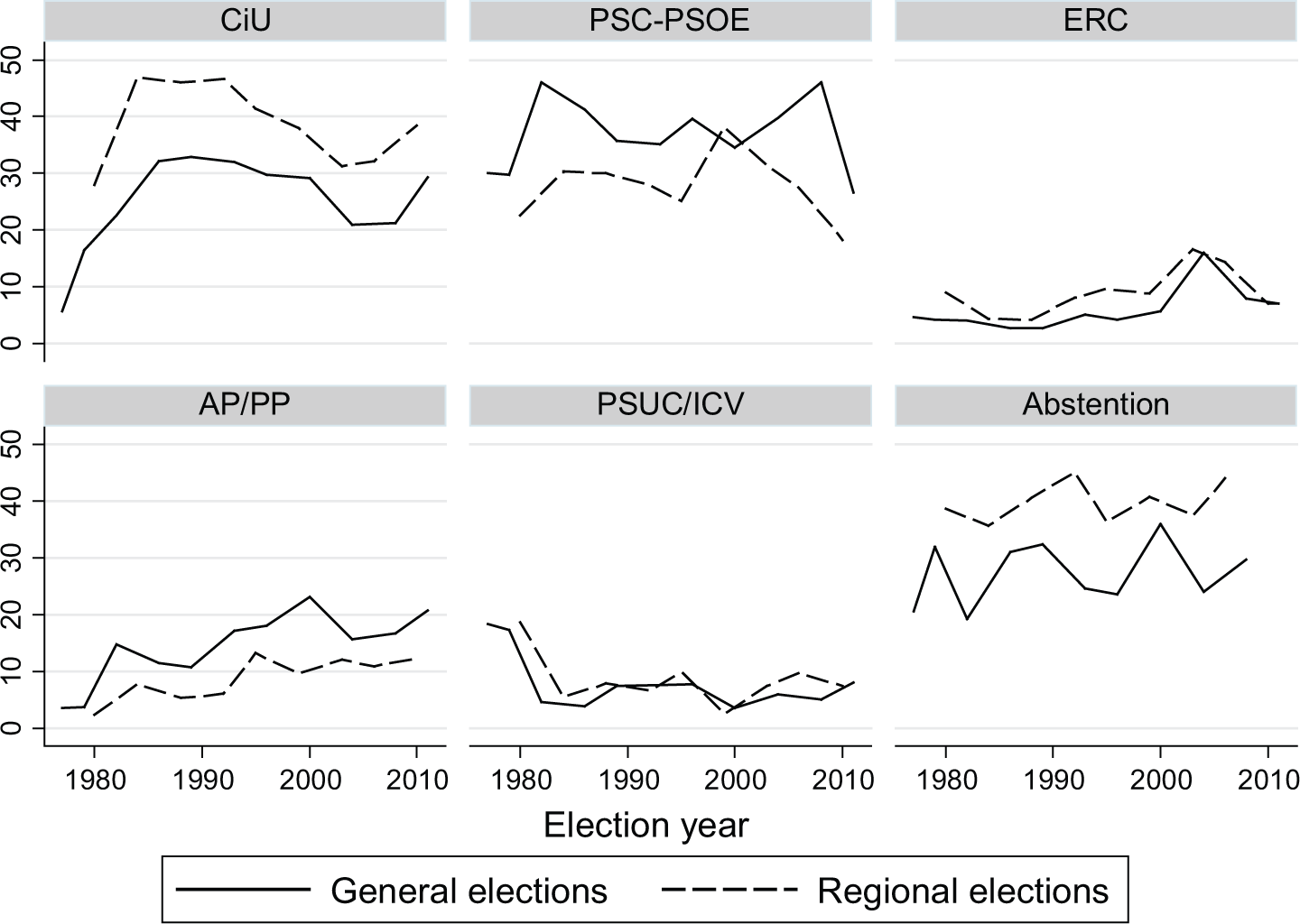
Evolution of Party Vote Shares and Electoral Abstention in General and Regional Elections in Catalonia (1977–2011).
That said, we cannot overlook the considerable variation that the fluctuations of vote shares between elections present within categories. In this sense, the parties mainly affected by these regular differences in electoral support across arenas seem to be CiU and PSC, whereas the AP/PP, on the one hand, and the ERC, on the other, win and lose a smaller number of voters. Partly as a consequence of this, CiU has won every regional election to date (in seats and, with two exceptions, in votes), while the PSC had, until 2011, always obtained the largest number of Catalan votes in general elections (Lago et al., 2007). Finally, the vote shares of the PSUC and its successor, the ICV, remain pretty stable irrespective of the sort of election under consideration.
Thus far, I have talked about dual voting in Catalonia in terms of aggregate election outcomes. However, using this kind of information is not completely satisfactory because it enables us to capture only imperfectly the exact size of the exchange of voters. Moreover, it is not possible to disentangle with such data precisely which vote transfers are taking place. These two main flaws force me to turn to individual data for my analysis. Using surveys conducted by the Spanish Centre of Sociological Research (Centro de Investigaciones Sociológicas or CIS), Table 1 displays vote transfers between general and regional elections in Catalonia from 1982 onwards. 6 Because I am interested in why the PSC loses so many votes in regional elections, the table only shows information about socialist voters in general elections. These preliminary data confirm the pervasiveness of dual voting in the region: on average, about three out of ten respondents that voted for the Socialist Party in general elections preferred a different option in the next regional election. The ratio of defectors is particularly high in the first electoral cycle under scrutiny (that is, 1982–84). Table 1 also identifies CiU as the main beneficiary of these vote transfers: in overall terms, two out of ten former socialist voters shifted their support to this nationalist party in regional elections.
Socialist Voters’ Transfers between General and Regional Elections, Catalonia (1982–2006).
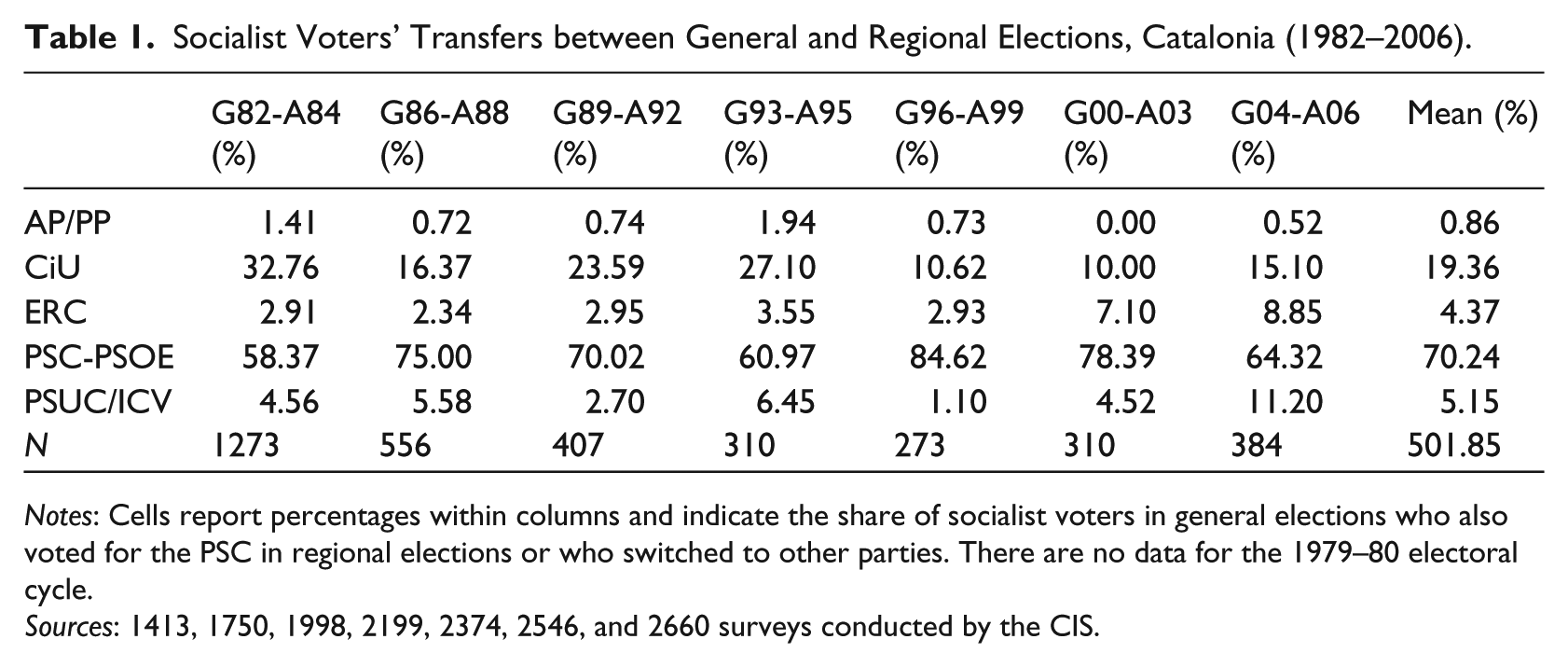
Notes: Cells report percentages within columns and indicate the share of socialist voters in general elections who also voted for the PSC in regional elections or who switched to other parties. There are no data for the 1979–80 electoral cycle.
Sources: 1413, 1750, 1998, 2199, 2374, 2546, and 2660 surveys conducted by the CIS.
Descriptive Statistics.

Sources: 1992, 1999, and 2007 surveys conducted by the ICPS.
Hypotheses
Although dual voting has mainly drawn the attention of students of political behaviour in Catalonia, positive evidence for this type of pattern has also been found in Scotland (Johns et al., 2009; Liñeira, 2011), Wales (Orriols and Richards, 2005; Wyn Jones and Scully, 2006), Canada (Wolinetz and Carty, 2006), and Belgium (De Winter, 2006). Taking into consideration the insights provided by this literature, the reasons for dual voting in Catalonia are analysed here through the assessment of four hypotheses. Specifically, the causal mechanisms that I intend to explore are the following: regional accountability, approval of regional candidates, national accountability, and approval of national candidates.
First of all, the regional accountability hypothesis is grounded on Key’s work (1966) and suggests that elections are lost by the incumbent rather than won by the opposition. In other words, voters only pay attention to the outcomes generated by the policies pursued by the party (or parties) in office during the previous term, and decide whether to keep the incumbent or throw him out depending on the hypothetical achievement of the end-of-period threshold of welfare at election time. Hence, the opposition plays no active role in this type of model and, as Ferejohn (1986: 14) points out, its importance lies simply in its availability as a replacement government.
The retrospective voting framework has been used in the past to explain dual voting in Catalonia. In this sense, Pérez-Nievas and Fraile (2000) show that PSC–CiU dual voters’ and loyal CiU voters’ evaluations of the performance of Jordi Pujol as the regional incumbent in 1992 were almost identical. Hence, the work of these two scholars seems to imply that a considerable share of socialist voters in general elections appreciated the achievements of the nationalist leader as Catalan prime minister and switched their vote in regional elections accordingly. Liñeira (2011), on the other hand, does not find any significant effect of the evaluation of the tripartite Catalan government on the likelihood of casting a dual vote in 2006. Bearing in mind these contradictory results, I put forward the following hypothesis: Hypothesis H1: The more favourable the evaluation of the Catalan government, the higher the likelihood of voting for the regional incumbent in Catalan elections and, hence, the higher the likelihood of dual voting if the respondent did not vote for the party concerned in the previous general election.
In other words, voters for the PSOE in the general elections during the 1980s and the 1990s reward CiU in regional elections for what they perceive as a good government performance. By contrast, socialist voters in the 2004 general elections are less likely to punish the PSC and, hence, less likely to engage in dual voting in the next regional election as their retrospective evaluations of the performance of the Catalan government improve.
In recent times, two of the traditionally most relevant predictors of party choice, social class and party identification, seem to have lost explanatory power (Curtice and Holmberg, 2005; Franklin et al., 1992). Candidates’ valence, by contrast, gives the impression of having gained importance in recent years, in spite of the growing cynicism of voters towards politicians (Norris, 1999; Pharr and Putnam, 2000). According to Bosch and Rico (2003), the process of the personalization of politics by which leaders have become increasingly decisive in election outcomes may be identified at four different levels: institutions (Barberá, 2010; Carey and Shugart, 1995; McAllister, 2007), political communication (Butler and Ranney, 1992; Mughan, 2000; Swanson and Mancini, 1996), the electorate (Dalton, 1996), and political parties (Scarrow et al., 2000). Although these assertions lead to the expectation that the quality of candidates fundamentally shapes voters’ behaviour, the importance of the process of personalization still needs to be empirically tested. On the one hand, the idea that the evaluation of candidates affects party choice receives weak support in the six democracies (that is, the United Kingdom, Germany, the Netherlands, Denmark, Norway, and Sweden) examined by Curtice and Holmberg (2005). On the other, Rico (2009) demonstrates the important effect of political leaders in Spanish elections. In fact, Catalans who evaluated the Catalan prime minister very positively in 1999 voted for the regional incumbent even when evaluating his economic policies negatively (Riba and Díaz, 2002). Finally, Liñeira (2011) demonstrates that key valence variables, such as the evaluation of CiU’s and PSC’s regional candidates, have strong and significant effects on dual voting in Catalonia.
To sum up, and despite some negative findings, I argue that evaluations of regional candidates have an impact on the likelihood of casting a dual vote. In fact, the proximity (comparatively speaking) between leaders and electorate characteristic of regional elections and the relative youth of the Catalan party system may help to boost this effect. Hence, holding other variables constant, I posit the following: Hypothesis H2a: The more favourable the evaluation of the regional candidate for the party the respondent voted for in the last general election, the lower the likelihood of withdrawing his or her support in the regional elections and, hence, the lower the likelihood of dual voting.
Likewise: Hypothesis H2b: The more favourable the evaluation of the regional candidate for a party the respondent did not vote for in the last general election, the higher the likelihood of supporting that party in the regional elections and, hence, the higher the likelihood of dual voting.
The prevailing interpretation of European parliamentary elections as second-order elections has yielded relevant insights into the way sub-national elections can be understood as manifestations of national political processes (Reif and Schmitt, 1980). More specifically, we can develop two main expectations with regard to party choice on the basis of its premises (Van der Eijk et al., 1996). First of all, large parties will do worse and smaller parties will do better in sub-national elections. Second, parties of national government will suffer losses in such arenas. Yet, a major problem with the original formulation of Reif and Schmitt’s model can arise from the existence of at least two large parties in a given polity such as Catalonia and the difficulty of saying which of them will lose more votes.
Closely related to the second-order elections framework, scholars have coined the term ‘coattail effects’ to refer to the reciprocal influence of political processes across levels. The existence of coattail, contagion, contamination, or interaction effects has been documented in studies with very different research questions. I will focus here on the list of works that show that individuals take into account their evaluations of national-level phenomena when voting in sub-national elections (Ames, 1999; Johns et al., 2009; Rae Atkeson and Partin, 1995). In the Spanish context, Aguilar and Sánchez-Cuenca (2007) and León-Alfonso (2007) find considerable evidence of contamination across levels. In other words, voters reward (or punish) national incumbents in regional elections when their performance is good (or bad). Focusing on Catalonia, Queralt (2012) shows that the electoral performance of regional incumbents primarily depends on retrospective evaluations of the Spanish government. Based on this previous research, the new working hypothesis proceeds as follows: Hypothesis H3: The more favourable the evaluation of the Spanish government, the higher the likelihood of voting for the national incumbent in Catalan elections and, hence, the higher the likelihood of dual voting if the respondent did not vote for the current government in the last general election.
As in the case of the evaluation of the regional incumbent, I will distinguish between cycles with conservative governments and cycles with socialist governments. In this sense, the more favourable the evaluation of the incumbent socialists at the national level in 1992 and 2006, the lower the likelihood of voting CiU in the regional elections and, hence, the lower the likelihood of casting a PSC–CiU dual vote if the respondent voted for the Socialist Party in the last general election. By contrast, the more favourable the evaluation of the conservative incumbent at the national level in 1999, the higher the likelihood of voting CiU in the regional elections and, hence, the higher the likelihood of casting a PSC–CiU dual vote if the respondent voted for the Socialist Party in the last general election. The existence of this second contamination effect is far from obvious because CiU supported Aznar’s government throughout the whole legislative period even though that party was never allocated a single portfolio in the PP’s cabinet.
Similarly, I argue that candidates at the national level can also produce two types of coattail effects. On the one hand, citizens are less prone to shift their support when they like the national-level candidate of the party they voted for in the last general election. For this reason, I believe the following: Hypothesis H4a: The more favourable the evaluation of the national candidate for the party the respondent voted for in the last general election, the lower the likelihood of that respondent withdrawing his or her support in the regional elections and, hence, the lower the likelihood of dual voting.
On the other hand, citizens have incentives to change their behaviour when they come to approve the candidate at the national level of a party they did not vote for in the previous general election. Hence, I argue the following: Hypothesis H4b: The more favourable the evaluation of the national candidate of a party the respondent did not vote for in the last general election, the higher the likelihood of supporting such a party’s candidate in the regional elections and, hence, the higher the likelihood of dual voting.
In addition to the factors of theoretical interest, I have included two individual-level control variables (namely, national identification and ideology) identified in the literature as relevant to the process of party choice in Catalonia. First of all, citizens’ degree of identification with Catalonia or Spain (or both) has been extensively studied from a descriptive perspective (Martínez-Herrera, 2002; Montero and Torcal, 1990) or with electoral purposes (Argelaguet, 2006; Pérez-Nievas and Bonet, 2006). In this context, Linz (1985) argues that individuals’ identification with the nation is the best predictor of Spaniards’ attitudes towards nationalism. Catalonia was one of the autonomous communities with the highest proportion of citizens who identified at the same time with Spain and the region in the late 1980s (Montero and Torcal, 1990). This fact leads me to think that national identity can explain dual voting. Moreover, vote transfers across electoral arenas seem to have increased over time because some communities (such as Catalonia) have engaged in a process of nation-building that augments the number of people identified with those communities without provoking a decline in the number that consider themselves Spanish (Martínez-Herrera, 2002).
Second, ideology can affect voters’ dual behaviour for causes similar to those relating to national identification (Torcal and Medina, 2002; Van der Eijk et al., 2005). Prospective models mainly argue that citizens vote out of ideological closeness to parties or candidates (Downs, 1957). However, the analysis of the role of ideology in multilevel democracies is more complicated because there is often more than one dimension of political competition in terms of which the proximity to parties and candidates can be assessed. In fact, some scholars attribute the success of non-national parties in regional elections to the greater relevance acquired by a second nationalist dimension in determining the votes of the electorate (Molas, 1992; Padró-Solanet and Colomer, 1992). By contrast, other researchers have shown that the impact of national identities on party choice has the same importance in general and regional elections (Riba, 2000) or can even play a weaker role in the latter than in the former (Pallarés and Font, 1994; Pérez-Nievas and Fraile, 2000). Finally, Balcells i Ventura (2007) provides the most recent spatial account of voting behaviour in Catalonia to date by applying a model of policy balancing (Kedar, 2005) to the elections in this region. The findings of this academic also point to a need to control for the ideology of citizens in my models. In fact, her results perfectly fit the logic of dual voting: supporters of non-national parties in regional elections often compensate for national policies they do not like by defecting from parties whose positions resemble their own.
All things considered, explanations of why dual voting takes place can be hardly confined to only one factor. This is why I have to test the validity of several competing hypotheses. 7
Empirical analysis
In order to assess the actual factors that drive dual voting, I will make use of a two-step research strategy. First, I will compare the profile of dual voters with that of loyal socialist supporters. Then, second, I will estimate a couple of multivariate logistic regressions for each electoral cycle: the first models comprise only the controls, whereas the second models incorporate the rest of the variables of interest. The dependent variable will take a value of 1 if the respondent recalls voting PSC-PSOE and CiU in general and regional elections, respectively, and 0 if he or she recalls voting for the Socialist Party in both elections. Hence, the sample will only include socialist voters in general elections.
Although the ICPS datasets are particularly appropriate because the questionnaires include an extensive list of questions about approval of candidates and retrospective evaluations of government performance that are usually missing in other surveys, they are obviously far from perfect. First of all, they lack a (true) panel structure. In other words, rather than asking the same citizens at two different points in time for their vote preferences, respondents are asked about their voting behaviour only once (that is, after the second (always regional) election takes place). Second, they lack important items, such as measures of the ideological scores of the parties or of individuals’ nationalist identification or left–right placement using the usual 1–10 scales. The absence of party-position scores is particularly troublesome because it means we cannot match voter preferences with the parties’ or candidates’ positions and, hence, examine the distances between them. Finally, ‘subjective social class’ in 1989–92 and the evaluation of CiU’s candidate for Spanish prime minister in 1996–99 (that is, Joaquim Molins) are not available either, so we cannot test the effects of these covariates for this cycle.
The bivariate analysis displayed in Table 3 gives us some interesting clues about dual voting. First of all, vote transfers may be partly explained by national identity and left–right self-placement: those who voted for the PSC-PSOE in both elections show a more leftist and Spanish profile than that of dual voters, in two out of the three electoral cycles. Second, loyal PSC-PSOE voters had worse evaluations of incumbents at both levels of government only in 1999 (p < 0.05). Finally, good evaluations of socialist candidates and bad evaluations of nationalist candidates in general and regional elections were more common among those who voted for the PSC-PSOE on both occasions. However, some of these correlations may be spurious, so I will turn now to multivariate methodology in order to deal with this.
Profiles of Loyal Socialist Voters and PSC–CiU Dual Voters (1989–2006).

Notes: Loyal socialist voters are those citizens that voted PSC-PSOE in both elections, whereas PSC–CiU dual voters switch parties across arenas. Cells show percentages except where otherwise indicated. *** p < 0.01; ** p < 0.05; * p < 0.1.
Sources: 1992, 1999, and 2007 surveys conducted by the ICPS.
In general, the results reported in Table 4 comport with my theoretical expectations, although some of the hypotheses do not bear out. For example, the variable tracking the effect of retrospective evaluations of the regional incumbent displays evidence of a statistically significant effect only in the first electoral cycle: socialist voters in the 1989 general elections were more likely to switch to CiU in regional elections as their assessment of the task developed by Jordi Pujol’s government became better. By contrast, this effect faded away in 1999 and 2006: positive evaluations of the parties in office on these two other occasions were expected to increase CiU’s and PSC’s vote shares in regional elections, respectively, but they do not seem to have discernibly affected citizens’ behaviour. So, the likelihood of casting a dual vote is not always determined by a reward-and-punishment mechanism at the regional level. 8 An alternative explanation for these negative findings could be that voters did not see CiU and PSC as fully responsible for their performance as regional incumbents because those parties lead a minority and a coalition government, respectively (Powell and Whitten, 1993). Further research would be required to determine whether the lack of a majority of seats in the Catalan parliament attenuates the attribution of responsibility to the main government party in both these cases.
Determinants of PSC–CiU Dual Voting (1989–2006).

Notes: The dependent variable takes a value of 1 if the respondent voted PSC-PSOE in the general elections and CiU in the regional elections (dual voter) and 0 if he or she voted for the Socialist Party in both elections (loyal PSC-PSOE voter). Unstandardized logistic coefficients with standard errors are shown in parentheses. *** p < 0.01; ** p < 0.05; * p < 0.1.
Sources: 1992, 1999, and 2007 surveys conducted by the ICPS.
Changes in the evaluation of regional candidates display a substantively important and consistent effect over time on the likelihood of casting a dual vote, irrespective of the party analysed. More specifically, holding all else constant, improving the approval of CiU’s regional candidate can massively drive socialist voters in general elections to switch to the nationalist party in regional elections. In the same vein, a negative change in the evaluation of the socialist regional candidate increases the likelihood of former socialist supporters casting a dual vote by making them less prone to keep voting for the PSC in regional elections. These results hold for the three electoral cycles analysed in this article. Hence, the findings show that CiU benefits from the positive evaluation of its candidates not only by its own loyal voters, but also by citizens who have previously voted for the Socialist Party.
Evidence is at best mixed with regard to contamination effects. On the one hand, better evaluations of the performance of the national incumbent do not lead to changes in the likelihood of casting a dual vote. Hence, it seems that Catalan voters are capable of correctly attributing responsibilities across levels of government, and do not reward or punish Catalan parties for their good or bad performance at the national level. A priori, a socialist voter in general elections who either thinks the performance of the Spanish socialist incumbent in 1992 or 2006 is bad or likes the achievements of the conservative government at the national level in 1999 should be more likely to switch to CiU in regional elections. But evidence of this proposed effect is particularly weak.
In turn, approval of national candidates displays a discernible effect in some of the specifications reported in Table 4. For example, socialist voters in the 1996 general elections who were pleased with the former Spanish prime minister, Felipe González, were more likely to keep voting for the PSC in the 1999 regional elections and, hence, less prone to casting a dual vote. Similarly, socialist voters in the 2004 general elections who were satisfied with the nationalist leader who ran for Spanish prime minister (that is, Josep Antoni Duran i Lleida) were more likely to stop voting for the PSC in the 2006 regional elections and, hence, more prone to casting a dual vote. These are the only two statistically significant effects (at traditional confidence levels) of evaluations of leaders running for national office on the likelihood of casting a dual vote. As I have said before, I was not able to test the impact of the approval of CiU’s candidate for national office in 1996 (that is, Joaquim Molins) because this item was not included in the survey. Therefore, it is hard to make direct comparisons between this electoral cycle and the other two, and findings regarding the positive effect of the evaluation of the socialist candidate at the national level (that is, Felipe González) can only be tentative.
Interestingly, most of the controls do not have a perceptible impact on the dependent variable. As reported in Table 4, having Catalan origins (as measured by the birthplace of the respondents and their parents) increases the likelihood of casting a dual vote in 1999, but not in 1992 or in 2006. Somewhat to my surprise, identification with Catalonia is not a particularly good predictor of dual voting either. Only in the model with control variables for the first electoral cycle analysed, do nationalist feelings influence the likelihood of switching between the PSC-PSOE and CiU in national and regional elections. In contrast, knowledge of Catalan increases the likelihood of dual voting between 1989 and 1992 and between 1996 and 1999.
I also observe trivial differences between ideological categories in two out the six specified models. Relatively right-wing socialist voters in general elections were more prone to choose, as expected, CiU in the 1999 and 2006 regional elections. But this small effect does not lend any definitive support to the impact of ideology on the likelihood of casting a dual vote. One suggested reason for this partial relevance is that only after the years in which CiU supported the PP’s government in Madrid did ideological divisions between the latter and the PSC-PSOE become meaningful. Ideological voting requires the perceiving of differences between at least two alternatives, and the results seem to suggest that socialist voters in general elections did not distinguish between the PSC-PSOE and CiU on these grounds before 1996. By contrast, former socialist voters appear to see CiU as a clearly more conservative option after the Aznar period.
A supplementary explanation would be that far-left socialist voters in general elections were less likely to participate in Catalan contests during the cycles in which ideology does not show a significant effect on dual voting (Riba, 2000). The reasoning in this case would be that a voter located on the left side of the political spectrum with a predominantly Spanish national identification would vote for the PSC-PSOE in general elections, but would not turn out in regional elections since he or she perceives a wide distance between himself or herself and all the regional parties, including the PSC (Padró-Solanet and Colomer, 1992). The story would then suggest that the PP’s governments at the national level led socialist voters to discount this hypothetical failure in the supply side of the political market, making them more likely to participate in regional elections and, hence, contributing to the enhancement of the impact of ideology on dual voting. Unfortunately, the lack of enough differential abstainers in the sample precludes the study of the causes of this particular phenomenon.
Finally, there have been many different attempts at characterizing the subjective evaluations of incumbent performance as endogenous (Maravall and Przeworski, 2001; Marsh and Tilley, 2009; Van der Eijk et al., 2007). In this sense, it has been suggested that individuals’ left–right positions link actual objective results to people’s assessments of governments’ outcomes. Likewise, citizens’ evaluations of candidates are also expected to be coloured by partisan affinities (Rico, 2009). Accordingly, voters’ appraisal of political leaders is driven by an underlying preference for a political party. Unfortunately, lack of panel data does not allow me to minimize the risk of endogeneity in determining the influence of ideology on dual voting. However, I would like to point out the possibility that ideology falls below the level of achieving statistical significance because of problems of endogeneity.
An alternative potential explanation for the lack of significant results with regard to some independent variables is the rather small number of observations available to be employed in the empirical analysis. Logistic regression relies on asymptotic assumptions. For this reason, the risk of making type-II errors is quite high when the sample is so small, and all the results concerning non-significant coefficients should be considered tentative. 9
The magnitude of the effect of an independent variable in a logistic model cannot be evaluated through the size of the coefficient shown in the regression table. Thus, it is necessary to illustrate graphically the changes in the predicted probability of casting a dual vote when the explanatory factor goes from its minimum to its maximum values. To this end, Figure 2 plots the effect of the evaluation of the CiU’s and PSC-PSOE’s candidates at the regional and the national levels on the dependent variable in the last electoral cycle. The first graph shows that the predicted probability of casting a dual vote in 2006 dramatically increases as the evaluations of the CiU’s candidate for Catalan prime minister, Artur Mas, improve among former socialist voters. This effect is not only highly statistically significant, but it is also large in substantive terms (with a change in the predicted probability of about 80 percent).

Approval of Socialist and Nationalist Candidates and PSC–CiU Dual Voting (2004–06).
As expected, the effect in the upper right-hand graph of Figure 2 is exactly the opposite, and there is a huge harmful impact of negative evaluations of the PSC’s regional candidate, José Montilla, on the electoral prospects of this party in 2006 among those citizens who voted for the Socialist Party two years before. In fact, the predicted probability of dual voting decreases from 0.85 to 0.00 as the evaluation of Montilla goes from its minimum to its maximum value. Hence, the dependent variable is slightly more sensitive in the case of the evaluation of the socialist candidate. Finally, given that the predicted slopes of probability in the lower two graphs of Figure 2 are almost flat, I conclude that the evaluations of national candidates have no impact or, at best, a weak impact on citizens’ likelihood of casting a dual vote. Thus, neither very good evaluations of Duran i Lleida nor very bad evaluations of Rodríguez-Zapatero significantly induce 2004’s socialist voters to defect from the PSC and vote CiU in the regional election.
Conclusions
One of the most striking features of the Catalan political system is the existence of important differences in party vote shares across electoral arenas. The parties mostly affected by this high electoral volatility are the PSC-PSOE and CiU. Scholars have traditionally held vote transfers between elections (‘dual voting’), and the difficulties of national parties to mobilize their supporters in regional elections (‘differential abstention’), responsible for these remarkable swings in support. Despite the quantitative and qualitative relevance of the former process, we have possessed little systematic knowledge about the motivations that dual voters have to defect from the Socialist Party in regional elections. While some scholars had begun to explore the possible role played by valence considerations such as assessments of incumbents’ performance or evaluations of candidates in a given election, we still lacked evidence regarding the importance of these factors across different electoral cycles. In this article, I have addressed this question by adopting a longitudinal perspective that examines three different electoral cycles that embodied three different political scenarios.
As I noted when commenting on the results of my empirical models, PSC–CiU dual voting is fostered when evaluations of the nationalist leaders at the regional level improve, when the assessments of the socialist candidates for Catalan prime minister worsen, and, to a lesser extent, by good retrospective assessments of Jordi Pujol as the regional incumbent, and also by the appraisal of the merits and demerits of Duran i Lleida and González as national candidates, respectively. Thus, the empirical results suggest that national identity and ideology exert less independent influence over vote choice than do candidate assessments. One implication of these findings is that valence rather than position politics is most responsible for dual voting in a decentralized democracy. Another implication is that Catalan citizens behave as bankers instead of peasants (Mackuen et al., 1992), and prospective considerations are more important than retrospective motivations when casting their vote. Finally, one might infer from the empirical results of the study that as a country becomes more politically and fiscally decentralized, first-order factors have less impact on a regional electorate. However, the argument is not that voters are completely unaware of national issues. Rather, there is a very powerful explanatory variable in the evaluation of regional candidates that mitigates the importance of other (national) features, and whose relevance is systematic across electoral cycles. By focusing on three diverse electoral cycles, and drawing supportive evidence for this factor from all of them, we can be more confident in predicting that evaluations of regional candidates will play a role in other instances.
These findings do not only add to our knowledge about the electoral effects of popular candidates, but also carry implications for our understanding of voter behaviour in a multilevel polity. The strong electoral benefits of the evaluations of regional leaders that we find are consistent with prospective theories of voting which predict that citizens will reward parties for selecting good candidates. However, given the emphasis on vote transfers that go back and forth, I also expect that electoral rewards for popular candidates should be very short-lived, and certainly not affect behaviour beyond one particular arena. The almost complete absence of electoral returns for well-valued candidates at the national level that I document seems perfectly to fit this prediction as well. Moreover, the Catalan case is not so different that it cannot be useful in illuminating dual voting elsewhere. Catalans’ high levels of dual voting over time reflect a series of electoral choices that citizens have made during the past 30 years. If Catalonia had a different form of autonomy, if the electoral systems were exactly the same across arenas, if there was not a centre–periphery cleavage, or if Catalonia had more intensively organized mass parties, then it is possible that national and regional votes might be more closely connected to each other. We simply do not know and, hence, comparison with regions in other federations and multilevel systems of governance would be useful.
Regarding the normative repercussions for democratic accountability in the case of decentralized countries, my findings may be interpreted as either good or bad news. On the one hand, positive reactions to the presence of popular candidates on the regional ballot may be seen as a manifestation of an open-minded electorate and an autonomous political system. On the other hand, the importance of this particular valence variable illustrates a possibly troublesome disconnection between electoral arenas, and a further stage in the process of unfreezing of party systems.
Despite the broad applicability of the findings, I would also like to note some of their limitations. First of all, my study only considers evidence from one Spanish autonomous community. This leaves open the question of whether the impact of the evaluation of regional candidates on dual voting in other regions or countries is as important as it seems to be in Catalonia. I hope that future research will shed light on this issue. Another fruitful avenue for upcoming work would be to focus on the next electoral cycle, and examine whether the evaluation of the national incumbent was so irrelevant amid rampant economic crisis and growing political discontent. 10 Lastly, while the exact identification of the causal effects I find remain beyond the scope of this article, I acknowledge that part of the impact of the evaluation of regional candidates is endogenous to citizens’ political attitudes. Future research should address how ideological allegiances and partisan affinities moderate the importance of politicians’ valence for dual voting in the context of a decentralized democracy.