



Abstract
Why do some countries tolerate dual citizenship while others do not? The answer concerns the interaction between regime type variation and international migration. Democracies with a relatively large migrant stock are more likely to tolerate dual citizenship than democracies with a low migrant stock. Meanwhile, democracies with relatively high emigration rates for the highly educated population are more likely to tolerate dual citizenship than democracies with low emigration rates of the highly educated. In authoritarian states, the opposite is the case: emigration of the highly educated and immigration both reduce the likelihood of dual citizenship toleration. These claims are supported by the evidence from a large n examination of contemporary cross-national data. Understanding dual citizenship helps us address larger questions about the significance of democracy and the nature and scope of nation states.
Introduction
Why do some countries tolerate dual citizenship while others do not? This question has implications for the study of important political phenomena. First, dual citizenship raises questions for our understanding of the relationship between voice, exit, and loyalty (Hirschman, 1970). Emigrants have left their country of origin, 1 but dual citizenship allows them to retain legal ties to that country and to potentially participate in its politics. Dual citizenship can facilitate voice after exit. Second, dual citizenship does not fit well with the traditional conception of the nation state (Howard, 2005; Spiro, 2012). In that view, different states’ spheres of sovereignty are mutually exclusive. Dual citizenship complicates that picture, as it enables individuals to have rights and obligations in multiple states.
In addition to helping us understand important concepts, dual citizenship is an issue with increasing practical relevance. An increasing number of countries tolerate dual citizenship (Brøndsted Sejersen, 2008; Howard, 2009), while in 1960 about 66% of the world’s countries deprived their nationals who naturalize elsewhere of their original citizenship. By 2013, this percentage declined to about 31% (Vink et al., 2013). This trend has magnified challenges and opportunities (e.g. managing external voting) for governments. Technological progress has facilitated involvement in the politics and economies of two countries by reducing the cost of communication across borders (Brinkerhoff, 2009).
I argue that dual citizenship toleration is driven by an interaction between regime type variation and international migration, both in terms of immigration and emigration. Among democracies, those with a relatively large migrant stock (e.g. the percentage of the population that is foreign born) are more likely to tolerate dual citizenship than those with a relatively small migrant stock. Having relatively high rates of emigration (people moving out of the country in question) for the highly educated also increases the likelihood of dual citizenship toleration in democracies. In authoritarian states we observe the opposite patterns.
The article’s econometrics section uses data from 2000 and 2011 from about 160 countries to examine the determinants of cross-national variation in dual citizenship toleration. This article is one of the first in the literature (notable exceptions include Dahlin and Hironaka (2008) and Rhodes and Harutyunyan (2010)) to provide such large n analysis. 2 In terms of immigration, this article examines cross-national variation in migrant stock, rather than migrant inflows. In terms of emigration, it focuses on the emigration rates of the highly educated population. 3 The next section of the article addresses conceptual issues.
Conceptualizing dual citizenship toleration
Dual citizenship may be acquired by birth, marriage, adoption, or naturalization (Blatter et al., 2009). States may regulate acquisition and loss of citizenship via citizenship and nationality laws, or by constitutional provisions or administrative decrees (Vink and de Groot, 2010).
The mechanisms through which countries regulate dual citizenship include the following. First, a country may withdraw citizenship from its nationals who naturalize elsewhere (i.e. emigrants). Second, a country might make naturalization (i.e. of immigrants) conditional on giving up one’s original citizenship (Vink et al., 2013). The former rule is likely more relevant to migrant sending countries, while the latter rule is likely more relevant to migrant receiving countries. However, both forms of dual citizenship toleration may be pertinent in countries of residence and in countries of origin for the following reasons. First, requiring renunciation of citizenship upon naturalization elsewhere may not only affect emigrants from the country in question. It may also affect spouses and children of immigrants into the country in question. If the spouse and children are native-born destination country citizens, such a rule could deter them from also acquiring the country of origin citizenship of their immigrant spouse or parent. Castles and Davidson (2000) identify binational marriage as a mechanism that leads to an increase in dual citizenship. Second, dual citizenship toleration may matter not only for its practical consequences, but also as a litmus test. Constituents’ perceptions of political actors may be partly defined by the choices of those political actors regarding dual citizenship toleration. As Bauböck (2003) argues, dual citizenship toleration may be an issue with symbolic value for immigrants. Third, different countries may adopt a similar approach across various dimensions of dual citizenship toleration; for example, if they do not withdraw the citizenship of their nationals who naturalize abroad, they also do not require immigrants naturalizing at home to give up their country of origin citizenship.
Dual citizenship is sometimes de facto tolerated even though the underlying legislation may be open to different interpretations (Blatter et al., 2009). Hence, I use the term dual citizenship toleration, rather than the alternative term dual citizenship recognition.
Situating the argument in the literature
This article provides arguments and evidence that modify or challenge several arguments prominent in the literature on dual citizenship. The article also has broader implications for the study of international migration, and of the impact of regime type variation. In this section, I outline the following perspectives: the citizenship identity approach; previous work linking regime type and dual citizenship; the convergence arguments (i.e. the claim that sending countries are converging toward dual citizenship toleration partly in pursuit of remittances, and the argument that receiving countries are converging toward dual citizenship in order to protect the rights of their immigrant populations); and applications of demographic pressures, globalization, and modernization arguments to dual citizenship toleration. I formulate these alternative arguments as hypotheses I evaluate in my model.
Dahlin and Hironaka (2008) posit that citizenship identity shapes dual citizenship toleration. I assess the following Dahlin and Hironaka (2008) hypotheses as alternative arguments: former colonies are more likely to tolerate dual citizenship than countries that are not former colonies (partly due to some citizens in the former colony retaining ties with the former colonial power), and increases in postnationalism (measured as the extent of a country’s membership in international organizations and international non-governmental organizations) increase the likelihood of dual citizenship toleration. Dahlin and Hironaka (2008) further argue that postcolonial states face the task of developing a new national identity, which affects their citizenship policy choices. 4
Colonial legacies and shifting borders may have different implications for dual citizenship toleration cross-regionally. Partly due to past decisions by colonial powers, there are a number of countries where the majority of the population is Arab (the Arab League has 22 members). Shared identity ties between those countries may provide an impetus for dual citizenship toleration. Meanwhile, a notable recent re-drawing of borders followed the collapse of three communist federations in Eastern Europe, USSR, Yugoslavia, and Czechoslovakia (Milanovic, 1994).
The impact of regime type on dual citizenship toleration is an unresolved debate in the literature. Dahlin and Hironaka (2008) contend that democracy is not an important determinant of dual citizenship choices. Rhodes and Harutyunyan (2010) argue that political contestation increases the likelihood of dual citizenship toleration, in order to extend citizenship to emigrants. Regime type findings likely have been inconsistent because we should not think of the regime type effect as being directly connected to dual citizenship toleration, but rather as a part of an interaction effect with international migration. In this article, I show that regime type has a systematic effect on dual citizenship toleration in interaction with both immigration and emigration. The article also provides a general theoretical explanation of the interplay between international immigration and dual citizenship in both democracies and in authoritarian states. The literature lacks a systematic account explaining why emigration or immigration reduces the likelihood of dual citizenship toleration in autocracies.
Scholars have explored links between international migration and dual citizenship toleration. Castles and Davidson (2000) and Soysal (1994) (among others) view dual citizenship toleration as partly a response to immigration. Other scholars, including Itzigsohn (2000), argue that dual citizenship toleration is a means for countries of origin to facilitate remittances. Freeman and Ögelman (1998) contend that sending countries are converging toward reaching out to their emigrant populations, including adopting a more permissive approach regarding dual citizenship. One remittances hypothesis is that countries that receive an extensive amount of remittances are more likely to tolerate dual citizenship than countries that do not receive extensive remittances.
I argue below that the claim that having a larger migrant stock leads to more dual citizenship toleration tends to be correct only for democracies; in authoritarian states the pattern tends to be the opposite. In terms of emigration, democracies are more likely to tolerate dual citizenship as a response to emigration of the highly educated, but in authoritarian states the pattern is the opposite. I also contend that politics, rather than remittances, drives dual citizenship toleration. While there is a global trend toward more dual citizenship toleration, I argue against the view that either sending or receiving countries are uniformly converging toward extending the rights of their emigrant or immigrant populations, respectively, by tolerating dual citizenship. Rather, these dynamics are sharply conditioned by regime type.
In terms of empirical testing, to the best of my knowledge, none of the econometric studies of dual citizenship toleration include interaction effects between regime type and either immigration or emigration. Examining the impact of a specific subgroup of emigrants (the highly educated) on dual citizenship toleration in a large n study is a novel approach as well. 5
Demographic pressures may lead small countries to tolerate dual citizenship in order to increase the size of their polity. Small countries may be open to international links (Katzenstein, 1985) because autarchy is not a plausible strategy for them. A demographic pressures hypothesis might be as follows: countries with small populations are more likely to tolerate dual citizenship than countries with large populations.
The claim that globalization is weakening states (Friedman, 1999) might imply that international economic integration undermines citizenship based on a national foundation. Furthermore, countries that integrate economically (e.g. via international trade) may be more likely to integrate internationally in other ways, such as by tolerating dual citizenship. A globalization hypothesis might be as follows: countries with high levels of trade integration are more likely to tolerate dual citizenship than countries with low levels of trade integration.
Modernization theory (Rostow, 1960) links economic development and political change. A modernization theory hypothesis might be as follows: countries with high levels of economic development are more likely to tolerate dual citizenship than less economically developed countries.
This article has important implications for the study of the consequences of regime type variation—the question of whether democracy matters—as well as for the study of international migration. This article contributes to the debate over the extent to which there are systematic differences in policy choices between democracies and authoritarian states (Boix, 2001; Mulligan, Gil and Sala-i-Martin, 2004)—regarding dual citizenship toleration, democracy matters—and there are stark differences in policy choices between democracies and authoritarian states. Explaining the link between migration and (a lack of) dual citizenship toleration in authoritarian states helps us understand understudied questions regarding immigration and diaspora politics in authoritarian states.
Regime type, international migration, and dual citizenship
Immigration and dual citizenship
An important dual citizenship toleration issue for immigrants is whether they can retain their original citizenship upon naturalization. Immigrants may push for their country of residence to tolerate dual citizenship. For example, individual migrants and migrant organizations participated in the push for Sweden to tolerate dual citizenship (Gustafson, 2005). I argue that regime type shapes the ways in which countries of residence respond to the preferences of their immigrant population.
Democracies are relatively responsive to the demands of their immigrant populations (Freeman, 1996; Mirilovic, 2010). In democracies, an independent judiciary tends to protect free speech and assembly rights for citizens and non-citizens. Courts and constitutions usually ban discrimination based on ethnicity or religion. Political parties have electoral incentives to address concerns of naturalized voters. Hence, the likelihood of dual citizenship toleration is relatively high in democracies with a high migrant stock.
Politics of immigration are systematically different in authoritarian states (Bruenig, Cao and Luedtke, 2011; Mirilovic, 2010). In authoritarian states, immigrants tend to enjoy fewer rights than in democracies. Constitutional rights and an independent judiciary are less likely to be present. Specific policies restrictive of migrant rights adopted by rich authoritarian states with a large per capita migrant stock, such as the Gulf Cooperation Council (GCC) states, 6 include mass expulsions of migrants, restrictions on marriage between nationals and non-nationals, and restrictions on migrants’ movements. For example, Saudi Arabia expelled up to one million Yemenis in the early 1990s (Kapiszewski, 2001). Saudi Arabia, Qatar, and Kuwait have banned or discouraged marriage between nationals and non-nationals (Kapiszewski, 2001). GCC countries have engaged in practices such as taking migrant workers’ passports upon arrival (Crystal, 1990; Longva, 1997). Finally, GCC countries have reduced the recruitment of workers from other majority Arab countries, perceived to be more likely to become politically active while in the GCC. Arab workers accounted for 75% of the expat population in the GCC in 1975 and for 31% of that population in 1995 (Kapiszewski, 2001: 62).
By contrast, in democracies, policies that are perceived to restrict migrant rights can be invalidated by courts. Examples include California’s Proposition 187 and provisions of the Second Pasqua Law in France (Adams et al., 2000; Hollifield, 2004).
The discussion above does not imply that democracies adopt permissive immigrant admissions policies. In fact, it is difficult to move to many contemporary rich democracies as a legal, permanent immigrant. Overall, per capita migrant stocks are significantly lower in rich democracies than in rich authoritarian states (Mirilovic, 2010). However, while rich democracies tend to restrict immigrant admissions, they do tend to grant migrant populations who are already present in their country more rights than authoritarian states do.
Authoritarian states tend not to grant dual citizenship rights to their migrant populations for two reasons. First, as argued above, immigrants are better positioned to push for dual citizenship toleration in a democracy than in an authoritarian state. Mechanisms through which migrants push for dual citizenship toleration in democracies (e.g. free speech and assembly) are largely closed to them in authoritarian states.
Second, many contemporary rich authoritarian states, such as GCC countries, do not seek to naturalize and fully integrate their migrant populations. Rather, they seek to maintain guest worker programs: a rotation system through which they bring in foreign workers, but later require them to leave. Guest worker program rules allow GCC countries to deny migrant workers access to the extensive social welfare programs that GCC nationals benefit from (e.g. free education) (Crystal, 1990; Longva, 1997). Naturalization undermines guest worker program rules, as naturalized persons have the right to stay in the country permanently.
A lack of dual citizenship toleration may act as a layer in the structure of obstacles that discourage migrant worker naturalization (e.g. restrictions on marriages between nationals and foreigners) in rich authoritarian countries. The practical impact of this mechanism is likely decreased by low migrant naturalization rates in authoritarian countries. However, as argued above, dual citizenship may have symbolic as well as a practical relevance, and might serve as a signaling mechanism. Finally, rich authoritarian countries may regard dual citizenship as an unacceptable loss of sovereignty.
The relationship between immigration and regime type presents an extreme interaction effect captured by the hypotheses below.
Emigration, diasporas, and dual citizenship
Having a large population of highly educated emigrants increases the likelihood of dual citizenship toleration in democracies and decreases that likelihood in authoritarian states. This is the case primarily because of the political implications of dual citizenship toleration in the dealings of a national government with its diaspora.
Dual citizenship toleration may strengthen a country of origin’s ties with its diaspora. Some diasporans become naturalized citizens of their country of residence. Dual citizenship toleration by the country of origin may allow them to keep their country of origin citizenship. Examples of diasporans that have pushed for their country of origin to tolerate dual citizenship include emigrants from the Dominican Republic, Colombia, Ecuador, and Finland (Newland, 2010).
Allowing diasporans to keep their country of origin citizenship may increase their involvement in the country of origin politics for three reasons. First, country of origin citizenship makes it easier for diasporans to visit the country of origin (e.g. by eliminating visa requirements). Second, country of origin citizenship facilitates financial investment by diasporans into the country of origin, partly by removing legal obstacles on property ownership. For example, in some countries foreign nationals are barred from owning agricultural land (Barrionuevo, 2011). Third, country of origin citizenship is likely a prerequisite for holding political office in the country of origin.
There is empirical evidence that indicates that dual citizenship toleration may strengthen diasporans’ ties to their country of origin. For example, survey evidence (of migrants based in Germany and Spain) shows that dual citizenship toleration in the country of origin increases the likelihood that migrants will state that they intend to return to their country of origin (Leblang, 2011).
Dual citizenship toleration increases the likelihood that diasporans will be involved in the country of origin’s politics. For democracies, this is a positive effect that governments will generally seek to encourage. For authoritarian states, this is a negative effect that governments will generally seek to discourage.
Dual citizenship toleration leads to political benefits for democracies for three reasons. First, returned diasporans sometimes assume leadership roles in the country of origin. For example, migrant candidates (previously US-based) have been elected to political office in the Mexican state of Zacatecas, as well as in the Mexican federal legislature (Williams, 2012: 65).
Second, dual citizenship toleration can facilitate external voting (i.e. voting in country of origin elections that take place in the country of residence). Collyer (2013) cites data indicating that 115 countries allow some form of external voting. Democracies may view external voting as an opportunity to extend political participation. Multiparty competition may encourage dual citizenship toleration for partisan reasons, with political parties seeking to mobilize diasporans as a source of votes and contributions. Whitaker (2011) argues that such dynamics help explain dual citizenship toleration in Africa.
Third, diasporans can lobby in the country of residence on behalf of the country of origin. For example, lobbying efforts by Indian-American groups helped facilitate the US–India Nuclear Deal (Kirk, 2008).
These political benefits of dual citizenship toleration can be magnified in three ways: first, when emigrants’ numbers are relatively large; second, when emigrants tend to be highly educated; and third, when emigrants move to democracies. The size of the emigrant population conditions its importance: there is influence in numbers. Meanwhile, education tends to increase diasporans’ resources and involvement in destination country politics. Studies of political transnationalism among the US-based immigrant or immigrant origin populations find that education tends to increase their involvement in country of origin politics (Guarnizo, Portes and Haller, 2003; Soehl and Waldinger, 2012).
Regime type in the country of residence matters because emigrants based in democracies are more likely to acquire political skills which they can later apply while in positions of political leadership in the country of origin. Furthermore, emigrants based in democracies are likely better positioned to lobby for stronger bilateral ties between the country of origin and the country of residence than emigrants based in authoritarian states. Newland (2010) argues that in representative systems diasporans can take part in the electoral process, while in authoritarian countries their influence may take the form of personal contacts or economic pressure.
In authoritarian states, the interplay of emigration and dual citizenship toleration likely has different political implications for the following reasons. First, emigrants from autocracies are, all else being equal, less likely to be sympathetic toward the country of origin government than emigrants from democracies. Some departed for political reasons: a pursuit of more political rights and/or because of a conflict with the authoritarian elite and their supporters. By contrast, emigration from democracies is more likely to be motivated by more purely economic concerns. Because the relationship between authoritarian governments and their émigrés is often contentious, authoritarian elites tend to lack an incentive to encourage the involvement of émigrés in country of origin politics. Consequently, authoritarian states may respond to emigration by resisting dual citizenship toleration. Democracies may be interested in encouraging diasporans to return and assume positions of political leadership; authoritarian states are likely to be interested in discouraging them from doing so.
Examples of diasporans and exiles being perceived as a political threat by authoritarian leaders are plentiful. For example, Joseph Stalin’s regime assassinated Leon Trotsky while the latter was based in Mexico. There are also prominent examples of diasporans leading or actively participating in successful efforts to overthrow authoritarian regimes. For example, Sun Yat-sen, a former exile, returned to China and became a leader in the uprising that overthrew the Qing Dynasty. Meanwhile, Iraqi diasporans, such as Ahmed Chalabi, played a prominent role in the US-led intervention to overthrow Saddam Hussein (Diamond, 2004).
Another example of an authoritarian state seeking to control and police political activity by its diasporans is Morocco’s approach toward Moroccans based in Europe. An important purpose of organizations established by the Moroccan state, such as amicales (friendship associations), has been to control and collect information on politically active Moroccans based in France, especially university student groups and leftist and labor unionist groups. Moroccan security services have infiltrated and monitored university student groups based abroad (Brand, 2006).
Second, as argued above, émigrés from autocracies are likely to be less willing and/or effective lobbyists in the country of residence for stronger bilateral ties with the country of origin than émigrés who left democracies.
Third, the relationship between dual citizenship and external voting has sharply different implications for democracies and for authoritarian states. Democracies may tolerate dual citizenship in order to encourage external voting. Autocracies may not hold elections at all. If they do hold elections, those elections are, as a matter of definition, of less consequence than elections in democracies. Hence, the incentive to extend political participation through dual citizenship and external voting that may exist in democracies is weaker or non-existent in authoritarian states.
The political downsides to autocracies from involvement of émigrés in their domestic politics are magnified when the émigrés in question are relatively numerous, highly educated, and based in a democracy. Highly educated emigrants based in a democracy may be perceived as a political threat by authoritarian elites because they are more likely to become involved in country of origin politics and because they may acquire pro-democratic views in their country of residence. They may seek to export those views by promoting democratization in their country of origin (Shain, 1999), presenting a political threat to the authoritarian elite.
In the economic realm, the incentives for the authoritarian elites may be different, as some authoritarian states, such as China, have been very successful in attracting investment from their diaspora (Katzenstein, 2005).
Emigration of unskilled and semiskilled workers has different political and economic implications for the country of origin than emigration of the highly educated. As argued above, the highly educated are more likely to have a political impact. However, there is evidence that skilled workers have a lower propensity to remit earnings to their country of origin than unskilled workers (Faini, 2007). Other scholars also find that remittances and other forms of emigrant transnationalism are based on different rationales (Soehl and Waldinger, 2010).
In terms of relations with the diaspora, authoritarian states may weigh political downsides against economic benefits when choosing whether to tolerate dual citizenship. Economic development matters, but political power and survival are likely of primary importance. I address this question empirically as an alternative argument: if dual citizenship toleration is primarily driven by economic factors such as obtaining foreign currency, remittances and not the emigration rate of the highly educated (who are less likely to remit) will be the key explanatory factor.
We should expect a stark interaction effect in the relationship between regime type, dual citizenship toleration, and the emigration rate of the highly educated.
Data and testing
Indicators and variables
The article analyzes two dual citizenship toleration measures. Vink et al. (2013) global dual citizenship database includes a dual citizenship toleration indicator that measures procedures applied to citizens who voluntarily acquire citizenship in another country. The indicator allows us to distinguish countries that withdraw their citizenship upon naturalization elsewhere (i.e. low level of dual citizenship toleration) from countries that do not impose such requirements (i.e. high level of dual citizenship toleration). 7 The dataset further distinguishes between two types of countries in the latter group: those that do and those that do not allow for renunciation of the original citizenship. I treat this indicator as a dummy variable, coded 0 if naturalization elsewhere leads to an automatic loss of country of origin citizenship, and 1 if naturalization elsewhere does not lead to an automatic loss of country of origin citizenship. Vink et al. (2013) constructed the dataset by examining relevant legal provisions (e.g. citizenship laws) cross-nationally covering 1960–2013.
The other dual citizenship toleration indicator is based on United States Office of Personnel Management Investigative Services (USOPMIS) data (2001). USOPMIS codes countries that tolerate dual citizenship 1, while countries that do not tolerate it are coded 0. According to USOPMIS, countries that do not recognize dual citizenship have governments that: “do not recognize a person’s prerogative to the rights, privileges, or immunities that may be the prerogatives of citizens of the other nation.” USOPMIS coded dual citizenship partly based on information obtained by contacting officials representing the country in question (e.g. embassies). The year covered by USOPMIS data is 2000.
USOPMIS data is likely characterized by some degree of measurement error, due partly to ambiguities, described above, in how some countries regulate dual citizenship. Including USOPMIS data in the analysis, however, has the following advantages. First, it allows for testing using two different dependent variable measures. If the key results are roughly consistent across both measures, this increases our confidence that the results are robust. Second, previous large n dual citizenship toleration research (Dahlin and Hironaka, 2008; Rhodes and Harutyunyan, 2010), uses dependent variable indicators based on USOPMIS data. Third, unlike the Vink et al. (2013) data which may, in its focus on the rules regarding naturalization of citizens abroad, be particularly relevant in countries of emigration, USOPMIS data may do more to capture dual citizenship toleration regarding naturalization requirements in destination countries. The lack of a systematic distinction between different types of dual citizenship toleration in USOPMIS data is, however, also a limitation that may make measurement less precise.
The choice of the time period studied is guided by two concerns: data availability and assessing recent data. The statistical analysis examines data from 2000 (the period analyzed by previous large n studies and the only data point covered by USOPMIS), and in 2011 (to examine contemporary patterns). 8 Comparing and contrasting the results using 2000 and 2011 data provides an additional robustness test. 9 Logit models are used since both dependent variable indicators are dummy variables.
The regime type measure (authoritarian), constructed by Cheibub et al. (2010), categorizes a country as a democracy if its executive and legislature are elected in contested elections, and if there is alternation in power. Authoritarian states are coded 1; democracies are coded 0. 10
The emigration indicator is the emigration rate of a country’s tertiary educated population. The indicator is based on emigrant stock aged 25 or older, with at least one year of tertiary (i.e. college) education, who reside in an Organization for Economic Cooperation and Development (OECD) country, divided by the total country of origin tertiary educated population aged 25 or older.
Focusing on emigration to OECD countries has three advantages. 11 First, emigration of the highly educated to the OECD is a good proxy for overall (i.e. global) emigration patterns of the highly educated. Docquier et al. (2009: 303) estimate that OECD countries are the destination for about 90% of world’s highly educated emigrants. Second, OECD data tends to be reliable, while emigration statistics produced by countries of origin are rare and often unreliable (Docquier et al., 2009: 302). 12 Third, OECD countries are overwhelmingly democratic. I argue above that emigration of the highly educated to democracies magnifies political benefits of dual citizenship toleration for democracies, while magnifying the political costs to autocracies. Hence, the emigration rate of the tertiary educated to OECD countries captures the group of maximum domestic political relevance for countries of origin.
The Docquier et al. (2009) emigration indicator is only available for 1990 and 2000. However, Institute for Employment Research (Institut für Arbeitsmarkt- und Berufsforschung, IAB)’s brain drain-dataset, by Brücker et al. (2013), extends data availability to cover 2010. 13 It includes an emigration indicator based partly on the work of Docquier et al. (2009). The IAB indicator measures the emigration of individuals with tertiary education aged 25 or older, divided by the country of origin population in that category, to 20 OECD countries. 14
The migrant stock (i.e. immigration) indicator is the percent of a country’s population that is foreign born. The population variable measures a country’s total population. The economic development indicator is the gross domestic product (GDP) per capita. 15 All of these variables, as well as the emigration variables listed above, are logged following the standard practice when working with variables with skewed distributions. The remittances indicator is personal remittances received divided by the GDP; the trade indicator is also divided by the GDP. 16 The Arab League member variable measures whether a country is a member of the Arab League. The ex-communist federation variable is coded 1 if a country was a part of USSR, Yugoslavia, or Czechoslovakia, and 0 otherwise.
The ex-colony dummy is coded 1 for former colonies and 0 for non-colonies. The postnational variable measures the extent of a country’s membership in international organizations. 17
Data analysis
Table 1 displays logit analysis results.
Determinants of dual citizenship toleration.
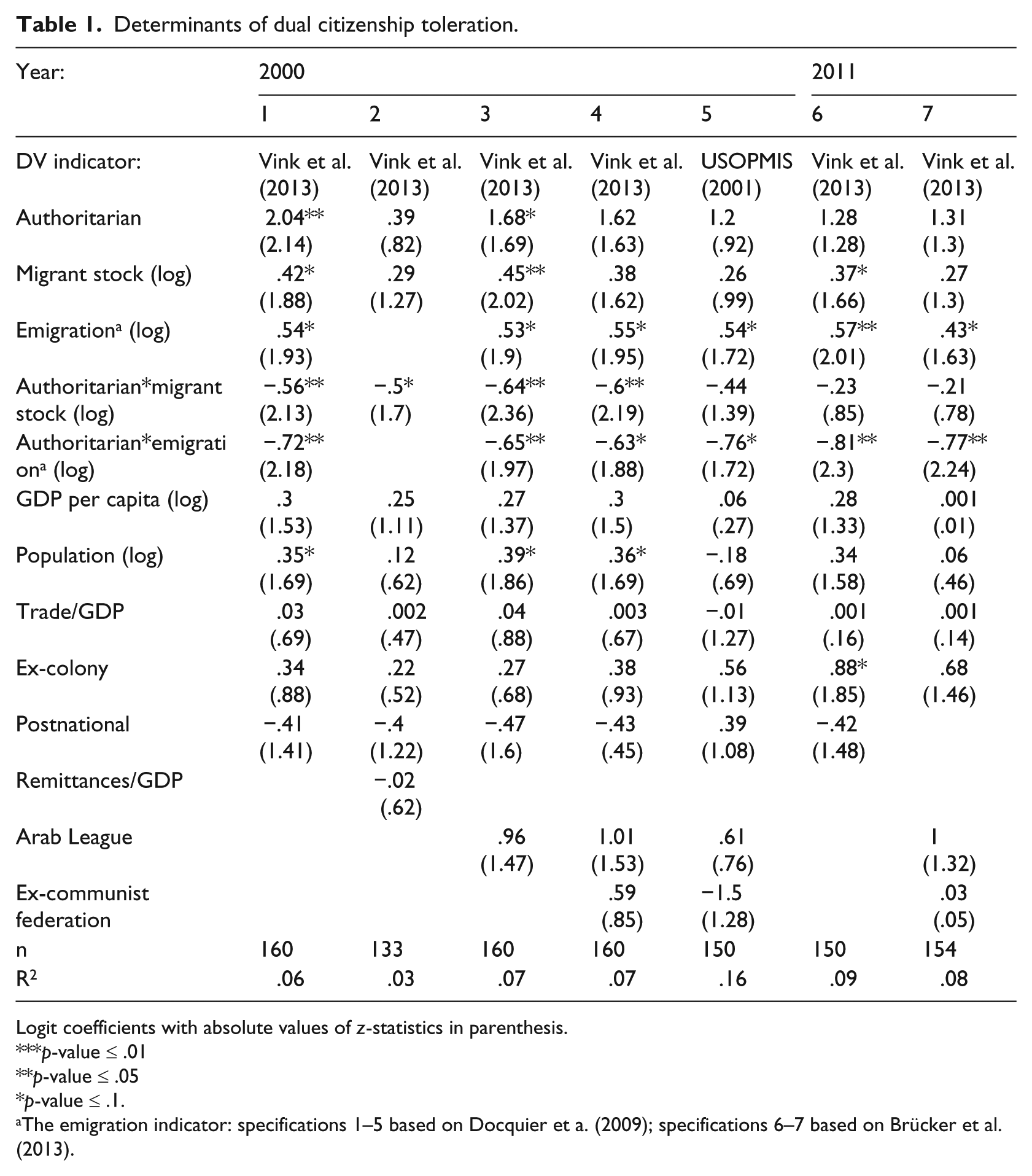
Logit coefficients with absolute values of z-statistics in parenthesis.
p-value ≤ .01
p-value ≤ .05
p-value ≤ .1.
The emigration indicator: specifications 1–5 based on Docquier et a. (2009); specifications 6–7 based on Brücker et al. (2013).
The migrant stock coefficient in specification 1 indicates that democracies with a relatively large migrant stock are more likely to tolerate dual citizenship than democracies with a relatively small migrant stock. By contrast, the authoritarian*migrant stock coefficient indicates that authoritarian states with a large migrant stock are less likely to tolerate dual citizenship than autocracies with a small migrant stock. Both results are statistically significant. The results indicate an extreme interaction effect consistent with hypotheses 1a and 1b.
The emigration and authoritarian*emigration coefficients from specification 1 reveal that democracies with high emigration rates for the highly educated are more likely to tolerate dual citizenship than democracies with low emigration rates for the highly educated. In authoritarian states, the pattern is reversed. Both coefficients are statistically significant. These results are consistent with hypotheses 2a and 2b.
Specification 2 replaces the emigration indicators with remittances. The results indicate that remittances are not strongly connected to dual citizenship toleration. 18 Dual citizenship toleration is likely primarily driven by political dynamics linked to the emigration of the highly educated, and not by economic dynamics associated with remittances.
Specifications 3–4 add Arab League and ex-communist federation controls. The key results remain consistent with the predictions of hypotheses 1a, 1b, 2a, and 2b.
Specification 5 uses the USOPMIS dependent variable indicator. The results are generally consistent with those obtained using the Vink et al. (2013) measure: having a larger migrant stock raises the likelihood of dual citizenship toleration in democracies and decreases it in authoritarian states; higher emigration rates of the highly educated raise the likelihood of dual citizenship toleration in democracies and decrease it in authoritarian states. The immigration coefficients do not pass a statistical significance threshold, but the coefficients are similar as when using the Vink et al. (2013) indicator.
Specifications 6–7 examine contemporary data using the Vink et al. (2013) dual citizenship toleration measure (for 2011). The results are generally similar to those described above. Having a larger migrant stock raises the likelihood of dual citizenship toleration in democracies and decreases it in authoritarian states; higher emigration rates of the highly educated raise the likelihood of dual citizenship toleration in democracies and decrease it in authoritarian states. The emigration results are generally statistically significant. The migrant stock coefficient passes or approaches the statistical significance threshold; the authoritarian*migrant stock coefficient is in the expected direction but it does not pass the statistical significance threshold. While the results are somewhat weaker using 2011 data than using 2000 data, the substantive impact indicated by the 2011 coefficients (shown in Table 2) is high.
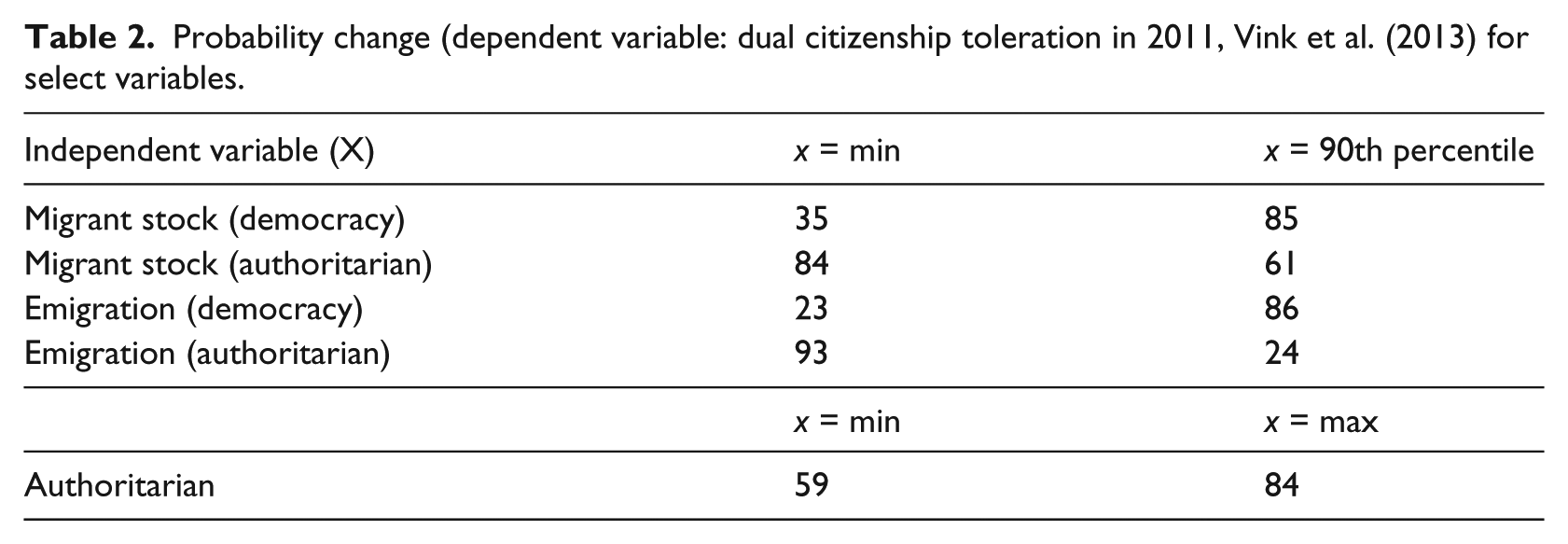
Probability change (dependent variable: dual citizenship toleration in 2011, Vink et al. (2013) for select variables.
The overall pattern, which is consistent regardless of the dependent variable indicator and the time period studied, is that of an extreme interaction effect regarding the relationship between immigration, emigration of the highly educated, regime type, and dual citizenship toleration.
Alternative explanations do not receive as much support from the evidence. Contrary to the predictions of Dahlin and Hironaka (2008), the postnational variable is not strongly associated with dual citizenship toleration. (Furthermore, the coefficient is usually in the counter-theoretical direction.) The alternative measure of shifting borders, the ex-communist federation dummy, is not strongly associated with dual citizenship toleration; a similar pattern pertains to Arab League membership. Consistent with predictions by Dahlin and Hironaka (2008), former colonies are more likely to tolerate dual citizenship, but this result is usually not statistically significant. Economic development, trade, and population are generally not strongly associated (the population coefficient is usually positive) with dual citizenship toleration, contrary to the predictions of modernization, globalization, and demographic pressures theories, respectively.
How substantively relevant are the interaction effects emphasized above? We can translate logit coefficients (from specification 6 in table 1) into changes in the probability that relevant dependent variable outcomes will occur. Table 2 displays changes in the probability that a country will tolerate dual citizenship when a relevant independent variable increases from its minimum to its 90th percentile (or its maximum), 19 holding other independent variables at their mean. Table 2 displays the results:
In an authoritarian state, when migrant stock increases from its minimum to its 90th percentile (holding other independent variables at their mean) the likelihood of dual citizenship toleration drops from about 84% to about 61%. In a democracy, the corresponding effect is an increase in the likelihood of toleration from 35% to 85%. In an authoritarian state, when the emigration of the highly educated increases from its minimum to its 90th percentile, the likelihood of dual citizenship toleration drops from 93% to 24%. In a democracy, the corresponding effect is an increase in the likelihood of toleration from 23% to 86%. The interaction effects, in addition to usually being statistically significant, are also substantively important.
Meanwhile, in a country with zero immigration and zero emigration of the highly educated democratization lowers the likelihood of dual citizenship toleration from 84% to 59%. This relationship is, however, not consistently statistically significant across various specifications. This evidence indicates a lack of a direct link between regime type and dual citizenship absent international migration.
Conclusions
This article argues that dual citizenship choices are the result of an interaction between regime type and international migration. In democracies, the likelihood of dual citizenship toleration increases in response to immigration as well as to a high emigration rate of the highly educated. In authoritarian states, the pattern is the opposite.
These findings indicate that broad generalizations about immigration policies must be qualified according to the character of the regime. The findings also indicate that we should study domestic and international politics together. For example, domestic political institutions help determine how states organize their outreach efforts toward diasporans, actors based in other states. Finally, this article shows evidence that international migration plays a key role in shaping an institution that structures politics: citizenship.
Footnotes
Acknowledgements
I would like to thank Susan Banki, Alexandra Delano, Kerstin Hamann, Roger Handberg, Barbara Kinsey, Covadonga Meseguer, Philip Pollock and three anonymous reviewers for their helpful comments and suggestions.
Funding
This research received no specific grant from any funding agency in the public, commercial, or not-for-profit sectors.
Notes
Author biography
References
Supplementary Material
Please find the following supplemental material available below.
For Open Access articles published under a Creative Commons License, all supplemental material carries the same license as the article it is associated with.
For non-Open Access articles published, all supplemental material carries a non-exclusive license, and permission requests for re-use of supplemental material or any part of supplemental material shall be sent directly to the copyright owner as specified in the copyright notice associated with the article.
