




Abstract
Performance voting studies implicitly assume that voters know who the government is, and can thus judge office-holders retrospectively. Scholars have recently addressed the issue in a majoritarian electoral context. This study expands into looking at (1) knowledge of the government in a multiparty setting by (2) focusing on the sociodemographic determinants of that knowledge. Using a 2008 survey data from Finland, the study finds that ignorance of government composition is more widespread in a proportional electoral system with a coalition government. Only 38% of the respondents correctly identified the government. Those on the political left, and hence in parliamentary opposition, men, over 45 years old and those with a high socioeconomic status were more likely to correctly identify the government. The results suggest that most voters do not know what they need to know in order to vote retrospectively. The implications for government accountability are discussed.
Introduction
A well-established research tradition within the study of voting behaviour suggests that voting decisions are guided by a retrospective assessment of how the incumbent government has performed. When positive enough, the assessment leads to rewarding by re-election. If not, the government will be punished through the election of new office-holders (e.g. Key, 1966; Kramer, 1971). The simple but significant issue addressed in this study is whether voters in a multiparty system know who they should either reward or punish. The objective is to see whether voters have that quantum of factual knowledge required to vote, as the retrospective explanation of voting assumes.
Considering the centrality of the retrospective judgement approach in the voting behaviour paradigm, surprisingly little attention has been paid to finding out whether voters know who they are supposed to be judging. In their recent analysis, Fortunato and Stevenson (2013a) report that they found no previous publication that would have tackled the issue, making this contribution the second to do so. As they note, previous research (e.g. Armstrong and Duch, 2010; Hobolt et al., 2013) has focused on how electorates construct opinions about incumbent performance and to what extent those perceptions can be considered factually accurate, not on whether the voters know who the incumbents are. Given how notoriously ignorant the public is considered to be about politics (e.g. Arnold, 2012; Bartels, 1996; Delli Carpini and Keeter, 1996; Rapeli, 2013), it seems important not to take for granted that voters know who the government is.
It is an obvious problem, especially for those political scientists who utilize the performance voting theory, if the voters cannot identify the government correctly. However, there is also a wider significance to the matter, which goes beyond mere scholarly debate. Government accountability, a true cornerstone of representative government, cannot function properly if the parties competing for power are not being judged on a correct basis by voters who under such circumstances are unable to hold their leaders accountable. If voters do not know who the government is, the logic of representative government is disrupted.
While studies measuring factual knowledge about government composition are almost nonexistent, previous research has increasingly acknowledged the complexity faced by voters in multiparty systems (Hobolt and Karp, 2010). A growing number of studies have found that voters successfully utilize heuristics to predict possible government coalitions, indicating ability to make sense of multiparty systems (e.g. Armstrong and Duch, 2010; Fortunato and Stevenson, 2013b). The matter concerns a fundamental premise of an influential framework for explaining voting behaviour and calls for more evidence. Focusing on the public’s knowledge of a coalition government seems warranted also because coalition governments are in fact the predominant government type in parliamentary democracies (Hobolt and Karp, 2010: 299).
Despite seeking to analyse an assumption underlying one of the most persuasive theories of voting behaviour, this study does not wish to say anything about the act of voting as such. Instead, it seeks to contribute to our understanding about the public’s ability to vote retrospectively in terms of factual knowledge. The study aims to make two contributions. Firstly, drawing on survey data from Finland, the study focuses on a multiparty system, where governments are typically coalitions of several parties, facing a multiparty parliamentary opposition. This puts the electorate to a test that is more difficult than the one faced by electorates in majoritarian democracies, which were the focus of Fortunato and Stevenson’s study (2013a). Secondly, instead of focusing on the consequences of ignorance and on its effect on economic voting, the analysis examines the individual-level determinants of knowledge of government composition. Based on these contributions, the study reflects upon the consequences variations in government knowledge have for voting and government accountability.
Retrospective voting and the clarity of government responsibility
The concept of retrospective voting refers to voting decisions that are based on an evaluation of how the incumbent government has managed the economy (Kiewiet and Rivers, 1984: 369–370). An impressing body of evidence, beginning with Gerald Kramer’s classic study (1971), has shown elections to be the public’s verdict on the economic performance of the government (for more, see especially Lewis-Beck and Stegmaier, 2007, 2009). In terms of knowledge, such voting behaviour requires two things: knowing (1) who the government is and (2) how it has performed economically. This study is only concerned with knowledge of the government, not with its economic performance. While objective knowledge of a government’s economic performance, for example in the form of major economic reforms or legislation, could possibly be measured, research suggests that from the voters’ viewpoint economic performance of the government is more a question of believing, not knowing. According to Evans and Andersen (2006: 194), evaluations of economic performance are heavily influenced by partisan and/or ideological inclinations. Van der Brug et al. (2007: 26) go as far as suggesting that because of the hopelessly biased nature of such assessments, subjective indicators of economic performance should be avoided in empirical research. (See also Lewis-Beck et al., 2013: 525.)
As Anderson (2007: 274) explains, the crux of the problem is that it is difficult to know what the citizens are evaluating. Summarizing a vast body of literature Anderson concludes ‘that scholars have disagreed over whether individuals react to national economic performance (sociotropic voting) or their own economic situation (egocentric voting); whether citizens evaluate actual or potential economic performance retrospectively or prospectively; and whether they react to growth, unemployment, or inflation’ (see also Lewis-Beck and Stegmaier, 2000). Thus, whatever the citizens do evaluate in terms of the economic performance of the government varies across individuals. What, however, does not vary is government composition. It is the same for every citizen. Limiting the inquiry to knowledge of the government safely keeps the analysis in the realm of factual knowledge. It also highlights that the objective of the study is simply to establish whether citizens have the required knowledge to evaluate the economic performance of governments. A discussion about the nature of those evaluations falls outside the scope of this study.
However, this seemingly simple task is greatly complicated by the difficulty of defining government accountability in the case of coalition governments. Hobolt et al. (2013: 165) distinguish two fundamentally different aspects in this regard: institutional and government clarity. The former refers to the distribution of formal power among the executive, the legislature and the various levels of governance. The latter type of clarity, with which this study is also concerned, refers to how easily the composition of the incumbent government can be comprehended. Government clarity, as it has been called, is greatly dependent on systemic qualities. Majoritarian systems, where two major parties compete for power, are characterized by clearer government responsibility than proportional systems, where institutional arrangements tend to involve more diffusion. Based on this reasoning, Powell and Whitten (1993) have constructed a much-used clarity of responsibility index, which has been influential in explaining cross-national variance in the occurrence of performance voting (see Hobolt et al., 2013: 167, for a review). Our task is, however, limited to only one dimension in the wide-ranging field of performance voting, accountability and clarity of responsibility: whether the people know who is in the government.
Government composition and knowledge
Addressing the issue of knowledge in this context, Fortunato and Stevenson (2013a) measured knowledge of cabinet composition in the UK, which is a majoritarian system. Conducted in June of 2012, their survey data essentially measured whether the respondents were able to identify the Conservative Party and the Liberal Democrats as the two government parties. Getting the government right simultaneously meant recognizing the Labour Party as being in opposition. Referring also to evidence from a few comparable surveys conducted in other European countries between 1993 and 1998, Fortunato and Stevenson conclude that approximately one third of electorates are typically unable to identify the government.
With its proportional electoral system and a multitude of parties, Finland presents a different scenario. As is usually the case with countries with institutional arrangements based on proportionality, it is less clear who the voters should hold responsible if and usually when such a system produces a coalition government. Several possible answers can be suggested. The party of the prime minister, or other head of government, is perhaps the most obvious alternative, because that party is typically the most powerful one within the coalition (Anderson, 2000; Fisher and Hobolt, 2010). Since retrospective voting so heavily relies on the economic evaluations of government performance (e.g. Rudolph, 2003: 698), another option would be to hold the finance minister’s party accountable. This possibility gets additional support from the fact that empirical evidence shows retrospective voting being particularly strongly related to fluctuations in economic conditions (e.g. Lewis-Beck and Stegmaier, 2000; see also Hobolt et al., 2013). For many voters, the government member responsible for the economy might therefore be the most apparent target of retrospective judgement. These simple conceptualizations – knowing the prime minister or the finance minister – could also be considered as heuristics for a more profound understanding of government composition.
Another option is not to reduce the necessary knowledge to individuals, but to consider the composition of parties in a coalition government. This seems reasonable, since parties always have varying significance for the coalition as a whole. As Vowles (2010: 371) has noted, power tends to circulate rather than alternate between parties in systems that usually produce coalition governments. In cases such as Finland, government power has historically circulated between three major parties, which have formed different combinations of governments and oppositions. 1 Smaller parties have completed the coalitions, helping to create comfortable majorities in the parliament to push through government-initiated legislation. Hence, knowing the statuses of the major players would also seem like a relevant option in terms of knowing who the rascals are – and who is not this time around. However, perhaps the most obvious alternative is to actually know all parties in a coalition government and, by extension, parties in the parliamentary opposition. Although a demanding requirement for the typical voter, it is arguably relevant knowledge since the harsh reality in proportional systems tends to be that there are several parties to be monitored. Knowing all the parties in a government is, after all, what voters in majoritarian systems are also expected to know. They just have fewer parties to identify.
In order to include a wide array of possibilities, the subsequent analysis will consider knowledge that is relevant for government accountability from each of the above perspectives. Let us now look at the data that makes such an analysis possible, and describe the variables used to explain individual-level variation in the ability to identify government parties.
Data and variables
The analysis uses the Knowledge of Politics and Society Survey, which was conducted in Finland in February–March 2008. The survey consisted of 38 political knowledge questions. Its 1020 survey respondents form a probabilistic sample representative of the Finnish voting age population in terms of age, gender and place of residence. The survey was conducted face-to-face by professional interviewers from a major, independent survey company, Taloustutkimus Plc.
Based on the above discussion on the complexities of assigning government responsibility to a coalition government, the analysis uses four indicators of knowledge of government:
identifying the prime minister’s party as government party;
identifying the finance minister’s party as government party;
identifying the statuses of the three major parties;
identifying all government parties.
All four measures are derived from the same question where respondents were asked to say for each parliamentary party whether it is currently in the government. All measures are coded dichotomously: 1 if the respondent has identified the expected party/parties and 0 if the respondent has failed to do so.
The two first measures only require naming the relevant parties, the Centre Party and the National Coalition, as being in the government. In addition to naming both of these, the third measure also requires indicating that the Social Democratic Party (SDP) is not in the government. The fourth measure is quite demanding in the sense that it requires naming all government parties without naming any additional parties. Hence, if a respondent named all four government parties correctly, but also incorrectly named a fifth party as being in government, the reply was coded as incorrect. In similar fashion as the measure used by Fortunato and Stevenson (2013a), the strict measure is also simultaneously a latent measure for knowing the opposition as well.
What factors should be expected to predict individual differences in the ability to identify government parties? Existing literature suggests two types of variables: those pertaining to one’s attachment to politics, and those related to sociodemographic status. The former is typically seen as indicating cognitive affection and motivation toward politics, the latter as reflecting ability and opportunity to understand it.
Three measures will be used to tap political attachment. Voting is included as an indicator of political participation, while political interest and ideology are used as indicators of cognitive engagement in politics. Previous findings show that all three variables predict differences in political knowledge. Voting and political interest predict high political knowledge (Delli Carpini and Keeter, 1996; Eveland and Scheufele, 2000), whereas people who label themselves as leftist or liberal tend to be more knowledgeable (Delli Carpini and Keeter, 1996; Elo and Rapeli, 2008).
To measure subjective interest, the standard item ‘How interested are you in politics’ with the four-point Likert-scale responses is used. Voting is operationalized as whether the respondent voted for a government party or an opposition party in the 2007 parliamentary election, held one year before the survey. This variable will be used to explore the possibility that knowledge of government composition may depend on whether one finds him-/herself on the winning or the losing side in the electoral arena. The reference category for voting behaviour is ‘voted for opposition’. This allows one to simultaneously examine how voting either for government or opposition and non-voting relate to each other.
Considering the centrality of retrospective voting for the analysis, a measure for the tendency to engage in performance voting also seems warranted. For this end a simple proxy is available. Asked about how the respondents choose which party or candidate to vote for, they could say ‘I always vote for the same party’, or choose one of three alternatives, which all indicate some form of performance evaluation: ‘I vote for the party/candidate that seems most suitable to me’, ‘I find out what the parties/candidates think about issues that are important to me and then decide’ or ‘I use a voting advice application’. While these alternatives do not measure true economic voting, the question will be used in a binary form measuring whether the respondent always votes for the same party or not. Although not measuring performance voting as such, it nevertheless measures the absence of such a voting habit; if a person always votes for the same party, assessments of performance do not affect the vote, at least not enough to change it.
The measure of ideology is based on the widely used 11-point scale measure, where 0 indicates far left and 10 far right. Using the left–right ideology scale in addition to a party choice measure provides an indicator of the more durable political position of the individual. While party choice may fluctuate between elections, especially in a multiparty system with several choices, left–right ideology can be expected to be a more stable property. 2 Also, given that the government in power at the time of the measurement was clearly right-wing, the ideological cleavage might be relevant in predicting knowledge about it.
Previous research shows that individual variations in political knowledge are strongly related to socioeconomic and demographic characteristics; well-educated, affluent middle-aged men are typically high-knowledge individuals (Delli Carpini and Keeter, 1996; see also Rapeli, 2013: 45–51, for a review). Subsequently, age, gender, education and income will be used as indicators for an individual’s sociodemographic status.
The data only covers one point in time from one country. While the lack of comparative data is a familiar problem for scholars working with political knowledge, it is always necessary to address the issue of generalizability in case studies such as this one. Two questions are relevant. Firstly, was the government that survey respondents were questioned about particularly easy or difficult to identify? Secondly, was that government somehow particular to the Finnish context or did it have similarities with coalition governments elsewhere?
The simple answer to the first question is that the government in question was quite representative of Finnish governments from the past few decades. At the time of the survey (2008), there were eight parties in the Finnish parliament: four in the government and four in the opposition. The incumbent government had been formed by two major parties, the National Coalition and the Centre Party, and two minor parties, the Green League and the Swedish People’s Party. The coalition was centre-rightist, with a touch of green. The third major party at the time, the SDP, was the major opposition party. Although undoubtedly more rightist, the green nuance made the coalition slightly more cumbersome to identify on the basis of the traditional left–right continuum. From the voters’ perspective, identifying such an ideologically diffuse government coalition of four out of a total of eight parliamentary parties is certainly more difficult than identifying two parties out of a possible three.
Given the relatively unproblematic positioning of the government on the left–right dimension, the answer to the second question is arguably that the government was hardly very particular to Finland. Being a combination of rightist and green ideology, it was a rather typical coalition government produced by a multiparty system in an industrialized Western democracy. As Hobolt and Karp (2010: 300–301) show, coalition governments have historically dominated the political landscape of most West European countries. During 1944–2009, 21.3% of all governments in their analysis of 479 governments in 17 European countries were oversized coalitions such as the one in this study. In addition, the occurrence of such coalitions has become more frequent in recent years. Hence, the 2008 Finnish government was by no means exceptional in an international comparison.
Finland, on the other hand, is perhaps not quite an average country in regard to public awareness of politics. Finland is often considered to be a high civic literacy country (e.g. Milner, 2002) whose electorate could be expected to have a relatively good ability to comprehend a complex multiparty system. It is also relevant to note that retrospective assessments of government performance affect party choice in Finland (Söderlund, 2008). Finland seems therefore a suitable case for analysing if voters have the knowledge required for retrospective voting, because its electorate engages in economic assessments when they vote. All things considered, Finland provides an appropriate context for the purposes of this study. The 2008 Finnish government as well as Finnish voters’ voting habits are fairly unproblematic in terms of generalizability to other multiparty contexts.
Analysis
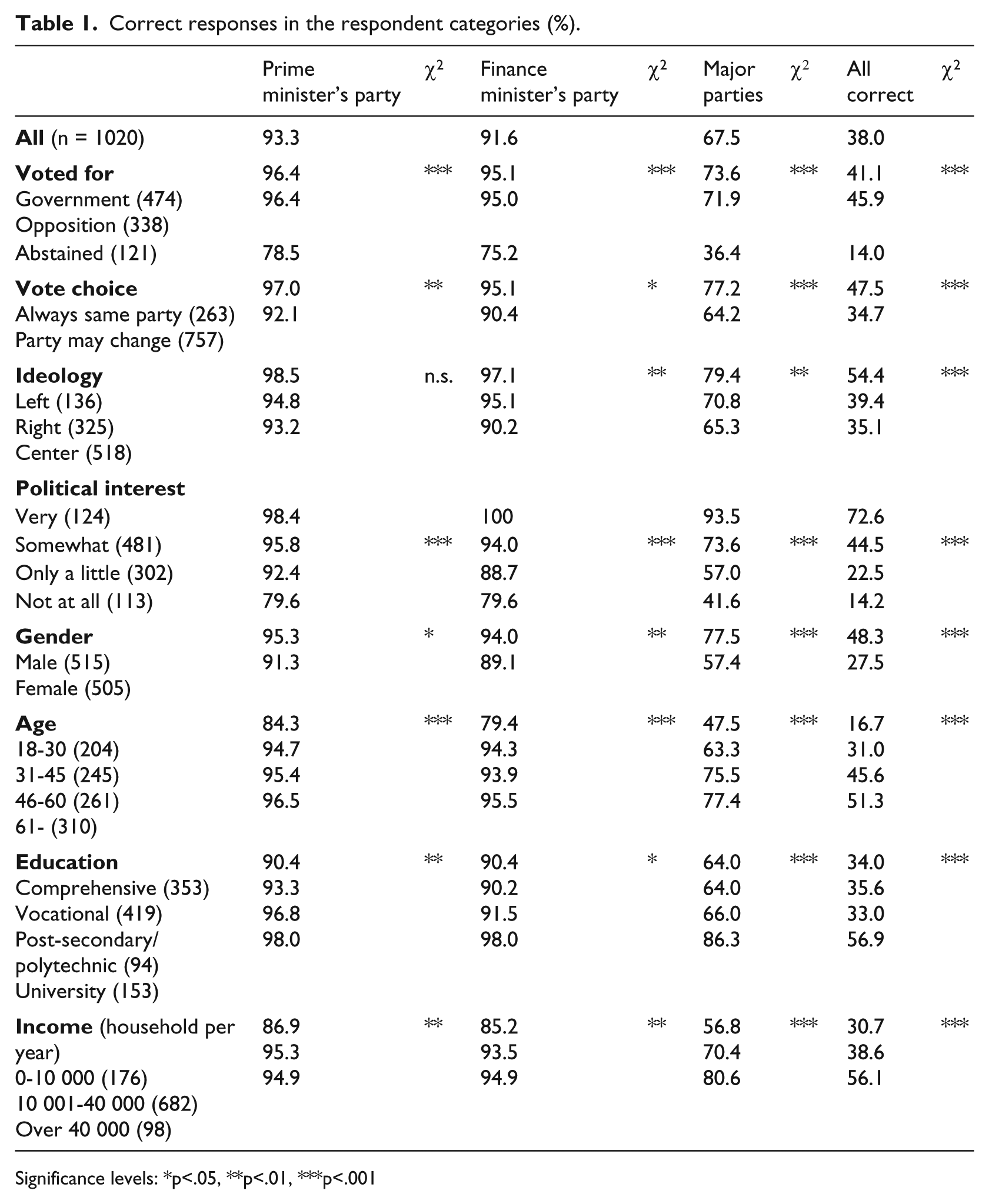
Table 1 reports how the various measures of government knowledge are distributed among the respondent groups. Based on the χ2 test, the table shows the statistically significant differences in group means for the ability to identify the government.
Correct responses in the respondent categories (%).
Significance levels: *p<.05, **p<.01, ***p<.001
There is great variance among the four different ways of identifying the government. Almost all respondents were able to name the prime minister’s and finance minister’s parties as being government parties, with 93.3% and 91.6%, respectively, providing correct answers. Despite statistically significant group differences, very little between-group variance can be detected. Even those respondents whose attachment to politics is quite weak – the abstainers and those not at all interested in politics – were typically able to identify the prime minister’s and the finance minister’s parties as being in the government. More than three out of four such respondents got these parties right.
However, even without having any clue of government composition many are likely to name the prime minister’s and the finance minister’s parties as being in the government simply because their parties are among the largest and most well-known in the country. The third alternative raised the bar by requiring respondents to identify the positions of all three major parties in Finland at the time correctly. When potential guessing is not as helpful, we see much more variance among respondent groups. Overall, the results are now reminiscent of those of Fortunato and Stevenson (2013a), who found two-thirds of the electorate able to correctly identify the incumbent government in the UK. In this case 67.5% of respondents correctly assigned government accountability among the major parties in Finland. While 93.5% among those very interested in politics correctly identified the major parties, only 41.6% among those ‘not at all interested’ managed the same. The 20 percentage point gender difference in favour of men is also quite sizable. The 30 point difference between the youngest and oldest age groups is similarly noticeable, with the latter group being more knowledgeable.
Requiring complete knowledge of government composition in a multiparty system seems to reverse the one-third-rule found by Fortunato and Stevenson (2013a): instead of one-third of the electorate being unable to correctly identify the incumbent government, it is now approximately one-third (38%) that is capable of doing so. The group differences are largely similar compared with the previous ‘major parties’ measure and the picture looks familiar to all students of political knowledge. Men are again much more often capable of identifying the government parties than women, as are older age groups compared with younger age groups. The difference between the youngest and the oldest age group becomes particularly accentuated and is now almost 35 percentage points. Similarly, those with a university education and high income are strongly associated with a much higher awareness of the incumbent government than their counterparts.
Socioeconomic or demographic status, however, is not quite all that matters. Respondents who place themselves on the political left are more aware of the composition of the rightist government than respondents on the political right. This is the case regarding the two more demanding measures of government knowledge. It therefore seems that those individuals who find themselves in the political opposition keep better track of who to blame. This suggests that those interested in ‘punishing’ the incumbent government are also more likely to want to know who they can punish. Always voting for the same party is also associated with greater awareness of the government. Although one may have expected the opposite, the difference most likely reflects the finding that politically knowledgeable individuals tend to remain loyal to their chosen party. The ability to identify the government may therefore often be used for evaluations that are unlikely to cause retrospective vote switching. Rather, it seems likely that party loyalists are simply politically engaged people who keep track of the government and politics more generally. They have a deeper cognitive engagement with politics than people who have not developed a similar devotion to a particular party.
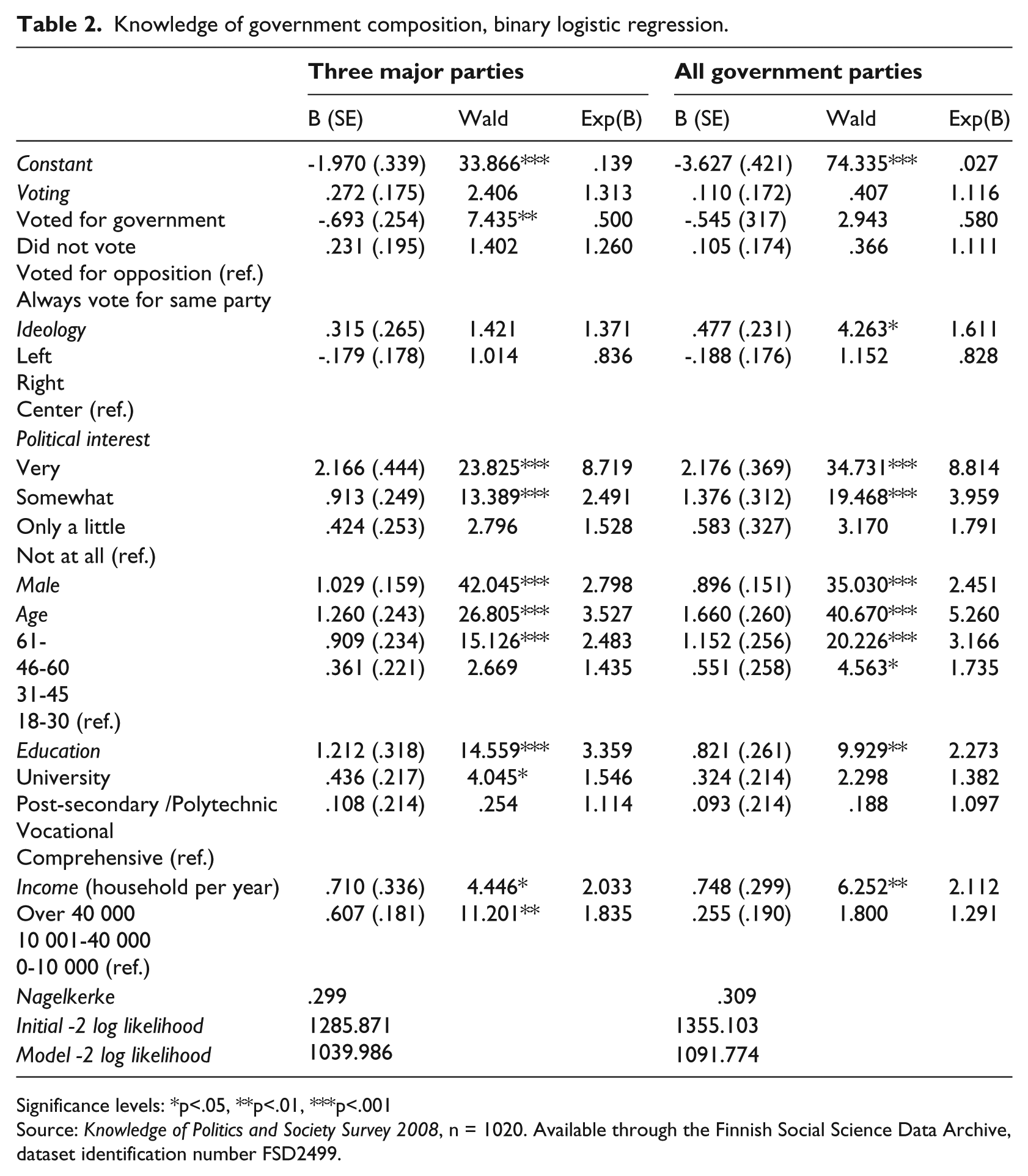
Given that there is very little variation in respondents’ ability to identify the prime minister’s and the finance minister’s parties as being in the government, only the two more demanding measures are used in the multivariate regression. Table 2 reports the determinants of (a) identifying the three major parties and (b) perfect government knowledge.
Knowledge of government composition, binary logistic regression.
Significance levels: *p<.05, **p<.01, ***p<.001
Source: Knowledge of Politics and Society Survey 2008, n = 1020. Available through the Finnish Social Science Data Archive, dataset identification number FSD2499.
As Table 1 hinted, in addition to political interest the predictors of government knowledge are related to sociodemographics. Only vote abstention and self-placement in the political left have some relevance, otherwise the statistically significant predictors are unrelated to the available measures of political attachment. The finding that a different ideological position from that of the government may increase knowledge of government composition is nevertheless interesting, as it provides further support for the initial finding that a critical stance seems to motivate government monitoring.
The model does quite well in explaining individual-level differences in government knowledge. The Nagelkerke pseudo indicator indicates that around one third of the variation in both dependent variables is explained. Since all independent variables are dichotomously coded to 0 and 1, the Wald statistic together with the odds ratios (Exp(B)) are useful in assessing the relative importance of the individual predictors. The larger the Wald statistic, the greater the impact of that variable on the outcome variable. Consequently, variables with large and statistically significant Wald values typically also have large odds ratios.
Men were almost three times more likely (odds ratio 2.798) than women to identify the three major parties correctly. University education mattered slightly more, as the odds compared with only comprehensive education were well above three (Exp(B) = 3.359). The two oldest age groups differed significantly from the youngest group of 18–30-year-olds, while the 31–45 group did not. The age effect is particularly strong between the oldest (above 60) group and the youngest. The oldest respondents were 3.5 times more likely to respond correctly than the youngest. Although the picture looks nearly identical in the case of perfect government knowledge, the relative significance of the variables is different. The male gender and university education lose some of their importance, while age and political interest become accentuated. The gap between the oldest and youngest age groups has now risen from an odds ratio of 3.5 to 5.3.
While these results are by no means surprising, they contain a few noteworthy findings. Firstly, they indicate that knowledge does not rise linearly or even ordinally with age, education and interest. Instead, there are obvious cut-off points in each case. When compared with the lowest educational level, all levels besides university are practically irrelevant. The finding suggests that identifying a coalition government requires a good amount of cognitive capacity. This is reflected by the fact that it is only the university educated who stand out as being able to do so. That political interest shows a similar pattern strengthens this interpretation. Being ‘very’ interested in politics is a particularly strong indicator. Respondents in this category are almost nine times more likely to get government composition right than their uninterested counterparts. Whereas university education suggested an ability effect, ‘very interested’ suggests a large motivation effect.
To further underline this latter finding, Figures 1 and 2 illustrate the predictive power of the two most significant determinants in the preceding analysis, political interest and age. The figures plot the predicted probabilities for knowledge of the three major parties and knowledge of all government parties against age and political interest.

Predicted probabilities by age and political interest for identifying major parties.
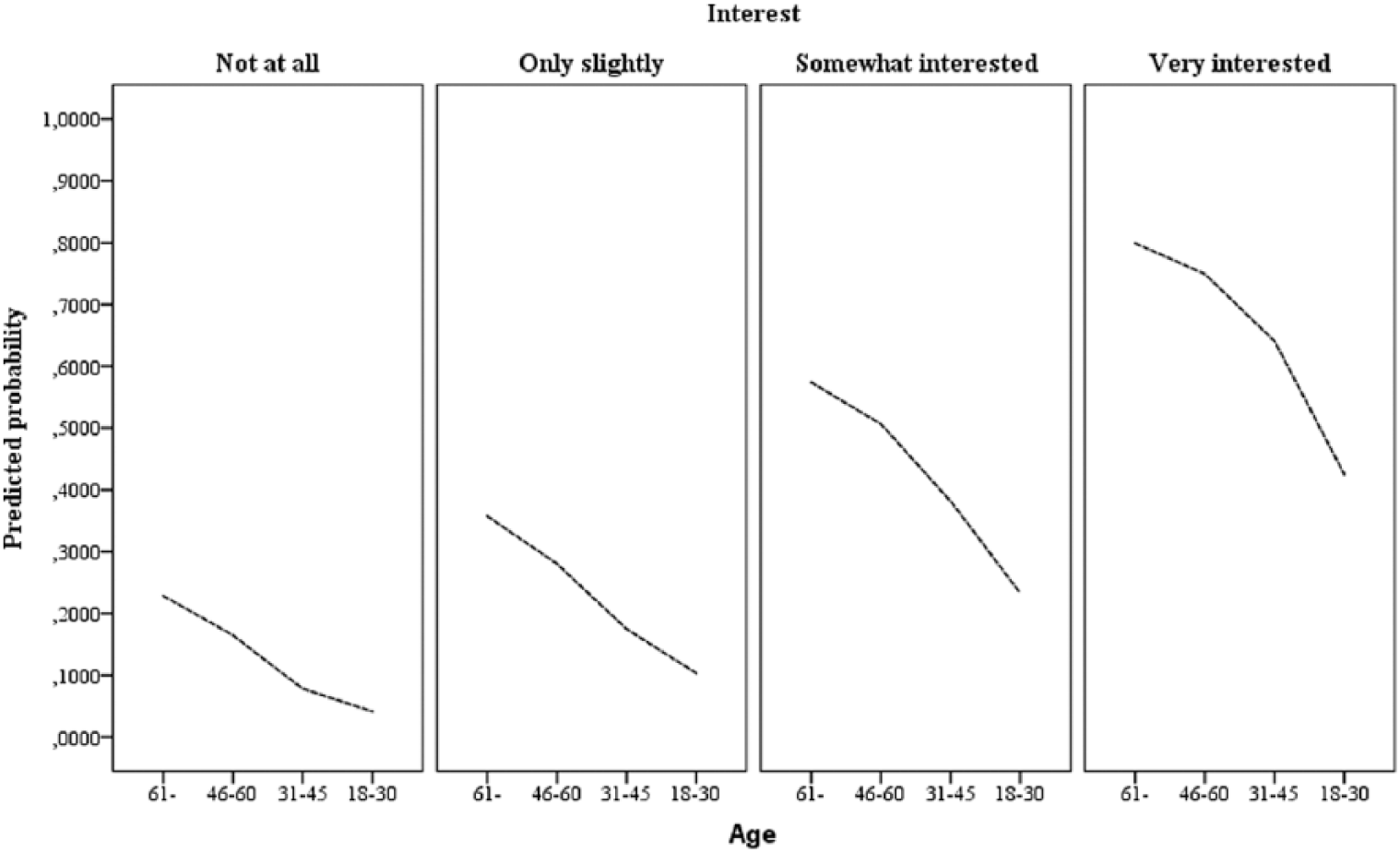
Predicted probabilities by age and political interest for identifying all government parties.
The figures help to demonstrate two key findings. Firstly, they show how the probability of knowing, which here represents ability to exercise government accountability, rises remarkably – and similarly – with political interest in all age groups. This means that differences in age do not disappear when interest is taken into account: the older age cohorts are more knowledgeable regardless of interest. Secondly, the differences between age groups are smaller regarding different levels of interest in Figure 1 compared to Figure 2. This means that the effect of age becomes emphasized in the most challenging measure of government knowledge. There is a much greater difference in predicted knowledge between the older and the younger age cohorts in Figure 2. Hence, even being very interested in politics has not helped the youngest respondents to fully grasp who is responsible for governing. Even the most politically engaged youth found this to be an arduous task.
Discussion
So what do these findings tell us about the public’s ability to hold the government accountable? Firstly, it depends greatly on how accountability is defined and to whom it is assigned. If the electorate is expected to blame or reward the government based on the performance of the leading coalition partners, then their ability to do so is unquestionable. Both the prime minister’s and the finance minister’s parties were named as government parties by almost all respondents. If, on the other hand, the electorate needs a more refined understanding of government composition, a substantial portion of voters do not possess the knowledge assumed by theories of economic voting. This is true even in the case of Finland, which has high civic literacy and a highly educated public. One third of the Finnish respondents were unable to assign correct government and opposition positions to the three major parties in the country. Only 38% could name all four parties in the government coalition, without also incorrectly naming any additional parties.
Secondly, the results suggest that political institutions matter for voters’ ability to hold the government accountable. A multiparty system with a coalition government of four parties is clearly more difficult to identify than a government in a majoritarian system or in a system where competition is narrowed down to fewer parties and possible coalitions. Although the appropriate measure for necessary government knowledge in the case of coalitions is a contested issue, a comparison with the Fortunato and Stevenson (2013a) study shows that identifying the government is more difficult in a multiparty setting.
There is, however, great individual-level variation in government knowledge. In the Finnish case the variation is mainly socioeconomic and less related to political attachment, to the extent that the latter could be examined with the available data. What seems clear is that much depends on ability and motivation of the individual. This is especially obvious in regard to political interest. The results also hinted at the possibility that people on the losing side, that is, those who reported having voted for the opposition, were somewhat more likely to identify the government correctly than those who had voted for the government. It seems possible that the will to punish makes voters more likely to keep an eye on the government than the desire to reward. The impact was small and the interpretation is bold and speculative. However, given that the finding touches upon an essential feature of the performance voting model, it deserves further investigation.
Although opposition voters were more knowledgeable about the government, the effect was at best of secondary importance compared to sociodemographic factors. This is, of course, a likely product of the multiparty system itself: if grand coalitions are possible, even probable, it is difficult to punish or reward entire governments. The relatively low percentage of respondents who had perfect knowledge of government composition might reflect a natural reaction to the difficulty of rewarding or punishing in a multiparty system. Supporting this interpretation, Powell and Whitten (1993: 407) found that retrospective economic voting was less prominent in contexts where the clarity of political responsibility was low, such as in Finland. A related finding by Vowles (2010) is that the public perception of coalition governments is more often that ‘they make no difference’ than in the case of single-party governments. This latter finding can also be seen as a result of unclear government accountability in multiparty systems. Against this background it seems understandable that lack of government knowledge is more widespread in multiparty than in majoritarian systems. The cost of keeping informed is higher and at the same time the benefits are assumed to be lower.
Reflecting on these findings, it appears natural to propose that future research on performance voting takes into account the knowledge aspect when dealing with government accountability. There is now evidence suggesting that (a) the electorate does not necessarily have the knowledge assumed by the performance voting paradigm, (b) that the degree to which the electorate does have it greatly varies between institutional contexts and measures of accountability and (c) that it also varies significantly between individuals. Since the context of voting varies between countries as well as between elections, more evidence is needed about voters’ ability to perform the accountability function in elections.
The consequences of the results for the theory of retrospective voting are not that such research should be abandoned because voters do not fulfil the assumptions made by theory. Instead, future research should be amended so that analyses account for the fact that there is extensive variation in voters’ knowledge of who they ought to punish or reward and that a large proportion of voters do not possess the requisite amount of information regardless of how government responsibility is assigned to the various coalition government partners. Based on the results reported here, as well as those by Fortunato and Stevenson (2013a), it is tempting to conclude that future research seeking to explain voting as a function of retrospective judgements of economic performance of the incumbent government should acknowledge the incomplete knowledge of government composition and individual variation in its extent.
Quite different is whether public ignorance about government composition matters for vote choice and electoral results. According to Fortunato and Stevenson it does: in their analysis low-sophistication individuals were more likely to vote retrospectively than high-sophistication individuals (2013a: 522). There is a lively debate in the political knowledge literature concerning the possible consequences of political ignorance. Some scholars offer persuasive accounts suggesting that a more enlightened public opinion would result in very different political outcomes (e.g. Althaus, 2003; Arnold, 2012). Others disagree, by relying on evidence that presents aggregate public opinion as a very reliable indicator of the public will, despite deficiencies at the individual level (e.g. Erikson, 2007; Erikson et al., 2002; Page and Shapiro, 1992).
Future research could therefore contribute to our understanding of how, if at all, knowledge of government composition and assessments of government economic performance affect vote choice. This approach would expand not only the inquiry into the interrelations between political beliefs and knowledge, but also concrete political action. Here lies rich potential for new findings concerning citizens’ political reasoning. Voting is not merely a matter of fact but also, perhaps even more so, a matter of emotion and it is still partly unclear what the real-life consequences of political ignorance are, despite several impressive attempts at producing conclusive evidence.
Another aspect, which has been overlooked, is the use of heuristics across different political systems. The use of heuristics refers to information shortcuts that assist voters in decision-making when they operate without the benefit of complete information. In complex systems, such as multiparty systems, voters may be able to deduce extensive relevant information for retrospective judgements by knowing, for example, the political ideology of the major coalition partner(s), even if they lack knowledge of the entire coalition composition. Such heuristics are, of course, dependent on the ideological clarity of the coalition. To what extent voters are willing and able to use heuristics in various systems and whether that results in effectively holding the government accountable amply deserves scholarly attention.
How easily oversized government coalitions lend themselves to ideological heuristics is also a potential source of concern when it comes to the generalizability of the results. In the current case the government was quite unequivocally aligned along the left–right ideological dimension, making it easier to identify. There is evidence of increased ideological confusion as the once dominant left–right dimension has been gradually challenged by new, cross-cutting cleavages concerning European integration and immigration (e.g. Mattila and Raunio, 2006; Thomassen, 2012). It is therefore by no means certain that the results from this particular case can be applied to contexts which vary in terms of the ideological clarity of the government. In a more general sense, however, problems of generalizability should not be overemphasized in the current case. As mentioned, the government that the respondents in the data were required to identify was quite typical of multiparty systems. In addition to showing that oversized coalitions have for several decades been a regular event in European democracies, Hobolt and Karp (2010) also show that in the Finnish case they have been by far the most common government type. Thus, the results should be quite applicable to multiparty systems with large government coalitions.
Footnotes
Acknowledgements
I would like to thank the anonymous reviewers and Mark Kesselman for very useful comments, and Jelena Ahlblad for assistance during the final preparation of the article.
Funding
This research received no specific grant from any funding agency in the public, commercial or not-for-profit sectors.
Notes
Author biography
References
Supplementary Material
Please find the following supplemental material available below.
For Open Access articles published under a Creative Commons License, all supplemental material carries the same license as the article it is associated with.
For non-Open Access articles published, all supplemental material carries a non-exclusive license, and permission requests for re-use of supplemental material or any part of supplemental material shall be sent directly to the copyright owner as specified in the copyright notice associated with the article.
