




Abstract
What determines whether militaries will defect from authoritarian incumbents during regime crises? Variance in military behavior in the Arab Spring has given rise to a debate around this issue. This article highlights weaknesses of the dominant explanation and develops an alternative account of military behavior in ‘endgame scenarios’. If militaries are politicized institutions that play a major role in regulating access to power under authoritarianism, they are more likely to intervene during normal times, but less likely to defect during mass uprisings. I quantitatively test this argument against data on military coups between 1975 and 2000 drawing on a new variable that allows me to explicitly model the impact of major regime crises. I illustrate the emergence of different forms of political–military relations and their consequences in the Arab Spring by drawing on evidence from Syria, Egypt, and Tunisia.
The posture of the armed forces significantly shaped the fate of autocratic regimes during the Arab Spring. Where the military collectively turned against the incumbent, regimes were decapitated within a matter of days (Egypt and Tunisia); where major parts of the military elite remained loyal, on the other hand, continuing protests were met with harsh repression and defections from the armed forces, external intervention, or both transformed the respective uprisings into armed conflicts, the consequences of which are still being felt in the region (Libya, Syria, and Yemen).
What, however, determined military behavior in the Arab Spring? Why did some Arab generals collectively turn against their chief executives, while others did not? Drawing on data on military behavior in popular uprisings against non-democratic regimes around the world, this article proposes a new answer to this question: I find that, somewhat counter-intuitively, militaries with a long history of political involvement are unlikely to turn against dictators in the face of mass-uprisings. Militaries that face competition from rival regime institutions or have traditionally been marginal politically, by contrast, are more likely to defect from embattled incumbents.
The puzzle of military behavior in the Arab Spring
Based on case studies of the Arab Spring, it has been argued that military behavior in these regime crises was a consequence of the degree to which the armed forces were bound to the ruler by patrimonial ties. Setting the tone, Eva Bellin argues that:
where the military is organized along patrimonial lines, where military leaders are linked to regime elites through bonds of blood or sect or ethnicity, where career advancement is governed by cronyism and political loyalty rather than merit, […] the fate and interests of the military’s leadership become intrinsically linked to the longevity of the regime. (Bellin, 2012: 133)
While there is no doubt that such strategies were central in the Middle East, it is less clear whether patrimonialism indeed led to military loyalty: In Yemen, for example, the ‘biggest loss for the regime was the defection of General Ali Mohsen al-Ahmar, Saleh’s tribesman and longtime ally’ (Barany, 2011: 29) and in Libya the defection of Major General Abd al-Fattah Yunis, a co-conspirator in the 1969 coup that had brought Gaddafi to power, points in a similar direction (Gaub, 2013: 16); even in Syria the defection of Manaf Tlass, son of long-term defense minister Mustafa Tlass and personal friend of Bashar, or of figures such as the Alawite former Defense Minister and Chief of Staff Ali Habib show that patrimonialism does not always guarantee loyalty (Zisser, 2013). In other words, patrimonialism does not seem to have prevented individual high-level defections in Syria and has contributed to the fracturing of the armed forces in Libya and Yemen.
In addition, if favoritism in career advancement is evidence of patrimonialism, it is not clear if variation among the militaries involved in the uprisings of the Arab Spring is as pronounced as is sometimes assumed. Hicham Bou Nassif (2013), for example, has presented evidence that the Egyptian officer corps remained ‘wedded to Mubarak’ and that officers could expect to be rewarded with lucrative positions upon retirement. Military officers in Egypt thus did profit from close connections to political power (also see Sayigh, 2012). Even in the comparatively professionalized Tunisian armed forces the dominance of Sahelian officers in high-ranking positions meant that officers from less privileged areas were actively disadvantaged and that military and political elites shared important markers of regional identity (Jebnoun, 2014: 299). Yet, both the Egyptian and Tunisian armed forces turned against the respective incumbents and thereby precipitated the fall of Mubarak and Ben Ali.
More generally, approaches to the military in politics – particularly where authoritarian regimes are concerned – have overwhelmingly focused on how regimes managed the armed forces. Such arguments highlight different forms of coup-proofing such as counterbalancing (Belkin and Schofer, 2005), ethnic stacking (Harkness, 2014), the availability of economic benefits (Quinlivan, 1999), or a mixture of all of these elements as in the patrimonialism argument.
I argue that by looking at political–military relations solely from the perspective of authoritarian incumbents, such arguments miss important variation in the political role of military institutions. Building on the fundamental observation that some militaries are political institutions while others are not, I develop an explanation for military behavior in mass-uprisings that draws on such historically determined differences. In brief, while most existing scholarship has focused on the role of the regime in the military, I focus on the historically defined role of the military in the regime.
The article proceeds in three broad steps. In the first section I develop the theoretical argument. In the second section I test this argument against data on military insubordination under authoritarian regimes between 1975 and 2000. The third section then turns to the Arab Spring and illustrates how different patterns of political–military relations emerged in Syria, Egypt, and Tunisia and how these patterns conditioned the behavior of the respective militaries during the popular uprisings.
Military behavior in crisis situations
Although theories of revolution and regime change have often pointed to the significance of the military, the behavior of armed forces in the face of popular mass uprisings remains undertheorized. In Theda Skocpol’s famous work on social revolutions, for example, divisions in the elite and the military are an essential component of the ‘crisis of the state’ that leads to a revolutionary situation (Skocpol, 1979); in their classical work on transitions from authoritarian rule, in turn, Guillermo O’Donnell and Philippe Schmitter emphasize that for pacts between soft-liners and moderate opposition actors to succeed, ‘[i]t is crucial that among them, in a prominent role, should be found well-placed and professionally respected military officers’ (O’Donnell and Schmitter, 1986: 25). There is thus every reason to assume that military behavior will matter in cases of popular mass uprisings against authoritarian rule. What we lack, however, is a systematic empirical analysis of this issue.
There is empirical material for such an analysis. Between 1945 and 2013, 76 non-democratic regimes experienced popular uprisings with regime-threatening proportions. In only 26 of these cases, however, did the military turn against the chief executive (Albrecht and Koehler, 2014). The Arab Spring is thus part of a larger category of cases that encompasses such diverse settings as Belarus, Georgia, Kyrgyzstan, Serbia, and Ukraine during their respective ‘color revolutions’ or the people power protests of the late 1980s in Burma and the Philippines.
In this article, I focus on what I – drawing on the work of David Pion-Berlin and Harold Trinkunas (2010) – refer to as endgame scenarios, namely instances of popular mobilization of sufficient intensity to threaten regime stability. In contrast to these authors, however, I consider only uprisings against non-democratic rule since they put the military in the spotlight in a way mass-based contention in democratic contexts does not. Embattled non-democratic rulers often call on the security forces, including the military, to intervene and restore calm by force. 1 This puts the military in a crucial position and tests their loyalty to the incumbent. In consolidated democracies, by contrast, massive repression is less likely to be considered, giving rise to a different strategic situation.
Why, however, do some generals turn against dictators in the face of domestic unrest while others do not? I argue that military behavior in the face of endgame scenarios is, to a large extent, driven by historically grown patterns of military politicization, rather than by the structural or organizational factors emphasized in accounts of military coups (Powell, 2012), or by the dynamics of patrimonialism and coup-proofing that rose to the status of a dominant explanation in studies dealing with the Arab Spring (Bellin, 2012).
The political role of the military
The role of the military in authoritarian regimes varies substantially. Consider the contrast between Syria and Tunisia: Syria experienced 15 military coups between 1946 and 1970, military officers were traditionally well represented in the ruling Ba’th Party, and most chief executives hailed from a military background (Quinlivan, 1999); in post-independence Tunisia, on the other hand, the military never staged a successful coup, members of the armed forces were prohibited from joining the successive ruling parties, and chief executives were not drawn from the officer corps. Even the 1986 ‘medical coup’ that brought Ben Ali to power was orchestrated by the internal security services centering on the National Guard, rather than the armed forces proper (Jebnoun, 2014: 300). This contrast illustrates a broader phenomenon: Some militaries develop into institutions that play a major role in regulating access to power in authoritarian regimes, while others remain politically marginal. The coup-proofing literature has largely ignored this crucial distinction.
The origins of military politicization lie in historical patterns of interaction between political and military elites, most notably in the role played by military officers in regime formation. As Alfred Stepan (1988) has argued, for example, the close historical involvement of the Brazilian military in politics gave rise to a system of military prerogatives that endured beyond the period of direct military rule. Similar things could be said of countries as diverse as Algeria, Egypt, and Turkey (Cook, 2007), or Indonesia, Pakistan, and Thailand (Barany, 2012; Mietzner, 2014). Globally, of the 348 authoritarian ruling coalitions for which Milan Svolik (2012) has collected data, almost half (170 or 49%) achieved power with the help of the military.
Building on these observations, I focus on the long-term consequences of early military politicization for political–military relations. More specifically, where the military emerges as a major player from conflicts surrounding regime formation, officers will be in a good position to claim their share of influence in the new regime. Military participation in regime formation gives rise to political–military relations that favor the armed forces vis-à-vis civilian actors. Since such militaries have both the incentives and the means to resist attempts to role back their privileges (Barany, 2012; Stepan 1988), military-dominant patterns of political–military relations are associated with a higher frequency of military intervention.
Precisely for this reason, however, not all politicized militaries remain unchallenged. Since such militaries were ‘able to solve the collective action problems inherent in putting the dictator into office, [they] can solve the collective action problem of removing him from office’ (Haber, 2006: 696). Such concerns are well founded: Coups d’état are the most frequent forms of leadership ouster in authoritarian regimes (Svolik, 2012: 4) and among all dictators, military rulers face the strongest risk of being overthrown by their brothers-in-arms (Frantz and Ezrow, 2011: 23–24).
One way authoritarian incumbents have dealt with the problem of military influence is by building alternative institutions: Instead of relying on the armed forces alone, authoritarian ruling coalitions that have come to office with the help of the armed forces might set up parties, parliaments, or legislative and executive electoral processes to broaden their societal support (see Haber, 2006; Lee, 2015; Svolik, 2012). Such strategies are different from more dedicated strategies of ‘coup-proofing’ (Brooks, 1998; Quinlivan, 1999) in that they directly address the political role of the military. In a nutshell, in cases where militaries are politicized, institutionalizing political processes often leads to a reduction of direct military influence and increasing prominence of civilian elites. As Steven Cook observes for the cases of Algeria, Egypt, and Turkey, such processes ‘contained significant risk for the military as these pretenses of democracy actually became powerful instruments’ (Cook, 2007: 9). Thus, strategies of institutional balancing over time lead to competition between the military and other regime institutions and give rise to what I term divided patterns of political–military relations.
Taken together, I differentiate between three different forms of political–military relations under authoritarian rule: Where the armed forces were involved in regime foundation, political–military relations are likely to remain dominated by military actors anxious to protect their prerogatives. I call this the military-dominant pattern. Secondly, in the course of regime consolidation, regime elites in military-dominant settings might work to diversify their sources of support and set up alternative regime institutions. Since such strategies aim at civilianizing the regime, they transform military-dominant into divided patterns of political–military relations. Lastly, some non-democratic regimes never experienced strong military involvement and therefore developed civilian-dominant patterns of political–military relations.
Military insubordination in regime crises
How do these patterns affect military behavior? To begin with, it is important to remember Samuel Finer’s (1962) classical distinction between the disposition and the opportunity to intervene. All other things being equal, we would expect political militaries to assert themselves vis-a-vis political elites more frequently and to thereby reproduce military-dominant patterns of political–military relations. As mentioned above, the reason for the political activism of such militaries lies in the combination of an expansive definition of corporate interests that includes the safeguarding of political prerogatives, as well as in the ability to overcome coordination problems. If political–military relations are dominated by civilian elites, by contrast, military elites are likely to both have a more modest understanding of their mission, and to be subjected to oversight by non-military elites. Countries with civilian-dominant political–military relations should thus see less military insubordination.
In endgame situations all other things are not equal, however. Rather, the presence of anti-regime mass uprisings changes the dynamics of military behavior. While the likelihood of military insubordination should increase with the increasing politicization of the armed forces during normal times, it will decrease with increasing politicization during anti-regime mass uprisings.
The logic is straightforward. Military insubordination during regime crises is different from regular coups in at least two ways. To begin with, the presence of a threat to regime stability increases the costs of loyalty. As demonstrated by cases such as Hungary in 1956, Burma in 1988, China in 1989, or Syria in 2011, if militaries support an embattled autocrat, they often have to bear considerable costs associated with violently repressing the uprising. Secondly, endgame scenarios are defined by the presence of an external challenge to regime stability. Officers do not plan a move in order to redress corporate or political grievances, but are forced to take a stance by the unfolding events. The closer the involvement of the military in the old regime, the more likely it is that military influence will be curtailed by a potential new regime. As the regime change literature suggests, politically influential militaries are thus likely to favor the status quo, particularly in the absence of a pact guaranteeing their prerogatives (O’Donnell and Schmitter, 1986).
The combination of these factors has different consequences for different militaries in the context of mass uprisings. To begin with, the likelihood of insubordination should increase for politically marginal militaries. Since such militaries do not have major political prerogatives to protect, the increasing costs of loyalty will push them toward insubordination. Political militaries, by contrast, should be better able to offset the increased costs of loyalty. While they can expect the status quo regime to uphold their prerogatives if they intervene on its behalf, the position of the armed forces under a new regime led by the opposition is unclear, especially given the association of the military with the old order. Political militaries should thus be expected to remain loyal. This leads to the expectation expressed in Hypothesis 1.
Hypothesis 1: Military-dominant patterns of political–military relations will be associated with a higher likelihood of military coups during normal times, but with a lower probability of insubordination in the presence of endgames.
A second implication of this argument is that military insubordination becomes more likely if officers in formerly dominant militaries feel their prerogatives are being threatened under the old regime. If military elites perceive a concerted challenge against the position of the armed forces from within the political elite itself, they will be less willing to bear the costs of repressing the uprising and might even be tempted to exploit the situation of an endgame to improve the standing of the armed forces. Given the logic of institution building outlined above, I thus expect divided patterns of political–military relations to be associated with a higher likelihood of military insubordination in endgames.
Hypothesis 2: Military insubordination in endgames should be more likely under divided patterns of political–military relations than under military-dominant patterns.
Data and analysis
In order to test these hypotheses, I draw on a new and comprehensive dataset on endgame scenarios in non-democratic regimes between 1945 and 2013 (Albrecht and Koehler, 2014). Endgames are defined as situations in which a non-democratic regime is challenged by mass-based, sustained, cross-sectoral anti-regime mobilization. This implies four operational criteria. An episode is mass-based, to begin with, if it comprises at least 50,000 participants; it is sustained if it lasts at least one week; it is cross-sectoral if participants are drawn from more than one social group; and it is anti-regime if regime change is part of the demands put forward. The endgame variable is coded one for years in which there was such anti-regime popular mobilization.
The dependent variable is a binary measure of the occurrence of military insubordination constructed on the basis of the coup data collected by Powell and Thyne (2011) and is coded one for each year in which they record at least one coup attempt. The assumption is that this operationalization will capture more significant instances of military insubordination, irrespective of the outcome of the challenge at a later point. For endgame years it is important to make sure that military insubordination – if it occurred at all – actually occurred after and in relation to mass mobilization. This excludes cases of insubordination that were followed by mass mobilization or country-years in which both military insubordination and an endgame occurred without any causal connection between the two (e.g. Philippines 1989, Sudan 1985).
Given the logic outlined above, I measure military politicization with three dummy variables. Drawing on Milan Svolik’s (2012) data on authoritarian ruling coalitions, I first differentiate between coalitions based on the military as their launching organization (military-dominant) and others in which the armed forces did not play a central role (civilian-dominant). In a second step I record the presence of civilian institutions. The measure is based on the Database of Political Institutions and its Executive Index of Political Competition (Beck et al., 2001). Whenever the last executive election within the spell of a given military-launched ruling coalition was competitive (if there ever was one) in that more than one candidate was allowed to compete, I assume that the military was facing competition through party-based and electoral mechanisms. Elections for the office of the chief executive, even if they are controlled by the regime, signal a move away from recruitment from within the officer corps and towards civilian political institutions. I code cases that exhibit such institutional traits as divided. The universe of cases is delineated by Svolik’s (2012: 22) definition of dictatorships.
I also include a number of different control variables based on existing coup incident models. Measures of military spending and force levels from the Correlates of War Project’s National Material Capabilities data (Singer et al., 1972) stand for the material capabilities and resource base of the armed forces and thus for some of the factors emphasized by military-centric models of military coups (Powell, 2012). I calculated levels of military spending per soldier and change in military expenditure from these data and transformed the expenditure per soldier and military personnel variables into their natural logarithms. The variable measuring time since the last coup attempt stems from Powell (2012). I also control for lagged real gross domestic product (GDP) per capita (from Penn World Tables 2013) and for economic growth using changes in GDP per capita from one year to the other.
Since military insubordination is a relatively rare occurrence, I estimate rare events logit models (King and Zeng, 2001) to test various aspects of my theory.
I regress the military insubordination variable on the variables capturing different patterns of political–military relations. In both models civilian-dominant patterns are the excluded category, and both models also include interactions between patterns of political–military relations and the presence of endgames to capture the conditional effect of these measures expressed in the hypotheses above. While Model 1 includes only the political–military relations dummies, in Model 2 I add the control variables discussed above.
The results displayed in Table 1 are supportive of my theory. The variable capturing military-dominant patterns of political–military relations behaves as expected by the theory: Military dominance increases the likelihood of insubordination during ‘normal’ times, but decreases it in endgames. Divided patterns of political–military relations show a positive and significant effect in Model 1, but the significance disappears with the addition of control variables in Model 2. Moreover, the interaction term between divided coalitions and endgames does not reach statistical significance in either model.
Military insubordination in authoritarian endgame situations, 1975–2000.
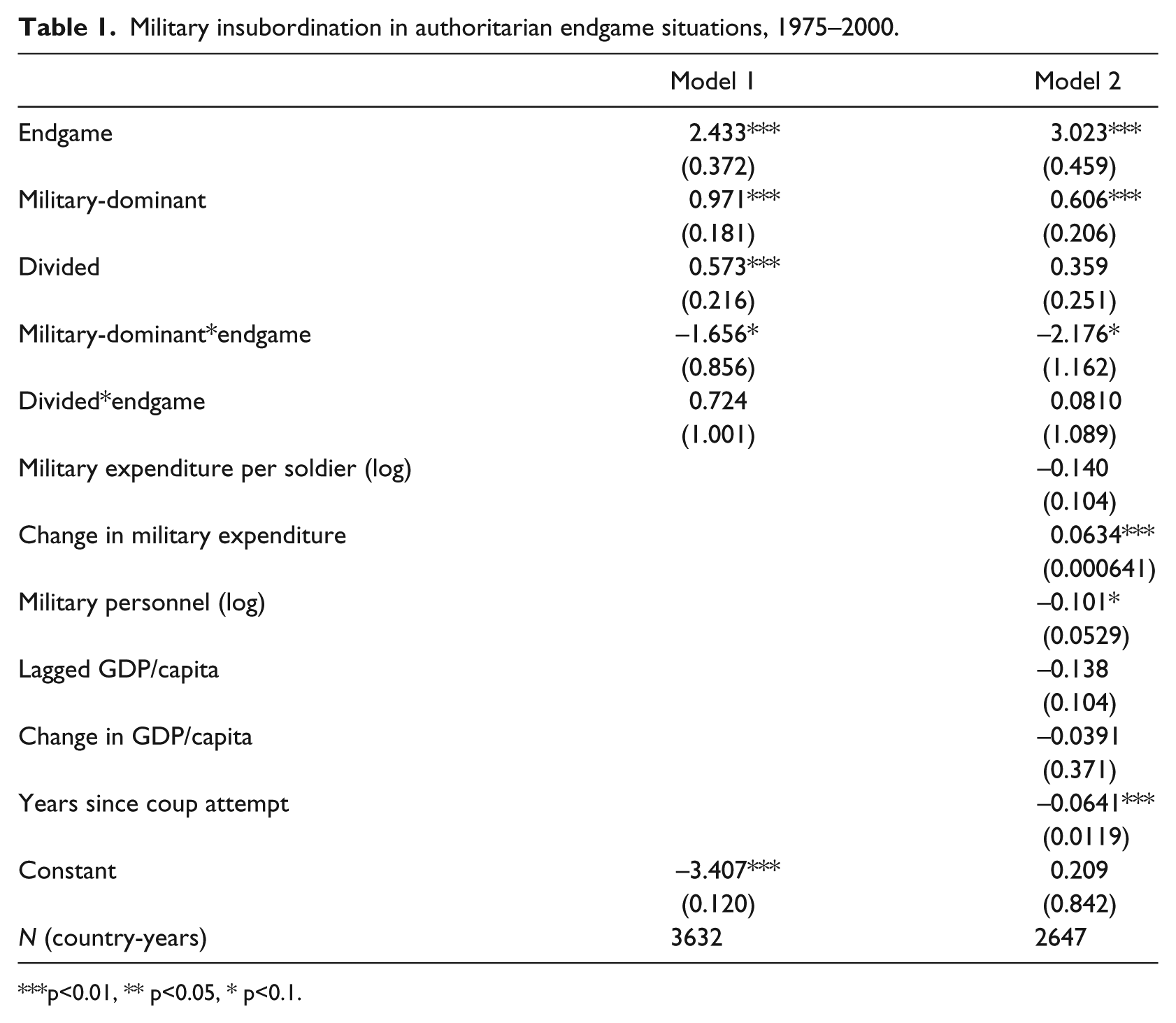
p<0.01, ** p<0.05, * p<0.1.
In order to evaluate Hypothesis 2 and to illustrate the substantive impact of each of these effects, I used the Clarify package (King et al., 2000) to estimate the change in the predicted probability of military insubordination conditional on the presence or absence of military-dominant and divided patterns of political–military relations. Table 2 displays the predicted probabilities.
Predicted probabilities.
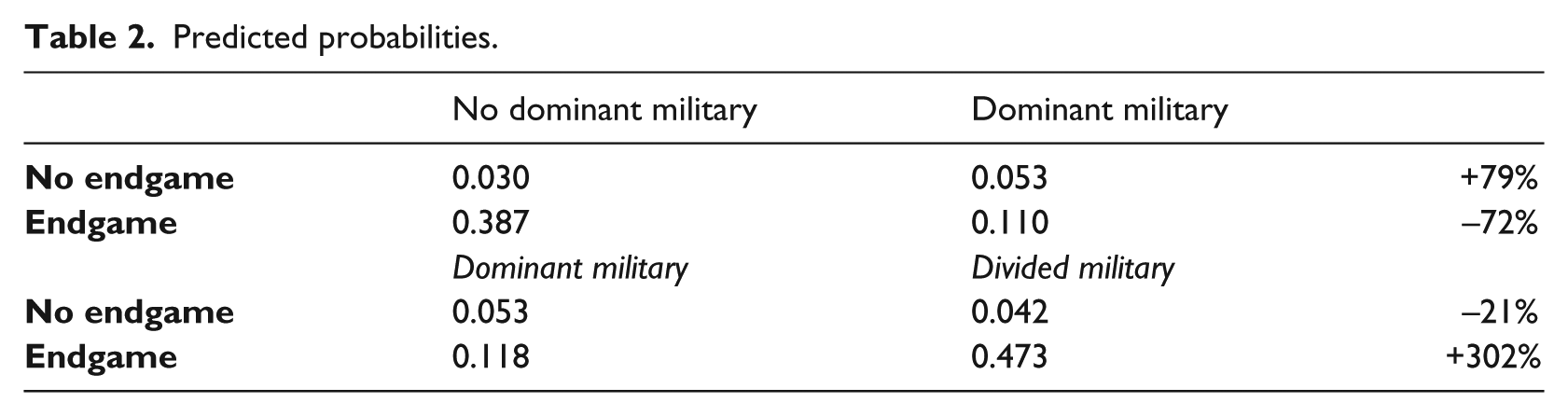
As displayed in Table 2, the presence of a dominant military increases the probability of military insubordination by 79% in non-endgame years, but reduces it by 72% in endgames. The last effect in Table 2 allows us to directly assess Hypothesis 2 by contrasting military-dominant with divided patterns of political–military relations. While the move from military-dominant to a divided pattern decreases the predicted probability by 21% in non-endgame years, the same movement increases the predicted probability of insubordination by 302% in endgame years, although only the effect in endgame years is significant. Taken together, the effect of the dominant military variable summarized in Table 2 lends strong support to Hypothesis 1, while the effect of the movement from military-dominant to a divided pattern on the predicted probability of military insubordination supports Hypothesis 2.
The analysis presented here thus supports my theoretical expectations: Historically determined patterns of political–military relations shape military behavior, and the presence of endgame scenarios is a major intervening factor. In the next section, I illustrate the underlying mechanisms by drawing on evidence from Syria, Egypt, and Tunisia.
Military insubordination in the Arab Spring: Evidence from Syria, Egypt, and Tunisia
How does this theory hold up against empirical evidence of military behavior during regime crises in the Arab Spring? Drawing on evidence from Syria, Egypt, and Tunisia, I begin by outlining how political–military relations in the Middle East before the Arab Spring did indeed differ along the lines suggested above; I then show that the behavior of both regime and military actors in these three cases varied in a way consistent with the theory.
Table 3 provides an overview of the patterns of political–military relations prevailing in the six Arab Spring countries along with the reaction of the armed forces to the mass uprisings. Only Bahrain does not follow the trajectory suggested by my theory. Given the low levels of military politicization in Bahrain, my theory would have predicted a relatively high likelihood of corporate insubordination. In the event, however, the Bahraini armed forces remained loyal. This exception is more apparent than real. In fact, the Bahraini regime received massive external support in the form of military intervention by Saudi Arabia, a fact that tilted the playing field in favor of the regime. Moreover, Bahrain did not have a national military in the same sense as was true of the other five cases, but rather relied on the recruitment of mainly Pakistani nationals into its armed forces (Louër, 2013).
Military politicization and insubordination in the Arab Spring.
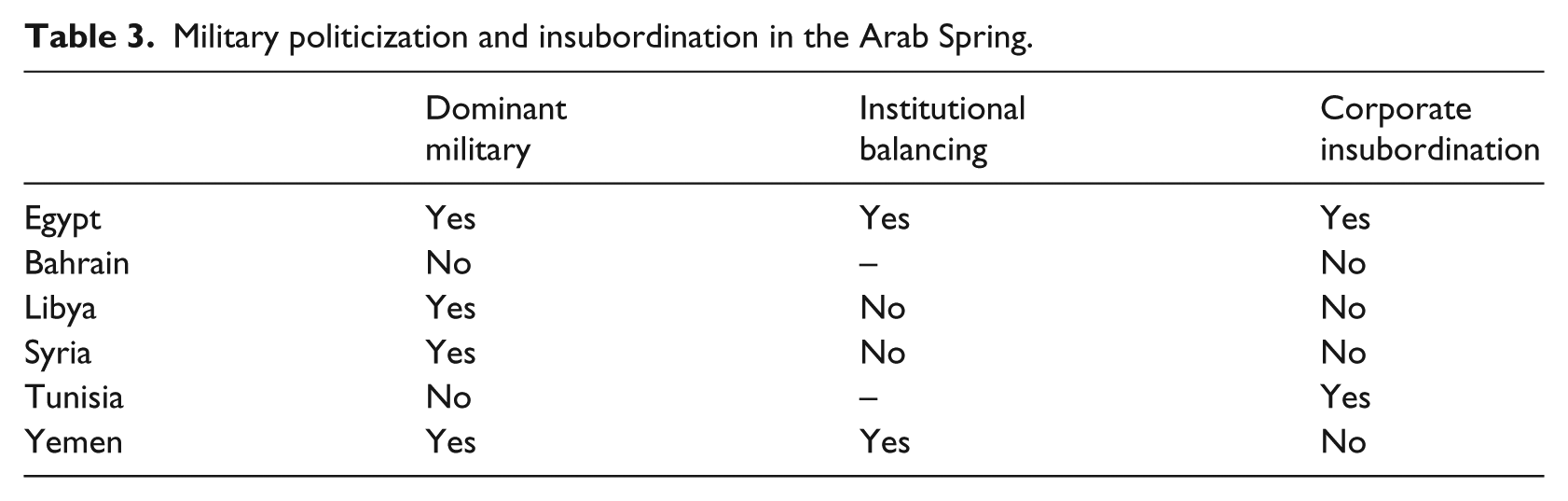
With the exception of Bahrain, then, all Arab Spring cases behave in a way consistent with my theory: Egypt’s politicized military faced competition from the civilian political realm and helped depose Hosni Mubarak; Libya’s politicized army did not face such competition and did not find a united stance for or against Gaddafi, but rather splintered into several parts; the Syrian military had retained its politically pivotal position and consequently remained loyal on the corporate level, but experienced massive defections from the rank and file; in Tunisia, a politically marginal military contributed to the fall of Ben Ali mainly through inaction; while in Yemen, finally, insubordination was attempted but the military split along the lines of elite conflict. In the following pages I illustrate three prominent paths towards military insubordination or loyalty in the Arab Spring.
Syria: Military politicization. The Syrian regime originated in a military coup led by Minister of Defense Hafiz al-Assad against a group of radical Ba’th Party leaders in 1970. As a consequence, a closely-knit group of elites established their hold over the military–security sector. Many of these central figures, such as long-term Chief of Staff Hikmat al-Shihabi, air force commander Muhammad al-Khuli, or veteran Minister of Defense Mustafa Tlass, were only replaced in the context of the succession to Bashar al-Assad after having held their positions for the better part of three decades.
The politicization of the Syrian military was maintained. Military officers remained prominent within the leading organs of the party and regularly served as cabinet ministers. Five out of 13 members of the Ba’th Regional Command elected at the 10th (and thus far last) Regional Congress in 2005 came from a military background and the defense minister was always a military officer. This can be seen as a particular form of coup-proofing adopted by the Syrian regime that aimed at binding military elites to the status quo (Albrecht, 2015).
It is instructive to look at the process of hereditary succession in Syria, particularly in contrast to similar designs in Egypt (see below). As Jason Brownlee explains, in Syria ‘military leaders retained enormous influence over the state and these elites supported the father–son transition’ (Brownlee, 2008: 41). Bashar al-Assad was built up as an heir to his father from within the military, a process that underlined the importance of that institution (Albrecht, 2015). Moreover, the transition from Hafiz to Bashar led to the replacement of old-guard military figures with a younger generation of officers loyal to Bashar. The rise of Bashar’s brother-in-law General Asif Shawkat to the head of military intelligence, that of Hassan Turkmani first to Chief of Staff and then Minister of Defense, and the emergence of Mahir al-Assad, the president’s brother as a commander in the 4th Armored Division are illustrative of these processes. The presence of closely connected individuals in key military commands further illustrates the continuing importance of the military in regulating access to power in Syria.
Units charged with regime protection, moreover, had a special position in Syria. Three major ‘praetorian’ units can be differentiated: the 4th Armored Division under the de facto command of Mahir al-Assad, the Republican Guards which included commanders such as Talal Makhluf, a member of the Makhluf clan of the president’s wife as commander of the 103rd Brigade, or Manaf Tlass, son of long-term minister of defense Mustafa Tlass and close friend of Bashar as commander of the 104th Brigade, and finally the Special Forces Regiments (Holliday, 2013: 43–45).
Given the politically pivotal position of the Syrian military, corporate insubordination was an unlikely outcome when the uprising erupted. Rather, parts of the security forces reacted violently to the original protests in Deraa. On 23 March, five days into the uprising, the military intervened for the first time with Special Forces units attacking a mosque in Deraa in which protestors had sought refuge. 2 Defections from the Syrian military, on the other hand, remained an individual matter. Despite the fact that dissatisfaction was widespread especially within the rank-and-file, large-scale defections did not occur in Syria until relatively late in the course of the conflict (Koehler et al., 2016). Taken together, the Syrian case illustrates how a politicized military renders corporate insubordination in endgame scenarios an unlikely outcome.
Egypt: Institutional balancing. Just as in Syria, the Egyptian regime originated in a military coup under the leadership of Gamal Abd al-Nasser in 1952 and the Egyptian armed forces subsequently developed into a politicized military. Under Nasser’s successor, Anwar al-Sadat, however, this situation slowly began to change and a divided pattern of political–military relations emerged. Three processes combined to restructure political–military relations in Egypt from the 1970s onwards: The demilitarization of Egyptian cabinets, the growth of the non-military security services, and the emergence of the project of hereditary succession in the 2000s.
A highly visible form of change in the political–military balance was the demilitarization of the Egyptian cabinet (Cooper, 1982). The number of military officers holding government offices declined steadily: while 35.6% of the 131 ministers serving under Nasser (1952–1970) hailed from the military, this proportion declined to 19.6% of the 163 ministers serving under Sadat (1970–1981) (Hilal, 2006: 162–163 and 189) and to less than 10% of the 120 ministers serving under Mubarak up to 2005 (Stacher, 2012: 156).
A parallel trend was the growth of the non-military security apparatus. Throughout the 1990s and 2000s, the budget of the Egyptian interior ministry grew at a much faster pace than did the defense budget. While Egypt spent on average 3.5 billion EGP annually on the ministry of interior in the 1990s, this figure grew more than six-fold to reach about 20 billion in the late 2000s; during the same period, by contrast, the military budget only doubled. By 2011, the security services had grown to an estimated 1.4 million personnel, or 1.5 times the strength of the military including its reserves (Sayigh, 2012: 6–7). The internal security forces controlled by the ministry of interior thus became the central agencies of repression and their influence was resented by the military (Mietzner, 2014: 439)
While the Egyptian military’s influence over politics receded, however, officers continued to profit from networks of active and former military personnel that permeated the state and public sector (Bou Nassif, 2013). The Egyptian military was not marginalized and its economic interests even significantly expanded under Mubarak’s watch. At the same time, however, the military’s role as kingmaker was being challenged by the rise of civilian elites as a long-term result of political liberalization and by plans to install Mubarak’s son Gamal in the presidency.
In contrast to Syria, the project of tawrith, of hereditary succession, was prepared in Egypt by allowing Gamal Mubarak to rise within the hegemonic National Democratic Party (NDP), rather than the military. A Gamal-advisor described his group as primarily interested in reforming the party from within and in enhancing its institutional capacities. As part of this project, the group was behind the organization of Egypt’s first multi-candidate presidential elections in 2005, a fact that further nurtured speculation that all this was part of a strategy to engineer Gamal’s succession. 3 Thus, in sharp contrast to Syria, ‘Gamal Mubarak virtually ignored the military apparatus and took over the politicized institutions of the state’ (Albrecht, 2015: 45).
The rise of Gamal and the ‘new guard’ did not go down well with high-ranking military leaders. 4 In a US embassy cable published on WikiLeaks, then Minister of Defense Tantawi is reported to have complained about Gamal and his cronies and speculation was rife about whether the military would accept the succession of the president’s son. 5 President Mubarak and his advisors were aware of these grievances within the officer corps. In an effort to secure the loyalty of the military leadership, on 28 January 2011 – the day on which the military had been deployed in the streets of Cairo – Mubarak first offered the position of Prime Minister to Field Marshall Tantawi and then, upon his refusal, that of Vice President (Bakry, 2011: 8). When Tantawi also rejected this offer, the new government formed on the next day saw the appointment of a military figure, General Ahmad Shafiq, as prime minister and the removal of several businessmen from their ministerial portfolios, some of whom had been closely associated with Gamal. 6
Such concessions came too late, however. On 31 January 2011 the military issued its first public statement after the beginning of the uprising in which it spoke of the legitimate demands of protesters and ruled out the use of force against the people. 7 This declaration was unprecedented since it had been issued without consulting the president and thus constituted a sign of independence. 8 On 10 February, the Supreme Council of the Armed Forces (SCAF) issued its ‘Communiqué No. 1’ in which it declared to remain in continuous session to monitor the situation. The next day, Hosni Mubarak was forced to resign and the SCAF took over power. Egyptian officers saw the military’s position as kingmaker threatened and took the opportunity of the 2011 uprising to enhance their position.
Tunisia: Military marginalization. In the context of Middle Eastern republics, the Tunisian military represent an exception in that it never occupied a politically pivotal position. Formed from Tunisian units within the French colonial army rather than the party militia that had fought French occupation (Willis, 2012: 86), the Tunisian armed forces did not have a special relationship to the national movement in general or the Neo-Destour in particular. Given this marginal position, the new leadership under President Bourguiba cemented military marginalization: until the promotion of Ben Ali to the Interior Ministry and the party’s political bureau in 1986, there were no officers in prominent positions within the single party. A decree issued in 1957 even prohibited members of the armed forces from joining political organizations, including the Neo-Destour (Camau and Geisser, 2003: 164–165). The marginality of the Tunisian military is also visible in the modest levels of growth it experienced during the Bourguiba-era: force levels increased only slightly from 25,000 in 1963 to around 40,000 in 1987, and defense expenditure averaged 3% of GDP over the same period. During the 1960s, the armed forces even shrank in relation to the overall population with 5.8 soldiers per 1000 inhabitants in 1963 but only 3.65 in 1973. 9
The Tunisian military did not play an active political role as a channel for elite recruitment either. Of the 11 different individuals who served as Defense Ministers under Bourguiba (1956–1987), not a single one was an active or former officer. Bourguiba even removed Béji Caïd Essebsi, the current Tunisian President, from the office for not observing the strict separation of the military and party-political spheres when he involved a military officer in the preparation of a party congress (Willis, 2012: 87). The same is true of other ministries with the exception of the Interior Ministry under Ben Ali (1986–1987), and even Ben Ali was an intelligence officer, rather than a military officer in the classical sense (Jebnoun, 2014). In brief, the Tunisian military never developed into a politicized institution.
The behavior of the Tunisian military in response to the 2011 uprising was a result of this marginality. Instead of relying on the military, Ben Ali had built up the police as a ‘praetorian guard’ in its own right. Numbering about 80,000 (Halon, 2012: 13), the police forces were the main agents of repression in Tunisia. What is more, the military leadership, represented by Army Chief of Staff Lieutenant-General Rachid Ammar, was deliberately kept misinformed about the situation in the country. Even when the military was deployed in Tunis from 11 January onwards, attempts were made to place army units under the control of the National Guard in a bid to ‘prevent the army from staging a coup’ (Jebnoun, 2014: 306). Only after the armed forces reinforced their troops on 13 January did they dominate the situation on the ground.
The role of the military in Tunisia has been overstated in some early accounts. While it is true that Rachid Ammar issued an order not to use force against protesters on 10 January 2011, the military continued to protect public buildings, including the Ministry of Interior, after this declaration and followed orders by their civilian superiors (Pachon, 2014: 516–517). Rather than coming from the military, the initiative that ultimately led Ben Ali to leave the country came from police special forces, more specifically the Brigades Anti-Terrorisme (BAT) under the command of Colonel Samir Tarhouni. Tarhouni, apparently on his own initiative, decided to arrest members of the Trabelsi family of Ben Ali’s wife Leila at Carthage airport, an event that contributed to Ben Ali’s decision to join his wife on a plane headed for Saudi Arabia. It is thus the police, rather than the military, that took the first active steps against parts of the regime (Belkhodja and Cheikhrouhou, 2013; Pachon, 2014).
These events, however, put the role of the military into even stronger relief. Faced with an open mutiny by police special forces and explicitly ordered to deal with the situation by the Minister of Defense, Ammar refused to deploy the army against Tarhouni and his supporters at the airport (Pachon, 2014: 520). The relative marginalization of the military in Tunisia and the fact that it was not actively involved in regime politics meant that Tunisian military elites had little to gain from supporting Ben Ali, but much to lose from openly clashing with rival forces or from violently repressing the uprising.
Conclusion
As I have argued in this article, military insubordination in endgame scenarios is driven by a distinct set of causal factors. Most importantly, while the presence of a dominant military increases coup likelihood during normal times, in endgame situations military insubordination is less likely if the military is a political institution. Dominant militaries rally around the flag unless officers had occasion and incentives to coordinate a stance critical of the regime before the outbreak of the uprising. I have demonstrated that this model holds up against evidence from the Arab Spring and beyond.
Note that this explanation differs significantly from the ‘patrimonialism’ hypothesis. Most importantly, it does not rest on the difficult notion that loyalty can be explained by some form of ‘closeness’. Not only is it doubtful whether such an explanation is particularly informative, but examples in which those considered ‘close’ to the incumbent became involved in attempts to overthrow him abound. In Syria, Hafiz al-Assad’s brother Rifat, commander of the praetorian Defense Companies, moved against his brother in 1983/1984; in Tunisia, President Bourguiba was overthrown by his own prime minister in 1987; and Manaf Tlass in Syria, Abd al-Fattah Yunis in Libya, and Ali Muhsin in Yemen are all cases of defections by regime insiders during the Arab Spring. In contrast to such explanations, I have focused on the corporate interests of militaries in their capacity as political institutions.
Furthermore, in contrast to explanations based on strategies of coup-proofing, I have argued that it is long-term developments of military politicization that crucially shape military behavior. Where military institutions acted as the launching organizations of authoritarian ruling coalitions, they develop into politically powerful actors. In the context of endgame scenarios, such militaries are likely to rally around the flag. Many questions regarding the role of the armed forces in popular uprisings against authoritarian rule must remain open. What I have shown, however, is that variation in military politicization is a crucial factor in understanding military behavior in crisis situations. Only if we take such variation into account can we understand why some militaries turn against non-democratic rulers, while others do not.
Footnotes
Acknowledgements
Research for this article has been conducted while I was a Research Associate in a research project on the international politics of authoritarian rule at King’s College London funded by the European Research Council. I would like to thank my colleagues there, Oisín Tansey and Alex Schmotz, for their support. The data on popular mass uprisings are part of a joint project with Holger Albrecht. I thank him for sharing his insights and for allowing me to use the data here. I also want to specifically thank Theodore McLauchlin for offering help far beyond the regular duties of a reviewer. David Pion-Berlin and Philippe Schmitter commented on earlier drafts.
Funding
This research received no specific grant from any funding agency in the public, commercial or not-for-profit sectors.