




Abstract
There are already a number of good accounts of the impact of the recent 2008–2014 economic crisis on European democracies. However, no systematic assessments of how it has affected specific aspects of democracy have so far been carried out. We explore its impact on European democracies in several areas by adopting the ‘quality of democracy’ framework. Our analysis shows that the measures we employ capture the variation in quality during this ‘troubled’ period. The empirical analysis suggests that a shrinking of private and public resources due to an economic downturn prompts three reactions: (a) a general deterioration of the rule of law; (b) citizens become more sensitive about what governments deliver; and (c) detachment from the institutional channels of representation along with a choice to protest.
Introduction
It is received wisdom that economic crises can deeply affect democratic regimes (see Gasiorowski, 1995). In the past, this happened in the most dramatic ways, with the breakdown of democracy and the emergence of authoritarian regimes, or even of totalitarian ones, as was the case of Weimar Germany and the establishment of the Nazi regime (see, e.g. Evans, 2003). More recently, economic crises have brought about basic radical changes, as well as relatively moderate partial transformations, in some democracies, including the building of the public sector of the economy, such as the New Deal in the USA; the democratic integration of the northern European Socialist parties as a political consequence of the economic crisis in the early 1930s; the partial invention and spread of the welfare state in most European democracies as a result of the crisis stemming from the destruction wrought by the Second World War; and the development of neo-corporatist arrangements, complemented by policies of privatization and deregulation, at the end of the 1970s as a way to respond to and seek to resolve the crisis of those years (see Gourevitch, 1986). We ask here what the political consequences of the 2008–2014 economic crisis are? The question arises at an appropriate time, since the economic crisis in European countries is apparently past. To explore this question it is, however, necessary to investigate which aspects of democracy have been the most affected by the crisis.
In addition to economic research on the crisis (see, e.g. Lane, 2012), there are salient political science analyses involving this issue, for instance, on the impact of the crisis on elections, which has been thoroughly analysed from different perspectives, such as how economic issues become dominant for voters under economic recession (see Singer, 2011); how incumbent parties are punished when there is an economic crisis (see Kriesi, 2014); the more general effects of the crisis on voting (again, Kriesi, 2014; or Lindvall, 2014); the impact of the crisis on voting and parties (Bosco and Verney, 2012); and on the welfare state in a specific group of countries, such as southern Europe (Petmesidou and Guillén, 2014). One of the most thoughtful empirical statements on what has been labelled the ‘Great Recession’ claims that ‘[v]oters did punish incumbents, as predicted; but […] in most countries, popular reactions to the Great Recession were surprisingly muted and moderate’ (Bermeo and Bartels, 2014: 3). Is this so? That is, was there at most a temporary change in voting behaviour? Or was there actually something else, perhaps a less evident but even more relevant impact than a change in voting preferences? In this vein, the historical cases cited above suggest that crises were opportunities for a reinvention of democracy, with the addition of welfare institutions and policies reshaping the representative channels of democracy. What, if anything, is there to be discovered this time?
It may be that one way to detect the deeper political consequences of economic crisis is to assess its impact on the quality of democracy. In other words, a democracy may or may not change as a consequence of an economic crisis, but some of the transformations may be largely irrelevant for citizens. At the same time, all changes that not only affect the actual working of democracy but also the lives of citizens, and which fall within the quality of democracy framework, need to be analysed in more depth because of their objective salience. Moreover, an analysis of this kind is also relevant to help political leaders better understand what is changing and where in order to intervene to counter unwanted impacts. In this article, we expect that the recent economic crisis has not only affected the political preferences of citizens in Europe, but also other dimensions of democracy. This is because an economic crisis limits governments’ capacity to spend, and it involves a general decline in citizens’ wealth. Thus, an economic crisis may promote changes in aspects of democracy not directly concerning voting behaviour, such as the rule of law or responsiveness. We therefore address a classic question by exploring the political consequences of an economic crisis – the 2008–2014 recession – by building on the ‘quality of democracy’ framework (see the Introduction to this special issue and below) and investigating which dimensions of democracy were most affected by the crisis.
Consequently, in this article we take analysis and measures of the crisis for granted. 1 Note that there is a large consensus in the literature regarding the beginning of the crisis in 2008 following the bankruptcy of Lehman Brothers (see, e.g. Bermeo and Pontusson, 2012). This consensus is also strengthened by data on gross domestic product (GDP) growth, involving stagnation or even recession that year. The possible end of the crisis is 2014, when there is a significant inversion in the data (see the official statistics from Eurostat, the Organisation for Economic Co-operation and Development (OECD) or the World Bank). Of course, these data can be complemented by similar data on unemployment and government deficits – with all the necessary caveats regarding differences among countries, even when using the same indicators. Moreover, looking at these data we can see strong evidence that the economic crisis affected different countries in quite different ways. For example, Greece and other southern European countries were much more deeply affected than eastern European countries, for example, Poland and the Czech Republic. Finally, as Bermeo and Bartels (2014: 4) state, the effective impact of the crisis can be measured when, under pressure from the European Union and international institutions, or even autonomously, governments made decisions to cope with the crisis, such as cutting budgets, with all the related consequences that ensued for people and the functioning of institutions. This was especially true during 2010–2012 (see Lane, 2012, and also Picard, 2015). 2
Following these observations about the main factors involved, we now focus on two subsequent research steps: how to measure democratic quality and how to assess the consequences of the economic crisis for democratic quality.
The quality of democracy and the economic crisis
To carry out this analysis, we must first outline what the quality of democracy is. We define the ‘quality of democracy’ in terms of three elements: (a) the rules and procedures that give citizens the power to check whether the government is pursuing the required objectives by implementing the rule of law, through elections, other forms of participation or indirectly in other ways, (quality in terms of procedure); (b) the liberty and equality, in different forms and to different degrees, that citizens, associations and communities enjoy (quality in terms of content); and (c) citizen satisfaction or governmental responsiveness (quality in terms of result) (Morlino, 2011; see also Sabl, 2015).
Second, when empirically developing and applying these three aspects of quality to democracy, we obtain eight related dimensions along which a democratic regime might vary. These are summarized in Table 1. The first five reported in the first column of Table 1 are procedural. Although they are relevant to the content of democracy, these dimensions mainly concern the rules. The first procedural quality is the rule of law. The second and third involve the two forms of accountability: electoral and inter-institutional. The fourth and fifth are the classic participation and competition. The sixth and seventh dimensions are substantive in nature. The sixth relates to full respect for rights, which are expanded through the achievement of a range of freedoms. The seventh is the progressive implementation of greater social and economic equality. The eighth and final dimension concerns responsiveness, which involves correspondence between the system’s outputs and the preferences of citizens and civil society in general.
Quality of democracy: Most relevant dimensions and sub-dimensions.

Each dimension can be measured along different sub-dimensions. There is insufficient space here for a detailed discussion of the definitions of each dimension and sub-dimension. 3 However, when empirical cases are examined more closely (see, e.g. Morlino and Piana, 2014), two aspects emerge. First, for dimensions such as inter-institutional accountability and freedom, no evident change can be detected. The simple reason is that we are analysing a short span of time, while the impact of crisis on these dimensions can be better detected over the medium or long term. Moreover, when the sub-dimensions are considered, some are more relevant than others; these are indicated in the second column of Table 1. We decided to consider these the actual defining sub-dimensions of each of the six remaining dimensions. Thus, regarding the rule of law – which is defined by the principle of the supremacy of law, the institutional and administrative capacity to formulate, implement, and enforce the law, and control of the security forces – the key aspects to analyse are implementation of the law and government effectiveness. For the first sub-dimension, the core feature captures the ‘actual’ rule of law, that is, the effective capacity of institutions to implement existing laws. With the second sub-dimension, the other side of the same coin is revealed, that is, whether institutions are able to carry out legislative activities that meet government indications, and if they are supported by a well-trained and professional bureaucracy. Electoral accountability involves citizens’ ability to evaluate governments according to their preferences and needs, and here it is mainly related to the pure and simple fact that the electorate has the actual possibility of rewarding or punishing the incumbent authorities when there are new elections. As for participation, this may be conventional (voter turnout) or unconventional (strikes, demonstrations, riots), and refers to the set of activities that enable citizens to influence the recruitment of and decisions made by political authorities. Regarding competition, the characteristic aspect is the presence and stability of political alternatives, which make competition itself actually possible and effective. This concerns patterns of ‘contestability’ of elections, that is the ‘input’ side, and patterns of different potential choices among policy alternatives – the ‘output’ side. Equality is defined as the absence of economic differences or disparities. Finally, responsiveness involves the extent to which citizens perceive the actions of government and its policies as being close to their preferences.
To justify and better understand the choice of the dimensions mentioned above and the selection of sub-dimensions (see Table 1), it is worth considering the two specific key factors that have a hypothetical impact on these dimensions and sub-dimensions, and their possible mechanisms. First, an economic crisis brings about a contraction in the public financial resources available for allocation. To mention the most obvious aspects, this is because of a decrease in revenues due to the decline in GDP, and/or an increase in public debt, constraining states’ ability to spend. Second, crisis entails a decrease in private wealth – especially per capita income at different social levels – due to higher unemployment and weaker services resulting from the reduction in public investment, with fewer resources available for blue- and white-collar workers, the self-employed middle class and entrepreneurs (see, e.g. Di Meglio, 2013; Monastiriotis et al., 2013).
Moreover, an economic crisis represents a period of great uncertainty for citizens, with material and personal consequences that may spur feelings of alienation towards the political system and actors in general (see Clarke et al., 1993), and may erode security and self-esteem (Di Tella et al., 2003). This might have consequences for political competition, as new parties may emerge, for example populist parties promoting anti-austerity measures, criticizing European Union governance or riding the immigration phenomenon due to diffuse feelings of insecurity, such as ‘Syriza’ and ‘Golden Dawn’ in Greece, the ‘Five Star Movement’ in Italy, ‘Podemos’ in Spain and the ‘UK Independence Party’ (‘UKIP’) in the United Kingdom. There might also be consequences for electoral accountability, as citizens may punish incumbents for their inability to deal with a worsening economic situation; and for participation, as citizens may reject institutional forms of participation, that is elections, and use more non-institutional forms, such as protest, as alternatives to voice their preferences and defend their interests.
Therefore, in our perspective there are two main consequences. The first one is the most frequently mentioned: growth in discontent and alienation among a country’s citizens. The second one has to do with the smaller amount of public resources that can be allocated. This second aspect is usually solved by increasing debt, as the relevant official data (see above) confirm. However, because of the rules they have accepted (see, e.g. Bermeo and Pontusson, 2012; and Lane, 2012) European Union member countries confronted a set of constraints in the period under consideration. Consequently, they had to cut ministerial budgets and resources allocated to local levels, as in Portugal, Ireland, Spain and Greece. They also accepted the international assistance of the International Monetary Fund (IMF), the World Bank and the European Commission.
Consequently, if the sub-dimensions indicated in Table 1 are considered, we can easily understand how the first mechanism – the emergence of, or increase in, people’s negative attitudes – which was much researched from different perspectives in the years before the economic crisis (see Torcal and Montero, 2006), affects electoral accountability, participation and competition.
The reduction in public resources might also have a negative effect on equality because of a fall in welfare provisions. A reduction in public resources often affects primary public services. The consequence is that the poorest segments of the population, which rely most heavily on these policies, are most adversely affected by the crisis and by this governmental response. This mechanism was particularly evident in Greece, where, as a consequence of the economic crisis, many welfare state services were cut with deep repercussions on the levels of inequality and poverty in general (see Petmesidou and Guillén, 2014).
An economic crisis represents a state of emergency in which governments might be allowed broader discretion in dealing with worsened conditions. However, as mentioned, the rule of law entails the principle of the supremacy of law. Therefore, if governing or administrative bodies are allowed discretionary powers it might represent a potential threat to aspects of the implementation of the law and the ability of an administration to implement policies (see Zywicki, 2012). Furthermore, in the context of the European Union, an economic crisis represents a threat to the rule of law because of the conditionality imposed on member states and the exceptional nature of the instruments used to deal with it in periods of emergency (see Kilpatrick, 2015).
Finally, we expect both factors to affect responsiveness: a growth in negative attitudes confirms that the incumbent authorities are unable to meet the needs of citizens, and consequently responsiveness worsens; a reduction in public resources strengthens a perception of lack of responsiveness when people confront a worsening of public services and governmental effectiveness. Thus, changed economic conditions might also have consequences for responsiveness, as citizens become more critical of how the political system complies with their preferences and needs (see Clarke et al., 1993; and Morlino and Quaranta, 2014).
Before describing the research design and conducting the empirical analysis, it should be added that an additional step in the research might be to check whether the impact on some dimensions or sub-dimensions of democratic quality was triggered by previously existing background conditions. That is, the economic crisis might have been a catalyst for changes in democratic quality. This step is beyond the scope of the present article. However, the analysis provides a picture which may alert political elites, oppositions included, to the aspects of democratic quality in which to intervene to mitigate the impact of economic crises.
Research design
Dependent variables
To test our argument, we draw on a time-series cross-sectional dataset covering 25 European countries from 2000 to 2014. 4 The countries were selected following a most similar systems design. Despite having different democratic histories and institutional configurations, European countries are relatively homogeneous. Moreover, the selected countries are all subject to the control of the European Union, which constrains them to ‘behave’ within the same institutional framework (see Armingeon and Baccaro, 2012; Lane, 2012). Therefore, the potential effect of the European Union, especially regarding the economy, is controlled for. Finally, this selection permits the use of quality data produced by international organizations. 5
This section describes the operationalization of the dimensions of the quality of democracy, which uses a parsimonious approach. The measurement could be deemed ‘under-determined’, given the complexity of the concept analysed. However, this is an exploratory study aiming to test whether indicators measuring ‘partial’ aspects 6 of the dimensions of democratic quality change as economic conditions change. Therefore, each dimension is measured only using one or two indices. We follow the scheme outlined in Table 1, which relies on Morlino (2011, see Chapter 7). 7
The rule of law is measured with two indices from the World Governance Indicators (Kaufmann et al., 2009). The first is the ‘rule of law’ index, which measures the extent to which actors comply with the law and have confidence in it, contracts are enforced, property rights guaranteed, and the quality of the police and the courts maintained. The second is the ‘government effectiveness’ index, which measures the capacity of institutions to produce and implement quality legislation, and the presence of a professional bureaucracy. Electoral accountability is measured using the percentage of votes gained by incumbents in an election at time t, that is, the electoral performance of those parties in power before the following election. 8 This makes it possible to test whether incumbents are rewarded or punished (see Lewis-Beck and Stegmaier, 2000). Political participation is operationalized in two ways. Conventional participation is measured using electoral turnout (IDEA, 2015). Unconventional participation is measured by using a count of protest actions – demonstrations, strikes, boycotts and riots – initiated by civilians, the opposition, labour organizations, the media, non-governmental organizations and human rights organizations (GDELT, 2015).
Competition is measured using two indicators. The first is an index of competition gauging the share of seats gained by smaller parties in parliamentary elections, calculated by subtracting 100 from the percentage of seats held by the largest party (Vanhanen, 2003), which indicates how likely it is for smaller parties to gain seats. The second is the effective number of parliamentary parties (Laakso and Taagepera, 1979). This measure indirectly indicates what the structure of competition might be. A higher number of parties might indicate a larger opposition, or the presence of coalitions, while fewer parties might indicate a more stable party system or a recurrent pattern of alternation.
Equality is measured using the ‘Gini index’ (Solt, 2014), which accounts for the distribution of income. The Gini index is a convenient tool that provides an indication of how unequal the distribution of wealth in a country is across time. Responsiveness is measured by looking at the legitimacy of the regime using citizen evaluations. The variable used is the evaluation by citizens of the way democracy is developing in their country, expressed as the percentage of respondents who feel satisfied. This operationalization assumes that when citizens express satisfaction about the way democracy works, it means that the output of institutions sufficiently meets their preferences (Morlino and Quaranta, 2014).
Independent variables
As the article focuses on how the recent economic crisis impacted the quality of democracy, we use three different measurements. The first is a dummy variable identifying the years after 2008. This approach accounts for the period of economic downturn, roughly corresponding to the ‘Great Recession’ (see Bermeo and Bartels, 2014). However, distinguishing between two periods – before and after a time point – may not allow the detection of nuances in the variation in economic performance within countries. Some countries, for instance, had a shorter period of crisis, while others are still striving to find a way out. Therefore, continuous measures may be more appropriate. On the one hand, we use the ‘Economic Performance Index’ (henceforth, EPI) (Khramov and Lee, 2013), a weighted index summarizing deviations from the desired levels of inflation, unemployment, deficit and growth. These are ‘objective’ factors affecting three important segments of the economy: firms, households and governments. 9 A value of the index above 95 means that economic performance is ‘excellent’, above 90 is ‘good’, above 80 is ‘fair’, above 60 is ‘poor’ and below 60 is ‘bad’. On the other hand, we use the ‘Consumer Confidence Indicator’ (henceforth, CCI), which assesses citizens’ perception of the economy by looking at households’ financial situation, the general status of the economy, employment and savings expectations (European Commission, 2014). The indicator ranges from −100 – all respondents have negative opinions – to +100 – all respondents have positive opinions about the economy. Continuous measures of economic performance have the advantage of being summary indices taking into account different aspects of the economy, not just specific aspects. Indeed, using macro-economic indicators as separate predictors would lead to some collinearity, as these conditions are very likely to be related to each other. These two indices are measured at t-1, in order to test whether the previous year’s economic situation affects the dimensions of democratic quality. 10
In addition to the independent economic variables, we add dummy variables to the models indicating clusters of countries which share common characteristics, for instance regarding democratic history, authoritarian legacies, culture, institutional configurations, economic development, the welfare state model and even geographical proximity. The models thus check for area-specific effects using the following dummy variables: Eastern (as reference category), Continental, Southern, Scandinavian and Anglo-Saxon countries.
Models
Time-series cross-section (TSCS) data can be modelled as if they were multilevel data. 11 It has been shown that multilevel models are more efficient than classic models when applied to TSCS data, as observations can be treated as nested in both countries and years (Shor et al., 2007). The models are estimated in the Bayesian framework (see Jackman, 2009). This framework produces more reliable standard errors in the presence of small sample sizes, provides better model fits when the data structures are complex, and permits the estimation of uncertainties for all the model parameters. 12 The models are estimated using the Gibbs sampler and are based on 10,000 Markov chain Monte Carlo (MCMC) draws running two chains. 13 All the models are linear, with the exception of the one whose dependent variable is the number of protests, which is estimated using a negative binomial framework. 14
Findings
Table 2 shows the models that test whether the indicators measuring the quality of democracies changed after 2008. In the period after the beginning of the crisis, the rule of law seems to have been affected differently in European countries depending on which aspect is taken into account. The capacity for law enforcement increased, while the capacity to produce and implement legislation, and the quality of administration, decreased. Conversely, electoral accountability did not change after 2008. The participation dimension, by contrast, reveals significant shifts. Voter turnout decreased after 2008, on average by about 3%, with the highest occurring in Scandinavia and Continental Europe, while, on average, the number of protests increased compared to the previous period. The competition dimension did not change after the beginning of the crisis. The chances of small parties gaining more seats and the number of parties in parliament did not change after 2008. However, the distribution of economic resources appears to have become more unequal after 2008. In fact, the Gini index increased by about 0.6 points after the beginning of the crisis. Finally, responsiveness declined. After 2008, satisfaction with democracy decreased by about 3.6%.
The association between the post-2008 period and the qualities of democracy.
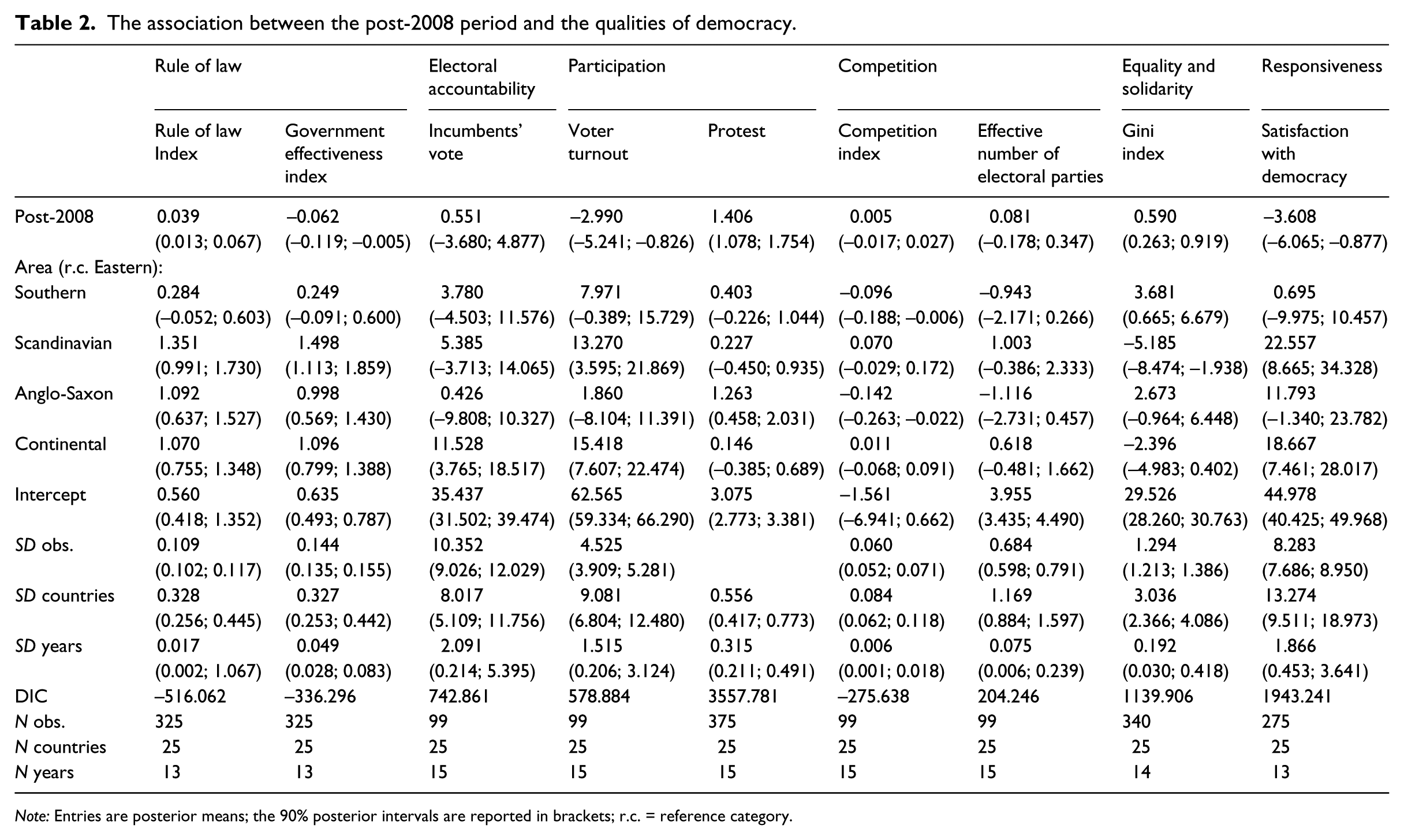
Note: Entries are posterior means; the 90% posterior intervals are reported in brackets; r.c. = reference category.
In Table 3, the dummy variable identifying the years after 2008 is replaced with the continuous EPI variable to better capture the effects of the dynamic nature of the economy. In this case, both of the indices measuring the rule of law have a positive association with the previous year’s economic performance. Electoral accountability also increased as economic performance increased. This means that when economic performance improved, citizens rewarded the parties in office. Participation is affected by economic performance in different ways. Turnout does not seem to be affected by variation in objective economic conditions. However, the number of protests decreases when the economy improves. The two measures of competition are not associated with the state of the economy. Inequality, in contrast, increases when the economy improves. The last column shows that an improvement in the economy leads to an increase in citizens’ evaluation of the regime’s performance.
The association between the Economic Performance Index (EPI) and the qualities of democracy.
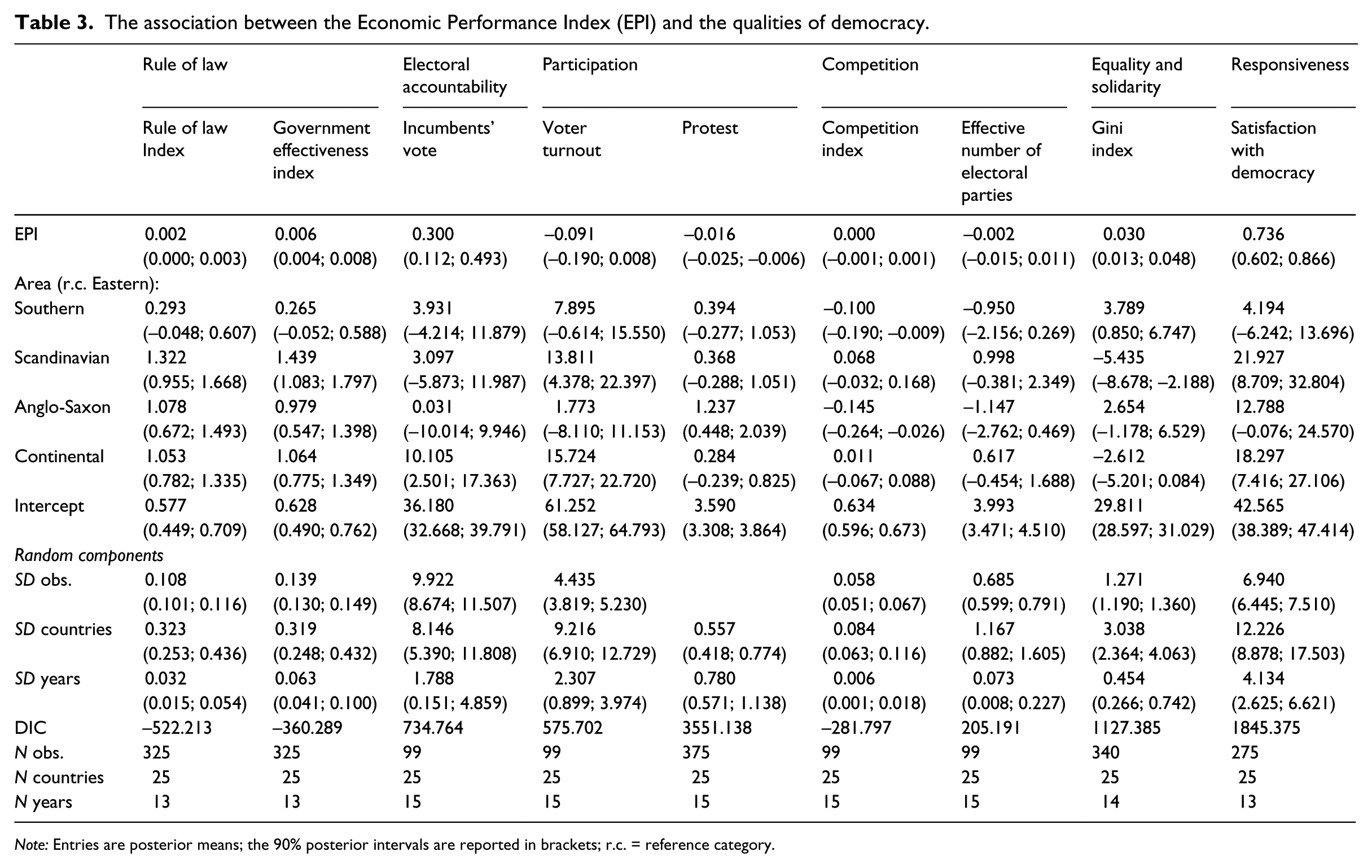
Note: Entries are posterior means; the 90% posterior intervals are reported in brackets; r.c. = reference category.
Finally, Table 4 shows the association between the CCI and the dimensions of democratic quality, and offers a different view of this relationship, as this is a continuous measure of subjective evaluation of the economy. As before, the rule of law measures increase as the economy improves, but in this case electoral accountability does not improve with positive economic perceptions. In fact, when subjective evaluation of the economy improves, it is not automatic that citizens will confirm their vote for the incumbent authorities. Citizens also tend to vote more and protest less when the economy is perceived to be performing well. Competition, as seen before, is not affected by changes in the economy, and neither is inequality. Instead, the level of responsiveness grows as consumer confidence increases.
The association between the Consumer Confidence Indicator (CCI) and the qualities of democracy.
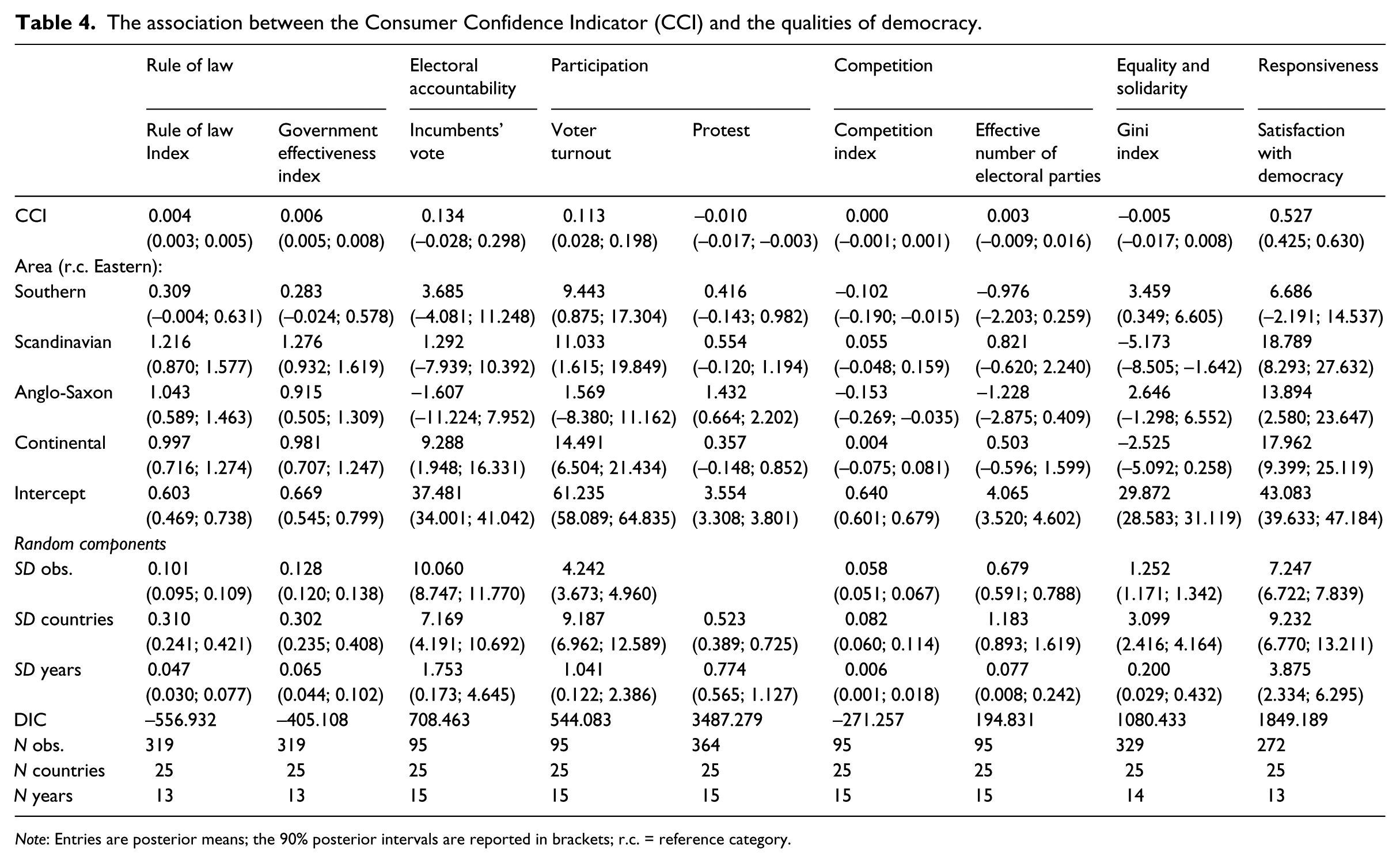
Note: Entries are posterior means; the 90% posterior intervals are reported in brackets; r.c. = reference category.
In general, this analysis indicates that almost all the dimensions of the quality of democracies change following changes in economic conditions. Worsening of the economy mainly affects the rule of law, electoral accountability, participation, equality and responsiveness. Only competition seems to be unaffected by the economy. Of course, the analysis also shows that the way the economy is measured may play a role. The first measure looks at the difference between two periods, not accounting for possible differences in economic performance within and between countries. The other two measures provide a more nuanced look at how the economy may affect the dimensions of democratic quality. 15
Concluding remarks
Further research will be needed to analyse in depth how an economic crisis affects the quality of democracies, starting from an exhaustive measurement of its dimensions. However, our analysis suggests, first, that the measures employed are able to capture the variation in quality during a troubled period, and provide an application of the ‘quality of democracy’ empirical model. Second, building on the results of the empirical analysis, we can see the mechanisms at work more clearly. In fact, when there is a contraction of private and public resources, in all likelihood due to an economic downturn, our empirical analysis suggests that three main reactions are prompted: (1) There is greater difficulty in decision-making and eventually a worsening of the quality of administration; (2) Citizens are sensitive about what governments deliver and therefore assess their responsiveness negatively, partly as a result of the difficulty governments have in dealing with the suddenly changed economic situation; and (3) There is a detachment and alienation from political institutions as well as from the related institutional channel of representation along with a choice to protest.
Parallel with the changes that occur when the economy worsens, we can see these same mechanisms working in the opposite directions if the economy improves. These findings show that economic changes may indeed alter some elements of democracies. What is more relevant here is to understand the possible consequences of (and responses to) these changes, given the obvious links among the dimensions of democratic quality. We have found that citizens become more dissatisfied, dismiss the traditional forms of representation and choose alternative ones. This suggests that in moments of crisis political actors become less representative and less able to aggregate preferences or meet citizens’ policy demands. A potential consequence of these transformations is a decline in the legitimacy of democratic regimes, partly given the greater responsibility of governments towards the European Union, at the expense of their citizens (see Mair, 2009). A solution to these problems would be a more consistent and rapid decision-making process in order to comply with citizens’ needs. Unfortunately, as seen, the effectiveness of governments during an economic crisis appears to decline, while it improves when the economy performs well. We have also shown, unlike previous research on the consequences of the economic crisis, that the same pattern applies to the enforcement of laws and contracts, the protection of property rights and the quality of the police and courts. Therefore, if in general the rule of law and government effectiveness worsen when economic performance deteriorates, the paradox is that the preferences of citizens have to be more urgently met when governments are unable to respond or maintain the rule of law due to the various constraints imposed by the crisis. The solution to these problems could lie in an equilibrium between these aspects, which would probably be found if democracies were more responsible towards citizens and (temporarily) less responsible towards other actors. Of course, this analysis only provides evidence about how a crisis affects aspects of democracies. We have drawn this scenario using empirical data; practical solutions would need to be put forward by elected officials and political leaders.
It should be added that this study is not without limitations. One is the limited inclusion of additional control variables in the models. Unfortunately, dealing with many dependent variables to measure the different dimensions of the quality of democracy does not allow a parsimonious model specification. The ideal would have been to select appropriate control variables for each dependent variable. However, this would have made the models very different from each other and would have required us to discuss all these controls. It should be evident, however, that this would have extended the scope of the discussion about the control variables much further. Alternatively, we could have included the same control variables in all the models predicting different dependent variables. However, this strategy would have led to mis-specified models, as these control variables would have been very inappropriate in most cases. Therefore, to keep the models parsimonious and straightforward, we decided to use the same independent variables for all the dependent variables, also to test the effects of the same variables and to present, therefore, comparable models with a comparable specification. The results should be interpreted with caution due to the exploratory nature of the analysis, although the findings do indicate that economic performance matters for some dimensions of democratic quality. Future research could analyse single dimensions of democracy, also taking into account how the effect of the economy changes across sub-groups of countries or areas. Unfortunately, space constraints have limited our pursuing this path.
Another limitation might be considered to be the focus on Europe. Further research should engage in a wider comparison, possibly with a longer time span, of the effects of economic performance on democratic quality. A further development could be to handle reverse causation, with the quality of democracy being responsible for better economic performance (see, e.g. Persson and Tabellini, 2003). Looking at some cases in depth could solve this issue. Just to cite a few instances: despite being industrially weaker than Italy, Spain was better able to cope with the crisis because of the higher quality of factors involving the rule of law. On the contrary, Greece has had more serious problems in dealing with the crisis because of shortcomings in its overall rule of law. A lengthy discussion of such cases was, of course, not possible here. The problem of reverse causation, which we tried to limit by using lagged independent variables, needs to be seriously accounted for in future research, possibly by combining quantitative and qualitative approaches. Another factor to be accounted for in future research is the quality of social and economic policy. This can be considered an intervening variable that plausibly affects the impact of economic crisis on various dimensions of the quality of democracy.
To conclude, this article has provided a preliminary evaluation of how the recent economic crisis affected some dimensions of democratic quality. These results can provide valuable information to help re-define some policies, whenever possible, to improve democratic quality. Indeed, an economic crisis, and crises in general, may represent an opportunity to design political and institutional reforms that might enhance democracy. Crises do not only hinder democracies – they might do so in the short run – but in the long run they can be exploited to address those aspects which are defective and which the crisis brings to the surface, serving as a ‘trigger’. As already shown in the literature, economic crises are moments of change for democracy, not only at the national level (see Gasiorowski, 1995) but also at the supranational level, as in the recent case involving the possible further political integration of the European Union (see Schmitter, 2014). Unfortunately, it is too early to detect these changes, which are likely to take some time to occur. Thus, future research will be required to explore the long-term effects of the recent crisis, with a more specific analysis of single cases or groups of countries affected.
Footnotes
Acknowledgements
The authors would like to thank the IPSR editor, Mark Kesselman, the editors of the special issue, Brigitte Geissel, Marianne Kneuer and Hans-Joachim Lauth, and the three anonymous reviewers for their comments on previous versions of the article.
Funding
This work was supported by the Italian Ministry of Education, University and Research (Economic Crisis and Quality of Democracies in Europe; grant number 2010WKTTJP).