




Abstract
Combining data from the sixth wave (2010–2014) of the World Values Survey (WVS) and the 2012–2013 Perceptions of Electoral Integrity (PEI) expert survey, this study looks at the link between the frequency of citizens’ informational use of traditional media (newspapers, magazines, radio and TV) and the internet, and the accuracy of their perceptions of the electoral process, and investigates how this link varies depending on countries’ levels of press freedom. A multilevel analysis including data from 16 countries shows that the frequency of the use of traditional media has a significantly more positive effect on the accuracy of citizens’ perceptions of electoral integrity in countries with high levels of press freedom compared with countries with low levels of press freedom. The frequency of the use of the internet relates similarly to the accuracy of perceptions of electoral integrity in countries with high and low levels of press freedom.
Introduction
Free and fair elections are a crucial, albeit insufficient, aspect of any well-functioning democracy. There are, however, numerous methods for political candidates, parties and institutions to cause elections to lose their openness and fairness at various stages in the electoral cycle (Norris, 2014). For example, opposition parties may be prevented from running, candidates may not be covered equally in the media, or votes may be purposefully miscounted.
Although elections and the conduct surrounding them have long been in the scholarly spotlight, academic interest in public perceptions of electoral fairness and integrity has only begun to emerge in recent years (e.g. Birch, 2010; Carreras and Irepoglu, 2013; McAllister and White, 2011; Norris, 2014). This research has focused mainly on citizens’ perceptions of electoral integrity and the consequences thereof on electoral participation and regime support. As such, it offers an important addition to reports from (inter)national election observers. Ultimately, the voters are the key actors in the electoral process, and a sound comprehension of their perceptions is crucial if we want to gain a full understanding of the electoral process.
This study seeks to add to the existing scholarship on public opinion and electoral integrity by looking at the accuracy of citizens’ perceptions of electoral integrity. As such, it also adds to the ongoing debate concerning citizens’ political knowledge and competence, and the discussion about what citizens should know to make informed political judgements and decisions (Popkin and Dimock, 1999). While not all political knowledge may be equally important (Jenssen et al., 2012), citizens’ accuracy of their assessments of the quality of the electoral system seems an important aspect of political knowledge as citizens’ assessments of the quality of elections are known to influence the extent to which and how they engage in the political system. Norris (2014), for example, confirms that citizens who perceive the elections as being fair are more likely to vote, whereas perceived electoral malpractices increase the likelihood to protest. Norris (2014) also reveals a positive link between perceptions of electoral integrity and various measures of system support, including satisfaction with democracy and confidence in Parliament and government. Given the consequences of citizens’ perceptions of electoral integrity for their political attitudes and behaviour, understanding how accurate their perceptions are is important since ill-informed citizens may not participate in politics or participate differently than they would if they have accurate perceptions of the fairness of the elections held in their country.
Specifically, the current study explores the association between citizens’ media use patterns and the accuracy of their perceptions of the quality of the elections held in their country, and investigates how this association interacts with a country’s level of press freedom. The research question motivating my study thus reads: To what extent does media use relate to the accuracy of citizens’ assessments of the quality of their national elections and to what extent is this conditioned by their country’s level of press freedom?
Media are undoubtedly an invaluable source of information from which people draw knowledge to form their opinion about current affairs, including elections, and are thus suggested to positively relate to political awareness (e.g. Curran et al., 2009; Graber, 1988). I distinguish the use of new media (the internet) from the use of traditional mass media (television, newspapers, magazines, and radio) and hypothesize conditional effects of the use of media on the accuracy of citizens’ perceptions of electoral integrity depending on a country’s levels of press freedom. In brief, in countries with free flow of information, the use of traditional media is anticipated to have a more positive effect on the accuracy of citizens’ perceptions of electoral integrity than in countries with limited press freedom where traditional media operate under the direct control of the state and offer one-sided, censored, information (Levitsky and Way, 2002). Since controlling the information contained by new media such as the internet is difficult due to its global online locale (Hachigian, 2002), new media are expected to be an important source offering a broad variety of information, in particular in those countries with limited press freedom and where traditional media offer state controlled information. In countries with limited press freedom, the information available from various sources on the internet will offer a perspective of the elections that may differ from, and be more accurate than, the official line taken by the state that is presented in the traditional, state-controlled media. By contrast, in countries with high levels of press freedom, both traditional and new media sources are expected to provide complete and accurate information about the elections, making the additional value of new media to citizens’ perceptions of electoral integrity less substantial. Hence, it is mainly in countries with low levels of freedom of the press that the internet will be an important alternative source of information that provides the knowledge necessary for citizens to form an accurate opinion about the quality of the elections held in their country.
To answer my research questions and test my hypotheses, I draw on data from the sixth wave (2010–2014) of the World Values Survey (WVS) and data from the Perceptions of Electoral Integrity (PEI) expert survey (Norris et al., 2014) across 16 countries with various levels of press freedom.
Theory
Media use and accuracy of perceptions of electoral integrity
An informed electorate with a substantial level of political knowledge is generally considered as an important attribute for the polities of democratic countries. Delli Carpini and Keeter (1996: 63), for example, argue that “citizens are better able to make choices and respond to relevant cues if they have a broader range of information to draw on.” An understanding of political candidates and their policies allows citizens to form reasoned opinions and to participate effectively in the political process. Popkin and Dimock (1999) show how citizens’ knowledge about political institutions and the political system influences the way they reason about politics, and how it allows them to perform their role as voters and citizens in a meaningful way. Furthermore, assessments of the quality of the electoral system are known to relate to feelings of political legitimacy and to influence the extent to which and how citizens engage in the political system, with public perceptions of electoral malpractice mobilizing protest actions and violent conflict and perceptions of electoral integrity increasing the likelihood to participate in elections (Birch, 2010; Norris, 2014). Given these attitudinal and behavioural consequences of perceptions of electoral integrity, understanding the accuracy of these perceptions is important since an ill-informed public may not participate in politics or participate differently than it would if it were well-informed and have accurate perceptions of the fairness of the elections.
Given the significance of elections, they are widely reported upon by the media. Consequently, media serve as an important source of information for citizens to form their opinion about elections and are thus expected to have a substantial influence on the accuracy of citizens’ perceptions of the electoral process (see also Norris, 2014).
Scholarly opinion regarding the influence of news media on citizens’ political knowledge is, however, disparate. Some perceive the media as being increasingly sensational and personality oriented, arguing that the media negatively affect social capital (Putnam, 2000). Furthermore, media malaise scholars claim that media – and television and the internet in particular – are generally only used for entertainment purposes and thus do not promote active and informed citizenship (Scheufele and Nisbet, 2002). Even the viewing of supposedly informative television news programmes has not always been positively correlated with elevated political knowledge (McLeod and McDonald, 1985).
In contrast to these critical claims about the media, various scholars have shown that citizens who use media intensively are noticeably better informed and more knowledgeable about politics than those who do not (e.g. Chaffee and Kanihan, 1997; Kenski and Stroud, 2006; Xenos and Moy, 2007). Perhaps unsurprisingly, in particular the use of mass media that are intended for informational purposes appear to have pro-civic consequences (McLeod et al., 1999; Shah et al., 2001).
Different media seem, however, to have a different impact on political knowledge. Here, I focus on the expected divergent effect of traditional media (radio, newspapers, magazines and television), and new, internet-based, media. While television and newspapers were traditionally the most prominent news sources, the internet has become an influential medium over the last two decades (Kaye and Johnson, 2002). Compared with traditional media, the internet is more interactive and allows its users to engage in the exchange of political information and perspectives through online discussion networks (Delli Carpini, 2000; Kaye and Johnson, 2002).
While the information on the internet remains largely unchecked and, as a result of its open source access, may include unreliable information, it does provide a wealth of easily accessible information from various sources without concern for geographical location (Ayres, 1999; Norris and Inglehart, 2009). While some work suggests that the new technologies are polarizing society because people tend to get together online with people with similar values, interests and concerns (e.g. Dahlberg, 2001; Sunstein, 2001), the internet offers its users the potential of an immense exposure to diverse political information and arguments, including those that challenge or conflict with the political beliefs they themselves or the regimes they reside in prefer. By contrast, users of traditional media are typically exposed to news that is more localized in its nature and content. As such, the internet expands access to political information and offers citizens new possibilities for learning about political ideas (Bimber, 1998). As a consequence, I expect that access to the internet will correlate positively with the accuracy of citizens’ perceptions of electoral integrity. I contend, however, that this effect, as well as the link between the informational use of traditional media and the accuracy of citizens’ perceptions of electoral integrity, is context-dependent and will differ depending on a country’s level of press freedom.
Cross-national differences in press freedom, and media use and accuracy of perceptions of electoral integrity
Different countries across the globe attempt, with varying degrees of success, to control or influence the information media provide. White et al. (2005) for instance, describe how the Russian state television, which operates under the direct control of the Kremlin, devoted a disproportionate share of coverage to Vladimir Putin and his Unity Party in the scope of the 1999 parliamentary and 2000 presidential elections. Norris and Inglehart (2010) portray the example of Myanmar, where critical opinions of the military junta and the governmental establishment are not covered in the domestic media. In environments such as these, the state-controlled media offer one-sided accounts aimed at inspiring confidence in the regime and elections, even though international and human rights observers may consider the regime unfair. Exposed only to these biased perspectives, citizens will generally be ill-informed and unaware of criticism against the regime they reside in. Under such conditions, the effect of access to traditional media is not expected to have a significant, let alone positive, effect on the accuracy of citizens’ perceptions of electoral integrity.
In societies with a comparatively free press, the media tend to take up the role of ‘watchdogs’ which ensure the accountability of the decision makers and political elite, and as a result strengthen the transparency of the political process (Norris, 2011). In such a media environment where the traditional media provide open and diverse coverage of political affairs, the frequency of the use of traditional media is anticipated to positively correlate with the accuracy of citizens’ perceptions of electoral integrity.
Investigating citizens’ overall regime support, Norris and Inglehart (2010) argue that state restriction of news broadcasting achieves its intended propagandistic effects. In particular, in states with restricted media environments, those who are most exposed to the news in traditional media show higher levels of confidence in the regime institutions. By contrast, in states with pluralistic media environments, there is no substantial link between the use of traditional media and institutional confidence. In his study of Central and Eastern European countries, Leeson (2008) concludes that where governments regulate the media industry and control the content of news programmes, citizens appear to have less accurate knowledge about political issues. Leeson (2008), however, focuses on the aggregate level and does not investigate to what extent the frequency of individual citizens’ media use affects their political knowledge and how that may vary depending on a country’s level of media freedom.
Based on the above, I hypothesize:
H1: The frequency of citizens’ informational use of traditional media will have a stronger positive effect on the accuracy of their perceptions of electoral integrity in countries with high levels of press freedom compared with countries with limited press freedom.
While regimes such as North Korea, China and Singapore censor and limit access to the internet, doing so is generally much harder to achieve than manipulating traditional, domestically located mass media outlets (Norris and Inglehart, 2009; 2010). Even China’s so-called Great Firewall is not impenetrable (Clayton et al., 2006). Hence, the internet offers an unprecedented possibility for citizens across the globe – including those living in countries with generally limited freedom of press – to be connected directly to global networks and to read news websites and blogs originating from different countries around the world (Norris and Inglehart, 2009). Consequently, it allows its users to be informed by a broad spectrum of sources offering unfiltered information (Norris, 2000). This is expected to be particularly important for citizens living in countries with limited press freedom as they are expected, proportionally speaking, to gain more accurate supplementary information about current affairs through the internet than citizens residing in countries with a free press. In countries where traditional media are influenced by governmental control (Norris and Inglehart, 2009), the internet embodies more of an alternative source of information that provides its users with the knowledge they do not receive via traditional media compared to countries where the government does not act as a gatekeeper of the traditional media and where traditional media offer a more diverse spectrum of information. Hence, while the informational use of new media is anticipated to relate positively to the accuracy of perceptions of electoral integrity overall, it is expected to play a more crucial role in countries with low levels of press freedom compared with countries with high levels of press freedom.
Therefore, I suggest the following hypothesis:
H2: The frequency of citizens’ informational use of new media will have a stronger positive effect on the accuracy of their perceptions of electoral integrity in countries with less press freedom compared with countries with high press freedom.
Data and measurements
To investigate the link between citizens’ frequency of media use and the accuracy of their perceptions of the quality and integrity of the electoral process, I draw on the sixth wave of the WVS (2010–2014) (see for more information: www.worldvaluessurvey.org) and the PEI expert survey (Norris et al., 2014). The PEI expert survey consults around 40 domestic and international experts for each election held in the countries examined by the survey. These experts are asked to assess to what extent the contests meet international standards during the entire electoral process (more detailed information about the project and the PEI expert survey can be found on the following link: www.electoralintegrityproject.com). Table A in the online appendix (available at http://ips.sagepub.com) specifies, for each country included in the current study, the type and date of the elections, the number of experts consulted, and the response rate.
The 16 countries for which relevant information was available in both the WVS and PEI expert survey at the time the current study was conducted, and which are thus included in the study, are: Australia; Azerbaijan; Chile; Ecuador; Germany; Ghana; Jordan; Malaysia; Mexico; The Netherlands; Pakistan; Philippines; Romania; Rwanda; Ukraine; and Zimbabwe. A listwise deletion of observations with missing data was employed; 1 therefore, the final sample utilized in the study contains 16,244 individuals (N1) from the 16 aforementioned countries (N2). 2 Data were weighted on the individual level using the weighting factor provided by the WVS.
Dependent variable
The dependent variable is the accuracy of citizens’ perceptions about the quality of the electoral process. To measure this variable, indicators of both citizens’ subjective opinions and the ‘objective’ situation are needed. While the first aspect is relatively straightforward to ascertain and can be obtained from survey data, the second part is more complicated. The reports of observer missions that are regularly utilized in these situations offer in-depth evaluations of many elections, but these reports are written in isolation from each other and only cover individual elections. Hence, they are difficult to compare cross-nationally in a systematic manner. In contrast to independent observer reports, the PEI expert survey offers comprehensive and comparable data about the quality of elections across the globe, and provides a measure of electoral integrity which can be compared with the opinions of citizens across a variety of countries (Norris et al., 2014). Of course, one can question to what extent experts themselves have an accurate picture of the quality of the electoral cycle. Nevertheless, comparisons between PEI expert data and other measures of electoral integrity and quality of elections (e.g. National Elections across Democracy and Autocracy (NELDA), Quality of Elections (QED) and Index of Electoral Malpractice (IEM)) have been found to show strong overall positive correlations. The simple Pearson correlations between the PEI index and various other expert indices of electoral integrity and democracy presented in Norris’ (2014) work are all statistically significant and range between 0.61 (with NELDA) and 0.77 (with Freedom House Liberal Democracy scale, 100 points, 2000–2010). This illustrates that experts’ opinions objectively grasp the quality of the elections.
To determine the accuracy of citizens’ assessments of the quality of elections, I compare citizens’ and experts’ perceptions of six items that measure various components of electoral integrity and that are included in both the WVS and PEI expert survey. 3 The items refer to various phases in the electoral process – before, during and after the elections – and are as follows: “Votes are counted fairly”; “Election officials are fair”; “Voters are offered a genuine choice in the elections”; “Opposition candidates prevented from running”; “Rich people buy elections”; and “Voters are threatened with violence at polls.” In the WVS, respondents are asked to what extent these issues occur in their country’s elections, with answer categories ranging from (1) very often to (4) not at all often. Within the PEI expert survey, experts are asked to evaluate these same issues referring to a particular election that was held in their country (for an overview of the elections covered in the survey see Table A in the online appendix). In particular, they are asked to what extent they agree with statements referring to the quality of the process of the election studied. The statements are identical to those asked in the WVS, but their answer categories range between (1) strongly agree to (5) strongly disagree.
Answer categories were recoded for some items so that, in all cases, higher scores refer to higher levels of electoral integrity. Furthermore, the six items were quantified onto a scale from 0 to 1 in order to situate the PEI expert survey and WVS scales on a similar continuum. The six items were summed up in one scale for both the WVS and PEI expert survey data (Cronbach’s alpha PEI survey=0.93; Cronbach’s alpha WVS=0.72). 4 Table B in the online appendix provides mean levels on the scale for both the WVS respondents and PEI experts. The correlation between the perceptions of the electorate and those of the experts for the whole sample is 0.46 (significant p<0.001).
Since the study focuses on citizens’ accuracy of perceptions of electoral integrity and is not primarily interested in the nature of the distinctions between PEI experts and WVS respondents, or whether experts have a more positive opinion of electoral quality than ordinary citizens or vice versa, the absolute difference between the WVS and PEI expert survey score was calculated as a final step in the operationalization of the dependent variable. Table B in the online appendix offers mean levels of the accuracy of perceptions of electoral integrity for the different countries included in the current study. It shows that, while country-differences exist in citizens’ accuracy of perceptions of electoral integrity, the scores are overall relatively high, with mean scores on the 0–1 scale of 0.75 or higher in all countries except Azerbaijan. This indicates that in general, citizens do seem to have fairly accurate perceptions of the quality of the elections held in their country (see also Norris, 2014).
Explanatory variables
The key explanatory variable in this study is citizens’ use of various media sources. To measure respondents’ media use, I rely on the WVS question which asks respondents to what extent they use various media sources to learn about what is going on in their country and the world in general. The answer categories were: (1) daily; (2) weekly; (3) monthly; (4) less than monthly; or (5) never, and these were re-coded in such a way that higher values refer to more frequent use.
The question thus measures explicitly the informational use of media – that is, to what extent respondents use certain media to follow public and current affairs – and refers to the frequency of the use of the media sources. To test the hypotheses presented above, traditional and new media sources are distinguished. Traditional media use includes the use of television, radio, newspaper, and magazines (Cronbach’s alpha= 0.60). Respondents missing information on two or more items were disregarded. In the case of all other respondents, the scale was divided by the total number of valid responses. The use of new media is determined by the frequency of the informational use of the internet. It is important to note that the evaluation of new media use is relatively imprecise as it does not specify the disposition of the websites viewed by the respondents. As a consequence, respondents may, for example, consult “traditional media sources” such as newspapers online, which would be classified as “new media use.” Yet, while the use of the internet may include information gained from traditional media sources, the use of new media sources is still likely to include the use of less-traditional media sources.
Control variables
In the analyses below, I control for some common socioeconomic, attitudinal and political background characteristics which are expected to relate to citizens’ accuracy of their perceptions of the quality of the electoral process and/or explain the influence media use has on these perceptions (e.g. McAllister and White, 2011; Norris, 2014).
Gender is a dichotomous variable with men coded as 0 and women as 1. Age is a continuous variable. Education refers to the highest level of study completed and is measured by four categories: (1) no education; (2) primary education; (3) secondary education; and (4) tertiary/university education. The latter category is the reference category. Employment status represents two categories: (1) having a paid job (whether as full-time employee, part-time employee or self-employed); and (0) not having a paid job. The last socioeconomic characteristic is religious attendance. It is a continuous variable ranging from (1) more than once a week to (7) never, but was re-coded so that a higher value indicates more frequent religious attendance.
In addition to socioeconomic variables, I also introduce five attitudinal and political characteristics: social trust; trust in political institutions; political interest; attitudes towards democracy in one’s country; and frequency of political conversation. 5 One question is used to measure social trust: “Do you think most people would try to take advantage of you if they got a chance, or would they try to be fair?” The possible answers range from (1) People would try to take advantage of me to (10) People would try to be fair. The variable trust in political institutions adds three elements (Cronbach’s alpha=0.82): respondents’ trust in the government, political parties and Parliament. The answer categories range from (1) a great deal to (4) not at all. Once again, these categories were re-coded so that higher values indicate higher levels of political trust. Respondents who failed to provide information on at least two of the three items were deleted. For all other respondents, the scale was divided by the total number of valid responses. The indicator of political interest relies on the question how preoccupied respondents say themselves that they are with politics; with answering categories, after re-coding in a reversed order, ranging between (1) not at all interested and (4) very interested. 6 Furthermore, the analyses control for the respondents’ opinion about how democratic their country is being governed today, with answer categories ranging between (1) not at all democratic to (10) completely democratic. Finally, as citizens also learn about the world and society by interpersonal communication, I include a variable measuring how often citizens “learn what is going on in their country and the world by talking with family, friends and colleagues.” Answer categories are similar to those of media use – (1) daily, (2) weekly, (3) monthly, (4) less than monthly, or (5) never – and were re-coded so that higher values indicate a higher frequency of political conversation.
Contextual variable
To determine the press freedom in a given country, I use the Press Freedom Index developed by Freedom House. The Press Freedom Index is an annual measure designed to assess the degree of print, broadcasting and internet freedom in every country worldwide (see for more information: www.freedomhouse.org). 7 The current analysis uses the numerical rates covering 2012 (Freedom House, 2013). These rates were re-coded so that a higher value implies a higher degree of liberty.
Lastly, since the level of economic development of a country shapes investment in communication infrastructures and thus influences the access to mass media, and to the internet in particular (Norris and Inglehart, 2009), I introduce the level of economic development (measured by gross domestic product per capita) as a contextual control variable. 8
Analytical strategy
Since the analyses combine information at the individual (micro) level and country (macro) level, and the dependent variable, accuracy of perceptions of electoral integrity, is a continuous variable, I performed a linear multilevel regression analysis. 9
For ease of comparison, all variables have been re-coded to range between 0 and 1. Table C in the online appendix provides an overview of the means and standard deviations for all variables included in the analyses.
Analyses
Descriptive analyses
Prior to presenting the multivariate analysis, Figure 1 and Figure 2 offer scatter plots showing the correlations between the frequency of informational use of traditional media and internet and levels of accuracy of electoral integrity, and the level of freedom of press for each country included in the current study (recoded to range between 0 and 1, with 0 for the country included in the current study with the lowest level of freedom of press (Azerbaijan) and 1 for the country included in the current study with the highest level of freedom of press (The Netherlands)).
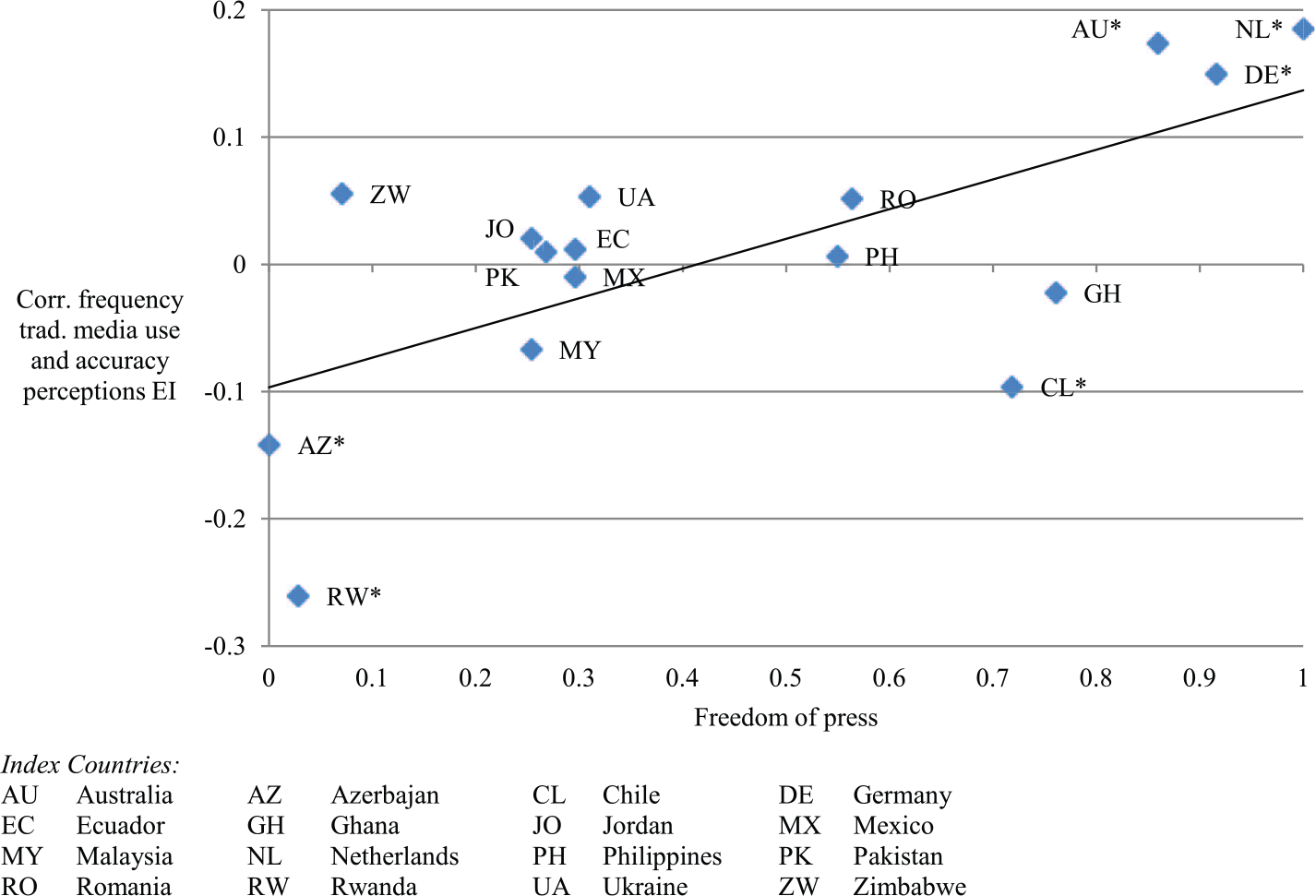
Scatter plot correlations between frequency of traditional media use and accuracy of perceptions of electoral integrity and freedom of press.
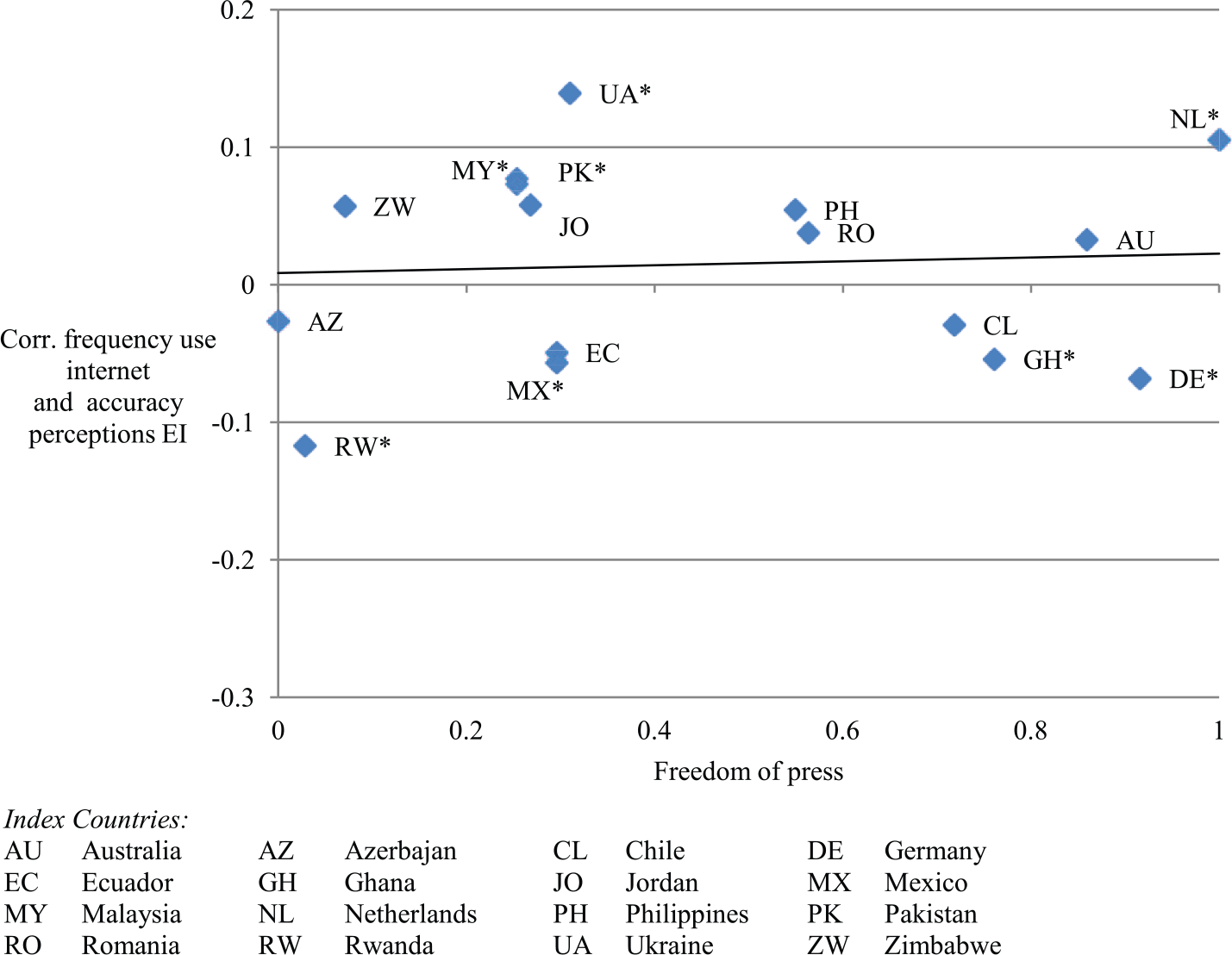
Scatter plot correlations between frequency of internet use and accuracy of perceptions of electoral integrity and freedom of press.
The descriptive evidence presented in Figure 1 indicates that the correlations between the informational use of traditional media and accuracy of perceptions of electoral integrity vary widely between the different countries. The trend line confirms that the correlation between citizens’ frequency of the use traditional media and the accuracy of their perceptions of electoral integrity is stronger and more positive the higher a country’s level of press freedom. Correlations between the frequency of the informational use of traditional media and accuracy of perceptions on electoral integrity are particularly strong in those countries with low and high levels of freedom of press. In countries with low levels of freedom such as Azerbaijan and Rwanda the correlation is negative, indicating that the more citizens rely on traditional media, the less accurate their perceptions of electoral integrity. By contrast, in countries with high levels of freedom of press (Australia, The Netherlands and Germany), we see significant and positive correlations, suggesting that higher levels of informational use of traditional media relates to more accurate perceptions of electoral integrity. In the countries with medium levels of freedom of press, no significant links between traditional media use and citizens’ accuracy of perceptions of electoral integrity seem to occur.
Turning to the link between citizens’ frequency of the informational use of the internet and the accuracy of their perceptions of electoral integrity, Figure 2 reveals an almost flat, horizontal trend line. This indicates that the strength of the correlation between citizens’ informational use of the internet and the accuracy of their perceptions of electoral integrity does not vary significantly between countries with high levels and countries with low levels of freedom of press. The figure shows significant and positive correlations between the frequency of the use of the internet and accuracy of perceptions of electoral integrity both in countries with high levels of press freedom (The Netherlands) and in countries with low levels of press freedom (Ukraine, Malaysia and Pakistan). Similarly, negative correlations are found in countries with high levels of freedom of press (Ghana and Germany) and in countries with relatively low levels of freedom of press (Rwanda and Mexico). No clear pattern thus seems to exist.
While these exploratory graphs offer some first insights and seem to support Hypothesis 1 but to reject Hypothesis 2, they do not simultaneously consider the effect of media use frequency and other relevant socioeconomic and attitudinal characteristics that may relate to citizens’ accuracy of perceptions of electoral integrity. To this end, the next section presents a critical test of the hypotheses through multivariate multilevel analysis.
Multilevel analysis
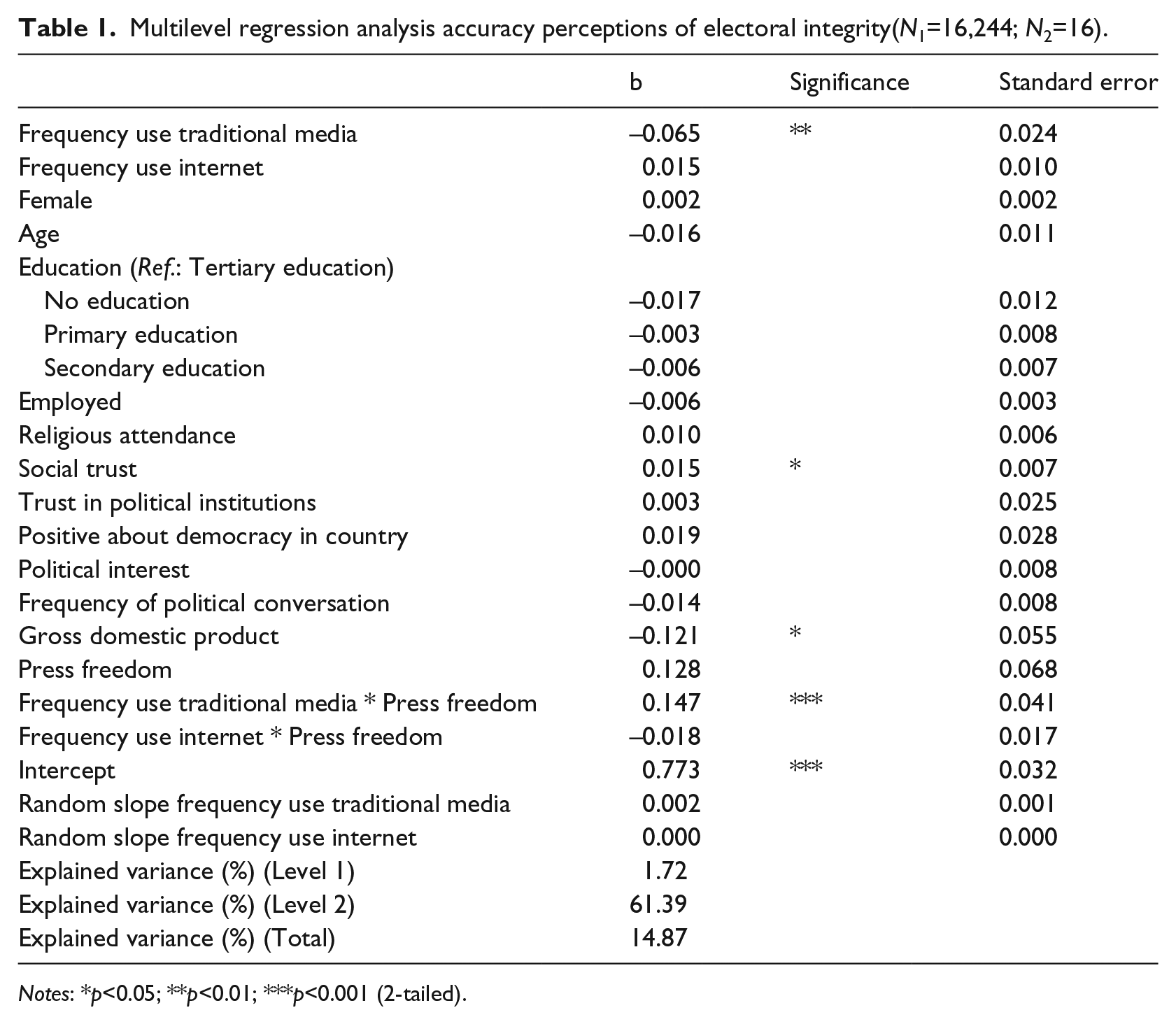
Table 1 presents a multilevel interaction model including all individual explanatory and control variables discussed above, as well countries’ levels of press freedom and economic development, and the interaction terms between countries’ levels of press freedom and the frequency of the informational use of traditional media and the internet. 10 The model also includes a random slope for the effects of traditional and new media, allowing these to differ between countries.
Multilevel regression analysis accuracy perceptions of electoral integrity(N1=16,244; N2=16).
Notes: *p<0.05; **p<0.01; ***p<0.001 (2-tailed).
The analysis reveals that free flows of information (measured by press freedom) interact significantly and positively with individual patterns of the use of traditional media. In other words, and in support of Hypothesis 1, the frequency of the use of traditional media has a stronger positive effect on the accuracy of perceptions of electoral integrity in countries with higher levels of press freedom. Furthermore, the interaction model reveals a significant overall negative effect of the frequency of the use of traditional media. This indicates that in countries with no freedom of press, the frequency of the use of traditional media has a significant negative effect on the accuracy of perceptions of electoral integrity.
In contrast to my expectation (Hypothesis 2), the frequency of the use of the internet does not interact significantly with levels of press freedom. In other words, the link between citizens’ use of the internet and the accuracy of their perceptions of electoral integrity does not differ between countries with different levels of press freedom.
To illustrate the findings of the multivariate multilevel analysis, Figure 3 shows the combined impact of the use of traditional media and press freedom on the accuracy of citizens’ perceptions of electoral integrity. It presents the predicted accuracy of perceptions of electoral integrity for low (0), middle (0.5) and high (1) frequency of informational use of traditional media in countries with low (0) and high (1) levels of press freedom, with all the remaining variables included in the analysis presented in Table 1 set at their mean values.
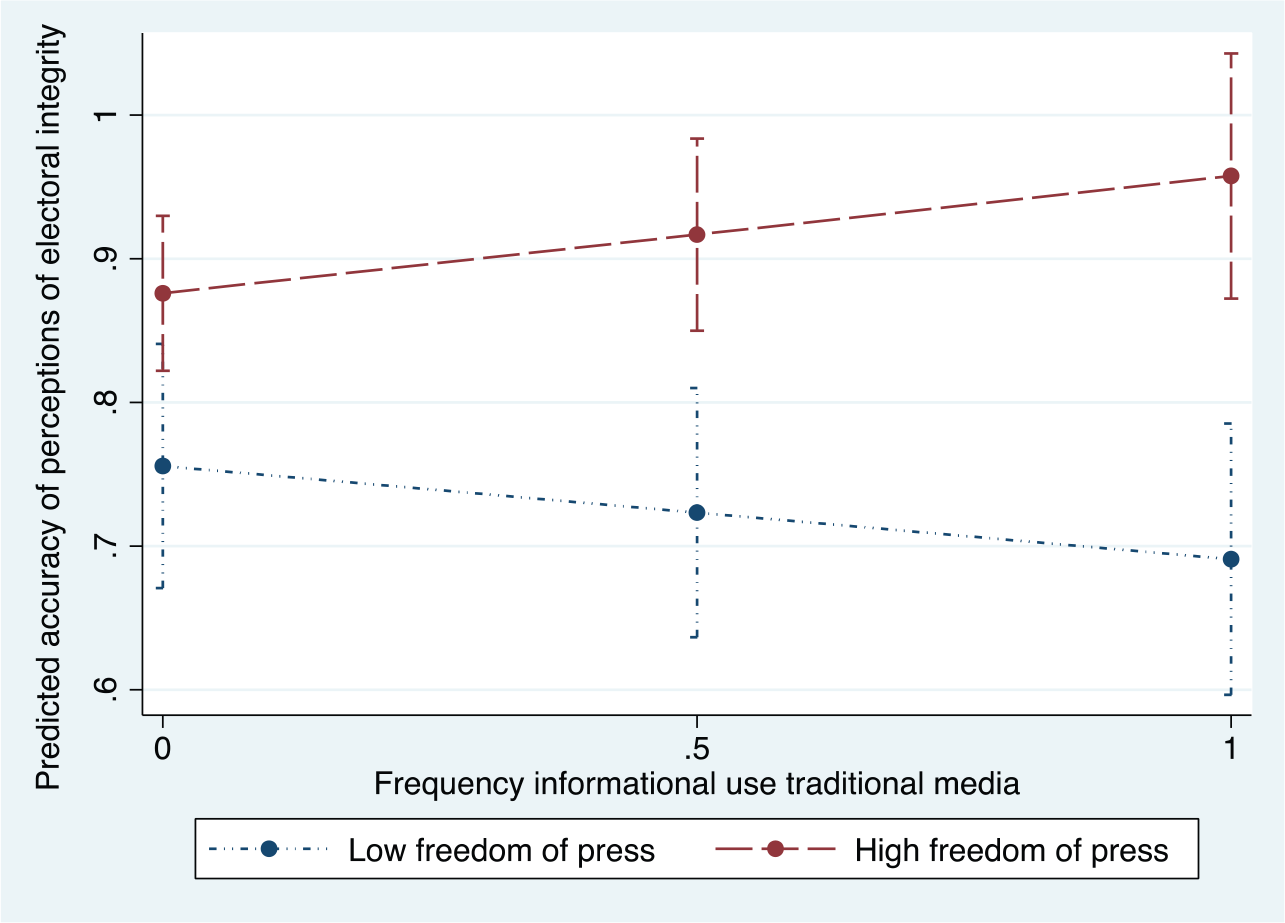
Marginal effects of frequency of informational use of traditional media according to levels of press freedom (with 95% confidence intervals).
As can be seen from Figure 3, in countries with high levels of press freedom, the accuracy of citizens’ perceptions of electoral integrity increases significantly the more frequently citizens use traditional media for informational purposes. 11 In countries with low levels of press freedom, by contrast, the accuracy of citizens’ perceptions of electoral integrity decreases substantially the more citizens rely on traditional media to be informed about public and current affairs. Thus the more frequently citizens use traditional media in countries with low levels of press freedom, the less accurate their perceptions of electoral integrity are.
The contrasting pattern in countries with low and high levels of press freedom supports the suggested informative effect of traditional media use on the accuracy of perceptions in countries where the traditional media are free and offer open and diverse coverage of political affairs, and the effect of disinformation of traditional media use, where these media are not free and often propagandistic.
Conclusion
The issue at the heart of this paper was the dynamic of the relationship between citizens’ informational use of the internet and traditional media and the accuracy of their perceptions of electoral integrity, and how these relationships are contingent on countries’ levels of press freedom. In line with Hypothesis 1, the multilevel analysis revealed that the frequency of the use of traditional media relates significantly more positively to citizens’ capacity to make accurate judgements about the electoral process in societies with open media environments compared with societies with restricted media environments. In particular, in countries with high levels of press freedom, the frequency of the use of traditional media relates significantly and positively to the accuracy of citizens’ perceptions of electoral integrity. By contrast, in countries with low levels of press freedom, a frequent use of traditional media actually decreases the likelihood to hold accurate perceptions of electoral integrity. This supports the expectation that in countries with low levels of press freedom, the information presented by the traditional media tends to be one-sided, centralized and used for propagandistic purposes. Such one-sided information negatively influences citizens’ understanding of the quality of elections. On the contrary, in countries with high levels of press freedom, where traditional media offer a diverse spectrum of information, the use of traditional media positively affects citizens’ perceptions of the fairness of the elections held in their country.
In contrast to Hypothesis 2, the analysis shows no evidence of a different effect of the informational use of new media, measured through the use of internet, according to countries’ levels of freedom of press. The internet thus does not seem to provide an alternative source, which was anticipated to be particularly important in those countries where the freedom of press is limited and traditional media tend to offer one-sided information.
Taken together, the study provides an important window on the link between media use and the accuracy of citizens’ perceptions of a high profile democratic event such as elections. A great deal, however, remains to be learned. At this point, for example, I can but speculate about the causal relationship between the frequency of media use and the accuracy of perceptions of electoral integrity. Supported by previous empirical evidence (e.g. Strömbäck and Shehata, 2010; de Vreese and Boomgaarden, 2006) indicating a mobilizing effect of media exposure, the starting point of the current study was that media inform citizens about the quality of elections and thus consequently that the frequency of media use influences citizens’ accuracy of perceptions of electoral integrity. It is, however, also possible that citizens with more accurate perceptions of the quality of elections take more interest in politics and are more likely to follow the news (Jenssen et al., 2012). Yet, the finding that in countries with limited freedom of press citizens with less accurate perceptions of the quality of elections are more likely to follow the news via traditional media supports the idea of media exposure affecting political knowledge (rather than the other way around). In particular, the misinformation that citizens in such media environment get through traditional media makes them more likely to lack accurate perceptions of the quality of elections. This seems more plausible than that lacking accurate perceptions of electoral integrity will increase the frequency to use traditional media to get informed about current affairs in countries where these media are only providing one-sided information.
More detailed information about citizens’ media use, such as the specific characteristics of the websites and media outlets they read, see, or listen to, would also be beneficial to the study of media use and its effect on citizens’ perceptions. In particular, the WVS instrument measuring informational use of new media, operationalized through the frequency of the use of the internet, is quite vague and unspecific. While the survey question does specifically refer to informational use, we do not know which internet websites respondents consult. They may include blogs but also websites of mainstream newspapers. Moreover, the measure is limited to the use of internet and does not include social media such as Twitter, which citizens increasingly use as a news source (Westerman et al., 2012). More detailed information on the informational use of a variety of new media would enable us to further explore whether or not any of the new media sources would offer an alternative road to accurate information and thus more accurate perceptions of electoral integrity, in particular in those countries with limited freedom of press.
For now, we can conclude that a complex pattern of media effects exists. The findings presented in this study suggest that different types of media have different effects on the likelihood of arriving at correct judgements about electoral integrity and the effects are conditional upon the restrictiveness of the media environment. Hence, it urges future research to consider the divergent and conditional effects of media sources.
Footnotes
Acknowledgements
I would like to thank the Electoral Integrity Project for the fellowship it provided to work on this paper and the University of Sydney, Department of Government and International Relations, for its hospitality. I am also grateful to Victoria University of Wellington, Faculty of Social Sciences, for giving me the flexibility allowing me to spend a semester at the University of Sydney. I would like to thank Pippa Norris and Laura Stoker for fruitful discussions, Tim Immerzeel and Ignacio Lago for methodological help and suggestions, and Sebastiaan Bierema for editorial help. A previous version of the paper has been presented at the Electoral Integrity Research Seminar (University of Sydney). I would like to thank all participants for their helpful comments and feedback.
Funding
This research received no specific grant from any funding agency in the public, commercial or not-for-profit sectors.