




Abstract
On the question of how voters perceive party positions, much of the existing literature has not adequately considered the case of a multidimensional policy space. Since the ideological cues related to each issue differ in a policy space of multiple dimensions, it is possible that each individual favors different dimensional cues. To test this hypothesis, this paper focuses on Japan’s 2012 Lower House election, which took place in a two-dimensional policy space. An analysis of how voters position the three major parties relative to each other reveals that there is actually heterogeneity in the voter perception of the policy space. Further, using a mixed logit model, we find that demographic factors and political attitudes explain this heterogeneity.
Introduction
The question of how voters perceive party positions is important when considering the responsiveness of democracy. 1 One precondition for voters to conduct issue-oriented voting is to recognize which party most closely represents their own positions—that is, voters must distinguish the differences in policy positions among parties (Campbell et al., 1960). Research on the behavior of political elites has attempted to demonstrate that parties and candidates respond to and act upon voters’ policy positions (e.g. Adams et al., 2005). Most of these studies are based on spatial theory, and assume that voters can discern the positions of parties or candidates.
While it is not easy for the average voter to accurately identify party positions on all issues, voters can use ideology as a cue to reduce information costs (Downs, 1957). Policy space is mainly depicted in terms of a one-dimensional liberal–conservative or left–right ideology, not only in the US two-party system (Poole and Rosenthal, 2007), but also in European countries that include multiparty systems (Huber and Inglehart, 1995).
As such, research on how voters perceive policy positions has mainly focused on where voters place parties’ ideological stances along a one-dimensional axis. Such studies have investigated not only the United States (Delli Carpini and Keeter, 1996; Hetherington, 2001) and developed European countries (Fortunato and Stevenson, 2013; Freire and Kivistik, 2013) but also Asian and other non-European countries (Jou, 2010; Kabashima and Takenaka, 2012).
Previous studies that assumed one-dimensionality in voter ideological perceptions may have overlooked diversity in voter policy space recognition. Although some recent literature on party competition has focused on multidimensional ideological spaces (e.g. Benoit and Laver, 2006), such a perspective has not been sufficiently introduced into voter-side research. Some scholars have argued that voters’ policy preferences are structured by multidimensional ideology, even if the ideological space is one-dimensional at the elite level (Swedlow and Wyckoff, 2009; Treier and Hillygus, 2009). Given the multidimensionality of the ideological space at the voter level, it is possible that a simple one-dimensional axis cannot capture voter recognition of party policy positions. However, previous research has not tackled the issue of multidimensionality in voters’ views of party competition.
We argue that if voter recognition of party policy positions relies on two or more ideological cues, it could be that not all voters are able to use multiple cues in the same way. Depending on voters’ levels of political sophistication, it is natural for there to be differences in their ability to use ideological cues. Moreover, we expect that even when comparing two voters with the same level of political sophistication, one person might be better at using the first cue, while the other would tend to interpret the policy space based on the second cue. Although other heterogeneous aspects of voter perceptions, such as views on national economic conditions (Duch et al., 2000), have been well addressed, those of party policy positions in multidimensional space have been largely overlooked.
Scholars, politicians, and media across the world have been likely to assume that citizens share the same views of the political realm, although the extent of comprehending politics varies depending on one’s political sophistication. Political communication is performed based on the ideological map that is believed to be shared by citizens. We must reconsider such an assumption if heterogeneity exists in perceptions of party competition. The interpretation of what political actors compete for can vary from person to person. The same policy position or political discourse can have different meanings for different people. 2 If we assume a homogeneous dimensional view, citizens who do not share a major outlook on political competition can be seen as less sophisticated and can be excluded from political communication, despite that they may deliberate on political issues based on their own interpretation of the political world.
This study examined whether such heterogeneity exists based on Japan’s 2012 Lower House election. Our quantitative analysis of public opinion survey data shows that at the time of Japan’s 2012 Lower House election, the recognition of voter policy space was heterogeneous; furthermore, certain voter demographic attributes and political attitudes—specifically age, ideological extremity, and partisanship—may explain differences in recognition. Since our argument derives from general theories and previous studies in other countries, the findings can be generalized to nations other than Japan. This study not only provides suggestions for the fields of public opinion and voting behavior, as discussed above, but also for research on party competition.
This paper is organized as follows: In the next part, we reiterate the research problem and present the hypotheses. The third section provides an overview of the Japanese political policy space, and explains why the 2012 Lower House election was an ideal case for testing the hypotheses. In the fourth section, we describe the analysis used to capture the heterogeneity of policy space recognition. The fifth part presents the analyses and results. Finally, we summarize the implications of our findings.
Hypotheses
This study addresses how voters perceive policy positions on specific issues. As mentioned previously, ideology is useful for summarizing and breaking down a policy space into a few dimensions; research suggests that voters can surmise standpoints on individual policy issues based on a party’s ideological stance (Feldman and Conover, 1983).
However, if a policy space is multidimensional, things are not so simple. Under the multiple axes that form an ideological space, the cues related to each issue differ. That is, even if it is appropriate to use a first-dimension cue to determine a party’s outlook on one issue, determining another issue might require a second-dimension cue. Using the cue based on the first dimension could lead to a mistaken estimation. Given the small amount of information the average voter possesses (Delli Carpini and Keeter, 1996), and the fact that most voters have difficulty with abstract concepts such as ideology (Converse, 1964) it is not easy for the typical person to properly link issues with ideologies or axes.
How, then, do voters try to ascertain a party’s policy positions in such an environment? It is unlikely that ideologies or ideological axes cease to serve as heuristics; even if it is impossible to appropriately use multiple cues, many studies in various countries have shown that if voters only have to consider one kind of ideology, they can use it as a cue (Feldman and Conover, 1983; Fuchs and Klingemann, 1990).
Therefore, aside from the few experts who can adeptly use multiple ideologies or axes, most voters probably have a particular cue they are good at using. For all issues, including those that have no inherent relationship to the issue at hand, they tend to use just one cue to infer a party’s standpoints. Thus, we argue that when voters identify a party’s policy position within a multidimensional ideological space, certain dimensions are easy for them to use as cues, while others are difficult. In other words, there is heterogeneity among voters in terms of their views of the policy space. 3
If there are differences among voters for whom a given cue is easiest to use, it is unlikely that such differences are randomly determined. We focused on several demographic and political attitudinal factors as the determinants of dimensional cue-taking. The first factor concerns generation. Axes of political competition have developed under various political contexts in different eras. Such differences can appear in the data as intergenerational distinctions (Knutsen, 1995). Since voters in each generation have unique socialization experiences in particular political circumstances, we expected the ease with which a voter could use a given ideology or axis as a cue to vary by generation. In fact, some previous studies have shown that older European voters tend to vote in line with traditional left–right ideology (van der Brug, 2010; Walczak et al., 2012), while younger voters tend to consider new issues, such as immigration and European Union (EU) membership (Walczak et al., 2012). Therefore, we propose that:
Hypothesis 1: The older voters are, the more likely they are to use traditional dimensional cues. The younger voters are, the more likely they are to use newly formed dimensional cues.
Whether voters can use a certain ideology as a cue might also depend on where their personal stance falls along the ideological axis in question. Here, we focus in particular on whether the positioning of a voter’s views is extreme. The fact that voters would place themselves near the end of an ideological scale reveals their comprehension of a cue. Furthermore, if a voter supports an ideology in one direction, it is easy to make assessments based on that ideology. Existing research has shown that the more extreme people’s ideologies, the more likely it is that they will place the two main parties in their respective countries further apart on a left–right scale (Granberg and Brown, 1992; Hetherington, 2001). Thus, we posit the following:
Hypothesis 2: The more extreme voters are in their self-positioning on a certain dimensional scale, the more likely they are to use the corresponding dimensional cue.
Finally, we consider the effect of partisanship. In multidimensional policy space the question of which dimensional cues voters use is vitally important for parties. This is because parties usually have favorable dimensions for which they enjoy greater support, as well as weak aspects for which they have less support. Thus, parties try to emphasize their favorable dimensions and remain silent on the weak ones (De Sio and Weber, 2014; Rovny, 2012, 2013). Because such framing manipulation by parties seems to be particularly effective for their supporters (Slothuus and de Vreese, 2010), we hypothesize the following:
Hypothesis 3: Partisans tend to use dimensional cues that benefit their parties.
Japanese political ideology and the 2012 Japanese Lower House election
To test the hypotheses presented in the previous section, we examined the policy space in Japan during the Lower House election in December 2012. In this part, we outline characteristics of Japan’s policy space, and explain why Japan’s 2012 Lower House election is appropriate for testing the hypotheses.
After World War II ended, the US-led Allied forces disarmed Japan and promoted democratization. Once Japan regained its sovereignty, the country faced questions related to two main issues: (a) whether Japan should aim to return to its pre-war conditions or stay on the path of post-war democracy; and (b) security matters surrounding the US–Japan alliance and remilitarization. These questions comprised a liberal–conservative ideological conflict around which political party competition developed (Kabashima and Takenaka, 2012). 4 Unlike Western countries, there were no major differences between parties regarding economic policies; this is a distinctive feature of post-war Japanese politics (Inoguchi, 1987).
In the 1990s, as liberal–conservative ideology retreated, there were calls to review traditional economic policy, including excessive government protection of farmers and small-to-medium-sized enterprises through subsidies and regulations, in addition to social welfare policy, which depended on the traditional family structure (Rosenbluth and Thies, 2010; Schoppa, 2006). With the combination of electoral and political funding reform in the early 1990s, along with public demand to revamp the subsequent political system and governance mechanisms, a new axis of competition arose—namely, whether to maintain the traditional Japanese political and economic system, or alter it. This axis of competition comprises the second facet of the policy space, hereafter referred to as the radical-reform–maintenance dimension. Japanese politics have developed in the context of this second angle since the 2000s, in combination with the first dimension, the liberal–conservative ideology (Kabashima and Takenaka, 2012; Okawa, 2011).
From about 2000 to 2012, two major parties, the Liberal Democratic Party (LDP) and the Democratic Party of Japan (DPJ), played leading roles in Japanese politics. In terms of the liberal–conservative ideology dimension, the LDP has maintained a conservative stance, while the DPJ has held a relatively liberal view (Kato, 2016; Okawa, 2011). In contrast, regarding the radical-reform–maintenance dimension, following many twists and turns, the two major parties have both been on the maintenance side since 2006 (Okawa, 2011; Taniguchi et al., 2010). The reform side, however, remained vacant until the 2012 Lower House election.
Then, the Japan Restoration Party (JRP) appeared on the scene. Regarding the liberal–conservative dimension, they advocated for a conservative policy; for the traditional–reformative aspect, they pressed for the need to make fundamental reforms. In the 2012 Lower House election, the JRP leaped into position as the third party in terms of seats, and the second in regard to proportional district votes. Thus, in 2012, Japanese politics transitioned into what might be most aptly called a three-party system. 5
To confirm parties’ stances on various policies, we estimated the ideal points of elected members of parliament (MPs) using the UTokyo-Asahi Elite Survey, a questionnaire administered to candidates prior to the 2012 Lower House election. This survey was given to intended candidates on 16 November, one month before the election. The survey targeted 1504 people, 1404 of whom responded (for a response rate of 93.4%). If limited to only those who were elected, there were 454 responses (for a response rate of 94.6%). The survey used a five-point scale to assess respondents’ attitudes on 35 policy issues. To extract the latent competition axis behind the survey responses, we adopted an ordinal item response model.
Using the two-dimensional model, we examined MPs’ views on each policy dimension. By comparing information criteria of the one- and two-dimensional models, we confirmed that Japanese party competition was multidimensional at the time of the 2012 Lower House election. 6 Figure 1 shows the estimation results of the discrimination parameters for each issue. Discrimination parameters denote the strength and direction of the influence of the latent trait on the dimension in question for each item’s response. In terms of the liberal–conservative facet, items related to defense and security have high discriminative power (i.e., a large amount of information to estimate the individual liberal–conservative latent trait). In addition, social issues such as foreign suffrage and moral education are also highly discriminating. Since support for increasing defense power works in the positive direction, a high latent trait score for the first dimension indicates a conservative orientation.
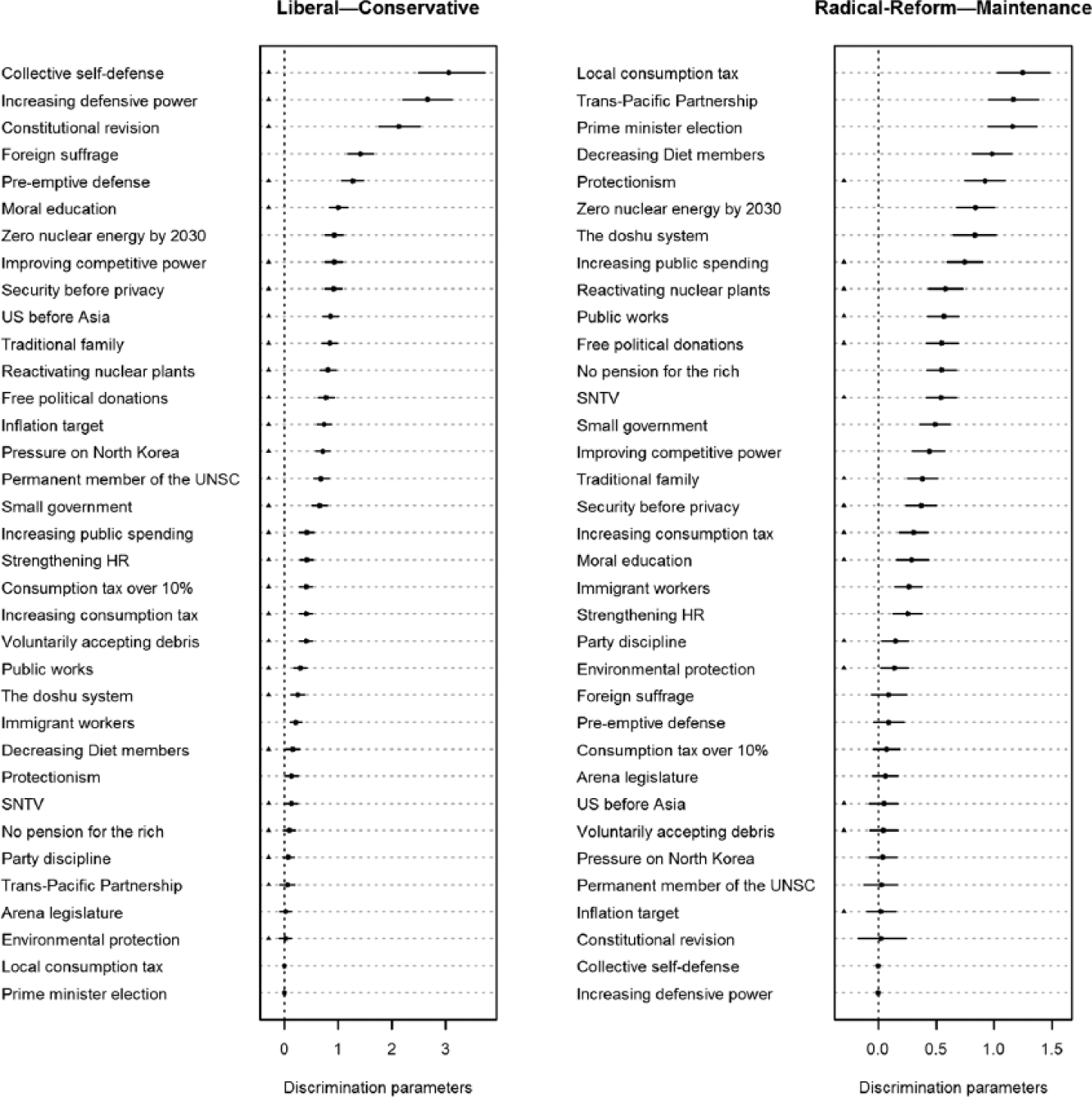
The estimated discrimination parameters of the issues.
For the radical-reform–maintenance aspect, in addition to items about political and administrative reform, economic issues such as public spending and the Trans-Pacific Partnership make a large contribution in terms of estimating the individual radical-reform–maintenance latent trait. Since opposing a series of reforms works in the positive direction, MPs with a high latent trait score for the second dimension seem to be against radical reforms, and support Japan’s traditional political and economic system.
Figure 2 shows the point estimates (the means of the posterior distributions) of the latent traits of representatives who belonged to the six major parties. Larger uppercase letters indicate the average positions of the three major parties. The horizontal axis represents the liberal–conservative dimension; a high latent trait score for this aspect signifies a conservative orientation. The vertical axis represents the radical-reform–maintenance dimension; a high latent trait score for this feature signifies a traditional-system orientation. It is evident here that the LDP is conservative and anti-reform, while the DPJ is liberal and anti-reform, and the JRP is conservative and pro-reform.

An ideological map of the Lower House after the 2012 election.
As described above, at the time of the 2012 Lower House election, Japan provided an appropriate context for verifying this study’s hypotheses. First, the policy space was composed of two dimensions that were highly independent from each other; furthermore, the extent to which those orientations explained each field’s policy was quite high. Second, the ordering of the three major parties in the policy space was very different between the two dimensions. For the liberal–conservative aspect, the LDP and JRP were on the same side, while the DPJ was on a different one. However, in regard to the radical-reform–maintenance dimension, the LDP and DPJ were on the same side, while the JRP was on the other. In such conditions, it is easy to detect voters’ misuse of ideological cues. In other words, it is easy to grasp which cue each voter is more adept at using.
Data and methods
Measuring how voters comprehend the policy space
The data used to test the hypotheses came from a nationwide mail-in survey conducted after the 2012 Lower House election. The country’s voters comprised the sample. Based on a survey from the previous wave using two-stage stratified random sampling, we used quota sampling and weighted parts of the population of respondents in order to balance the factors of region, sex, age, and city size. Following the election (which happened on 16 December 2012), the surveys were mailed on 7 January 2013, with a response deadline of January 25. Out of 4000 people surveyed, 2736 answered (for a response rate of 68.4%). We used mail-in survey data to test the hypotheses of this study due to the low item non-response rate. 7
This paper analyzes how voters position the three major parties on each issue. If the
D/LR: DPJ is on one side; LDP/JRP is on the other;
R/LD: JRP is on one side; LDP/DPJ is on the other;
L/DR: LDP is on one side; DPJ/JRP is on the other;
LDR: LDP/DPJ/JRP is on the same side.
Here, we have only focused on how the three major parties are divided; which side each party falls on is outside our range of interest. This is because in terms of the issues we cover, there are many for which it cannot be categorically decided which opinion stands for which position in a given dimension (please see Endnote 9 for more details). Please note that in the subsequent analysis, the patterns are indicated using the following subscripts: 1 for D/LR, 2 for R/LD, 3 for L/DR, and 4 for LDR.
As explained in the previous section, because the three parties occupy different quadrants in the two-dimensional party space, depending on the pattern of party positions, we can estimate which dimensional cue the respondent used to make that decision. For D/LR, it is natural to interpret the decision as being based on a liberal–conservative ideology, since the DPJ opposes both the LDP and the JRP in regard to this dimension. Thus, we label D/LR as the liberal–conservative pattern.
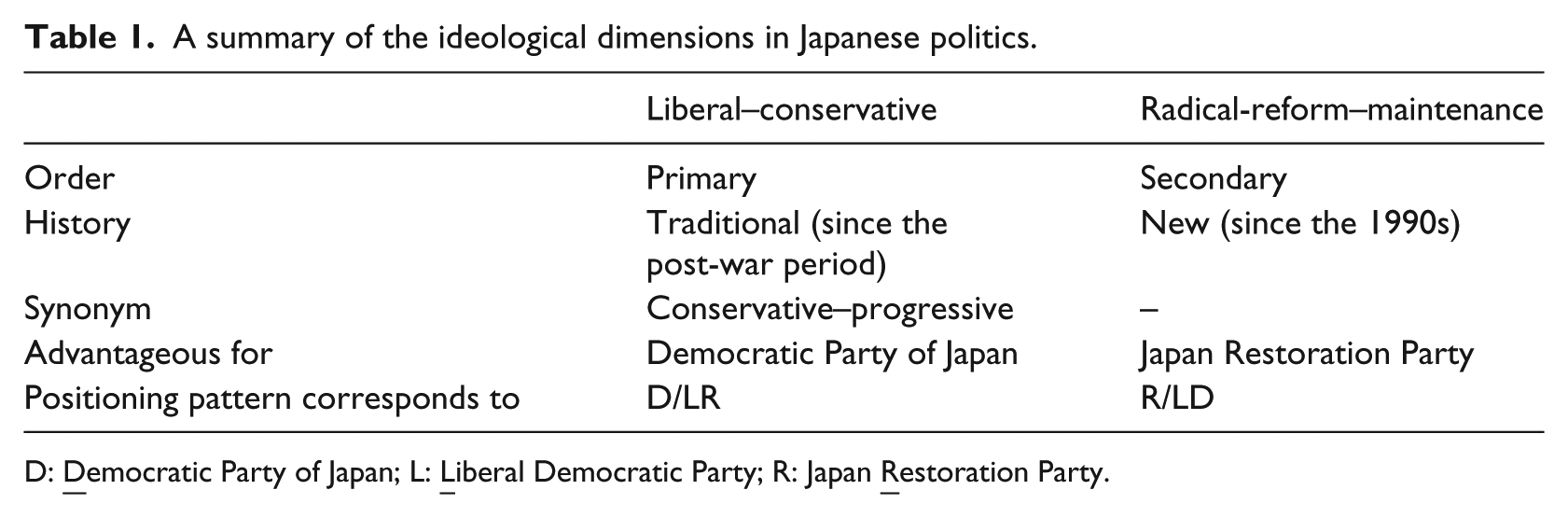
Conversely, for R/LD, it is possible that the decision was made based on a radical-reform–maintenance orientation, since the JRP opposes both the LDP and the DPJ here. Thus, we label R/LD as the radical-reform–maintenance pattern. We refer to L/DR as an ambiguous pattern because L/DR does not do a good job of explaining the policy space in 2012. 8 Finally, we determine that LDR has a “no distinction” pattern, which either represents an inability to distinguish between parties due to a lack of political knowledge, or a cynical view that sees the three major parties as basically the same. Table 1 summarizes which positioning patterns each policy dimension relates to, as well as the features of each dimension (including what we will explain below).
A summary of the ideological dimensions in Japanese politics.
D:
Inferring which dimensional cue a respondent used from positioning patterns is not a flawless strategy. It is true that a gap exists between positioning patterns and dimensional-cue usage; respondents may have located parties using other reasoning. Nevertheless, we have adopted this operationalization for specific reasons. First, opinion polls rarely directly ask voters whether they used certain cues in judging political matters—for instance, “Do you consider the left–right ideology when you infer the parties’ policy positions?” Such questionnaire items are unnatural, particularly for those who are not aware of certain cues. Second, the human decision-making process is sometimes unconscious, and self-explanations of one’s own mental processes are not necessarily reliable (Nisbett and Wilson, 1977). Even if we asked the questions mentioned above, the responses do not guarantee that we can measure voters’ dimensional cue-taking. Therefore, we argue that it is more reasonable to indirectly infer cue-taking using visible positioning patterns than to directly ask respondents about their invisible reasoning process.
Using an interpretation of positioning patterns discussed above, we can consider how Hypotheses 1–3 predict the patterns in the placement of the three main parties. First, because the liberal–conservative dimension is older than the radical-reform–maintenance aspect (which has appeared more recently in Japanese politics), Hypothesis 1 predicted that younger respondents would be more likely to choose the radical-reform–maintenance pattern, and less likely to choose the liberal–conservative one.
Second, although the survey unfortunately did not contain a question to gauge self-positioning on the radical-reform–maintenance scale, it did measure respondents’ self-positioning on the conservative–progressive scale. Since conservative–progressive ideology could be viewed as nearly identical to liberal–conservative ideology (see Endnote 4), Hypothesis 2 predicted that the more extreme voters were in their self-placement on the conservative–progressive scale, the more likely they would be to choose the liberal–conservative pattern.
Lastly, we describe the prediction about partisanship, as deduced from Hypothesis 3. As mentioned in the previous section, the DPJ is the sole liberal force among the three major parties. Thus, if the policy space is framed by the liberal–conservative angle, the DPJ could monopolize votes from liberal citizens. In the same way, since the JRP has assumed a reform label, the radical-reform–maintenance aspect could result in the JRP monopolizing votes from the reform-oriented electorate. Hypothesis 3 predicted that those with DPJ partisanship would be more likely to select the liberal–conservative pattern, and those with JRP partisanship would be more likely to select the radical-reform–maintenance pattern. We did not make a prediction about LDP partisans since both dimensions neither benefit nor hinder the LDP. Readers may raise the doubt that even if the results follow the prediction, the results were merely produced by partisans’ tendency to distinguish their preferred party from others; for example, this is caused by voters projecting their own views onto the party’s stance (Adams et al., 2005; Page and Brody, 1972). We will reject this possibility, however, by showing that LDP partisans are not likely to select the ambiguous pattern (L/DR).
Data description
After the introduction, the survey asked, “Please let us know your thoughts on the following several opinions that have recently been expressed.” Two opposing opinions were given: “On X, there are opinions such as A and B.” The survey asked for the respondents’ own opinions and the extent to which they found the issue important. Then, the respondents were asked for their perceptions of the positions of the most prominent 11 parties: “For the following parties, what stance do you think they take on X?” This study used the responses to this question regarding the LPD, the DPJ, and the JRP.
The nine issues we examined are: fiscal reform; collective self-defense; welfare and tax burden; nuclear power; decentralization; constitutional revision; the public pension system; the relocation of the US military base in Futenma; and free competition. 9 For fiscal reform, for instance, opinion A was “Nowadays, when the economy is not as good, measures for economic stimulus should be taken, even if fiscal consolidation is delayed,” while opinion B was “Nowadays, when the government debt is high, fiscal consolidation should be carried out, even if economic stimulus is delayed.” 10 There were four options for answers: “Close to A”; “Closer to A than B”; “Closer to B than A”; and “Close to B.” We treated “Close to A” and “Closer to A than B” as being on the “A” side and “Closer to B than A” and “Close to B” as being on the “B” side. We determined a classification of D/LR, R/LD, L/DR, and LDR based on whether the three parties were positioned on the A or B sides. For example, if the DPJ was placed as A, the LDP as B, and the JRP as B, the positioning pattern was D/LR. Note that we only focused on the division of the three parties, and did not consider the direction of the A or B side. The unit of analysis was individual × issue.
Table 2 shows the distribution of positioning patterns for the three main parties. This table shows that the positioning pattern varied greatly depending on the issue. Moreover, as shown in the rightmost column of Table 2, for each issue, the percentage of people who did not respond in terms of at least one party’s position was over 10 percent. These respondents were not able to define a position pattern for these issues. Therefore, for the subsequent analysis, we excluded these groups from individual × issue.
The distributions of positioning patterns for the three major parties.

Notes: Units are percentages. The percentages take as the divisor the number of people who responded regarding the policy positions of the Liberal Democratic Party, the Democratic Party of Japan, and the Japan Restoration Party for the relevant issue. The far right column shows the percentage of respondents who did not provide an answer in terms of at least one party’s stance.
Analysis
The dependent variable y is the positioning pattern of the three primary parties. We employed a mixed logit (MXL) model (Glasgow, 2001). We denote the utility for individual k for locating the three major parties in pattern i on issue j by Uijk and suppose that

where
Thanks to the disturbance term, we can alleviate the assumption of independence from irrelevant alternatives (IIA). The IIA assumption should be relaxed here because, first, some alternatives probably share unobservable common factors (e.g. the “no distinction” pattern differs in nature from the other alternatives), and this is one of the causes of IIA violation (Glasgow, 2001: 118). Second, there is likely to be a correlation clustered by the individual in the error term because the same individual appears nine times in our data at most.
We suppose that for issue j, individual k locates parties in accordance with pattern i, which maximizes utility Uijk. Assuming that

where
We include three variables that correspond to Hypotheses 1–3: age; ideological extremity; and partisanship. The first two are individual-specific. Age is a continuous variable drawn from an item on the face sheet. For ideological extremity, we calculate the responses to the question of conservative–progressive self-placement (from 1 to 11) minus the middle category of value 6, and we take its absolute value. We also add individual-specific dummy variables (female and education) as basic controls. We delete missing cases listwise. The number of respondents omitted due to missing independent variables is 234 out of 2757 (9.3%).
We treat partisanship as an alternative-specific variable. Partisanship is measured by the question of long-term partisanship, which is a concept proposed by Taniguchi (2012) for studying this phenomenon in Japan. It aims to be equivalent to party identification in the United States. zik denotes the partisanship variable of alternative i and individual k.
The marginal effects of individual-specific variables cannot be clarified by their coefficients alone. 12 Therefore, we simulate the change in expected probability by approximation, with a multivariate normal distribution. Figure 3 shows the simulation results of positioning patterns regarding the issues of collective self-defense and decentralization. 13 We vary variables from the 10th to the 90th percentile, while fixing the other variables at their observed values, and calculate the change in the expected probability of each positioning pattern being chosen. 14

The simulation results of the positioning patterns.
Consistent with Hypothesis 1, older voters tended to choose the liberal–conservative pattern and not the radical-reform–maintenance one. Older voters were also not likely to choose the ambiguous pattern, probably because it is partially explained by the radical-reform–maintenance cue (see Endnote 8). Furthermore, older voters tended to choose the “no distinction” pattern.
We find support for Hypothesis 2 as well. This hypothesis anticipates that those who self-identified as leaning toward an ideological extreme on the liberal–conservative scale would tend to choose the liberal–conservative pattern, and the results reflect this. The probability of the ambiguous pattern and the “no distinction” pattern decreased as ideological extremity grew; conversely, centrist voters were more likely to choose those patterns.
With regard to Hypothesis 3, Figure 3 shows that those with long-term JRP partisanship were likely to distinguish their party from the others, though the degree of change varied across the issues. In contrast, there was no effect of long-term DPJ partisanship. Long-term LDP partisanship did not influence voter positioning patterns, implying that the results for JRP partisanship was not the artifact caused by the projection effect. Thus, we can say that Hypothesis 3 is partly supported. We infer that the reason JRP partisanship alone affected the perceptions of party competition is that the JRP emphasized its pro-reform posture in the electoral campaign. The JRP’s party platform published before the election, Ishin Hassaku, was almost entirely devoted to policy plans related to the radical-reform–maintenance aspect. On the other hand, although the liberal stance could offer an advantage to the DPJ from the standpoint of spatial theory, the DPJ did not actively mention the issue of security in the electoral campaign; this is the field most closely related to the liberal–conservative dimension (Midford, 2013: 190). 15
We review the remaining results. Women were more likely to choose the “no distinction” pattern, and less likely to choose the liberal–conservative one, although the differences between males and females were small. As for education, we find that highly educated voters were likely to choose the liberal–conservative pattern and unlikely to choose the “no distinction” pattern and the radical-reform–maintenance pattern. Lastly, non-partisan voters seemed less likely to distinguish among the three major parties, but this effect was not significant, at the 10 percent level by a slight margin. 16
Conclusion
Regarding whether voters are able to recognize party policy positions and how they perceive them, much of the existing literature has focused on their positioning on a one-dimensional ideological axis. Research has shown that in many countries, voters place the major parties on the left–right axis; in other words, voters understand their country’s policy space based on a single-dimensional ideology. However, when the policy space is not represented by a single dimension, the approach used in the existing literature cannot fully capture the diversity in voter recognition of policy space.
This study used the case of recent Japanese politics—which has a policy space consisting of two ideological axes, with a high level of independence—and considered the perceptions of policy positions in a political environment comprised of multiple ideological axes. Using the liberal–conservative and radical-reform–maintenance dimensions, for which the three major parties’ views differ, we analyzed whether voters tended to place these parties according to a particular pattern across multiple policy issues. By estimating a mixed logit model of the three parties’ positioning patterns, using voters’ individual factors, we concluded that voter demographic attributes and political attitudes (age, ideological extremity, and partisanship) could explain heterogeneous positioning patterns.
This study has some limitations. First, as discussed in the section on data and methods, although we believe our operationalization of dimensional cue-taking (using the positioning patterns of parties’ stances on various issues) is original and can be applied to future studies, it is also true that a gap exists between placing parties in certain patterns and using a specific dimensional cue. We admit that what we interpret as voters’ use of dimensional cues may be explained by other heuristic uses, and thus our conclusion is conditional. Future researchers should develop a more direct indicator of dimensional cue-taking.
Second, since we only studied the case of Japan, future research should determine whether our argument applies to other countries with multidimensional policy spaces. However, we expect that our results will be found in other contexts as well, because our reasoning on dimensional cue-taking has a general theoretical background. For example, in most European countries, party competition takes place along the EU-related dimension, as well as in terms of the traditional economic left–right aspect (Benoit and Laver, 2006). Based on previous studies that examined the generation gap in relation to issue importance (Walczak et al., 2012) and issue entrepreneurship (De Vries and Hobolt, 2012), we can posit that citizens who are young and/or have partisanship for challenger parties are likely to use the EU-related dimensional cue.
Third, we only examined a limited angle of dimensional cue-taking. Dimensional cues are not only used when voters infer a party’s policy positions but also when they form their own opinions on various issues, and when they decide which party or candidate to vote for. Future research should investigate whether there is heterogeneity in such situations.
We conclude that implications exist for other research topics. First, this study has suggestions for research on party competition in multidimensional spaces. Since many countries’ policy spaces can be sufficiently aggregated along a single left–right dimension, and as there are difficulties regarding social choice in multidimensional spaces, much of the research over the past few decades on party competition has assumed single dimensionality. Yet in recent years, there has been some research on party competition in multidimensional spaces (De Sio and Weber, 2014; De Vries and Hobolt, 2012; Rovny, 2012). This research has approached politics in multidimensional spheres from a heresthetical angle (Riker, 1984); such studies have shown that political parties emphasize the policy dimensions that benefit them, and take positions that bring certain issues to the forefront, while blurring issues that are disadvantageous. Such cases do not introduce the notion that voter recognition of the ideological space is heterogeneous. According to our analysis, however, it should be likely that a party’s heresthetical strategy is more likely to persuade some voters than others. By incorporating the element of voter-side recognition, we expect that research on party competition in multidimensional policy spaces will further develop.
Second (and related to the previous point), this study could provide suggestions for research on the entry of new parties. In Japan’s 2012 Lower House election, the emerging political party, the JRP, squared off against the then-two major parties as a flag bearer of radical reform in government structure. To win votes, new parties enter into a gap in the existing policy space (Downs, 1957). However, even if a new party can advance into the gap in a given ideological dimension, voters might not perceive the policy space in that way. For the emerging political party to gain support, it must gain recognition of the importance of an issue that favors it, and have voters interpret party competition based on that policy dimension (De Vries and Hobolt, 2012; Tavits, 2008). Hence, parties blur their stances on policy dimensions that do not benefit them (Rovny, 2013). By accepting that heterogeneity exists among voters when they recognize the policy space in the country being analyzed, and by considering what kind of people use ideology as a cue in a way that benefits a new party, we can achieve a more meaningful explanation for a new party’s entry, and subsequent success or failure.
Footnotes
Acknowledgements
This paper is an outcome of the Japanese Electoral Study V Project. We wish to thank the other project members: Yoshiaki Kobayashi; Hiroshi Hirano; Takeshi Iida; Ryota Natori; and Masahiro Yamada. We also use auxiliary data from the Keio University Global COE Program “Designing Governance for Civil Society.” An earlier version of this paper was presented at the Annual Meeting of the Japanese Political Science Association, Waseda University of Tokyo, on October 12, 2014. We are grateful to Airo Hino, Yoshihiko Takenaka, Hirofumi Takesue, Soichiro Yamauchi, and three anonymous reviewers for their helpful comments. We also thank Crystal Pryor for her language assistance and comments.
Funding
This work was supported by the Japan society for the promotion of science KAKENHI (grant numbers 24000002, 25•8571).
Notes
Author biographies
References
Supplementary Material
Please find the following supplemental material available below.
For Open Access articles published under a Creative Commons License, all supplemental material carries the same license as the article it is associated with.
For non-Open Access articles published, all supplemental material carries a non-exclusive license, and permission requests for re-use of supplemental material or any part of supplemental material shall be sent directly to the copyright owner as specified in the copyright notice associated with the article.
