



Abstract
While many studies of party system nationalization examine the effects of various institutional factors, few take into account the impact of party formation cost. This paper aims to fill the empirical gap by focusing on the interactive effect of electoral systems and party registration rules. I argue that the effect of electoral systems on party system nationalization is conditional on spatial registration rules, a requirement that requires a party to collect signatures or organize local branches in a specified geographical manner to maintain the party’s legal status. Based on data for 97 legislative elections in 18 Latin American countries from 1978 to 2011, the empirical analysis demonstrates that a country with an electoral system that encourages a personal vote tends to have a much lower level of party system nationalization when that country does not have spatial registration requirements. The result is robust across different model specifications and estimation techniques.
Introduction
Party system nationalization matters for party system institutionalization, accountability, and representation in modern democracies (Caramani, 2014). Moreover, a higher level of party system nationalizationcreates favorable conditions for the adoption of policy programs based on issues at the national level instead of particularistic local benefits (Alemán and Kellam, 2008: 193). A highly nationalized party system tends to focus more on non-targetable expenditures in the composition of spending (Castañeda-Angarita, 2013; Crisp et al., 2013). In contrast, the lack of nationalized parties leads to an undersupply of nationally-focused public health services (Hicken et al., 2016), and, at least in Europe, a larger number of regional parties has been shown to increase government instability (Brancati, 2005). In short, party system nationalization is a research area of substantive importance because public policies made in a country with a higher level of party system nationalization tend to be based on national interests.
Given that party system nationalization affects government policy priorities, what explains the variation in the extent to which party systems are nationalized? Existing studies have focused on the effects of political institutions, such as executive systems (Cain et al., 1987), decentralization (Chhibber and Kollman, 2004), and electoral systems (Bochsler, 2010a). However, these studies have largely ignored one important institutional factor that can shape party system nationalization: party registration rules. Specifically, when studying party system nationalization, it is crucial to take into account whether a country has a spatial registration rule. Such a rule requires that, to register a party and maintain the party’s legal status, party leaders must collect a certain number of signatures or organize subnational branches in more than one electoral district.
The major task of this paper is to address this empirical gap in the literature by examining the interactive effects of electoral systems and party registration rules on party system nationalization. While some recent studies have found that a country with an electoral system that has a high propensity to cultivate a personal vote 1 tends to have a much lower level of party system nationalization (e.g. Golosov, 2016), others find that the effect is inconclusive (Simón, 2013). I argue that a spatial registration requirement is an important intervening variable in the relationship between the personalism of the electoral system and party system nationalization.
In a country where district-level parties are disallowed for registration, an electoral system with a high personal-vote propensity has limited effects on party system nationalization because a certain level of cross-district coordination of candidates is ensured by the party law. In contrast, the effect of the personalism of the electoral system in reducing party system nationalization will be stronger if the country does not have a spatial registration rule for parties. Under such an institutional context, politicians are more likely to register a district-level party, not only because it is less costly than establishing a national party, but also because doing so further highlights the personal attributes of the candidate.
Considering the effects of electoral systems and party registration rules, my hypothesis suggests that an electoral system that encourages amore personal vote will reduce party system nationalization to a greater extent when the country permits the registration of district-level parties. I test this theoretical assertion using data from 97 legislative elections in 18 Latin American countries between 1978 and 2011. The empirical analysis supports the hypothesis about the interactive effects of electoral systems and party registration rules.
Theoretical perspectives
Party nationalization 2 considers the degree to which a party has similar support across different districts in an election. Party nationalization reflects parties’ campaign strategies (Conway, 1986) but not party discipline (Jones and Mainwaring, 2003: 142). Leaders of nationalized parties are likely to emphasize platforms on national issues and organize campaigns at the national level (Morgenstern et al., 2009: 1325; Stein et al., 2005: 40). 3 Moreover, from an organizational perspective, a nationalized party is expected to have effective local party organizations for channeling popular demands in every region of a country. Therefore, a nationalized party system indicates that major parties have strong ties with their electorates across districts in the country (Jones and Mainwaring, 2003: 143). In contrast, in a poorly nationalized party system, each major party tends to run electoral campaigns based on local politicking and mainly focuses on certain regionally-based channels.
What explains the variation in party system nationalizationacross countries? Existing studies havefocused on the effects of political institutions. For instance, Cain et al. (1987) argue that the executive system plays an important role in determining a personal vote, a concept that is closely related to party nationalization. Specifically, parties in parliamentary systems are generally more nationalized than parties in presidential systems because “the electoral fates of executive and legislative candidates are so intricately intertwined in parliamentary systems” (Morgenstern et al., 2009: 1327). For countries that adopt presidentialism, Brancati (2008) finds that the level of party system nationalization tends to be higher when the presidential and legislative elections are held concurrently because the presidential post is a great “electoral prize” so that different parties tend to coordinate or even merge in order to be more viable for the presidential election (Cox, 1997).
In addition to executive systems, many studies have identified political decentralization as a crucial institutional determinant of the lack of party system nationalization.Jones and Mainwaring (2003: 159) and Thorlakson (2007) demonstrate that federal countries tend to have lower levels of party system nationalization. Brancati (2008) finds that decentralization not only helps regional parties gain more votes, but also provides all parties a less even distribution of votes throughout the country. Harbers (2010) further demonstrates that both political decentralization and fiscal decentralization inhibit party system nationalization in Latin America.
Electoral systems matter for explaining party nationalization because they provide incentives for a politician to compete in the election either under a national party label or centered on the politician’s personal characteristics. In countries whose electoral rules make party labels crucial, a national party label offers important informational cues of policy positions to the constituents, and thus candidates are less likely to win the election if they do not join national parties (Simón, 2013: 28). Carey and Shugart (1995) argue that the closed-list proportional representation system tends to discourage candidates from cultivating a personal vote because party leaders have more power to control candidate nominations and tend to adopt a more nationally focused campaign strategy.
In contrast, in countries where electoral systems encourage personal votes, candidate reputation is crucial for driving electoral outcomes, and thus candidates are less likely to coordinate across various districts. De Miguel’s (2013) study shows that, in young party systems, adopting a plurality electoral system increases the cost for party coordination across districts and thus makes the party system less nationalized. Golosov (2016) finds that single non-transferable vote, single transferable vote, and mixed-superposition electoral systems offer strong incentives to cultivate a personal vote, and thus countries that adopt one of the above electoral systems tend to have less nationalized party systems.
However, Simón (2013: 36) did not find statisticallysignificant evidence for the independent effect of the personal-vote orientation of the electoral system on party system nationalization. This suggests that the findings about the effects of electoral systems on party system nationalization are inconclusive, and thus that further investigation is required. In this paper, I argue that prior studies have overlooked the important variable of party registration rules. Unlike many electoral institutions, the importance of such rules lies in the fact that they directly affect a party even before it competes in an election (Birnir, 2004). Specifically, party registration rules shape the structure of party competition by imposing certain formation costs for new party applicants (Hug, 2001; Molenaar, 2014; Su, 2015). Therefore, party registration rules matter for the quality of democratic representation (Scherlis, 2014).
The form of party registration rules varies. In addition to the total number of signatures required for registering a political party,spatial party registration rules involve the level of restrictiveness of party registration rules. A spatial party registration rule determines the geographical scope that a party mustbe organized in to be eligible for competing in elections. When there is no spatial registration rule, it is not necessary for a party to be organized across districts in the country. In other words, a party can choose to be organized in one district. Therefore, a country without party registration rules should have more regional parties, and thus the overall level of party system nationalization should tend to be low. For instance, Birnir’s (2004) analysis shows that when Ecuador’s spatial registration requirements were removed in 1994, an important region-based indigenous party,Movimiento de Unidad Plurinacional Pachakutik – Nuevo País (MUPP-NP), emerged and ran in the 1996 election.
This study considers the importance of spatial registration rules in explaining party system nationalization. More importantly, I follow Simón’s (2013) approach of considering the combined effects of different institutional factors on party system nationalization. 4 My hypothesis suggests that the effect of personal-vote orientation of electoral systems on the reduction of party system nationalization is not direct, but conditional on the role of party registration requirements. In a country where district-level parties are prohibited from registering, an electoral system that promotes a personal vote has limited effects on party system nationalization because a certain level of cross-district coordination is ensured by the party law. In other words, when candidates are required by law to compete under a national party label, their electoral fates rise and fall together. In such an institutional context, these candidates are likely to coordinate across various districts to some extent even though the electoral system provides strong incentives for the candidates to rely on their personal attributes to compete.
In contrast, in countries with no spatial registration rules, politicians have more flexibility to establish parties regardless of geographical scope. While a country with an electoral system of high personal-vote orientation tends to have a lower level of party system nationalization, the effect of personalism will be stronger if the country does not have a spatial registration rule. In a country without spatial registration rules, politicians have fewer incentives to establish national parties because it is more costly to do so, and thus cross-district coordination is less likely. Moreover, registering a district-level party helps highlight for the voters the personal attributes of an ambitious candidate because the electoral fate of the party and the candidate are more strongly intertwined. Therefore, a country is likely to have a less nationalized party system when the personal attributes of the candidate are crucial to winning elections and district-level parties are free to register.
A testable hypothesis derived from this discussion is that a country that has a highly personal-vote-oriented electoral system should have an even lower level of party system nationalization if the country does not have a spatial registration rule. Thus, the interaction of these two variables affects the extent to which a party system is nationalized. My claim does not directly challenge the argument that electoral systems matters for explaining party system nationalization. Rather, I suggest that, in order to expand the personal vote hypothesis for nationalization, we should account for the party formation costs imposed by party laws. As Simón (2013: 29) suggests, ‘the causal mechanism that explains the nationalization of party systems requires further consideration about how institutional settings interact.’
Personalism, spatial registration rules, and party system nationalization in Latin America
In this paper, I focus on examining the nationalization of party systems in 18 Latin American countries by analyzing legislative elections in their lower chamber from 1978 to 2011. I choose to study this region for two reasons.
First, there is great variation in party system nationalization in Latin America. Comparing the medians of party system nationalization from all continents, Vasselai (2009: 12) shows that ‘in Western Europe, Oceania and Central America medians are a bit higher and the concentration of results between the first and the third quartiles is greater… [w]hile South America, Eastern Europe, Asia and Africa not only have lower medians but also have much greater range of values between quartiles.’ Since Central American countries and South American countries reveal very different patterns of party system nationalization, analyzing these countries facilitates our understanding about the topic.
Second, Latin American countries are ideal for the performance of empirical analysis. Cain et al. (1987) and Morgenstern et al. (2009) have argued that the executive system shapes party system nationalization. Specifically, parliamentary systems tend to display a higher level of party system nationalization because a party operating in a parliamentary system is more likely to behave as a cohesive unit in the elections. In contrast, since the electoral fates of executive and legislative branches in presidential systems are relatively independent, parties in presidential systems tend to have a lower level of unity than their counterparts in parliamentary systems; therefore, presidential systems tend to have a lower level of party system nationalization. 5 Because all countries in Latin America adopt presidentialism, the effect of executive systems is held constant in the empirical model.Therefore, to estimate the effect of different institutions on party system nationalization, the executive system will not be a concern as an intervening variable.
While I argue that the combined effects of electoral systems and party registration rules matter for explaining party system nationalization, we can first examine the correlation of each institutional variable with party system nationalization. Figure 1indicates that there is a negative correlation between personal vote scores for the electoral system and the Party System Nationalization Score (PSNS) in Latin America from 1978 to 2011. 6

Personalism of electoral systems and party system nationalization scores in Latin America.
A spatial registration rule requires that, to register a party and maintain the party’s legal status, the applicants must collect signatures or organize local party branches in a particular spatial or geographical manner, usually from more than one constituency. Figure 2 compares the PSNS for countries that have spatial registration rules and those that do not, showing that countries that have spatial registration rules tend to have a bit higher level of party system nationalization than countries that do not.

Spatial registration rules and party system nationalization scores in Latin America.
The above discussion provides preliminary evidence thatelectoral systems that cultivate a personal vote and spatial registration rules matter for explaining party system nationalization. However, as Figure 1 demonstrates, the correlation between personalism of electoral systems and PSNS is weak. Similarly, Figure 2 shows that although countries with spatial registration rules generally have a higher level of PSNS than those without spatial registration rules, such a difference may not be meaningful.
As I have discussed in the previous section, it is necessary to consider the interactive effects of different political institutions when analyzing variation in party system nationalization. A country that has an electoral system that encourages more personal votes generally has a low level of party system nationalization. If the country has a party law that allows the registration of district-level parties, the reducing effects of the personal-vote-oriented electoral system on party system nationalization should be even stronger. To further examine to what extent the effect of electoral systems on party system nationalization is conditional on spatial registration rules, I report multivariate analyses in the subsequent sections.
Measurement and estimation
This paper aims to provide an account of different institutional determinants of party system nationalization in Latin America. The unit of analysis in this study is a country-election. For each country, the analysis begins with the first democratic election after 1978, the beginning of the Third Wave Democratization.
Dependent variable
The dependent variable for this study is the level of party system nationalization. The indicator that I use is PSNS, developed by Jones and Mainwaring (2003). 7 The PSNS measures the degree to which major parties of a country have similar support across different constituencies in an election.
According to Jones and Mainwaring(2003), there are two steps forcalculating the PSNS for a country. The first step is to obtain the Party Nationalization Score (PNS) for each of the major parties in a country. Jones and Mainwaring calculated the Gini coefficient for the distribution of the party vote in each of the lower/single house elections and then subtracted the Gini coefficient from 1: 8 this inverted Gini coefficient is the PNS. Next, the second step of calculation is to develop the measure of the PSNS based on the calculated PNS. Jones and Mainwaring (2003) multiplied the PNS for every major party of a country by its share of the national valid vote, and then summed this product for all parties to create the PSNS.
With respect to the data for party system nationalization, I have collected data from multiple sources (Alfaro-Redondo, 2010; Harbers, 2010; Jones, 2007; Jones and Mainwaring, 2003; Kollman et al., 2016; Mustillo, 2007). The PSNS data are computed based on lower house elections in Latin America.According to Jones and Mainwaring (2003: 145), lower house elections form a better starting point for exploring nationalization than presidential and senate elections because: (1) presidential elections are generally nationalized; and (2) several countries have a unicameral legislature or a senate that is not directly elected by the voters. Because the countries studied have different election schedules, the data structure of this research is unbalanced.
Independent variables
There are two major independent variables for my empirical analyses. The first is the Personalism of Electoral System. The data are from Johnson and Wallack (2012). The variable is coded based on Carey and Shugart’s (1995) ranking system for the level of a candidate’s control over the ballot, the vote, and the pool system. Specifically, the coding involves three questions: To what extent does the party leader control the ballot?Do voters cast votes for parties or for individual candidates? Are votes pooled to determine the number of seats won by the party, or do votes count only for individual candidates? In the ordinal ranking system constructed by Carey and Shugart (1995), the relative importance of the three components is that ballot > vote > pool. After eliminating combinations of values for the three components that are logically impossible, Carey and Shugart (1995) create a theoretical index that includes 13 ranks for the personalism of electoral systems. The value of the variable ranges from 1 to 13, with a higher value indicating that the electoral system provides more incentives to cultivate a personal vote. 9
The second independent variable is District-Level Party Eligibility for Registration. The data are from Su’s (2015) study. Certain types of spatial registration rules indicate that district-level parties are not eligible for registration. For instance, in Guatemala and Honduras, party laws require that a new party must be organized in about half of the constituencies of the country. In Peru, a constituency-level party is allowed to register for local elections only. The value of this variable is coded 1 when a country allows district-level parties to be registered in the legislative elections (i.e. the country has no spatial registration rules) and 0 otherwise (i.e. the country has spatial registration rules). 10
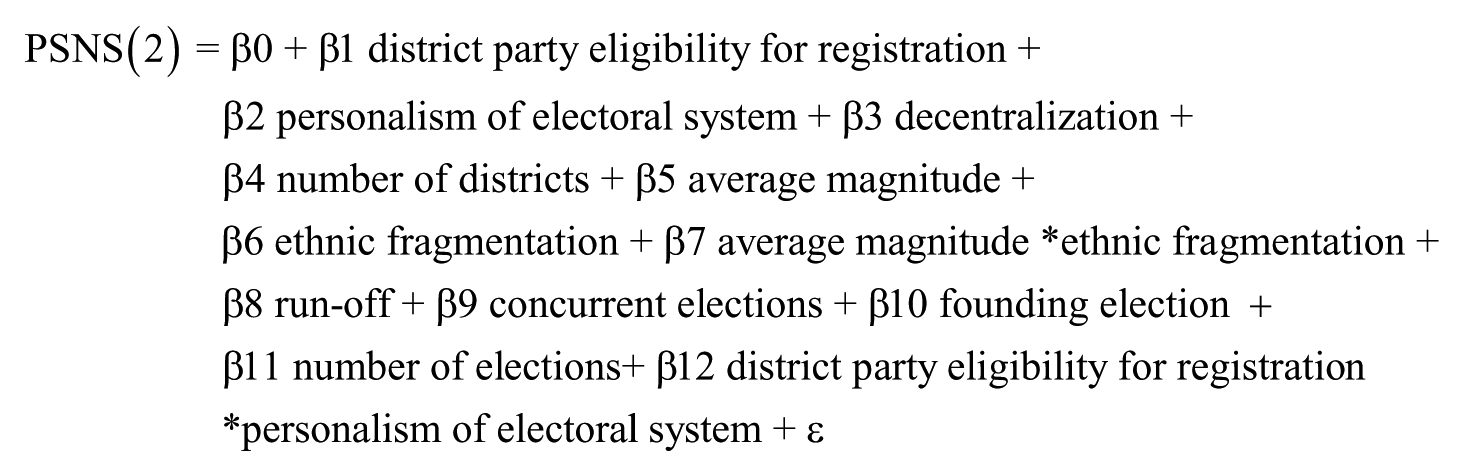
To test my hypothesis, I include an interaction term of the two above variables: Personalism of Electoral System* District-Level Party Eligibility for Registration. Both variables interact in eroding party system nationalization and so, according to my theoretical argument, I expect a negative association between the interaction term and the PSNS.
Control variables
Previous research has shown that development of party systems is closely related to the social and political heterogeneity of a country (Amorim Neto and Cox, 1997). Therefore, logarithmic transformation of district magnitude is used to control for the possibility that a larger district magnitude might encourage multipartism. In addition, when a country has a large number of territorial ethnic minorities, the party system nationalization is eroded because candidates are more likely to compete locally (Caramani, 2004).Furthermore, as Amorim Neto and Cox (1997) suggest, the number of parties is a function of the interaction of district magnitude and the number of social cleavages. This perspective may also suggest that the combined effect of district magnitude and social cleavages increases the number of regional parties, and thus reduces the level of party system nationalization. Therefore, I include in my empirical models Average District Magnitude (Wills-Otero and Pérez-Liñán, 2012), Ethnic Fractionalization (Fearon, 2003), and an interaction term of these two variables.
In addition, I control for several important institutional variables. Political Decentralization (Harbers, 2010) is included to accountfor the fact that a politically decentralized country tends to have a lower level of party system nationalization. The Number of Districts is used to control for the possibility that coordination between candidates becomes more difficult when a country has many electoral districts (Harbers, 2010: 615). Moreover, Concurrent Elections is included as a control variable because it is possible that when presidential elections are held concurrently with nationallegislative elections, the resulting coat-tails effects could lead to a higher level of party system nationalization (Brancati, 2008; Cox, 1997).
I also control for Presidential Run-off and Founding Election because both variables might have negative effects on party system nationalization. The run-off formula might encourage more regional parties to field their candidates in the presidential electionsso that it might indirectly help improve the parties’ chances of winning seats in the legislature (Su, 2015: 297). Moreover, it is expected that more parties tend to run in a founding election after the return of democracy; because political elites might think that it is not obvious which parties are viable, every potential new party entrant is ‘perceived to have an ex ante equal chance to win’ (Cox, 1997: 152). 11 Last,party system nationalization might be shaped by the capacity (or lack thereof) of parties to structure electoral competition, and this can only emerge with the passage of time. Therefore, I included the Number of Elections as a control variable in the empirical models. 12
Estimation techniques
In the empirical analyses, I employ two estimation techniques. First, I use ordinary least squares (OLS) regressions to estimate party system nationalization, following many previous studies (Golosov, 2016; Simón, 2013). Because my data include multiple observations from the same country over time, observations within countries may not be truly independent. Therefore, I obtain robust standard errors by employing Huber–White sandwich robust variance estimators.
Second, I follow Harbers’ (2010) study, using pooled time-series cross-sectional (TSCS) analyses with panel-corrected standard errors (Beck and Katz, 1995). Feasible generalized least squares technique is not appropriate for my data because the number of elections in my dataset is small compared to the number of countries. To preserve the degrees of freedom for the analyses, I take into account panel-specific serial correlation as a first-order process through a Prais–Winsten transformation rather than including a lagged dependent variable in the model.
In this study, two different sets of models have been specified: one that takes into account the independent effect of variables; and the other that includes all variables as well as the interaction term. Thus, models have been defined as follows:

Empirical results
Table 1 presents the results for the empirical models that predict the party system nationalization scores. Model 1 and Model 2 employ OLS with robust standard errors clustered by country. Model 3 and Model 4 follow the TSCS technique with panel-corrected standard errors.
Effects of personalism and spatial registration rules on party system nationalization in Latin America.

Notes: standard errors are in parentheses. ***p⩽ 0.001; **p⩽ 0.01; *p⩽ 0.05.
In Model 1 and Model 3, the coefficient of personalism of electoral system does not attain statistical significance. This finding suggests that the degree to which an electoral system cultivates personal vote has at most small effects on the level of party system nationalization, which is consistent with Simón’s (2013) finding. Moreover, the results in Model 1 and Model 3 demonstrate that the coefficient of district-level party eligibility for registration is not statistically significant, showing that this party law has little effect on the level of party system nationalization.
In contrast, the results for the full models, Model 2 and Model 4, offer considerable support for my hypothesis. The coefficient is negative and statistically significant for the interaction term of personalism of electoral system * district-level party eligibility for registration. This indicates that, in a country with an electoral system that provides stronger incentives for a personal vote, the level of party system nationalization tends to be much lower when this country does not have a spatial registration rule. This evidence suggests that it is necessary to consider the multiplicative effects of party formation cost imposed by party laws and personal-vote incentives provided by the electoral system.
In all four models, the effect of a founding election is negative and statistically significant, suggesting that a party system tends to be less nationalized in the founding election. Similar to many previous studies (Golosov, 2016; Harbers, 2010), the results show that political decentralization is a factor that greatly suppresses party system nationalization. Moreover, the interaction term of ethnic fractionalization and average district magnitude has a negative and statistically significanteffect, indicating that a country that has more ethnic cleavages will have a much lower level of PSNS when its average district magnitude is large. The coefficient for average district magnitude is statistically significant, which suggests that in a hypothetical situation where no ethnic cleavage exists (ethnic fractionalization equals zero), a larger average district magnitude increases the level of PSNS.
Other control variables exhibit mixed results for different models. Whether presidential and legislative elections are held at the same time is expected to increase the level of party system nationalization. However, the variable of concurrent elections attains statistical significance in Model 3 and Model 4 but not in Model 1 and Model 2.The coefficient of the number of elections is negative and statistically significant in Model 3 and Model 4, but it is statistically insignificant in Model 1 and Model 2. The coefficient of the number of districts attains statistical significance only in Model 4. Last, the results show that the presidential run-off formula does not appear to be a significant predictor of party system nationalization in my sample.
The main hypothesis of this paper is supported by the empirical results presented above. I show that the variation of party system nationalization in Latin America is driven by the combination of personal-vote orientation of the electoral system and party laws that make district-level parties eligible for registration. To better understand the substantive effect of the interaction between these two institutional variables, I conduct a marginal effect estimation to predict the PSNS based on the results of Model 4 in Table 1.
Figure 3 presents the predicted PSNS for countries that have spatial registration rules and those that do not at different levels of personalism.As can be seen, the margin for the two types of countries increases as the personal-vote orientation of the electoral system increases. Figure 4 reports a test of difference in PSNS between the two types of countries at different levels of personalism. It shows that the difference is not statistically significant when the incentive for cultivating personal vote is low, but such difference becomes statistically significantwhen a threshold of personalism of electoral system is surpassed, which is about a value of 6.
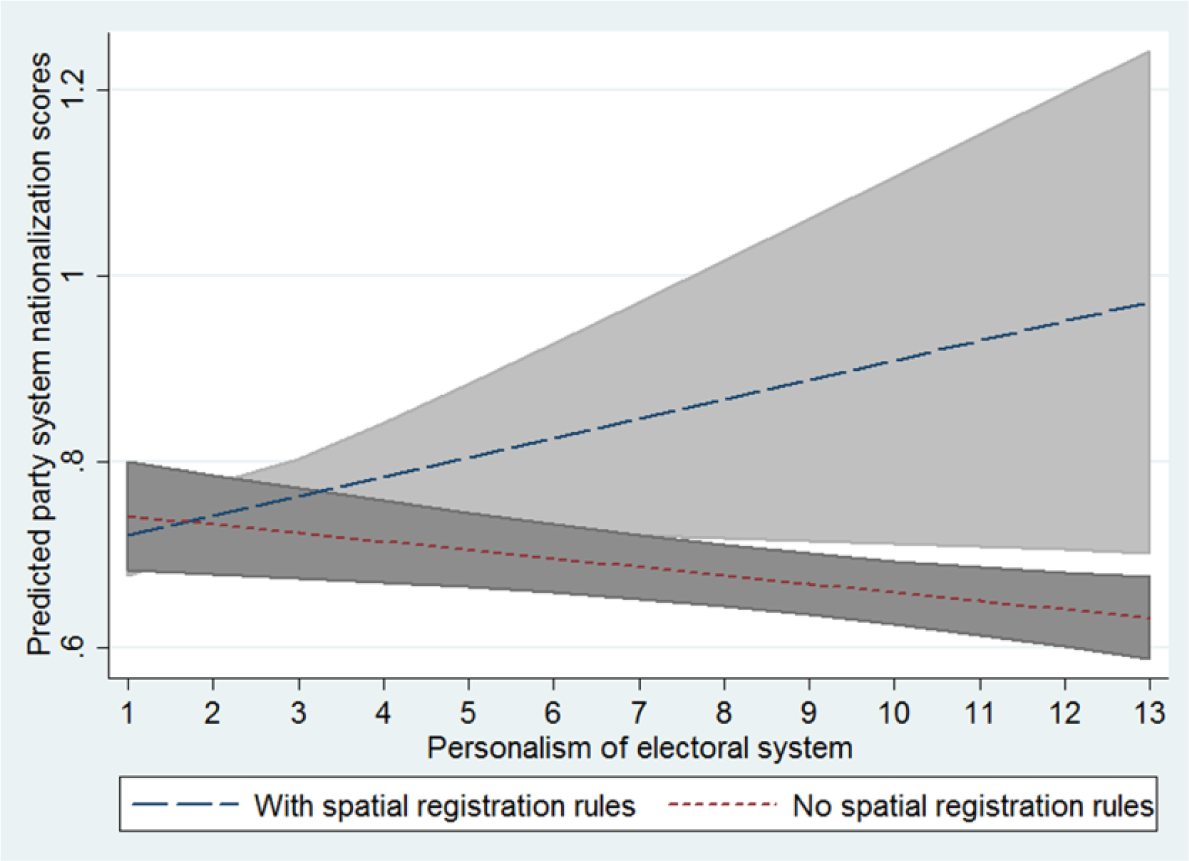
Predicted party system nationalization scores (with 95% confidence interval) by the presence of spatial registration rules at different levels of personalism of electoral system.
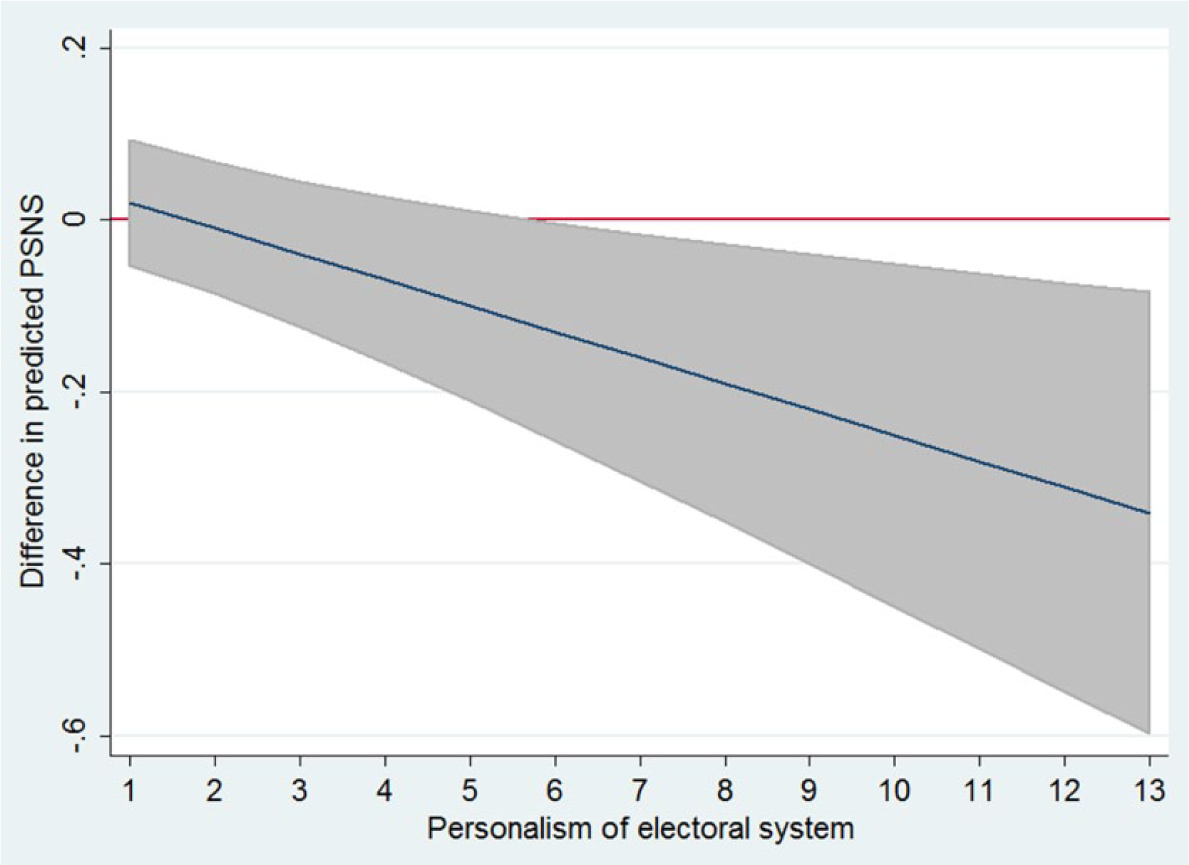
Difference in predicted party system nationalization scores (with 95% confidence interval) by the presence of spatial registration rules at different levels of personalism of electoral system.
Robustness tests
To ensure that my empirical finding is not sensitive to coding decisions for the independent variable, I use an alternative measurement of personalism of electoral system proposed by Nielson (2003) to perform a robustness check reproducing the analysis. Nielson’s personalism index keeps the same three elements of the electoral law and the ordinal ranking in the elements that determine the personal-vote orientation (ballot > vote > pool) suggested by Carey and Shugart (1995). However, Nielson (2003) reformulates the coding questions about institutional incentives for personal vote on each of the three elements, and the various resulting combinations simplify the measurement of personalism to a nine-point scale. The re-estimated results of Model 5in Table 2 are consistent with those reported earlier.
Robustness tests.
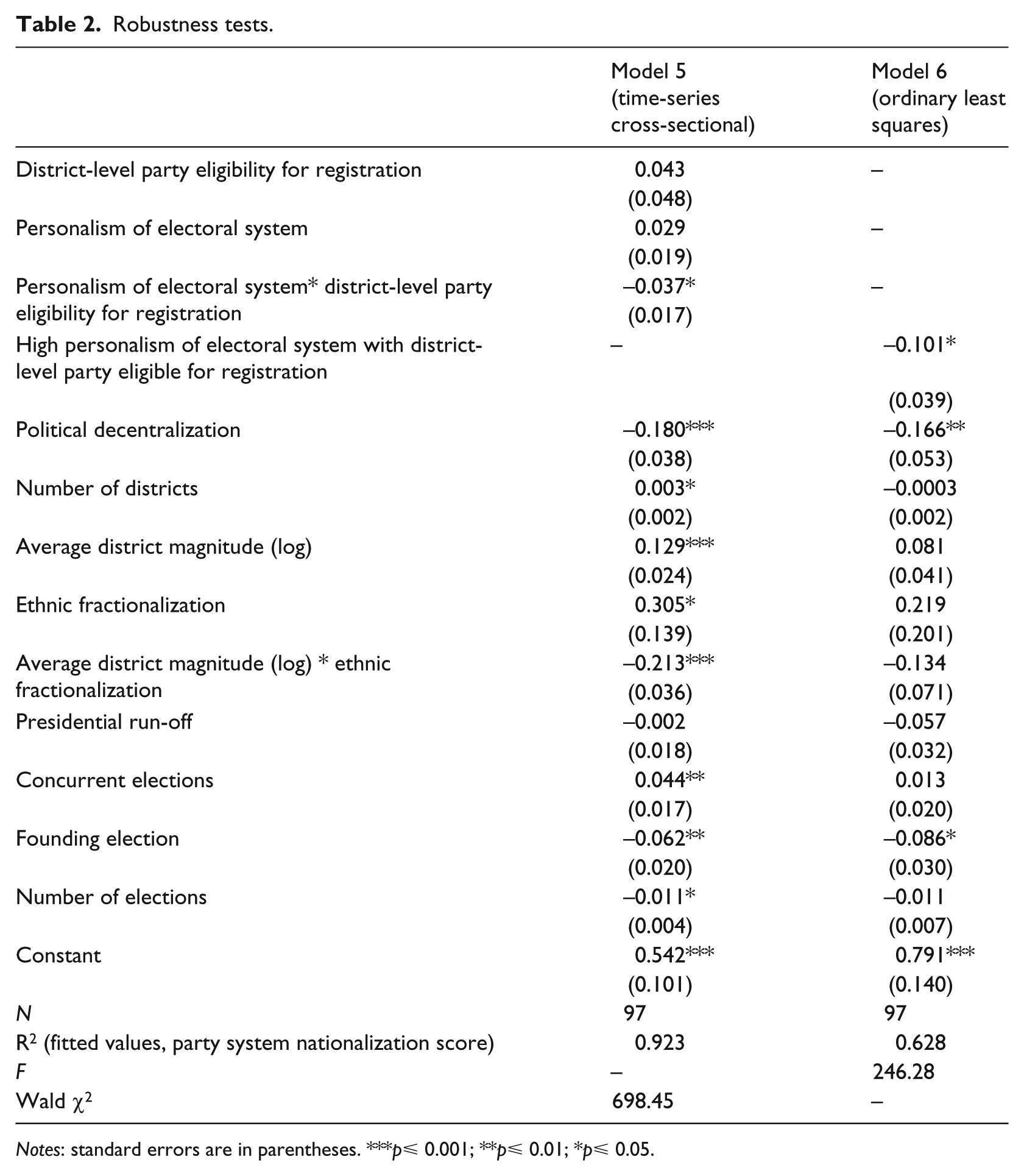
Notes: standard errors are in parentheses. ***p⩽ 0.001; **p⩽ 0.01; *p⩽ 0.05.
So far, the models that have been estimated do not take into account possible endogeneity between the institutional factors and party system nationalization. In the absence of an instrumental variable that is correlated with personalism of electoral system and spatial registration rules but not with party system nationalization, using matching techniques to condition on certain unobserved variables that would possibly induce endogeneity between the independent variable and dependent variable would help minimize the risk of endogeneity. Matching pre-processes the data by pruning observations from the sample that have no matches on certain pretreatment covariates in the treated groups and the control groups. As a result, matching helps to reduce model dependence, lower statistical bias, and increase computational efficiency (Ho et al., 2007).
Among various matching methods, I employ a propensity score matching (PSM) approach to pre-process the data and check the robustness of my results. The PSM approach that I use involves the use of propensity score weights to adjust for selection bias between the observations (Imai and van Dyk, 2004).I create a categorical variable in which 1 indicates that a country that simultaneously has a high level of personalism of electoral system (personal vote score > 5) 13 and has no spatial registration rules, and 0 indicates the residual category. This categorical variable can be conceived as a treatment variable as used in experimental studies, and it is used to compare observably similar observations that did and did not receive the treatment. Cases in the treatment group are matched to cases in the control group based on the closeness of their propensity scores.
In order to obtain the propensity score for each observation, I estimate each observation’s likelihood of being in the treatment group by using a logit model based on the number of constituenciesand average district magnitude. The inverse of that predicted probability is used to create the propensity score weight (Morgan and Winship, 2007: 152–155). I then estimate an OLS regression, reweighting each observation by the inverse of its probability of being in the treatment group. This reweighting process reduces selection bias by assigning higher weights to the observations that could plausibly be in the treatment category other than those in which they were observed. As the results of Model 6 in Table 2 show, the effect of the treatment variable is negative and statistically significant, providing robust evidence for my theory.
Conclusion
This study is motivated by the lack of scholarly attention to party registration rules and their effects on party system nationalization. Previous research has argued that the personal-vote incentives provided by electoral systems affect the level of party system nationalization. However, I argue that the theorized effect should be conditional. Using electoral data for 18 Latin American countries from 1978 to 2011, I have shown that the independent effect of a personal-vote orientation of an electoral system is not statistically significant. Instead, the empirical result supports my theoretical claim, demonstrating thata country that has electoral rules with a highpersonal-vote propensityis more likely to have a lower level of party system nationalization when the country allows district-level parties to register.
The causal mechanism of electoral system and party system nationalization is closely linked to the level of party formation cost in elections where personal attributes of candidates are crucial for determining the electoral outcome. In a country that does not allow the registration of district-level parties, candidates tend to coordinate across various districts, even though the electoral system provides strong incentives for the candidates to rely on their personal attributes to compete. However, in countries with no spatial registration rules, politicians have fewer incentives to establish national parties because it is more costly to do so. Registering a district-level party helps highlight the personal attributes of an ambitious candidate for the voters. The reduction effect of personalism of electoral system on party system nationalization will be strengthened if district-level parties are free to register.
Other institutional hypotheses on nationalization were tested in this study. The reduction effect of political decentralization on party system nationalization is reaffirmed by the empirical analysis. Moreover, I find that a country’s party system tends to be less nationalized right after the founding election in the transition to democracy. In a country with many ethnic cleavages, the level of party system nationalization tends to be even lower when the country has a large average district magnitude.
Overall, this study offers strong support for the argument that explaining the nationalization of party systems requires consideration about how different institutional settings interact. It also creates new opportunities for a broader research agenda for party nationalization. One extension of my analysis is to explore the interactive effects of electoral systems and party laws on nationalization at the party level. In addition, future studies should take into account the impacts of electoral reforms and party vote swings on party system nationalization. Furthermore, it is important to explore how party elites actually craft strategies facing the incentives and restraints provided by particular institutions to nationalize/de-nationalize their parties. Last but not least, this study provides important implications for the study of party system institutionalization. For instance, it will be promising for future scholars to conduct comparative research on the interaction effects of different institutional factors on electoral volatility.
Footnotes
Acknowledgements
I sincerely appreciate the feedback and suggestions from Ronald Alfaro-Redondo, Miguel García, Scott Morgenstern, Adrián Pignataro, Juan Carlos Rodríguez, Laura Wills-Otero, Lawrence Zigerell Jr, the three anonymous reviewers of this article, and Professor Mark Kesselman.
Funding
This work was supported by the Ministry of Science and Technology, Taiwan (grant number 104-2410-H-004-107-MY2).
Notes
Author biography
References
Supplementary Material
Please find the following supplemental material available below.
For Open Access articles published under a Creative Commons License, all supplemental material carries the same license as the article it is associated with.
For non-Open Access articles published, all supplemental material carries a non-exclusive license, and permission requests for re-use of supplemental material or any part of supplemental material shall be sent directly to the copyright owner as specified in the copyright notice associated with the article.
