




Abstract
State capacity may be a crucial factor conditioning the democratizing power of elections in authoritarian regimes. This paper develops a two-phase theory considers the different effects of state capacity on turnover in elections and democratic change after elections. In regimes with limited state capacity, manipulating elections and repressing opposition is more difficult than in regimes with extensive state capacity, rendering turnover in elections more likely in weak states. However, if the new incumbent has limited capacity to deliver public services and make policy changes after coming to power, sustainable democratic change is unlikely. Hence, state capacity is hypothesized to have a negative effect on turnover, but a positive effect on democratic change. These hypotheses are confirmed in a sample of 460 elections in 110 authoritarian regimes taking place in the period 1974 to 2012 using the Varieties of Democracy dataset. The findings suggest a need to revisit strong-state-first theories of democratization.
Introduction
Because many autocracies in the world today hold multiparty elections (Croissant and Hellmann, this issue), it is critical to understand the conditions under which elections lead to democratization or, conversely, sustain authoritarianism. On the one hand, research into democratization-by-elections argues that repeated elections, even when held in authoritarian contexts, eventually lead to democratization (Edgell et al., 2015; Howard and Roessler, 2006; Lindberg, 2009). Indeed, in countries as varied as Tunisia, Ghana and Mongolia, the introduction of multi-party elections has generated increased civil liberties, deepened respect for the rule of law, and regular turnover of the national executive (Doorenspleet and Kopecky, 2008; Lindberg, 2006; Stepan, 2012). On the other hand, cases such as Malaysia, Russia and Cameroon demonstrate that elections in authoritarian regimes can be subverted to such an extent that they strengthen, rather than weaken, authoritarian rule (Gandhi and Lust-Okar, 2009; Levitsky and Way, 2010; Schedler, 2002, 2013). Clearly, elections can both sustain and undermine authoritarianism, raising the question: what factors mediate the relationship between elections and democratization?
We argue that state capacity is one of the factors affecting the democratizing power of elections in authoritarian regimes. Scholars have argued that developing strong state institutions is an important pre-condition for successful democratization, acting both to prevent instability and conflict in transitional regimes and to enable newly democratic governments to gain legitimacy by providing public services (Fortin, 2012; Fukuyama, 2014; Mansfield and Snyder, 2007; Mazzuca and Munck, 2014). However, state capacity may serve those same functions in authoritarian regimes and, in addition, strengthen autocrats’ capacity to manipulate support and oppress dissent (Seeberg, 2014; Slater, 2012; Way, 2005), suggesting state capacity might be equally important for either democratic or autocratic stability (Andersen et al., 2014b; Slater and Fenner, 2011).
We build on insights from research on state capacity, democratization and electoral authoritarianism to develop a theory of how state capacity conditions the effectiveness of elections in bringing about democratic change in authoritarian regimes. We argue that, ultimately, whether state capacity undermines or reinforces democratization depends on who is exercising the capacity of the state and to what end. We therefore propose a two-phase theory that considers the differential effects of state capacity on turnover in elections and democratic change after elections. We hypothesize that state capacity has a negative effect on the likelihood of turnover in authoritarian elections, but a positive effect on democratic change after turnover has occurred. In authoritarian regimes with weak state capacity, manipulating elections, repressing opposition and co-opting elites may be more difficult than in authoritarian regimes with strong state capacity. Hence, we expect elections in regimes with weak state capacity to be more likely to lead to incumbent turnover. However, after turnover, if the new incumbent has limited capacity to deliver public services and make policy changes after coming to power, democratic change is unlikely to be sustainable. 1 Thus, state capacity in authoritarian regimes can either reinforce or undermine the democratizing power of elections, depending on the stage at which state capacity is being applied.
In the next section, we develop our theoretical argument and hypotheses about the relationship between state capacity, elections and democratization. We then present our data and methods, followed by the results of our empirical analyses using new data from the Varieties of Democracy (V-Dem) dataset (version 6.1) and Hanson and Sigman (2013). By drawing on the V-Dem dataset and the Hanson and Sigman state capacity index, we are able to test our theoretical expectations robustly, cross-nationally, and over time, examining 460 elections in 110 electoral authoritarian regimes over a 35+ year period, from 1974 to 2012. In the final section we conclude with a discussion of the results and suggestions for future research. Our findings highlight the need to revisit strong-state-first theories of democratization.
State capacity, elections and democratic change in electoral authoritarian regimes
A rich and extensive literature considers whether or not elections in authoritarian regimes lead to democratization. Some conclude that elections in authoritarian regimes sustain authoritarianism. Historical research on elections in fledgling democracies in Europe, the United States and Latin America demonstrates that elections were subverted in a variety of ways, from co-optation of ruling elites to exclusion of opposition parties and voters, and to electoral manipulation (Evans, 1989; Key, 1949; Lehoucq, 2003; Mickey, 2015). 2 Likewise, during the Cold War authoritarian regimes often restricted competition in elections (when held at all) to such an extent that elections were single-party elections or plebiscites (Magaloni and Kricheli, 2010). More recently, the spike in electoral authoritarian regimes after the end of the Cold War that use a variety of strategies to manipulate elections (Lehoucq, 2003; Levitsky and Way, 2010; Schedler, 2002, 2013), suggests that elections can indeed be useful instruments to promote authoritarian stability (Gandhi and Lust-Okar, 2009; Magaloni and Kricheli, 2010).
Conversely, another thread of research concludes that elections can offer opportunities for democratization. The struggles for electoral reform in countries such as the USA and Mexico illustrate this pathway (Magaloni, 2006; Mickey, 2015). Similarly, many of the authoritarian regimes that started holding multiparty elections after the end of the Cold War did democratize, albeit sometimes through protracted periods of transition (Barkan, 2000; Lindberg, 2006, 2009). 3 Regime change by elections has become increasingly frequent in authoritarian regimes (Croissant and Hellmann, this issue). 4 Hence, a better understanding of the conditions under which elections contribute to the democratization of authoritarian regimes is critical. 5
To resolve these opposing conclusions of the literature on elections and democratization, we examine the mediating variable of state capacity. Although scholars have considered a range of intervening variables that may affect whether or not elections lead to democratization, state capacity has been largely overlooked as such a factor, especially in empirical work. 6 In order to understand the role of state capacity in strengthening or weakening the democratizing power of elections, we map the causal connections between state capacity, elections, and democratic change. 7 We first discuss the direct effects of elections and state capacity on democratic change, and then proceed to outline our key hypotheses on the role of state capacity as a mediating variable in the relationship between elections and democratization in electoral authoritarian regimes.
Elections and democratic change
Elections can lead to democratic change in two ways. First, elections can spur democratic change by generating incremental changes in other components of democracy that subsequently lead to improvements in overall democratic quality. Repeated experiences with elections can encourage learning and socialization of elites and citizens into the practices of democracy, and expand media freedom and civil liberties, changes that might be difficult to turn back after the elections are over (Lindberg, 2006, 2009). Second, elections can lead to democratization by generating incumbent turnover in elections, creating a possibility for citizens to ‘throw the rascals out’ if they are dissatisfied with the incumbent government (Huntington, 1991: 174). Of course, in electoral authoritarian regimes this possibility may be very small, but even autocrats sometimes lose elections, creating a window of opportunity for political change (Levitsky and Way, 2010; Schedler, 2013). Evaluating whether elections have democratizing effects therefore requires a two-phase operationalization of democratization-by-elections: one that examines the determinants of incumbent turnover separately from the determinants of democratic change after elections.
State capacity and democratic change
The state and state capacity have been conceptualized in many different ways (Andersen et al., 2014a; Hanson, this issue). Following the Weberian tradition, we define the state as ‘an entity that successfully claims a monopoly on the legitimate use of force within a specified territory’ (Weber, 1918). State capacity is defined as ‘the ability of state institutions to effectively implement official goals’ (Sikkink, 1991). Following Hanson (this issue), we distinguish between three types of state capacity: three types of state capacity: coercive; administrative; and extractive. While coercive capacity relates to states’ capacity to maintain their monopoly of power and deliver a minimum level of security for citizens (Fukuyama, 2004; Mansfield and Snyder, 2007), administrative capacity refers to states’ capacity to implement policies and deliver basic public services (Andersen et al., 2014a). 8 Extractive capacity refers to states’ capacity to collect resources, which is important for sustaining both coercive and administrative capacity. In practice, authoritarian regimes vary in terms of their capacity on these three dimensions, and this variation determines what strategies for ensuring regime stability are available to incumbents (Andersen et al., 2014b; Slater and Fenner, 2011). 9
We argue that authoritarian rulers can channel state capacity to strengthen their power base in three ways: first, by generating genuine support; second, by fabricating support; and, third, by suppressing dissent. State capacity enables incumbents to generate genuine support by providing security and other public services, such as education or health services (Slater, 2012; Slater and Fenner, 2011). State capacity also allows incumbents to fabricate support by manipulating elections, distorting information provided by the media, and co-opting ruling elites, opposition and citizens (Seeberg, 2014). Lastly, state capacity can be used to suppress dissent by legal prosecution, intimidation, or even jailing and eradicating opposition actors, journalists and critical citizens (Gandhi and Lust-Okar, 2009; Schedler, 2013; Seeberg, 2014).
All three types of state capacity can be used by authoritarian incumbents to generate genuine support, fabricate support, or suppress dissent. For example, coercive state capacity can be used to guarantee security for citizens (generating genuine support) as well as to limit opposition to the incumbent (suppressing dissent). Likewise, administrative state capacity can be used to deliver public services to citizens (generating genuine support) as well as to manipulate elections (fabricating support). Finally, extractive state capacity can be used to fund public services (generating genuine support) as well as for co-opting elites and citizens that may otherwise oppose the incumbent (fabricating support).
In various combinations therefore, electoral authoritarian regimes can use the three types of state capacity through these three different channels to strengthen their power. 10 This can affect prospects for democratic change directly, regardless of whether elections are held or not. For example, co-optation of ruling elites and citizens can ensure loyalty and support for incumbents in the period between elections and can lower the risk of coups, protests and even revolutions or civil war. Coercion of the opposition serves the same purpose, maintaining stability of the regime regardless of whether elections are being held. 11 Hence, we would expect state capacity in authoritarian regimes to lower the prospects of democratic change even in the absence of elections.
How state capacity mediates the relationship between elections and democratization
When it comes to understanding how state capacity affects the democratizing power of elections, it is important to consider two phases, modeling incumbent turnover in elections separately from democratic change after elections. Here, we define ‘incumbent turnover’ to be the election of a different ruling party, and we define ‘democratic change’ as a net shift towards democracy in the years following the election. We advocate this two-phase approach because whether state capacity undermines or reinforces democratization depends on who is exercising the capacity of the state, and to what end (Slater and Fenner, 2011). In considering what leads to incumbent turnover in electoral authoritarian regimes, state capacity is in the hands of an authoritarian incumbent. In this phase, we anticipate state capacity being used to retain power using the strategies outlined above, making turnover and democratic change less likely. However, if turnover nevertheless does occur, state capacity is then in the hands of a newly elected incumbent, who – if democratic – can use state capacity to generate democratic change. We therefore theorize that state capacity has opposing effects in these two phases and thus it is critically important to separate both phases when investigating the effects of state capacity empirically.
Starting with turnover, in elections in authoritarian regimes, strong state capacity can enable incumbents to engage in generating genuine support, fabricating support and suppressing dissent. For example, strong state capacity allows incumbents to ramp up delivery of public services and goods in the months leading up to the elections, to target clientelism, to co-opt elites by promises of access to and redistribution of state resources after the elections, to intimidate opposition and voters and oppress independent sources of information, and to manipulate electoral institutions such as electoral management bodies to deliver results in favor of the incumbent (Gandhi and Lust-Okar, 2009; Hellmann, this issue; Schedler, 2013; Seeberg, 2014). Strong state capacity thus allows authoritarian incumbents to limit the presence of viable opposition parties, limit the freedom of the media, engage in electoral fraud, and use many other strategies that maximize their chances of winning the elections. Hence, we would expect strong state capacity to significant lower the chances of turnover in authoritarian elections. Elections held in electoral authoritarian regimes with strong states, such as Malaysia, Singapore and Russia, provide illustrative examples of this logic. Conversely, we would expect weak state capacity to increase the likelihood of turnover in authoritarian elections, as illustrated by elections in regimes with weaker state capacity such as those in Haiti, Bangladesh and Comoros.
However, while weak state capacity may increase the probability that elections trigger incumbent turnover, subsequent democratic change may be less likely in regimes with limited state capacity. Conversely, if elections in authoritarian regimes with strong state capacity bring a ‘democrat’ to power, however unlikely such an outcome might be, state capacity would be important in supporting the new incumbent’s attempts at implementing further democratic change. A democratic leader attempting to generate genuine support would need strong extractive capacity to fund large-scale public goods, strong administrative capacity to follow through on a programmatic agenda, and strong coercive capacity to enforce the rule of law and depart from the previous autocratic status quo. Thus, what may be needed for democratic change after elections is the (unlikely) combination of incumbent turnover and a strong state. 12 The cases of South Korea (Hellmann, this issue) and Indonesia (Mietzner, this issue) provide examples of this logic.
We therefore expect state capacity to be positively associated with democratic change after elections, but only if the elections resulted in incumbent turnover. Figure 1 provides an illustration of the expected relationships between state capacity, incumbent turnover and democratic change after elections.
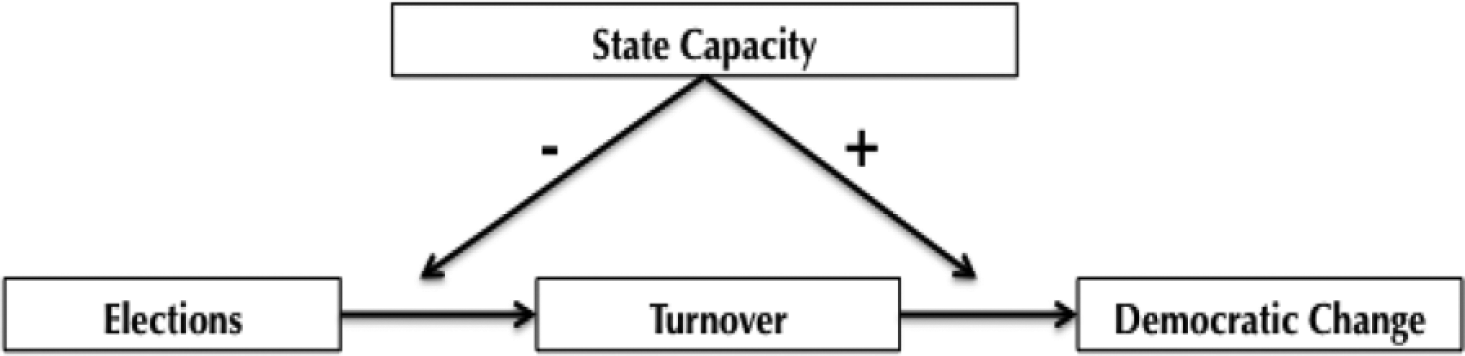
Theoretical conditional effect of state capacity on democratization-by-elections.
Summarizing our hypotheses, our hypothesis for the direct effect of state capacity on democratic change in electoral authoritarian regimes is:
H1 – Greater state capacity is associated with a lower likelihood of democratic change.
Our hypotheses for the conditional effects of state capacity on the democratizing power of elections in electoral authoritarian regimes are:
H2 – Greater state capacity is associated with a lower likelihood of turnover in elections; and
H3 – Greater state capacity is associated with a higher likelihood of democratic change after elections that resulted in turnover.
Data and methods 13
The hypotheses outlined in the previous section are tested with new data from the Varieties of Democracy (V-Dem) dataset, version 6.1 (Coppedge et al., 2016a, 2016b, 2016c) and the Quality of Government dataset (Teorell et al., 2015), as well as data on state capacity from Hanson and Sigman (2013). 14
Sample selection
Because our theoretical argument focuses on authoritarian elections, we limit our sample to electoral authoritarian regimes. We use the V-Dem liberal democracy index which classifies regimes along a continuum from ‘very authoritarian’ (0) to ‘very democratic’ (1). 15 We consider all regimes that hold elections and score lower than 0.5 on the liberal democracy index to be electoral authoritarian regimes and include them in our analysis. 16 This cutoff means some ambiguous cases on the border between electoral authoritarianism and electoral democracy might be included, but assures inclusion of all electoral authoritarian regimes.17,18 We exclude closed autocracies that do not hold multiparty elections for the national executive, and exclude countries that are not fully independent. 19 We further restrict the sample to national-level elections for the executive. Hence, in presidential regimes we include presidential elections and in parliamentary regimes we include parliamentary elections. 20 These choices result in a sample of 460 executive elections that took place between 1974 and 2012 in 110 countries around the world, a total of 3116 country–year observations. 21
Dependent variables
Tables A and B in the online Appendix show summary statistics for all variables. The analyses include two dependent variables: incumbent turnover in elections, and democratic change after elections.
Turnover is measured using the V-Dem variables capturing turnover in the head of government and turnover in the head of state. We code elections as having resulted in turnover when the head of state or head of government lose their position(s) as a result of the outcome of the election. In presidential systems, this code applies when the new president is both a different person and from a different party (or independent) than was in power before the election. In parliamentary systems, this code applies when the ruling party or coalition of parties loses and the new head of government is from a different party or from a new coalition (Coppedge et al., 2016b). 22 In our sample, 34% of elections resulted in turnover. 23
We measure democratic change by calculating the change in the regime’s democracy score in the two years after the elections. 24 The democracy score we use is the V-Dem liberal democracy index described above, which classifies regimes along a continuum from very authoritarian (0) to very democratic (1). 25 In the models with democratic change as the dependent variable, we include lagged democracy level (t – 1) as an independent variable to mitigate possible ceiling effects. 26
Independent variables
Our main independent variable of interest is state capacity. We use the measure of state capacity developed by Hanson and Sigman (2013) for three reasons. First, it combines the three dimensions of state capacity discussed – extractive capacity, coercive capacity, and administrative capacity – into a single measure of state capacity. 27 Second, it offers the greatest coverage in years and countries, because it incorporates measures of state capacity from multiple sources. Third, missing data are imputed rather than list-wise deleted. 28 In the models explaining turnover, state capacity is lagged; hence it is measured in the year before the election; in the models explaining democratic change after the election, we measure state capacity in the year of the election.
Controls
In models explaining turnover, we include several control variables associated with turnover in elections. Because turnover is more likely if economic performance is unsatisfactory (Anderson, 2007), we include GDP per capita (in current US dollars) and economic growth per capita (% annual GDP growth per capita). 29 Clarity of responsibility, required for voters to hold incumbents accountable for bad performance, is considered to be greater in presidential (versus parliamentary) systems (Anderson, 2007), and so presidentialism is included as a control variable as well. 30
In models explaining democratic change, we include control variables that have commonly been found to be associated with democratization in previous research (Lindberg, 2006; Przeworski et al., 2000; Teorell, 2010). We include control variables for the level of economic development (measured as GDP per capita in current US dollars) and economic growth (measured as % annual GDP growth per capita), because previous research has found that greater economic development but lower growth rates are conducive to democratization (Przeworski et al., 2000). We include control variables indicating whether a coup d’état or civil war occurred in the year before the elections because previous research has found both such events to have a negative effect on democratization (Lindberg, 2006). We include controls for ethnic and religious fractionalization, whether the country has a presidential or parliamentary form of government, and whether the country is a former British colony because previous research has found that ethnic and religious fractionalization undermines democratization (Teorell, 2010), presidentialism negatively affects prospects for democratization (Przeworski et al., 2000), and former British colonies tend to have better prospects for democratization (Teorell, 2010). Data on the level of economic development and growth are derived from the World Development Indicators, data on coup d’états and civil war from the V-Dem dataset, and data on the other control variables from the Quality of Government dataset (Teorell et al., 2015). 31
We do not include the level of foreign aid and the level of natural resources as controls when predicting democratic change because we anticipate these to be intervening variables in the relationship between state capacity and democratic change. Similarly, we do not include intervening variables that are associated with elections and democratic change, such as co-optation of elites and citizens, oppression of the opposition, and electoral manipulation. These variables are part of the causal mechanisms we are positing, meaning that we expect state capacity to shape turnover in elections and democratic change through these variables, and that the multicollinearity between these variables and state capacity would render the effect of state capacity insignificant in regression analysis.
We lag all included control variables by one year, so they are measured the year before the elections took place.
Empirical strategy
Our empirical strategy has two sections. First, in order to test whether there is a direct negative effect of state capacity on democratic change (H1), the first section of our analysis predicts democratic change in all country–years, regardless of the incidence of an election. These analyses are carried out using time-series cross-sectional ordinary least squares regression with country fixed effects: the results are presented in Table 1. Because we are testing for a direct effect of state capacity on democratic change, in these analyses we consider all country–years in our sample, regardless of whether elections were held or not.
The direct effect of state capacity and elections on democratic change.

Standard errors in parentheses. p-values: *0.05; **0.01’ ***0.001.
To determine whether there is a negative effect of state capacity on turnover in elections (H2), we first test the effect of state capacity on turnover, using time-series cross-sectional logistic regression with regional fixed effects for turnover models. 32 Then, in order to test whether there is a positive effect of state capacity on democratic change after elections with turnover (H3), we model turnover and democratic change simultaneously as part of a two-step equation. We use a treatment effects model to test, first, how state capacity affects turnover (selection model) and, subsequently, how state capacity affects democratic change once turnover has taken place (regression equation). 33 A treatment model is an appropriate test for our hypothesis about the two-stage nature of democratization-by-elections, where elections first need to lead to incumbent turnover in order to open possibilities for wider post-election democratic change. Since these analyses focus on the consequences of elections, the sample is limited to election years. Results for these analyses are presented in Table 2.
The effect of state capacity on turnover and democratic change.
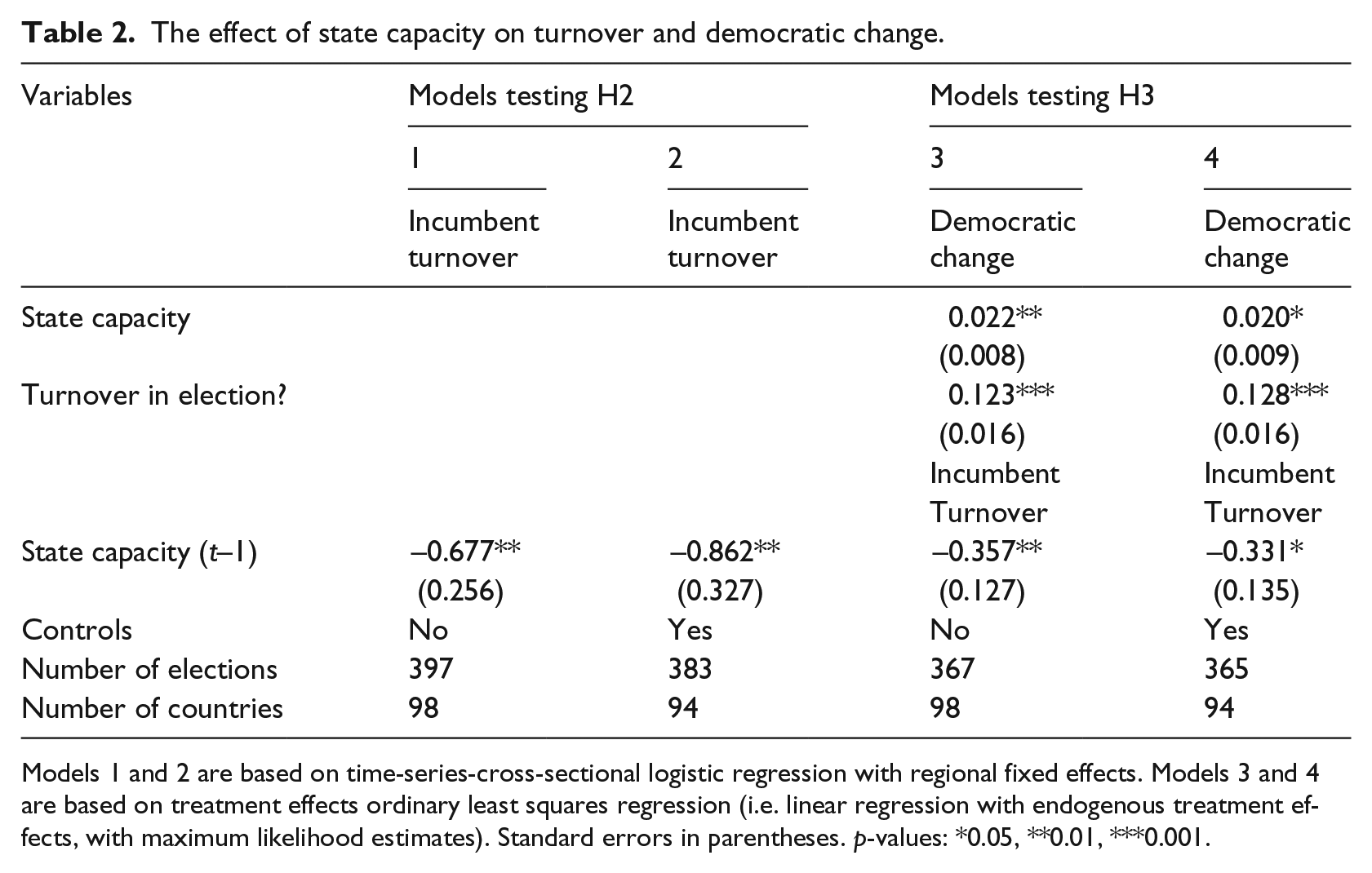
Models 1 and 2 are based on time-series-cross-sectional logistic regression with regional fixed effects. Models 3 and 4 are based on treatment effects ordinary least squares regression (i.e. linear regression with endogenous treatment effects, with maximum likelihood estimates). Standard errors in parentheses. p-values: *0.05, **0.01, ***0.001.
Robustness checks of the analyses are discussed in the endnotes and reported in the online Appendix.
Results
Table 1 shows the results of the analyses testing the direct effect of state capacity on democratic change (H1).
As Model 1 shows, in our sample of electoral authoritarian regimes, state capacity negatively affects democratic change, supporting H1. This effect is robust to the inclusion of controls (Models 2 and 4) and the election variables commonly included in the democratization-by-elections literature (Models 3 and 4). To summarize these findings, state capacity has a negative direct effect on democratic change, while elections have a positive direct effect on democratic change. The democratizing power of elections is strongest when elections resulted in turnover and when elections occurred in high state capacity states.
Table 2 models the impact of state capacity on democratization-by-elections as a two-phase process. We first predict the effect of state capacity on turnover in Models 1 and 2. Models 3 and 4 report the results when turnover and democratic change are modeled simultaneously in a treatment effects model, where turnover is the dependent variable of the selection equation and democratic change is the dependent variable of the regression equation.
As Model 1 shows, lagged state capacity has a strong negative effect on incumbent turnover. This effect is robust to the inclusion of control variables in Model 2. A plot of the marginal effects of state capacity on turnover shows that at higher levels of state capacity, turnover is much less likely to occur (Figure 2). These results suggest that state capacity is an important factor shaping whether authoritarian elections result in turnover, and that greater state capacity may be detrimental for turnover, supporting H2.
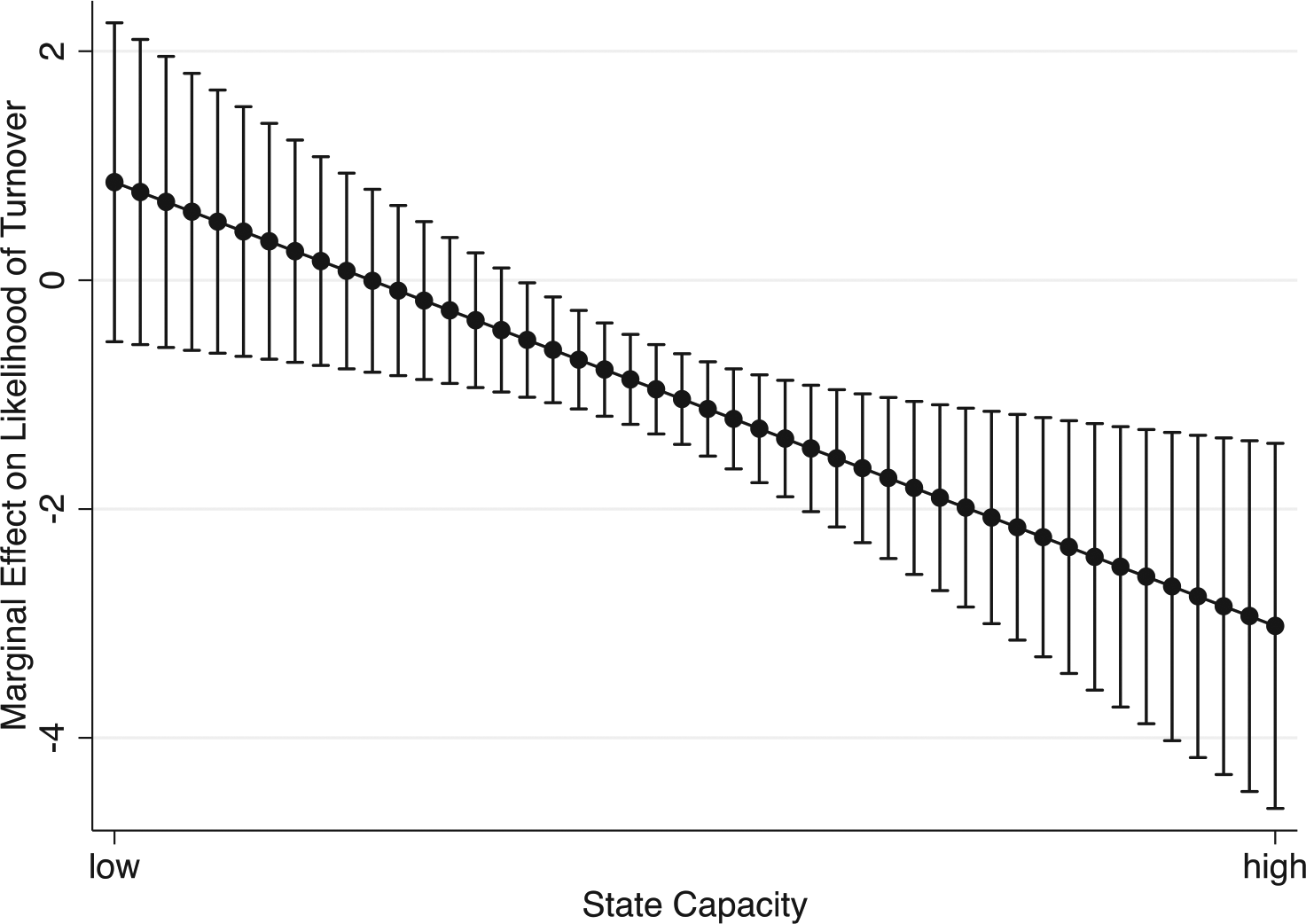
Marginal effects of state capacity on turnover Vertical bars indicate 95% confidence intervals; estimates based on Model 2, Table 2.
In Models 3 and 4, we model turnover and democratic change as a two-stage process using a treatment model. The results of the selection model indicate the expected strong negative effect of state capacity on turnover, although the strength of the effect is somewhat diminished in comparison to Models 1 and 2. The results of the regression model indicate that turnover has a significant positive effect on democratic change in years after elections. Moreover, if elections result in turnover, state capacity has a substantively small yet statistically significant positive effect on democratic change in electoral authoritarian regimes. Thus the results in Table 2 appear to confirm H2 and H3. State capacity decreases the likelihood of turnover in authoritarian elections but increases post-election democratic change once turnover occurs. Figure 3 illustrates the marginal effects of state capacity on democratic change with and without turnover.
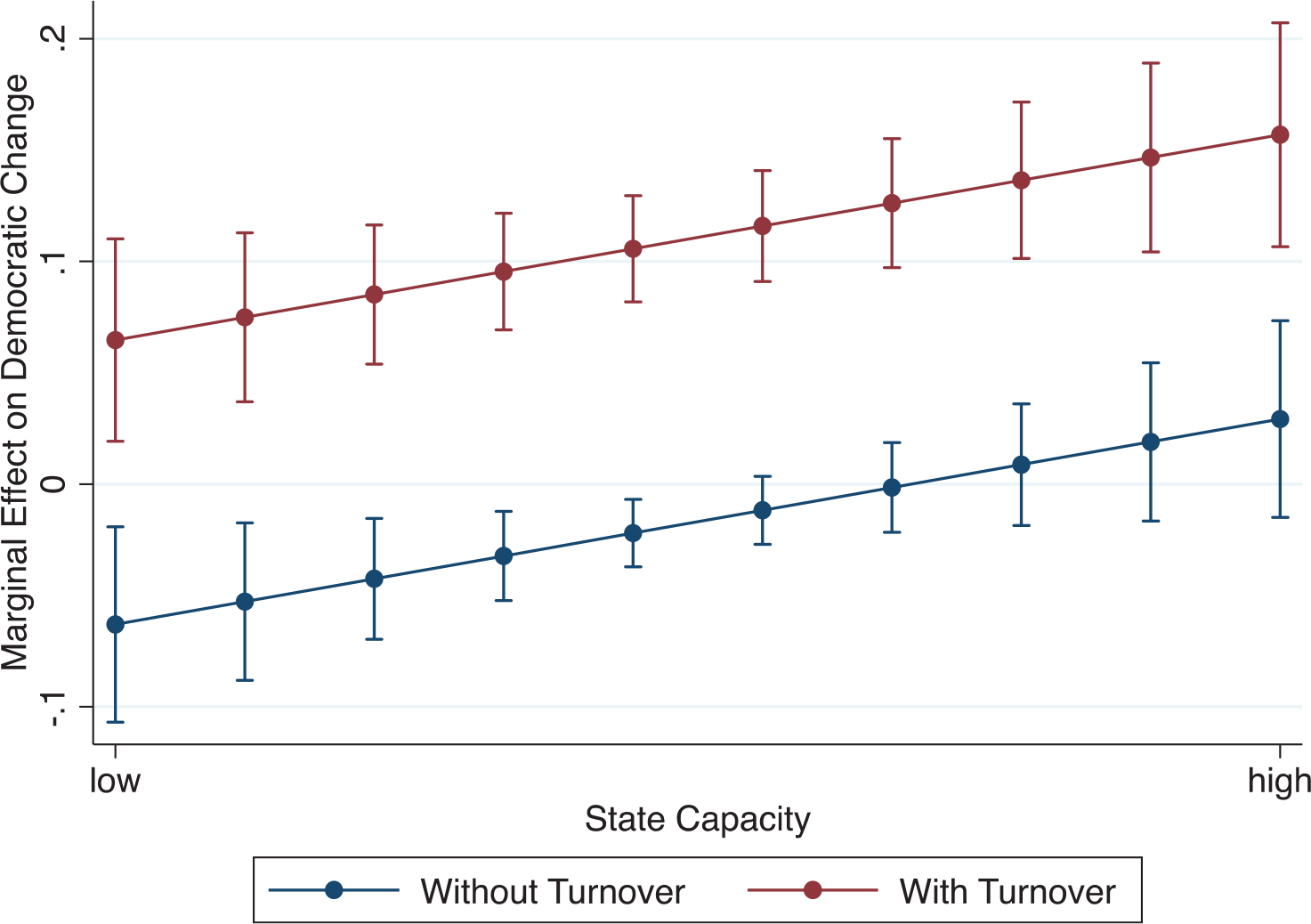
Marginal effects of state capacity on democratic change, with and without turnover. Vertical bars indicate 95% confidence intervals; estimates based on Model 4, Table 2.
We ran a series of robustness checks using different criteria for sample selection, using different measures for the dependent variables, and using a different measure for state capacity. The results of these tests are reported in the online Appendix to this paper. In brief, H1 appears to be robust with regard to alternative model specifications: state capacity significantly lowers the likelihood of democratic change, regardless of whether elections were held or not. Only in models using the Polity IV < 0 score as a sample selection criterion and in models with the alternative measure of state capacity was the effect of state capacity insignificant, though still negative. H2 and H3, concerning the conditional effect of state capacity on the democratizing power of elections, appear to be partially confirmed in the robustness checks. The clear negative effect of state capacity on turnover in elections (H2) is robust with regards to alternative model specifications. However, the positive effect of state capacity on democratic change after turnover has occurred (H3) does not always hold in robustness checks and the effects are substantively small.
Conclusions
Under what conditions do elections lead to democratization or, conversely, sustain authoritarianism? In this article, we propose that state capacity is a key intervening variable in the relationship between elections and democratization in authoritarian regimes. We develop two main hypotheses regarding this relationship: that state capacity prevents turnover in authoritarian elections but that, conditional on turnover having occurred, state capacity catalyzes democratic change after elections. We use the Varieties of Democracy dataset and the Hanson and Sigman state capacity index to test these expectations robustly, cross-nationally and over time, examining 460 elections in 110 electoral authoritarian regimes over a 35+ year period.
The results suggest that state capacity significantly lowers the likelihood that elections will result in turnover. However, if elections do result in turnover, the effect of state capacity on democratic change is positive. Whilst turnover in elections is less likely in authoritarian regimes with strong state capacity, if elections do result in turnover in these regimes then state capacity enables new incumbents to consolidate democratic change. These results demonstrate the mixed effects of state capacity under authoritarian regime conditions: electoral authoritarian incumbents that benefit from stronger state capacity face greater chances of surviving elections, but if turnover does occur – against the odds or for other reasons – state capacity can help newly democratic incumbents to stabilize and sustain the new regime.
The fact that state capacity has opposing effects on turnover in elections and democratic change after elections demonstrates that the role of state capacity in conditioning the democratizing power of elections is more complex than previous research has demonstrated. This suggests that ‘strong state first’ theories of democratization may need to be qualified. While state capacity is clearly important with regard to consolidation of democratic change once democratic incumbents come to power, it is only if and when such incumbents come to power that state capacity helps to promote democratic change. In the hands of authoritarian incumbents, state capacity both limits the likelihood of democratic change directly and undermines the capacity of elections to generate turnover, thereby hindering the prospects for democratic change overall. Our findings reinforce the idea that policy efforts to build state capacity should be executed carefully, mindful of this precarious tipping point between building state capacity that might reinforce authoritarian control and building state capacity that can enhance democratization.
Limitations and future research opportunities
A number of caveats to these findings are in order. First, in the analyses presented here we have considered the relationship between state capacity, turnover and democratic change with a relatively short-term perspective. Our analysis focuses on short-term causal effects such as the relationship between state capacity and election turnover one year later, and then the subsequent democratic change in the years immediately following elections. There are valid causal inference reasons for doing so, because examining democratic shifts over a longer time period would result in the inclusion of multiple elections, potentially confounding cause and effect. However, it is possible that state capacity affects democratization-by-elections through more long-term causal mechanisms, such as processes of ‘creeping democratization’ whereby successive elections generate slow, protracted change in other components of democracy that eventually pave the way for broader democratic change. A better understanding of the role of state capacity in promoting or hampering such long-term processes would be an interesting venue for future research.
This leads to the second caveat, which is that we have considered democratic change here as shifts of regimes in the direction of democracy, conceiving regimes to be located along a continuum from authoritarian to democratic, and allowing positive democratic change to serve as an indication that democratization-by-elections is succeeding. However, some would argue that successful democratic change is only achieved when democratic change is substantial enough to shift regimes from being classified as ‘electoral authoritarian’ to being classified as ‘electoral democracies’. Future research exploring how elections and state capacity interact in generating full regime change across different regime types could give a more complete picture of the role of elections and state capacity in cultivating democratization.
Finally, an interesting venue for future research would be to investigate the specific causal mechanisms by which state capacity affects the democratizing power of elections; for example, by disaggregating state capacity into its three components of administrative, coercive and extractive capacity. Currently, cross-national data on state capacity are scarce, and data on its specific components even more so, limiting analyses to a small (and non-random) sub-set of electoral authoritarian regimes for which such data are available. The new Hanson and Sigman (2013) data ameliorates this situation by using multiple data sources and Bayesian latent variable analysis to generate high quality comparative data on state capacity, but more detailed data on the disaggregated components of state capacity are still lacking. Future research collecting large-N cross-national data on these dimensions would be highly valuable, and could shed more light on the causal mechanisms connecting state capacity, elections, and democratic change.
Policy implications
Recognizing these caveats, the findings presented in this article nonetheless suggest several policy implications. Our findings provide evidence that the positive effects of state capacity for democratization may only occur under specific – and comparatively rare – circumstances, i.e. after authoritarian incumbents have lost elections and a democratic incumbent has come to power, suggesting that strengthening state capacity in authoritarian regimes is not necessarily good for democratization. Of course, strengthening state capacity might be beneficial for achieving other goals such as security and efficient public service delivery, but the empirical evidence presented here suggests that in electoral authoritarian regimes it is likely that investments in state capacity with the goal of democratization will need to be complemented by other interventions aimed at promoting turnover in elections, such as increasing the integrity of elections and supporting opposition.
Footnotes
Acknowledgements
The authors would like to thank: our three anonymous reviewers; Aurel Croissant, Olli Hellmann, Matthew Wilson, Gerardo Munck; and participants at the University of Sussex workshop on state capacity and the stability of electoral authoritarian regimes, 10–11 June 2015; at the Varieties of Democracy Annual Conference 23–24 May 2015, University of Gothenburg; and at the Annual Conference of the American Political Science Association, 3–6 September 2015, for their valuable feedback on earlier versions of this paper. Any remaining errors are our own.
Funding
This research project was supported by the Australian Research Council DECRA funding scheme, with funds granted to Dr Carolien van Ham [grant number RG142911, grant name DE150101692].
Notes
Author biographies
References
Supplementary Material
Please find the following supplemental material available below.
For Open Access articles published under a Creative Commons License, all supplemental material carries the same license as the article it is associated with.
For non-Open Access articles published, all supplemental material carries a non-exclusive license, and permission requests for re-use of supplemental material or any part of supplemental material shall be sent directly to the copyright owner as specified in the copyright notice associated with the article.
