




Abstract
The possibility of holding representatives to account through regular elections is one of the cornerstones of representative democracy. The precise role of partisanship in doing this has not been extensively examined. Using survey data from Europe (2002–2012), we show that partisanship can weaken or strengthen accountability, depending on its sources. If it is an affective-psychological attitude, as the Michigan school suggests, then it weakens accountability because it acts as a perceptual screen. If, however, it is a calculation of party performance which is constantly updated by citizens, then it strengthens accountability. The findings suggest that partisanship in Europe has been quite responsive to performance over the ten-year period. Instead of acting as a screen that inhibits accountability, partisanship appears rooted in calculations of party performance and so enhances accountability. However, the effects are asymmetric with left-leaning partisans more sensitive to the performance of their governments than right-leaning partisans.
Keywords
Introduction
One of the most important features of democratic rule is the possibility of holding politicians to account for their decisions. Accountability in this context relates to the connection between performance and its consequences (Manin et al., 1999a; Romzek, 2015). The role of partisanship in this process has not been extensively examined, and so in this article we contribute to the discussion of accountability and partisanship with a single claim: the extent to which citizens hold governments accountable depends on the source of their partisanship.
Over the last several decades, the concept of partisanship has been employed in many studies and it is one of the dominant drivers of voter choice. While the literature largely agrees on these effects, it is more divided when it comes to understanding the sources of partisanship. When the concept was introduced originally, it was defined as the product of socialization processes and affective reasoning among citizens (e.g. Campbell et al., 1960). In contrast, later studies have argued that partisanship is the result of cumulative evaluations of party performance (e.g. Fiorina, 1981). We suggest that this difference in the sources of partisanship matters with regard to its effects on political accountability.
Numerous studies of the accountability mechanism have investigated how the performance of politicians in managing the economy influences citizens’ voting behaviour (for an overview, see Lewis-Beck and Stegmaier, 2013). It shows clearly that voters reward incumbents for good economic performance and punish them for bad outcomes (Key, 1961). According to the socialization interpretation of partisanship, or what we will call type-1 partisanship, party identification is exogenous to voting behaviour since it is an ‘unmoving mover’ of the immediate factors which determine electoral choice. Type-1 partisanship should therefore weaken political accountability because stable, long-term attachments to parties can override public evaluations of their performance (see e.g. Kayser and Wlezien, 2011; Tilley and Hobolt, 2011). In contrast, partisanship grounded in policy evaluations, or what we call type-2 partisanship, is based on cost–benefit calculations of the perceived effectiveness of parties in delivering public policies (Fiorina, 1981; Franklin, 1992). This is often referred to as the ‘running tally’ model of partisanship. Type-2 partisanship should enhance accountability because it is responsive to other factors which drive voting behaviour, in particular policy performance and leadership evaluations. It makes partisanship an effective mechanism of political accountability.
The academic debate on the rival accounts of partisanship is widespread and on-going, and it has produced many studies on either side of the argument. We do not aim to settle this debate here. Existing research shows that the electorate is made up of a mixture of both types of partisans (see Kramer, 1971, 1983; Wlezien et al., 1997). The rich literatures on both types are our point of departure for arguing that both have their theoretical and empirical merits, and that they should be incorporated into a joint analysis to further shed light on how Europeans hold their governments accountable. Doing that requires a conceptualisation of political accountability as partisan responsiveness to government performance.
This article is believed to be the first to study sources of partisanship comparatively and to use such a conceptualisation of accountability. The rapidly changing economic and political circumstances of European democracies in the first decade of the twenty-first century serve as our context. The analysis uses ten years of European Social Survey data (2002–2012). This period encompasses the ‘Great Recession’, which started in 2008, following the global financial crash. This rare event focused the minds of Europeans on the issue of the economic performance of their governments and so the mechanisms of accountability should be strong during this period (Whiteley et al., 2013).
The first section sets out two ideal-type sources of partisanship and examines their connections to political accountability in democratic systems. We then test our central hypothesis that type-2 partisanship enhances accountability and type-1 partisanship weakens it. The results confirm previous research suggesting that both types of partisans are to be found in European electorates. However, political accountability is more strongly influenced by type-2 partisanship. Type-1 partisans are less responsive to policy performance and political events and more likely to evaluate political performances through their ‘partisan lenses’. The effects are cross-cut by the ideological leanings of incumbent parties, however, with left-leaning partisans being more sensitive to the performance of their governments than right-leaning partisans. Overall these results mean that patterns of political accountability are explained not only by the absence of partisanship, as Kayser and Wlezien (2011) have demonstrated, but also by the existence of type-2 partisans and partisans’ ideological leanings.
Partisanship and democratic accountability
Theories of representative democracy hold that accountability is an important mechanism by which citizens incentivise politicians to implement their promises made at election times (Urbinati and Warren, 2008). A politician is given the task of representing voters by answering to citizens ‘for what he does’ (Pitkin, 1967: 55). In electoral democracies, both the authorisation and accountability of representatives are facilitated through recurring elections (Manin et al., 1999b; Urbinati, 2005). It is a ‘standard view’ in this literature that citizens use ‘retrospective voting’ to hold politicians to account (Manin et al., 1999b: 40): voters observe the performance of politicians, and reward or punish them at the next election. The extensive field of research on economic voting supports this view (see Lewis-Beck et al., 2013a; Whiteley et al., 2013). We also know that partisanship plays an important role in citizens’ voting choices. Over the last several decades the concept of partisanship has been employed in many studies and it is one of the dominant drivers of vote choice. While researchers largely agree on these effects, they are more divided on the sources of partisanship.
Currently, there are two main conceptions of partisanship in the empirical literature. First, the ‘Michigan’ model regards partisanship as a long-term, largely affective-psychological attachment to a party that is typically acquired by individuals in adolescence or early adulthood and maintained in later stages of life (e.g. Campbell et al., 1960; Converse, 1969). This conception of partisanship was seen as an enduring product of socialisation processes in the family and community and the product of a set of values developed during early life. Once formed, partisanship was thought to be stable, with (in the USA) Democrats and Republicans generally sticking with their party loyalties over time, except in rare periods of ‘realignment’ caused by major economic and social upheavals.
The Michigan model has its origins in a ‘social cleavages’ analysis of party representation. High-status, well-educated and affluent individuals will tend to support the Republicans – or, in other political systems, parties of the right. In contrast, low-status, poorly educated and low-income individuals will tend to support the Democrats; more generally, parties of the left. Social cleavages were identified by Lipset and Rokkan (1967) as the source of political divisions in society. They are based on conflicting groups in society that are politicized by their social and economic relationships to each other. Individuals form attachments to political parties whose role is to protect their interests arising from their position in the social structure. Cleavages are based on social characteristics such as class, religion, ethnicity and cultural identities. In this model accountability is achieved by parties trying to represent social cleavages. However, in a world of ‘catch all’ parties this is necessarily a weak form of accountability.
Importantly for our argument, type-1 partisanship is located in the well-known ‘funnel of causality’ of voting behaviour, between social cleavages on the one hand and immediate drivers of voting, such as leadership and issue evaluations, on the other (Campbell et al., 1960). This analysis makes partisanship exogenous to the immediate voting decision and an unmoving anchor in electoral choice. Partisanship strongly influences the voters’ perceptions of issues and their evaluations of leaders but, except in unusual circumstances is not influenced itself by these variables. This is a crucial point because it means that partisanship of this type biases judgements about the performance of parties in a positive direction for supporters and in a negative direction for opponents (Marsh and Tilley, 2010; but see Lewis-Beck et al., 2013b). Bartels (2002) illustrates this process by showing that many strong Democrats in the United States thought that inflation had increased during Ronald Reagan’s presidency when it had actually declined precipitously.
There is, however, an alternative source of partisanship, originally introduced by Fiorina (1981), which sees it as a running tally of evaluations of the past performance of parties which cumulates over time. In this view, a perceived poor performance arising from economic outcomes and the quality of public services from an incumbent party will weaken the attachments of its supporters. A perceived strong performance will have the opposite effect. For this reason, type-2 partisanship is rooted in the valence politics model of electoral choice which focuses primarily on policy delivery.
Unlike type-1 partisanship, type-2 partisanship can be considered to be one of many mechanisms by which voters hold parties to account. 1 If type-2 partisans are dissatisfied with the policy performance of their preferred party, they will hold the party accountable by withdrawing their partisanship. Updated continuously over time, with earlier evaluations progressively discounted in favour of newer ones, this conception of partisanship is dynamic rather than static and endogenous rather than exogenous to the vote choice (e.g. Achen, 1992; Fiorina, 1981).
There is a good deal of evidence to suggest that partisanship influences issue perceptions, evaluations of leaders and other important variables related to electoral choice (Evans and Chzhen, 2016; Kramer, 1983; Tilley and Hobolt, 2011). However, there is also evidence of reciprocal relationships between these variables and partisanship over time (Wlezien et al., 1997; Whiteley et al., 2016). In his original analysis, Fiorina (1981) allowed for an exogenous component of partisanship, recognizing that socialisation processes played a role in the formation of party loyalties. Subsequent evidence suggests, however, that partisanship is quite dynamic, and this is difficult to reconcile with an exclusively socialisation story of its origins and the claim that it is stable and exogenous (e.g. Clarke et al., 2004, 2009; Clarke and McCutcheon, 2009; Neundorf et al., 2011).
Partisanship is one component of the valence politics model which has its origins in Stokes’ ground-breaking critique of spatial models of party competition (Stokes, 1963, 1992). It is based on the idea that voters’ primary concern in deciding which party to support is the party’s capacity to deal with issues over which there is widespread agreement on what should be done. For example, the great majority of voters will favour low rates of unemployment and inflation coupled with vigorous, sustainable rates of economic growth, cost-effective health care and security from threats posed by terrorists and criminals. Though voters may agree on desirable policy outcomes, they will often disagree on which party is able to deliver these outcomes.
Three variables drive voters’ evaluations of parties in the valence model: type-2 partisanship; voters’ perceptions of the performance of party leaders; and voters’ assessments of the capacities of competing parties to deal with the most important issues. Typically, though not invariably, these are valence issues. Given the pivotal importance of the economy, valence models usually include an economic component.
In practice, the empirical evidence suggests that both type-1 and type-2 partisans are to be found in the electorate (see Clarke and McCutcheon, 2009; Kramer, 1971, 1983; Neundorf et al., 2011). This means that partisanship can enhance or weaken accountability depending on the balance between these types of partisans. Our aim is to take both types of partisanship into account when studying how Europeans hold their governments accountable.
Hypotheses
One of the major difficulties is to define and measure political accountability in a way that is theoretically sensitive to both type-1 and type-2 partisanships. Previous studies often used voting or voting intentions for incumbents (e.g. Kayser and Wlezien, 2011) but they were mostly concerned with the role of partisanship in performance-related voting. In contrast, we study the influence of different sources of partisanship on accountability. We therefore opt for a different route and conceptualise accountability as partisan responsiveness to government performance. Citizens have many different tools at their disposal with which to hold governments accountable, and partisan attachments to governing parties is one of them. Compared to voting, this is less direct, but the withdrawal of partisanship might have more severe and enduring consequences than changing vote preference.
If pure type-1 partisanship is ubiquitous among voters then democratic accountability will be weakened, because this obscures performance evaluations. Such partisans do not impartially evaluate the performance of the political parties but, rather, their judgements are biased according to their party loyalties. In contrast, if a pure type-2 partisanship applies then it will strengthen political accountability, because it is based on relatively unbiased evaluations of the performance of parties and leaders. These are ideal types because there is no reason to believe that electorates are made up exclusively of type-1 or type-2 partisans: they differ in their sensitivity to performance considerations, however. This reasoning implies the following hypothesis:
H1: Relative to type-1 partisans, type-2 partisans enhance political accountability.
In order to identify the key difference between these rival sources of partisanship, we consider their covariates and take advantage of the Great Recession as a European-wide event with major economic and political consequences. Poor economic performance and austerity politics meant many European governments struggled to stay in power during this period. If type-1 partisanship weakens accountability and type-2 partisanship enhances it, then we should see this in the effects of the Great Recession. This event should have had a weak influence on type-1 partisanship but a much greater effect on type-2 partisanship. This brings us to our second hypothesis:
H2: The Great Recession created weaker partisan responsiveness to government performance amongst type-1 partisans than type-2 partisans.
In order to accurately identify the effect of different sources of partisanship on accountability during the Great Recession, we need also to take into account the role of ideology. It has long been established that parties of the left are treated differently from parties of the right by voters when they evaluate the economic performance of incumbents (Budge and Farlie, 1983; Hibbs, 1977; Wright, 2012). This research shows that the left is held more responsible for unemployment than for inflation while parties of the right have the opposite profile. This reflects the impact of unemployment on different types of workers.
The latter point has implications for the political effects of the Great Recession. Recessions commonly increase unemployment, and this certainly happened in Europe after 2008, while at the same time they reduce inflation since jobs are lost by the deflationary effects of the crisis (Reinhart and Rogoff, 2009). If left-wing partisans are more sensitive to unemployment than right-wing partisans we would expect them to react more negatively to the Great Recession than their right-wing counterparts (Lindvall, 2014). This will be true of type-2 partisans whereas type-1 partisans will not be greatly affected, for the reasons described earlier. Therefore, our third hypothesis separates the effects of the Great Recession on type-2 partisanship for respondents with different ideological leanings.
H3: Type-2 partisans who are affiliated to incumbent left-wing parties are more likely to be critical in their valence performance evaluations than are type-2 partisans who support incumbent right-wing parties.
Data and methods
We do not know if a particular respondent is a type-1 or type-2 partisan, so we must identify these indirectly in the modelling according to their relationship to other variables. Pure type-1 partisans are unaffected by performance considerations and so their attachments will not be influenced by party leaders or by the effectiveness of policy making. In contrast, pure type-2 partisans will be strongly influenced by such variables. We test the differences between these two conceptions by looking at the relationship between partisanship and these performance measures in the valence model. To find support for hypothesis 1, two conditions need to be met: (1) positive leadership evaluations and optimistic economic evaluations should be strong positive predictors of the respondents’ partisanship; and, at the same time, (2) partisanship should be a relatively weak predictor of leadership evaluations and economic judgments.
Such findings would suggest that type-2 partisanship is the dominant source of party identification among European electorates because it is responsive to the performance of both leaders and the economy. If, on the other hand, these conditions show a reverse pattern, then it would suggest that type-1 partisanship is dominant. This constitutes our empirical expectation for hypothesis 1. We can test hypothesis 2 and 3 within this framework by incorporating variables related to the Great Recession into the analysis and examining the sources of partisanship. If the recession has a stronger impact on type-2 partisans than on type-1 then this would suggest that the recession created stronger partisan responsiveness to government performance amongst type-2 partisans (hypothesis 2). Furthermore, if the effects of the recession are stronger for left-leaning partisans than for right-leaning partisans, then valence performance evaluations are dependent on ideological leanings (hypothesis 3).
To test these complex expectations, we estimated a simultaneous equation model that allows partisanship to interact with other components of the valence model (see Clarke et al., 2017; Whiteley et al., 2016). The model specifications are as follows:



In these specifications the endogenous variables Partisanship, Leadership, and Economic Evaluations are instrumented by other variables to avoid simultaneous equation bias and to identify the system (see Kennedy, 2008: 171–186); χk is a vector of exogenous variables which includes the demographic variables, and ε ij are the error terms.
We use pooled data from the European Social Survey (ESS) 2002–2012 to estimate the models. These are biannual cross-sectional probability surveys carried out using face-to-face interviews with European citizens. Statistical estimation of our models faces problems of heteroscedasticity in the cross-sectional observations and autocorrelation in the model residuals in addition to simultaneous equation bias (Kennedy, 2008). We estimated robust standard errors and used a two-stage least-squares modelling strategy to deal with these problems. The data cover 32 European and some non-European countries between 2002 and 2012, when Europe was facing major economic and political difficulties. 2 The data set includes more than 290,000 cases in total. 3 (Table A.1 in the supplementary material includes a list of all the variables we used in our analysis, including their sources and coding. 4 )
First, we constructed our measure of partisanship from individual-level survey questions and party-level information. We started with a question about whether respondents feel close to a political party, immediately followed by asking them to specify the party. 5 From the latter we coded a variable of party-specific partisanship that simply distinguishes between those who have no party affiliation from those who do. However, as the earlier discussion indicates, type-1 partisanship is based on social cleavages, which in turn influence support for left-wing or right-wing parties. Such a distinction is also important for testing hypothesis 3. We therefore incorporated ideological divisions into our measure by grouping party-specific affiliations according to the ideological leaning of the party. We defined a left-leaning partisan as a supporter of a party with a score of less than 5 on the left–right scale as reported in the ParlGov database (Döring and Manow, 2015). 6 Equally, a right-leaning partisan is defined as a supporter of a party with a score greater than 5 on the same scale. This produces an ideological partisanship variable, which distinguishes between those who have no party affiliation (59.4% in the entire sample) and those who do have a party affiliation either to a left-leaning (19.6%) or a right-leaning party (21%).
A measure of partisanship that only distinguishes between left- and right-leaning partisans, however, would not allow us to test for type-2 partisanship which focuses on the performance of incumbents. Incumbent parties are in a position to deliver on policies, whereas opposition partisans are not. Therefore, and as a final step, we included information from the ParlGov database on whether respondents’ preferred party was in government at the time of the interview. From the combination of information on parties’ ideologies and government status we produced two dummy variables, one relating to left-leaning and the other to right-leaning incumbent partisanship. 7
The simultaneous equation specification requires the use of instrumental variables in order to identify effects. For instruments, we require variables that are closely related to the endogenous variables in the system but which do not directly affect the other variables in the model, except via the measure being instrumented. 8 In the case of left and right partisanship the surveys measure the respondent’s self-identified ideological preferences on an eleven-point ‘left–right’ scale (where 0 = ‘very left-wing’ and 10 = ‘very right wing’). This was used as an instrument for the partisanship variables by recoding it into two separate scales: left-wing distance and right-wing distance from the ideological midpoint. This has a modest, but highly significant, correlation with left-leaning government partisanship (+0.18). 9 Moreover, a partial correlation analysis, which controls for leadership and economic evaluations, leaves the correlation unchanged. This suggests that ideology influences the other endogenous variables only via left-leaning partisanship, which makes it an ideal instrument. A similar exercise constructed a right-leaning ideological distance scale, which correlated fairly closely with the right-leaning incumbent partisanship variable (+0.29). Once again, a partial correlation analysis showed that the relationship between these two was unaffected by the other endogenous variables.
Economic evaluations were measured by respondents’ judgements about the state of the economy in their country, their possible responses varying from zero (‘extremely dissatisfied’) to ten (‘extremely satisfied’). To operationalise this, we used the Eurostat national annual rates of unemployment in each country at the time of the survey. This is an ‘objective’ measure of the economy and so will not be influenced by the subjective variable at a given point in time. It correlates quite well with the economic evaluations variable (–0.31) suggesting that it also works as a good instrument.
Leadership evaluations were measured using a question about trust in politicians, with a score of zero indicating ‘no trust at all’ and a score of ten ‘complete trust’. We used a general indicator of leadership evaluations, because data on specific leaders in different countries at different times were not available. The variable measures the extent to which respondents trust their parliaments, again using an eleven-point scale. The two variables correlated highly (+0.73), and the partial correlation between them, controlling for the other measures was still very strong (+0.64), suggesting that it is an acceptable and suitable instrument.
The drivers of type-1 partisanship are social cleavages based on social class, educational attainment, employment status and ethnicity with age serving to strengthen such attachments over time. Social class was defined as a five-point index of occupational status running from one (‘unskilled worker’) to five (‘high-grade professional and service class’) based on the ESS variables recording respondents’ and their partners’ occupation, employment relations and the number of employees in the workplace (see Oesch, 2006a, 2006b). Educational attainment was measured by years in full-time education, employment by a dummy variable (unemployed = 1), as is ethnicity (minority = 1) and gender (female = 1).
Demographic variables such as social class, age and education should influence both sources of party attachments. In the case of type-1 partisanship these relationships should be dominant, but they are likely to be much weaker for type-2 partisans. This is because the former is grounded in social cleavages and socialisation mechanisms, whereas the latter is grounded in performance considerations. Not unexpectedly, there is a link between demographics and performance, because individuals’ status in the economic and social structure influences their experiences of the economy and other valence issues. However, the relationships between demographics and partisanship will be much less important for type-2 than for type-1 partisans.
We measured objective economic conditions using the annual growth rate of Gross Domestic Product, obtained using World Bank data. In addition, we used a time dummy variable called ‘post-crash’ for surveys conducted in 2010 and 2012. These both capture the political, economic and social effects of the Great Recession, which started in late 2008 and whose effects are still (2018) being felt in some countries.
Results
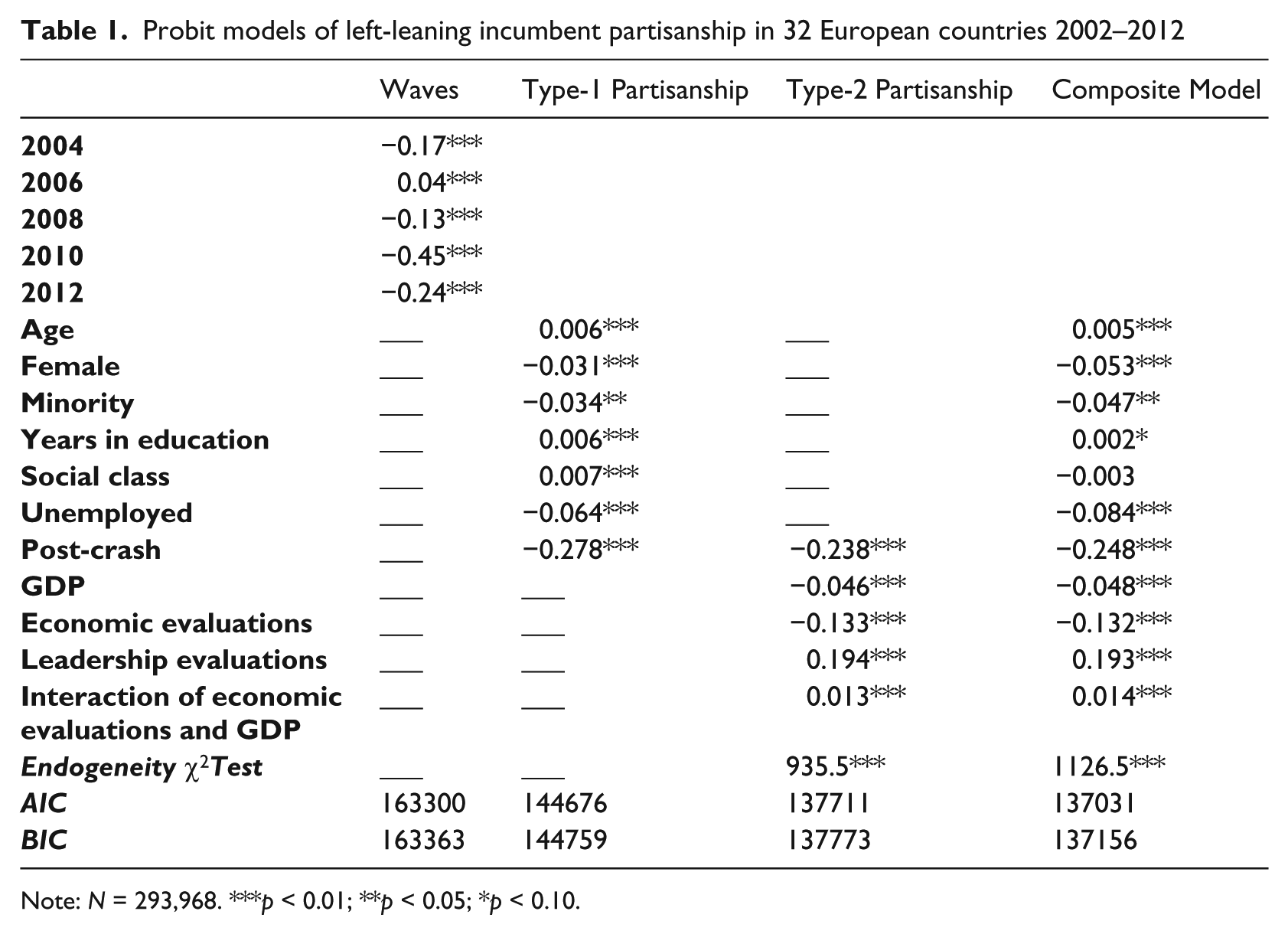
We used a multivariate endogenous probit model to estimate the effects of all the predictors on the two partisanship dummy variables. This provided for the use of instrumental variables to model endogenous variables in the model (Cameron and Trivedi, 2010: 479–483). A key focus in the analysis is on the dynamics and responsiveness of partisanship over time; thus the first model in Table 1 estimates the effects of the successive rounds of the ESS compared with 2002 on left-leaning incumbent partisanship. These estimates show that the probability of being a left-leaning incumbent partisan declined on average over time. In particular, from 2008 onwards, coinciding with the start of the economic crisis, partisanship shifted consistently away from left-leaning incumbent parties with a particularly large effect occurring in 2010, some two years into the Great Recession. This first look at the dynamics of partisanship indicates that type-2 partisanship was important in European democracies in these years because in a purely cleavage-driven model, partisanship would change only very slowly over time.
Probit models of left-leaning incumbent partisanship in 32 European countries 2002–2012
Note: N = 293,968. ***p < 0.01; **p < 0.05; *p < 0.10.
The type-1 partisanship model appears in the second column of Table 1 and because demographic variables can be regarded as exogenous it is estimated with a simple probit model. It shows that women and the unemployed were less likely to be left-leaning incumbent partisans than men, and the employed. In contrast, social class and education were significant positive predictors, showing that left-leaning incumbent partisanship increased among professionals and managers during this period. The post-crash variable had a highly significant negative impact on left-leaning partisanship. This evidence suggests that left-leaning incumbent parties were more likely to be deserted by their supporters as a consequence of the Great Recession.
The type-2 partisanship model is estimated in the third column of Table 1 and in this case instrumental variables are used to identify effects in the endogenous probit estimation. This is a ‘pure’ type-2 partisanship model which ignores any demographic effects. A preliminary analysis showed that there was an interaction between subjective economic evaluations and GDP, and so an interaction variable is included in the specification. Results show that the economic indicators had a highly significant negative impact on left-leaning partisanship during this period. As economic performance worsened during the recession, respondents deserted left-leaning parties and did not return to them in significant numbers when the recovery started. That said, the interaction between the economy and GDP showed that this effect weakened with increasing GDP. This provides initial support for hypothesis 3.
We can examine the impact of type-1 and type-2 partisanship in these models with the assistance of the Aikaike (AIC) and Bayes (BIC) Information Criteria model selection statistics, which measure the goodness of fit of the models, with lower scores representing a better fit. As the earlier discussion indicated, a pure type-1 model would be driven largely by demographics which represent the social cleavages that underpin that model. If so, omitting demographics from the composite model in Table 1 would have a strong effect on the fit as captured by the AIC and BIC statistics. This would mean that type-1 partisans dominate the picture in these countries. In contrast, if the economic and leadership evaluations which drive the type-2 partisanship model were omitted from the composite model, and this had a large impact on the AIC and BIC statistics, that would suggest that type-2 partisans were more important in these democracies.
A comparison between the AIC and BIC statistics in columns three and four of Table 1 show the effect of deleting demographics from the model. If this is done the AIC increases by 680 and the BIC by 617, which represent modest but statistically significant reductions in the goodness of fit from this exercise. In complete contrast, a comparison of columns two and four shows the effects of omitting the performance variables from the model. This has the effect of increasing the AIC by 7646 and the BIC by 7603: these are very large reductions in the model fit statistics. The latter are some eleven times greater in their impact on the model fit than the former. This evidence suggests that type-2 partisans are much more common in these European states than type-1 partisans, making partisanship very responsive to performance measures.
In the composite model, economic evaluations had a negative impact on left-leaning partisanship and leadership evaluations had a positive impact. This is because economic evaluations are measured by unemployment in the instrumental variables probit modelling, so that a negative coefficient on the economic variables means that left-leaning partisans are more positive about the economy when unemployment falls. Overall, these estimates show that performance considerations relating to issues and to party leaders were both very important in influencing incumbent partisanship.
In the composite model the subjective measure of economic performance and the objective measure (GDP) indicate that the partisan attachments of the supporters of governing parties changed in response to the performance of these parties in delivering effective leadership and good economic performance. We noted earlier that the first condition to be met for finding support for our first hypothesis is that both positive leadership and optimistic economic evaluations should be positively related to partisanship. These conditions are met in the composite model. The endogeneity tests confirm throughout that economic and leadership evaluations are clearly endogenous in this specification. That said, the models in Table 1 tell only part of the story, because we need to consider the impact of these variables on right-leaning partisanship.
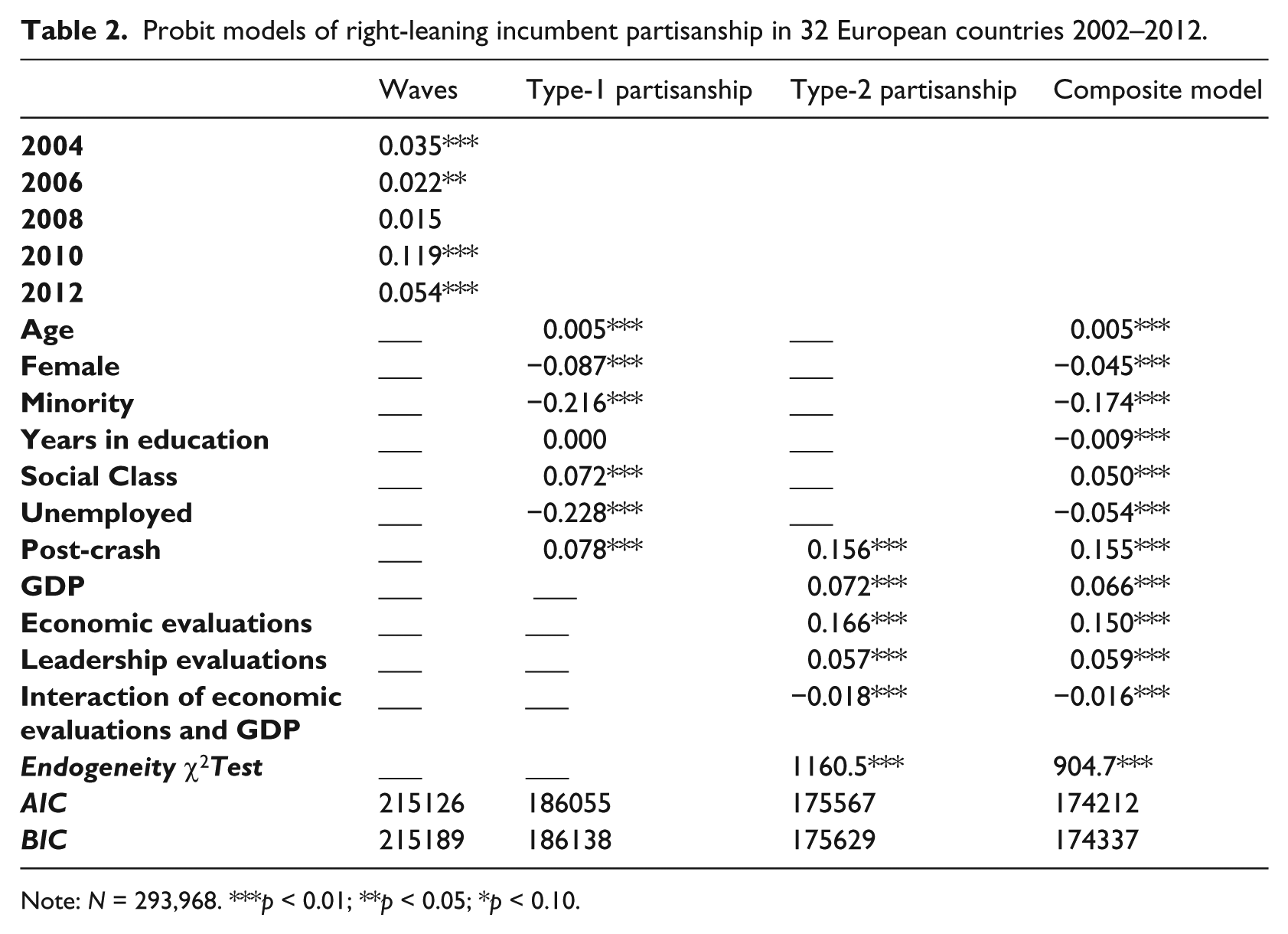
Table 2 contains the endogenous probit estimates of the right-leaning incumbent partisanship models and, in many respects they are the mirror image of the results above. Thus right-leaning incumbent partisanship strengthened throughout the period, with the sole exception of 2008, and again the largest effect occurred in 2010, although in general the effects are weaker than those presented in Table 1. A key difference between left-leaning and right-leaning incumbent partisanship relates to economic evaluations. In the third column of Table 2 economic evaluations are positive predictors, implying that right-leaning partisanship strengthened generally but with weakening effects as GDP growth increased. This finding is reinforced by the post-crash variable, which shows that these parties gained support during the years after the financial crisis after controlling for everything else, whereas the opposite occurred in Table 1. This finding supports hypothesis 3 on the differential effects of the Great Recession. Comparison of the sizes of the effects of the post-crash variable across columns 2 and 3 also supports hypothesis 2, because the effect is much stronger for type-2 partisanship than for type-1 partisanship.
Probit models of right-leaning incumbent partisanship in 32 European countries 2002–2012.
Note: N = 293,968. ***p < 0.01; **p < 0.05; *p < 0.10.
A calculation based on the fit statistics in Table 2 shows that omitting the demographic variables from the composite model increased the AIC by 1355 and the BIC by 1292. In contrast, omitting the performance variables increased the AIC by 11842 and the BIC by 11801, some nine times larger. This reinforces the point made earlier that Europeans are much more likely to be type-2 partisans than type-1 partisans.
Based on the results thus far, we find support for our hypotheses. However, the effects are not based on a simple reward–punishment model of responsiveness to performance, because left-partisans behave differently towards their governments than right-partisans. The massive rise in unemployment during the Great Recession made left-leaning partisans punish their governments because of the high priority they attach to full employment. In contrast, right-leaning partisans were reinforced in their support for their governments as inflation remained negligible during this period, and they attached a much lower priority to rising levels of unemployment. This was an ‘issue priority’ form of accountability rather than a ‘reward–punishment’ form, an effect which has been identified in other recent research (see Lindvall, 2017).
Finally, in Table 3 we examine the influence of partisanship on leadership evaluations and perceptions of economic performance. Recall that for type-1 partisans the impact of their partisanship on leadership and economic evaluations should be strong, whereas for type-2 partisans it should be weaker. Both dependent variables can be treated as interval-level variables because they are measured using eleven-point scales. Because endogenous variables are included in the analysis as predictors, a two-stage least-squares estimation procedure is used, with the instrumental variables discussed earlier. The first two columns in Table 3 repeat the wave model for both leadership and economic evaluations. In this case leadership evaluations declined continuously over the ten-year period in comparison with 2002, the effect being the largest in 2010, followed by 2012. Clearly, the decline in trust in political leaders was ubiquitous during this period. That said, it is clear that the economy played an important role in explaining this development, because economic evaluations changed signs from 2008 compared with earlier. Recalling that the state of the economy is measured by unemployment, this means European voters became much more sensitive to rising unemployment after the start of the Great Recession.
Regression models of leadership and economic evaluations in 32 European countries 2002–2012.

Note: N = 243,450. ***p < 0.01; **p < 0.05; *p < 0.10.
The results of the full models in the third and fourth columns of Table 3 provide support for the second condition of hypothesis 1 and further corroborate hypothesis 3. The full model of leadership evaluations shows that both partisanship variables have strong effects on leadership, but the effects associated with left-leaning incumbent partisanship are somewhat stronger than those of right-leaning incumbent partisanship.
The fourth column in Table 3 examines the effects on economic evaluations. Here, partisanship had a significant negative impact on economic optimism, in the case of both left-leaning and right-leaning incumbent parties. However, the negative effects associated with left-leaning partisans were more than three times the size of the negative effects of right-leaning partisans. The implication is that partisanship had a much stronger impact on economic evaluations for left-wing supporters of incumbent parties compared with right-wing supporters of incumbent parties, which again corroborates our third hypothesis.
Discussion and conclusions
We have investigated the connections between different sources of partisanship and government accountability, and have argued that a pure type-1 partisanship inhibits accountability whereas a pure type-2 model of partisanship enhances it. The evidence suggests that both types of partisans are to be found in the electorates of European democracies, and so the relationship between accountability and partisanship depends on how partisanship interacts with other components of the models. If partisans in Europe were exclusively of the type-1 kind then accountability would be weak, although not non-existent because demographic changes over the ten-year period influenced partisanship. That said, the evidence that type-2 partisans predominate in European electorates over this period has served to strengthen overall democratic accountability.
Specifically, our results show that type-2 partisans enhance political accountability more than type-1 partisans. In particular, we have showed that left-leaning type-2 partisans were more critical in their valence performance evaluations than right-leaning type-2 partisans. Overall these findings show that the extent to which citizens hold governments accountable depended on sources of partisanship, and indeed more so than we initially thought. Not only does the difference between sources of partisanship matter, so also do ideological leanings. Since the Great Recession had a much bigger impact on unemployment than it did on inflation, asymmetries in the way voters reacted to economic conditions undermined support for the left much more than for the right. Overall, partisanship interacts with the other variables in the valence model and the argument that it is a ‘standing decision’ by voters, which can be regarded as exogenous, is not supported by this analysis.
The economic crisis affected leadership and economic evaluations in predictable ways, but it also weakened partisanship among some voters, particularly on the left of the political spectrum. Partisanship in Europe did not insulate voters from responding to the economic crisis, something consistent with the running tally version of the variable. It indicates that particularly type-2 partisans were holding governments accountable. That said, the authors of the Michigan model accepted that their version of partisanship would be affected by a major crisis and so the effects for type-1 partisans are not negligible.
We should stress, however, that there is an important qualification to our findings. Only about half of the respondents in the European Social Surveys acknowledged having partisan attachments. If voters are completely detached from party politics this may make them more responsive to the performance of governments, but it may also make many of them apathetic and disengaged. In this article we have conceptualised accountability through partisan responsiveness to test our hypotheses. Future research should, however, also develop and test the effects of sources of partisanship on accountability, conceptualized as incumbent voting. Lindvall (2014) has already illustrated the differential impact of great recessions on right-wing and left-wing party success, and we can only speculate that the differential impact of partisanship might also have consequences for vote choice.
Overall, our results indicate that while there are many important systemic and economic differences between countries, Europeans held their governments to account despite weakening partisanship in some countries. However, an important finding is that parties of the left largely failed to take advantage of the recovery from the Great Recession, which occurred in many countries after 2010. Marx may have argued that serious recession boosts support for the left, but the evidence of this article suggests that the opposite happened in Europe in the first decade of the twenty-first century.
Supplemental Material
Appendix_IPSR_(002) – Supplemental material for How do different sources of partisanship influence government accountability in Europe?
Supplemental material, Appendix_IPSR_(002) for How do different sources of partisanship influence government accountability in Europe? by Paul Whiteley and Ann-Kristin Kölln in International Political Science Review
Supplemental Material
IPS780445_French_and_Spanish_abstract – Supplemental material for How do different sources of partisanship influence government accountability in Europe?
Supplemental material, IPS780445_French_and_Spanish_abstract for How do different sources of partisanship influence government accountability in Europe? by Paul Whiteley and Ann-Kristin Kölln in International Political Science Review
Footnotes
Funding
Ann-Kristin Kölln’s work was supported by Forte co-funded by the European Commission [2013–2692].

Notes
Author biographies
References
Supplementary Material
Please find the following supplemental material available below.
For Open Access articles published under a Creative Commons License, all supplemental material carries the same license as the article it is associated with.
For non-Open Access articles published, all supplemental material carries a non-exclusive license, and permission requests for re-use of supplemental material or any part of supplemental material shall be sent directly to the copyright owner as specified in the copyright notice associated with the article.
