



Abstract
There is a vast literature on the effects of electoral institutions on party systems. Research on the relationship between electoral systems and the strength of partisan identities, however, is inconclusive, as existing work mostly focuses on individual-level factors. In this paper, we analyze the case of Indonesia to illustrate the links between electoral laws and patterns of mass partisanship. By exploiting variation over time (four electoral cycles), we show that deep-seated partisan affiliations weakened substantially with the introduction of open-list PR, a system that provides strong incentives to cultivate a personal vote. By analyzing variation across space (189 districts), we further document that partisan alignment has been more pronounced where personal voting is more prevalent. These findings suggest that electoral institutions are a powerful driver of partisan identities, and that the effect of institutional change at the national level may be contingent on local politics.
Introduction
How do electoral institutions shape the development of partisan identities among voters? A large literature has documented that electoral laws have a powerful effect on voting behavior, as they structure competition among political parties and strategic considerations for voters (Lijphart, 1994). However, the effects of electoral institutions on partisan identities are not clear. While some research suggests that electoral systems that produce a large number of parties and ensure party control over ballots facilitate the emergence of strong partisan identities (Huber et al., 2005; Karp and Banducci, 2008), other studies have found little empirical support for these hypotheses (Norris, 2004).
In part, such mixed results are due to the prevalence in the literature of cross-sectional research designs in which whole countries are units of analysis. This methodological approach hinders the identification of institutional effects by overlooking changes in partisan identification over time and across space within single countries. With an analysis of electoral reform and partisanship in Indonesia, the world’s third largest democracy and a case that is often overlooked in comparative research, this paper aims to demonstrate that in-depth case study analysis may be a powerful tool to learn about institutional determinants of partisan identity.
Indonesia constitutes a particularly suitable case to investigate the relationship between electoral institutions and partisanship. First, we leverage the uniqueness of the Indonesian case as a country in which radical changes to the ballot structure were introduced a few years after democratization. We analyze an original dataset in which we match electoral data from the first democratic election in Indonesia in 1999 with district-level electoral returns for the following three election cycles (2004–2014). The data allow us to document a process of partisan dealignment in democratic Indonesia, in which the effect of the 1999 electoral returns on subsequent voting patterns has decreased over time, especially in the immediate aftermath of the introduction of open-list PR in 2009.
Second, building on district-level analyses of electoral rules and party systems (Chhibber and Kollman, 2009), we exploit the exceptionally high degree of subnational social and political heterogeneity in Indonesia to identify if electoral reform contributed to partisan dealignment. Specifically, we focus on personal voting, the key feature of open-list PR, and we find that partisan dealignment is strongest in districts where personal voting is more prevalent.
This paper contributes to existing research with a detailed case-study analysis of how electoral reform affects mass partisan identities. While the literature on partisan identities is vast, it mostly focuses on individual-level determinants of partisan affiliations and on cognitive factors in particular (Dalton, 2002). As a result, research on institutional determinants of partisan identities is relatively undeveloped (Huber et al., 2005), and the extent to which candidate-centered electoral systems weaken existing partisan affiliations is an open question. This analysis of the Indonesian case suggests that electoral institutions do have a large effect on voter propensity to develop and maintain partisan identities.
We also contribute to the study of democratic consolidation in Indonesia. Existing research has argued that partisan identities have been weakening (Mujani et al., 2018; Ufen, 2008), and it has recognized the importance of electoral reform to account for changes in the party system (Aspinall, 2014; Mietzner, 2013; Tomsa, 2014). However, despite a rich and insightful literature on this subject, there is no empirical analysis to date that examines the full temporal and spatial spectrum of available electoral data. We lack conclusive evidence on the extent of partisan dealignment, its trajectory over the four electoral cycles, its subnational variation, its variation across party, and the causal mechanisms that are driving it. This article proposes answers to each of these questions.
Electoral systems and partisan identity
Conceptualizations of partisan identity that are commonly used in the literature understand partisanship as an attitudinal characteristic of individuals that comprises two main dimensions. 1 On the one hand, partisan identities can be conceptualized as affective attachments to political parties (Campbell et al., 1960). On the other hand, partisanship can also be considered as a ‘running tally’ resulting from voters retrospectively evaluating the performance of political parties (Fiorina, 1981). Given this focus on individuals as units of analysis, the scholarship has mostly studied individual-level characteristics such as age, ‘cognitive mobilization’, or satisfaction with democratic institutions to explain the strength of partisan identities and how they change over time (Dalton, 2002).
Institutions, however, and electoral institutions in particular, have important effects on the behavior of politicians and voters. Since Duverger’s (1959) foundational work, a prolific literature has investigated the relationship between electoral institutions and party systems, showing that electoral rules shape politics by determining the number and the type of political parties that win seats, shaping strategic interaction among parties and intra-party discipline, and influencing voting behavior. Nevertheless, surprisingly few studies have focused explicitly on the link between electoral systems and partisan identities.
Existing research on the institutional origins of partisan identities suggests that electoral systems do affect citizen propensity to develop partisan identities, but the empirical evidence in support for this argument is limited. Karp and Banducci (2008) argue that partisan identities are stronger in PR electoral systems, as they provide a broader choice of political parties to voters and thus more ample opportunity to develop party affiliations. 2 However, while some scholars have found support for this thesis in similar cross-country analysis (Huber et al., 2005), others have found that voters in multi-party political systems are as likely as voters in two-party systems to report strong partisan identities (Norris, 2004: 138–139). Furthermore, while a high number of electoral parties may strengthen partisanship by supplying more party choice, a large number of effective political parties in legislature may depress party attachment by reducing clarity of responsibility (Huber et al., 2005).
Another key aspect of electoral systems, namely the incentives they provide for candidates to articulate personalistic appeals, may be consequential for mass partisanship. Scholars of campaigns and elections have long acknowledged that candidates can choose various strategies to achieve electoral success, and they often portray a tension between two main options. In some cases, candidates cooperate with other party members, emphasizing their partisanship, party platform and ideology. In others, they focus most of their efforts on building a personal reputation, highlighting their own personal traits and accomplishments and possibly taking positions that diverge from the party line. 3
Electoral systems are powerful determinants of which of these two modes prevails (Carey and Shugart, 1995). When parties tightly control the ballot structure, they are able to discipline their members, ensuring that they refrain from engaging in campaign strategies that may benefit the candidate at the expense of the party. Under electoral systems in which success considerably depends on votes cast for individual politicians, candidates have stronger incentives to run candidate-centered campaigns and assume independent positions.
This literature suggests that party–candidate relations may be a crucial channel through which electoral systems shape the strength of partisan identities in the electorate. Research on the nexus between party-candidate relations and partisan identities, however, is limited to very few studies, and it does not offer conclusive evidence. While Huber et al. (2005) refine the majoritarian/PR dichotomy and find that partisan attachments are weaker where elections are more candidate-centered, Norris (2004: 135–136) finds only limited evidence of a systematic relationship between strength of partisan identification and ballot structure, which she attributes to the lack of accurate measures of candidate selection processes within parties. 4
The prevalence in existing research of cross-sectional analysis of country-level data has been a crucial reason for the modest degree of knowledge accumulation in this field. First, such research designs forego the opportunity to leverage cases of institutional change within a single country to identify the effect of electoral institutions on partisan identities. Electoral reforms, in particular, understood as major changes in national legislation related to the electoral process, offer valuable opportunities to study institutional determinants of partisan affiliations with longitudinal research designs. 5
Second, adopting countries as units of analysis assumes the effect of electoral institutions to be uniform within territories that display substantial heterogeneity in social formation, political geography, and citizen-politician linkages. First, party systems can vary significantly across districts, especially when subnational units play an important role in policy-making (Chhibber and Nooruddin, 2004). Second, the extent to which elections can be characterized as ‘candidate-centered’ also varies subnationally. For example, personal voting and candidate electoral strategies can vary dramatically across regions in open-list PR systems (Ames, 1995). This suggests that relationships between electoral rules and partisan identities may be best studied at the district level, as the implications of institutional change in heterogeneous political systems may be contingent on local-level factors (Singer and Stephenson, 2009).
Partisan affiliations and dealignment in Indonesia
During the liberal democratic era (1950–1957), ideological competition was highly polarized in Indonesian politics, and political parties sorted into two main camps. The secularist end of the ideological spectrum was presided over by the Nationalist Party (PNI) and the Communist Party (PKI). At the opposite end of the spectrum, two main forms of political Islam, differentiated more by their social bases than by their ideological orientation, advocated for a larger role for Islam in public affairs. On the one hand, ‘traditionalist’ Islam was propagated especially in rural Java by the Nahdlatul Ulama (NU), a religious organization that also acted as a political party. On the other hand, ‘modernist’ Islam, more common in cities and regions outside Java, was represented by the Masyumi Party and Muhammadiyah, another religious organization that was part of Masyumi until 1959.
This climate of ideological polarization came to an end with the traumatic transition to the New Order regime in the mid-1960s. The state-led killings of 1965–1966 fully eradicated the political left, and the subsequent establishment of an authoritarian political order severely constrained political competition. First, the number of non-regime political parties was reduced to two by the early 1970s. In the Islamist camp, various existing parties were merged into a new formation called PPP (United Development Party), and what remained of secularist-nationalist groups coalesced into the PDI (Indonesian Democratic Party). Second, an existing organization called Golkar (Functional Groups Party) was transformed into the electoral machine of the regime. This party was typically presented as being ‘non-ideological’, and it was a key element in the regime’s strategy to depoliticize the mass public. In the new authoritarian regimes, the old ideological dichotomy between secularism and political Islam thus persisted, but the new dominant actor was a party that positioned itself at center of the ideological spectrum rather than at one of its extremes.
Today, although the ideological profile of Indonesian political parties is less clear-cut than in the past, it is still possible to identify differences along the religious cleavage that has long defined political competition in this country (Aspinall et al., 2018; Mietzner, 2013: 167–191). At one end of this continuum, the PDI-P (Indonesian Democratic Party-Struggle) continues the ideological tradition of prioritizing nationalism over Islam. At the opposite end, several parties compete for the Islamic legacy, with the PKB (National Awakening Party) maintaining close ties to NU’s traditionalism, parties such as PKS (Prosperous Justice Party) and PAN (National Mandate Party) typically being described as modernist, and the PPP trying to appeal to both constituencies. Between these two opposites, Golkar may still be characterized as a centrist political party, as it strives to strike an ideological balance between secularism and political Islam (Tomsa, 2008: 98–99). Three additional parties, namely Gerindra, NasDem, and Hanura, have been established by former Golkar cadres to support their presidential ambitions, and present a similar ideological profile. 6 Table 1 offers an overview of the ideological orientation of the main actors in past and contemporary Indonesian politics.
Past and present party families in Indonesia.

Existing research suggests that historical partisan affiliations were an influential driver of voting behavior in the first democratic elections in 1999. By comparing 1999 electoral data and historical electoral returns, King (2003) found substantial continuities in electoral geography. Since then, however, many have argued that a process of dealignment from historical partisan identities has been occurring in Indonesian politics (Mujani and Liddle, 2010; Tomsa, 2008: 169–170). While explanations vary somewhat in the literature, scholars of Indonesian politics have often emphasized the failure of political parties to provide meaningful alternatives to voters, the increasing personalization of politics, rising levels of clientelism and ‘money politics’, and intense competition to appeal to ideologically moderate voters rather than ‘core’ secularist or Islamist constituencies (Hadiz, 2004; Mietzner, 2008; Slater, 2004; Ufen, 2008).
These features of the Indonesian party systems are consequential for partisanship, as they may hinder the process of responsibility attribution through which voters develop partisan attachments. However, many of these characteristics have been fairly stable throughout the last twenty years of democracy in Indonesia, and it is thus problematic to rely on them alone to account for dealignment from deep-rooted partisan identities. For instance, political parties have never had significant programmatic differences and party coalitions have always been highly heterogeneous. By contrast, the Indonesian electoral system evolved significantly during the first decade of democratic politics.
The role of electoral reform
After democratic transition in the late 1990s, the first democratic elections in 1999 featured a closed-list PR system with provinces functioning as large, multi-member districts. This electoral law allowed political parties complete control over the ballot structure, as voters, just like in the New Order, were only allowed to choose a party symbol rather than individual candidates. Party leaders would allocate seats according to their patronage priorities, often in exchange for generous financial contributions, and it was possible for candidates with little or no profile in a district to win seats even without campaigning (Sherlock, 2009).
Because of its detrimental implications for democratic accountability, closed-list PR came under increasing scrutiny in the aftermath of the 1999 elections, and the DPR responded by amending the electoral law in 2003. The new law introduced candidate preferences by allowing voters to choose, in addition to a party, a candidate from the party list. However, the new law was functioning as a de facto closed-list PR system (Horowitz, 2013: 144–145). The requirement that candidates would have to reach a ‘full district quota’ (i.e. the total number of votes in a district divided by the number of allocated seats) of personal votes to be elected was prohibitive for almost all candidates.
The Indonesian electoral system changed much more dramatically in the lead up to the 2009 elections. A new electoral reform implemented in 2008 allowed voters to choose an individual candidate, a party, or both, and the minimum number of votes to be elected through personal voting was reduced to 30% of the district quota. Based on the 2004 results, however, this new law ensured that a substantial number of representatives would still be drawn from party lists (Crouch, 2010: 74–75). A turning point came shortly after the ratification of the law, when four politicians associated with one of the largest political parties (Partai Demokrat) challenged the new law before the Constitutional Court (Mietzner, 2010: 410–411). They argued that the requirement of a 30% quota was unconstitutional, as it was discriminatory, unfair, and in breach of elective rights . The Court ruled in favor of the applicants in late 2008, mandating that all candidates be elected based on the number of votes they receive rather than on their position on party lists.
This decision, which came after party lists had already been drawn under the assumption of the 30% quota, forced Indonesian political parties to a rushed transition to a full open-list PR system, which had important consequences for Indonesian politics. First, open-list PR introduced intra-party competition and greatly undermined the ability of party machines to determine the electoral fortunes of their candidates. The new electoral system substantially increased the uncertainty of electoral outcomes, limiting the ability of political parties to reward loyalists or large donors with ‘safe’ seats (Horowitz, 2013: 185).
Most importantly, however, the implementation of an open-list PR system had far-reaching implications for electoral campaigns and voting behavior. Anecdotal evidence of the aftermath of the Constitutional Court decision suggests that the sentence had an immediate and substantial effect on campaign activities (Sherlock, 2009: 6–7). Due to the increased competitiveness, candidates soon realized that they had to raise further funds and establish a personal profile by campaigning more vigorously. While election posters rarely featured candidate names in the 1999 and 2004 elections, the 2009 campaign required a new emphasis on name and face recognition and personal traits such as leadership, economic success, ethnic identity, and family heritage. In short, the abrupt imposition of the new electoral system changed electoral campaigning quickly and dramatically. As observed by Aspinall (2014) in his analysis of electoral politics in the 2014 elections, the transition to open-list PR was crucial for the rise of a new mode of accountability based on clientelism and patronage.
Indonesia thus transitioned to a candidate-centered ballot structure in its first decade as a democracy. To be sure, this is only one of the important ways in which electoral and political institutions have evolved in this country since democratic transition in the late 1990s. Most notably, other reforms such as the introduction of direct presidential elections and direct elections for governors and district heads have also contributed to an increasing personalization of politics. More broadly, as mentioned above, partisan dealignment and electoral reform may be related to declining public trust in political parties due to their inadequacies to provide meaningful representation in this young democracy (Tan, 2002). While such relations are difficult to disentangle, Indonesia provides an ideal case to study the nexus between electoral systems and partisan identities. First, the fact that open-list PR was imposed by a decision of the Constitutional Court rather than deliberately chosen by political parties attenuates the inferential challenges due to the endogenous nature of electoral institutions. Second, as we elaborate in the next section, the high degree of subnational diversity in Indonesia allows us to accurately measure the effect of electoral reform on partisan dealignment by exploiting cross-district variation in personal voting, a key feature of open-list PR.
Research design
To explore the link between electoral reform and partisanship, we analyze a panel dataset with district-level electoral returns from 189 districts with data from all four national legislative elections in post-authoritarian Indonesia (1999, 2004, 2009, 2014). 7 By ‘districts’ we refer to important political and administrative units in Indonesian government that can be further divided into kabupaten (regencies) and kota (cities). 8 Indonesian local government is currently constituted by 34 provinces and 508 districts and cities. Many of these districts were established in an ongoing process of administrative proliferation that took place starting in the early 2000s. To restrict the analysis to readily comparable units, we drop from the sample districts that underwent territorial change between 1999 and 2014, which we have identified from national regulations on administrative boundaries. 9 This leaves us with 189 regencies and cities observed over four electoral cycles. 10
As mentioned above, this research design allows us to study variation over time and across district, in contrast with the analysis of cross-sectional national data that is prevalent in existing research on electoral systems and partisan identities. To determine if the strength of partisan affiliations has weakened over time, we measure the effect of 1999 electoral patterns on 2004–2014 support for the main Indonesian political parties. 11 We expect district-level support for PDI-P, Golkar, traditionalist Islamic, and modernist Islamic parties in 1999 to be positively associated with support for the same parties in the following electoral cycles, and the strength of this association to decrease over time. 12
We thus exploit the association between past and present electoral geography as a proxy measure of the strength of partisan identities. In so doing, we make two important premises. First, we assume that voting can be treated, to a considerable degree, as an expression of partisan identity. While new democracies are often considered to be cases where partisanship is a weak driver of voting behavior, recent research suggests that partisan cues can have a strong effect on voting choices even in least likely scenarios (Conroy-Krutz et al., 2016). With reference to the Indonesian case, Mujani et al. show that, indeed, party identity has been a driver of voting behavior in democratic Indonesia, although its relevance in accounting for party choice has been declining steadily from election to election (Mujani et al., 2018: 199). While these data indicate that partisan identities are more marginal now than in the immediate aftermath of authoritarian breakdown, they also reassure us that the deep-seated partisan identities discussed above have oriented voting behavior in post-Suharto Indonesia, and that changes in mass partisanship have affected electoral outcomes.
Second, we posit that partisan identities, and voting behavior more generally, can be fruitfully studied by analyzing macro-level data. This approach is common in the literature reviewed above on the institutional determinants of partisan identities, but it does not allow us to identify accurately the micro-foundations of our argument. Micro-level analyses, however, are not without limitations. While they avoid the ecological fallacy of studies based on aggregate data, they risk overlooking important developments that unfold at the macro-level, as observed by Dassonneville and Lewis-Beck (2014) in the context of economic voting. Moreover, while a vast literature has identified various micro-mechanisms driving the development of partisan attachments, in this article we are ultimately interested in studying how electoral institutions shape mass partisan identities as expressed in electoral results, a purpose for which the study of macro-level data is suitable.
With these two caveats in mind, various hypotheses can be tested with an analysis of district-level electoral outcomes over four electoral cycles. If partisan affiliations still matter in Indonesian politics, we should observe a correspondence between 1999 and 2014 electoral patterns. If a process of dealignment has taken place, the effect of 1999 returns should have decreased from 2004 to 2014. If the transition to open-list PR and candidate-based appeals are indeed one of the key causal mechanisms in the erosion of partisan affiliations, the relationship between 1999 and subsequent electoral data should be weaker in districts where party support depends more heavily on personal voting. To be sure, Indonesian political parties still hold a significant degree of control over the ballot, as they decide candidate list position. This is an important prerogative, as list position is a powerful determinant of election prospects (Dettman et al., 2017). Nevertheless, as discussed above, qualitative evidence points to a substantial shift toward candidate-centered campaigning. For this reason, we consider personal voting as indicating that candidate-based appeals play an important role in orienting voting choices.
In regression analysis, we estimate fractional logistic models (Papke and Wooldridge, 1996) in which electoral returns from 2004 to 2014 are regressed on 1999 data. 13 All pooled models, estimated with cluster-robust standard errors for districts, include fixed effects for years and a host of covariates as controls, namely district type (city vs. regency), total population, population density, socioeconomic development, poverty, inequality, urbanization rate, and religious and ethnic fractionalization. 14 To measure variation in the effect of 1999 electoral patterns from 2004 to 2014, we estimate multiplicative models in which binary indicators for years are interacted with 1999 election data. Using 2004 as the baseline year, negatively signed interaction terms for the two following elections indicate a process of partisan dealignment.
To build a district-level measure of the extent to which party support depends on votes to individual candidates, we use 2014 electoral data 15 to calculate the share of total votes for each party indicating a candidate preference, as opposed to votes that only indicate a party label preference. While most Indonesian voters take advantage of the possibility of casting a candidate preference, substantial variation exists across districts, as shown in Figure 1. To test if partisan dealignment has occurred through the electoral mechanisms introduced by the transition to open-list PR, we estimate multiplicative models in which 1999 data interacts with our measures of personal voting. We expect the interaction terms to be negatively signed, showing that the effect of 1999 electoral returns is weaker in districts with higher levels of personal voting.
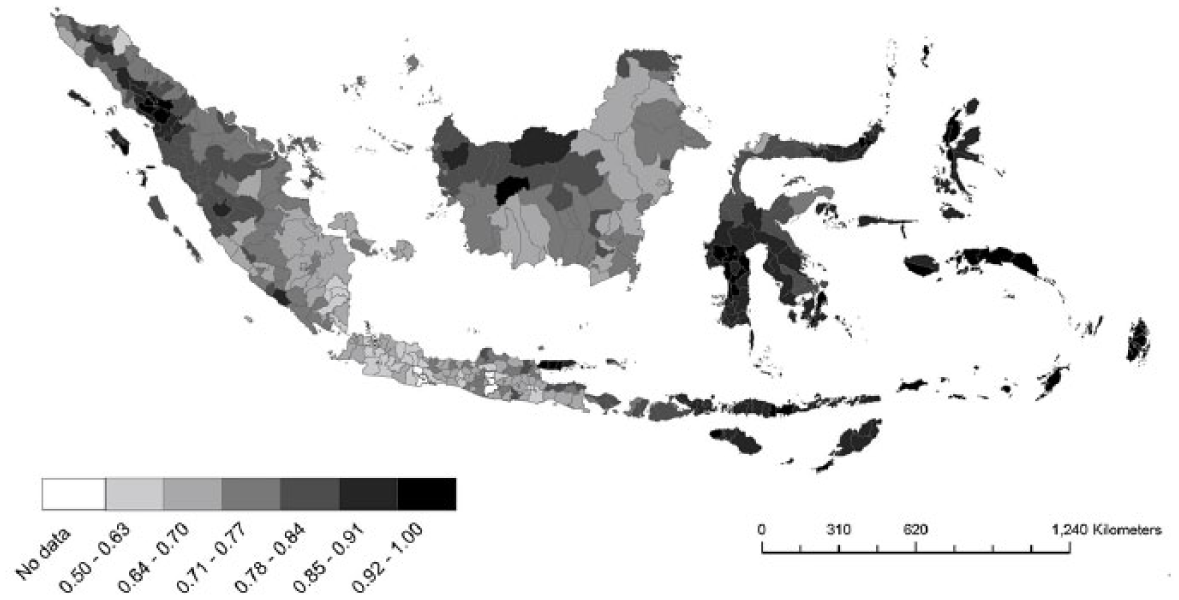
Personal voting for the nine largest parties across district.
A district-level analysis
Table 2 reports estimation results for a set of models in which 1999 electoral returns, election year, interaction between the two, and a battery of control covariates affect 2004–2014 party support. All models show that 1999 electoral results are positively associated with party support in subsequent years, as the estimated coefficients for 1999 returns are large in magnitude and significant at conventional statistical levels for all parties and party groups. However, these results also show that the effect of partisan legacies has weakened significantly over time, as suggested by the partisan dealignment hypothesis. The interaction terms between 1999 electoral results and the year indicator for 2014 (the last electoral cycle) are negatively signed and statistically significant for all the models reported in Table 2, which indicates that the effect of historical partisan legacies was substantially weaker in 2014 than in 2004. This is strong evidence that a process of dealignment from historical affiliations has been taking place in democratic Indonesia, as suggested by the qualitative literature.
Partisan dealignment in Indonesian districts, 1999–2014.

Robust standard errors in parentheses. ***p < 0.001, **p < 0.01, *p < 0.05.
Figure 2 displays estimated party support for each of the four models above by plotting two separate lines for 2004 (solid) and 2014 (dashed). In all panels, the association between 1999 and 2004 is stronger than between 1999 and 2014, as shown by solid lines that mostly appear steeper than their dashed counterparts. However, the figure also shows evidence of variation across party. Specifically, secularist-nationalist PDI-P stands out as an exception to the general pattern of partisan dealignment, as the two plotted lines for 2004 and 2014 largely overlap. These results suggest that the PDI-P has been more successful than other Indonesian parties in preserving its traditional constituency that emerged in the foundational elections of 1999, and invite further analysis of asymmetries in dealignment across parties.

Partisan dealignment in Indonesia.
Figure 3 offers a more comprehensive display of over-time variation in the strength of historical partisan affiliations. For each party and party group, the figure plots the estimated effect of 1999 electoral returns on 2004, 2009, and 2014 results with their respective 95% confidence intervals. The plots confirm the progressive weakening of historical partisan affiliations, as the estimated effect of historical partisan legacies systematically weakens over time in all quadrants. Nevertheless, Figure 3 also indicates that legacies from the foundational 1999 elections are still an important driver of voting behavior today, because the 2014 coefficients are positive and significant for all party groups. In other words, PDI-P support today is still substantially stronger in district where this party gained more votes in 1999, and a similar pattern emerges from the other three quadrants. While this is the general picture portrayed in Figure 3, however, the plots also show considerable variation across party and party group. Specifically, the association between 1999 and 2014 electoral results is strongest for PDI-P, with an estimated coefficient of 3.06, weaker for traditional and modernist Islamic parties (2.56 and 1.75, respectively), and weakest for Golkar (0.78). This indicates that the process of dealignment has been more profound for Golkar, the former electoral arm of the authoritarian New Order regime, than for parties in the other three groups.
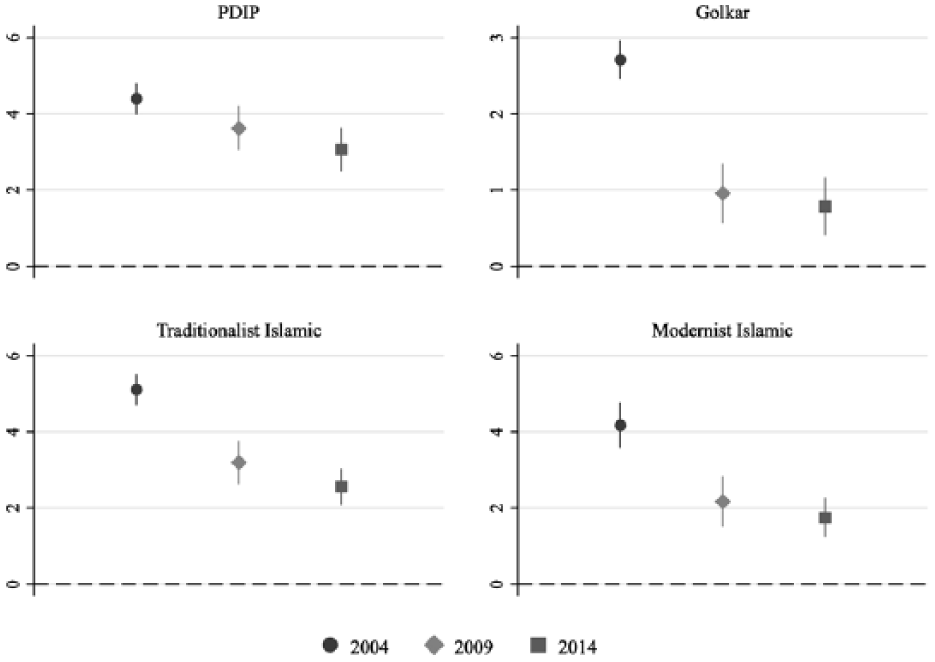
Partisan dealignment by party and year.
Perhaps one reason for such partially divergent trajectories in party dealignment patterns lies in the different origins of partisan identities for Golkar and ideology-based parties. As discussed above, the PDI-P and Islamic parties appeal to deep-seated ideological traditions rooted in a religious cleavage that has characterized Indonesian culture, society, and politics for several decades. In contrast, a large factor driving loyalty to Golkar has been clientelism, as this party has built its electoral base by leveraging its monopolistic access to state resources during authoritarianism (Tomsa, 2008: 37). As access to patronage has become much more fragmented and decentralized in post-Suharto Indonesia, more parties have been able to establish linkages with their voters based on the delivery of materialistic benefits, and Golkar’s advantage in pursuing this strategy has been dwindling quickly.
Visual inspection of Figure 3 further reveals that the effect of 1999 returns dropped substantially between 2004 and 2009 for all parties except PDI-P. This may indicate that the transition to open-list PR in 2009 significantly contributed to the erosion of historical partisan affiliations, but these results alone are not sufficient to conclude that one has caused the other. To further probe the extent to which electoral reform has weakened established partisan identities, we estimate models in which we posit an interaction between 1999 returns and the share of personal votes for each party and party group. Results are reported in Table 3, and they corroborate the hypothesis that partisan dealignment has been more pronounced in districts where party support depends more heavily on votes to individual candidates than to the party label.
Personal voting and partisan dealignment.

Robust standard errors in parentheses. ***p < 0.001, **p < 0.01, *p < 0.05. All models include the control variables listed in Table 2.
For all parties, the coefficient of the interaction term is significant and negative, as expected: the higher the share of party votes that are also personal votes, the lower the effect of 1999 vote on 2014 electoral results. However, once again, results are weaker for Golkar than they are for PDI-P and Islamic parties. As discussed above, this difference between Golkar and ideology-based parties may lie in the fact that personalistic appeals have been a key element in developing partisan attachments for Golkar. For this reason, the transition to a more candidate-centered electoral system may have been less disruptive for Golkar than it has been for parties who have based a substantial share of their electoral fortunes on ideological appeals.
Conclusion
Our findings contribute to our understanding of how institutions shape mass partisanship. More precisely, the focus on electoral reform and the ballot structure allows us to build on research on the political outcomes of electoral institutions. As we have argued, despite a large and sophisticated literature on the nexus between electoral laws and party systems, research on the effect of electoral institution on partisan identification is limited, and its results are inconclusive. Leveraging on a unique dataset for the Indonesian case, our analysis suggests that candidate-centered ballots may weaken partisan affiliations by increasing incentives for politicians to cultivate clientelistic linkages with voters. A first contribution of this article is thus to build on research showing the importance of institutional factors to account for shifting patterns of mass partisanship (Huber et al., 2005). Furthermore, as we explore how patterns of dealignment vary according to local-level characteristics of political competition, our research also contributes to scholarship on how contextual factors moderate the outcomes of electoral institutions (Ferree et al., 2014).
Our analysis also reveals the remarkable resilience of a religious cleavage. To be sure, the empirical analysis has focused exclusively on partisanship as expressed in voting choices. We are therefore unable to directly estimate the importance of ideological positions about the role of Islam in politics for partisanship, and further research will have to ascertain how exactly the two interact in shaping voting behavior. Yet as we have discussed above, the divide between secularism and political Islam has historically been a key source of partisan identity in Indonesia, and our analysis shows that this religious cleavage managed to survive almost 40 years of authoritarian rule, was a key driver of voting behavior in 1999, and appears to be still influential as a driver of voting behavior today. Such a remarkable resilience resonates with comparative research that has documented similar patterns of partisanship survival in other regions, such as Eastern Europe and Latin America (Geddes, 1995; Wittenberg, 2006; see also Lupu and Stokes, 2010).
We have also identified important differences in partisan dealignment across parties. On the one hand, parties with a clear ideological profile have been overall more successful than centrist Golkar in nurturing their core constituencies. On the other hand, however, and possibly for the very same reasons, the transition to a candidate-centered electoral system appears to have affected ideology-based parties more substantially than Golkar. While an exhaustive analysis of the causes of variation in partisan dealignment across party is beyond the scope of this article, this divergence suggests that focusing on political parties as units of analysis (Lupu, 2014) may be a particularly fruitful analytical strategy to identify factors that moderate the relationship between institutional change and mass partisanship.
Finally, we build on the Indonesian politics literature by documenting the extent of dealignment from historical partisan identities. To an extent, our findings suggest that partisan affiliations have become increasingly marginal in the first 15 years of democracy in Indonesia, which resonates with analyses of voting behavior in this country (Mujani et al., 2018) and research portraying Indonesian politics as being largely transactional (Aspinall and Sukmajati, 2016). However, it is important to emphasize that partisan identities still matter for a significant portion of the Indonesian electorate. Despite high levels of electoral volatility in this young democracy, Indonesian political parties with a distinctive ideological profile still draw a substantial share of their contemporary support from their traditional constituencies. From this perspective, then, our findings indicate that calls for an ‘end of ideology’ in Indonesian politics are premature, which is consistent with some research on Indonesian political parties (Mietzner, 2013).
In terms of policy implications, our analysis of the Indonesian case contributes to policy debates on institutional design and democratic consolidation. On the one hand, the transition to a candidate-centered electoral system appears to have increased accountability between citizens and politicians. While elected politicians were exclusively accountable to party leaders in the first two electoral rounds, the introduction of open list-PR in 2009 forced them to build closer ties with their constituencies. From this perspective, electoral reform has provided an important tool to Indonesian citizens, as they are now empowered to use their vote to reward or punish elected politicians according to their performance in office.
On the other hand, a more troubling development is that increased accountability has translated into a higher incidence of clientelistic practices and further erosion of historical partisan affiliations. This suggests that electoral reform, in the Indonesian case, has been detrimental to a goal often valued by policy makers in young democracies, namely the emergence of more programmatic politics and a stabilization of the party system through deeper partisan identities. In this regard, we should note that the transition to open-list PR in Indonesia took place in a context of weakly institutionalized parties, fairly low socioeconomic development and high incidence of clientelistic linkages between politicians and citizens. Indeed, a weakly institutionalized party system is a feature shared by many democracies around the world, especially in low- and middle-income countries. The findings presented here may thus be applicable to a wide range of countries that share similarities with Indonesia’s institutional and socioeconomic context.
Supplemental Material
Copy_of_Descriptive – Supplemental material for Electoral reform and partisan dealignment in Indonesia
Supplemental material, Copy_of_Descriptive for Electoral reform and partisan dealignment in Indonesia by Diego Fossati in International Political Science Review
Supplemental Material
French_Spanish_abstract_826389 – Supplemental material for Electoral reform and partisan dealignment in Indonesia
Supplemental material, French_Spanish_abstract_826389 for Electoral reform and partisan dealignment in Indonesia by Diego Fossati in International Political Science Review
Footnotes
Acknowledgements
The author is grateful to Kevin Evans for sharing data. The manuscript has benefited from insightful comments by Kevin Evans, Duncan McDonnell, Lee Morgenbesser, Annika Werner, three anonymous reviewers, and attendees at the various seminars and conferences at which preliminary versions of this article were presented. Ray Hervandi, Pearlyn Pang, and Emilia Yustiningrum have provided excellent research assistance.
Funding
This project has received funding from ISEAS-Yusof Ishak Institute and the Centre for Governance and Public Policy, Griffith University.

Notes
Author biography
References
Supplementary Material
Please find the following supplemental material available below.
For Open Access articles published under a Creative Commons License, all supplemental material carries the same license as the article it is associated with.
For non-Open Access articles published, all supplemental material carries a non-exclusive license, and permission requests for re-use of supplemental material or any part of supplemental material shall be sent directly to the copyright owner as specified in the copyright notice associated with the article.
