




Abstract
Achieving the ideals of electoral democracy depends on well-run elections. Persistent problems of electoral integrity in transitional and established democracies have prompted a burgeoning literature seeking to explain the determinants of electoral integrity around the world. However, the study of the organisations responsible for managing the electoral process has been limited to isolated national case studies. This article opens up an interdisciplinary and international research agenda on the global study of the organisational determinants of electoral integrity. It defines the concept of electoral management and provides a framework to understand how electoral management body (EMB) institutional design, EMB performance and electoral integrity are related. Findings from new data derived from cross-national surveys of EMBs are described, providing new insights into how elections are managed worldwide.
Introduction
While many elections across the world are conducted to very high standards, there remains evidence of problems with poor election quality worldwide. In the past ten years, research on electoral integrity has greatly expanded, and we now know much more about the drivers of electoral malpractice (Alvarez et al., 2012; Birch, 2011; Lehoucq, 2003; Norris, 2015). This includes the societal structure, institutional factors such as constitutional design and actor-based factors (van Ham, 2012; van Ham and Lindberg, 2015). However, we still know very little about the organisations responsible for implementing elections and how their organisational design affects electoral integrity and other political outcomes.
This oversight is remarkable. We know that the quality of public services such as schools and hospitals can depend upon the (mis)use of staff, technology, organisational design and capacity, so we should expect the same to hold true of elections too – the public service whose outcomes shape all other public policies and the provision of all other public services. The quality of the delivery of elections is thought to affect confidence in the electoral process and democratic consolidation. High-profile domestic commissions have been set up to investigate problems, such as the US Presidential Commissions in 2000 and 2012. The international community has likewise poured money and resources into improving elections. The professionalisation of electoral management bodies (EMBs) was defined as an important policy objective by Kofi Annan’s Global Commission on Elections (2012).
There has been some work on the organisational characteristics of the public bodies responsible for implementing elections, but for the most part research has been focused on single countries. Part of this lack of research can be explained by the difficulties that scholars face in straddling different disciplines: law, public administration and politics. It is also in part because of the lack of availability of comparative data.
This special issue therefore aims to make a major advance in one of the most overlooked aspects of democratic governance: electoral management. This introductory article opens up the research agenda by providing a new conceptual framework to identify the characteristics of EMBs that might be important in linking EMB design to EMB performance, and outlines the potential consequences for election integrity. This agenda is then advanced in the collection of articles that follow, which mostly use new data on variations in the institutional design of electoral management bodies worldwide.
Following these opening remarks, the next part of this article argues that the organisational determinants of electoral integrity have long been overlooked, with a focus on structural factors, institutional checks and the design of electoral laws dominating. We then argue that there are rich literatures in organisational theory which identify themes of direct relevance for the study of electoral integrity that could be better explored. Following from this, we provide a new broader framework to conceptualise different dimensions of the organisations involved in electoral management. We introduce two new datasets on the organisational characteristics of EMBs around the world and present the descriptive results – mapping them onto the characteristics of EMBs provided earlier. We finish with an overview of the articles in this special issue, which use these and other data to answer core questions about the organisational determinants of electoral integrity.
Existing approaches to understanding the determinants of electoral integrity
The expanding literature on electoral integrity has identified a number of determinants of electoral integrity, ranging from structural factors such as historical experiences with democratic elections and socio-economic features of societies, to institutional explanations focused on electoral systems and the presence of institutional checks and balances, to more proximate explanations that focus on the actors involved in electoral manipulation and electoral oversight (Birch, 2011; Kelley, 2012; Lehoucq, 2003; Norris, 2015; Simpser, 2013; van Ham, 2012; van Ham and Lindberg, 2015, for discussions of the literature).
Structural explanations refer to the economic and social structure of societies that shape power relations between citizens and elites, such as economic inequality and social heterogeneity, where scholars have found that electoral manipulation is more widespread in countries with high levels of poverty, high economic inequality and deep social divides (Birch, 2011; Lehoucq, 2003; Norris, 2015). Historical experiences with democratic elections also appear to foster electoral integrity (van Ham, 2012).
Institutional explanations have focused on the political institutions that set the rules of the game. Institutions that increase the stakes of the electoral race, such as majoritarian electoral systems, have been found to increase electoral manipulation (Birch, 2008), while proportional electoral systems have been found to decrease levels of electoral manipulation (Lehoucq and Kolev, 2015). Electoral integrity may also be higher in political systems with stronger checks and balances resulting from power-sharing (Elklit and Reynolds, 2005) and/or de facto independent judiciaries (Birch and van Ham, 2017).
Actor-based explanations refer to strategic choices of political actors, based on the characteristics of the particular electoral game. Findings on the effects of electoral competition have been mixed, with electoral integrity appearing to be highest in electoral races that are moderately competitive. In terms of oversight, independent media has been found to have a significant positive effect on electoral integrity (Birch 2011; Birch and van Ham 2017). Findings on the impact of international and domestic election observers are more mixed (Hyde, 2011; Ichino and Schündeln, 2012).
In addition to this considerable progress in identifying why overall levels of electoral integrity are higher in some countries than in others, an extensive literature is developing on specific types of electoral manipulation as well, such as vote buying and election violence (Collier and Vincente, 2012; Daxecker, 2012; Hafner-Burton et al., 2013; Wilkinson, 2006). Within established democracies, scholars have explored how elites select electoral institutions to maximise electoral self-interest rather than electoral integrity (James, 2012).
However, research on the consequences of electoral management and EMB organisational design, which is located between the institutional and actor-based explanations, is still very limited, as we will discuss next.
The organisational approach to electoral integrity
There has been a long-standing interest in the quality of public administration, which can provide insight into electoral management organisations. Such work is usually seen as beginning with Max Weber, who distinguished modern public bureaucracies from traditional or charismatic forms of rule. This rational-legal system had a clear chain of command, salaries for public officials who were no longer reliant on patrons, a meritocratic workforce and a scientific-technical basis for decision making (Weber, 1922 [1978]). As the twentieth-century emerged, and a rational-legal system was thought to have become established in older democracies, efforts turned to consider how productivity within public organisations could be improved. A scientific management school sought to promote efficiency in the workplace by prescribing methods to co-ordinate workers, through strict chains of command and harsh penalties to boost performance. A concern that these working conditions had undermined the employee’s motivation, and recurrent clashes between employers and labour set the conditions for revision. Human relations theory and a bureaucratic discretion school warned about the dangers of top-down hierarchies. Trusting ‘street-level bureaucrats’ became valued because distant public officials could never anticipate the problems faced on the frontline (Lipsky, 1980).
Fast forward to the 1980s and New Public Management (NPM) was being proposed to reinvent ailing public sectors in older democracies and being imposed by the international donor community on many developing countries. The problem with government-run public services was that they tend towards bloated bureaucracy and inefficiency, claimed NPM proponents. Policy solutions were devised to structure the incentives of the individual employee such as reducing public expenditure, privatisation, and the use of quasi-autonomous non-governmental organisations to insulate decision-makers from political influences on policy (Hood, 1991).
The roll out of NPM, in time, created a backlash as the perverse incentives that it could create became clear. Dunleavy et al. (2006) argued that NPM had ‘essentially died in the water’ (p.468) and that a new wave of reforms was now being enabled by technology. During times of Digital Era Governance, the digitalisation of administrative processes became possible, including electronic service delivery and automation. Meanwhile, collaborative governance is sometimes prescribed to bring stakeholders together to co-deliver and co-produce services (Ansell and Gash, 2008).
These literatures, and the questions and challenges that provoked their emergence, speak to the heart of the challenges facing organisations delivering elections around the world. Yet they have not been regularly drawn upon by scholarship in the study of elections. Some countries still struggle to move towards the Weberian ideal-type of bureaucracy as ‘independent electoral management bodies’ remain independent in name only and remain dominated by personal or elite rule and patrimonial relationships. The challenge of efficiency within the delivery of elections also remains a critical one as EMBs struggle with finite resources. New technology has opened up opportunities for improved efficiency and customer service to the citizen but poses new threats for privacy, ownership and influence. NPM solutions of contracting out services such as election stationery and e-voting seem to be widespread and organisational autonomy for EMBs from government is much prized.
There has been some progress on these themes, thanks in part to the 2000 US presidential election. A plethora of literature and a new research community emerged to consider the American electoral process. We now know more about American electoral administration, poll workers and the effects of voter identification, for example (Montjoy, 2008). But attempts to systematically deal with these issues at an international level remain a major failure for political science and public administration. There are examples of case study work outside of the USA (Herron et al., 2017), but cross-national work remains rare (exceptions include Garnett, 2017b; James, forthcoming; Norris, 2015; van Ham and Lindberg, 2015).
In large part, this is the result of the absence of cross-national comparative data. The only global comparative data on electoral management bodies’ institutional design was collected by the International Institute for Democracy and Electoral Assistance (IDEA), in the context of their Handbooks on Electoral Management Design (Catt et al., 2014; Wall et al., 2006). These data, which build on the analytical categories developed by Lopez-Pinter (2000), distinguish three broad types of electoral management: independent, mixed, and governmental. The organisational structure of EMBs is vastly more complex than their classification, however. In practice, many more differences in functions and accountability exist between countries (Elklit and Reynolds, 2001; Lopez-Pinter, 2000; Norris, 2015; Wall et al., 2006).
Conceptual framework: EMB organisational design, EMB performance and electoral integrity
What is electoral management?
As James (forthcoming) sets out, electoral management is the application and implementation of electoral rules. The rules for how elections will operate are traditionally designed towards the top of the political system and are made into law by parliaments and executives. However, the implementation of these rules is needed for democracy to function in practice. This process is not just a technical task since it may involve granting discretion to front-line policy officials who make every-day decisions about how rules are implemented, resources are spent and stakeholders or citizens are negotiated with. It is therefore inevitably political as actors negotiate the implementation process, and the consequences of rules are entirely contingent on the implementation phase.
Electoral management covers three sets of related activities – organising, monitoring and certifying elections:
What are electoral management bodies?
Electoral management bodies are the individual or collection of organisations or bodies that are tasked with ‘managing some or all the elements that are essential for the conduct of elections’ (Catt et al., 2014: 5). Essential tasks include: determining voter and candidate eligibility, conducting polling, and counting and validating votes (Catt et al., 2014: 5). However, EMBs can be tasked with organising any of the steps in the electoral process, ranging from boundary delimitation, voter and candidate registration, campaign media and finance monitoring, voter education, to post-election dispute adjudication (Elklit and Reynolds, 2005).
These tasks may be carried out by one or multiple organisations. In some countries, the adjudication of election results will be a task allocated to the courts or to a specialised electoral court (Chernykh et al., 2014), voter registration can be a task carried out by the civil registration office or national statistics office, and monitoring of media conduct in elections is sometimes carried out by specialised media monitoring agencies, etc. (Catt et al., 2014).
Organisations involved in electoral management therefore often have multiple (and sometimes conflicting) tasks. As Mozaffer and Schedler (2002: 8) set out, this can involve reconciling the imperatives of bureaucratic efficiency, political neutrality and public accountability. Electoral processes that are rife with administrative problems or partisan bias can generate election outcomes that do not reflect the will of the people, and electoral processes that lack transparency can generate distrust among citizens and political actors. Ultimately therefore, the legitimacy and credibility of election outcomes depend on electoral processes that strike a balance between these varying imperatives. 1 Hence, electoral management is of crucial importance to guarantee the ‘institutionalized uncertainty’ that democracy requires (Mozaffer and Schedler, 2002).
Dimensions of EMB organisational design
Clearly, electoral management can be organised in many different ways (Catt et al., 2014; Wall et al., 2006). In order to map variation in EMB organisational design around the world, we distinguish at least seven dimensions. 2
Centralisation refers to whether election management is carried out by a single national-level organisation or whether election management is carried out by multiple electoral management bodies at sub-national levels of administration (e.g. federal and state level EMBs; or national and municipal EMBs). This is relevant for EMB performance because organising elections closer to local constituencies may make electoral management more efficient and sensitive to local needs (James, 2017). Conversely, decentralised election management may also generate significant differences in EMB performance within a country, as research on the highly decentralised election management systems in the USA and the UK has shown (Bowler et al., 2015; Clark, 2016; James, 2017).
Independence refers to the extent to which EMBs are formally independent from government, for example, the degree to which EMB independence is embedded in the legal framework. It comprises the procedures for appointment, tenure and removal of EMB president and board members, control of the EMB budget, and EMB reporting requirements. To what extent are EMBs formally independent of government? What is the scope of tasks of EMBs? What appointment procedures and tenure rules are used for EMB presidents and boards? Who can dismiss EMB presidents and boards and under what conditions? Who decides on the EMB budget? What formal accountability structures are in place? This is relevant for EMB performance because formally independent EMBs may be better able to operate impartially in practice, and thereby strengthen electoral integrity. However, the link between formal independence and de facto independence may not be that strong, and findings on the consequences of formal EMB independence for electoral integrity are mixed (see van Ham and Garnett in this issue).
Capacity refers to the degree to which election management organisations are stable and sustainable organisations that are sufficiently resourced to have the capacity to deliver elections. This refers not only to whether election management organisations are permanent or temporary, but also to the resources available to EMBs. What amount of resources do EMBs have? How secure are these resources and do they fluctuate strongly between election and non-election years? Where are resources spent (e.g. new technology, personnel development, election logistics, etc.; see Clark in this issue, but also Clark, 2016; James and Jervier, 2017)?
Scope and division of tasks refers to the range of elements of the electoral process that EMBs are tasked with managing. As discussed above, EMBs can be tasked with managing the entire electoral process, or just a narrow sub-set of these tasks. This is relevant for EMB performance in a number of ways. For example, EMBs that are responsible for organising elections and monitoring electoral conduct, but not for dispute adjudication may be (or perceived to be) more impartial (Chernykh et al., 2014). Likewise, EMBs with responsibility for a more limited sub-set of tasks may be more efficient, though this may depend on the quality of cooperation with the other organisations involved in electoral governance, to which we turn next. Apart from scope, division of tasks refers to the extent to and the way in which electoral management tasks are carried out by multiple organisations. As discussed above, in some countries electoral management is carried out by a network of agencies, with, for example, boundary delimitation commissions, statistical offices, media and tax auditing agencies, and specialised electoral courts all involved in specific elements of the electoral process, generating a network of agencies involved in electoral governance. This is relevant for EMB performance because EMB capacity to deliver efficient, impartial and transparent electoral processes may depend on the quality of these agencies as well as the quality of their collaboration with the EMB.
Relation to external actors refers to EMB relations with actors that are not directly responsible for electoral management, but that have a stake in the electoral process, either because they are participants (e.g. political parties, candidates, citizens), because they are sub-contractors providing products or services to the EMB (e.g. ballot printing agencies, companies providing election technology equipment and services), or because they are national or international NGOs and organisations committed to improving election management (e.g. Venice Commission, Association of World Election Bodies, Association of European Election Officials). The latter also includes national and international election observation missions and election assistance practitioners, such as the International IDEA, the International Foundation for Electoral Systems (IFES), and the Carter Centre. These relationships with external actors may affect EMB performance in a number of ways. Interactions with domestic stakeholders and international organisations may provide feedback on EMB performance, opportunities for learning and suggestions for improvement, help to hold the EMB to account, and pressure for electoral reform, all of which may help to increase EMB efficiency, impartiality and transparency. Conversely, relationships with sub-contractors pose an entirely different set of questions, especially in relation to election technology companies. James (forthcoming) identifies different types of policy governance networks including a variety of different external actors at the domestic and international level.
Technology refers to the technical software and hardware used to organise and implement elections. This includes both the front-end technology, such as vote scanning machines, and the back-office equipment, such as voter registration database software. Key questions to be asked are: what types of technology are used to run elections? Who owns the technology? Who provides technology support during elections and what safeguards are in place to prevent errors and external interference? Who makes the decisions about technology use and ownership? At one extreme more sophisticated, digital solutions might be used, but at another, paper-based solutions might be put in place. In terms of ownership, state-ownership might be common in some countries, but private sector ownership more common in others.
Personnel refers to the people that run elections, for example, the staff working for national, regional and local level EMBs as well as the temporary staff that assist in running polling stations on election-day. This dimension refers not only to the number of employees involved in managing elections but also their levels of expertise, training, recruitment methods, public service orientation and the systems used to manage them. This is relevant for EMB performance because having EMB staff with sufficient training and expertise in electoral procedures is likely to enhance both perceptions of and actual EMB efficiency in delivering elections. In addition, EMB staff professionalism and public service orientation is likely to strengthen EMB impartiality. Who are the officials who work within the ‘black-box’ of electoral management bodies? To what extent is their recruitment based on Weberian ideals of meritocracy and skill? How long have staff been in their post? What qualifications and training do they have? Have norms of professionalism been adopted? What policies are in place to monitor and improve employee performance? What is the level of job satisfaction among employees? These questions are central to the study of public sector performance, but they remain rarely asked in the field of elections (see James in this issue).
For each of these seven dimensions we have suggested how differences in EMB organisational design might affect EMB performance. 3 However, empirical evidence for most of these connections is scarce or sometimes even lacking entirely.
In this special issue, we therefore propose a renewed research agenda on electoral management that:
maps the empirical variation in EMB organisational design around the world;
investigates the consequences of such variation for EMB performance; and
perhaps most crucially, charts the consequences of EMB performance for generating desirable outcomes such as electoral integrity, legitimacy of election processes and outcomes, and citizens’ and political actors’ confidence in elections.
Figure 1 outlines the conceptual framework of the special issue, which maps the causal connections between EMB design, EMB performance and outcomes. 4 Note that while we define the dimensions of EMB organisational design – the focus of this special issue – in detail above, for reasons of parsimony we build on James (forthcoming) to define EMB performance. As electoral governance requires balancing bureaucratic efficiency, political neutrality and public accountability (Mozaffar and Schedler, 2002), EMB performance is a multi-dimensional concept. James (forthcoming) further details and operationalises these dimensions to include service quality (e.g. the speed of the results, levels of voter convenience), service effectiveness (e.g. the completeness and accuracy of the electoral register) and cost efficiency (e.g. expenditure per elector); equity (e.g. the distribution of outcomes across groups by age, gender, ethnicity, etc.), impartiality (e.g. electoral officials must not act in ways that advantage or disadvantage the interests of any political party or candidate) and probity (e.g. electoral officials do not misuse public resources for personal gain); and accountability (e.g. systems for redress when problems occur).
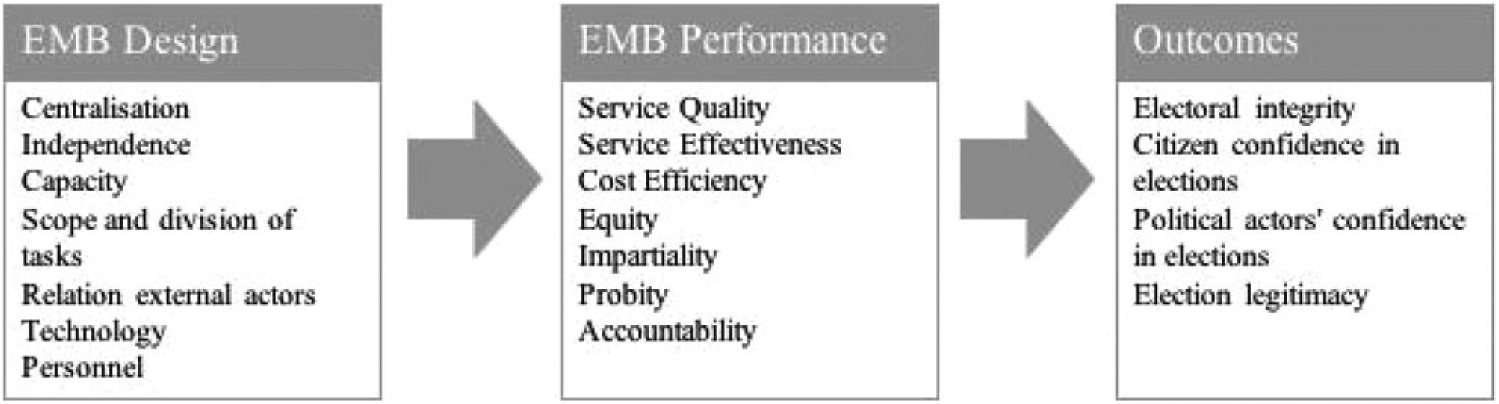
Hypothesised causal linkages between EMB design, performance and outcomes.
As Figure 1 sets out, broadly, we expect EMB organisational design to shape EMB performance, and EMB performance in turn to affect desirable outcomes such as election integrity and confidence in elections. However, there are many more detailed causal linkages which need to be explored to fully understand the connections between EMB design, performance and outcomes. Different dimensions of EMB design may affect different aspects of EMB performance, and likewise, different aspects of EMB performance may generate different outcomes. For example, EMB formal independence may affect EMB impartiality, but other dimensions of EMB organisational design such as EMB capacity and personnel may also shape EMB performance in this respect. Likewise, EMB scope and division of tasks are likely to affect EMB service effectiveness, but EMB capacity and personnel could equally be expected to shape this aspect of EMB performance. Turning to the consequences of EMB performance for outcomes, here too different dimensions of EMB performance are likely to have different consequences. EMB service effectiveness and quality may have important consequences for citizens’ confidence in elections, while EMB impartiality may be more strongly related to political actors’ confidence in elections.
Finally, apart from these more detailed causal linkages, there are also intervening variables operating at each step of the chain. Hence, EMB performance will be shaped by EMB organisational design to a certain extent, but also by other factors that are beyond institutional engineers’ control, such as the level of democracy and economic development in a country, whether or not elections take place in a context of conflict or post-conflict transition, etc. Likewise, as discussed in the section ‘Existing approaches to understanding the determinants of electoral integrity’, desirable outcomes such as electoral integrity or citizens’ and political actors’ confidence in elections are shaped by many other factors besides EMB performance.
Clearly, the connections between EMB organisational design, performance and outcomes as mapped in Figure 1 represent a complex set of causal linkages that require more detailed research to disentangle. As we have set out in the previous sections, given the importance of electoral management for election integrity, this is a vital research agenda that needs to be taken forward. The articles in this special issue do this, each investigating a part of this puzzle, as we outline in the conclusion section. However, addressing these research questions requires more detailed data on electoral management, to which we turn now.
New datasets: the electoral management surveys
Many of the articles in this special issue are underpinned by a new dataset developed by the editors (James et al., 2019) being reported and analysed for the first time here. 5 To understand the organisational determinants of electoral management body performance and electoral integrity outcomes, pioneering data on variation in the institutional design of EMBs worldwide was collected. Two surveys of EMBs, with common questions, were conducted. The ELECT survey was conducted in 2016 by the Electoral Integrity Project (with Pippa Norris, Alessandro Nai and Jeffrey Karp) in cooperation with the Association of World Electoral Bodies. The Electoral Management Survey (EMS) was conducted between July 2016 and October 2017 by James et al. (2019), and administered with the support of the Venice Commission. The EMS also collected additional data in this period through direct contact with remaining EMBs and regional networks not covered by the initial EMS survey or the ELECT project (see Online Appendix for listing of countries studied). 6
While not identical, the surveys from the EMS and the ELECT project both included a structural survey and a personnel survey and included a series of common questions in each survey. The structural survey was completed by one senior official from each EMB. This survey collects data on:
the organisational design of the EMB;
the number of staff;
the tasks and responsibilities of the EMB;
the decision-making process within the EMB;
the budget and resources of the EMB; and
the EMBs’ involvement with the international community.
Where appropriate, multiple EMBs were contacted in each country. In many countries, multiple organisations are involved in the administration of elections. As such, the survey includes responses from 78 organisations in 72 countries. 7 The sample is therefore not necessarily representative because it is possible that those who are responding are not representative of the population. However, the sample includes EMBs from many different regions around the world, including Asia, Africa and Europe, and includes EMBs from countries at different levels of economic development. 8 Given the difficulties in gathering data about electoral management organisations and electoral officials and the limited availability of comparative electoral management data so far, these data mark out unchartered territory in the research agenda that we have set out.
A second survey was sent to all employees of EMBs that agreed to participate through an online platform with the help of EMB officials. This personnel survey covered questions about the individual’s:
role within the EMB;
perceptions of the quality of elections in their own country;
perceptions of the human resource practices and their workplace;
training and professional development; and
demographic information.
Overall, EMBs from 52 countries circulated the survey and 2,029 responses were collected. 9
The countries represented in the datasets range from small countries such as Dominica (population less than 80 000), to very large countries such as Indonesia (population over 260 million). They also represent a variety of levels of economic development. The average GDP of the countries that responded to this survey is US$21,608 (US dollars per capita, purchasing power parity), slightly above the 2016 world average (US$16,143). 10 It covers both long-standing established democracies and emerging democracies. A full list of countries and organisations that participated is listed in Appendix A.
Summary data
In this section we illustrate the seven dimensions of EMB organisational design we have set out, using the new data on electoral management. In this summary analysis, data is reported by country. 11 In some cases, not all countries or organisations responded to each question, however, in most cases the number of responses matches the 72 countries that participated in this study. The analyses of the underlying relationships between EMB design, EMB performance and outcomes are developed in the remaining papers of the special issue – which are briefly described in the Conclusion section.
Centralisation
EMBs were asked about their relationship with other EMBs at the regional or local level. The responses varied widely. The largest group of respondents (26 of the 72 countries studied, or about 36%) reported that local or regional EMBs were subordinate and accountable to the national EMB. Another nine EMBs (about 13%) reported that local and regional EMBs are completely autonomous. However, the remaining responses described alternative arrangements between the local, regional and national levels. For example, Belarus and Croatia reported that regional or local electoral commissions are created for specific elections that report to the central election commission. Belgium and Switzerland, by contrast, reported that their national elections department organises national level elections only, and local elections are managed by the regions. The responses to this question about centralisation reveal that there are a wide variety of models of centralisation and decentralisation in electoral management.
Independence
EMBs were also asked about their institutional design, as it relates to how they function in relationship to other branches of government, and where they fit within the government bureaucracy. Traditionally, systems of electoral management have been classified according to three categories: independent, governmental or mixed (Catt et al., 2014). The independent model, also sometimes referred to as the agency model (Norris, 2015), sees EMBs as arms-length from the executive branch of government. Governmental models, on the other hand, are often election administrators who work from within a government department or ministry. The mixed model refers to countries where both exist, and each have specific functions or oversight over elections in the country. In the electoral management surveys, organisations were asked how they saw themselves: as independent, governmental or other. Of those countries that responded, the majority were independent bodies (72%), rather than governmental bodies (21%), and 7% identified as neither. Van Ham and Garnett (in this issue) carry out a more in-depth analysis of specific organisational design features that shape EMB formal independence such as appointment procedures, budgetary control and formal competences.
Rather than functioning out of the executive, or bureaucratic, branches of government, some EMBs are part of the judicial branch of government. This may be seen as an alternative way of promoting EMB independence, or distance from the competitors of any election (Berruecos, 2003). These may take the form of a special electoral tribunal, for example. In this survey, about 23% of EMBs identified as a specialised judicial body. Most interesting is that 18% of EMBs responded that they identified as ‘other’. This once again highlights that our current typologies fail to capture the full range of EMB designs.
A final dimension of independence is EMBs’ inclusion (or not) of political parties in their management boards. There are arguments to suggest that involving political parties in electoral management will lead to better cooperation, as parties can serve as ‘watchdogs’ of their elections. In this survey, the vast majority (74%) of EMBs identified as non-partisan organisations, while a minority (12%) indicated they include parties in their organisation. However, there were also a number of EMBs (13%) that employ both partisan representative and professional representatives to lead their organisations. 12
Together, these institutional design variables, including independence, judicial and partisan involvement, demonstrate that our current scholarly typologies of EMB institutional design do not always capture the actual variety of EMBs organisational design.
Capacity
The third major category of variables collected through the electoral management surveys dealt with their capacity and the resources available to perform their functions. There was previously no central source of data on EMB budgets and expenditures on elections, a major gap in our scholarly understanding of overall EMB capacity. In this survey, 46 countries provided budgetary data. When adjusted for US dollars per capita, purchasing power parity, the overall budgets of EMBs ranged from US$39 per person (in Zimbabwe) to less than 1 cent per person (in Afghanistan and Mozambique). The average budget was about US$7 per person (Standard Deviation 7.5).
EMBs also reported on their funding sources (multiple responses options were allowed). The vast majority were provided funding from the national government (88% of EMBs reported receiving funding from the national government, see Figure 2). The decentralised nature of some EMBs may explain the frequency of EMB funding from local (19%) and regional governments (14%) as well. Additionally, a significant proportion of EMBs reported receiving funding from international organisations (39%), and foreign governments (20%). This highlights the widespread impact of electoral assistance on the management of elections around the globe.
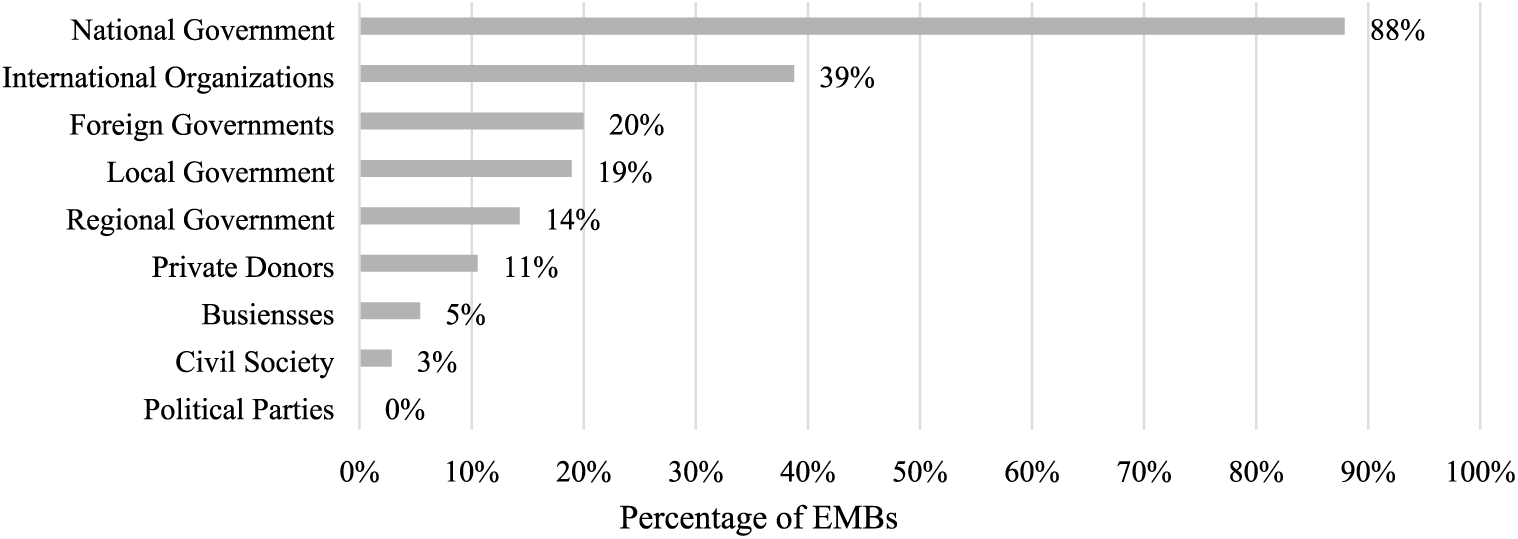
EMB funding sources.
However, there remain some challenges in using these data on EMB funding. While Figure 2 provides a picture of the major funding sources, the challenges of collecting full budgetary data means that we do not have a clear picture of what budgetary items are provided from which source(s). Additionally, as Garnett sets out in this special issue, it is difficult to compare budgetary data cross-nationally, due to differences in EMB responsibilities and the concomitant differences in the categorisation of their expenses, as well as the incompleteness of cross-national data. Furthermore, the contributions of international organisations and foreign governments are difficult to account for in determining EMB resources. In fact, 39 countries that responded to the electoral management surveys reported receiving some form of electoral assistance. To overcome these challenges, Clark’s article in this special issue presents more comparable budgetary data from local electoral authorities in the UK, and Garnett considers an alternative method of evaluating EMB capacity.
Scope and division of tasks
EMBs were also asked about whether their organisation is involved in a variety of electoral management tasks, according to an electoral cycle approach. These included activities from voter registration through to the adjudication of electoral disputes. However, the overwhelming number of incomplete responses to this question made it clear that the number of bodies involved in running elections is perhaps greater than initially hypothesised. Further research by Garnett (2017a) is collecting supplementary data using a variety of other secondary sources to provide a fuller picture of the scope and division of tasks performed by any given EMB.
Relations with external actors
When EMBs are unable to procure the necessary budgets or staff to fulfil their tasks, they may turn to foreign assistance in order to bolster their election management capacity. Technical electoral assistance from international organisations and foreign governments aims at assisting local EMBs, governments and civil society organisations in the tasks important to running a free and fair election. Of the 72 countries that responded to the survey, 39 (or 54% of respondents) reported receiving some type of electoral assistance at least some of the time.
When asked about the most common types of assistance received (multiple response options allowed), the greatest percentage of EMBs responded that they were helped with training and advice (Figure 3). Training programmes such as the popular BRIDGE program (Building Resources in Democracy, Governance and Elections) are used by a variety of international organisations and EMBs to share specialised electoral knowledge. 13 These types of training and further advice on election management are provided both through international organisations (such as IFES, UNDP, International IDEA), as well as on a bi-lateral basis between countries or EMBs.
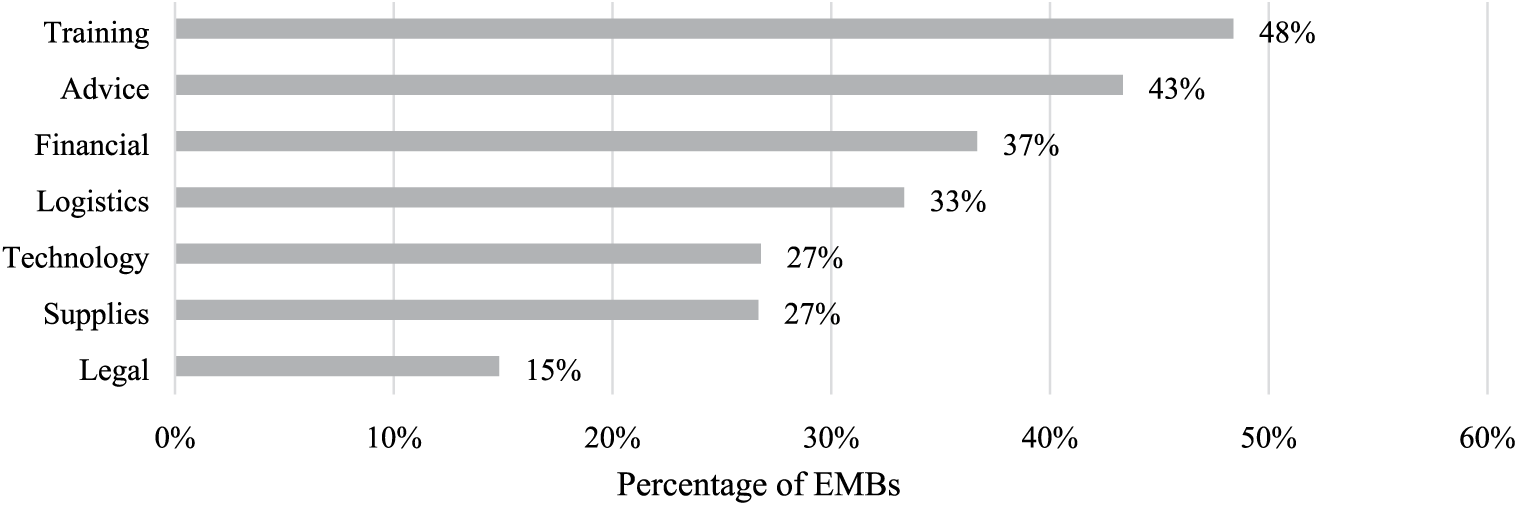
Types of EMB foreign assistance.
Technology
The use of technology for government operations, including electoral management, has increased in recent years. The electoral management surveys provide the first cross-national data on the use of technology. EMBs were asked about the areas of electoral management where technology is used. A majority of countries surveyed used technology for the tabulation of votes (60%) and voter registration (54%). The use of technology for candidate registration was also relatively common (44%). One of the most discussed new technologies for electoral management, biometrics (Piccolino, 2016), was used by only about a quarter of countries. The least common electoral technologies used related to the process of voting itself, namely some forms of internet voting (7%) and voting machines (14%). This is an interesting finding, since in the discussions about technology in the election process there is a tendency to focus only on the use during the voting process itself (Loeber, 2016).
Personnel
A final key dimension of EMB organisation is the high-quality and well-trained staff required to effectively run elections. The electoral management surveys therefore collected data on EMB staff levels and training. Staff levels ranged from 74 EMB employees (per 100,000 people) to less than one. The average number of staff was five (per 100,000 people, standard deviation 10). Furthermore, 57 organisations reported seconding staff from other government departments, and 68 organisations reported hiring additional staff (ranging from one to one million) during intense periods of the electoral cycle. Alongside the variations in tasks that EMBs are required to fulfil, and the presence of seconded, part-time and additional staff, it is difficult to directly compare staff levels with such a variety of responsibilities involved in running elections in each country.
However, beyond the simple numbers of staff, EMBs also reported on the training they provide to their staff members. This is a major focus on the ELECT Project’s report ‘Building Professional Electoral Management’ (Karp et al., 2017). The combined surveys reported in this special issue found that majority of EMBs reported providing training to their employees on a regular basis (41%) or often (13%). However, a surprising number of EMBs (13%) reported only providing training rarely or never. Of interest is also the training programme topics (Figure 4). Unsurprisingly, the most common topics covered were electoral procedures and the voting process. The least common training topics were campaign finance and gender equality, both emerging issues in electoral management.
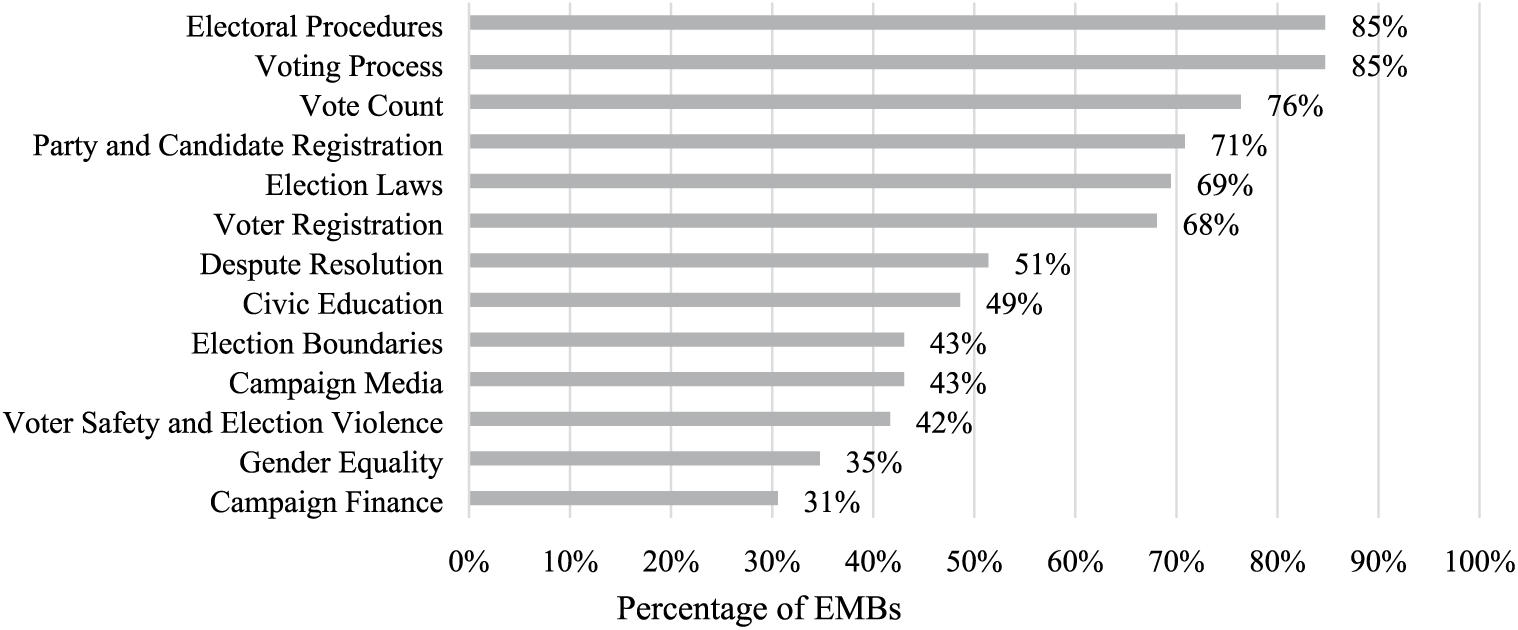
Training topics.
The personnel survey dug even deeper into the qualities of the staff working on elections by looking at the socio-demographic characteristics of the workforces, de facto human resource management practices and employee experiences. James’ article in this special issue maps these out in detail and assesses the underlying relationships between them. This helps researchers to identify understudied drivers of electoral integrity. Figure 5 summarises the extent to which respondents to a survey agreed with questions about their experiences.
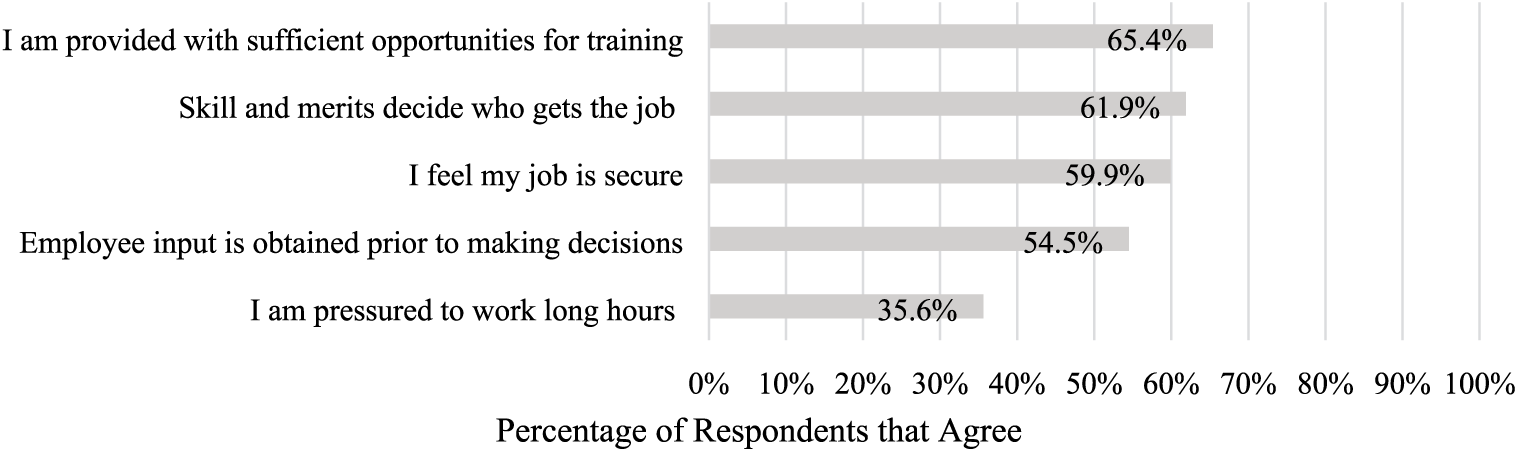
Employee experiences and human resource management practices.
Conclusion and the issue ahead
This introductory article has therefore opened a research agenda by providing a new framework for understanding previously underexplored drivers of electoral integrity and presented new macroscopic global data. The remaining articles in this special issue address the four themes identified in the conceptual framework set out so far. Beginning with independence, Carolien van Ham and Holly Ann Garnett present new data on variation in EMB organisational independence around the world such as appointment procedures, budgetary control and formal competences. They test for the effects of these features on the capacity of EMBs to operate independently in practice, as well as its effects on electoral outcomes such as electoral integrity.
Next, Holly Ann Garnett begins an analysis of capacity by mapping out variation in resources between EMBs, examining the consequences of EMB capacity for key electoral outcomes such as electoral integrity using new cross-national data. Meanwhile Alistair Clark provides a within-case analysis of the UK to reveal more micro-level data of how money is spent on the running of elections.
Finally, looking at the theme of personnel, Toby S James analyses new data on the people who run elections around the world. This includes their demographic characteristics but also human resource management practices and employee experiences. The study demonstrates how workforce personnel have an important effect on the performance of EMBs.
Pippa Norris concludes by reflecting on the special issue and outlining some of the methodological challenges facing the new agenda.
Supplemental Material
IPS828206_French_and_Spanish_abstracts – Supplemental material for Electoral management and the organisational determinants of electoral integrity: Introduction
Supplemental material, IPS828206_French_and_Spanish_abstracts for Electoral management and the organisational determinants of electoral integrity: Introduction by Toby S James, Holly Ann Garnett, Leontine Loeber, Carolien van Ham, Toby S James, Holly Ann Garnett, Leontine Loeber and Carolien van Ham in International Political Science Review
Supplemental Material
James_et_al,_INTRO_MSed_Supplementary_FileRR_(1) – Supplemental material for Electoral management and the organisational determinants of electoral integrity: Introduction
Supplemental material, James_et_al,_INTRO_MSed_Supplementary_FileRR_(1) for Electoral management and the organisational determinants of electoral integrity: Introduction by Toby S James, Holly Ann Garnett, Leontine Loeber, Carolien van Ham, Toby S James, Holly Ann Garnett, Leontine Loeber and Carolien van Ham in International Political Science Review
Footnotes
Acknowledgements
The authors are grateful to two anonymous reviewers for the comments on an earlier version of this paper. They are also grateful to the Venice Commission for collaborating with the research project. The authors alone are responsible for any errors.
Funding
This research received funding from the Electoral Integrity Project; University of East Anglia, UK; and, the University of New South Wales, Australia.
Notes

Author biographies
References
Supplementary Material
Please find the following supplemental material available below.
For Open Access articles published under a Creative Commons License, all supplemental material carries the same license as the article it is associated with.
For non-Open Access articles published, all supplemental material carries a non-exclusive license, and permission requests for re-use of supplemental material or any part of supplemental material shall be sent directly to the copyright owner as specified in the copyright notice associated with the article.
