



Abstract
This article reports on deliberation between citizens and politicians in a citizens’ forum about closing small schools and building a school center in a Finnish municipality. This real-world policy issue was highly contested at the time of the deliberation. The purpose of the study was to analyze both the magnitude of opinion changes and potential opinion convergence between citizens and politicians. The citizens’ forum used an experimental design whereby half of the groups engaged in discussion under the guidance of a facilitator with discussion rules, and the other half of the groups had no facilitation or rules. The analyses test how potential opinion changes are mediated by how deliberators experience discussion quality and moderated by the type of participant (citizen or politician). The findings show that opinion changes, both regarding magnitude and convergence, are not uniform for politicians and citizens. Moreover, this study shows how different layers of opinions may be affected differently by deliberation.
Introduction
This study reports on a field experiment that brought together politicians and citizens to deliberate in a citizens’ forum event held in a Finnish municipality in November 2016. The forum concerned the closure of village schools and the construction of a school center. Of special interest was the fact that there was a division of opinion among deliberators regarding what the solution to the school-center problem should be. Local politicians favored the school center, whereas most citizens strongly opposed it. Our findings show that, even concerning this kind of value-laden issue, deliberation can lead to some convergence of opinions between citizens and politicians, especially when the participants encountered new perspectives on the school-center issue during the deliberation.
Deliberation entails a communicative process with distinct elements of rationality. Scholars usually mention inclusion, equality, reciprocity, rational argumentation, sincerity and respect as key components of high-quality deliberation (e.g. Fung, 2003). The goal of deliberation is often to achieve mutual understanding and to find a common ground concerning societal matters (Bächtiger et al., 2014; Barabas, 2004: 689–690; Grönlund et al., 2015). The purpose of this study is to investigate how opinions change due to deliberation on a divisive societal issue and whether there are any distinct patterns in opinion changes among politicians and citizens respectively. The study thus focuses on group-composition effects (e.g. Farrar et al., 2009; Grönlund et al., 2015; Mendelberg and Karpowitz, 2007) within deliberative settings. The study also builds on the literature about deliberation between politicians and their constituents (e.g. Barrett et al., 2012; Button and Mattson 1999; Hendriks 2016; Minozzi et al., 2015). To systematically test the impact of deliberation per se, we varied the discussion setting (cf. Strandberg et al., 2019): half of the groups engaged in discussion with rules using facilitation (henceforth: facilitated deliberation) while the other half had a free discussion without rules or facilitation (henceforth: non-facilitation). All of the discussion groups contained a mix of citizens and politicians. We thus study how opinion changes are affected by the type of discussion (facilitated deliberation or non-facilitation) and the type of deliberating actor (politician or citizen).
Mixed deliberation between citizens and politicians
From a systemic perspective on deliberation, the most important aspect is that the system as a whole contains various interconnected spaces for deliberation (Elstub et al., 2016; Hendriks, 2016). Some of these spaces may be only for policymakers, others only for citizens and some may contain a mix of both. The citizens’ forum of interest in this paper is of the last type. We will thus elaborate on mixed micro-deliberations between citizens and politicians (henceforth: mixed deliberation) and potential group-composition effects contained therein.
Arguably, when citizens and politicians meet to deliberate, the best-case scenario is that it is part of a decision-making process (e.g. Bächtiger et al., 2014: 239; Levine et al., 2005). This, however, is seldom the case (Barrett et al., 2012; Button and Mattson, 1999). In fact, to require that deliberation has a direct policy impact might be setting the goal too high. Button and Mattson (1999: 612), for instance, state that the goals of deliberations are to achieve learning about an issue, to gain an increased mutual understanding, to achieve direct legislative impact or to serve as an arena for so-to-speak ‘letting out steam’. According to Barrett et al. (2012: 188), we should evaluate the impact of deliberations according to the goal of each deliberative event, rather than staring blindly at direct policy impact. In fact, regardless of impact on actual policy, citizens taking part in mixed deliberations tend to appreciate the opportunity to meet with politicians and gain some insight into politics (Barrett et al., 2012: 189; Button and Mattson 1999: 633).
Often, opinion changes in mixed deliberations concern achieving mutual understanding between citizens and politicians and letting out frustration. Opinion changes in deliberations potentially take place due to the deliberative process forcing people to encounter various opinions, facts and rational arguments on a given topic, which helps them form reasonable, well-informed opinions (Barabas, 2004; Chambers, 2003: 309). According to Mansbridge (1992: 36, see findings in Farrell et al., 2016), this also holds true for deliberations between citizens and representatives: ‘After absorbing new insights and information and after experiencing new ways of feeling, citizens and representatives may be expected to change their minds.’ However, non-deliberative forces that also influence opinions sometimes obscure the ideal deliberative process. Group-composition effects can have a stronger impact on opinions than the actual discussion or, as Mendelberg and Karpowitz (2007: 106) state, ‘good deliberation can be undermined by group norms.’
The literature on group-composition effects (Farrar et al., 2009; Grönlund et al., 2015; Mendelberg and Karpowitz, 2007; Smets and Isernia, 2014; Strandberg et al., 2019; Sunstein, 2009; Vinokur and Burnstein, 1978) indicate that people often seek social acceptance within the discussion group and tend to adjust their view to the dominating, or most vocal, views and information provided therein. When citizens and politicians deliberate, politicians might thus leverage their higher social status and their in-depth knowledge of the societal issue at hand and swing opinions in their favor (e.g. Gastil, 2000; Minozzi et al., 2015; Sunstein, 2009). Other studies (e.g. Suiter et al., 2016) also show that individuals of higher social standing change their minds less than those of lower standing. This could mean that ‘mutual understanding’ in mixed deliberations is mostly driven by opinion changes on the part of citizens, not politicians. On the other hand, issue salience and pre-deliberation opinions can influence opinions too (e.g. Smets and Isernia, 2014; Sunstein, 2009). Thus, the more an individual personally cares about a certain policy issue, the less likely he/she is to change opinions due to deliberating (Bächtiger et al., 2014; Benoît and Dubra, 2014; Lindell et al., 2017; Morrell, 2010: 103–104). Hence, citizens care more strongly about school closures on a personal level than politicians, and are less likely to adjust their views on the issue due to deliberation, whereas politicians could be more open to consider other arguments.
Facilitated deliberation and opinion changes in mixed deliberation
To be considered truly deliberative, a discussion should give equal opportunities for all participants to speak, the discussion should be based on facts and reasoning and all participants should have an open mindset to differing views and behave respectfully towards each other (see e.g. Young, 2000). This process encourages opinion change and increases the participants’ civic capacity (e.g. Carcasson and Sprain, 2016; Fung, 2003; Gastil, 2000). It is noteworthy, though, that high-quality deliberation does not always produce opinion changes nor a movement towards mutual understanding (Baccaro et al., 2016; Benoît and Dubra, 2014; Bächtiger et al., 2014; Lindell et al., 2017). For instance, not changing one’s mind at all, or even becoming more ‘extreme’ or polarized, may both be the result of a well-functioning deliberative process (Fishkin, 2009). Farrar et al. (2009) state that opinion crystallization may well be the real effect of deliberation, rather than opinion change. Thus, if the discursive process is of good deliberative quality, any outcome of that process is likely a result of rational contemplation.
To increase the likelihood of rational deliberation taking place, organizers of mini-publics commonly use both rules for discussion and trained facilitators. These procedural safeguards not only depict the ideals of deliberation (i.e. the rules) to participants, but also seek to ensure that the flow of discussion and interaction between participants adheres to them (Landwehr, 2014). Although there are several studies of mixed deliberations where opinion changes have been examined (e.g. Barrett et al., 2012; Button and Mattson 1999; Hendriks 2016; Minozzi et al., 2015), there are still no studies of mixed deliberation in which these effects have been systematically tested experimentally by having deliberating groups with rules and facilitation compared to groups lacking these. Nonetheless, our expectation is that facilitated deliberation in a mixed-deliberation setting will achieve higher deliberative quality. The connection from deliberative quality to opinion changes and direction of changes, though, is a bit unclear with contradicting findings in several studies (Baccaro et al., 2016; Barabas, 2004; Caluwaerts and Reuchamps, 2014; Gastil et al., 2008; Schneiderhan and Khan, 2008).
As was evident earlier, opinion changes in a mixed setting can take several forms. Regarding these, facilitation could hamper group-composition effects such as the dominance by individuals of higher social status (e.g. politicians) through ensuring equal opportunities to speak for all participants (e.g. Gerber, 2015: 114). When deliberations concern policy issues affecting people’s lives, however, citizens might remain adamant in their opinions (Benoît and Dubra, 2014; Morrell, 2010). Politicians, having a more ‘professional’ connection to the policy issue, might have a more open mindset and begin to understand the citizens’ point of view and reasoning. Whether facilitated deliberation can affect opinion positions based on an affective, personal connection to a policy issue remains an open question. Both the rules and the facilitator emphasize being open to different viewpoints, new facts and arguments in order to focus on a solution acceptable to all. This could mean that opinions can change due to facilitation. In studies of opinion polarization in enclaves of like-minded citizens (e.g. Grönlund et al., 2015; Strandberg et al., 2019), facilitated deliberation stopped polarization from taking place. Additionally, as Baccaro et al. (2016; see also Gerber et al., 2018: 22) argue, facilitated deliberation is not only related to opinion changes on an aggregate group level, but potentially also to the magnitude of opinion change on the individual level. Thus, group-level aggregation of individuals’ opinion change can cancel each other out; meaning that stability of opinions on the aggregate level – which at face value looks as though no opinion changes are taking place – can conceal meaningful changes at the individual level (Gastil et al., 2008; Himmelroos and Christensen, 2018).
Design and analytical model for the empirical study
The mechanisms of how facilitated deliberation connects to opinion changes are complex. In the discussion thus far, we have pointed to the influence of both group-composition effects as well as the effect of the deliberative communication process and its quality. Figure 1 depicts a summary of the theoretical framework as a mediation/moderation model which also serves as an analytical model for the empirical part of this study:
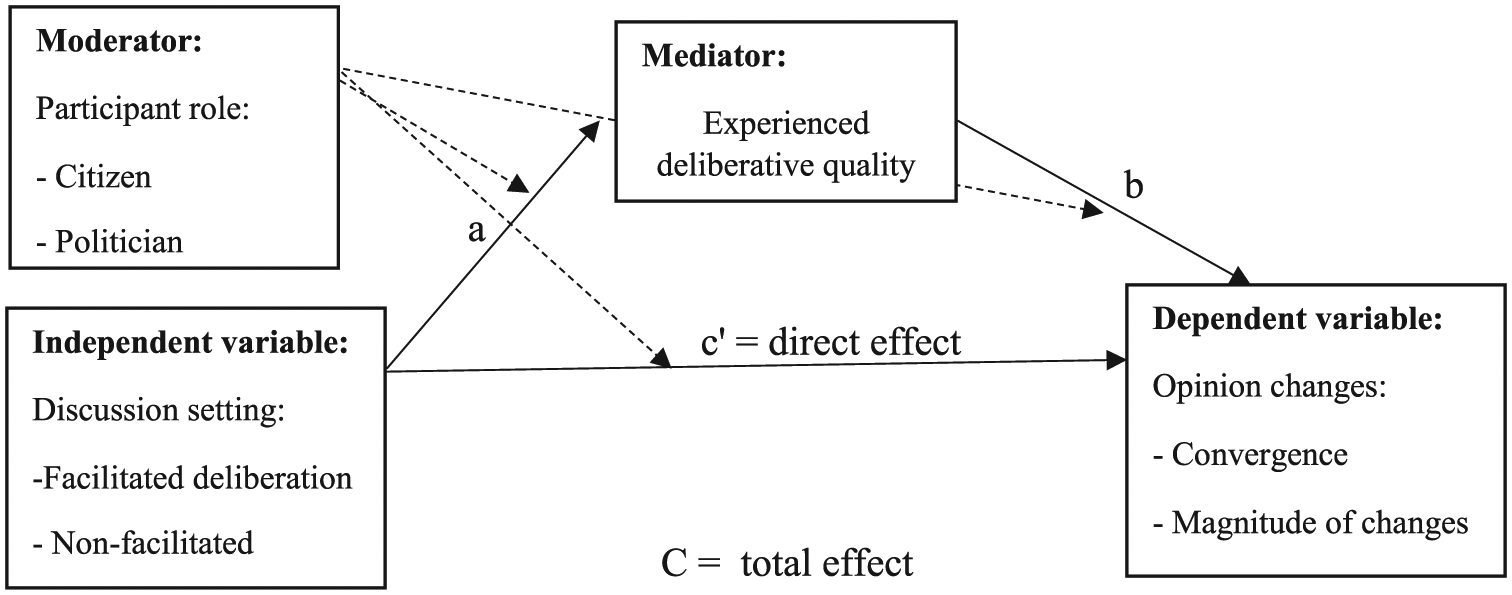
Analytical model: direct (c’), mediated (a and b), moderated and total effects (C) of type of discussion on opinion convergence and magnitude of opinion changes.
The total effects (marked by a C), of facilitated deliberation are potentially mediated by how participants experience the deliberative quality of the actual discussion (see O’Keefe, 2003). Thus, path a examines how facilitated deliberation links to deliberative quality and path b how deliberative quality per se links to opinion convergence and magnitude of opinion changes. Both the total effects (C), mediated effects (a and b) as well as direct effects (marked c’ ) could also be moderated by type of participant, an indicator of group-composition effects, so that the impact in each path and the total model differ between citizens and politicians. Contained within the model are two general hypotheses regarding the impact of facilitated deliberation on opinions, both of which are potentially mediated by deliberative quality and moderated by type of participant:
H1: Facilitated deliberation leads to more opinion convergence between citizens and politicians compared to non-facilitated discussion.
H2: Facilitated deliberation leads to greater magnitude of opinion changes compared to non-facilitated discussion.
The citizens’ forum experiment
The case: closing village schools and building a school center
In 2014, a municipality in western Finland assigned a planning committee to provide recommendations for the future organization of the school infrastructure. In its final report the committee recommended that four small village schools – Schools A, B, C and D – would be shut down and instead incorporated into a new (yet-to-be-built) school center in another village, School E. The motivations for this solution were mainly economic. The municipal assembly made a decision-in-principle in favor of the school center in March 2015. At the time of the citizens’ forum experiment in November 2016, this decision had just been made and was widely contested among citizens, especially among the parents of children in the affected schools, but was mostly supported by politicians. In a sense, there was a collision between the emotionally driven concerns of citizens and the need for politicians to justify their decision-in-principle to close schools and build a school center. Relating to Button and Mattson (1999: 612), the setting we study here thus seems likely to be a place for conflictual deliberation rather than for finding mutual understanding.
Design and treatments
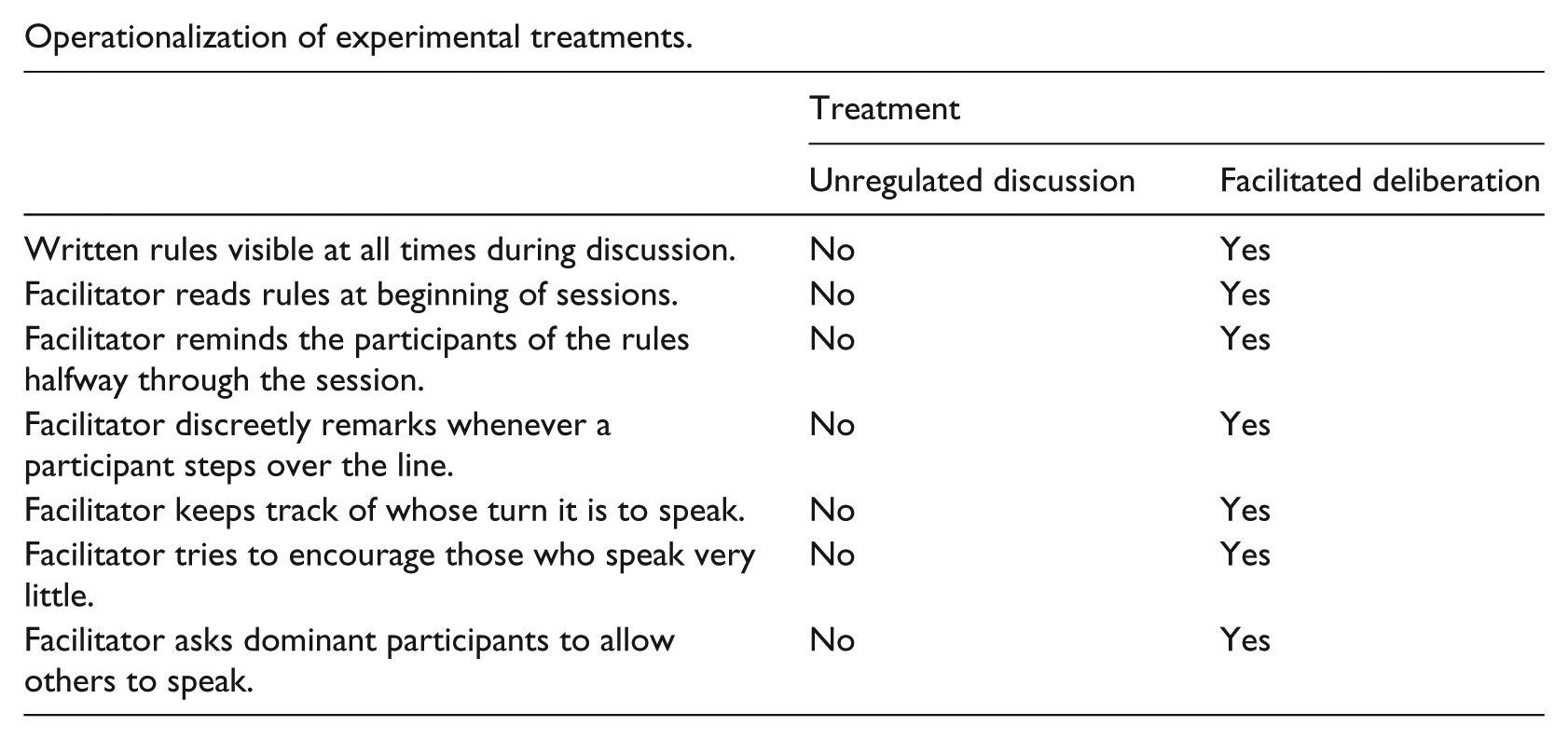
To test our hypotheses, we designed a citizens’ forum field experiment, with mixed discussion groups of citizens and politicians, employing a one-factor factorial design. Half of the participants engaged in discussion in small groups without rules or facilitation; a person was merely present to take notes during the discussion (i.e. the control treatment, non-facilitated discussion). The other half of the discussion groups had a facilitator leading the discussion and rules to guide the discussion (i.e. the treatment, facilitated deliberation). The combination of rules and facilitation approximated the ideal deliberative process (see Fung, 2003). Thus, rules support reasoned justifications, reflection, sincerity and respect, whereas facilitation encourages reciprocity, inclusion and equality in the discussions (see Appendix A). Manipulation checks of the impact that facilitated deliberation had on perceived deliberative quality showed that there was a significant difference, with a rather high explained variance (eta-squared of 0.107), between the treatment and control treatment regarding deliberation quality. Thus, facilitated deliberation indeed has a positive effect on how participants experienced the deliberative quality in the discussions.
Participants and procedure
In recruiting citizens, awareness of the deliberation was raised through social media and the local newspaper. To recruit politicians, we contacted key persons and relied on word of mouth to do the rest. This self-selection recruitment means that our sample was not representative of the entire population in the municipality. A total of 35 participants eventually took part in the mini-public: 21 citizens and 14 politicians. Compared to the general population of the municipality, representativeness for gender was rather good (53% male participants compared to 49% among population). However, 50% of the participants were aged 35 to 49 years, which was almost double the share of that age category among the population of the municipality. However, it should be noted that our research interest was not concerned with generalizing to the entire population. Rather, we focused on citizens’ and politicians’ opinion changes as a result of discussing with either a facilitated deliberation or a non-facilitated discussion.
To ensure that each discussion group would include as equal a number of citizens and politicians as possible, we used stratified randomization in the treatment (facilitated deliberation) and the control treatment (non-facilitation). This resulted in 17 participants in the non-facilitated treatment (11 citizens and 6 politicians) and 18 in the facilitated deliberation treatment (10 citizens and 8 politicians). Randomization checks showed that there were no systematic between-groups differences in the characteristics of participants regarding gender, age, education and profession (chi-squares test) in each treatment, nor between citizens and politicians.
After randomization, the participants discussed in small-n groups, two groups in each of the treatments. Both groups in the facilitated deliberation treatment had nine participants, whereas one of the non-facilitated discussion groups had nine participants and the other eight. The discussions started with participants answering a survey (abbreviated to T1), after which they read impartial information material on the topic of the discussion. The discussions then lasted for 1.5 hours after which participants answered a post-test questionnaire (T2).
Measures
To gauge opinion changes we used a pre-test post-test experimental design. The T1 survey contained 24 items measuring various opinions on the school closures and building a school center. By comparing changes from pre-test to post-test between the two treatments concerning these items, we were able to assess the impact of facilitated deliberation compared to non-facilitated discussion on opinion changes (magnitude and convergence).
We focus on changes regarding two underlying dimensions of opinions (see Appendix B). Firstly, 14 items pertaining to opinions regarding the school center and village-school closures on a level of principle were analyzed using a sum-variable (Cronbach’s alpha pre-discussion = 0.93 and post-discussion = 0.95). Secondly, opinions regarding specific aspects of the issue, 10 items in total, were also analyzed as a sum-variable (alpha pre-discussion = 0.98 and post-discussion = 0.97). The division between opinions on the level of principle and specific level was constructed since one might support school closures in general while simultaneously question certain details of a particular closure. Before discussion, though, there was a correlation of r=0.89 between the two scales which suggests that this was generally not the case. Nonetheless, it is conceivable that opinions on a level of principle change less than opinions on the specific level. Table 1 below depicts the pre-deliberation opinions for each type of participant according to treatment and the small-n discussion group.
Initial opinions according to type of participant and treatment group (means with standard deviation in parentheses).
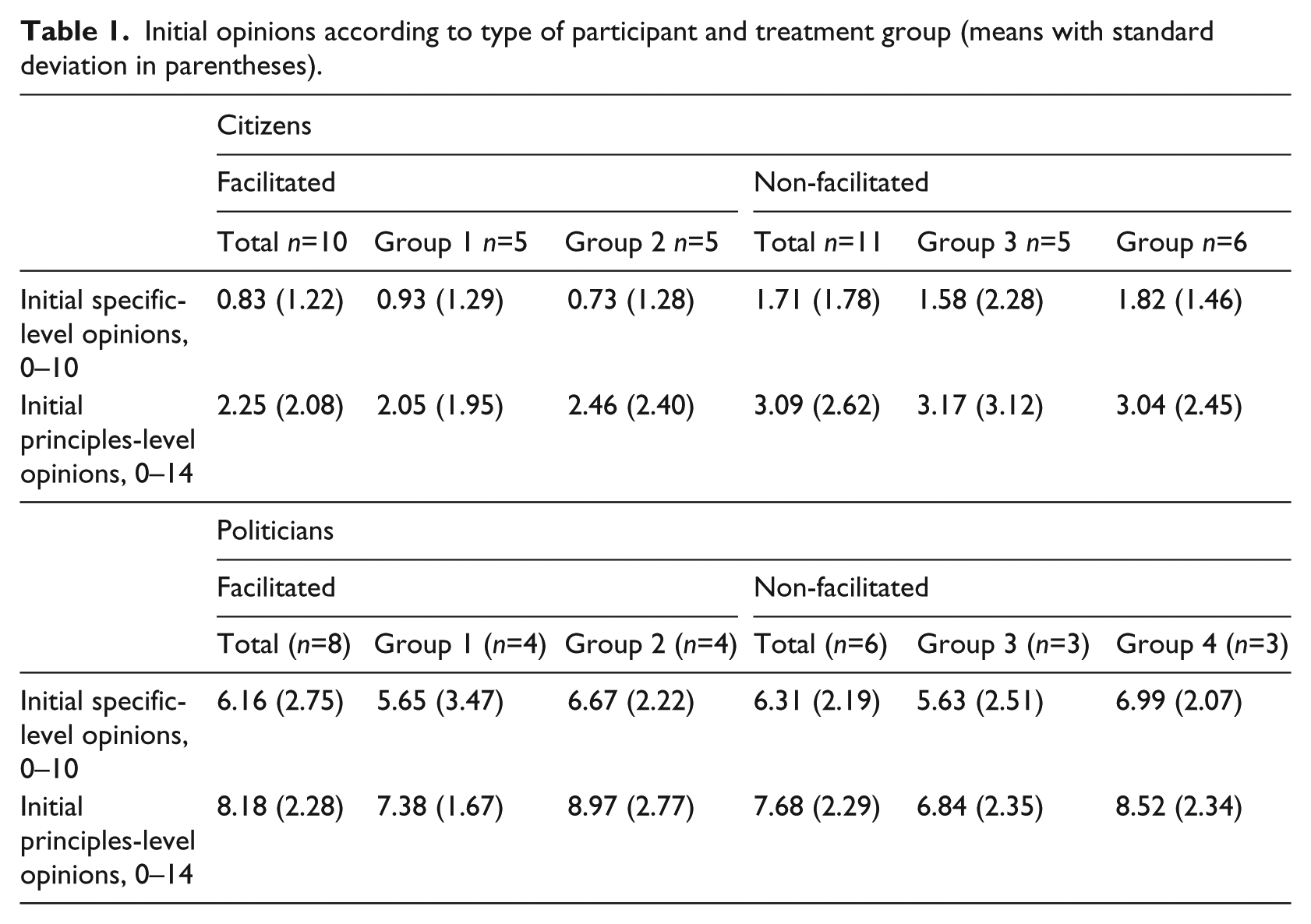
The main thing to notice is the clear differences in all groups between citizens’ and politicians’ opinions for both specific- and principle-level aspects.
The measure for opinion convergence, our first dependent variable, was constructed by calculating each participant’s pre-discussion (T1) opinion-distance to the mean opinion of the opposing type of participant at T1. For instance, a citizen’s opinion at T1 is measured against the average opinion of all politicians at T1 and vice versa. We then took the absolute of that number and retained a ‘distance to opposition’ measure for both specific-level and principles-level opinions at T1. A corresponding ‘distance to opposition’ measure was then calculated for T2 (after discussion). The convergence measures (one for specific-level opinions and one for principles-level opinions) were obtained by subtracting the T2 distance to opposition from the T1 distance to opposition measure. This gives a convergence measure where a higher value indicates more convergence and a lower value indicates less convergence. Magnitude of opinion changes, our second dependent variable, for both specific-level items and principles-level items were obtained by taking the absolute scores for opinion changes for each item contained in the scales and then summing these absolute scores. The mediator deliberative quality is based on self-reported subjective measures of how participants experienced the discussion (see Appendix B). 1
Findings
To study the mediation/moderation model depicted in Figure 1, we used the PROCESS macro Model 8 for SPSS (Hayes, 2017). Thus, a conditional process model was applied with discussion setting as predictor (facilitated deliberation as treatment and non-facilitation as control), opinion convergence on specific and principles level as well as absolute opinion changes on specific and principles level as outcomes, deliberation quality as mediator, and the participant role (citizen or politician) as moderator. A separate set of multivariate analyses of variance (MANOVA) for each step in the conditional process model were also conducted and they produced consistent findings with the process model (these are available on request).
Since the data was not normally distributed upon initial examination (Kolmogorov-Smirnov test), and thus sensitive to outliers due to the low-n, all data was outlier-corrected prior to the analyses using the adjusted ranks-transformation method (Leys and Schumann, 2010). This facilitates the use of parametric analyses on non-normally distributed data (non-parametric methods in fact perform the rank transformation within the analysis). We nonetheless show descriptive data in parametric form (mean-values are easier to understand than mean-ranks) but all tests of statistical significance are based on tests of mean-ranks and not means. Statistical significance is indicated at the 0.10 level, which is often used in small-n experiments in order to achieve sufficient statistical power and less total risk of error (e.g. Strandberg, 2015: 463). 2 Statistical tests are one-tailed when they pertain to hypotheses 1 and 2 since these have directional expectations. For all other tests, two-tailed tests are used since we did not have directional expectations for the impact of the mediator nor for the moderator.
Conditional process analyses
We present the results of the conditional process analyses in four tables, one for each indicator of the dependent variables. In the first hypothesis we predicted that facilitated deliberation leads to more opinion convergence than discussion without facilitation. We start with the model for convergence of opinions on the specific-level (Table 2):
Conditional process model for the effect of facilitated deliberation on convergence of opinions on the specific level.

p<0.05 ** p< 0.01.
Note: The model used bootstrapping (5000 times).
SE: standard error
It should be noted, first, that the overall model showed a statistically significant trend, F(4,29)=1.76, p (one-tailed)=0.08, R2=0.20, according to which facilitated deliberation positively affected specific-level convergence. 3 This is in line with hypothesis 1. Looking at the precise effects within the whole model, there are no indirect effects (mediation, arrows a*b in Figure 1) since all bootstrapped confidence intervals contain the value zero. In both the direct effects (arrow c’ in Figure 1) and the total effects (C in Figure 1), the main observation is a significant and strong moderation effect. This effect shows that citizens’ opinion shifted towards that of the politicians after deliberation, whereas a similar shift towards the citizens’ opinions did not occur among politicians. These findings thus partially confirm our first hypothesis that facilitated deliberation leads to more convergence than non-facilitated discussion, with the caveat that this convergence was asymmetrical since it only occurred on the part of the citizens (moderation).
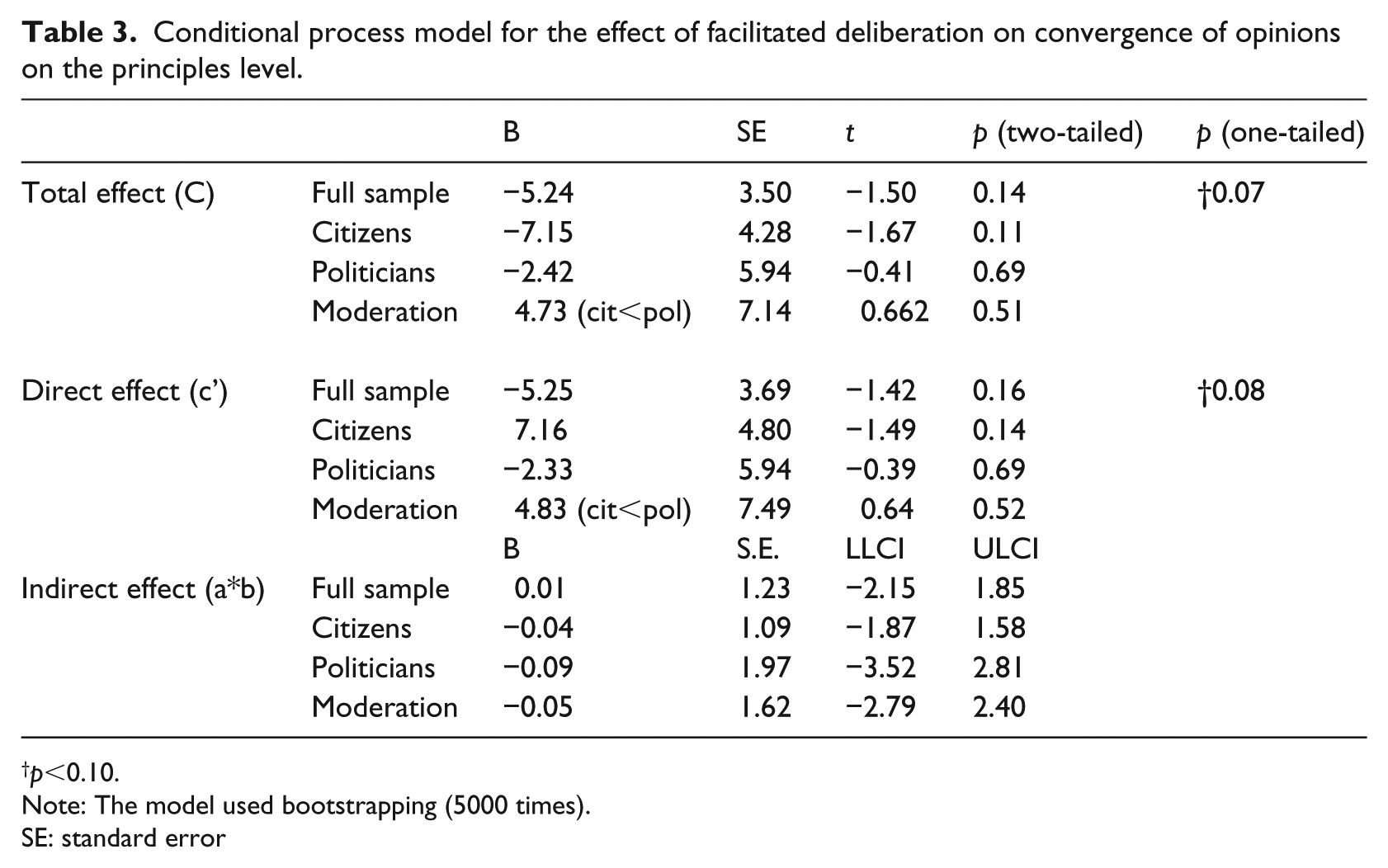
We continue with the corresponding model for principle-level opinion convergence (Table 3):
Conditional process model for the effect of facilitated deliberation on convergence of opinions on the principles level.
p<0.10.
Note: The model used bootstrapping (5000 times).
SE: standard error
For principle-level convergence the overall model was insignificant, F(4,29)=0.61, p (one-tailed)=0.33, R2=0.08, which does not support H1. In the specific findings of the model, there are statistical trends (on the one-tailed level) indicating a negative effect of facilitated deliberation on principles-level convergence (for the full sample in both total effects (C in Figure 1) and the direct effects (c’ in Figure 1). There are no mediation nor moderation effects. The findings concerning opinion convergence on the principles level thus stand in contrast to hypothesis 1, since there are no effects in the overall model, and effects running in the opposite direction to that of the hypothesis in the direct effects and the total effect. Our analyses of opinion convergence thus, on balance, provided mixed support for hypothesis 1. Facilitated deliberation positively affects convergence, through moderation, on the specific level while it had no effect or, opposite main effects (no moderation) on the principles-level convergence.
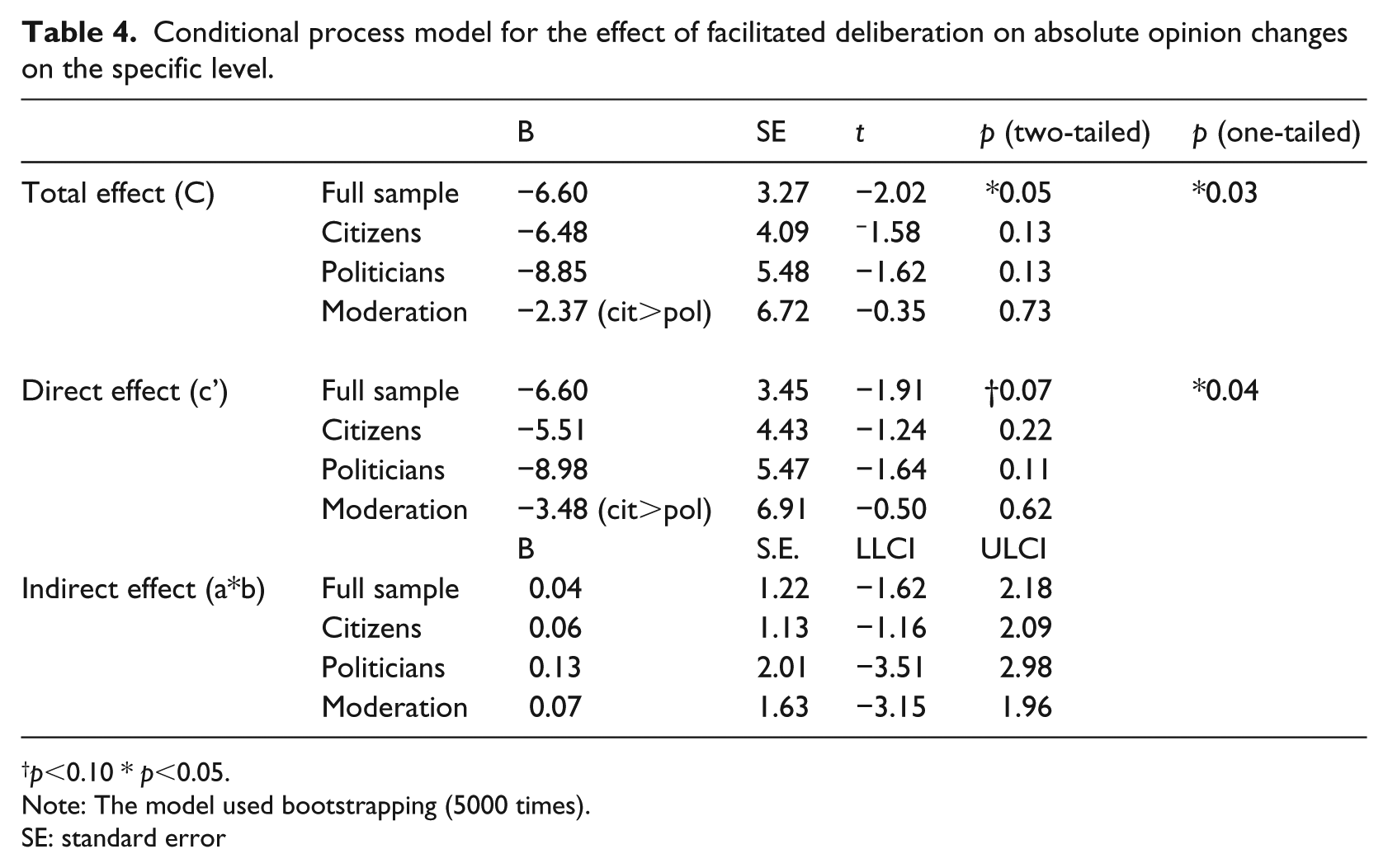
In the following two tables (Table 4 for specific-level opinions and Table 5 for principles-level opinions) we focus on the conditional process models for our second dependent variable, magnitude of opinion changes (measured as absolute opinion changes). Our second hypothesis predicted that facilitated deliberation would lead to more absolute opinion changes than non-facilitated discussion.
Conditional process model for the effect of facilitated deliberation on absolute opinion changes on the specific level.
p<0.10 * p<0.05.
Note: The model used bootstrapping (5000 times).
SE: standard error
Conditional process model for the effect of facilitated deliberation on absolute opinion changes on the principles level.
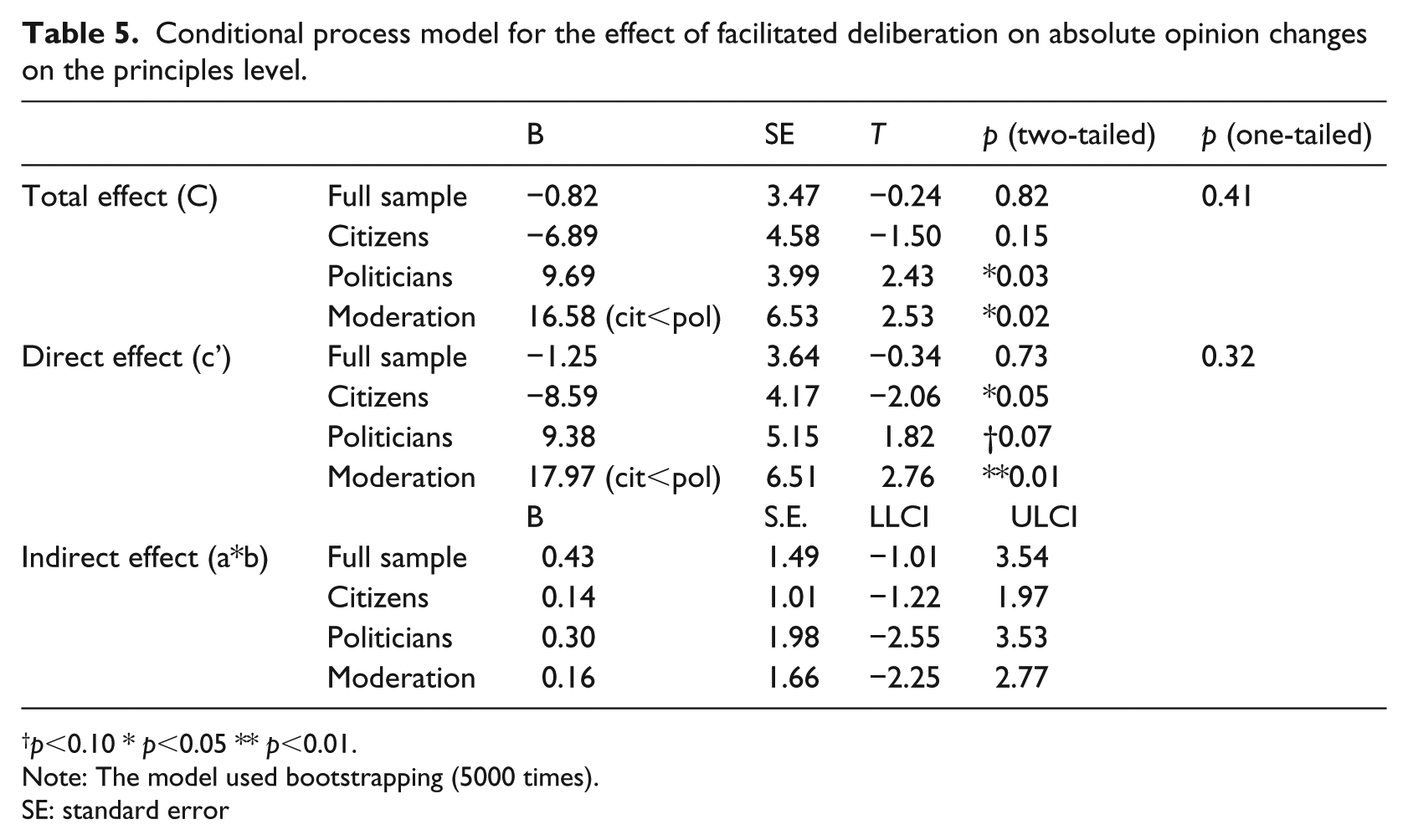
p<0.10 * p<0.05 ** p<0.01.
Note: The model used bootstrapping (5000 times).
SE: standard error
The overall model for specific-level absolute changes was not statistically significant, F(4,29)=1.27, p (one-tailed)=0.15, R2=0.15, which does not confirm H2. The direct and total effects show two statistically significant effects, but these are contrary to H2 since absolute opinion changes were smaller with facilitated deliberation than without it. There are no indirect (mediated effects) in the model since all bootstrapped confidence intervals contain the value zero).
We finally analyze absolute opinion changes for opinions on the principles level (Table 5).
The overall model for principles-level absolute opinion changes is positively significant, F(4,29)=2.32, p (one-tailed)=0.04, R2=0.24, which supports hypothesis 2. When examining the effects in detail, a strong moderator effect can be seen in both the total effects and the direct effects whereby the absolute opinion changes among politicians are greater than among citizens. In the direct effects, we also see that citizens’ absolute changes are significantly smaller in the facilitated deliberation treatment than the non-facilitated treatment. The moderation effects thus only partially confirm hypothesis 2. Thus, looking at our two analyses of absolute opinion changes, we find no support that facilitated deliberation lead to greater magnitude of opinion changes on the specific level. On the principles level, though, our findings partially confirmed hypothesis 2.
Conclusions
This study concerned a real-world deliberation in a citizens’ forum between politicians and citizens regarding a salient and emotionally laden local-level societal problem. This forum was held after a decision (in principle) had been made in favor of closing village schools and building a school center. We argued earlier that this post-facto deliberation, nonetheless, was an opportunity for gaining mutual understanding and for venting frustration (Button and Mattson, 1999). We designed an experiment where the discussion setting used either facilitated deliberation or was non-facilitated, and where each of these treatments included both citizens and politicians in order to study group-composition effects and deliberation effects. The hypotheses were that facilitated deliberation would achieve more opinion convergence and greater magnitude of opinion changes.
The findings only partially confirmed the hypotheses. Often, the facilitated deliberation setting per se did not affect opinion convergence nor the magnitude of changes in the expected way. In several instances, the effect was even negative, which indicates that it was actually the control treatment (non-facilitation) that drove the changes. This could indicate that the opportunity for politicians and citizens to meet, regardless of the precise rules of conduct for this meeting, is one factor causing opinion convergence and absolute changes (e.g. Barrett et al., 2012; Button and Mattson, 1999). However, scrutinizing the findings, this is necessarily not the whole picture. Another important result is that facilitated deliberation can achieve both convergence and absolute opinion changes as a moderation with participant role, i.e. as an interaction between facilitated deliberation and group-composition effects. To simplify our findings, one could state that facilitated deliberation makes individual politicians’ opinions on the level of principle move about without really converging on a group level. On the other hand, facilitated deliberation has fewer effects on citizens’ absolute opinion changes both on specific and principles level, but it does lead to convergence regarding specific-level opinions.
How can we make sense of these findings? Although these interpretations are tentative due to this being a small-n experiment, it appears that facilitated deliberation matters more for the perspective on a societal matter which one knows less about before deliberating. Thus, regarding the school-center issue studied here, citizens were perhaps a priori less acquainted with the specifics of the matter and encountered new information about this during deliberation in the forum and slightly adjusted their views on the specific level. They remained against school closures in principle since their opinions are perhaps formed more on emotional and personal grounds and thus less likely to budge (e.g. Bächtiger et al., 2014; Benoît and Dubra, 2014; Morrell 2010). Conversely, politicians were aware of the details from having already discussed and made a decision-in-principle on the school center before attending the deliberation. What politicians probably were less aware of a priori, however, was the reasoning behind the citizens’ opposition to closing schools. Hence, we observed a greater magnitude of opinion changes on the level of principle among politicians. These interpretations of our findings lend some support to the notion that hearing opposing viewpoints and engaging in respectful argumentation can affect opinions, even concerning salient and highly emotional problems (e.g. Carcasson and Sprain, 2016; Fishkin, 2009). As an add-on to this, our study shows that these effects may differ for different types of participants and concerning different sub-aspects of the topic of deliberation and due to each participant’s own prior knowledge and view on the topic (see Farrar et al., 2009).
The lack of impact of the mediating variable perceived deliberative quality on opinion convergence and absolute opinion changes merits attention. Thus, we found that facilitated deliberation had a positive impact on how participants experienced the deliberative quality. However, perceived deliberative quality per se did not have any bearing on whether and how opinions moved. Of course, a lack of opinion changes and convergence does not necessarily mean that the discursive process lacked rationality, only that it did not alter opinions (e.g. Baccaro et al., 2016; Benoît and Dubra, 2014; Lindell at al., 2017). To learn more about the mechanisms behind non-movement, more in-depth analyses of the actual discussions and the speech-acts contained in these need to be employed in future research. A limitation hereby, in this study, is that there were no measures of reflection due to deliberation. As several studies indicate (e.g. Ajzen 1991; Evans and Stanovich, 2013; Fishbein and Ajzen, 2010), deliberation often affects beliefs and reflection even though this might not lead to opinion changes. In simple words, deliberation can affect the cognitive parts of our thinking – reflection and learning – even though the emotional and instinctive parts of our thinking are unaffected. Future research could focus more on this link between deliberation, reflection and opinion changes.
Within this current experiment, it is also noteworthy that perceived deliberative quality was measured using self-reported measures and that the differences in experienced quality between the facilitated deliberation treatment and non-facilitation control treatment were significant but not extremely large (see Gerber et al., 2014: 33). Therefore, even though self-reported discussion quality is clearly an important aspect of a deliberative process (Caluwaerts and Reuchamps, 2014; Steiner, 2012), it is plausible that differences in objectively measured deliberative quality in the speech-acts would produce differences in opinion movement and convergence. This kind of variable would be important to study further.
Some additional lessons of a methodological character emanated from the study. For instance, the real-world decision setting enforces some trade-offs between stringent experimental design and a meaningful and honest process for the participants. Ideally, the experimental design would have included a separate control group, to which participants at the venue would have been randomly allocated but in which participants would only answer the pre-test and post-test surveys and not have any discussion in between. This would have allowed us to gauge the effects of ‘just being part of an event’ (i.e. Hawthorne effects). In our context, it seemed highly unethical to have people coming to discuss an issue, which they cared strongly about, and then be told that they were not allowed to discuss it after all. Of course, a public-opinion survey could have served as quasi-control group (e.g. Farrell et al., 2016) but a previous survey did not exist and conducting one of our own was well beyond the budget. Moreover, future studies need to be conducted using a larger number of participants. Since the low-n raises effect sizes, there are likely smaller significant effects that were impossible to observe in this experiment.
Methodological reservations and limitations notwithstanding, the main finding that a deliberative process between citizens and politicians – whose opinions were in stark contrast to each other prior to deliberation – to some extent can affect opinion movement and even lead to slight opinion convergence regarding salient and emotionally laden issues (see Carcasson and Sprain, 2016), is an important one. Especially interesting is the way in which facilitated deliberation appears to have the greatest impact on opinion perspectives with which one is unfamiliar prior to deliberating. A contribution to the research field is thus that the interaction between group-composition (and group norms) and facilitated deliberation is not unidimensional but rather complex. In a perfect world, the inclusion of citizens in decision-making should be made before a decision is made on a local-level wicked problem. However, if an inclusive deliberative process after-decision also tends to promote at least some movement of hard-knocked opinions and even result in some opinion convergence, as demonstrated in this study, then this may be a good starting point towards a local democracy with greater mutual understanding of the complexities of municipal issues and acknowledgement of the merits of the arguments of all viewpoints.
Supplemental Material
French_Spanish_abstract_859351 – Supplemental material for When reality strikes: Opinion changes among citizens and politicians during a deliberation on school closures
Supplemental material, French_Spanish_abstract_859351 for When reality strikes: Opinion changes among citizens and politicians during a deliberation on school closures by Kim Strandberg and Janne Berg in International Political Science Review
Footnotes
Appendix A. The discussion rules and related deliberative norms
Operationalization of experimental treatments.
| Treatment |
||
|---|---|---|
| Unregulated discussion | Facilitated deliberation | |
| Written rules visible at all times during discussion. | No | Yes |
| Facilitator reads rules at beginning of sessions. | No | Yes |
| Facilitator reminds the participants of the rules halfway through the session. | No | Yes |
| Facilitator discreetly remarks whenever a participant steps over the line. | No | Yes |
| Facilitator keeps track of whose turn it is to speak. | No | Yes |
| Facilitator tries to encourage those who speak very little. | No | Yes |
| Facilitator asks dominant participants to allow others to speak. | No | Yes |
Appendix B. Operationalization of opinion variables and deliberative quality scale
Acknowledgements
We are grateful to the Municipality of Korsholm for collaborating with us on this citizens’ forum. A special thank you to the people who served as moderators at the event and those who helped us with the venue. A very big thank you to the four anonymous reviewers whose constructive and helpful comments alongside positive encouragement helped develop and improve this article into its current final form.
Funding
Funded by the Academy of Finland, project nr. 28200170, and the Högskolestiftelsen i Österbotten, project OstroInvolve.

Notes
Author biographies
References
Supplementary Material
Please find the following supplemental material available below.
For Open Access articles published under a Creative Commons License, all supplemental material carries the same license as the article it is associated with.
For non-Open Access articles published, all supplemental material carries a non-exclusive license, and permission requests for re-use of supplemental material or any part of supplemental material shall be sent directly to the copyright owner as specified in the copyright notice associated with the article.
