



Abstract
To what extent does conventional survey measurement capture the political interest of men and women equally well? We aim to answer this question by relying on unique data from a national online survey in Spain, where we used various questions unpacking the standard indicator of political interest. The findings show that men and women nominate different personal political interests. We also find that the gender gap in political interest vanishes once these specific interests are taken into account. This suggests that at least part of the documented gender gap in general political interest might be due to the fact that, when prompted to think about politics, women disregard their own specific political interests and instead focus on the dominant, male-oriented understanding of politics.
Introduction
Empirical research consistently shows political attitudes to be gendered. In general terms, females appear to be less engaged than males in many aspects of the political realm. For example, men tend to be more likely than women to engage in partisan political participation (Conway, 2001; Quaranta and Dotti-Sani, 2018). Women also tend to declare less interest in politics than men (Fraile and Gómez, 2017a; Fraile and Sánchez-Vítores, 2019; Kittilson and Schwindt-Bayer, 2012). Last but not least, in most advanced industrialized democracies women appear to be less knowledgeable about political matters than men (Fraile, 2014; Fraile and Gómez, 2017b). However, most of these findings rely on evidence from conventional large-scale surveys, which have used similar questions for decades under the assumption that they are all interpreted in the same way by both genders.
One such example is the standard question used to measure political interest – ‘how interested would you say you are in politics?’ Despite the polysemy of the concept of politics, research on political interest tends to operate with this survey question, which asks about ‘politics’ in an abstract manner. While this has enabled scholars to compare levels of interest and involvement in ‘politics’ as an overarching concept, most studies on political interest take it for granted that the standard measure compares well across groups (Prior, 2019). The underpinning assumption tends to be that this abstract formulation captures equally well women and men’s personal political interests. But, to what extent is this the case? In this study, we aim to answer this question by building upon an emerging line of research on how ‘politics’ is interpreted by different groups of citizens (see Campbell and Winters, 2008 and Fitzgerald, 2013).
Our study relies on unique data from a nationally representative online survey in Spain, where we used a set of questions that unpack the standard indicator of general political interest. Findings show that both men and women interpret the abstract concept of ‘politics’ in a fairly similar manner – which suggests that the gender gap in political interest captured by surveys may not be driven by different interpretations of the abstract concept of politics, as prior scholarship has assumed. However, we find that men and women are not interested in the same political topics and that the standard indicator of general political interest correlates strongly with those political issues that men are most interested in. Women may be personally interested in a wide range of political topics, but many of these are not factored in when answering abstract questions about general political interest. As most of the gender gap in political interest is explained by a mismatch between the abstract understanding of politics and women’s distinct political interests, we suggest that women’s political engagement might be underestimated by standard survey indicators. We discuss these findings and their implications in the concluding section.
Theory: Unpacking gender differences in political interest
Political interest is a subjective concept that has been defined as ‘attentiveness to politics’ (Zaller, 1992: 18), or the ‘degree to which politics arouses a citizen’s curiosity’ (van Deth, 1990: 278). However, measuring such an abstract concept is not an easy task. First, political interest is not exactly the same as its consequences, among which are political discussion or political engagement (van Deth, 1990). Second, in order to measure interest in politics it is necessary to decide what exactly is understood by the word ‘politics’ – a decision that may not always be neutral. Most research on the topic simply assumes politics to be a ‘general, broadly defined domain’ that can be measured with a single question about ‘general’ political interest, or interest in ‘public affairs’ or ‘national politics’ (Prior, 2019: 41).
Only a few studies have attempted to measure political interest by asking separate questions about different political domains (e.g. interest in local, national and international politics, see Coffe, 2013 and Sánchez-Vítores, 2018) or topics (see, e.g. Campbell and Winters, 2008; Brese et al., 2009). However, the association between all of these measures is frequently interpreted as evidence that people who are interested in a given policy area are also interested in other policy areas (Prior, 2019: 56), and that political interest in abstract terms is therefore a one-dimensional concept.
Interestingly, when survey-oriented studies have used the standard indicator of political interest, they have consistently found a gender gap in political interest across the world, with women being consistently less interested in politics than men (Fraile and Gómez, 2017a, b; Fraile and Sánchez-Vitores, 2019; Kittilson and Schwindt-Bayer, 2012). As a first explanation, studies tend to relate the existence and the size of the gender gap in political interest to a number of disadvantages (e.g. women’s higher degree of responsibilities at home, their lower levels of resources and, in general, societal stereotypes dictating a net differentiation between women’s and men’s roles in society) that hinder women’s availability to engage in politics. However, when these structural, contextual or situational circumstances are taken into account, most studies find them to only explain part of the gender gap in political interest (Bennet and Bennet, 1989; Burns et al., 2001; Fraile and Gómez, 2017a, b). So perhaps the explanation of the gender gap in politics has to be looked for elsewhere.
Inspired by Phillips’ (1995) argument of the existence of distinctive ‘women’s issues’, an emerging line of research claims that women are not less interested in politics than men, but are simply interested in ‘different’ political issues or political domains (Coffe, 2013; Sánchez-Vitores, 2018). Although the reasons for these differences are not fully understood, they tend to be attributed to gendered socialization processes. Gender differences in early socialization affect how women and men place themselves in society in general and in the political world in particular, leading to differences in how each gender approaches and becomes politically interested in the domain of politics (Jennings, 1983; Lawless and Fox, 2010). For instance, Campbell and Winters (2008) show with survey data collected in Britain that women are more interested than men in domestic political issues, whereas men are more interested than women in politics as traditionally defined by partisan politics. Compared with men, women are more likely to prioritize spending on welfare and to be (with the exception of older generations) more concerned about gender equality (Campbell, 2004). In a similar vein, electoral studies indicate that issues related to education and health are more salient for women, whereas the economy tends to be a more prominent issue for men (Campbell, 2006: 58; Wängnerud, 2000). There is also substantive evidence that women are equally or even more interested in local politics than men in the USA (Verba et al., 1997), Britain (Coffe, 2013), and in different European countries (Sánchez-Vitores, 2018). When investigating the gender gap in political knowledge, Dolan (2011) also realized that much of women’s seemingly lower degree of knowledge is explained by the fact that traditional measures are biased towards male-dominated topics. While men score higher than women on questions related to functions of government (Burns et al., 2001; Delli Carpini and Keeter, 1996), women show greater levels of knowledge of governmental services and social programmes (Ferrin et al., 2018; Stolle and Gidengil, 2010). Research about gender differences in people’s understanding of the word ‘politics’ is scarcer, but using a convenience sample in the USA and Canada, Fitzgerald (2013) concludes that ‘women hold less expansive conceptualizations [of politics] than men, resulting in a narrower repertoire of relevant topics in which to take interest or discuss’ (Fitzgerald, 2013: 472). There are, therefore, grounds to think that the way the standard political interest question is asked in conventional surveys might not fully reflect people’s actual interest in politics.
The mainstream notion of political interest as a unidimensional concept might in fact overlook the existence of gender differences in the way in which political interest is expressed. The abstract concept of political interest seems to evoke the idea of interest in ‘government’, ‘parties’ and conflict over ‘policies’ (Fitzgerald, 2013; Prior, 2019; Walsh, 2004), all of which are associated with functions of government and the procedural side of politics. This might produce two potential biases. On the one hand, if women’s understanding of ‘politics’ does not correspond to these ideas, they may express lower levels of interest in politics in the standard survey indicator than they actually have. On the other hand, even if men’s and women’s understanding of the word ‘politics’ is the same, this conception might be socially biased towards aspects of politics that men are typically more interested in. Were this the case, women might not consider their interest in other aspects of politics when answering the typical survey question about general interest in politics, leading them to express a lower degree of interest than they actually have.
To recapitulate, gender may influence people’s understanding of and interest in politics, and it could do so in different ways. First, gender could affect how people define politics, with men being more likely than women to associate politics with partisan politics, representation, and conflict over resources, and women being more likely than men to associate politics with their closest concerns as citizens, including gender-related issues and specific welfare issues and policies. Second, even if both genders share the same abstract understanding of ‘politics’, they might be particularly interested in different political issues. Third, these processes might contribute to explain the gender gap in general political interest. In other words, women might express lower levels of general interest in politics because they do not define politics in the same way as men, or/and because the standard indicator of political interest is better equipped to capture interest in male-dominated topics. These considerations lead to the following hypotheses:
H1: Being a woman will be negatively associated with the probability of defining as ‘political’ topics related to partisan politics, representation, and conflict over resources (H1a), and positively associated to the probability of defining as ‘political’ topics related to gender issues and specific welfare policies (H1b).
H2: Being a woman will be negatively associated with the probability of declaring an interest in topics related to partisan politics, representation, and conflict over resources (H2a), and positively associated to the probability of declaring an interest in gender issues and specific welfare policies (H2b).
H3: Declared general interest in politics will be significantly higher among those whose definition of politics is closer to that provided by men (as per H1).
H4: Declared general interest in politics will be significantly higher among those who express an interest in male-dominated topics (as per H2).
H5: The association between gender and political interest will cease to be statistically significant once we control for the topics that individuals define as political.
H6: The association between gender and political interest will cease to be statistically significant once we control for the specific topics that individuals are interested in.
Research design
We adopt a threefold empirical strategy to explore how respondents interpret the concept of politics, and whether there are differences in the extent to which women’s and men’s political interests are uncovered by the standard indicator of political interest. First, building upon Fitzgerald (2013: 456), we selected a large number of topics and asked respondents whether they considered each of them to be political (see next section for more details). As respondents often provide answers to survey questions based on the notions and ideas that are at the top of their heads at the moment they are interviewed (Zaller, 1992; Zaller and Feldman, 1992), this initial question (which we refer to as the ‘topics’ question) should prompt spontaneous answers from respondents on which topics they first pick when reading the word ‘politics’. 1 In contrast to Fitzgerald (2013), our study is based on a representative sample, and also allows exploration of this topic beyond English-speaking contexts.
After this question, we asked respondents which of those topics they were personally most interested in (they could choose up to three). 2 We refer to this second set of questions as the ‘interest’ question throughout the text. This question was intended to shift respondents’ attention from ‘politics’ or potential political topics in an abstract sense to their specific interests and will enable us to obtain a detailed account of the political interests of women and men. Lastly, a final follow-up open-ended question asked respondents whether they missed any important political topic in the list of topics. 3 We will refer to this as the ‘follow-up open-ended’ question. This part builds upon Campbell and Winters’ (2008) strategy, but we introduced a larger list of issues and combined closed- and open-ended questions. Also, as explained later, we will use the answers to these questions to examine the link between interest in specific issues and answers to the standard question on general political interest.
The order in which these three groups of questions were offered to respondents was decided with the aim of encouraging them to gradually move their attention from the abstract concept of politics as it first comes to citizens’ minds to their own personal interest in specific political issues. The open-ended question is particularly suited for our purposes as it permits respondents to ‘define their own issue space by naming issues that [are] salient to [them]’ (Geer, 1991; RePass, 1971). Our research strategy was therefore based on the assumption that an open-ended question inviting respondents to reflect further on their political interests would provide specific additional information that a standard and more abstract closed-ended question might not be able to capture.
Data, operationalization and methods
Data and case selection
For the purpose of our study, we designed an online survey that was fielded to a representative sample of the Spanish population (N=1,248) in December 2013 (see the online supplementary material for detailed information about the sample and the survey protocol, Box A.1. and Table A.4).
Spain provides a good case study within the European context. Spain is no exception to the existence of a gender gap in political interest. 4 Also, similarly to other countries in the West, the visibility of women in the political arena in Spain has increased in the past decades – and particularly so since the end of Franco’s dictatorship in 1975 (Verge, 2012). According to the latest version of the European Gender Equality Index (2017), Spain falls close to the average of the 28 European Union (EU) members in terms of general equality (the average is 68.3 in Spain and 66.2 in the EU), 5 which further emphasizes the importance of this case study. In addition, considering that the two unique empirical pieces of evidence have been collected in a few advanced English-speaking democracies, expanding the fieldwork to a South European country helps not only to either challenge or validate past findings but to open a new line of research, that is, into what extent the concept of political interest travels well across contexts.
Our online survey was administered by Netquest, a company specializing in survey research in Spain, Portugal and Latin America. Respondents were randomly recruited by invitation based on a number of quotas predefined by the researchers (in this case sex, education, age and region). Internet surveys are increasingly common in the social sciences and have both advantages and disadvantages, although comparisons of estimates regarding political behaviour have found very few differences (Bytzek and Bieber, 2016). A comparison between the socioeconomic profiles of our sample and a face-to-face representative sample of the population collected in the same month and year shows only small and expected differences (see Table A.4 in the online supplementary material). Our sample is slightly younger than the general population as respondents over 70 were not targeted. A younger sample also implies higher educational levels and fewer retired respondents. We believe that those deviations do not threaten the validity of the results since they should not affect differences between women and men. Furthermore, it is often the case that respondents to online surveys are more interested in politics. This is also the case in our sample (see Note 4 and Table A.4 in the online supplementary material), which we believe provides a stronger test as the expected gender gap in political interest should be smaller with our data (see Campbell and Winters, 2008 for the same argument).
Operationalization
We presented respondents with a list of 19 topics distributed in two consecutive screens. 6 Figure A.1 in the online supplementary material shows the two screens presented to respondents. The list of topics was randomized to avoid ordering effects. We first asked the respondents to classify each topic as ‘political’ or ‘not political’ (our ‘topics’ question). 7 We then asked them to choose (up to three) topics that they were most interested in (the ‘interest’ question). Two binary variables were then created for each topic to indicate whether respondents had classified a topic (1) or not (0) as political; and they were interested in a topic (1) or not (0).
The list of topics was followed by a follow-up open-ended question where respondents were asked to provide up to five other topics that they deemed to be political but were not included on the initial list of 19 topics. Their answers were coded into seven categories based on their content: political actors, corruption, economy, institutions and democracy, social policies, security, and other issues. 8 For each of those categories, we created a binary variable indicating if the topic was mentioned (1) or not (0) by the respondent.
As for ‘general political interest’, we used the usual question wording: ‘In general, how interested would you say you are in politics?’ The response is measured by a 4-point scale ranging from 0 ‘Not interested at all’ to 3 ‘Very interested’. This question was asked at the end of the questionnaire in order to prevent the other questions from being contaminated by it. This in turn means that declared levels of general political interest may have been influenced by the fact that respondents were asked extensively to think about ‘politics’ beforehand. If anything, we expect this to produce a relative underestimation of the gender gap in political interest in comparison with the more standard position of this question at the beginning of the questionnaire.
Finally, gender, which is our main independent variable, is dichotomous and takes on value 1 if the respondent is female and 0 if the respondent is male. The control variables used are age (dichotomous variables measuring age cohorts: 18–24, 25–36, 35–44, 45–54 and 44–64); and level of education (continuous variable ranging from no formal qualification, 1, to higher education, 6).
Methods
In the first part of the analysis, we analyse gender differences in the probability to consider each topic to be political (H1), and the probability to declare an interest in that specific topic (H2). As robustness check to the initial descriptive analysis, we employed separate zero-inflated negative binomial logistic regression analyses for each topic, since the variables resulting from the ‘topics’, ‘interest’ and ‘follow-up open-ended’ questions were all binary.
The second part of the analysis tests whether gender differences in ‘general political interest’ may be explained by respondents’ different conceptions of politics or the topics that they are interested in (H3 to H6). As the dependent variable is ordinal, we employed ordered logistic regression. We regressed general political interest on a) the binary variables accounting for the topics that respondents considered as political (the ‘topics’ question), and then b) on the topics that respondents declared an interest in (‘interest’ and ‘follow-up open-ended’ questions). Of course, we also controlled for gender, age and education.
Findings
Gender differences in conceptions of politics: H1
The percentage of respondents who considered a topic to be political in the initial closed question varies across topics (see Table A1 in the online supplementary material). There is a relatively high degree of variation in the issues that citizens consider to be political: there is more than a 50% difference between the topic that is most often mentioned as political (employment, 88.6%), and the topic that is mentioned the least (religion, 34%). The topics that are mentioned most often as political clearly relate to the government’s actions (employment, salary of politicians); whereas many of the topics that are mentioned least often can be considered to be related to personal choices (religion, the day-after pill, etc.).
Figure 1 shows the gender gap (measured as percentage of men minus percentage of women) in mentioning as political each of the issues in the ‘topics’ question with 95% confidence intervals. Positive figures indicate that men are more likely to mention the topic as political, with negative figures indicating that women are more likely to do so than men. Most gender differences are small and not statistically significant. Women and men tend to coincide in their choices when prompted to think of ‘political’ topics. The four topics most often mentioned as political by women (employment, the salary of politicians, citizens’ rights, and the system of scholarships, see Table A1 in the online supplementary material) are also the four topics that are most often mentioned as political by men. And the same pattern is found for the last two topics: day-after pill and religion. Gender differences in the propensity to identify a topic as political are statistically significant at the 95% level of confidence for a number of topics: poverty and gender pay gap (women more than men); religion and school subjects (men more than women). The average number of topics mentioned as political is identical for women and men (13 out of 19, see Table A1 in the online supplementary material).
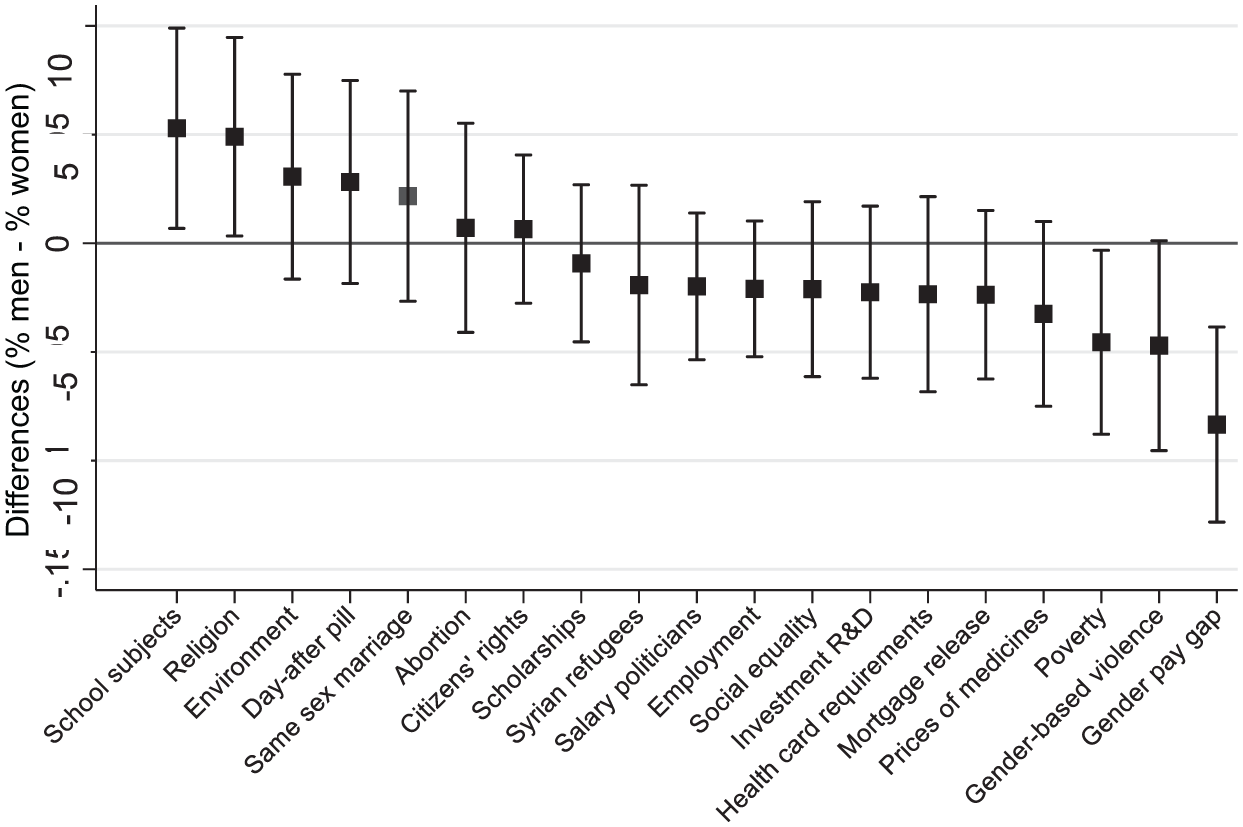
Difference between men and women for each of the topics mentioned as political.
Results remain broadly the same after controlling for other potential sources of heterogeneity (see Table A.6 in the online supplementary material). After introducing controls, men are not significantly more likely than women to mention any topic as political, which leads us to reject H1a. Women’s propensity to consider a topic as political is greater than men and statistically significant for seven topics (see Table A.6 in the online supplementary material). Some of these topics relate very closely to potential women’s concerns as well as specific welfare issues and policies (e.g. gender pay gap, gender-based violence, employment, mortgage release), but, contrary to H1b, women are also significantly more likely to mention topics related to representation (e.g. the salary of politicians). So we only find partial support for H1b, and cannot fully reject the null hypothesis that, when called to answer questions about what ‘politics’ is in the abstract, similar topics tend to come to the top of women’s and men’s minds.
Gender differences in specific political interests: H2
Figure 2 provides the gender gap (measured as percentage of men minus percentage of women) in declaring to be interested in each of the topics, with 95% confidence intervals.
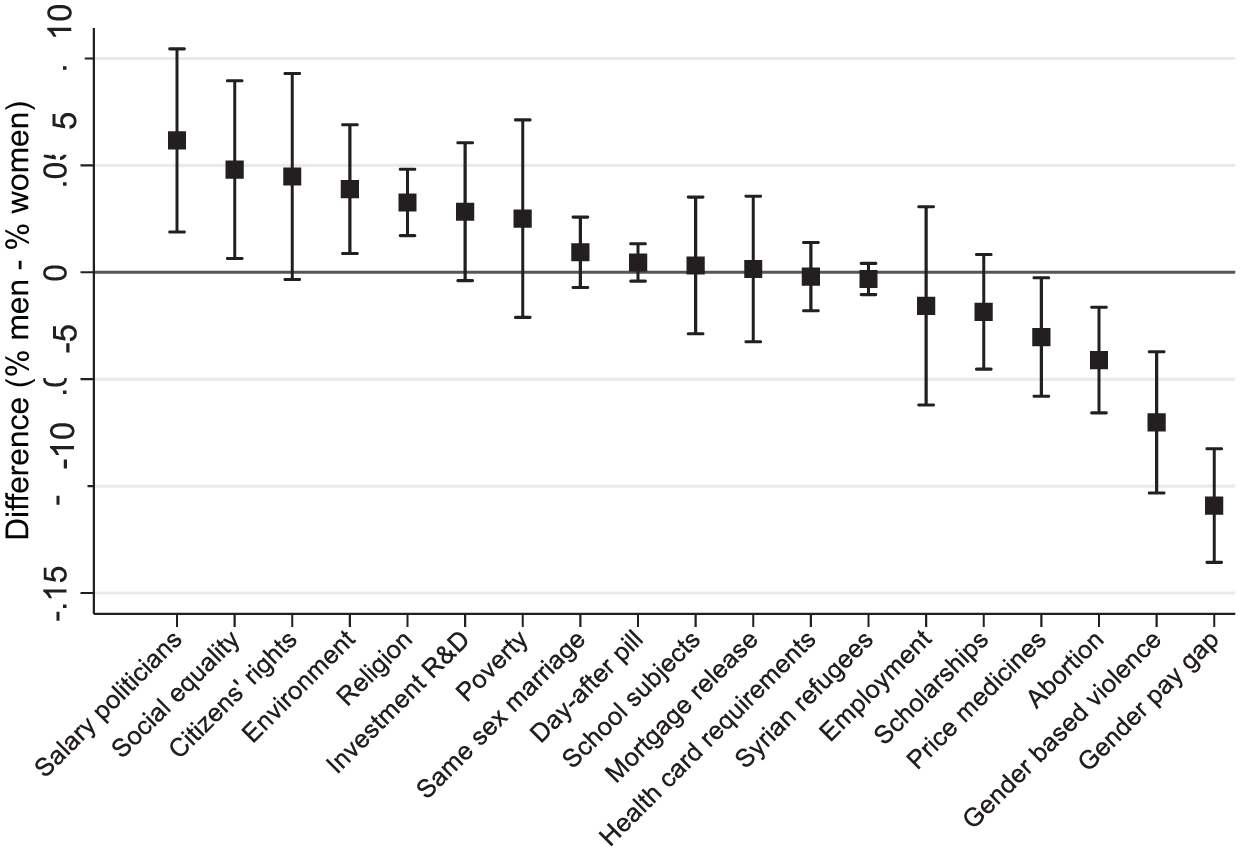
Difference between men and women for each of the topics they declared to be interested in.
Levels of declared personal interest vary considerably across topics (see also Table A2 in the online supplementary material). Employment ranks first in terms of respondents’ declared personal interest (66.3% declared to be interested in this topic) and it is also the topic mentioned by most respondents as political. 9 However, few respondents claimed to be interested in scholarships (only 7%), which is the fourth ‘political’ topic by number of mentions.
Regarding gender differences, men are significantly more likely than women to express an interest in 11 out of the 19 topics (see Figure 2), confirming H2. 10 Men present higher probabilities than women to declare an interest in topics related to representation (i.e. the salary of politicians, which shows the largest gender differences with about 6% more men than women declaring an interest in it) and contentious partisan issues (among which we include the role of religious values, which is a partisan issue in Spanish politics). This is consistent with H2a. Also consistent with H2b, women are significantly more likely to express an interest in topics that relate to their closest concerns: the gender pay gap, abortion, and gender-based violence. Women are also more likely than men to declare an interest in topics related to specific welfare issues and policies, such as the ‘price of medicines’. Men, however, are more likely to be interested in social issues than women when framed as general principles rather than specific policies (in this case ‘social equality’), which refer to conflict over resources. Remarkably, none of the topics that capture more interest among women than among men ranked high on the list of topics that respondents identified as ‘political’ in the previous question (see again Figure 1). Even if preliminary, this finding is consistent with our expectations that people’s understanding of the abstract concept of politics might reflect men’s personal interests better than women’s (anticipating H4).
We now focus on respondents’ answers to the follow-up open-ended question that invited respondents to provide additional topics that they were interested in. Figure 3 displays the gender gaps with 95% confidence intervals for each of the topics resulting from coding respondents’ answers. The average number of topics provided by respondents was 1.24, with men providing a higher number of answers than women (1.4 versus 1.1, see Table A3 in the online supplementary material). Considerable and statistically significant gender differences became noticeable when respondents were asked to volunteer topics after being framed to think about their own interests. As shown in Figure 3 (and Table A3 in the online supplementary material) at the top of men’s suggested topics are issues related to corruption, followed by institutions and democracy. In contrast, women tended to volunteer more topics related to social policies.
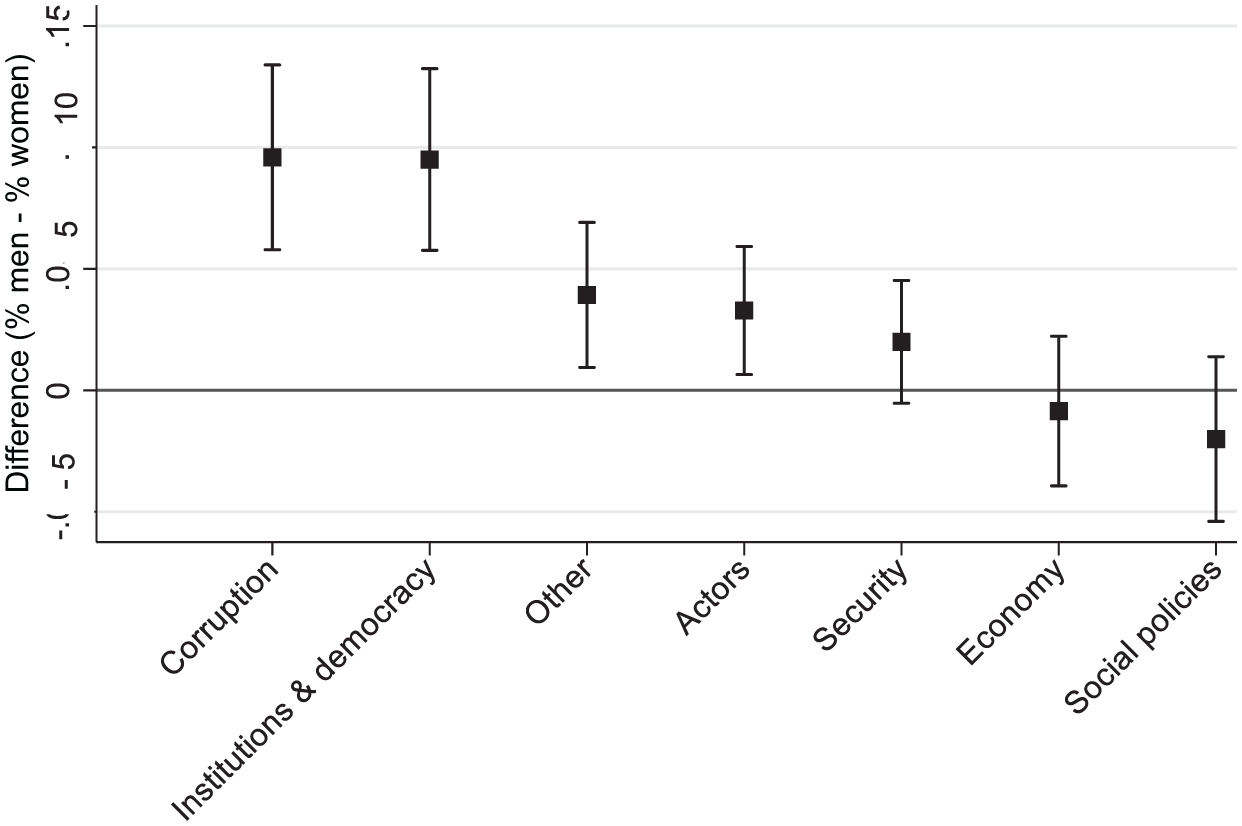
Difference in the percentage of men and women mentioning each of the topics in the open-ended question.
After adding controls, gender differences remain statistically significant at the 95% level of confidence and the coefficient’s size increases (see Table A.7 in the online supplementary material). The coefficient corresponding to gender is statistically significant for topics related to corruption, institutions and democracy (both with a negative sign, indicating that women are less likely to mention those two types of topics) and social policies (with a positive sign, indicating that women are more likely to mention this sort of topic). Overall, findings in Figures 2 and 3 are consistent with Campbell and Winters (2008) and provide support for both H2a and H2b. We therefore have enough evidence to accept H2.
The standard general political interest indicator put to the test: H3 to H6
We now test whether the standard indicator of general political interest is associated with (a) the topics that men consider as political, and/or (b) the topics that men are most interested in. In addition, we also test whether the gender gap in general political interest remains once we account for (a) women’s and men’s definition of politics and/or (b) their political interests.
Before presenting the results, it is worth reminding readers that general political interest was asked after our other three questions, so we find (as expected) relatively higher levels of political interest compared with other surveys. 11 In addition, we also find a slightly smaller gender gap among our respondents compared with face-to-face representative samples (see also note 4). As a result, our evidence provides more conservative estimations of the extent of the gender gap in political interest than evidence coming from face-to-face conventional surveys.
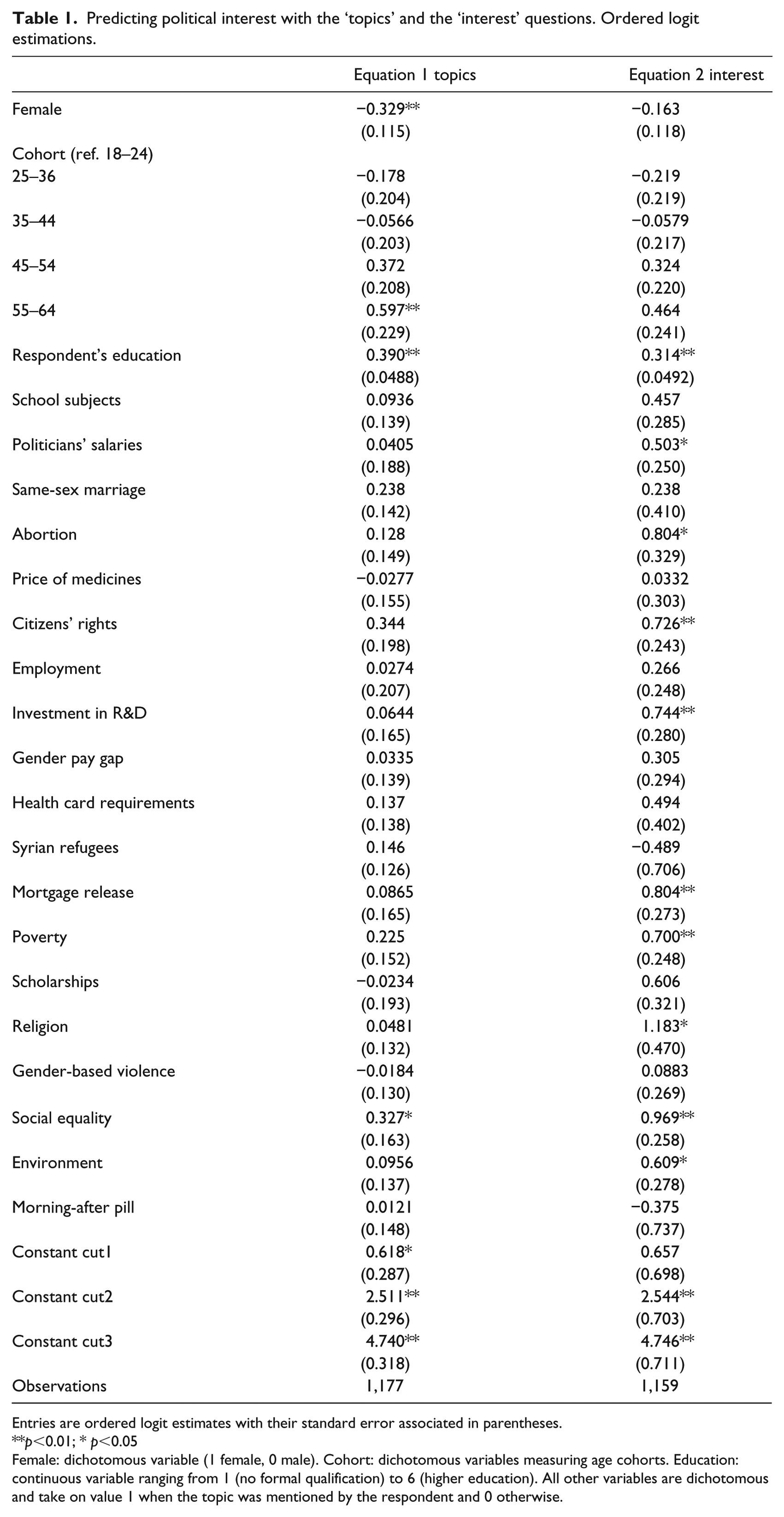
We regressed general political interest on the variables measuring whether respondents considered a topic to be political (equation 1 in Table 1), as well as those measuring whether respondents were interested in a range of topics from the closed- and open-ended questions (equation 2 in Table 1, and equation 3 in Table 2). Apart from gender, we also controlled for education and cohort.
Predicting political interest with the ‘topics’ and the ‘interest’ questions. Ordered logit estimations.
Entries are ordered logit estimates with their standard error associated in parentheses.
p<0.01; * p<0.05
Female: dichotomous variable (1 female, 0 male). Cohort: dichotomous variables measuring age cohorts. Education: continuous variable ranging from 1 (no formal qualification) to 6 (higher education). All other variables are dichotomous and take on value 1 when the topic was mentioned by the respondent and 0 otherwise.
Predicting political interest with the ‘follow-up open-ended’ question. Ordered logit estimations.
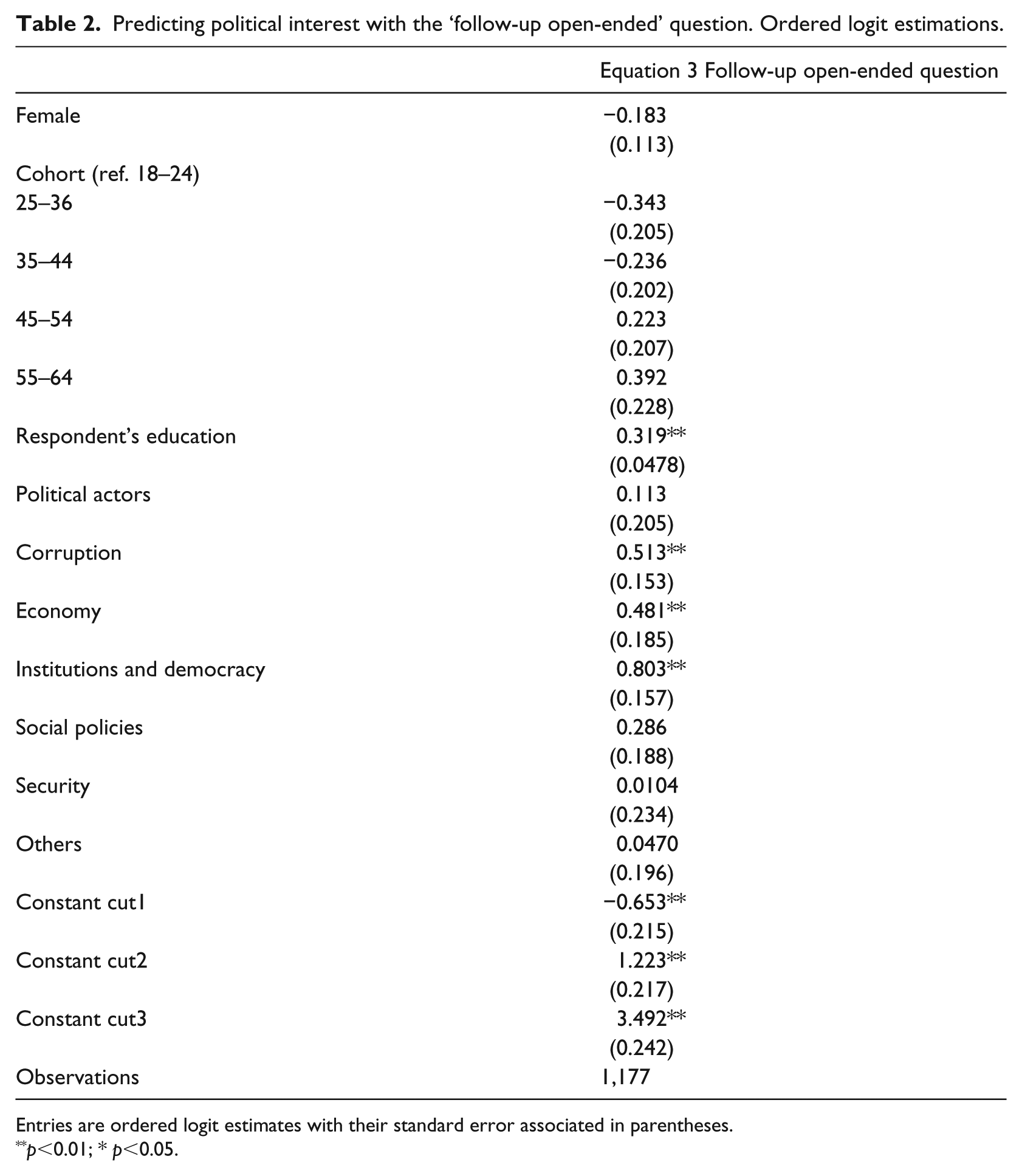
Entries are ordered logit estimates with their standard error associated in parentheses.
p<0.01; * p<0.05.
Equation 1 (Table 1) shows that political interest is only weakly related to the kinds of topics that respondents considered as political. Moreover, social equality is the sole coefficient being statistically significant. This constitutes enough evidence to reject H3. Crucially, the coefficient for gender is of a substantive magnitude and does not disappear after controlling for the topics that respondents defined as political (see the negative coefficient corresponding to female: -0.329***). This runs contrary to H5, which is therefore rejected. Even after controls, men are 4.7 percentage points more likely than women to declare themselves ‘quite interested’ in politics, and 2.7 percentage points more likely to declare themselves ‘very interested’. 12 In the previous section, we found that women and men do not hold significantly different conceptions of politics. Now, we have provided further evidence that the gender gap in general political interest is not driven by differences in the topics that men and women consider as political.
Equations 2 and 3 (in Tables 1 and 2 respectively) allow us to observe whether the standard political interest indicator is associated to women’s and men’s political interests to the same extent. Equation 2 includes the ‘interest’ question, which is measured by a series of binary variables indicating the topics that respondents declared to be personally interested in. As Table 1 shows, not all the topics that are of personal interest to respondents turned out to be significantly related to general political interest. In fact, only certain specific interests (the salary of politicians, abortion, citizens’ rights, investment in R&D, mortgage release, poverty, religion, and social equality) are associated with general interest (their corresponding coefficients are positive and statistically significant). Importantly enough, with the exception of abortion, all of these topics are of greater interest for men than for women (see previous section and Figure 2). This is consistent with H4. Also, the coefficient corresponding to gender is not only halved once personal political interests are included in the equation but it also becomes statistically insignificant (-0.163ns), as predicted by H6. This implies that taking into account differentiated interests is not only crucial to unpacking the standard survey question about general interest in politics, but it is also essential for understanding gender differences in how well this question captures both women’s and men’s interests.
Finally, equation 3 in Table 2 controls for the topics that respondents volunteered when, after prompting them to think about their political interests, they were asked about other topics that they consider to be political in the ‘follow-up open-ended’ question. General political interest is associated with three types of topics: corruption, economy, and institutions and democracy (their corresponding coefficients are positive and significant). The first two are topics that men declare to be significantly more interested in than women. Respondents who mentioned those topics are significantly more likely to declare a higher general interest in politics (see the corresponding coefficients in Table 2, corruption: 0.513**; economy: 0.481**; institutions and democracy: 0.803**). In contrast, the topic that is mentioned significantly more by women than by men (see Figure 3) – social policies – does not appear to be significantly associated with general interest in politics (0.286ns). Therefore, the evidence from equations 2 and 3 is compatible with H4, which is confirmed. Notably, once controls are introduced the coefficient corresponding to gender is not statistically significant (-0.183ns). This finding suggests that much of the gender gap is explained by the topics that both genders are interested in, with respondents interested in male-dominated topics being more likely to declare higher levels of general political interest. We therefore have enough evidence to support H6.
Conclusions and discussion
Scholars have called for a broadening of our conception of the political (Campbell and Winter, 2008; Coffe, 2013; Cramer and Toff, 2017; Ferrin et al., 2018; Stolle and Gidengil, 2010). This strategy has proven useful in understanding that women do not simply stay away from politics, but tend to know facts, use participatory channels, and become interested in issues that differ from those associated with men, indicating that personal experience constitutes a vital and often overlooked factor that citizens employ to obtain information and develop an engagement with politics.
In this article, we have married these critiques and findings to tap an underexplored aspect of the nexus between gender and political interest. Our findings suggest that, when prompted to think about politics, both men and women are more likely to consider as political those topics associated with government actions, political actors, and institutions. The reasons for this may be manifold. Studies of survey responses have shown that respondents typically engage in a two-step cognitive process when providing their answers (see for instance Tourangeau and Rasinski, 1988). In the first stage respondents figure out what they are being asked, while in the second they decide if they need to search their memory to rescue relevant ideas to respond to the question. Our question asking respondents to classify a list of topics as political or not might have prompted respondents to use those issues that first came to mind, therefore bringing up aspects of politics which conform to the socially accepted definition of ‘politics’. All in all, our findings suggest that the gender gap in general political interest is unlikely to be explained by women’s and men’s different understandings of the abstract concept of politics.
Gender differences did, however, arise when respondents were asked to declare which political topics they were personally interested in. Consistent with Campbell and Winters (2008), which we partly replicate, men were more likely to show an interest in actors, institutions and conflict over resources, whereas women were significantly more interested in those issues affecting them directly, and more closely related to their own personal experience as citizens (the gender pay gap, abortion, gender-based violence) as well as social policies. The fact that two studies conducted in two different contexts (Britain and Spain) yield similar findings provides evidence in favour of the existence of gender differences in specific political interests. The source of those differences is not subject to study in this piece of research, but it might lie in the way in which men and women are socialized and distinctly experience the political realm, as political socialization scholarship has shown (Fraile and Sánchez-Vitores, 2019; Jennings, 1983).
Our last findings show that when general political interest is regressed on the topics that respondents declare to be interested in, it turns out that the standard indicator is more strongly associated with those topics that men are more interested in. Crucially, when people’s specific interests were controlled for, the gender gap in general political interest vanished.
These findings suggest that when women and men answer the standard political interest question in conventional surveys, they have a similar concept of politics in mind. However, this does not mean that the socially accepted concept of politics is gender-neutral. On the contrary, it is strongly correlated with those topics that men are more interested in. So, when women are asked about their general interest in politics, they do not necessarily refer to their interest in a wide range of political issues but focus mainly on topics that are of less interest to them but considered to be more strongly linked with the abstract concept of ‘politics’. As a consequence, women may declare low levels of general political interest in politics while simultaneously caring a great deal about topics such as the privatization of public services (health and education), gender discrimination in the labour market, abortion, gender-based violence, etc.
Another implication of these findings is that the gender gap portrayed by standard indicators may sometimes hide the distinct substantive interests of women and men. Consequently, there are a number of implications for the future study of citizens’ attitudes towards politics. First, we need to conceptually distinguish between what people understand as political in the abstract and the specific political issues they care about, and experience in their daily life. Second, the evidence about the existence of gender gaps in political involvement documented in previous studies might need to be revisited. Instead of automatically attributing an involvement deficit in political engagement to women, we suggest that women and men become interested differently in politics, confirming some recent studies (Campbell and Winters, 2008; Coffe, 2013). Third, male-coded interpretations of politics are likely to arise in standard questions that ask about political interest in an abstract manner, even if they seem neutral at first sight.
Using more specific questions in surveys could address the puzzling gender gap consistently found in standard survey questions on political interest. We therefore need to experiment with different ways of asking respondents about their degree of interest and involvement in the political world, opening the door to gender-balanced measures of citizens’ views and opinions about politics. Enlarging the list of items to include the potential interests of women and men would probably bring an improvement. So, instead of solely asking respondents about their general political interest, the inclusion of a battery of questions asking people to state their interest in specific aspects of politics such as, for instance, education, unemployment, social inequalities, health, etc. may be worthy of consideration. Or even distinguishing between different levels of government such as local, regional, national, and European/international. Additional information on this would break new ground in the field, allowing us to analyse the real size of the gender gap in political interest. This applies to other extensively used survey questions referring to ‘politics’ in an abstract way, such as exposure to political news, political discussions or specific statements regarding political efficacy, and political knowledge. We recognize that incorporating new questions is costly, but it also involves taking gender seriously and acknowledging its impact as fundamental.
Supplemental Material
French_Spanish_abstract_860260 – Supplemental material for The gender gap in political interest revisited
Supplemental material, French_Spanish_abstract_860260 for The gender gap in political interest revisited by Monica Ferrín, Marta Fraile, Gema M García-Albacete and Raul Gómez in International Political Science Review
Supplemental Material
IPS860260_supplemental_material – Supplemental material for The gender gap in political interest revisited
Supplemental material, IPS860260_supplemental_material for The gender gap in political interest revisited by Monica Ferrín, Marta Fraile, Gema M García-Albacete and Raul Gómez in International Political Science Review
Footnotes
Funding
The author(s) disclosed receipt of the following financial support for the research, authorship, and/or publication of this article: This work was supported by the Spanish Ministry of Science, Innovation and Universities (under grants CSO2016-75090-R and CSO2012-32009).

Supplemental material
Supplemental material for this article is available online.
Notes
Author biographies
References
Supplementary Material
Please find the following supplemental material available below.
For Open Access articles published under a Creative Commons License, all supplemental material carries the same license as the article it is associated with.
For non-Open Access articles published, all supplemental material carries a non-exclusive license, and permission requests for re-use of supplemental material or any part of supplemental material shall be sent directly to the copyright owner as specified in the copyright notice associated with the article.
