




Abstract
While numerous studies have explored the foundations of autocratic stability by focusing on macroeconomic variables, the micro-foundations of autocratic support have largely been overlooked. Using Afrobarometer survey data from 22 African autocracies, I examine how dictators stabilize their rule even during economic recessions. I find that the provision of welfare benefits alleviates the adverse impact of negative economic perceptions on support for the dictator. Citizens are likely to continue supporting the dictator as long as the government keeps providing universal welfare benefits. The results remain robust to different model specifications that account for alternative explanations and validity concerns associated with autocratic survey data.
Introduction
In January 2018, the Sudanese government eliminated wheat subsidies and devalued its currency in an attempt to alleviate its budget deficit. These actions induced a shortage of cash, and the prices of necessities skyrocketed. As inflation reached over 50%, bread prices doubled, and Sudanese citizens suffered from severe shortages of basic commodities (Abdelaziz, 2018). On 19 December 2018, public anger over hyperinflation triggered a wave of popular protests, which transformed into nationwide anti-regime demonstrations demanding the resignation of President Omar al-Bashir. Al-Bashir was ousted by the military on 11 April 2019, ending his 30-year grip on power.
Economic performance is a critical source of autocratic legitimacy and stability. During economic recessions, it is easier for the opposition to mobilize citizens’ grievances and promote demonstrations in order to cause nationwide social unrest. Indeed, 389 of the 1,254 nationwide protests (31%) that occurred between 1964 and 2017 in African autocracies were triggered by economic and subsistence-related issues (Salehyan et al., 2012). 1 Likewise, about 80% of third-wave democratizations were caused by a fiscal crisis or declining living standards (Ulfelder, 2009). For example, economic recessions in the 1980s created an opportunity for democratization in several sub-Saharan African autocracies. A deep recession caused by a decline in cotton prices and neighboring Nigeria’s economic downturn prompted democratization in Benin (Gisselquist, 2008). After experiencing severe droughts, Madagascar held free democratic elections, while Mali held its first competitive presidential elections (Brückner and Ciccone, 2011). In 2011, the Arab Spring democratization movement gathered momentum during a period of food crisis, triggering the collapse of several North African autocracies.
Previous studies on autocratic politics have explored the relationship between economic conditions and autocratic stability (Brückner and Ciccone, 2011; Haggard and Kaufman, 1997; Huntington, 1991; Ulfelder, 2009). However, they have paid only limited attention to the micro-foundations of the effect of economic performance on support for dictators. They have not directly discussed how citizens’ perceptions of the national economy affect popular support for autocracy.
This article explores this micro-foundation of autocratic support by highlighting how welfare programs mitigate the adverse impacts of negative economic perceptions. Autocracies often invest in social welfare policies and increase the provision of redistributive benefits—particularly during economic recessions—to maintain public support, and thus their legitimacy and stability. More importantly, autocratic welfare policy is a tool for reducing the adverse impact of economic recessions. Negative economic growth encourages citizens to withdraw their support for the dictator because it deteriorates their material wellbeing. However, autocratic welfare programs distribute to citizens material benefits in order to compensate for their economic insecurity. The provision of welfare benefits contributes to maintaining autocratic legitimation even during economic crises. Therefore, even if the national economic condition is perceived negative, the dictator can maintain citizens’ support through the provision of welfare benefits. Evidence from Afrobarometer surveys conducted in 22 African autocracies between 1999 and 2015 is consistent with this theoretical expectation. The empirical results are robust to different model specifications that account for alternative explanations and alleviate concerns about the validity of surveys taken in autocratic countries.
The article is organized as follows. First, I review previous studies on the relationship between economic growth and autocratic stability and elaborate my argument by focusing on the impact of autocratic welfare policies. Second, I empirically test my argument, before providing concluding remarks about the study’s contributions.
Popular support and regime stability
Popular support for the dictator is critical to a regime’s stability. Despite the prevalence of electoral fraud and political violence, autocratic elections cannot completely eliminate the possibility of electoral turnover. Even autocratic ruling parties can be defeated in elections and experience regime breakdown. According to the autocratic regime data compiled by Geddes et al. (2014), about 13% of autocratic breakdowns after the Second World War (28 out of 223) were caused by electoral defeats of the ruling parties. Popular uprisings collapsed 38 autocratic regimes (17%) during the same period. This evidence shows that the loss of citizens’ support is an important cause of autocratic regime breakdown.
A loss of popular support unravels dictators’ political dominance over the opposition and ruling elites for three reasons. First, unpopular dictators have less electoral support and thus reduced bargaining power over the opposition, so they are forced to make policy concessions (Miller, 2015). Second, weakened support for the dictator facilitates the growth of an opposition-backed social protest movement. As the scale of protests increases, the demonstrations deliver more reliable information about the citizens’ dissatisfaction with the regime’s performance (Lohmann, 1993). In short, unpopular dictators face popular protests more frequently.
Third, in unpopular autocracies, elites are more likely to desert the ruling party (Magaloni, 2006) and join or create an opposition party. As unpopular regimes face more public demonstrations, the cost of repressing the threats from below also causes internal splits within the ruling elites (Przeworski, 1991). The risk of a coup also increases if dictators face a loss of citizen support.
Economic performance and support for the dictator
National economic conditions determine the dictator’s popularity. While economic booms legitimize repressive rule and improve citizens’ material wellbeing, economic downturns increase the risk of popular protests and the possibility that citizens will remove the dictator by force.
The economic voting literature argues that good economic performance is the primary source of popular support for incumbent politicians in democracies. The rule of thumb in this literature is that citizens vote for the incumbent when the economy is strong, but vote against him or her if it is doing poorly (e.g., Lewis-Beck, 1988). Economic issues thus more critically determine the fortunes of incumbent politicians compared to other issues, such as environment or foreign policy issues. Since economic policy outcomes are directly linked to citizens’ material wellbeing, the national economic condition gives voters an informational short-cut about the incumbent’s policy competence (Singer, 2011).
Autocratic leaders can use repression to stabilize their regimes, but this will not alleviate citizens’ discontent; dictators also need to deliver economic prosperity to maintain support. Repression also has the drawback of increasing a dictator’s dependence on the military, which empowers these agents and increases the risk of military intervention, such as a coup (Svolik, 2012).
Due to the limitations of repressive tactics, dictators promise to improve the economy in order to maintain political order (Huntington, 1991). If they fulfill this promise by delivering a robust economic outcome, citizens will prefer to support the incumbent dictator and maintain the status quo rather than face the uncertainty of a new leader. Indeed, opposition parties’ competence is highly uncertain in autocracies because they have never been given the opportunity to exercise power (Magaloni, 2006). Economic development in autocracies even allows dictators to further consolidate their personal control. For example, China’s recent economic development legitimizes the personalization of Xi Jinping’s regime. Despite criticism outside the ruling party, Xi removed term limits for presidents and consolidated his dominance of the communist dictatorship; he also increased repression in order to force the political acquiescence of the population. However, his regime has gained popular support by improving citizens’ material wellbeing, which has been shown to be negatively correlated with support for a transition to democracy, especially among the middle class (Chen and Lu, 2011). The population has accepted even more personalized rule in return for material wellbeing.
Economic downturns can jeopardize autocratic stability from both above and below. During an economic recession, dictators face top-down threats from ruling elites, who are more likely to defect from the ruling party when the regime is less able to buy their support with generous perquisites (Kailitz and Stockemer, 2017). Defecting elites are also likely to criticize the dictator’s poor economic performance in order to increase the opposition’s chances of winning an election (Reuter and Gandhi, 2010). Such criticism is likely to exacerbate the dictator’s bottom-up risks: citizens face a heightened risk of unemployment and loss of income when the economy is weak. This drop in material wellbeing is likely to encourage the population to rise up in protest and demand political liberalization and democracy—as occurred in the Arab Spring of 2011.
Welfare programs in economic downturns
Dictators can respond to inevitable economic downturns using two broad approaches. First, they can increase repression. However, this approach can intensify a legitimacy crisis. Facing a nationwide economic recession, citizens may interpret greater repression as incompetence and increase their dissatisfaction with the autocrat’s performance. Once unsatisfied citizens are fully mobilized, protests can cascade into massive anti-regime movements (Kricheli et al., 2011). Hence, even severely repressive actions cannot completely decrease the risk of a regime’s breakdown.
In a second approach, dictators can use social welfare programs to counteract the devasting consequences of economic downturns. Just as welfare systems in democracies decrease voters’ sensitivity to the incumbent’s economic performance and improve citizens’ perceptions of life satisfaction and happiness (Pacek and Radcliff, 1995, 2008), autocratic regimes can increase their provision of welfare benefits to compensate citizens for a loss of income during economic recessions and maintain their support.
Dictators have strong incentives to moderate the adverse impact of economic hardship on their citizens’ personal wellbeing. Economically insecure citizens (i.e., the poor and the unemployed) are more likely to withdraw their support for the regime when faced with economic hardship. These citizens may demand greater democratic freedoms in order to gain more access to the policy-making process (Acemoglu and Robinson, 2006; Boix, 2003). Indeed, Fossati (2014) argues that economically vulnerable citizens are more likely to base their voting decisions on the state of the national economy. Welfare programs institutionalize the process of distributing material resources in order to effectively buy citizens’ support (Blaydes, 2010; Magaloni, 2006): recipients of welfare benefits are persuaded to overlook their political preferences and support the dictator. The provision of such benefits has a greater impact during a recession.
The provision of welfare benefits also helps strengthen autocratic legitimacy (Cassani, 2017) by improving the regime’s image. Autocracies claim performance-based legitimacy by guaranteeing access to public goods or equal redistribution (von Soest and Grauvogel, 2017). For instance, communist countries during the Cold War era sought to provide cost-free social services to create the image of a credible alternative to capitalism (Obinger and Schmitt, 2011). Before the 1980s, North Korea disseminated propaganda about its free health care system to demonstrate the regime’s superiority over that of South Korea.
However, a reduction in welfare benefits would intensify the adverse impact of economic downturns. Welfare programs institutionalize the distribution of material resources. Since dictators sit atop an informal structure based on unwritten rules, they can easily withdraw the benefits of discretionary distribution (i.e., patronage and clientelistic goods) from recipients. Yet the codified rules and repeated transactions in welfare programs institutionalize the monitoring process; dictators cannot simply renege on distributing these benefits (Knutsen and Rasmussen, 2018). Even if it was possible, this would only increase the regime’s legitimacy crisis during a recession.
The case of Sudan demonstrates how the retrenchment of institutionalized welfare benefits can threaten autocratic survival during economic downturns. It also indicates that repression is not an effective tool to reduce threats from below during a recession. After its southern part became independent, Sudan lost 75% of its oil production fields, which was the source of half of its fiscal revenues and two-thirds of its foreign currency earnings. This accounted for an annual loss of 26.2% of its GDP (International Monetary Fund, 2012). The loss of foreign currency sources resulted in a hike in the currency rate and hyperinflation. According to Afrobarometer surveys administered between 2013 and 2018, 67.5% of Sudanese respondents perceived their national economic condition as getting either worse or much worse; in 2018 this figure increased to 81.9%. However, the Sudanese government took no significant actions to alleviate its citizens’ economic needs. Indeed, it worsened them in some ways.
The government was controlling the price of basic foodstuffs in order to reduce threats from urban areas. It also subsidized certain items, which provided a universal form of social protection by decreasing the cost of living. The abolition of subsidies on fuel in 2013 and wheat in 2018 intensified the people’s economic hardship. The provision of wheat subsidies had helped maintain low bread prices in Khartoum and other cities (Jaspars, 2018). The removal of wheat import subsidies, combined with the currency devaluation, resulted in soaring food prices. For example, in 2018 the prices of sorghum and millet increased by 100 to 250 percentage points compared to the previous year (Food and Agriculture Organization of the United Nations, 2019). The prices of meat, bread, and other basic commodities also doubled (Younes, 2018). Due to the large proportion of their budgets that Sudanese households spent on food in 2013—an average of 61%, and 57% for the highest-income group—the price shock intensified economic difficulties across income groups (International Monetary Fund, 2013).
Although the International Monetary Fund recommended that the Sudanese government spend more on poverty reduction after removing the subsidies, the government still allocated 14% of its budget for 2018 to military and security and only 3% and 2% of total spending to education and health expenditures, respectively (Radio Dabanga, 2017). However, the massive spending on repressive apparatus could not guard al-Bashir’s regime from nation-wide anti-regime demonstrations. The removal of material benefits from government subsidies ultimately triggered civil protests in December 2018 that ousted al-Bashir.
In short, welfare programs contribute to regime stability during times of national economic adversity by institutionalizing the redistributive process and alleviating adversity. An autocratic regime can respond swiftly and convincingly to citizens’ demands for redistributive benefits in order to avert a legitimacy crisis generated by the effects of an economic recession.
Hypothesis. Social welfare programs alleviate the adverse effects of perceived hardship in the national economy on citizens’ support for the dictator.
Data and method
I use Afrobarometer survey data to explore how autocratic welfare programs reduce the adverse impacts of poor economic performance on support for dictators. Afrobarometer provides unique cross-national surveys in African autocracies, which—crucially for this study—ask questions about the approval of the president in all rounds. Given that political instability and poverty are critical issues in this region, African autocracies are an excellent sample to test how economic performance affects autocratic stability. The sample covers 22 autocratic countries in Africa between 1999 and 2015 (see Table A2). These countries are representative of the global sample of autocracies, as demonstrated by the sample’s economic growth rate during the study period (5.47%, vs. 4.81% for global autocracies, World Bank, 2018) and welfare policies (0.45 vs. 0.49 for global autocracies, Coppedge et al., 2018). I use the updated version of Boix et al. (2013) democracy measure: if a country does not regularly hold free and fair elections, it is considered an autocracy.
The dependent variable is Support for the Dictator, which is measured based on answers to the question “Do you approve or disapprove of the way the following people have performed their jobs over the past twelve months, or haven’t you heard enough about them to say: President or Prime Minister?” This variable directly captures whether citizens approve/strongly approve (coded 1) or disapprove (coded 0) of the dictator. Figure 1 illustrates the country-level averages of approval rates in the sample countries. The average approval rate, 67%, indicates that the majority of respondents supports their dictators. Additionally, the figure shows substantial cross-country variation in support for the dictator, ranging from a high of 89% in Namibia to a low of 41% in Tunisia.

The approval rate for the dictator in African autocracies.
The first key explanatory variable is Sociotropic Perception, which captures citizens’ retrospective economic perceptions of the national economy to indicate their evaluations of the dictator’s economic performance. Figure A1 presents the country-level averages of economic perceptions, which range from 54% of respondents in Lesotho who perceive their national economic conditions as getting worse or much worse, to 49% of respondents in Mozambique who report that their national economic conditions are getting better or much better.
Another key explanatory variable is the universal welfare policy index (Universalism), which I obtained from the Varieties of Democracy Project (V-Dem, Coppedge et al., 2018). This index measures how many welfare programs—including education, health, retirement, unemployment, and poverty programs—are provided to all citizens in each country in a given year. It is important to note that this index does not indicate the size of welfare programs, but rather measures whether major social policies are provided as universal benefits. In short, this variable estimates the quality and structure of welfare programs (Rasmussen and Knutsen, 2017).
The universal welfare program index is a good proxy for capturing the extensiveness of a country’s social welfare policy because it is significantly correlated with the social protection program’s coverage as a percentage of each country’s total population (0.328, p = 0.0319) (International Labour Organization, 2018). 2 Although the index varies little across years within each country in Figure A2, it varies across countries. Nigeria in 2003 has the lowest value (–1.175), and Burkina Faso in 2012 has the highest (1.419). I take the average of Universalism if a survey was conducted in two consecutive years.
I add six controls that may affect support for the dictator. First, given Bratton and Mattes’ (2001) finding that urban residents are more familiar with individual liberties than communal solidarity in Africa—which suggests they should support dictators more than their rural counterparts—I control for whether an individual lives in an urban area (Urban). Second, I control for the respondent’s education level (Education) since higher levels of Education are related to higher political awareness because education increases critical scrutiny of political phenomena (Geddes and Zaller, 1989). I use the Afrobarometer’s aggregate measure of Education (1 = no formal schooling, 2 = primary schooling, 3 = secondary schooling, and 4 = tertiary schooling or above). I expect educated citizens to be less likely to support the dictator because they are more critical of dictatorships. Third, I control for gender (Female) because previous studies argue that women’s social and political participation have a positive relationship with democratization (e.g., Ross, 2008). I therefore expect women to be less likely than men to support dictators. Fourth, since younger people are more likely to actively participate in anti-regime social movements in autocracies (Nordås and Davenport, 2013), I control for Age in the empirical models. I expect younger people to be less likely to support dictators than older people.
Fifth, I control for Poverty. Since the Afrobarometer does not include information about income level, and because many Africans do not rely on cash income, I use the question about respondents’ recent experiences without food (0 = never, 4 = always) to measure poverty levels. Considering that economic grievance is one of the critical drivers of autocratic breakdown, a higher level of poverty is expected to deter citizens from supporting the dictator. Finally, the empirical models also include citizens’ satisfaction with their country’s overall democratic governance (Satisfaction with Democracy). If citizens perceive that their autocratic ruler guarantees democratic values (i.e., political rights), the ruler is perceived as legitimate and gains more support even though the country is not actually a democracy.
I also add two country-level indicators: GDP per capita (GDPpc) and GDP growth rate (GDP Growth). I expect GDPpc to have two impacts. On the one hand, the level of economic development consolidates autocracies by legitimizing repressive rules (Huntington, 1991). On the other hand, citizens in economically developed autocracies are less likely to support the dictator (Lipset, 1959). Economic development contributes to increases in citizens’ education levels and economic wealth; citizens in developed autocracies demand more political liberties to participate in politics. Second, I add GDP Growth to the empirical models to distinguish between the effects of an autocracy’s general economic policy and a citizen’s perception of the regime’s policy performance. I expect a higher growth rate to increase support for the dictator. Like Universalism, I take the average if a survey was done in two consecutive years. GDPpc and GDP Growth are obtained from the World Bank (2018). To reduce the model convergence problem, I divide Age and GDP Growth by 10.
This article explores how social protection programs at the country level moderate the relationship between citizens’ perceptions of the national economy and their support for the dictator. As the units of analysis are individual respondents who are nested in a given country, and the dependent variable (Support for Dictator) is dichotomous, I estimate mixed-effects multilevel binomial probit models to test my hypothesis. My models include varying intercepts and varying slopes to account for the likelihood that respondents in the same country share similar characteristics, and the fact that perceptions of the national economy can have different effects across African autocracies. Therefore, empirical models contain country-fixed effects, country-random effects, and random coefficients to allow varying impacts of sociotropic economic perceptions across countries.
The main multilevel model in this article is structured as follows:


In this model, i denotes individuals and j denotes countries.
Empirical analysis
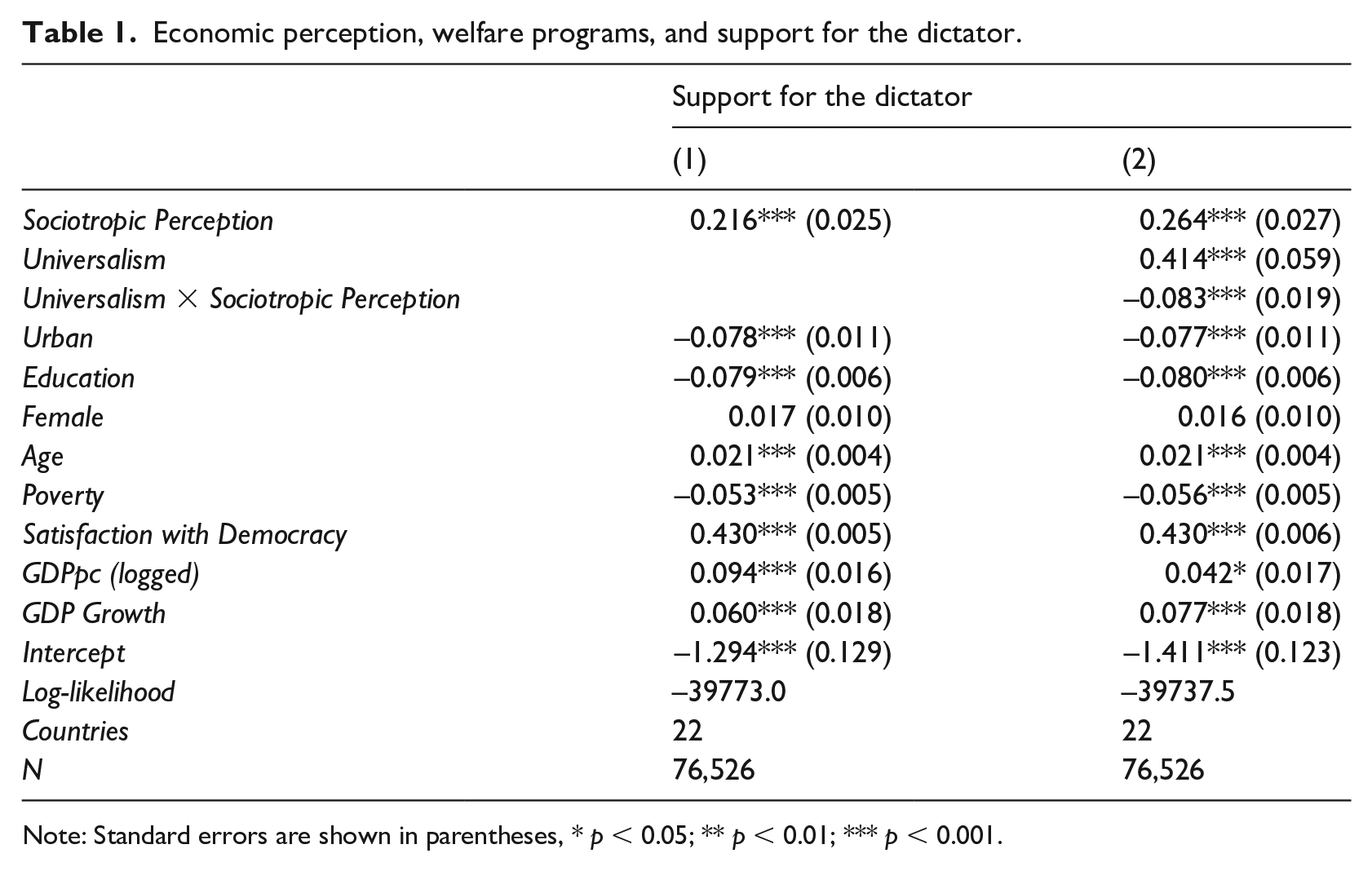
Table 1 presents the coefficient estimates for the effect of economic perceptions on support for the dictator. I run Model 1 without Universalism to test the economic voting argument in the autocratic context. The coefficient estimate of Sociotropic Perception is significant and positive, which means that a more positive economic perception of the national economy increases the likelihood of support for the dictator. If a respondent has the most positive economic perception (much better), their predicted probability of support for the dictator is 74%; the most negative perception (much worse) decreases support to 49%. Even in autocracies, the incumbent’s economic performance is critical to cultivating citizens’ support. This finding is consistent with previous studies in the economic voting literature, which argue that economic downturns destabilize autocratic regimes (Brückner and Ciccone, 2011; Haggard and Kaufman, 1997; Huntington, 1991; Ulfelder, 2009).
Economic perception, welfare programs, and support for the dictator.
Note: Standard errors are shown in parentheses, * p < 0.05; ** p < 0.01; *** p < 0.001.
Model 2 includes the interaction term between Sociotropic Perception and Universalism to test how welfare programs condition the impact of negative economic perceptions on support for the dictator. Both variables significantly increase the likelihood of support for the dictator. More importantly, the coefficient estimate of the interaction term between Universalism and Sociotropic Perception is negative and significant, indicating that the impact of economic perceptions on support for the dictator decreases as an autocracy provides more universalized welfare benefits, which is consistent with my theoretical argument. On the one hand, positive evaluations of the dictator’s economic performance are more likely to increase the probability of support for the dictator if an autocracy provides less universalized welfare benefits. On the other hand, the provision of universalized welfare benefits has a stronger positive impact on the likelihood of support for the autocratic ruler if a citizen has more negative evaluations of the national economy. In short, more universalized welfare programs decrease the adverse effect of negative retrospective evaluations of the national economy on approval of the dictator. We can therefore conclude that autocratic welfare programs stabilize citizens’ support for the dictator even under negative economic evaluations by offering redistributive benefits.
Based on Model 2 of Table 1, Figure 2 illustrates the effect of economic perceptions on support for the dictator as Universalism changes. 3 If an autocracy provides a very low level of welfare programs (i.e., –1.17), a negative economic evaluation (worse) leads to a 0.42 probability of support for the dictator, whereas a positive one (better) leads to a 0.65 probability of support. However, when Universalism is high (i.e., 1.42), the probability of supporting the dictator among those who believe the national economy is getting worse and better is 0.62 and 0.71, respectively (top panel). In the whole range of Universalism, positive economic perceptions lead to a higher probability of support for the dictator. However, the gap in the likelihood of support for the dictator between positive and negative perceptions decreases from 0.20 to 0.06. In addition, even citizens with a negative economic evaluation support the dictator at a 0.62 probability if a country provides a high level of coverage of welfare programs. Considering that the average approval rate for dictators is 67% in the sample, the effect of Universalism is quite substantial. This result indicates that citizens’ economic evaluations are more critical when an autocracy provides fewer universal welfare benefits.
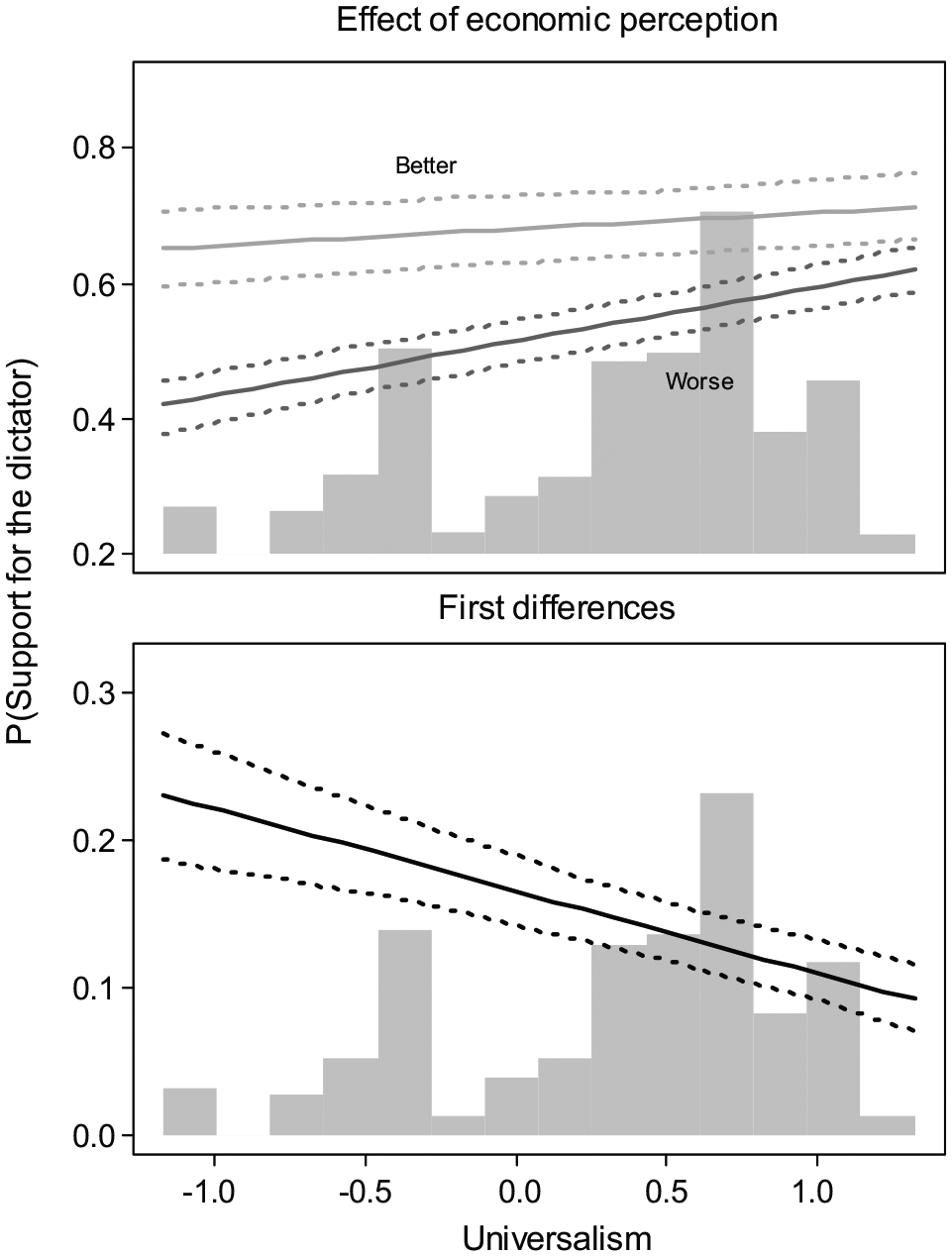
Effect of economic perceptions on support for the dictator as Universalism changes.
I also plot the predicted probabilities of support for the dictator by high (90th percentile, 1.21) and low (10th percentile, –0.40) levels of Universalism at all levels of Sociotropic Perception (Figure 3). The welfare programs more critically increase the likelihood of support for the dictator if a citizen perceives that the national economy is getting worse (top panel). As sociotropic economic perceptions improve, the first differences for the impact of welfare programs presented in the bottom panel decrease and then diminish if a respondent has the most positive economic perception (much better). A universalized welfare policy neither increases nor decreases the likelihood of support for the dictator if a respondent perceives that the economy is getting much better. This result shows that the impact of autocratic welfare programs is more pronounced when an individual citizen has a more negative perception of the dictator’s economic performance. In short, Figures 2 and 3 both indicate that welfare programs help alleviate the impact of negative economic evaluations on support for the dictator.

Predicted probabilities (top panel) and first differences (bottom panel) of support for the dictator based on high and low levels of Universalism as perceptions of the national economy (Sociotropic Perception) change.
Almost all individual-level controls exhibit the expected effects. Rural residents and the elderly are more likely to support the dictator, whereas more educated individuals are less likely to do so. We should note that the coefficient estimate of Poverty is negative, which indicates that those who have suffered from economic hardship are less likely to support the dictator. The respondent’s gender does not significantly affect their approval of the dictator (Female). Greater satisfaction with democracy increases the probability that an individual approves of the dictator (Satisfaction with Democracy). This result shows that perceived legitimacy is crucial to cultivating support for the dictator. Both GDPpc and GDP Growth significantly increase citizens’ support of the dictator. Economic wealth and good economic performance legitimize autocratic rule. In addition, both objective and subjective economic conditions influence approval of the dictator.
Conclusion
This article has explored how autocratic welfare programs contribute to sustaining autocratic stability. Citizens’ material wellbeing is critical to stabilizing autocratic rule. During economic booms, citizens have various opportunities to improve their wealth. Even the curtailing of civil liberties can be perceived as legitimate if autocracies demonstrate good economic performance. However, economic downturns dismantle the foundation of autocratic legitimacy by reducing citizens’ income and increasing the risk of unemployment. Citizens’ grievances over negative economic outcomes can trigger anti-regime protests and destabilize autocracies. Welfare programs stabilize autocracies even during recessions by distributing material benefits as compensation for economic adversity. The provision of welfare benefits maintains autocratic legitimation by alleviating the adverse impact of decreased income.
This study suggests two main avenues for future research. First, future studies should discuss how dictators use different policy instruments to respond to economic conditions. Considering that welfare retrenchment is unpopular in democracies (Pierson, 1996), dictators are unlikely to be able to take away redistributive benefits without recourse even in good economic conditions. In addition, even autocracies can prioritize welfare programs during economic recessions to reduce the legitimation crisis. However, an economic crisis can prompt a reduction of welfare benefits, as occurred in Sudan. Although an economic crisis undermines the material foundation of autocracies (Bratton and van de Walle, 1997), it is also possible that resource-abundant autocracies can maintain or expand welfare benefits even during economic crises.
Second, future studies should explore how dictators use their welfare programs to legitimize their repressive regimes. As mentioned earlier, communist countries created their positive image based on free health care and the absence of unemployment. While the main role of welfare programs is to provide tangible material benefits, dictators can also create the illusion of utopia in their society by disseminating welfare propaganda via the state-controlled media.
This study contributes to the autocratic politics literature by initiating a discussion of economic voting and welfare politics. Consistent with prior studies, the article finds that autocratic economic performance is critical to maintaining popular support for dictators. It also provides new insights into the impact of welfare policy on autocratic stability. I find that welfare programs stabilize autocracies by maintaining popular support even when citizens have negative perceptions of the dictator’s economic performance. Based on individual-level survey data, this article fills a gap in the literature on autocratic politics by linking the discussion of autocratic stability to the political behavior literature.
Supplemental Material
Supplementary_file – Supplemental material for Autocratic welfare programs, economic perceptions, and support for the dictator: Evidence from African autocracies
Supplemental material, Supplementary_file for Autocratic welfare programs, economic perceptions, and support for the dictator: Evidence from African autocracies by Kangwook Han in International Political Science Review
Footnotes
Acknowledgements
I thank Eric C. C. Chang, David Rueda, and Constanza F. Schibber for their helpful comments. I also thank the editors and the anonymous reviewers for their constructive comments and suggestions.
Funding
This research received no financial support from any funding agency in the public, commercial or not-for-profit sectors.

Notes
Author biography
References
Supplementary Material
Please find the following supplemental material available below.
For Open Access articles published under a Creative Commons License, all supplemental material carries the same license as the article it is associated with.
For non-Open Access articles published, all supplemental material carries a non-exclusive license, and permission requests for re-use of supplemental material or any part of supplemental material shall be sent directly to the copyright owner as specified in the copyright notice associated with the article.
