




Abstract
Political consumerism is currently one of the most prevalent forms of non-institutionalized political engagement in Western democracies. This article aims to understand its psychological roots. We expect interindividual differences in psychological dispositions to be particularly relevant for political consumerism due to the individualized and cause-oriented nature of this form of political action. Our empirical evidence supports this claim: Open people favour, and conscientious people avoid, boycotting and buycotting. Agreeable persons tend to avoid boycotting in particular. These relationships persist even when political and social attitudes are controlled for. Thus, we show that psychological factors play an important role in shaping politically conscious consumption behaviour. At the same time, our study points out that personality profiles vary across different forms of political consumerism and modes of political action more generally. The characteristics of the diverse modes may help to understand this variation.
Introduction
In the last decades, we have been witnessing a diversification of political action in established democracies. Highly individualized forms of participation have gained momentum, while traditional and institutionalized forms of participation are on the decline. Alongside different forms of online participation, political consumerism is the most established and researched contribution to the expanding repertoire of political action (Copeland, 2014b; Copeland and Boulianne, 2020; de Moor and Balsiger, 2019; Gundelach, 2020a; Koos, 2012; Neilson, 2010; Newman and Bartels, 2011; Stolle and Micheletti, 2013). In this article, we contribute to the understanding of political consumerism by examining its psychological roots and study how personality traits relate to different forms of political consumerism.
Focusing on the psychological underpinnings of political consumerism is particularly relevant due to the individualized and cause-oriented character of this form of participation. In comparison with institutionalized forms of political participation, political consumerism is ‘citizen-created action involving people taking charge of matters that they themselves deem important’ (Micheletti, 2003: 25). Instead of using established political structures and procedures for political engagement, political consumption behaviour is self-initiated and practised alone or collectively beyond representative democratic structures. Political consumers take political responsibility personally instead of delegating it to political leaders (Micheletti, 2003: 25). Thus, individual characteristics, such as sociodemographic and socioeconomic factors, like gender, education, or age, as well as attitudes and values, like political interest, are decisive for the decision to become a politically active consumer (Copeland and Boulianne, 2020). By investigating the role of personality traits, we focus on other individual factors that have proven to be relevant for political participation (Cawvey et al., 2017). However, the influence of personality traits varies across different forms of participation and scholars have not yet fully understood this variation. We assume that the characteristics of the modes of political action matter and argue that, for political consumerism as an individualized form of participation, psychological dispositions should be particularly relevant. In comparison with collective forms of political action, like protests or activities in parties and organizations, individualized forms, like buycott and boycott, depend less on mobilization through networks and direct contacts and can be undertaken independently from others. Thus, we argue that individual dispositions, like caring about others or striving for new experiences, are essential for this kind of political action. Individualized forms of political participation might serve to satisfy individual psychological needs immediately and to reduce cognitive dissonances between dispositions and behaviour. Therefore, it is important to consider fundamental psychological differences in explaining political consumerism.
More generally, studying the psychological roots of boycott and buycott brings us closer to an encompassing understanding of politically conscious consumption behaviour. Since personality traits are relatively stable over time and situations, they also help us to understand differences we observe between individual’s reactions to similar situations. In other words, personality might be key to understand why individuals within the same contextual environment or with similar resources and network access as well as attitudes and values reveal differing participatory behaviour (Mondak, 2010). Yet, the role of psychological dispositions for political consumer behaviour has hardly been studied. As a recent meta-analysis shows, personality traits are not part of the standard repertoire to explain political consumerism and have received much less attention than sociodemographic or attitudinal factors (Copeland and Boulianne, 2020). Thus, we do not know whether personality traits matter for political consumerism beyond their influence through values, attitudes and orientations. We will examine this empirical question to gain a better understanding of the psychological roots of political consumerism. This might in turn also help to develop more effective strategies of mobilization.
Finally, we will show that it is important to study how personality traits relate to different forms of political consumerism. By and large, existing studies consider only one form of political consumerism, namely boycott, among many other forms of political participation (Gallego and Oberski, 2012; Ha et al., 2013). 1 Paying heed to recent suggestions to differentiate at least two forms of political consumerism, we use boycotting and buycotting as the most frequent and known examples of political consumerism in our analysis (Zorell, 2019). This is an advance compared with most studies on political consumerism (Copeland and Boulianne, 2020). Heterogeneous effects of personality traits will also further underscore the necessity to differentiate between different forms of political participation in the analysis of personality and political action. Depending on how conflictive, public, time costly and demanding different forms of participation are, relationships to psychological dispositions are very likely to be different.
We scrutinize the link between personality traits and political consumerism in Switzerland where it is particularly prevalent (de Moor and Balsiger, 2019; Teorell et al., 2007). Focusing on the Swiss case allows us to study this relationship using a general population survey from 2014 with more than 5700 randomly selected respondents. Next to being a general population survey, the data set offers the opportunity to distinguish between boycott and buycott. This enables us to examine whether the psychological roots differ between these two distinct forms of political consumerism. To grasp personality, we make use of the well-established Five-Factor Model (‘Big Five’). We find that open people favour, and conscientious people avoid, boycotting and buycotting. Agreeable persons tend to avoid boycotting in particular. These relationships persist when political and social attitudes are controlled for.
Conceptual and theoretical considerations
Within recent years, the active consumer choice of producers, products and services based on social, political, environmental and/or ethical considerations became one of the most prevalent non-electoral forms of political participation in Western democracies (Norris, 2002; Teorell et al., 2007). We study political consumerism from a psychological perspective, taking into account recent conceptual and theoretical debates in the field.
Political consumerism and the diversification of political participation
Conceptually, we differentiate the two most widely known forms of political consumerism, namely buycott and boycott. Buycotting means the deliberate choice of products and services based on labelling schemes that warrant specific ethical guidelines for production processes. 2 Boycotting is the deliberate refusal of consumers to buy a specific product, aiming to change objectionable corporate behaviour or governmental policy (Stolle and Micheletti, 2013). 3 The conscious choice of some products over others becomes political action when it is used to express policy preferences concerning environmental standards, animal welfare, labour practices and (regional) origin of products or fair trade (Newman and Bartels, 2011; Shaw, 2007). In other words, originally non-political activities such as shopping and consuming become political participation if these activities are steered by political motives and used for political purposes (Van Deth, 2014: 358).
Political consumerism has been studied scientifically from different angles, but the focus is clearly on individual-level explanations. Although political consumerism might be embedded in larger campaigns, for instance to boycott products of certain companies, the political act of deliberately buying or not buying a product is a highly individualized action. Thus, it is not surprising that it is largely studied on an individual level. To begin with, education is systematically linked to political consumerism (Copeland and Boulianne, 2020). It is supposed to increase awareness of issues like animal welfare, climate change, or labour practices. Moreover, political consumerism is linked to norms and values. Copeland (2014a), for instance, shows that boycott and buycott are related to different types of citizenship norms. While boycott relates to the adherence to dutiful norms, buycott is positively linked to engaged norms of good citizenship. Additionally, Neilson (2010) shows that buycott goes along with altruism. Furthermore, there is some initial evidence that psychological dispositions shape political consumerism, although this evidence is either based on subsamples of the population or rather unspecific measures of political consumerism (Gallego and Oberski, 2012; Ha et al., 2013; Quintelier, 2014). We build on these findings in developing our arguments regarding the psychological roots of political consumerism.
Psychological explanations of political participation
The incorporation of psychological explanations in the study of political participation has gained momentum in the last 10 years. In particular, scholars pay increasing attention to the role of psychological disposition (Cawvey et al., 2017). Against the backdrop of general models of civic engagement, like the Civic Voluntarism Model (Verba et al., 1995), it is more than reasonable to add these factors to the canon of determinants of participation. Verba et al. (1995) discuss resources, networks and psychological motivation as driving factors of social and political participation. Thus, for an encompassing understanding of civic action, it is necessary to move beyond the study of socioeconomic and demographic differences and the role of social networks as places of recruitment for participation. Motivational factors, such as norms of good citizenship and post-materialist values, are relevant for political participation (Dalton, 2008). We assume that psychological dispositions can also serve as motivational factors for certain behaviour. They go along with psychological needs, for instance to care for others or to have new experiences, and political participation might be a way to satisfy these needs.
Psychological dispositions can be understood as deep-seated enduring general tendencies that guide human behaviour and thinking. Thus, individuals are expected to show behavioural and attitudinal patterns in different spheres of life that resonate with these tendencies. Following trait theory, we conceptualize these dispositions as the core component of personality. They are supposed to structure a person’s value system, attitudes and behavioural patterns (McCrae and Costa, 2008; Mondak, 2010). Part of the variation in personality traits can be attributed to genetic dispositions, part of it is shaped in early life. Thus, personality traits are presumed to be relatively, yet not completely, stable over the life course. Within the universe of personality models, the Five-Factor Model has established itself as a gold standard (John et al., 2008). Based on lexical analyses, it assumes that five personality traits – openness to experience, agreeableness, conscientiousness, extraversion and neuroticism – are sufficient to distinguish between the personality structures of two persons. Openness to experience describes a person’s interest in new ideas and alternative lifestyles: open persons are curious, appreciate innovation and critically examine existing norms and value systems. Agreeable persons are sociable, compassionate, trustful and reliable, and they value good relationships with their fellows: they avoid competition and conflicts. Conscientiousness describes to what extent a person is dutiful, organized, responsible, efficient and in need of structure. An extroverted person is characterized as outgoing, sociable, talkative and socially dominant. Finally, neuroticism describes the level of stress resistance, tension and anxiety (McCrae and Costa, 2008; Mondak, 2010). These Big Five personality traits provide a universal model of personality, which is found in different cultures (Schmitt et al., 2007).
Linking personality traits and political consumerism
Personality differentiates individuals from each other and is related to attitudinal and behavioural tendencies (McCrae and Costa, 2008). An individual’s personality shapes their feelings, thoughts and behaviour in all spheres of life, including political behaviour, and thus participation (Mondak, 2010). Openness, extraversion and conscientiousness have shown the strongest relationship with different forms of political participation (Cawvey et al., 2017). Openness and extraversion foster most forms of institutionalized as well as noninstitutionalized political participation (Ackermann, 2017; Brandstätter and Opp, 2014; Dawkins, 2017; Gallego and Oberski, 2012; Ha et al., 2013; Mondak et al., 2010). Extraversion, however, has been found to be irrelevant for individualized forms of participation, including political consumerism among young people (Quintelier, 2014). Conscientiousness is reported to be negatively correlated, or not at all, to non-institutionalized forms of political participation, in particular, political protest (Ackermann, 2017; Gallego and Oberski, 2012; Mondak et al., 2010). Concerning agreeableness, empirical findings are ambiguous – though previous research suggests that agreeable persons tend to avoid forms of engagement that are potentially conflictual (Brandstätter and Opp, 2014; Gallego and Oberski, 2012; Ha et al., 2013). Finally, neuroticism has been found to be unrelated or weakly and inconsistently related to political participation. Empirical and theoretical insights from previous research on personality and political participation hence give reason to expect openness and conscientiousness to be the foremost relevant personality traits to predict political consumerism. Besides, we can derive from previous research that agreeable personalities will tend to avoid boycotting as a rather conflictual form of political engagement, whereas they approve buycotting.
More precisely, we expect individuals scoring high on openness to experience to be more likely to become a political consumer than closed-minded ones, for several reasons. First, openness is correlated with liberal and left-wing political orientations (Carney et al., 2008; Mondak and Halperin, 2008), which are in turn expected to foster participation in political consumerism (Newman and Bartels, 2011). Moreover, open-minded persons have been shown to care more about the environment and are more likely to behave in an environmentally friendly way (Hirsh and Dolderman, 2007; Milfont and Sibley, 2012). This should also make them more likely to engage in political consumer activities. Furthermore, political consumerism often deals with policy issues that are not effectively tackled by the traditional political organization of the nation-state (Baek, 2010). Therefore, it should be especially appealing to open-minded persons who are more likely to have a global outlook on political issues and to identify with larger political entities (Curtis, 2016). Finally, political consumerism is an alternative and non-institutionalized form of participating in politics, and research shows that open-minded persons are particularly attracted by these types of political action (Ackermann, 2017; Gerber et al., 2011b; Ha et al., 2013; Mondak et al., 2010).
H1a: Openness to experiences is positively related to boycotting
H1b: Openness to experiences is positively related to buycotting.
In line with previous research on other forms of non-institutionalized participation, we further expect conscientiousness to be negatively linked to political consumerism for different reasons. First, conscientious persons hold conservative political attitudes and adhere to conservative parties (Carney et al., 2008; Mondak and Halperin, 2008) and this is supposed to be negatively linked to political consumerism (Newman and Bartels, 2011). 4 Moreover, conscientious persons are more likely to participate in politics if they perceive it as their duty to do so (Ha et al., 2013; Mondak, 2010). It is, however, unlikely that a rather alternative form of political participation is perceived as a duty. Additionally, political consumerism is a political action that will only indirectly influence politics. However, conscientious persons prefer to put effort into political actions that pay off immediately (Mondak, 2010: 165).
H2a: Conscientiousness is negatively related to boycotting.
H2b: Conscientiousness is negatively related to buycotting.
Concerning agreeableness, we argue that the role of this trait depends on the form of political consumerism. We expect that buycotting is a form of political action that appeals to agreeable persons. Compared with other forms of political participation, buycotting, which is the most prevalent form of political consumerism, is less conflictual (Copeland, 2014a; Neilson, 2010). It does not necessarily imply engagement in a political discourse directly and, thus, may attract agreeable persons. Lindell and Strandberg (2018), for instance, show that agreeable persons avoid participating in deliberative political activities. In line with this finding, the conflictual nature of boycotting is assumed to discourage agreeable persons from participating. Also, agreeable personalities may wish to avoid the sometimes conflictual considerations of the consequences of boycotts. 5
H3a: Agreeableness is positively related to buycotting.
H3b: Agreeableness is negatively related to boycotting.
Research design
We test our theoretical expectations using survey data from Switzerland. This allows us to analyze the link between personality traits and political consumerism using a representative survey that distinguishes different forms of political consumerism and that has been collected in a country where this form of political action is highly prevalent.
Case description and data set
Studying political consumerism, Switzerland is well suited as an empirical case. The country is a highly developed Western democracy where citizens have a very wide range of opportunities to access political information and to voice their political opinion. Particularly, initiatives and referendums give people a direct say in political decision-making processes. As Smith and Tolbert (2004) argue, individuals in direct democratic contexts are used to decide upon a variety of political issues and, therefore, they are expected to be better able to handle complex political information. This ability might be useful for political consumerism that requires people to be well informed about companies and their actions. Furthermore, we witness a huge supply of ethical products and abundant information sources, as well as numerous campaign activities for the promotion of sustainable consumption in Switzerland. Besides, the country disposes of a solid spending capacity to buy sustainable products even if they carry significant price premiums. 6 This enables a large part of the population to take part in costly forms of political action, as high rates of political consumerism in Switzerland indicate (de Moor and Balsiger, 2019). Thus, the context is highly favourable, but still not every Swiss citizen engages in boycott and buycott. This suggests that individual characteristics play an important role in political consumerism and it makes the Swiss context with its laboratory conditions the ideal case to study the role of these factors.
To examine our empirical case, we use the Swiss Volunteering Survey. This is a general population survey that was conducted from 15 September until 20 December 2014 by the polling firm DemoSCOPE in all parts of Switzerland. 7 Random sampling was based on register data offered by the Swiss Federal Statistical Office using a three-stage stratification: Inhabitants of small cantons (strata 1), young adults (strata 2) and immigrants (strata 3) have been oversampled. For data collections, a mixed-mode survey method was applied: respondents were invited by letter and could decide to answer the questionnaire online (CAWI) or by phone (CATI). These efforts in sampling and data collection resulted in a sample of more than 5721 respondents and a response rate of 24.6%. The average duration of an interview in the CATI-mode was about 25 minutes (Reimann, 2015). Additional analyses show that the survey represents the Swiss population well in terms of sociodemographic and socioeconomic conditions (Ackermann and Manatschal, 2018). In sum, the representativeness and the line-up of variables make the Swiss Volunteering Survey well suited to study our research question.
Measurement and methods
The data set contains a 15-item measurement for the Five-Factor Model which is called BFI-S. It is a short version of the well-established Big Five Inventory (BFI) that has originally been developed for the German Socio-Economic Panel (G-SOEP) and entails three items per personality trait (Gerlitz and Schupp, 2005). To grasp these traits, respondents were asked to indicate to what extent each of the 15 statements applies to them on an 11-point scale. Using maximum-likelihood exploratory factor analysis with a promax rotation that allows correlations between factors, we can prove the dimensionality underlying the Five-Factor Model (for details see Table OA1 in the Supplemental Appendix). Based on this result, we construct additive indices to measure our main explanatory variables, the Big Five personality traits. Figure 1 displays the distribution of the additive indices of the Big Five personality traits in our sample. The values are rescaled to range from 0 to 1. 8

Distribution of the Big Five personality traits.
Concerning the measurement of our dependent variable, political consumerism, we follow recent empirical research that suggests a differentiation of at least two forms of political consumerism, namely boycotts and buycotts (Baek, 2010; Copeland, 2014a; Koos, 2012; Neilson, 2010; Zorell, 2019). We use the following two questions, which are asked within a broader battery measuring political participation: ‘Within the past twelve months, did you. . . (a) . . .boycott any products for political, moral, or environmental reasons? (i.e. not buy or consume; e.g. meat as vegetarian) (b) . . .buy certain products for political, moral, or environmental reasons? (e.g. fair-trade products, in order to support farmers in developing countries).’ We construct a dichotomous variable that measures whether a respondent has at least taken part in one of these two actions. Furthermore, we derive two separate dichotomous variables that indicate whether someone took part in boycott respectively in buycott. As shown in Figure 2, 53% of the respondents either had boycotted or buycotted products, which underlines the prevalence of political consumerism in Switzerland. Looking at boycotting and buycotting separately, Figure 2 shows that buycotting (48%) is slightly more popular in Switzerland that boycotting (32%). 9 What is more, these figures indicate a large overlap of boycotting and buycotting.
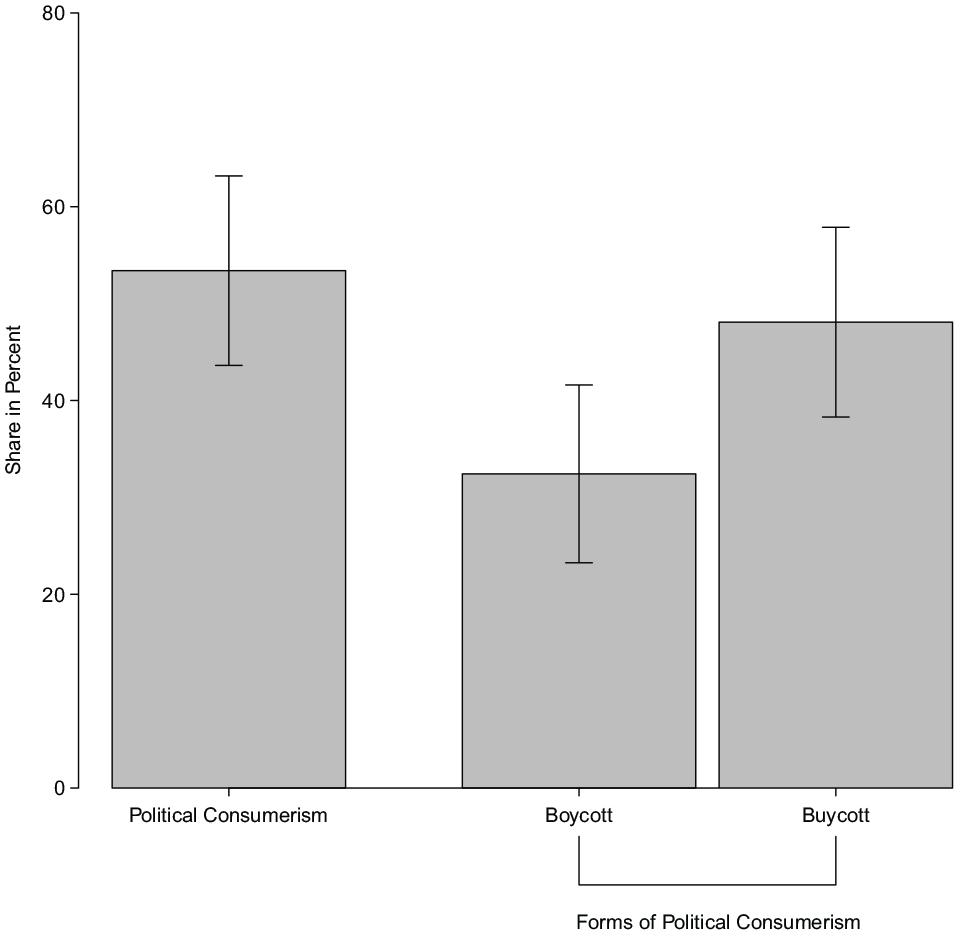
Prevalence of political consumerism in Switzerland.
To examine the link between the Big Five personality traits and political consumerism we estimate logistic regression models for separate measures of boycott and buycott. Thereby, we try to disentangle variances in the effects for the two most prominent forms of political consumerism. To access the robustness of our results, we apply several robustness checks. First, we estimate a logistic regression model for an overall indicator of political consumerism. Second, we apply multiple imputation by chained equations to avoid a potential bias caused by missing data. 10 This technique increases our sample by 2055 observations (about 36% of the sample) that are otherwise lost by listwise deletion. Third, to account for potential dependencies between persons living in the same structural and political context, we estimate multilevel models with random intercepts using the 26 Swiss cantons as contextual unit. Finally, we estimate a biprobit model to account for the correlation between boycott and buycott.
All estimated models include sex, age, education, income and type of settlement as control variables. Sex is measured as a dichotomous variable, age as continuous, and education, income, and settlement type as categorical ones. Additional analyses also include political and social attitudes that are supposed to mediate the link between personality traits and political consumerism. More detailed information about the variables as well as some descriptive statistics can be found in Table OA2 in the Supplemental Appendix.
Empirical findings
Examining the link between personality traits and political consumerism, we find that openness to experience and conscientiousness are important drivers of boycott and buycott, while agreeableness is only related to boycott. Figure 3 displays the results of our regression analysis, where coefficients are depicted as dots and 95% confidence intervals as horizontal lines (for detailed results see Table OA3 in the Supplemental Appendix, Model M1–M2). Various robustness checks using multiple imputation (Table OA6 in the Supplemental Appendix), multilevel modeling (Table OA7 in the Supplemental Appendix), and alternative estimation techniques (Table OA8 in the Supplemental Appendix) confirm these results. If an overall measure of political consumerism is used for the analysis, the results resemble the model for buycott. That is not surprising, given that buycott is the predominant form of political consumerism (Table OA9 in the Supplemental Appendix).

Personality traits and political consumerism in Switzerland.
Considering the demographic factors, female and older respondents are more likely to engage in boycott and buycott. In line with the results of former research, higher education is one of the most important driving forces of this form of political participation. As expected, individuals with low income are less likely to become political consumers compared with individuals with high income. Furthermore, respondents living in the German-speaking part of Switzerland are more likely to engage in this kind of political action than people living in the Italian-speaking part. Finally, urban dwellers have a higher likelihood of participating in boycotts and buycotts than anybody else.
To illustrate our main findings, predicted probabilities for different levels of openness to experience, conscientiousness and agreeableness are plotted in Figures 4 and 5. The figures show the probabilities of taking part in boycott and boycott for a man with secondary education, living in a suburb in the German-speaking part of Switzerland, with average income and age and average values on the remaining personality traits over the scale of the relevant personality traits. If that person was very open-minded, the probability of taking part in boycott was about 48%, and 61% to participate in buycott. Compared with a closed-minded person with the same characteristics, that means an increase of about 30 percentage points. Thus, being critical, curious and open to new ideas and values substantively increases the likelihood of using purchase decisions to make a political statement. Particularly, buycotts seem to be interesting for open-minded persons because they give them the chance to get in touch with new and alternative products but also to express criticism and disagreement concerning certain business behaviours.

Predicted probabilities of engaging in boycotts (Model M1).

Predicted probabilities of engaging in buycotts (Model M2).
Meanwhile, political consumerism does not seem to resonate with conscientious persons. The described sample person with maximum values of conscientiousness is about 26 percentage points less likely to take part in boycotts than his less conscious counterpart. For buycott, the difference amounts to 22 percentage points. Building on theoretical considerations, we attribute this negative link between conscientiousness and political consumerism to conservative values and attitudes. Political consumerism is seen as a behavioural expression of post-materialist values and liberal attitudes (Baek, 2010). Therefore, conservatives, who do not identify with such values, will unlikely choose this form of participation. Moreover, conscientious persons are known to participate if they perceive it as their civic duty to do so. While institutionalized forms of political participation, such as voting, are considered a duty, political consumerism probably is not. Still, even among the very conscientious ones, every third person participates in boycott or buycotts. This is again an indicator of the high prevalence of political consumerism in Switzerland.
Finally, the results for agreeableness show why it is worthwhile to distinguish between different forms of political consumerism. While this trait is not systematically related to taking part in buycotts, it hampers the likelihood of participating in boycotts (see Figure 4). Assuming that the described sample person was very agreeable, his probability to take part in boycotts is about more than 22 percentage points lower than the propensity of an otherwise equal but less agreeable person. Agreeable persons seem to avoid the conflictual form of boycotting. Similar patterns have been found for other forms of political action that are rather confrontational, such as political protest (Brandstätter and Opp, 2014; Ha et al., 2013). Overall, these findings give leverage to recent research showing that boycott and buycott follow different logics (Baek, 2010; Copeland, 2014a; Koos, 2012; Neilson, 2010; Zorell, 2019).
The positive relationship between openness to experience and political consumerism is in line with former findings in the literature, while the effect of conscientiousness is less well documented in the literature (Gallego and Oberski, 2012; Quintelier, 2014). Our study, that uses a representative sample and an encompassing measure of political consumerism capturing both boycott and buycott, however, clearly shows that conscientiousness is an equally relevant correlate of political consumerism. In contrast to other forms of political engagement, political consumerism is not related to extraversion. The individualized character of political consumerism does not seem to appeal to extroverts, who prefer more social forms of political action. Additionally, our results indicate that participation in political consumerism is highly stratified along ideological lines. Openness to experience and conscientiousness are those two traits that are most clearly linked to ideological orientations (Carney et al., 2008; Mondak, 2010). Openness correlates significantly with left-wing and liberal orientations, while conscientiousness is related to conservative, right-wing attitudes. Hence, political consumerism seems to have an ideological connotation that is more likely to resonate with open-minded citizens than with conscientious ones.
To examine whether the documented relationships are due to the particular nature of political consumerism, we have estimated additional logistic regression models for 10 other modes of political participation (Table OA10 in the Supplemental Appendix). The results largely correspond to former findings in the literature for Switzerland (e.g. Ackermann, 2017) and other countries (e.g. Gerber et al., 2011b; Ha et al., 2013; Mondak et al., 2010; Mondak and Halperin, 2008). Next to political consumerism, openness to experience positively relates to other cause-oriented forms of political participation. Meanwhile, it negatively relates to what Norris (2002) calls ‘citizen-oriented’ modes of participation taking place in the traditional arena of party democracy. Conscientiousness does not seem to be a driving force of participation at all: it is not, or negatively, related to all kinds of political action. Regarding extraversion and agreeableness, the additional analyses confirm the interpretation of our findings for boycott and buycott. Forms of collective action (e.g. participating in a party group), as well as contacting activities, attract extraverts. Individualized forms of action without direct contact with political actors do not seem to be particularly appealing to them. Meanwhile, agreeable persons avoid conflictive modes of participation, like contacting, party work or signature collection. To sum up, the additional analyses underline that the particular characteristics of political consumerism help to understand our findings. They explain what kind of political action attracts what kind of personality types.
Assessing potential mechanisms: The mediating role of attitudes
Given the identified links between personality traits and political consumerism, a next step would be to disentangle potential mechanisms. How do these relationships come about? What kind of mechanisms explain, for instance, the link between openness to experience and buycott? We assess these questions using the sociological method to mediation that has been applied in the study of personality and politics before (Ackermann et al., 2018; Gallego and Pardos-Prado, 2014). Thus, we add potential mediators to the regression model, first in a stepwise procedure and second in a full model. If the regression coefficients of the personality traits become less strong and significant by the inclusion of post-treatment variables, mediation is at work. Following our theoretical argumentation and empirical evidence on determinants of political consumerism, we include political orientation, political interest, political trust and social trust as potentially mediating factors. Political orientation is assumed to be highly correlated with openness to experience and conscientiousness (Gerber et al., 2011a; Mondak, 2010). At the same time, left-leaners have a higher probability of participating in political consumerism (Copeland and Boulianne, 2020) and therefore we assume political ideology to act as a mediating factor. Political interest is positively correlated with openness to experience (Gerber et al., 2011a; Mondak, 2010) and is a determinant of political consumerism (Copeland and Boulianne, 2020). Thus, it is as well a potential mediator. Finally, social and political trust are systematically linked to agreeableness (Freitag and Ackermann, 2016; Freitag and Bauer, 2016) and particularly low political trust is a driving force of political consumerism (Copeland and Boulianne, 2020; Gundelach, 2020a). Therefore, we also consider the two trust variables as potential mediating factors in our analysis. The results of the full model are presented in Figure 6 (see Tables OA4 and OA5 in the Supplemental Appendix for the stepwise procedure and the complete regression table of the full model).

Personality traits and political consumerism in Switzerland.
Our results confirm that political orientation, political interest and social trust are relevant drivers of participation in boycotts. More importantly, political orientation, and to some degree also political interest and social trust, seem to be partly causing the relationship between personality and boycott. The inclusion of these variables in the regression model reduces the size of the coefficients of openness to experience and conscientiousness. However, the regression coefficients remain significant, indicating that these attitudes do not seem to be the only pathway through which personality traits and boycott participation are related. The coefficient of agreeableness even becomes stronger in the full model. Thus, the considered attitudes do not bring about the negative link between agreeableness and boycott.
Considering buycott, we find a rather similar picture: political orientation, but also political interest and social trust, reduce the size of the personality effects. However, even if these attitudinal factors are included in the regression model, openness to experience and conscientiousness are still significantly related to buycott. In sum, attitudes seem to be only one mechanism among many that link personality and political consumerism. Personality traits are related to political consumerism beyond their correlation with attitudes.
Conclusion
In recent years, political consumerism has become one of the most prevalent forms of non-institutionalized political participation in Western democracies. It is representative of the growing diversification of political action and the increasing relevance of individualized forms of participation, such as online participation. Thus, we argue that it is important to gain an encompassing understanding of its roots. Given its individualized and cause-oriented nature, we argue that interindividual differences in psychological dispositions should be a particularly relevant explanation. We test this assumption empirically by examining how personality traits relate to different forms of political consumerism and whether these relationships persist once we account for political and social attitudes. Our results show that openness to experience encourages politically conscious consumption behaviour, while conscientious people are inclined to avoid political consumerism. Also, agreeable persons are less likely to take part in boycotts. As expected from theory and derived from previous empirical findings on different forms of non-institutionalized participation, the remaining personality traits are unrelated to taking part in political consumer action.
Our findings fit well into the existing evidence on personality and other forms of political participation (Cawvey et al., 2017). While openness to experience has been found to foster different forms of political participation, extraversion is mainly related to social forms of engagement. As political consumerism is rather individualistic, our results confirm these former findings. Meanwhile, conscientiousness is found to be negatively linked to non-institutionalized and cause-oriented forms of political engagement, such as protest (Ackermann, 2017). Again, that matches our empirical evidence for political consumerism as a non-institutionalized form of political action. Concerning agreeableness, our results underline that agreeable persons most likely would avoid conflictual forms of engagement, among which boycotts can certainly be considered (Gallego and Oberski, 2012). Furthermore, our analyses indicate that these links between personality traits and political consumerism are partly mediated by social and political attitudes. Yet, psychological dispositions matter for political consumerism beyond their correlation with these attitudes.
Hence, our empirical study delivers four important contributions. First, our findings corroborate the relevance of personality to explain non-institutionalized political action. By focusing on political consumerism, we add important evidence on a form of political action that has hardly been studied from a psychological perspective. Thus, we advance both the literature on personality and politics, as well as the literature on the determinants of political consumerism. Our findings indicate that political consumerism research should pay greater attention to psychological factors as relevant determinants. Second, our results further strengthen the observation that the impact of personality depends systematically on the individualized versus social nature of participation. While extraversion is an important explaining factor for the prediction of many different modes of political participation involving social acts, this does not apply to individualized forms of political action, such as buycotting and boycotting products and services. Third, in line with recent suggestions to differentiate explaining factors for boycotting and buycotting, our analysis shows plausible different relationships in the case of agreeableness. Fourth and finally, we demonstrate that attitudes can be a powerful mediator of the relationship between personality and political participation, but, at the same time, they cannot fully account for it.
While our study contributes to a deeper understanding of the psychological roots of political consumerism, it still is the first step on a larger research agenda. The following shortcomings need to be tackled by future research. First, the measurement of political consumerism in our data set has apparent weaknesses. Although it offers the possibility of distinguishing between boycott and buycott, it is problematic for several reasons. We probably overstate political consumerism and mix political and non-political motivations due to the large period of 12 months. This might lead to a dilution of the personality structure of political consumers in our study. Moreover, the examples of political consumerism activities given in the question potentially cause a priming effect. The examples are ‘disproportionately part of shopping lists of consumers on the political left’, as Stolle and Huissoud (2019: 627) put it. Thus, our measure and our results are potentially biased towards left-leaning boycotts and buycotts. Otherwise, research also shows that political consumerism is ideologically biased and more prevalent among left-leaners (Hooghe and Gobin, 2020). Either way, future research should try to develop better measurements of political consumerism that consider the frequency and variants of political consumerism as well as efforts to retrieve information on the political motives of the consumption behaviour (Gundelach, 2020b). Second, our data set only covers parts of the broader concept of political consumerism. In future research, it might be fruitful to broaden the scope of the analysis by integrating other forms of political consumerism, such as discursive political consumerism and lifestyle politics (Stolle and Micheletti, 2013). All of these political actions differ considerably in their degree of conflict and politicization. Thus, psychological dispositions might help to explain an individual’s decision to take part in one or the other action. Third, it might be worthwhile to broaden the perspective on the psychological roots of political consumerism in future research. We have used the well-established conceptualization and measure of the Big Five personality traits but, of course, this model is not uncontested (for an overview see Boyle, 2008). The application of other personality models or additional traits, as Weinschenk and colleagues (2019) have done recently, or the consideration of other psychological factors, such as the basic needs included in self-determination theory (Deci and Ryan, 2000), seem to be promising. Finally, researchers might want to think about contextual or situational factors, which can moderate the link between personality traits and political consumerism (Ackermann, 2017; Dawkins, 2017; Jennstål, 2018; Mondak et al., 2010; Weinschenk, 2017). The relationships found in this study do not necessarily have to be universal but might vary across situations and contexts. For instance, the importance and prevalence of political consumerism in a country might alter the role of conscientiousness. As soon as people perceive it as a duty to engage in political consumerism, the negative effect might vanish. Besides, extroverts might want to join the bandwagon if political consumerism is highly prevalent in a country or a region. Moreover, it would be interesting to study the role of the political opportunity structures or the economic wealth in a cross-country comparison. Thus, replications in other countries or comparative studies would be an important step to assess the generalizability and contextual stability of our findings.
In conclusion, our study encourages future research to dig deeper into the relationship between personality and political action. It adds to the growing evidence showing that personality is a significant predictor of individualized and cause-oriented forms of political participation. At the same time, it points out that personality profiles vary across different modes of political action. The characteristics of the diverse modes may help to understand this variation.
Supplemental Material
Supplementary_File – Supplemental material for Psychological roots of political consumerism: Personality traits and participation in boycott and buycott
Supplemental material, Supplementary_File for Psychological roots of political consumerism: Personality traits and participation in boycott and buycott by Kathrin Ackermann and Birte Gundelach in International Political Science Review
Footnotes
Acknowledgements
Earlier versions of this paper were presented at the Annual Meeting of the International Society of Political Psychology (ISPP) in 2015 and during internal workshops at the Department of Social Sciences, University of Bern. The authors are grateful to the participants in these meetings as well as to the three anonymous reviewers and Marian Sawer, as the responsible editor, for valuable comments and suggestions on previous versions of this article.
Funding
The author(s) received no financial support for the research, authorship, and/or publication of this article.

Notes
Author biographies
References
Supplementary Material
Please find the following supplemental material available below.
For Open Access articles published under a Creative Commons License, all supplemental material carries the same license as the article it is associated with.
For non-Open Access articles published, all supplemental material carries a non-exclusive license, and permission requests for re-use of supplemental material or any part of supplemental material shall be sent directly to the copyright owner as specified in the copyright notice associated with the article.
