




Abstract
Radical right parties’ calls for a strong and illiberal nation-state have travelled across the political spectrum into the mainstream in Eastern Europe since the 2000s, contributing to a rightward shift in the region’s politics. The mechanisms behind such influences in Eastern Europe are not yet fully understood. Focusing on the strength of radical right parties and mainstream parties’ strategic reactions to them, this study explores how and under what circumstances radical right parties exert influence on mainstream parties’ general political positions and on their positions concerning ethnic and national minorities – a group frequently targeted by radical right intolerance in the region. Shifts in parties’ positions are analyzed using comparative data from the Chapel Hill Expert Survey and the authors’ own Viadrina Expert Survey. The study finds that where mainstream parties formally or informally cooperated with radical right parties or coopted their agenda, lasting rightward position shifts are observable. Consequently, the authors argue that by contributing to rightward shifts, especially on positions concerning minorities, radical right parties play a role in undermining liberal democratic values, thus contributing to the ‘depletion of democracy’.
Keywords
Introduction
Many signs point to a significant rightward shift in East European politics over the past three decades. 1 In the 1990s, the mainstream left’s and right’s rush to embrace democracy made the radical right’s ultranationalist agenda appear rather marginal. Nevertheless, the constant calls of radical right parties (RRPs), defined here as anti-liberal and ultranationalist parties, for a strong and illiberal nation-state did not subside with democratic consolidation; rather, they have moved across the political spectrum into the mainstream.
This article systematically investigates the interaction between RRPs and mainstream parties in Eastern Europe and argues that rightward shifts in mainstream party positions are more likely to occur if mainstream parties pursue a strategy of positive engagement with RRPs, and that the disappearance of the RRP from the parliamentary or electoral arena does not automatically lead to the affected parties’ ‘return to the center’. For the analyses, the article uses existing and novel comparative data on party positions in East European countries between 2000 and 2016. This coincides with the end phase of the adoption of the European Union’s (EU) acquis communautaire in most countries under study, and an ensuing reconfiguration of their radical right party sector, as well as covering the aftermath of the migration crisis in Europe. The latter introduced a new contentious issue for the radical right and triggered competition dynamics for parties in the region.
More specifically, we argue that while direct effects of RRPs on democratic quality may be limited (thereby differing from Huber and Schimpf, 2016), these parties have pushed mainstream parties’ general positions and those on minorities to the far right in many countries. With inclusiveness being understood here as a fundamental value of liberal democracy, the restrictive shifts in mainstream parties’ positions regarding ethnic and national minorities contribute to a ‘depletion of democracy’; that is, a process of undermining the values of liberal democracy, such as equality and inclusiveness.
The article is structured as follows: the first part introduces the key concepts and an analytical model of radical right impact, conceptualizing impact as the outcome of interactions between RRPs and mainstream parties. These are either parties’ position shifts or policy developments; for example, legislative changes. For reasons of scope, we focus in depth on parties’ position shifts, but highlight examples of concrete policy changes reflecting their influence in support of our arguments. Parts two to four analyze the interaction between RRPs and mainstream parties in three country groups established according to the strength of the RRPs within them. The analysis discusses parties’ position shifts based on data from the Chapel Hill Expert Survey (CHES) and the authors’ own Viadrina Expert Survey (VES). The article concludes with the key findings and their relevance for the question of democratic quality and future research.
Analyzing radical right impact: positions, policies and democratic quality
Whatever definition of the radical right is chosen in the literature, a central concern is its relationship to the concept and reality of liberal democracy in general and its fundamental contestation of the multicultural/multinational realities of most nation-states in particular (Müller, 2016). In that vein, the radical right is understood here ‘in an ideological way and as part of the political-programmatic spectrum in distinction to other party families, most of which constitute the mainstream’ (Minkenberg, 2013: 6). Given its ideological core of nativism or a romantic and populist ultranationalism, which is directed against the concept of liberal and pluralistic democracy and its underlying principles of individualism and universalism (Minkenberg, 2017; Mudde, 2007), the radical right’s impact on mainstream parties can be seen as an indirect attack on the ‘underlying liberal values and legitimizing constitutive principles of liberal democracy’ (Pytlas, 2019: 177).
Our article builds on this approach and explores the radical right’s impact on mainstream parties’ positions in general, and those on ethnic and national minorities, which have been the East European RRPs’ core issue, in particular. 2 We argue that the positions of many East European governments have been affected as a result of political processes in which the ultranationalist politics of the radical right have infiltrated the political mainstream, and have thus had an impact on the quality of democracy through the process of depletion.
Democratic quality can be understood in many ways, but most experts agree on a few fundamental dimensions, such as free elections, access to information, civil rights and liberties, the legal state, and checks and balances (Bühlmann et al., 2012). In the context of liberal democracy, however, a central aspect is inclusiveness, as emphasized in Dahl’s (1971) ‘polyarchy’ concept. The debate surrounding multicultural democracy and minority rights has specifically addressed deficits in citizenship as democratic deficits, and argued for the widening of social inclusion, in particular that of minorities and hitherto disadvantaged or marginalized groups (Gagnon and Tully, 2001; Kymlicka, 1995). This dimension needs to be included in all attempts to put ‘the demos back into the concept of democratic quality’ (Mayne and Geissel, 2016).
Depletion of democracy signifies the process of undermining and weakening the values of the liberal democratic order – such as equality and inclusiveness – rather than the outcome of this process. With the intervention of the radical right, the exclusionary understanding of the people as ethnos gains increasing prominence in mainstream politics at the expense of the demos. The institutions providing for a ‘government of the people’ may not (yet) be at stake, although several countries in Eastern Europe with strong RRPs show signs of democratic deconsolidation, such as weakening of parliamentary control, reduction of the independence of the judiciary or that of the freedom of media (Ágh, 2019: 180). Thus, through the process of depletion, the concept of the demos is under attack.
Studying the impact of the radical right requires a closer look at the interaction patterns between the radical right and other actors and the mechanisms through which the radical right influences other parties’ positions (see also Biard, 2020). This interaction process is schematically summarized in Figure 1.
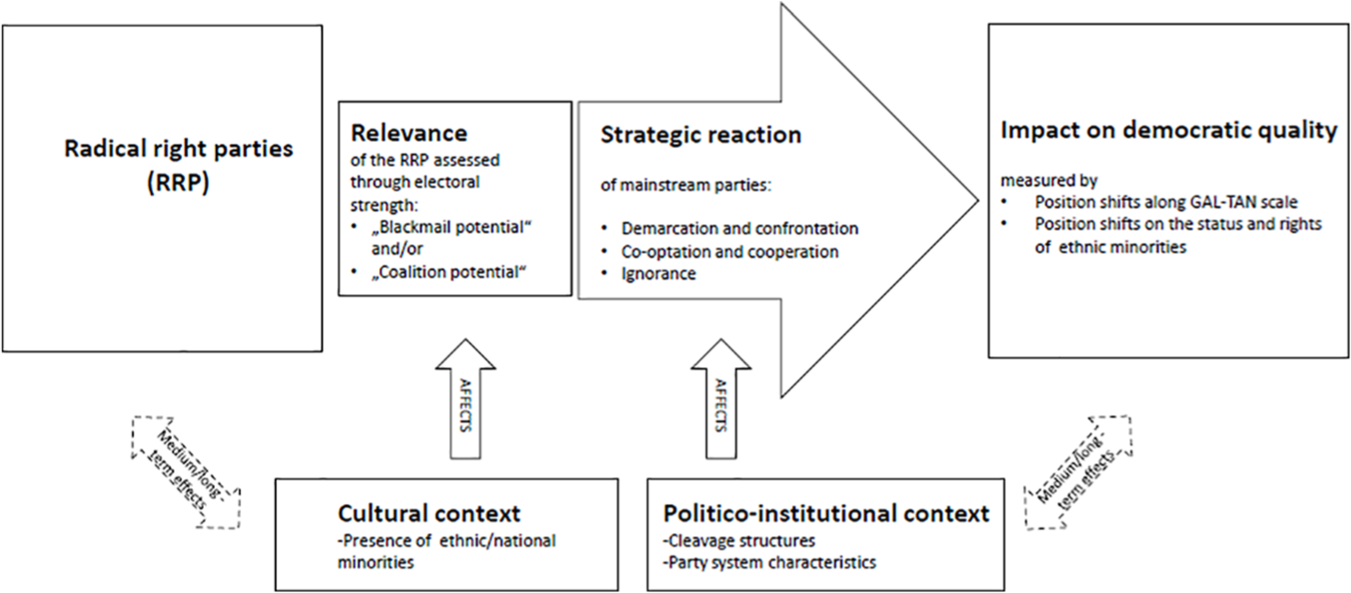
Modeling the role and impact of radical right parties in the political process.
On a general level, this model takes into account the interaction dynamics between the radical right and a variety of other actors, including parties, the state or the civil society, and the cultural and institutional context in which such interaction occurs (McAdam, 1999: xiv). The causal mechanism of impact is understood as an ‘interaction effect’ where the relevance of RRPs prompts the strategic response of other actors to the (perceived) challenge posed by the radical right. For the purposes of our analysis, we concentrate only on the interaction dynamics between RRPs and mainstream parties and on the process through which the former influence the latter. We argue that RRP impact occurs as a consequence of parties’ competition, which in turn is shaped by the respective countries’ cultural and politico-institutional context; that is, the presence and relevant size of ethnic and national minorities on the one hand, and party-system characteristics and cleavage patterns on the other (see Bustikova, 2020: 53–66; Minkenberg, 2017: 53–65, 105–114). 3 Following this model, the first factor that shapes the radical right’s impact is the relevance of the respective party, which is derived from its electoral strength manifested either in its ‘blackmail potential’ –meaning its power to make another party follow (some of) its policy goals – or its ‘coalition potential’ (Sartori, 1976: 121–124; Zobel, 2017: 48–49). To obtain blackmail potential, the mainstream parties need to perceive the RRP as a threat to their electoral success or ability to form a government. Electoral threat is often operationalized as vote gains of a niche or challenger party in quantitative studies of political competition (see e.g. Meguid, 2008; Spoon et al., 2014). Depending on the national context, RRPs with blackmail potential might also be perceived as potential coalition partners in the future (Zobel and Minkenberg, 2019).
Beyond mere relevance, the processes of interaction and the resulting effects are also influenced by mainstream parties’ strategic reactions to the RRPs (Zobel and Minkenberg, 2019). Strategic reactions can take the form of: (a) positive engagement, like cooperation or co-optation; (b) negative engagement, like stigmatization or maintaining a cordon sanitaire; and (c) disengagement (Downs, 2012; Meguid, 2008). Moreover, parties do not only compete with RRPs by co-opting their issue positions, but also by taking over their narrative framing of specific issues (Pytlas, 2016; Zobel, 2017). Consequently, RRPs’ impact can occur on various levels (e.g. party positions, agenda-setting, policy-making) and to varying degrees (Minkenberg, 2015; Mudde, 2005, 2007). In line with Downs (2012), mainstream parties’ co-optation or collaboration strategies may reduce the votes for and the mobilization potential of the RRP. Yet this immediate gain is likely to be outweighed by lasting effects, like the radicalization of the mainstream. Alternatively, negative engagement with or the sidelining of RRPs may help consolidate their mobilization base and enhance their status as a persecuted minority that is only granted a minimum level of political relevance.
When studying party interactions in East European countries, we must pay attention to the specific cultural and politico-institutional context. Post-communist party systems are characterized inter alia by comparatively higher levels of instability and de-institutionalization, indicated by a high average number of new parties, high levels of electoral volatility, and a short lifespan of RRPs compared to Western Europe (Casal Bértoa and Enyedi, 2018: 431–432; Deegan-Krause and Haughton, 2018; also Minkenberg, 2017: 100–103). Consequently, party strategies in confronting RRP competitors vary more than in Western Europe. In addition, the programmatic coherence or ideological principles of mainstream parties are more easily compromised by expected gains in pursuing accommodative rather than confrontational strategies, especially when institutional and civil-societal contexts favor ultranationalist politics (Minkenberg, 2017: 53–65).
Ethnic and national minorities and neighboring countries have long featured as the majority population’s scapegoats in Eastern Europe – a cultural factor with roots in the region’s nation- and state-building processes. Brubaker (1997), many post-communist nations can be characterized by a ‘triadic’ configuration of nations between nation-building processes, the existence of national minorities within the new states, and the existence of ‘external homelands’. Against this backdrop, the process of nation-building tends to override other issues – for example, cleavages in the economic dimension; nationalist rhetoric and the ethnic concept of nationhood are widespread among the political class and the public and are not solely characteristic of the radical right (Bustikova, 2020: 25–30). The prevalence of the ethnos across the political spectrum in turn influences the mobilization potential of RRPs, but also informs the programmatic positions of mainstream parties, providing more opportunities for cooperation among the two (Minkenberg, 2017: 129).
The existence of sizable ethnic and national minorities and the majority population’s responses typically lead to conflicts along an ethno-cultural cleavage (Pytlas, 2016). From the 1990s onwards, in countries like Bulgaria, Estonia or Slovakia, constitutional conflicts around these issues arose: attempts to ban ethnic parties, access to citizenship, language laws, issues of territorial autonomy and education were not only issues on the fringes, but also entered mainstream parties’ agendas (Ágh, 2019: 158–163; Minkenberg, 2017: 50; Pytlas, 2016). 4 Such conflicts have hampered the process of democratic consolidation and affected the quality of democracy by challenging the value of inclusiveness. In this vein, the process of depletion is not solely a consequence of the radical right. Rather, the prevalence of an ethnic understanding of nationhood and the (pre-)existing constitutional challenges have fostered a favorable environment for radical right mobilization which, when successful, significantly contributed to this process.
Following the model described above, two potential implications of party interaction deserve particular attention. First, RRPs can result in shifts to the right in other parties’ positions on specific issues. Here, mainstream parties’ strategic reactions to the RRP and its agenda are important because they affect the RRP’s chances to exert influence. Second, specific strategies by mainstream parties towards RRPs – for example, efforts to marginalize them by co-opting their agenda – can also result in a lasting rightward shift in mainstream parties’ overall positions as they engage in competition with the RRP. This article therefore sets out the following two propositions:
Rightward shifts in party positions are more likely to occur if mainstream parties pursue a strategy of positive engagement (e.g. do not uphold a cordon sanitaire) with the RRP.
Once a rightward shift occurs in a mainstream party’s position, the disappearance of the RRP from the parliament or the electoral arena does not automatically lead to the affected parties’ ‘return to the center’; rather, it leads to their programmatic transformation.
The two propositions will be investigated regarding two types of party positions: (a) the GAL-TAN dimension 5 (overall spatial positions); and (b) positions regarding ethnic minorities, which will allow us to assess the strategic reactions of mainstream parties to the core issue of the East European radical right.
We build on Pytlas and Kossack (2015) who demonstrated rightward shifts instead of polarization in the party systems of Bulgaria, Hungary, Poland and Slovakia when studying party positions along the GAL-TAN scale in 2002–2010 (see also Pirro, 2015: 126–135). As we demonstrate, survey data on parties’ positions concerning ethnic and national minorities between 2006 and 2014 from the CHES survey and for 2016 from the VES survey also show such shifts with some alterations (Polk et al., 2017; Bakker et al., 2015; Zobel et al., 2017). While the CHES survey presents positions on ethnic minorities as a catch-all category in the given country, the VES survey evaluates party positions on the Roma separately from positions on other ethnic minorities. Exploring party positions specifically on the Roma, a significant minority group and key target of the radical right in multiple countries, underlines the regional complexities and offers further insights into position shifts. 6
To discuss the changes in the political landscape in relation to RRPs’ strength, we group the countries as follows: (a) Slovakia and Bulgaria: strong radical right, significant government participation; (b) Poland and Hungary: strong radical right but no government participation, or fluctuating radical right with limited government participation; and as a control group (c) the Czech Republic and Estonia: weak radical right until recently.
The relevant contextual factors as discussed above, along with the strength of the RPPs and their proposed impact in the seven countries, are summarily depicted in Table 1. In the following sections the interaction patterns between the mainstream and RR parties as well as the evidence for RRP effects will be demonstrated empirically.
Context factors, party interaction and impact in Eastern Europe (2000–2016).
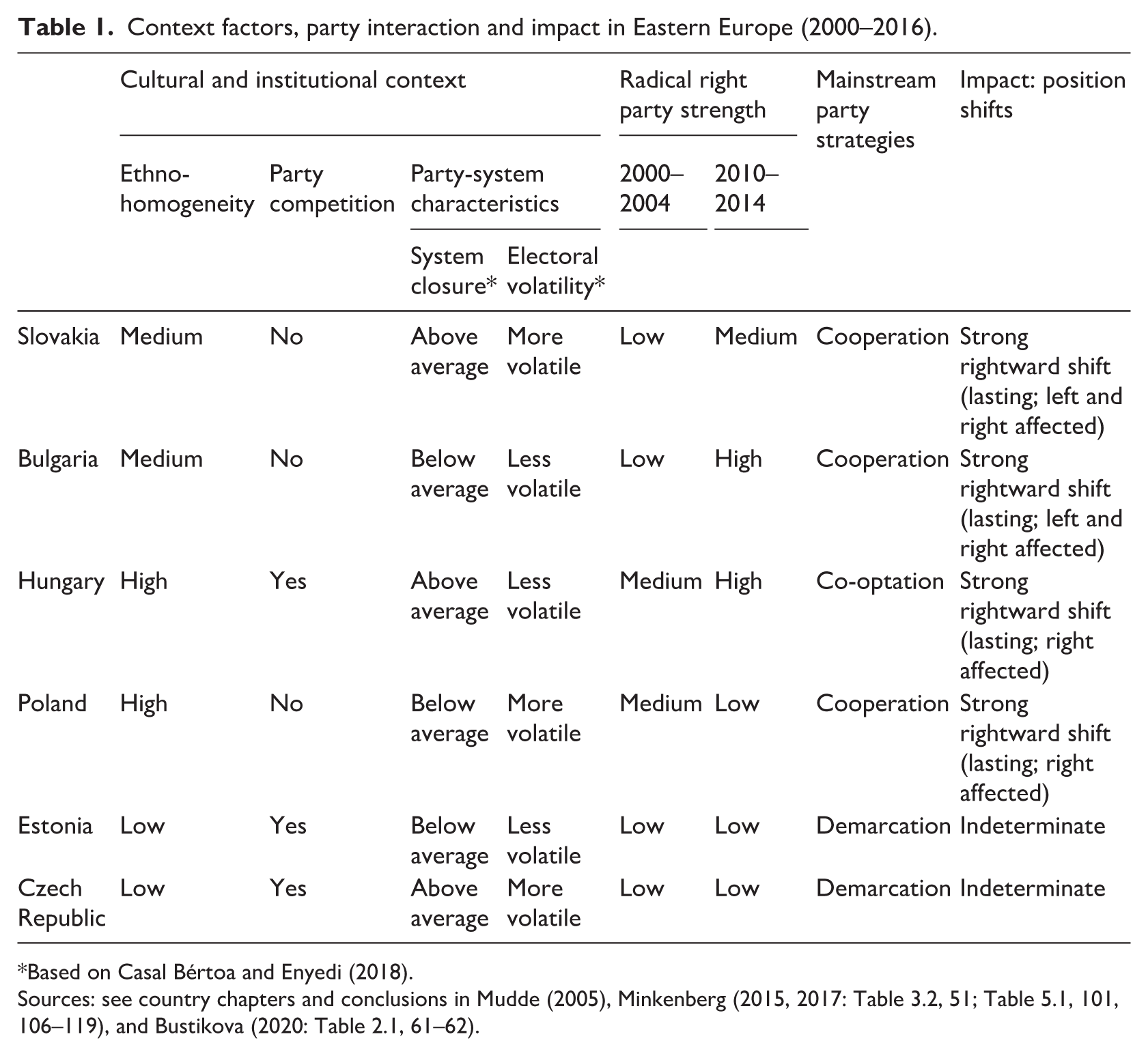
Based on Casal Bértoa and Enyedi (2018).
Sources: see country chapters and conclusions in Mudde (2005), Minkenberg (2015, 2017: Table 3.2, 51; Table 5.1, 101, 106–119), and Bustikova (2020: Table 2.1, 61–62).
Slovakia and Bulgaria: maximum impact through government participation?
Slovakia has a sizable Hungarian and Roma minority and overall medium-level ethnic homogeneity (Table 1). The ethnic cleavage has featured strongly in the party system with parties branding themselves on both sides and capitalizing on a ‘national appeal’ (Deegan-Krause and Haughton, 2018: 483–484). This appeal also contributed to the fact that no cordon sanitaire was maintained towards the radical right following Slovakia’s independence. One of the first cases of radical-right government participation in Eastern Europe occurred here with the Slovak National Party (SNS) joining Vladimír Mečiar’s government led by the People’s Party – Movement for a Democratic Slovakia (LS-HZDS) in 1993–1994 and 1994–1998.
After an extra-parliamentary period, SNS returned to the parliament in 2006 in an election that marked one of the highest rates of electoral volatility since the regime change (Casal Bértoa and Enyedi, 2018: 435–439) and brought about a subsequently fragmented legislature. Though Direction – Social Democracy (SMER), a party identifying itself as social democratic, won the elections, it lacked a majority. SMER limited coalition options increased SNS’s coalition potential and eventually led to a coalition government with the LS-HZDS.
SNS was the second-largest force in the three-party coalition, which helped with the pursuit of its anti-minority agenda, including rolling back legislative advances the Hungarian minority achieved ahead of Slovakia’s EU accession under the previous Slovak Democratic and Christian Union (SDKU)-led governments (Pytlas, 2016: 129). Such restrictive initiatives included, for example, an education reform introducing the use of Slovak geographic names in minority-language textbooks in 2008, which gained the support of the senior governing party. SMER’s cooperation later shifted into co-optation of SNS’s agenda as exemplified by an amendment to the State Language Act in 2009, initiated by the SMER-led Ministry of Culture, which restricted the use of minority languages in public administration in order to defend the status of the Slovak language. It passed with support from SNS and LS-HZDS. Upon the Hungarian Fidesz government’s adoption of a simplified naturalization process granting easy access to citizenship for ethnic Hungarians abroad, it was SMER that – calling for Slovak national self-confidence and sovereignty during the parliamentary election campaign – adopted amendments to the Citizenship Law in May 2010 allowing the revocation of Slovak citizenship from those acquiring another (see Bustikova, 2020: 113–119).
The results of SMER’s collaboration and co-optation are reflected in the rightward shift in the party’s GAL-TAN and minority issue positions following 2006 (Figure 2). This supports our proposition that a shift occurs when the mainstream party engages positively with the RRP. The lasting effects of the shift in SMER’s position, even beyond 2010, supports the proposition that the affected party’s programmatic transformation can prevail even after the RRP fails to win seats in parliament, which happened to SNS in 2012.
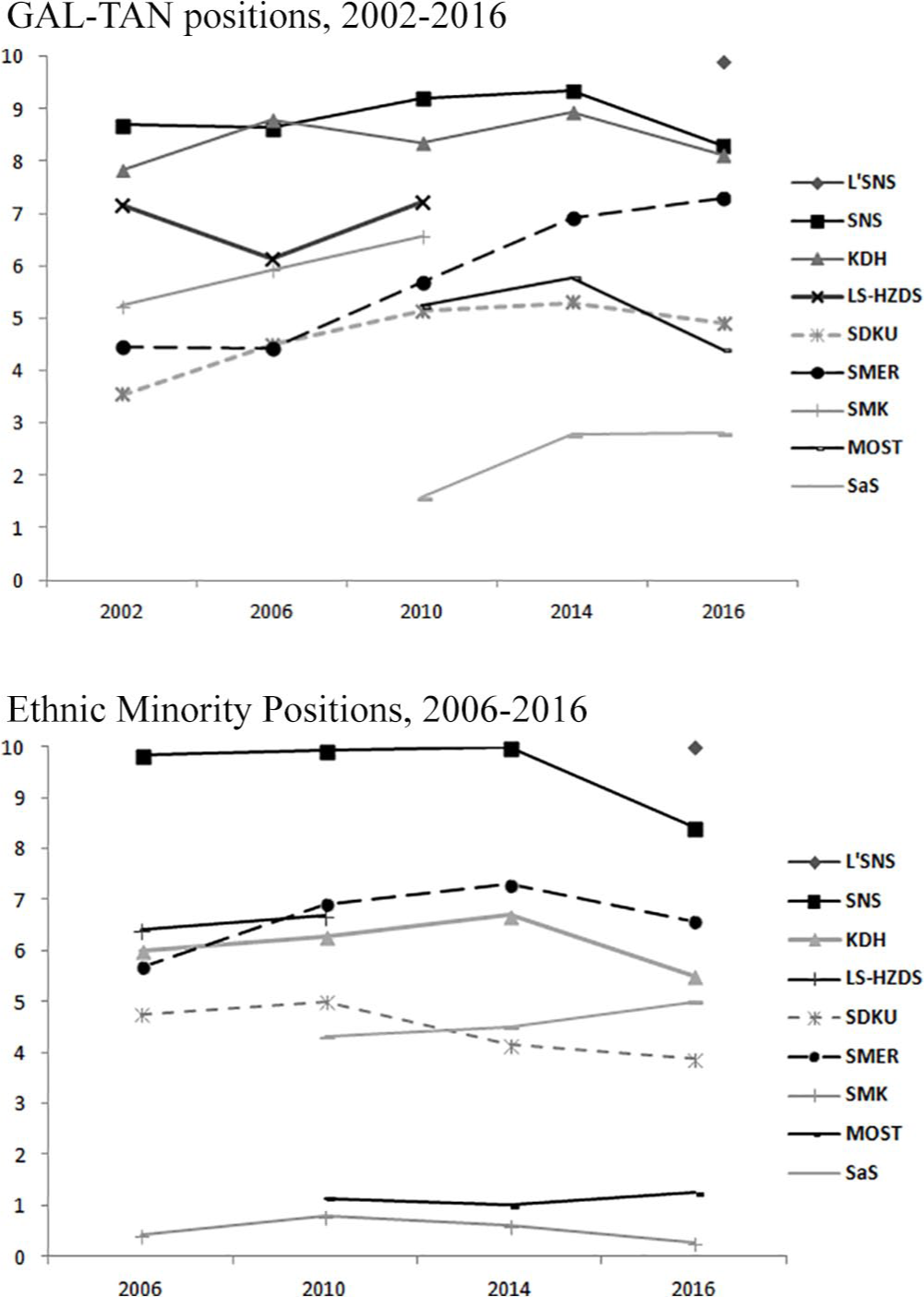
Spatial shifts in the Slovak party system (0 = liberal policies; 10 = restrictive policies).
The 2016 election in Slovakia marked the highest level of electoral volatility to date (Casal Bértoa and Enyedi, 2018: 439) resulting in an ever more fragmented parliament. Along with SNS, which returned to the parliament after four years, another far-right party, the right-wing extremist People’s Party – Our Slovakia (L’SNS), located at the most extreme position of the GAL-TAN scale, managed to enter the parliament as a newcomer. The fragmentation made coalition formation challenging and again increased SNS’s coalition potential, especially since the strongest party, SMER, already had experience of cooperating with it. Eventually, SNS, Network and the bi-ethnic Most-Híd (MOST) party joined SMER in forming a coalition, resulting in a previously unimaginable cooperation between SNS and an (at least partly) ethnic Hungarian party. Simultaneously, L’SNS was formally excluded from coalition talks (Spectator Staff, 2016).
Two trends are notable leading up to 2016: while SMER’s rightward position shift continued between 2014 and 2016, SNS was seen to moderate slightly. 7 This resulted in the two parties occupying positions closer together than ever before, reflecting a higher coalition potential. SMER also shifted rightward on the Roma, a move following the increasing electoral success and consequently growing blackmail potential of L’SNS after its 2013 breakthrough with party leader Kotleba winning the seat of governor in Banská Bystrica and running a racist and anti-Roma campaign (Bustikova, 2020: 153–157; also Mesežnikov and Gyárfášová, 2017: 24–26). Meanwhile, the positions of SNS and SMER on minorities aside from the Roma (here, Hungarians) both show some moderation (data available upon request), which may have facilitated the establishment of the 2016 governing coalition. SMER’s cooperation with SNS in 2016, however, confirmed its continued openness to the radical right, but ruling out cooperation with L’SNS also showed its limits.
Bulgaria is a country with significant Turkish and Roma minorities and medium ethnic homogeneity, which makes identity politics and a strong ethnic cleavage an important component of the party system (Deegan-Krause and Haughton, 2018). Additionally, the system is fragmented, fragile and dynamic with high levels of electoral volatility, and marked by difficulties in coalition formation (Casal Bértoa and Enyedi, 2018; Ganev, 2006).
Throughout the 1990s the Bulgarian radical right was merely peripheral (Ganev, 2006). Attack (ATAKA), the first significant Bulgarian RRP with an ultranationalist, anti-minority and authoritarian stance, entered parliament in 2005, just months after its formation, in a period marked by intense electoral volatility (Casal Bértoa and Enyedi, 2018: 438) and riding on the ‘punitive’ wave against the coalition government led by the National Movement Simeon II (NDSV) in which the Turkish-minority formation Movement for Rights and Freedoms (DPS) was also mired in corruption scandals (Avramov, 2015: 309). In 2009, in the context of difficult negotiations following the parliamentary elections, ATAKA’s blackmail potential increased considerably and the mainstream-right party Citizens for European Development of Bulgaria (GERB) had no choice but to rely on the informal support of ATAKA to be able to command a majority.
The proximity to power significantly emboldened ATAKA. Its impact was notable in the radicalization of public discourse, as well as in anti-minority mobilization and the orchestration of racial violence throughout this period. ATAKA led multiple racist and ultranationalist campaigns, contributing to the normalization of nationalist language. Furthermore, it drove the increase in militant violence: for instance, the physical attack on Muslim worshipers at the Sofia mosque in 2011; or an incident involving Roma youth that escalated into week-long anti-Roma riots in Kutuniza village the same year (Ivanova, 2011). Though formally condemning the attacks, in order to preserve the fragile balance of power, GERB did not demarcate itself organizationally. Simultaneously, it began co-opting ATAKA’s anti-Roma, anti-Turkish and overall anti-minority discourse (Avramov, 2015).
Against a background of austerity and major social unrest, ATAKA led a successful highly charged anti-minority campaign in the 2013 elections. When GERB was unable to form a government despite coming first, ATAKA’s coalition potential grew again. This time around, however, it granted informal support to the left-wing Left Bulgaria (BSP), which could not have secured its government without ATAKA. In turn it became its political ‘hostage’ (Avramov, 2015: 306). ATAKA’s influence was particularly visible on a policy level through its xenophobic and nationalist initiatives, like extending the ban on the sale of agricultural land to foreigners, which passed despite opposition from the BSP and in violation of EU law, and encouraging restrictions on using the Turkish language on television or during political campaigning. Furthermore, it continued to support militant violence by encouraging the formation of anti-Roma militias (Avramov, 2015; Smith, 2016).
The following period coincided with a rightward shift that affected the entire political system. In opposition after 2013, GERB’s co-optation of nationalist positions continued as reflected in its rightward shift on ethnic minorities (Figure 3). It was BSP, however, which began an abrupt and sustained move to the right, both on the GAL-TAN scale and regarding ethnic and national minorities.
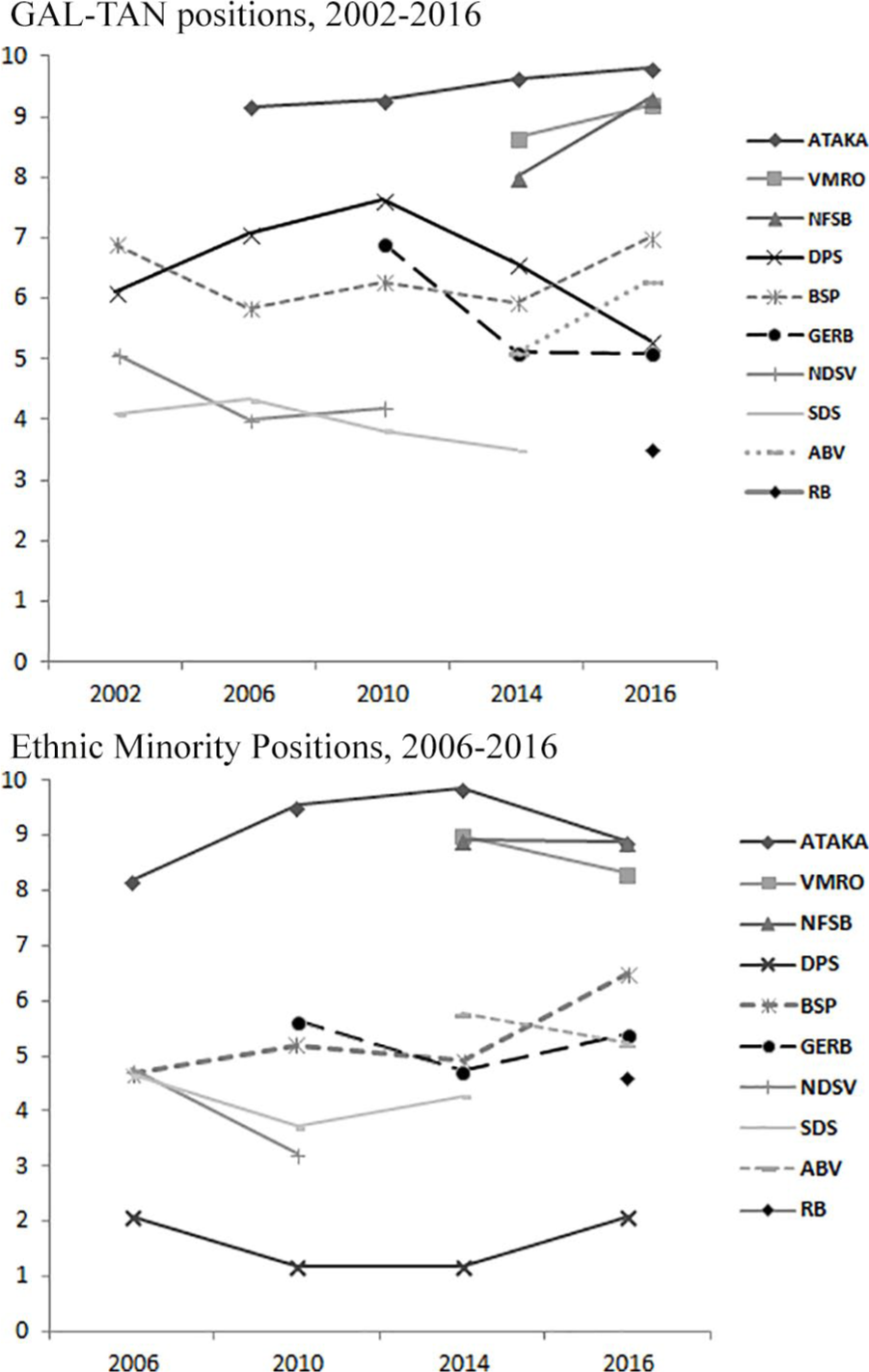
Spatial shifts in the Bulgarian party system (0 = liberal policies; 10 = restrictive policies).
Despite its policy success, ATAKA entered a period of decline and barely entered parliament in the 2014 elections, as its core electorate became increasingly dissatisfied with its informal ‘marriage of convenience’ with the moderate GERB and the ‘unholy’ alliance with the Turkish DPS in the BSP-led coalition (Avramov, 2015: 305). Consequently, ATAKA splintered and newer, fringe radical parties rose and entered the political arena. As a result, by 2014, GERB could rely on the outside support of a new nationalist force, the Patriotic Front, when forming a government. Finally, after the 2017 elections, GERB entered a coalition with the United Patriots, an alliance between ATAKA and the Patriotic Front, making this the first post-communist government in the country formally involving radical right parties (Zankina and Gurov, 2018).
Even as ATAKA’s influence waned, the system’s shift to the right continued, confirming our proposition that the disappearance of the initial radical right contender does not reverse the rightward trend. While GERB continued to move along a rightward slope, it was the left-wing BSP that saw the sharpest move to the right, reaching the most restrictive positions among all mainstream parties both on the GAL-TAN scale and regarding ethnic and national minorities. The strategy seemed to pay off electorally: BSP doubled its vote share from 2014 to 2017 and regained its place as GERB’s challenger (Zankina and Gurov, 2018). The lack of a cordon sanitaire against the radical right, and the ideological porosity between RRPs and mainstream parties (Avramov, 2015), led to a visible and lasting rightward transformation of the party system (Table 1).
Strong but (largely) excluded: Poland and Hungary
Unlike elsewhere in the region, ethnic minorities are virtually absent in Poland (Table 1). The Polish radical right thus pursues a vision of an ethnically homogenous and purely Catholic nation, mobilizing against social minorities and the alleged anti-Polish politics of the post-communist left (Pankowski and Kornak, 2013; Pytlas, 2016). Formed in 2001, the League of Polish Families (LPR) became the first significant radical right party in modern Polish politics, entering parliament the same year with backing from the ultra-Catholic Radio Maryja (Pankowski, 2010: 111–119). LPR’s rise came in the context of high electoral volatility when, dissatisfied with the outcome of the post-communist transformations, a third of voters switched political affiliation (Kasprowicz, 2015).
Initially, mainstream parties attempted to build a cordon sanitaire around LPR and excluded it from representation in the parliament’s executive body. LPR nonetheless succeeded in promoting its agenda by alternative means; for example, the (often televised) parliamentary debates (Kasprowicz, 2015: 172). Its vocal opposition also contributed to a delayed and slimmed-down version of the Minorities Law (2002–2005), despite the law being debated in the context of EU accession negotiations in a climate supportive of minority rights (Vermeersch, 2007). This shows the RRP’s potential to influence the public agenda despite the mainstream’s negative engagement.
In the coalition stalemate between the 2005 election winners Law and Justice (PiS) and the Civic Platform (PO), PiS decided to break the cordon sanitaire and invite LPR into a governing coalition together with the populist Self Defense of the Polish Republic (S), first as a supporter of a PiS minority government (2005); then in 2005–2007 as part of a nationalist, anti-liberal and populist coalition government (Kucharczyk and Wysocka, 2008; Pytlas, 2016: 30). While in government, LPR impacted policy areas like education (where the LPR Minister proposed ultra-conservative, religious elements in the national curriculum (Pytlas, 2016)) and gender (with attempts to restrict abortion), and also tried to control the public media (Kasprowicz, 2015).
The short coalition period was followed by a major political shift, with all parties, regardless of ideological position, beginning a rightward trajectory on the socio-cultural position along the GAL-TAN scale, and to a lesser extent regarding ethnic minorities. Though most pronounced after the coalition ended, this shift remained in place throughout the next electoral cycles. Despite the de facto cordon sanitaire in place at that point, PiS’s positions – as the sole party at that time – started to shift rightward upon LPR’s entry to parliament from 2001, and almost converged as PiS co-opted many of LPR’s nationalist ideas and framing devices during the coalition period (Figure 4).
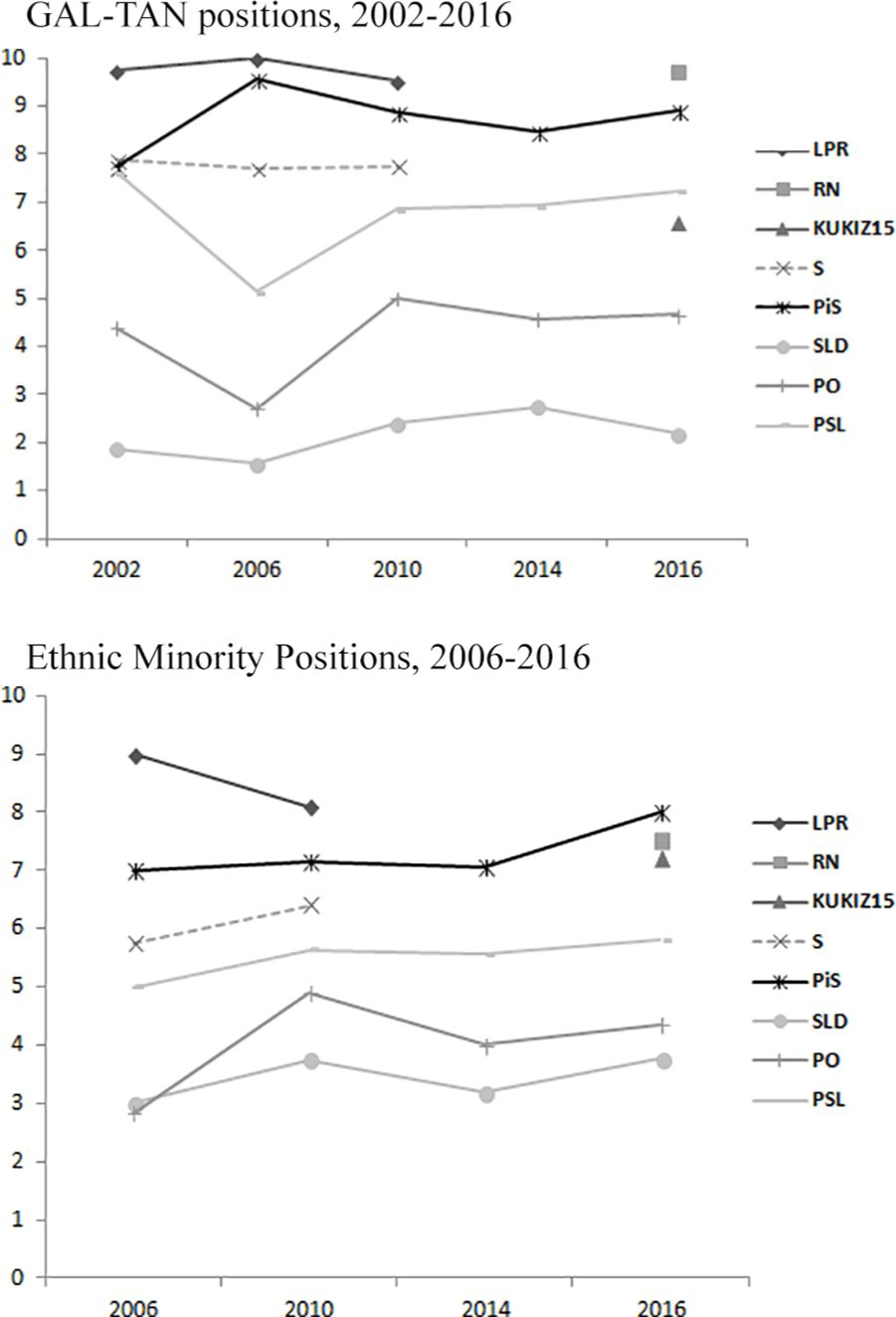
Spatial shifts in the Polish party system (0 = liberal policies; 10 = restrictive policies).
Despite the high level of political affinity between PiS and LPR (the highest between any mainstream and radical right party in the region, according to Kossack, 2012: 47), the coalition eventually split due to internal scandals. The great winner of the subsequent early elections was PiS, which absorbed 45% of LPR’s electorate (Kasprowicz, 2015), the party’s agenda and the support of Radio Maryja (Pankowski, 2010), while LPR failed to re-enter parliament. PiS continued LPR’s ideological trajectory, becoming a right-wing anchor as reflected in its socio-cultural positions along the GAL-TAN scale and those regarding ethnic and national minorities (Figure 4). The fact that PiS and other parties maintained this trajectory despite the disappearance of LPR indicates a lasting and system-wide shift.
The demise of LPR did not eliminate RRPs altogether. Against the background of increasing electoral volatility (Casal Bértoa and Enyedi, 2018: 449), new radical right forces entered parliament in 2015; for example, Kukiz’15 (KUKIZ15) allied with the National Movement (RN). This confirms that there is potential room for radical right contenders, especially with the emergence of new discursive opportunities such as the ‘migration crisis’. Nonetheless, in the studied period, no other party on the far right gained influence comparable to that of LPR.
Losing significant territory and population following World War I, Hungary became a country with high-level ethnic homogeneity. Consequently, the ethnic question appeared in domestic politics primarily through parties’ attitudes towards Hungarians abroad. Attitudes towards the country’s only significant minority, the Roma, became politicized in the late 2000s, but it did not develop into an ethnic cleavage.
Though the Hungarian Justice and Life Party (MIEP) dropped out of parliament in 2002, following the establishment of Jobbik – Movement for a Better Hungary (Jobbik) in 2003, the radical right’s relevance increased throughout the 2000s and Jobbik entered the parliament in 2010 as the third-biggest political force amidst the highest degree of electoral volatility in Hungary since the regime change (Casal Bértoa and Enyedi, 2018: 439). Its speedy growth on the wave of protests against the left-wing Gyurcsány government and the politicization of the Roma issue through fueling ethnic conflict from autumn 2006 posed an unprecedented electoral challenge to the mainstream-right Fidesz – Hungarian Civic Alliance (Fidesz), which until then had been the only viable political force on the right (Krekó and Mayer, 2015). To counter Jobbik’s blackmail potential, Fidesz co-opted elements of its nationalist agenda. Following the 2010 elections, which Fidesz won by a two-thirds majority, it also adopted corresponding policies, like the introduction of the simplified naturalization procedure, voting rights for Hungarians abroad or ‘law and order’ measures affecting primarily the Roma population, which Jobbik had often attacked before (Pytlas, 2016: chap. 6).
Supporting our proposition, Fidesz’s positive engagement with Jobbik through co-optation shows its impact on Fidesz’s significant rightward shift along the GAL-TAN scale between 2006 and 2010. The trend continued, albeit slower, in the presence of an even stronger Jobbik challenging Fidesz at the 2014 elections. The co-optation of Jobbik’s programmatic and ideological stance was so significant that by 2015 Fidesz was the one fueling a harsh anti-immigration campaign (Szalai and Gőbl, 2015), leaving no space for Jobbik on an issue which would have otherwise been close to its core ideology. The corresponding position shift (Figure 5) raises the question of whether Fidesz itself has become a radical right party (Bustikova, 2020: 34, 65; Krekó and Juhász, 2017).
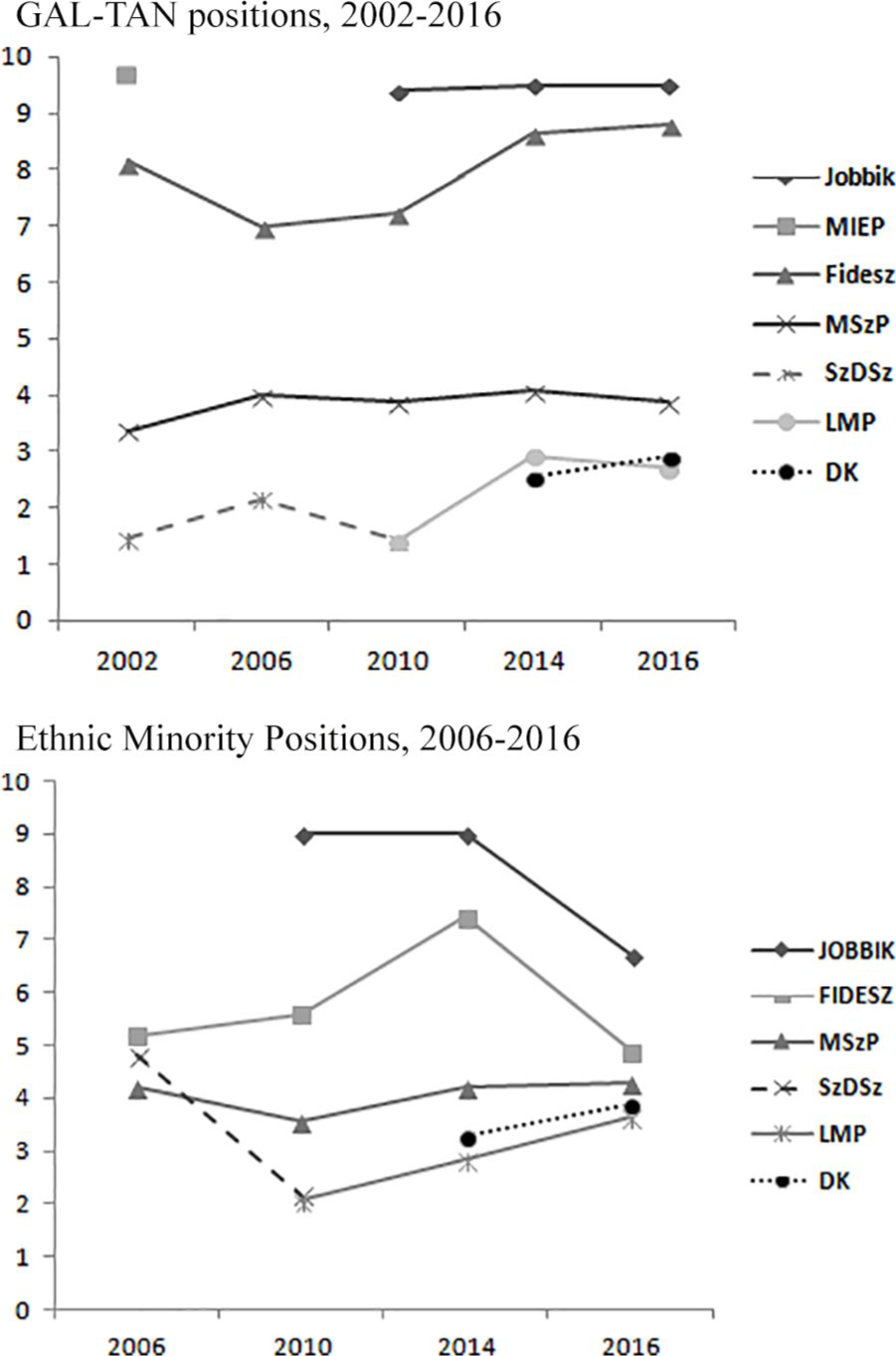
Spatial shifts in the Hungarian party system (0 = liberal policies; 10 = restrictive policies).
The rightward shift appeared also in Fidesz’s positions on ethnic minorities between 2010 and 2014. The separate evaluations of positions on the Roma and ethnic minorities without Roma in 2016, however, reveals that Jobbik’s position on the Roma is significantly more restrictive than on other ethnic minorities (data available upon request). It was likely the case before, too, considering that Jobbik introduced the term ‘Roma criminality’ to Hungarian political discourse in the late 2000s. The 2016 data also suggests that the significant rightward shift of Fidesz’s position on ethnic minorities from 2010 to 2014 was likely due to a shift on the Roma, as the party’s position on this group in 2016 is further to the right than that on other ethnic minorities. This assumption is supported by the law and order legislation adopted in the 2010–2014 period by Fidesz (Róna, 2016: 204–213), which primarily affected Roma.
The increasing marginal utility of marginality: the Czech Republic and Estonia
Ethnicity never constituted an important cleavage in the Czech Republic, which, while home to several minorities, does not have a single sizable minority group. Because of these multiple minorities, however, ethnic homogeneity is lower than in the other East European countries studied (Table 1). Since the regime change, several RRPs, like the Republicans, the Workers’ Party or the Workers’ Party of Social Justice, operated in the country, but, failing to enter parliament in the studied period, they never gained blackmail potential. Mainstream parties’ strategic reaction towards them was consistent demarcation (Mareš, 2015).
In 2013, however, the Dawn of Direct Democracy (USVIT) entered the Czech parliament, coinciding with a period of increasing electoral volatility and change in the party system (Casal Bértoa and Enyedi, 2018). During the following electoral cycle, USVIT was kept behind a cordon sanitaire by the political mainstream and, in this form, gradually disintegrated without any significant blackmail potential. Consequently, the rightward shifts of parties along the GAL-TAN and the minority issue dimensions observable between 2014 and 2016 are hard to attribute to USVIT (Figure 6). The period, however, coincides with the peak of the migration crisis that contributed to a competition for issue-ownership in the fragmented Czech political system, which could have pushed mainstream parties to the right.
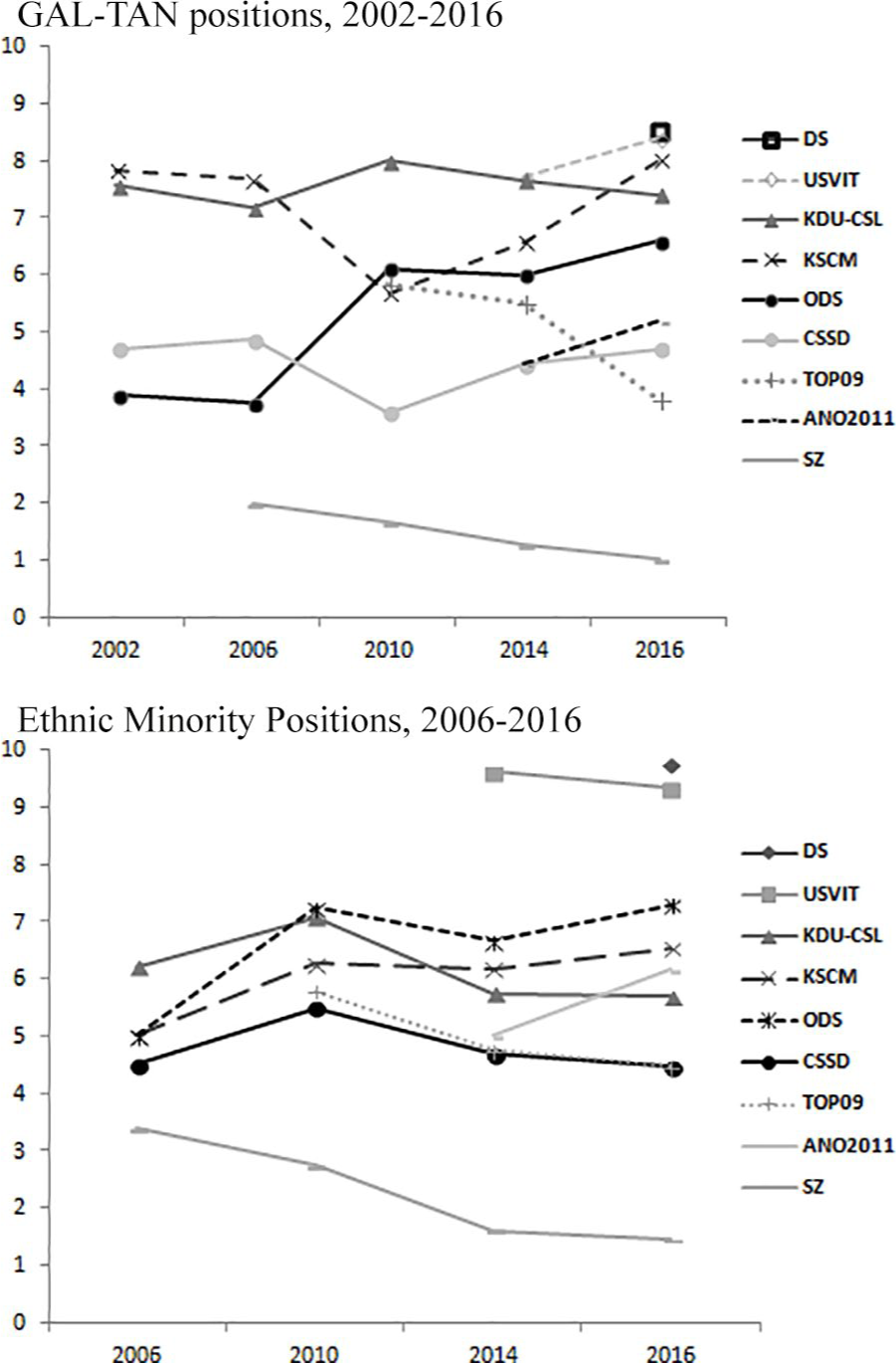
Spatial shifts in the Czech party system (0 = liberal policies; 10 = restrictive policies).
Estonia’s ethnic homogeneity is the lowest of the six cases studied (Table 1). Russian speakers, consisting primarily of Russians but also Belarusians and Ukrainians, represent sizable minorities. Although the ethnic cleavage has not been a defining feature of Estonian politics, the restrictive citizenship policies of the early 1990s, advocated by and adopted with the radical right Estonian National Independence Party in governing coalition, seriously curtailed the rights and status of the Russian-speaking minority. However, 1995 marked the end of the RRPs parliamentary presence, and hence mainstream parties’ positive engagement with it (Auers and Kasekamp, 2009).
Between 2000 and 2015, no RRPs entered the parliament and the party system increasingly stabilized with electoral volatility dropping quite low from the 2000s to the 2010s (Casal Bértoa and Enyedi, 2018). The trend changed when the Conservative People’s Party of Estonia (EKRE) entered parliament in 2015 on the back of a campaign focused on conservative social values and in opposition to the 2014 adoption of the Cohabitation Act. In doing so, it posed competition to the then junior coalition member and until then most socially conservative and nationalist mainstream-right Pro Patria and Res Publica Union (IRL) (which dropped out of coalition in 2014). Indeed, EKRE’s blackmail potential, as it took ownership of and expressed more restrictive positions on IRL’s issues, is arguably behind the rightward shift of IRL along the GAL-TAN scale, although no positive engagement took place between the two parties (Figure 7). On the national level, mainstream parties – including IRL – maintained a cordon sanitaire against EKRE during the studied period. 8
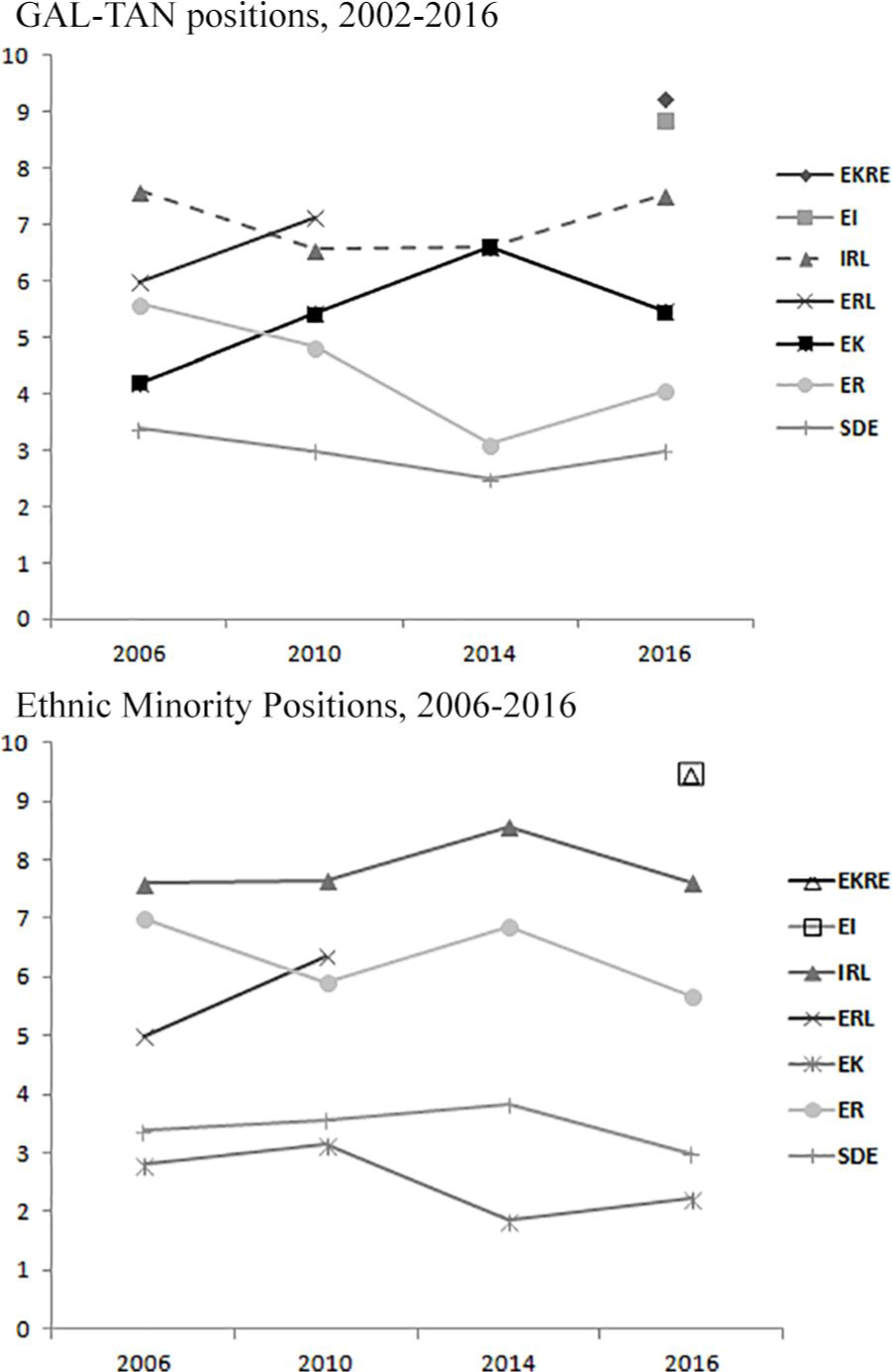
Spatial shifts in the Estonia party system (0 = liberal policies; 10 = restrictive policies).
Conclusion
This article has investigated the impact of radical right parties on mainstream parties’ positions along the GAL-TAN scale, on ethnic and national minorities, and the accompanying signs of depletion of democracy in six East European countries. Our findings suggest that when mainstream parties engage positively with RRPs through cooperation and co-optation, the interaction causes a rightward shift in the mainstream parties’ overall positions and those concerning ethnic and national minorities. This applies clearly to the first group: in Slovakia and Bulgaria, the mainstream left was also open to cooperation with RRPs, and consequently shifted to the right. Government participation, however, did not close the right flank in these countries and new competitors emerged in time.
The second group – Poland and Hungary – also shows such impact but the pattern is different. Instead of just moving to the right due to competition from RRPs, the Polish and Hungarian mainstream right parties (PiS and Fidesz) seem to have transformed into radical right parties themselves. This, however, has not led to the disappearance of far-right competitors. In Poland, the 2015 elections brought a renewal with Kukiz’15 and its partner Ruch Narodowy; the radical right Jobbik party in Hungary also continued to strive for power in the studied period, though it eventually began to moderate. Interestingly, cooperation was not a sine qua non for rightward shifts. As attested to by Hungary, it also took place as a result of co-optation in conjunction with the increasing blackmail potential of the initially extra-parliamentary Jobbik that later established its parliamentary presence as a mid-sized party. Lastly, throughout the studied period, party positions remained overall unaffected in the third group (Czech Republic and Estonia) with electorally marginal RRPs. However, the picture in these nations started to change after 2015, with RRPs gaining traction.
Earlier evidence regarding Eastern Europe indicates that RRP government participation did not result in the mainstreaming of the radical right but instead in the radicalization of the mainstream (Pytlas and Kossack, 2015). Our research suggests that this radicalization can affect both left and right mainstream parties, highlighting the specificity of the East European context where left–right ideological differences are often blurred. Furthermore, our data demonstrate that a party experiencing a rightward shift does not automatically return to its previous position once the RRP loses support or parliamentary presence.
Our findings contribute to the comparative literature on the radical right by confirming that the pattern of interaction between RRPs and mainstream parties lies at the center of any explanatory model of radical-right impact (Van Spanje, 2010; Zobel, 2017). Yet this interaction does not function in a vacuum but must be situated and analyzed in its cultural and politico-institutional context. Below, we evaluate our two propositions along these lines, taking into account the specificities of the party-systems as summarized in Table 1 above.
Periods of high electoral volatility allow new RRPs to enter the political scene and pose new threats to mainstream parties, making them (even) more open to engaging positively with the newcomers or their agenda, resulting in rightward shifts in their positions as illustrated by the case of Poland in 2015 or Slovakia in 2016. Regarding the trajectory of mainstream parties once the initial RRP danger is eliminated, different explanations are required. The openness of the party system in combination with higher electoral volatility might facilitate the appearance of new RRPs, as illustrated by Poland. Considering that rightward shifts have the practical impact of mainstreaming and accentuating the radical right’s exclusionary and divisive discourse which treats a part of the citizenry as unequal based on ethnocultural criteria, it is pertinent to question how it affects the democratic quality of the polity overall.
Generally, the quality of democracy has indeed experienced a decline in Eastern Europe over the past two decades, which – as reflected in Freedom House’s and other democracy indices – by and large coincides with the previously identified periods of RRP impact on mainstream parties’ positions (Figure 8). As we have shown, this is more than a mere coincidence: our analysis strongly suggests that RRPs, in interaction with mainstream parties, have left a mark of ‘democratic depletion’ in these countries by strengthening the ethnocratic approach to ‘government of the people’. While this may not have resulted in autocratic regime change or ‘velvet dictatorships’ (Ágh, 2019: chap. 7), it has certainly paved the way for such a development.
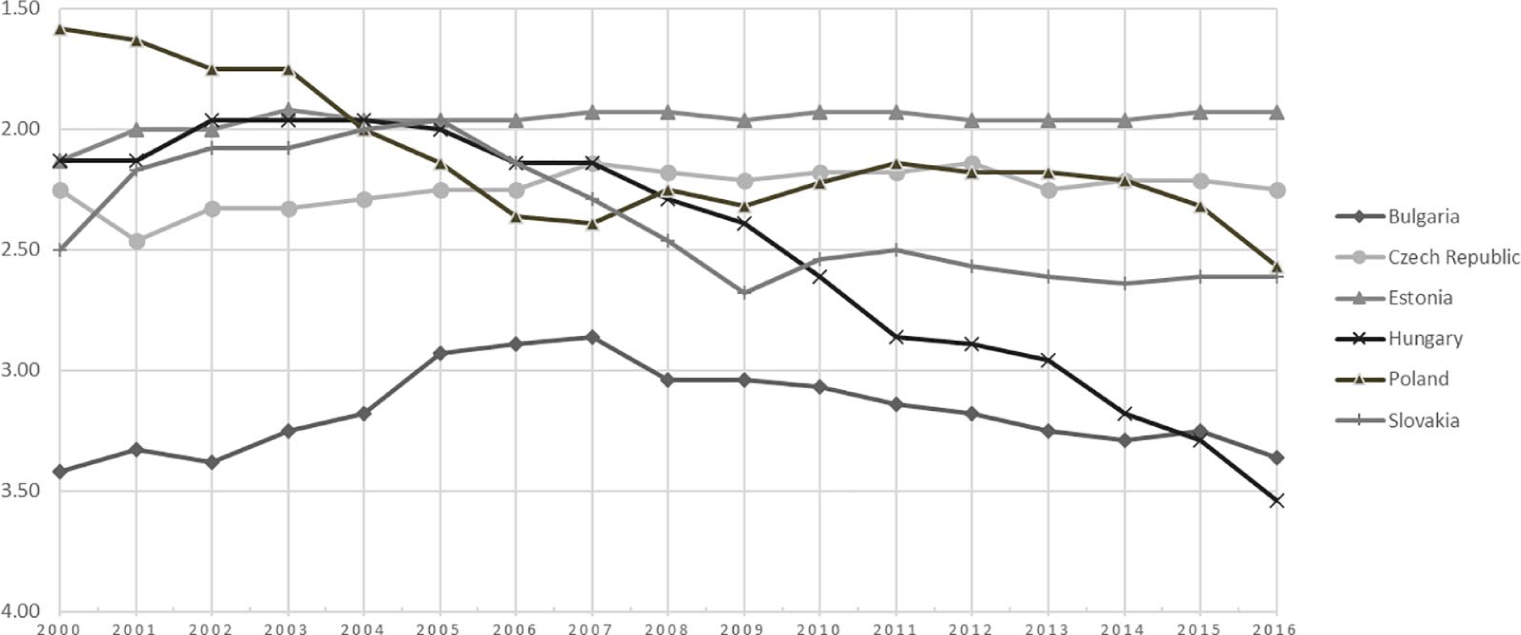
Democracy scores in Eastern Europe, 2000–2016.
As a caveat, the analyses presented in this article are not sufficient to support the argument of an existing connection between the radical right and the overall decline of democratic quality in these countries, as we only trace shifts in party positions without systematically exploring how they translate into an impact on minorities as such. Moreover, neither the measurement used by Freedom House in Nations in Transit nor any other existing democracy-quality indices currently include well-rounded and traceable indicators on the status and rights of minorities. The co-variance, however, opens the potential for further research looking into the connection between the radical right’s impact on minorities’ rights and status via agenda-setting and policy effects and the subsequent impact on democratic quality overall.
Footnotes
Appendix 1
List of party abbreviations.
Bulgaria
Czech Republic.
Estonia.
Hungary.
Poland.
Slovakia.
Acknowledgements
The authors would like to thank Cas Mudde, Andrea Pirro, Bartek Pytlas and the three anonymous reviewers for their valuable feedback; our thanks also go to Franziska Keß and Friedrich Landenberger at European University Viadrina for their assistance in our research.
Authors’ note
An earlier version of the article was presented at the 2017 European Consortium for Political Research (ECPR) General Conference.
Funding
The authors disclosed receipt of the following financial support for the research, authorship and/or publication of this article: This work received financial support from the Fritz Thyssen Foundation (under grant AZ. 10.16.2.003PO).
