




Abstract
This study explores how differing opinions on immigration relate to affective polarization via either moderation or mediation by two factors: (i) emotional attachment to people with similar opinions to oneself; and (ii) perceived threat from people with opposing views to oneself. The data for the study (n = 2,291) were collected from a representative online panel among Swedish-speaking Finns, a setting in which partisan animosity is low and the potential for issue-based polarization is higher. The key findings are that opinions on immigration relate to affective polarization on immigration, and this is mainly as either a moderation or mediation by emotional attachment and perceived threats. Pro-immigration citizens exhibit higher levels of affective polarization than those who are anti-immigration. Furthermore, we find that affective polarization among anti-immigration citizens is mainly moderated and mediated by perceived threat whereas it is mainly moderated and mediated by emotional attachment for those who are pro-immigration.
Keywords
Introduction
A major surge in research on affective polarization has been evident in recent years. The first, and influential, wave of this research focused on the United States and how the parties and partisanship constitute bases of affective polarization (e.g., Druckman and Levendusky, 2019; Iyengar et al., 2012). This type of affective polarization has increased substantially over time in the United States (Iyengar et al., 2019). Studies from other contexts also followed suit by studying party-directed and partisan-directed affective polarization in Europe (e.g., Gidron et al., 2023; Harteveld, 2021; Kawecki, 2022; Kekkonen et al., 2022; Reiljan, 2020; Wagner, 2021). However, thus far, affective polarization has mainly been explored from a social identity perspective (Tajfel, 1982) whereby parties form identifiable social groups towards which people feel an attachment, or resentment as an in-party/out-party mechanism (Iyengar et al., 2012; Mason, 2018). The importance of the parties for self-identity is both evident and far driven in the United States where people are even internalizing their party identities as important parts of their self-concept (West and Iyengar, 2022). However, the increased salience of issue-based political identities (Hobolt and Tilley, 2025) give reason to study affective polarization also from a perspective beyond political parties.
Strong issue positions, notably regarding salient issues, have been found to drive affective polarization in many contexts (Filsinger and Freitag, 2024; Harteveld, 2021; Herold et al., 2023; Hobolt et al., 2021). Especially in multiparty systems, where policy issues tend not to be as heavily party-branded as in the United States, issue-based opinion camps can form independently of parties and partisanship and potentially give rise to processes of affective polarization. Thus, citizens form psychological groups around opinion positions, either due to the nature of certain issues (Harteveld, 2021; Herold et al., 2023) or due to issue salience at a given moment (Hobolt et al., 2021; Simonsen and Bonikowski, 2022). Even in the United States, scholars have debated whether the parties per se, or the issue opinions which they stand for, are the main drivers of affective polarization (e.g., Dias and Lelkes, 2022; Orr et al., 2023). Often issues in the United States tend to have become ‘party branded’ over time which makes it trickier to discern whether it is the party or their position on an issue that people like, or dislike (Orr et al., 2023). In European multiparty systems, issue ownership is further complicated as it often overlaps several parties (Kristensen et al., 2023). Within European multiparty systems, the last decades have also seen the rise of a value-based division centred around so-called cultural issues − such as immigration, European integration and multiculturalism (Helbling and Jungkunz, 2020). Consequently, given this increasing and stark division in opinions into effectively a value-liberal and value-conservative opinion camp (e.g., Hooghe et al., 2002), people may exhibit mechanisms of in-group and out-group thinking based on their issue-positions regardless of whether these are ‘owned’ by parties or form the basis of social identities or not (Devine, 2015; Hobolt et al., 2021; Mason, 2018; Röllicke, 2023).
This study adds to the research on how opinion divides regarding political issues relate to affective polarization by examining issue-based affective polarization on immigration. We specifically study how Finnish citizens, living in a multiparty setting, with differing views on immigration exhibit affective polarization on that issue. We define affective polarization as ‘the gap between an individual’s positive in-group affect and their dislike for the out-group’ (Iyengar and Wagner, 2025: 47) Specifically, we seek to study whether and how issue opinions on immigration are associated with individual-level affective polarization. This study thus empirically explores these mechanisms of in-group and out-group thinking around opinions on immigration and their connection to affective polarization on immigration. We specifically adapt theories of emotional attachment to in-groups (Devine, 2015; Greene, 2004; Mael and Tetrick, 1992; Mason, 2018) and perceived threats from out-groups (Hellmann et al., 2022; Renström et al., 2022; Stephan and Stephan, 2018) to analyse issue-based affective polarization in relation to not only immigration opinions, but to immigration opinions in interaction − as either moderation or mediation − with emotional attachment to those that think likewise as oneself, and perceived threats from those with opposing views to oneself (see Berntzen et al., 2024: 944; Hobolt et al., 2021). While earlier literature on issue-based affective polarization tends to centre on the same core elements − that is, opinion on an issue, in-group evaluation and differentiation from out-group − few have systematically explored empirically how these interrelate.
Issue positions and affective polarization
Albeit that affective polarization may stem from various sources, a commonality is that it requires some form of division into real (Iyengar et al., 2012; Röllicke, 2023) or perceived groups (Harteveld, 2021; Schedler, 2023) that develop dislike towards each other. That division may be regarding parties, partisans or citizens with different opinions on policies. The last of these is a form of horizontal dislike between citizens which many view as a form of affective polarization (e.g., Harteveld, 2021; Hobolt et al., 2021; Röllicke, 2023). But why, and how do issue positions potentially relate to affective polarization?
Obviously, there is no denying the importance of party cues in (partly) driving opinions on specific issues (Dias and Lelkes, 2022; Orr et al., 2023). Regarding immigration opinions, the role of right-wing populist parties in championing opposition to immigration has been evident in Europe in the last decade (Gidron et al., 2023, Harteveld, 2021). Nevertheless, beyond populist parties, parties are not as clear-cut markers of opinions in Europe as they are in the United States (Röllicke, 2023). Thus, although issue opinions may not always be party branded, they nevertheless tend to give rise to group-based thinking and mechanisms akin, but not necessarily equal (see Hobolt et al., 2021; Röllicke, 2023), to those depicted in social identity theory (Tajfel, 1982). A chief departure from said theory, is that people with differing views on societal issues − that is, opinion camps (Hobolt et al., 2021) − are not pre-existing identifiable social groups in society. Rather, these constitute fluid and constantly reconstructed objects of emotional attachment (Röllicke, 2023), identity (Mason, 2018) and differentiation from ‘those with opposing views’ (Hobolt et al., 2021). Thus, when identification with an opinion becomes stronger for people, and thus also more important for people (Kustov, 2023), they tend to have the most bearing for affective polarization.
This was evident during the Brexit referendum in the United Kingdom where people were forced to take sides and started to exhibit feelings of identity with their own opinion group (Leaver or Remainer) and prejudice and animosity towards the opposing side (Hobolt et al., 2021). Similar patterns where also found regarding attitudes on COVID-19 pandemic vaccines in several European countries (Filsinger and Freitag, 2024). Thus, significant societal events may give rise to opinion-based affective polarization. The same mechanism can occur, Hobolt et al. (2021: 1489) argue, without such events if certain political issues are sufficiently salient and divisive. Harteveld (2021, see also Simonsen and Bonikowski, 2022) furthermore argues that so-called cultural issues such as immigration tend to be associated with greater loathing of those with opposing views than economic issues are (see also Herold et al., 2023). One reason for this turning into affective polarization is that cultural issues tend to become about a deep sense of moral conviction, about good and bad, right and wrong (Schedler, 2023; Simonsen and Bonikowski, 2022). This makes it harder to find an acceptable middle ground. Furthermore, as discussed earlier, cultural issues have been at the heart of the populist rhetoric in Europe which exacerbates divisions on such issues (Gidron et al., 2023; Harteveld, 2021; Helbling and Jungkunz, 2020).
A further way in which opinion positions become relevant for affective polarization is when division on certain salient issues has been sustained for a long time and the respective opinion camp become what Schedler (2023: 244) calls ‘opposing imagined communities.’ Röllicke (2023) similarly discusses how diffuse politicized social identities such as ‘feminists’ may become objects of dislike between citizens either identifying as one or being opposed to that group. Thus, it does not necessarily matter whether there is a real organized political group around such an issue, the mere labelling of people according to their opinion on sustained divisive issues leads to people forming mental images of such people and consequently a process of in-group like and out-group dislike may occur (Comellas and Torcal, 2023). Within the United States context, for instance, the terms ‘liberals’ and ‘conservatives’ have become very salient social labels to the extent that the label itself creates feelings of belonging and resentment (Mason, 2018: 885; see also Devine, 2015). Mason (Mason, 2018: 867) even argues that Americans nowadays mostly disregard the policy opinions represented by these labels when forming feelings of ‘us’ and ‘them’ towards these labels.
Within a European context, the terms ‘liberals’ and ‘conservatives’ have not necessarily been used outright to describe people with certain sets of opinions, but we would argue that the latest decades have certainly seen a similar psychological cleavage emerge among citizens and parties alike (Helbling and Jungkunz, 2020; Renström et al., 2021). Hooghe et al. (2002) summarize this division through their classification of the main European attitudinal division as one between green, alternative and libertarian (GAL) and traditionalist, authoritarian and nationalist (TAN) opinions. 1 Later studies (e.g., Helbling and Jungkunz, 2020; Simonsen and Bonikowski, 2022) have demonstrated that the main attitudinal division in contemporary Europe concerns the socio-cultural issues of immigration and European integration. It appears, then, that many European societies are divided into ‘two opposing imagined communities’ (Schedler, 2023) of value-liberals and value-conservatives, and that opinions on immigration have become signposts, or brands, for these politicized social identities (Renström et al., 2021: 555).
Based on the discussion thus far, we expect that divisions in immigration opinions and the associated identification with one’s opinion camp will relate to people’s feelings of affective polarization so that people holding stronger opinions towards either opinion camp (pro or anti) on immigration, are more affectively polarized:
H1: The stronger an individual’s opinion on immigration is, in either pro-direction or anti-direction, the more it relates to individual-level affective polarization concerning immigration.
Emotional attachment to those with similar opinion
Thus far we have argued that issue opinions may give rise to processes of in-group and out-group differentiation (Berntzen et al., 2024: 944). In this section, we shed further insight into the former part of that process, in-group identity or attachment. Regarding this, scholars of social-identification and partisan-identification (e.g., Comellas and Torcal, 2023; Devine, 2015; Greene, 2004; Hellmann et al., 2022; Huddy et al., 2015) all point to the same aspect as being important for attitudinal and behavioural effects; the strength, or intensity, of the feeling of identity or the attachment. Thus, either being Democrat or Republican, Liberal or Conservative or pro-immigration or against immigration is conceptually different from also feeling a strong attachment to those groups (Devine, 2015: 14). Thus, what matters is not only feeling part of something, but especially what value and significance you place on being part of that something (Devine, 2015: 512). This is often referred to as an identification with, or emotional attachment to, a psychological group and entails ‘a feeling of oneness with a defined aggregate of persons, involving the perceived experience of its successes and failures’ (Mael and Tetrick, 1992: 814).
The core argument in the literature is thus simple, but compelling. The more attached you feel to something the more personal and important it becomes to you, and the more it affects your emotions, your opinions and your behaviour (Devine, 2015; Huddy et al., 2015). This has a bearing on how people regard those who are ‘like them’ or ‘different from them.’ Greene (2004: 138) argues that ‘A stronger partisan social identity should lead to greater differentiation between the parties [. . .].” Likewise, Devine’s (2015: 530) findings show that the intensity of psychological attachment to a symbolic ideology conditions the effect that this ideology has on feelings and behaviour. Comellas and Torcal (2023) similarly demonstrate that affective attachment to ideological labels has a more profound impact on affective polarization than issue extremity or consistency have. Thus, people with the strongest attachment tend to display the strongest positive emotions towards their own group and strongest negative emotions towards their out-group. While most of the above-mentioned studies concern partisan identity, which are arguably very well-defined ‘aggregates of persons’ (Mael and Tetrick, 1992), Hobolt et al. (2021; see also argumentation in Filsinger and Freitag, 2024; Röllicke, 2023) have demonstrated that people internalize belonging to less well-defined groups such as opinion camps in a similar way and that this has implications for affective polarization between such perceived groups.
Naturally, both an issue opinion, and the emotional attachment to those with a similar opinion as oneself, are closely related (e.g., Hobolt et al., 2021). Thus, it is hard to be attached to an opinion group without having an opinion in the first place, but we would also argue that having an opinion on an issue does not mean that all that share an opinion are emotionally attached with the same intensity. Albeit that scholars agree that attachment and affective polarization are linked, the relationship between the two is complex and there is uncertainty on the exact role of attachment for affective polarization. Scholars using strict social identity theory as a basis (e.g., Filsinger and Freitag, 2024) mostly see identification as the next step from opinion formation which then leads to affective polarization, others (e.g., Hobolt et al., 2021) merely acknowledge the association but do not depict the exact mechanism. It is thus yet unclear whether emotional attachment alters the strength of the association (moderates) between issue opinions and affective polarization or is situated as a link between issue opinion and affective polarization (mediator). This is arguably an empirical puzzle to explore. Therefore, it is important to analyse whether and how the emotional attachment to one’s (objective) ingroup relates to the association between issue opinion and level of affective polarization. Thus, we explore the following hypotheses:
H2a: The strength of emotional attachment to people with similar opinions on immigration moderates the relation between immigration opinion and individual-level affective polarization regarding immigration, so that stronger attachment is related to stronger affective polarization.
H2b: The strength of emotional attachment to people with similar opinions on immigration mediates the relation between immigration opinion and individual-level affective polarization regarding immigration, so that stronger attachment is related to stronger affective polarization.
Perceived threat from people with opposing views
According to Röllicke (2023: 12), the thing that separates affective polarization from neighbouring concepts is the co-occurrence of both in-group and out-group evaluations which together create an evaluative bias. The final key component of affective polarization is thus the dislike that people feel towards other people that they regard as part of their out-group − or as having opposing opinions to themselves. Sometimes, the assessment of ‘the other’ is even considered the main component of affective polarization (e.g., Druckman and Levendusky, 2019; Gidron et al., 2023; Mason, 2018: 867) to the extent that some scholars even equal affective polarization with ‘[. . .] antipathy between citizens with opposing political views’ (Harteveld, 2021: 1).
In theories about intergroup relations, threat perception is often regarded as central to how people perceive other people, or groups of people (e.g., Stephan and Stephan, 2018; Stephan et al., 1998). Typically, threats are either symbolic − that is, a threat to core values, morals, culture and beliefs − or realistic threats which concern economic-related, physical-related and health-related well-being (Hellmann et al., 2022: 333; Stephan et al., 1998: 560–561). Perceived threats tend to give rise to negative emotions and negative cognitive appraisal towards those that are perceived as threatening (Stephan and Stephan, 2018). While threat perception is obviously tied to how strongly people feel attached to their in-group or to people with similar opinions as themselves (Hellmann et al., 2022: 332; Hobolt et al., 2021; Renström et al., 2022), it is also potentially a factor that in itself relates to affective polarization. Essentially, as Renström et al. (2022: 3) argue, people with similar ideological position and similar in-group attachment should vary in their level of affective polarization due to differences in perceived threat from their out-group (see also Renström et al., 2021; West and Iyengar, 2022: 810). When it comes to the role of threat perception concerning differences in opinions on immigration specifically, threat attribution tends to spill over onto those seen as responsible or as proponents of a specific opinion (Renström et al., 2022: 2; see also Harteveld, 2021). Essentially, we thus regard threat perception as indicative of the intensity of how worried people are about the ‘other side’ which, consequently, spills over into how much they dislike the other side. Based on these arguments, we will explore the following two hypotheses:
H3a: The strength of perceived threat posed by those with opposing opinions moderates the relation between immigration opinion and individual-level affective polarization regarding immigration, so that higher perceived threat is related to stronger affective polarization.
H3b: The strength of perceived threat posed by those with opposing opinions mediates the relation between immigration opinion and individual-level affective polarization regarding immigration, so that higher perceived threat is related to stronger affective polarization.
Summary of framework and analytical model
Considering the aspects that we have discussed thus far, it seems probable that differences in issue opinions may relate to affective polarization. As we have argued, this is likely to occur when issues become salient in society, or personally important for people (see Kustov, 2023). Furthermore, the strength of this relationship is expected to vary according to how much people feel an attachment to those with similar opinion as themselves and according to the extent to which they feel that those with opposing opinions pose a threat. Together, these aspects form two analytical models for the study, one for moderation and one for mediation (Figures 1 and 2).
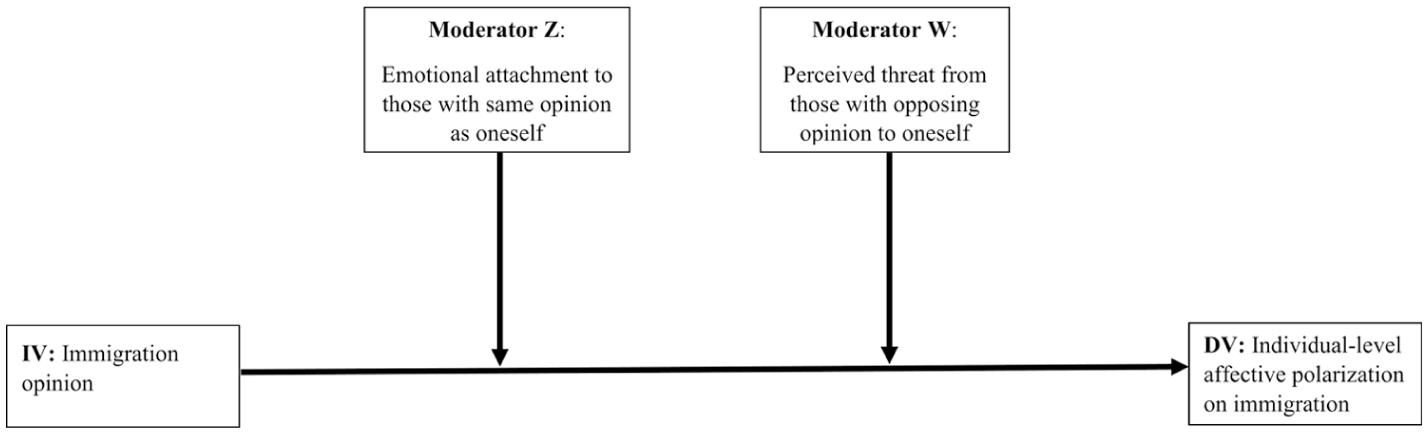
Analytical moderation model.
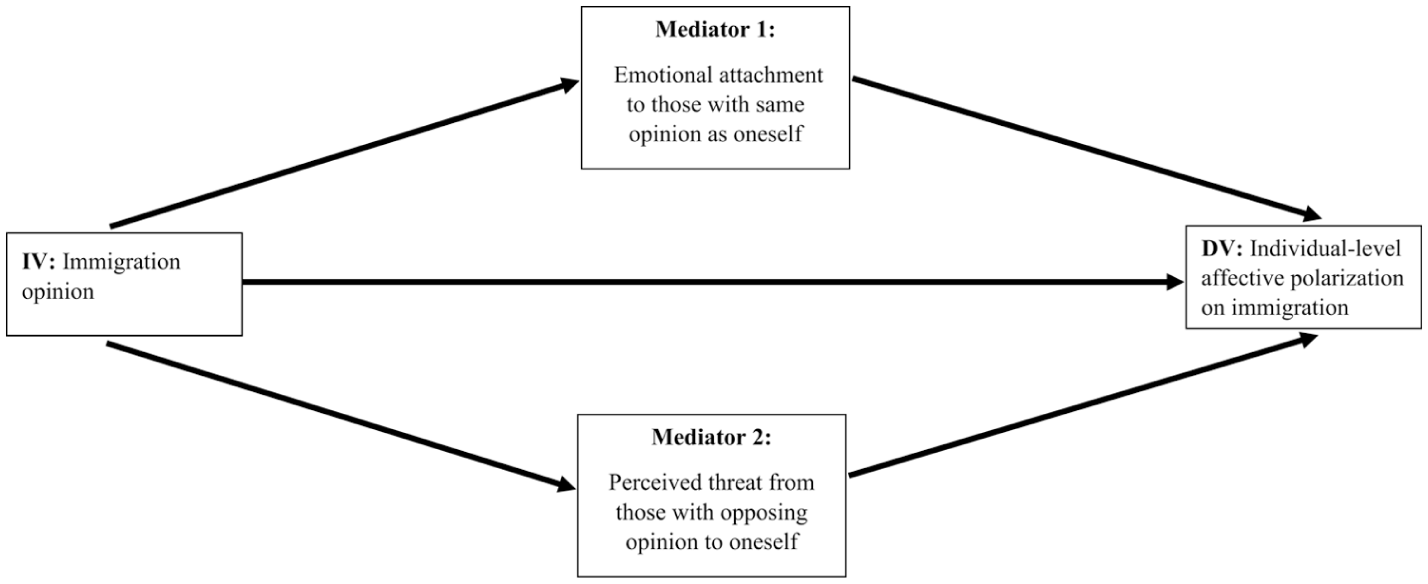
Analytical mediation model.
Methods, data and operationalizations
Methods and data
The study has been pre-registered 2 at the Open Science Framework (https://doi.org/10.17605/OSF.IO/AWF5G). The data were collected via an online survey in the Barometern-panel, which is recruited using probability-based sampling. The panel’s population consists of Swedish-speaking Finns aged 18 years and above. This panel is part of the Finnish Research Infrastructure for Public Opinion. The survey used for this study was an online questionnaire in the field from 10th June to 23rd June 2024. This survey was distributed as a simple random sample to a total of 4,500 by e-mail (59% of the total panel population), and after one reminder the total amount of respondents was 2,291 (51% response rate). All descriptive analyses are done using weighted data (anesrake-package v. 0.80 for R) for gender, age, region and education level to be representative of the Swedish-speaking minority in Finland (see Online Appendix Table A1).
The use of the Swedish-speaking minority in Finland as context has noteworthy implications for this study of issue-based affective polarization. Although part of the Finnish multi-party system, over 70% of Swedish-speaking Finns typically vote for one party, the Swedish People’s Party (SPP). The Swedish language is thus a common denominator for Swedish-speaking voters and, besides protecting the language minority, the SPP has a broad ideological outlook. Swedish-speaking Finns thus focus much less on political parties and more on issues. The political context is very consensus-oriented, even more than the already very consensus-oriented broader political landscape in Finland. Finally, the level of partisan hostility is comparably low among Swedish-speaking Finns (Berg et al., 2025, c.f. Kawecki, 2022). As a context, then, the Swedish-speaking Finns are suitable for the study of issue-based affective polarization as the confounding effects of party-directed and partisan-directed affective polarization are weak. Thus, the case is akin to a most-likely-case for the study of affective polarization which might have repercussions on the ability to generalize from our findings.
Independent variable
Immigration opinions were measured by this survey question: ‘Below is a list of statements about the development of certain issues in Finland. Please indicate for each of the statements whether you agree or not.’ The statement regarding immigration read as follows: ‘Immigration to Finland should increase substantially.’ The response scale was: (i) completely disagree; (ii) partially disagree; (iii) partially agree; (iv) completely agree; and (v) neither disagree nor agree. Obviously, this is a crude measure as we have no way of knowing precisely what type of immigrants, or aspect of immigration, that respondents have in mind when answering the question. In our weighted sample: 393 (19%) respondents completely disagreed; 429 (21%) partially disagreed; 195 (9%) neither agreed nor disagreed; 791 (38%) partially agreed; and 269 (13%) completely agreed with the statement (Figure A1 in the Online Appendix visualizes the distribution). While the distribution is leaning more towards the pro-immigration camp, there is a fair spread of opinions on immigration, and this spread is like that of the general Finnish population (Finnish Business and Policy Forum (EVA), 2023). Nonetheless, part of the pro-immigration bias likely stems from biases in the Barometern-panel’s population. As in most survey-based research (Lundmark and Backström, 2025), there is an over-representation of women, highly-educated people living in cities in the Barometern-panel’s population and people who are likelier to hold more liberal views. For the moderation and mediation analyses, we exclude respondents with neutral opinions (‘neither disagree nor agree’). This is because the moderators and mediators presuppose that respondents identify with a clear opinion position on immigration. For neutral respondents, there is no meaningful ‘in-group’ or ‘out-group’ to anchor attachment or threat perceptions. Nonetheless, we provide in Online Appendix Table A2 basic descriptives for neutral respondents regarding the applicable key variables used in our analysis.
Moderators and mediators
In measuring emotional attachment (Moderator Z; Mediator 1), we followed other studies (e.g., Devine, 2015; Greene, 2004; Hobolt et al., 2021; Mason, 2018) and adapted measures of organizational attachment (see Mael and Tetrick, 1992). Thus, we used six items with statements describing people’s attachment to those who are anti-immigration, and six identical items describing attachment to those who are pro-immigration (see Online Appendix Figure A1 for the distribution and Online Table A3 for items and descriptives). For example, the pro-immigration set included ‘I feel a sense of belonging with people who are in favour of immigration.’ The equivalent item for the anti-immigration set was ‘I feel a sense of belonging with people who are against immigration.’ A standardized measure (ranging between 0 and 1) was then constructed. This was done by averaging the items for opinions on people who are anti-immigration for the respondents who were anti-immigration themselves and, vice versa, by averaging the items for opinion on people who are pro-immigration for the respondents who were pro-immigration themselves. This entails that the index for emotional attachment considers each respondent’s own opinion so that the measure is comparable across respondents regardless of their immigration opinion. The reliability of the emotional attachment index was high (Cronbach’s α = 0.87 for pro-immigration items; α = 0.82 for anti-immigration items).
For our measurement of perceived threat (Moderator W; Mediator 2), we follow other studies (e.g., Hellmann et al., 2022; Renström et al., 2021, 2022) and adapt items from the integrated threat theory (Stephan and Stephan, 2018). We specifically use survey items that measured perceptions of threats − either symbolic or realistic threats 3 − represented by people having a certain opinion on immigration. In total, there were six items describing threats from those with anti-immigration opinions and, likewise, six items describing threats from people with pro-immigration opinions (see Online Appendix Figure A1 for the distribution and Online Table A4 for items and descriptives). For example, the pro-immigration set included ‘People who are against immigration create a threatening atmosphere in Finland.’ The equivalent item for the anti-immigration set was ‘People who are in favour of immigration contribute to an increase in crime in Finland.’ It should be noted, albeit that similar measures of threat perception have been used in several other studies before (Hellmann et al., 2022; Renström et al., 2021, 2022; Stephan et al., 1998), that these capture perceived threats more on a societal level than towards the respondent’s own opinion group directly. Finally, we constructed a standardized scale (from 0 to 1) which considers respondents’ own immigration opinion so that pro-immigration respondents assess perceived threats from anti-immigration people and, vice versa, anti-immigration respondents assessed perceived threats from pro-immigration people. The reliability of the perceived threat index was high (Cronbach’s α = 0.92 for pro-immigration items; α = 0.93 for anti-immigration items).
Dependent variable
The dependent variable, individual-level affective polarization on immigration (Y), is operationalized as two distinct measures. We use a feeling thermometer where respondents rate their feelings towards someone who is anti-immigration and someone who is pro-immigration (see Harteveld, 2021; Herold et al., 2023), respectively, on a scale between 0 and 100 (c.f. Gidron et al., 2023; West and Iyengar, 2022). Feeling thermometers typically give an impression of general sympathy and antipathy (Röllicke, 2023: 4). Thus, as a complementing measure, we also use a so-called social-distance measure of affective polarization (e.g., Druckman and Levendusky, 2019: 115–116; Mason, 2018). Social-distance measures are better at capturing intended behaviour (Röllicke, 2023: 4). In these survey items, respondents were asked, on a scale from 1 to 7, how comfortable they would be being close friends with someone who is anti-immigration or pro-immigration, respectively (see Online Appendix Figure A1 for the distribution and Online Table A5 for the descriptives for both measures). Considering each respondent’s own position on immigration, individual-level affective polarization scores were then constructed by subtracting their score for those with opposing opinion from their score for those with similar opinion as themselves. The final measures for both the feeling thermometer (APtemp henceforth) and the willingness to be a friend (APfriend henceforth) both range from −1 to 1 where 1 stand for maximum affective polarization. 4
Covariates
The moderation and mediation analyses use three demographic covariates − gender, age and education level − as well as two attitudinal variables: left−right self-placement; and the degree of dislike towards the right-wing populist party, the Finns Party. Harteveld (2021) remarks that the immigration issue is often ‘owned’ by right wing populists so this might confound the findings. Furthermore, as the Finns Party is the only severely disliked party among Swedish-speaking Finns, that aspect could also confound the findings.
Findings
We start by showing descriptive findings for the two moderators/mediators and the two measures of affective polarization (Table 1).
Average level of emotional attachment, perceived threat and dependent variables by immigration opinion.
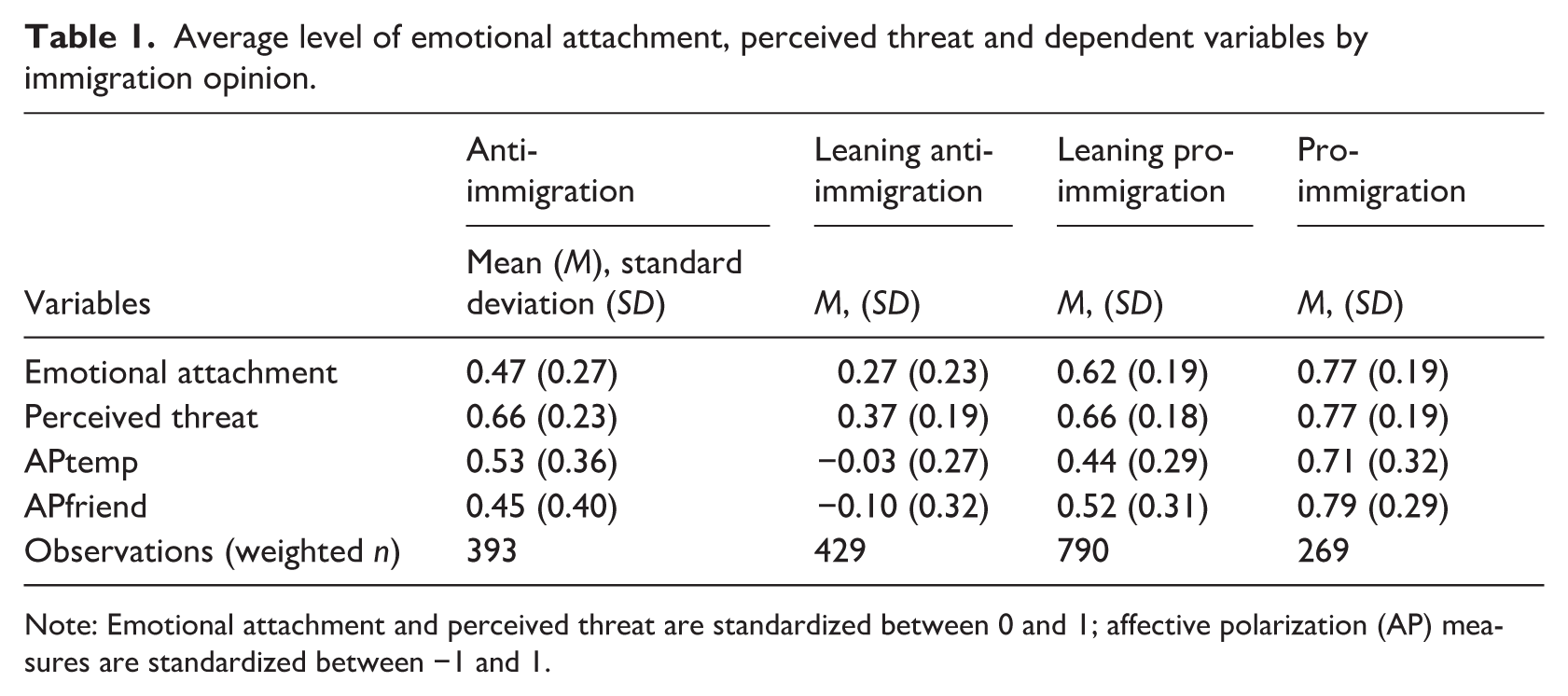
Note: Emotional attachment and perceived threat are standardized between 0 and 1; affective polarization (AP) measures are standardized between −1 and 1.
A pattern that emerges in Table 1 is that people who are pro-immigration tend to have higher levels of both moderators/mediators and on the two measures of affective polarization. A further notable pattern is that the stronger opinions people have on immigration, in either direction, the higher their levels on both moderators/mediators tend to be and the higher their levels of affective polarization are (all mean differences between groups are statistically significant). 5 This supports the U-shaped expectation of H1. An interesting observation, though, is that pro-immigration respondents have higher affective polarization than anti-immigration respondents on both measures.
We then turn to the moderation and mediation analyses. These were carried out using the Process Macro version 5.0 (in R) model 2 for moderation and model 4 for mediation (Hayes, 2022). The analyses used robust standard errors (Cribari-Neto control). The analyses used bootstrapping for 5,000 samples. The moderators were mean-centred. Since the models can only be run for respondents with values on all variables, the analyses are run on slightly reduced samples (n = 1,560 in the moderation/mediation analysis for APtemp and n = 1,585 for APfriend respectively). 6 The statistical power is nonetheless good with the ability to detect small effect sizes (0.02) at alpha = 0.05 with power = 0.99 (calculated with GPower 3.1.9.7 for linear multiple regression). Figures 3 and 4 present the findings of the moderation and mediation models for the APtemp measure (the regression tables in Online Appendix Tables A8 and A9, and incremental sensitivity analysis without controls is presented in Online Table A10).
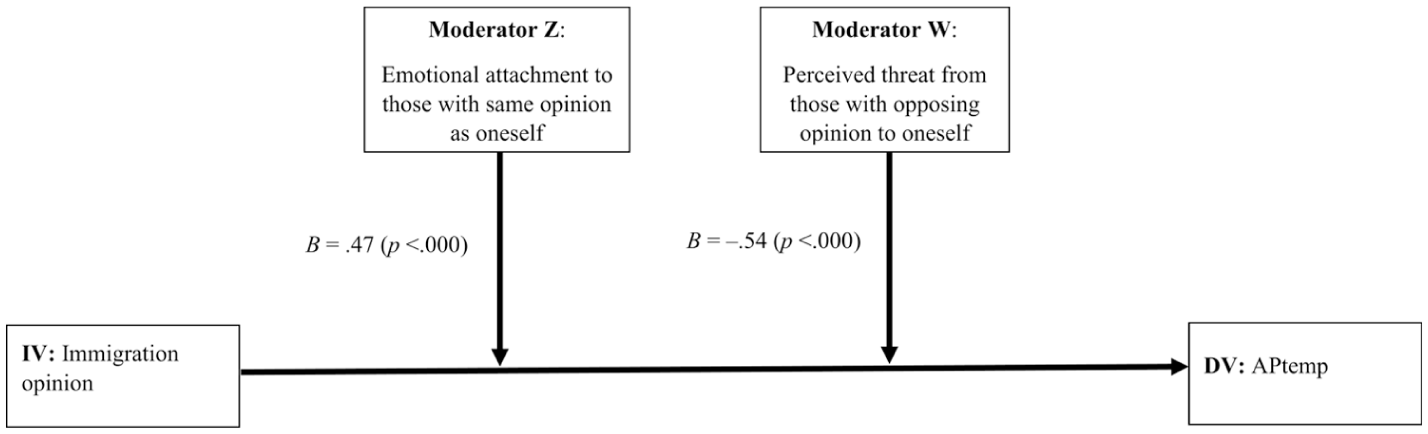
Results of moderation analysis for individual-level affective polarization, measured as APtemp.
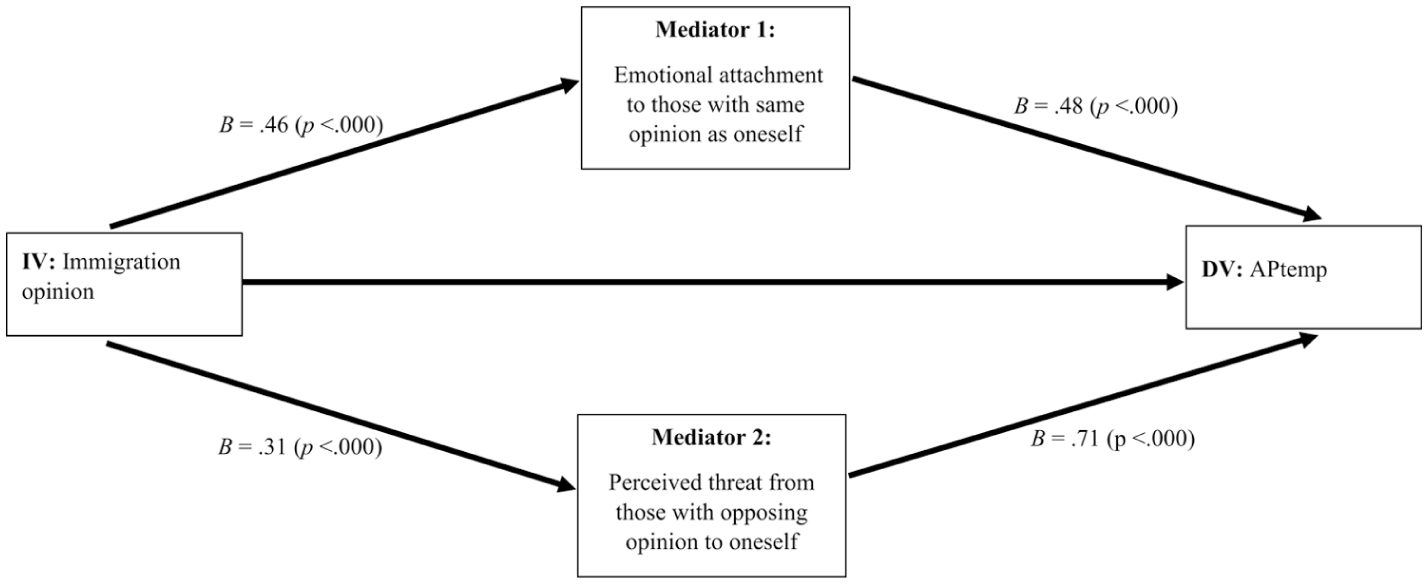
Results of mediation analysis for individual-level affective polarization, measured as APtemp.
The overall moderation model is significant at p < 0.000 with the R-squared value of explained variance at 0.52. There is no unconditional direct effect from the independent variable to the dependent, as that effect is conditional on the moderators being at certain values (Online Appendix Table A11). The overall mediation model is also significant at p < 0.000 with R-squared value of explained variance at 0.51. The total effect is 0.44 and the indirect effects are 0.22 for emotional attachment and 0.22 for perceived threats. Thus, there is no significant direct effect of X on Y, only the indirect mediated effects. The lack of direct effects in both models signify that Hypothesis 1 is only partially confirmed for APtemp. Nevertheless, both moderators have significant interaction effects with immigration opinion in relation to APtemp as do both mediators. This confirms Hypothesis 2a, 2b, 3a and 3b. To better interpret the moderation effects, Figure 5 provides visualizations.
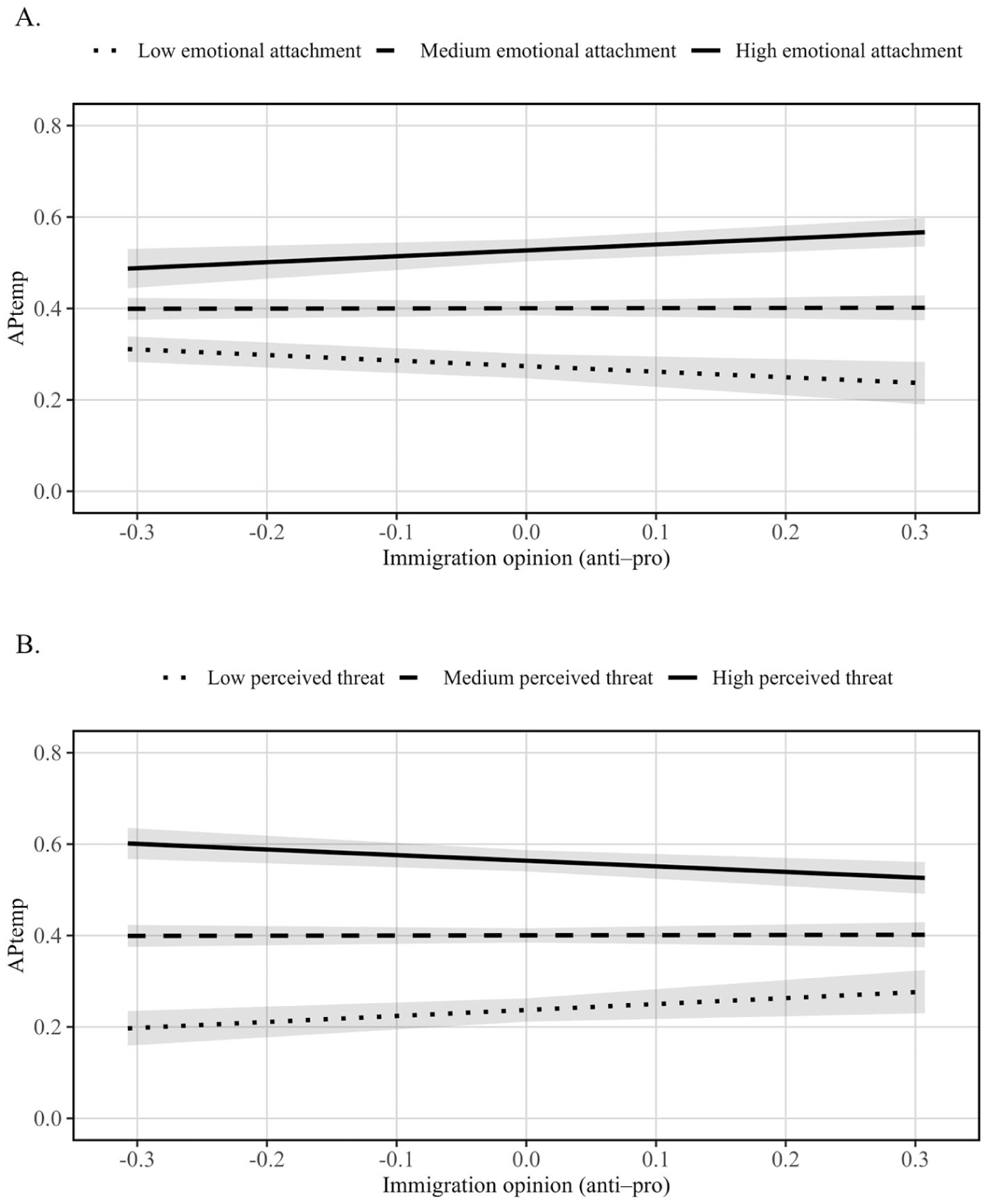
Significant conditional effect of immigration opinion (X) on APtemp (Y1) as moderated by (a) emotional attachment (Z) and (b) perceived threat (W).
The moderation effect of emotional attachment to those with similar opinion as oneself (Z) is evident both for people who are anti-immigration and those who are pro-immigration, but the effect is stronger the more positive opinion one has on immigration. Thus, higher emotional attachment amplifies affective polarization on immigration both for people who are anti-immigration and pro-immigration, but this amplifying effect is stronger, that is, the gaps between the slopes are larger, for people who are pro-immigration. The moderation effect of perceived threats from those with opposing opinion to oneself (W), on the other hand, works in the opposite direction whereby higher levels of perceived threat augments affective polarization across the opinion range, but the augmenting effect is here more profound (larger gaps between the lines) the more negative opinion one has on immigration. We continue by showing the visualization of the mediations, according to immigration opinions, in the b-path of the mediation model for APtemp, in Figure 6.
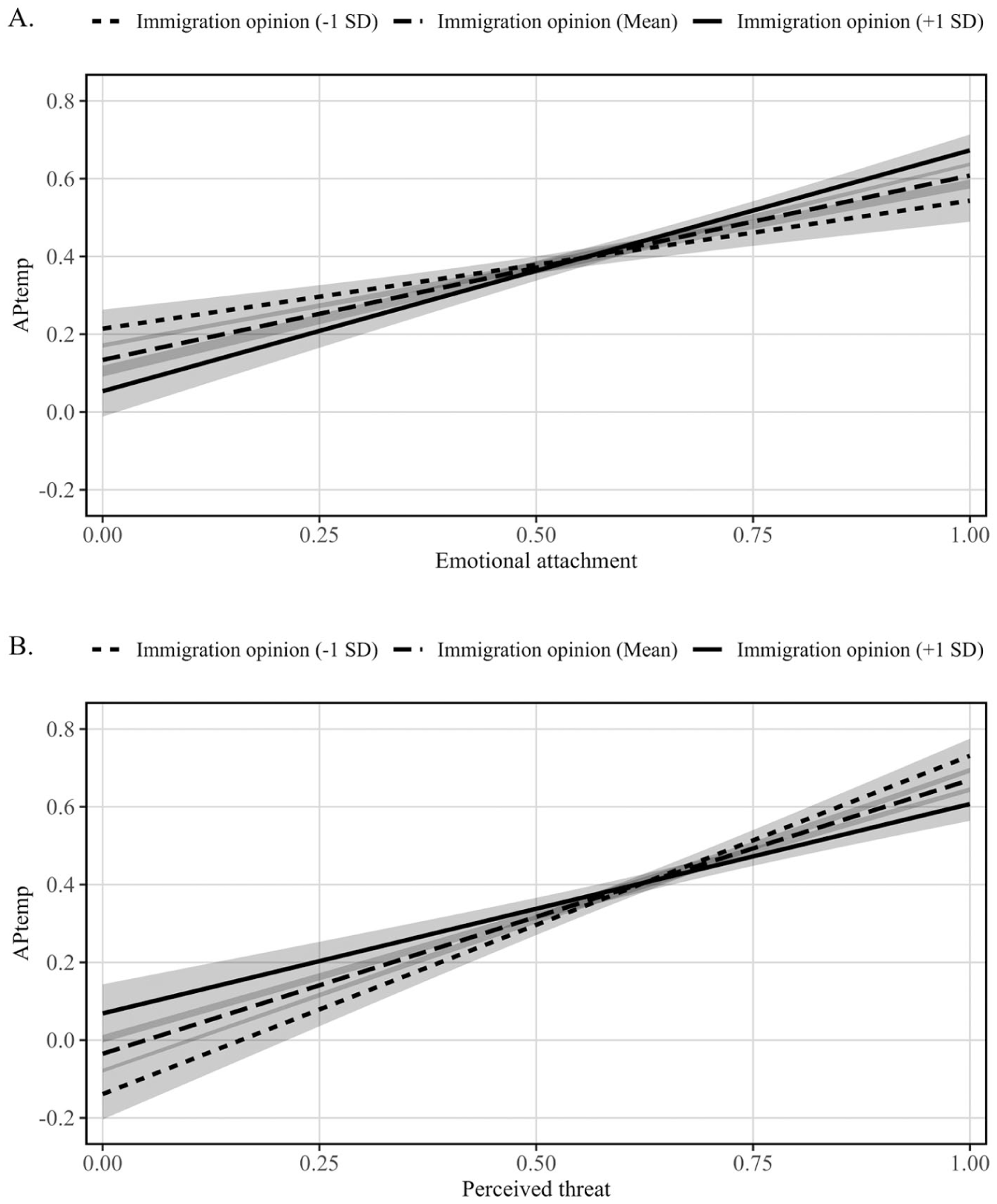
The effect of mediator emotional attachment on APtemp (path b in mediation model), according to immigration opinion.
The visualization for emotional attachment according to immigration opinion (A-panel) shows that the mediator’s effect is stronger for pro-immigration respondents (+1 standard deviation (SD) slope is steeper) but also clear for anti-immigration respondents (–1 SD slope is weaker in slope). The corresponding visualization for perceived threats (B-panel) shows less differences according to immigration opinion in the mediator’s effect. A tendency that the mediator’s effect is stronger for anti-immigration than for pro-immigration respondents is nonetheless discernible.
We continue by providing the findings of the moderation and mediation analyses for the second measure of individual-level affective polarization, APfriend, in Figures 7 and 8 (the regression tables in Online Appendix Tables A12 and A13, and incremental sensitivity analysis without controls is presented in Online Table A14).

Results of moderation analysis for individual-level affective polarization, measured as APfriend.
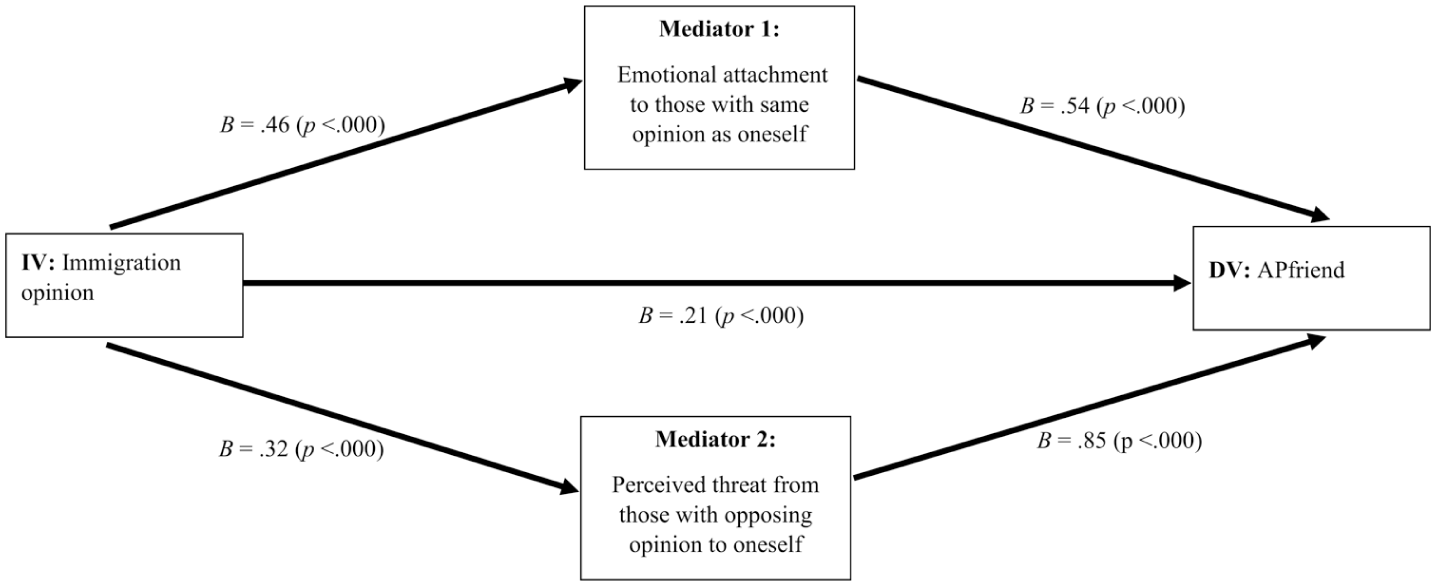
Results of mediation analysis for individual-level affective polarization, measured as APfriend.
The overall moderation model is significant at p < 0.000 with the R-squared value at 0.64. In contrast to the previous moderation model, there is a significant positive unconditional direct effect from immigration opinion to APfriend. Thus, regardless of the values on the moderators, the more pro-immigration one is the higher the level of affective polarization, measured as APfriend, is. The overall mediation model is also significant at p < 0.000 R-squared value at 0.61. The total effect is 0.74, and the indirect effects are 0.25 for emotional attachment and 0.27 for perceived threat. The mediated effects account for roughly 70% of the total effect. There is thus a significant direct effect of 0.22 in this model. Therefore, H1 is fully supported in both models. Turning to moderation and mediation effects, emotional attachment, as moderator Z, lacks significance for APfriend which does not support Hypothesis 2a. Perceived threats (moderator W), however, has a significant negative interaction effect with immigration opinion in relation to APfriend. This confirms Hypothesis 3a. When entered as mediators, both emotional attachment and perceived threat have significant effects, which supports H2b and H3b. The visualization of the significant moderation effect is provided in Figure 9.
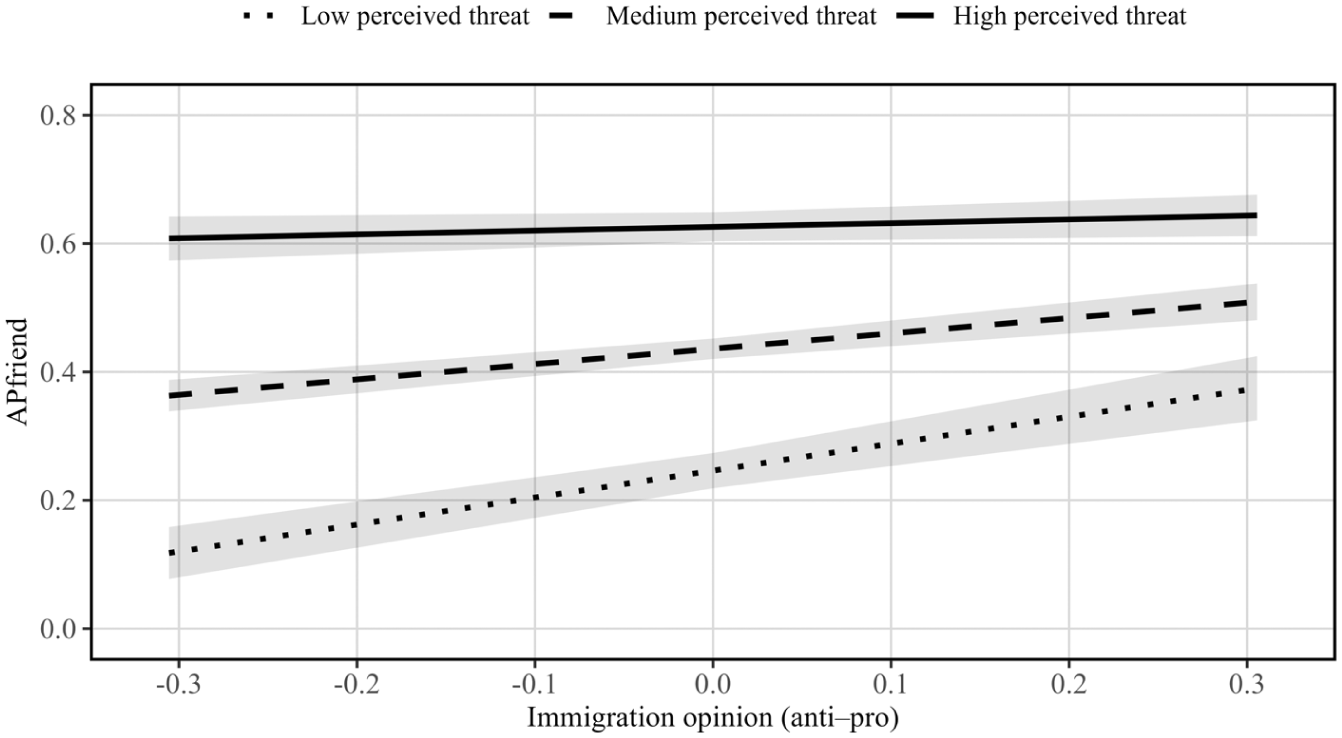
Significant conditional effect of immigration opinion (X) on APfriend (Y2) as moderated by perceived threat (W).
The moderating effect of perceived threat is stronger for people who have more negative opinions on immigration. Thus, the gaps between the slopes representing different levels of the moderator are larger for anti-immigration respondents than for pro-immigration respondents. We finally show the visualizations for the mediation effects, according to immigration opinion, in path b of the mediation model in Figure 10.

The effect of mediator emotional attachment on APfriend (path b in mediation model), according to immigration opinion.
The effect of the mediator emotional attachment (A-panel) is almost equally strong according to immigration opinion as all slopes run more-or-less parallel. For perceived threat (B-panel), the mediator’s effect is stronger for anti-immigration respondents than for pro-immigration respondents (i.e., –1 SD slope is steeper than the +1 SD slope).
Discussion and conclusions
We set out to explore empirically whether and how opinions on immigration relate to individual-level affective polarization regarding immigration. We posed five hypotheses stating that opinions on immigration would be linked to affective polarization (H1) through moderation by emotional attachment (H2a) and perceived threats (H3a) or through meditation by the same factors (H2b and H3b). The analyses provided at least partial support to all hypotheses while revealing important caveats and patterns that add to our understanding of how issue opinions relate to issue-based affective polarization among individuals. Overall, we found that immigration opinions relate to individual-level affective polarization mainly conditionally through moderation or indirectly through mediation by emotional attachment and perceived threat.
As to the specific hypotheses, several findings merit discussion. Firstly, the moderation analyses and the mediation analyses showed that more positive immigration opinions, regardless of moderation or mediation, were associated with higher level of affective polarization measured as APfriend (but not when measured as APtemp). The descriptive findings also showed that the more extreme position on immigration one holds, the more affective polarization is observed (see Harteveld, 2021: 6). These findings thus mostly support H1. Furthermore, the findings show that emotional attachment moderates the link between immigration opinion and affective polarization for APtemp (but not for APfriend). Hypothesis 2a was thus partially supported. A noteworthy aspect is that this moderation is stronger for people who are pro-immigration than anti-immigration. Emotional attachment was also significant as mediator for both affective polarization measures, which confirm H2b and H3b. As mediator, emotional attachment also had a stronger effect for pro-immigration respondents for APtemp (not for APfriend). These findings echo those of Devine (2015: 523) who found that liberals in the United States tend to identify stronger with the in-group than conservatives. According to Mason (2018), attachment to those like oneself is always linked to the differentiation to the ‘other.’ As arguably the Cultural Issue at the moment (Simonsen and Bonikowski, 2022: 1404), with a clear societal norm and sense of what is morally right and wrong (Schedler, 2023), we see a potential that pro-immigration peoples’ strong opinion-group identity − besides a feeling of having the moral high ground − might also have an inherent element of negative identity. That is, part of their identification is not ‘being one of them’ (see Röllicke, 2023: 8). The asymmetry might also reflect that liberal-minded (i.e., pro-immigration people) and conservative-minded people (i.e., anti-immigration people) rely on different sets of moral foundations. Thus, people differ not only in what they believe is right or wrong, but in what they believe is morally relevant (Graham et al., 2013). It is possible that pro-immigration respondents place more value on care and fairness moral foundations which prioritize compassion for vulnerable people (e.g., immigrants) and a desire for social justice (see Graham et al., 2013).
Regarding perceived threat, Hypothesis 3a was fully confirmed as threat perception moderated the effects of immigration opinion for both APtemp and APfriend. In both models, threat perception had a stronger amplifying association with affective polarization for people who are anti-immigration. Likewise, perceived threat was a significant mediator for both affective polarization measures, which confirmed H3b. The mediator effect of threat perception was slightly stronger for anti-immigration respondents for APtemp and more clearly so for the APfriend measure. These findings corroborate earlier findings (e.g., Renström et al., 2021, 2022) whereby people who worry about immigration per se are projecting their worry onto citizens who are pro-immigration. Anti-immigration respondents might emphasize moral foundations relating to loyalty/betrayal and sanctity/degradation and prioritize protecting the ingroup and its traditions from external threats. Kustov (2023) also found, that anti-immigration people feel that the issue itself is more important than what pro-immigration people do, which possibly is reflected in our findings too. People who are pro-immigration do not worry about immigration, and this seems to show in threat perception not having a strong moderation effect for them. The asymmetry could also partly be an artefact of our crude survey construct on immigration opinions whereby respondents might envision different types of immigrants, or different aspects of immigration, when answering the question. Our analyses also found that the mediators/moderators were significant predictors of affective polarization by themselves and this indicates that, regardless of opinion, emotional attachment and threat perception are important components of affective polarization (see Online Appendix Tables A8 and A9).
An interesting methodological sidenote is that we found slightly differing effects depending on how affective polarization was measured. Based on the arguments of others (e.g., Carlin and Love, 2025; Druckman and Levendusky, 2019), we think that this is partly a measurement artefact. Thus, the thermometer rating is more abstract than imagining being a friend with someone, and this might influence the findings. As discussed earlier, thermometers gauge general sympathy and antipathy whereas the social measures indicate potential behaviour (Röllicke, 2023: 4). One could also interpret some of the measurement discrepancy as an indication of behavioural constructs being more norm-constrained than abstract constructs on general sympathy/antipathy. Furthermore, since this study was conducted in a low-partisan multiparty context which makes it likely to observe issue-based affective polarization − that is, a most-likely-case for finding issue-based affective polarization − future research could replicate our study in high-partisan multiparty contexts. Thus, issue-based affective polarization would be put to a more critical test, and we would gain knowledge on how contexts set limits to how issue-opinions matter for affective polarization. Likewise, this study focused on perhaps the most salient cultural issue, which is thus the likeliest to be a basis for affective polarization (e.g., Harteveld, 2021). Future studies could focus on how other cultural issues, and non-cultural issues, relate to affective polarization among individuals (e.g., Herold et al., 2023). Such studies would constitute more critical tests of issue-based affective polarization and further our knowledge on not only how, but which, issues are associated with affective polarization. The use of cross-sectional data also limits us to observing patterns of association and does not allow for proving causality.
In conclusion, this study has added further evidence that issue opinions may play a part in affective polarization even when the issue is not part of an extraordinary event such as a referendum. Furthermore, we have demonstrated that the psychological mechanisms of emotional attachment and perceived threat appear to apply also regarding people who hold certain immigration opinions, and not only regarding parties that represent certain opinions. As we argued in the framework, opinions thus may constitute imagined communities (Schedler, 2023: 244), objects of both positive and negative affect. An important finding that merits further study, is that the bases of the psychological mechanisms of attachment and perceived threat appear to vary in character depending on immigration positions. Anti-immigration people seem worried about the phenomenon, immigration, and people who facilitate it − whereas pro-immigration people take the moral higher ground and form identities based more on the values that the issue position represents. A final however is nonetheless pertinent: this study did not set out to prove what is the definitive driver of affective polarization is, and neither should our conclusions be interpreted as an argument that issue positions − or their interaction with the moderators and mediators − are the only factors of relevance for affective polarization. As our analyses showed, the relationships between issue opinion, emotional attachment, threat perception and affective polarization are almost akin to a ‘reinforcing spiral’ whereby a process of polarization leads to more extreme opinion on the issue which leads to a new process of affective polarization and so forth. Thus, we have in this study added another piece to the puzzle that is affective polarization, but many unsolved questions remain.
Supplemental Material
sj-docx-1-ips-10.1177_01925121261428656 – Supplemental material for How issue opinions relate to individual-level affective polarization: Exploring the psychological mechanisms of affective polarization regarding immigration in a multi-party setting
Supplemental material, sj-docx-1-ips-10.1177_01925121261428656 for How issue opinions relate to individual-level affective polarization: Exploring the psychological mechanisms of affective polarization regarding immigration in a multi-party setting by Kim Strandberg, Jesper Eklund, Janne Berg, Janette Huttunen, Daniel Kawecki and Marina Lindell in International Political Science Review
Footnotes
Acknowledgements
We thank the members of the project’s advisory board for commenting on an earlier draft. We also thank the anonymous reviewers for their valuable comments.
Declaration of conflicting interests
The authors declared no potential conflicts of interest with respect to the research, authorship, and/or publication of this article.
Funding
The authors disclosed receipt of the following financial support for the research, authorship, and/or publication of this article: This work was supported by the Society of Swedish Literature in Finland (SLS) Grant number 6071 and the Research Council of Finland Grant numbers 350361 and 350947
Ethical approval
Informed consent is obtained from all individual participants included in the online panel Barometern. The research raises no ethical concerns as the project does not include any elements requiring formal ethical review. This conclusion is based on the statement issued by the Board for Research Ethics at Åbo Akademi University (FEN) for the project (General statement 5/2024).
Pre-registration
Data availability statement
Replication materials for the moderation and mediation analyses are available in the online supplementary materials. The full dataset underlying the findings will be deposited in the Finnish Social Data Archive ( ) following an embargo period.
Supplemental material
Supplemental material for this article is available online.
Notes
Author biographies
References
Supplementary Material
Please find the following supplemental material available below.
For Open Access articles published under a Creative Commons License, all supplemental material carries the same license as the article it is associated with.
For non-Open Access articles published, all supplemental material carries a non-exclusive license, and permission requests for re-use of supplemental material or any part of supplemental material shall be sent directly to the copyright owner as specified in the copyright notice associated with the article.
