




Abstract
Few studies provide specific rates of marital divorce or separation in association with a history of infidelity. Research based primarily from clinical or help-seeking populations suggests that most couples who have experienced infidelity do not divorce within the time frames assessed. Using self-reported history of extramarital sex (EMS), divorce, and separation data from 16,090 individuals assessed between 1991 and 2008 as part of the General Social Survey (GSS), the authors found that, relative to married (and never divorced) individuals, a history of EMS raised the likelihood of being currently divorced but remarried (odds ratio [OR] = 2.6), divorced and not remarried (OR = 4.1), and separated (OR = 5.8). While there are interpretive limitations, the data from the GSS suggest that more than half of men and women who engage in EMS also separate or divorce from their spouse. Results are discussed in terms of methodological differences among studies as well as clinical implications.
Despite general disapproval of extramarital sex (EMS) in the United States, research with representative samples indicate that up to 34% of men and 19% of women in older cohorts report engaging in EMS at some point in their lives (Wiederman, 1997). Individual reasons for EMS are varied, although the predominant reasons tend to cluster around issues such as dissatisfactions with the primary relationship or partner, desire for more frequent or varied sex, and love for the extramarital partner (Barta & Kiene, 2005; Glass & Wright, 1992). Motivations for EMS, and the nature of the extramarital relationship, can vary widely in the degree of emotional connection with the extramarital partner, and some evidence suggests that divorce is more likely with greater emotional involvement with an extramarital partner (Allen & Rhoades, 2008; Glass, 2003).
Overall, EMS and divorce seem strongly associated, as there have been a number of studies that have found that divorced and separated individuals will often cite infidelity as a reason for divorce or note that infidelity occurred prior to divorce (Cleek & Pearson, 1985; De Graaf & Kalmijn, 2006; Janus & Janus, 1993; Lawson & Samson, 1988; South & Lloyd, 1995; Spanier & Margolis, 1983; Sweeney & Horwitz, 2001). In fact, Amato and Previti (2003) found that infidelity was the most commonly cited reason for divorce. Thus, while we know that the probability of reporting infidelity, given divorce, is relatively high, there is markedly little information regarding the actual probability of divorce, given infidelity. That is, what percentage of individuals in the United States who report EMS also report divorce? Even recent books or articles that review the aftermath of infidelity do not present specific percentages regarding divorce for those with a history of EMS (Allen et al., 2005; Baucom, Snyder, & Gordon, 2009; Blow & Hartnett, 2005; Hall & Fincham, 2006a). Thus, the purpose of the current article is twofold. First, given the sparse information available on this topic, we provide a review of the extant research on rates of divorce or marital separation for samples with a history of infidelity, including salient methodological features and moderators of findings. Second, we add to this literature by evaluating the association between EMS and divorce/separation in a large representative U.S. sample.
Divorce Outcomes Following Infidelity
Table 1 presents summaries of nine located studies that included the percentage of marital separations and/or divorces for persons who had experienced infidelity in their marriage. 1
Prior Evaluations of Rates of Divorce Following Infidelity

Peer-reviewed article.
Only three of these studies were found in the peer-reviewed literature (with a total of 77 couples with infidelity represented in these three publications), further underscoring the paucity of easily accessible information on this issue. Also included in Table 1 is information about the length of the follow-up period, as any given estimate of divorce cannot capture the divorces that will occur but have not yet occurred. For example, Charny and Parnass (1995) concluded that many marriages remained together after infidelity but in a relatively distressed state; it is likely that a substantial number of these marriages could eventually dissolve over time. Moreover, Vaughn (2002) asked individuals who discovered a partner’s infidelity about how long it took to make a decision about the fate of the marriage. She found that while most (56%) said that they decided in less than 3 months, 30% endorsed 3 months to a year, and 14% said more than a year. Vaughn also presented many accounts of participants describing ongoing ambivalence about the marriage years after the infidelity. Therefore, decisions to divorce can be an extended process not fully captured in any given sample. Table 1 also presents any available information regarding moderators of divorce outcome for the reviewed studies.
Three studies presented in Table 1 were based on visitors to online infidelity resource websites (Furrow & Klacsmann, 2008; Vaughn, 2002, 2004). The Vaughn (2002) survey is of individuals who came to such a website for support after they had discovered their partner’s infidelity. Thus, this is a relatively help/information seeking sample; in fact, almost 80% of the sample reported going to therapy or counseling. As seen in Table 1, Vaughn (2002) found that only 13% of respondents were divorced at the time of the survey; however, only 54% reported a current decision to stay married, 19% reported deciding to divorce, and 27% were currently undecided. The more that the respondent felt that the spouse answered questions and openly discussed the affair, the more likely the marriage was to be intact. Vaughn (2004) found very consistent numbers when assessing individuals who reported that their spouse had engaged in an “online affair,” defined as “online interactions that include ‘intimate sharing’ and/or ‘sex talk’ (regardless of whether or not there was physical contact)” (p. 16), finding that only 14% of individuals who knew of a spouse’s online affair reported that they were not currently married and living with the spouse. Furrow and Klacsmann (2008) also assessed individuals who were using online support after a partner’s infidelity. They found somewhat higher numbers than Vaughn (2002), stating that 17.6% divorced after the disclosure of infidelity, but additional couples had separated as “over a third” of the sample had either divorced or separated.
Another four studies located on this topic involve clinical samples, from the clinical practice of experts in treating infidelity (Glass, 2003; Pittman, 1989), a clinical trial of couples therapy (Atkins, Eldridge, Baucom, & Christensen, 2005; with follow-up data in Marin, 2010), and a research study on a conjoint treatment designed specifically to address infidelity (Gordon, Baucom, & Snyder, 2004). Thus, these samples are characterized as treatment seeking, with most partners aware of the infidelity. 2 The samples in Atkins et al. and Gordon et al. had specific exclusion criteria (e.g., excluding those with alcohol abuse). This may contrast with the more naturalistic clinical samples of Glass and Pittman.
In these clinical studies, the overall estimated rates of divorce for couples with infidelity ranged from 0% to 53%. Although Pittman did not provide percentages moderated by gender and frequency of affairs, he noted that gender did not moderate divorce outcomes whereas a number of affairs did, stating that “only one person left because his spouse had a solo affair” (p. 132). Glass (2003) contrasted a 10% separation rate at the end of therapy for couples without infidelity to a 35% rate for couples who had experienced infidelity. Although statistics are not presented for all moderators, Glass noted that separation was more likely when the affair was ongoing, the affair was “combined-type” with both sex and deep emotional attachment, the affair was carried out by a young wife in a childless marriage, or commitment was low. 3 In Gordon et al. (2004) and Atkins et al. (2005), there were no separations or divorces by the end of therapy for infidelity couples. However, a 5-year follow-up on the Atkins et al. sample by Marin (2010) found that infidelity couples had a higher rate of eventual divorce (43% for couples in which infidelity was known and discussed in therapy, 80% for affairs that were kept secret during therapy) compared with couples without infidelity (23% divorce rate for couples without infidelity).
Finally, a unique approach was used by Charney and Parnass (1995). These researchers asked therapists to think of a specific extramarital affair with which they were very familiar—whether as therapist, relative, or friend or if they themselves were involved. The therapists reported that 34% of the marriages ended as a result of the infidelity, with onetime affairs having less risk of divorce.
Taking these studies as a whole, some general patterns emerge. In these samples and their respective time frames, the majority of couples with infidelity did not separate or divorce. Exceptions were when the infidelity occurred very early in the marriage or if the unfaithful partner did not reveal the infidelity during therapy (Marin, 2010; Pittman, 1989). Other compounding risk factors included multiple or mutual betrayals and a lack of open dialogue about the infidelity once discovered. These studies are informative, particularly when generalizing to clinical samples. However, because they generally involved some type of clinical or help-seeking populations, it is difficult to know whether one would find similar rates of divorce in a more representative survey of the U.S. population. Additional study characteristics further limit the ability to make broader generalizations about the association of divorce and EMS in the United States (e.g., small samples, non-U.S. samples, lack of comparison groups without infidelity, or very brief follow-up period).
Larger, more representative, and longitudinal studies on this issue have been conducted using data from the Panel Study of Marital Instability over the Life Course. In this study, married participants were asked “Have you had a problem in your marriage because one of you has had a sexual relationship with someone else?” Although this question has some limitations, such as probably missing cases of unknown infidelity, it generalizes well to the situation where an episode of extramarital sexual involvement has resulted in difficulties for the couple. As such, it is fitting information for situations where a distressed spouse wonders about the chances of his or her marriage “making it” after a disruptive infidelity event. Participants who endorsed problems related to infidelity were at higher risk of divorce than those who did not endorse such problems, even after controlling for concurrent or preexisting risk factors (Amato & Rogers, 1997; Edwards & Booth, 1994; Previti & Amato, 2004). For example, Previti and Amato (2004) found that infidelity increased the odds of divorce 2.6 times, even after controlling for prior marital happiness and divorce proneness. Thus, this study represents the best available data directly relevant to assessing the likelihood of divorce following a disruptive infidelity experience. However, there were some selection factors wherein participants were relatively more stable (excluding those with infidelity at baseline, who divorced in early years of the study, and who did not participate at multiple time points) and divorce rates overall were fairly low (13% of the sample divorced between 1983 and 1997). Therefore, although this study has strong methodological features, it still leaves unanswered the basic question of the likelihood of divorce given a history of EMS in a representative U.S. population.
The Present Study
To add to this literature on divorce and infidelity, our study directly assessed the likelihood of divorce given one’s own EMS using data from the General Social Survey (GSS), a large, nationally representative survey. Individuals in the GSS were asked about their own lifetime history of engaging in EMS and their current marital status and history of divorce. As such, these data provide estimates of divorce given one’s own EMS, collapsed across potential (but unmeasured) moderators such as partner knowledge, partner EMS, time since EMS, treatment, or number of EMS partners. Based on the prior literature, we hypothesized that individuals with a history of EMS would be more likely to divorce than those without EMS, but that a majority of individuals would remain married after such extramarital involvement, particularly because the GSS assessed only “own” EMS, not “own and/or spouse” EMS, and many of these instances of EMS may never have been disclosed to the spouse.
Method
Participants
The data for this study were drawn from the GSSs conducted by the National Opinion Research Center at the University of Chicago. The surveys were begun in 1972 and are currently conducted every other year with approximately 3,000 participants. Surveys are based on in-person, structured interviews that last approximately 90 minutes. Each survey involves a national, cross-sectional sample of noninstitutionalized, English-speaking individuals 18 years of age or older in the continental United States. The GSS began asking about EMS in 1991, and the current data include all ever-married participants who answered the EMS question between 1991 and 2008, yielding a total sample size of 16,090 (9,401 women and 6,689 men). Survey response rates vary between 76% and 82% across the given years.
Survey Questions
Respondents were asked whether they had “ever had sex with someone other than your husband or wife while you were married?” Out of 16,090 ever-married respondents, 2,857 (or 17.7%) reported having had EMS (14% of women and 23% of men). Participants were also asked whether they were currently married, divorced, or separated. Currently married participants were also asked if they had ever divorced, allowing us to further separate the married group into currently married and never divorced and married but divorced previously. Currently widowed participants were also assessed but are excluded from the present analyses.
Timing of EMS and Divorce
The questions about history of ever engaging in EMS and marital status allow one to estimate an approximate probability of divorce after one’s own infidelity but could misclassify some cases. That is, lifetime EMS and lifetime divorce do not specify the timing of either. The most unambiguous outcome is having a history of EMS and being currently married with no history of divorce. Although a small number of these individuals may have had a prior marriage that ended due to reasons other than divorce (e.g., death), one can assume that, for the vast majority of these individuals, they engaged in EMS in their present marriage and that their marriage has thus far survived this behavior. Individuals with a history of EMS who are currently divorced or separated are fairly straightforward, but with some small amount of error regarding EMS and marital breakup. That is, for a person who is currently divorced and reports EMS, even if they have been married multiple times, we know that whatever marriage in which they engaged in EMS did not survive. Again, although some prior marriages may not have survived because of factors such as the death of the spouse, in most of these cases one can infer that the marriage ended in divorce. A similar logic applies to those who are separated: either they are separated from the marriage in which they had EMS or they had EMS in a prior marriage that did not survive. The most ambiguous category is “currently married but divorced previously.” For a person who endorses EMS and is currently married but with a prior divorce, it is impossible to know whether the EMS occurred in a prior marriage that ended in divorce or in the current, still intact marriage.
Results
Data were analyzed in two primary ways. First, percentages of EMS for persons of various marital statuses were examined to confirm that individuals with divorce or separation have higher rates of EMS compared with those who are currently married with no history of divorce. Second, to estimate the probability of divorce based on history of EMS, we examined marital status contingent on history of EMS. Note that these represent two alternative ways to present the same data, though focusing on different questions. The first presents percentages of EMS given marital status, whereas the second presents percentages of marital status given EMS.
Table 2 present the percentages of respondents reporting EMS by marital status and gender. Reading across the rows of this table, it is clear that persons who are currently divorced or separated, or who have been divorced in the past, are much more likely to endorse a history of EMS relative to those who are currently married with no history of divorce. For example, 50% of men who are currently separated from their spouse report having engaged in EMS, compared with only 14% of men who are currently married with no history of divorce. Only 7% of married women with no history of divorce have engaged in EMS, compared with 25% of currently divorced and 31% of currently separated women. A logistic regression with EMS as the outcome and gender and marital status as covariates showed that women had half the odds of reporting EMS compared with men (odds ratio [OR] = 0.50, 95% confidence interval [CI] = 0.46-0.55). Using married (and never divorced) as the reference group, currently married but previously divorced individuals [had more than double the odds of reporting] EMS (OR = 2.61, 95% CI = 2.32-2.94), currently divorced individuals had more than four times the odds of reporting EMS (OR = 4.13, 95% CI = 3.71-4.59), and currently separated respondents had almost six times the odds of reporting EMS (OR = 5.81, 95% CI = 4.90-6.88).
Extramarital Sex Given Marital Status

Note: Read across rows to identify percentage reporting history of extramarital sex (EMS) given marital status.
Focal to our research question, we then calculated the percentage of various marital status categories based on history of infidelity (see Table 3). Reading across the rows of this table, of those who endorsed EMS, only 33% of men and 23% of women were currently married with no divorce history, in contrast to 60% of men and 49% of women not reporting EMS. Similarly, of those respondents reporting EMS, 41% of men and 48% of women were either currently divorced or separated, in contrast to only 17% of men and 22% of women without a history of EMS. That is, having a history of EMS approximately doubles the likelihood of reporting current separation or divorce. 4
Marital Status Given Extramarital Sex (EMS)
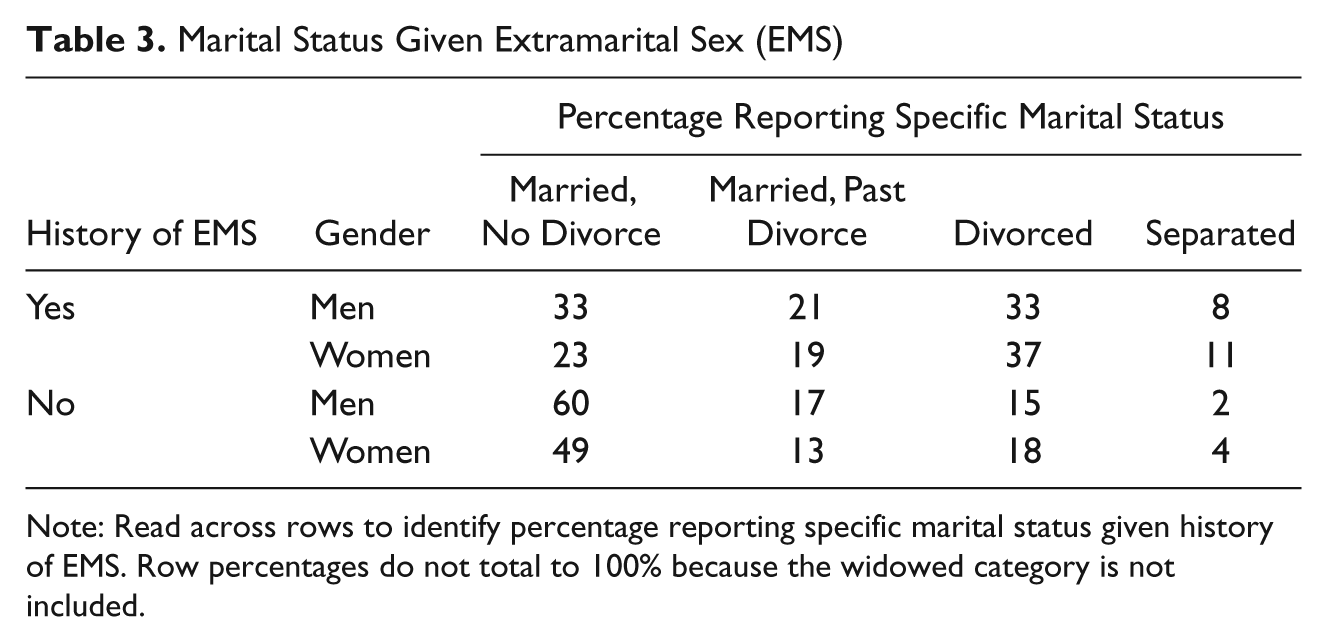
Note: Read across rows to identify percentage reporting specific marital status given history of EMS. Row percentages do not total to 100% because the widowed category is not included.
As noted, the “married but divorced previously” category is ambiguous with respect to whether the EMS occurred in the present and ongoing marriage or a past marriage that has ended. However, it is still possible to use this category to estimate outside ranges. For example, consider the case of men who endorse EMS and are currently married but have been divorced in the past. If one assumes that all these instances of EMS occurred in past (now divorced) marriages and none in the current marriage, this would suggest that in 62% (21% + 33% + 8%) of all the cases where men report EMS, these men divorced or separated from that spouse. In contrast, if one assumes that all instances of EMS for men who are currently married but had a prior divorce occurred in the current, still intact marriage, then 41% (33% + 8%) of cases were men who engaged in EMS divorced or separated from that spouse. Thus, for men who have had EMS, one can extrapolate that between 41% and 62% divorced or separated from that marriage. Applying the same logic to women, for women who engaged in EMS, between 48% and 67% divorced or separated from that spouse.
Although these extrapolations provide possible ranges, given the approximate doubling of divorce for the EMS group seen in the analyses noted above, it is likely that the preponderance of these cases should be categorized as “divorce given EMS” instead of as “marital stability given EMS.” This logic suggests that over half of participants who engaged in EMS also divorced or separated from their spouse. In addition, some currently married persons who have engaged in EMS in the current marriage likely go on to divorce, thus reinforcing the conclusion that over half of the participants in this representative community sample who report EMS will eventually divorce.
Discussion
With few exceptions, past research using small or nonrepresentative samples has found that the majority of couples who have experienced infidelity do not divorce in the time period assessed. In contrast, and contrary to hypotheses, the current data from a large representative U.S. community sample indicate that more than half of individuals who engage in EMS do, in fact, divorce or separate from their spouse. Most of the previous research relies on clinical or help-seeking samples, whereas the GSS has no such restrictions. As such, the current findings based on the GSS better represent rates of divorce given own EMS in the population in general. The relatively high rate of divorce or separation given EMS in the current study is surprising given that only own EMS was evaluated; it is assumed that there would be even higher rates of divorce if additional types of extramarital relationships were included (e.g., emotional infidelity) and if both partners’ extramarital relationships were evaluated.
It is clear both from previous studies and the present findings that infidelity substantially increases risk for divorce. The present findings add to previous studies (e.g., Glass, 2003, Marin, 2010; Previti & Amato, 2004) that include a comparison group of couples without reported infidelity. Those studies suggest that infidelity increases the likelihood of divorce approximately 2 to 3 times. The current findings yield even more dramatic impact—indicating that a history of EMS raises the odds of being currently divorced (and not remarried) 4.1 times, relative to being currently married and never divorced. However, it is also clear that many couples who have experienced EMS do stay together. Charny and Parnass (1995) found that some couples used the crisis of infidelity to improve their marriages, and existing data from therapy with couples with a history of infidelity suggest that these couples can be helped with intervention (e.g., Atkins et al., 2005; Gordon et al., 2004). Glass’s (2003) findings suggest that couples with a history of infidelity who enter therapy committed to the marriage have relatively good chances of working through the infidelity with their marriage intact.
Considerations of the association of infidelity and divorce should recognize other related marital problems. Although individuals may report infidelity in the absence of marital distress (e.g., Glass & Wright, 1985), marital problems clearly increase the risk of infidelity (e.g., Previti & Amato, 2004). Thus, marital distress and infidelity are typically intertwined and should be jointly considered when evaluating divorce after infidelity. As articulated by Hall and Fincham (2006a), the question is, “When a couple decides to separate after infidelity, how much of this decision can be attributed to the affair and how much must be attributed to other factors?” (p. 156). Even when couples cite infidelity as the primary cause of their divorce, this is unlikely in isolation of other marital problems. For example, Allen, Stanley, Markman, and Johnson (2006) found that out of 661 currently or previously divorced individuals who cited infidelity as a reason for divorce, only 10 (or 1.5%) of these individuals endorsed infidelity as the only reason for the divorce out of a standard list of possible reasons provided.
Yet, based on existing research, infidelity does seem to contribute unique variance to divorce. Previti and Amato (2004) found infidelity increased the odds of divorce even after controlling for prior happiness and divorce proneness. Moreover, Atkins and Gallop (2007) modeled infidelity as a predictor of steps toward divorce across levels of marital satisfaction. For couples without affairs, declines in marital satisfaction predicted greater steps toward divorce. However, for couples with affairs, steps toward divorce were elevated across all levels of marital satisfaction. As Atkins and Gallop summarize, “The trauma of infidelity appears to push these couples closer to divorce regardless of the quality of the overall relationship.” (p. 731) The nuance presented by Markman and Pregulman (2011) may be useful: while divorced participants endorsed many reasons for their divorce including conflict and poor communication, 69% agreed there was a “final straw” in the decision to divorce, and these tended to be issues such as infidelity, aggression, and drug or alcohol problems.
Moreover, perceptions regarding the causal role of infidelity versus other marital problems in divorce may be influenced by which partner did or did not engage in the infidelity. For example, in a sample of divorced or separated persons, Spanier and Margolis (1983) found that approximately 70% of those who had engaged in infidelity in the prior marriage reported that their infidelity was largely a result of marital problems. In contrast, individuals whose ex-spouses had engaged in infidelity reported that their partner’s infidelity was more frequently the cause, rather than the result, of marital problems. Similarly, De Graaf and Kalmijn (2006) found that divorced respondents were more likely to cite their ex-spouses’ infidelity as a cause of divorce rather than their own infidelity.
The existing literature, including that reviewed here, also suggests the importance of key moderators, such as number of affairs or the emotional closeness with the extramarital partner, in the prediction of divorce when there has been infidelity (Allen & Rhoades, 2008; Hall & Fincham, 2006a). For example, research conducted with dating populations suggests that voluntary confession results in lower likelihood of breakup compared with discovering the partner engaging in infidelity, hearing about infidelity from a third party, or eliciting a confession with confrontation (Afifi, Falato, & Weiner, 2001). As another example, Hall and Fincham (2006b) found that benign attributions about a dating partner’s infidelity (e.g., that the reasons for the behavior were external, specific, and unstable) predicted greater forgiveness regarding the infidelity and lower rates of breakup.
The variability of the reviewed and presented data is noteworthy. One source of variability involves inconsistent definitions of extramarital involvement. These include participants’ interpretation of the word “infidelity,” a definition of online affairs, and questions about EMS. The definition used in the current study, extramarital sex, does not allow us to study the important distinction of sexual versus emotional infidelity (Glass, 2003), and moreover may be endorsed by a number of respondents to refer to sex that occurred with another partner while separated, but technically married. The samples are also diverse. The majority of the previous studies include individuals who “present with” infidelity—such as clinical samples of couples or persons seeking help and information about infidelity on the Internet. As such, the findings from these studies may be more relevant to clinical practice—but methodological limitations in sampling seriously restrict their generalization. Attention to methodological issues involving explicit criteria defining extramarital relationships in representative community and clinical samples should yield more robust estimates regarding dissolution subsequent to infidelity. A representative study that measures actual timings of own and partner’s behaviors considered to be unfaithful, partner knowledge, and marital transitions, as well as information about type of infidelity, duration of marriage, and other salient variables, would greatly enable more informed decisions for both therapists and couples confronting this critical issue.
Footnotes
Declaration of Conflicting Interests
The author(s) declared no potential conflicts of interest with respect to the research, authorship, and/or publication of this article.
Funding
The author(s) received no financial support for the research, authorship, and/or publication of this article.