



Abstract
Although numerous studies of the general population show that married people tend to exhibit better mental health than their unmarried counterparts, there is little evidence to suggest that the psychological benefits of marriage extend to low-income urban women with children. Building on previous research, this study uses longitudinal survey data from the Welfare, Children, and Families project (1999, 2001) to examine the effects of marriage and related transitions on changes in psychological distress among low-income urban women with children. It also tests the mediating influence of financial hardship, social support, self-esteem, and frequency of intoxication. Although entering and exiting marriage are unrelated to changes in psychological distress, continuous marriage is associated with lower levels of psychological distress from baseline to follow-up. The mediation analysis also suggests that the apparent mental health benefits of continuous marriage are partially mediated or explained by lower levels of financial hardship.
Numerous studies show that married people tend to exhibit better mental health than their unmarried counterparts (Carr & Springer, 2010; Hope, Power, & Rodgers, 1999; Horwitz, White, & Howell-White, 1996; Marks & Lambert, 1998; Meadows, McLanahan, & Brooks-Gunn, 2008; Mirowsky & Ross, 2003; Pearlin & Johnson, 1977; Scott et al., 2010; Sherbourne & Hays, 1990; Stack & Eshleman, 1998; Umberson & Williams, 1999; Waite & Gallagher, 2000; Waite, Luo, & Lewin, 2009; K. Williams, Frech, & Carlson, 2010). This general pattern is consistent across a range of mental health outcomes, including, for example, happiness, depression, anxiety, nonspecific psychological distress, and overall psychopathology. Inspired (in part) by this body of research, policy makers have created programs and enacted legislation designed to promote marriage, especially among low-income urban mothers (Huston & Melz, 2004; Lichter, Graefe, & Brown, 2003; Meadows et al., 2008). Yet Meadows et al. (2008) note that marriage promotion policies “rest on the assumption that parents and children would be better off if unmarried parents marry” and that “evidence for this assumption . . . is limited” (p. 315).
Meadows et al.’s (2008) recent analysis of longitudinal survey data from the Fragile Families and Child Well-Being Study is among the first to seriously consider the link between marital status and mental health among disadvantaged urban mothers. Following their work, this study uses a different longitudinal data source to examine the effects of marriage and related transitions on changes in psychological distress among low-income urban women with children. It also builds on the work of Meadows et al. by testing several potential mediators of the association between marital status and mental health, including financial hardship, social support, self-esteem, and frequency of intoxication.
Theoretical Background
Explanations for the Association Between Marriage and Mental Health
There are three general models for understanding why the married tend to exhibit better mental health than their unmarried counterparts: marital selection, marital crisis, and marital resource (Carr & Springer, 2010; Meadows et al., 2008; K. Williams et al., 2010; K. Williams & Umberson, 2004). The marital selection model suggests that the apparent mental health benefits of marriage are driven by healthier and happier people being selected into marriage in the first place. The idea is that healthier people are better equipped to attract a spouse and to maintain a marital relationship. Although selection processes help explain some of the apparent benefits of marriage and costs of marital dissolution, selection processes fail to fully explain the health benefits of marriage (Blekesaune, 2008; Hope et al., 1999; Johnson & Wu, 2002; Kim & McKenry, 2002; Lamb, Lee, & DeMaris, 2003).
In contrast with the marital selection model, the marital crisis model suggests that the conditions of marriage can have important psychological consequences. Specifically, the marital crisis model suggests that the apparent mental health benefits of marriage are primarily due to the strains of marital dissolution (e.g., relationship loss and financial insecurity). For example, research shows that divorce can contribute to losses in psychological well-being that are evident for many years following the transition (Hughes & Waite, 2009; Lee & DeMaris, 2007; K. Williams & Umberson, 2004).
Finally, the marital resource model suggests that marriage favors mental health because it tends to promote financial, social, psychological, and behavioral resources and conditions (Bierman, Fazio, & Milkie, 2006; Carr & Springer, 2010; Mirowsky & Ross, 2003; Umberson, 1987; Umberson & Williams, 1999; Waite & Gallagher, 2000). Drawing from the marital resource model, the next few paragraphs examine the potential mediating influence of financial hardship, social support, self-esteem, and alcohol consumption.
Financial hardship
One reason why marriage might benefit mental health is by contributing to the financial stability of families (Mirowsky & Ross, 2003; Stack & Eshleman, 1998; Waite & Gallagher, 2000). For example, research indicates that married people tend to exhibit higher levels of family income and lower levels of financial hardship (Hope et al., 1999; Mandara, Johnston, Murray, & Varner, 2008; Pearlin & Johnson, 1977). Waite and Gallagher (2000) explain that married people have greater access to income from dual earners, lower costs from sharing life expenses, greater savings for family commitments, and lower impulse spending from having to be accountable to another person. Hope et al. (1999) attribute the adverse mental health consequences of financial hardship to “associated physical hardships, or . . . the stress of financial uncertainty, impaired social relations, increased acute and chronic stressors, inability to fulfill role obligations, and also possibly because of perceptions of relative deprivation” (p. 1645). Although some studies show that financial resources partially mediate or explain the link between marriage and mental health (Hope et al., 1999; Pearlin & Johnson, 1977; Stack & Eshleman, 1998), other research efforts find no support for this process (Horwitz et al., 1996).
Social support
Marriage may also favor mental health by promoting social ties and supportive relationships (Mirowsky & Ross, 2003; Pearlin & Johnson, 1977; Waite & Gallagher, 2000). The institution of marriage is an integrating force that connects romantic partners to one another and to friends and relatives, and these ties provide the structural basis for greater social support (Mirowsky & Ross, 2003). Indeed, studies show that marriage is associated with higher levels of social integration and social support (Kessler & Essex, 1982; Pearlin & Johnson, 1977; Sherbourne & Hays, 1990). Research also suggests that social support may reduce symptoms of psychological distress by creating or enhancing a sense of security and feelings of self-worth (from knowing that one is loved, valued, and cared for) and, consequently, by reducing perceptions of vulnerability in one’s life (Mirowsky & Ross, 2003; Waite & Gallagher, 2000). Although there is some evidence to suggest that social ties and social support may help mediate or explain the link between marriage and mental health (Pearlin & Johnson, 1977; Sherbourne & Hays, 1990), other studies show no mediating influence (Hope et al., 1999; Horwitz et al., 1996).
Self-esteem
Another possibility is that marriage protects mental health by promoting self-esteem (Cotten, 1999; Pearlin & Johnson, 1977). Studies clearly show that marriage is associated with higher levels of self-esteem (Kessler & Essex, 1982; Mandara et al., 2008; Marks & Lambert, 1998; Waite et al., 2009). Because entry into the institution of marriage meets social expectations (Marks & Lambert, 1998), the simple act of getting married could contribute to self-worth through positive reflected appraisals. Marriage may also enhance self-esteem by promoting financial stability and supportive relationships. For example, Mandara et al. (2008) show that the association between marriage and self-esteem is partially mediated or explained by higher levels of family income. Cotten (1999) also notes that marital partners and relatives “serve as sources of beliefs and values, validators of identity, and they may remind individuals of their worth and achievements” (p. 225). Most approaches to the study of mental health view psychological distress as at least partially determined by threats to self-conceptions. Not surprisingly, studies consistently show that self-esteem is associated with better mental health (Thoits, 1995). These arguments seem reasonable; however, to the best of my knowledge, there is no empirical evidence to suggest that self-esteem might mediate or explain the association between marriage and mental health.
Alcohol consumption
Marriage might also benefit mental health by discouraging heavy alcohol consumption (Stack & Wasserman, 1993). Indeed, several studies show that marriage is associated with healthier drinking practices, including lowers rates of heavy drinking, binge drinking, and alcohol abuse and dependence (Horwitz et al., 1996; Power, Rodgers, & Hope, 1999; Scott et al., 2010; Umberson, 1987, 1992; Waite et al., 2009; D. Williams, Takeuchi, & Adair, 1992). Social control is a key link between marriage and healthy behavior (Umberson, 1987, 1992). According to Umberson (1992),
Social control efforts may be more effective among the married because married individuals are more motivated to reduce negative behavior—because of responsibilities and commitments to others and a normative desire to avoid divorce. Married individuals are also under more constant surveillance than the unmarried. (p. 915)
Marriage may also discourage heavy drinking indirectly by helping individuals to avoid stressful conditions such as financial hardship and by promoting supportive relationships that satisfy the need for intimacy and social connectedness.
Although alcohol consumption is often used to explain the effects of marriage on physical health and mortality risk (Umberson, 1987, 1992), risky drinking practices are rarely thought to link marriage and mental health. This tendency may be explained by uncertainty concerning the causal order of the association between alcohol consumption and mental health and the dominance of tension reduction models (i.e., the idea that people often consume alcohol to relieve symptoms of psychological distress). Nevertheless, research suggests that heavy drinking can contribute to symptoms of psychological distress through specific neurobiological pathways, including hangover and withdrawal symptoms and lower levels of serotonin in the bloodstream (Manninen, Poikolainen, Vartiainen, & Laatikainen, 2006; Paljarvi et al., 2009; Stack & Wasserman, 1993). Once again, to the best of my knowledge, there is no direct empirical support for alcohol consumption as a link between marriage and symptoms of psychological distress. However, Stack and Wasserman (1993) provide some indirect support for this process, showing that marriage reduces the risk of suicide by discouraging heavy drinking.
The Special Case of Low-IncomeUrban Women With Children
In the general population, marriage tends to promote mental health, whereas marital dissolution tends to undermine it. There are several reasons to believe that the benefits of marriage and the consequences of marital dissolution might be attenuated for low-income urban women with children. Low-income urban women face numerous obstacles with regard to finding a marital partner who is educated, steadily employed, and financially stable (Coontz & Franklin, 1997; Edin, 2000; Edin & Kefalas, 2005; Huston & Melz, 2004; Lichter et al., 2003). The mental health benefits of marriage are often attributed (at least in part) to financial stability; however, low-income urban women are unlikely to reap significant improvements in economic status through marriage (Coontz & Franklin, 1997; Huston & Melz, 2004). Huston and Melz (2004) offer the following concise explanation: “Two incomes are better than one, but one income for two (a mother and child) is better than one for three (add a husband, who cannot find or hold a job)” (p. 955).
Low-income urban women with children may also be less likely to acquire the social, psychological, and behavioral resources and benefits that are generally associated with marital relationships. Low-income urban women with children are often involved in relationships and marriages that are characterized by infidelity, intimate partner violence, and substance abuse (Edin, 2000; Hill, Mossakowski, & Angel, 2007; Huston & Melz, 2004). The conditions of infidelity and violence are likely to undermine intimate and supportive marital relationships, not to mention the self-esteem of the person who has been cheated on and abused. The financial difficulties that low-income couples face and the loss of social support and self-worth are also likely to contribute to a range of stressful conditions that would surely increase the probability of substance use. Moreover, the presence of a spouse who indulges in substance abuse would certainly do more to encourage risky behaviors than to discourage them through noted mechanisms of social control.
Hypotheses
In accordance with the general patterns of marriage and mental health research, I developed the following hypotheses to guide subsequent analyses:
Hypothesis 1: Entering marriage during the study period will be associated with lower levels of psychological distress.
Hypothesis 2: Exiting marriage during the study period will be associated with higher levels of psychological distress.
Hypothesis 3: Continuous marriage over the study period will be associated with lower levels of psychological distress.
Hypothesis 4: Any mental health benefits of marriage or adverse psychological consequences of marital dissolution will be at least partially mediated or explained by financial hardship, social support, self-esteem, and heavy alcohol consumption.
Nevertheless, given the unique social conditions and marital experiences of low-income urban women with children, I present these general expectations tentatively.
Data
To formally examine the effects of marriage and related transitions on changes in psychological distress among low-income urban women with children, I employ data from the Welfare, Children, and Families (WCF) project (see http://www.jhu.edu/~welfare/). The WCF project is a household-based, stratified random sample of 2,402 low-income women living in low-income neighborhoods in Boston, Chicago, and San Antonio. The WCF first sampled census blocks (or neighborhoods) with at least 20% of residents below the federal poverty line based on the 1990 census. Within these neighborhoods, households below 200% of the poverty line were sampled, with an oversample of households below 100% of the poverty line. Because one of the goals of the WCF project is to assess the impact of welfare policy and work on children, households were screened for the presence of children. Households with at least one infant or child (aged 0-4 years) or young adolescent (aged 10-14 years) were sampled. The children’s caregivers, all women, were interviewed face-to-face. I refer to the caregivers as “women with children” instead of “mothers” because some caretakers did not identify themselves as the child’s parent. The data were collected in 1999 with a follow-up in 2001. The baseline response rate was 75%, and 89% of the original sample was reinterviewed. The overall respondent-level response rate is 75%, with city-specific response rates of 74% (Boston), 71% (Chicago), and 79% (San Antonio). Subsequent analyses are weighted to account for variations in sample sizes across cities.
Measures
Psychological Distress
Psychological distress is measured with the Brief Symptom Inventory (BSI-18; Derogatis, 2000), which includes subscales for depression, anxiety, and somatization. Psychological distress is measured as the mean response to 18 items (α = .92). For example, respondents were asked to indicate how much in the past 7 days they were distressed or bothered by “feeling no interest in things,” “feeling tense or keyed up,” and “experiencing nausea or upset stomach.” Response categories for all psychological distress items are coded as 1 = not at all, 2 = a little bit, 3 = moderately, 4 = quite a bit, or 5 = extremely.
Marital Status
Marital status is the focal predictor variable. I isolated four marital status groups. The first group captures women who exited marriage during the study period (i.e., those who were married in 1999 but not in 2001). The second group captures women who entered marriage (i.e., those who were married in 2001 but not 1999). The third group captures women who were continuously married (i.e., married in 1999 and 2001). The fourth group captures women who had no exposure to marriage during the study period (i.e., those who were not married in 1999 or 2001). In subsequent analyses, the fourth group serves as the reference category against which the three marriage groups are compared. I acknowledge that the mental health benefits of marriage may vary according to the reference group (e.g., Bierman et al., 2006; Umberson & Williams, 1999); however, the present coding strategy is intended to provide a rigorous and conservative test of the psychological benefits and consequences of involvement in the institution of marriage.
Self-Rated Health
Physical health is indicated by a single item. Respondents were asked, “In general, how is your health?” Response categories for this item are coded as 1 = poor, 2 = fair, 3 = good, 4 = very good, or 5 = excellent. This item is unique in that it measures a wide range of physical health problems, including diagnosed or known conditions and symptoms of undiagnosed or unknown conditions (Idler & Benyamini, 1997). Self-rated health is widely used to measure general physical health status. It is strongly correlated with more objective measures of physical health, including physician diagnoses, various measures of morbidity, and all-cause mortality (Idler & Benyaminil, 1997; Idler & Kasl, 1991).
Financial Hardship
Financial hardship refers to the inability to meet essential material needs. Hardship is measured as the mean response to 13 items (α = .83). For example, respondents were asked to indicate how often they had to “borrow money to pay bills.” Respondents were also asked to indicate whether they had enough money to “afford housing, food, and clothing” and whether any adults or children in the household were “unable to eat for a whole day because there wasn’t enough money for food.” Because the original hardship items were measured with mixed-question formats and response categories, each of these items has been standardized to account for metric differences. This measure has been used in previous research to predict heavy drinking and psychological distress (Hill & Angel, 2005; Hill et al., 2007).
Social Support
Although some researchers define social support as the actual receipt of resources, others classify it in cognitive terms, as individual perceptions of resource availability (Thoits, 1995). In the present study, social support refers to perceptions of emotional and instrumental support. Emotional support is measured with a single item. Respondents were asked to indicate how many people they could count on to listen to their problems when they were feeling low. Instrumental support is measured as the mean response to three items (α = .78). Respondents were asked to indicate how many people they could count on (a) to take care of their children when they were not around, (b) to help them with small favors, and (c) to loan them money in case of an emergency. Response categories for all support items are coded as 0 = no one, 1 = too few people, and 2 = enough people. These measures have also been used in previous research to predict psychological distress (Durden, Hill, & Angel, 2007; Hill, Kaplan, French, & Johnson, 2010).
Self-Esteem
Self-esteem is measured as the mean response to eight items (α = .74), which were developed by Rosenberg (1965) and are known to have adequate reliability and validity (Blascovich & Tomaka, 1991). Respondents were asked to indicate the extent to which they agree or disagree with the following statements: (a) I take a positive attitude toward myself. (b) All in all, I am inclined to feel that I am a failure. (c) On the whole, I am satisfied with myself. (d) I feel I don’t have much to be proud of. (e) I’m a person of worth, at least on an equal basis with others. (f) At times, I feel that I am no good at all. (g) I wish I could have more respect for myself. (h) I feel I am able to do things as well as most other people. Response categories for these items range from 1 = strongly disagree to 4 = strongly agree.
Intoxication Frequency
Heavy alcohol consumption is indicated by frequency of intoxication. Frequency of intoxication is intended to measure the most fundamentally problematic aspect of alcohol consumption—getting drunk. Instead of asking respondents to recall specific alcohol frequencies and quantities consumed, this measure requires respondents to estimate the number of occasions during which they were drunk. Specifically, respondents were asked, “In the past 12 months, how often have you gotten drunk?” Response categories for this item are coded as 0 = never, 1 = once or twice, 2 = several times/often. This measure of intoxication has demonstrated construct validity in previous research (Hill & Angel, 2005; Hill, Nielsen, & Angel, 2009; Robbins, 1989). For example, using the 1985 National Survey on Drug Abuse, Robbins (1989) employed a similar measure of intoxication and found strong positive associations with psychological distress and social and behavioral problems.
Background Factors
Subsequent multivariate analyses also include controls for age (in years), race and ethnicity (four dummy variables capturing non-Hispanic Whites, Mexicans, other Hispanics, and Blacks—the reference category), education (in years), employment status (four dummy variables capturing employment in 1999 only, employment in 2001 only, employment in 1999 and 2001, and continuous unemployment—the reference category), welfare status (four dummy variables capturing welfare receipt in 1999 only, welfare receipt in 2001 only, welfare receipt in 1999 and 2001, and no welfare receipt—the reference category), and number of children (1 to 6 or more, top-coded continuous variable).
Statistical Procedures
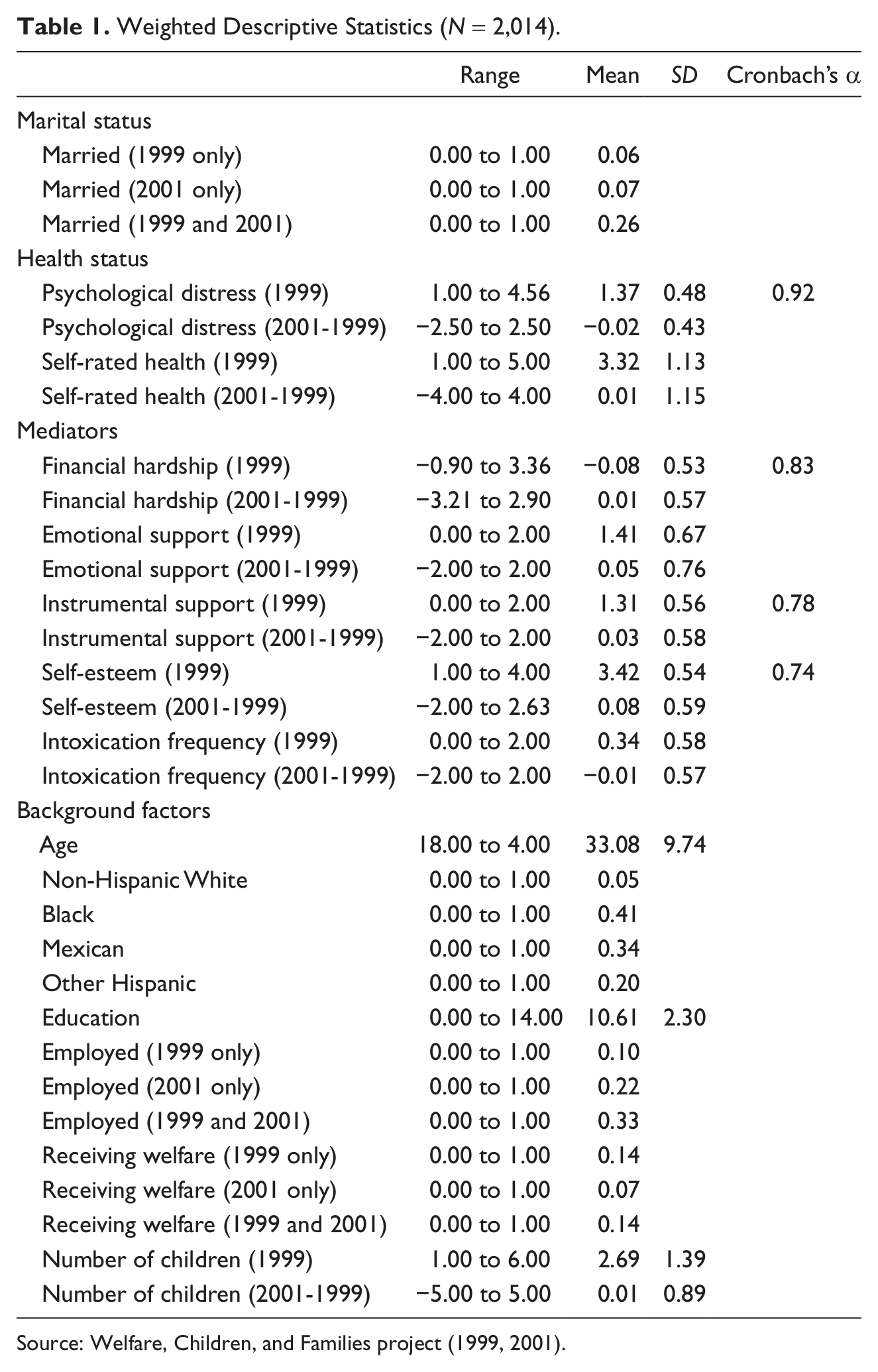
The analyses begin with the presentation of weighted descriptive statistics for the study sample, including minimum and maximum values, means, standard deviations, and alpha reliability estimates (Table 1). In the second stage of the analysis, I model changes in psychological distress over 2 years (1999 and 2001). In lieu of standard lagged endogenous dependent variable models, I employ change score models to assess 2-year distress trajectories. A recent comparison of two-wave panel designs concluded that change score models are generally preferable to lagged endogenous dependent variable models (Johnson, 2005).
Weighted Descriptive Statistics (N = 2,014).
Source: Welfare, Children, and Families project (1999, 2001).
I first computed change scores by subtracting baseline (1999) distress scores from follow-up (2001) distress scores. Change scores are continuous variables that range from some negative number to some positive number. Negative numbers indicate fewer symptoms of psychological distress in 2001 than in 1999. Positive numbers suggest greater distress in 2001 than in 1999. Many respondents exhibit a change score of zero, which indicates no change in distress levels across waves. To account for the possibility of other changing conditions and circumstances, I computed change scores for financial hardship, social support, self-esteem, intoxication frequency, and number of children. Because change scores are continuous variables, I used ordinary least squares regression to predict changes in psychological distress with marital status (Table 2). In this case, unstandardized coefficients are estimated to describe the difference in the expected change in psychological distress for every one-unit change in an independent variable.
Ordinary Least Squares Regression of the Change Psychological Distress (N = 2,014).

Note: Shown are unstandardized ordinary least squares coefficients with standard errors in parentheses. Models control for age, race and ethnicity, education, work status changes, welfare status changes, and changes in the number of children.
Source: Welfare, Children, and Families project (1999, 2001).
p < .05. **p < .01. ***p < .001 (two-tailed tests).
Analytics Strategy
The specific analytic strategy proceeds in five steps. Model 1 tests whether marital status predicts changes in psychological distress, controlling for baseline psychological distress, self-rated health status, changes in health status, and all background factors. Models 2 through 5 add a sequence of potential mediators to explain any significant effects for marital status. Model 2 adds baseline financial hardship and changes in financial hardship to Model 1. Model 3 adds baseline emotional and instrumental support and corresponding change scores to Model 2. Model 4 adds self-esteem and changes in self-esteem to Model 3. Finally, Model 5—the full model—adds intoxication frequency and changes in intoxication frequency.
To formally assess mediation, I employ the Clogg statistic (see Clogg, Petkova, & Haritou, 1995) to test for significant changes in the effects of marital status across nested models (i.e., before and after adjusting for mediators). A statistically significant reduction in the magnitude of a marital status coefficient would suggest mediation. To formally establish associations between marital status and significant mediators, I used ordinary least squares regression to predict changes in financial hardship, social support, self-esteem, and intoxication frequency (Table 3).
Ordinary Least Squares Regression of Mediators (N = 2,014).

Note: Shown are unstandardized ordinary least squares coefficients with standard errors in parentheses.
Source: Welfare, Children, and Families project (1999, 2001).
Model controls for age, race and ethnicity, education, work status changes, welfare status changes, changes in the number of children, psychological distress (1999), changes in self-rated health, and financial hardship (1999).
Model controls for age, race and ethnicity, education, work status changes, welfare status changes, changes in the number of children, psychological distress (1999), changes in self-rated health, changes in financial hardship, changes in instrumental support, and emotional support (1999).
Model controls for age, race and ethnicity, education, work status changes, welfare status changes, changes in the number of children, psychological distress (1999), changes in self-rated health, changes in financial hardship, changes in emotional support, and instrumental support (1999).
Model controls for age, race and ethnicity, education, work status changes, welfare status changes, changes in the number of children, psychological distress (1999), changes in self-rated health, changes in financial hardship, changes in emotional support, changes in instrumental support, and self-esteem (1999).
Model controls for age, race and ethnicity, education, work status changes, welfare status changes, changes in the number of children, psychological distress (1999), changes in self-rated health, changes in financial hardship, changes in emotional support, changes in instrumental support, changes in self-esteem, and intoxication frequency (1999).
p < .05. **p < .01. ***p < .001 (two-tailed tests).
Attrition Analysis
When considering changes in outcomes over time, it is customary to examine the issue of bias due to sample attrition. The primary concern is whether or not there are any systematic changes in the sample across waves. To formally assess this issue, I estimated a binary logistic regression model predicting the log odds of sample attrition (results not shown). The dependent variable in this case is dummy coded such that respondents who completed questionnaires for both waves were given a value of zero and those who completed the Wave 1 questionnaire only were given a value of one. The independent variables include marital status, psychological distress, self-rated health, and all mediators and background factors. Approximately 12% of the sample (276 respondents) was lost to follow-up. The logistic regression results show very little evidence of bias because of sample attrition. Only education was statistically significant at conventional levels (odds ratio = 0.94, p < .05). Briefly, this result suggests that each additional unit of education reduces the odds of attrition by approximately 6%. Since I adjust for education in the analysis, attrition is unlikely to bias regression coefficients (Winship & Radbill, 1994).
Results
Descriptive Analysis
Table 1 provides weighted descriptive statistics for the study sample. Few respondents transitioned into (7%) or out of (6%) marriage over the study period, whereas many (26%) respondents reported being married in both 1999 and 2001. The majority of women had no exposure to marriage over the study period. This group mainly consists of women who were single (55%), separated (10%), or cohabiting (1%) at both waves. The average respondent also exhibited low levels of psychological distress and “good” self-rated health. The change scores for these measures suggest that both mental health and self-rated health improved over the study period. Interestingly, the average respondent reported low levels of financial hardship. In terms of psychosocial resources, most respondents reported having someone they can count on for emotional and instrumental support. The high levels of self-esteem are surprising given the disadvantaged nature of the sample; however, this pattern is generally consistent with the high percentage of Black respondents in the sample (Rosenfield, Phillips, & White 2006). The average respondent also exhibited low levels of intoxication. The change scores for these measures indicate that although financial hardship, social support, and self-esteem increased over the study period, levels of frequent intoxication decreased.
In terms of racial/ethnic composition, the sample includes Blacks (41%), Mexican-origin persons (34%), other Hispanics (20%), and non-Hispanic Whites (5%). The average respondent is 33 years of age, with approximately 11 years of formal education. Many respondents were employed in 1999 and 2001 (33%). Approximately 14% of respondents reported receiving welfare benefits in 1999 and 2001. The average respondent is responsible for nearly three children. The change score for this measure suggests that the average number of children increased over the study period. With respect to chronic stressors, the average respondent reported low levels of financial hardship and household disrepair and a moderate level of neighborhood disorder.
Multivariate Analysis
Table 2 presents the primary regression analysis. On one hand, transitioning into and out of marriage is unrelated to changes in psychological distress. On the other hand, respondents who reported being married in both 1999 and 2001 exhibited lower levels of psychological distress from baseline to follow-up than respondents who reported no exposure to marriage. This pattern is generally consistent across models. When baseline financial hardship and the change in hardship are added to the regression equation in Model 2, the coefficient for being married in 1999 and 2001 is reduced by approximately 10% ([0.10 − 0.09]/0.10), which is a statistically significant reduction (t = 3.33, df = 2,011, p < .001). Table 3 confirms that respondents who reported being married in 1999 and 2001 also exhibited lower levels of financial hardship from baseline to follow-up than respondents who reported no experiences with marriage during the study period. Taken together, these results suggest that lower levels of financial hardship partially explain why respondents who reported being married in 1999 and 2001 exhibited favorable changes in psychological distress. Interestingly, I find no evidence to support the mediating influence of emotional support, instrumental support, self-esteem, or intoxication frequency.
Discussion
Although policy makers have created programs and enacted legislation designed to promote marriage among low-income urban women with children, scholars have only begun to test whether the apparent psychological benefits of marriage extend to this population. Following the work of Meadows et al. (2008), this study used longitudinal data collected from a large probability sample of low-income urban women with children to examine the mental health consequences of marriage and related transitions. It also extended the work of Meadows et al. by testing several potential mediators of the association between marriage and mental health, including financial hardship, social support, self-esteem, and frequency of intoxication.
Key Patterns
The first hypothesis stated that entering marriage during the study period would be associated with lower levels of psychological distress. I found no evidence to support this hypothesis. The psychological distress trajectories of women who entered marriage were similar to women with no exposure to marriage. Although this pattern fails to support the marital resource model and several studies that associate entry into marriage with significant improvements in mental health (e.g., Frech & Williams, 2007; Lamb et al., 2003; Simon, 2002; Simon & Marcussen, 1999; K. Williams, 2003; K. Williams, Sassler, & Nicholson, 2008), it is generally consistent with research that shows no mental health benefits of entering into marriage (e.g., Hope et al.,1999; Horwitz & White, 1991; Meadows et al., 2008; Wade & Cairney, 2000; Wu & Hart, 2002).
The next hypothesis stated that exiting marriage during the study period would be associated with higher levels of psychological distress. Once again, I found no evidence to support this hypothesis. The psychological distress trajectories of women who exited marriage were similar to those women with no exposure to marriage. This finding fails to support the marital crisis model and numerous studies of the mental health consequences of divorce (e.g., Simon, 2002; Simon & Marcussen, 1999; Strohschein, McDonough, Monette, & Shao, 2005; K. Williams, 2003; Wu & Hart, 2002) and widowhood (e.g., Lee & DeMaris, 2007; Pudrovska & Carr, 2008; Strohschein et al., 2005; K. Williams, 2003). My review of literature revealed only one other study that showed that divorce is unrelated to depressive symptoms (Pudrovska & Carr, 2008). To the best of my knowledge, this study is among the first to report no psychological costs associated with marital dissolution among low-income urban women with children (see Meadows et al., 2008, for empirical support of the marital crisis model).
The third hypothesis stated that continuous marriage over the study period would be associated with lower levels of psychological distress. In support of this hypothesis, I found that women who were continuously married exhibited lower levels of psychological distress from baseline to follow-up than women who reported no exposure to marriage. An examination of standardized regression coefficients (not shown) suggests that continuous marriage is actually one of the stronger predictors in the analysis. For example, in the final model, the standardized coefficient for continuous marriage (β = −.09) is larger in magnitude than those for continuous employment (β = −.05) and continuous welfare (β = .05), similar to those for changes in financial hardship (β = .11) and emotional support (β = −.10), and smaller than the standardized coefficient for changes in self-esteem (β = −.17). Because the benefits of continuous marriage are net of controls for baseline mental and physical health, the results are inconsistent with the marital selection model. However, the analysis supports previous research concerning the mental health benefits of continuous marriage (e.g., Bierman et al., 2006; Meadows et al., 2008). The combination of the results for continuous marriage and entry into marriage suggest that it may take a significant amount of time for low-income urban women with children to accrue the psychological rewards of marriage.
The final hypothesis stated that any mental health benefits of marriage or adverse psychological consequences of marital dissolution would be at least partially mediated or explained by financial hardship, social support, self-esteem, and heavy alcohol consumption. This hypothesis (along with the marital resource model) received mixed support. I observed modest indirect effects of continuous marriage through lower levels of financial hardship, but there was no evidence to confirm the mediating influence of emotional support, instrumental support, self-esteem, or intoxication frequency. The results for financial hardship are generally consistent with previous mediation studies (Hope et al., 1999; Pearlin & Johnson, 1977; Stack & Eshleman, 1998). These patterns also tend to substantiate research that suggests that the financial benefits of marriage are especially important to the mental health of women (Mirowksy & Ross, 2003). The null results for the mediating influence of social support are consistent with some mediation studies (Hope et al., 1999; Horwitz et al., 1996) and inconsistent with others (Pearlin & Johnson, 1977; Sherbourne & Hays, 1990). To the best of my knowledge, this study is the first to consider whether the association between marriage and mental health is mediated or explained by self-esteem and alcohol consumption. The null results for the mediating influence of alcohol consumption may support previous research that suggests that women are the primary agents of social control in marital relationships (Umberson, 1992).
Limitations
The present study is limited in several respects. Although the results suggest that entering and exiting marriage are unrelated to changes in psychological distress, these patterns could be artifacts of low incidence rates for new marriages (7%) and marital dissolution (6%). Because small sample sizes such as these could limit my ability to detect statistically significant differences, the marital transition results should be interpreted with caution.
It is also important to note that the women who entered marriage during the study period did so as single mothers, whereas those women who were married prior to the study period may have been married before having children. If, as previous research suggests (e.g., Edin, 2000; Lichter, Qian, & Mellott, 2006), entering marriage with children predicts lower marital quality, the present analysis should be considered with this in mind.
Although this study examined the role of health selection, I was unable to explore the possibility of personality selection. For example, research suggests that personality types that favor negative moods and emotional instability (e.g., neuroticism or negative affectivity) can actually contribute to lower quality marriages (e.g., Caughlin, Huston, & Houts, 2000). If certain personality types are selected out of marriage because they have difficulty getting married or staying married, this study may overestimate the mental health benefits of continuous marriage.
Finally, I would like to recognize the limitations of the alcohol measurement. Although it is customary to measure multiple aspects of drinking behavior with precise frequencies and quantities, the measure of intoxication is based on a single item with a narrow range of imprecise response categories. This measure has demonstrated construct validity in the present analysis and in previous research (e.g., Hill & Angel, 2005; Hill et al., 2009; Robbins, 1989); however, the reliability of this single item is a cause for concern.Because this measure exhibits low reliability, the associations presented in this study are likely to reflect conservative estimates.
Conclusions
The results of the present study underscore the value of exploring the connection between marriage and mental health in theoretically relevant subpopulations. Huston and Melz (2004) argue that “we need to know the conditions under which the proposition that marriage is good for people does or does not hold” (p. 944). I speculated that the unique social location of low-income urban women with children could attenuate the benefits of marriage and the costs associated with marital dissolution. This perspective might help explain the null results for entering and exiting marriage but it cannot account for the notable benefits of continuous marriage. The results for continuous marriage are mostly consistent with a time-dependent marital resource model. Viewed in this light, it is important for future research to consider the timing of the development of marital-related resources.
Although we were unable to thoroughly examine race and ethnic differences in the mental health consequences of marriage for low-income urban women, this is an important avenue for future work. For example, several studies have highlighted the unique conditions of poor marital quality and low levels of stigma associated with being single in the Black population (Harris, Lee, & DeLeone, 2010; Lincoln & Chae, 2010; Mandara et al., 2008; D. Williams et al., 1992). This body of work suggests that the psychological benefits of marriage and the costs of marital dissolution could be especially attenuated for Black low-income women with children. Because Blacks make up a large portion of the WCF sample, some of the results of the current study (e.g., the patterns for marital dissolution) could be driven by race and ethnic variations.
The results of the mediation analysis suggest that financial resources explain only a small portion of the association between continuous marriage and psychological distress. If social support, self-esteem, and alcohol consumption are inconsequential, why might low-income urban women with children benefit from marriage? Future research might consider other important psychological resources (e.g., meaning and purpose, the sense of mattering, and the sense of coherence). Because previous work suggests that marriage contributes to healthier lifestyles, it is also important to account for other behaviors that are relevant to mental health (e.g., sleep quality and illicit drug use). Clearly, additional research is needed to explore the causal processes through which marriage might benefit the mental health of low-income urban women with children. Studies along these lines are critical because policy makers have and continue to promote marriage in this population.
Footnotes
Declaration of Conflicting Interests
The author(s) declared no potential conflicts of interest with respect to the research, authorship, and/or publication of this article.
Funding
The author(s) received no financial support for the research, authorship, and/or publication of this article.