



Abstract
This study investigated family structure differences in family functioning, evaluated whether extra-familial social capital accounted for any observed differences, and tested whether the influence of extra-familial social capital on family functioning varied by family structure. Using the first wave of the Canadian National Longitudinal Survey of Children and Youth (n = 6,223), analysis revealed significantly lower family functioning levels within stable cohabiting two-biological-parent households and stable single-biological-mother households relative to stable married two-biological-parent households, even after sociodemographic controls. Higher levels of social involvement and neighborhoodcohesion were associated with increased family functioning, but did not mediate family structure differences in family functioning. The effect of neighborhood cohesion on family functioning depended on family type such that the benefits of neighborhood cohesion for family functioning were magnified at high levels of neighborhood cohesion for both married and cohabiting households but had much less influence on family functioning within single-mother households.
Family researchers and policy makers commonly view the married two-biological-parent family as the gold standard (Brown, 2010). A vast amount of research to date has shown that children from single mother or cohabiting households are, on average, more likely to exhibit behavioral and emotional problems, are at greater risk for delinquency, and are less likely to be sociable, complete high school, and gain secure employment than children raised in intact married-parent households (Artis, 2007; Brown, 2004; Carlson & Corcoran, 2001; Hill, Yeung, & Duncan, 2001; Thomson, Hanson, & McLanahan, 1994). Policy responses to these findings include marriage promotion (Brown, 2010; Furstenberg, 2007) and efforts to increase the social capital of poor and single-parent families by integrating them into extra-familial networks (Edwards, 2004; Gerwitz, Dickson, Power, Halpin, & Whitty, 2005). In this article, however, we challenge views that cohabiting and single-mother households are necessarily deficient and that increasing social capital will improve family life in all households. Instead of encouraging one familial form by highlighting differences in individual-level outcomes between family structures, we move beyond social address explanations and explore differences in the relational processes of the family environment (family functioning), which are arguably the mechanisms through which family structure influences child development (Brown & Manning, 2009, p. 89; Daniels & Moos, 1988). Furthermore, drawing on Bronfenbrenner’s (1986) social ecological perspective that families are nested microsystems that are shaped by different external systems, we examine how familial ties to the exosystem, the various contexts in which children’s parents circulate (such as paid employment, social networks, and neighborhoods), affect family functioning.
It is frequently suggested that cohabiting or single-parent families “compensate” for the disadvantages that presumably follow being unwed to a child’s other biological parent by drawing on resources outside the household (Alwin, Converse, & Martin, 1985; Stack, 1974; Stets, 1991). Researchers, however, know little about how specific external contexts affect family-level outcomes (Furstenberg, 2005). The tendency in policy circles and social capital research is to view any community integration as beneficial (Portes, 1998, p. 2). Recent social capital theorists, however, have suggested that social ties are not universally beneficial (Furstenberg & Kaplan, 2004; Lin, 2001; Portes, 1998). Our study advances knowledge of how exosystem connections affect families by investigating how family functioning across different family structures is influenced by a household’s ties to local settings. To isolate the effects of family structure, we use data from a nationally representative sample of Canadian children to compare differences in family functioning among households where children have continuously resided with their biological parents in a married, cohabiting, or single-mother household. To acknowledge that families are themselves embedded in exosystems, we evaluate whether extra-familial social capital, assessed as social involvement and neighborhood cohesion, explains any observed differences in family functioning. We then test whether these extra-familial social capital ties operate differently across family structures. We find that family functioning among single-biological-mother households does not respond to increasing levels of neighborhood cohesion in the same way that it does for married and cohabiting two-biological-parent households.
Background
Family Functioning and Family Structure
Family functioning is the extent to which family members are emotionally bonded, effectively communicate emotions and information, and respond cooperatively and flexibly to problems (Epstein, Bishop, & Levin, 1978; Olson & Gorall, 2003). Designed to assess the family system as a whole, family functioning is distinct from both parenting and marital behavior in that the latter two measures address different subsystems in the family unit (Hayden et al., 1998). Because we conceptualize families as microsystems that are greater than the sum of their parts, we focus on studies that assess family functioning at the family-unit level.
It is clear that family functioning matters for child well-being. Evidence suggests that low levels of family functioning are associated with lower educational attainment (Boyle, Georgiades, Racine, & Mustard, 2007) and a wide range of child physical and mental health problems, including obesity (Rhee, 2008), substance abuse (Wagner et al., 2010), social phobias (Knappe et al., 2009), indirect aggression (Pagani, Japel, Vaillancourt, & Tremblay, 2010), and depression and antisocial behavior (Strohschein, 2005). Researchers have also begun to identify the upstream factors associated with family functioning. Low income, welfare status, low maternal education, and maternal depression have been linked to reduced family functioning (Clark, Barrett, & Kolvin, 2000; Daniels & Moos, 1988; Dickstein et al., 1998; Georgiades, Boyle, Jenkins, Sanford, & Lipman, 2008; Hayden et al., 1998; Lee, 2000; Yeung & Chan, 2010).
Although research suggests that single-parent or cohabiting households are disadvantaged in most of these domains compared to married-parent families (Brown, 2004; Stets, 1991; Thomson et al., 1994), there is little conclusive evidence about family structure differences in family functioning. Some studies found significantly lower levels of family functioning in single-parent households relative to intact two-parent households (Bernstein & Borchardt, 1996; Clark, Barrett, & Kolvin, 2000; Hayden et al., 1998; Yeung & Chan, 2010) whereas others found none (Agate, Zabriskie, & Eggett, 2007; Herzer et al., 2010; Hornberger, Zabriskie, & Freeman, 2010; McFarlane, Bellissimo, & Norman, 1995). Brown and Manning (2009) provide the only study of family-level assessment that includes cohabiting parents as a separate family structure category. They found that households outside the two-biological-parent form reported lower levels of family connectedness, with cohabiting stepfamilies faring the worse. Unfortunately, it is unclear to what degree mixed biological relations (i.e., step-parentage) or family structure (cohabitation) are responsible for these findings because their examination of cohabitation included only cohabiting stepfamilies.
Methodological problems of many family functioning studies include relying on small, nonrepresentative samples and the use of bivariate rather than multivariable analyses. More generally, these studies share two shortcomings characteristic of research on family structure differences. First, many treat single-parent households (and other family structures) as monolithic categories. Given that a single-parent household can develop though widowhood, divorce, or nonmarital childbearing, researchers who simply compare differences between one- and two-parent households risk conflating the effects of single parenthood with effects that might be more accurately attributed to the disruptive process of parental separation or death (Weinraub, Horvath, & Gringlas, 2008). Moreover, researchers have inconsistently classified cohabiting households, sometimes including them with single-parent households and at other times combining them with married households. Careful attention to these nuances might resolve contradictory findings. Second, stressing average differences in child outcomes often leads scholars to promote the married, two-biological-parent family structure, when many children from other types of households, despite increased risk factors, obtain satisfactory results (Anderson, 2003). Focusing on social address variables, such as family structure tells us little about why those differences exist (Bronfenbrenner & Crouter, 1983; Strohschein, 2010) and ignores the potential industriousness of households that might draw on external resources to improve particular outcomes (Alwin et al., 1985; Stack, 1974).
By using a nationally representative sample to evaluate family structure differences in family functioning where households in each family structure category have had stable family structure histories, we exclude the possible effects of family restructuring and provide initial steps toward a more rigorous analysis of the effects of family structure per se. Following our social ecological framework, we then go beyond social address comparisons to evaluate whether extra-familial social networks enhance family functioning and if they do so in the same way across different stable family configurations.
Social Capital and Family Functioning
We draw on the contested concept of social capital to assess how exosystem ties affect family functioning. Social capital denotes the quantity and quality of social connections that persons or collectives have (Lin, 2001; Portes, 1998). The concept, however, requires specification due to the contributions of different theorists, including Coleman (1988a, 1988b), Bourdieu (1997), and Putnam (2001). Our analysis mainly follows Coleman’s (1988a, 1988b) formulation, which holds that social capital consists of social ties that are available as informational or instrumental resources. Coleman identified levels of shared information, connectedness, trust, and informal social control as important social capital resources (Goyette & Conchas, 2002, p. 47). Coleman (1988a, 1988b) further argued that social capital (a) existed within families, which he defined as the presence and attention of parents in the lives of their children and (b) consisted of ties parents had to “networked resources” external to the family, such as neighbors, school personnel, voluntary and religious institutions, and work colleagues. Hofferth, Boisjoly, and Duncan (1998, p. 251) aptly differentiate these two forms of social capital as intra-familial social capital and extra-familial social capital respectively.
Our social ecological perspective, however, rejects the notion of intra-familial social capital. Coleman’s (1988a) contention was that single-parent families are structurally deficient because of the absence of a second adult in the household. We argue that neither the number of parents nor the attention that parents invest in their children should be viewed as social capital. Rather, as Morrow (1999), Ravanera and Rajulton (2010), and Winter (2000) note, Coleman’s definition of intra-familial social capital is more accurately labeled parenting behavior and is problematic because it narrowly represents social capital as a top-down dyadic exchange between parents and their children. Using this idea of intra-familial social capital therefore contradicts our conceptualization of the family as a microsystem greater than the sum of its individual relations. Additionally, the idea of intra-familial social capital ignores our concern with the how families are embedded in external systems.
Coleman’s notion of extra-familial social capital, on the other hand, meshes with our social ecological perspective, given its emphasis on ties to exosystem settings such as neighborhoods, work, and formal institutions. Its measurement, however, remains contested (Furstenberg, 2005). Our study relies on two measures; social involvement in community organizations and neighborhood cohesion. Both are popular indicators of social capital insofar as the first measures civic participation and the second reflects levels of social connectedness, mutual trust, and informal social control between neighbors (Lochner, Kawachi, & Kennedy, 1999; Pichler & Wallace, 2007; Sampson, Morenoff, & Earls, 1999; Ziersch, Baum, MacDougall, & Putland, 2005). These local resources are particularly relevant to disadvantaged families who, because of lack of economic resources, are potentially more neighborhood-dependent (Bronfenbrenner, 1986; Ziersch et al., 2005, p. 81) and are less likely to have ties to other exosystem settings such as work.
No empirical studies evaluate whether social capital accounts for the association between family structure and family functioning. Nonetheless, studies on family functioning and extra-familial social capital, coupled with separate research on family structure and social capital, support our contention that local ties affect family functioning. Daniels and Moos (1988) found that maternal involvement in extra-familial social networks was positively associated with family functioning. More recently, Pitt-Catsouphes, MacDermid, Schwarz, and Matz (2006) found that a parent’s positive assessment of their community (an index that subsumed measures of social involvement and neighborhood cohesion) was associated with higher levels of family functioning. Meanwhile, research has found that although single mothers frequently use friend and family networks, they have less extra-familial social capital in the form of neighborhood ties than married persons (Alwin et al., 1985; Ravanera & Rajulton, 2010). Similarly, although Stets (1991) found that cohabitors had more ties to informal social networks such as friends and family than married persons, it is commonly argued that the incomplete institutionalization of the cohabiting family form results in less social acceptance and social integration relative to married families (Nock, 1995; Wu, 1995). It is possible, then, that lower levels of extra-familial social capital explain observed differences in family functioning relative to married households and that increased local ties would serve as “compensatory” mechanisms for disadvantaged families. By assessing whether extra-familial social capital accounts for any deficits in family functioning among single-biological-mother and cohabiting biological-parent households relative to married biological-parent households, our study provides the first empirical test of this issue.
Many social capital theorists, however, caution that the effects of social capital might not be universally beneficial (Furstenberg & Kaplan, 2004; Lin, 2001; Portes, 1998). Increased engagement in social networks might not benefit family functioning if extra-familial networks are resource poor (Hofferth et al., 1998), or if involvement in extra-familial networks diverts time and energy investments in the family (Buchel & Duncan, 1998; Hofferth, Boisjoly, & Duncan, 1999). Since these characteristics and abilities vary across different family types, we might expect a lower rate of return for investments in social capital on family functioning across family structures. We examine this possibility by assessing if and how social capital interacts with family structure.
In sum, we used Bronfenbrenner’s (1986) social ecological approach to investigate how local ties to the exosystem influence intra-familial processes by examining the links between family functioning, family structure, and extra-familial social capital. We first tested whether there were differences in family functioning across stable married two-biological-parent households, stable cohabiting two-biological-parent households, and always-single-biological-mother households, using data from a nationally representative sample and rigorously controlling for sociodemographic variables. Using a sample with stable family structure histories ensures we examine the effects of family structure itself and not family reconfiguration. We then tested whether extra-familial social capital mediated the association between family structure and family functioning. Finally, we tested whether family structure operates as a moderator, such that the effects of extra-familial social capital on family functioning differ across family types.
Method
Data and Sample Selection
Designed to track Canadian children’s health and development, the Canadian National Longitudinal Survey of Children and Youth (NLSCY) began in 1994 and continues to re-interview the original cohort of children every 2 years. A person designated as the most knowledgeable about the child, typically the mother, acted as the main informant and responded to questions about child well-being, family dynamics, and family composition history. Of 15,579 households identified in 1994 as having at least one child younger than 12 years, 13,439 households (86.3%) agreed to participate. Randomly selecting one child and up to four siblings from each household created a sample of 22,831 children in 13,439 households. With the exception of children living in institutions or on Indian Reserves, this sample, when weighted, provides a representative sample of all children aged 0 to 11 years living in Canada in 1994 (Statistics Canada, 1995).
This study analyzed data from the first wave of the NLSCY. We selected households where a firstborn child was a participant (N = 10,214, 76.0% of total number of households) so that it was possible (a) to determine which households had stable family structure histories during the years it contained any children and (b) to use the age of the eldest child as a proxy for the duration of household stability. Restricting our analysis to biologically related families and households where there had been no change in family structure since the birth of the first child reduced the sample to 7,635 households (56.8% of the total number of households). To ensure consistency in who reported on our dependent variable, and because there were too few (i.e., less than 10) fathers in single-parent households to use parent gender as a variable in the analysis, we dropped 686 cases where the father was the main informant across the three household types (N = 6,949). Based on evidence of unique family dynamics in multigenerational households, particularly for young, single mothers (Deleire & Kalil, 2002), 407 households that contained adults who were not parents of children in the NLSCY were also eliminated, resulting in a sample size of 6,542. After listwise deletion for missing information, we obtained a final sample of 6,223 households (46.3% of total), consisting of 5,321 stable married two-biological-parent households, 669 stable cohabiting two-biological-parent households, and 233 stable single-biological-mother households.
Measures
Family functioning
Consistent with the view that the family is a microsystem with its own family-level processes, family functioning is assessed with the McMaster Family Assessment Device (Epstein et al., 1978). Mothers indicate whether they strongly disagree, disagree, agree, or strongly agree (assigned a value of 0 to 3 respectively) with 12 statements referring to the level of communication, trust, support, and conflict within their households (e.g., “individuals in the family are accepted for who they are” and “we confide in each other”). Summed items produce a scale ranging from 0 to 36, with higher scores representing higher levels of family functioning. The research instrument demonstrated good internal reliability for the entire NLSCY sample (Cronbach’s α = .88).
Family structure
Using mothers’ reports of marital status and family structure history, we constructed dummy variables for stable cohabiting two-biological-parent households and stable single-biological-mother households, with stable married two-biological-parent households as the omitted reference category. Single-mother families, then, contain mothers who report having never lived with or been married to the father of their children or to any one else (i.e., they are not separated, divorced, or widowed). Married parent households included 297 couples who were cohabiting when their first child was born but later married without any intervening interruption. This decision was based on prior research and our own separate analyses (not shown), which revealed couples that cohabited and then married were more similar to married couples who had never cohabited than to currently cohabiting couples (Fomby & Cherlin, 2007; Nock, 1995).
Unfortunately, family structure measures and questions have not kept pace with new family forms (Brown, 2010). With this wave of data we cannot accurately assess whether respondents who had experienced a family disruption have gone through multiple household reconfigurations. Focusing on the three stable family structures reduces the number of family types we can compare, but remains the best available means by which we can assess the effects of married, cohabiting, and single-parent family structures in and of themselves. We discuss further implications of this in our discussion section.
Social capital
Social capital is assessed with two variables: social involvement and neighborhood cohesion. Social involvement is dummy variable coded 1 if the mother reports that she is currently involved in any voluntary organizations (e.g., school groups, church groups, community organizations) and 0 if not. Neighborhood cohesion is a five-item scale that asked the mother whether she strongly disagrees, disagrees, agrees, or strongly agrees (coded 0 to 3 respectively) that (a) if there is a problem around here, the neighbors get together to deal with it, (b) there are adults in the neighborhood that children can look up to, (c) people around here are willing to help their neighbors, (d) I can count on adults in the neighborhood to watch out that children are safe and don’t get into trouble, and (e) when I am away from the house, I know my neighbors will keep their eyes open for possible trouble. Items were summed to produce a scale ranging from 0 to 15, with higher values reflecting greater perceived levels of neighborhood cohesion (Cronbach’s α = .86). Consistent with Coleman’s (1988a, 1988b) idea of social capital, these measures are not aggregated to reflect community-level social goods and participation levels (Lochner et al., 1999; Putnam, 2001) that allegedly remain accessible to all persons within community boundaries. Rather, these are reports of each mothers’ level of participation and the level of assistance, trust, and informal social control she perceived to be available to her family as resources in the neighborhood.
Control variables
To rule out spurious associations between family structure and family functioning, all models include a range of demographic and socioeconomic variables. Ages of the mother and firstborn child are measured in years. Age of the firstborn child doubles as a proxy measure for the number of years a household has been a continuously married, cohabiting, or single-mother household with children. Sibship size is a count of all children younger than 18 years living in the home. Parental education records the highest level of education attained by any parent in the house. Dummy variables were constructed for less than high school, completed high school, some postsecondary education, with completed degree or certificate from a postsecondary institution as the omitted reference category.
Maternal depression, maternal employment, and maternal time with child are also included as controls. Maternal depression was assessed using an abbreviated version of the Center for Epidemiological Studies Depression Scale. Mothers responded to 12 questions about the frequency of depressive symptoms in the past week (including poor appetite, feelings of hopelessness, and restless sleep) as rarely or none of the time, some or a little of the time, occasionally or a moderate amount of the time, and most or all of the time. Responses were scored from 0 to 3 and summed to produce a scale ranging from 0 to 36, where higher values indicate increased depression. The scale had acceptable reliability (Cronbach’s α = .82). Maternal employment status consisted of dummy variables that compared mothers employed full-time, employed part-time, or not employed (omitted reference category). Maternal time with child was a three-item scale that assessed how frequently the mother (a) plays sports, hobbies, or games with child, (b) does something special with the child, and (c) talks or plays with her child for 5 minutes or more. Scores from 0 to 4 were assigned, respectively, to the following responses: never, about once a week or less, a few times a week, one or two times a day, and many times a day. Representing the sum of these scores, maternal time with child ranged from 0 to 12, with higher scores indicating more time spent with the child (Cronbach’s α = .79).
Analysis and Sampling Weights
Ordinary least squares regression models were used to evaluate predictors of family functioning. Sampling weights were used in all calculations to take into account the complex sampling design and differential probabilities of selection and nonresponse. Because our models included tests for a moderating relationship between family structure and social capital, we centered all continuous variables around their sample means to minimize multicollinearity.
Results
Differences in family characteristics across the three family structures appear in Table 1. Stable married-biological-parent households report significantly higher family functioning, on average, than stable cohabiting two-biological-parent households or stable single-biological-mother households. Always-single-mothers and mothers in stable cohabiting households were significantly younger, had eldest children who were younger, had shorter durations of stability, had fewer children, less household income, less education, and higher levels of depression than mothers in stable married households. Maternal time with child, however, was greater in stable single-biological-parent households and stable cohabiting biological-parent households than in stable married-biological-parent households. There were also significant differences in social capital across the three family types, with mothers in stable married two-biological-parent households reporting higher levels of social involvement and neighborhood cohesion relative to stable cohabiting two-biological-parent households and stable single-biological-mother households.
Family Structure Differences Across Key Variables, NLSCY (Canadian National Longitudinal Survey of Children and Youth), 1994-1995 (N = 6,223).
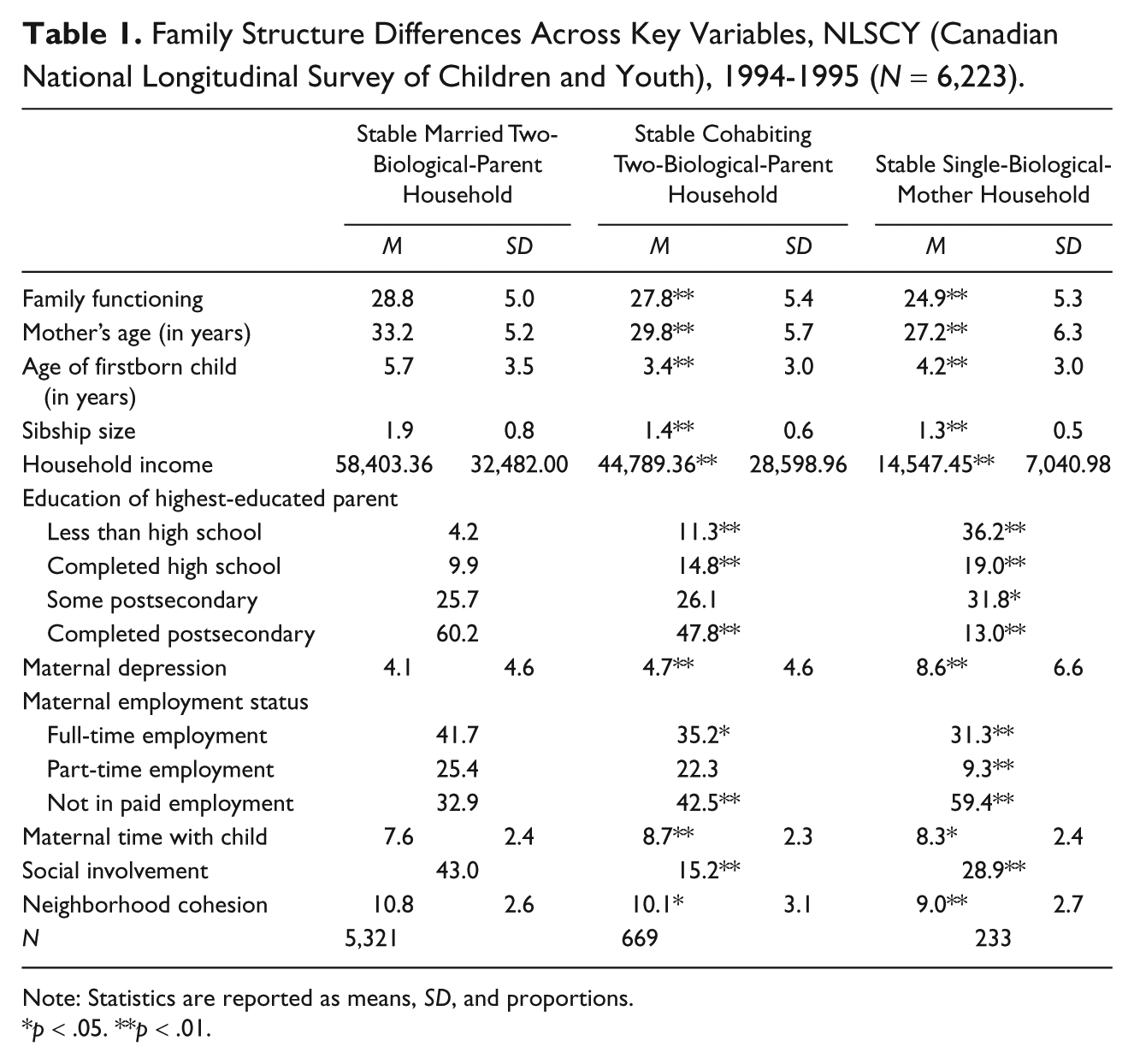
Note: Statistics are reported as means, SD, and proportions.
p < .05. **p < .01.
Differences in family functioning and social capital, however, might be confounded by sociodemographic differences between the three family structures. Multivariable regression results are presented in Table 2. Results (Model 1) suggest that family functioning is significantly lower in continuously cohabiting two-biological-parent households (b = −0.61, p < .01) and stable single-biological-mother households (b = −1.54, p < .001) relative to stable married two-biological-parent households, net of controls. Higher levels of family functioning are associated with younger maternal age, older age of the eldest child (longer duration of stability), larger family size, higher household income, greater maternal time spent with child, and lower levels of maternal depression. Households where no parent has finished high school have significantly lower levels of family functioning relative to households where at least one parent has a postsecondary degree or diploma. Households where the most highly educated parent has some postsecondary education report significantly higher levels of family functioning relative to households where the most educated parent has a postsecondary degree or diploma.
Family Structure and Social Capital as Predictors of Family Functioning, NLSCY (Canadian National Longitudinal Survey of Children and Youth), 1994-95 (N = 6,223).
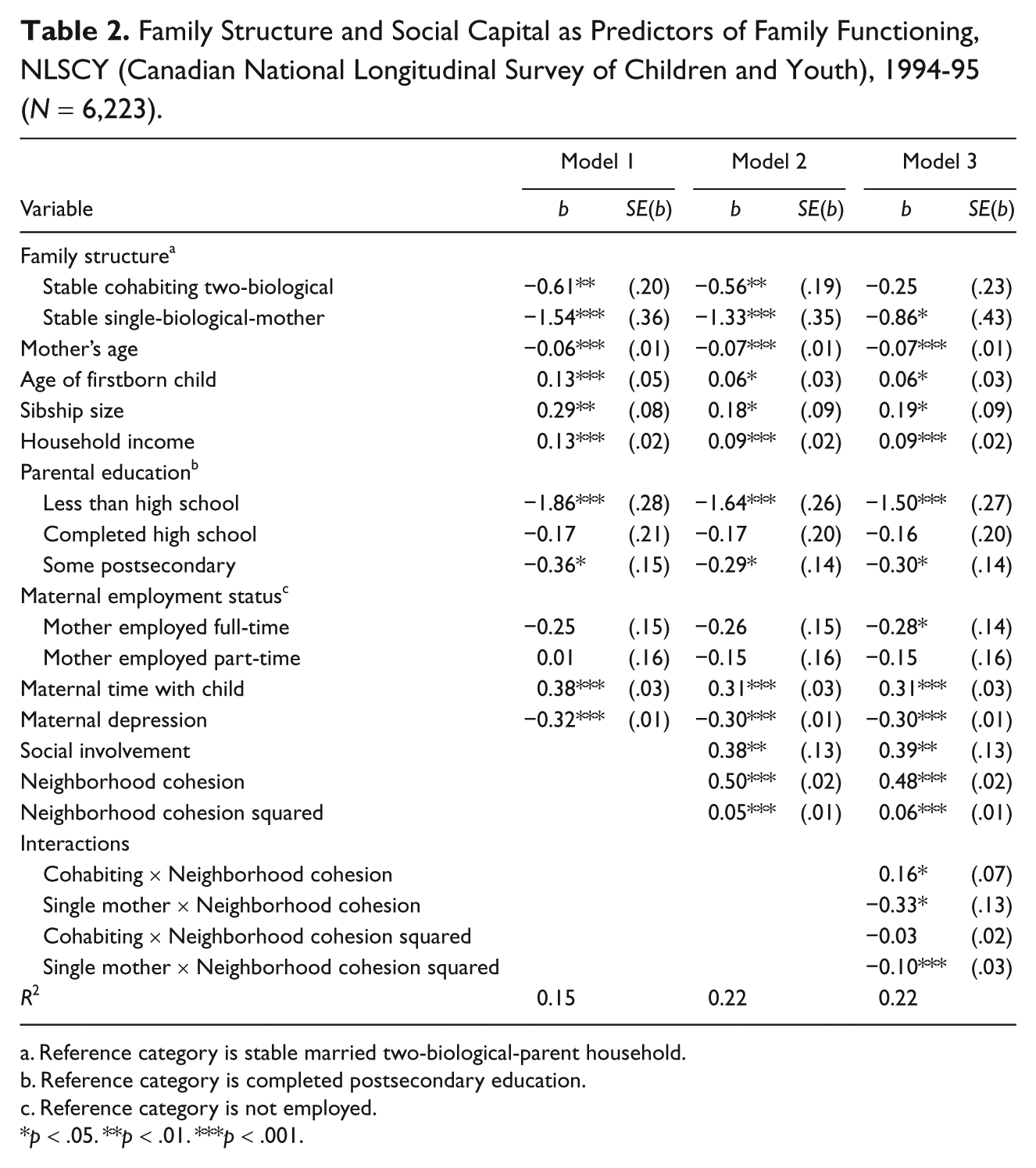
Reference category is stable married two-biological-parent household.
Reference category is completed postsecondary education.
Reference category is not employed.
p < .05. **p < .01. ***p < .001.
Next, we assess whether social capital mediates the association between family structure and family functioning. Following Baron and Kenny (1986), we first confirmed that family structure was a significant predictor of both social involvement and neighborhood cohesion, net of controls (results not shown), and therefore plausible contenders for mediation. Results shown in Model 2 (Table 2) reflect the addition of social involvement and neighborhood cohesion to Model 1. Greater social involvement was associated with higher levels of family functioning. Preliminary analysis revealed a nonlinear relationship between neighborhood cohesion and family functioning that was captured by adding a quadratic term to the model. Coefficients for the linear and quadratic terms were both positive, indicating that the effect of neighborhood cohesion on family functioning magnifies at higher levels of neighborhood cohesion. Coefficients for continuously cohabiting two-biological-parent households and stable single-biological-mother households were slightly attenuated (8.2% and 13.6%, respectively), but remained statistically significant.
The final model (Table 2, Model 3) presents results testing if the effects of social capital on family functioning differ across family structure. We initially tested two-way interactions between (a) family structure and social involvement and between (b) family structure and the linear and quadratic terms for neighborhood cohesion. The interaction between social involvement and family structure was not significant (results not shown) and was parsed from the model. Results from Model 3 indicate that the effect of neighborhood cohesion on family functioning differs across family structures such that the benefits of neighborhood cohesion for family functioning are magnified at high levels of neighborhood cohesion for both stable married two-biological-parent households and stable cohabiting two-biological-parent households. For cohabiting households, this magnification is such that as neighborhood cohesion increases, the predicted family functioning values go from being similar to the lower levels found among single-mothers to being indistinguishable from the higher levels found among married two-biological-parent families. In contrast, in stable single-biological-mother households, neighborhood cohesion increases family functioning initially, but then exhibits a threshold effect whereby increases in neighborhood cohesion are no longer associated with increases in family functioning. We graph this interaction by plotting predicted family functioning for each family structure across the valid values for neighborhood cohesion. Figure 1 illustrates the similar, positive exponential effect that increasing neighborhood cohesion has on stable married two-biological-parent households and stable cohabiting two-biological-parent households, and the diverging flatter pattern for stable single-biological-mother households at higher levels of neighborhood cohesion.
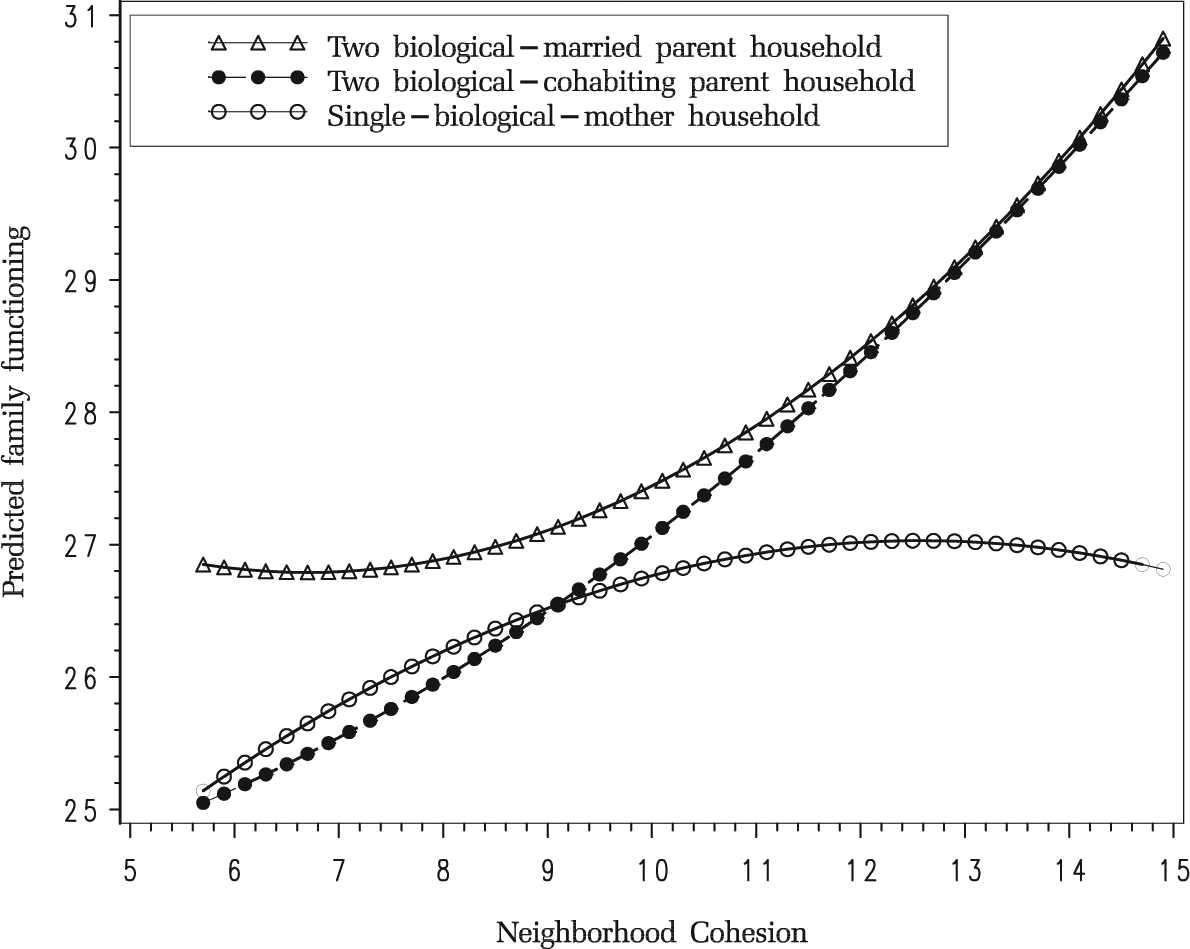
Predicted family functioning by neighborhood cohesion and family structure.
Discussion
Although the links between family structure, social capital, and family functioning have not been systematically investigated, marriage promotion and increased extra-familial social capital are frequently proffered as effective policy solutions to ameliorate the disadvantages found within families outside the two-married-biological-parent household. The findings of the current study provide a different perspective on this issue.
By analyzing a nationally representative sample to evaluate family structure differences in family functioning where households in each category share stable family structure histories and where a wide range of sociodemographic characteristics have been controlled, our study moves beyond prior scholarship and provides a more rigorous assessment of the effects of married, cohabiting, and single-mother family structures in and of themselves. Our analyses revealed that stable single-biological-mother households and stable cohabiting two-biological-parent households report significantly lower levels of family functioning than married two-biological-parent households net of controls. Our findings regarding single-mother households are consistent with those of Bernstein and Borchardt (1996), Clark et al. (2000), Hayden et al. (1998), and Yeung and Chan (2010), who also report that single-mother families, on average, report significantly lower family functioning than married families. Our findings also resemble Brown and Manning’s (2009) claim that cohabitors score lower on family functioning indicators than married households. With our sample, however, we can more confidently assert that these differences stem from the respective family structures themselves.
We also note that the relationships between family functioning and our control variables are consistent with what has been reported in previous research. That is, we found that socioeconomic disadvantage (Clark et al., 2000; Georgiades et al., 2008; Hayden et al., 1989; Lee, 2000), reduced maternal care (McFarlane et al., 1995), and maternal depression (Daniels & Moos, 1988; Dickstein et al., 1998) were associated with lower levels of family functioning. The finding that younger mothers reported higher family functioning than older mothers does not align with other research indicating that maternal age positively relates to family functioning (Georgiades et al., 2008). Preliminary analysis (not shown) revealed that the association between maternal age and family functioning in our sample was also positive and statistically significant at the bivariate level, but that once adjusted for other terms in the model, the coefficient for maternal age became negative.
Given that after controls both single-mother households and cohabiting households still report lower levels of family functioning than married households, differences across family types cannot be solely attributed to the absence of a second parent in the household. Our findings, however, should not suggest that marriage promotion ought to be the solution. As stated earlier, comparing outcomes across family types where married two-biological-parent households are the reference category might unwittingly reinforce this category as the gold standard and overlook the fact that families are embedded in external contexts that might be used to improve their internal relations. Certain families might be able to invoke external resources to help overcome the apparent disadvantages associated with household compositions outside the married two-biological-parent form (Alwin et al., 1985; Stack, 1974).
Policy discourses have grasped this notion and frequently suggest that observed deficits in single-parent households might be overcome by increasing the social capital of these households (Edwards, 2004; Gerwitz et al., 2005). Our bivarate analyses confirm previous claims that single mothers have less extra-familial social capital in the form of neighborhood ties than married persons (Alwin et al., 1985; Ravanera & Rajulton, 2010), and that cohabitors are less socially integrated than married families (Nock, 1995; Wu, 1995). Our regression models advanced these debates by allowing us assess whether lower levels of social capital explain disadvantages in family-level measures, such as family functioning. Our second model revealed that our measures of extra-familial social capital (neighborhood cohesion and social involvement) were significant predictors of family functioning. This finding aligns with previous research that demonstrated greater attachment to extra-familial social networks was positively associated with family functioning (Daniels & Moos, 1988; Pitt-Catsouphes et al., 2006). The coefficients for family structure, however, remained largely unchanged when extra-familial social capital was added to the model. This suggests that extra-familial social capital does not account for family structure differences in family functioning.
Our test of the moderating relationship between family structure and social capital provided an opportunity to examine the internal dynamics of different households by evaluating whether social capital differentially affects family functioning. The significant interaction between family structure and neighborhood cohesion on family functioning suggests that higher levels of neighborhood cohesion garner few benefits for stable single-biological-mother families in terms of family functioning, whereas two-parent families gain exponentially improved family functioning. As with our test of social capital as a mediator, this finding further suggests that programs that aim to improve levels of extra-familial social capital in single-parent households might not achieve desired results. This finding also demonstrates that arguments that local resources are particularly important to disadvantaged families (e.g., single-parents) who are ostensibly more neighborhood dependent (Bronfenbrenner, 1986; Ziersch et al., 2005, p. 81) are overstated. Further-more, the claim by Alwin et al. (1985) that single parents compensate for the disadvantages of not being married to a second parent by reaching out to local networks is not fully supported by our results. In fact, our interactions reveal that at low levels of neighborhood cohesion, levels of family functioning in stable cohabiting biological-parent households are comparable with those of stable single-mother households; however, as neighborhood cohesion increases, family functioning in cohabiting households more closely resembles that of stable married two-biological-parent households. Evidence that extra-familial ties operate as a partial “compensatory mechanism” is therefore actually stronger for cohabiting households than single-parent households.
We discovered two potential explanations for why the interaction between social capital and family structure results in fewer benefits for single-mother households, but these are not easily tested with our data set. First, if the resources in extra-familial social networks are low, then increased engagement might provide minimal benefit (Hofferth et al., 1998) and might even result in “downward leveling norms” (Portes, 1998). Because single parents are more likely concentrated in poor neighborhoods that lack resources (Furstenberg et al., 1993), they may be at greater risk of realizing fewer benefits from greater social engagement. To test this, we estimated models that added the mother’s perceptions of neighborhood safety and the poverty level of the census-track neighborhood, but found neither variable had a significant bearing on the interaction between extra-familial social capital and family structure (results not shown). Thus, the characteristics of neighborhoods appeared not to be responsible for the differential effect of social capital. Unfortunately, the lack of more refined measures of neighborhood characteristics made it difficult to fully test these explanations and thus should be tested with other data. An alternative explanation is that norms of reciprocity, which obligate parents to make substantial investments of their time and energy to maintain extra-familial social networks siphon off what parents can invest in their own families (Buchel & Duncan, 1998; Hofferth et al., 1999). Among our sample, however, single mothers report greater time availability with their firstborn child. This suggests that the decreased time investments because of demanding social ties are not the reason single-mother families derive less benefit from high levels of neighborhood cohesion. How different families convert extra-familial social capital into benefits needs to be determined (Furstenberg, 2005). Considering how those conversion processes might be developed or bolstered within single-mother households is a question that policy makers with interests in social capital must address.
Limitations
Although one of the strengths of our study has been the use of meaningful family structure categories where households in each group have had stable family structure histories, our sample restrictions also introduce the problem of selection bias (Berk, 1983). That is, limiting the sample to those who remained in the same family structure since the birth of the first child resulted in retaining nearly 80% of married-parent households, but only 25% of single-parent households. It is well-recognized that household instability is more common when children are born to single-parent rather than married-parent households. Our estimates are in-line with other studies that track household instability over time (McLanahan, 2009); nonetheless, there is a possibility that our findings lack internal validity. Unfortunately, including all household transitions as family structures was not possible with this data set and would have reduced the statistical power to determine differences because there would have been too many categories, some with very few cases. Longitudinal designs and questions about household composition that incorporate many family members will be invaluable to future researchers who must continue to develop more specific family structure measures (Brown, 2010).
We also caution that our study examines only two types of exosystem ties: neighborhood cohesion and social involvement in formal organizations. Other exosystem settings are also relevant. For example, researchers have identified the workplace as an important context affecting family-level functioning (Daniels & Moos, 1988; Pitt-Catsouphes et al., 2006). We encourage other scholars to examine how other exosystem ties bolster or inhibit family functioning across different family types.
Conclusion
Despite these limitations, our research advances understanding of different family functioning and social capital patterns among stable married, cohabiting, and single-mother households. Using a sample of stable family structures so as to isolate the effects of family structure per se, and drawing on Bronfenbrenner’s (1986) ecological framework to evaluate how extra-familial social networks influence family processes, our results demonstrated the impact of extra-familial social capital on family functioning and revealed that not all families benefit similarly. The reduced benefits of increased neighborhood cohesion on the family functioning of stable single-mother households relative to stable married and cohabiting households are not easily explained but nonetheless imply that policy efforts to improve extra-familial social capital among certain households may deliver few rewards. The findings of this study demonstrate that researchers must continue to explore the links between family structure, social capital, and family-level outcomes so as to identify the mechanisms that cause distinct family structures to benefit from social ties in different ways.
Footnotes
Acknowledgements
Our thanks to the anonymous reviewers for insightful commentary.
Author’s Note
The research and analysis are based on data from Statistics Canada, and the opinions expressed do not represent the views of Statistics Canada. An earlier version of this article was presented at the annual meeting of the American Sociological Association, August 11-14, 2009 in San Francisco, California.
Declaration of Conflicting Interests
The author(s) declared no potential conflicts of interest with respect to the research, authorship, and/or publication of this article.
Funding
The author(s) disclosed receipt of the following financial support for the research, authorship, and/or publication of this article: This research was supported by a research grant and a scholarship from the Social Sciences and Humanities Research Council of Canada.