



Abstract
This is the first study evaluating the desire to marry and attitudes toward same-sex family legalization in an Italian sample of lesbians and gay males from 18 to 35 years of age. Even though the majority of participants reported a positive attitude toward same-sex family legalization, gay men expressed a lower desire to marry than lesbian participants. Participants with a high level of internalized sexual stigma were less likely to want to marry and to recognize the positive effects of the legal recognition of the same-sex family. Regression analyses showed the relevance of internalized sexual stigma, self-disclosure to family, political progressivism, and higher education to predict a desire to marry and a more positive attitude toward same-sex family legalization. The results point to the necessity of social policy reform to eliminate social and structural inequalities surrounding the pursuit of intimacy to reduce disparities in intimacy-related stressors of lesbians and gay men.
Keywords
Power is strong that is because, as we are realize, it produces effects at the level of desire—and also at the level of knowledge.
In the past two decades, legal and policy questions about same-sex families were strongly debated in various nations. Governments around the world are faced with the challenge of creating legislation that acknowledges these emerging family groups. The recognition may be afforded through four principal systems: marriage, civil unions, registration, and de facto recognition. Much progress has been made in advancing the cause of civil rights for lesbian, gay, and bisexual (LGB) people in some countries, but legalized relationships remain unavailable to the majority of same-sex couples (Balsam, Beauchaine, Rothblum, & Solomon, 2008). The recent literature have also highlighted the issue of equality (Badgett, 2011; Eskridge, 2012; Hull, 2003), but to date, only the State of Maine (at legislative level) and California (at giuridic one) assured the right to marry to same-sex couples. Nevertheless, in most of circumstances, these rights cannot be valid in other states. The perception of a different treatment by the institutions do not promote a climate of social inclusion; many same-sex couples have reported that all surrogate forms of marriage can be only a first step, but in the long term is necessarily an equal recognition (Badgett, 2011).
In Italy, there is still no law establishing the legality of the union between two adult persons of the same sex, so lesbians and gay males cannot access marriage, civil unions, registration, or de facto recognition, which are available to heterosexual married couples. Furthermore, it is not possible for gays and lesbians who are single or cohabitating to adopt a child. In 2007, the center-left coalitional government presented to Parliament a law concerning rights and duties of cohabitating persons. The law aimed to extend the civil rights normally assigned to a family based on marriage to cohabitating couples, regardless of their sexual orientation. This legal proposal was never ratified because of the vigorous hostility of the government coalition (Pacilli, Taurino, Jost, & van der Toorn, 2011). Nevertheless, according to the Italian National Health Service (Superior Institute of Health, 2005) and the primary Italian association for gay and lesbian rights (Arcigay), there are more than 100,000 same-sex parents and more than 20% of lesbians and 18% of gay men more than 40 years old have at least one child. More recently, many gay and lesbian couples have created families. Italian lesbians or gay men usually become parents in the context of a previous heterosexual relationship or travelling to other countries (in particular, the United States, Canada, Spain, Greece, or Holland) and accessing donor insemination and surrogacy that are not legal in Italy. “Famiglie Arcobaleno” or Rainbow Families (www.famigliearcobaleno.org) is an important association representing more than 400 families and more than 200 children, most of whom (more than 75%) were born in the context of a same-sex relationship. Legally recognizing same-sex families would contribute to their greater personal well-being and social inclusion. On the contrary, the prohibition of such rights marginalizes LGBT people and their children and sends a message to the wider community that same-sex unions are not morally or legally acceptable. It perpetuates homophobia, tacitly encouraging discrimination against an already marginalized group of Italian citizens. In Italy, the legal recognition of same-sex relationships is a question about which there is a lack of consensus, not only within society in general but also within the gay and lesbian community in which some people view marriage as an outdated and heterosexual institution (Pacilli et al., 2011). Italian society is based on a number of religious and political traditions that maintain homophobic opinions and sentiments. Survey research has revealed higher levels of sexual prejudice among heterosexuals who are strongly religious and political conservatives than among those who are not. In a similar way, lesbians and gay men should tend to manifest higher levels of self-stigma to the extent that they are affiliated with these institutions (Herek, Gillis, & Cogan, 2009). A recent study in the Italian context (Pacilli et al., 2011) found that higher levels of conservative ideology endorsement predicted greater internalized homophobia and a more negative attitude toward same-sex parental competence. Lingiardi, Baiocco, and Nardelli (2012) found that religiosity and right-wing political orientation was associated with greater internalized sexual stigma and social anxiety in a sample of Italian lesbians and gay men.
Internalized Sexual Stigma and Psychological and Relational Well-Being
A theoretical framework that has been used to understand the impact of stigma on LGB persons is the Minority Stress Model (MSM), which proposes that stigma, prejudice, and discrimination constitute unique, chronic, psychosocial stressors that can interfere with the psychological and relational well-being of the person and coping processes (Meyer, 2003; Mohr & Daly, 2008). More precisely, minority stress processes in lesbians and gay men are caused by (a) external objective events and conditions, such as discrimination and violence; (b) expectations of such events and the vigilance that such expectations bring; and (c) a more subjective status that can be conceptualized as internalized sexual stigma (ISS). Another model proposed by Herek (2009) defined “sexual stigma” as the negative regard, inferior status, and relative powerlessness that society collectively accords to any nonheterosexual behavior, identity, or relationship. When heterosexuals internalize sexual stigma about sexual minorities, the result is sexual prejudice. When homosexual people internalize society’s negative ideology about sexual minorities, the result is internalized homophobia or homonegativity (Hudson & Ricketts, 1980; Malyon, 1982; Sophie, 1987). Self-stigma is reinforced and maintained by a heterosexist cultural and institutional context, negative beliefs, affects, and behaviors. Such form of self-directed prejudice would not only lead to a devaluation of the self and individual desires but also to the perception of not being worthy of the same rights normally attributed to heterosexuals. These models are two complementary approaches (Herek et al., 2009): the MSM mainly refers to psychological impact of stigma on LGB persons, whereas the sexual stigma perspective emphasizes the social implications of sexual stigma and its manifestations in both majority and sexual minority groups. Recent studies in the Italian context have underlined the presence of high levels of ISS in gay and lesbian adults (Baiocco, D’Alessio, & Laghi, 2010; Lingiardi et al., 2012). Internalized homonegativity is a significant correlate of mental health problems and may lead to negative health outcomes (Balsam & Mohr, 2007; Herek & Garnets, 2007; Meyer, 2003; Sue, 2010). Researchers have reported that higher levels of ISS are associated with higher levels of social anxiety and feeling less connected to the gay community (Baiocco et al., 2010; Herek et al., 2009; Mays & Cochran, 2001; Meyer, 2003), lower quality friendships (Baiocco, Di Pomponio, Nigito, & Laghi, 2012), and lower levels of family/peer self-disclosure (Chow & Cheng, 2010; D’Augelli & Grossman, 2001; Lingiardi et al., 2012). Mohr and Daly (2008) indicated that individuals with high levels of ISS are more likely than others to be dissatisfied with their relationships and reduce the degree to which they view their relationships as attractive, satisfying, and lasting.
Internalized Sexual Stigma, Marriage Desires, and Legal Recognition
Social and institutional heterosexist attitudes and behavior tend to confirm and reinforce some common stereotypes about gay couples: a lower level of commitment in relationships, therefore the inability to sustain a stable bond, or the possibility that this kind of family would be harmful for children (Patterson, 2009). As a result of social and cultural myths that devalue gay relationships, some people have recently initiated legal action to protect the traditional family. It is plausible, then, that some lesbians and gay men stop desiring marriage to the extent that they have internalized prejudicial attitudes suggesting that lesbians and gay men are inadequate to have a family and that they cannot pretend to have rights afforded to heterosexual couples (Pacilli et al., 2011). In a sample of adults living in the United States, Riskind and Patterson (2010) showed that childless gay men were less likely than their heterosexual peers to express parenting intentions, but childless lesbians were just as likely as their heterosexual peers to express parenting intentions. However, some studies evidenced no signs of significant differences between married heterosexual and gay and lesbian couples regarding parenting styles and the psychological development of children (Patterson, 2009) and the duration and strength of relationships (Balsam et al., 2008). In other words, characteristics of couple commitment in heterosexual and same-sex couples are more similar than different (see Kurdek, 2004, for an overview). Despite these findings, the negative attitudes about the constitution of lesbian and gay men couples remain, both in the heterosexual and in the LGBT populations. To highlight the importance of the legal recognition of gay couples, recent studies showed that being in an intimate same-sex relationship that has a legally recognized status is associated with reports of significantly less psychological distress and more well-being than being single or dating (Riggle, Rostosky, & Horne, 2010). There has been relatively little research regarding the desire of Italian gay and lesbian young adults to marry and their attitudes toward the legalization of same-sex families. Same-sex couples commonly report the desire for legal protections and economic benefits as well as the social support and cultural legitimacy associated with the legal recognition of an intimate relationship (Badgett, Gates, & Maise, 2008; Hull, 2003; Lanutti, 2008).
The principal aim of this study was to investigate whether the presence of high level of internalized homophobia, in LG people, may affect negatively their desire to marry as well as the opinion on legalization of same-sex families. In this research, using the Minority Stress Model (Meyer, 1995, 2003) and Sexual Stigma perspective (Herek et al., 2009) as the conceptual frameworks for our hypotheses, we studied marriage desires and attitudes toward same-sex family legalization in a sample of Italian lesbian and gay adults. Studying the literature (Blakemore, Lawton, & Vartanian, 2005) and comparing our data with that collected in previous studies of heterosexual samples, we expected to find that gay men have a lower desire to marry than lesbian participants (Pacilli et al., 2011; Hypothesis 1). Similar data were obtained in recent research done by Riskind and Patterson (2010) and in an Italian study (Baiocco & Laghi, 2012), which found a lower level of parenting intentions and desires to have a child in LG people and, in particular, in gay men compared with heterosexual people. Other studies have also found that lesbians do in fact get married in higher numbers than gay men (Carpenter & Gates, 2008; Ponce, Cochran, Pizer, & Mays, 2010).
Moreover, we hypothesized that ISS would be associated with a devaluation of the marriage institution and a lower desire to marry in the future. We expected that lesbians and gay men with a high level of ISS would be less likely to desire to marry and to recognize the positive effects of the legal recognition of the same-sex family (Fingerhut & Maise, 2010; Frost, 2011; Mohr et al., 2008; Pacilli et al., 2011; Riggle et al., 2010; Hypothesis 2). In addition, we hypothesized that lesbians and gay men with higher levels of education (Herek et al., 2009), higher involvement in the LG community (Lingiardi et al., 2012), greater beliefs in left-wing progressivism, and a greater level of self-disclosure to family and friends/members of a social network (Herek & Capitanio, 1996; Solomon, Rothblum, & Balsam, 2004) were more likely to express marriage desires and more positive attitudes toward same-sex family legalization (Hypothesis 3).
Method
Participants and Procedures
Our study focused on a sample of 373 adult subjects who defined themselves as gay and lesbian (female = 197; male = 176) recruited from LGB-focused community organizations (55%) and three LGB college student organizations (45%) in Rome, Italy. A total of 92.5% of distributed questionnaires were completely filled in. All participants responded individually to the same questionnaire packet with face-to-face administration. Participation in the study was voluntary and anonymous, and participants were encouraged to answer as truthfully as possible. Participants were eligible to participate in the study if they were Italian, childless, and not married. In this study, we did not include the bisexual (2.2%) and transgender participants (0.3%) because of the low number of respondents attributable to these categories. The ages of those in the sample ranged from 18 to 35 (lesbian women: Mage = 25.2, SD = 5.4; male Mage = 25.4, SD = 5.2). Participants averaged 14 years of education, which means they reported completing the first year of college (female M = 13.7, SD = 2.6; male M = 13.6, SD = 2.5). Less than one-half of participants (48.3%) were currently involved in a romantic relationship. No statistical differences were found between male and female groups with regard to age, F(1, 371) = 0.20, p = .66, or years of education, F(1, 371) = .53, p = .47, and with or without a stable relationship, χ2(1) = 0.38, p = .46. Regarding religious affiliation, participants were mainly Catholics (79.5%); 8.2% reported “other religions,” and 12.3% reported “no religious affiliation.” Involvement in the study was voluntary and anonymous, and participants were encouraged to answer as truthfully as possible. The participants took about 20 to 25 minutes to complete the questionnaire. The Ethics Commission of the Department of Developmental Psychology at Sapienza University in Rome reviewed and approved this survey.
Measures
An Identifying Information Form was used to collect demographic information, including age, gender, educational history, religious affiliation, and sexual orientation (participants were asked to identify themselves as heterosexual, bisexual, lesbian, or gay).
Political orientation was measured by asking participants to report their political orientation on a 5-point Likert-type scale ranging from 1 = completely right to 5 = completely left so that higher scores indicated greater left-wing progressivism (M = 3.96; SD = 0.67). The majority of the participants (87.9%) positioned themselves on the left side of the scale, while only 6.6% identified with right-wing conservatism, and 6.2% identified themselves as centrist (n = 9). All the participants provided information about their political orientation.
Attitudes about the desire to marry and same-sex family legalization were investigated by using the two following questions: “Would you marry a person of your sex if it would be possible in Italy?” and “Do you think that the Italian State should legalize same-sex families by allowing marriage or civil unions?” Both were dummy coded as yes = 1 and no = 0.
Connectedness to the gay community was measured using a 5-item scale used by a previous researcher in the Italian context (Baiocco et al., 2010). Subjects were asked to report how often in the past 3 months they had engaged in gay community activities: reading gay newspapers, seeking advice from gay-related websites, and attending GLTB meetings. A total score derived from the 5-point Likert-type scale, ranging from never (=0) to several times a week or every day (=4) was used for current analyses, whereby a higher score indicated greater community involvement (in this study Cronbach’s α = .73).
Disclosure of sexual orientation was assessed by employing a list that participants used to indicate the extent to which each individual or group of individuals were aware of their sexual orientation (Vyncke & Julien, 2008). The responses were scored on a 4-point Likert-type scale (1 = I’m sure he/she knows and we have talked about it and 4 = He/she doesn’t know and doesn’t suspect). The list was divided to create two subscales, each composed of 7 items: coming-out to family members (in this study Cronbach’s α = .71) and self-disclosure to friends/members of social network (in this study Cronbach’s α = .74). Higher scores indicated greater self-disclosure in both the subscales (D’Augelli & Hershberger, 1993).
The Measure for ISS for Lesbians and Gay men (MISS-LG) was used to assess negative attitudes that lesbian and gay people have toward homosexuality in general and toward such aspects in themselves. A total score derived from the 5-point Likert-type scale ranged from 1 = I agree to 5 = I disagree, whereby a higher score indicated greater internalized sexual stigma. Reported α for the lesbian and gay version ranged from .77 to .80 (Baiocco et al., 2012). Validity was supported via exploratory and confirmatory factor analyses and by correlating the MISS with measures assessing internalized homonegativity, self-disclosure, and social desirability (Lingiardi et al., 2012). The MISS-LG evaluated ISS as a multifactorial construct composed of three fundamental dimensions: (a) Identity, (b) Social Discomfort, and (c) Sexuality. The “Identity” dimension corresponds to an enduring propensity to having a negative attitude about one’s self as a homosexual and to considering sexual stigma as a part of one’s value system and identity (e.g., “If it were possible, I’d do anything to change my sexual orientation”). “Social Discomfort” is the fear of public identification as a lesbian or gay man in the social context, disclosure in one’s private and professional life, and negative internalized beliefs regarding religious, moral, and political acceptability of homosexuality (e.g., “At university (and/or at work), I pretend to be heterosexual”). The “Sexuality” dimension describes the pessimistic evaluation of the quality and duration of one’s intimate gay or lesbian relationships and a negative concept of gay or lesbian sexual behaviors (e.g., “I don’t believe in love between homosexuals”). In this study, α ranged from .75 to .78.
Data Analysis
To conduct bivariate and multivariate analyses relating to independent variables, we used the Statistical Package for the Social Sciences (SPSS). Gender and group-age differences were analyzed using the chi-square test. Group differences were analyzed using the multiple analysis of variance (MANOVA). Post hoc analyses following MANOVAs were carried out with Duncan’s test to detect group differences (p < .05). The corresponding subscores were calculated by totaling items within each dimension. The internal consistency of the overall scale and subscales was measured using Cronbach’s alpha coefficient. Logistic regression analyses were conducted to investigate the relevance of internalized sexual stigma, political involvement and religiosity, and connectedness to the gay community to predict participants’ desire to marry and perception/representation of same-sex family legalization. Wald χ2 statistics were used to test the significance of individual coefficients in the model. We analyzed data separately for male and female participants and did not estimate gender effects or interactions.
Results
Desire to Marry and Attitudes Toward Same-Sex Family Legalization: Gender and Age Differences
The first step taken in this study was to assess gender and age differences (group ranges: 18-21, 22-26, 26-35 years of age) regarding the desire to marry and attitudes toward same-sex family legalization. Regarding the desire to marry, our first hypothesis was confirmed: Gender differences were statistically significant, χ2(1) = 9.53, p < .01; lesbian participants presented a higher desire to marry (56.3%) than gay males (40.3%); and there were no differences among participants of different ages, χ2(2) = 4.65, p = .10, and between participants involved in a stable relationship, χ2(1) = 2.87, p = .06. In addition, 87.5% of gay males and 86.3% of the lesbian participants reported a positive attitude toward same-sex family legalization. We did not find differences for gender, χ2(1) = 0.12, p = .43, and group-age, χ2(2) = 0.67, p = .71. The participants who declared that they had a stable relationship (92.2%) were more likely to have a positive attitude toward same-sex legalization, χ2(1) = 8.76, p < .01, than participants who were not committed in a dyadic relationship (81.9%).
Effects of Gender and Age Differences on Internalized Sexual Stigma
In the total sample, the strongest relationship was between Identity and Sexuality dimension, r = .43, p < .01; the correlation between Social Discomfort and Identity and between Sexuality and Social Discomfort was medium, respectively, r = 0.25, p < .05, and r = 0.24, p < .05. We conducted a 3 (group ranges: 18-21, 22-26, 26-35 years of age) × 2 (gender) MANOVA on the three dimensions of the MISS. The analysis revealed a significant effect for gender, Wilks’s Λ = 0.88, F(3, 365) = 16.96, p < .01, even if the magnitude of the effects was medium, η p 2= 0.12.
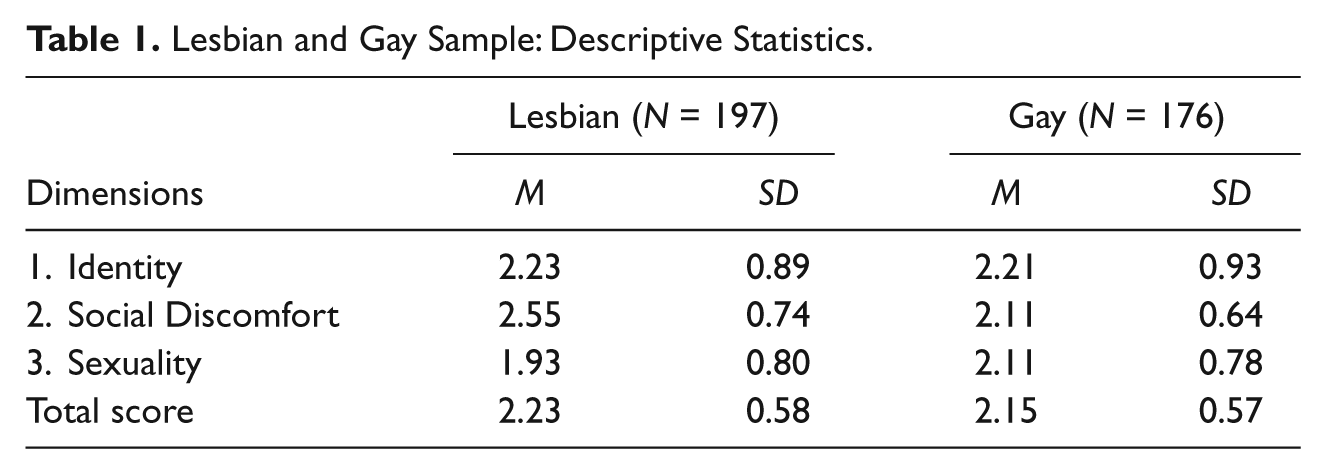
Gay men showed higher levels of ISS than lesbians for the Sexuality dimension, F(1, 367) = 5.01; p < .05. For the Social Discomfort dimension, lesbian participants showed a higher level of homonegativity than gay men. We found no significant effects related to group age, Wilks’s Λ = 0.97, F(6, 730) = 1.83, p = .09, and for gender × group age, Wilks’s Λ = 0.99, F(6, 730) = 3.88, p = .88.
Effect of ISS on Desire to Marry and Same-Sex Family Legalization
Using the MISS-LG total score (Table 1 shows Means and Standard Deviations of Miss Subscales), we divided lesbian and gay male participants into three groups: low (score < −1.5 SD), medium (score <−1.4 to<1.4 SD), and high ISS (score >1.5 SD). Using this classification, the sample was composed of 54 participants with low ISS (14.5%), 278 with medium ISS (74.5%), and 41 participants with high ISS (11.0%). The three groups differed regarding their desire to marry, χ2(2) = 40.47, p <.001, and regarding same-sex family legalization, χ2(2) = 20.83, p = < .01. Regarding their desire to marry, participants with low ISS were more likely to answer that they would marry if it were possible (77.8%) than participants with a medium (48.6%) or high level ISS (12.2%). We found that the same trend was apparent regarding same-sex family: the participants with low ISS were more likely to want legal recognition (96.3%) than participants with a medium (88.1%) or high level of ISS (65.9%).
Lesbian and Gay Sample: Descriptive Statistics.
Predictor of Attitudes Toward Desire to Marry and Same-Sex Family Legalization
We conducted logistic regression analyses to investigate the relevance of independent variables to predict participants’ attitudes toward marriage and same-sex family legalization (Table 2).
Marriage Desires and Attitude Toward Same-Sex Family Legalization: Logistic Regression Analysis.
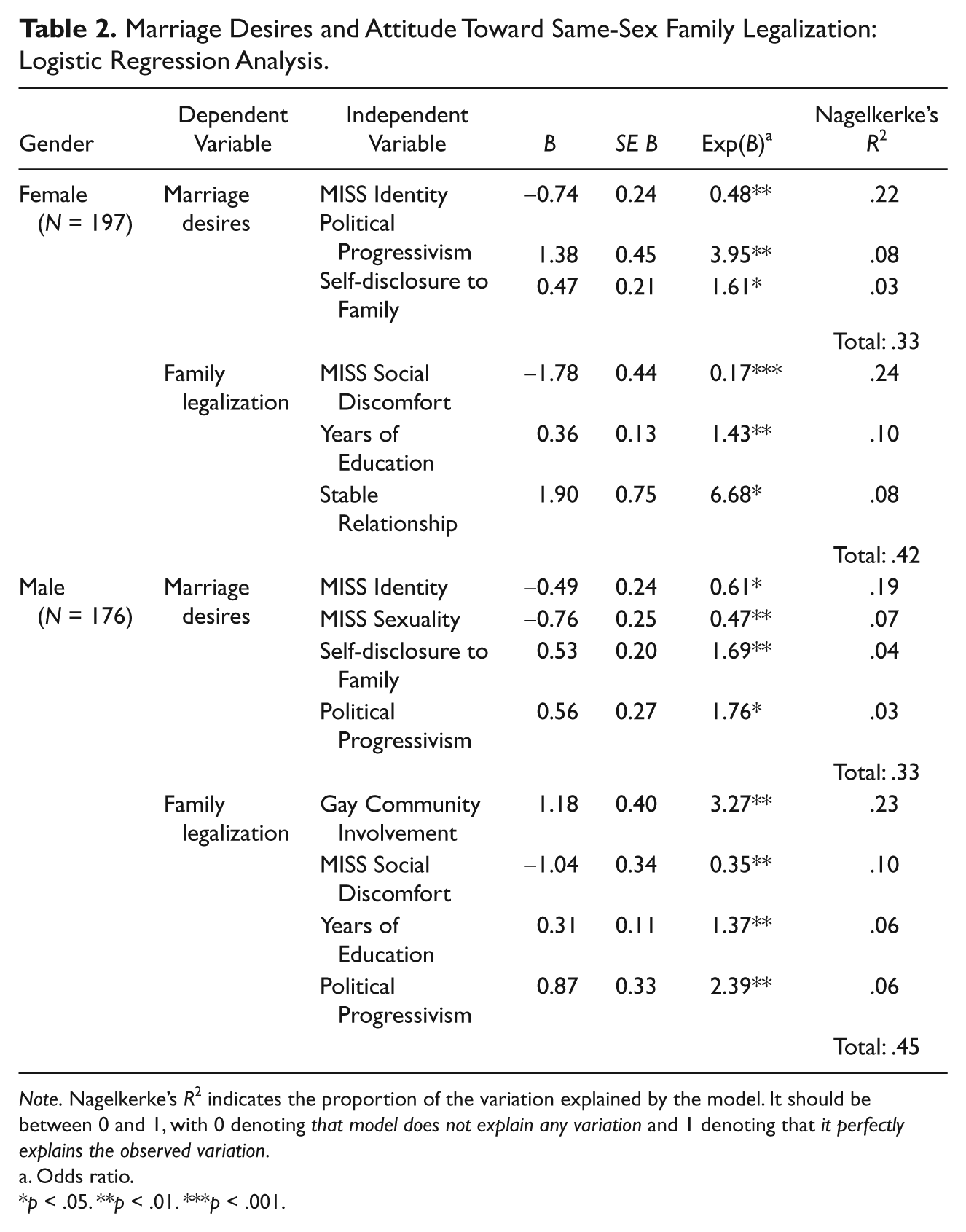
Note. Nagelkerke’s R2 indicates the proportion of the variation explained by the model. It should be between 0 and 1, with 0 denoting that model does not explain any variation and 1 denoting that it perfectly explains the observed variation.
Odds ratio.
p < .05. **p < .01. ***p < .001.
The analysis of the lesbian sample showed that the Identity dimension of the MISS was the strongest predictor of negative attitudes toward the desire to marry (Nagelkerke’s R2 = .22). The dependent variable was also predicted by a left-wing political orientation (Nagelkerke’s R2 = .08) and a high level of self-disclosure to family members (Nagelkerke’s R2 = .03). A positive attitude toward same-sex family legalization was predicted by the Social Discomfort dimension of the MISS (Nagelkerke’s R2 = .19), a higher level of education (Nagelkerke’s R2 = .10), and commitment in a stable and intimate relationship (Nagelkerke’s R2 = .08). In the gay men’s sample, as in the lesbian one, the Identity dimension of the MISS was the strongest predictor of negative attitudes toward a desire to marry (Nagelkerke’s R2 = .19). The second independent variable entered in the logistic regressions was the Sexuality dimension of the MISS (Nagelkerke’s R2 = .07). The other variables were a higher level of self-disclosure to family members (Nagelkerke’s R2 = .04) and a left-wing political orientation (Nagelkerke’s R2 = .03). A positive attitude toward same-sex family legalization was significantly related to the following predictors: a higher connectedness to the gay community (Nagelkerke’s R2 = .23), the Social Discomfort dimension of the MISS (Nagelkerke’s R2 = .10), a higher level of education (Nagelkerke’s R2 = .06), and a left-wing political orientation (Nagelkerke’s R2 = .03).
Discussion
As stated earlier, this is the first study to evaluate the desire to marry and attitudes toward same-sex family legalization in a sample of Italian lesbian and gay adults. We used as our conceptual framework the Minority Stress theory (Meyer, 1995, 2003) and the Sexual Stigma perspective proposed by Herek et al. (2009). These models allow to explain the ways in which the LG people internalize negative social attitudes toward homosexuality and the social implications and manifestations of sexual stigma in both heterosexual and sexual minority individuals. Previous research in this field (Baiocco et al., 2010; ; Lingiardi et al., 2012; Pacilli et al., 2011) demonstrated that heterosexism is firmly rooted in Italian society and institutions. By denying same-sex couples the right to marry legally, the Italian State perpetuates the stigma historically attached to homosexuality, and this stigma has negative consequences regarding the relationship status or desire to marry of lesbians and gay men (Herek, 2006). Different studies involving self-report measures and interviews have shown that the majority of LG people want to engage in a stable relationship and that they prefer a stable relationship to occasional liaisons (Julien, Chartrand, Simard, Bouthillier, & Begin, 2003).
As we surmised in Hypothesis 1, we found that gay men have a lower desire to marry than lesbian participants. In fact, even though the majority of participants favored same-sex family legalization, gay men reported a lower marriage desire than lesbian participants. Other studies with heterosexual participants found that women were more likely to desire marriage than men (Mahay & Lewin, 2007; South, 1993). These results are in agreement, in terms of direction, with research done by Riskind and Patterson (2010) and with an Italian study (Baiocco & Laghi, 2012), which showed a significantly higher desire to become a parent among lesbian participants than among gay males. Even in states where the recognition is a reality, some studies highlighted this trend: Carpenter and Gates (2008) found that lesbians (46%) were much more likely to have been legally married than gay men (38%). Ponce et al. (2010) found that 51% of lesbians and 38% of gay men reported being in a partnered or married relationship. Furthermore, our study revealed gender differences related to ISS measured by the MISS: Sexuality and Social Discomfort. For the Sexuality dimension, we found higher levels of ISS in men than among lesbians. The Sexuality dimension revealed a pessimistic evaluation of the quality and duration of intimate relationships and a negative impression of gay or lesbian sexual behaviors. The data suggested that Italian gay men have a more negative evaluation of same-sex couples, and this is consistent with a greater pressure placed on gay men in Italy to conform to a heteronormative gender role (D’Augelli & Grossman, 2001; Herek, 2002, 2009). For the Social Discomfort dimension, lesbian participants reported higher levels of homonegativity than gay men. The data gathered regarding this dimension revealed participants’ fears concerning public identification as a lesbian or gay man in the social context; disclosure in their private and professional spheres; and negative internalized beliefs regarding religious, moral, and political acceptability of homosexuality. This gender difference was found in a previous study in the Italian context (Lingiardi et al., 2012) and underlined a greater reticence among the lesbian participants to express their sexual orientations in the social context, for instance, at the university or at work.
With respect to Hypothesis 2, we found that lesbians and gay men with a high level of ISS would be less likely to desire to marry and to recognize the positive effects of the legal recognition of the same-sex family. We noticed a similar trend regarding the legalization of same-sex families: almost the totality of participants with low ISS and more than half of the participants with a high level of ISS expressed a positive evaluation. These data are consistent with Hull’s (2003) research on LG couples.
Finally, we highlighted the relevance of ISS, greater self-disclosure to family and friends/members of a social network, left-wing progressivism, level of education, and connectedness to gay community to predict a desire to marry and attitudes toward same-sex family legalization (Hypothesis 3). As we expected, we found that the ISS was the strongest predictor of the desire to marry. More specifically, the study showed that the Identity dimension of the MISS, for both lesbians and gay males, was the strongest predictor of negative attitudes toward the desire to marry. In the gay sample, the Sexuality Dimension of the MISS was also relevant to predict the dependent variable. The Sexuality dimension of the MISS described the difficulty of maintaining the affective and sexual aspects that characterized every romantic relationship. High levels in this scale portrayed a person who devaluates gay and lesbian relationships and thinks this kind of relationship is quite impossible (e.g., “I don’t believe in love between homosexuals”) or less attractive, satisfying, and stable (e.g., “Gays can only have flings/one-night stands” or “All lesbians end up isolated and alone”). The data we collected were consistent with that revealed in previous research that analyzed the negative effects of internalized homophobia on the relational well-being of the person and the capacity and motivation to commit in a dyadic relationship (Baiocco et al., 2012; Mohr & Fassinger, 2006; Riggle et al., 2010; Williamson, 2000).
Both lesbian and gay male participants’ political progressivism and higher levels of self-disclosure to family but not to friends predicted a positive attitude toward the possibility of marriage in the future if it were possible in Italy. This latter finding is not completely consistent with prior studies suggesting that the development of social support from friends is one of the special tasks facing same-sex couples (Green & Mitchell, 2002), whereas for heterosexual couples the family context plays a more prominent role in the establishment of a relationship’s commitment level and quality (Elizur & Mintzer, 2003). Maybe this finding needs to be situated within the ecological niche of Italian and southern European culture. Italian society is characterized by religious family values: marriage is often viewed as a commitment between two people that has a moral and religious dimension. From a psychological perspective, for Italian adults it could be possible to marry a person of the same sex only if they were able to disclose their sexual orientation to family members and if the family of origin could clearly understand and positively support this life project.
With respect to the attitude toward same-sex family legalization (Table 2), the logistic regression analysis highlighted anew, as we assumed it would, the preeminent role of the Social Discomfort of the MISS for both lesbians and gay men who participated in the study. Education also had a statistically significant effect on their attitudes toward same-sex family legalization. As shown in the study by Mahay and Lewin (2007), having a higher education increased the chances that a person would have a more positive evaluation of the family headed by a couple of the same sex. This finding was consistent with the perspective that people with more personal resources expect to gain from marriage and therefore see it as desirable. Gay men who presented a wider connection to the LGBT community and lesbian participants characterized by a stable relationship were more likely to have a positive attitude toward same-sex family legalization. The positive effect of the LGBT community confirmed the protective effects of community involvement to develop and maintain a positive sense of the self and as a mechanism to reduce the stress caused by a heterosexist society (Lingiardi et al., 2012). Furthermore, in the process of mobilizing, volunteers and activists are more likely to develop a sense of community and call on those in their social networks for social support to cope with their individual and community stressors.
Finally, gender differences aside, ISS seems to have a pervasive negative influence on the way gay men and lesbians regard a desire to marry and induces a negative attitude toward the legalization of the same-sex family. Riggle et al. (2010) demonstrated that the legal recognition seems to be a protective macro-environmental factor that may affect the psychological health and well-being of not only same-sex couples but also heterosexual individuals (Kamp Dush & Amato, 2005). Cohabitating gays and lesbians experienced problems in their relationships, not because they are unable to marry but because their relationships are not legally recognized. In Italy, same-sex couples live in a jurisdiction in which the legal recognition of their relationships and family units is not available. We cannot foresee the potential psychological benefits that members of same-sex couples in legally recognized relationships may enjoy (Herek et al., 2009; Riggle et al., 2010). The desire to marry could be one of the new possibilities offered by the legal recognition. As Riggle et al. (2010) pointed out, legal recognition eliminates neither the minority stressors nor the stigmatization of lesbians and gay men, but at the same time, we can consider legal recognition to be an important macro-environmental factor that may affect the psychological health and well-being of same-sex couples. A very important next step for LG people (Badgett, 2011) would be not only a same-sex couples recognition, but it would be considerable a real equality between same-sex and different-sex marriage, which is valid even beyond the borders of own state or nation. This kind of action would allow even more to break down stereotypes, heterosexist events, and, more significantly, would promote greater LG people social inclusion.
Limitations and Future Directions
There were important limitations to our study. First, we used a convenience sample. Second, the study was conducted in Italy, and these findings may not apply to lesbians and gay males living in other countries with more positive legislative policies toward LGBT people. Participants were also recruited in Rome, and urban dwellers might be more liberal than those in rural areas. Furthermore, the generalizability of our findings was restricted to young adult participants. Third, there was a possible effect of social desirability as there always is when data are collected using self-report questionnaires. Fourth, we did not consider the relevance of the variables that can counter stress and may help in mediating the relationship between internalized stigma and a more positive attitude toward same-sex marriage. It would be interesting to conduct other studies in order to determine how ISS affects lesbians and gay men and how it correlates with resilience factors, such as personality characteristics, family environments, and early coming-out. An additional limitation of the study was our use of one-item measures. In the future, it would be useful to ask more detailed questions regarding the desire to marry and attitudes toward same-sex family legalization. Finally, we did not study gay and lesbian couples with children. Despite these limitations, we hope that this article will contribute to the scientific community so that work will be undertaken to promote health and support for gay men and lesbians. In Italy, negative attitudes about same-sex relationships persist despite existing psychological theory and research that suggests intimacy needs are fundamental in the lives of all individuals, regardless of sexual orientation. The data presented in the present work demonstrated that a large proportion of Italian lesbians and gay men report a desire for long-term romantic relationships and to marry their partners should same-sex marriage be an available legal option in Italy. This study suggests that what is most necessary is social policy reform to eliminate social and structural inequalities surrounding the pursuit of intimacy to reduce disparities in intimacy-related stressors of lesbians and gay men (Frost, 2011; Frost & Meyer, 2009). Additional research is necessary to understand how the legal recognition of same-sex couples could be relevant to reducing the devaluation experienced by lesbians and gay men that negatively affects their desires and intentions to create families.
Footnotes
Declaration of Conflicting Interests
The author(s) declared no potential conflicts of interest with respect to the research, authorship, and/or publication of this article.
Funding
The author(s) received no financial support for the research, authorship, and/or publication of this article.