



Abstract
An extensive body of research demonstrates that children increase the stability of marriage, but it is unclear whether the same is true for cohabitation. Marital stability theories often assume fertility is intended, which is less likely to be the case for cohabiting births. Using the 2002 National Survey of Family Growth, we find that intended and disagreed-upon pregnancies (but not unintended pregnancies) reduce the risk of dissolution relative to women who have no pregnancy or birth. Relative to nonfertile couples, all pregnancies increase the risk of marriage over staying cohabiting, but there is little difference in the odds of stability or transitions after birth. However, relative to an intended birth, having an unintended or disagreed-upon birth increases the risk of dissolution. These findings suggest that normative pressures influence the union behaviors of cohabitors during pregnancy, whereas selection processes and rational choice considerations play a greater role after a birth.
The role of cohabitation in the U.S. family system remains unclear. As cohabitation has increased in prevalence in the United States, childbearing and childrearing in cohabiting unions has become more common and acceptable (Kennedy & Bumpass, 2008; Raley, 2001). Cohabiting women are increasingly similar to married women in their contraceptive and fertility behaviors (Sweeney, 2010), and a sizeable proportion of pregnancies and births in cohabiting unions are intended, between 30% to 42% depending on the source of the estimate (Chandra, Martinez, Mosher, Abma, & Jones, 2005; Finer & Henshaw, 2006; Guzman, Wildsmith, Manlove, & Franzetta, 2010). At the same time, though, marriage remains the preferred union type in which to have and raise children (Morin, 2011; Thornton & Young-DeMarco, 2001), and many cohabiting couples who become pregnant marry before the birth of their child (Manning, 2004). Because marriage is viewed as a more appropriate context in which to raise a family, fertility within cohabiting unions is more likely to be unintended or disagreed-upon by partners than fertility within marriages (Chandra et al., 2005). Previous research studying fertility and cohabitation has proposed that the unintended fertility experienced in cohabiting unions may be detrimental to union stability (e.g., Manning, 2004). However, prior research has not explicitly considered the possible associations between fertility intentionality and the full range of relationship outcomes for cohabiting couples. This article uses data from the 2002 National Survey of Family Growth to examine the association between intended and unintended births and stability, relationship dissolution, and marriage among cohabiting couples.
Children and Union Stability
The effect of children on union stability has been extensively studied, largely with a focus on marital unions. Past research finds that married couples with children are less likely to experience marital disruption than those without children (Cherlin, 1977; Heaton, 1990; Lillard & Waite, 1993; Morgan & Rindfuss, 1985; Waite, Haggstrom, & Kanouse, 1985; Waite & Lillard, 1991). The association between fertility and cohabitation stability is less clear, in part because stable cohabiting unions can take two different forms—continued cohabitation or a transition to marriage. Using data from Canada and Great Britain, respectively, Wu (1995) and Steele, Kallis, Goldstein, and Joshi (2005) find that children reduce dissolution rates of cohabiting unions, but neither of these studies examined the transition to marriage. Manning (2004) more explicitly examined transitions and stability in the United States, finding that fertility among cohabitors increased union stability by increasing the likelihood of marriage during pregnancy but that children born during cohabitation did not increase union stability as they do in marriage.
Three primary explanations for associations between childbearing and marital stability have been proposed. The first approach to explaining the stabilizing effects of children on relationships is essentially a rational choice approach. This theory argues that, relative to childlessness, shared children create “union-specific capital” that increases the utility of a particular union (Becker, 1981) and generate relationship solidarity by reducing uncertainty about the union’s future, given the long-term commitment having children entails (Friedman, Hechter, & Kanazawa, 1994). Therefore, the benefits of remaining in the original relationship increase; the financial costs of dissolution increase as well when children are involved. According to the second explanation, children increase the normative pressure against dissolution (Coleman, 1988; Thornton, 1977). That is, there is more social disapproval when parents split up than when nonparents do. Finally, the third approach suggests that the decision to have children is selective of the most stable couples (Lillard & Waite, 1993; Myers, 1997). Since couples who are unsure of their union’s strength and longevity avoid childbearing, choosing to have children serves as a signal of union stability and commitment. All these arguments, but especially the rational choice and selection approaches, implicitly assume children are planned and intended. This assumption is important to note for reasons we discuss below.
These explanations may be applicable to fertility in cohabiting unions as well as marriage. However, the role of cohabitation in the U.S. family system is unclear, having been variously characterized as an alternative to being single, a stage in the marriage process, or an alternative to marriage (Smock, 2000). As such, associations between childbearing and union outcomes are likely to be different for cohabitation than for marriage. Applying these theories is also made more complex by the fact that there are more possible outcomes for cohabiting couples than for married couples: cohabitors can separate, remain cohabiting, or decide to marry. Because research shows that children who live with cohabiting biological parents do not fare as well as children who live with married biological parents (Brown, 2004), it is important to assess not just stability but union form. Furthermore, as we briefly note later, understanding the implications of fertility within cohabiting unions may inform research on the role of cohabitation in the relationship spectrum.
According to the rational choice framework, children would reduce rates of dissolution of cohabiting unions but would not necessarily increase rates of marriage; that is, children in cohabiting unions would increase union stability, regardless of union type. If children are union-specific capital, this capital can be enjoyed (and further investments can be made) regardless of whether the cohabiting union remains intact as a cohabitation or transitions to marriage. Theories based on the normative pressure against dissolution among parents also predict that children would reduce separation rates for cohabitors. However, the normative pressure theory would suggest that there is a distinction between cohabitation and marriage. Given that marriage is preferable to cohabitation as an appropriate family form, social pressures to form a “legitimate” family would encourage cohabiting parents to marry rather than remain cohabiting. Arguments about the role of selection in explaining links between fertility and relationship outcomes also suggest that childbearing reduces the risk of dissolution but are less clear about the association between cohabiting fertility and the transition to marriage. Cohabiting couples who have children are potentially signaling their greater commitment to each other and the relationship but also possibly their greater acceptance of cohabitation as a context for fertility, though as we argue below, the idea of childbearing in cohabitation as a signal largely depends on whether couples intend to have children while cohabiting.
Another layer of complexity is added when considering the distinction between relationship transitions during pregnancy and those after the birth, as this distinction appears to be greater for cohabitation than marriage (Manning, 2004). For married couples, staying married during and after a pregnancy is the “default” option. For cohabiting couples, a conception presents an occasion for decision-making about the future; if couples do not change their status during the pregnancy, the birth provides another opportunity to consider these decisions. Some work shows that pregnancy among unmarried couples may initially increase commitment (Kendall et al., 2005), as couples idealize their future childrearing and family life, which may encourage marital transitions prior to the birth; once the difficulties of parenting set in after a birth, though, the momentum and optimism may fade. Social pressures, particularly those from family members, may be stronger during pregnancy if there are firm beliefs about legitimation. Selection processes linking fertility and relationship outcomes may also function differently during a pregnancy and after the birth, such that the most committed and strongest couples might be most susceptible to social pressures to marry. Manning (2004) notes that couples who experience a pregnancy during cohabitation but do not marry before the birth have already decided to stay together in a nonmarital union—they have essentially decided not to commit to marriage. According to these arguments, both pregnancy and birth during cohabitation should reduce the risk of relationship dissolution; the risk of transition to marriage should be higher during pregnancy but not after the birth.
The Role of Fertility Intentionality
None of these theories—union-specific capital as seen in a rational choice framework, normative pressure against dissolution, and selection—have explicitly considered the role of fertility intentionality and how it may impact union stability, though distinctions by intentionality are often implicit in applications of these theories (see, e.g., Manning, 2004). Relative to married couples, cohabitors who experience fertility are more likely to report a birth was unintended (Chandra et al., 2005), and prior work on couples with children suggests that unions are more likely to dissolve after an unintended birth than an intended birth (Guzzo & Hayford, 2012; Manning, Smock, & Majumdar, 2004; L. L. Wu & Musick, 2008). As is widely known, children can introduce stress into relationships—they are labor-intensive, entail additional financial obligations, and take time away from leisure activities that may reinforce a couple’s bond with each other (see Kluwer, 2010, for a review of research on the transition to parenthood and relationship changes). In particular, relationship quality often declines after a birth, and this decline is most sizeable among those with unintended fertility (Belsky & Rovine 1990; Cox, Paley, Burchinal, & Payne, 1999; Doss, Rhoades, Stanley, & Markman, 2009; Gable, Belsky, & Crnic, 1995; Lawrence, Rothman, Cobb, Rothman, & Bradbury, 2008). (It is worth noting, however, that the bulk of this research has focused on marital quality, to the exclusion of unmarried couples.) The stressors of childbearing may be greater for those with unintended fertility, whereas at the same time less stable couples are more likely to characterize their childbearing as unintended. Furthermore, couple disagreement on intentionality is common among unmarried couples (Williams, 1994), and when one partner wants (or does not want) the child, a rift may emerge in the relationship, as partners may feel betrayed or trapped (Edin & Kefalas, 2005). Still, since at least one partner intended the birth, disagreement over intentionality may lower the stress in the union and may reduce the negative effect on stability relative to those who both agree the birth was unintended, especially if one partner expects pleasure and satisfaction from having a shared child.
Rational choice and normative pressure approaches argue that children reduce rates of relationship dissolution because they increase the costs of dissolution, since parents have higher utility when they coreside with the child and the social pressure against dissolution is higher when children are involved. As such, both perspectives would predict that all births, regardless of intentionality, reduce dissolution rates relative to cohabitors with no children. However, given the stressors of childrearing, the rational choice perspective would suggest that unintended, and to a lesser extent, disagreed-upon fertility would result in lower utility (i.e., satisfaction) with the parent role than among those with intended fertility. Thus, the reduction in dissolution risks would be lower for unintended and disagreed-upon fertility relative to intended fertility.
Intentionality is most relevant to theories regarding fertility as selective of more stable couples. The signaling function of having a child differs for intended and unintended fertility, with further distinctions between pregnancy and birth. Overall, couples who intend to have children while cohabiting are likely to be more confident than either childless cohabitors or those with unintended fertility in the permanence of the relationship (Myers, 1997). These couples should thus be less likely to break up. Intentionally deciding to have a child with one’s cohabiting partner may suggest that couples are jointly planning marriage and childbearing (Brien, Lillard, & Waite, 1999; Musick, 2007; L. L. Wu & Musick, 2008), and so may lead to higher marriage rates, either before or after the birth, a view which would be supported by the idea of cohabitation as a stage in the marriage process. Alternatively, couples with intended births may view cohabitation as an acceptable union in which to raise their child, consistent with the view of cohabitation as an alternative to marriage. If this is the case, those with intended cohabiting births would be likely to continue cohabiting in the future, being less likely to break up or marry than those without births or those with unintended births.
Hypotheses
Based on the preceding discussion, we propose a set of hypotheses about associations between intended and unintended pregnancies and births and the outcomes of cohabiting unions (stable cohabitation, relationship dissolution, and marriage). Some of these hypotheses are competing, whereas others are complementary. Table 1 displays these hypotheses, indicating the theoretical framework(s) they are derived from.
Hypotheses.
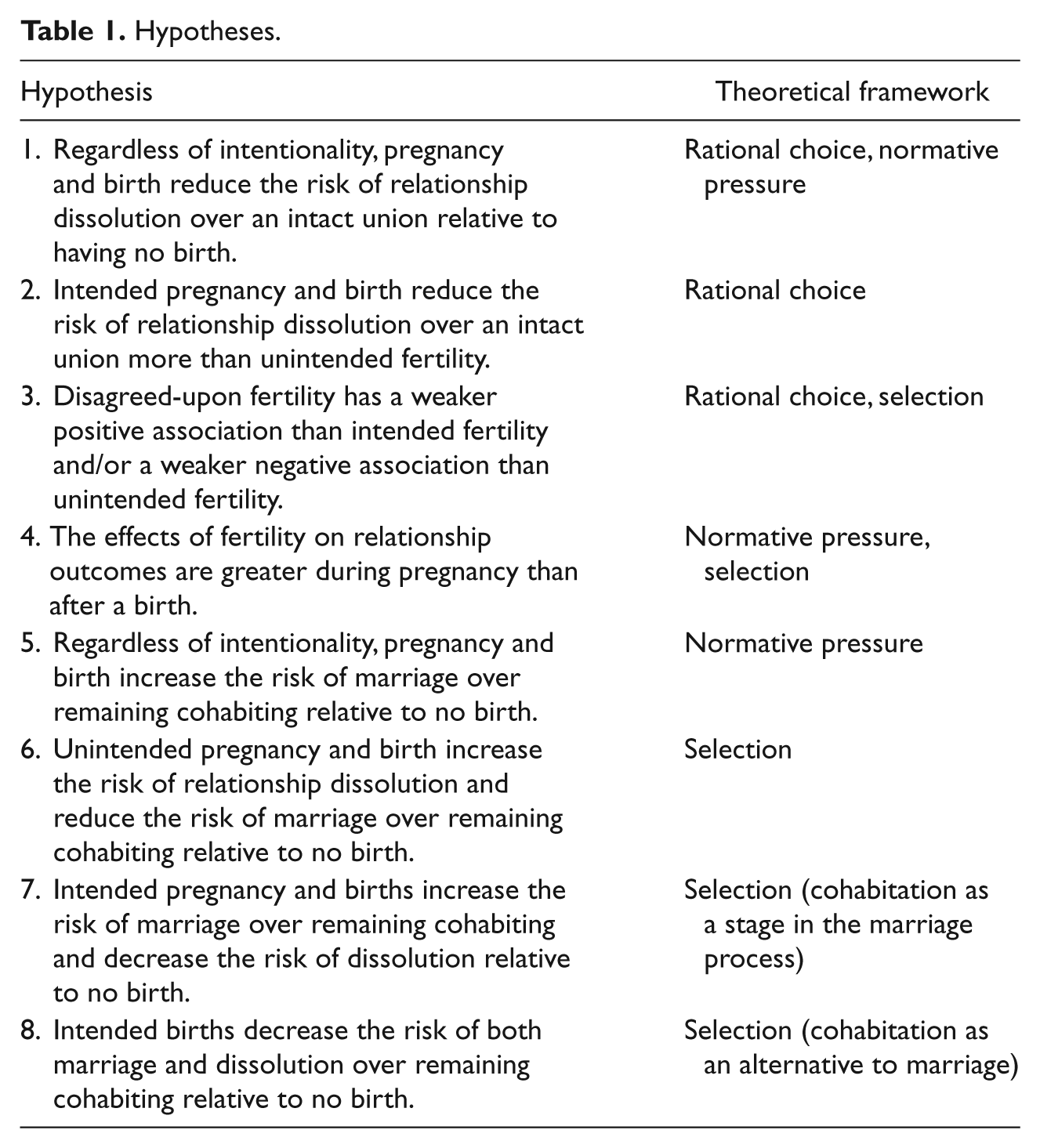
In sum, if all fertility reduces the risk of dissolution, with intended fertility having the largest reduction of risk but fertility overall is unrelated to the transition to marriage (with no variation by intentionality in the risk of transition), then the rational choice framework is supported. If all fertility reduces the risk of dissolution and all fertility increases the risk of marriage, particularly during pregnancy (with no variation by intentionality), the normative pressure theory is supported. If intended fertility reduces the risk of dissolution but unintended and disagreed-upon fertility does not, it would support selection arguments about the link between fertility and union stability. Furthermore, if there are differences between remaining cohabiting versus transitioning to marriage for intended births, these differences would support the selection approach and inform work on the role of cohabitation in the family system.
Other Factors Related to Fertility and Cohabitation Stability
Socioeconomic and demographic characteristics such as education and race/ethnicity are strongly linked both to cohabiting fertility and to the stability and transitions of cohabiting unions (Smock & Manning, 1997; Smock, Manning, & Porter, 2005; Z. Wu & Pollard, 2000), as are family background characteristics (e.g., childhood family structure, maternal education, and fertility timing). Generally, more advantaged individuals are more likely to transition to marriage, less likely to experience fertility in cohabiting unions, and less likely to experience unintended fertility. Teachman (2003) notes that the socialization process may differ for people who grew up in families that experienced marital dissolution and/or single parenthood, which may affect their attitudes toward, and stability of, cohabitation and marriage (Amato, 1996; Amato & Booth, 1991; Axinn & Thornton, 1996; Thornton, 1991; Wolfinger, 1999). Race-ethnic differences in fertility and cohabitation are widely documented (Raley & Sweeney 2007). Cohabiting White women are more likely to transition to marriage from a cohabiting union than women of other race-ethnic groups (Manning & Smock, 1995), especially when pregnant (Manning, 2001, 2004). Hispanic women are more likely to have a child while cohabiting, to intend their cohabiting births, and to remain in a cohabiting union after a birth than non-Hispanic White or Black women (Manning, 2001, 2004; Musick, 2007), with differences by nativity (Brown, VanHook, & Glick, 2008; Choi & Seltzer 2009; Landale & Oropesa, 2007). Birth rates in cohabiting unions are higher for Blacks than Whites, and their cohabiting unions tend to be more unstable (Manning & Smock, 1995, 2002).
Prior family formation behaviors also influence cohabitation stability. Rates of postmarital cohabitation are increasing (Lichter & Qian, 2008), and previously married cohabitors have lower rates of both marriage and relationship dissolution (Bumpass, Raley, & Sweet, 1995). Similarly, many individuals have children prior to cohabitation, either from their current union (where they begin cohabiting after the child has been born) or from a prior union, and having children with a different partner tends to reduce union stability (Bumpass, Sweet, & Martin, 1990; Clarkberg, Stolzenberg, & Waite, 1995; Lampard & Peggs, 1999; Stewart, Manning, & Smock, 2003). Finally, characteristics of the current union are important, with couples who were engaged when they began cohabiting more likely to transition to marriage (Guzzo, 2009).
Data and Method
Data and Measures
We use the 2002 cycle of the National Survey of Family Growth (NSFG), a nationally representative cross-sectional survey of U.S. women aged 15 to 44 years designed to measure levels and trends in fertility. The NSFG includes detailed birth and relationship histories as well as measures of sociodemographic characteristics and family background. The 2002 cycle interviewed 7,639 women, of whom 3,574 had ever cohabited and had valid information on cohabitation start and end dates.
Our dependent variable is the stability of the first cohabiting union. We use discrete time event history analysis, and the data are converted into person-months in which women enter the month they begin cohabiting and exit when the relationship ends or are censored if the relationship is intact at the time of survey. Cohabiting unions “end” through a break-up or marriage, though clearly a relationship does not end when marriage occurs. We analyze two versions of union stability. First, we investigate whether the cohabitation dissolves, regardless of whether the union transitions to marriage, using logistic regression. This analysis censors unions at marriage (and censors intact cohabitations at the time of the survey) but does not consider them dissolved. Unfortunately, we are unable to examine how pregnancies, births, and intentionality affect the long-term stability of marriages originated by cohabitation due to problems in the 2002 NSFG data collection process that affected the accuracy of marital end dates in the data (see the NSFG User Guide [National Center for Health Statistics, 2004, p. 22] for explanation and Kennedy & Bumpass, 2008, for a detailed discussion of the implication of the issue). Second, we use multinomial logistic regression to simultaneously estimate the competing hazards of cohabitation transition via dissolution or marriage.
Our primary independent variable is the occurrence of intended and unintended pregnancies and births. The NSFG collects full fertility histories and is the primary national source of information on birth intendedness. It should be noted that this measure only includes pregnancies resulting in a live birth; pregnancies ending in miscarriage or abortion are notoriously underreported in national survey data (Jones & Kost, 2006). We define a pregnancy as the 7 months prior to a live birth. The NSFG does not directly inquire whether a birth was intended or wanted. Instead, wantedness and intendedness are defined based on responses to a series of questions asked for every birth. Wantedness is derived from the question “Right before you became pregnant, did you yourself want to have a(nother) baby at any time in the future?” Negative answers are characterized as unwanted births. If a woman responds affirmatively, she is asked about the timing of the pregnancy: “So would you say you became pregnant too soon, at about the right time, or later than you wanted?” Births that are identified as too late or at about the right time are considered wanted and intended. Births that are identified as occurring too soon are asked a follow-up question regarding the extent to which the births were too soon: “How much sooner than you wanted did you become pregnant?” Following recent research on definitions of unintended fertility (Abma, Mosher, & Jones, 2008; Lindberg, Finer, & Stokes-Prindle, 2008; Pulley, Klerman, Tang, & Baker, 2002), we consider births occurring 2 or more years too soon as seriously mistimed and thus unintended, whereas those occurring less than 2 years too soon are considered slightly mistimed and thus intended. In exploratory analysis, we tested models using the traditional definition of unintended (i.e., including all mistimed births as unintended births) as well as a more detailed classification system (later than wanted, wanted or on-time, slightly mistimed, seriously mistimed, unwanted). Results from all models were substantively similar, although the magnitude of the associations between unintended fertility and stability were smaller when using the traditional definition of unintended.
The NSFG also asked women about their perception of their partner’s view of whether the birth was intended, using similar questions. Respondents were asked “Right before you became pregnant, did the father want you to have a(nother) baby at any time in the future?” and if they responded affirmatively, they were asked “So would you say you became pregnant sooner than he wanted, at about the right time, or later than he wanted?” Births that the respondent reported her partner considered too late or at the right time are considered intended. Births the respondent reported her partner considered too soon or didn’t care about the timing and those for which she was unsure of what her partner thought are considered unintended. There were 25 women who had a birth who were missing information on birth intendedness, reducing the sample size to 3,549 women.
Other socioeconomic and demographic characteristics include family structure at age 14, the respondent’s mother’s education, and whether the respondent’s mother had a child prior to age 18. We include age at the start of the union and race/ethnicity/nativity (non-Hispanic White, non-Hispanic Black, native-born Hispanic, and foreign-born Hispanic). Our analytical sample excludes women in the “other” race-ethnic category or who had missing information on nativity (n = 142). Time-varying covariates include duration of union since start of cohabitation and whether the respondent had a high school degree. Family formation behaviors include whether the respondent had a recent birth (defined as having a birth within 6 months of the start of cohabiting, which is most likely with their cohabiting partner) and whether the respondent had an earlier birth (defined as a birth more than 6 months prior to cohabitation, most likely with a different partner). Past relationship variables include whether the respondent had previously been married; preliminary models showed that the effect of fertility and intentionality did not vary significantly between never-married and previously married women. We also include whether the respondent’s partner had a child from a previous relationship or had been married before (there is no information on partner’s past cohabitations). Finally, we include whether the respondent was engaged at the start of cohabitation. Twenty cases are missing information on one of these covariates, leaving a final sample size of 3,387 women.
Analytic Approach
As stated above, we have two dependent variables—overall stability and union type. The first outcome measures whether the cohabiting union remains intact (regardless of type) or dissolves; this outcome tests Hypotheses 1, 2, and 6. The second dependent variable includes three possible cohabitation outcomes—intact as a cohabitation, transition to marriage, or dissolution. Models using this outcome test competing hazards to evaluate Hypotheses 5 to 8. For each outcome, we estimate two models. All models distinguish between pregnancy and birth to test Hypothesis 4; Hypothesis 3 is tested in the models discussed below. All measures of fertility focus on the first birth while cohabiting, not necessarily a woman’s or couple’s first birth; women may have had births prior to cohabitation either with this partner or another partner.
The first model for each outcome includes only simple time-varying indicators of the first birth within the union: whether the respondent was pregnant during the month (the 7 months prior to a live birth) and whether a birth occurred while cohabiting (the month of the birth and all months thereafter). These variables are mutually exclusive. This first model essentially replicates prior work on fertility and cohabitation stability to establish the baseline association between fertility and cohabitation outcomes.
The second model for each outcome incorporates more nuanced indicators of fertility to take intendedness into consideration; all intentionality models test Hypothesis 3 regarding disagreed-upon fertility. Here, fertility is a time-varying categorical measure of pregnancy and birth that takes the form of a set of mutually exclusive dummy variables: no pregnancy or birth during the month or in prior months (omitted), an unintended pregnancy during the month, an intended pregnancy during the month, a pregnancy during the month for which the woman reports she and her partner disagree about intendedness, an intended birth during the month or any previous month, an unintended birth during the month or any previous month, and a disagreed-upon birth during the month or any prior month. In exploratory analyses, we tested several alternative specifications. We ran models distinguishing between preunion conceptions and pregnancies conceived during cohabitation but did not find significant differences by timing of conception. We also assessed whether associations between fertility and relationship outcomes varied by time since birth (i.e., whether the association was stronger immediately after a birth); results showed that they did not. Preliminary analyses also indicated that it did not matter if the women reported the birth as intended but reported that her partner did not intended the birth, or vice versa.
Results
Descriptive Results
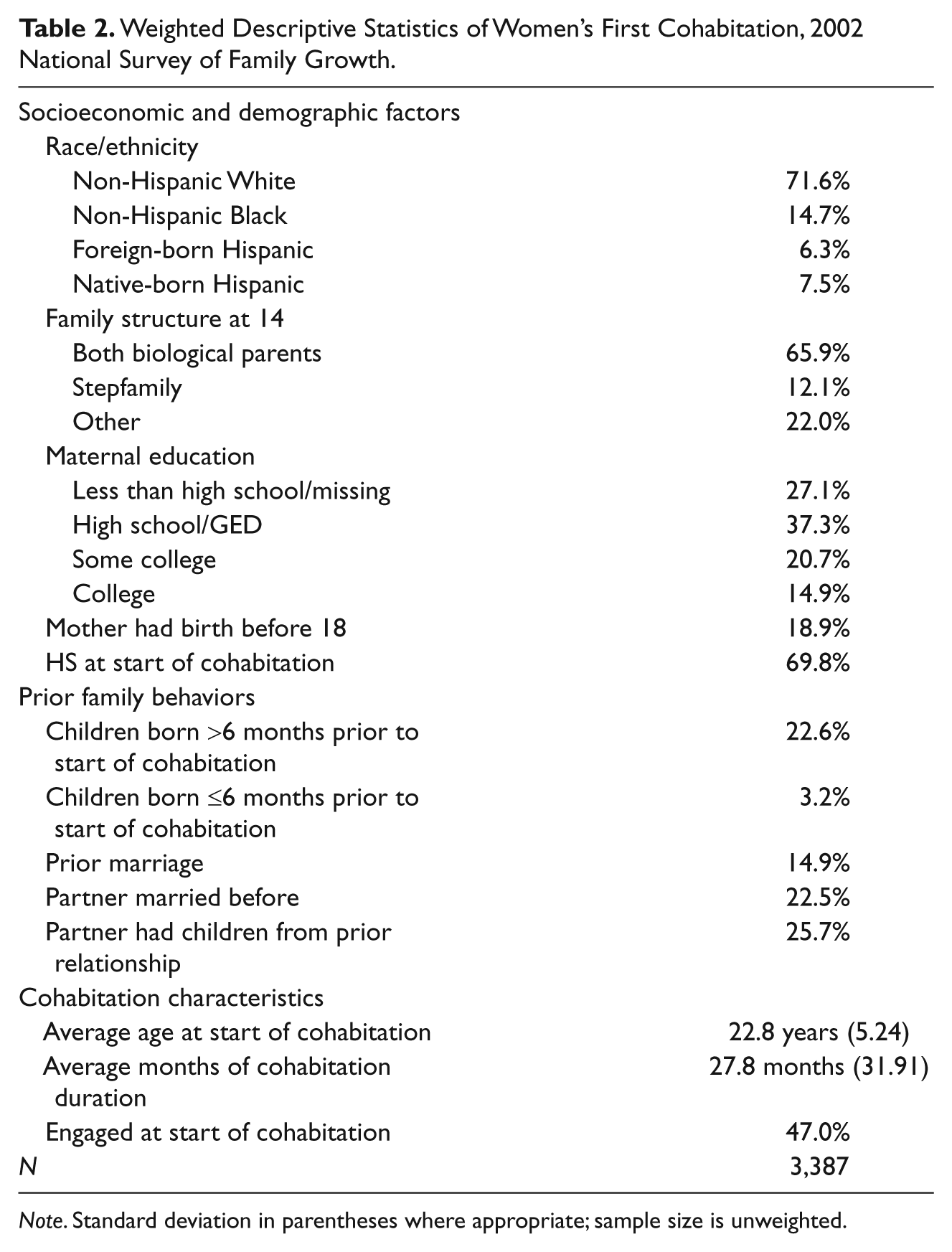
Table 2 displays weighted descriptive information for women’s first cohabiting unions. The sample is largely non-Hispanic White, and about two thirds of the sample lived with both biological parents at age 14. About three fourths of mothers of the women in the sample had completed high school, though only 15% of the respondent’s mothers had completed college and 19% had a birth prior to age 18. Seventy percent of the women themselves had completed high school prior to the start of cohabitation.
Weighted Descriptive Statistics of Women’s First Cohabitation, 2002 National Survey of Family Growth.
Note. Standard deviation in parentheses where appropriate; sample size is unweighted.
Looking at prior family behaviors, about a fifth of women had a birth more than 6 months prior to the start of cohabiting (i.e., a birth likely to be with a partner other than their cohabiting partner), whereas 3% had a birth within 6 months of cohabiting (most likely with their cohabiting partner). Fifteen percent of the sample is previously married, 23% are partnered with a man who had been married before, and 26% are partnered with a man who has children from a prior relationship. Turning now to characteristics of their first cohabiting union, women were about 23 years old on average when they started cohabiting. Slightly less than half were engaged at the start of cohabitation. These first cohabitations lasted just more than 2 years (27.8 months) on average.
Union stability and fertility behaviors are displayed in Table 3. By the end of the period of observation, only 13% of cohabitations were still intact as cohabitations, just over half (54%) had transitioned to marriage, and about a third had dissolved (bottom row of Table 3). Keeping in mind that the data only reliably provide information on pregnancies ending in live births, fertility is fairly common in first cohabitations, as shown in the next-to-last column. Just more than 40% of women reported a pregnancy during cohabitation, though only 20% reported a birth, suggesting that about half of pregnant cohabitors who carry their pregnancy to term transition to marriage prior to the birth. Disagreed-upon first pregnancies were most common, occurring for about 18% of women and 42% of all pregnancies (17.9%/42.6% = 42.0%). Thirteen percent of women in first cohabitations had an intended first pregnancy in the union, and 12% had an unintended first pregnancy. About 8% of women had an intended first birth while cohabiting, about 5% had an unintended birth, and 8% had a disagreed-upon birth.
Weighted Bivariate Associations Between Pregnancy and Birth and Cohabitation Outcomes (Sample Size is Unweighted).
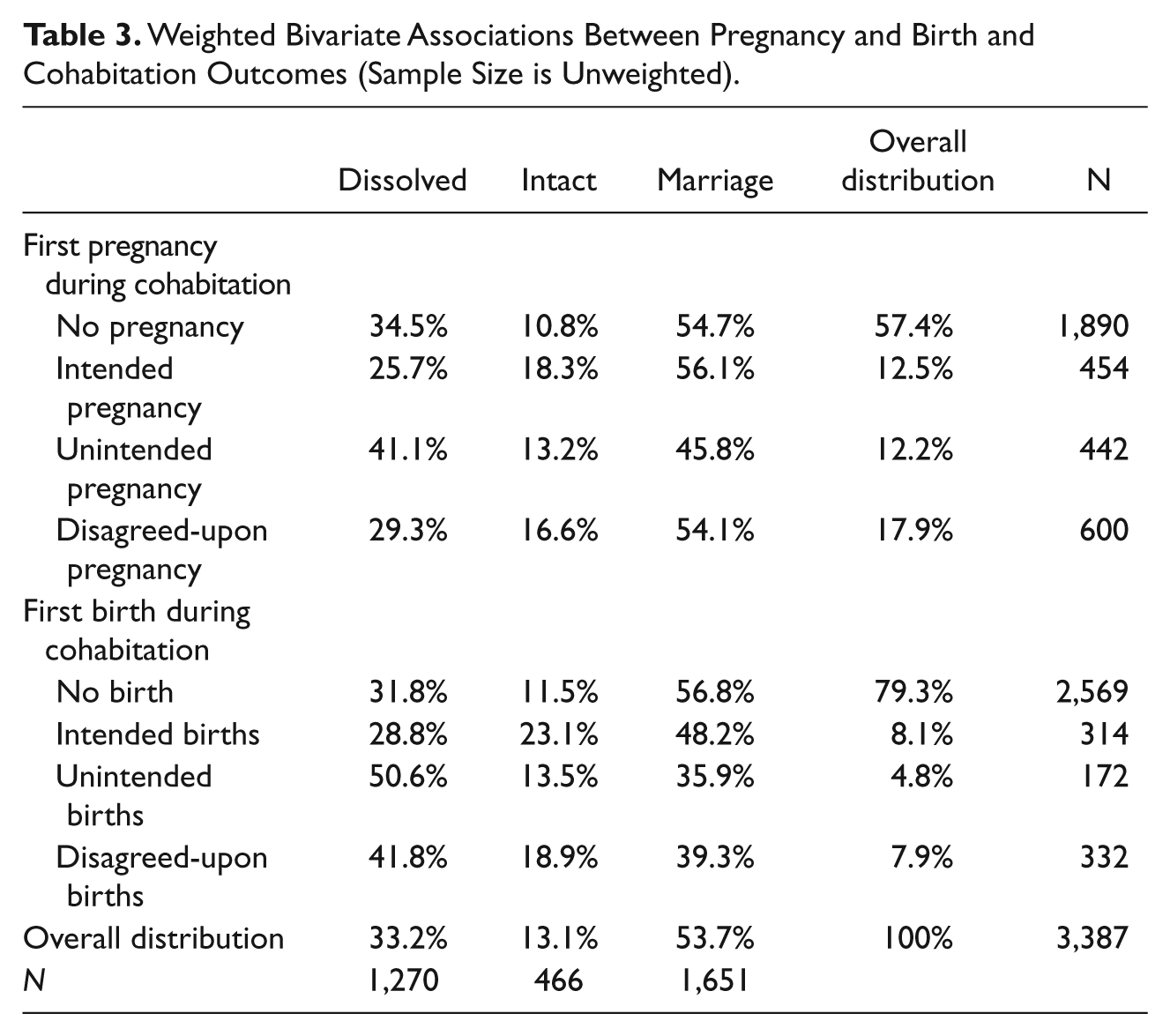
The bivariate associations between fertility behaviors and cohabitation outcome support our hypotheses that intentionality of births is associated with cohabitation stability and outcomes. In particular, we see that fewer women with intended and disagreed-upon pregnancies during cohabitation experience union dissolution, and more of these women transition to marriage, compared to women with no pregnancies or with unintended pregnancies. Fewer women with intended births during cohabitation end their unions, and more of these women remain cohabiting or marry their cohabiting partner relative to those with any other types of births and those with no births.
Multivariate Results: Overall Stability by Any Fertility
Table 4 displays odds ratios and relative risk ratios for our four models of cohabitation stability and transitions. Model 1 includes measures of the first pregnancy and birth within the union, not accounting for intentionality, and tests Hypothesis 1 regarding overall union stability (whether the couple separated or stayed together, regardless of the form of the union) and Hypothesis 4 regarding pregnancies and births. Consistent with previous research, fertility is associated with cohabitation stability, but only during the months leading up to the first birth within the union. A pregnancy during the month sharply reduces the odds of dissolution, by 50% relative to women who are not pregnant and who have not had a birth while cohabiting. However, if a woman does not marry prior to the birth, having had a birth does not affect relationship stability relative to women who have not had a pregnancy or birth during cohabitation.
Odds Ratios From Logistic Regression and Relative Risk Ratios From Multinomial Logistic Regression of Pregnancy and Fertility on the Stability of Cohabiting Unions.

p ≤ .06. *p ≤ .05. **p ≤ .01. ***p ≤ .001.
Socioeconomic and demographic variables are only weakly associated with overall union stability. Foreign-born Hispanic women are about 40% less likely to dissolve their union than non-Hispanic White women. Women who lived in a stepfamily at age 14 are 1.25 times as likely to experience dissolution than women who lived with both biological parents. Prior family behaviors are more important. Women who had been previously married or whose partner had been previously married are less likely to experience dissolution. However, having a partner who has children from a prior relationship increases the odds of dissolution (odds ratio = 1.23). Characteristics of the cohabitation themselves also influence stability. Women’s age at the start of cohabitation is negatively associated with the likelihood of dissolution. Engagement at the start of the union is highly salient, as would be expected—women who report being engaged when they started living with their partner are 0.71 times as likely to experience dissolution.
Multivariate Results: Overall Stability by Intentionality
Our overarching argument is that the association between fertility and cohabitation outcomes varies by intention status of pregnancies and births. The second model in Table 3 shows results incorporating indicators of fertility by intentionality, continuing to examine overall union stability, testing Hypotheses 2, 3, 4, and 6. The coefficients for socioeconomic, demographic, and prior/current union variables remain virtually unchanged, so the discussion here will focus only on fertility and intentionality. As expected, Model 2 demonstrates that not all pregnancies and births are associated with stability in the same manner. Consistent with Hypotheses 2 and 4, intended pregnancies (but not births) sharply reduce the odds of dissolution (by about 60%). Disagreed-upon pregnancies (but not births) function similarly to intended pregnancies, but the magnitude of the associations are smaller, as expected in Hypothesis 3. The odds of dissolution are about 40% lower during a pregnancy intended by only one partner than for couples without a pregnancy or birth. Unintended pregnancies are not significantly associated with overall stability, but having an unintended birth while cohabiting significantly increases the likelihood of dissolution (vs. remaining together in any union type) relative to couples without a birth, consistent with Hypothesis 6.
Multivariate Results: Stability and Transitions by Any Fertility
Models 3 and 4 disaggregate stability by union type. The dependent variable for these analyses is dissolution, intact cohabitation, or transition to marriage. Model 3 mirrors Model 1, using indicators of any pregnancy and birth, and tests Hypotheses 4 and 5. Looking at dissolution risk relative to remaining in an intact cohabitation, the results are largely the same as those for overall dissolution odds in Model 1. However, when looking at the distinction between marriage and remaining cohabiting, a different picture emerges. Women with intended pregnancies are not only less likely to experience dissolution, they are also over twice as likely to marry than remain cohabiting than women who have no pregnancy or birth. This finding supports Hypotheses 4 and 5. However, births in cohabiting unions do not increase the odds of marriage over remaining cohabiting.
Variation in the relative risk of marriage versus stable cohabitation is associated with more socioeconomic, demographic, and relationship covariates than variation in the relative risk of dissolution versus remaining cohabiting. Relative to non-Hispanic Whites, all other groups are less likely to marry than remain cohabiting. Women who grew up in an “other” family type at age 14 are about 14% less likely to marry than remain cohabiting, and having a high school degree increases the risk of marriage. Having children born in the union and having a partner with children from a prior union decrease the risk of marriage by about 30%, whereas having been married before or being with a partner who has been married before increases the risk of marriage by about 20%. Finally, engagement and age increase the likelihood of transitioning to marriage.
Multivariate Results: Stability and Transitions by Intentionality
Model 4 tests Hypotheses 3, 4, 6, 7, and 8, demonstrating that intentionality is indeed associated with union stability and outcomes. Consistent with Hypotheses 3, 7, and 8, intended and disagreed-upon (but not unintended) pregnancies reduce the risk of dissolution over remaining cohabiting (by 60% and 40%, respectively). All types of pregnancies increase the risk of marriage over stable cohabitation compared to women have no cohabiting pregnancy or birth, but the risk of marriage is far greater for those with an intended pregnancy, as expected in Hypothesis 7. Hypothesis 8 is not supported—intended births are associated with neither dissolution nor marriage. The lack of significant relationship between planning a birth and marrying is partially consistent with the notion that cohabitation may serve as an alternative to marriage. Furthermore, an unintended birth increases the risk of dissolution by 55%, consistent with Hypothesis 6 (though it is not associated with a lower risk of marriage over remaining intact).
Table 5 shows the relative risk ratios for dissolution and marriage with different omitted categories of fertility for the models shown in Table 3. These results provide explicit tests for Hypothesis 3 and confirm differences between intended and unintended births. All other coefficients are identical to those presented in Table 3, where the comparison category is women who do not experience fertility in their unions. The results with different contrasts show that although intentionality matters, simply being pregnant, regardless of intentionality, exerts greater influence on relationship outcomes, as suggested by the normative pressure and selection arguments and Hypothesis 4. Looking first at Model 1, women with a birth are far more likely to experience dissolution than women with a pregnancy, suggesting that if women do not transition to marriage during a pregnancy, their union is highly unstable. In Model 2, the odds of dissolution do not vary across pregnancy intentionality categories (consistent with Hypothesis 1), whereas the odds of dissolution are higher for any type of birth relative to an intended pregnancy. The odds of dissolution for an intended pregnancy are about half the odds of dissolution for an intended birth, again suggesting that the months preceding a birth are a vital period for union stability. Furthermore, relative to an intended birth, a disagreed-upon birth and especially an unintended birth increase the risk of dissolution, providing some support for Hypothesis 3.
Relative Risk Ratios From Multinomial Logistic Regression of Fertility Intentionality on Cohabiting Unions Using Alternative Omitted Categories of Intentionality of First Pregnancy/Birth Within the Union.

Note. The coefficients for other covariates and model sample and fit statistics are the same as in Table 2.
As seen in Models 3 and 4 in Table 4, union stability can take different forms. Compared with women with a pregnancy during cohabitation, women who have a birth are over twice as likely to experience dissolution and only half as likely to marry than stay cohabiting (Model 3, Table 5). In Model 4 (Table 5), we again see that having no fertility or having any type of birth increases the risk of dissolution relative to an intended pregnancy, with no differences between intended and disagreed-upon or unintended pregnancies. Moreover, with the exception of unintended pregnancies, all other categories of pregnancy and births are associated with lower risks, relative to those with an intended pregnancy, of marriage than remaining cohabiting. Looking at an intended cohabiting birth as the omitted category, an intended pregnancy is associated with half the risk of dissolution, and unintended and disagreed-upon births increase the risk of dissolution, as expected in Hypotheses 3 and 4. An intended pregnancy increases the risk of marriage over staying cohabiting twofold compared with those with an intended birth. Even women with unintended and disagreed-upon pregnancies are more likely to marry than those with an intended birth, by about 70% to 80%. Together, these findings suggest that the normative pressures to marry are strongest prior to a birth. Among the select group of women who do not marry prior to a birth, women with an intended birth are less likely to experience dissolution than women with other types of births but no more likely to transition to marriage, perhaps because they view cohabitation as an acceptable family form in which to raise children (the selection argument) or because the utility of unintended and disagreed-upon births is lower than intended births (the rational choice framework).
Discussion
A summary of results is presented in Table 6. Overall, our findings provide support for two broad arguments. First, fertility is associated with cohabitation stability regardless of intentionality. But second, intentionality matters, particularly when considering whether a couple remains cohabiting or transitions to marriage. Like previous research, we find that associations between fertility and cohabitation outcomes are stronger during a pregnancy than after a birth. We expand on prior work by demonstrating that cohabiting unions are strongest and most likely to transition to marriage when the pregnancy was intended. Unlike intended pregnancies and disagreed-upon pregnancies, unintended pregnancies do not reduce the risk of dissolution relative to cohabitors who did not experience fertility.
Summary of Results.

Our findings contribute to theoretical understandings of the associations between fertility and union formation. Components of all three theoretical approaches to understanding these associations found some support. Normative pressure theories are supported, in that couples are most likely to transition to marriage during pregnancy; births are far less salient for the stability of cohabiting unions. Consistent with the selection approach, both the reductions in dissolution risks and the increases in marriage risk associated with fertility are larger for intended pregnancies than unintended and disagreed-upon pregnancies. Finally, there is also some support for the rational choice framework in that intentionality of births affects dissolution risk. Although dissolution risks do not differ between couples who do not experience fertility and couples who have an intended birth, those who have an unintended or disagreed-upon birth are more likely to experience dissolution than those with an intended birth. Our overall interpretation is that there are different mechanisms at play at different stages of cohabitation and fertility, with normative pressures affecting cohabitation prior to a birth and then selection and rational choice factors affecting cohabitation after a birth.
These results also contribute to our understanding of the role of cohabitation in the U.S. family system. Although our overall results confirm that births during cohabitation are more weakly related to cohabitation stability than pregnancies, we demonstrate that intended births while cohabiting, relative to other types of births, reduce the risk of dissolution but are unrelated to the marriage transition. This latter finding suggests that there is a subset of cohabiting women who view their unions as stable and appropriate for having and raising children, essentially using their relationship as an alternative to marriage. We also show that the likelihood of marriage is highest among cohabitors with an intended pregnancy, suggesting that couples do in fact jointly plan cohabitation, fertility, and marriage (cf. Musick, 2007). The larger transition rates during pregnancy than either before a pregnancy or after a birth suggest that pregnancy may act as catalyst that pushes couples to progress from one stage to another. Because intended and unintended pregnancies reflect different stages and qualities of relationships, decision making in response to this catalyst varies by intentionality. Together, this suggests that any attempt to understand whether cohabitation plays a singular role in the family spectrum are misguided, as cohabitation appears to function differently for different types of individuals. Thus, there is a need for continued research to better identify for whom cohabitation functions as a stage in the marriage process and for whom it functions as an alternative to marriage (as well as for whom it functions as an alternative to being single).
Limitations
As is the case for most research on unintended fertility, we are limited to retrospective reports of pregnancy wantedness. There is a tendency in retrospective accounts to rationalize births and a reluctance to identify a child as unwanted (Musick, 2002; Trussell, Vaughan, & Stanford, 1999; Williams, Abma, & Piccinino, 1999). Though we argue that couples with intended fertility are more likely to marry, an alternative explanation might be that couples whose relationship transitioned to marriage are more likely to label a birth intended. Conversely, women may be more likely to retrospectively classify births as unintended if their relationship dissolved, and thus the results shown here may overestimate the causal effect of unintended births on cohabitation outcomes. The retrospective nature of the data prevents us from examining this possibility. Generally, though, the face validity of these measures of unintendedness has been shown to be high (Bachrach & Newcomer, 1999; Joyce, Kaestner, & Korenman, 2002). Thus, associations shown here are unlikely to be solely the result of reporting bias.
Furthermore, retrospective reports of pregnancies are biased by the underreporting of abortion that is endemic to survey data (Jones & Kost, 2006). Women in the least stable unions may be most likely to abort unintended pregnancies; if this is the case, then unintended pregnancies carried to term may be selective of more stable relationships, and the results shown here would underestimate the causal effect of unintended pregnancy. It is impossible to address these limitations using survey data, and any causal inferences should be made with caution. We are also limited by using women’s reports of their partner’s feelings toward a birth. As with women’s own retrospective viewpoints, women’s reports of their partner’s feelings about a birth may be colored by subsequent relationship trajectories.
Conclusions
In response to concerns about the impact of relationship instability for children and more recent work suggesting that cohabitation among biological parents does not provide children with the same advantages as marriage, recent public policy initiatives have attempted to encourage marriage among unmarried parents. Cohabiting parents are often seen as the prime targets for these attempts, since they are more stable and have greater hopes for marriage than parents who do not live together. This research suggests that if cohabitors do not marry prior to a birth, having a shared child born while cohabiting is unlikely to lead to marriage and may even increase the risk of breaking up if the child was not intended by both partners. As such, marriage promotion policies aimed at parents might be most effective during the prenatal time period, though it remains to be seen whether cohabiting couples who legitimate a pregnancy prior to birth have stable marriages over the long term. Furthermore, policies might need to adopt different strategies for parents based on the intentionality of their births—the obstacles facing those with an unintended birth are likely to differ (and be greater) than those with an intended birth. Alternatively, it is worth noting that efforts to reduce unintended births may have spillover effects in strengthening cohabiting relationships. Intended births in cohabiting unions are relatively rare; the majority of births to cohabiting couples are unintended by one or both partners. Should current policy initiatives aimed at reducing unintended births be effective, it is possible that cohabiting unions would become more stable and more likely to transition to marriage.
Footnotes
Authors’ Note
A prior version of this article was presented at the 2010 annual meeting of the American Sociological Association, Atlanta, GA, August 14-17. We wish to thank the discussant, Megan Sweeney, and session participants for helpful comments.
Declaration of Conflicting Interests
The author(s) declared no potential conflicts of interest with respect to the research, authorship, and/or publication of this article.
Funding
The author(s) received no financial support for the research, authorship, and/or publication of this article.