




Abstract
Although an emerging body of research has examined lesbian, gay, and bisexual (LGB) adults’ attitudes and feelings about marriage, very little research has explored how their offspring view marriage. The current exploratory, qualitative, interview-based study of 35 adolescents and emerging adults (ages 15-28 years; mean age = 21 years) with LGB parents examines their attitudes about and desire for marriage. Results revealed that many participants endorsed romantic ideas about marriage and hoped to someday marry themselves. Other participants expected to marry, but solely for “pragmatic” reasons (i.e., legal/financial protections). Some participants expressed concerns about the institution of marriage, and therefore rejected marriage for themselves—although some conceded that they might marry if and when all LGB people were able to marry. Finally, a small group of participants expressed a desire to marry, but struggled with the idea of marrying when their LGB parents could not. These findings reveal great diversity in the marital desires of young adults with LGB parents, and highlight the various social contexts that ultimately shape their beliefs and intentions surrounding marriage.
American adults are increasingly delaying marriage, if they marry at all (Kreider & Ellis, 2011; Plotnick, 2007). In 1960, 68% of persons in their 20s were married, whereas in 2008, 26% were (Pew Research Center, 2010). Furthermore, a 2010 national survey of 2,691 adults who had never been married found that only 61% wanted to get married, whereas 27% were unsure, and 12% did not want to marry (Pew Research Center, 2011). Social conservatives have voiced concern about the declining significance of marriage in society, as they view marriage as “a social institution of great public value” (The Heritage Foundation, 2012). In turn, they have resisted legislation that would extend civil marriage to same-sex partners, arguing that such legislation would hasten the decline of marriage (Wardle, 2006). Wardle (2006, 2008), for example, has contended that recognizing the marriages of same-sex couples would change the meaning of marriage, such that “conjugal marriage” would be replaced with “committed intimate relationships.” In his view, the heterosexual dimensions of the relationship are central to the definition of marriage, and why marriage is of such value to society. Furthermore, legally recognizing the unions of same-sex couples might lead these couples’ children to have less regard for “traditional” marriage (Wardle, 2006, 2008), further contributing to the breakdown of the institution of marriage (Wardle, 2006, 2008).
The question of how the marital desires and beliefs of young adults with lesbian, gay, and bisexual (LGB) parents may be shaped by growing up in “nontraditional” families has been subject to little empirical investigation, with the exception of an early study that examined whether adolescents with lesbian mothers expected to marry themselves (Javaid, 1993). Yet this question is important, insomuch as young adults with LGB parents construct their marital desires and beliefs amid several potentially competing realities and discourses. On one hand, they are exposed to dominant discourses of marriage as affording unparalleled symbolic and practical benefits to relationships (Cherlin, 2009; Swidler, 2001); on the other hand, their LGB parents are restricted from accessing civil marriage themselves. Thus, the current study of 35 adolescents and emerging adults (aged 15-28 years) with LGB parents takes up the question of how young adults with LGB parents think about marriage, whether they intend to marry themselves, and whether and how their marital beliefs reflect and are shaped by both their broader and immediate social contexts. This study uses the framework of “legal consciousness” (Ewick & Silbey, 1998) to examine young adults’ constructions of their marital desires. Of interest, for example, is whether these young adults demonstrate a politicized consciousness, whereby they deem it inappropriate to marry if their parents cannot. Furthermore, given that young adults with divorced parents may have more critical attitudes toward marriage (Burgoyne & Hames, 2002), and some young adults with LGB parents experience their heterosexual parents’ divorce prior to their LGB parent’s coming out (Fairtlough, 2008), of interest is how this set of experiences might affect young adults’ marital attitudes. Perhaps these young adults tend to hold particularly critical views of marriage, and to reject it for themselves. Finally, some young adults who have been raised by LGB parents experience their LGB parents’ relationship dissolution in the absence of legal divorce (Gartrell, Bos, Peyser, Deck, & Rodas, 2011). Perhaps this experience fosters sensitivity to the legal protections that marriage provides in the event of relationship dissolution, leading young adults to strongly value marriage for themselves.
To contextualize the current study, I first describe the theoretical framework that guides the investigation. Then, I discuss the meaning of marriage in society, for LGB people, and for the offspring of LGB people. I then explore how aspects of growing up in “nontraditional” families might influence young adults’ marital attitudes. Finally, I introduce the current study.
Theoretical Perspective
This study draws on the notion of “legal consciousness” (Ewick & Silbey, 1998), which encompasses the bidirectional and historically changing tensions between individual engagement with the legal system and the structural and practical constraints that govern such engagement. Ewick and Silbey differentiate between three types of legal consciousness—before the law, with the law, and against the law—which attend to “both the constraints and opportunities of law and the ways in which people negotiate their lives within these parameters” (Oswald & Kuvalanka, 2008, p. 1053). When persons perceive themselves as positioned “before the law,” they view the legal system as a powerful external authority to which they submit. For example, a young adult with LGB parents who uncritically accepts the status quo, whereby she or he is able to marry (because she or he is heterosexual) and his or her parents are unable to marry, is standing before the law (Oswald & Kuvalanka, 2008). When persons position themselves “with the law,” they strategically engage with the law for their own benefit. A young adult with LGB parents who states that she or he would marry to obtain certain rights, but who resists the power of legal authority to define his or her intimate relationships as meaningful and real, is positioned with the law. When persons struggle “against the law,” they intentionally resist legal authority. A young adult with LGB parents who states that she or he will not marry until his or her parents can marry is positioned against the law.
Legal consciousness can vary across circumstance, reflecting differences in individuals’ experiences and resources. Thus, young adults with LGB parents may have a variety of feelings and intentions surrounding marriage as a function of their own personal circumstances, including their developmental stage (Willoughby, 2010). For example, emerging adults (persons aged 18-28 years) might express more interest in marriage and be less likely to position themselves “against” marriage than adolescents (persons aged 13-17 years), since emerging adults have more experience with romantic relationships and are at a life stage where issues of coupling and marriage are more relevant and less abstract (Arnett, 2000; Scott, Schelar, Manlove, & Cui, 2009). Young adults’ marital desires might also vary according to other social locations, such as sexual orientation. The cultural narrative that marriage is an expected part of the life course (Cherlin, 2009; Swidler, 2001) is more directly relevant to heterosexual young adults with LGB parents than LGB young adults with LGB parents; marriage is also more accessible to them. Heterosexual young adults may thus espouse a greater interest in marriage, and be less likely to reject it for themselves.
This study also draws from a social constructionist framework, which emphasizes the construction of meaning and knowledge. Individuals’ meaning-making processes are necessarily shaped by their everyday interactions and immediate social context, as well as broader historical, cultural, and ideological contexts (Schwandt, 2000). In that the dominant cultural narrative is that marriage is a fundamental institution in society that affords unparalleled symbolic and practical benefits to relationships (Eskridge & Spedale, 2006), persons with LGB parents may internalize this narrative. In turn, they may endorse very positive, even romanticized notions of marriage (e.g., marriage is the “ideal” relationship form; Coontz, 2000; Swidler, 2001), in spite of their LGB parents’ inability to access it. Or, they may construct narratives about relationships that do not involve marriage as an index of relationship commitment and longevity, particularly if they grew up in LGB parent-families from childhood (Breshears, 2010). They may, in turn, express little personal investment in marriage.
The Meaning and Value of Marriage in Society
The marital views of young adults with LGB parents must be viewed within their broader historical and societal context. As Cherlin (2009) has argued, the meaning of marriage in American society is changing. Fewer people are marrying, and fewer people view marriage as an essential part of life (Plotnick, 2007). The declining centrality of marriage in society in part reflects Americans’ increasingly positive attitudes toward premarital sex, cohabitation, divorce, and gay parenting (Martin, Specter, Martin, & Martin, 2003; Thornton & Young-DeMarco, 2001) and a growing acceptance of “nontraditional” family forms (National Healthy Marriage Resource Center, 2011; Pew Research Center, 2010). Yet it is important not to overstate the declining significance of marriage in society. The majority of American adolescents and emerging adults do espouse overall positive attitudes toward marriage, and express a desire to marry someday (Martin et al., 2003; Thornton & Young-DeMarco, 2001). Furthermore, regardless of age and marital status, individuals tend to have similar views on what constitute important reasons for marrying: Love and making a lifelong commitment are consistently ranked as “very important” reasons for marrying (Pew Research Center, 2010). As Swidler (2001) argues, most Americans remain attached to the romantic love myth, even amid a growing “realist” discourse about love as difficult and challenging to maintain.
The Meaning and Value of Marriage for Same-Sex Couples
Although economic security and legal protections are not typically ranked as the primary reasons for marrying, they often represent secondary reasons for, or benefits of, marrying (Pew Research Center, 2010). Indeed, civil marriage confers more than 1,000 federal rights, protections, and responsibilities, including Social Security benefits on the death, disability, or retirement of a spouse; exemptions from federal income taxes on spouses’ health insurance; and the right to visit a sick or injured loved one in the hospital. Given the practical benefits that civil marriage affords, as well as the enduring symbolism of marriage in society (Swidler, 2001), it is not surprising that the 1996 passage of the Defense of Marriage Act, which defined marriage as exclusively heterosexual for federal purposes, has been the subject of great debate (Alexander, 2011; Polikoff, 2008). As Eskridge and Spedale (2006), Pawelski et al. (2006), and others have argued, denying same-sex couples the right to marriage deprives them of important material and symbolic benefits and may negatively affect their families’ well-being.
Yet some strides have been made in marriage equality legislation over the past decade. Six states (Connecticut, Iowa, Massachusetts, New Hampshire, New York, and Vermont) and the District of Columbia currently allow same-sex couples to enter into civil marriage, and two states (Maryland, Washington) have passed laws to begin granting same-sex marriage licenses during 2012 (Davis, 2012). Same-sex marriages could be legally performed in California during a short period in 2008, after which voters passed Proposition 8 prohibiting same-sex marriages; Proposition 8 was declared unconstitutional by the Ninth Circuit Federal Appellate Court in February of 2012 (Nagourney, 2012). But despite these advances in marriage equality legislation, the rights of LGB individuals continue to be quite restricted where marriage is concerned. Even in states where same-sex couples are able to enter into civil marriages, they are denied recognition, and thus many rights and benefits, at the federal level (Pawelski et al., 2006). Furthermore, the majority of U.S. states simply do not allow LGB people to enter civil marriages.
Research on LGB people’s attitudes toward marriage (which has relied mainly on small, nonrepresentative samples) indicates that individuals who wish to or choose to marry often do so because they desire legal relationship recognition (Alderson, 2004; Lannutti, 2005, 2007, 2008, 2011). They want the same type of legitimization of their relationships that heterosexual couples have enjoyed for centuries, and often hope that legal recognition will encourage others to see their relationships as “real” or “valid”—that is, equal in value to heterosexual unions (Lannutti, 2005; Shulman, Gotta, & Green, 2012). Many LGB people who wish to or choose to marry also speak to the personal and symbolic meaning that marriage has for them. Similar to many heterosexual couples who view marriage as a celebration of community and love (Swidler, 2001; Toerien & Williams, 2003), some same-sex couples are drawn to marriage because they view it as a meaningful, concrete way to solidify their unions (Lannutti, 2007). And finally, some LGB people—particularly those who have or want children—value marriage for the legal protections and benefits that it provides (Lannutti, 2005; Porche & Purvin, 2008; Shulman et al., 2012).
Similar to heterosexual couples (Polikoff, 2008), not all LGB people wish to marry, even when the option is available to them (Alderson, 2004; Lannutti, 2005, 2011). In a study of 50 same-sex couples in Massachusetts, Schecter, Tracy, Page, and Luong (2008) found that a quarter of the couples had chosen not to get married, typically because they did not feel ready, and/or they rejected the institution of marriage and did not wish to buy into a patriarchal institution. Interestingly, some of the couples who did choose to marry were also uncomfortable with the idea that being seen as “normal” also meant being seen as merging into a patriarchal institution. Likewise, in her study of 36 older same-sex couples in Massachusetts, Lannutti (2011) described a primary theme of ambivalence in some participants’ narratives, whereby they recognized and were attracted to the advantages associated with marriage (e.g., legal recognition and security), but were resistant to assimilation into dominant heteronormative cultural frameworks.
The Meaning and Value of Marriage for the Offspring of LGB People
Young adults with LGB parents may draw from or be influenced by their own parents’ views of marriage (e.g., as an important source of recognition and support or as a problematic institution). A recent study, using the current sample, examined the attitudes of young adults with LGB parents toward marriage equality, and found that the majority of young adults expressed supportive views toward marriage equality, viewing civil marriage as a right to which all people were entitled, and one that carried practical and symbolic benefits (Goldberg & Kuvalanka, 2012). Other participants, however, voiced critiques of civil marriage, feeling that it was a patriarchal institution and that LGB people’s participation in it had the potential to “heteronormalize” them. These findings somewhat echo the literature on LGB people’s attitudes toward marriage; yet they do not answer the question of how young adults with LGB parents view marriage for themselves.
Only one study examined how the offspring of LGB parents view marriage for themselves (Javaid, 1993). Using a sample of 26 children (mean age = 13 years) from 13 lesbian-mother families (all of whom had been conceived in a heterosexual union) and 28 children (mean age =13 years) from 15 divorced heterosexual-mother families, Javaid (1993) quantitatively assessed children’s desires for marriage and children. Javaid found that of the 15 sons of lesbian mothers, 13 desired marriage/children, 1 did not, and 1 was unsure. Of the 11 daughters of lesbian mothers, 6 desired marriage/children, 3 did not, and 2 were unsure. All 13 sons of heterosexual mothers desired marriage/children; whereas 12 of the daughters of heterosexual mothers did, and 3 were unsure. Javaid’s study is limited by its conflation of marriage and children, small sample size, inclusion of very young adolescents (who may not have had any sexual or romantic experience), and lack of exploration of participants’ explanations for their responses. Despite these limitations, the patterning of responses suggests that the daughters of lesbians might be somewhat more hesitant to endorse marriage for themselves.
The Current Study
Both the findings of Goldberg and Kuvalanka (2012) and Javaid (1993) suggest that growing up in or living in an LGB-parent family may shape young adults’ marital desires. At a broad level, it is possible that their experiences growing up in families where intimate relationships existed in the absence of marriage may lead young adults to place less importance on marriage as an appropriate measure of or even celebration of commitment (Breshears, 2010). Watching one’s parents sustain meaningful relationships in the absence of marriage could lead some young adults to have less regard for traditional (heterosexual) marriage and to be less likely to desire marriage for themselves. Furthermore, living in an LGB-parent family may foster a politicized consciousness about marriage, whereby young adults are aware of the historically heterosexist, exclusionary nature of marriage. Young adults with LGB parents did not simply grow up with parents who did not marry—as young adults with unmarried, cohabiting heterosexual parents do—but, rather, with parents who were denied the right to marry, a reality that could contribute to negative attitudes toward the institution of marriage, or an unwillingness to participate in it. That is, a sense of protectiveness for their LGB parents (Goldberg & Kuvalanka, 2012) could lead them to discursively reject marriage until LGB people are allowed to marry.
Notably, all the participants in Javaid’s (1993) study experienced their heterosexual parents’ divorce prior to their mother’s coming out, raising the question of whether and how witnessing parental relationship dissolution might also shape the marital attitudes and desires of children with LGB parents. The research on young adults from divorced parent families suggests that they tend to have less positive attitudes toward marriage than those from intact families (Benson, Larson, Medora, & Wilson, 1998; Jennings, Salts, & Smith, 1992; Miles & Servaty-Seib, 2010). They are also likely to report gaining negative messages about marriage from their families (e.g., relationships are not permanent) and less likely to report gaining positive messages (e.g., marriage is enduring; Weigel, 2007). Whereas young adults with married parents are more likely to use a romantic discourse when talking about marriage (e.g., they view marriage as completing a person), young adults with divorced parents are more likely to describe critical—although arguably more realistic and cautious—views of marriage (e.g., they are less likely to view marriage as a lifetime commitment; Burgoyne & Hames, 2002; Kozuch & Cooney, 1995). Thus, young adults who experience their heterosexual parents’ relationship dissolution, in combination with living in an LGB-parent family, may express especially low regard for marriage. Yet individuals who witness their LGB parents’ relationship dissolution, in the absence of legal marriage (and therefore legal divorce), might strongly value marriage—particularly if they believe that a legal divorce would have provided them or their parents with greater protection and security.
The marital desires of young adults with LGB parents may reflect not only their family structure but also the larger cultural discourses to which they are exposed. The United States is characterized by a complex set of discourses related to marriage. First, it is characterized by the romantic love myth: the notion that marriage is the ideal, and most valued, form of intimate relationships; that marriage ensures the endurance of romantic love; and that marriage promises personal fulfillment and companionship (Coontz, 2000; Swidler, 2001). Yet the United States is also characterized by a growing “realist” discourse about love and marriage as difficult to maintain (Swidler, 2001). Young adults with LGB parents may be influenced by these discourses, to the extent that they idealize (or reject) the significance of marriage. But there is also a discourse, which may be particularly prevalent in the LGB community, where marriage is valued for its pragmatic (legal, financial) benefits (Rolfe & Peel, 2011). The experience of growing up with LGB parents, who created marriage-like relationships in the absence of marriage, may lead young adults with LGB parents to downplay the symbolic aspects of marriage and to value it more for its pragmatic benefits.
The current, exploratory study builds on the relevant literature to examine, in depth, how adolescents (ages 15 to 17 years; n = 5) and emerging adults (ages 18 to 28 years; n = 30) with LGB parents explain their own marital attitudes and desires. Of particular interest is how they position themselves in relation to marriage (Ewick & Silbey, 1998), and how their positioning may reflect aspects of their nontraditional family structure, as well as other factors such as their developmental stage (adolescent vs. emerging adult) and sexual orientation. Indeed, in that the sample consists of young adults who experienced their parents’ heterosexual divorce prior to their parent’s coming out as LGB (n = 13), young adults who were raised by LGB parents from birth, and whose parents are still together (n = 11), and young adults who were raised by LGB parents from birth, and whose parents have dissolved their relationships (n = 11), it is possible to examine how different aspects of young adults’ “nontraditional” family structure may affect their marital ideas and desires. Furthermore, in that the sample consists of both adolescents and emerging adults, it is possible to consider how participants’ opinions may reflect their developmental stage, in that emerging adults may have more nuanced and experience-based ideas about marriage than adolescents (Willoughby, 2010). Finally, in that the sample consists of both heterosexual (n = 29) and gay, lesbian, bisexual, and queer (n = 6) young adults, it is also possible to examine whether young adults’ perspectives may vary depending on their sexual majority/sexual minority status.
Method
Description of the Sample
Thirty-five individuals, aged 15 to 28 years (M = 21.34 years, SD = 3.79), participated in the study. Thirty participants identified as female, and five as male. Most participants (n = 29) identified as heterosexual, three as queer, one as gay, one as lesbian, and one as bisexual. Most participants (n = 32) were White; two were Asian and one was Hispanic. Five participants had less than a high school education (they were in high school), one had a high school diploma, 15 had some college education (in most cases because they were in college), 13 had a bachelor’s degree, and 1 had a master’s degree. One heterosexual participant was married, and one heterosexual participant was engaged.
Participants grew up in a variety of family situations. In 13 cases, participants were born to heterosexual parents, one of whom came out as LGB during their childhood or adolescence (in seven cases, their mother came out as lesbian; in one case, their mother came out as bisexual; in five cases, their father came out as gay). Participants’ mean age, when their parent came out to them, was 9.2 years (SD = 4.78). In 17 cases, participants were born to two lesbian mothers, via donor insemination (DI). One participant was born to a single lesbian mother via donor insemination, one was born to a lesbian couple and a gay male couple who coparented, one was adopted by two gay fathers at birth, one was adopted by two lesbian mothers at birth, and one was born to heterosexual parents and adopted by two lesbian mothers at adolescence. Half of the participants who had been raised by LGB parents (as opposed to having a parent come out postheterosexual divorce) had experienced their LGB parents’ relationship dissolution. Eleven participants grew up in California, four in Ohio, three in Massachusetts, three in Pennsylvania, two in Minnesota, and one each in Arizona, Delaware, Florida, Georgia, Idaho, Maine, Maryland, Michigan, New York, Oregon, Virginia, and Washington.
Seven participants reported that their LGB parent(s) had obtained a civil marriage, which is a legal status, established through a license issued by a state government, which grants legal rights and confers legal obligations on the two married partners (Pawelski et al., 2006). In six of these cases, the marriages involved an LGB parent and stepparent. Also, in four of these cases, participants’ LGB parents/stepparents were married in California prior to Proposition 8, a voter measure that banned additional same-sex couples from entering into legally recognized civil marriages in that state, and which was declared unconstitutional in 2012 (Nagourney, 2012). In two of these cases, participants’ parents/stepparents had married in another state; their marriage was not legally recognized in their own state. Thus, in only one case was the participant’s parents’ marriage considered “legal and binding.” Two participants’ parents had a civil union, which is a legal mechanism, sanctioned by civil authority, intended to grant same-sex couples legal status similar to civil marriage (Pawelski et al., 2006). In one of these two cases, the civil union had been conducted in a different state and was therefore not recognized in the couple’s state of residence.
Procedure
Participants were recruited between Spring and Fall of 2010, in a variety of ways. Adolescents (ages 15-17 years; n = 5) and emerging adults (ages 18-28 years; n = 30) were invited via several listserv announcements to participate in a study focused on understanding their perspectives on and experiences with marriage (in)equality. For example, calls for participants were placed on listservs maintained by the Safe Schools Coalition, a partnership of organizations that seek to promote tolerance in schools by providing resources for students, parents, and schools; and COLAGE, an organization run by and for individuals with one or more lesbian, gay, bisexual, transgender, or queer (LGBTQ) parent(s). LGBTQ centers on several university campuses throughout the United States also disseminated study information. Several chapters of PFLAG (Parents, Families, and Friends of Lesbians and Gays) also provided information to their members.
My contact information was included with the study description, and potential participants contacted me for details. Interested participants were mailed a consent form ensuring confidentiality and detailing the conditions of participation. Participants then completed an in-depth, semistructured telephone interview (about 1 hour) with me or a trained graduate research assistant. Interviews were transcribed and pseudonyms were assigned to participants.
The larger interview contained questions pertaining to participants’ views of marriage equality and inequality, their experiences growing up amid marriage inequality, and their ideas about how growing up with LGB parents had shaped their views on a variety of topics. Development of interview questions was informed by the relevant empirical literature, including my own prior research with young adults with LGB parents (e.g., Goldberg, 2007), as well as social constructionist and legal consciousness frameworks. For the current study, my analysis primarily focused on the following questions: (a) Are you married or have you ever been married? (b) If not, do you want to get married some day? If so, why? (c) If you identify as heterosexual, is your desire to get married, or comfort with the idea of getting married, contingent on whether or not your LGB parent(s), or LGB people as a whole, can get married? Explain. (d) What are your feelings and opinions concerning marriage equality for same-sex couples? (What has informed your opinions? Do your opinions differ from your parents?)
As described, several participants’ parents had some form of relationship recognition—although in only one case was the marriage considered “legal and binding.” This participant was asked whether her desire to get married was contingent on whether the LGB community as a whole could get married, since her parents were already married. Also, one participant was married and one participant was engaged. Because they had already decided to get married, they were queried as to how they made the decision to marry, and whether they considered their LGB parents’ or the LGB community’s inability to get married in their decision-making process.
Data Analysis Process
I conducted a thematic analysis of the data (Bogdan & Biklen, 2003), which involves a thorough exploration of patterns in the data to create a coding system to organize the data. I chose thematic analysis because it is a versatile qualitative technique in which the themes or patterns that emerge are strongly linked to the data and not primarily driven by the researcher’s prior presumptions (Braun & Clarke, 2006). Both the relevant empirical research and my theoretical framework informed the analysis. I was particularly interested in how participants positioned themselves in relation to marriage. That is, using the concepts of legal consciousness, to what extent and how were participants standing before, acting with, or struggling against the law? As my analysis was also grounded in a social constructionist perspective, I was generally attentive to how the participants constructed and explained their views of and desires for marriage, and the degree to which these ideas reflected dominant narratives about marriage, their experiences growing up with LGB parents or amid marriage inequality, or their parents’ views on marriage.
First, I engaged in line-by-line analysis to generate initial theoretical categories (Charmaz, 2006). For example, I generated the initial codes “intends to marry” and “doesn’t intend to marry” to describe individuals’ general stance on marriage. As I moved to focused coding, I refined these codes. For example, the code “doesn’t intend to marry” was replaced with three separate codes: “ambivalent about marrying,” “will not marry; rejects the institution of marriage,” and “won’t marry until my LGB parents can.” I further specified the codes by developing subcodes, which denote information about participants’ interpretations of how or why they feel a particular way (e.g., some participants attributed their critical stance toward marriage to their parents’ influence). I also attended to relationships among categories (Charmaz, 2006). For example, I attended to how participants’ sexual orientation, family structure, and developmental stage, might be relevant to their views and intentions toward marriage. As one might expect, these social locations were not always relevant in the patterning of themes. Thus, they are only discussed when appropriate—that is, when they emerged as salient in differentiating the responses of participants.
I continued to reapply the coding scheme to the data and made subsequent revisions until all data were accounted for with the codes. The coding scheme was revised eight times. The findings are organized around the final coding scheme, which appears in Table 1.
Final Coding Scheme (N = 35).
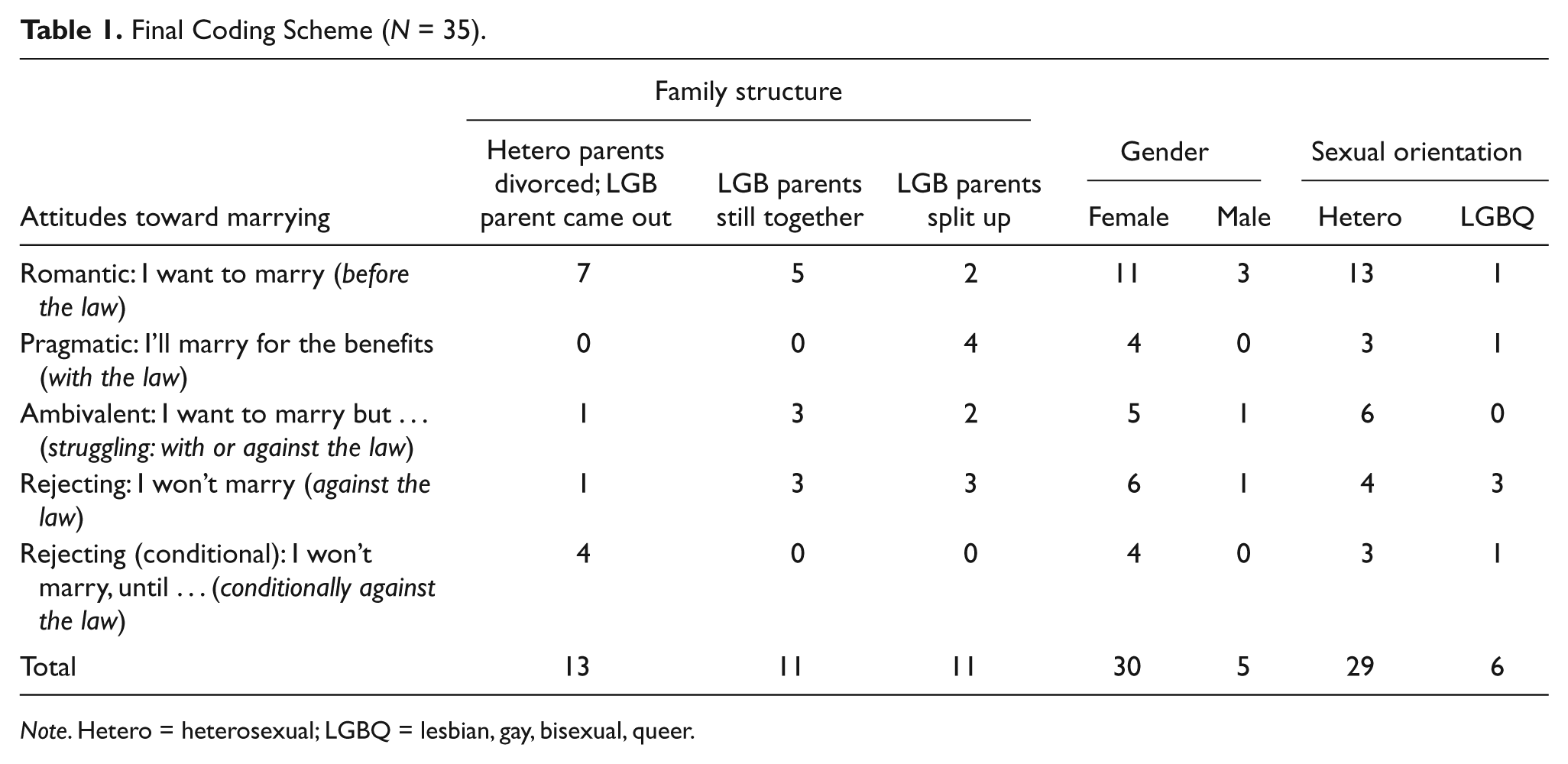
Note. Hetero = heterosexual; LGBQ = lesbian, gay, bisexual, queer.
Results
“Yes, I Want to Get Married”: Unconditional Desire to Marry, for Romantic Reasons
Fourteen participants (12 women, 2 men; 13 heterosexual, 1 bisexual) expressed an unconditional, straightforward desire to marry in the future. They described no ambivalence about marriage, or the fact that they could marry while their LGB parent(s) could not (or, in the three cases where participants’ parents were married, the fact that the LGB community as a whole could not marry). These participants’ endorsement of and interest in marriage were grounded in their views of marriage as the “ultimate commitment” and “the best way to solidify your bond with someone”; thus, their narratives reflected dominant, romantic discourses about marriage (Swidler, 2001). Darlene, a 25-year-old White heterosexual woman whose heterosexual parents had divorced when she was 10 years and whose father had repartnered with a man, said that she “definitely” wanted to get married: “Being somewhat traditional, I want to be married before having children. I feel marriage is the ultimate testament of love and your commitment to a person.” Notably, despite describing herself as traditional, Darlene made it clear that she did not see her father’s love for his partner as less meaningful than that of a heterosexually married person: “I view my dad as married even though he isn’t legally. He and his partner wear wedding rings, so I see that as a commitment to each other and their love.” Thus, Darlene applied the constructs she associated with marriage (commitment, love) to her father’s relationship, even though he was not married legally.
Nicole, a 25-year-old White heterosexual woman who had been born to two mothers, but who was raised primarily by her biological lesbian mother since her parents separated when she was a young child, also endorsed fairly traditional, romantic notions of marriage, stating,
I want to marry. I want to live my life with and raise children with a partner. I find the companionship and love in a committed relationship very fulfilling . . . I look forward to making a commitment with someone, to live our lives together and in a partnership.
Nicole went on to describe her ideal marriage as the type of relationship that she had seen modeled in the LGB community: “The kind of marriage partnership I see for myself is the same in terms of commitment and lifestyle that I see among life partners I know in the LGB community: committed, faithful, cohabiting.” Despite expressing a desire to marry specifically—as opposed to just having long-term committed relationships—Nicole asserted that the type of marital relationship she desired was no different from the relationships that she had witnessed in the LGB community. Darlene, Nicole, and others, then, had constructed their own notions of deep and committed relationships which were clearly informed by their LGB parents’ own relationships. Indeed, these participants appeared to rely more on their observations of relationship processes than relationship structure (i.e., heterosexual versus same-sex) in forming their own views and ideals about relationships. Therefore, at the same time that they enthusiastically and uncritically endorsed marriage as the ideal relationship form to which they aspired, thus aligning themselves “before the law” (Ewick & Silbey, 1998), they simultaneously failed to discriminate between the committed, nonmarital LGB relationships that they had observed, and the committed marital relationships that they hoped to form themselves.
In discussing their own desire to someday get married, 5 of these 14 participants noted that their parents wanted them to be happy, and would be upset if they did not marry. Given that participants were explicitly asked about their feelings about marrying when their parents could not, perhaps these participants volunteered this information as a way to justify their marriage intentions. Tessa was a 26-year-old White heterosexual woman whose parents had divorced when she was 5 years, after which her mother repartnered with a woman whom Tessa considered another parent. Discussing her upcoming wedding (she was the only participant who was engaged), Tessa said, “It bothers me that I can legally be married while my parents can’t but I know that my parents would not want me to hold off getting married until they could as well.” Thus, it was important for Tessa to assert that her mothers had effectively “given their blessing” for her to marry.
Three of these 14 participants specifically noted that although they felt that marriage equality was important, its absence would not keep them from marrying. Sadie, a 22-year-old White heterosexual woman who was raised in a two-mother, intact family, asserted,
I see no reason why I would not want to get married if presented with the option. It wouldn’t change the fact that I feel that everyone should have a right to get married; but because I have the right and desire to get married, I plan on getting married.
Yet these individuals cushioned such assertions by stating that they would continue to support marriage equality efforts, even if they married: “I’ll marry because it’s available to me . . . but I’ll continue to support the legalization of gay marriage as well” said Fred, a 24-year-old heterosexual man with two mothers who had split up when he was a teenager. These participants, thus, asserted their own desire to marry, while affirming their commitment to end marriage discrimination. In this way, they cannot be seen as entirely aligning themselves “before the law,” as they were ostensibly concerned about the injustice of marriage inequality—even as they were willing, at least in the abstract, to take advantage of their own ability to marry.
These 14 participants were from a variety of family backgrounds. They consisted of individuals who had been born to heterosexual parents who had divorced, and whose parent had come out as LGB during their childhood (n = 7); persons who had been raised by LGB parents from birth, and whose parents were still together (n = 5); and persons who had been raised by LGB parents from birth, and whose parents had broken up (n = 2). Thus, there was no consistent pattern or association between being raised in a particular family structure and endorsing an unconditional desire to marry. Interestingly, four of the five adolescents in the sample expressed an unconditional desire to marry, for romantic reasons. Thus, their limited romantic experiences and younger developmental stage may have had the effect of fostering relatively optimistic and uncritical views of marriage—as opposed to promoting more dismissive views of marriage (e.g., because it was still so abstract), as was expected.
“Yes, I Would Marry . . . for the Benefits”: Interest in Marrying, for Pragmatic Reasons
Four participants (all women; three heterosexual, one queer) endorsed a desire to marry—for pragmatic, legal reasons. Thus, in contrast to the above group, they did not couch their interest in marriage in romantic or commitment-related reasons, but noted that they would only marry for the legal protections that marriage provides—particularly if they intended to have children. In this way, they were positioned “with the law” such that they strategically engaged with the law for their own benefit; that is, they were willing to take advantage of the benefits provided by marriage (Ewick & Silbey, 1998). All four participants were women with two mothers; and, in all four cases, they had experienced their parents’ relationship dissolution in the absence of marriage. Thus, they may have been uniquely sensitive to how legal marriage, and legal divorce, might have provided their parents and them with certain protections. Hailey, a 19-year-old White heterosexual woman who was born to two mothers who had split up while Hailey was young, mused,
I will probably get married for the health care benefits and for the benefit of my future children, but I don’t believe that marriage is a sacred institution or a declaration of love. . . I just understand the practicality of marriage financially and for the sake of children. Not that children do better with married parents, per se, but that child support, alimony, etcetera is easier to work out if you’ve been married.
As Hailey alludes to, the reality that these individuals’ parents had been unable to get married had clearly shaped their perspective that marriage was “just a legal document”—albeit one that was useful, particularly when children were involved. That is, their parents’ inability to get married helped them to theoretically and concretely separate the constructs of love and commitment from the construct of civil marriage. Far from a “declaration of love,” civil marriage was imbued with legal but not sacred meaning by these participants.
I Want to Marry, but . . . : Ambivalent Attitudes Toward Marrying
Six individuals (five women, one man; all heterosexual) voiced ambivalent feelings about the possibility of marrying. They described a tentative desire to marry, but felt guilty about enacting this desire given their parents’ inability to marry; thus, they grappled between acting with or against the law (Ewick & Silbey, 1998). Louisa, a 23-year-old White heterosexual woman who was raised by her single lesbian mother said, “Sometimes I get caught up thinking about marriage and remember that I would be unhappy being married knowing that my mom doesn’t have that option yet.” Robin, a 19-year-old White heterosexual woman whose two mothers split up when she was 12 years old, and whose biological mother had repartnered with a woman she considered a stepmother, also struggled with the fact that she could marry but her mothers could not:
For legal purposes, I would probably want to be married. But I know that no matter how much I love a man, I would have a sense of guilt taking part in my wedding surrounded by family and friends, many of whom have been with their significant others for longer than I have been alive yet are not able to enjoy the same privileges as me and my partner simply because they happen to be two people of the same gender. So I am uncomfortable with the idea that the family I will someday create could be seen as more “real” than the one that I come from . . . I could walk out on the street right now, pick some guy I want to marry, we could be married by the end of the day, and society would accept that. Then the many same sex couples I know who have been in committed relationships for decades would instantly be considered less of a family than me and a stranger. I don’t know how to reconcile that and part of me feels that, no matter how much I love somebody, marriage between us would be irrelevant to me until it isn’t a privilege granted to only heterosexual couples.
Robin, then, was acutely aware of the injustice whereby any heterosexual relationship or marriage that she entered into would be viewed as more real and valid by outsiders than any relationship that her parents, or other beloved LGB elders, would enter into. She did not appear to have resolved this tension, but, rather, seemed to struggle actively with it.
In addition to expressing ambivalence about marrying because their parents did not have access to marriage, three of these six individuals also expressed ambivalence about marrying given its patriarchal history—but they somewhat resolved this tension by asserting that they intended to “define marriage on [their] terms.” Selena, a 24-year-old White heterosexual woman with two lesbian mothers who split up when she was young and repartnered with other women, explained, I like the idea of formalizing commitment but I also struggle with the traditional connotations of marriage. I reconcile [this] by committing to myself that I will do marriage in my own way . . . that I can redefine traditional marriage in a way that reflects my values.
Selena and others articulated an acceptance of some of the basic functions and structure of marriage (i.e., marriage is a means of formalizing one’s commitment to a single person; Swidler, 2001) but at the same time, indirectly asserted a rejection of “traditional” (i.e., patriarchal) marriage (Coontz, 2006).
“No, I Won’t Marry”: Rejection of Marriage
Seven participants (six female and one male; four heterosexual, one lesbian, one queer, and one gay) stated that they would not marry. This rejection of marriage for themselves was rooted in a critical perspective of the institution of marriage—an institution in which they did not wish to participate. Thus, they positioned themselves “against the law” (Ewick & Silbey, 1998). Notably, six out of seven of these participants were born into lesbian-mother households (in three cases their mothers were still together; in three cases they had split up). Madeline, a 21-year-old White queer-identified woman who grew up in a two-mother, intact family, asserted, “I’m not interested in participating in systems that try to regulate my relationships with people . . . I am, however, interested in long-term partnerships.” Paul, a 20-year-old White heterosexual man whose two mothers had split up when he was young, and had repartnered with women whom Paul considered stepparents, cited numerous problems with the “institution” of marriage:
I am uncomfortable with marriage as an institution because of the role it traditionally has had in securing rigid roles for people’s gender, sexuality, and personal lifestyle. I believe relationships, sexuality, and gender should be more fluid than marriage allows for. Even if I were to be in a primarily monogamous relationship for the majority of my life . . . I feel like it’s unhealthy to prop it up with some sort of binding contract. I also feel like there are expectations for married couples I’m not sure I want to be held to.
Both Madeline and Paul distinguished between long-term relationships and marriage, emphasizing that the former did not require and could in fact be negatively shaped by the latter. Paul also intimated that civil marriage might be unhealthy insomuch as it constituted a “binding contract,” thus making it more difficult for individuals to end their relationships. It is notable that both Madeline and Paul, as well as one other participant, had LGB parents who had been married. Thus, their critical perspectives on marriage are especially notable in light of their parents’ relatively recent marriages. Their rejection of marriage may stem in part from their experiences growing up with LGB parents who could not marry; indeed, their parents’ recent ability to marry may not have erased the impact of growing with parents who could not marry. It is also notable that all these participants were in or had recently graduated from college, and most of them referenced coursework on women, gender, or queer theory during their interviews. This suggests that their rejection of marriage may reflect their recent exposure to critical perspectives on marriage (Stake & Hoffman, 2001). Also, three of the seven participants were LGBQ-identified. In turn, their own identification as LGBQ, and their participation in the LGBQ community, may have contributed to their awareness of the problematic aspects of marriage (Lannutti, 2011; Rolfe & Peel, 2011).
Importantly, four of these seven participants described specifically how their upbringing in general, and their parents’ inability to access marriage for much of their lives, had shaped their own critical perspective on marriage. Freida, a 19-year-old queer-identified woman who grew up in a two-mother, intact family, stated,
I don’t think that the legal recognition which the government gives you is at all helpful to solidifying bonds. I can have an equally beautiful relationship without involving the government . . . this idea is undoubtedly shaped by growing up with lesbian moms who could not get married.
Sara, a 20-year-old White heterosexual woman who grew up in a two-mother, intact family, explained,
I was raised to be very skeptical of the institution of marriage since my parents were not allowed to marry and they thus felt disenfranchised from the institution. I’ve seen the positive ways in which not being married has affected my parents’ relationship. Since they are not married, they have not held the same expectation as married couples that they will stay together forever until the end. Instead they have been able to negotiate challenges and decide at each new stage of their relationship what is working, what needs to change, and whether they are ultimately a good fit for each other. I think this has been extremely positive in their relationship and I have adopted this method in my own relationship.
Like many of the participants in the sample, Sara seems to have constructed her own notions of committed relationships that are not contingent on being married. Furthermore, she described various advantages of enacting intimate relationships in the absence of legal recognition. Indeed, all seven participants in this category claimed to value healthy and enduring relationships; what they rejected was the significance of marriage for facilitating and upholding relationships.
“No, I Won’t Marry . . . for Now”: Rejection of Marriage Until All People Can Marry
In four cases (all women: three heterosexual, one queer), participants emphasized that they would not marry until everyone could marry. Thus, their rejection of marriage was conditional: They could imagine themselves marrying, but only if their parents—and/or the LGB community as a whole—could also marry. In one of these cases, the participant’s mother and stepmother had married in California, but the participant underscored the legally contested nature of this marriage and noted the importance of federal marriage equality. As Shira, a 24-year-old White heterosexual woman whose heterosexual parents had divorced when she was school-aged, and whose father had repartnered with a man whom she considered her stepfather, stated decisively: “I think someday that I would like to get married . . . But I will not get married unless all people are able to get married, regardless of sexual orientation.” Thus, these participants refused to participate in the institution of marriage—at least in the abstract—until marriage equality was a reality. They can therefore be viewed as conditionally “against the law” (Ewick & Silbey, 1998).
All four participants had heterosexual parents who had divorced prior to their parent’s coming out. Furthermore, in three cases, participants noted that they were more impassioned advocates of marriage equality than their LGB parents, whom they described as “not outspoken” and persons who “[don’t] see the point of marriage.” Their unwillingness to marry then does not appear to reflect the influence of their own parents’ politicized views about marriage equality.
Discussion
The current, exploratory study of 35 adolescents and emerging adults lends insight into how young adults with LGB parents construct their own feelings and intentions surrounding marriage. Having grown up in families that do not conform to the heterosexual nuclear ideal, these participants’ own marital attitudes and intentions are notably variable, and appear to have been influenced by their growing-up experiences, societal discourses about marriage, and other factors.
Forty percent of the sample (n = 14) voiced an unconditional desire to marry, which they grounded in a valuing of marriage as the ultimate bond between two people and the ideal way of solidifying commitment and love. These ideas reflect dominant discourses that still prevail in American culture, albeit amid more critical “realist” notions of marriage (Coontz, 2006; Swidler, 2001), thus revealing how young adults with LGB parents draw from larger cultural discourses about love and marriage in constructing their own relationship views. It is notable that all but one of the individuals who endorsed this position was heterosexual. A study by Meier, Hull, and Ortyl (2009) found that lesbian and gay young adults were less likely than heterosexual young adults to endorse “lifelong commitment” as a very important relationship value. Perhaps heterosexual young adults are more likely to uncritically value mainstream notions of love, commitment, and monogamy than sexual minorities, in general—even if their own parents are LGB. It is also notable that four of the five adolescents in the sample voiced an unconditional desire to marry. Insomuch as adolescents typically have not experienced committed, long-term relationships (which are more characteristic of emerging adults; Arnett, 2000), their lack of relationship experience may have led them to develop more idealized and romantic views of marriage—as opposed to leading them to espouse more dismissive views, as was expected.
Consistent with a social constructionist approach, many of the same participants who uncritically endorsed the value of marriage defined successful relationships in terms of the values and strengths that they observed in their LGB parents’ relationships and the LGB community. Thus, they drew more on their observations of relationship processes than relationship structure in forming their own views about relationships (Breshears, 2010). Furthermore, although these participants asserted their intention to marry, several also emphasized an unwavering commitment to end marriage discrimination. This stance is consistent with that of some heterosexual allies to the LGB community, who have noted that deciding not to marry does not by itself improve the situation for LGB persons (Toerien & Williams, 2003). Thus, the 14 participants who voiced an unconditional desire to marry cannot be seen as entirely “before the law,” in that they acknowledged, and voiced a commitment to end, marriage inequality (Ewick & Silbey, 1998).
Some participants (n = 4) asserted that they intended to marry for practical reasons, echoing the perspectives of some members of the LGB community who seek to marry for legal benefits and protections (Porche & Purvin, 2008; Rolfe & Peel, 2011). These individuals were therefore “with the law” in that they strategically engaged with the law for their own benefit (Ewick & Silbey, 1998). These individuals were all women whose mothers had broken up during their childhoods, and thus had experienced their parents’ relationship dissolution in the absence of legal marriage or divorce, a reality that may have sensitized them to the utility of a legal document in ensuring certain protections for children. Their perspectives are particularly interesting in light of research examining how young adults with divorced parents come to view marriage (Miles & Servaty-Seib, 2010). Some of this research suggests that young adults with divorced parents are more likely to form critical or cautious views of marriage than young adults from intact families (Burgoyne & Hames, 2002; Weigel, 2007). Yet these young adults’ perspectives point to the reality that experiencing parental relationship dissolution without legal recognition can create additional challenges for families—challenges that might ultimately have the effect of reinforcing, for children, the importance of legal marriage, even if that marriage ends in divorce.
Other participants (n = 6) voiced ambivalent reactions to the possibility of marrying, where they were drawn to the idea of marrying, but expressed guilt or uncertainty about marrying in light of their parents’ lack of access to marriage. These participants offered up poignant reflections on how they would feel enacting the right to marry while their own parents and/or the LGB community could not. In some cases, they underscored their frustration that, by virtue of their own sexuality, they had the opportunity to participate in an institution that carried unparalleled symbolic value, and, in turn, their relationships would in turn be seen by society as more meaningful than those of their LGB parents. These participants therefore experienced a tension between their marital desires, which would position them “with the law,” and their awareness of and desire to fight marriage inequality, which would position them “against the law” (Ewick & Silbey, 1998). Far from resolving this tension, they appeared to be actively struggling with it.
One fifth of the participants (n = 7) were critical of marriage as an institution and asserted that they would not be participating in it themselves. These individuals were squarely “against the law” in that they refused to participate in the institution of marriage, which they viewed as a discriminatory and unfairly powerful legal system (Ewick & Silbey, 1998). All of these participants were currently in or had recently completed college, and most of them described recent exposure to coursework in queer theory and the like; thus, their rejection of marriage may in part reflect their recent exposure to critical perspectives regarding marriage (Stake & Hoffman, 2001). Also, all but one of these participants had grown up from birth with lesbian mothers, and three of these participants were LGB themselves. Their experience growing up in lesbian-parent households (Goldberg & Kuvalanka, 2012) as well as their own participation in LGB—and possibly politically radical—communities (Goldberg, Kinkler, Richardson, & Downing, 2012), may have also shaped their more critical attitudes toward marriage. Indeed, several of these participants specifically invoked their parents’ influence on their own marital attitudes, underscoring the role of familial circumstances in the construction of alternative discourses about relationships and marriage (Breshears, 2010).
Finally, several participants (n = 4) described a rejection of marriage that was conditional on marriage (in)equality. They could imagine themselves marrying, but only if their parents, or the LGB community as a whole, could marry. Thus, they were positioned “against the law”—but conditionally so (Ewick & Silbey, 1998). Interestingly, these individuals had all experienced their heterosexual parents’ divorce, and then a parent’s coming out as LGB, and tended to describe themselves as more passionate advocates of marriage equality than their LGB parents. Thus, their unwillingness to marry does not appear to reflect a politicized consciousness that was informed by their parents’ views or their experiences growing up with LGB parents. Perhaps their refusal to marry—conditional on marriage equality for all—may have functioned as a discursive attempt to communicate their loyalty to their LGB parent. Alternatively, it is possible that the combined experience of enduring their heterosexual parents’ divorce and having a parent come out as LGB may have facilitated a diminished idealization of marriage and a greater tolerance of alternative family structures, leading these participants to reject marriage for themselves, at least for now.
In sum, the findings suggest that the marital attitudes and desires of young adults with LGB parents are shaped by a variety of influences, including broader societal discourses about marriage, their immediate circumstances (e.g., their family structure), and their own social locations (e.g., their sexual orientation). Furthermore, they suggest that most young adults with LGB parents value at least some aspects of marriage, and express an interest in marrying themselves; yet, at the same time, they sometimes struggle intrapersonally with the fact that they can access marriage whereas their parents cannot. As a whole, the findings underscore that for adolescents and emerging adults with LGB parents, marriage is a complex issue, and one which they consider with sensitivity to both the personal and sociopolitical implications of their actions.
Limitations
This study is limited in several ways. First, the sample was mostly women, making it difficult to draw conclusions about the role of participant gender in the patterning of responses. Future work should include a more balanced representation of young men and women with LGB parents, as gender may influence marital attitudes (Pew Research Center, 2011). Second, the sample was largely composed of persons with lesbian mothers, as opposed to gay fathers. Thus, it is impossible to make claims about how having a gay father versus a lesbian mother may have shaped participants’ beliefs about marriage. Third, the sample was limited racially, as participants were mostly White. Research indicates that race/ethnicity influences marital meanings and aspirations, as does social class (Edin & Kefalas, 2005). Indeed, most participants were in or had graduated college; thus, their marital meanings may have been shaped by their participation in institutions of higher education (Pascarella & Terenzini, 2005). Fourth, the participants were from a particular set of geographic locations. Young adults living in other areas of the country may have been exposed to different norms pertaining to marriage; indeed, rates of marriage and divorce vary by state and county (Pew Research Center, 2009). Related to this, participants grew up in many different states. Research on young adults from a few well-defined regions could attend explicitly to the role of regional influences in marital attitudes.
This study examined young adults’ perspectives and desires regarding marriage; it did not examine their behaviors. We do not know whether the individuals’ statements in the interviews are at all predictive of their future marital behaviors. Given that marital attitudes change across development (Willoughby, 2010), future work should examine how young adults with LGB parents’ attitudes about and aspirations for marriage unfold over time. Also, the current sample included a very small number of adolescents (n = 5), permitting only cautious claims to be made about the role of developmental stage in participants’ responses. Future work should include large samples of both adolescents and emerging adults with LGB parents to more closely examine how developmental stage may intersect with family structure in shaping marital attitudes.
Finally, a strength and limitation of this study is the heterogeneity of the sample with regard to family structure. The heterogeneity of the sample is a strength in that it enabled an exploratory analysis of the degree to which family structure did and did not appear to shape participants’ marital views. And yet, insomuch as the number of participants in each type of family structure was small, caution must be used in generalizing the findings beyond the particularities of the current sample.
Conclusions
This study makes several contributions to the literature. First, whereas a modest body of literature has examined LGB people’s decision making about marriage, and reasons for marrying (e.g., Lannutti, 2011; Shulman et al., 2012), only one prior study examined the marital desires of the offspring of LGB people (Javaid, 1993). Thus, this study provides insights into the myriad factors that young adults with LGB parents consider and are influenced by when thinking about their own marital futures. It raises many questions to be pursued in future research on the offspring of LGB parents, such as the following: How, when, and why do their ideas about marriage and their desire to marry shift across the life course? If they do choose to marry, how do they explain this decision? (How) do they navigate heteronormative discourses surrounding weddings with the particularities of their family structure, in planning their own weddings?
It is worth considering the findings in light of the concerns raised by opponents of extending marriage equality to same-sex couples. Wardle (2006, 2008) and others have raised the concern that children of LGB couples may have less regard for “traditional” marriage, and have cited this concern as a reason for opposing marriage equality. Javaid’s (1993) findings, which suggested that children of single lesbian mothers may be less likely to uncritically endorse marriage for themselves, coupled with the findings of this study, which further suggest why the offspring of LGB parents may be hesitant to endorse marriage for themselves, do suggest that the children of LGB parents may hold more critical views of marriage than their counterparts in heterosexual-parent families. Furthermore, the participants in this study may indeed have “less regard for traditional marriage”—if traditional marriage is defined as exclusively heterosexual, which it often is. And yet a large number of participants did express a desire to marry, thus highlighting the variability in perspectives that exists among young adults with LGB parents, and thereby contradicting Wardle’s claims about the inevitable breakdown in marital values that will befall children of LGB parents.
Footnotes
Declaration of Conflicting Interests
The author(s) declared no potential conflicts of interest with respect to the research, authorship, and/or publication of this article.
Funding
This study was supported by a grant-in-aid from the Society for the Psychological Study of Social Issues and a grant-in-aid from the Society for the Scientific Study of Sexuality, both awarded to the author.