



Abstract
Although most Americans agree that postsecondary education is the clearest path to later financial security, many families have trouble saving money to help their children in this process. This article focuses on the struggles of middle-income families as they attempt to negotiate their daily financial realities with their aspirations for their children’s postsecondary education. In particular, the article examines the discord between the high educational aspirations these middle-income families have for their children and their daily financial constraints. We do so by analyzing in-depth interviews with 31 middle-income families living in the greater Philadelphia area. The middle-income parents in our sample are acutely aware of the importance of college for their children’s upward mobility, and they ideally would like to support their children in this pursuit. However, their current financial insecurity, their lack of government support, and the rising costs of college make preparing for this dream increasingly difficult.
Introduction
In a speech to Congress in the first months of his presidency, Barack Obama discussed the link between postsecondary education and financial security. He urged U.S. citizens to attend postsecondary institutions and proclaimed that “by 2020 America will once again have the highest proportions of college graduates in the world” (Obama, 2009). Although there is some dissent surrounding the current “college for all” mandate in American society, 1 postsecondary attainment is still one of the clearest paths to better financial outcomes (Gladieux & Scott Swail, 1998; Goldrick-Rab, Harris, Benson, & Kelchen, 2011; Haskins, Holzer, & Lerman, 2009).
Given the importance of postsecondary education in the postindustrial, skills-based economy, researchers have spent considerable time investigating the factors that influence children’s ability to attain degrees. In particular, much previous research has focused on how parents’ attitudes and resources directly affect children’s educational goals and attainment. Some of the earliest research on these dynamics came from the Wisconsin school of the 1960s, whose status attainment researchers found that parental aspirations for children’s educational achievement were important predictors of children’s own college plans (Sewell & Shah, 1968b). Since that time, aspirations have consistently been found to play a key role in children’s educational attainment (Bronstein, Ginsburg, & Herrera, 2005; Fan & Chen, 2001).
Although parental aspirations are clearly important, their role in the attainment process, we suspect, has shifted over time along with views about the growing necessity of postsecondary education. For the first half of the 20th century, college was seen as the exclusive purview of the elite (Brock, 2010). Since the 1960s, however, policy makers and parents have increasingly viewed college as a universally beneficial aspiration, or even an economic imperative. As perceptions of the importance of college have shifted, variation in parents’ college aspirations has decreased, such that parents from different socioeconomic and racial groups now share similar hopes that their children will attain college degrees (e.g., Goldenberg, Gallimore, Reese, & Garnier, 2001; Kirk, Lewis-Moss, Nilsen, & Colvin, 2011; Spera, Wentzel, & Matto, 2009).
As college has become an almost universal goal, the cost to achieve college degrees has risen substantially. Over the last three decades, college tuition has increased by twice the rate of inflation (Hauptman, 2010). Additionally, state support for publicly funded universities has declined (Hout, 2009) and grant-based aid has lost value (Carey, 2010; The College Board, 2007b; Curs, Singell, & Waddell, 2007). Consequently, students and their families have had to take on more of the burden for financing college costs, often relying more on costly loans to make up for these deficits (Rothstein & Rouse, 2011).
The relationship between rising parental aspirations and rising costs is an important one as parents work to provide their children with the necessary financial backing to gain educational credentials. However, little sociological research has examined in-depth the interplay between parental aspirations and rising financial constraints. In particular, little research has examined how parents negotiate their aspirations for their children’s educational attainment with their own financial realities (for exceptions, see Grodsky & Jones, 2007; Manly & Wells, 2011; Sallie Mae, 2010).
This article examines this negotiation process among a group of middle-income families living in a major metropolitan area in the eastern United States. Although there has been general attention paid to the problems of the rising cost of college for families, most of these discussions center on the least advantaged in the United States (for exceptions, see Jesse, 2011; Presley, Clery, & Carroll, 2001). Although (obviously) not unimportant, these discussions consequently often gloss over, or even ignore altogether, examinations of those in the middle of the income distribution. Middle-income, or more broadly defined middle-class, parents are often assumed to want their children to attain postsecondary education, and even more important for this analysis, they are assumed to be able to bear a significant portion of the expenses. And while there is anecdotal evidence that these families do struggle with college costs (e.g., Jesse, 2011), there has been little systematic, qualitative research on how family’s daily financial lives play out in the college savings process. This article begins to fill this void by focusing on the educational aspirations of parents earning between 75% and 125% of median family income, 2 and the struggles they encounter as they try and pave the way for their children’s postsecondary education. Our analysis focuses on the double burden parents face as they attempt to make their finances work in the short term and also prepare for their children’s future education.
Family Background and Educational Attainment
It has long been known that family background has a potent impact on children’s educational attainment. Even as access to postsecondary education expanded in the United States, social position—often operationalized as parents’ educational attainment, occupational status, and income, or a combination of these—remained a strong predictor of entering and completing any postsecondary education and, in particular, 4-year degrees (Belley & Lochner, 2007; Haveman & Smeeding, 2006; Hill & Duncan, 1987; Hofferth, Boisjoly, & Duncan, 1998; Rumberger, 2010; Sewell & Shah, 1968a). Furthermore, despite the fact that college participation rates for all socioeconomic groups have risen in recent decades, the gaps between these groups have remained relatively fixed over time (Gladieux & Scott Swail, 1998). Although scholars have documented the link between family background and educational attainment, they have failed to offer a coherent explanation for why this relationship exists and persists (see also Goldrick-Rab et al., 2011; Menning, 2002; Roksa & Potter, 2011).
One prominent argument is that families from different socioeconomic backgrounds have different knowledge and skills regarding education, which affects children’s attainment. Most often this is referred to as families’ different levels of cultural capital, or the cultural skills that are passed from parents to children (Bourdieu, 1977; Lareau, 2000). In particular, scholars have argued that parents from lower socioeconomic classes are less knowledgeable about the ways to negotiate with their children’s schools, which negatively affects their children’s achievement (e.g., Baker & Stevenson, 1986; Lareau, 1989, 2000, 2011; Lareau & Horvat, 1999). Although this work primarily focuses on young children, more recent research has also examined its impact in the transition to college. In her 10-year follow-up to Unequal Childhoods, Lareau (2011) argues that the cultural capital displayed by middle-class families when their children are in elementary school can also be seen as these children transition to college. Specifically, upper-middle-class families, and particularly mothers, actively direct their children’s transition from high school to postsecondary institutions, negotiating with their children and educational institutions to make sure students are adequately prepared. Although working- and lower-class families had similar educational aspirations for their children, they lacked the knowledge to navigate the passage from secondary to tertiary education.
Although cultural arguments are one theoretical approach to understanding different levels of attainment across socioeconomic strata, these views tend to treat the financial aspect of postsecondary education as secondary to the cultural considerations affecting entrance to college (for an exception, see Manly & Wells, 2011). Economists often focus on the role of borrowing constraints or low-income families differential “consumption value” of higher education to explain differential rates of attainment (see Belley & Lochner, 2007). Other research has explored how the financial landscape of higher education disadvantages middle- and lower-income families.
Rising Costs
Although aspirations across social strata appear to have converged over the last several decades, the ability to pay for postsecondary education has encountered major stumbling blocks. Both increases in tuition and changes in financial aid resources have affected families’ ability to pay. Over the last decade, published tuition and fees at public 4-year institutions rose annually at an average rate over 4% beyond inflation (The College Board, 2007a). Total costs for resident students at state public universities as well as students at private 4-year nonprofit schools rose almost 6% from the 2006 to 2007 school years (The College Board, 2007a). Nonresident students at public universities saw similar, though slightly lower, increases over the same period (The College Board, 2007b). The costs at public universities over the last several decades have increased in part because of decreases in state funding, which have forced schools to raise tuition to offset the difference (Hout, 2009).
The changes in higher education costs have altered the ways that families pay for postsecondary education, shifting the burden to parents and youth. Along with decreases in state aid to public educational institutions, the value of federal financial aid to students and families has also been in decline. The primary federal grant families most often rely on for financial support in pursuit of higher education is the Pell Grant. The Pell grant is an entitlement given to students based on the difference between a chosen college’s costs and the expected level of contribution from the student’s family (expected family contribution). In the 2010-2011 school year, the maximum Pell grant award was $5,500. The average Pell award was $3,705 (New America Foundation, 2011). Although in the last several years Pell generosity increased in certain ways, for example, by allowing students to receive more than one grant per year for summer coursework, that benefit was recently eliminated and the fighting over the current budget in Congress has left the amount of Pell funding in the future in jeopardy (Field, 2011).
Furthermore, the Pell grant has seen its value, relative to the cost of higher education, dip significantly over the last several decades (Curs et al., 2007). From 1986 to 2006, Pell grant coverage of tuition, fees, and housing at average public 4-year colleges dropped 20% (The College Board, 2007b). For students most likely to receive Pell grants, the actual cost of postsecondary education at public universities rose almost 50% from 1980 to 2000 (St. John, 2002).
Given these dramatic changes, it is not surprising that researchers find family income to be positively related to educational attainment. In earlier work, Hill and Duncan (1987), using intergenerational data from the Panel Study of Income Dynamics, find that parental income had significant positive effects on the total years of schooling completed by adult children. Similarly, Hofferth et al. (1998) find that higher family income in adolescence was positively associated with additional years of schooling. Furthermore, Belley and Lochner (2007), using 1979 and 1997 data from the National Longitudinal Survey of Youth, conclude that the influence of family income on college attendance has increased over the last several decades. Moreover, they find that the effects of family income on enrollment at 2-year versus 4-year institutions are much larger for the latter cohort.
Indeed, students and their families are currently much more likely to pay for their education with loans than grants relative to their peers several decades ago. Rothstein and Rouse (2011) find that between 1993 and 2004 the percentage of college students with at least some loans rose 11%. Not surprisingly, as students have taken on more loans, the total amount of debt they incur has risen as well. Holding inflation constant, average debt for a college graduate increased by almost $5,000 from 1993 to 2004 (Rothstein & Rouse, 2011), and over the last 3 decades, annual loan volume has increased 10-fold (Hauptman, 2010). Middle-income dependent students are somewhat more likely than lower income students to have accumulated at least $30,000 of debt while achieving their bachelor’s degree (The College Board, 2010a).
Middle-income students are also less likely to achieve a bachelor’s degree compared with their higher income peers. For students who entered their first postsecondary institution in the 2003-2004 school year, only 36.3% of students with family incomes in the second quartile and 45.5% of students in the third income quartile earned their bachelor’s degrees in 6 years, compared with 58.6% of students from families with incomes in the top quartile (Presley et al., 2001).
Although differences in educational attainment continue to be a topic of interest to scholars, the actual planning and management of economic issues facing middle-income students and their families have often been left out of the discussion (for exceptions, see Manly & Wells, 2011; Sallie Mae, 2010). Given the dramatic rise in tuition costs over the last several decades (The College Board, 2007a) and the corresponding decrease in aid generosity (Carey, 2010; The College Board, 2007b; Curs et al., 2007) and rising burden on families, it seems likely that family’s economic situations are still a crucially important piece of understanding the likelihood that some youth are less likely to attain college degrees over others. Yet examinations of the process by which families think about financing their children’s postsecondary careers have been relatively absent from the literature. This article seeks to address this gap by examining the experiences and expectations of middle-income parents as they try and navigate the path to postsecondary education for their children.
Sample and Method
The sample discussed in this article is part of a larger, cross-national examination of middle-income families in the United States and Canada (Furstenberg & Gauthier, 2007; Iversen, Napolitano, & Furstenberg, 2011). The families in the current study live in a suburban township of nearly 90,000 in the greater Philadelphia area. The township is 68% White, 20% Black, 11% Asian, and 3 % Hispanic (2005-2009 American Community Survey (ACS) 5-Year Estimates). The majority of our families come from areas in the township that have been stably White and working and lower middle class for several decades. However, there are also predominately White, upper-middle-class areas of the township as well as other areas that are poorer, more transitory, and have seen an influx of non-White immigrants during the last several decades. Demographic information comparing the community with the surrounding metropolitan statistical area (MSA) and the United States can be found in Table 1. The median family income for the community is $63,376 (2009 dollars). Compared with the greater MSA, the study community has a lower median family income and a slightly higher percentage of families living below the poverty line or unemployed (2005-2009 ACS 5-Year Estimates). The community also has almost double the percentage of foreign-born residents. In terms of educational attainment, slightly less than 30% of residents above the age of 25 have bachelor’s degrees or higher, similar to the nationwide percentage but lower than the greater MSA. The school district ranks in the middle third of the state in 7th/8th and 11th grade math and reading scores on the Pennsylvania System of School Assessment tests (Pennsylvania Department of Education, 2011).
Demographics of Sample City, Greater Metropolitan Statistical Area, and the United States a .
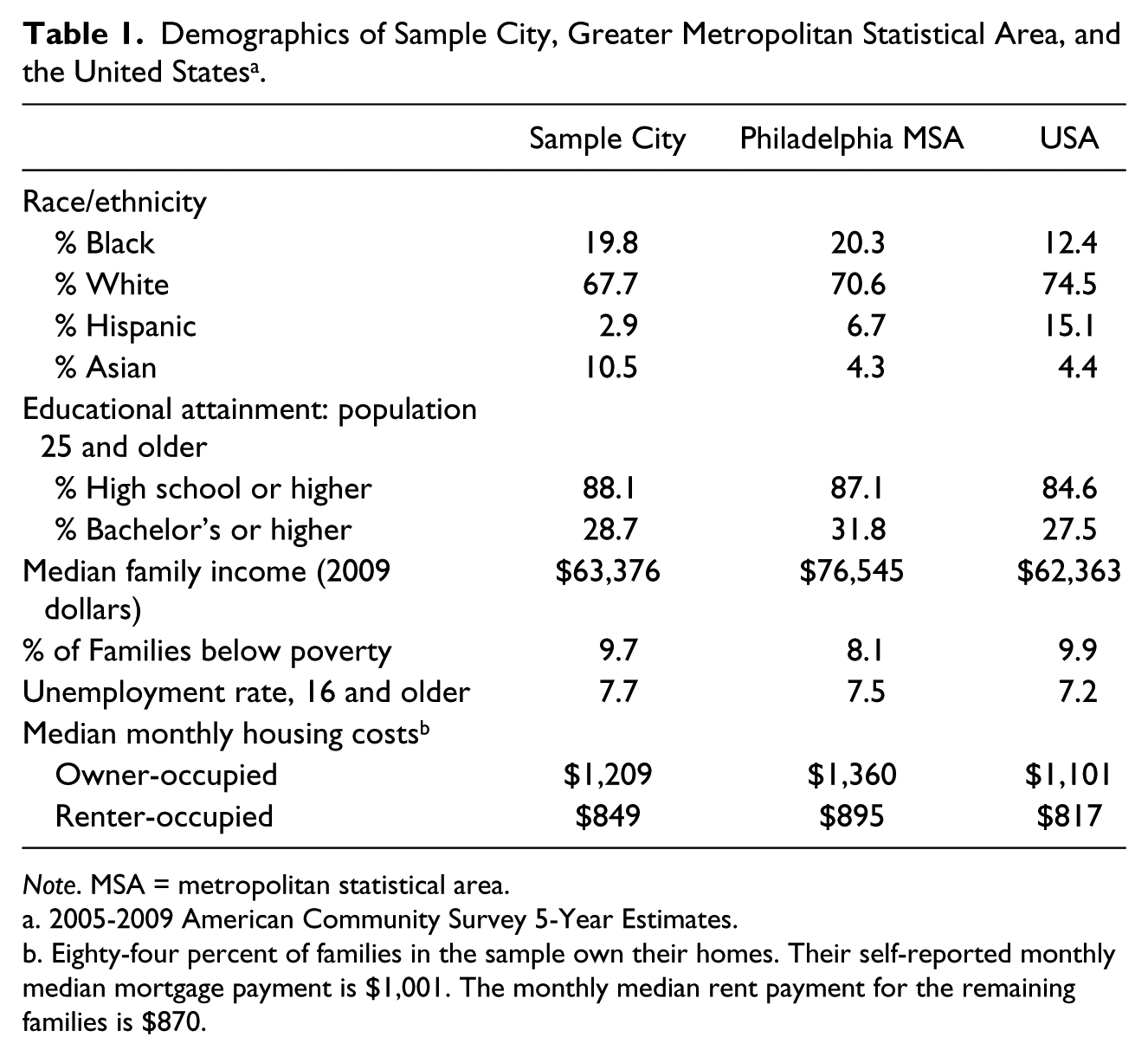
Note. MSA = metropolitan statistical area.
2005-2009 American Community Survey 5-Year Estimates.
Eighty-four percent of families in the sample own their homes. Their self-reported monthly median mortgage payment is $1,001. The monthly median rent payment for the remaining families is $870.
This article uses data from qualitative interviews conducted during the summer of 2008, before the official announcement of the recent recession, with 31 middle-income families. In the spring of 2008, 238 families recruited through the local middle schools returned short recruitment questionnaires concerning their economic well-being. For the qualitative sample, we randomly selected families who fit our eligibility criteria and reported that they were willing to be contacted further. To be eligible for the qualitative component, families had to report annual incomes between $45,000 and $75,000, approximately 75% to 125% of median family income. We chose to define middle income in this way based on previous discussions in the literature (Gauthier, 2012; see also Birdsall, Graham, & Pettinato, 2000; Pressman, 2007; Thurow, 1984, 1987). Although this definition likely does not map perfectly onto subjective feelings of social class, the goal of the current project is to understand the experiences of families truly in the middle of the income distribution. We, therefore, chose to limit the sample in this way. We also limited our sample to families with two to four children, one of whom had to be in middle school to receive the initial recruitment survey. Only two families who fit into our criteria and who had initially said that they were willing to participate did not participate in the qualitative interview, resulting in a sample of 31 families. Interviews took place in respondents’ homes and averaged approximately 2 hours. Families also filled out a longer questionnaire up on completion of the in-depth interview. We compensated families $50 for their participation.
Of the 31 families 3 interviewed, 24 are White, 6 are African American, and 1 is Asian. The median age of respondents is 43 years, and the median number of children per family is 2.5 (almost half had two children). Parents in 18 of the families are married, 10 parents are currently divorced or separated, 2 are currently cohabiting with partners, and 1 has never been married. The median education level for respondents is a diploma or certificate from a postsecondary institution. Nine participants hold a bachelor’s degree or a diploma or certificate from a postsecondary institution. Seven participants have some postsecondary experience, but no degree, and the remaining respondents have completed high school (N = 4) or attained their General Equivalency Diploma (N = 2). Twenty-four of the families report earnings of $45,000 to $60,000 annually, whereas the remaining families report incomes of $60,000 to $75,000 annually. In all the families at least one parent is working full-time and jobs range from short-haul truck drivers and union carpenters for fathers, to nurses, legal secretaries, and office managers for mothers. In most families with two parents in the household, both parents are working full-time, though there are a few exceptions.
Qualitative interviews with families covered a range of topics including views on their neighborhood quality, employment experiences and perceived work/family balance, children’s education, daily family life, health, and finances. The qualitative interviews were digitally recorded, transcribed verbatim, and then coded using Atlas TI qualitative software. The coding process generally follows LaRossa’s (2005) discussion of grounded theory methods in family research. In the first “open” (LaRossa, 2005) level of coding, the authors developed the coding scheme on the basis of an initial reading of the interview data. This first layer of coding involved a more general examination of the data and included codes such as “education-children current,” “education-children expectations,” “neighborhood,” “finances,” “employment,” and “work/family balance,” among many others. Once this first level of coding was completed, and on the basis of emergent findings from the first wave of coding, we returned to the data and conducted “axial” coding (LaRossa, 2005). These codes included more detailed examinations of the data, such as “finances-strain” and “finances-bill paying,” among others.
Finally, we used selective coding (LaRossa, 2005) to analyze the codes most relevant to our discussion in this article, which included our general codes on education and finances and their more detailed iterations. Once we identified these codes, the first author examined each code, across respondents, to classify any patterns emerging across the different families. This involved, for example, analyzing what all the respondents said under the “education-children expectations” code to identify similarities or differences in how the families spoke of their educational expectations for their children. The second level of this analysis involved analyzing each code in this fashion by mother’s educational attainment to make comparisons across family background. The second author examined the same codes but separately for each family to ensure that the family’s narrative was not separated from the coded material. Comparing the results from all analyses, we discovered that each respective analysis revealed similar conclusions regarding the expectations, aspirations, and financial realities that many of the families encounter. We also examined both the short and long questionnaires the families filled out to more broadly contextualize our findings. However, our ability to do any significant quantitative data analysis is severely compromised by the small N of the sample. Consequently, and given the rich depth of our qualitative interviews, we use the families’ narratives to drive our analysis though we do occasionally incorporate descriptive survey data to broaden our points and strengthen our arguments.
Of the 31 families in the qualitative interview sample, more than 40% categorize themselves as lower middle class, whereas one third characterize themselves as working class and the remaining characterize themselves as middle or upper middle class. Nearly all report in both the qualitative interviews and self-administered questionnaires that even though they, and their partners, have decent jobs, they are struggling to maintain a comfortable lifestyle. Slightly more than 35% of families report having at least some problems paying their housing and food bills, whereas a slightly higher percentage (38.8) of families report having at least some problems paying their utility bills. 4 Slightly less than one half report at least some trouble repaying loan debt, and nearly three quarters of the sample report at least some problems making needed new purchases for their families. Just less than 60% of families report that their income was not sufficient to take a family vacation, and slightly more than 80% report that they get by on their current salaries with difficulty or great difficulty. Given these day-to-day struggles, it is not surprising that 84% of our families, when asked about their current financial situation, are worried that they will not have enough money to pay for their children’s postsecondary education. Yet aspirations and expectations for their children’s postsecondary education are quite high, and similar. Eighty-nine percent of parents would like their child to attend a 4-year college or university and the same percentage expect that their child will be able to do that.
These descriptive results coincide with our qualitative analysis. Throughout our interviews, we consistently find that despite their limited resources, middle-income families want their children to go college. Because of both their high expectations and their limited resources, however, these families also know they will face severe challenges to meet these goals. The remainder of this article explores these issues. The following section examines the origins and rationale for the high aspirations that families have for their children. We then address how these aspirations collide with the financial constraints facing the families in our study. Next, we explore how the families experience these constraints and, in the face of them, plan for their children’s future education, and their own retirement. The contradiction between aspirations and financial reality is also manifested in how the families anticipate and experience sources of public and private assistance for their children’s education. The final section of the article discusses the implications of these findings for middle-income families, their children, and American postsecondary education.
Findings
High Aspirations
Nearly all of the families we spoke with expressed a desire for their children to graduate from high school and obtain some type of postsecondary education.
5
This desire was often tied into parents own biographies, including regrets or mistakes they felt had been made in their own lives. Jackie, a 32-year-old married mother of three children, states that, in terms of her three children attending college, “four year would be excellent. I want them to do something . . . I got pregnant, I graduated [from high school], I was a mom right away. So for me, I’d rather them live a little bit and then do everything.” Tom, a divorced, single father of three children, strongly believes that all his children are going to attend a 4-year college. He relates:
I tell them all the time it’s like you live by example. . . . Don’t get in the same mistakes I made. I don’t regret my kids, but I regret all the way up there. I told them they’re all gonna go to college, they’re all gonna do something with their life and they’re not just gonna quit after high school. They’re not gonna go to a trade school. You know, I tried that route too ’cause it was the lazy route.
Shannon, a 42-year-old married mother of two who is currently taking classes toward her bachelor’s degree, explains how her expectations for her children are different than those she heard growing up. She relates:
I think that my mom expected her girls . . . to become housewives and maybe, maybe get their high school diploma and probably not go forward with education after that. . . . I expect [my children] to go to college, I don’t expect them to just settle for something.
More specifically, parents believe that their financial situations would be more secure if they had more education and desire this advantage for their own children. More than 90% of families report in the accompanying questionnaire that getting a good education was “essential” or “very important” to getting ahead in life, and the qualitative narratives are consistent with these results. For example, Dominic, a divorced 45-year-old single father of two children, states that he wants his children to attend college because
That’s definitely like a given nowadays. . . . I kind of I wish I did, because I’d be much better off and be able to provide more and not be in such a hand-to-mouth situation that I’m in. It bothers me that I let that happen.
Grace, a 53-year-old divorced mother of two whose highest level of education was high school, says: “I want them both to go [to college] because I don’t want them to have a hard life.” In a discussion about her 14-year-old son’s education, Maggie, a married mother of two with a bachelor’s degree, states that she wants her son to at least get a master’s degree because “It’s real important. Because even the basic job, even if you’re not getting a fantastic job, you’ll still do better with at least a bachelors. You just don’t even have a chance. The competition is just too tight.” Tina, a 31-year-old cohabiting mother of two who is working full-time and in nursing school, puts it succinctly: “I’d definitely say education is everything, because if you don’t have it, then you’re not going to have anything.”
There were no differences in aspirations between parents with their high school diploma versus those with at least some postsecondary experiences. In the qualitative interviews, parents with different levels of education expressed similar aspirations for their children’s postsecondary education. Additionally, in bivariate analysis of survey data (not shown), the relationship between parents’ education level and their aspirations or expectations for college was not statistically significant. The aspirations of middle-income parents in this sample, with both moderate and higher levels of education, coalesce around the belief that college is an essential step for their children.
Active Involvement
Given their hopes for their children’s postsecondary education, it is not surprising that parents in this sample are overwhelmingly involved in their children’s educational lives. Oftentimes the American ethos blames individuals, or their families, when children do not reach high levels of educational attainment. However, the narratives of these families indicate that they are doing what they can within their means to place their children in as educationally advantaged a position as possible.
One example of this is Martha, a 35-year-old African American married mother of three children under 18. Martha and her husband moved out of Philadelphia and into their current home 9 years before the interview because “the schools are good” and she “didn’t want [her] kids to grow up with that violence and the drugs” that she had experienced growing up. Their transition was not without costs, however. Martha and her husband were the first African Americans on their block and although they “didn’t even consider racism . . . we just wanted something better for ourselves and for our kids” when they first moved, they still had to deal with resistance from some neighbors. Martha relates that “we had a few American flags put in our yard, beer bottles broken on our porch.” Additionally, the move took a great financial toll on the family and when the adjustable rate on their mortgage escalated quickly and unexpectedly, Martha and her husband were forced to file for bankruptcy. Although the neighborhood has become more diverse over time, and they have stabilized their mortgage payments for the time being, she says she will likely move once her children graduate from high school, Because we sacrifice a lot just to be here, to pay the mortgage and things like that. It’s hard. I want to be able to enjoy life. I’ll sacrifice for them now, but as they graduate and go to college, we want to downsize.
Martha’s inability to “enjoy” her life because she wants a better education for her children is just one of many examples of the myriad ways families in the sample attempt to put their children’s education first despite its many complications.
In addition to moving for better schools, families engaged in a variety of other strategies to aid their children’s education. Although they struggle with saving for postsecondary education, many parents in this sample participate in a variety of activities that demonstrate the high value they place on education. These activities range from working on homework with children every night to communicating regularly with teachers and other school officials about their children’s academic progress. Just shy of 90% of parents report that they had discussed their children’s progress with their teacher more than once during the previous school year, and more than 80% report attending at least one PTA meeting during the previous year, with most reporting attendance at multiple meetings. More than three quarters of the respondents helped out with special activities, projects, or class trips at least once during the previous year. Elizabeth, a 50-year-old married mother of two with a high school diploma, describes the activities she and her husband have done with their children’s school over the previous year during the following exchange.
How often have you met with the kids’ teachers in the past year?
Very often. Every time they have parent teacher conferences.
Does your husband go or just you?
Both of us usually. My husband always goes. I make sure he gets off that night or switches. We both go.
Have you seen them other than the parent-teacher conferences?
No, but I call on the phone often. I talk to them on the phone all the time pretty much. At least, if Stephanie is having an issue with something, I really keep in touch with the school.
Once a month, once a week you talk to them?
Probably I’d say probably every other week, maybe less depending on what’s going on. I volunteer on school trips if they need a chaperone. I donate things to the art classes at Stephanie’s schools and Shawn’s school and clothes, whatever, stuff like that.
While Elizabeth provides one example of involvement with in-school activities, Maggie, describes how she provides outside of school educational support to her son.
Toward the end of the school year, we had him do a journal. I assigned him a book to read . . . when he came home he would read the book and then write out a journal. And also included in that journal was a behavior journal, so he would discuss how he behaved in school, what his performance was, what he did, what the teacher said, you know, what happened in each class, just to get him kind of thinking about what happened in school and to really get to the level where he can evaluate his own actions.
Clearly, then, these parents care about their children’s education and in many ways are model parents for helping their children to succeed. Yet even with their belief in the importance of education, and the myriad ways they attempt to help their children succeed, the financial difficulties of their position make planning for the expenses of their children’s postsecondary education extremely difficult.
A Disconnect Between Aspirations and Finances
Although the families in our sample place a very high value on education, and overwhelmingly want their children to graduate from a postsecondary institution, their financial situations do not leave them with much wiggle room to save money for this goal. Most of the middle-income families in this sample, of all education backgrounds, struggle with day-to-day finances. In bivariate analysis of survey data (not shown), the relationship between mothers’ education and whether the family had begun saving for children’s postsecondary education approaches, but does not reach, statistical significance (p < .1). Savings for college are related to students’ postsecondary attendance (Charles, Roscigno, & Torres, 2007) and many of our families simply do not have the means to help their children in this way.
Although the families in our sample reside squarely in the middle third of the income distribution, they face daily financial strains that make setting aside money for their children’s postsecondary careers quite difficult. Many of the families in the sample are struggling to maintain comfortable and secure lifestyles in the face of rapidly rising costs. More than one half of the families reported general savings of $1,000 or less, and more than three fourths had been unable to save any money for their children’s postsecondary education.
Michele, a 42-year-old married mother of four children, tells a story similar to many others when discussing the difficult financial situations that these families often face. She reports that
we get bombarded, you know, our washer breaks, the car breaks down, he needs new tires. My fuel pump just went, that was six hundred and some dollars stuff like that. When that happens it’s like crap, I have my mortgage due this week, what are we gonna do?
Similarly Barbara, a 56-year-old married mother of two, lives “paycheck to paycheck.” As she says, Once in a while we have the 1-800 people calling, a collector calling or a bill collector calling. The kids know not to pick it up, and if it doesn’t get paid this pay it’ll get paid next pay. There’s always something trying to pay off this one to pay that one and then something else comes up.
Susan, a married mother of two teenagers, also expresses her frustration with her family’s financial situation.
It’s limiting (our finances). I’m actually to the point of I’m getting ready, I want to get rid of the cell phones . . . [but then] I don’t want to get rid of the cell phones because the kids need to get a hold of me during the summer no matter where I [am]. I like the fact that they have those cell phones going to and from the bus, so to me it’s the safety net. So what else can we cut out? We don’t go to the movies. We don’t eat out. We don’t belong to a pool. We don’t have sports. It’s not like they’re in karate every week. I don’t know what else can come out. The lights? I won’t pay the electric bill?
Many families would like to be saving for their children’s postsecondary education but given their financial difficulties find that there simply is not enough money left at the end of the day to do so. Jackie reports that she does not have money saved for her children’s postsecondary education because
I don’t have the money, you know, living paycheck to paycheck, I won’t lie. Yeah, maybe I have a couple bucks in savings but it’s not like there’s $50 grand in savings. No, it’s not realistic today, not for a married couple.
When asked if she had started saving for her 14-year-old son’s postsecondary education, Maggie responds, Yeah. We’ve thought about it. I started setting aside money a couple years ago, and I was like, I need this money now. Maybe in the future I can pick it up a little bit more and tighten up on it. But I’m just hoping for some scholarships.
Annie, a 38-year-old divorced mother of two teenagers, is so challenged by managing daily finances in her household while working full-time that she cannot bear to even think about it. “I can’t add any more stress right now,” she says when asked if she’s thought how she’d pay for her daughter’s college. “We would have to just deal with it as the time came and go from there.”
Parents are not, however, just dealing with the present in terms of their finances. Many families are trying to make financial plans for the future but often find themselves juggling concerns with paying for college against those of financing their own retirement (see also Sallie Mae, 2010). Mary, a 40-year-old mother of two children, has one of the largest savings accounts in the sample. However, her discussion of this account underscores the issues many families face in terms of trying to be prepared for their children’s future, as well as their own. She relates: “I have a secondary IRA set up. Not a whole lot in there but you know it’s something. And I’m prepared to cash that sucker out when she goes to college . . . but I’m trying to save for my own retirement.” Consequently, Mary is stuck between trying to save for her own retirement and the guilt she feels about not putting more money into her daughter’s postsecondary savings fund. Shannon and Gene are also trying to balance the need to establish savings for themselves and their two children’s postsecondary education. Shannon relates that she and her husband “were just talking about our retirement funds and [we] would hope that within the next year or two, we can start socking some money away . . . for that or for college.” Jackie, the mother of three who we met earlier, reports that she is also not sure how they are going to help their children pay for college but most likely they will “borrow from our 401K or something.” Martina and her husband have tried to be particularly strategic in their thinking about their children’s postsecondary expenses, yet still find themselves juggling their own retirement needs against the financial needs of their children. She relates:
My husband has tried to prepare for our retirement because he has his own business, so he’ll buy these little properties that he’s fixing up and renting out. So we’re thinking that maybe in 10 years if we sell them, if they appreciate, we can sell them for a retirement/education type of thing.
Despite this planning, however, she still believes that when the time for college comes “we will probably go into deep debt realistically.” Additionally, given the state of the housing market, their ability to rely on housing equity to provide for them in the future seems quite precarious. Parents’ willingness to use their retirement savings to pay for their children’s education is another indication of their dedication to education, albeit a potentially shortsighted one if it significantly hampers their own retirement.
Struggling on Their Own
Given the financial difficulties the families in our sample encounter, they would seem to be ideal candidates for assistance from social institutions that could help them to stay afloat and even aid them in supporting their children in the future. However, the American welfare system is largely means tested and directed to the most disadvantaged, while tax deductions largely benefit the most advantaged families. The middle-income families in our sample often find themselves in the impossible position of having too much income to qualify for many social services and yet seemingly not enough to protect themselves in emergency situations, or save for their children’s postsecondary education. 6
Indeed, many families have experienced being priced out of social services because their incomes were too high. Although Maggie’s husband, a military veteran, is in nursing school full time while she works, the family still does not qualify for subsidized child care for their 5-year-old son. She relates: “We don’t qualify for anything. We don’t qualify for WIC, we don’t qualify for subsidized daycare. So I’m paying $560 a month for child care and I’m like, we can’t really afford that.” Sharee, a married mother of three who works as a receptionist, and whose husband is a hospital orderly, recently attempted to obtain a local grant to fix the various problems with her home including a (temporarily fixed) broken pipe in the basement, a leaking kitchen sink, a broken front door, and growing settlement cracks in the house. However, she too did not qualify. She relates:
I found out the other day about a grant program for homeowners that if you want something done around your house, if you qualify for it you can apply. But, of course, we didn’t qualify because we’re just over that margin.
Annie, who we met earlier, expresses the frustration she felt when she learned that her income level rendered her ineligible for assistance that would ease some of the financial burden on her family. Annie’s children attend programs at the local YMCA and the counselors told her to apply for financial aid, despite her protestations that she would likely be denied. However, she completed the application, which included crafting a letter stating why she needed aid, and was rejected. Regarding the experience, she states:
They were like well, you make too much money. I’m like that’s what I said to begin with. Why did you make me go through all this, and humiliate myself, and give you all of my financial information, which is personal, for you to tell me what I already knew?
Stephanie, a 45-year-old divorced mother of three daughters, exemplifies the difficulties discussed above. Stephanie has a relatively well paying and stable job as a nurse. However, her daughters have various mental and physical health issues that are often quite taxing on her finances, despite her salary and benefits. She explains the Catch-22 she encounters in receiving any type of government assistance, which she has tried various times. One of her daughters requires counseling once a month at $100 a session, But it’s not in my budget, so I had to put in extra time [at work]. So then my salary looks higher at the end of the year. See? And they say, “Well look at all this money you made.”
Although some research suggests that parents realign their assets to qualify for the most financial aid (see Reyes, 2008), only one parent discussed adjusting household assets and income to help pay for college. Tiffany is a divorced mother of three children. Her current boyfriend, who she has been dating for 5 years, proposed to her several months before our interview. Although she accepted his proposal, she refuses to marry him because of the impact it will have on her children’s ability to qualify for financial aid.
What’s stopping me (from getting married) is my kids because they’re going off to college and my kids are benefiting going to college if I don’t get married. If I get married, they’re going to take from (my new husband) which I think is unfair because they don’t go after the real fathers . . . soon as a kid gets out of high school, they stop the (child) support, so now I’ve got to look for other ways to get them into college. If I get married, they’re going to ask him for his wages and he makes less than me but they’ll still say “well yours and his are combined, you can support.”
At the point of our interview, Tiffany had already filled out her FAFSA form and knew that her expected family contribution would be zero as long as she stayed single. However, hers was the only family to use such an explicit strategy to afford college.
Discussion
The importance of a postsecondary degree continues to be the focus in American society. Georgetown University’s Center on Education and the Workforce argues that by 2018 the United States will have three million more jobs for individuals with a postsecondary education than workers to fill them (Carnevale, Smith, & Strohl, 2010). Yet the narratives of families in this sample present one of several issues that are likely to stand in the way of meeting this goal.
This article focuses on middle-income families because of their scant attention in the literature and their crucial place in American society. The middle-income families in this sample have high aspirations for their children’s educational attainment, most often tied into the financial insecurities they experience in their own lives. These families use a variety of both micro and macro strategies to aid their children’s education, highlighting the high value they place on it. Yet despite this high valuation, and their strong desire for their children’s attainment, these families struggle to save money for their children’s higher education. A recent article in the Detroit Free-Press highlights the shrinking number of students from families with incomes between $40,000 and $100,000 entering the University of Michigan over the last several years (Jesse, 2011). Our research provides insights into the difficulties families in this income category face as they struggle to negotiate their earnings with the costs of higher education.
Given their level of financial strain, it would seem that these families would do well with, and arguably deserve, government-based support. Yet when they have previously applied for a variety of support, they have often found their incomes deemed too high to qualify. This problem is likely to continue as their children attempt to enter, and remain enrolled in, postsecondary institutions. Although there are some federal grant programs that provide financial assistance to less advantaged students in their pursuit of higher education, most often these programs exclude students from families similar to those in this sample. In the 2008-2009 academic year, close to two thirds of dependent Pell recipients came from families with annual incomes of $30,000 or less (The College Board, 2010b), which is significantly lower than the least advantaged families in our sample. Furthermore, though some families might qualify for Pell grant aid at some point, particularly if there are multiple children in school, the lower purchasing power of the Pell grant (The College Board, 2007b; Curs et al., 2007; St. John, 2002) means that families are likely to still be taking out substantial loans—provided they are able to match the increasingly stringent credit requirements of lenders—to pay for their children’s postsecondary attainment.
Additionally, parents’ reliance on, and willingness to use, their retirement savings for their children’s education potentially portends more financial difficulties for these parents later in life as they will not have the financial ability to retire as earlier generations have. On a broad level, this might lead to a similar aging of the employment sector and inability for young adults transitioning to adulthood to secure employment as is currently the case in American society (see Von Bergen & Lubrano, 2011). Parents find themselves doubly burdened in that they must not only find a way to make their finances work in the short term, but they also must find ways to finance their children’s education, not to mention their own retirement, in the future with limited government support.
It is not the case that the families in this sample are thinking of very expensive, elite, private postsecondary institutions for their children’s education. Given their personal biographies, families hold a very instrumental view of postsecondary education. Rather than discuss college as an opportunity for their children to engage in “emerging adulthood” (Arnett, 2004), these parents discuss college as a very pragmatic way for their children to solidify their future finances. Most often, they refer to public postsecondary institutions as the most likely places for their children to further their education. Although the literature on the effect of college prestige on lifetime earnings is fraught with methodological difficulties (see Dale & Krueger, 2011), there is some indication that more elite schools are more important for less advantaged students. Dale and Krueger (2011) use the 1976 and 1989 cohorts of the College and Beyond Survey along with detailed administrative records to ascertain the impact of college selectivity on earnings. Although on average they find only a small positive impact on school selectivity once accounting for unobserved student characteristics, there are exceptions. For children whose parents averaged less than a 4-year college degree, the returns to attending a more selective college are positive. Extending these results to the sample discussed in this article, the financial returns to the majority of children in this article would be greater if they were able to attend a selective 4-year institution. Yet parents in this sample rarely mention the most selective colleges when discussing their children’s future education. Instead, given their limited resources, they focus on schools that they deem more manageable financially. Yet even these colleges can be quite expensive, particularly in Pennsylvania where the average cost of attending a public university was the nation’s highest in 2008 (National Center for Public Policy and Higher Education, 2008).
Although current prominent financial aid studies, such as the Wisconsin Financial Aid Study (www.finaidstudy.org), are examining the impact of additional grant aid on college students’ completion rate, this study suggests this policy might not be comprehensive enough. The Wisconsin Financial Aid Study examines the impact of an additional, state-based grant given to students after they have already enrolled in a postsecondary institution. Yet for the families in this sample, it appears that worries about costs of college will have an impact on selection and possibly matriculation. Although the additional grant aid might help some students persevere in their education after receipt (Goldrick-Rab et al., 2011), less is known about the impact of financial aid on families’ decision making much earlier in the process.
Helping families save for college is a promising strategy that might alleviate part of the stress experienced by families like those in the study (see also Sallie Mae, 2010). However, such plans must realistically take into account that middle-income families are not generating sufficient income to put more than a token amount away. Although savings accounts such as 529s provide parents the opportunity to save for college, if families are struggling to manage daily costs it is less likely they will be able to contribute to such an account. Indeed, few families in our sample mentioned using such accounts.
These families in the middle are clearly in a difficult predicament. Knowing full well the benefits of postsecondary education, often due to their own experiences, they want their children to take this next educational step. However, as the burden of financing postsecondary education has increasingly been shifted onto families and students themselves, these aspirations meet a harsh reality: their current financial situation makes saving for that future difficult, if not impossible. Although it might be the case that their cultural orientations to educational institutions disadvantage them in this process (Lareau, 2011), it seems clear that the impact of their financial circumstances is also crucial.
Furthermore, families’ financial strain is more amenable to potential policy interventions. One obvious, though perhaps unlikely, way would be to adjust the cost of higher education. Another step would be to adjust grant-based aid. Different types of grant-based programs have proven to be successful in getting targeted groups of students to college in the past (Curs et al., 2007) and there seems to be no reason to believe that properly developed grant-based programs would not have the same impact on middle-income students today. Particularly in the current climate of economic stress and strain (Grusky, Western, & Wimer 2011), it seems unlikely that current levels of government support are adequate to overcome families’ financial barriers to college. Without proper policies that can help families truly in the middle of the income distribution as they prepare for their children’s postsecondary education, a generation of children is likely to have difficulty meeting their educational aspirations. And if “average” families like those in this sample who want to send their children to college are logistically unable to do so, it raises serious questions about the feasibility of the current political and popular push toward “college for all.” The impact of this on an already fragile American economy seems likely to be quite substantial.
Footnotes
Acknowledgements
The authors would like to thank Anne Gauthier, Roberta Rehner Iversen, Barbara Ray, Jessica McCrory Calarco, the anonymous reviewers, and the editor for their helpful comments on earlier drafts. We would like to acknowledge the research assistance of Jamie Budd and Sigrid Luhr. Any errors are the responsibility of the authors.
Declaration of Conflicting Interests
The author(s) declared no potential conflicts of interest with respect to the research, authorship, and/or publication of this article.
Funding
The author(s) disclosed receipt of the following financial support for the research, authorship, and/or publication of this article: The authors would like to thank the Russell Sage Foundation and the Social Sciences and Humanities Research Council of Canada for their generous support of this research. The first author conducted part of this research while she was a Harold A. Richman Postdoctoral Fellow at Chapin Hall at the University of Chicago.