



Abstract
Academic outcomes as a function of parental absence were examined among 268 newly immigrant Latino youth from Argentina, Colombia, and Cuba. Participants experienced parental absence as a result of divorce, parental death, and serial migration. Students who experienced parental absence reported lower achievement expectations. Parental death, prolonged parental absence, and serial migration negatively affected the academic competence and expectations of students. The extent to which parental absence related to competence and expectations through potential mediating factors was assessed with structural equation modeling. Overall, the model was able to explain some of the relationship between parental absence and the academic competence and expectations of these Latino immigrant students.
Immigrants from Latino countries are currently the fastest growing immigrant population. According to the U.S. Census Bureau (2010), more than half of the total population growth between 2000 and 2010 was because of the growing Latino population. With this growth comes a concordant increase in the number of Latino immigrant children in school. Thus, it is important to examine factors that may promote or hinder academic competence and expectations for this population.
Immigrant children often experience separation from one or both parents (Suárez-Orozco & Carhill, 2008) and Hernandez (2004) lists living in a one-parent family as one of the four main determinants of immigrant child outcomes. Parental absence has been associated with reduced academic success in immigrant students, with prolonged absences being more detrimental to child outcomes (Suárez-Orozco et al., 2010). However, although numerous studies have been conducted on the academic achievement of immigrant students, to our knowledge, none have examined the effects of parental absence in depth within this population (Rousseau, Rufagari, Bagilishya, & Measham, 2004; Suárez-Orozco et al., 2010; Suárez-Orozco, Rhodes, & Milburn, 2009). The current study examined the academic competence and achievement expectations of Latino immigrant students who had experienced parental absence, in the context of additional factors known to affect academic outcomes in immigrant youth.
Our study is unique in sampling immigrant students from Argentina, Colombia, and Cuba, as most studies of Latino immigrants have involved those who have migrated from Mexico. Our focus on newly immigrant students is also exceedingly rare (see Suárez Orozco et al., 2009; Suárez Orozco et al., 2010, for an exception), but valuable, as it enables us to assess the early adaptation of these students in relation to factors, such as parental absence, thought to play an important role in academic outcomes. Another unique aspect of this study is the use of a multifaceted assessment of academic competence to appraise the school adaptation of immigrant students.
The Immigrant Paradox
Latino immigrant students generally have positive attitudes toward school (Suárez-Orozco & Suárez-Orozco, 1995), are optimistic about their future (Suárez-Orozco, 2001), and have high aspirations for themselves (Fuligni, 1997; Portes & Rumbaut, 2001). In a reflection of what has been termed the immigrant paradox, first-generation immigrants often have better educational outcomes than subsequent generations, with apparent resiliency to the disruption and hardship often associated with international migration (Fuligni, 1997; Hummer, Powers, Pullum, Gossman, & Frisbie, 2007; Kao, 1999; Palloni & Morenoff, 2001). First-generation Latino immigrants, in particular, have been found to have a minimal advantage over subsequent generations of Latino immigrants, in comparison with Asian, Black, and White immigrants (Palacious, Guttmannova, & Chase-Lansdale, 2008), while still showing a decline in academic success from the first generation to the third generation (North, 2009).
Although the immigrant paradox has been observed primarily across immigrant generations, Suárez-Orozco et al. (2009) found a decline in academic performance in first-generation immigrants after 5 years postmigration, suggesting that that the longer Latinos are in the United States the worse they perform academically (see also, Hill & Torres, 2010), even within the first generation. Some research has also indicated that many immigrant students perform lower on standardized achievement tests, have lower academic grades, are more likely to be behind a grade level in school, drop out of school at higher rates (Hernandez, 2004), and have lower rates of college attendance (Orfield, 2002), compared with U.S.-born students.
Thus, although first-generation students often have higher achievement motivation, have stronger beliefs about the value of education, and see fewer obstacles in achieving their goals (Hill, Ramirez, & Dumka, 2003; Olmeda, 2003; Perreira, Fuligni, & Potochnick, 2010), problematic experiences once in the United States may overtake preexisting strengths, resulting in academic problems (Garcia-Coll & Szalacha, 2004). Defining those experiences is an important goal for researchers concerned with the academic success of Latino immigrant students.
Theoretical Framework
This research was grounded in the segmented assimilation framework of Portes and Rumbaut (2001), who propose that adaptation is uneven across immigrant groups, with variations contingent on their socioeconomic context following migration. From this perspective, economic hardship, language difficulty, and other sources of postmigration stress may compromise academic competence and achievement expectations through several channels. First, these conditions might be expected to limit parental involvement in the child’s school environment. Second, these conditions may interfere with the child’s level of school support and school engagement directly, leading to less positive attitudes toward school, poorer competence, and lower expectations. Third, unique experiences of postmigration stress among Latino immigrants, such as serial migration resulting in parental absence and variations in the parental absence experience, may impede academic success. A primary goal of this research was to assess the effects of parental absence on the academic competence of immigrant students, in the context of additional factors known to affect Latino achievement, including child gender, English language proficiency, school support, economic hardship, and parent involvement.
In line with the segmented assimilation framework, research has demonstrated that there are variations in circumstances that prompt migration, in socioeconomic status, and in receiving contexts once in the United States across differing immigrant groups (Portes & Rumbaut, 2001; Rumbaut, 1997; Suárez-Orozco & Suárez-Orozco, 2001; Zhou, 1997). Families may choose to migrate because of foreseen economic opportunity or relief from political persecution and violence in their home lands. However, once in the United States, new immigrants may encounter more prejudice and discrimination as well as fewer opportunities for economic advancement in comparison with earlier immigrants (e.g., European; McLoyd, 1998; Portes & Rumbaut, 2001; Suárez-Orozco & Suárez-Orozco, 2001; Zhou, 1997). Families who are able to settle in established ethnic enclaves may have more support available to them than those migrating to communities with few migrants from their countries of origin.
The current study examined academic competence and achievement expectations among newly immigrant Argentineans, Colombians, and Cubans representing recent waves of migration from these countries to South Florida. Argentinean and Colombian immigrants are less established in the area, compared with Cubans. The arrival of Argentinean immigrants followed a collapse in Argentina’s economy. Colombian migration has been motivated by an increase in guerilla violence and economic problems in Colombia. Cubans have migrated generally to escape political and economic oppression. Despite such differences, these immigrants have in common their Hispanic heritage and language and the major challenge to their life trajectories posed by the migration process (Levitt, Lane, & Levitt, 2005). Postmigration academic adaptation is likely to be especially challenging for students with absent parents.
Previous Research on the Effects of Parental Absence
Han (2008) describes the family environment as the most important factor in learning and development for children and research has generally demonstrated that children raised in dual-parent homes have better school achievement and higher educational attainment (Coley, 1998; Hernandez, 2004; Lamb, 1999; Suárez-Orozco et al., 2009) than children from single-parent homes. This may be because two-parent homes have greater resources, time, and attention to offer their children (Gibson-Davis, 2008; Suárez-Orozco et al., 2009). Multiple caretakers also are better able to facilitate academic engagement and performance (Suárez-Orozco et al., 2009).
In considering the effects of parent absence, a number of factors are important to consider, including the age of the child, the gender of the child and of the absent parent, the length of the absence, and the reason for the absence. With respect to the child’s age, the literature is inconsistent. Some researchers suggest that parental separation during childhood is most detrimental (Amato, 1996; McLanahan & Teitler, 1999), whereas others claim the effects are worse if the separation occurs during adolescence (McCabe, 1997; McLanahan & Teitler, 1999).
With regard to child and parent gender, research suggests that boys from parent-absent homes have more academic problems than girls (Coney & Mackey, 1998; McLanahan & Teitler, 1999), but few studies have addressed the gender of the absent parent. Most studies addressing parental absence have focused on fathers, as fathers are more likely than mothers to be absent from the home. In a rare study that examined the effects of both father and mother absence, Heard (2007) found that father absence increased the risk of school disciplinary problems, whereas mother absence reduced children’s college expectations. Also, for each year a child lived in a single-parent home, there was a substantial reduction in grade point average. In general, prolonged absence is more detrimental than shorter periods of absence (Suárez-Orozco et al., 2010).
The cause of separation is also important. Most research on parent absence has focused on divorce (e.g., Amato & Sobolewski, 2001; Coley, 1998; Gibson-Davis, 2008; Lamb, 1999), but separation may occur for other reasons, including parental death. Studies examining the effect of parental death on academic outcomes have suggested a negative association between the two (Abdelnoor & Hollins, 2004a). Future educational plans of children have been postponed after parental death and children who experience the death of a parent are more likely to drop out of college (Abdelnoor & Hollins, 2004b).
Of prime significance in the present study is the fact that parental absence often occurs in the course of immigration. Families are often separated as one or more family members migrate to the new country to establish a home, while the remaining family members wait in the mother country before migrating (Rousseau et al., 2004). This process of serial migration is a very common occurrence. Gaytán, Carhill, and Suárez-Orozco (2007), for example, reported that 85% of a sample of newly immigrant students from Central America, the Dominican Republic, China, Haiti, and Mexico experienced some form of parent−child separation during immigration.
Although immigrant children often experience parental separation as a result of migration, they may also experience parental absence before or after migration for reasons similar to those of U.S.-born children, including divorce and parental death. It is important to examine the reason(s) for parental absence because parental absence may be viewed differently by those who have experienced divorce than by those who experience parental absence for other reasons (Lamb, 1999). For example, children who experience the divorce of their parents may have difficulty dealing with their parents’ separation, as well as postdivorce events or circumstances (e.g., reduction in family income, parental remarriage). Children who lose a parent as a result of death may view the separation as inevitable, but may be overtaken by grief, instead of anger or resentment. Those who experience serial migration may view the absence as only temporary, being a necessary step in establishing a home in the new country (Rousseau et al., 2004).
Additional Factors Influencing Academic Achievement in Immigrant Latino Youth
Academic achievement among Latino immigrant youth has been associated with several contextual factors examined in this study, including child gender (Crul & Vermeulen, 2003; Portes & Rumbaut, 2001; Suárez-Orozco & Carhill, 2008; Suárez-Orozco et al., 2009; Way, 2004), language proficiency (Genesee & Gandara, 1999; Hernandez, 2004; Suárez-Orozco & Carhill, 2008; Suárez-Orozco et al., 2009), school environments (Gaytán et al., 2007; Han, 2008; Suárez-Orozco & Carhill, 2008; Woolley & Brown, 2007), economic hardship (Suárez-Orozco & Carhill, 2008; Suárez-Orozco et al., 2010), and parental school involvement (Barnard, 2004; Gaytán et al., 2007; Hernandez, 2004; Kuperminc, Darnell, & Alvarez-Jimenez, 2007; Martinez, DeGarmo, & Eddy, 2004; Suárez-Orozco et al., 2010), in addition to parental absence from the home (Amato & Sobolewski, 2001; Coley, 1998; Lamb, 1999; Suárez-Orozco et al., 2009; Suárez-Orozco et al., 2010).
Specifically, with respect to gender, immigrant girls tend to outperform their male peers (Portes & Rumbaut, 2001; Suárez-Orozco et al., 2009). Feliciano and Rumbaut (2005) examined Latino immigrants in California and found that immigrant boys exhibit lower expectations than immigrant girls. They also observed that Latinos were less likely than Latinas to follow a path congruent with accomplishing their goals, so that Latinas surpassed Latinos in their educational attainment. The gendered difference may be related to school support and school engagement. For instance, Way (2004) found that Latino immigrant boys tend to view their school environment as less supportive. Additionally, Crul and Vermeulen (2003), who examined Turkish and Moroccan second-generation immigrants in Europe, concluded that immigrant boys are at greater risk for school disengagement compared with immigrant girls.
Difficulties with the English language also pose a problem for academic success. Genesee and Gandara (1999) examined bilingual education in both the United States and Canada and concluded that the immigrant family is often linguistically isolated from the external English-speaking society. Hernandez (2004) found similar results in the process of examining demographic changes among immigrants, focusing on Hispanic immigrants as well as other minority and immigrant groups (e.g., Asian, American Indian). Language barriers can cause difficulties in class for immigrant students and can hinder optimal performance on achievement tests (Suárez-Orozco & Carhill, 2008). In addition, limited English can make it difficult for immigrant students and their parents to communicate with teachers and other school personnel (Hernandez, 2004) and may hinder access to college (Suárez-Orozco & Carhill, 2008).
The school environment also affects student outcomes (Burchinal, Peisner-Feinberg, Pianta, & Howes, 2002). Unfortunately, immigrant students often attend schools that are at a disadvantage, with poor students, overcrowding, and inadequate learning materials (Suárez-Orozco & Suárez-Orozco, 2001). In a 5-year study on newly immigrant students from Central America, the Dominican Republic, China, Haiti, and Mexico, Gaytán et al. (2007) found that immigrant students are disproportionately more likely to attend schools that fail to provide the resources needed to achieve (see also, Valencia, 2000). Recently, Han (2008) reported that Latino immigrant students were more influenced than non-Latino White students by their school environment.
Economic hardship has been linked to student success through several outlets (Suárez-Orozco & Carhill, 2008). Valencia (2000) found that economic hardship affected both Mexican American and African American students via school context and Martinez et al. (2004) found that economic hardship affected Latino students in Oregon via parental school involvement. Hernandez (2004) lists economic hardship as one of the four major risk factors for immigrant youth. Economic deprivation is not uncommon among immigrant populations, as Suárez-Orozco and Carhill (2008) reported that 25% of immigrant youth in their sample lived below the poverty line and that 37% reported family difficulties with buying food.
Parental school involvement is a good predictor of children’s academic development during the school years (Barnard, 2004). Teacher−parent communication is thought to be vital for academic achievement of all students, especially immigrant youth (Hernandez, 2004). Immigrant parents face unique circumstances, however, such as limited education and language difficulties (Gaytán et al., 2007), that may compromise their ability to provide adequate support to their children (Waters, 1997). Both economic hardship and reduced parental involvement are often associated with single-parent homes (Suárez-Orozco & Carhill, 2008).
In sum, many Latino immigrant students are at risk for academic difficulties (Hernandez, 2004; National Center for Education Statistics, 2006) related to numerous factors, including parental absence. However, the effects of parental absence have not been examined in depth and the paths through which parental absence affects academic outcomes for Latino immigrant students have not been specified, although parental absence in general has been associated with factors related to academic difficulties and reduced expectations, including economic hardship, low parent involvement, and less supportive schools.
The Current Study
The current study assessed the effects of parent absence on the academic competence and achievement expectations of immigrant youth from Argentina, Colombia, and Cuba who participated in a study of school adaptation over their first three postmigration years. The reported cross-sectional analyses are based primarily on data from the third year of the project, when a number of variables of interest were assessed, including details of parent absence, parental school involvement, and student achievement expectations.
The primary goal of the study was to assess the extent to which the effects of parental absence varied as a function of the child’s age, child and parent gender, length of absence, and cause of absence (serial migration, divorce, parent death). Although some of these factors have been addressed in past research on parental absence, little is known about how these variables affect immigrant students. Each of these factors was expected to contribute to variance in academic competence and expectations in hierarchical regression analyses.
An additional goal was to test a mediational model specifying that parental absence is linked to academic competence and expectancies via economic hardship, parental involvement, and school supportiveness. As indicated in the structural model presented in Figure 1, economic hardship was hypothesized to play a central role in the model, mediating the association of parental absence to school support, parent involvement, and academic outcomes. English language proficiency was included in the model as a control factor in the analysis, but was not expected to interact with parental absence.
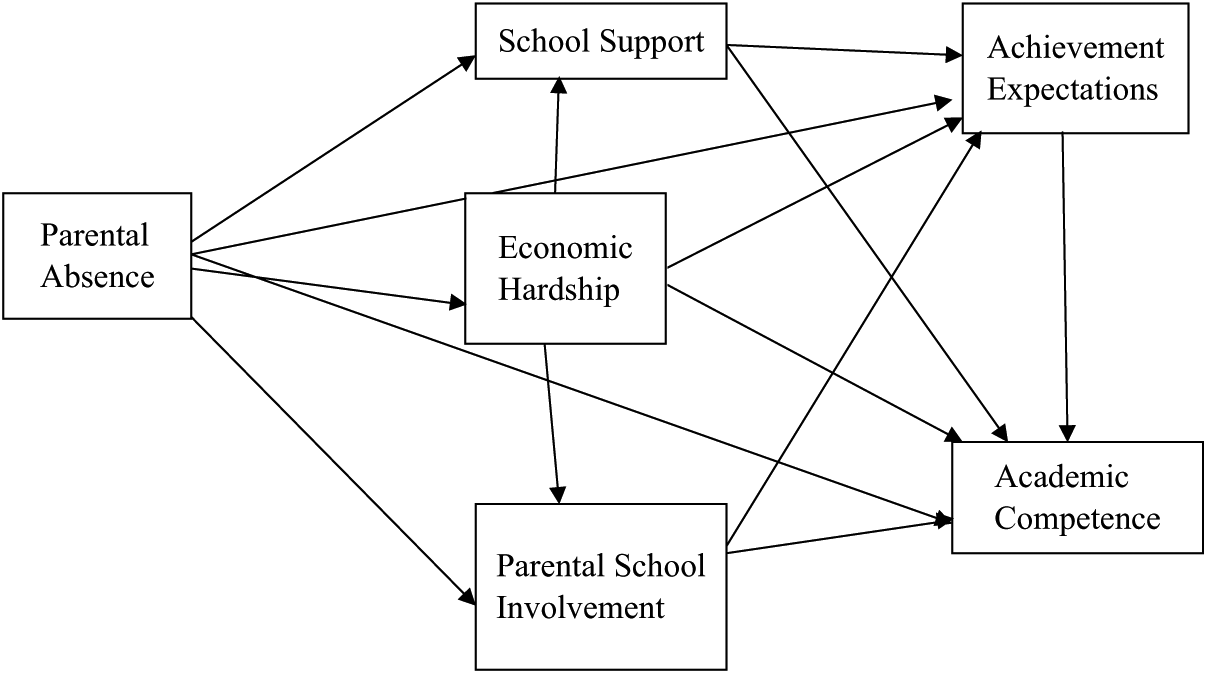
Structural equation model.
It is important to note that most research on academic success among immigrant populations has used end-of-year grades and test scores as indicators of academic performance. However, success in school is not just about grades and test scores, and the academic competence of English language learners in particular may not be reflected in these standard performance measures. Academic competence for immigrant students is better measured through a multidimensional assessment including the skills, attitudes, and behaviors that contribute to academic success. Academic competence not only includes many skills, such as reading, writing, and arithmetic, which are needed for success in school (DiPerna, 1997; DiPerna & Elliott, 1999) but also includes academic enablers (DiPerna & Elliott, 2000), which are attitudes and behaviors that permit a student to learn. For newly immigrant students, enablers may include factors such as psychosocial adaptation, interpersonal skills, effort, conduct, motivation, and school engagement.
Method
Participants and Procedures
The current study was part of a larger longitudinal study of school adaptation of newly immigrant elementary, middle, and high school students. The original study was designed to address major deficits in knowledge regarding immigrant students, including a lack of information about the impact of immigration on students at different age/grade levels and the absence of data regarding postmigration adaptation. The focus of the research was on the emotional, behavioral, and academic adjustment of newly immigrant children and adolescents.
Latino participants included in the study were immigrant elementary, middle, and high school students from Argentina, Colombia, and Cuba who had been in the United States for less than 1 year at the beginning of the study. These were predominant Latino groups migrating to the South Florida area at the time of the study. Data were also collected for Haitian and English-speaking West Indian students, but the focus of these analyses is on Latino student adaptation, as considering the ethnically, racially, and linguistically distinct Haitian and West Indian groups would add a layer of complexity beyond the scope of this research. Although there are some differences in the cultural backgrounds and migratory experiences of the Latino groups, they share a common Hispanic heritage and language, such that aggregating data from these groups was justifiable, given that limitations of sample size precluded subgroup analyses for this report.
Potential participants were identified through a centralized Miami-Dade County public school district database, indicating that they originated in one of the focal countries and were newly matriculated to the district. Students randomly selected from this pool were contacted at their schools and screened for eligibility (residing less than a year in the United States) by an interviewer fluent in Spanish. Eligible participants were given information concerning the study, along with parent consent and child assent forms, and asked to return them to the interviewer at a scheduled time.
Participants returning signed consent and assent forms were then interviewed individually in a quiet school location. Participants were reinterviewed 1 and 2 years later. The mean interview time was 44 minutes at Times 1 and 2 and 48 minutes at Time 3. Students took surveys home for parents to complete and return by mail. Follow-up telephone calls were made to parents for surveys that were not returned and parents were given the option of answering by phone. Very few parents answered by phone (<12 at Times 1 and 2, and none at Time 3). Children were given small prizes and parents were given supermarket gift certificates for participating. Teacher ratings of adaptation were also obtained in each year and achievement data were obtained from centralized school records.
Participants assessed in the current study included the 268 Latino immigrant students (51% male) from Cuba (n = 105), Colombia (n = 77), and Argentina (n = 86) for whom complete student interview and parent survey data were available in the third year of the project. This was 90% of the of 298 Latino students for whom parent surveys were returned at Time 1. Parent surveys had been returned for 74% of the total sample of 404 Latino students at Time 1. Teacher ratings were complete for almost all (96%) the students at Time 3.
Of the participants, 91 (34%) were in elementary school (Grade 3), 99 (37%) were in middle school (Grade 6), and 78 (29%) were in high school (Grade 9) in the first year. The majority (72%, n = 193) had experienced some form of parental absence. Of these, 96 (49.7%) experienced parental absence as a result of serial migration, 19 (9.8%) because of divorce, 62 (32.1%) because of both serial migration and divorce, and 16 (8.3%) as a result of parental death; 117 (60.6%) experienced paternal absence, 50 (25.9%) experienced maternal absence, and 26 (13.5%) experienced the absence of both parents.
Measures
Measures used in the present analyses were obtained from centralized student records, teacher ratings, student interviews, and parent surveys. Interviews and surveys were translated by project personnel fluent in the language and dialects of participants, backtranslated, assessed for equivalence across groups, and pilot-tested prior to inclusion in the study. The following measures were used in the present analyses.
Student Gender, Grade Level, and English Language Proficiency
Information about the student’s initial grade level (3, 6, or 9), gender, and language proficiency was obtained from centralized district records. The district schools use the Miami-Dade County Oral Language Proficiency Scale−Revised to determine students’ level of English language proficiency (Florida Department of Education, 2009). This assessment is performed by interviewing the child within 20 days of entering the school system. The assessment is administered by the English for Speakers of Other Languages Coordinator or Administrator at each school, who scores the child’s oral English abilities using raw scores ranging from 0 to 20. The raw scores are then transformed into English for Speakers of Other Language levels of 1 to 5, with 1 being a raw score of 4 or lower (novice) and 5 being a raw score of 20 (fluent).
Experience With Parental Absence
Students’ experience with parental absence was assessed through a number of questions included in the student interviews and parent surveys in one or more of the three assessment years. Parents were asked about their marital status in Years 1 and 2 (i.e., married, separated, divorced, widowed, living in marriage-like relationship, never married) and the parents’ locations were assessed in student interviews each year (i.e., in house with child, another place in United States, in home country, other). To determine serial migration experience, students were asked in Year 1 if they had come to the United States alone or with other family members, who came with them (if applicable), if any family member had come before and (if applicable) who came before. Thus, it was possible to determine whether they migrated with one or both parents or alone and whether one or both parents were residing in the United States before they arrived. In Year 3, parents were asked if the child had ever been separated from either parent and, if so, for what period of time. For analysis purposes, this period was defined as less than 1 year or more than 1 year. Parents were also asked at Time 3 if either parent was deceased. From these questions gender of the absent parent, absence length, and reason for absence were identified.
Participants experienced parental absence as a result of parental separation/divorce, parental death, and serial migration, or a combination of the three. Of the 268 participants, 193 (72%) experienced some parental absence. For analysis purposes, dummy-coded variables were created for parental absence resulting from serial migration, from parental divorce, from both parental divorce and serial migration, and as a result of parental death (each of these reasons for absence was coded 1 vs. 0 and these reason for absence variables were entered as a block in regression analyses, with those not experiencing parental absence thus being the reference category). Dummy-coded variables were also created for gender of the absent parent(s) and entered as a block in the regressions, with maternal absence, paternal absence, and the absence of both parents each coded as 1 versus 0 (with no absence being the reference category).
School Support
School support was assessed with a nine-item scale from the Year 2 student survey (adapted from Suárez-Orozco, Suárez-Orozco, & Todorova, 2008). Example items are “Do you feel there is at least one adult in school you can always count on?” and “Do you feel that school is a lonely place where no one cares about you?” Responses were dichotomous (1 = Yes, 0 = No) with negative items reverse coded. The sum of items was used in analyses. Higher scores indicate better support. The sample alpha reliability for this measure was .65.
Economic Hardship
Economic hardship was assessed with a single question, asked of students at all three times: “How often does your family have problems paying for things that the family really needs, like food, clothing, or rent?” Responses ranged from 1 (never) to 5 (almost always). Answers were averaged to develop a mean score, representing the overall amount of postmigration hardship experienced by the student. Sample alpha reliability for the combined measure was .66. A comparable single-item index used with adolescents in a study by McLoyd, Jayaratne, Ceballo, and Borquez (1994) was a stronger predictor of adolescents’ psychosocial outcomes than were objective measures of family economic status.
Parental School Involvement
Parents answered three questions in Year 3 to identify their level of school involvement. The first question asked how often in the past year they had attended activities at their child’s school (1 = about once a week and 5 = hardly ever or never). Responses were reverse coded. Parents were also asked how often they checked that their child completed homework assignments, and how often they helped their child with homework. Responses ranged from 1 (never) to 5 (almost always). Scores were averaged to obtain a mean score that was used in analyses. Sample alpha reliability for the measure was .67.
Achievement Expectations
Achievement expectations were measured at Time 3 with three items assessing expectations for high-school graduation, college attendance, and achieving career goals. Specifically, students were asked “How sure are you that you will graduate from high school,” “. . . go to college,” and “. . . have the job that you want?” Responses ranged from 1 (not at all sure) to 4 (extremely sure) and were averaged to derive an overall mean score. Sample alpha reliability for the measure was .79.
Academic Competence
Academic competence was assessed via several measures, including objective performance and teacher-rated school adaptation indices. Performance indicators obtained from centralized school records included teacher assigned end-of-year grades in reading/language arts and math and in conduct (0 = F, 4 = A) along with effort scores (1 = below average, 2 = average, 3 = above average). Reading and math grades were averaged to create an overall grade point average. Ratings of student adaptation were obtained from teachers at the end of the school year. Teachers rated students on a 14-item scale assessing characteristics of the child, such as, “very enthusiastic, interested in a lot of different things, likes to express his or her ideas,” “disobedient at school,” and “creative or imaginative” (Alexander, Entwistle, & Dauber, 1993). Scores ranged from 1 = exactly like this child to 6 = not at all like this child. Negative items were reverse coded, so that higher scores indicated better adaptation. Teachers also completed four items comparing students with “pupils of the same age” from the Teacher Report Form of the Child Behavior Checklist (Edelbrock & Achenbach, 1984). Items were (a) “How hard is he/she working,” (b) How appropriately is he/she behaving,” (c) “How much is he/she learning,” and (d) How happy is he/she?” Responses ranged from 1 = much less to 7 = much more. The Year 3 academic competence measures were transformed to z scores and then averaged to create a mean score that was used in analyses. Alpha reliability for the measure was .88.
Results
Preliminary analyses were conducted to assess the reliability, distributional characteristics, and intercorrelations of measures and the extent of missing data. Missing data were minimal (<10%) for most variables and were estimated using a multiple imputation approach with the computer program Amelia II (King, Honaker, Joseph, & Scheve, 2001). This method creates five filled-in versions of the incomplete data set using the expectation-maximization with bootstrapping algorithm. This technique involves imputing five (the program default) values for each missing cell in a data matrix and creating five complete data sets. Across the five complete data sets, the missing values are filled in with a sample of values from the predictive distribution of the missing values (Honaker, King, & Blackwell, 2011). To combine the model results across the five data sets, the average of the separate estimates was computed and then used as the multiple imputation estimate of the missing value.
Analyses relevant to the study aims are described in the following sections. These include (a) regression analyses of the relation of parent absence variables to the academic competence and expectation measures and (b) a structural equation analysis assessing the fit of the hypothesized mediational model.
Parental Absence Variables Predicting Competence and Expectations
Hierarchical multiple-regression analyses were conducted for the academic competence and expectation indices. Child gender, grade level, and language proficiency were entered first as control variables, as these are known to be related to academic competence, followed by the reason for parental absence (dummy-coded as serial migration, parental separation/divorce, both serial migration and parental separation/divorce, or parental death), length of absence, and absent parent gender (dummy-coded as mother, father, or both parents). Interaction terms of interest were then entered (grade × reason for absence, grade × parent gender, child’s gender × reason for absence, child’s gender × parent gender). Results can be found in Table 1.
Predicting Academic Competence and Achievement Expectations: Hierarchical Regression Analysis.
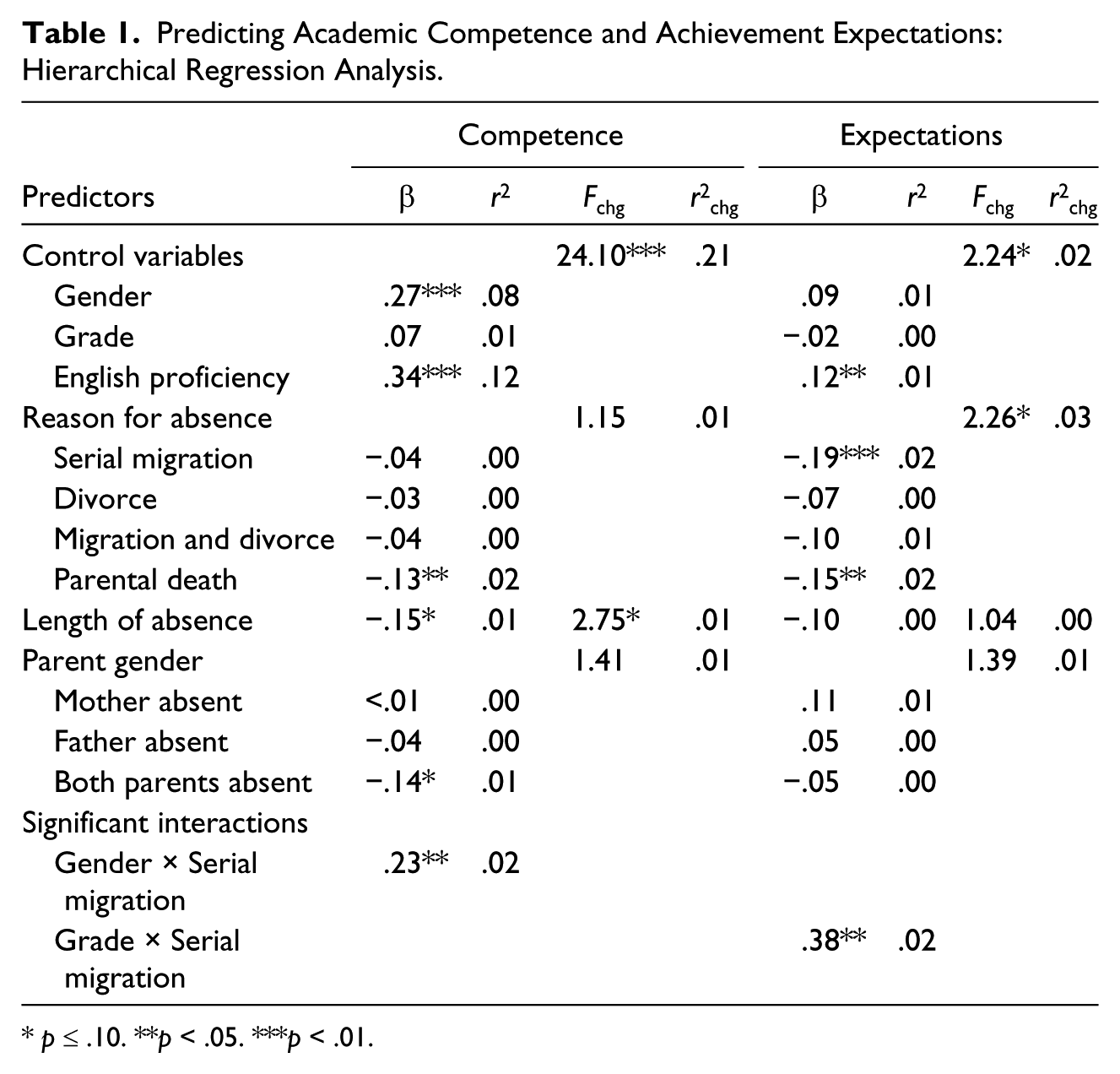
p ≤ .10. **p < .05. ***p < .01.
For academic competence, gender and language proficiency were significant predictors. Girls demonstrated higher academic competence than boys and students more proficient in English had higher competence than those struggling with English. The block representing reason for absence was not significant, but there was a significant effect of parental death within this block. Those having this experience had lower competence scores than those who did not experience parental death. Absence length was also marginally significant, with students experiencing prolonged absence having lower competence than students who did not experience lengthened parental absence. The absence of both parents was also marginally significant, with these students having lower competence than students who did not experience parental absence. Results indicated a significant interaction effect of gender and serial migration, in that boys who experienced serial migration had lower academic competence than boys who did not have this experience (b = −.21, p < .05), whereas there was no significant effect of serial migration for girls (b = .11, p > .10).
For achievement expectations, the block representing reason for absence was marginally significant. Individually, serial migration was a significant predictor of expectations, with students experiencing serial migration having lower expectations. Also, students who experienced parental death had lower expectations than those who did not experience the death of a parent. There was a significant interaction effect of grade level and serial migration, in that elementary school students (b = −.51, p < .01) and middle school students (b = −.35, p < .05), but not high school students (b = .22, p > .05), who experienced serial migration reported lower expectations than students who did not experience serial migration.
Structural Model of Paths Through Which Parental Absence Relates to Competence and Expectations
The extent to which parental absence related to academic competence and achievement expectations through the hypothesized mediating factors (economic hardship, school support, and parent involvement) was assessed with structural equation modeling using AMOS 17.0 software. Data were analyzed first for outliers and nonnormality. Multivariate normality was evaluated using Mardia’s test for multivariate normality. Univariate indices of skewness and kurtosis were also examined to determine if the absolute value of any of these indices was greater than 2.0. In the current study, nonnormality was an issue. Therefore, bootstrapping with 2,000 iterations was used to remedy the problem.
Although not shown in Figure 1, child grade level, gender, and language proficiency were included in the model as exogenous control variables. The proposed model was a good-fitting model for the data set, with χ2 = 3.53, df = 3, p = .32, CFI = 1.00, RMSEA = .03, and PCLOSE = .57. Inspection of the residuals and modification indices revealed no ill-fit in the model. Figure 2 is a simplified model highlighting the significant paths from parental absence to academic outcomes; it includes parameter estimates for the structural coefficients in the model. Standardized coefficients appear on each path, with unstandardized coefficients in parentheses. Standardized coefficients for all paths in the model and significance levels can be found in Table 2.
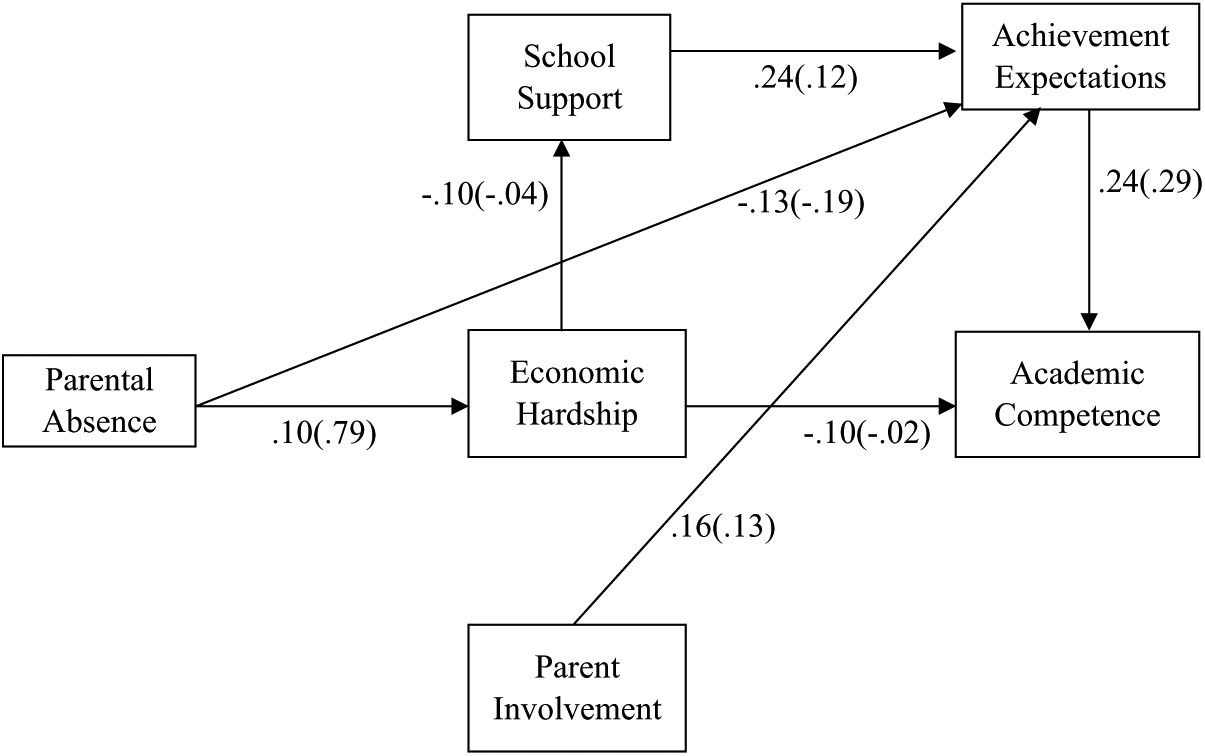
Simplified model of parental absence effects on academic competence and achievement expectations.
Standardized Path Coefficients for Model.

p < .10. **p < .05. ***p ≤ .01.
Among the individual paths, parental absence was related to economic hardship and hardship was linked directly to academic competence and indirectly to both competence and expectations through school support. Parental absence was also related directly to expectations. Not surprisingly, expectations were related significantly to academic competence. However, neither parent absence nor economic hardship was related to parental school involvement, although parent involvement was related significantly to expectations. Also, parental absence did not link directly to school support and neither parent involvement nor school support affected academic competence directly.
Among the control variables, male gender was associated with lower academic competence, less economic hardship, and less school support. Higher grade level was associated with reduced parent involvement. Students more proficient in English had higher academic competence and expectations.
Discussion
In the current study, academic competence and achievement expectations of Latino immigrant students were examined as a function of their experiences with parental absence. The study aimed at determining (a) how variations in the parental absence experience (reason for absence, gender of absent parent, length of absence) affect academic competence and expectations, and (b) how parental absence relates to academic outcomes through potential mediating factors (economic hardship, school support, and parental involvement).
Variations in Parental Absence and Academic Outcomes
Variations in parental absence experiences were associated with student academic competence and achievement expectations. One set of effects concerned the reason for parental absence. Parental death was associated with both lower competence and lower expectations, consistent with studies that have documented a negative association between parental death, academic outcomes, and limitations on plans to attend college (Abdelnoor & Hollins, 2004a, 2004b).
Of particular note is the association of serial migration with the academic outcomes. Students who experienced serial migration reported lower expectations than students who did not experience parental absence as a result of immigration to the United States. A significant interaction indicated that this effect varied by grade level. Serial migration was a significant predictor of expectations for students in elementary and middle school but not high school. It may be the case that older children and younger children view parental absence as a result of migration differently. Older children may be less affected by this experience as they see parental separation as a necessary step in the migratory process, viewing the absence as acceptable and temporary. They may also have a greater sense of control or certainty with respect to their future educational endeavors. Younger children may not be able to grasp this understanding of the separation and are likely to be less certain of their future potential. Familial disruptions in early childhood may also be more detrimental than those that occur during older childhood and adolescence because of the greater dependence that younger children have on their parents. Additionally, familial separations may be more detrimental during early childhood because young children have fewer alternate sources of support, are more affected by the stress of their parents, and have less developed coping skills.
With respect to academic competence, the results indicated an interaction effect of child gender and serial migration, in that the experience of parental absence as a consequence of migration was linked to lower academic competence for boys but not for girls. Most of the research addressed to the effects of parental absence on academic outcomes has been focused on parental divorce and divorce has been found to be especially detrimental to school performance in boys (e.g., Coney & Mackey, 1998; McLanahan & Teitler, 1999). Results of the current study extend these findings, in that absence caused by serial migration also appears to compromise academic competence for boys more than girls. Thus, in general, parental absence seems to be associated with male academic vulnerability.
Research is minimal regarding the effects of parental absence length on academic outcomes (e.g., Biller, 1970), although the association of single-parent homes with lesser academic success has been well established (e.g., Coley, 1998; Lamb, 1999). The current study suggests that prolonged absence was associated with lower academic competence independent of the reason for the absence. Presumably, many of the challenges facing single-parent families are encountered by those in which parents are absent for long durations. Findings from the current study also demonstrated that the combination of mother and father absence predicted lower academic competence. Students who experienced prolonged absence and the absence of both parents were likely deprived of adult role models who could invest resources to help the child succeed (Heard, 2007; Valencia, 2000).
Mediating Factors Between Parental Absence and Academic Outcomes
The paths through which parental absence relates to academic outcomes were assessed with structural equation modeling. It was hypothesized that parental absence would be associated with greater economic hardship, lower parental school involvement, and a less supportive school environment, which would mediate the relationship between parental absence and academic outcomes. Overall, the model was a good fit to the data. Among the significant paths, parental absence adversely affected academic competence via economic hardship. The link between parent absence and hardship is consistent with previous research (Heard, 2007; McLanahan & Teitler, 1999) as is the association of hardship with lower academic success (Hernandez, 2004).
Parental absence also affected expectations via economic hardship and school support. The association of economic deprivation with reduced school support was anticipated, as previous research has recognized that schools serving low-income, minority, and immigrant students tend to be at a disadvantage for academic success (Suárez-Orozco & Suárez-Orozco, 2001). Reduced school support was linked to decreased expectations. Previous research has demonstrated how important a supportive school environment is for student success (Burchinal, Peisner-Feinberg, Pianta, & Howes, 2002; Han, 2008), especially that of Latino immigrant students (Han, 2008). The current study expands these findings to include future achievement expectations as well. The expectations of students were associated with their actual academic competence.
As in prior research, significant relations were also documented between gender, grade level, and language proficiency and the outcome measures. Girls had higher academic competence than boys, agreeing with previous findings regarding academic outcomes among youth from single-parent homes (Coney & Mackey, 1998; McLanahan & Teitler, 1999) and immigrant students (Feliciano & Rumbaut, 2005; Portes & Rumbaut, 2001; Suárez-Orozco, 2001; Suárez-Orozco et al., 2009). Gender also influenced expectations via economic hardship and perceived school support. Boys were more likely to report economic hardship than girls. Girls viewed their school environment as more supportive than boys, consistent with the findings of Way (2004). Grade level influenced expectations through parental school involvement. As students increased in grade level, the level of parental school involvement decreased. Lower levels of parental school involvement were linked to decreased expectations. The observed decline in parental school involvement at higher grade levels also concurs with prior findings (Kuperminc et al., 2007). Difficulties with English had a direct effect on outcome measures. As students were more proficient in English, both their competence (consistent with Genesee & Gandara, 1999; Hernandez, 2004) and expectations increased, perhaps because more proficient students foresee fewer barriers to higher education and career success.
Limitations of Study
There are some limitations of the current study that merit discussion, including indeterminacy with regard to proposed causal relationships in the data, the modest size of many effects, and limited generalizability of the findings. With respect to causal analysis, structural equation modeling enables researchers to test the fit of causal models to a set of data. A good-fitting model provides an indication that the hypothesized causal relations in the model are valid. However, it does not rule out alternative models and findings remain fundamentally correlational and in need of further verification.
With respect to effect sizes, although the overall model evidenced a good fit to the data, some specific hypothesized links were marginal or lacking in statistical significance and parental absence overall contributed only modestly to the variance in academic competence and achievement expectations. This was to be expected, given that the presence or absence of a parent is a broad categorical variable unlikely to bear a causal relation to achievement except through its association with variables more proximal to academic outcomes, such as those hypothesized as mediators in the present study. Although economic hardship, school support, and parent involvement are implicated as mediators in the current findings, there are no doubt additional unexamined variables whose inclusion would increase the predictive power of the model (as suggested in the following section on further research needs).
Limitations on generalizability exist as the current study was addressed to the academic outcomes of Latino immigrant students from Argentina, Colombia, and Cuba. The extent to which the results would generalize to other immigrant groups is unknown. Furthermore, although there is likely heterogeneity of experiences and outcomes across these groups, limitations on sample size precluded analyzing results separately by country of origin. Thus, there may be differences across groups within the sample that remain undiscovered. Nevertheless, many of the study findings are consistent with research on other immigrant groups and advance our knowledge of Latino-origin groups that have been relatively less researched in the past.
Significance of the Study and Implications for Further Research
In focusing on the effects of parental absence on immigrant children and adolescents, the current study bridges two bodies of research, one on the general effects of parent absence and single parenthood on academic outcomes and the other on the academic achievement of Latino immigrant students. The study has identified economic hardship and school support as key mediators of the effects of parental absence on academic competence and expectations. It has also revealed that the commonly experienced absence of a parent, or both parents, as a consequence of migration is linked to academic outcomes, especially for preadolescents. This information should be helpful to those involved in the education of immigrant students and has broad significance, given that immigrants from Latino countries are currently the fastest growing immigrant population in the United States.
Although the results of this study help to answer questions regarding the association of parent absence with academic competence and expectations of immigrant students, they also pose implications for future research directions within this domain. Serial migration is an experience that is unique to immigrant students, but research addressed to academic outcomes for immigrant students has only touched on the effects of serial migration. Additional research is needed to expand our limited knowledge of these effects.
Additionally, serial migration is only one aspect of the migratory process. Variation may also occur in the timing of migration, location of parents before and after migration, and possible additional caregivers prior to and after migration. In agreement with Suárez-Orozco and Carhill (2008), one of the primary goals of research on immigrant students should be to capture the various migratory experiences and their effects on student performance. Future research is needed to examine the divergence of the migration process more specifically in relation to the academic success of immigrant students.
Future research also needs to clarify how parental absence associated with serial migration is viewed by children and how the perception of parental separation affects academic outcomes. Lamb (1999) has speculated that parental absence as a result of reasons other than divorce may be viewed differently by the children involved. The present findings suggest that parental absence resulting from serial migration may be viewed differently by age and gender of the child. In any event, the reasons why serial migration effects were more negative for boys and for younger children remain to be explored.
Footnotes
Authors’ Note
The data presented, the statements made, and the views expressed are solely the responsibility of the authors.
Declaration of Conflicting Interests
The author(s) declared no potential conflicts of interest with respect to the research, authorship, and/or publication of this article.
Funding
The author(s) disclosed receipt of the following financial support for the research, authorship, and/or publication of this article: This research was funded by the Spencer Foundation and was awarded the Dissertation Year Fellowship Award from the University Graduate School at Florida International University.