



Abstract
Focusing on the uncertainty of low-income mothers’ lives, this qualitative study examined the family experiences of 57 Appalachian low-income mothers. With scarce economic resources, mothers forged identities that expressed the centrality of motherhood, concentrated their activities within traditional family expectations, and made decisions that often resisted federal welfare reform expectations for work and family. Work and family policies that acknowledge the commitment of low-income, rural mothers to their children and create supportive employment options for them are needed. Parenting education programs that broaden mothers’ understanding of child discipline are recommended.
With the passage of The Personal Responsibility and Work Opportunity Reconciliation Act in 1996, changes occurred in how federal programs assisted low-income families. New emphasis focused on work programs where recipients, regardless of marital or parental status, were expected to seek and obtain employment. Time limitations for benefits and an increased monitoring of recipients were also new features of these reforms (Piven, 2002). With almost two decades of legislative implementation, challenges continue for low-income mothers when seeking, obtaining, and maintaining employment while raising families (Johnson, Kalil, & Dunifon, 2010). For low-income mothers who work and parent, economic pressures and lack of resources intensify their struggles and mark their daily experiences related to material needs, work schedules, child care, transportation, health, and social support (Dodson & Bravo, 2005; Dolan, Bauer, & Katras, 2011; Williams, 2010).
This study examines the experiences of rural, low-income mothers who are expected to seek employment and increase family economic security in the shadow of welfare reform. How mothers value and commit to motherhood and paid labor play an important role in deciding whether to seek employment outside of the home. Prevalent in mainstream society, the traditional motherhood ideology (i.e., “good mothering”) is based on expectations that women stay home full time and care for children (DiLapi, 1989). Hays (1996) claimed that this traditional motherhood ideology transitioned into intensive mothering, described as
child-centered, expert-guided, emotionally absorbent, labor intensive, financially expensive ideology in which mothers are primarily responsible for the nurture and development of the sacred child and in which children’s needs take precedence over the individual needs of their mothers (p. 46).
Hays further suggested that this ideology became more salient when mothers entered the workplace. For affluent working mothers, absence from home often was supplemented by hiring nannies and/or sending children to high-quality child care programs. Johnston and Swanson (2006) argued, however, that mothers who were unable to purchase quality parenting alternatives were set up for failure.
Examining the intersection of race and class among low-income African American women and their families, Burton, Obeidallah, and Allison (1996) underscored how traditional family ideologies are based on White, suburban populations and inadequate for describing their participants’ experiences of motherhood. Furthermore, alternative motherhood ideologies and practices embraced by women of color and/or poor mothers that also fall outside the intensive mothering ideology, often have been characterized as deficient or deviant in popular media and academics alike (Arendell, 2000; Dodson, 2007). Collins (1994) addressed this notion of deviancy by highlighting an alternative motherhood ideology for racial–ethnic mothers who positioned waged work equally as important as care work for children. More recently, the time-limit demands and required extensive training and work activities associated with receiving aid for low-income women have created another challenge to the dominant ideology of motherhood. Dodson (2007) suggested that low-income women may feel they have the right to resist the demands of working when it jeopardizes the safety of their children and when low-paying opportunities offer little financial security. By these actions, low-income mothers may be perceived within dominant ideologies of motherhood and federal policies of work as deviant by defying current work norms and prioritizing their children first.
Contending with an ideology of motherhood that may have little meaning or usefulness for their family lives and the expectations for and activities required to obtain paid work through federal policies, low-income, rural mothers may have new ways of understanding and enacting motherhood as influenced by gender, economics, rural location, and culture. In this study, we used a lens of uncertainty (Burton & Tucker, 2009) that acknowledges how low-income mothers and their families are influenced by and motivated to negotiate constraints—employment, resources, and formal and informal support systems—in ways that differ from mothers who experience economic stability. By focusing on the uncertainty of low-income mothers’ lives (i.e., structural constraints that limit economic security, allocations of time, access to living wage employment, and gendered expectations of parenting) rather than on how mothering and working fall short of traditional motherhood and/or welfare-to-work expectations allows us to more fully understand the lived experiences of mothering in diverse families and locations.
Gender, Poverty, and Rurality: Challenges to Mothering and Working
Gendered disadvantage is a feature of urban and rural poverty. Women earn less than men in most occupations and typically work in gendered segregated fields (Hegewisch & Liepmann, 2010). When compared to men, women have increased caregiving demands and work contexts that offer less paid leave, schedule flexibility, and break times (Heymann, Penrose, & Earle, 2006). Women’s lower levels of education, parental expectations to be primary caregivers when children are in households, and greater likelihood of working in low-skilled, low-pay jobs render them more vulnerable to poor economic outcomes (Pruitt, 2008). Household structure also matters for women. As poverty has increased across all types of families (married, female-headed and male-headed households), mother-headed households in both urban and rural locations are particularly at risk (Child Trends, 2010).
Using a lens of uncertainty (Burton & Tucker, 2009), the tensions that emerge when caring for children and working outside of the home are clearly visible and create multiple constraints for low-income mothers. Finding affordable and quality care for children and identifying trustworthy care providers are ongoing struggles (Dodson & Bravo, 2005; Williams, 2010), particularly in rural locations (Walker & Manoogian, 2011). Low-income mothers express concerns about their inability to monitor, support, and encourage their children in educational settings, purchase basic necessities, and make up work days when children are ill (Dodson & Bravo 2005; Heymann et al., 2006). They often find themselves in employment situations that offer limited wages, few benefits, inflexible work schedules, limited sick leave, and transportation constraints to get to and from work (Dodson & Bravo, 2005; Dodson & Luttrell, 2011). Similarly, Albelda (2002) pointed out that low-income women need support and flexibility, yet they have access to jobs that “often are the most inflexible, have the least family-necessary benefits (vacation time, health care, sick days) and provide levels of pay that are insufficient to support a single person, let alone a family” (p. 73).
Combined with gendered financial and flexibility disadvantages in workforce engagement and family responsibilities, residence in a rural area provides distinct challenges. In contrast to urban poverty, rural poverty rates are higher, persistent, and particularly challenging in distressed communities such as those prominently featured in Appalachia (Appalachian Regional Commission, 2010; Lichter & Parisi, 2008). When compared with urban and metro areas, rural areas typically have limitations regarding access to and quality of employment, education, social services, transportation, and child care (Duncan, Whitener, & Weber, 2002). Employment that features living wages, benefits, and advancements are limited in rural areas and annual incomes generally are lower when compared with urban counterparts (Pruitt, 2008). Because of distances between communities and geographic isolation, rural residents also pay more for basic necessities that include food, household utilities, transportation, and health care (Annie E. Casey Foundation, 2004; Glauber, 2009).
Low-Income, Rural Mothers: Navigating Motherhood and Work
Under the old welfare system, mothers routinely determined ways to obtain resources that would help them make ends meet when their public assistance failed to cover basic necessities (Dodson, 2007). Their greatest resource was parental presence (the mothers themselves or other mothers) to help in times of need (e.g., being able to stay home with an ill child without jeopardizing one’s job). In the aftermath of welfare reform, family policies influenced how low-income mothers engaged in their work and parenting roles. As a consequence of time limitations for receiving benefits and expectations for seeking and obtaining employment outside of the home, low income mothers became less able to leave or forgo work to care for their children (Dodson, 2007). At the same time, although they held jobs in the past, their ability to secure gainful employment that offset the loss of program supports were complicated by low levels of education and lack of recent work experiences (Albelda, 2002). When the wages they could earn prevented them from providing adequately for their children, low-income mothers found themselves facing a choice between being “either a good mother or a good recipient,” and consequently, unable to meet the expectations of either role (Henderson, Tickamyer, & Tadlock, 2005, p. 140).
For many low-income mothers, lack of access to “motherwork” is the greatest loss associated with welfare reform. Placing primary importance on motherhood as work that highlights their expertise and skill, low-income mothers routinely express concern about their children’s safety and care (Dodson, 2007; Seccombe, 2011). As a consequence, low-income mothers often are viewed as deficient in multiple categories as they are unable to devote their attention to children as reflective of intensive mothering ideologies (Hays, 1996) while simultaneously engaging in economic endeavors that provide limited economic resources to their families (Williams, 2007). These issues tend to be reinforced in rural areas through emphasis on traditional gender roles and intergenerational connections to family and place (Henderson & Tickamyer, 2008; The Rural and Appalachian Youth and Families Consortium, 1996). The combination of traditional expectations for motherhood with lower educational statuses, inaccessibility to high-paying employment, and limited child care options motivates many rural, low-income women to forgo employment even when their families desperately need the income (Smith, 2008). For example, most low-income mothers receive little help in paying for child care and experience limited and low-quality options for care (Walker & Manoogian, 2011). In the face of such difficulties, staying home with their children often is seen as the most viable option.
The Appalachian Context
Appalachia is home to families that often face greater poverty, fewer employment/educational training opportunities, less infrastructure, and poorer health when compared to other regions in the United States (see the Appalachian Regional Commission website for extensive information http://www.arc.gov/). Geographic contexts may offer different constraints and opportunities for rural, low-income mothers when compared to their low-income, urban counterparts. For example, although both inner-city and rural poor families rely on extended family members for support, Appalachian children typically are raised in traditional households that reinforce gender norms and operate within a deep, extended kin social system (The Rural and Appalachian Youth and Families Consortium, 1996). Furthermore, the isolation of many Appalachian communities makes access to child care, transportation, and economic resources more difficult (Henderson et al., 2005). In light of such differences, parenting dynamics within poor rural areas such as Appalachia may take on a unique quality. The same behavior (e.g., mothers’ participation in child care) may take on different meanings in different contexts (e.g., traditional vs. nontraditional gender role norms; rural vs. urban environments). Limited studies have explored how low-income Appalachian mothers perceive their roles and how they see the challenges of rural poverty influencing their parenting behaviors (see Henderson & Tickamyer, 2008, for an exception). For this study, we focused our lens on how Appalachian low-income mothers with young children experienced motherhood. The specific research questions were as follows: (a) how do rural, low-income women view and evaluate their roles as mothers? and (b) how do rural locations and limited economic resources influence mothers’ parenting experiences?
Method
We used existing data from Rural Families Speak, a longitudinal, multimethod project focusing on the well-being of rural low-income families in the context of welfare reform. Data were collected across three periods of time (waves) to track any changes experienced in participant families. A total of 448 participants who resided in rural counties (populations less than 20,000) in 18 states were followed from 1999 until 2005. Participants were mothers with at least one child younger than 13 years in the household and family incomes at or below 200% of the poverty line. Researchers conducted interviews with mothers primarily recruited through social service providers, either at their homes or in mutually agreed-upon locations. The focus on mothers reflected the high representation of women as heads of households in single-parent, low-income families in the United States (Cherlin, 2010) and the desire to obtain a wide variety of motherhood experiences in diverse households.
Sample
Data came from three Appalachian communities in close geographic proximity: two counties in West Virginia (n = 29) and one county in southeast Ohio (n = 28). These counties were added to the original national sample when Rural Families Speak researchers sought to increase understanding of family experiences from this distressed economic region. Participants in these three counties completed intense interviews in 2001-2002 for Wave 1, and follow-up interviews in 2003. As the Appalachian data in these two states were collected a few years after the initiation of the national project, we concluded the interviews without Wave 3 data. The same Wave 1 and Wave 2 protocols and measures used for the larger study were administered in these three counties. Interview questions used for the second wave of data collection also were similar to the interviews conducted during Wave 1, with additional emphasis on areas the research team deemed as critical for further understanding rural low-income family experiences (i.e., mothers’ relationships with their children’s fathers, coparenting arrangements, family health, and educational/employment training opportunities.)
Table 1 shows demographic information of our sample. At Wave 1, mothers averaged 28.4 years of age and were more likely to be partnered (57.9%). The average number of children per family was 2.1 and children’s average age was 5.8 years. The mode of mothers’ education was high school or a GED equivalent (n = 23; 40.4%) and almost half (n = 28; 49.1%) had children while teenagers. Regarding work status, 20 mothers (35.1%) and 19 partners (57.6%) were employed. Some mothers reported that they had trouble paying for food (n = 23; 39%) and medications (n = 21; 36%; data not shown in Table 1).
Demographic Characteristics of Sample (N = 57).
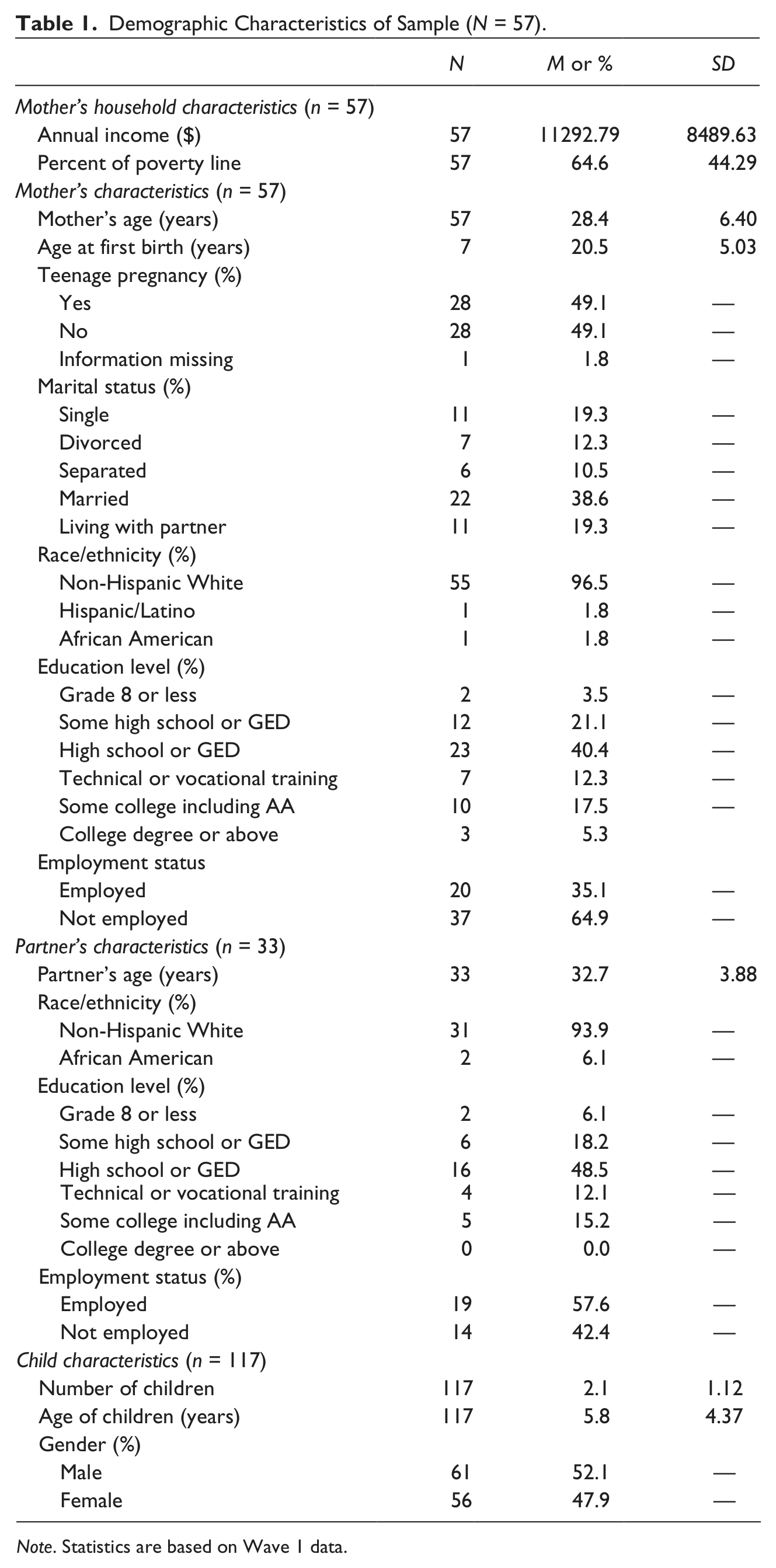
Note. Statistics are based on Wave 1 data.
Data Analysis and Coding
Initial coding was completed by the national Rural Families Speak team, which included 18 broad categories in areas such as household and extended family relationships, parenthood, employment/education, health, financial management, food security, social support, and community resources. To develop a subcoding system (Berg, 2007), the first and fourth authors repeatedly read, analyzed, and discussed the transcripts across the two data waves. Data were initially coded into four areas, including strengths of parenting, positive outcomes, stress/challenges of parenting, and role of partner in parenting. Key codes were identified and later used for coding the transcripts with the aid of MAXQDA, software for qualitative data analysis. Pseudonyms were used for mothers, family members, and geographic locations.
Seventeen subcodes were created within the four broad areas of parenting as reflective of mothers’ narratives. For instance, when mothers mentioned their strengths as parents, the information was coded as guidance, behavior and discipline, communication, spending time with children, and child as priority. Information was coded as personal, fun and leisure, sense of pride, and witness to developmental growth when mothers expressed positive parenting outcomes. Participants were coded as having stress or challenges, with subcodes for this area, including finances, lack of support, discipline, meeting children’s needs, work balance, and health. Partners’ or ex-partners’ parenting skills also were coded.
Findings
Eager to share their parenting stories, mothers aided our understanding of how poverty and rural location influenced their family experiences. Mothers expressed the centrality of motherhood that shaped their personal identity, daily experiences, and decisions about time, finances, and parenting responsibilities. They focused their mothering activities within traditional family and gendered expectations. As they negotiated the constraints of limited economic resources in rural settings, mothers outlined their decisions and actions that reflected the importance of motherhood, sometimes risking increased financial stability for their families and resisting outside expectations as to how to do work and family.
“They’re What I Live For”: The Centrality of Motherhood
In Appalachian culture, women typically have exclusive responsibilities for child care (Gagné, 1992). In this study, the standards women felt were critical to being a good mother reflect the values of their Appalachian culture. They described a traditional view of motherhood, valued their role as mothers above all else, and expressed satisfaction with child outcomes as a consequence of their mothering efforts.
One feature of motherhood outlined by mothers was its ultimate importance to personal identity and life satisfaction. For instance, Lynnea, a college graduate, expressed her strong commitment to parenting. She believed that being a good mother meant that she remain a stay-at-home mother despite the fact that her husband, a trucker, was currently unemployed. Although she really worried about the family income, she explained how her children featured prominently in her sense of identity and life purpose.
I think they’ll [children] still be good because whether your family life is good or not, doesn’t depend on your income. Because we have a really good family life and even with little kids pitching in. I always tell my husband that I don’t see how people without kids make it through life because life is so hard. They’re what I live for and they’re the ones that give the joy to life. Everything else you have to deal with.
It was not uncommon to hear mothers echo Lynnea’s sentiments. When outlining what they gained from parenting, mothers shared that being a parent challenged them to develop personally, and made them feel valued. Garnet stated, “My kids make me stronger, ‘cause I know that I feel that I have to work hard, and try to work harder, to make them have, you know, a really good life.”
Mothers also underscored their role in preparing children to be responsible community citizens. One mother, Liane, shared,
I want to be like a good role model for them like if they see us do good stuff, when they get older they will like do the same. They won’t go out and do bad stuff and I just want them to see what we do and that we are trying to make it for them. And we are trying to work for what we get and I just want them to do the same.
Another mother, Kaleah, emphasized her desire that her daughter mature into a responsible adult. She explained, “I think I have good morals and I’m trying to instill good morals into her.”
Linked to their role in socializing children, mothers commented on the sense of satisfaction and pride they felt when children achieved their expectations regarding behavior, values, and developmental growth. Indicative of many mothers, Iva thought that her children were doing well and had the potential for a positive future, something she felt was an outcome of her motherwork.
I have got my children the way they are and hopefully they will have a good future and not act like most of the world, you know. I enjoy it. To know they’re better. They’re good. You know what I mean? They’re up there where they need to be. I just hope they stay there.
“They’re Just So Sweet but They Need Consistency”: Daily Experiences of Motherhood
In interviews, mothers outlined their daily activities. They shared how they devoted significant day and night hours to their children and used this time to reinforce values and socialize children. For those not working during the day, mothers reported that they share inside time with children such as watching TV or reading books as well as common outside activities such as swimming or walking to the park. Shared activities were a source of enjoyment. Nineteen women specifically expressed how much fun they had with their children and took pleasure doing things with them. Mayda illustrated what she enjoyed most about being a parent:
I love it. Because I’m here, I like to get down on the floor and play with my kids, and I’m not very good at riding a bike and I was riding the neighbor’s bike next door and my son just thought it was the funniest thing cuz I hadn’t been on a bicycle in I don’t know how long. I mean, more or less, if you’ve got kids you kinda have to be a kid at heart yourself in order to get down and play cuz you get out in public and your kids have you do some of the craziest things. I have embarrassed myself so many times cuz the kids get me uptown and want me to do something.
A challenging aspect of daily mothering that emerged in interviews concerned the conflict that sometimes erupted when children were not obedient to parental wishes. Mothers considered discipline the most difficult part of being a parent and, in some cases, complained that they were unable to redirect or restrain their children’s behavior. Maylin thought addressing her children’s inappropriate behavior was a big challenge:
When it comes to behavior, it’s really rough, you know. Like, for an example from last week: I took them to Wal-Mart and I told them, “If you’re good, I’ll get you something. I’ll get you a little toy.” Well, they started trying to knock down the jewelry thing. So, I kept telling them about it. So I said, “I ain’t gonna get that toy for you.” They started screaming and crying. Everybody just looked. That’s embarrassing.
Some mothers (n = 9) stated specifically that they did not know how to use discipline appropriately with their children. Layne stated,
Consistency. Because there are times in your life that you can’t be as consistent as you would like to be. You know that they need to be disciplined, and “Not this time. I don’t want them to sit in the corner again.” They’re just so sweet but they need consistency.
Mothers who felt discipline was the stressful part of being a parent expressed urgency in wanting to prevent children from acting inappropriately with others. Additionally, when they tried to discipline their children, children’s behaviors became more problematic as they started to talk back. It was only in this realm of responsibilities that mothers expressed a lack of confidence regarding their competencies as parents.
“Either Work or Him”: Mothering Within Traditional Borders
Mothers’ focus on discipline illustrated the gendered expectations that reflect distinct role responsibilities between mothers and fathers. Mothers repeatedly identified fathers and stepfathers as primary disciplinarians. One mother, Laurellen, shared these expectations:
Discipline and my kids don’t get along too well. Basically, mom tells them to do something, they just laugh at mom and go on because they know mom is going to do it and they are not going to have to. I have tried to discipline the kids. At one point, I tried to spank my son for being very violent toward his sister. That ended very quickly when he turned around and looked at me and said, “Mom is that supposed to hurt?” So usually, grounding, sitting in corners, or make them wait until their dad gets home then dad grounds them longer than mom did.
Some mothers, however, voiced mixed feelings about their husbands’ involvement with children, particularly when partners used harsh punishment. In her response to whether her husband was involved in parenting, Garnet initially praised his parenting contributions by sharing that
He’s a pretty good guy. And they love him to death, you know. They listen to him more than they do me, actually, because I mean, they just, they don’t really pay any attention to me when I ask them to do something. He helps me out, but you know, when I have to work, he makes sure they get fed. He makes sure they get bathed. He makes sure they get their night clothes on and makes sure they get in bed, and stuff, you know. He’s a good dad. He’s a really good dad.
Yet Garnet was concerned about his harsh discipline with their children and his approach created tension for her. “Because there’s quite a few times where I’d get upset, you know, and we’d argue, because he was tryin’ to give the kids discipline.” As mothers turned to men for help with discipline, those mothers without partners often were at a loss. Jalene described her challenges with discipline after her divorce, “My husband was always the disciplinarian. It’s very hard for me to take that discipline under control now.”
Gendered expectations that fell within traditional family boundaries also contributed to mothers’ reticence to seek employment and have children in daycare settings. If married, husbands often expected wives to stay home. As one mother shared, “I had talked to him just a couple of days ago about possibly getting a factory job which I did when I was in high school and he doesn’t feel like he is strong enough to let me go. Basically he said it was either work or him. I couldn’t have both.” Nola added, “I met my present husband and we got married and he didn’t want me to work.” Once they did work, mothers also found that the challenges to work–family balance were daunting. Mayda shared, “It [breastfeeding] was just getting to be too much for me to do.” Malina left one job because of her need to “be closer to home with the kids.”
Linked to how motherhood was situated within traditional family frameworks, parenting support from partners often was perceived as “helping” mothers, who viewed parenting more as a critical role for mothers than fathers. Typically, mothers reported that most custodial, noncustodial, and nonbiological fathers were “not much” or “not at all” involved in actively parenting their children. For the small group of mothers (n = 14; 24%) who identified their partners and noncustodial fathers as providing support and sharing responsibilities for parenting, they offered praise. Wren shared,
My friends and family and all the women over there at Head Start are like, “How do you get such a great husband? He’s such a great guy.” He spends as much time as possible with the boys. Before he started this seventy-hour week thing, he was spending a lot of time. He would come down to the school and volunteer; come to the parent meetings for the kids; he’d take them swimming and fishing. Just all the time. My husband feels guilty because he’s afraid that Mason is going to grow up and not be as close to him as Gordie is because he’s not going to be able to spend that time with him.
“To Have to Tell Them No”: Motherhood, Poverty, and Rural Locations
Mothers expressed that it was difficult for their family needs to be met. They shared that they felt sorry for their children because they could not afford the things that their children needed. Laurellen thought it was the hardest part of being a parent:
When they come to me and they want this new outfit because all of the other kids in the school has it or they want these particular rollerblades because all of the kids have them or they want to go to the school dance and it only costs $2.00 and I have to say no because I don’t have, just plain $2.00, for them to go.
Having enough food for family members was a predominant concern. Mothers would let children eat first and often would either reduce or go without certain meals. Laurellen described how she and her husband ensured that their children were fed.
We [she and husband] have never let the kids go without and we have never let them know. You know, Mom and Dad, we are not hungry, we are kind of sick at our stomach right now. You guys go ahead and eat.
Other child needs were met first in families and it was common to hear mothers share that their “kids come first.” Mothers tried to provide both essential and desired items for children. If they had money, they strategized by shorting bills, purchasing items for their children rather than themselves, or using income to pay those bills that directly impacted the well-being of their children. Liliana talked about how she decided to spend her income:
The electric and the rent and stuff. That always comes first cuz if I don’t have that then I don’t have a place to live and then I’m not going to intentionally hurt my kids in a way like that. That comes first and then you know, necessities. If I don’t have them, then they would come first. If I were to have [some financial resources] then my kids come first, cuz my kids come before I do, they come before my mom, you know. If there was something special that I would want and my son says, “Mommy, can I have it?” He’ll get what he wants before I got myself what I want.
When queried, most mothers (n = 38) indicated they would buy birthday presents for their children despite having little money to meet essential needs. Buying presents demonstrated their commitment to children, contributed to parenting satisfaction, and helped children to feel on par with their peers. Most mothers asserted that they would simply absorb costs into their everyday budgets. Other mothers suggested that they would save money or use layaway, so children could have gifts. A few mothers suggested that they would try to make additional income in order to afford birthday gifts. Rosaline stated,
Well, this year for her birthday, I spent over 200 and some dollars on her birthday. I had a job. And I worked hard. I worked overtime and everything to get everything that I wanted to get her. But she got, she always has a good birthday. I’ll clean houses or something, I don’t care. Anything to get her something she wants.
In addition to purchasing items for children, some mothers explained how they would do things to show that children were valued by granting them access to other scarce resources. Tansy described why she had to sleep on the couch:
Their bedrooms aren’t too big and I don’t have a bedroom. I sleep on the couch cuz there’s only two. And they want another bathroom cuz they’re getting a little older and the bathroom’s always taken when one of us needs it. You know, I’ve heard several people tell me to get bunk beds and have them share a room and then I can have, but they’re a boy and a girl. They’re five years apart and I just don’t feel that’s the right thing to do.
Viewing children as first priority also meant forgoing employment even when family needs were high. Several mothers mentioned that they wanted to stay at home, spend time with their children, and raise children themselves rather than rely on child care or outside help. Rona related why she did not want employment: “I’m not doing it. I’d rather give up the job than, you know, my kids be affected from it. My kids are more important than money.” Another participant, Nola, also had a similar reason for not seeking employment, “Like when they go to kindergarten, if you want to get a job during the day, you know, I don’t think there is anything wrong with that, but, I don’t know, I can’t do it.”
The employed mothers (n = 20) shared concerns with balancing work and family. They described how their children influenced decisions regarding where to work. They sought jobs that would fit with children’s schedules as it was important for mothers to spend as much time as possible with children. When mothers were asked about employment, they often emphasized that their families and children were more important than work and shared a common belief that family work such as child rearing and household chores was their primary responsibility.
“We Struggle So She Helps Us”: Sources of Support
To ease financial stress in their families and offset lack of services in rural areas, mothers regularly received financial, emotional, and instrumental supports from their family members. Tansy described the importance of her family of origin and their support:
We are on a very tight budget and a lot of times it doesn’t, it still doesn’t get met so I’m thankful for family members that help out. You know my grandmother, she’s constantly sending us, she gives the kids money every time we see her and she sends me money and it makes me feel bad in a way. But she knows, the rest of the family, cuz they are more well off, you know. We struggle so she helps us as much as she can.
With few exceptions, mothers identified family of origin members as their primary sources of support but friends and neighbors could be valuable resources. As Josephine related,
My friend Renee, she’s a neighbor, too. Uh, she can sometimes help babysit for a little while if we’re really in a pinch, or we need her for something. She has been real helpful to me before, when I needed transportation to get to the grocery store, so . . . She’s offered me her car, different things, you know . . . So, I’ve had friends who are pretty supportive too, even friends who will just listen. A lot of times you just need to vent; talk, tell ‘em what’s going on in your life, and what’s frustrating.
Mothers additionally looked to informal networks for help caring for children. Marsella described what has prevented her from using a formal daycare program for her son, Theo:
I don’t believe in daycare. I wouldn’t send Theo to daycare, but somebody else would. But I wouldn’t. To me, I don’t like daycare. So many stories I heard. But my mom would watch Theo if I had any reason.
Similar to Marsella, mothers typically identified grandmothers as first choice for child care providers. For instance, Dagney depended on her mother-in-law to watch the children for free, resulting in both comfort and a financial benefit. She stated, “She is good with the kids. She spends time with them. She just, I know when they’re with her, nothing bad’s gonna happen to ‘em.” Grandmothers not only provided child care but also assistance. When Mayda was questioned as to her family’s food security, she replied, “No. Mom works at White’s Cafe so she, if there’s anything that’s going to get thrown away . . . she’ll bring that kind of stuff home to us or we can go there and eat.” Grandmothers also supplied necessities such as clothes, shoes, school supplies, and diapers for their grandchildren. Cricket stated, “My mom usually pays for the kids’ milk at school for snack time, and brings over snacks, and stuff like that.”
Discussion
With the realities of limited economic resources, their commitment to their children within traditional gendered family roles, and the rural geographical constraints shaping their daily experiences, the women in this study negotiated motherhood in ways that differed from intensive mother ideologies (Hays, 1996) and federal policy dictates (Dodson, 2007; Piven, 2002). Their primary social and family roles were tied to motherhood and were enacted within traditionally gendered family contexts. They clearly cared for their children and established personal expectations of good mothering that belie cultural stereotypes of deficit or deviant parenting practices among mothers in poverty (Arendell, 2000). As mothers, they sought to protect children from hazard, convey to them that they were loved and valued, and socialize them to be moral and upstanding citizens (Fiene, 1991). Fathers, if present in the household, were expected to provide for families financially and discipline children. Distinctly, these mothers emphasized activities that engaged children in fun activities and highly valued their time interacting with them on a daily basis, perhaps in part mitigating their geographic isolation or rural residences.
As suggested by others (Dodson, 2007; Henderson & Tickamyer, 2008; Seccombe, 2011), these mothers faced economic constraints that threatened basic family needs of food and shelter, yet valued their time with children over their employment even when potential wages could ease their family’s financial situations. As previous studies have indicated, low educational attainment, lack of available and well-paying employment opportunities, and inability to access quality and affordable child care programs typify rural poverty areas (Smith, 2008). Such structural constraints appear to support child-focused activities. For example, mothers were quick to express their distrust about placing their children in care situations and, in some cases, leaving children with fathers at home. Their traditional family framework underscored their expressed importance that children spend time in homes with mothers. Mothers felt that that their job opportunities were not worth it for them to leave their children at home and feelings of competence and personal satisfaction were linked to their roles as mothers, enhancing these decisions to stay at home (Dodson, 2007; Oberhauser, 1995). Their constructions of good motherhood and their insistence on living up to personal and cultural expectations were present across all interviews, suggesting that these mothers enacted motherhood in ways that were distinctly shaped by culture, gender, and location. By focusing on their perceptions of good mothering, we are able to understand how these mothers negotiate, embrace, and reject both the deficit and intensive mothering frameworks when economic resources are scarce (Burton & Tucker, 2009) For example, their clear commitment to spending time with and prioritizing the needs of their children shows that these mothers are not deficient in their attention to their children and, indeed, embrace the strong child focus that characterizes intensive mothering. On the other hand, the decision by some mothers to forgo employment and needed financial resources that might benefit their children runs counter to the intensive mothering endorsement of purchasing high-quality care for children and may diminish their ability to provide basic needs such as food security for their children, as reflective of the deficit framework.
In part because of mothers’ rural residence and isolation from many formal support programs (Duncan et al., 2002; Pruitt, 2008), as well as a cultural emphasis on kin networks in Appalachian areas (The Rural and Appalachian Youth and Families Consortium, 1996), mothers depended on trusted sources of instrumental and emotional support from kin and friends, especially their mothers. Particularly in the case of child care, grandmothers were key providers, emphasizing the gendered nature of the work, the flexibility and low costs that grandmother care can offer, and mothers’ desire to have children with a trusted other when they were working or not able to be home (Reschke, Manoogian, Richards, Walker, & Seiling, 2006). Mothers believed that grandmother caregivers were the best option for their child care needs, underscoring their belief that maternal care (or an extension of mother care) is the ideal care for young children (Wheelock, Oughton, & Baines, 2003).
Fathers were not expected to be involved in family life in the same ways as mothers. When fathers were involved, as in the case of Wren’s husband, their work was valued and often lauded. One exception to the traditional separation of parenting roles involved discipline. Mothers were aware that children needed discipline but were unsure how to proceed. In many cases, fathers were expected to assume child discipline (Fox & Solís-Cámara, 1997; Summers et al., 1999), although mothers were sometimes uncomfortable with instances of harsh discipline exhibited by some partners and/or children’s fathers. Working within traditionally gendered roles of parenting, mothers sought to protect children from harsh disciplinarian fathers rather than restrict them from families altogether. For those mothers who were single, lack of male partners may have increased the sense of urgency mothers felt regarding child discipline.
Implications
The mothers in this study care about their ability to parent children. Perhaps in part to combat their ambivalent feelings about employment and negative images of low-income mothers in society at large (Seccombe, 2011), mothers placed great emphasis on motherhood. Even when fathers were unemployed and it would be beneficial for mothers to secure employment, mothers’ definition of their distinct role made this less likely to happen. Working outside the home violated their ideology of motherhood. Since daycare was not considered a safe option and husbands’/partners’ primary role was seen as breadwinner, mothers perceived few options for providing quality care to children. Additionally, those mothers who felt uncomfortable with the way their partner disciplined children may have been more reluctant to leave their children with him for extended periods of time. Needing support, these mothers, particularly those without partners, may obtain employment but typically will face inflexible time schedules, lack of support for families when children are ill or out of school, and low salaries to meet basic financial needs (Albelda, 2002). These mothers understood their constraints and chose to instead focus on work that they valued and where they felt most competent, parenting (Dodson, 2007).
The shift in welfare policy, represented by the passage of The Personal Responsibility and Work Opportunity Reconciliation Act in 1996, emphasized work as a requirement for receipt of assistance. For rural women, such as the mothers in this study, new work expectations create tensions, and in many cases, counter their beliefs about motherhood and child well-being. Rural labor markets continue to be challenged by limited work opportunities (Gibbs, Kusmin, & Cromartie, 2005) and these mothers in general tend to have lower levels of formal education and difficulties accessing formal support, child care, transportation, and health care programs (Duncan et al., 2002). Underemployed single mothers, a growing demographic in rural areas (Mattingly & Bean, 2010) often turn to kin for economic survival (Nelson & Smith, 1999; Smith, 2008). In turn, this dependence on kin may increase rural, low-income single mothers’ responsibilities to network maintenance, time expectations for support, and limited residential mobility (Perry-Jenkins, 2004). These constraints all occur within a rural culture that emphasizes traditional gendered family expectations for parenting and mothers’ focus on childrearing (Pruitt, 2008; The Rural and Appalachian Youth and Families Consortium, 1996).
To support these mothers and other women in similar situations, both policy and education programs are critical. Rural, low-income mothers need work programs that respect their family contributions and the care of children. Additional resources are needed for meeting basic financial needs, obtaining food, and accessing affordable and quality child care facilities (Piven, 2002). Mothers need to see that employment settings support the combination of paid work and family responsibilities and will not hinder the well-being of their children through time mothers spend away from them. High-quality and affordable child care will aid a transition to employment, however, only if trust is created with new child care providers. Child care center personnel need strategies to connect to their communities and break down the barriers that contribute to rural, low-income mothers’ distrust of their services. Additionally, there are distinct benefits to having grandmothers and other kin as child care providers—affordability, flexibility, accessibility, and trust (Brewster & Padavic, 2002). Mothers’ choices may reflect their efforts to fulfill an obligation to preserve their most critical resource, their kin networks. Asking family members to provide care for children as well as paying or bartering for this service are ways to keep families connected and enable mothers to work. These networks need attention as many of these extended family networks also are financially vulnerable.
Positive parenting behaviors may more powerfully reduce negative child outcomes in unstable and unpredictable environments than in more stable and predictable environments (Bronfenbrenner & Morris, 2006). These mothers demonstrated an eagerness to engage in discussions about parenting and sought ways to strengthen their skills, suggesting that parent training and skill development are of interest. As evidenced, mothers may have limited access to the information and skills needed to make informed decisions for themselves and their families. This may be exacerbated by the broader culture that places emphasis on materialism and the increased ability of children to make social comparisons as they mature (Selman, 2003). Mothers may feel pressured to overspend or prioritize their needs differently as influenced by the tensions that they encounter with their older children and society at large. When developing these educational and intervention programs, renewed emphasis needs to be placed on life skills such as budgeting and decision making.
Additionally, mothers viewed the discipline of their children as correcting or punishing bad behavior—which typically falls to fathers/partners. Parent educators conceptualize discipline as structuring behavior, including showing children what to do (role modeling), redirecting behavior, setting up events and environments to shape children’s behavior so that they have little opportunity to misbehave, and correcting behavior (Cooperative Extension, University of New Hampshire, 2002; Steinberg, 2005). As suggested by mothers’ concerns, educational interventions could help broaden participants’ definition of discipline, which could not only give mothers additional tools to try but also influence their gendered view of child discipline. Softening these boundaries may help mothers to learn effective “corrective” strategies and, perhaps, expect their partners to engage in other forms of structuring. Such interventions may have great payoff since mothers report spending a lot of time with their children. Caution, however, is needed in this approach to parent education. Cultural contexts for parenting expectations are important to recognize and mothers may be reticent to reconceptualize this aspect of father involvement with children.
Recommendations for Further Research and Conclusion
Our findings suggest the need for further research on rural, low-income parents. Prior studies have indicated the relationship between poor communities and negative parenting behaviors, which influence children’s developmental outcomes (McLoyd, 1998; Seccombe, 2011). However, mothers in this study suggested a different perspective. Therefore, possible research goals may focus on the discrepancy of values between low-income mothers and middle-income mothers and the effect of informal and formal support of low-income mothers on parenting. Furthermore, mothers expected their husbands or partners to be disciplinarians, which can increase stress in these families if fathers abdicate these responsibilities or when no fathers are present. As is true in this study, studies on parenting typically only address maternal contributions (Fox, Platz, & Bentley, 1995). Because there is less information about how fathers view parenting expectations, their parenting behaviors, and how and where they get support and information about parenting, future studies would benefit from a focus on the perceptions and behaviors of both parents if present in the household and of fathers who live outside of the home.
For studies on families in poverty, child outcomes have guided the methods and analysis of family well-being. This project captured the perspectives of mothers. Although less money and greater stress have been shown to be associated with poorer parenting skills and child outcomes, these mothers demonstrated their commitment to children and desire to enhance parenting abilities. Although this study highlights sources of uncertainty in the lives of these families (e.g., economic, food security, provision of daycare), it also identifies possible sources of stability, such as spending a good deal of time with children, prioritizing children’s needs, and a commitment to parenting overall. By exploring mothers’ perspectives, these rich sources of stability can be identified and the variability of their lived experiences can be better understood within the context of rural, low-income communities. The mothers in this sample care for their children and the jobs they do as parents. Their ability to carry out parenting tasks under extremely challenging circumstances speaks to their strength and resilience.
Footnotes
Declaration of Conflicting Interests
The author(s) declared no potential conflicts of interest with respect to the research, authorship, and/or publication of this article.
Funding
The author(s) disclosed receipt of the following financial support for the research, authorship, and/or publication of this article: The author(s) received support for this research by the Agricultural Experiment Stations and Cooperative Extension in the cooperating states, and Ohio University, Maryland Department of Human Resources, U.S. Department of Agriculture (NRICGP2000-0159), and American Association of Family and Consumer Sciences. Cooperating states are: California, Colorado, Indiana, Kentucky, Louisiana, Maryland, Massachusetts, Michigan, Minnesota, Nebraska, New Hampshire, New York, Ohio, Oregon, and West Virginia. The views presented in this paper reflect perspectives of the authors, not the funding agencies.