




Abstract
Whether couples have children or remain childless has largely been associated with individual and couple characteristics. We propose that the broader social network additionally differentiates between parents and childless couples, particularly between involuntarily and voluntarily childless couples. In light of this, we studied social network differences and their interplay with dyadic and individual characteristics in three types of couples with and without children, in a sample of 248 German early-midlife adults (n = 41 voluntarily childless, n = 35 involuntarily childless, n = 48 traditional parental dyads). A multinomial logistic regression analysis revealed that social network characteristics distinguished between voluntarily and involuntarily childless individuals. Additionally, attitudes toward children differed substantially across types of couples, whereas levels of partnership distress did not. Findings provide new insights into the significance of the social network above and beyond dyadic and individual characteristics in early-midlife couples with and without children.
Keywords
In modern societies, most people hold normative expectations regarding parenthood. For example, childlessness is often negatively evaluated (Koropeckyj-Cox & Pendell, 2007). Despite this prevailing norm, an increasing number of couples around the world deliberately choose not to have children (Abma & Martinez, 2006; Adams, 2004; Park, 2005) and to postpone childbearing (Umberson, Pudrovska, & Reczek, 2010). At the same time, a growing number of couples wish to have a child, but remain involuntarily childless (McQuillan, Greil, White, & Jacob, 2003). Childlessness is often considered as an issue attributed to the potential parent(s). However, prior theoretical and empirical accounts have emphasized other factors, such as the transaction between social relationships and individual choices, as well as the development of individuals within couples pertaining to other topics such as premarital and marital relationships (e.g., Antonucci, Langfahl, & Akiyama, 2004; Sprecher & Felmlee, 1992). What remains unclear, however, is whether and in what ways both the composition of social networks and the qualities of social relationships are related to the different circumstances of childless couples in early midlife. In the present research, we therefore addressed two underexplored issues in the emergence of long-term childless couples: First, we investigate how social network composition and the quality of social relationships differ across traditional parents, voluntarily childless, and involuntarily childless couples. Second, we tested whether social network characteristics distinguish between types of couples beyond individual and dyadic characteristics. Addressing each of these research questions is proposed to enhance our understanding of the extent to which childlessness is not only a matter of an individual or couple, but rather, is also related to the social network that surrounds the couple.
According to Bronfenbrenner (1979), the social context is inherently connected to individual behaviors and development. However, the assessment of social contexts by simple scales is often insufficient, and as such, consideration of intricate social networks may be a more comprehensive measure in this regard. Social networks are known to fulfill fundamental needs of belonging and emotional closeness (Baumeister & Leary, 1995; Neyer & Lang, 2003), as well as mutuality and reciprocity (Homans, 1961; Sahlins, 1972). In particular, social network structures and relationship qualities are pertinent to an individual’s life course (Carstensen, 1992; Kahn & Antonucci, 1980). There is robust evidence illustrating the significant role of social networks for developmental transitions and family pathways (e.g., Antonucci et al., 2004; Degenne & Lebeaux, 2005), such as, perceived network support from friends and family having a positive effect on the quality and stability of romantic relationships (Sprecher & Felmlee, 1992). Our study concentrated on possible relations between childlessness and social network characteristics in early midlife. 1
Our investigation is based on four research premises that reflect important contributions to our current understanding of childlessness. First, in contrast to most survey studies we clearly differentiated two types of childlessness: Our voluntarily childless couples have made a deliberate, intentional decision to remain childless despite being biologically able to have children (Houseknecht, 1979). In contrast, we define involuntary childlessness as a condition in which there is an explicit desire to have a child, but where the desire is unfulfilled for medical reasons and has lasted for a minimum of 2 years (Voß, Soeffner, Krämer, & Weber, 1994). We draw comparisons with “traditional” parents, that is, early-midlife married couples with at least two biological children. This scenario thought to reflect the most common life context within society today. Second, we focus on early midlife couples, that is, couples in their late 20s up to mid-late 40s, because (a) early midlife reflects life course conditions of settlement within diverse adulthood roles (Staudinger & Kunzmann, 2005), (b) longer partnership durations indicate higher levels of interdependence beyond romantic infatuation (Lehnart & Neyer, 2006), and (c) early midlife induces an urgency regarding the approach of the developmental deadline of childbearing, at least for women (Heckhausen, Wrosch, & Fleeson, 2001). Third, because most childlessness research is still limited to women (Koropeckyi-Cox & Call, 2007), we wanted to consider the views of both women and men by including only couples in which the two partners participated in the study. Finally, theoretical accounts (e.g., Bronfenbrenner, 1979) and previous empirical research (e.g., Neyer & Voigt, 2004) have illustrated that the transactions between social networks and individual characteristics as well as dyadic partner relationships are anything but trivial. Therefore, the consideration of individual and dyadic characteristics seems essential in testing the unique contribution of social network characteristics. Among others, findings on social network characteristics of early-midlife childless couples may provide important insights for understanding social embeddedness and the relational needs of these couples. Furthermore, findings may point to factors that have been overlooked thus far by counseling agencies and in societal debates on childlessness.
Social Network Characteristics and Couples With and Without Children
Social networks comprise diverse types and qualities of social relationships that have the potential to affect people’s feelings and behaviors, as well as their health and well-being (Carstensen, 1991; Fiori, Antonucci, & Cortina, 2006; Kahn & Antonucci, 1980; Uchino, Holt-Lunstad, Uno, & Flinders, 2001). Network structures tend to reflect normative developments of social goals and adaptations to recent (life) events (Antonucci & Akiyama, 1991; Carstensen, 1992). Moreover, different relationship types within social networks fulfill diverse functions, and thus hold more (or less) prominent roles in various life contexts or at certain ages (Wrzus, Wagner, & Neyer, 2012; Zettel & Rook, 2004). For example, new parents tend to increase contact with family and decrease the intensity of relations with more distant friends (Bost, Cox, Burchinal, & Payne, 2002). Within given biological and societal constraints, individuals are expected to actively shape the structure and intensity of social relationships (Baltes, 1987; Lang, Wagner, & Neyer, 2009; Neyer, Wrzus, Wagner, & Lang, 2011). More recently, we have proposed a general model of relationship differentiation, with the two relationship qualities of emotional closeness and perceived reciprocity that differentiate between three fundamental relationship systems: biological kin, cooperative non-kin, and partner relationships (Neyer et al., 2011). Emotional closeness, defined as a sense of kinship with others (Lang et al., 2009), and perceived reciprocity, defined as a subjective evaluation of equity and balance (Gouldner, 1960), thus, represent two principles that distinguish between types of relationships. Both composition and quality of social networks together indicate a comprehensive picture of an individual’s and couple’s social embeddedness.
So far, not much is known about the interplay between childlessness and social networks in early midlife. Generally, childless individuals forgo several developmental transitions such as starting their own families and becoming grandparents. Furthermore, involuntary childlessness may be regarded as a nonnormative life event with profound effects on the individual, the couple, and their social contexts. An early social network study by Hammer, Gutwirth, and Phillips (1982) found no differences in the general network size of parents and childless individuals, but the study omitted possible effects of the type of childlessness. In an interview study, Bernardi (2003) found a tendency toward network segregation between mothers and peers without children. Additionally, circles of friends described either a “cascade” of couples having children, or a tendency toward distancing of friendships due to dissimilar interests. The last may be particularly true for voluntarily childless individuals who increasingly withdraw from new parent friends. In the specific context of involuntary childlessness, women seem anxious to avoid encounters with other families because of experiences of discomfort (Sabatelli, Meth, & Gavazzi, 1988). Furthermore, women often conceal their circumstance of infertility, possibly resulting in even greater segregation (Voß et al., 1994). Thus, mothers’ and childless women’s networks may differ structurally, especially in terms of relationships with other parents or families.
In addition to composition, differential patterns of perceived emotional closeness and reciprocity in relationships may characterize individuals in certain living and family circumstances. For example, partner relationships proved to be more alike to kin relations in terms of feeling closer and having fewer expectations of reciprocity among involuntarily childless and parental couples but not in voluntarily childless couples (Neyer et al., 2011). Additionally, involuntarily childless couples who openly discussed infertility in their social context reported having more supportive and close relationships with family and friends (Voß et al., 1994). In contrast, voluntarily childless women preferred reciprocal exchanges with their romantic partners (Carl, Bengel, & Strauß, 2000). Such findings suggest that perceptions of emotional closeness and reciprocity to biological kin and non-kin may differentially characterize couples with and without children, and voluntary or involuntary childlessness.
A further question in this context is what additional factors may be related to the adjustment to involuntary or voluntary childlessness. In the following, we discuss possible influential factors, both on the dyad and individual levels.
Dyadic Characteristics and Couples With and Without Children
Marriage
In many societies, parenthood follows marriage (Schoen, Astone, Kim, & Nathanson, 1999). In addition, a few welfare states (e.g., Germany) partly refund the costs of infertility treatments, but only when partners are married. Consequently, infertile couples and parents may more often be married than not. In contrast, voluntarily childless individuals are less likely to express traditional gender roles (Lamprecht, Wagner, & Lang, 2008) and are thus less likely to marry.
Quality of Partner Relationship
Research from the past two decades has repeatedly suggested a paradoxical situation regarding new parents: They show lower marital satisfaction but higher relationship stability (Bradbury, Fincham, & Beach, 2000). In addition, meta-analytical findings have stressed that relationship satisfaction of newlywed couples generally decreases after marriage, irrespective of their parental status (Mitnick, Heyman, & Smith Slep, 2009). Direct comparisons between mothers, voluntarily childless women, and involuntarily childless women have yielded heterogeneous results. A number of studies have found that childless women show more marital satisfaction (e.g., Burman & de Anda, 1985; Houseknecht, 1979), whereas other studies highlight similarities or suggest only specific aspects of the marital relationship to differ (e.g., Callan, 1987; Gillespie, 2003). Above all, we suggest that similarities outrank differences in marital satisfaction across early-midlife couples with and without children.
Individual Characteristics and Couples With and Without Children
Education
Childless women tend to have higher education and more continuous career paths (Carl et al., 2000; Kan, 2007; Keizer, Dykstra, & Jansen, 2008; Koropeckyj-Cox & Call, 2007), as well as a higher degree of work-related preferences than mothers (Ferriman, Lubinski, & Benbow, 2009). However, recent demographic data indicate childlessness to occur for people of diverse social backgrounds (Tölke & Diewald, 2003).
Attitudes Toward Children
Fertility decision processes and subsequent fertility behaviors relate to individual attitudes and fertility intentions (Miller & Pats, 1996; Schoen, Astone, Kim, & Nathanson, 1999). Thus, the desire for motherhood and related conditions may be particularly dominant in involuntarily childless women (Kotter-Grühn, Scheibe, Blanchard-Fields, & Baltes, 2009; Lamprecht et al., 2008). Voluntary childlessness, in contrast, is related to the importance of self-realization and investment in other life domains (Callan, 1987; Park, 2005). In this condition, children may instead be perceived as a personal constraint.
Gender
Most previous research on childlessness focused on women (Koropeckyj-Cox & Call, 2007) and indicated the importance of the mother role, and the societal significance of childbearing (Veevers, 1973). Thus, childless women are consistently confronted with societal expectations regarding childbearing. In Germany, for example, political and public discussion regarding low birth rates centers on well-educated, childless women, despite the fact that other groups, such as men with lower education, show similar or even higher rates of childlessness (Tölke & Diewald, 2003). At the same time, childlessness (or parenthood) appears to be a topic with different implications across genders. For example, a Norwegian study found positive effects of parenthood on well-being and self-esteem for women but not for men (Hansen, Slagsvold, & Moum, 2009). Thus, previous research suggests that within couples, female characteristics may be more actively related to childbearing decisions compared with male characteristics.
In sum, previous findings have illustrated the potential association between dyadic as well as individual characteristics and starting a family or remaining childless. First, women appear to shape the process of family planning, whereas little is known about the role of men and the couple as a whole in early-midlife childlessness research (e.g., Callan, 1983; Carl et al., 2000). Hence, one important issue is to disentangle the unique contributions of husband and wife toward the couple’s current situation. Second, attitudes toward children differentiate between parents and childless individuals. These attitudes have rarely been considered alongside social network characteristics, even though networks often mirror the recent life tasks and goals of a person (Lang & Heckhausen, 2006; Neyer et al., 2011).
The Present Research
The goal of the present research was to advance the understanding of the role of social network composition and perceived relationship quality to kin and non-kin for the comparison of parents and childless couples in early midlife, placing particular emphasis on the distinction between voluntary and involuntary childlessness. Specifically, we examined how the situations of couples with and without children are related to social network characteristics, and whether such associations are informative, in addition to the respective characteristics of the dyad and the involved individuals.
Based on previous considerations, we submitted three sets of hypotheses: First, compared with voluntarily and involuntarily childless couples, parents will tend to have more social network partners who also have children of their own. Involuntarily childless individuals emphasize perceptions of emotional closeness, whereas voluntarily childless individuals may be more concerned with the evaluation of reciprocity in social networks. These social network differences extend beyond the consideration of dyadic as well as individual characteristics. Second, regarding partnership distress, we hypothesized that similarities outrank differences in couples with and without children. Third, reason for childlessness was predicted to be associated with diverse fertility attitudes: Although involuntarily childless individuals were expected to seek emotional meaning and social acceptance, voluntarily childless individuals were expected to avoid constraints (thus, mirroring our expectation of the differential evaluation of relationship qualities as previously stated). Overall, female characteristics were expected to illustrate more substantial effects compared with male characteristics.
To test these hypotheses, we conducted a quasi-experimental study with both partners of early-midlife German couples occurring in one of three couple situations with and without children. In contrast to most previous studies, our design clearly differentiated between voluntarily and involuntarily childless couples. In addition to possible effects of individual attitudes toward children and partnership distress, we collected data on social networks.
Method
Participants
Participants were 124 heterosexual German couples (N = 248 individuals). The three types of couples, voluntarily childless couples (n = 41), involuntarily childless couples (n = 35), and traditional parents (n = 48), were matched for age (M = 37.5 years, SD = 5.1) and years of education (M = 15.7, SD = 4.1). Couples differed with regard to marital status, with traditional parent families more often being married (n = 40, 83%) than voluntarily childless couples (n = 18, 44%); χ2 (df = 2) = 15.98, p < .001. Involuntarily childless couples did not differ from the other two groups (n = 25, 71%).
Procedure and Measures
Recruitment methods involved advertisements in local newspapers and leaflets in public places such as supermarkets, doctor’s offices, and fertility centers to reach a broad population. Couples were included if (a) their relationship had lasted at least 3 years (M = 11.5, SD = 5.6), (b) the couples lived together in one household, (c) both partners confirmed participation, and (d) they belonged to one of the three types of couple groups. To identify couples, a telephone screening tested for strict criteria with respect to both partners: Both partners of voluntarily childless couples reported a general lack of desire for parenthood, and that they actively used a contraceptive or were sterilized. Involuntarily childless couples were involuntarily childless for at least 2 years and may or may not have previously undergone fertility treatment. Traditional parents lived with at least two biological underage children in one household (mean number of children in household = 2.2, SD = 0.5; mean age of children in household = 8.1 years, SD = 4.8). Hence, the parental sample can be regarded as homogeneous in having two-child families in early midlife. Given this structure, we ruled out the possibility of comparing childless couples with first-time parents, who often have high stress levels (Lawrence, Nylen, & Cobb, 2007) and time-related social network changes (Bost et al., 2002). All couples were questioned simultaneously but in separate rooms to ensure independent answering. Interview sessions with computer-assisted questionnaires took 1.5 hours. Participants received a compensation fee of 30 Euro, approximately 40 USD, per couple.
Social Network Characteristics
To assess ego-centered social networks (Broese van Groenou & Van Tilburg, 2007), we asked participants to list up to 35 social relationship partners they have already known for a long time and/or have frequent contact with (Hinde, 1979). Social relationships differed by type such as family, neighbors, or colleagues. Among other things, participants reported the age and parental status of each social network partner.
Relationship Qualities
For each social relationship, relationship qualities—namely, perceived emotional closeness and reciprocity—were assessed with two graphical items each. Emotional closeness ratings were based on the Inclusion of Other in the Self Scale (Aron, Aron, & Smollan, 1992), a 7-point response graph with higher values indicating higher perceived closeness, and the Graphic Closeness Scale (Neyer et al., 2011), where participants marked perceived closeness as the distance between the self and the other person ranging from 0 (very close) to 100 (very distant; reverse coded). The two items were linearly transformed to a 4-point agreement format, to match the metric of reciprocity measures, ranging from 1 (not at all close) to 4 (very close) and then averaged to create a reliable index of perceived closeness in relationships (α = .77).
Perceived reciprocity was defined in terms of different degrees of (a) mutuality (Graphical Interdependence Scale; Neyer et al., 2011), which was indicated by varying strength in arrows, and (b) balance (Graphical Balance Scale; Neyer et al., 2011), using more or less tilted scales. Both graphs had a 7-point response format ranging from 1 (not reciprocal, I do more) to 4 (reciprocal) to 7 (not reciprocal, other does more). As previous investigations suggested that neither perceptions of underbenefit nor of overbenefit are truly beneficial (Gouldner, 1960), original items were recoded to a 4-point scale where the lower end captured both nonreciprocal exchange patterns (under- and overbenefit) and the higher end illustrated reciprocal support of exchange. Again, the two items were averaged to create a single indicator of perceived reciprocity in support (α = .77).
The following analyses used aggregated social network variables at the individual level. Dividing the social network into two broad relationship categories of (a) biological kin and (b) non-kin (Neyer et al., 2011), these aggregates contain either the percentage share of social network partners with children themselves ranging from 0 (none) to 1 (100%), or mean-level information of closeness and reciprocity to kin or non-kin. Children of traditional parents as well as romantic partners were excluded from the network to test comparable structural and qualitative differences between the three types of couples.
Dyadic Characteristics
Partnership distress was assessed using two items of the measure of relationship satisfaction by Hendrick (1988). The first item assessed the frequency of thinking about ending the relationship from 1 (not at all) to 7 (very often), and the second assessed the number of problems in the relationship from 1 (none) to 7 (many). The reliability of the scale was sufficient (α = .65).
Individual Characteristics
Attitudes toward children were assessed with a shortened version of the Lipzian Questionnaire on motives for wanting children (Brähler, Stöbel-Richter, & Schumacher, 2001). Using a 7-point scale from 1 (no influence) to 7 (strong influence), it assessed three items from each of three subscales: emotional stability (α = .84, example item: “A child gives true meaning to my life”), personal constraints (α = .62, example item: “Having a child, I would not be able to maintain all my friendships”), and social acceptance (α = .67, example item: “Having a child is essential for me to be acknowledged as an adult”).
Furthermore, participants reported information on age, gender, education, marital status, and partnership duration.
Statistical Analyses
Gender-specific descriptive statistics, correlations among variables separated by gender, and similarity between partners are reported in Table 1. Apart from age differences, t(123) = 3.94, p < .001, spouses did not differ substantially in any of the considered individual, dyadic, or social network variables, all ps > .134. Additionally, within-variable ranges indicate a sufficiently diverse sample of early midlife individuals. For example, education range spread out from 8 years up to 25 years of education; and couples represented a diverse sample of stable long-term relationships with a range of 2.5 to 25 years. Agreement was generally high with the exception of some social relationship qualities. As such, spouses’ data were considered to be interdependent. To adjust for this interdependence, in all following statistical procedures, the couple level constituted the level of analysis (N = 124).
Descriptive Statistics and Zero-Order Correlations of Men’s (n = 124; Below the Diagonal) and Women’s (n = 124; Above the Diagonal) Characteristics, Similarity Between Partners (in Diagonal).
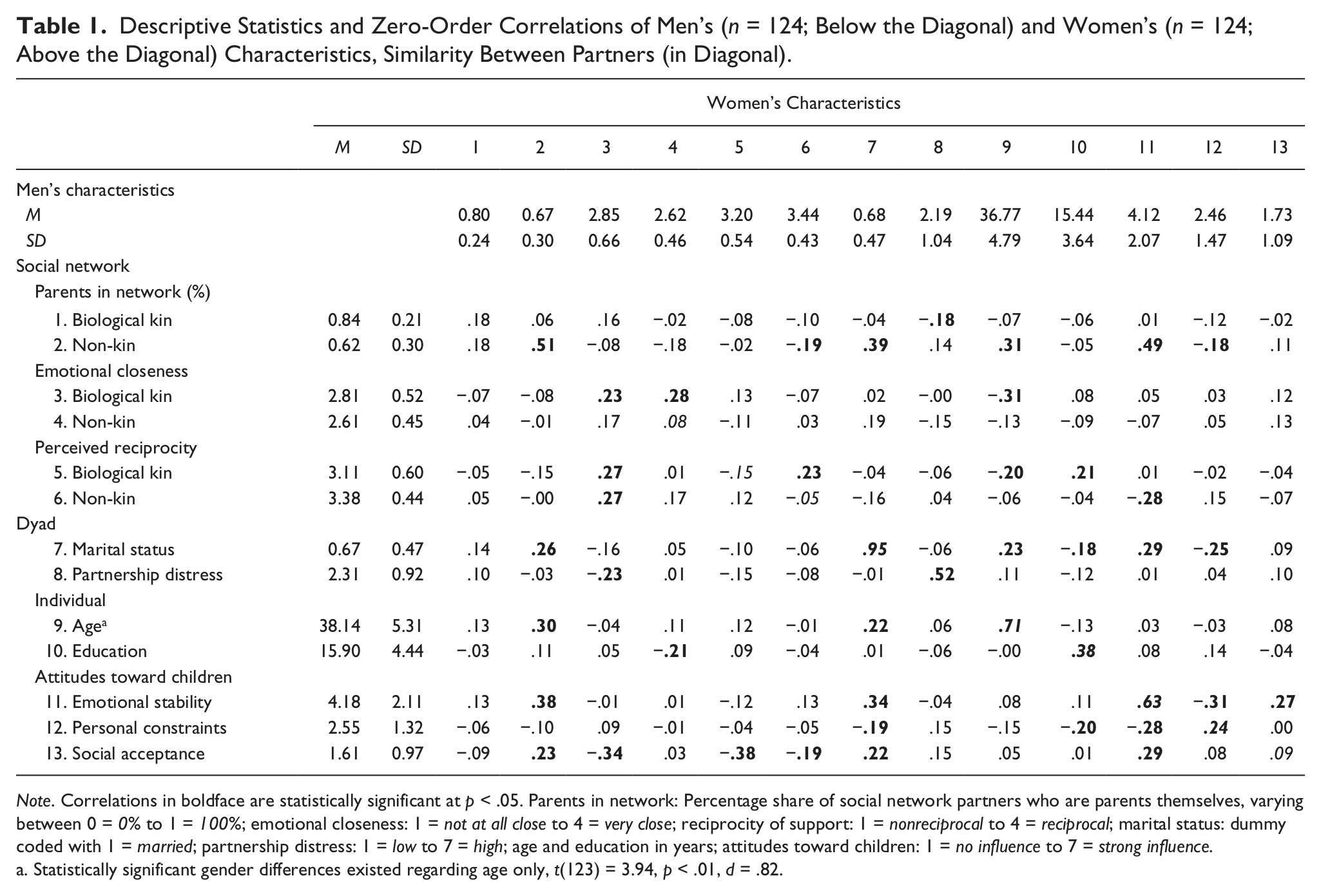
Note. Correlations in boldface are statistically significant at p < .05. Parents in network: Percentage share of social network partners who are parents themselves, varying between 0 = 0% to 1 = 100%; emotional closeness: 1 = not at all close to 4 = very close; reciprocity of support: 1 = nonreciprocal to 4 = reciprocal; marital status: dummy coded with 1 = married; partnership distress: 1 = low to 7 = high; age and education in years; attitudes toward children: 1 = no influence to 7 = strong influence.
Statistically significant gender differences existed regarding age only, t(123) = 3.94, p < .01, d = .82.
To differentiate the three types of couples and to consider all three sets of variables concurrently (i.e., social network, couple, and individual characteristics), we conducted multinomial logistic regression analyses. The outcome was a three-stage variable (1 = traditional parent, 2 = voluntarily childless, 3 = involuntarily childless) with the last category serving as the reference group. The selection of involuntarily childless couples as the reference group was guided by previous findings illustrating a kind of intermediate position with similarities in both directions toward voluntary childlessness and parenthood. The comparison of three couple types requires the presentation of only two comparisons because the last one—in this case, traditional parents versus voluntarily childless couples—is directly deducible from the other two. Statistical analyses were conducted in four steps: First, we included all social network variables of both partners in one model, resulting in 12 predictor variables altogether (percentage of parents in kin, percentage of parents in non-kin, emotional closeness to kin, emotional closeness to non-kin, perceived reciprocity to kin, perceived reciprocity to non-kin; with all variables introduced for men and women, respectively). In a second step, we reduced this model to significant social network predictors. In all cases, we kept predictors of both partners to compare effects of men and women. To test for social network effects above and beyond dyadic and individual characteristics, Steps 3 and 4 of the analyses additionally included these variables. Nagelkerke’s R2 is reported to present explained variance. Analyses were conducted in PASW 18. 2
Results
What characteristics differentiate between couples who are parents, voluntarily childless, or involuntarily childless? The first presented model (Model 1, Table 2) depicts the model with only substantial social network characteristics, yet also represents the predictors of both partners. As expected, the comparison of involuntarily childless couples and traditional parents showed that a higher percentage of other parents in a social network (odds ratio [OR] = 73.23, p < .01) and relationships to non-kin who were perceived as less close (OR = 0.22, p < .05) were related to a higher probability of motherhood. Perceptions of more reciprocal relationships to non-kin related to a higher probability of women being voluntarily childless relative to being involuntarily childless (OR = 6.37, p < .05). Among men, the number of parents in networks did not distinguish between childless men and fathers, but emotional closeness in relationships did. Closer relationships to non-kin predicted that men were more likely to be fathers relative to being involuntarily childless (OR = 4.11, p < .05). Apart from this difference, social networks of voluntarily and involuntarily childless men were fairly similar. Together, the included social network predictors explained 52% of the variance in type of couple.
Multinomial Logistic Regression Analyses Examining the Probability of Belonging to One of Three Family Types.
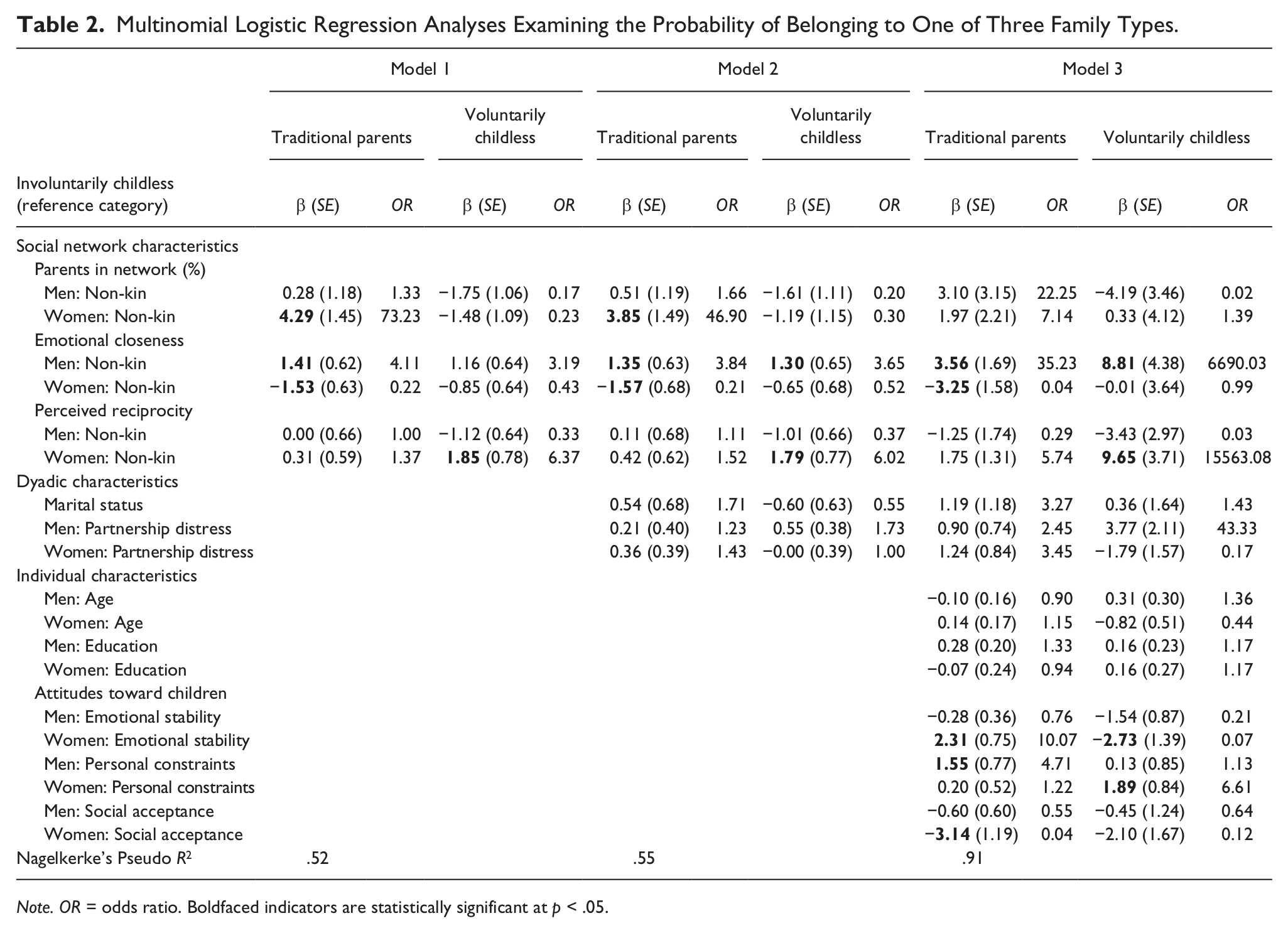
Note. OR = odds ratio. Boldfaced indicators are statistically significant at p < .05.
The second model (Model 2, Table 2) additionally included marital status—using only one variable as marital status was the same for both partners—and perceived partnership distress of both relationship partners. None of the additional variables were substantial predictors (all ps > .15). As hypothesized, patterns of social network characteristics remained stable above and beyond dyadic characteristics. In comparison with involuntarily childless men, voluntary childlessness in men was associated with higher closeness to non-kin (OR = 3.65, p < .05). The explained variance was increased to 55%.
In our final model, we predicted couple type using social network variables, dyadic variables, as well as sociodemographic variables and attitudes toward children. As illustrated in the right column of Table 2, social network effects remained largely stable. Additionally, women’s attitudes toward children significantly distinguished between types of couples. When compared with involuntarily childless couples, motherhood was related to higher expectations of emotional stability through children (OR = 10.07, p < .01) and lower anticipation of social acceptance (OR = 0.04, p < .01). Experiences of higher personal constraints predicted fatherhood (OR = 4.71, p < .05) compared with involuntary childlessness in men. For the second comparison of involuntarily versus voluntarily childless couples, low expectations of emotional stability (OR = 0.07, p < .05) but expectations of strong personal constraints (OR = 6.61, p < .05) predicted voluntary childlessness in women. Both voluntarily and involuntarily childless men showed high similarity in attitudes toward children. Neither age nor educational level of women and men distinguished between types of couples; yet the number of statistically significant effects clearly supported the hypothesis of a generally stronger impact of female characteristics in regard to the couple’s current parenting situation.
Discussion
The findings support our assumption that social network characteristics distinguish between different types of couples with and without children who are voluntarily or involuntarily childless. Social networks differentiate above and beyond individual and dyadic characteristics in different types of couples in early midlife. Notably, although models with dyadic and individual characteristics as covariates still illustrated effects of closeness and reciprocity with social network members, they additionally suggested the important role of women’s attitudes toward children. In light of these findings, our discussion focuses on the significance and robustness of social network characteristics concerning the distinction between childlessness and parenthood, and their interplay with dyadic as well as individual characteristics in early-midlife couples.
Distinguishable Social Network Characteristics of Voluntarily and Involuntarily Childless Couples
Our results replicate previous findings in illustrating the social segregation between childless women and mothers, particularly in light of having other parents as relationship partners. However, the finding that childless couples have similar social network structures may be related to different motives: Involuntarily childless women might stay away from parents for reasons of avoidance, coping, or discomfort, whereas voluntarily childless women might show diverging interests. The additional consideration of attitudes toward children showed a slight reduction in this relation of social network structure across couple types. Correlations of Table 1 already indicated substantial associations between selected social network and individual characteristics. This finding agrees with theoretical outlines that suggest interrelations between changes in social networks and motivations or attitudes (Carstensen, 2001; Charles & Carstensen, 2010). Furthermore, further empirical analyses highlighted this interdependence—or shared variance—of attitudes and social network characteristics regarding the couple’s current situation (Lang & Heckhausen, 2006).
Compared with involuntarily childless individuals, non-kin relationships were perceived as less close relationships by mothers, but closer by fathers. This pattern for women may be rooted in a stronger investment in the kin network and generally stronger kinship preferences found for mothers (Buss, 2004; Neyer & Lang, 2003). We can only speculate that mothers possibly reduce available resources for and perceived closeness to non-kin relationship partners, in order to save them for biological kin relationships. Dissimilarly to mothers, fathers are still less likely to go on parental leave. They have more continuous career paths and are thus perhaps more able to foster non-kin networks, and may also gain different kinds of relationship qualities in early midlife. Involuntarily childless men perceive infertility as a major flaw related to high levels of social stressors (Peronace, Boivin, & Schmidt, 2007; Webb & Daniluk, 1999). As such, this may have decreased disclosure and relationship quality with non-kin network partners. In contrast, for involuntarily childless women, friends and professionals may represent primary support givers in this challenging situation.
Consistent with previous results regarding preferences for mutuality in exchanges with spouses (Carl et al., 2000), voluntarily childless women reported more reciprocal relationships with colleagues, acquaintances, and neighbors compared with involuntarily childless women. It may be the case that voluntarily childless women generally have a stronger need for reciprocity in social relationships and are particularly attentive to non-kin exchanges. Furthermore, this characteristic served as a differential predictor of voluntary childlessness above and beyond other social network and dyadic characteristics as well as individual attitudes toward children. Interestingly, we found an unexpected positive result for perceptions of higher emotional closeness to non-kin for voluntarily childless men. Voluntary childlessness is a self-chosen life situation and is thus unrelated to perceptions of failure and stress. In the context of voluntary childlessness, cooperative non-kin relationships appear to acquire a meaningful position for men. This observation may relate to an earlier finding regarding “family by choice” (Wrzus et al., 2012), that illustrates greater closeness to non-kin when reporting less close family relationships.
In sum, results show the significance of social networks in distinguishing partners with children, voluntarily childless couples, and involuntarily childless couples in early midlife.
The Impact of Partnership Distress and Attitudes Toward Children
Both marital status and partnership distress did not differ across the three types of couples with and without children. Partner relationship distress was low in partners with children, voluntarily childless, and involuntarily childless individuals. Such findings may highlight the similarity of long-term relationship processes in stable partnerships irrespective of parental situations (Mitnick et al., 2009). In addition, this finding may have particularly important implications for counselors working with infertile couples: Neither parents nor infertile couples have more strained partnerships per se (for further consideration, see the Limitations and Outlook section).
Despite the absence of mean-level gender differences, predominantly women’s attitudes were observed to differ across the three types of couples. Motherhood in early midlife was predicted by both higher emotional stability—the most positive fertility motive (Brähler et al., 2001)—as well as lower expectations of social acceptance. Voluntarily childless women, in contrast, were more likely to associate parenthood with lower expectations of emotional stability and increased personal constraints. This pattern concurs with assumptions about the importance of individual motives guiding fertility behaviors (Miller, 1992): Mothers illustrated the highest levels of emotionally meaningful experiences. Involuntarily childless women—with strong unfulfilled fertility desires—anticipate positive emotional experiences (Kotter-Grühn et al., 2009) and struggle for more social acceptance or less social stigmatization (Dyer, Abrahams, Mokoena, & Van der Spuy, 2004). These result patterns agree with our social network findings: Social withdrawal from contact with other parents clearly distinguished between partners with children and involuntarily childless couples. Voluntarily childless women highlighted the personal constraints of parenthood. Again, results regarding attitudes are in line with social network findings: Voluntarily childless women emphasized the reciprocity principle with non-kin relationships in their work or leisure time. Alternatively, voluntarily childless women could be regarded as more realistic and less likely to follow the myth of idealizing parenthood (Eibach & Mock, 2011).
In this study, findings were not affected by levels of education. The educational levels of voluntarily childless couples resembled those of involuntarily childless and parental couples. Voluntary childlessness, thus, does not appear to be an exclusive characteristic of individuals who have achieved higher educational levels, but is rather representative of people of diverse social backgrounds (Lundquist, Budig, & Curtis, 2009; Tölke & Diewald, 2003). Overall, our findings suggest that social relationship qualities and individual characteristics are indicative and differential characteristics of voluntary childlessness.
Our findings indicate that women’s characteristics show substantially more associations with the couple’s current situation, regardless of an overall mean-level gender similarity. Social network qualities of both genders, as well as women’s attitudes toward children, emerged as strong predictors in our models. Thus, the impact of women’s attitudes on deciding family pathways appears to outrank the impact of men’s. As such, results shed further light on the “leading role” of women regarding family pathways, in light of pregnancy, motherhood, and childlessness. In contrast, in late life, childlessness appears to affect men’s lives more so than women’s (Dykstra & Hagestad, 2007). Thus, results highlight life-course specific dynamics that must be considered in aging societies.
Limitations and Outlook
We acknowledge several limitations in the present study. We reported only cross-sectional data, reducing our results to a demonstration of differences between types of couples with and without children, which limits inferences regarding the direction of effects. Possible changes in social relationships in the period before and while deciding for or against parenthood remain unknown. Extensive longitudinal studies that start before couples initiate the decision-making process would be needed to come closer to any causal directionality. Nonetheless, our study represents the first findings regarding social network differences between voluntarily as well as involuntarily childless couples and parents of early midlife. Unlike most previous studies, this clear differentiation of types of couples, the consideration of dyads, and the inclusion of social network variables extends our knowledge to the specificity of effects in diverse, early-midlife life contexts. Studies including larger samples and longitudinal designs will serve to further improve our understanding of selection processes as couples choose their pathways of childlessness or parenthood across time. Furthermore, despite having used a broad range of sampling strategies at various locations, some selectivity among voluntarily or involuntarily childless couples might have occurred. However, the high similarity of childless couples and traditional parents with respect to demographic characteristics in the present study supports the transferability of our findings to diverse types of couples in early midlife. In addition, a small positive selection bias is possible, as we only included couples where both partners were willing to participate in the study. However, the advantages of dyadic considerations and new knowledge on childlessness in men may outreach such disadvantages. Moreover, both the mean level and the considerable variability in partnership distress did not suggest bottom effects of studying exclusively harmonious couples.
In sum, our results contribute to and extend previous findings regarding the terms and conditions of childlessness in early midlife, indicating important differences in social network characteristics. To better understand differential pathways to childlessness across the life span, we encourage further research that considers social network characteristics in addition to demographic characteristics and attitudes. This might help disentangle the potential role of social networks in adapting to intentionally or unintentionally nonnormative life paths. For example, in Germany, as the site of the study, not only the number of children per women decreased but also childlessness steadily increased up to 20% across the 20th century (Statistisches Bundesamt, 2009). Despite the fact that German social policy intensified the encouragement of young families to have (more) children (i.e., child allowance, availability of and financial support for daycare) within the past 10 years, childlessness is still increasing. Moreover, prevalence of childlessness appears to be quite similar across countries with different policies and even across continents and cultures (Rowland, 2007; Tanturri & Mencarini, 2008). Thus, it is very clear that the social and political structure of most Western societies will indeed be shaped by increasing numbers of individuals without children over the coming decades. Over and above social–political interventions, social networks should be regarded as one potential characteristic contributing to differences between couples with and without children.
Understanding the social needs and the interdependency between individual and social structures of early-midlife childless couples is essential in several respects. First, fertility rates below the replacement level constitute a major challenge for societal and economic systems. Research could improve possible social and political steps to encourage young couples to start their own families. For example, young voluntarily childless women perceive higher personal constraints to be associated with parenthood, and indicate less contact with other young families. This segregation may reduce the possibility of social learning or attitude change to a more positive view toward parenthood. Likewise, research could increase acceptance of different types of couples. Second, this path of research might open up an important route for practitioners working with involuntarily childless couples: When couples are confronted with this unexpected, disruptive challenge, social networks illustrate a positive supportive potential.
In conclusion, it appears that the social context is central to the development of individuals and dyadic relationships alike (Bronfenbrenner, 1979). In extending on previous findings, our results reveal that social networks of voluntarily and involuntarily childless couples differ by structure as well as by perceived closeness and reciprocity of support. Furthermore, such differences in social network characteristics prevail in early-midlife couples with and without children above and beyond individual and dyadic features.
Footnotes
Declaration of Conflicting Interests
The author(s) declared no potential conflicts of interest with respect to the research, authorship, and/or publication of this article.
Funding
The author(s) disclosed receipt of the following financial support for the research, authorship, and/or publication of this article: The research was supported by research grants of the German Research Foundation to Franz J. Neyer (NE 622/3) and Frieder R. Lang (LA 1002/2).