



Abstract
This article examines the differences between currently married and currently cohabiting couples in their household labor allocation in Italy, distinguishing the experience of both premarital cohabitation and previous unions with other partners. Results suggest that, on one hand, cohabiting couples present more equal arrangements of household labor time than married ones, but the more equal allocation of premarital cohabitation is not carried into marriage. On the other hand, contrary to hypothesis, the experience of previous unions does not mean more equal allocation of household labor in the current union either for marriages or for cohabitations.
Introduction
This article studies the household labor allocation within married and cohabiting couples in Italy, with particular attention to the different types of marriages and cohabitations. 1 This is an innovative approach, since most international literature on this topic has followed two different perspectives: some authors considered only currently married individuals and compared them on the basis of the experience of premarital cohabitation (see, e.g., Batalova & Cohen, 2002); other scholars focused, instead, on the direct comparison of currently married and currently cohabiting couples (Davis, Greenstein, & Marks, 2007). Baxter (2005) combined the two approaches, comparing the gender division of household labor among currently cohabiting and currently married couples but examining also the impact of a previous period of cohabitation for married individuals. Nevertheless, very few studies have considered the differences among cohabiters (Ciabattari, 2004). The present article goes beyond most previous studies using the work by Baxter (2005) as a starting point but taking into account also the experience of previous unions. In particular, besides distinguishing marriages with premarital cohabitation, this article classifies both currently married (without premarital cohabitation) and currently cohabiting individuals according to whether they have experienced previous unions with different partners. The aim is to examine whether the cohabitation in itself and/or the experience of previous unions mean a more egalitarian division of household labor within the couple, considering whether differences across different couples persist once household and sociodemographic characteristics and other controls are taken into account.
The focus on Italy is motivated by two main reasons. One is connected with its particular pattern of cohabitation; the second reason is its particular gender context.
With regard to the first reason, recent years have seen an increase in the phenomenon of nonmarital unions in many European countries: marriage has lost much of its centrality in the process of family formation and has been gradually replaced by cohabitation, either as a prelude or as an alternative to marriage (Bumpass & Lu, 2000; Seltzer, 2000; Smock & Manning, 2004). In fact, the situation is heterogeneous across countries. In particular, consensual unions spread more slowly in Italy (but, more generally, in Southern Europe) than in other areas (Kiernan, 2002). However, recently, cohabitations start their diffusion also in this country (Di Giulio & Rosina, 2007; Salvini & De Rose, 2011). Nonmarital couples in Italy have gone from 1.6% of the couples in 1993-1994 to 3.8% in 2003 and then to 5.9% in 2009 (Istat, 2006a, 2011). In addition to couples who are currently cohabiting, many married couples have cohabited before the marriage. Percentages of premarital cohabitations considerably increased in the past decades too: in 2003, only 1.4% of marriages celebrated in Italy before 1974 had been preceded by a premarital cohabitation; this percentage passed to 9.8% of marriages celebrated between 1984 and 1993, to 14.3% in 1994 to 1998, and reached 25.1% among marriages celebrated between 1999 and 2003 (Istat, 2006a). Despite the increasing interest of researches on cohabitations in Italy (Gabrielli & Hoem, 2010; Liefbroer & Dourleijn, 2006; Mazzuco, 2009; Rosina & Fraboni, 2004), there are no studies on the extent to which marriages and cohabitations differ in the gender division of household labor in the Italian context. The present study aims to fill this gap.
Italy represents a context where this research question is particularly interesting also because of the traditional gender roles within the family and the importance of the male-breadwinner family model, which characterized the country (Del Boca, Pasqua, & Pronzato, 2004; De Rose, Racioppi, & Zanatta, 2008; Ongaro, 2002). According to comparative data on time-use, the gender division of household tasks is heavily asymmetric in Italy: Italian men are the least collaborative among Europeans with regard to household labor, and Italian working women have the higher workday hours considering both paid work and family work (Eurostat, 2004; Istat, 2006b). The couple’s sharing of household labor is, indeed, heavily unbalanced, not only when the woman is a housewife but also when she works full-time. In the same perspective, in the presence of children, another distinctive feature of the Italian gender system is the low level of fathers’ involvement in child care (Smith Koslowski, 2008), with the women carrying the main responsibility of child care and childrearing activities. This peculiarity of the Italian gender role context has effects on the employment system (De Rose et al., 2008) and, potentially, also on fertility (McDonald, 2000; Pinnelli & Di Giulio, 2003). In fact, younger couples appear to have more egalitarian behaviors, with the male partners being much more collaborative (Istat, 2005).
The reminder of the article is organized as follows. The next section gives a brief description of the theoretical approaches developed to explain the gender gap in household labor and then discusses its allocation within different married and cohabiting couples in the light of hypotheses and empirical results in the literature. The following section describes the data used, presenting also some descriptive analyses. Then results are presented. Last, some concluding remarks follow.
Background
Explaining the Gender Gap in Household Labor
Research has consistently shown the gender gap in household labor (Bianchi, Milkie, Sayer, & Robinson, 2000), and several theoretical approaches have been developed to explain the higher household labor contributions of women in comparison with men.
According to the economic exchange model, also referred to as the relative resources perspective, individuals perform household tasks in exchange for economic support (Brines, 1994). In this perspective, because of the traditional economic dependency of women on their male partners, women are primarily responsible for household labor. In general, individuals who can negotiate a more favorable allocation of household labor for themselves are those with more resources in relation to their partners (Knudsen & Wærness, 2008; Mannino & Deutsch, 2007). In fact, though most researches supported the importance of women’s resources for the domestic division of household labor, a number of studies debated this perspective (for a review, see Lachance-Grzela & Bouchard, 2010).
The time-availability perspective suggests that family members rationally allocate the household labor according to the availability of time in relation to the amount of household labor to be done (Hiller, 1984). The idea is that family members divide household tasks according to the time they have available after paid work time is subtracted (Arrighi & Maume, 2000). In general, individuals spending more time at work, usually men, have less time to spend on household labor (Artis & Pavalko, 2003). Despite most literature supporting the time availability hypothesis (see studies cited by Lachance-Grzela & Bouchard, 2010), empirical evidence showed that, even when women work as many hours as their male partners in paid employment, they assume the larger proportion of household tasks (Bartley, Blanton, & Gillard, 2005).
Another theoretical perspective on the process of household labor allocation frequently used by literature is the gender ideology. 2 It posits an inverse relationship between traditional gender ideology and men’s household labor contributions (Arrighi & Maume, 2000; Davis et al., 2007). According to this approach, men and women spend different amounts of time in household labor depending on what they believe appropriate for men and women: women with more egalitarian attitudes perform less household labor than women with traditional gender ideology, whereas men with more egalitarian attitudes tend to spend more time on household labor than men with traditional attitudes. Researchers have generally supported this hypothesis, though some authors found mixed evidence (see the review by Lachance-Grzela & Bouchard, 2010).
The Allocation of Household Labor in Cohabiting and Married Couples
Thus far, literature has provided evidence of a more egalitarian division of household labor in cohabitations than in marriages, although cohabiting women still contribute more than their partners (Davis et al., 2007; Shelton & John, 1993). Scholars have offered several explanations for the more equal allocation of household labor among cohabiting couples than among married ones.
First of all, the different patterns may be due to the selection of cohabiters. In other words, it is possible that cohabiters and married individuals differ on certain key sociodemographic characteristics and attitudes relating to the theoretical approaches described in the previous section to explain the allocation of household labor. For example, cohabiting women have been found to have a greater participation in the labor market than married women 3 (Shelton & John, 1993) and, thus, according to the economic exchange model and according to the time availability perspective (being less dependent on their partners and having less time available), could spend less time in household labor than married women. A similar observation is related to the attitudes of individuals who choose to cohabit. In particular, individuals with more traditional attitudes are more likely to marry, whereas those who are less likely to identify themselves with the traditional homemaking and breadwinning roles will choose cohabitation, rejecting marriage as an institution (Baxter, 2001). Of course, cohabiters are not necessarily a homogeneous group: besides individuals who plan to cohabit permanently, cohabiting couples may include individuals who consider cohabitation as a forerunner to marriage. However, also in this case, cohabiting men and women are less likely to accept the homemaking and breadwinning roles.
Similarly, some of the differences in household labor allocation between married and cohabiting couples may be due to differences in household composition, which imply different and gender differentiated labor load. For example, married couples are more likely to have children than cohabiting couples, particularly in Italy (Kiernan, 2004), and this is clearly associated with more household labor. Since mothers are responsible for the majority of child care, even if fathers’ participation is increasing in most European countries (see, e.g., Smith, 2004; Smith Koslowski, 2008), this may contribute to explaining the less egalitarian household labor division among married couples than among cohabiters.
Therefore, these remarks suggest that differences in the allocation of household labor between cohabiting and married couples may decrease after controlling for potential selection due to preexisting characteristics. In fact, most recent literature has shown that differences in the domestic division of labor across couples persist once potential confounders were taken into account, supporting the hypothesis of cohabitation as a more egalitarian union in itself (Baxter, 2005; Davis et al., 2007).
An explanation of this result is connected with the concept of incomplete institutionalization originally proposed by Cherlin (1978) for remarried families and step-families. The concept may be extended to the situation in cohabitating couples (see, e.g., Baxter, 2005; Brines & Joyner, 1999) to stress the fact that cohabitations are not subject to all of the institutional rules of marriages. Marriage is, indeed, a type of union with clear norms and legal status, whereas cohabitation does not have clear norms regarding behavior, is not legally recognized, and can thus be considered “incompletely institutionalized” (see also Kuperberg, 2012). The institution of marriage can affect behavior within the couple because of the clear norms regarding behavior as well as conformity of people in this type of union to norms, specifically, traditional norms on the gendered division of labor in terms of appropriate behaviors for husbands and wives. The incompleteness of these rules in cohabitation may leave space for cohabiters to negotiate new rules and meanings leaving room for more egalitarian division of labor than in the case of marriage (Baxter, 2005; Cherlin, 2004).
In fact, despite the evidences from recent literature toward a more egalitarian pattern among cohabitations than among marriages, it should be mentioned also that some other studies (South & Spitze, 1994; see also the discussion in Smock, 2000) show that cohabitations do not differ substantially from married couples in their household labor allocation. This may be connected with the fact that, as said above, cohabiters are not a homogeneous group. In this perspective, Brown and Booth (1996) suggested that there may be two types of cohabiting couples: those who plan to marry and those who do not. The former may be quite similar to marriages and, instead, the latter can be characterized by lower levels of commitment, which, in turn, might lead to a lower commitment among men to the partner’s well-being (see also Nock, 1995) and, thus, to a lower equality in household labor allocation. In fact, the incomplete institutionalization of cohabitation may be a particularly realistic prospective in a context such as Italy, where cohabitations are very often a step preceding marriage (Rosina & Fraboni, 2004).
In the perspective of incomplete institutionalization of cohabitation in opposition to the institutionalization of marriage, for cohabiting women a transition to marriage should increase their household labor, and conversely, for men a transition from cohabitation to marriage should mean a decrease in their household labor. In fact, couples who have cohabited before marriage are found to have more equal division of household labor than those who have not cohabited before marriage (see, e.g., Batalova & Cohen, 2002; Baxter, 2005). This may be due to the fact that the patterns established during premarital cohabitation are carried over into marriage 4 (Baxter, 2005). In other words, former cohabiters bring their egalitarian experiences of cohabitation to their subsequent marriage.
These issues suggest the following hypotheses for Italy: Hypothesis 1: Due to the incomplete institutionalization of their union, currently cohabiting couples have a more equal division of household labor than married couples: this means that, net of controls, cohabiting women do less household labor than married ones, and cohabiting men spend more time in household labor than married ones. Hypothesis 2: The mechanism of incomplete institutionalization suggested in Hypothesis 1 holds also for cohabitations that are prelude to marriage, and the egalitarian pattern established in the period of premarital cohabitation is then carried over into marriage.
The Importance of Previous Unions for the Allocation of Household Labor in Current Unions
A number of studies have investigated the impact of previous marital relationships on the division of household labor in later marriages (Demo & Acock, 1993; Ishii-Kuntz & Coltrane, 1992). Results suggested that remarried men spend more time on household labor than men in first marriages, and the reverse happens for women, leading to a slightly more equal division of household labor in second than in first marriages. The lack of prescribed roles and models in the context of incomplete institutionalization of remarriages (Cherlin, 1978) allows more experimentation and bargaining over household labor and may explain this finding. In this perspective, the experience of a previous marriage is the mechanism that drives household labor allocation in the current (new) partnership.
Furthermore, another potential causal mechanism may be related to the experience of the previous marriage dissolution. Even if only few studies have documented a causal link between an unequal division of household labor and the risk of divorce (see the researches mentioned by Frisco & Williams, 2003), the dissolution of the previous marriage may be also due to dissatisfaction with the allocation of household labor. In this hypothesis, individuals may compare their current situation to that of the previous marriage (Thompson, 1991) as a means of negotiating more equal arrangements (probably in order to not experience union dissolution again). From the women’s perspective, those who perceived that their previous marriage was characterized by an unfair share of household labor might be prone to seek a more equal division in the subsequent marriage. From men’s viewpoint, those who have experienced conflicts on the division of household labor in previous marriage might be more prepared to adapt to a more equal allocation in subsequent ones.
Probably the two mechanisms (those connected with the experience of a previous marriage and of the marriage dissolution) are not completely separable, and both experiences are drivers of household labor allocation in the current marital union.
Sullivan (1997) extended the potential effect of the experience of previous marriage to the experience of previous union in a de facto relationship: the central conceptual issue is concerned with the effect of live-together relationships within which negotiation and issues of fairness and equity around household labor allocation would apply.
This body of research suggests the following hypothesis: Hypothesis 3: Both cohabiters and married individuals report a more egalitarian allocation of household labor if they have been previously married or have cohabited with a previous partner, since they use the comparison with previous unions to have more power of negotiation in the current union.
Data
Data Set and Sample
The data come from the survey “Family and Social Subjects” (FSS) conducted in Italy by the Italian Statistical Institute (Istat) in 2003. The survey is based on a representative sample at national level of about 20,000 households collecting social and demographic information about each household member. In particular, detailed data on current and past marital and nonmarital unions were available. In comparison with most previous studies (which used data gathered from only one partner in a couple so that each respondent—male or female—is reporting about his or her own information and that of his or her partner), in the FSS survey all members of the couples directly answer most of the questionnaire. In particular, all respondents (over the age of 18) were asked how many minutes and hours a week they spend, on average, on household labor 5 (including housework, doing the shopping, and care of other components of the household).
The focus of the analyses is all currently married or currently cohabiting individuals aged 18 to 64 6 (9,346 male respondents and 10,259 female respondents); marriages with premarital cohabitation are distinguished, and both cohabiters and married (without premarital cohabitation) individuals are classified according to whether they have experienced at least one previous (marital or nonmarital) union (with a different partner).
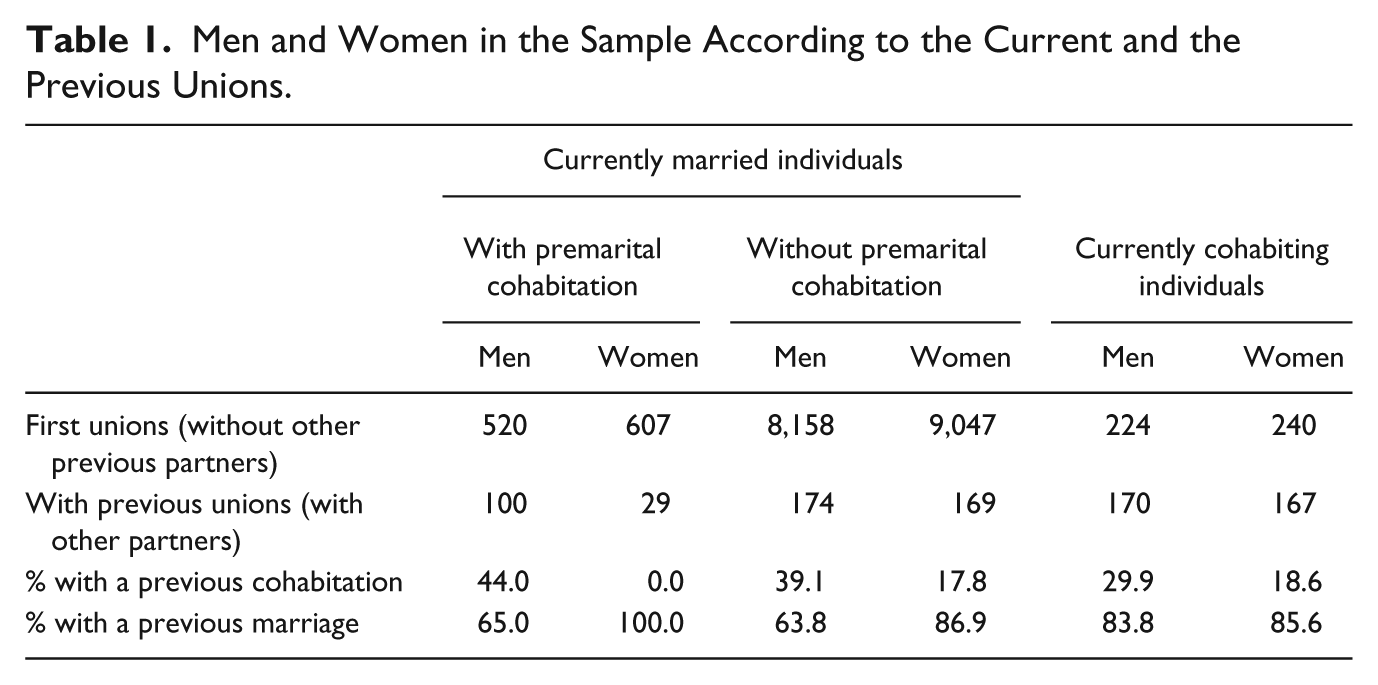
Table 1 shows individuals in the sample according to the different types of couples, which will be the focus of the following analyses. Among currently married individuals with premarital cohabitation, those who had been previously married or had cohabited with a different partner are a small group, and in the following they are not distinguished from those without previous unions. This is motivated also by the assumption that the more recent mechanism (in this case that related to the experience of premarital cohabitation) acts, replacing potential previous ones (in this case those related to the experience of previous unions with other partners). In this way, five different types of couples can be distinguished: besides married couples with premarital cohabitation, marriages and cohabitations that are first unions and those following unions with other partners. 7 Clearly the different couples identify particular groups of men and women in different stages of their life course. For example, married individuals who have cohabited with their current spouse before the marriage may have viewed cohabitation as a forerunner to marriage, and thus, they probably belong to younger birth cohorts than married individuals (in their first union) without premarital cohabitation. 8 In the same way, most cohabiters with previous unions had undergone the dissolution (for separation or death) of a previous marriage and are experiencing a further union with a new partner, and thus, they are older than cohabiters in their first union: this means that the population of cohabiters is very heterogeneous and is quite different than it is in many countries (Kasearu & Kutsar, 2011), and this confirms the importance of distinguishing among currently cohabiting individuals those with previous unions.
Men and Women in the Sample According to the Current and the Previous Unions.
Descriptive Analyses
Table 2 reports the weekly mean hours spent in household labor among men and women in different couples. The first point to note is that women report significantly more hours of work than men, regardless of the type of couple. For example, married women report spending about 36 hours per week on household labor whereas married men report about 6 hours. In fact, as expected, the gender gap in household labor time is lower among currently cohabiting individuals than among married ones. This is mainly because cohabiting women report significantly fewer hours of labor than married ones; men’s household labor time is, instead, quite similar across couples, with cohabiting men reporting only slightly (not significantly) more hours than married ones.
Weekly Mean Number of Hours Spent in Household Labor by Currently Married and Currently Cohabiting Men and Women, According to the Type of Couple.

However, some differences in men’s household labor time across couples emerge when examining marriages and cohabitations in more details according to the five types of couple presented in the previous section (second part of Table 2). With regard to the experience of premarital cohabitation, married men who have cohabited with their spouse before the current marriage report significantly more household labor than married ones in their first unions. This higher participation in household labor among married men with premarital cohabitation corresponds to significantly lower hours of household labor for their female partners. Considering the experience of previous unions, both currently married and currently cohabiting men with previous unions report significantly more household labor hours than men in their first unions. A more equal allocation of household labor among marriages is suggested by the corresponding lower hours of household labor for married women with previous unions. Cohabiting women with previous unions report, instead, more hours of labor than those in a first cohabitation.
In summary, the gender gap is wider among married couples than among cohabitations, particularly when individuals are in their first unions; among cohabiters, having had previous unions leads to a higher household labor both for men and women.
Clearly, these patterns may be the result of differences across individuals in different couples that, according to the three theoretical perspectives described above, may lead to differences in household labor allocation rather than of the type of couple. Similarly, differences in household composition and in other characteristics may explain the different household labor allocation across couples.
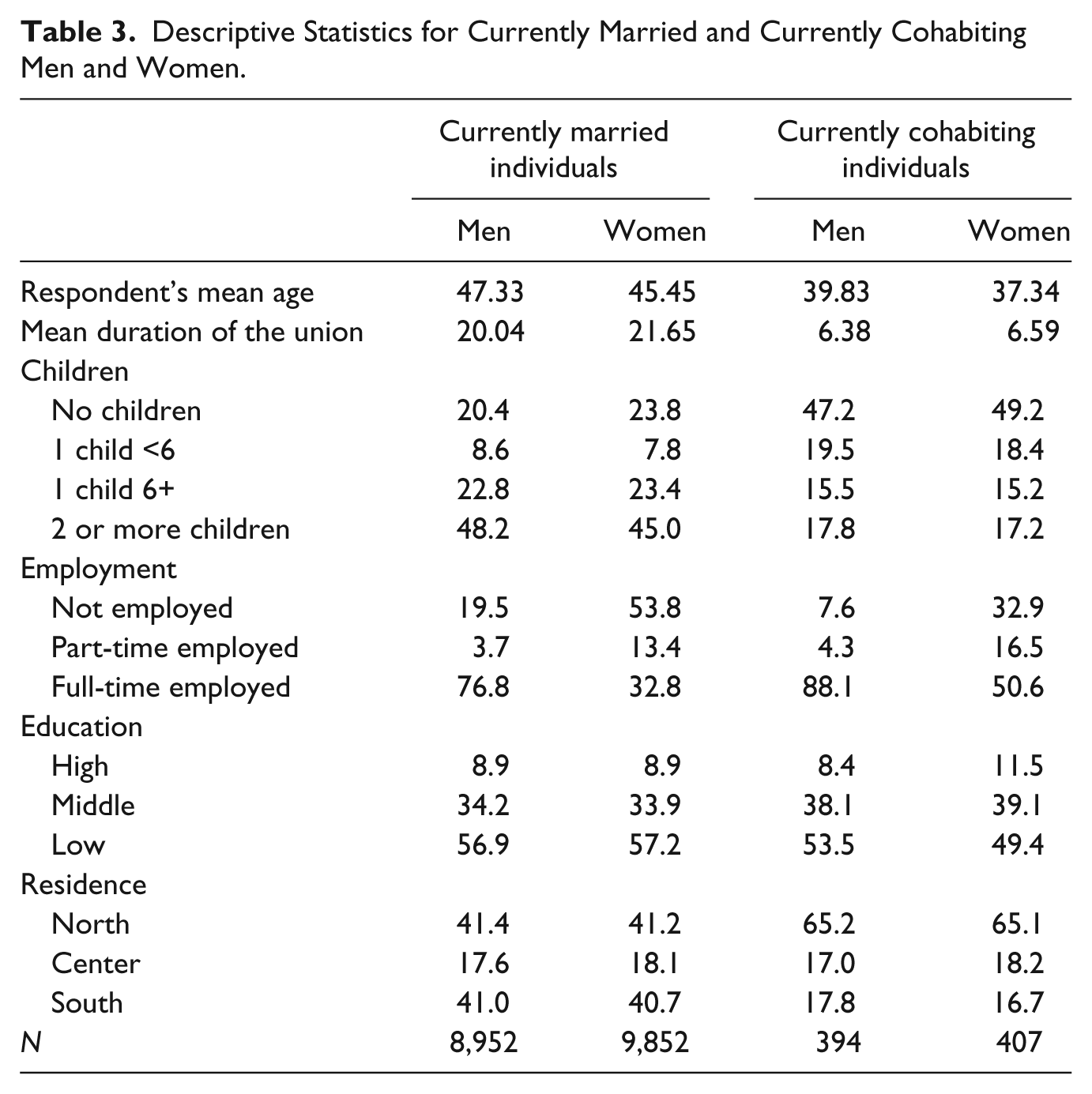
First, as Table 3 shows, cohabiters belong to younger cohorts than married individuals. Age also influences other characteristics—for example, the duration of the union and the presence and age of children: married individuals have longer duration of their relationship and are more likely to have more and older children in the household than cohabiting individuals do. Remarkable differences, partly connected with the cohort differences, between married and cohabiting individuals are observed also for participation in the labor market, 9 particularly for women: cohabiters report higher participation than married ones. In addition, cohabitations are more common in the North of Italy.
Descriptive Statistics for Currently Married and Currently Cohabiting Men and Women.
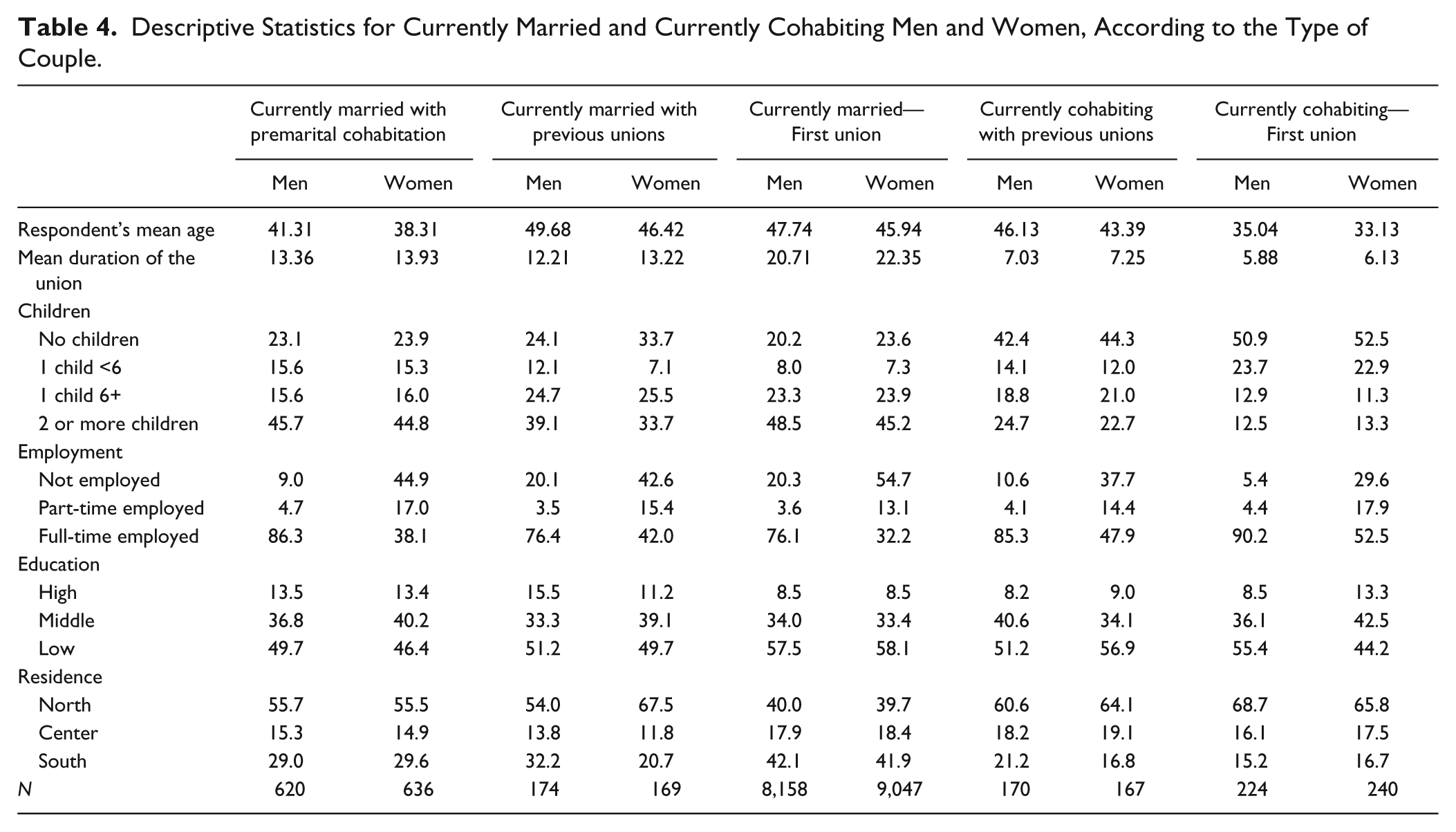
In fact, as said above, currently married and currently cohabiting individuals identify particular groups in different stages of their life course according to the five types of couples described in the previous section. As a consequence, the different couples are expected to be characterized by different characteristics, some of which may be associated with household labor time. Currently married individuals with premarital cohabitation belong to younger cohorts than those in their first unions (Table 4). This means, for example, shorter duration of the relationship, younger children, higher participation in the labor market, and a higher educational level than that observed for married men and women in their first unions. At the opposite, since most married individuals with previous unions have experienced previous marriages (Table 1), they are older than married ones in first union but with shorter duration of the marriage. Similarly, since most currently cohabiting individuals with previous unions had experienced a previous marriage, they belong to an older cohort than that of cohabiters in their first union (Table 4). It is not surprising, therefore, that, although the duration of their relationship is similar to that of cohabiters in their first union, they have more and older children (probably born in the previous marriage) and a lower participation in the labor market. Clearly, these and other differences suggested by Table 4 may contribute to different allocation of household labor across couples.
Descriptive Statistics for Currently Married and Currently Cohabiting Men and Women, According to the Type of Couple.
Multivariate Analyses
Multivariate analyses can be applied to verify whether the effects of (premarital) cohabitation and of previous unions on the household labor patterns observed in Table 2 remain when potential confounding factors are held constant; variables related to the three theoretical perspectives described above as well as some other controls are considered. In particular, educational level and employment status of both partners are taken into account in the perspective of the economic exchange model. In fact, employment status is connected also with the time availability, which, in addition, is described by the presence of (preschool) children 10 due to the amount of time required for child care. 11 A measure of the gender perspective of both partners is considered. 12 Finally, several sociodemographic (respondent’s age, residence, duration of the current union, experience of previous unions by respondent’s partner) and economic controls (perception of household economic situation, number of rooms of the house, home ownership) are taken into account. Table A.1 in Appendix A shows the percentage distribution of each variable for the sample of currently married and currently cohabiting men and women used in the following analyses. Table A.2 presents the same distributions considering the five types of couples described in previous sections.
Results
The multivariate analyses first examine, through ordinary least squares regression models estimated separately for men and for women, 13 whether the differences in household labor allocation across couples are statistically significant (completing results of Table 2). The second stage of the analyses examines the impact of the explanatory variables on household labor and, in particular, whether any observed differences by couples remain when key sociodemographic variables and other controls are held constant.
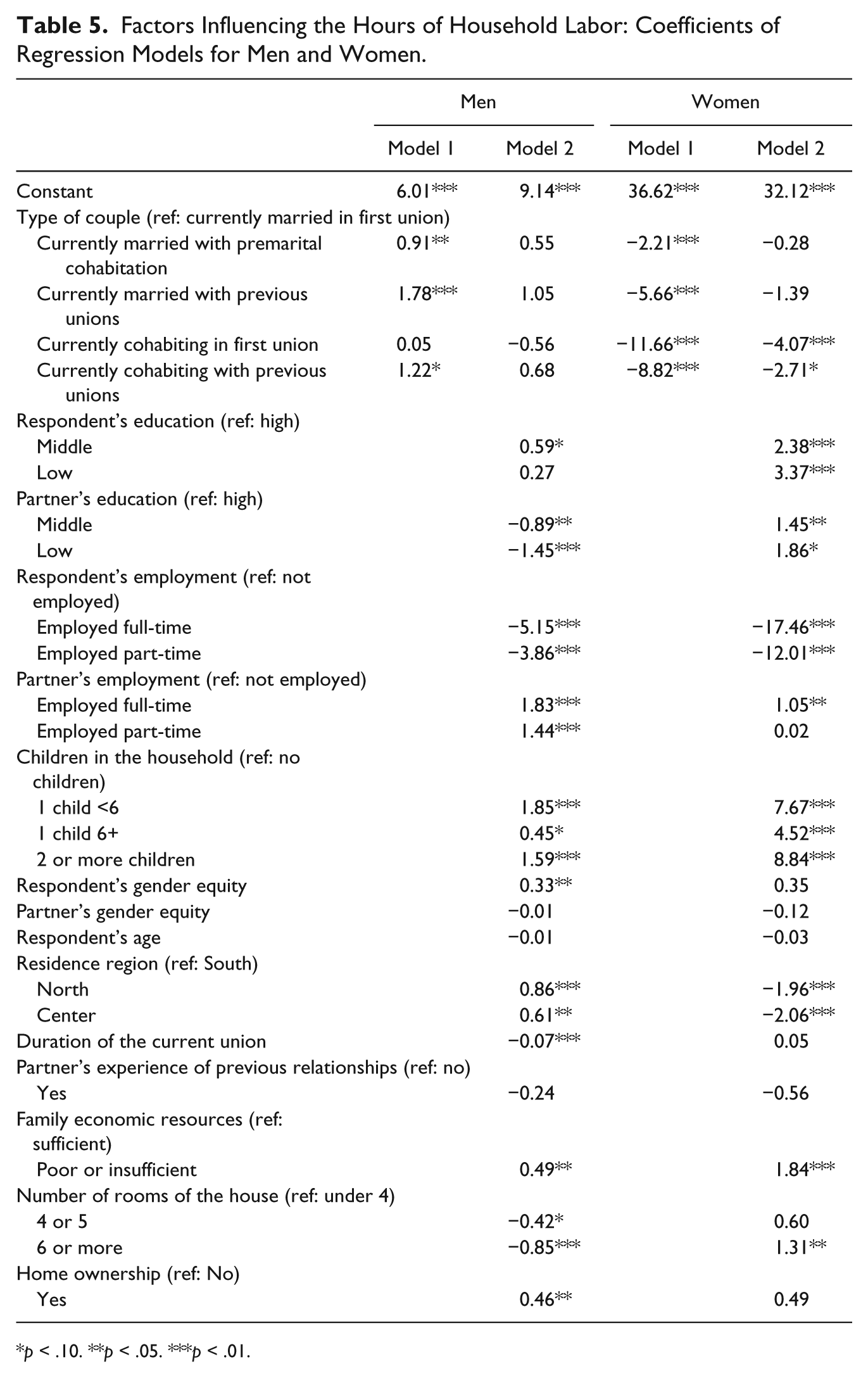
Models 1 in Table 5 regress weekly household labor hours on the key independent covariate representing the types of couple. Currently married men in their first union (reference category) report spending almost 6 hours per week on household labor, compared to over 36 hours for their female counterparts (see the constant terms of Model 1). More important, the differences in household labor hours across couples seem to be smaller among men than among women. As suggested by the results of Table 2, married men with premarital cohabitation and both married and cohabiting ones with previous unions report doing significantly more household labor than do married men in their first union. Thus, for men, a higher participation in household labor is related to the experience of previous unions or of premarital cohabitation, whereas cohabitation in itself (if it is not followed by marriage) does not mean a higher household labor contribution in comparison with marriage. The situation is completely different among women; for them, cohabitation, also without being necessarily a prelude to marriage, implies a lower participation in household labor, particularly when it is the first union (currently cohabiting women in their first union spend over 11 hours fewer per week on household labor than married women without previous unions). In the case of marriage, the experience of previous unions results in a lower participation in household labor. Thus, Models 1 suggest that cohabitation and previous unions have different effects on household labor time according to the gender.
Factors Influencing the Hours of Household Labor: Coefficients of Regression Models for Men and Women.
p < .10. **p < .05. ***p < .01.
Models 2 in Table 5 reestimate couples differences in household labor hours for men and women, controlling for other explanatory variables.
After taking into account all sociodemographic and economic controls, and variables related to the three theoretical perspectives presented above, all the effects of the type of couple decrease and some effects disappear. Thus, at least parts of the effects of cohabitation and of previous unions on household labor allocation are accounted for by other variables. In particular, the occupational status of the respondent and the presence of children in the household are especially important. 14
With regard to the type of couple, for men the effect of the experience of previous unions and of premarital cohabitation disappears. Instead, for women, differences across those in marital unions completely disappear, whereas the negative impact of cohabitation, particularly of first union, remains, even if its effect decreases. In fact, a large gap between married and cohabiting women remains even after differences in other characteristics have been taken into account: cohabiting women in their first union spend an average of 4 hours per week fewer on household labor than married women do. Similarly, cohabiting women with previous unions spend over 2 hours per week fewer than married women do. This lower household labor time of cohabiting women than of married ones should be considered jointly with the fact that cohabiting men do not report significantly higher participation in household labor than their married counterparts do. This suggests that the total household labor load is different across couples (also considering other factors, such as the presence of children). In particular, the total household labor is lower in cohabitations than in marriages, and the fact that this is due only to a lower time spent in domestic tasks by women, but not by men, leads to conclude that, confirming Hypothesis 1, cohabitations have a more equal division of household labor than marriages. However, Hypothesis 2 does not hold, since neither for men nor for women the effect of premarital cohabitation is significant. Thus, the more egalitarian arrangements of cohabitation before marriage are not carried over into the following marriage, not confirming results by literature (see, e.g., Batalova & Cohen, 2002).
Hypothesis 3 is not confirmed both among marriages and cohabitations: both married women and men do not report, indeed, significant differences in household labor time according to whether they are in their first union or not. With regard to cohabitations, as observed above, the effect of the experience of previous unions is not significant among cohabiting men, and other analyses (not presented here for space reasons) show that differences across cohabiting women—according to the experience of previous unions—are not significant, despite the fact that, as observed, they represent individuals in different stages of their life course.
Discussion and Conclusion
This article examines the differences between currently married and currently cohabiting couples in their household labor allocation, with reference to a country such as Italy, where cohabitation is only recently spreading. It is the first study on this topic in this country. In addition, in comparison with previous literature, the topic is addressed with an innovative approach, distinguishing the heterogeneous groups of cohabitations and marriages. In particular, whether married individuals have cohabited with their current partner before the marriage and whether individuals have previous unions is considered. In this way, couples in different stages of their life course are identified, and not only the effects of cohabitation but also the effects of previous unions are studied.
Descriptive analyses show that, for a man the experience of previous unions increases his participation in household labor within his current relationship (marriage or cohabitation), and a similar positive effect on household labor hours is observed for married men who have cohabited with their current spouse before the marriage. Cohabiting women report spending fewer hours of household labor than married ones do, particularly if they are in their first union. In the case of married women, the experience of premarital cohabitation means less household labor in the direction, as observed for men, of a more equal allocation of household labor.
In fact, multivariate results suggest that some differences across couples account for some of the observed differences in men’s and women’s household labor time. Nevertheless, even after controlling for sociodemographic and household characteristics, cohabiting women (both those in their first union and those with previous unions) spend less time on household labor than married women do. Among men, selection due to preexisting characteristics completely accounts for differences in the household labor across couples.
Thus Hypothesis 1 stating that, net of other controls, household labor is shared more equally among cohabiters than among married partners is confirmed but only due to a lower contribution by cohabiting women. In other words, it appears that the institution of marriage exerts influence on women to behave in particular ways, independently of the social and economic differences across type of couple that we know lead to women doing more household labor (e.g., having young children in the household, women spending less time in the labor market). It is not easy to understand the underlying mechanisms explaining this result. Differences in women’s time in household labor between cohabiting and married couples may be due to different investments in child care (a typical women’s responsibility) and in other household tasks by cohabiting women in comparison with married ones. At this point, qualitative research could shed some light over individuals’ perceptions and behaviors, which can help identify the real mechanisms acting in this case. In addition, more research is needed to address whether the greater egalitarianism in cohabiting unions is the result of selection of more egalitarian individuals into cohabitation or of the experience of cohabitation itself (cohabitation as a causal mechanism). Longitudinal data on couples would provide additional and more powerful analytic tools with which to examine these issues. Interestingly, these more equal household arrangements among cohabitations are not carried over in the case of marriage, not confirming Hypothesis 2 and results by the literature (see, e.g., Batalova & Cohen, 2002). This seems to suggest that entrance into marriage after a period of cohabitation is accompanied by important changes in the division of household labor. Explanations may have much to do with the institutionalization of marriage and with the so-called enforceable trust of marriage (see the discussion in Kuperberg, 2012), according to which individuals who cohabited may view themselves differently once they have taken the role of a spouse. In other words, they may change their behavior after marriage following what they perceived to be the norms and expectations associated with the role of a spouse, particularly in a country such as Italy characterized by traditional gender roles and behaviors.
With regard to the experience of previous unions, both among marriages and cohabitations, it does not imply a more equal household labor allocation in the current union, thus not confirming Hypothesis 3. The greater power of negotiation conferred by the experience of previous unions suggested by the literature (Sullivan, 1997) is not observed in the current study. It is likely that marriages and cohabitations with previous unions are select couples in comparison with those in other countries. This may be particularly true for Italy, where marital instability and unions following previous marriages are only recently spreading (Meggiolaro & Ongaro, 2008). Clearly, previous experience in marriage could exert different effects in comparison with experience of previous cohabitations, but differences cannot be explored with the present data (due to small sample sizes). The use of more recent data will allow us to analyze more in depth subgroups, distinguishing the experience of previous cohabitations versus previous marriages. More research, with more recent data, is also needed to address whether patterns found in other countries will be confirmed with the greater diffusion of cohabitations and of unions after previous marriages also in Italy.
Despite these limitations, the current study has the benefit of using very complete data. Estimates of time spent on household labor made by respondents (as recorded in the FSS survey) may be less accurate than estimates from time diaries; however, the fact that in the FSS survey the time spent on household labor is provided directly by both partners and detailed data on both—unions’ biographies and household’ and respondents’ characteristics—are collected adequately compensates for the lack of time-diary data.
Footnotes
Appendix A
Characteristics of Currently Married and Currently Cohabiting Men and Women (Percentages) According to Explanatory Variables and the Type of Couple.
| Currently married with premarital cohabitation |
Currently married with previous unions |
Currently married—First union |
Currently cohabiting with previous unions |
Currently cohabiting—First union |
||||||
|---|---|---|---|---|---|---|---|---|---|---|
| Men | Women | Men | Women | Men | Women | Men | Women | Men | Women | |
| Respondent’s education | ||||||||||
| High | 13.3 | 13.5 | 16.0 | 11.6 | 8.5 | 8.6 | 7.8 | 9.1 | 8.8 | 12.5 |
| Middle | 36.9 | 40.1 | 33.7 | 38.7 | 34.1 | 33.5 | 40.4 | 34.8 | 37.0 | 43.3 |
| Low | 49.8 | 46.4 | 50.3 | 49.7 | 57.4 | 57.9 | 51.8 | 56.1 | 54.2 | 44.2 |
| Partner’s education | ||||||||||
| High | 13.7 | 13.0 | 11.2 | 15.3 | 9.1 | 8.3 | 11.5 | 9.8 | 11.1 | 6.9 |
| Middle | 40.5 | 37.1 | 45.0 | 28.8 | 35.6 | 32.1 | 36.1 | 34.1 | 43.5 | 41.6 |
| Low | 45.8 | 49.9 | 43.8 | 55.8 | 55.3 | 59.6 | 52.4 | 56.1 | 45.4 | 51.5 |
| Respondent’s employment | ||||||||||
| Not employed | 8.7 | 45.3 | 20.1 | 41.7 | 20.3 | 54.5 | 10.8 | 36.6 | 4.6 | 29.2 |
| Employed part-time | 4.8 | 16.8 | 3.6 | 16.0 | 3.6 | 13.2 | 3.6 | 14.6 | 4.6 | 17.6 |
| Employed full-time | 86.5 | 37.9 | 76.3 | 42.3 | 76.1 | 32.3 | 85.5 | 48.8 | 90.8 | 53.2 |
| Partner’s employment | ||||||||||
| Not employed | 44.7 | 10.7 | 40.2 | 23.9 | 51.4 | 26.7 | 34.3 | 18.3 | 31.0 | 4.3 |
| Employed part-time | 16.9 | 5.0 | 16.0 | 3.7 | 14.1 | 3.5 | 15.7 | 4.9 | 15.3 | 4.7 |
| Employed full-time | 38.4 | 84.3 | 43.8 | 72.4 | 34.5 | 69.8 | 50.0 | 76.8 | 53.7 | 91.0 |
| Children in the household | ||||||||||
| No children | 22.7 | 23.6 | 24.8 | 33.7 | 20.0 | 23.5 | 42.8 | 43.9 | 51.4 | 53.2 |
| 1 child <6 | 15.7 | 15.2 | 11.8 | 7.4 | 8.1 | 7.4 | 14.4 | 12.2 | 23.2 | 23.2 |
| 1 child 6+ | 16.0 | 16.4 | 24.3 | 24.5 | 23.3 | 23.8 | 18.7 | 21.3 | 12.9 | 10.7 |
| 2 or more children | 45.6 | 44.8 | 39.1 | 34.4 | 48.6 | 45.3 | 24.1 | 22.6 | 12.5 | 12.9 |
| Respondent’s gender equity | ||||||||||
| Mean | 3.29 | 3.45 | 3.28 | 3.32 | 3.19 | 3.30 | 3.35 | 3.44 | 3.33 | 3.46 |
| Partner’s gender equity | ||||||||||
| Mean | 3.45 | 3.29 | 3.46 | 3.25 | 3.32 | 3.17 | 3.47 | 3.29 | 3.45 | 3.37 |
| Respondent’s age | ||||||||||
| Mean | 41.27 | 38.31 | 49.77 | 46.34 | 47.69 | 45.89 | 46.14 | 43.25 | 35.06 | 33.02 |
| Residence region | ||||||||||
| North | 55.2 | 55.1 | 54.4 | 67.5 | 40.1 | 39.7 | 60.2 | 65.2 | 69.9 | 65.2 |
| Center | 15.3 | 14.9 | 13.6 | 12.3 | 17.6 | 18.1 | 18.1 | 17.7 | 15.7 | 18.0 |
| South | 29.5 | 30.0 | 32.0 | 20.2 | 42.3 | 42.2 | 21.7 | 17.1 | 14.4 | 16.7 |
| Duration of the current union | 13.34 | 13.93 | 12.22 | 13.06 | 20.66 | 22.29 | 7.01 | 7.24 | 5.97 | 6.17 |
| % with partner with previous unions | 4.9 | 17.8 | 30.2 | 38.0 | 1.3 | 1.6 | 53.0 | 14.0 | 28.2 | 12.5 |
| Family economic resources | ||||||||||
| Sufficient | 69.4 | 68.9 | 73.4 | 72.4 | 73.6 | 73.6 | 70.5 | 75.0 | 69.9 | 69.1 |
| Poor or insufficient | 30.6 | 31.1 | 26.6 | 27.6 | 26.4 | 26.4 | 29.5 | 25.0 | 30.1 | 30.9 |
| Number of rooms | ||||||||||
| Under 4 | 24.9 | 25.2 | 16.6 | 15.3 | 16.3 | 16.3 | 22.9 | 25.0 | 36.6 | 34.3 |
| 4 or 5 | 55.3 | 54.7 | 53.2 | 55.2 | 58.3 | 58.3 | 51.8 | 48.2 | 45.8 | 48.1 |
| 6 or more | 19.8 | 20.1 | 30.2 | 29.5 | 25.4 | 25.4 | 25.3 | 26.8 | 17.6 | 17.6 |
| % Home-owner | 60.8 | 61.3 | 72.9 | 76.7 | 75.4 | 76.5 | 55.4 | 58.5 | 52.8 | 51.9 |
| N | 607 | 623 | 169 | 163 | 7,986 | 8,847 | 166 | 164 | 216 | 233 |

Declaration of Conflicting Interests
The author(s) declared no potential conflicts of interest with respect to the research, authorship, and/or publication of this article.
Funding
The author(s) received no financial support for the research, authorship, and/or publication of this article.