



Abstract
The present study modeled the associations between adolescent mothers’ and young fathers’ perceptions of partner conflict, parenting alliance, fathers’ prenatal involvement, and father engagement with infants using a sample of 127 adolescent mothers and their partners. This study hypothesized that (a) higher quality parenting alliances would be associated with increased father engagement with infants, (b) prenatal partner conflict would have a negative spillover effect on the parenting alliance and father engagement during infancy, and (c) fathers’ prenatal involvement would be positively associated with parenting alliance and engagement during infancy. The results showed that mothers’ perceptions of parenting alliance during infancy were robust correlates of father engagement, mothers’ perceptions of prenatal partner conflict had a negative spillover effect on parenting alliance and father engagement with the infant as perceived by mothers, and fathers’ and mothers’ perceptions of fathers’ prenatal involvement were directly linked to engagement with infants.
Adolescent fathers are at high risk for decreased levels of engagement with their young children because of a range of risk factors, including low education levels, lack of employment, high rates of antisocial behavior, lack of developmental maturity, and poverty (Pittman & Coley, 2011). One of the most significant risk factors for adolescent fathers is the tendency for the adolescent father–mother romantic partnership to dissolve (i.e., go from higher to lower commitment relationship) or to deteriorate (i.e., increased partner conflict) shortly following the birth of the child (Gee & Rhodes, 2003). Researchers have found that transitioning from higher to lower commitment relationships has a greater negative effect on adolescent fathers’ engagement with the child than on adult fathers’ engagement (Farrie, Lee, & Fagan, 2011). However, researchers have also found that some adolescent fathers are able to stay engaged with their children even when the young couple is no longer romantically involved with each other (Futris & Schoppe-Sullivan, 2007). These fathers are able to continue their engagement because they develop supportive coparenting relationships, defined as “the ways that parents and/or parental figures relate to each other in the role of parent” (Feinberg, 2003, p. 96). It is important to understand how positive coparenting and other partner relationship factors (e.g., partner conflict) are related to father engagement because studies suggest that highly engaged fathers can have a significant positive effect on adolescent mothers’ well-being and sense of parenting self-efficacy (Fagan & Lee, 2010) and on children’s outcomes (Mollborn & Lovegrove, 2011).
Although studies have shown significant associations between the quality of the coparenting relationship and adolescent father engagement with children (Futris & Schoppe-Sullivan, 2007), there are several significant shortcomings with the existing research. One shortcoming is that research has not modeled the dynamic interplay between coparenting quality, partner relationship quality, and young fathers’ engagement with children. Ample research with adult parents has shown that coparenting and relationship quality are distinct aspects of family functioning (Mangelsdorf, Laxman, & Jessee, 2011), although they are strongly tied to each other (McHale, 2009). Researchers have suggested that partner conflict may spillover to the coparenting relationship (McHale, 1995). The associations among partner relationship conflict, coparenting, and father engagement may be particularly important to understand among adolescent couples because adolescent fathers are more likely to withdraw from parenting than adult fathers when there are high levels of relationship conflict (Herzog, Umana-Taylor, Madden-Derdich, & Leonard, 2007). Research has also shown that adolescent fathers frequently begin to withdraw from parenting shortly after the child’s birth, and this process of withdrawal is partly related to the quality of the mother–father relationship before the birth (Marsiglio & Cohan, 1997). However, studies have not modeled the associations among these variables during the transition to parenthood. In response to these shortcomings, the present study conducts a short-term longitudinal study of the associations between partner conflict and coparenting before the birth of the child and the same variables plus father engagement after the birth of the child.
Another shortcoming is that available studies have not examined how fathers’ prenatal involvement is associated with the quality of the coparenting relationship and with partner relationship quality after the birth of the child. Understanding the linkages among partner conflict, father’s prenatal involvement, coparenting, and father engagement during infancy has significant implications for program planners and practitioners who need to know which aspects of family functioning should be addressed in interventions with adolescent parents. Moreover, early intervention with adolescent parents before or shortly after the birth of the child may be important because young fathers are at high risk for decreased involvement with children over time.
Background
The present study was based on the ecological systems perspective, which stresses the importance of viewing parenting in the context of the multiple systems in which the parent is located (Doherty, Kouneski, & Erickson, 1998). Bronfenbrenner (1986) suggests that individual behavior can best be understood within the context of the complex array of systems. Although this perspective emphasizes systems at all levels, including immediate and remote environments, recent studies have shown the significance of the father–mother relationship to parent–child relationships (Bradford & Hawkins, 2006). Furthermore, immediate environments, such as the family and coparenting relationship may be more amenable to intervention than remote environments such as the educational or class systems (Fernandez & Nichols, 1996).
Significant aspects of the father–mother relationship include the establishment of close family structures, such as marriage and cohabitation (Cabrera et al., 2004), emotional and physical intimacy with one’s partner (Schamess, 1993), relationship conflict, and healthy coparenting relationships that occur both inside and outside of marriage and cohabitation (McBride & Rane, 1998). Quality of the partner and coparenting relationship may be especially important because many adolescent parents do not marry or reside together (Pittman & Coley, 2011). A major difference between partner relationships and coparenting is that partner interactions involve dyadic exchanges whereas coparenting interactions involve triadic exchanges (i.e., they are always focused on raising children; McHale & Irace, 2011). Researchers have suggested that coparenting has a stronger influence on parent–child relationships (Elliston, McHale, Talbot, Parmley, & Kuersten-Hogan, 2008), because it is more proximally related to parenting than is partner relationship quality (Feinberg, 2002; McHale, 2009). Researchers have also suggested that the quality of the coparenting and partner relationship is especially important for fathers because the father–child relationship tends to be more sensitive to social and family environmental influences than is the mother–child relationship (Doherty et al., 1998; Elliston et al., 2008).
Adolescent fathers often have difficulty with establishing healthy coparenting relationships, regardless of their relationship status with the mother (Furstenberg, 2007). Qualitative studies of young nonresidential fathers revealed high levels of undermining behavior between new parents (Young & Holcomb, 2007). Adolescent parents have also been found to engage in low levels of communication with each other regarding their children (Vosler & Robertson, 1998). Despite the challenges to healthy coparenting faced by adolescent fathers and mothers, researchers have found that coparenting support has a stronger positive influence on adolescent fathers’ engagement with young children than it does on adult fathers’ engagement, even after controlling for residential status of the parents (Fagan & Lee, 2011). One reason is that adolescent fathers may have little chance of staying involved with their children over time, if they do not maintain at least an adequate coparenting relationship with the mother (Gee & Rhodes, 2003).
The present study focuses on one component of the coparenting relationship that has been widely addressed in the research literature: parenting alliance (Futris & Schoppe-Sullivan, 2007). Cohen and Weissman (1984) defined parenting alliance as the capacity of partners to “acknowledge, respect, and value the parenting roles and tasks of the partner” (p. 35). Two important components of parenting alliance include trusting one’s coparent and the extent and quality of communication between coparenting partners. Researchers have suggested that coparenting alliance is essential for understanding a family’s strengths (McBride & Rane, 1998; McHale, 2009; Van Egeren & Hawkins, 2004). In addition, the present study focuses on parenting alliance because studies have shown that adolescent mothers and fathers begin to form mental representations of their alliance before the birth of the child (Fagan, 2008). Moreover, these mental representations of the parenting alliance are associated with later outcomes for adolescent parents, including their expectations regarding marriage and fathers’ engagement in caregiving activities with infants (Fagan, Schmitz, & Lloyd, 2007). Because I am interested in the period of time between pregnancy and early infancy and there is evidence that adolescent parents form mental representations of parenting alliance before the birth, I do not include other significant aspects of the coparenting relationship (e.g., support, conflict, shared parenting).
Current theory suggests that partner conflict between fathers and mothers has a spillover effect on the quality of the coparenting relationship (McHale, 1995). Partner conflict may cause stress in parents, which then compromises coparenting interactions (Kitzmann, 2000). Partner conflict may also be misdirected to coparenting interactions through mechanisms, such as scapegoating or detouring (Stroud, Durbin, Wilson, Mendelsohn, 2011). Evidence for the spillover effect among adult parents has been demonstrated in meta-analyses of the associations between partner conflict and parenting behavior (Krishnakumar & Buehler, 2000). There is reason to expect that partner conflict will have a significant spillover effect on young fathers. Adolescence is a time of rapid and multiple developmental changes when youth are still developing their coping skills, maturity (e.g., identity), and experience (see Steinberg & Morris, 2001). Adolescent couples may find it difficult to maintain supportive coparenting relationships when there are high levels of relationship conflict because they lack experience in interpersonal skills because of their young age (Marsiglio & Cohan, 1997).The challenges associated with adolescence, including lack of emotional control, may interfere with adolescent fathers’ ability to deal effectively with partner conflict (Florsheim, Moore, & Edgington, 2003). Moreover, high levels of relationship conflict may be especially detrimental during the transition to parenthood, which is the time when young parents are just beginning to establish patterns of coparenting behavior (Pittman & Coley, 2011). On the basis of current research and theory, I hypothesize that partner conflict during the pregnancy will have a spillover effect on the adolescent mother–father parenting alliance during infancy and on fathers’ engagement with the child.
I focused on fathers’ engagement (i.e., face-to-face interaction) instead of fathers’ availability (i.e., being accessible to child) or responsibility (i.e., planning for and managing child’s needs) in this study because meta-analytic reviews of father involvement find stronger associations between indicators of engagement and child outcomes than between availability or responsibility and outcomes (Marsiglio, Amato, Day, & Lamb, 2000). There is also growing evidence that early levels of fathers’ prenatal involvement may influence the quality of the coparenting relationship and in turn subsequent levels of father engagement. For the purposes of this study, fathers’ prenatal involvement is defined as expressive (i.e., feeling baby move) and instrumental involvement (i.e., helping to prepare living space for the baby) during the pregnancy (May, 1980). Fathers who are more engaged during the pregnancy may fulfill mothers’ expectations for father involvement, which may also lead to better quality coparenting relationships (Jia & Schoppe-Sullivan, 2011). Studies have shown that adolescent mothers begin to avoid coparenting when the man shows signs of withdrawing from parenting responsibilities (Futris & Schoppe-Sullivan, 2007). Recent research with adult fathers in fragile families has stressed the importance of fathers’ prenatal involvement (Cabrera, Fagan, & Farrie, 2008). Fathers’ prenatal involvement may not only foster the development of the father–child bond in infancy, but it may also be associated with higher levels of commitment in the mother–father relationships after the birth of the child, suggesting that fathers who become involved during the pregnancy also develop healthier coparenting relationships with the mother. On the basis of these findings, I hypothesize that higher levels of young fathers’ prenatal involvement will be associated with a greater degree of parenting alliance during infancy, and hence higher levels of paternal engagement.
Current Study
The present study models the associations between parenting alliance, partner conflict, fathers’ prenatal involvement, and father engagement with the infant. I focus on the prenatal period and infancy because recent studies suggest that these are important time periods for the development of young fathers’ relationships with the child and mother (Fagan, 2008). I assess fathers’ prenatal involvement, partner conflict, and parenting alliance before and after the birth of the baby, and father engagement during infancy. The advantage of a longitudinal research design (i.e., measuring these variables at two points in time) is that it can help to determine whether there is a spillover effect of partner conflict on parenting alliance and hence father engagement with the infant. The longitudinal design is also useful for determining whether young fathers’ prenatal involvement is associated with subsequent healthy parenting alliance and greater engagement with the infant.
The first hypothesis of the study is that positive alliance will be associated with higher levels of father engagement during infancy (Hypothesis 1). I expect that alliance during infancy will be more closely linked to concurrent father engagement than prenatal alliance because the transition to parenthood is often associated with changes in the quality of partner relationship, and more proximal measures of the parenting alliance and partner conflict are likely to be more closely linked to father engagement than are more distal measures of the same variables. The present study also hypothesizes that young parents’ early representations of the parenting alliance will have an effect on later alliance (Hypothesis 2). Parents begin to formulate mental representations of coparenting during the pregnancy and sometimes before conception (McHale & Rotman, 2007; Van Egeren & Hawkins, 2004).
The present study also hypothesizes a spillover effect of partner conflict on parenting alliance during infancy (Hypothesis 3). A spillover effect would be evidenced if partner conflict during the pregnancy is negatively associated with parenting alliance during infancy. I also expect that partner conflict will spill over into the father–child relationship. That is, I expect that prenatal partner conflict will have an indirect effect on father engagement with the infant through its negative association with parenting alliance. Finally, the present study hypothesized that fathers’ prenatal involvement would be positively associated with higher quality parenting alliance and father engagement during infancy (Hypothesis 4).
The present study used the actor–partner interdependence model (APIM) to examine the effects of mothers’ and fathers’ perceptions of partner conflict, parenting alliance, and fathers’ prenatal involvement before the birth of the baby on mothers’ and fathers’ perceptions of partner conflict, parenting alliance, and father engagement after the birth of the baby (Cook & Kenny, 2005). This approach enables the researcher to examine how a person’s current behavior is predicted by his own and his partner’s past and concurrent behavior. This model assumes that there is interdependence between fathers and mothers and that fathers’ engagement with infants may be associated both with their own and their partner’s perception of the couple relationship. Although I am assessing the same variables for mothers and fathers (e.g., parenting alliance), there is sufficient evidence in the literature to suggest that mothers and fathers often have different perceptions of the same behaviors, and it is therefore important to treat these as separate variables, which at the same time are likely to be correlated with each other.
I controlled for possible confounding variables in this study, including race/ethnicity, child gender, mother–father residential status, fathers’ employment, and mothers’ and fathers’ age. I controlled for racial and ethnic background to account for such differences in family processes that influence parenting alliance and father engagement (Dorsey, Forehand, & Brody, 2007). Child gender was controlled because many fathers are more engaged with their sons than their daughters (Cabrera et al., 2004). I also included a measure of residential status of the parents because compared with nonresidential fathers, residential fathers have been found to be more positively involved with children (Hofferth & Anderson, 2003). Employment hours were controlled because studies have shown patterns of paid work outside the home significantly influence fathers’ involvement with children (Pleck, 2010). Mothers’ and fathers’ age was controlled because studies have shown than older adolescent parents are more engaged with their babies (Farrie et al., 2011).
Method
The present study was based on data from the Adolescent Father Involvement Intervention Project (AFIIP), which assessed the impact of two different interventions (coparenting and child development) on young fathers and their adolescent partners. The AFIIP was a pretest/posttest randomized control study, which also included a follow-up interview with couples when the baby was 3 months old. The interventions were conducted before the birth of the child. The findings of the current study were based on posttest and follow-up data. All posttests were completed before the birth of the baby.
Criteria for participation in the AFIIP included the pregnant mother must be less than 20 years old, the expecting father must be less than 24 years old, and the expecting mother must be between 5 and 9 months pregnant at the time of the pretest interview. Also, both expecting parents had to agree to participate in the study. Young couples were recruited face-to-face from three obstetrics/gynecology hospital clinics located in high-poverty communities in a northeastern U.S. city. Notices about the study were also placed at several additional obstetrics/gynecology clinics in low-income communities. Project staff recruited young parents from the clinics between January 2004 and November 2005. Potential participants, often the expecting adolescent mother and sometimes both the expecting mother and father, were screened at the clinic for eligibility. The screening procedure involved reading a brief statement about the purpose of the study, eligibility requirements, and procedures of the study to potential participants. The recruiters asked five questions: the mother’s and father’s age, number of months pregnant, and mother’s and father’s race/ethnicity.
If both parents were eligible and expressed interest in participation in the study, information regarding how to contact them was then obtained. Appointments were then made to meet with the young mothers and fathers in their respective homes. Because of the sensitivity of the questions in the survey instrument, individuals were always interviewed separately. Every effort was made to match interviewer and participant race/ethnicity. All survey questionnaires were read aloud by the interviewers.
A total of 501 age-eligible couples were screened. Among those, 165 adolescent mothers and their partners agreed to participate in the study. Of these, 127 fathers completed the posttest and follow-up interviews, 127 mothers completed the posttest, and 113 mothers completed the follow-up interview.
Participant Characteristics
The average ages of mothers and fathers in the present sample were 17.27 and 18.85 years, respectively (see Table 1). Almost 45% of the participants were African American, about 36% were Hispanic, and the remaining 19% were non-Hispanic White or other (e.g., Asian American). Mothers completed 10th grade on average, whereas fathers completed 11th grade on average. Fathers worked an average of 15 hours per week, although there was considerable variation in the number of hours worked, including about one half of fathers who were not working any hours per week. About 58% of couples were cohabiting when the baby was 3-months old. The vast majority (95%) of couples were still romantically involved with each other when the baby was 3 months old.
Descriptive Statistics (N = 127).

Measures
Fathers’ Engagement With Infant
Fathers and mothers assessed fathers’ engagement in caregiving activities with the 15-item Parental Childcare Scale (Hossain & Roopnarine, 1994) when the baby was 3 months old. Participants were asked to indicate the extent (1 = never to 5 = always) to which the father engages the child in activities, such as holding the baby during play, feeding the baby, and changing the baby’s diaper. Higher total scores reflect more frequent involvement with the infant (α = .86 for fathers and .91 for mothers).
Parenting Alliance
Fathers and mothers completed the McBride and Rane (1998) Parenting Alliance Scale (which is a modification of Abidin & Brunner’s, 1995, Parenting Alliance Inventory), a 17-item Likert-type questionnaire with responses ranging from 1 = strongly disagree to 4 = strongly agree, before the birth of the baby (posttest interview) and when the baby was 3 months old. The wording of the items in this instrument were appropriate for use prenatally or after the child’s birth. Sample items included, “Even if my baby’s mother and I (baby’s father and I) have problems in our relationship, we can work together for our child,” “The baby’s mother and I (baby’s father and I) have similar goals for our child,” and “My (baby’s father/mother) believes that I will be a good parent.” A high score on this scale suggests higher levels of parenting alliance. The prenatal and 3-month Cronbach’s alphas for the scale were .92 and .81 for fathers, and .77 and .95 for mothers, respectively.
Partner Conflict
Conflict in the couple relationship before and after the baby’s birth were measured using the conflict items from Ahrons and Wallisch’s (1987) Coparental Conflict Scale (eight items) and Rands, Levinger, ad Mellinger’s (1981) Coparental Conflict Management/Resolution Scale (six items). The scales address conflict between partners; none of the items in the scales focus on conflict about parenting. For example, participants were asked, “How often were the conversations between you stressful or tense?,” “How often did you and he/she physically attack each other?,” and “How often did you and he/she call each other names?.” The response format was based on a Likert-type scale, with responses ranging from 1 = never to 5 = always. Composites of the 14 items were constructed by adding all items together (αprenatal, 3-month = .86 and .90 for fathers and .87 and .86 for mothers).
Father’s Prenatal Involvement
Father’s prenatal involvement was measured using a seven-item instrument (Fagan, 2008) developed on the basis of a review of the transition to parenthood literature and on interviews with pregnant parents about the important components of father’s prenatal involvement. Fathers and mothers completed this measure. Parents were asked to indicate how often the father of the baby participated in various prenatal activities on a five-point scale (1 = never to 5 = always). There were five items measuring communication with the mother (e.g., “How often do you and your partner talk about plans for the baby?”) and two items on interacting with the mother and child prenatally (e.g., “How often do you speak with the baby while in the mom’s belly?”). A high score on this scale suggests that fathers are more involved in various aspects of the pregnancy. A composite of the seven items was constructed by adding all items together (α = .80 for fathers and .76 for mothers).
Control Measures
One item in the follow-up questionnaire asked respondents to indicate whether they currently live together (cohabit) on a regular basis. These data were coded so that 0 = coresident and 1 = nonresident. Participants were asked to indicate whether they were African American, non-Hispanic White, Hispanic, or Other. Three categorical variables were created from these data: African American, Hispanic, and non-Hispanic White/other race (reference category). Child gender was also controlled (1 = boy). Mothers and fathers were also asked to indicate their age in years. A measure of fathers’ weekly work hours was based on two items: whether the father currently works for pay and how many hours the father works per week. Fathers who indicated that they are not currently working were coded as working 0 hours per week.
Analyses
Path analyses were conducted using AMOS. Full information maximum likelihood (FIML) estimation in AMOS was used to handle all missing data. Goodness of fit of the model to the data is suggested when the chi-square is nonsignificant, the Comparative fit index (CFI) is greater than .90 (Hu & Bentler, 1999), and the root mean square error of approximation (RMSEA) is less than .06 (Browne & Cudeck, 1993). A RMSEA score of .06 is acceptable and a score less than .05 is indicative of a close fit (Browne & Cudeck, 1993). AMOS uses the Sobel (1982) equation to test for the statistical significance of total indirect effects for variables in the model. To be consistent with the actor-partner interdependence model, I included mother and father reports of all study variables (e.g., partner conflict) in the same model. All prenatal variables were set to covary with each other, as were the infancy variables.
Results
Preliminary Analyses
Among the 127 cases in the analytic sample, data were only missing among mothers during the infancy interview. From 10% to 11% of cases were missing data for mothers’ perception of parenting alliance, partner conflict, and father engagement during infancy. In order to determine whether data were missing at random, we conducted t tests and chi-square tests to determine the extent to which race/ethnicity, mother’s age, and mothers’ perception of prenatal parenting alliance, partner conflict, and father involvement were associated with missing items on mothers’ perception of parenting alliance, partner conflict, and father engagement during infancy. There were no significant associations between race/ethnicity and missingness on mother’s perception of alliance, χ2 (df = 4) = 2.52, ns; mother’s perception of partner conflict, χ2 (df = 4) = 3.54, ns; or mother’s perception of father engagement with the infant, χ2 (df = 4) = 2.44, ns. There were also no significant associations between mother’s age and missingness on mother’s perception of alliance, t(125) = −0.14, ns; mother’s perception of partner conflict, t(125) = 0.04, ns; or mother’s perception of father engagement with the infant, t(125) = 0.14, ns. Mothers who were missing data on parenting alliance during infancy had lower scores on prenatal alliance, t(125) = − 2.53, p < .05; but not on mothers’ perceptions of fathers’ prenatal involvement, t(125) = 1.62, ns; or mothers’ perceptions of prenatal conflict, t(125) = 1.86, ns. Mothers who were missing data on perception of fathers’ engagement during infancy had lower scores on prenatal alliance, t(125) = −2.94, p < .01 and higher scores on prenatal conflict, t(125) = 2.62, p < .01; but they did not have lower scores on perceptions of fathers’ prenatal involvement, t(125) = −0.05, ns. Mothers who were missing data on partner conflict during infancy did not differ from those with available data on measures of prenatal alliance, t(125) = −1.88, ns; conflict, t(125) = 1.84, ns; or fathers’ prenatal involvement, t(125) = −1.66, ns. The small number of significant associations suggests that the data were not “completely missing at random” but instead were “missing at random.” FIML has been viewed as an acceptable technique to handle data that are missing at random (Raykov, 2011), especially with small amounts of missing data.
Preliminary analyses were also conducted to determine whether any of the study variables were correlated with fathers’ participation in the treatment or control groups. Results revealed no significant associations between treatment group and any of the prenatal or postbirth variables, including parenting alliance, partner conflict, fathers’ prenatal involvement, and father engagement. Moreover, I did not find significant differences for participation in the treatment or control groups by race/ethnicity or age of the parent. On the basis of these findings, treatment group was not included as a control variable in the path analyses. The correlation matrix reveals no evidence of collinearity among the study variables (see Table 2).
Correlation Matrix (N = 127).

Note. C = child, F = father, M = mother, I = infancy, P = prenatal.
p < .05. ** p < .01. ***p < .001.
Descriptive Analyses
On average, fathers rated their engagement with the infant slightly higher than mothers did (see Table 1). When fathers’ and mothers’ total engagement scores were divided by the number of items in the composite measure (n = 15), the average item scores (2.83 for fathers and 2.72 for mothers) suggested that fathers were often involved with their infants (items were scored 1 = never to 5 = always). When fathers’ and mothers’ perceptions of fathers’ prenatal involvement were divided by the number of items in the composite measure (n = 7), the average item scores (3.90 for fathers and 3.70 for mothers) suggested that fathers were very often involved prenatally (items were scored 1 = never to 5 = always). Both fathers and mothers rated partner conflict as having occurred “sometimes” before the birth of the baby and when the baby was 3 months old (average item scores = 2.93 and 2.89 for fathers and 2.96 and 3.17 for mothers [items were scored 1 = never to 5 = always]). When fathers’ and mothers’ perceptions of parenting alliance were divided by the number of items in the composite measure (n = 17), the average item scores before the birth of the child and at 3 months (average item scores = 2.64 and 2.46 for fathers and 2.72 and 2.45 for mothers) suggest that both fathers and mothers rated the parenting alliance as somewhere between agree and disagree (items were scored 1 = strongly disagree to 4 = strongly agree).
Path Analyses
Table 3 and Figure 1 show the results of the path analysis. Only significant parameters are shown in Figure 1. The hypothesized model revealed a good fit to the data, χ2(df = 10) = 14.06, ns; CFI = .99; RMSEA = .00. With approximately 90% confidence, the RMSEA was between .00 and .12.
Path Analysis for Mothers’ and Fathers’ Perceptions of Parenting Alliance, Partner Conflict, Father Prenatal Involvement, and Father Engagement (N = 127).
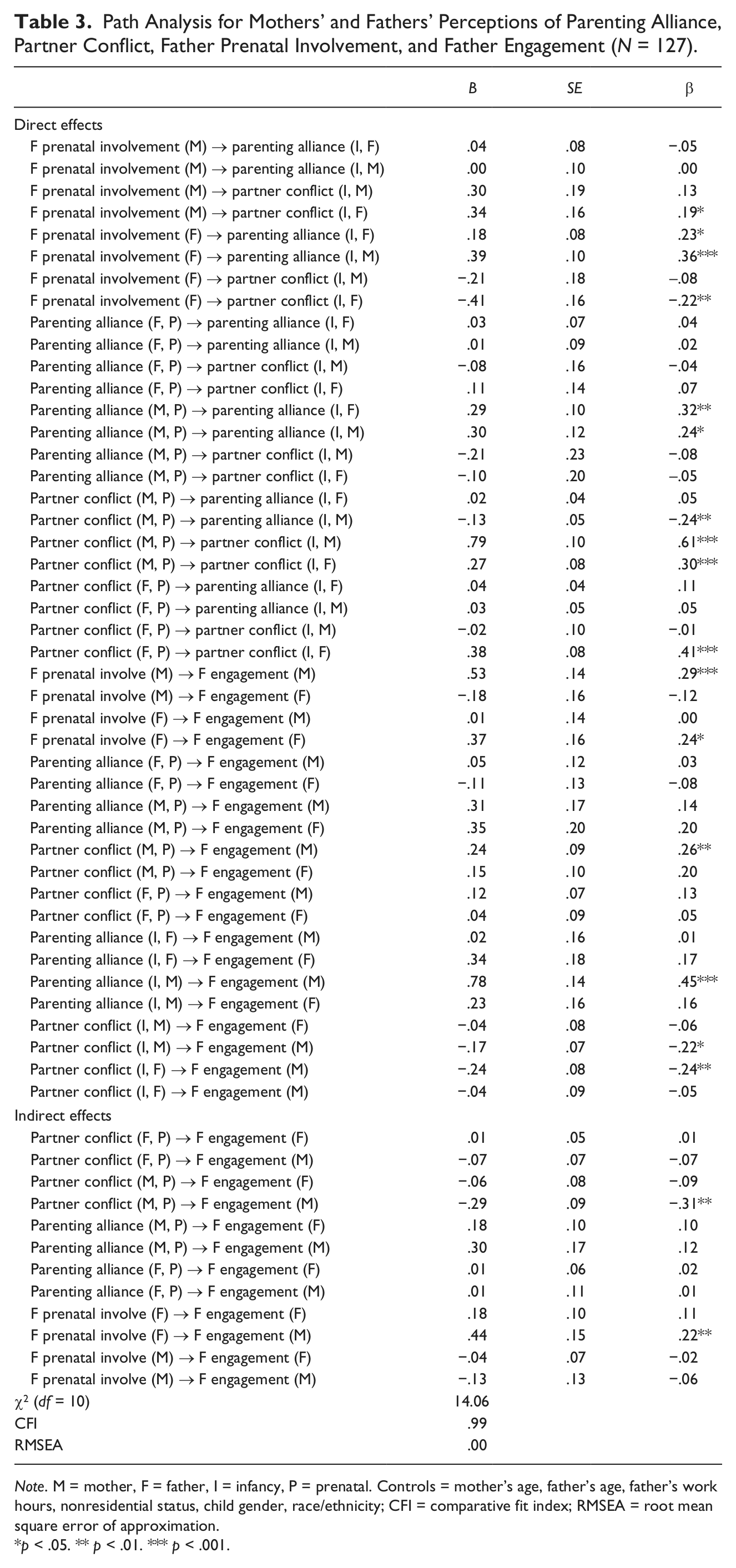
Note. M = mother, F = father, I = infancy, P = prenatal. Controls = mother’s age, father’s age, father’s work hours, nonresidential status, child gender, race/ethnicity; CFI = comparative fit index; RMSEA = root mean square error of approximation.
p < .05. ** p < .01. *** p < .001.

Path analysis of partner conflict, parenting alliance, fathers’ prenatal involvement, and father engagement with infants.
Examination of the direct effects reveals mothers’ perceptions of parenting alliance during infancy were positively related to mothers’ reports of father engagement during infancy. There was no significant association between fathers’ perception of parenting alliance during infancy and his engagement with the infant. There were no significant associations between mothers’ or fathers’ reports of prenatal parenting alliance and father engagement with infants. Thus the first hypothesis of the study was supported: Alliance during infancy will be more closely linked to concurrent father engagement than will prenatal alliance. However, this was only the case for mothers.
The second study hypothesis suggested that young parents’ early representations of the parenting alliance will have an effect on later alliance. Only mothers’ perceptions of prenatal alliance were significantly associated with both mother and father perception of alliance during infancy, suggesting that mothers’ but not fathers’ representations of alliance before the birth of the baby show stability over time.
The present study hypothesized a spillover effect of prenatal partner conflict on parenting alliance during infancy (Hypothesis 3). Mothers’ perceptions of prenatal conflict were significantly and negatively associated with mothers’ perceptions of parenting alliance during infancy. Moreover, there was a fairly robust indirect effect of mothers’ perceptions of partner conflict before the birth of the baby on mothers’ perceptions of father engagement with the infant, which was partially mediated by mothers’ perceptions of parenting alliance during infancy. The size of the indirect effect was calculated by multiplying the coefficients for prenatal conflict (M) → infancy parenting alliance (M) (β = −.24) and infancy parenting alliance (M) → father engagement (M) (β = .45), which yields an indirect effect of .11. It should be noted that the indirect effect of mothers’ perceptions of partner conflict before the birth of the baby on mothers’ perceptions of father engagement with the infant was also partially mediated by mothers’ perceptions of conflict during infancy (β = .13). Thus, the spillover hypothesis was supported, but only in relation to mothers’ (not fathers’) perceptions of partner conflict, alliance, and engagement.
The fourth hypothesis suggested that fathers’ prenatal involvement would be positively and directly associated with higher quality parenting alliance and father engagement during infancy. Fathers’ perceptions of prenatal involvement were positively associated with higher levels of parenting alliance during infancy as perceived by fathers and mothers and higher levels of father engagement as perceived by fathers. Mothers’ perceptions of prenatal involvement were positively associated with mothers’ perceptions of father engagement but not with higher levels of parenting alliance. Moreover, there was a significant indirect effect of fathers’ perception of their prenatal involvement and father engagement with infants as perceived by mothers (fathers’ prenatal involvement (F) → infancy parenting alliance (M) [β = .36] × infancy parenting alliance (M) → father engagement (M) [β = .45] = .16). This indirect effect was mediated by mothers’ perception of parenting alliance during infancy. Thus, the fourth hypothesis was supported, but the associations between fathers’ prenatal involvement and alliance or engagement depended on who rated the behavior.
Discussion
The present study modeled the associations among parenting alliance, partner conflict, fathers’ prenatal involvement, and fathers’ engagement with infants. A strength of the present study was that both adolescent mothers’ and young fathers’ perceptions of these variables were included. As hypothesized (Hypothesis 1), the results showed that concurrent (proximal) measures of parenting alliance during infancy (as perceived by mothers) were more closely linked to father engagement than were prenatal measures of parenting alliance. Researchers have suggested that parents start to form mental representations of parenting alliance before the birth of the child, and these representations are predictive of postbirth parenting alliance and father engagement. The present study revealed no significant associations between prenatal parenting alliance and father engagement. It is possible that adolescent parents’ representations of parenting alliance before the birth of the child are not associated with father engagement with the infant because adolescents do not yet have a clear understanding of what is involved in sharing the care of a new baby. Just as adolescent parents often have inappropriate expectations for their infant’s development (O’Callaghan, Borkowski, Whitman, Maxwell, & Keogh, 1999), they may also have unrealistic expectations of the parenting alliance, especially before the child’s birth. Adolescent parents may be overly idealistic before the birth about the extent to which they will be able to work together as a team with their partner. Their experiences with forming a parenting alliance may change dramatically once the baby arrives and the couple realizes the responsibilities of caring for a newborn.
It was interesting to note, however, that there were significant associations between prenatal parenting alliance and postbirth parenting alliance among adolescent mothers but not among young fathers (Hypothesis 2). Adolescent mothers may be able to construct a more accurate representation of the parenting alliance before the child’s birth because of their close physical involvement with the child. As a result, adolescent mothers’ perceptions of parenting alliance may be more closely linked to their postbirth perceptions of coparenting. These findings also suggest that adolescent and young fathers may benefit from prenatal intervention programs designed to help them understand the nature of parenting alliances (i.e., coparenting) and to begin communicating with their partners about how they will work together as a team.
The present study hypothesized a spillover effect of prenatal partner conflict on parenting alliance and father engagement during infancy (Hypothesis 3). The results supported this hypothesis but only in relation to adolescent mothers’ perceptions of parenting alliance, conflict, and engagement. Mothers’ perceptions of prenatal partner conflict were not only negatively associated with parenting alliance during infancy, but they were also indirectly related to father engagement through parenting alliance during infancy. These findings extend the work of previous researchers who have focused on adult parents (e.g., Krishnakumar & Buehler, 2000) by showing that the spillover effect also applies to adolescent mothers and young fathers. It is not clear from these data, however, whether partner conflict causes stress in parents which then compromises the parenting alliance (Kitzmann, 2000) or whether partner conflict is misdirected to the parenting alliance through mechanisms such as scapegoating or detouring (Stroud et al., 2011).
It is noteworthy that the spillover effect seems to depend on the gender of the parent. It is possible that adolescent mothers have more at stake in terms of the quality of the parenting alliance and they are therefore more sensitive to couple conflict. That is to say, because adolescent mothers are likely to assume long-term primary caregiving responsibility for the child, they are also more likely to have greater influence on whether they will allow the young father to coparent the child. Adolescent mothers may partially base their decision to form a parenting alliance with the young father on the level of conflict in the couple relationship. On the other hand, father’s sense of the parenting alliance may be based more on factors such as the mother’s gatekeeping or his own feelings about becoming a father.
The findings partially supported the hypothesis that fathers’ prenatal involvement would be positively associated with the parenting alliance and with father engagement (Hypothesis 4). Fathers’ ratings of their own prenatal involvement were positively associated with both fathers’ and mothers’ perceptions of the parenting alliance during infancy, but mothers’ perceptions of fathers’ prenatal involvement were not significantly associated with mothers’ rating of the alliance. These findings show some consistency with a growing body of research showing that adult fathers’ engagement with young children is longitudinally associated with subsequent quality of the coparenting relationship (Jia & Schoppe-Sullivan, 2011). It is interesting to note that the significant associations among fathers are between their perceptions of their own prenatal involvement and later parenting alliance, but the significant associations among mothers are between quality of the prenatal mother–father relationship (partner conflict, parenting alliance) and parenting alliance during infancy. Young fathers may feel that their alliance with the mother is determined more by their early involvement in the pregnancy whereas adolescent mothers may feel that their alliance with the father is determined more by partner relationship factors. These findings may have implications for practice with young parents. For example, interventions that focus on the quality of the partner relationship during pregnancy may be associated with improved parenting alliances as perceived by mothers but not by fathers. Practitioners may need to be aware that interventions during pregnancy may have different effects depending on the gender of the parent.
Fathers’ prenatal involvement was positively and directly associated with father engagement with the infant as perceived by both mothers and fathers, supporting a growing body of research showing linkages between fathers’ prenatal involvement and later engagement (Cabrera et al., 2008). An unexpected finding was that fathers’ prenatal involvement was indirectly associated with fathers’ engagement through its effect on mothers’ perception of parenting alliance during infancy. These findings are significant because they suggest that fathers’ prenatal involvement is not only important for fostering the development of the father–child bond in infancy, but it may also be associated with higher levels of engagement with the infant because the mother and father have an improved parenting alliance. Young fathers need to establish early patterns of engagement with their children in hopes that the father–child relationship will be stable over time. Consequently, there may be considerable value in promoting young fathers’ prenatal involvement in programs for young parents.
Limitations
A limitation of the present study was that data were collected from a very low-income population in a large urban community. Thus, the findings cannot be generalized to the U.S. population of adolescent mothers and young fathers. The results may also be biased because parents who participated in the study agreed to participate in an intervention program for expecting adolescent parents. It is not clear how this sample of young parents differs from other adolescent parents. It is possible that the participants of this study included couples who were more committed to each other than adolescent couples in the general U.S. population. If that is the case, then the findings may be more representative of couples with better quality relationships. However, it is also possible that the couples who participated in the study were expectant parents with more inter-personal or personal problems. These couples may have agreed to participate in the intervention study because they were seeking help from a program to address relationship difficulties. There were also limitations due to missing data. Mothers who were missing parenting alliance and father engagement assessments during infancy were more likely to report lower prenatal parenting alliance, suggesting that attrition occurred among couples with lower levels of commitment to each other. Given these various limitations, I suspect that the findings are more representative of higher functioning adolescent mothers and young fathers.
Conclusions
The present study found that adolescent mothers’ and young fathers’ perceptions of the parenting alliance before the birth of the baby were not good predictors of fathers’ engagement with the infant. Mothers’ perceptions of parenting alliance during infancy were robust correlates of mothers’ reports of father engagement with infants. Moreover, mothers’ (but not fathers’) perceptions of prenatal parenting alliance were significantly related to parenting alliance in infancy. These findings suggest that practitioners and researchers may need to help young couples obtain more realistic understandings of what it means to form a parenting alliance before the birth of the baby and how it can affect later coparenting relationships and father engagement.
Mothers’ perceptions of prenatal partner conflict were linked to lower quality parenting alliances during infancy, and there was an indirect spillover effect of mothers’ perceived prenatal conflict on later father engagement. This is an important finding because adolescent mothers often control the extent to which fathers have access to their children. These results suggest that it is especially important for practitioners and researchers to assess the adolescent mothers’ perceptions of partner conflict before the child’s birth, as these perceptions may influence the extent to which the father is involved with the baby shortly after the child is born.
Finally, mothers’ and fathers’ perceptions of fathers’ prenatal involvement were robust correlates of fathers’ engagement with infants. These findings are consistent with the growing body of research showing the importance of fathers’ early involvement with the mother and fetus. We caution, however, that the results of this study may be more applicable to higher functioning adolescent mothers and young fathers.
Footnotes
Declaration of Conflicting Interests
The author(s) declared no potential conflicts of interest with respect to the research, authorship, and/or publication of this article.
Funding
This study was funded by a grant from the U.S. Department of Health and Human Services, Public Health Service, Office of Adolescent Family Life Research, Grant # APRPA006004-03-02