




Abstract
This study evaluated associations between dating partners’ risky family backgrounds in childhood and current romantic relationship functioning. One hundred young adult dating couples (N = 200) self-reported childhood risky family environments (e.g., conflict, nonnurturing behavior, neglect) and current relationship satisfaction. Partners also engaged in laboratory-based conflict, which was subsequently coded for positive and negative interaction qualities. Results revealed a positive linkage between males’ and females’ risky family backgrounds. Actor–Partner Interdependence Modeling, which accommodated dyadic data and controlled for neuroticism levels, indicated that males’ riskier family backgrounds were associated with their female partners’ greater observed negative interaction qualities (e.g., conflict) and with their partners’ lower observed positive interaction (e.g., support, communication skills). Experiencing interparental divorce during childhood moderated the results, with riskier family backgrounds holding more negative implications for subsequent young adult romantic relationships when the parents remained together during childhood compared to when the parents divorced.
An emergent literature documents potential enduring legacies of childhood contexts by showing lasting relations between riskier family environments in childhood and later psychosocial and health impairments in adulthood. “Risky families” describe a childhood family environment marked by frequent or high levels of conflict, aggression, and/or neglect in place of a harmonious, warm, and nurturing environment (Taylor, Lerner, Sage, Lehman, & Seeman, 2004). Repetti, Taylor, and Seeman (2002) document several childhood emotional and behavioral issues that are associated with the presence of riskier family environments, including anxiety, conduct disorder, antisocial behavior, and suicide. Beyond childhood effects, these problematic family backgrounds have been shown to predict elevated psychopathology in young adulthood, which, in turn, is associated with impaired stress responses, lower self-rated health, and impaired interpersonal relations (Taylor et al., 2004). Other studies have established linkages between risky family backgrounds and young adults’ increased depressive symptoms (Sen et al., 2010) and anxiety levels (Edge et al., 2009), as well as disrupted emotion processing (Taylor, Eisenberger, Saxbe, Lehman, & Lieberman, 2006). Childhood family environment also serves as a moderator of well-being, with young adults from riskier family backgrounds experiencing poorer sleep in the face of daily distress (Hanson & Chen, 2010). Recent work sheds further light on the physical health implications of such family environments, with men and women (aged 33-45 years) who reported riskier childhood family environments showing significantly increased risk for coronary heart disease over a 10-year period (Loucks, Almeida, Taylor, & Matthews, 2011).
To date, however, limited work has tested whether and how the model of childhood “risky families” sets the stage for later relationship outcomes. Regular exposure to conflict, regardless of the severity, is correlated with children becoming sensitized, or primed, to anger at a younger age, which can lead to greater distress, fear, and anxiety when interacting with others (Davies & Cummings, 1998; Repetti et al., 2002). Previous investigation of young adults shows that experiencing more frequent and severe hostile conflict between parents in childhood systematically predicts more negative expectations, problematic communication, and verbal and physical aggression in early intimate relationships (Duggan, O’Brien, & Kennedy, 2001; Grych & Kinsfogel, 2010). Thus, it follows that variations of risky family environments in normative samples would be expected to hold implications for close connections across the life course, especially intimate partnerships.
Substantial evidence supports the notion that riskier family environments should hold important consequences for later young adult intimate relationships. Observation and evaluation of interparental relationships during childhood help establish individuals’ expectations and beliefs about their future romantic relationships (Roisman, Collins, Sroufe, & Egeland, 2005; Weigel, 2007). Previous research suggests that these early experiences shape children’s perception of communication and conflict resolution and may further contribute to the ways in which individuals relate with others as they grow older (Crockett & Randall, 2006; Dinero, Conger, Shaver, Windaman, & Larson-Rife, 2008; Gardner, Busby, & Brimhall, 2007). Conger, Cui, Bryant, and Elder (2000) documented reliable linkages between family of origin divorce, emotional abuse, and interpersonal violence and the same characteristics in children’s intimate relationships as adults.
Partners who display better conflict resolution abilities generally report higher quality relationships overall. When couples communicate with each other effectively, they are able to prevent potentially conflictual topics from turning into destructive disagreements (Domingue & Mollen, 2009). In a study of 736 couples, Gardner et al. (2007) found that males’ and females’ reports of conflict management in the relationship (both their own and their partner’s) were positively correlated with relationship satisfaction. Also, a study of young adult couples showed that those with negative conflict styles and those who described their conflict as “not satisfactorily resolved” reported lower overall relationship satisfaction (Cramer, 2000). Research has shown that self-reported relationship quality and observed ratings of how couples handle their conflict discussions reliably predict the long-term functioning of the relationship, including whether it continues (Gottman, 1994; Heyman, 2001). Accordingly, the current study adopts a multidimensional approach to assess young adults’ romantic relationship outcomes, drawing on partners’ self-reported relationship satisfaction and observers’ ratings of negativity and positivity during conflict interactions.
Characteristics of partners or their relationships may account for or moderate the linkages between early family environments and young adult intimate relationship functioning. In terms of moderation, partners who experienced divorce during childhood could be considered particularly susceptible to having risky family backgrounds predict negative relationship functioning. Childhood divorce is a significant stressor and requires navigating multiple transitions (Amato & Keith, 1991); thus, it is expected to moderate by strengthening the negative implications of risky family environments for young adult relationships. In terms of covariation, the personality characteristic of neuroticism could account for the associations under investigation if individuals with higher neuroticism systematically reported greater negative perceptions of family environment or relationship functioning as a function of their general negative affect (e.g., White, Hendrick, & Hendrick, 2004). Thus, the study’s central analyses account for partners’ neuroticism levels.
The current study evaluated whether risky family environments in childhood are associated with dating relationship functioning in young adulthood, broadly operationalized from observed positive and negative interaction qualities and self-reported omnibus relationship satisfaction. First, we expected that partners’ ratings of risky family backgrounds would be positively interrelated. Consistent with a large assortative mating literature that has reliably documented partner similarity along a host of characteristics, including personality traits, health behaviors, and psychological distress (e.g., Etcheverry & Agnew, 2008; Lesnik-Oberstein & Cohen, 1984; Merikangas, 1982), individuals may select partners who experienced relatively similar family psychosocial backgrounds. Next, we hypothesized that individuals who reported riskier family environments in childhood would report lower current levels of romantic relationship satisfaction, even after accounting for general negative affect. Also, these individuals were predicted to display more negative interaction qualities with their dating partner (negative affect and conflict) along with fewer positive qualities (communication, support/validation, positive affect, and engagement) during their conflict discussion as coded by trained observers. Given the interdependent nature of relationship dynamics, we further predicted that individuals’ risky family backgrounds would hold problematic implications for their partners’ relationship functioning as well (i.e., lower reported relationship satisfaction, lower observed positive interaction, higher observed negative interaction), again controlling for negative affectivity. Moderating effects were also predicted such that associations between riskier family backgrounds and poorer relationship functioning would be stronger for partners who experienced parental divorce in childhood. Given scant evidence of sex differences in the risky families literature (e.g., Loucks et al., 2011; Repetti et al., 2002), we did not posit differential relations for males versus females. The current study employed a dyadic analytic approach to examine these predictions.
Method
Participants and Procedure
For this study, 100 heterosexual dating couples were recruited from a medium-sized Midwestern city to participate in a study investigating “the connections between romantic relationships and individuals’ well-being.” Recruitment flyers were posted on several college campuses and throughout the community. To participate, couples were required to be dating each other exclusively for at least 1 month. Couples who were currently married, had been married previously, or had children were ineligible for participation. Recruitment details are provided in Papp (2010). The original study included additional assessments; however, only measures related to the current focus on linkages between risky family environments and romantic relationship functioning are detailed here.
Couples had been dating an average of 22.7 months (SD = 18.0 months, range = 1-72 months), and 22% of the couples were cohabitating. The respective ages of male and female participants averaged 21.0 years (SD = 3.1 years, range = 18-36) and 20.3 years (SD = 2.4 years, range = 18-30). The race/ethnicity breakdown for men in the sample was 82% White, 6% Asian, 4% Hispanic, and 8% other. The women in the sample were 85% White, 6% Asian, 2% Hispanic, 2% Black, and 5% other. Twenty percent of females and 19% of males reported experiencing one or more interparental divorces during their childhood. One female and four males experienced more than one childhood divorce (they all reported two), so the indicator of childhood divorce was dichotomized in analyses (0 = no childhood divorce, 1 = childhood divorce). For both females and males, these divorces occurred between ages 2 and 17 (M age = 7.5 years). Of the 20 females from divorced backgrounds, 10 experienced one or more parental remarriage before the age of 18; of the 19 males, 15 experienced a parental remarriage during childhood. On average, parental remarriage occurred 5 years following the first or only divorce in childhood.
Couples each attended one laboratory-based session on campus that lasted between 1.5 and 2 hours and was facilitated by trained research assistants. Individuals provided consent prior to participation and were given $10 each on completion. The study was approved by the university’s institutional review board.
Measures
The Risky Families Questionnaire (Taylor et al., 2006) captures respondents’ experiences of conflict, coldness, and neglect in the family environment during childhood. Responses are made on a Likert-type scale ranging from 1 (rarely or none of the time) to 4 (most of the time). As examples, items included the following: “I observed quarrelling or shouting between parents” and “I lived with a substance abuser.” This questionnaire has been validated against coded interviews of childhood dynamics (Taylor et al., 2004) and exhibits satisfactory psychometric properties (e.g., Cronbach α = .77; Loucks et al., 2011). In the current study, alpha was .85.
Couples participated in a discussion about a source of conflict in their relationship. First, potential topics were selected using the Areas of Disagreement Scale (Roberts, Tsai, & Coan, 2007), wherein both partners individually rated the intensity of areas of potential conflict in their relationship (e.g., money, communication, sex, alcohol/drug use). When partners were reunited, they were given the option of sharing their responses with each other to help select one area to discuss during the recorded 7.5-minute discussion. Couples were asked to discuss the topic as they would in everyday life. Immediately following, partners independently answered questions concerning the discussion, including how similar it was to typical conversations, on a scale ranging from 0 (not at all) to 9 (a whole lot). Both males and females, respectively, described their own (M = 7.02, SD = 1.96; M = 7.74, SD = 1.68) and partner (M = 6.81, SD = 1.98; M = 7.48, SD = 1.82) behavior as externally representative.
Trained observers subsequently reviewed recordings of the couples’ interactions and coded them using an adapted version of the Interactional Dimensions Coding System (IDCS; Julien, Markman, & Lindahl, 1989; Kline et al., 2004). Using a 1 (extremely uncharacteristic) to 9 (extremely characteristic) response scale, observers rated affect (e.g., positivity), content (e.g., problem solving), and couple (e.g., withdrawal) codes. In the current sample, each conflict discussion was coded independently by two observers. On completion, the observers compared ratings and discussed discrepancies until all ratings were in agreement within 1 point. Analyses used the final conferred scores, which were averaged when perfect agreement was not reached. Based on the IDCS, Cox, Paley, Burchinal, and Payne (1999) developed combinations of psychometrically sound variables to produce composite scores of positive and negative interaction qualities. Specifically, observed positive interactions were characterized by positive affect, support/validation, communication skills, and lack of withdrawal, whereas observed negative interactions consisted of negative affect and conflict (Cox et al., 1999). Indicators of interrater reliability for these interaction variables were satisfactory in previous research (range = .75-.95; Cox et al., 1999). In the current study, alpha levels for males’ and females’ positive and negative interaction qualities exceeded .80.
Participants provided reports of the satisfaction they feel in their current relationship using the Couples Satisfaction Index (CSI; Funk & Rogge, 2007), which was developed using item-response theory. The version used in the current study includes 32 items, rated on differential response scales. The CSI correlates in expected directions with standard relationship measures such as the Dyadic Adjustment Test and Marital Adjustment Test and demonstrates excellent psychometric properties (e.g., Cronbach α = .98; Funk & Rogge, 2007). In the current study, alpha exceeded .90.
Ten items from Goldberg’s Neuroticism Scale (Goldberg, 1992) were used to assess participants’ negative affectivity. Respondents indicated how much each adjective generally describes them on a scale from 1 (not at all) to 4 (very). Example adjectives included “irritable” and “high-strung.” Reliability of this scale has been documented previously (e.g., Cronbach α = .88; Zvolensky, Sachs-Ericsson, Feldner, Schmidt, & Bowman, 2006); in the current study, alpha levels of males’ and females’ neuroticism scores were .80.
Data Analysis Plan
The current study applies the Actor–Partner Interdependence Model (APIM; Cook & Kenny, 2005; Kashy & Kenny, 2000) in AMOS (Arbuckle, 2011) to examine associations between risky family backgrounds and romantic relationship functioning among young adult dating partners. This dyadic analytic approach (shown in Figure 1) accounts for the fact that partners’ report on (and are observed in) the same intimate relationship and therefore are likely to evidence interdependent outcomes. In addition, the approach accounts for partners’ potential similarity in risky family environments as well as in any specified covariates (see also Gilbar, Weinberg, & Gil, 2012). As described in Kenny, Kashy, and Cook (2006), the APIM simultaneously tests both partners’ independent variables (in this case, risky family background) in relation to their own and their partner’s dependent variables (here, romantic relationship functioning). As shown in Figure 1, the current APIM specifies males’ and females’ risky family environment scores as intercorrelated predictors of their own and their partners’ relationship outcome variables. The error terms on the relationship outcomes are also intercorrelated. To account for the possibility that general negative affectivity is associated with interpersonal outcomes, males’ and females’ neuroticism scores are included as intercorrelated predictors of their own and their partners’ relationship functioning scores; correlations between neuroticism scores and risky family environment scores for males and females were also controlled (see Figure 1). The parameters of interest are actor effects (i.e., the effect of a person’s risky family environment on their own relationship outcome) and partner effects (i.e., the effect of a person’s risky family environment on their partner’s relationship outcome). Each association reported represents a unique effect, statistically controlling for all of the other associations in the model. Traditional model fit statistics are not relied on because the standard APIM is recursive (Cook & Kenny, 2005).
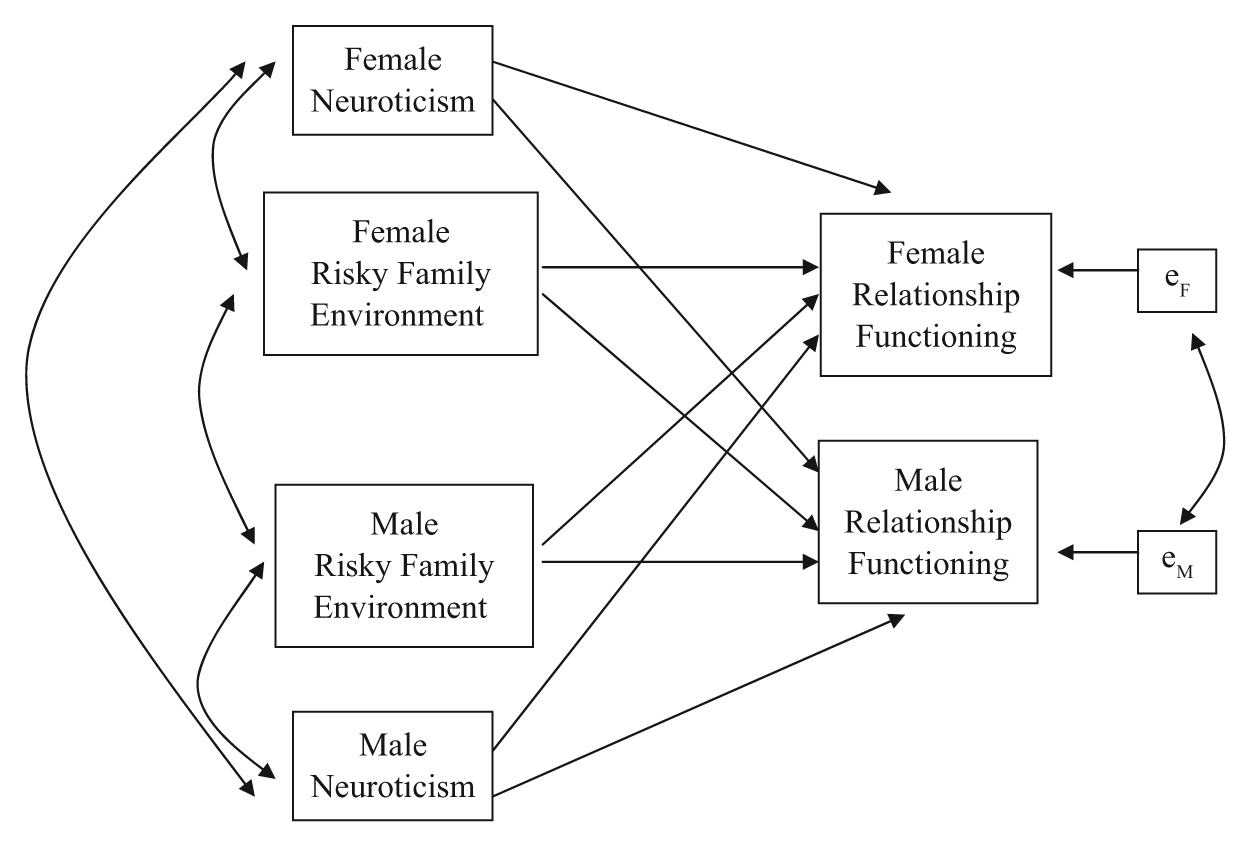
The Actor−Partner Interdependence Model is used to test associations between males’ and females’ risky family environment and romantic relationship functioning (i.e., relationship satisfaction, positive interaction, and negative interaction). The model also controls for actor and partner effects of neuroticism, correlated predictor variables, and correlated errors.
Extending the framework described above, the APIM easily accommodates tests of moderation (for a recent moderated APIM example, see Papp, Kouros, & Cummings, 2010). In the current study, moderation is tested by the inclusion of the predictor variable (i.e., risky family background; centered), the moderator (i.e., dichotomized indicator of interparental divorce in childhood), and the product term of the two. Examination of the interaction terms indicates whether linkages between risky family environments and romantic relationship functioning vary systematically by interparental divorce history in childhood. Again, partners’ intercorrelated neuroticism scores are included as covariates of males’ and females’ relationship functioning outcomes. Statistically significant moderator terms are probed following conventions in the literature (see Holmbeck, 2002), wherein conditional associations are calculated for interparental divorce history groups (i.e., intact vs. divorced).
Results
Preliminary Analyses
Table 1 presents descriptive statistics and correlations among the study variables for males and females. Paired-samples t tests indicated that males’ and females’ levels of the study variables did not differ from each other (all p values > .10), with one exception: females reported significantly higher levels of neuroticism than males, t(99) = 2.83, p = .006. For males and females, neuroticism scores were positively associated with risky family environments and demonstrated consistent associations with relationship outcomes in the predicted directions (see Table 1). Experiencing an interparental divorce in childhood was positively correlated with levels of risky family environments for both males and females. Males’ and females’ risky family backgrounds were positively correlated. In addition, male and female partners’ relationship satisfaction ratings were positively associated with each other, and trained observers rated males and females as exhibiting similar ways of interacting during relationship conflict. Within males and females, indicators of relationship functioning were also correlated in the expected directions, with partner-reported relationship satisfaction demonstrating reliable associations with observers’ ratings (see Table 1).
Descriptive Statistics and Correlations.

Note. Correlations for females appear above the diagonal in the matrix; correlations for males appear below the diagonal. Boldface values along the diagonal are correlations between male–female dyad members.
p < .05. **p < .01.
Childhood Risky Family Environments and Romantic Relationship Functioning
APIM results that provided estimates of the associations between risky family environment and romantic relationship functioning, accounting for males’ and females’ levels of negative affectivity and intercorrelations among the covariates, are shown in Table 2. Females’ childhood risky family backgrounds were not reliably associated with either their own or their male partners’ dating relationship outcomes (i.e., relationship satisfaction, positive and negative conflict interaction qualities). As shown in Table 2, males’ risky family backgrounds were associated with their female partners’ lower positive interaction in conflict (e.g., support, engagement, communication skills) as coded by trained observers. In addition, males’ childhood risky family environments were associated with their partners’ greater observed negative interaction qualities during conflict (e.g., conflictual behavior, negative affect). Males’ risky family environments in childhood were not reliably associated with their own observed behavior in conflict interactions or with either their own or their partners’ self-reports of current dating relationship satisfaction (see Table 2). In sum, direct associations revealed more consistent connections between males’ than females’ riskier family environments in childhood and romantic relationship functioning, and findings were more robust with observed indicators of relationship outcomes as compared with self-reports.
Actor–Partner Interdependence Model Results: Associations Between Risky Family Environment and Romantic Relationship Functioning.
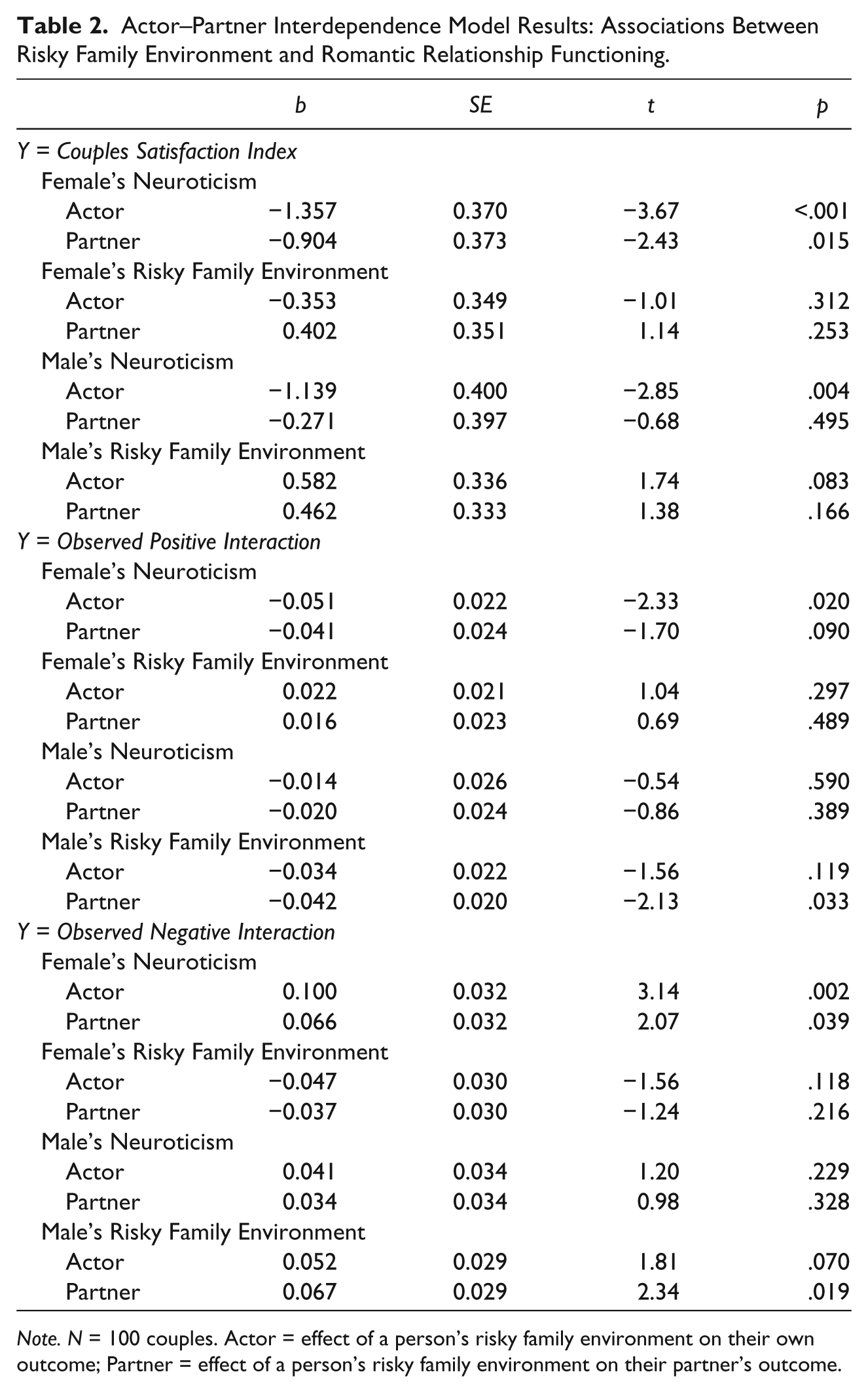
Note. N = 100 couples. Actor = effect of a person’s risky family environment on their own outcome; Partner = effect of a person’s risky family environment on their partner’s outcome.
Experiencing Interparental Divorce in Childhood as a Moderator
Moderating tests indicated that interparental divorce and risky family backgrounds interacted to predict relationship outcomes of satisfaction, observed positivity, and observed negativity following different patterns for male and female partners (see Table 3). Again, models account for males’ and females’ levels of negative affectivity. Specifically, as shown in Table 3, females’ interparental divorce history and risky family background levels interacted to predict their own (but not their male partners’) self-reported relationship satisfaction. Post-hoc probing with multigroup models in AMOS (Byrne, 2001) calculated conditional associations for partners from intact versus divorced families and revealed that, for females from intact families, risky family environment tended to be negatively associated with their relationship satisfaction (coefficient = −1.062, t = −1.91, p = .055), whereas females from divorced households evidenced no association between risky family environment and relationship satisfaction (coefficient = 0.054, t = 0.20, p = .845). Females’ interparental divorce and risky family environment did not interact to predict either their own or their male partners’ observed interaction qualities (see Table 3).
Actor–Partner Interdependence Model Results: Testing Interparental Divorce in Childhood as a Moderator.
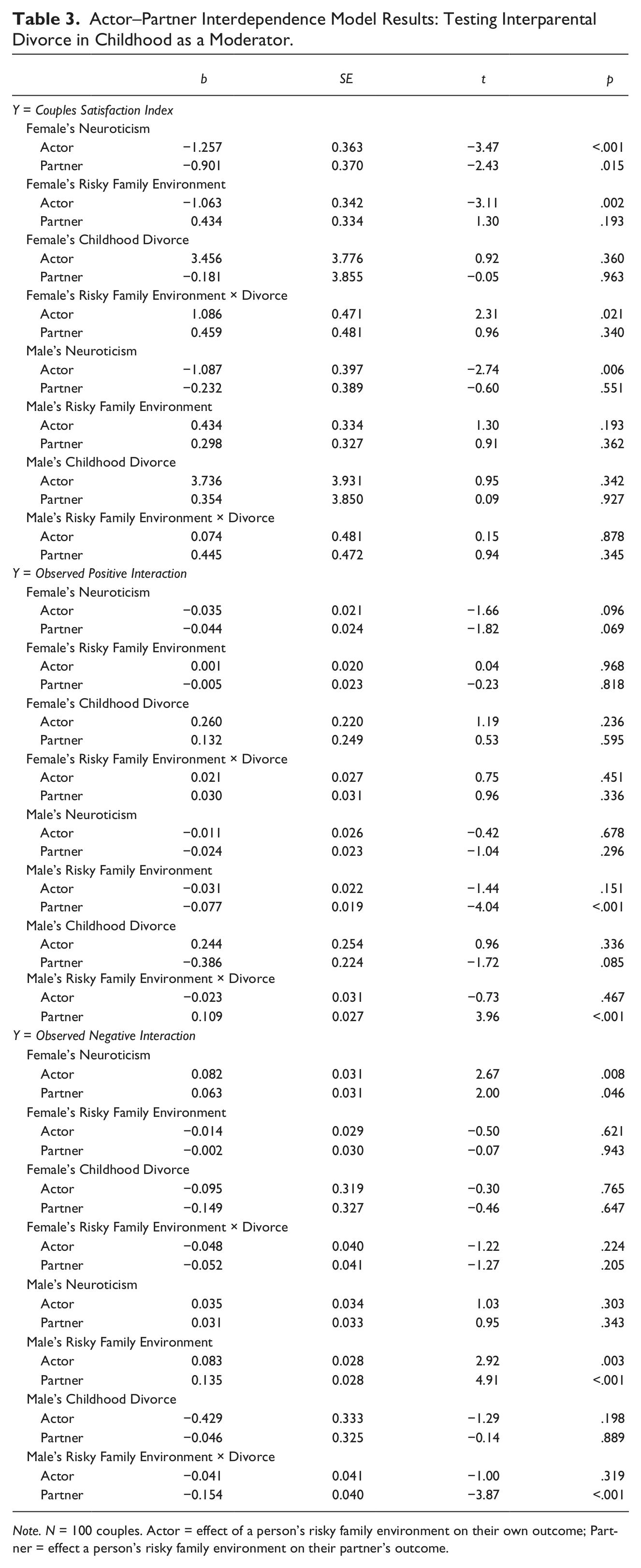
Note. N = 100 couples. Actor = effect of a person’s risky family environment on their own outcome; Partner = effect a person’s risky family environment on their partner’s outcome.
Males’ experience of interparental divorce during childhood moderated the linkages between their risky family environments and their female partners’ (but not their own) observed positivity and negativity during conflict interactions (see Table 3). Specifically, among couples with a male from an intact interparental relationship, post hoc probing showed a negative association between males’ risky family backgrounds and their female partners’ observed positivity (coefficient = −0.076, t = −2.86, p = .004); for couples with a male from a divorced household, no reliable association between males’ risky family backgrounds and their partners’ positivity was observed (coefficient = 0.028, t = 0.55, p = .585). In addition, multigroup post hoc probing revealed that, among couples that included a male from an intact childhood family, risky family environment was positively associated with their partners’ observed negativity (coefficient = 0.130, t = 3.57, p < .001); for couples including a male from a divorced household, no significant linkage between risky family environment and female negativity was evidenced (coefficient = 0.031, t = 0.36, p = .719). Males’ childhood divorce history did not interact with risky family levels to predict either their own or their female partners’ self-rated relationship satisfaction (see Table 3).
In sum, moderating tests revealed consistent support for experiencing divorce in childhood as a moderator, but in alternate directions than we had hypothesized: Overall, riskier family backgrounds held more negative implications for subsequent young adult romantic relationship outcomes when the parents of male and female partners remained together during childhood as compared to when the parents divorced.
Discussion
The current study contributes to an emergent body of literature on the long-term implications of risky family environments for individuals’ psychological and physical well-being (Repetti et al., 2002; Taylor et al., 2004; Taylor et al., 2006) by demonstrating associations between riskier family backgrounds and intimate relationship outcomes. Using a sample of young adult dating couples and a dyadic modeling approach, the current study found that males’ risky family backgrounds had more consistent negative implications than females’ family backgrounds for romantic relationship outcomes. Male partner effects (i.e., males’ family background associated with their female partners’ outcomes) were found for observed positive and negative interaction qualities. Neither actor effects nor partner effects were documented for direct relations between females’ risky family environment and relationship outcomes.
It is interesting to note that more consistent effects were detected using observed ratings of romantic functioning than self-reported satisfaction as dependent variables. Although speculative, it may be possible that our findings tap a phenomenon wherein the present romantic relationship is interpreted a certain way in light of the past, with people from riskier families who have positive romantic experiences feeling especially happy about the current relationship. This would align with research from the attachment field suggesting that the association between generalized attachment representations (stemming from early attachment relationships with caregivers) and romantic functioning depend on partner-specific attachment evaluations in the romantic relationship (Treboux, Crowell, & Waters, 2004). Another interpretation of the current findings aligns with Butler and Wampler’s (1999) earlier work on couple communication, which suggests that behavior change (i.e., captured using observations) precedes attitude change (i.e., captured by self-report). Future investigations of the long-term effects of risky family environments are encouraged to consider and test these possible explanations.
We tested interparental divorce in childhood (experienced by nearly 20% of this sample of young adults) as a possible moderator of the direct associations. Although we initially expected that having riskier family environments and experiencing an interparental divorce would be a “double whammy” for young adults in intimate relationships, results indicated that riskier family environments were associated with poorer romantic relationship functioning in young adulthood (e.g., lower reported relationship satisfaction, higher observed negativity) for both male and female partners whose parents remained together as compared to those whose parents had divorced. Thus, it appears that experiencing parental divorce during childhood buffers young adulthood romantic relationships from the potential negative correlates of riskier family environments—at least when evaluated retrospectively. Although interparental divorce in childhood is associated with numerous stressors and transitions (e.g., financial strain; Lye, 1996), the process may ultimately reduce or end the riskier family characteristics (i.e., hostility, aggression) and provide children with the perspective that distressed situations can be changed. Our findings align with a previous literature that posits the quality of relationships and the family climate to be more important in long run than whether divorce occurred or not (e.g., Doucet & Asletine, 2003). Indeed, research has shown that when divorce ends chronic interparental conflict, children eventually fare better on measures of psychological well-being (Amato, Loomis, & Booth, 1995). Alternatively, it is possible that those young adults who managed the stressors and transitions associated with divorce in childhood were more proactive in seeking out better relationships for themselves. Young adults who experienced especially risky family environments that never subsided seem most likely to continue negative dynamics in their own intimate relationships. Although replication of the current findings and longitudinal investigations are needed, we suspect that these partners and couples face the greatest risks for dysfunctional relationship patterns and processes as these partnerships continue and eventually form families.
Interestingly, our results indicated a significant positive association between male and female partners’ risky family levels. This aligns with a literature on assortative mating that suggests partners in committed relationships evidence substantial similarity on personality traits, health behaviors, and psychological distress (e.g., Etcheverry & Agnew, 2008; Merikangas, 1982). Our single-assessment, correlational design does not permit investigation of the possibility that partners become more similar reporters of relationship functioning and other characteristics over time. However, a post hoc correlation test showed that male and female partners’ risky family scores remained significantly linked even after accounting for length of dating relationship (rpartial = .21, p = .036).
Although not anticipated, sex differences emerged in the current results, with males’ risky family backgrounds (both directly and interactively with interparental divorce experience) emerging as potent predictors of their female partners’ relationship functioning. Research that has considered indicators of family risk separately indicates family aggression (reflecting riskier environments) to be positively associated with dating abuse and victimization (Grych & Kinsfogel, 2010; Milletich, Kelley, Doane, & Pearson, 2010) and parental involvement (reflecting less risky environments) to be negatively associated with dating violence (Miller, Gorman-Smith, Sullivan, Orpinas, & Simon, 2009), consistently for both males and females. However, studies in this literature have typically not included either dyadic data (i.e., both partners in a relationship provide information) or partner effects in their models (i.e., one person’s family background predicting the other partner’s outcome), thus leaving the associations documented in the current study relatively unexplored.
Males and females generally have different friendship experiences growing up, which may contribute to differential skill or preferences for communication and conflict resolution. Girls show a tendency to display more intimacy and self-disclosure within their friendships, whereas boys focus more on participating in activities and competition (Underwood & Rosen, 2009). Because of a greater amount of practice handling conflicts and expressing emotions in these early friendships, females may be better able than males to learn new ways of engaging with close others, thereby replacing potentially ineffective or destructive models they received from their families of origin. As such, future longitudinal work is needed to assess whether childhood friendships mediate the negative linkages between risky family environments and young adult romantic outcomes and whether pathways vary for males versus females.
Our research design included self-ratings of neuroticism and observers’ ratings of conflict communication to mitigate the possibility that the observed linkages between risky family environments in childhood and current romantic relationships were accounted for by more general negative tendencies and evaluations. Still, future research could build on the current findings in multiple ways. First, the risky family assessment used here prompted respondents to consider “your family environment during childhood”; thus, participants who were from for divorced or blended households may have been considering more than one family situation. Presently, it is unknown whether risky family characteristics are best considered cumulatively across contexts or whether each situation holds unique implications for future relationship functioning. Additional work is needed to understand how these risky family evaluations (and their implications) change with age and across family situations and other developmental processes. A necessary next step for advancing the field is to test pathways proposed in Repetti et al.’s (2002) model to elucidate the linkages between risky family environments and romantic relationship outcomes documented here. For example, young adults from riskier family backgrounds may exhibit more physiological reactivity in intimate conflict, which is expected to hamper their ability to communicate and resolve differences constructively (Laurent & Powers, 2007). As well, other family processes could be included (e.g., family socioeconomic standing; Conger, Ge, Elder, Lorenz, & Simons, 1994) to ensure that findings are uniquely attributable to family emotional climate. Kraft and Luecken (2009) reported that young adults from divorced families had lower cortisol levels sampled across a challenging speech task in the laboratory compared to those from intact families; in addition, lower family income mediated the association between parental divorce and cortisol. Across questions, additional research is needed using more diverse couples to extend generalizability of the findings, with variations in family income expected to be a particularly potent avenue for future study directions. These extensions of the present research have the potential to inform relationship education and treatment approaches.
Given that intimate relationship distress uniquely predicts greater utilization of mental health services for men and women (Schonbrun & Whisman, 2010), clarifying associations between early childhood experiences and later intimate relationship functioning can be helpful to the field for several reasons. First, when individuals are able to understand their own styles of communicating and handling conflict, they may become better able to explore how these patterns have developed over their lifetime and evaluate their effectiveness in everyday life. As people gain knowledge about ways these patterns of interacting have been passed on, they will be better able to understand their responses and learn what changes need to be made in order to have more positive interactions in their relationships. Second, it may be helpful for distressed partners and couples to attend to contexts of childhood relationships. Especially for partners who describe conflictual, nonnurturing, and/or neglectful family environments that endured and did not end through divorce, additional awareness or intervention may be helpful for discussing methods to make positive changes in their own intimate relationship dynamics and, ultimately, in their own family climate. Such efforts align with recommendations that treatment and prevention programs consider both interparental relationship status and levels of discord in the family for promoting children’s development and well-being (Grych, 2005). In closing, the current study provides a foundation for future research to continue examining the implications of risky family backgrounds for relational outcomes and encourages future attention in dyadic studies to the ensuing legacies of psychosocial family environments in childhood.
Footnotes
Acknowledgements
We gratefully acknowledge the research assistance provided by numerous undergraduate students in the UW-Madison Couples Lab.
Authors’ Note
This article is based on a master’s thesis completed by Sarah Maleck under the direction of Lauren M. Papp.
Declaration of Conflicting Interests
The author(s) declared no potential conflicts of interest with respect to the research, authorship, and/or publication of this article.
Funding
The author(s) disclosed receipt of the following financial support for the research, authorship, and/or publication of this article: We gratefully acknowledge support provided by the School of Human Ecology and The Graduate School at UW-Madison.