



Abstract
Little research has been done on the social contexts of adolescent sexual behaviors in sub-Saharan Africa. As part of a longitudinal cohort study (N = 1275) of teenage girls and boys in two Ghanaian towns, interviewers administered a 26-item questionnaire module intended to assess four dimensions of youth–adult relationships: monitoring, conflict, emotional support, and financial support. Confirmatory factor and traditional psychometric analyses showed the four scales to be reliable. Known-groups comparisons provided evidence of their validity. All four scales had strong bivariate associations with self-reported sexual behavior (odds ratios = 1.66, 0.74, 0.47, and 0.60 for conflict, support, monitoring, and financial support, respectively). The instrument is practical for use in sub-Saharan African settings and produces measures that are reliable, valid, and predictive of sexual behavior in youth.
A large body of research supports the importance of various aspects of parent–youth relationships to sexual behaviors, contraceptive use, and pregnancy among adolescents in the United States. Perhaps the most consistent finding in this literature is an inverse association between parental monitoring and the likelihood of sexual initiation: Youth are less likely to initiate sex when their parents know who their friends are, where they are at various times of day and night, and so on (see, e.g., DiClemente et al., 2001; Longmore, Manning, & Giordono, 2001; Miller, Forehand, & Kotchick, 1999; Rose, Koo, Bhaskar, Anderson, White, & Jenkins, 2005; Stanton et al., 2000; Yang et al., 2007; and see Miller, Benson, & Galbraith, 2001, for a review). Nor is parental monitoring the only family process variable that has been linked to adolescent sexual initiation. Other factors such as connectedness to parents or the quality of the parent–youth relationship (e.g., Davis & Friel, 2001; McBride, Paikoff, & Holmbeck, 2003; Ream & Savin-Williams, 2005; Resnick et al., 1997; Sieving, McNeely, & Blum, 2000) may play important roles in shaping the sexual behaviors and reproductive health of adolescents. Accordingly, working with parents to increase monitoring and improve the quality of parent–youth relationships has become a strategy for promoting the sexual and reproductive health of adolescents (Manlove et al., 2002; Stanton et al., 2004; Wu et al., 2003).
Less is known about the influences of family relationships on adolescents’ sexual behaviors in sub-Saharan Africa. The incidence of serious sexual and reproductive health problems among young people in that region highlights the importance of these issues (Bearinger, Sieving, Ferguson, & Sharma, 2007; Hindin & Fatusi, 2009). Accordingly, much epidemiological research has addressed the sexual and reproductive health of adolescent girls and boys in sub-Saharan Africa. But research on the family contexts of adolescent sexual risk behaviors in that region remains relatively sparse.
Nevertheless, there are several reasons to suppose that family contextual factors may play important roles. For one, scholars working in the region have consistently pointed to the centrality of the family as an institutional context for a wide range of social behaviors, including sexuality and reproduction, both historically and in the context of recent social change in sub-Saharan Africa (e.g., Bradley & Weisner, 1997; Oppong, 1997). Indeed, findings from recent surveys of adolescents in sub-Saharan Africa point to the importance of household composition and family processes as determinants of sexual behaviors. In a survey of unmarried 12- to 24-year-olds in Ghana, for instance, investigators found that girls who were not living with a parent or adult guardian were twice as likely as those who were living with both parents to report ever having sex (Karim, Magnani, Morgan, & Bond, 2003). In a more recent survey of 12- to 19-year-olds in Burkina Faso, Ghana, Malawi, and Uganda, investigators found that parent/caregiver monitoring was among the most consistent predictors of self-reported sexual initiation among girls and boys in multivariate models (Biddlecom, Awusabo-Asare, & Bankole, 2009; Kumi-Kyereme, Awusabo-Asare, Biddlecom, & Tanle, 2007). Similar findings have emerged from other surveys and qualitative research in the region (Babalola, Tambashe, & Vondrasek, 2005; Wamoyi, Fenwick, Urassa, Zaba, & Stones, 2011).
Still, several important limitations characterize this small but growing body of research. One is that most existing studies have considered only certain aspects of parent–child relationships, especially monitoring, to the exclusion of others (for an exception, see Dimbuene & Defo, 2011). An exclusive focus on parental monitoring may obscure other important aspects of parent–adolescent relations and lead to an incomplete understanding of the ways in which family processes influence adolescent sexual behaviors. Perhaps the most influential model of the family context of adolescent behavior and development locates parenting styles along two dimensions: demandingness (also referred to as control, the extent to which parents set and enforce rules) and responsiveness (also called support, the extent to which parents provide love, warmth, and understanding; Maccoby & Martin, 1983). A large body of research links the combination of high demandingness and high responsiveness, termed authoritative parenting, to positive adolescent development (e.g., Baumrind, 1991; Fletcher, Steinberg, & Sellers, 1999). In contrast, styles that are low in demandingness (called indulgent or permissive), responsiveness (called authoritarian), or both (called indifferent or rejecting-neglecting) have been linked to adolescent problem behaviors and negative developmental outcomes (e.g., Durbin, Darling, Steinberg, & Brown, 1993; Lamborn, Mounts, Steinberg, & Dornbusch, 1991; for reviews, see Smetana, Campione-Barr, & Metzger, 2006; Steinberg, 2001). A fuller appreciation of the ways in which families influence adolescent sexual behaviors, therefore, may require a consideration of practices beyond monitoring that are related to the responsiveness/support as well as the demandingness/control dimension.
A second limitation of existing research is the lack of published data documenting the reliability and validity of measures of parent–youth relationships in Africa. It should not be taken for granted that instruments that have been widely used in the United States will prove to be equally reliable and valid in Africa. One reason for this involves differences between the United States and Africa in the social organization of child care. In the United States, the care of children, including adolescents, is largely the responsibility of parents, to be carried out within a nuclear household. Of course, not all young people in the United States actually live in nuclear households. But sub-Saharan Africa is characterized by a long-standing and enduring tradition of what Weisner (1997) calls socially distributed child care. In this system, responsibility for an adolescent does not rest solely with the parents, but may be shared by older siblings, aunts and uncles, grandparents, and other relatives and nonrelatives within and beyond the household (see also Adepoju & Mbugua, 1997; Harkness & Super, 1992; Schlegel & Barry, 1991; Whiting & Edwards, 1988). Questionnaire-based indicators of constructs like monitoring, connectedness, and conflict for adolescents that are predicated on a nuclear family household may therefore produce invalid measurements and misleading conclusions when they are used in an African setting. Minor changes to the wording of questions—such as, for example, changing the word “parent” to the phrase “parent figure” in questionnaire items—may not be sufficient to capture the complexity of adult influences on adolescents in these settings. If a 13-year-old boy is looked after primarily by his 19-year-old brother, will he regard that brother as a “parent figure” and respond to questionnaire items accordingly?
A third concern is that research on this topic in the United States has not dealt extensively with one factor that may impinge heavily on parent–youth relations in Africa, namely, economic hardship. Several scholars (e.g., Oppong, 1997; Weisner, 1997) have written about the consequences of economic hardship for African adolescents’ relationships with adults in their lives. When a teenager’s parents and immediate family cannot pay school fees or provide other necessities, the child (if a girl) may be married off or (for either sex) may be fostered out to the household of better-off extended family relations. Even if the teenager remains in his or her parents’ household, the parents’ authority over the child and the child’s respect for the parents may be undermined by their financial circumstances. These dynamics may be implicated in the widely discussed “sugar daddy” phenomenon in which teenage girls form transactional sexual partnerships with older, financially secure men (Luke, 2003; Madise, Zulu, & Ciera, 2007). Data from at least one recent study support this view (Camlin & Snow, 2008). Yet questionnaire-based instruments measuring adolescent–adult relations in the United States do not typically include items dealing with the potential consequences of severe financial hardship.
In the current study, therefore, we accomplish five things. First, we present an easy to implement questionnaire-based instrument consisting of 26 items that use common stem and response option formats to measure four dimensions of youth–adult relations: monitoring, conflict, emotional support, and financial support. Second, we establish the internal consistency of these four multi-item scales in a sub-Saharan African setting (southeastern Ghana). The content and format of the items in these scales are derived from existing instruments, but we have substantially altered many of them to make them more appropriate to an African setting. Third, we document the relative frequency with which young people in this part of Ghana identify different adults (mothers, fathers, aunts, older siblings, etc.) as performing these functions. Fourth, we provide evidence for the validity of these scales in the form of known-groups comparisons: girls versus boys, older versus younger teenagers, and so on. And finally, we show that these scales are strongly associated with self-reported sexual intercourse, even after controlling for several sociodemographic confounders.
Methods
Participants and Procedures
The data for this study come from the first wave of a longitudinal cohorts study dealing with the social contexts of adolescent sexual and reproductive health in two towns in southeastern Ghana. Both communities are market towns along a major road connecting Ghana’s capital, Accra, with the capital of Volta region. Each has a population of just under 15,000 according to the 2000 census. The towns differ, however, in the prevalence of HIV. One is located within a district that has suffered a severe localized HIV epidemic, believed to be driven at least in part by circular migration of young women from this community to Abidjan, the capital of neighboring Cote D’Ivoire, during the 1990s. The other town, just 40 km away, is in a district that has seen virtually no cases of HIV in sentinel surveillance at prenatal clinics.
In the summer of 2010, a team of field workers from the Institute for Statistical, Social, and Economic Research at the University of Ghana visited all dwelling structures in both communities and compiled a list of eligible youth. Unmarried girls and boys age 13 to 14 years (the younger cohort) or 18 to 19 years (the older cohort) were eligible. A simple random sample of youth was drawn from this list, and interviewers then attempted to recruit the youth according to a protocol that was approved by institutional review boards at the George Washington University and the Noguchi Memorial Institute for Medical Research at the University of Ghana. In total, 1,275 youth agreed to participate and were interviewed, for a response rate of 75%. Interviews were conducted in a mixture of English and Ghanaian languages at interviewing centers established by the field teams in the two study sites.
Table 1 presents a description of the sample. More girls than boys participated. The two towns were approximately equally represented. There were somewhat more participants in the younger than in the older cohort, especially for girls, perhaps reflecting a combination of out-migration by older girls and ineligibility of older girls due to marriage. Most participants were currently attending school, but a substantial minority of participants, especially girls in the older cohort, was not in school. Many were living with neither biological parent; households including both biological parents were not the norm for either girls or boys.
Description of Sample a .
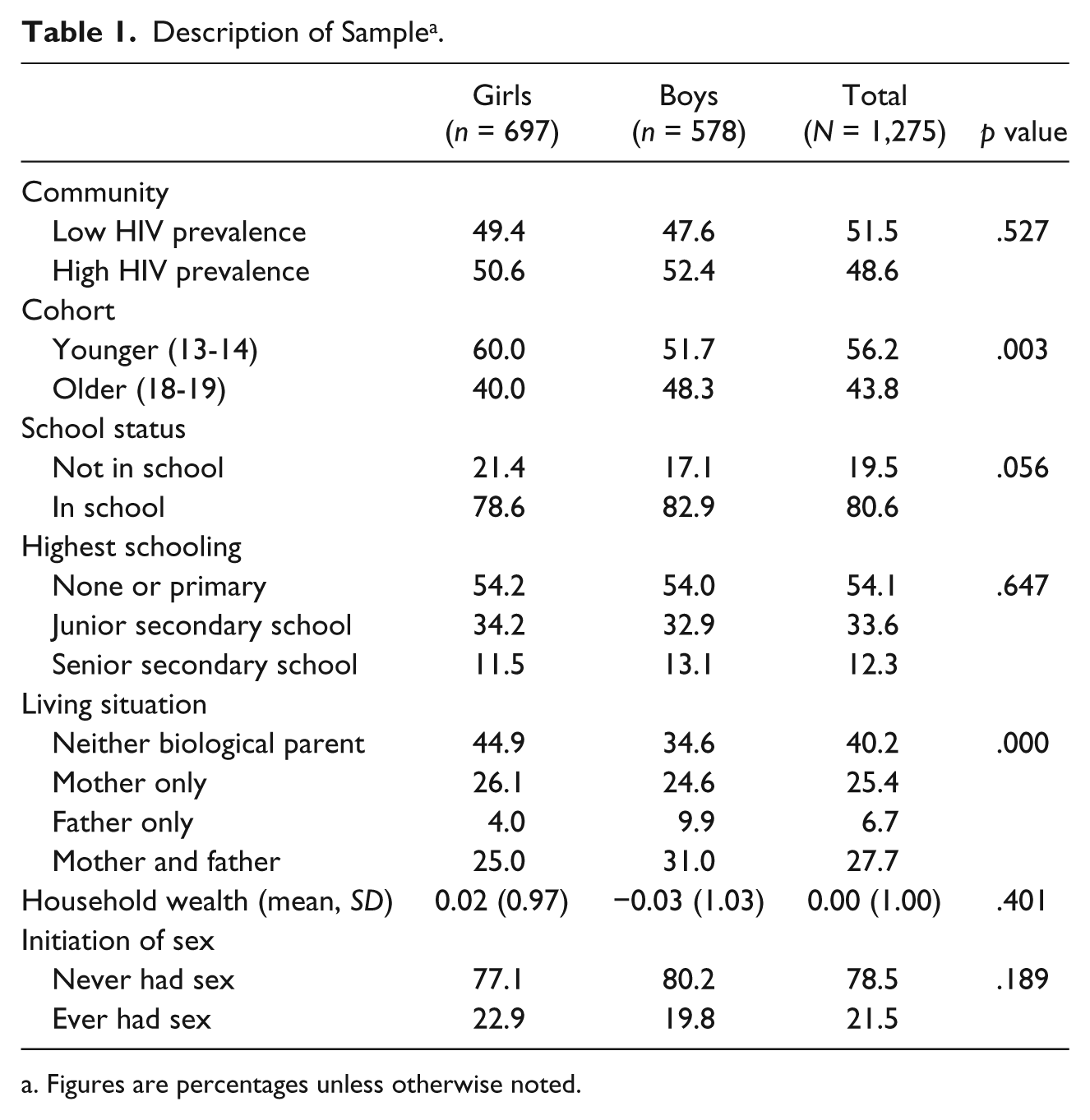
Figures are percentages unless otherwise noted.
Measures
The primary measures of interest here include 26 items intended to measure four dimensions of youth–adult relations: monitoring, conflict, emotional support, and financial support. To accommodate heterogeneity in the composition of households in sub-Saharan Africa and the possibility that adults beyond the household may play important roles in the lives of teenagers there, each item consists of a statement beginning with the phrase, “There is an adult in my life who . . .” For each item, the participant was asked to indicate whether the statement was very true, somewhat true, or not at all true for him or her. For analytic purposes, we coded these responses as 3, 2, and 1, respectively. The content of the 26 items, our a priori plan for sorting them into scales, and the distribution of responses according to gender are presented in Table 2. Many of the items are modeled on those from an earlier survey of Ghanaian youth (McQuestion, Ahiadeke, Posner, & Williams, 2011). The content of the items in the monitoring scale was nearly identical to those from a similar instrument described by Brown, Mounts, Lamborn, and Steinberg (1993). The content of most items in the emotional support scale is similar to that of items in the Inventory of Parent Attachment (Armsden & Greenberg, 1987). The content of most items in the conflict scale is similar to that of items in the Network of Relationships Inventory: Behavioral Systems Version (Furman & Buhrmester, 2009).
Distribution of Responses to Questions About Relationships With Adults, by Sex (%), and Factor Loadings a .
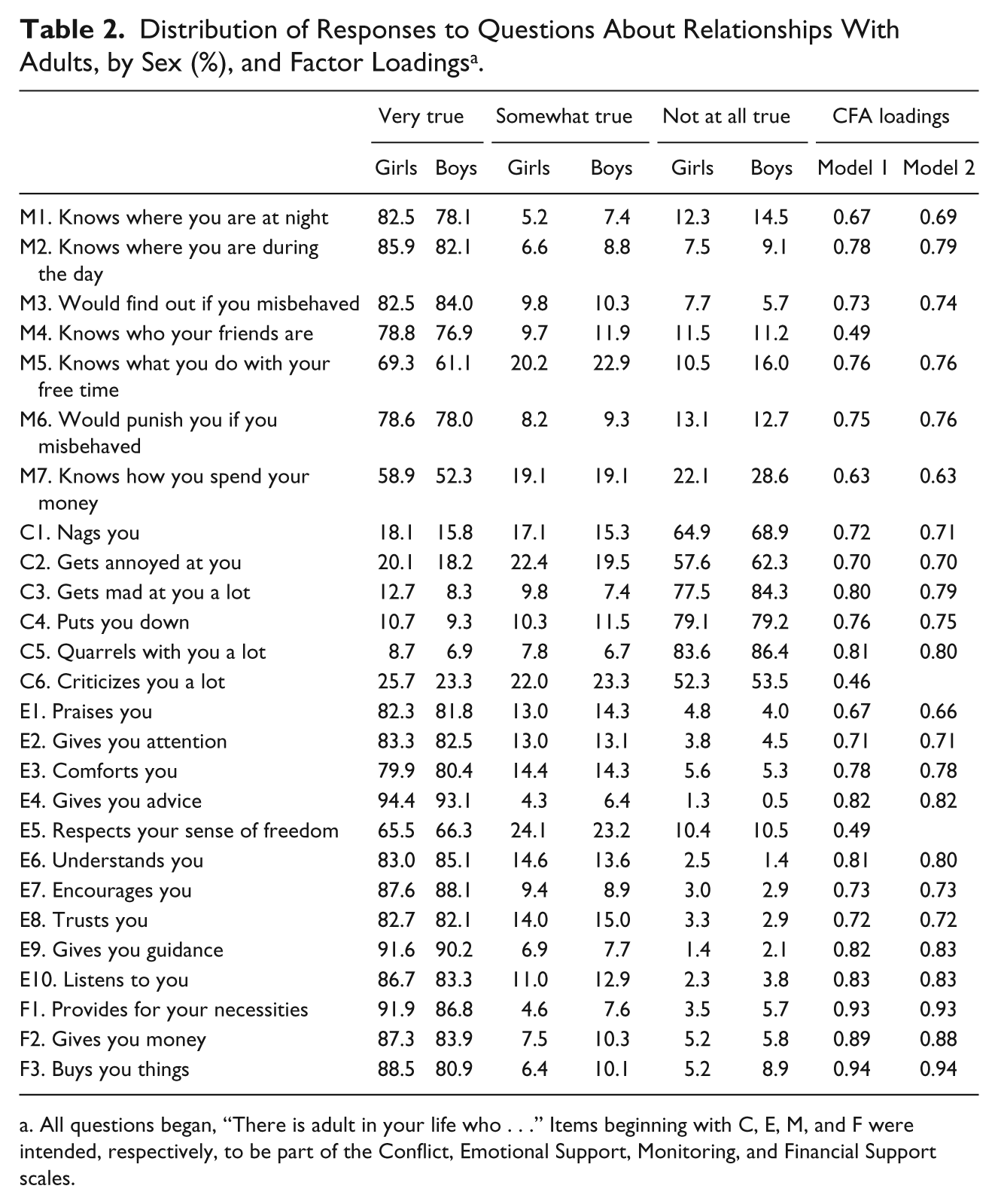
All questions began, “There is adult in your life who . . .” Items beginning with C, E, M, and F were intended, respectively, to be part of the Conflict, Emotional Support, Monitoring, and Financial Support scales.
After six of the items (E4, E10, M1, M4, M6, and F1), respondents who indicated that the statement was very true or somewhat true for them were then asked “Which adults usually . . .” Response options included mother, father, aunt, uncle, grandmother, grandfather, older sibling, cousin, teacher, minister, health care provider, neighbor, friend’s parent, and other. Interviewers accepted multiple responses. Those who indicated “other” were asked to specify, and those responses were then categorized as caregiver/guardian, other relative, or other nonrelative.
The interviews with youth participants covered many topics beyond the 26 items discussed above. In this article, we restrict our attention to the following. Each respondent’s sex was recorded by the interviewer based on the physical appearance of the participant. Community of residence (high vs. low HIV prevalence) is an administrative variable based on the sampling frame from which each participant was drawn. Age was assessed by asking each participant her or his age in completed years. Household composition (living with both biological parents, biological mother only, biological father only, or neither biological parent) was assessed by asking the youth whether each parent was alive and, if so, whether she or he lived in the same household as that parent. School status (in vs. out of school) was assessed by asking the participant how much time she or he normally spent attending school. Those who indicated that they spent a lot of time or some time in school were coded as in school; those who reported spending no time in school were coded as out of school. Highest schooling was assessed by asking each participant the highest level and year of schooling that she or he had attained. For analytic purposes we divide youth into three groups: those who never attended school or who attended only primary school, those who attended at least some junior secondary school, and those who attended any senior secondary school or beyond. Household wealth was assessed by asking each participant whether her or his household, compared to others in the area, was wealthier than most, fairly typical, or poorer than most (coded 2, 1, and 0), and whether the household had electricity, a radio, a television, a refrigerator, a flush toilet, and motorcycle or scooter, and a working car or truck (each coded 0 or 1). This set of items was moderately internally consistent (Cronbach’s α = .72); we therefore summed them to form a household wealth index similar to that used in other surveys (Rutstein & Johnson, 2004). Finally, sexual initiation status was assessed by asking each respondent whether she or he had ever had sex.
Analysis
Our analysis was conducted in five stages. The first stage consisted of the computation of simple frequencies on the 26 focal items as well as the six follow-up questions dealing with which adults played the different roles.
The second stage dealt with the internal consistency of the items in the four proposed scales. We approached this issue in two ways: (a) using confirmatory factor analysis and (b) using logistic regression to examine heterogeneity in the bivariate associations between each item and self-reported sexual initiation. Because our items used three ordinal response options, standard methods of estimating confirmatory factor analysis models (which rely on the assumption of multivariate normality) are not appropriate. We therefore conducted these analyses using the matrix of polychoric correlation coefficients and weighted least squares estimation as suggested in recent methodological literature (Flora & Curran, 2004; Holgado-Tello, Chacón-Moscoso, Barbero-García, & Vila-Abad, 2010; Yang-Wallentin, Jöreskog, & Luo, 2010). We first estimated a four-factor model using all of 26 items, with each item loading on its respective factor. We evaluated the fit of the model using several goodness-of-fit indices: the comparative fit index (CFI), the Tucker–Lewis index (TLI), the root mean squared error of approximation (RMSEA), and the standardized root mean squared residual (SMSR). Generally, values of CFI and TLI in excess of .95, and values of the RMSEA and SMSR less than .05, are considered indicative of adequate fit (Kline, 2005). We also examined the magnitude of the standardized factor loadings to identify items with low loadings. In parallel with this, we ran 26 logistic regression models, each using a single item to predict self-reported sexual initiation. We then examined the resulting odds ratios for items within each scale, in order to identify items whose association with self-reported sexual initiation was substantially different from the associations of other items in the same scale. We removed from the scales those items that had low (<.5) standardized factor loadings and/or associations with self-reported sexual initiation that were inconsistent with the associations of other items in the same scale.
In the third stage of the analysis, we examined the validity of the scales using a known-groups approach. After removing items with low loadings or discrepant associations with self-reported sexual initiation, we computed scale scores by taking the average of the items in each of our scales and then standardizing (subtracting the mean and dividing by the standard deviation). We then examined the pattern of associations between the scale scores and select sociodemographic variables. Based on existing literature and our familiarity with the study sites, we expected that girls would be more heavily monitored than boys but would also have more conflict with adults; that younger and in-school participants would be more heavily monitored, supported, and financially supported than older and out-of-school participants, and would have less conflict than adults; that household wealth would correlate positively with financial support and monitoring; and that youth living with both biological parents would report more support, monitoring, and financial support than youth living with neither biological parent. The overall extent to which the pattern of associations in our data corresponds to these expectations we took as an indication of the (known-groups) validity of our scales.
In the fourth and final stage, we examined the extent to which scores on each of the four scales was predictive of participants sexual initiation status using a series of simple and multivariate logistic regression models.
Results
The distributions of responses to the 26 focal interview items are presented in the first part of Table 2. These data show that the majority of youth report low levels of conflict with and high levels of emotional support from the adults in their lives. The majority also report being closely monitored by one or more adults and receiving financial support from an adult.
The frequencies with which respondents identified different people in connection to six of the items are shown in Table 3. For all six of these items, mothers are by far the most frequently identified as providing monitoring, emotional support, and financial support. For five of the six items, fathers are the second most frequently identified person, followed by siblings, aunts, grandmothers, and uncles (on the sixth item, the rank order of father and sibling is reversed). These findings highlight the important roles played by older siblings and extended family members, especially aunts, uncles, and grandmothers. Nonfamily caregivers or guardians were identified by approximately 5% of youth on each of the six items. Although respondents mentioned other individuals, these occurred infrequently with a few exceptions (e.g., teachers do not infrequently advise youth and would punish them if they misbehaved, according to our respondents).
Distribution of Responses to “Which Adults Usually . . .” a .
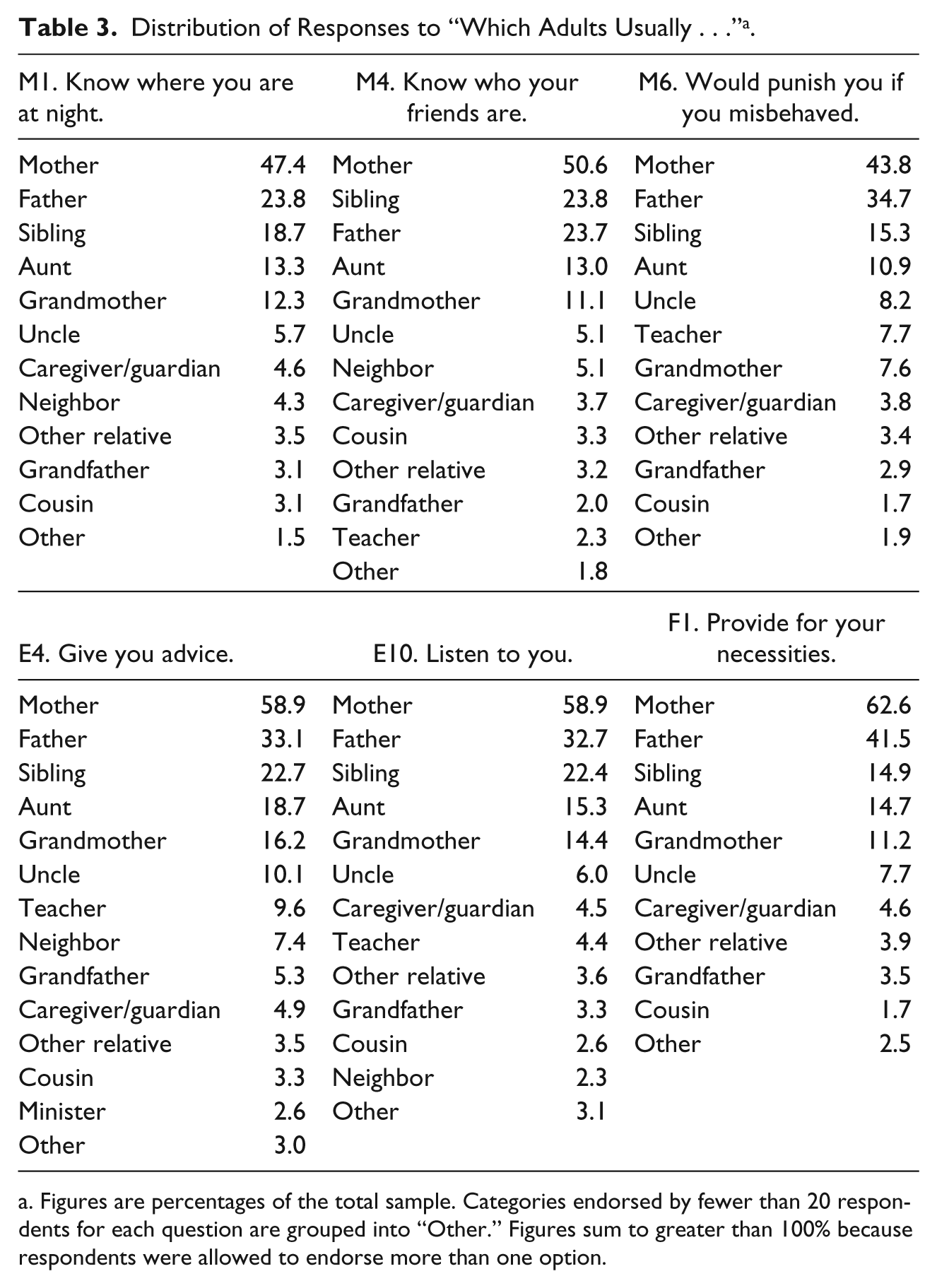
Figures are percentages of the total sample. Categories endorsed by fewer than 20 respondents for each question are grouped into “Other.” Figures sum to greater than 100% because respondents were allowed to endorse more than one option.
Our analyses of the internal consistency of the 26 items generally supported our a priori conceptualization of four distinct (albeit correlated) constructs and our corresponding partitioning of items into scales. The last two columns in Table 2 present factor loadings from our confirmatory factor analysis models, and Figure 1 presents bivariate associations between the items and self-reported sexual behavior. The four factor model with all 26 items (Model 1) fit quite well (CFI = .946, TLI = .975, RMSEA = .045, SMSR = .065). Three items stood out as having low factor loadings (below .50). These were items M4 (“Knows who your friends are”), C6 (“Criticizes you a lot”), and E5 (“Respects your sense of freedom”). The same three items had bivariate associations with self-reported sexual initiation that differed substantially from the other items in those scales, as shown in Figure 1. On the basis of these findings, we removed those three items from their respective scales. A four factor model with the remaining 23 items fit slightly better (Model 2; CFI = .959, TLI = .982, RMSEA = .043, SMSR = .060).

Bivariate associations between youth–adult relations items and self-reported sexual initiation.
Each of the resulting four scales has adequate internal consistency according to the conventional criterion of Cronbach’s α > .70. The coefficient α for the monitoring, conflict, emotional support, and financial support scales are, respectively, .73, .73, .80, and .82. Sex-specific α coefficients deviated from these by no more than ±.03. The correlations between the four scale scores (derived by averaging the 5, 9, 6, and 3 items in the monitoring conflict, emotional support, and financial support scales) are not inordinately high. Conflict is correlated at −.16, −.15, and −.16 with support, monitoring, and financial support, respectively. Support is correlated at .53 with monitoring and .43 with financial support, and monitoring and financial support are correlated at .50. All correlation coefficients were statistically significant at the p < .001 level.
Associations between the four scale scores and select sociodemographic variables are presented in Table 4. The patterns observed here are largely consistent with our expectations. Compared with girls, boys report less conflict with, less monitoring by, and less financial support from adults in their lives. Youth in the older cohort report more conflict, less emotional support, less monitoring, and less financial support than those in the younger cohort. Youth who were attending school reported less conflict, more emotional support, more monitoring, and more financial support than out-of-school youth. Compared to youth who were living with both biological parents, youth living with neither biological parent reported less emotional support from adults, less monitoring, and less financial support. In general, this pattern of associations is highly consistent with expectations, providing support for the validity of the four scales.
Bivariate Correlates of Relationships with Adults a .
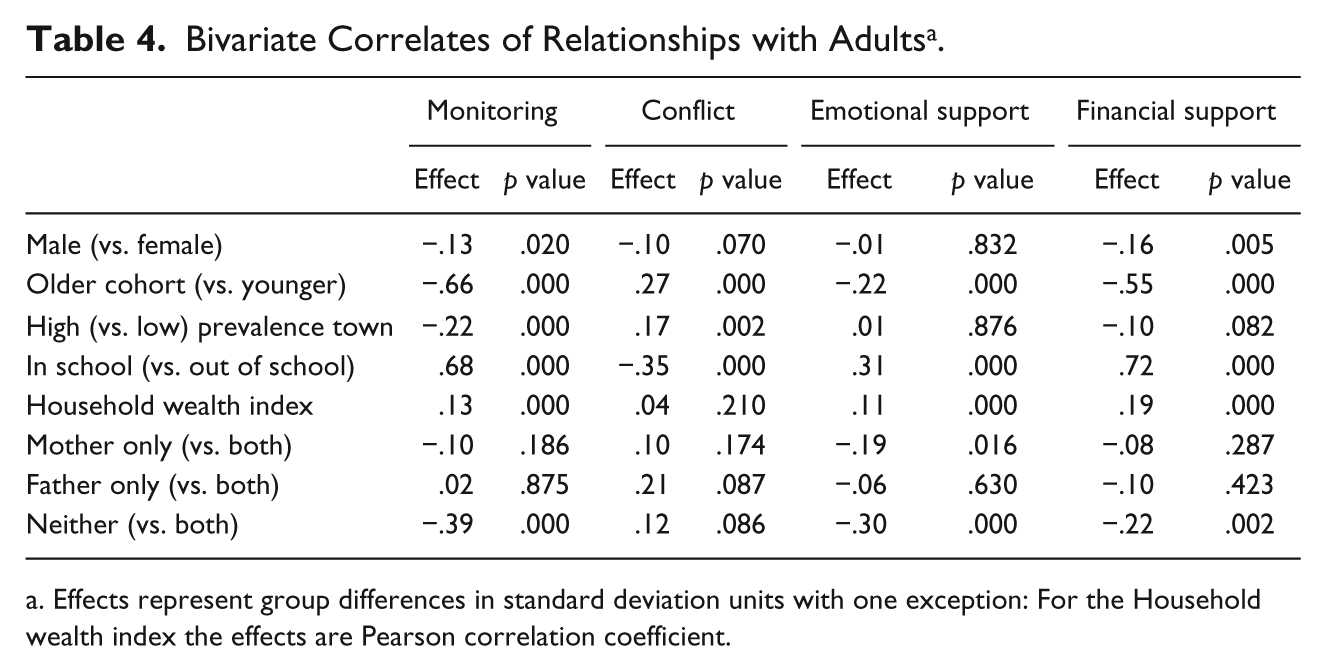
Effects represent group differences in standard deviation units with one exception: For the Household wealth index the effects are Pearson correlation coefficient.
Results of logistic regression models predicting whether or not each participant reported ever having sex are shown in Table 5. The first column collects the results of bivariate models for each predictor. All four scales show strong bivariate associations with initiation of sex: A standard deviation increase in conflict with adults is associated with a 66% increase in the odds of having had sex; a standard deviation increase in support is associated with a 26% decrease in the odds of having had sex; a standard deviation increase in monitoring is associated with a 53% decrease in the odds of having had sex; and a standard deviation increase in financial support is associated with a 40% decrease in the odds of having had sex. The pattern of bivariate associations between self-reported initiation of sex and various demographic variables reveals few surprises. Members of the older cohort were much more likely than members of the younger cohort to report sex. Youth residing in the high prevalence town, and youth residing with neither biological parent, were more likely to report sex. In-school youth and youth from wealthier households were less likely to report sex. Youth who had achieved higher levels of schooling were more likely to report sex. Most of these effects persist in a multivariable logistic regression model of self-reported sex in relation to demographic covariates. As shown in the second column of Table 5, however, the effect of highest achieved level of schooling disappears, presumably because that variable is highly collinear with age. Additionally, the protective effect of being male, which was not statistically significant in the bivariate analysis, becomes statistically significant when other demographic variables are controlled.
Logistic Regression Models of Sexual Behavior.
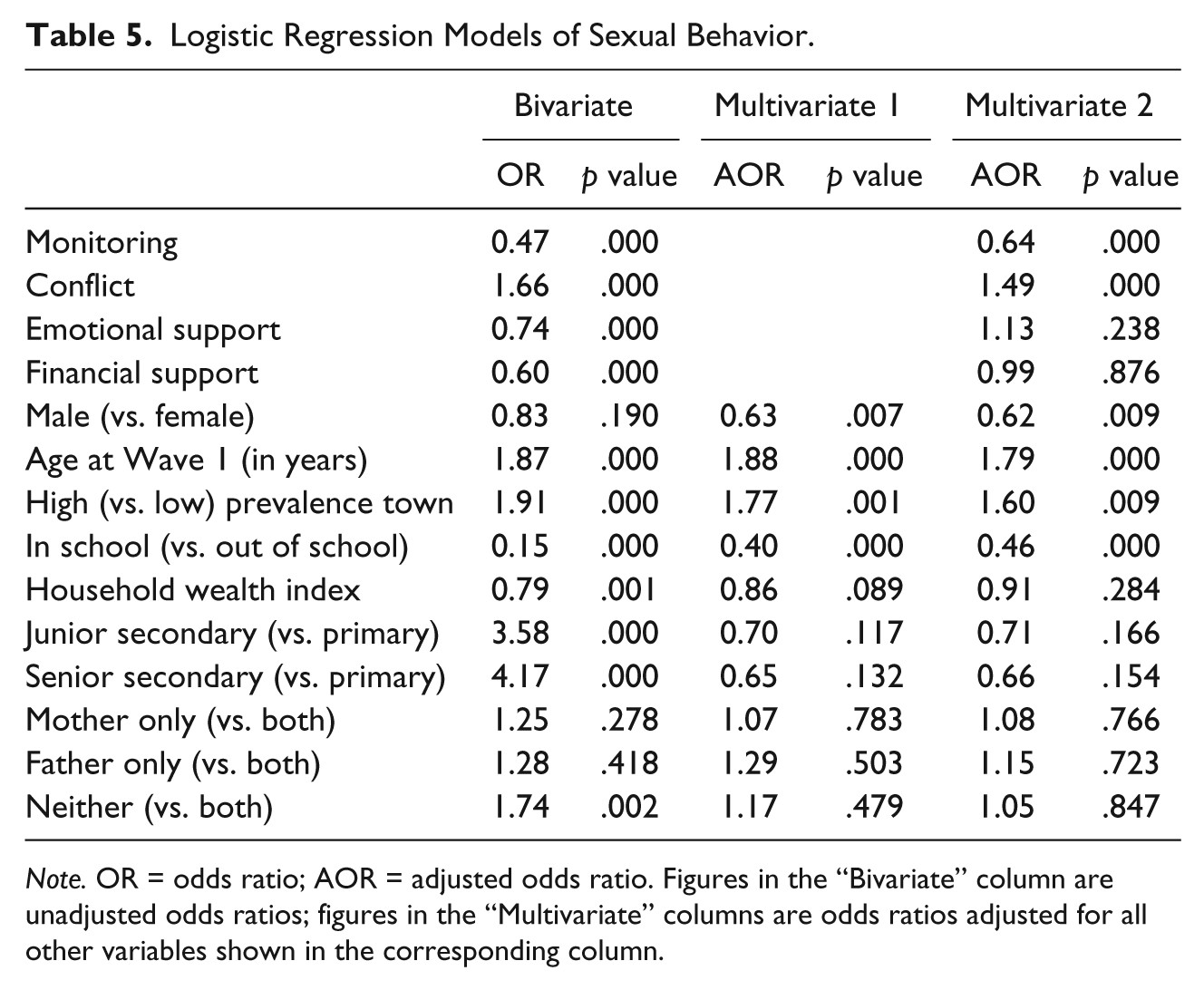
Note. OR = odds ratio; AOR = adjusted odds ratio. Figures in the “Bivariate” column are unadjusted odds ratios; figures in the “Multivariate” columns are odds ratios adjusted for all other variables shown in the corresponding column.
Results of the full multivariate model of self-reported initiation of sex appear in the last column of Table 5. The key finding here is that the effects of conflict and monitoring, although slightly attenuated, remain statistically significant when the demographic variables and other scale scores are controlled. The effects of emotional and financial support, in contrast, are more substantially attenuated and are no longer statistically significant in this multivariate model.
Discussion
The findings presented here demonstrate that the proposed instrument is practical for use with teenagers in sub-Saharan Africa and produces measures of four dimensions of youth–adult relations (monitoring, conflict, emotional support, and financial support) that are reliable, correlated in expected ways with each other and with select sociodemographic variables, and strongly associated with self-reported sexual activity. After the elimination of three anomalous items, the remaining 23 items all have high (>.5) standardized loadings on their corresponding factors, and each of the four scales has a Cronbach’s α within the acceptable range (>.7), supporting the reliability of the scales. The validity of the scales is supported by the finding that the four-factor model fits the data well and by the finding that each of the four scales is associated in expected ways with sociodemographic variables including sex, age, and household composition. All four scales have bivariate associations with self-reported sexual activity that are strong, statistically significant, and in the expected directions. And some of these associations persist even when all four scales are included along with several potential sociodemographic factors in a multivariate logistic regression model.
It is noteworthy that the monitoring and conflict scales retain their statistically significant associations with self-reported sexual behavior in the full multivariate model, whereas the emotional support and financial support scales do not. One plausible interpretation of this finding is that, in these Ghanaian towns, monitoring and conflict are the active ingredients in youth–adult relations. When youth are heavily monitored by adults, they may be less likely to initiate sexual activity; but when they have a great deal of conflict with adults they may tend to become sexually active sooner. The bivariate associations between emotional and financial support and self-reported sexual activity may be a statistical artifact of the correlation between these two variables and monitoring. Yet other interpretations are also possible. Conflict with adults may be a consequence as well as (or rather than) a cause of sexual activity among youth in these communities. Reverse-causation of this type is less likely to account for the association between monitoring and self-reported sexual activity, since the discovery by a parent or other adult of a sexual relationship on the part of youth would probably lead to increased rather than decreased monitoring, thereby generating a positive relationship between monitoring and youth sexual activity rather than the negative association observed here. Nevertheless, analyses of longitudinal data on youth sexual activity and youth–adult relations may provide more insight into the nature of the causal processes that may underlie these associations.
It should be noted, moreover, that all of our inferences rely entirely on information that was voluntarily self-reported by youth. To the extent that those self-reports include inaccurate information, the inferences may be misleading. HIV epidemiologists and social and behavioral scientists share a healthy skepticism of the accuracy of self-reports of sexual and other sensitive behaviors (Aral & Peterman, 1996; Cleland, Boerma, Caraël, Weir, 2004; Fishbein & Pequegnat, 2000). In these communities, where disapproval of sexual activity among teenage girls and boys is strong, it is likely that both girls and boys underreport their sexual activity. Our estimates that 23% of girls and 20% of boys are sexually experienced are therefore almost certainly downwardly biased.
It is less obvious how the associations between youth–adult relations and sexual activity may be affected by underreporting of sexual activity. If youth experiencing all levels of, for example, the monitoring were equally likely to underreport their sexual activity, the association between our monitoring scale and self-reported sexual activity might be close to unbiased. If, on the other hand, youth who are heavily monitored by adults are more likely to underreport their sexual activity, this would inflate the association between monitoring and sexual activity. From this perspective, we should be at least as concerned as the biasing effects of differential underreporting as we are about the effects of underreporting overall. These considerations must be borne in mind when interpreting the results presented here.
An issue that remains unresolved is whether it would be wise to reduce the number of dimensions to fewer than four. One approach, consistent with a widely used model of the family context of adolescent behavior, would be to reduce the data to two dimensions: demandingness/control and responsiveness/support (Maccoby & Martin, 1983). Conflict and monitoring might be taken as representative of the demandingness/control dimension, whereas emotional and financial support might be taken as representative of the responsiveness/support dimension. In our data, however, monitoring and conflict are only weakly (and negatively) correlated, suggesting that they do not belong to a single dimension.
Alternatively, a case could be made for combining the monitoring, emotional support, and financial support scales into a single scale that might be termed “positive engagement.” Indeed, investigators used this approach in a previous study on youth in Ghana, combining monitoring, emotional support, and financial support items into a single scale that they labeled “adult social support” (McQuestion et al., 2011). The positive correlations among those three scales in our data would seem to support that approach, as would the homogeneity of the item-level associations with self-reported sexual activity shown in Figure 1.
Yet there are conceptual and, in our data, empirical reasons to treat monitoring, emotional support, and financial support as three distinct constructs. Conceptually, monitoring falls clearly into a social control paradigm. Financial support, too, could be related to social control in that an adult’s ongoing financial support of a young person provides one basis for the authority of the former over the latter (Oppong, 1997; Weisner, 1997). But emotional support bears no clear relationship to social control. Moreover, although the pattern of associations with sexual activity and demographic variables are similar for these three scales, they are not identical. Although all three scales are negatively associated with age, for example, levels of monitoring and financial support are higher for girls than for boys, whereas levels of emotional support are similar for both the sexes. Finally, the fit of a confirmatory factor analysis model with all 18 monitoring, emotional support, and financial support items loading on a single factor was substantially worse than that of a three-factor model (details available from the author on request). For these reasons, we believe that the four-scale approach is preferable both empirically and conceptually to either of the competing two-scale alternatives.
This research leaves unanswered certain questions about conflict with, monitoring by, and emotional and financial support provided by different classes of adults: biological parents, aunts and uncles, older siblings, other extended family members, and so on. We argued in the introduction to this article that the nuclear family model is far from universal in sub-Saharan Africa, and that assessment of youth–adult relations should therefore be expanded to encompass adults other than parents or even parent figures. Our results in Table 3 show that nonparental adults, especially older siblings, account for a nontrivial proportion of relevant youth–adult interactions. But our instrument does not lend itself to comparing the effects of, for example, monitoring performed by a biological father to monitoring performed by an older sibling. Nor does our approach enable us to attach different weights to practices performed by different types of people (e.g., to assign greater weight to emotional support provided by one’s mother than to emotional support provided by one’s grandfather). All conflict, monitoring, emotional support, and financial support is treated as equal, regardless of its source. Investigators seeking to conduct a more nuanced analysis of youth–adult relations and the effects thereof may therefore find this instrument to be insufficiently detailed.
Yet no tool is ideal for every possible application. The instrument presented here is suitable for use in interviewer-administered surveys with youth in Ghana and, we believe, elsewhere in sub-Saharan Africa. It produces reliable measures of four dimensions of youth–adult relations—dimensions that may be important determinants of sexual activity and other behaviors. Our hope is that, ultimately, the use of this instrument and others like it in well-designed studies may lead to a better understanding of the family contexts of behaviors that place young people in sub-Saharan Africa at risk for HIV infection and other adverse sexual and reproductive health outcomes, and to the development of more effective interventions to protect young people from harm.
Footnotes
Acknowledgements
The authors gratefully acknowledge the hard work of numerous field team members and the cooperation of participants, their families, and their communities.
Declaration of Conflicting Interests
The author(s) declared no potential conflicts of interest with respect to the research, authorship, and/or publication of this article.
Funding
The author(s) disclosed receipt of the following financial support for the research, authorship, and/or publication of this article: The authors gratefully acknowledge funding in support of this work from the Eunice Kennedy Shriver National Institute for Child Health and Human Development (R01HD061017). The research and interpretations reported are the sole responsibility of the authors and are not necessarily endorsed by the NICHD or represent the views, opinions, or policies of the NICHD or its staff