



Abstract
We use CPS data from 1976 to 2009 to compare the characteristics and proportions of stay-at-home father (SAHF) households with both stay-at-home mother (SAHM) and dual-earner households. We find that mothers in SAHF households have a significantly higher level of education than their husbands and experience the sharpest increase in education over time compared with spouses in other household types. Caregiving SAHF households are, over time, closing the income gap with their SAHM counterparts. We make a distinction between caregiving and unable-to-work SAHFs and demonstrate that these two types of SAHF households are substantially different from one another. Caregiving SAHF households share key traits with SAHM households. Our results show that families living in stay-at-home households are increasingly the result of a deliberate choice made by spouses to have fathers assume a caregiving role while mothers pursue employment outside the home.
Keywords
Introduction
Stay-at-home father (SAHF) households, in which the father is present but the mother is the sole earner, are the least studied form of household income structure. SAHF households are similar to stay-at-home mother (SAHM) households in that both consist of a primary working parent and a nonworking parent. These two household arrangements, however, represent the least traditional and most traditional forms of household structures, respectively. A study of their differences and similarities is a vital point of entry into our understanding of how family life has changed over time.
The limited attention that scholars have given to the evolution and characteristics of families with SAHFs necessitates a broader analysis of these households. There is a large and vibrant literature on the gender division of labor in the home that looks to men’s and women’s available time, their relative resources, and the ways that gender identity is performed or “done” in housework and child care. This analysis of the work–family arrangements that couples pursue explicitly examines who has time availability by looking at the correlates of having one spouse at home full-time, with more time available to do housework and child care. We apply the latter two theories (relative resources and gender identity) to investigate which families are more likely to end up with a father who stays at home and a mother who works a full-time paid job. We further argue that changes in the nature of SAHF households over time arose because of both structural changes such as the increase in women’s education, labor force participation, and relative earnings and cultural shifts in the place of day-to-day fathering in masculine identity.
Our study’s contribution to clarifying the changing nature of domestic and family life in SAHF households is threefold. First, we follow the changes in the proportion and frequency of SAHF households over four decades, between 1976 and 2009, thus mapping the frequency of their occurrence over time. We do this using the Current Population Survey (CPS), which provides us with the ability to estimate representative, longitudinal trends of the proportion and structural characteristics of SAHF households in a 34-year period. Second, we show that SAHF households have changed dramatically over the past three decades from households that were uniformly composed of fathers whose reported reasons for staying at home were largely because of involuntarily departure from the workforce, and were unable to work because of disability, or an inability to find work. These categories have made a transition into two very different types of households: unable-to-work SAHF households and caregiving SAHF households in which individuals self-identify as not working because they are engaged in family responsibilities. These changes in the proclaimed reason for being home, we argue, are related to cultural changes in the acceptability of men’s caregiving, particularly in middle-class families, as well as to shifts in women’s identities in families where women’s careers are prioritized. Third, throughout our analysis, we compare SAHF households with both SAHM and dual-earner households, showing the similarities and dissimilarities between them in individual characteristics, household characteristics, and income.
Exchange Theory, Gendered Expectations, and Changing Norms of Masculinity
Exchange theory has become a prominent framework for understanding family decisions (Blumberg & Coleman, 1989; Parrado, Flippen, & McQuiston, 2005). Exchange theory explains how, economically, families are better off financially when they allow the spouse with the greatest earning potential to be the primary breadwinner. Because women’s education has increased substantially in the last decades compared with their husbands’ education, exchange theory would suggest that more families would choose an SAHF household work and care arrangement. In fact, the Bureau of Labor Statistics (2011) estimated that 37.7% of wives earned more than their husbands in 2009. At the same time, more families have adopted a more egalitarian division of household labor (Bianchi, Robinson, & Milkie, 2007) and that may prepare some families for a nontraditional arrangement such as having an SAHF. However, the persistence of family responsibilities and norms of masculinity (Bianchi, Sayer, Milkie, & Robinson, 2012; Bittman, England, Sayer, Folbre, & Matheson, 2003; Brines, 1994; Greenstein, 2000; Legerski & Cornwall, 2010; Tichenor, 1999, 2005) suggest that the shift in work and care arrangements is likely to face opposition that would require a significant difference in earnings between wives and husbands to “push” families into an SAHF work and care arrangement.
From the point of view of exchange theory in its pure form, the power of each spouse in this exchange is dependent on human capital and earnings (Parrado et al., 2005; Xu & Lai, 2004) as well as other characteristics. Relative resources, such as the income earned by each spouse, and relative human capital that can be translated into economic resources should predict which spouse is in the labor market and which spouse is taking care of the children and household; or if both spouses are in the labor market. Specifically, higher levels of education and income relative to one’s spouse are expected to translate into more power in the relationship. In turn, greater power is expected to be used to avoid doing housework and caregiving chores (Bianchi et al., 2007; Bianchi, Milkie, Sayer, & Robinson, 2000; Brines, 1994). However, even when wives work a full-time job and husbands do not work, housework, and especially caregiving, may still fall disproportionally on the wife (Coltrane, 2000; Tichenor, 2005). We propose, then, that exchange theory should be combined with a perspective that takes gendered expectations into account, thus providing us with a useful framework for understanding the conditions under which SAHF households become a feasible way of family life for some couples.
There is ample evidence that traditional gendered expectations drive the decisions of families on how to divide paid work, unpaid work, and caregiving (e.g., Bianchi et al., 2000; Bianchi et al., 2007). The gendered expectation perspective argues that decisions about the allocation of housework and paid work go far beyond rational choice and couple-level decision making. The division of labor into housework and caregiving chores performed predominantly by the wife, and paid labor performed mostly by the husband, is instead a symbolic enactment of gendered relations and appropriate masculinity and femininity (Hochschild & Machung, 1989; Tichenor, 2005). Hence, it takes more than a rational economic decision to reverse a husband’s traditional gendered expectation of being a primary breadwinner and a wife as a primary caregiver and housework performer. Such a reversal is, therefore, more likely to occur when the husband has significantly less human capital and income than his wife or when the husband has no earning potential whatsoever. For example, when a father is disabled and has limited ability to work for pay, the resources of the mother, as the able-bodied adult in the family who can work, make it more likely that the household will become one with an SAHF. Similarly, the greater the mother’s earning potential compared with that of the father’s, the greater the likelihood that the couple will choose a structure favoring the father acquiring a caregiving and housework role. In both examples, the exchange of roles is derived from the relative resources possessed by each spouse but also recognizes that the social gendered expectations mean it is likely that this reversal of roles will be temporary (Zimmerman, 2000) or only take place when the caregiving role is less demanding. For example, fathers might agree to stay at home when there are fewer children, or when children become older and are more self-sufficient.
Previous Research on SAHF Households
Previous empirical research on SAHF families is limited and primarily qualitative (e.g., Chesley, 2011; Doucet, 2006; Zimmerman, 2000) though there is other research on families in which the wife earns more than the husband. Some studies have concentrated on negative societal attitudes toward domestic arrangements in which gendered roles are reversed, as compared with the more positive societal attitudes toward traditional family structures with SAHMs (Brescoll & Uhlmann, 2005; Bridges, Etaugh, & Barnes-Farrell, 2002; Cuddy, Fiske, & Glick, 2004; Kaufman, 2005; Novack & Novack, 1996; Riggs, 1998). Doucet (2006) took a different approach in studying fathers who are the sole or primary care providers (but still, most were working) and focused on fathering strategies. However, Doucet (2006) did not address directly the decision to become a SAHF household among her married sample.
To date, only few qualitative studies have described the decision-making and relationship dynamics of SAHF households. Most important, Chesley (2011) interviewed both SAHFs and their breadwinning wives. She reports that some men in her study became SAHFs because of adverse work conditions, such as losing their job or feeling trapped in an unsatisfactory job, whereas others made the choice to stay at home. The findings emphasize a distinction between two paths to an SAHF household, one that is consistent with exchange theory and is a result of economic conditions (i.e., the wife has the potential of accumulating higher earnings) and another that is based in change in cultural norms about gender in which fathers make a choice, not for economic reasons, to stay at home. Chesley’s (2011) study provides, therefore, support for both the exchange argument and the change in masculinity norms and gendered expectations, especially among middle-class families. Chesley has further shown that most of the men in her sample have grown to value their newfound roles at home, despite the factors that precipitated their initial departure from the workforce. Similarly, Rochlen, McKelley, Suizzo, and Scaringi (2008) studied SAHF’s psychological well-being, life satisfaction, and relationship satisfaction and found that SAHF are at or above average across all these measures. However, as the authors note, the sample is not representative of the general population of SAHFs in that it is composed of affluent families and fathers who were actively involved in SAHF communities (online discussion forums) and therefore are more likely to be satisfied with their role.
Research on SAHFs has been complemented by other studies that have examined the specific role of fathers who may, or may not, be working but serve as the family’s primary child care providers. Casper (1997) has focused on the question of who provides child care for preschool children while the mother was working. Casper found that, in 1993, 19.6% of fathers provided some care for their children while the mother was working, and 12.9% were the primary providers of care. Furthermore, if the father was not working, he provided some care in 57.7% of the households and was the primary child care provider in 50.2% of the households. In another study, Casper and O’Connell (1998) studied the effect of different economic cycles on the provision of child care by fathers. They found that the ratio of economic resources provided by the father (as compared with those earned by the mother) help explain the reasons for assuming a child care role during the 1991 recession, but not before or after. Their analysis is important but does not speak directly to the specific profile of SAHFs; rather, they focus only on dual-earner couples and not on fathers who are available to do most, or all, of the child care (i.e., those who are not working at all or work substantially fewer hours than their wives). Still, the contribution these studies make are that they provide a profile of the potential exchange between work and family roles across the traditional division of gendered work. They also mount evidence that child care provision by fathers is greater when wives earn a higher proportion of the household income and work more hours for pay.
Fields (2003) provides another study using Census data, which examines fathers as child care providers and identifies stay-at-home parents. In 2002, only 0.5% of all two-parent households comprised families in which the father did not work in order to take care of home and family while the mother was working; children with one working parent were 56 times more likely to live in a household with an SAHM than an SAHF. Furthermore, Fields did not identify any significant change in the proportion of SAHF households in the population between 1994 and 2002. One limitation of Field’s (2003) study, however, is that it focuses on a relatively short period of time. This increases the likelihood that changes in the proportion of SAHFs could not be addressed accurately. In addition, Fields’s study does not identify the characteristics of SAHF households, nor does it profile the wives of SAHFs, thereby leaving out valuable information on the potentially dynamic character of these domestic arrangements.
As Fields (2003) suggests, SAHF households can also be divided into those in which the husband is not working because he is staying at home to take care of family and those in which the husband is unable to work (i.e., because he is ill or disabled, or because he cannot find gainful employment). These two types of SAHF households, caregiving and unable-to-work SAHF households, may differ significantly in their characteristics because those that fall into the category of caregiving are more likely to choose such a household arrangement, whereas those who are unable-to-work SAHF households are not. Furthermore, the same distinction between caregiving and unable-to-work can be extended to other family households in which the wife works substantially more hours than her husband.
Hypotheses Development
Exchange theory and gendered perspectives have been applied quite extensively to research on the division of household labor and housework specifically. Because the literature on SAHF households is limited (as we describe above), we draw on the literature on housework to develop hypotheses and consider how exchange theory and gendered perspectives might apply to decisions to have a father stay at home. Exchange theory suggests that men are more likely to do more housework when their wives have greater earnings and/or more education than the men themselves. There is a substantial body of evidence that relative resources are related to men’s housework (e.g., Bianchi et al., 2007; Sullivan, 2011). By extension, we hypothesize that men are more likely to become SAHFs when their wives have more education than they do and when wives earn more (at the last time of the man’s employment) than their husbands. However, the literature on the gendered division of household labor suggests it may not be so simple. The gender-deviance neutralization and gender display perspectives (Bittman et al., 2003; Brines, 1994; Greenstein, 2000; Thébaud, 2010; Tichenor, 1999, 2005) propose that when men earn less money than their wives or are unemployed, both the husband and the wife try to “neutralize” the nontraditional earning distribution by “doing gender” and displaying clear feminine and masculine division of labor in housework and care arrangements. Although recent studies argue that gender-deviance neutralization is not operating as strongly as previously suggested (England, 2011; Sullivan, 2011), it is possible that deviance-neutralization is more dependent on family context and is more frequent in some families, for example, among working class and conservative families (Legerski & Cornwall, 2010).
Research has shown that the effect of changing norms is not symmetrical; more egalitarian ideology has been associated with reductions in women’s housework but not with an increase in the amount of time men spend performing housework. Tichenor (2005) has further concluded that both men and women work to maintain men’s dominance in couples that violate traditional gendered expectation about earning distribution. It is important to note that much of the empirical literature that studied gendered expectations and exchange in two-parent households has focused on how it affects division of housework, not child care. For example, many studies have compared the time invested in different housework chores (preparing meals, washing dishes, cleaning the house, etc.) by men and women (e.g., Bianchi et al., 2000; Coltrane, 2000; Presser, 1994) with a general support to the hypothesis that women perform less housework when they work more hours for pay, whereas only few studies have included a comparison of the time spent by men and women in child care. The few studies that do compare time spent caring for children by men and women generally report that both men and women increased time spent with children over time. In addition, although greater increase in time spent with children occurred among men (Bianchi et al., 2000), women still spend more time with children than men (Bianchi et al., 2007). In sum, although there is still a debate on the dynamics that shape division of household labor and decision making in families in which the wife earns more than the husband, gendered expectations and persisting visions of masculinity and femininity likely add a layer of complexity to families’ division of caregiving and housework. Even when women earn substantially more than their husbands, and perhaps even when women are the sole earner in the family, gendered expectations are likely to persist in housework and caregiving. However, because we focus on households in which wives are the sole earners and work a full-time job, it is likely that exchange will take place and husbands will play a greater role in unpaid work. We further expect that the change toward greater egalitarian perceptions over time would manifest itself in greater proportion of husbands, over time, that report they do not work because they take care of home and family.
Descriptive analyses of the prevalence and characteristics of SAHF households and their change over time can contribute to our understanding of both the household and the labor force. We are unaware of studies that have examined differences in the income gap between SAHF and SAHM households. Such households present an interesting opportunity to analyze income differentials because both include a single earner and a stay-at-home parent. The gender–income gap is a well-established phenomenon (Bittman et al., 2003; Marini & Fan, 1997), and it may preclude the ability for some families to choose an SAHF household structure, even in cases where the mother, based on her education and occupation, has greater earning potential. Given a large possible difference in earnings between the mother and the father, in certain cases some households, however, may choose to make the mother the sole earner.
The proportion and characteristics of SAHF households may also be influenced by the growing societal trend to place greater emphasis and value on the fathering role. Family scholars have described how younger fathers assign parenting far greater importance and perceive fatherhood as an integral part of their identity. In the past three decades, fathers have moved beyond their position as breadwinners to embrace parenting roles more broadly, which include engaging in child nurturance and caregiving (Bianchi et al., 2007) while also assuming a greater part in maintaining social ties with extended family and the community (Cabrera, Tamis-LeMonda, Bradley, Hofferth, & Lamb, 2000; Marsiglio, Amato, Day, & Lamb, 2000).
We can still expect the characteristics of SAHF households and their members to be different than those of SAHM and dual-earner households. The societal gendered expectations, the rise of women’s participation in the labor force (Goldin, 2006), and the increase in education women have experienced (Buchmann & DiPrete, 2006; Goldin, 2006), along with the economic disadvantage of SAHF households and the view of SAHFs of their state as temporary (Zimmerman, 2000), all contribute to this expectation. We may also anticipate that fathers are less willing to stay at home when they have more offspring, or when children are very young because social perceptions might be even more gender biased in the case of men looking after, say, infants. We also expect that, based on exchange theory, fathers are more likely to stay at home when their wives have far greater earning potential. Finally, based on the increased involvement of fathers in the last three decades, we expect that more SAHFs will be of the caregiving type and less would be of the unable-to-work type as we look at data moving forward in time.
Method
Sample
The March CPS provides a unique opportunity to estimate the proportion and characteristics of SAHF households and their members in the U.S. population over time. The CPS is a monthly U.S. household survey conducted jointly by the U.S. Census Bureau and the Bureau of Labor Statistics. The CPS includes a battery of labor force and demographic questions, and the March Annual Demographic File and Income Supplement includes additional variables that will be used in this study. In particular, the current study used the Integrated Public Use Microdata Series of the Current Population Surveys (King, Ruggles, Alexander, Leicach, & Sobek, 2004) that coded variables identically between 1962 and 2009 to allow cross-time comparisons using the March CPS. In our analysis, we use all available data from 1976 to 2009. Data before 1976 are missing many of the study’s variables of interest.
We include only households with married heterosexual couples, with at least one spouse working at 35 hours a week or more in the previous year, for at least 40 weeks, with at least one child 18 years of age or younger who resides in the same household. Weighting was used for all data in the sample. Household-level variables were weighted using household weight. Individual- (person-) level variables were weighted by person weight.
Measures
Household Type
Household types were identified by calculating the standard weekly hours worked by husband and wife. Different types of SAHF household were considered based on the weekly working hours of both spouses, but we decided to adopt the most restrictive definition, that of a household in which the wife is employed full-time (35 weekly hours or more; Bureau of Labor Statistics, 2009) and the husband does not work at all (0 hours). The counterpart SAHM households were defined as those in which the husband is employed full-time (35 weekly hours or more) and the wife is not working at all (0 weekly hours). All households in which both the husband and wife work for at least 35 weekly hours were defined as dual-earner. We decided to adopt this categorization scheme because (a) it ensures that at-home households truly contain an adult who is likely to have greater than average responsibility for home and family and (b) it allows for comparisons of caregiving and unable-to-work SAHF households (such comparisons are not available if other definitions are used because the CPS did not ask individuals who worked any amount of time in the previous year why there were only employed part-time). Analysis using other definitions (where one spouse works full-time and one less than full-time) is available from the authors on request.
Household Work Income
The income of the household from paid work. For SAHF and SAHM households this is the income from work of the wife and husband, respectively. For dual-earner households this is the combined income of both spouses from work.
Number of Children
The number of children is measured directly by a variable that includes any biological, adopted, or stepchildren who reside in the same household.
Number of Children Under Age 5 in the Household
The CPS provides a direct measure of the number of children under age 5 living in the household.
Age
Age of mother and father as reported by the respondents.
Relative Education
Education level was coded into four categories: less than 12 years of schooling, 12 years of schooling, 1 to 4 years of college, and 5+ years of college. We then created measures of relative education of the mother compared with the father. The first variable indicates whether the mother has higher education than the father, the father has higher education than the mother, or both have similar education. We also created a relative education continuous variable that was calculated by deducting father’s level of education from the mother’s level of education as specified in the education level variable above; the created variable ranged from −3 (father with an education of 5+ years of college with a mother who has less than high school education) to 3 (mother with education of 5+ years of college with a father who has less than high school education), with 0 being similar education of both spouses. Only the continuous variable was used in the multinomial regression.
Race and Ethnicity
Four major racial and ethnic groups are identified and controlled for using dummy variables: Whites (non-Hispanic), Blacks (non-Hispanic), Hispanics, and Other Race/Ethnicity. Households are identified as both parents White, both parents Black, both parents Hispanic, and parents are of different race.
Reason Not Working Last Year
The CPS provides information from 1976 to 2009 about the reason for not working during the last year as reported by individuals. The reasons include “could not find work,” “ill or disabled,” “taking care of home/family,” “going to school,” “retired,” “in armed forces,” and “other.” We coded households in which the father reported he is not working because he is “taking care of home/family” as a caregiving SAHF. We coded households in which the father reported he is not working because he “could not find work” or was “ill or disabled” as an unable-to-work SAHF. All other reasons were coded as “other.”
Analyses
We use descriptive statistics to follow the proportion of SAHF, SAHM, and dual-earner households in the population over time. We then turn to multinomial logistic regression using SPSS 20.0 software.
Results
Table 1 shows the proportion of SAHFs, SAHMs, and dual-earner households with both spouses working full-time, over time. Using this very restrictive definition of SAHF households in which SAHF households are those where the mother works 35 weekly hours or more, and the husband does not work, the proportion of SAHF households has grown from 2.0% in 1976 to 1979 to 3.5% in 2000 to 2009. During the latter period, more than half a million households in the United States identified themselves as having SAHFs by this definition. As can be seen in Table 1, there is a steady increase in the proportion of SAHF households. Using a more relaxed definition, we calculate that households where the mother works 35 hours or more per week and the father is employed less than full-time (or not at all) have grown from 2.2% in 1976 to 1979 to 4.4% in 2000 to 2009; the other households in that analysis are those in which the father works 35 hours or more per week and the mother works less than full-time and households in which both spouses work 35 hours or more per week.

Note. Estimated number of U.S. households per year, in millions, in parentheses (Source: CPS March Supplement).
Stay-at-home father households are those in which the wife works 35 hours or more and the husband does not work.
Stay-at-home mother households are those in which the husband works 35 hours or more and the wife does not work.
Dual-earner households are those in which both spouses work 35 hours or more.
We find that there is a large increase in the proportion of SAHF households with fathers who claim to at home because they are caring for family and home, from almost none in 1976 to 1979 to 22% of all SAHF households in 2000 to 2009. Between 1976 and 1979, only 1% of fathers who did not work while their wife works 35 hours a week or more can be categorized as caregiving. In contrast, 72.7% were unable-to-work (i.e., could not find work or were ill or disabled). Between 2000 and 2009, 21.9% of fathers who were not employed indicated that they stayed at home to take care of home and family. Only 51.9% were unable-to-work, meaning that proportionally, the drop in unable-to-work SAHF households was substituted by caregiving SAHF households. This increase—from virtually no fathers reporting that they stay at home to more than one fifth of fathers who stay at home to take care of their home and children—indicates a major shift in family arrangements and suggests it has become more acceptable for fathers to acknowledge their caregiving responsibilities. Unlike SAHFs, the reasons given by mothers for not working have not changed substantially over time. Across all years, more than 90% of SAHM indicate they do not work because they are taking care of home and family.
Characteristics of Stay-at-Home Father Households
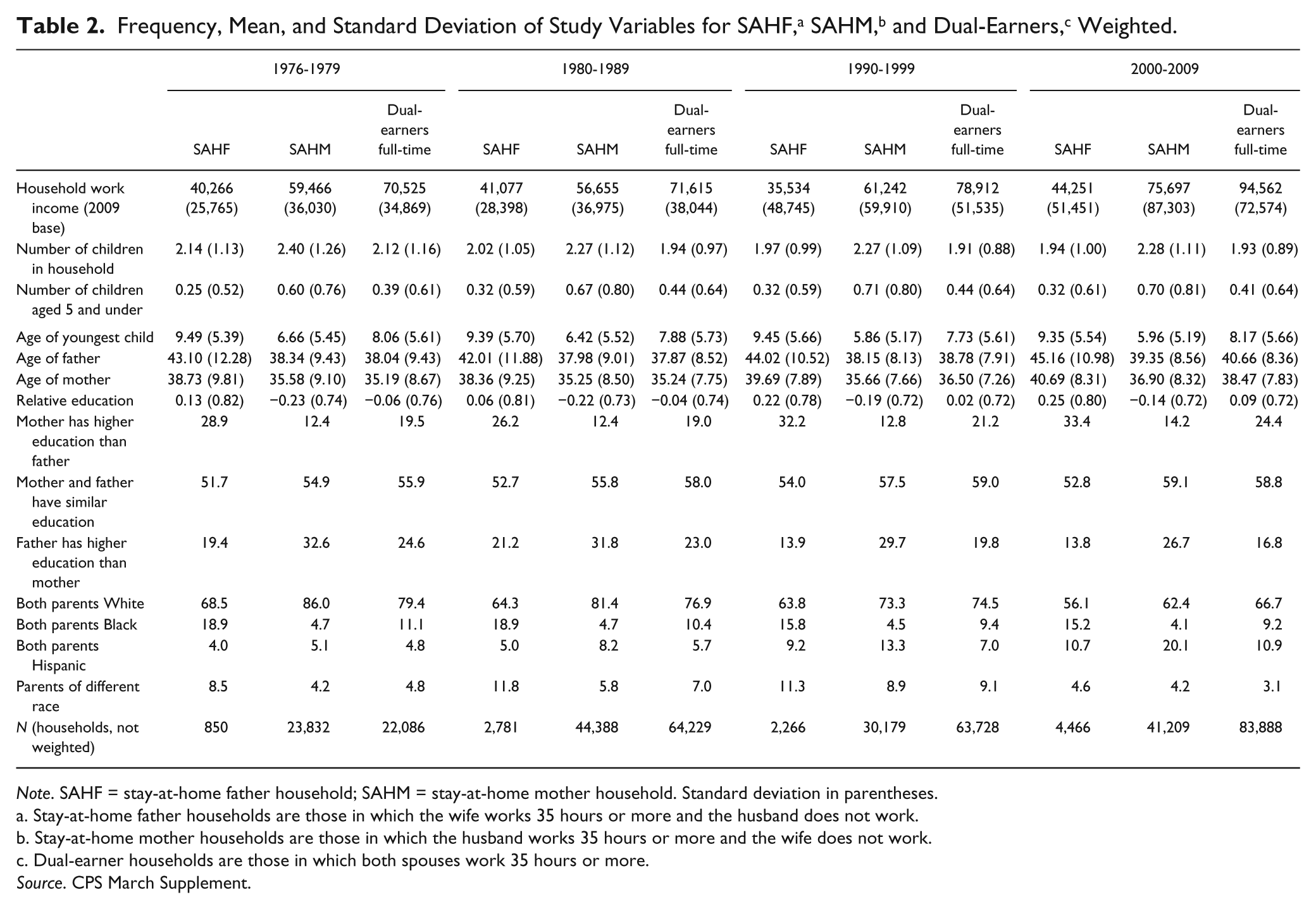
Table 2 compares the income, household composition, age, education, and race of households with SAHFs, SAHMs, and full-time dual-earner couples across four time periods: 1976 to 1979, 1980 to 1989, 1990 to 1999, and 2000 to 2009. As can be seen in Table 2, the income of SAHF households (adjusted to 2009 dollars for all years) is significantly lower (p < .01) than that of SAHM households in all four periods, and the income gap increases somewhat over time. From 1976 to 1979, SAHM households had an income that was $19,200 greater than that of SAHF households. This amounts to the households of SAHFs having 68% of the income of their SAHM counterparts. In the period between 2000 and 2009, the income gap between SAHF and SAHM households increased in dollar terms to $31,446, which translates into SAHF households having only 58% of the income households with SAHMs. Number of children is higher in SAHM households and similar in SAHF and dual-earner households throughout the time between 1976 and 2009. However, children in SAHF households are significantly older (p < .01) than children in both SAHM and dual-earner households. We also find that parents in SAHF households are significantly (p < .01) older than parents in SAHM and dual-earner households. We also find that mothers are more likely to have higher education than their husbands in SAHF households than in SAHM and dual-earner households. Finally, SAHF households are less likely to be white than both SAHM and dual-earner households.
Note. SAHF = stay-at-home father household; SAHM = stay-at-home mother household. Standard deviation in parentheses.
Stay-at-home father households are those in which the wife works 35 hours or more and the husband does not work.
Stay-at-home mother households are those in which the husband works 35 hours or more and the wife does not work.
Dual-earner households are those in which both spouses work 35 hours or more.
Source. CPS March Supplement.
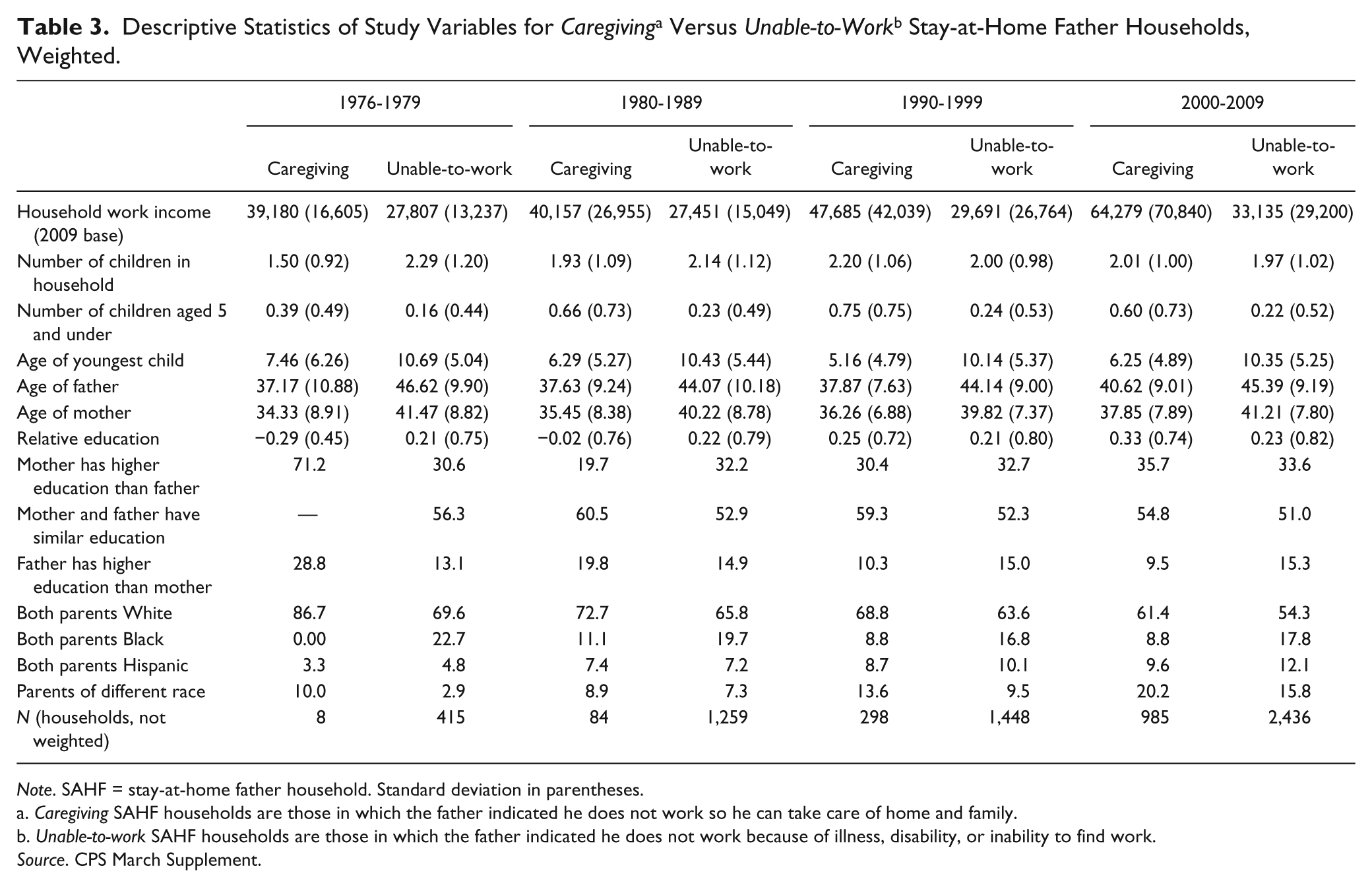
Table 3 presents the same characteristics that are presented in Table 2, but separates caregiving SAHF households, those in which the father indicated he does not work so he can take care of home and family, and unable-to-work SAHF households, those in which the father indicated he does not work because of illness, disability, or inability to find work. Comparing SAHF households that fall within the specific category of caregiving with SAHM households shows a much smaller income gap. In 1976 to 1979, there were only eight fathers who indicated they did not work because they took care of family and home. The results for this period are potentially suspect, given the small sample size from which to draw our data. A substantial increase in the income of caregiving SAHF households occurred between 1990-1999 and 2000-2009. Comparing the income of caregiving SAHF households to that of SAHMs reveals that in 2000 to 2009, these households had an income that was $11,418 lower than that of SAHM households, or 85% of the income of SAHM households. In addition, by the late 2000s caregiving SAHF households’ income was almost double the income of unable-to-work SAHFs. There are substantial differences in household characteristics between caregiving SAHFs, unable-to-work SAHFs, SAHMs, and dual-earners. Unable-to-work SAHF households have fewer children aged 5 and under than all other groups; in caregiving SAHF households, there were almost as many children aged 5 and under as there were in SAHM households. Furthermore, the age of the youngest child is almost identical for caregiving SAHF households and SAHM households throughout the 2000s.
Note. SAHF = stay-at-home father household. Standard deviation in parentheses.
Caregiving SAHF households are those in which the father indicated he does not work so he can take care of home and family.
Unable-to-work SAHF households are those in which the father indicated he does not work because of illness, disability, or inability to find work.
Source. CPS March Supplement.
Turning to the individual characteristics of household members in SAHF households, as compared with SAHM and dual-earner households, we find that there are substantial differences across all three categories. As can be seen in Table 2, both spouses in SAHF households tend to be much older than their counterparts in SAHM and dual-earner households. This finding is driven, however, by the advanced age of both spouses in unable-to-work households; comparing the age of mothers and fathers in caregiving SAHF households to the others reveals that they are similar to the ages of parents who are SAHM and dual-earners. Fathers in caregiving SAHF households tend to have lower education than their wives; in 2000-2009, 35.7% of wives had higher education than their husbands in caregiving SAHF households and only 9.5% of husbands had higher education than their wives. In comparison, in 2000 to 2009 only 14.2% of wives in SAHM households had higher education than their husbands, whereas 26.7% of husbands had higher education than their wives. Finally, race played a role in the type of SAHF household; Black respondents were more likely to be classified as unable-to-work than caregiving SAHF households.
Multinomial Logistic Regression Analyses
Table 4 shows the results from the multinomial logistic regression analysis predicting the type of household in the four household categories in the period of 2000 to 2009. 1 The first three columns of Table 4 present the results of the first multinomial logistic regression in which caregiving SAHF households were the reference category. The last two columns present the results of a second multinomial logistic regression in which unable-to-work SAHF households were the reference category.
Multinomial Logistic Regression Results, 2000 to 2009, Weighted.

Note. OR = odds ratio. Statistical significance and standard errors are presented without weights. Coefficients are calculated with weights.
*p < .05. **p < .01.
Source. CPS March Supplement.
The results from Table 4 provide further support for the assertion that caregiving and unable-to-work SAHF households are quite different. Higher income increases the odds that a household has dual-earners or an SAHM, relative to caregiving SAHF households, but reduces the odds of being an unable-to-work SAHF household. Caregiving SAHF households are similar to dual earner households in number and age of children, with larger families and younger children increasing the odds that a household has an SAHM. Father’s older age increases the odds of an SAHF household being caregiving compared with unable-to-work and having a younger mother increases the odds of an SAHF household being unable-to-work compared with caregiving. Also, the relative education of spouses has a very strong effect on the probability that a household will become an SAHF household, particularly a caregiving one. For example, between 2000 and 2009, each unit increase in the difference between the wife and husband level of education decreases the probability of a household becoming a SAHM household as compared with a caregiving SAHF household by 58.5%. Although we report multinomial logistic models for 2000 to 2009 only, additional analyses found that caregiving SAHF households became more similar to SAHM households over time. Although higher income is a stronger predictor of the probability of a family having an SAHM and dual-earner, the effect of income decreases over time. Moreover, the effect of the age of the youngest child and the mother’s age on the probability of a family being a caregiving SAHF household—as compared with SAHM household—decreases substantially over time. Finally, the odds of being a caregiving SAHF household are higher than being an unable-to-work SAHF household if both parents are Hispanic or of different race (compared with White) and lower if both parents are Black.
Discussion
Using a nationally representative sample, this article provides information on the characteristics of SAHF households and the changes in SAHF households over time. We find that, first, while still a relatively small proportion of couples with children, SAHF households are on the rise—from 2.0% in 1976 to 1979 to 3.5% in 2000 to 2009. This trend is likely to persist given increasing differences in the relative education of men and women (Raley, Mattingly, & Bianchi, 2006). Although SAHF families represent only a small proportion of two-parent families, we estimate that, on average, more than 1.125 million children lived in SAHF households in any given year between 2000 and 2009. Hence, the number of children who live in such a household arrangement is substantial. Furthermore, these results should be considered as a conservative estimate of the number of SAHF households in the population as the number would have been much higher had we used a less stringent definition such as including households where fathers did some part-time work for pay.
Second, the reasons for adopting an SAHF family structure are shifting from an emphasis on reasons linked to health or labor market constraints (unable-to-work SAHF) to those more focused on family caregiving needs (caregiving SAHF). In 2000 to 2009, 22% of SAHF households were ones in which the husband chose not to work so he could take care of home and family compared with only 1% in 1976 to 1979. We also find that, over time, caregiving SAHF households tend to be more similar in many respects to SAHM and dual-earner households and less similar to unable-to-work SAHF households. Specifically, caregiving SAHF became more similar to SAHM and dual-earner households in income and age of children. Taken together, the patterns offer evidence that provides further insights on the role of relative resources and gendered expectations in shaping work-family arrangements.
In support of exchange theory, we estimate that families are more likely to choose caregiving SAHF household arrangements in situations in which the earnings of the wife are higher than wives in other household types. Additional support for exchange theory is provided by the important role we find for relative education. Having a wife with higher education than her husband increases the probability of a family being a caregiving SAHF household compared with all other types of households. We also find support to changes in perceptions of masculinity and femininity that may have led to the increase in the proportion of SAHF households with fathers who specify taking care of home and family as the reason they do not work. It is possible that, over time, more families hold more egalitarian gendered expectations (Yoshida, 2011). Specifically, the finding that more fathers report being caregiving SAHF over time may point to changing norms of masculinity. In addition, the fact that caregiving SAHF households tend to have younger parents and younger children than unable-to-work SAHF and have a wife with higher income may also indicate that the shift toward weaker alignment between masculine identity and work identity is experienced mostly by younger, middle-class families (Chesley, 2011). Future studies may be able to elucidate more about the decision-making process for families who become caregiving SAHF households, as well as determine which of these two mechanisms is operating, and under what conditions. In addition, there is suggestive evidence here that class plays an important role in the decision of households to become SAHF households and especially a caregiving SAHF household. Caregiving SAHF households have an average yearly income of $64,279 compared with a yearly income of $33,135 among unable-to-work SAHF households. Future research should further study whether, for example, class is related to more egalitarian perceptions of masculinity (Chesley, 2011) and, through that, to greater acceptance of the role of a caregiving stay-at-home father. Finally, future studies may want to take a micro perspective on SAHF households. For example, parental control and involvement may be different in SAHF and SAHM households and could potentially result in different child outcomes (e.g., Kramer, 2012).
Although it is beyond the scope of our present study, an examination of whether gender role attitudes predict the likelihood of becoming a stay-at-home mother or father household would be useful in order to provide a more robust assessment of the growing SAHF phenomenon. For example, Zimmerman (2000) has suggested that SAHFs are more likely than SAHMs to perceive this type of household arrangement as temporary. Future studies of attitudinal differences could alter how we view the closing of the gender divide or understand some of the acute differences in expectations between spouses about the temporal role of unpaid work in the home. We also call for future studies to probe deeper to the importance of cultural shifts in norms of masculinity and femininity and their relationship to how couples divide paid-work, unpaid-work, and care responsibilities.
Finally, it is important to note that use of the very term “stay-at-home mother” or “stay-at-home father” implies that the parent is not employed in order fulfill the role of a primary caregiver for children. Having a parent out of the labor force is generally presented as a choice. It is, however, a constrained choice at best because caregiving responsibilities frequently come into conflict with inflexible and outdated work rules. Rigid working conditions can often precipitate the departure of some parents from the workforce because the demands of childrearing make it difficult to maintain a career (Moen & Roehling, 2005). However, we have also found that there are many parents who are at home with children, not because they “choose” to be home, but because they withdrew from the labor force following an illness, disability, or difficulty finding work. In our study, we trace the rise in the proportion of households with a father at home, and specifically the rise of households where fathers report being at home, to care for family. Although these caregiving SAHF households have increased dramatically over time, more fathers still report that they are at home because they are not employed and unable to work. There are, however, significant changes in societal attitudes and a diminishing gender income gap for women working in high-skilled professions which increase the likelihood that the number of caregiving SAHF households will continue to rise and merits future study.
Footnotes
Declaration of Conflicting Interests
The author(s) declared no potential conflicts of interest with respect to the research, authorship, and/or publication of this article.
Funding
The author(s) received no financial support for the research, authorship, and/or publication of this article.