



Abstract
The present study examined the moderating role of family income on the relationships between perceived paternal parenting behavior and adolescents’ anxiety among economically and ethnically diverse sample of adolescents. A total of 1,200 participants aged between 12 and 17 years were selected for the study. A self-administered questionnaire, including Quality of Parenting Behavior Scale and Beck Anxiety Inventory–Malay were used to collect the data. The results obtained indicate that there was a significant relationship between paternal hostility (β = .34, p < .001) and paternal monitoring (β = −.29, p < .01) with adolescents’ anxiety. A multigroup analysis using structural equation modeling also demonstrated that family income level moderated the relationship between parenting and adolescent outcomes. The findings revealed that paternal consistent discipline and paternal monitoring behavior reduced adolescent anxiety in high-income families. Finding advanced understanding on how the associations between fathers’ parenting behaviors and adolescent anxiety could be quite varied when family’s financial circumstances were taken into account.
Introduction
Adolescence is a crucial period of development because of numerous physical, emotional, and cognitive changes that happen at this time (Saluja, Iachan, & Scheidt, 2004). Although some changes that take place throughout this stage are positive, it is a time of increased vulnerability to psychological problems, such as anxiety (Rapee, Schniering, & Hudson, 2009). Difficulties in adjustment may negatively affect an adolescent’s mental health and lead to negative personal and social outcomes (Hudson & Rapee, 2004; Zimmer-Gembeck, Hunter, & Pronk, 2007). Psychological health issues among adolescents have been increasing worldwide, and Malaysia is no exception. For instance, Malaysian Psychiatric Association (2006) reported that 20% of adolescents suffer from mental health problems. Hence, it is important to refine and identify issues in the development of psychological disturbances among adolescents. One of these psychological issues is anxiety, which is a major health problem and may be associated with less positive adjustment in adulthood.
Anxiety in adolescents is defined as a form of emotional problem related to meaningful impairments in both current function and functioning throughout adulthood (Edwards & Rapee, 2007). Craske (1999) proposes that individuals with anxious apprehension tend to use worry as an attempt to cope with a threat or danger since worry is related to autonomic suppression. Anxiety attributions made by adolescents might influence the course of development. Since anxiety plays a vital role in the daily life of adolescents, it would be beneficial to recognize the factors that contributed to the development of anxiety. In all cultures, parents are recognized as a fundamental influence on their children’s and adolescents’ well-being (Bayer, Sanson, & Hemphill, 2006; Sorkhabi, 2005 ). Parents who are approving and responsive tend to reduce anxiety in their children, whereas disapproving, unresponsive, and uninterested parents may foster high levels of anxiety in their children (Greco & Morris, 2002; B.D. McLeod, Wood, & Weisz, 2007).
Responsiveness and demandingness are two dimensions of parental behaviors that have been linked to the development of psychological health issues (Baumrind, 1991 ; Maccoby & Martin, 1983). Parental responsiveness includes both parental warmth and parental hostility. Parents who are highly responsive indicate warmth and support in their relations with their children (Rapee, 1997; Steinberg, Blatt-Eisengart, & Cauffman, 2006). In contrast, parents with low responsiveness are hostile and uninvolved and they do not show warm behavior. They put their children at an increased risk for developing high levels of anxiety (B. D. McLeod et al., 2007). The demandingness dimension is formed by monitoring and consistent discipline. Monitoring behavior is defined as parental knowledge and supervision of their children’s whereabouts and activities. Parents with active monitoring attempts can instill the capacity for self-regulation in their children (Grusec & Goodnow, 1994; Wong, 2008), which determines one’s outcome in facing and handling stressful situations (Gottfredson & Hirschi, 2003). Parents who are consistent and persistent in their discipline adhering to rules of conduct for the child’s behavior when the child has violated these standards. They pay attention to their children’s behavior and set clear boundaries on what they are allowed to do.
Previous research revealed that different types of paternal and maternal relationships lead to different outcomes among children (Bosco, Renk, Dinger, Epstein, & Phares, 2003; Chao, 2011; Chorpita & Barlow, 1998; Conrade & Ho, 2001; Pong, Johnston, & Chen, 2010). Of particular interest in the current study is the contribution of fathers’ parenting behavior, and the extent to which family income would moderate the relationships between parenting behavior and adolescent’s anxiety. A review of previous research showed that most of the studies have focused on the role of mothers, leaving a dearth of information on the effect of fathers (Marsiglio, Amato, Day, & Lamb, 2000; Waizenhofer, Buchanan, & Jackson-Newsom, 2004; Zimmerman, Salem, & Maton, 1995 ) in their adolescents’ lives. Therefore, it is worth nothing that fathers’ parenting recognized as the critical contributors of emotional and cognitive development of their children when they enter adolescence. On the other hand, the important role of fathers in the development of adolescents’ cognitive and social skills appears robust across cultures (Marsiglio et al., 2000). However, much of the research was specific to industrialized countries and Western context and less addressed the issue at cultural- group levels (Holden & Barker, 2004; Tamis-LeMonda & Cabrera, 2002 ). Moreover, and specific to the current study, examination of the father’s role in the child-rearing activities in Malaysian society is scarce. In Malaysian families, the fathering role becomes more salient as children grow older and enter adolescence, while mothering is a supplementary role to support the members of family (Burns, & Brady, 1992; Hossain et al., 2005), because the father is the leader of the family and has a variety of responsibilities to socialize his children according to Islamic teachings. However, there is an observable gap in the literature regarding the contribution of the father’s parenting behavior in the overall well-being of adolescents. Hence, this study aims to explore the relationships between paternal-parenting behavior and adolescents’ anxiety, because adolescence is defined as a stage of high levels of risk taking in the Malaysian context.
The dimensions of parenting behavior are thought to share universal psychological facts, and comparative and cross-cultural studies in recent years tend to examine the generalizability of these dimensions across geographic and cultural boundaries. Research demonstrated that quality of parenting behavior across distinctive cultural contexts may influence parental bonding (Uji, Tanaka, Shono, & Kitamura, 2006), and behavioral expressions of parenting behavior might take different forms in various cultures. Collectivist cultures, for instance, emphasize the aspects of cooperation, obedience, and interdependence that are valued by both children and parents, whereas individualist cultures encourage independence and autonomy in children. Malaysia represents a collectivist nation because the Malaysian population that includes the Malay, Chinese, and Indian cultures are all collectivist cultures. In this collectivist cultural setting, because interdependence and conformity are fostered and are critical for group harmony, parents are believed to clear authority figures and sense of obligation to family (Goddard, 1997; Tafarodi & Smith, 2001). In Malaysia, the family as the starting point for learning provides the socialization for upholding values, such as adherence to conventions, obedience, self-control, and emotional dependence (Bouchner & Brandt, 1981; Goddard, 1997). Filial piety (that discourages aggressive expression of disagreements) and sense of obligation to family are common features of this culture. Hence, a special kind of strong familism and a patriarchal authority structure prevails in the Malay culture. However, most of the studies have not examined systematically the relationship between parenting behavior and adolescents’ outcome in a collectivist culture. Consequently, the form of attribution of fathers’ parenting behavior to a child’s developmental outcome may inappropriately originate from an individualistic and Western cultural setting. Accordingly, this study examines the associations between perceived fathers’ parenting behavior and adolescent anxiety in the collectivist cultural context of Malaysia.
Research has demonstrated that living in poverty and family economic pressure leads to children’s maladjustment (Aber, Jones, & Cohen, 2000; Ashiabi & O’Neal, 2007; Brody et al., 1994; Cabrera et al., 2004; J. D. McLeod & Shanahan, 1993), because the relationship between parent and children is vulnerable under family economic pressure (Gershoff, Aber, Raver, & Lennon, 2007; Scaramella, Neppl, Ontai, & Conger, 2008). Despite exposure to low socioeconomic status as risk factor in parent–child association, however, relatively few studies have investigated the moderating role of family income on these relationships (Shannon, Tamis-LeMonda, London, & Cabrera, 2002; Peterson, Lowe, & Janz, 2006). Therefore, to address these significant gaps in the body of literature, this investigation will examine whether the levels of family income moderate the associations between perceived paternal-parenting behavior and adolescents’ anxiety within Malaysia context.
Paternal Parenting Behavior and Adolescent Anxiety
The majority of the studies on the father’s role in the etiology of child anxiety, reviewed by Bögels and Phares (2008), found that the secure attachment in father–child relations operates as a protective factor in decreasing the likelihood of the development of child anxiety. This finding is confirmed in research of Lamb (1997), which indicated that father closeness and secure attachment influence the child’s orientation to novel social settings. In contrast, lack of affection, anxious raring, and paternal control foster the anxiety in children (Grusec & Goodnow, 1994; Kakihara & Tilton-Weaver, 2009; Rapee, 1997). Nevertheless, those children and adolescents with anxious apprehension and educational difficulties (Holden & Barker, 2004) describe their fathers as overcontrolling or intrusive and using harsh discipline (Cabrera, Shannon, & Tamis-LeMonda, 2007; Kakihara & Tilton-Weaver, 2009). In the same line, in divorced families, father–adolescent closeness as perceived by the adolescent predicted less anxiety and being withdrawn problems (Thomas & Forehand, 1993).
More evidence for the unique contributions of fathers to the etiology of excessive child anxiety comes from longitudinal studies. For example, Belsky, Hsieh, and Crinic (1998) demonstrated the importance of father’s rearing behavior of high and low negative emotionality in a longitudinal community sample of children. They found that more positive and less negative fathering forecasted more inhibition especially in young son, as behavior inhibition predisposes child’s trait anxiety. A tentative explanation for this finding is that such fathers provide more clues about how to cope with uncontrollability circumstances and how to interpret new positions (as threat or opportunity). Some other studies observed father relatedness as a predisposition for sons’ level of inhibition psychological distress compared with daughters in young adulthood (Barnett, Marshall, & Pleck, 1992; Summers, Forehand, Armistead, & Tannenbaum, 1998).
Moderating Effects of Family Income
The associations between paternal parenting behavior and child outcomes may depend on the levels of family income. Pervious empirical studies have found that the parents of lower income children are remarkably prone to lower probabilities of economical support (Huang, Mincy, & Garfinkel, 2005). Among low-income families, fathers of these families often do not have the economical resources to pay child support (Cancian & Meyer, 2004). In these families, children have a risk of health problems because their fathers employ more rejecting and more hostility toward children (Scaramella et al., 2008). It suggests that fathers in high-income families operate as child-protection resources in father–child relations. Loukas and Prelow (2004), in a diverse sample of 521 early adolescents aged 10 to 14 years living in the United States, found that quality of parental behavior was associated with levels of internalizing and externalizing problems for those reporting lower income. Similarly, Repetto, Caldwell, and Zimmerman (2004) had investigated the importance of adolescents’ depression symptoms in a population of low-income African American families. They reported that symptoms of depression are more common among low-income African American families in comparison with high-income families when their fathers use power assertive techniques.
In addition, studies have examined whether the relationship between parent and offspring academic achievement varies by family income. For example, Davis-Kean (2005), found both the levels of family income and parents’ education as crucial predictors of the association between parents’ behavior and academic achievement among school-aged children. These findings are consistent with those of McLoyd and Flanagan (1990), who found that the link between poor parenting behavior and low self-esteem among African American children was robust across economic hardship and poverty. It is assumed that African American children from poor families received parental harshness and punitive strategies. This pattern of parental disciplinary is importantly notable for low-income children, whose parents have low levels of education.
In sum, the objective of this study was to use a moderator model to examine whether there is a differential relationship between paternal parenting behavior and anxiety at various income levels. Often investigators infer that a third variable mediates a demonstrated relationship, but do not explicitly examine a moderator model via a structural model. Multiple scholars have used moderator models to demostarte the moderating effects of socioeconomic status on other parenting relationships (Cabrera et al., 2004; Peterson et al., 2006). This study fills as important gap in research, paternal parenting behavior and anxiety for diverse income groups within the general population have not been empirically examined. Accordingly, the relationships between dimensions of paternal parenting behavior were analyzed, with particular interest in understanding family income as potential moderator of the relation between parenting behavior and anxiety. It was hypothesized that paternal hostility and rejection would increase anxiety symptoms, and, conversely, that paternal warmth, monitoring, and consistent discipline will decrease anxiety symptoms. We further hypothesized that family income would moderate the relations between dimensions of paternal-parenting behavior and anxiety; specifically, that family income would be a more powerful predictor of anxiety for adolescents whose fathers have warmth or monitoring behaviors.
Method
Participants
The data used in this study were collected as a part of a national project on adolescents’ well-being. This cross-sectional study is titled “Benchmarking the Quality of Parenting Behavior and its correlations with Adolescents Well-Being: Implications for Enhancing Human Capital Development” (BQPB; Baharudin, Tan, & Zulkefly, 2010). BQPB used the probability proportional to size sampling cluster technique to select daily secondary schools in North, Central, East, South, and East Malaysia. The probability proportional to size sampling considers communities’ size (large and small) by compensating these differences. This self-weighting technique, known for its robustness in reducing error and bias, means the selection will be proportionate to the population of the selected states and its localities (Brewer & Hanif, 1983). The current analysis focuses on Selangor and comprises 1,200 adolescents from selected urban (640) and rural (560) daily schools. Of the total, 596 (49.7%) were males and 604 (50.3%) were females (Table 1). A majority of participants indicated their race to be Malay (61.9%), followed by Chinese (20%) and Indian (18.2%). The participants were from intact families with moderate family size (M = 3.81, SD = 1.67).
Participants’ Personal Profile (n = 1,200).

Procedures
Participants were selected from attending daily secondary schools of Selangor according to the approvals obtained from Malaysian Ministry of Education (2007). The data were collected using a self-administered Malay-language questionnaire containing a Quality of Parenting Behavior Scale, Beck Anxiety Inventory–Malay, and demographic items. All students gave consent to take part in the study and filled out the questionnaire during the normal school day. To ensure standardization of procedures across classrooms, members of the trained research team supervised survey administration. The questionnaire was separated into three parts. First, the part of the questionnaire included demographic information, such as participants’ age, gender, number of siblings, self-identified race. To complete the demographic profile, adolescents were asked to take the questionnaire home for their parents. The second part covered the quality of paternal parenting behavior, along with an instrument that estimated the level of anxiety symptoms.
Measures
Basic Demographic Information
Participants asked to answer the questions regarding their age, gender, ethnicity, as well as the number of siblings. Information on family income was obtained from combination of the respondent’s father’s and mother’s income earned in a month, which was collected by fathers.
Quality of Parenting Behavior
Participants completed the Quality of Parenting Behavior Scale, which assesses respondents’ perceptions on the dimensions of paternal-parenting behavior established on four subscales: Warmth/Support, Hostility, Consistent Discipline, and Monitoring.
Parental Warmth/Support
A Warmth/Support subscale of paternal parenting behavior was measured by a child report that focuses on the variety of components of supportive parenting. The participants were asked to report how often during the relationships, their father showed affection and concern for them. The measurement format consisted of 1 (always), 2 (almost always), 3 (fairly often), 4 (half of the time), 5 (not too often), 6 (almost never), and 7 (never). Example of an item is, “How often does your father lets you know that he cares about you?” According to previous studies, the warmth/support scale has acceptable internal consistency, with a Cronbach’s alpha coefficient of .87 for the respondents’ reports about their fathers (Simons & Conger, 2007 ). In the current study, Cronbach’s alpha coefficient was .81.
Parental Hostility
An adolescent’s report of hostile parenting was assessed by using a four-item scale in which the adolescent identifies the extent to which his or her father displayed hostility, anger, disapproving, and uninvolved behavior toward him or her. A sample item is, “How often do your parents get angry at you?” The response format for this scale was the same as that applied for the Warmth subscale. Items in the Hostility subscale were reverse coded. Cronbach’s alpha coefficient was acceptable for the adolescents’ reports about their fathers (Simons & Conger, 2007). The internal consistency for hostile parenting was .75 (Simons & Conger, 2007). In this study, the Hostility subscale has acceptable internal consistency, with a Cronbach’s alpha coefficient of .71.
Parental Consistent Discipline
A four-item scale used to assess rating the persistence of their parents’ discipline .Consistent discipline defined as quality and severity discipline by parents when their children violate their standards. Responses were coded on a 5-point Likert-type scale ranging from 1 (never) to 5 (always), with a midpoint of 3 (about half of the time). Sample item included “How often does your father know if you come home or are in bed by the set time?” The Consistent Discipline subscale had acceptable internal consistency, with a Cronbach’s alpha coefficient of .65 for the respondents’ reports about their fathers (Simons & Conger, 2007). In the current study, Cronbach’s alpha coefficient was .69.
Parental Monitoring
Adolescents reported on fathers’ monitoring behavior using a four-item subscale. This scale assesses parental monitoring policies by forming beliefs and forcing norms of behavior (Magruder et al., 1992). The measurement format for this scale was from 1(never) to 5 (always), with a midpoint of 3 (about half of the time). a sample item is “In the course of the day, how often does your father know where you are?” The monitoring scale has acceptable internal consistency, with a Cronbach’s alpha coefficient of .79 (Simons & Conger, 2007). In this study, Cronbach’s alpha coefficient was .74.
Beck Anxiety Inventory–Malay
Adolescent’s anxiety in this study was evaluated by using the Malay version of the Beck Anxiety Inventory. It is a converted edition of the original Beck Anxiety Inventory with 21 items of self-report, which estimates level of anxiety symptoms (Mukhtar & Zulkefly, 2011). The Beck Anxiety Inventory–Malay intends to assess the severity of common symptoms of anxiety in adolescents and adults. Participants were asked to what extent they were bothered by various symptoms over the past week. Adolescents used a 4-point response format ranging from 1 to 4 with the following correspondence: not at all (1); mildly; it did not bother me much (2); moderately; it was very unpleasant, but I could stand it (3); and severely; I could barely stand it (4). In this scale, 13 items are related to physical or physiological symptoms (e.g., heart pounding), 5 items report cognitive aspects of anxiety (e.g., fear of the worst), and 3 items have a physical as well as a cognitive connection (e.g., terrified). In the current study, Cronbach’s alpha obtained is .91.
Results
Analytic Strategy
Structural equation modeling employed to identify and examine the relationships among the main variable, that is, dimensions of paternal-parenting behavior and adolescent’s anxiety. For the current study, a maximum likelihood estimation procedure in structural equation modeling implemented by the program Amos 18 (Arbuckle, 2008) was applied to test model fit. Proceeding to test the model fit, statistical assumptions were considered using some indices, skewness value ranges from −3 to +3 (Byrne, 2010; Kline, 2005) and kurtosis value ranges from −7 to + 7 (Byrne, 2010; West, Finch, & Curran, 1995). In addition, Mahalanobis distance (D2) tested for outliers, by using p1 and p2 (<.001), that indicated the outlier cases. More specifically, the recommended technique of Tabachnick and Fidell (2001) for transforming variables for skewed distributions was applied to a positive skewed data set. To test goodness of fit, a variety of indices were reported—chi-square goodness-of-fit estimates as a test of the null hypothesis that represents the model fit the data. With respect to sensitivity of chi-square to sample size, normed chi-square was used for model testing, which is indicated as CMIN/DF in output (Byrne, 2010; Kline, 2005). According to Kline, there is no consensus on a cutoff point of this indicator but, 2.0, 3.0, and even 5.0 is acceptable. The comparative fit index and Tucker–Lewis index are considered with values >.90. The root mean square error of approximation used to support model fit with values ranging from .03 to .08. It takes into account the error of approximation in the sample. This indicator recognized as one of the critical criteria in covariance structure modeling. Generally, in models, evaluation was established by at least four indices. Ultimately, in the current study, multiple-group analysis is estimated to provide the interaction effect of moderating of family income in the relationship between paternal parenting behavior and adolescent anxiety (Hair et al., 2010). Prior to testing for potential moderating effects, family income as a continuous variable was handled in accordance with standards outlined by Hair et al. (2010). Specifically, on the data distribution, two groups (based on 1 SD below and 1 SD above the mean) for family income (high/low) were computed. Hence, in this study, 732 cases remain in the high-income group and 468 in the low-income group.
Descriptive Analyses and Correlations
To present the pattern of the relationships among variables, Pearson product–moment correlation was calculated in the preliminary analysis. Table 2 presents the means, standard deviations, and bivariate correlations among major variables of this study. All correlations were in the expected direction and in a majority of cases were significant. For the most part, the largest correlations for each data set were seen in paternal monitoring behavior and consistent discipline (r = .39), and the smallest correlation was for paternal warmth behavior and family income (r = .01).
Means, Standard Deviations, and Zero-Order Correlations Among the Study Indicator Scales.

p < .05. **p < .01. ***p < .001 (two-tailed).
Adequacy of the Hypothesized Model
The confirmatory factor analysis is used to confirm structured factors and improve measurement properties in scales. Accordingly, the measurement model revise and refine with three indicators in hostility (dropping Question 1), consistent discipline (dropping Question 2), and monitoring (dropping Question 3), and only all indicators of the Warmth subscale remain in the modified model. Apart from Cronbach’s alphas mentioned earlier, the instrument items in the structural equation model were further evaluated using confirmatory factor analysis of the maximum likelihood estimation procedures. As illustrated in Table 3, the composite/construct reliability of the constructs ranged from .72 to .79, which are acceptable levels of reliabilities (Fornell & Larcker, 1981; Kline, 2005). The composite/ construct reliabilities are the squared multiple correlations of an indicator. In addition, the average variance extracted checked the convergent validity and discriminant validity. For this study, the average variance extracted ranged from .51 to .61 (Table 3), showing adequate levels of validities (Ferrer, Hamagami, & McArdle, 2004; Hair et al., 2010).
Reliability and Validity Coefficients for Study Instruments.

Note. CR = composite/construct reliability; AVE = average variance extracted.
The hypothesized model (Figure 1) was designated by considering four dimensions of paternal parenting behavior (paternal warmth, hostility, discipline, and monitoring) as exogenous variables and adolescent anxiety as an endogenous variable. The relationship model was hypothesized based on the literature mentioned previously. Besides, based on the preliminary analyses, the dimensions of paternal parenting behavior (paternal warmth, hostility, discipline, and monitoring) were presumed to be correlated. The direct model by examining the relationships among paternal-parenting behavior and adolescents’ anxiety is shown in Figure 2. Using multiple fit indices, the chi-square goodness-of-fit for the model is significant, χ2(df = 94) = 287.831, p = .000, the baseline comparison fit indices, comparative fit index and Tucker–Lewis index, are greater than .90, and root mean square error of approximation is less than .8. These values indicate the improvement in fit of the model in relation to the null model. That is, the results of all the goodness-of-fit criteria satisfied their critical cut scores and indicated a fitting structural modeling of paternal parenting behavior and adolescent anxiety.
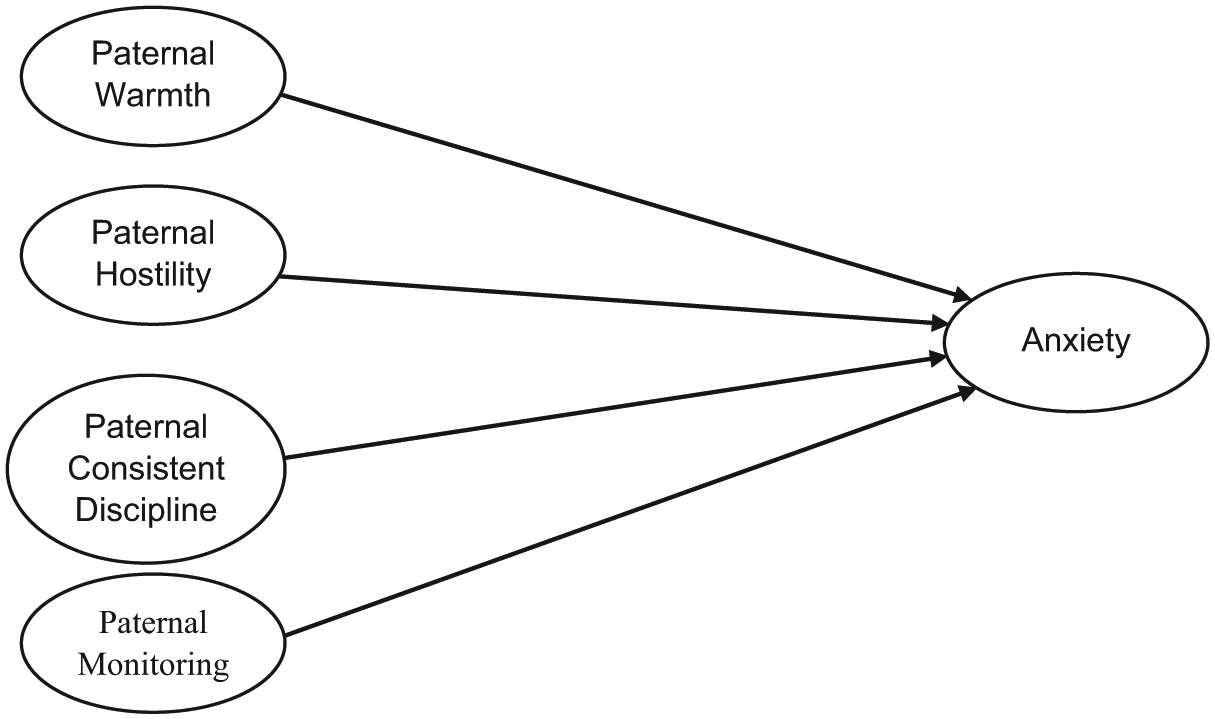
The hypothesized model of quality of paternal parenting behavior, adolescent anxiety.

Standardized coefficients of the hypothesized model.
Based on the regression weights in Figure 2, it is worth noting that two path coefficients of the structural modeling were found to be statistically significant at .05 and .01 levels: (a) paternal hostility to adolescent anxiety level and (b) paternal monitoring of adolescents’ anxiety level. In addition, paternal hostility had positive correlation with adolescent anxiety symptoms (β = .34, p < .001). Meaning that, adolescents tended to attribute higher levels of anxious symptoms when they perceived their fathers’ behavior as high hostility. Also supporting Hypothesis 1, it was shown that paternal monitoring is negatively related to the decreased anxious symptoms (β = −.29, p < .01). Adolescents whose fathers have monitoring behavior are at decreased risk of engaging in depression compared with the adolescents whose fathers do not have monitoring behavior. In other words, the data revealed that paternal hostility and monitoring were comparatively more dominant than the paternal consistent discipline and paternal warmth influence on the adolescents’ anxiety. Furthermore, the results of squared multiple correlation coefficients also revealed that 17% of the variance in adolescents’ anxiety was accounted by paternal-parenting behavior. Hence, the findings supplied support for the research hypotheses.
Family Income Invariant of the Structural Model
The second objective of the study was to examine the structural invariant of paternal quality and anxiety across family income as moderator. In order to verify family income invariant, parameters simultaneously estimated on both the unconstrained structural model and constrained model. First, all parameters in the unconstrained model tested without constraining the structural paths to provide a baseline chi-square value. Next, the structural paths of paternal-parenting behavior to anxiety were equally restricted across groups. This examination of the constrained model yielded another chi-square value to test the result against the baseline model. Finally, statistically significance was determined by using nested chi-square difference value (Bollen, 1989). The results of the multiple group modeling are presented in Table 5. The configural invariance model cross-groups produced statistically significant change in chi-square value. As the baseline comparisons shown in Table 4, the result is Δχ2(df = 4) = 14.235, p < .01. More specifically, the path coefficients varied cross-groups and the constrained model were much worse than the unrestricted model. Based on the results, it is justifiable to infer that family income interacted significantly with exogenous variables (paternal warmth, hostility, consistent discipline, monitoring). Thus, the level of family income moderates the relationship of paternal-parenting behavior and adolescent anxiety.
Model Fit Indices for Hypothesized Model.

Note. χ2 = chi-square; df = degrees of freedom; p = probability value; CFI = comparative fit index; RMSEA = root mean square error of approximation; TLI = Tucker–Lewis index.
Results of the Multiple Groups Modeling (Family Income as Moderator).

p < .01.
Table 6 indicated that of the four coefficients associated with the paths linking the model’s exogenous and endogenous variables, two are significant by the critical ratio test (>±1.96, p < .05). That is, paternal hostility positively related to anxiety symptoms of adolescents who lived in low-income and high-income situations, (β = .30 and β = .29, respectively). One interesting finding, though, is that paternal consistent discipline and paternal monitoring behavior reduced adolescents’ anxiety symptoms in high-income families (β = .39 and β = .32, respectively). They attributed to 23% of the variance in anxiety of adolescents.This finding suggested that paternal consistent discipline and monitoring were most useful for adolescents when family income is high.
Maximum Likelihood Estimates.

Discussion and Conclusion
The present study examined the moderating role of family income on the associations between perceived paternal-parenting behavior adolescent anxiety. Although, these associations have been examined prevalently in industrialized and Western countries (Bögels & Perotti, 2011; Peterson et al., 2006; Randall & Bohnert, 2009; Stevens, Vollebergh, Pels, & Crijnen, 2007; Wood, McLeod, Sigman, Hwang, & Chu, 2003); however, they are less addressed in heterogeneous, collectivist cultures and different geographical locations such as Malaysia.
The first hypothesis concerning the relationships between four dimensions of paternal-parenting behavior and adolescent anxiety supported in that greater perceived paternal hostility and ineffective disciplinary practices were associated with a greater level of anxiety in the adolescents. This finding is in line with previous research (Greco & Morris, 2002; Kakihara & Tilton-Weaver, 2009; Wood, 2006), indicating that hostile parenting practices are related to increased susceptibility to anxiety. The results also supported by parenting theorists (Bandura, 1999 ; Baumrind, 1991; Maccoby & Martin, 1983) that have contended that negative parenting dimensions (i.e., rejection, hostility, withdrawal, and aversiveness) explain child psychopathology and damage many aspects of their development in later years.
Also supporting our hypothesis, it was shown that paternal monitoring, which is marked by paternal knowledge and supervision of their children’s life, was found to be associated with lower levels of anxiety symptoms in adolescents. That is, during this period, Malaysian fathers who actively monitor and track their adolescents’ activities reduce adolescents’ susceptibility to anxiety. This finding is consistent with the idea that parental monitoring behaviors are a strong predictor of adolescents’ maladjustment outcomes (Chao, 2011; Grusec & Goodnow, 1994; Rapee et al., 2009). Similarly, Chen, Dong, and Zhou (1997) found that Chinese fathers who support and guide their adolescents during stressful or difficult periods most frequently performed monitoring strategies. Kim (2005) also found that high level of monitoring is an effective and desirable parenting behavior in Asian countries. Therefore, it has been shown that Malaysian fathers who were actively monitor and track their adolescents’ activities might support and guide their adolescents during stressful or difficult periods (Jafari, Baharudin, Mukhtar, & Jo-Pei, 2012).
The second hypothesis regarding the moderating effect of family income on the associations between perceived paternal parenting behavior and anxiety was supported. The interaction of paternal hostility and family income revealed that adolescents who lived in low- and high-income situations reported high level of anxiety symptoms, when they perceived their father’s behavior as highly hostilite. This study also found that adolescents whose fathers were consistent in their disciplinary behaviors and had a high level of income tended to express lower level of anxiety traits. Interestingly, adolescents of this study presented low level of anxiety among high-income Malaysian families when their fathers use monitoring strategies. Present findings supported earlier findings that family’s financial statues positively influence on how parents interact with their children in promoting their mental health as well as how they support their children’s needs (Cancian & Meyer, 2004; Huang et al., 2005; J. D. McLeod & Shanahan, 1993; Shannon et al., 2002). Therefore, the results of the current study imply that although the paternal parenting behavior may influence adolescents’ outcomes, considering this association in isolation may be incomplete.
The current study depicts an improvement of the previous literature in a number of significant ways. This study is able to present a model that paternal-parenting behavior is related to the development of anxiety exhibited by adolescents. It provided strong evidence on how family’s financial circumstances influence the strength of relationships between father’s behaviors and adolescent anxiety. Capturing dimensions of the quality of paternal parenting behaviors reminds researchers that a constellation of parenting practices is ideal for optimal fathering. The conceptualization of fathering as a combination of various components supplies a strong framework for comprehending how fathers can affect their adolescents. Also, this study simultaneously analyzed a compound of different constructions: quality of paternal parenting behavior, family income, and anxiety. This combination of different constructions introduces stronger knowledge for both paternal behavior and psychological health of school-going adolescents that explored individually in previous research (Operario, Tschann, Flores & Bridges, 2006; Vasey & Dadds, 2001).
Albeit the results of this study overcome some of the limitations of past research, it also suffered from other limitations. First, the current study is correlational in nature, and hence it does not allow for the causal identification about the adolescents’ outcomes. In other words, the data assessed at only one time point and and hence the generalizability of findings to other time points is not possible. It is only by means of using longitudinal designs that directionality could be examined. Another limitation of this study is assessing of paternal parenting behaviors obtained with adolescent report on the scales. For this reason, same-source bias may influence estimates of fathering effects. Therefore, it notified that the construct validity of the potential bias could measure by using multi-informant sources (parent report, teacher report, direct observations). The multi-informant sources would allow providing the independent corroboration of the unique effects of the paternal parenting behavior on adolescents’ outcomes. Another potential limitation involves the fact that the information of this study was obtained from a normative community sample of adolescents since the clinical sample reflected a qualitative break with normality; hence, it is noteworthy that this study can be replicated to assure its reliability by using a clinical sample.
Regarding the policy implications, the results of the current study have clinical and educational contributions, particularly within the cultural context of Malaysia. Concerning fathering, the present study provides continuing evidence that fathers play a prominent role in the well-being of their children. Hence, this study proposes that any intervention program or holistic policy to promote adolescents well-being should comprise fathers.
Footnotes
Acknowledgements
We thank the students and schools who participated in this research project.
Declaration of Conflicting Interests
The author(s) declared no potential conflicts of interest with respect to the research, authorship, and/or publication of this article.
Funding
The author(s) disclosed receipt of the following financial support for the research, authorship, and/or publication of this article: Research Management Center of University Putra Malaysia supported this research to a team of researchers led by Prof. Dr. Rozumah Baharudin.