



Abstract
Based on the data collected from 275 Chinese families experiencing economic disadvantage in Hong Kong, the influence of parental beliefs (Chinese cultural beliefs about adversity, attribution of children’s success and failure to effort, and expectations of children’s future) and parental control on adolescent development was examined. It was found that paternal expectations of children’s future predicted adolescents’ perceived maternal control and positive youth development. Furthermore, perceived maternal control mediated the effect of parental beliefs on adolescent positive development. This is the first scientific research that clarified the pathway through which parental beliefs influenced adolescent positive development via maternal control in Chinese families experiencing economic disadvantage. The research findings underscore the importance of understanding the triadic interactions among fathers, mothers, and adolescents in families experiencing economic disadvantage.
Introduction
Poverty has detrimental impacts on family functions and adolescent development. Theoretically, the “family stress model” of economic hardship has been used as the mainstream model that addresses how parental distress and parenting behaviors mediate the effects of poverty to adolescent psychosocial outcomes (Conger & Conger, 2008). Although the model has fostered the research trend on studying how parental deficits result in the adolescent pathological development (Conger, Ge, Elder, Lorenz, & Simons, 1994; Shek, 2008a), the focus has been put on how family processes impair adolescent development. In contrast, the strengths and contributions of the family on building adolescent positive development are often neglected. Walsh (2011) strongly criticized that “in mental health and child development literature, families were thought to contribute to risk, but not to resilience” (p. 149). McLoyd et al. (2009) similarly warned that there is “a dearth of research about contributors to positive adaptation in the context of socioeconomic disadvantage” (p. 446). With reference to this limitation, this study attempted to examine the role of parental beliefs and parental control in the positive development of adolescents experiencing economic disadvantage.
Theoretical Review of Parental Beliefs, Parenting Practice, and Adolescent Development
Based on the resilience literature, affectional ties within the families, such as cohesion, warmth, shared values, and consistency of rules, are important protective factors that moderate the influences of poverty on child developmental outcomes (Garmezy, 1993). Among them, the Family Adjustment and Adaptation Response (FAAR) Model (Patterson, 1988) provides a theoretical framework that addresses the relationships among family meanings, demands, capacities, and adaptation in face of adversity (Patterson, 1988, 1993). In the model, family meanings shape the levels of risk as well as the appraisal-focused coping strategies (Moos & Billings, 1982). Patterson (2002) suggested that “the meaning-making process is a critical component of family resilience, especially when the significant stress is due to adversity or trauma” (p. 244).
In addition, when reviewing the influences of parental attitudes, parenting practice, and adolescent development, LeVine (1980) portrayed the model of parental behaviors by encompassing universal goals, cultural strategies, and parental practice. He suggested that parents have hierarchical goals of survival, health, building of economic capabilities, and nurturing of cultural values for their children. On one hand, some socialization goals are quite universal across cultures, such as facilitating child’s future economic security, minimizing the risk for children, and maximizing their welfare (LeVine, 1988). On the other hand, socialization goals may vary across cultures with the specific demands and qualities of children that are valued and focused (Chen, Liu, & Li, 2000). Taking into account the importance of ecology and culture, the ecological–cultural perspective (LeVine, 1988; Super & Harkness, 1986) argued that parental beliefs influenced parental behaviors and parenting practices (Padmawidjaja & Chao, 2010; Super & Harkness, 1986). Parental beliefs enable parents to deal with challenges, preserve their self-esteem, setting family standards, and generate parental behaviors in responding to parenting demands (McGillicuddy-De Lisi & Sigel, 1995), which further influence adolescent development (Davis-Kean, 2005; Schoon, Parson, & Sacker, 2004). Parental beliefs in different cultural contexts are critical in determining the socialization goals of the families, which in turn affect the socialization strategies. While LeVine’s (1980) model of parental behaviors provides a broad and integrative framework for understanding parental goals and cultural socialization strategies, the ecological–cultural perspective sketches the systematic skeleton based on which the impact of family beliefs on adolescent development with reference to two contextual factors (economic disadvantage and culture) can be examined. These two contextual factors were the bases on which the present study was built on.
In Chinese culture, the core of Chinese value systems of Confucianism and Taoism carry distinctive features in socialization goals and parenting. Taoism focuses mainly on self-control and interpersonal harmony, whereas Confucianism emphasizes social responsibility and obligations, establishment of social bonds, conformity to rules and norms, respect to parents and seniors, and building of family reputation (Fung, 1983; King & Bond, 1985). Under these doctrines, Chinese parents build up interdependent relationships with their children through fostering obedience to rules and authority, while at the same time devoting their love, care, and guidance to their children. Shek (2007) further suggested several characteristics intrinsic to traditional Chinese families that may have implications to Chinese socialization practice. These include preservation of family harmony; regulation of behaviors of family members by well-defined duties, obligations, and rules; suppression of emotions especially to the seniors; and emphasis of family solidarity. As such, parental control is regarded as the distinctive feature of Chinese parenting practice (Chao & Tseng, 2002; Shek, 2007). Parents are “responsible and respectful instructors who pass along cultural norms, values, and life experiences” (Xu et al., 2005, p. 525).
In addition to the cultural context, the socioeconomic context where parental beliefs and socialization strategies are rooted should not be neglected. This is especially important for economically disadvantaged families when parents have the primary mission to prepare their children to escape from the trajectory of poverty, to climb up the social ladder, and to have good prospects and economic success in the future. Particularly, parents may pass on their beliefs, culture, values, and skills to their children via parenting. Cross (1998) suggested that how parents coped with adversity and nurtured family resilience was simply they “parent for resiliency” (p. 152). Unfortunately, research on the role of parental values and socialization processes in Chinese families is severely lagged and is almost nonexistent in the context of poverty. The paucity of Chinese family research has hindered the development of indigenous Chinese family models, especially in the area of family resilience.
Conceptions of Parental Beliefs, Parental Control, and Positive Youth Development
Parental Beliefs
Belief systems broadly encompass the “values, convictions, attitudes, biases, and assumptions, which coalesce to form a set of basic premises that trigger emotional responses, inform decisions, and guide actions” (Walsh, 1998, p. 45). Among the beliefs systems, two components are critically important in building family resilience: family meanings of adversity and positive outlook of life (Walsh, 1998). The former highlights how family members define and interpret adversity, whereas the latter carries the positive, forward-looking orientation of the family to deal with adversity. Using these perspectives, two dimensions of parental beliefs, including beliefs about adversity and specific beliefs related to child, are worth noting.
Cultural beliefs contribute to the parent’s belief systems about adversity by influencing how adversity is defined and conceptualized, as well as by shaping coping resources and behaviors (Shek et al., 2003). In Chinese communities, though research on parental beliefs is severely lacking, effort has been made in conceptualizing Chinese cultural beliefs about adversity and exploring how they influenced adolescent psychosocial development (Shek, 2004; Shek et al., 2003). Shek (2004) identified that Chinese cultural beliefs about adversity were shaped by the Confucian thoughts on people’s inner strengths and virtues such as perseverance and tolerance, which focus on people’s constructive values and capacity to overcome adversity. However, there were also cultural beliefs suggesting that people are incapable to change adverse situations, as adversity may be due to fate or superstition (Shek, 2004). In short, cultural beliefs can serve as resources for people to cope with life adversities.
Regarding child-specific parental beliefs, parental expectation has been one of the most significant factors predicting children’s cognitive and psychological competence (Davis-Kean, 2005; Schoon et al., 2004). This is especially relevant for Chinese people, as research showed that Chinese parents have high expectations of education of their children (Fuligni, 1997; Goyette & Xie, 1999). The popular Chinese saying of wang zi cheng long (expecting the son to become dragon) truly reflects the essence of parental expectations on their children’s future, with dragon symbolizing “supremacy” in Chinese culture.
Another parental child-specific belief that influences adolescents’ development and achievement is causal attribution for children’s success and failure. Causal attributions directly affect parents’ affective responses, parenting practices, and involvement in children’s activities, which in turn influence adolescent development (Bugental & Happaney, 2002; Georgiou, 1999). In Chinese culture, effort in education is emphasized, as reflected by the sayings qin you gong, xi wu yi (reward lies ahead of diligence but nothing is gained by indolence) and qin neng bu zhou (diligence is a means by which one makes up for one’s dullness). Thus, parental attribution of children’s success and failure to effort is worth noting in Chinese beliefs systems. Unfortunately, research on understanding the relationships between parental beliefs and adolescent developmental outcomes in Chinese economically disadvantaged families are almost nonexistent. An account for the paucity of research is the conceptualization of Chinese parental beliefs. K. Leung (1996) commented on “a dearth of theorizing and data on the beliefs systems of Chinese” (p. 262).
Parental Control
When studying socialization strategies in the Chinese contexts, one should be cautious that Chinese socialization is different from Western socialization. As mentioned by Wu (1996), Chinese socialization is described as “training for obedience, for proper conduct, for impulse control, and for the acceptance of social obligations, while a relative lack of emphasis is given to independence, assertiveness, and creativity” (p. 148). Thus, parental control becomes a distinctive feature in Chinese socialization practices (Chao & Tseng, 2002). Parental control refers to the “rules, regulations and restrictions that parents have for their children” (Smetana & Daddis, 2002, p. 563). As differentiated from punitive or harsh parenting practice, parental control has its indigenous meaning under the influence of Confucian concept of “training,” as expressed by the terms jiao xun (to train) and guan (to govern; Chao, 1994). Padmawidjaja and Chao (2010) further elaborated the concept of guan (to govern) to include setting of expectations and “contingent autonomy” (p. 41), that is, giving autonomy only when children act responsibly. Yang (1981) also proposed several features of Chinese socialization practices that are intrinsic to the Chinese concept of parental control, including dependency training, conformity training, modesty training, self-suppression training, self-contentment training, punishment orientation, shame strategy, parent-centeredness, and multiple parenting.
Reflecting parental control in the Chinese culture, several features are intrinsic to the concept (Shek, 2007). First, components of psychological control are intrinsic in parenting practice. There is a demand for absolute obedience of the child to respect the parents. Second, the child should have high level of morality and will not bring dishonor to the name of the family. Third, there are strict rules and firm requirements in Chinese parenting practice so as to enforce the expectation and demand to the child. Shek (2007) argued that parental control in the Chinese culture is a combination of behavioral control and psychological control.
To understand how parental control influences child and adolescent development in the Chinese contexts, a survey of literature shows equivocal results. While there was evidence showing that parental control positively predicted children’s physical and relational aggression (Nelson, Hart, Yang, Olsen, & Jin, 2006) and negative emotion regulation (Chang et al., 2003), and negatively related with peer acceptance, sociability-competence, distinguished studentship, and school academic achievement (Chen, Dong, & Zhou, 1997), there was also evidence showing that parental control did not affect adolescent psychosocial well-being (e.g., social competence, self-worth; Chen et al., 2000) and academic achievement (McBride-Chang & Chang, 1998). More surprisingly, the research results of K. Leung, Lau, and Lam (1998), in their study of Chinese adolescents in Hong Kong, European America, and Australia, found that authoritarian parenting was positively related to adolescents’ academic achievement in Chinese students. As a summary, the influence of parental control to adolescent psychosocial development is far from clear. In fact, one possible factor involved is the employment of different measures of parental control across studies. To give a fuller picture on this issue, an indigenous measure of parental control was employed in the present study.
Regarding parent gender in exercising parental control, fathers in the traditional Chinese culture play a crucial role in training and monitoring the behaviors of children, according to the requirements of the Three Cardinal Guide (san gang) and the Five Constant Relationships (wu lun) embedded in the Confucian philosophy. There is a popular Chinese maxim, yang bu jiao, fu zhi guo (it is the fathers’ fault for only nurturing but not teaching his children), which truly describes fathers’ roles in exercising parental control. Mothers, in contrast, are caregivers, responsible for taking care of their children and household management (Shek, 2002a). With the division of labor in the Chinese family, fathers are regarded as “harsh disciplinarians” whereas mothers are kind and affectionate (Shek, 2002b). There is strong traditional thesis of “strict fathers, kind mothers” (Wilson, 1974).
However, recent research challenged the “strict father, kind mother” thesis and supported for the “strict mothers, kind fathers” thesis, or even “stricter and kinder mothers with detached fathers” (Shek, 2008b). Furstenberg (1988) described the phenomenon as “two faces of fatherhood” (p. 193). On one hand, fathers were more involved in taking care of their children due to a more egalitarian expectation of gender roles in the contemporary world. On the other hand, increase in fathers’ absence of child support was also evident. In contrast, mothers shoulder the dual burdens on caring the children but at the same time monitoring and controlling their behaviors (J. T. Y. Leung & Shek, 2012; Shek, 2008b). While parental differences in parenting processes in the context of economic disadvantage are discussed (J. T. Y. Leung & Shek, 2012), maternal parenting was postulated as a mediator in this study, as mothers exercise more control over their children.
Positive Youth Development
J. T. Y. Leung and Shek (2011b) pointed out that a majority of research employed the “deficiency” paradigm that focused on the internalizing and externalizing behavioral outcomes of economically disadvantaged adolescents (Conger et al., 1994; Shek, 2008a), whereas studies employing the “positive development” perspective on understanding adolescent competence lagged far behind. Criticizing “deficiency” models in research, Burton and Jarrett (2000) suggested that youth are “erroneously assigned aberrant attributions when in fact their behaviors represent a cadre of actions that fit contextual demands” (p. 1118). Thus, the study of positive development of adolescents in the context of poverty is indispensible.
The concept of positive youth development emphasizes on assets, abilities, and potential of the adolescents (Damon, 2004; Shek, Siu, & Lee, 2007). Benson (1997) adopted the asset-building paradigm and identified 40 developmental assets. Lerner, Phelps, Forman, and Roeser (2009) identified six “Cs” of positive youth development, namely, competence, confidence, connection, character, caring, and contribution. Catalano, Berglund, Ryan, Lonczak, and Hawkins (2002) further proposed a systematic framework on adolescent positive youth development and highlighted 15 positive youth development constructs to assess adolescents’ assets and abilities. Shek et al. (2007) used Catalano’s framework and conceptualized the positive youth development constructs that are applicable to Chinese. It is argued that focusing on positive youth development attributes including resilience, self-efficacy, self-determination, cognitive competence, spirituality, clear and positive identity, and positive future orientation (Shek et al., 2007) is essential to give us a holistic view on adolescent psychological capabilities in facing poverty and adversity.
Research Gaps in the Literature
Apart from the paucity of Chinese research on parental beliefs, socialization strategies, and adolescent development in the context of poverty, together with the equivocal results of the Chinese studies on the influence of parental control to child and adolescent psychosocial well-being, there are other research gaps that are worth noting. From the viewpoint of family systems theories (Belsky, 1981; Minuchin, 1974), fathers, mothers, and children should be fully recognized as part of a family system (Cox & Paley, 1997; Parke et al., 2005). They interact and influence one another directly and indirectly. The triadic interactions within the family provide a holistic picture in studying the dynamic family processes. This is especially important in Chinese family, as fathers are considered as yi jia zhi zhu (the head of the family) under Confucian philosophy. Fathers’ influences could be determinant to the behaviors of other family members. Unfortunately, in most existing research examining Chinese parenting, the role of primary caregivers, mostly the mothers, was the main focus (Chao, 1996; Padmawidjaja & Chao, 2010) with the fathers usually not covered. The problem is more salient in poor families as long and nonstandard working hours become structural constraints for the fathers to be involved in research. The absence of fathers in participation in research greatly hinders the development of theoretical family models.
Furthermore, research findings on the relative paternal and maternal contribution to child’s socialization, especially in the low socioeconomic context, are far from clear. A survey of literature suggests that fathers are generally less involved than mothers in parenting (Forehand & Nousiainen, 1993; Paulson & Sputa, 1996). Specifically, fathers of low socioeconomic status are more detached in parenting (Rubin, 1976). There has been argument that low-income fathers are “not essential” as long as necessary resources are allocated to the child’s development (Silverstein & Auerbach, 1999). However, this argument contradicts with some empirical findings showing that paternal rather than maternal influences were associated with adolescent development in intact families (Lamb & Lewis, 2010; Shek, 1999). Though fathers are less involved in parenting, positive paternal attributes may have more salient effects on children’s behaviors and competence (Forehand & Nousiainen, 1993; Shek, 1999).
Against the above-mentioned background, the study attempted to study the paths of the influence of parental beliefs on adolescent positive development via parental control in Chinese families experiencing economic disadvantage based on the ecological–cultural perspective in which the Chinese culture and economic disadvantage are focused on. There were four research questions in the study:
Method
Participants and Procedures
A cross-sectional survey with purposeful sampling was conducted. Intact Chinese families having at least one child aged 11 to 16 experiencing economic disadvantage were invited to participate in the study. The concept of relative poverty was adopted, with 50% of monthly median domestic household income according to Hong Kong Population By-census 2006 used as the poverty threshold. Families experiencing economic disadvantage were identified and recruited by various children and youth service centers, school social work services, community centers, and family service centers across Hong Kong. Social workers identified the respondent families from their serving districts and invited them to participate in the research. Finally, there were 276 families who participated in the study. There was one set of invalid questionnaires, leaving 275 sets of questionnaires for analyses.
During data collection, fathers, mothers, and adolescents were given explanations about the purpose of the research, procedure of data collection, the rights of respondents to voluntarily participate and withdrawal from the study, as well as the use of the data in the study. Written informed consent was obtained. Fathers and mothers were requested to complete the Father Questionnaire and Mother Questionnaire, respectively, which contained identical measures of parental beliefs, whereas adolescents were requested to complete the Adolescent Questionnaire, which contained measures of perceived paternal and maternal control and positive youth development. To ensure confidentiality, the questionnaire was completed by each participant separately. The questionnaire was administered in a self-administered format. In case the participants had difficulties comprehending the questionnaires, questions or items were read out by researchers and trained social workers in an interview format. Parents took around 45 minutes to 1 hour to complete the questionnaires, depending on their literacy level. Adolescents took around 35 minutes to complete the questionnaires. Conforming to the ethics of human subject research, the study was approved and monitored by the Human Subjects Ethics Subcommittee of an internationally recognized university.
The mean ages of the fathers and mothers were 49.94 (SD = 9.28) and 42.18 (SD = 4.97), respectively. A majority of parents were of low educational standard, wherein 205 fathers (74.5%) and 204 mothers (74.2%) had junior secondary or lower level. There were 211 (76.7%) fathers who had a job, whereas a high proportion of mothers were housewives (n = 199, 72.4%). The average number of children in the families was 2.34 (SD = 0.90). There were 96 families receiving Comprehensive Social Security Assistance from the government, representing 34.8% of the sample.
Regarding adolescents, there were 134 boys (48.7%) and 141 girls (51.3%) participating in the study. The mean age of the adolescents was 13.56 (SD = 1.54), with the means of boys and girls at 13.40 (SD = 1.60) and 13.71 (SD = 1.47), respectively. There were 65 adolescents (23.6%) studying in primary school (Grade 6 or below), 151 (54.9%) in junior secondary level (Grade 7 to Grade 9), and 57 (20.7%) in senior secondary level (Grade 9 and above).
Instruments
Assessment of Parental Beliefs
Chinese Cultural Beliefs about Adversity Scale
Shek (2004) developed a nine-item Chinese Cultural Beliefs about Adversity Scale that attempts to measure the cultural beliefs of Chinese people about adversity. For each item, the respondents are asked to rate their degree of agreement with the item on a 6-point scale. Examples of the item are “Chi de ku zhong ku, fang wei ren shang ren” (hardship increases stature) and “Hao chou ming sheng cheng” (whether a life is good or bad depends on fate). Higher Chinese cultural beliefs about adversity scores indicate a higher degree of agreement with positive Chinese beliefs about adversity. The measurement showed internal consistency and factorial validity in the previous study (Shek, 2004). Reliability analyses showed that both fathers’ responses and mothers’ responses of the measures had acceptable reliability in this study (fathers’ responses: α = .66; mothers’ responses: α = .61). Although the overall alpha value was not high, the mean interitem and item–total correlation coefficients, as the indictors of reliability (Schmitt, 1996), were not low in the study (J. T. Y Leung & Shek, 2013).
Parents’ Attributions Questionnaire (PAQ)
The Parents’ Attributions Questionnaire was based on the Causal Attribution Scale Questionnaire developed by Chan (1994) in Hong Kong under the framework of Weiner’s (1974) theory of attribution of one’s success/failure and the literature on strategy attributes (Borkowski, Weyhing, & Carr, 1988). Four attributes—effort, ability, strategy use, and luck—were identified for success and failure in children in relation with their schoolwork (Chan, 1994). There are totally 24 items, with 12 statements reflecting success and 12 reflecting failure. Each statement represents one of the four causes (effort, ability, strategy use, and luck). Parents are requested to rate their agreement with each statement on a Likert-type scale ranging from “Strongly disagree” to “Strongly agree.” The scale showed internal consistency and factorial validity in a previous study (Phillipson, 2006). In the present study, the “attribution of children’s success and failure to effort” Subscale (FAQ-E for fathers’ responses and MAQ-E for mothers’ responses, respectively) were used. An example of the item is, “When my child does well in exams, it is most likely because he/she has put in effort.” Reliability analyses showed that both fathers’ response and mothers’ response to the measure had acceptable reliability in this study (fathers’ responses: α = .70; mothers’ responses: α = .74).
Parental Expectations of Children’s Future Scale (PECF)
Based on the literature of parental expectations (Brody, Flor, & Gibson, 1999; Davis-Kean, 2005) and parents’ attributes of an ideal child (Shek & Chan, 1999), an indigenous scale assessing parental expectations on children’s future was developed in five dimensions: educational achievement, self-reliance, occupation, family obligation, and conduct (J. T. Y Leung & Shek, 2011a). A 17-item measure was assessed in a previous validation study that showed internal consistency, divergent validity, and factorial validity (J. T. Y Leung & Shek, 2011c). Participants were requested to rate the degree of agreement with each item on a 6-point Likert-type scale ranging from “Strongly agree” to “Strongly disagree.” An example of the item is, “I expect my child to complete university.” Higher scores indicate higher parental expectations of children’s future. Reliability analyses showed that fathers’ response and mothers’ response to the measure had good reliability in this study (fathers’ responses: α = .88; mothers’ responses: α = .88).
Assessment of Parental Control
Chinese Paternal Control Scale and Chinese Maternal Control Scale
Based on a review of the literature and Chinese schools of thought, Shek (2005, 2007) developed a 12-item Chinese Paternal/Maternal Control Scale to assess perceived parental control based on indigenous Chinese cultural beliefs. The items contain elements of behavioral and psychological control. Adolescents are requested to rate the degree of agreement with each item on a 4-point scale ranging from “Strongly agree” to “Strongly disagree.” Examples of the items are “My father expects me to be mature (sheng xing)” and “My father expects me to have good behavior so that I will not bring dishonor to the family (you ru jia sheng).” The Chinese Paternal/Maternal Control Scale showed internal consistency and divergent validity in previous studies (Shek, 2007). A higher total score of the measure indicates a higher level of Chinese parental control. Reliability analyses showed that Chinese Paternal/Maternal Control Scale had satisfactory reliability in this study (.87 for paternal control and .88 for maternal control, respectively).
Assessment of Positive Youth Development
Chinese Positive Youth Development Scale (CPYDS)
Shek et al. (2007) developed a 90-item Chinese Positive Youth Development Scale that contains 15 aspects of positive youth development. Among the 15 aspects, 7 subscales measuring the psychological competence of adolescents were used in this study. They include resilience, cognitive competence, self-determination, self-efficacy, spirituality, beliefs in the future, and clear and positive identity. The measure showed good internal consistency, criterion-related validity, construct validity, and convergent validity in a previous study (Shek et al., 2007). The scale was demonstrated to have excellent reliability in this study (α = .94).
Results
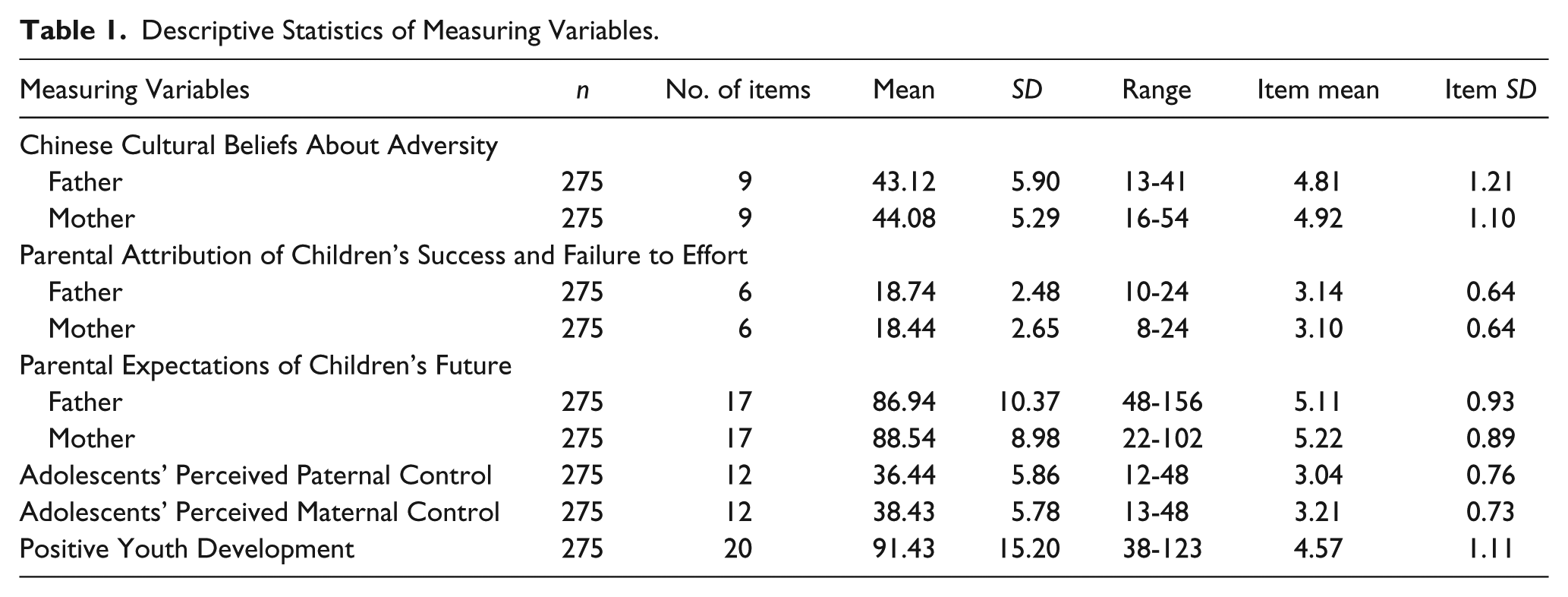
The descriptive statistics of various measuring variables are shown in Table 1. Pearson correlation analyses were performed to examine the relationships among parental beliefs, parental control, and positive youth development. A two-tailed multistage Bonferroni procedure was carried out to guard against inflated Type I error (Larzelere & Mulaik, 1977).
Descriptive Statistics of Measuring Variables.
It was found that the gender of adolescents did not correlate with parental beliefs, perceived parental control, and adolescent youth development. Age of adolescents was only weakly correlated with perceived paternal control (r = −.18, p < .006) and maternal control (r = −.16, p < .006), suggesting that older adolescents had lower endorsement of perceived parental control. The amount of overlap of the correlation of age and perceived paternal and maternal control was low (3.24% and 2.56% of the variance, respectively).
Regarding Research Question 1, it was found that paternal expectations of children’s future were positively related with adolescents’ perceived maternal control, thus giving support to Hypothesis 1k (Table 2). However, parental beliefs were not related to paternal control perceived by adolescents. To understand the influence of parental beliefs on maternal control, hierarchical multiple regression analyses of maternal control were performed. Demographic variable (age of adolescents), parental beliefs (endorsement of Chinese cultural beliefs about adversity, attribution of children’s success and failure to effort, expectations on children’s future) were entered into hierarchical blocks. It was found that parental beliefs influenced adolescents’ perceived maternal control, which added 5.0% to the explained variance. Paternal expectations of children’s future predicted maternal control, with β = .22 (p < .01; Path a; see Table 3).
Correlations Between Parental Beliefs, Adolescents’ Perceived Parental Control, and Positive Youth Development.

Note. Bonferroni correction was used to evaluate the significance of the correlations and * indicates that the r value is significant when familywise Type I error pFW < .05, pT < .006.
Hierarchical Regression Analyses of Effects of Parental Beliefs on Adolescents’ Perceived Parental Control and Positive Youth Development.

Note. β = standardized regression coefficient; B = regression estimate; SE = standard error; BCa (95% CI) = bias corrected percentile method with bootstrapping confidence intervals at 95%; CI = confidence interval; LL = lower limit; UL = upper limit. The results are significant if “zero” falls outside the confidence intervals.
p < .05. **p < .01. ***p < .001.
Regarding Research Question 2, it was found that both adolescents’ perceived paternal control and maternal control were positively related to positive youth development. Hypotheses 2a and 2b were supported (Table 2). Hierarchical multiple regression analysis was performed to study the prediction of parental control on positive youth development. Demographic variable (age of adolescents) and perceived parental control (paternal and maternal control) were entered into hierarchical blocks. It was found that parental control influenced the positive youth development, which added 13.0% to the explained variances. Both paternal control and maternal control predicted positive youth development, with β = .19 (p < .01) and β = .23 (p < .01), respectively (Path b; Table 3).
For Research Question 3, among the various parental beliefs perceived by parents, only paternal expectations of children’s future was positively related to positive youth development. Hypothesis 3e was supported (Table 2). Hierarchical multiple regression was performed to study the prediction of parental beliefs on positive youth development. Demographic variable (age of adolescents) and parental beliefs (endorsement of Chinese cultural beliefs about adversity, attribution of children’s success and failure to effort, expectations on children’s future) were entered into hierarchical blocks. It was found that parental beliefs perceived by parents influenced the positive youth development of adolescents, which added 5.0% to the explained variance. Only paternal expectations of children’s future predicted positive youth development (β = .14, p < .05; Path c; Table 3).
To address Research Question 4, the mediating effect of maternal control in the influence of parental beliefs on positive youth development was assessed. Based on the work of Baron and Kenny (1986), the four-step data analytic method suggested by Wu and Zumbo (2008) was employed to assess the mediating effects of maternal control. A Sobel test (Preacher & Hayes, 2004) was followed to test the indirect effect of parental beliefs on positive youth development via adolescents’ perceived maternal control.
In the analyses, adolescents’ perceived maternal control was found to be a mediator that mediated the influence of parental beliefs on positive youth development. Though paternal expectations of children’s future had significant direct effect on positive youth development (Path c), the effect became insignificant after inputting perceived maternal control into the regression equation (Path d; Table 3). Sobel test also indicated an indirect effect of paternal expectations of children’s future on positive youth development via perceived maternal control (z = 2.41, p < .05). Hypothesis 4 was supported (Table 4).
Sobel Test Statistics on Mediating Effect of Paternal Expectations of Children’s Future on Positive Youth Development of Adolescents via Perceived Maternal Control.
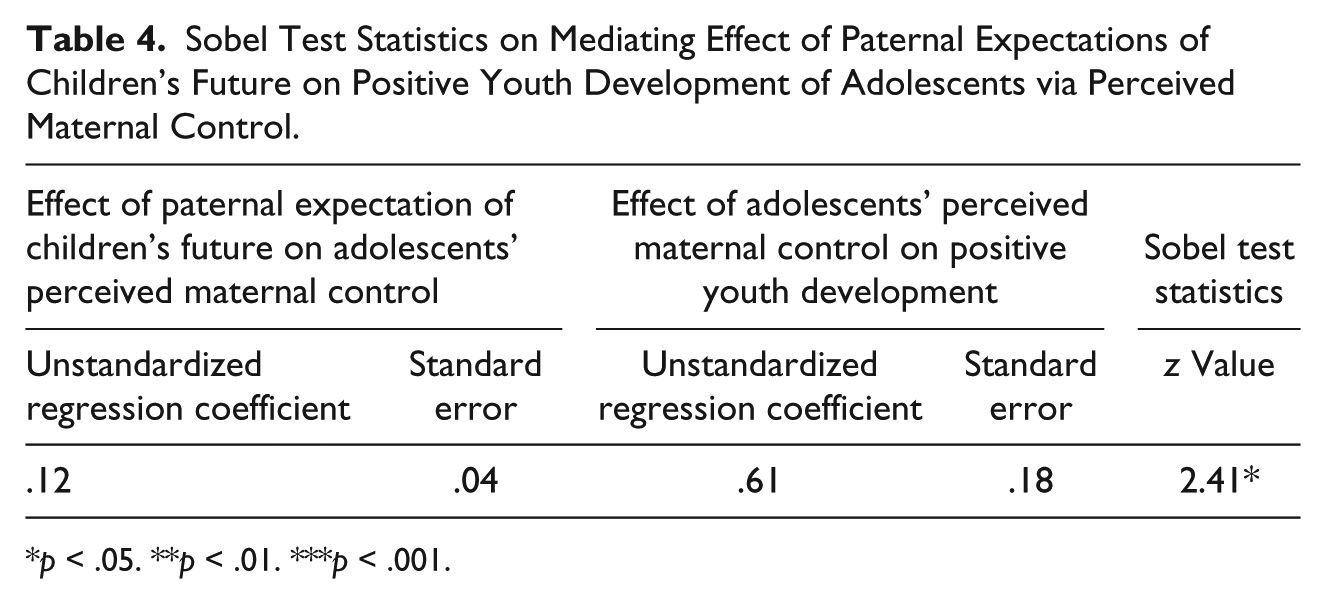
p < .05. **p < .01. ***p < .001.
To assess the stability of the multiple regression findings, regression analyses using bootstrapping method (Preacher & Hayes, 2004, 2008) having 2,000 bootstrapped resamples were performed. The predictor and outcome variables in the hypothetical models were analyzed by AMOS 16.0. The bias corrected 95% confidence intervals were set. As “zero” fell outside the 95% confidence intervals around the indirect effect, the mediation effect of adolescents’ perceived maternal control between the influence of paternal expectation of children’s future and positive youth development of adolescents was supported (Table 3).
Discussion
This study attempted to study the paths of the influence of parental beliefs on positive youth development via parental control in Chinese families experiencing economic disadvantage. There are several unique features in the study. First, this is the first scientific study that examined the influences of parental beliefs on adolescent positive development via parental control in economically disadvantaged families, particularly in the Chinese contexts. Second, indigenous Chinese conceptions of parental beliefs and parental control were adopted in the study, which is a first in the field. Third, instead of viewing the poor families as “pathological,” we adopted a “positive youth development” paradigm to understand family resilience in economically disadvantaged families in the study. Fourth, fathers, mothers, and adolescents were invited to participate in the study. Hence, it makes it possible to include parental beliefs from the parents’ perspectives as well as perceived parental control and positive youth development attributes from the perspectives of adolescents. Last but not least, validated indigenous measurement tools of parental beliefs, parental control, and positive youth development were employed in the study.
The present findings showed some support for the FAAR Model (Patterson, 1998), and they are consistent with the research findings in the field of resilience (Garmezy, 1993; Werner & Smith, 1992) that parental beliefs influenced adolescent positive development via parental control in Chinese economically disadvantaged families. Paternal expectations on children’s future and maternal control create an important path for their children to enhance their positive psychosocial development in economically disadvantaged families, which is an important milestone as far as construction of Chinese family model on resilience is concerned.
Among various parental beliefs, it was found that only paternal expectations of child’s future influenced adolescent positive development in economically disadvantaged families. The findings echoed the previous Chinese and Western literature (Davis-Kean, 2005; Fuligni, 1997; Goyette & Xie, 1999). Parents have expectations of their children to pursue a better future because they expect their children to be competent and contributing to the society and to bring honor to the family (Chao & Sue, 1996). This is of particular importance to poor families, as the future prospects of their children further imply an escape of the children and the families from the trajectory of poverty. In Chinese familism, parental expectations represent the devotion of parents to their children that may help foster the parent–child interdependence. When parents have high expectations about their children, they will devote their effort and resources for the benefits of their children. The children may experience shame and guilt when failing to fulfill their parents’ expectations (Chao & Tseng, 2002; Yang, 1981). Driven by filial piety, adolescents would try to fulfill parents’ expectations (Chao & Tseng, 2002). Thus, adolescents develop a clear purpose of life and strong sense of identity so as to gain pride and reduce shame to their families (Yu, 1996). Comparatively, parent’s cultural beliefs of adversity and attribution of child’s success and failure to effort may not have the direct impact on parent-child interdependence that is influential to adolescent positive development.
The findings suggest that paternal expectations of the children’s future shape the family values, which are critical for the positive development of their children. In the Chinese culture, traditional families are patriarchal and hierarchical, with power vested in the head of the household to maintain family proper functions. Chao and Tseng (2002) suggested that filial piety traditionally entails “a rigid system of age veneration and patriarchy” (p. 65), that is, fathers, as the head of the family, wielded greater decision-making power and were treated with respect and obedience by their children. Thus, paternal expectations are more influential in affecting the adolescent positive development.
Interestingly, it was found that instead of paternal beliefs that influence adolescent positive development via paternal control, paternal beliefs take the pathway of influencing maternal control. Also, maternal beliefs did not predict maternal control, but fathers’ expectations of children’s future did. The results were found contradictory with the traditional roles of fathers in training and monitoring the behaviors of children (Chao, 1994; Shek, 2002a, 2008b). There are three possibilities in explaining the phenomenon. First, though economically disadvantaged fathers may have high expectations on children’s future, they may face the practical difficulties in exercising paternal control due to long and nonstandard hours of work. Mothers, who spend most of their time nurturing and monitoring their children, are obliged to fulfill fathers’ expectations. Maternal control, as perceived by adolescents, becomes a manifestation of fathers’ requirement and standards according to fathers’ expectations. Second, Parke et al. (2005) suggested that maternal attitudes on fathers’ involvement need to be considered as a determinant of paternal participation in child care. Mothers who previously held monopoly over child care and family work may perceive that increased fathers’ involvement is intrusive to their positions and power in the home, which may result in ambivalence, resentment, and conflicts. Hence, maternal attitudes may develop a form of gate keeping that restrict fathers’ participation in child rearing (Allen & Hawkins, 1999; Bonney, Kelley, & Levant, 1999). This ambivalent attitude may be more salient in the Chinese contexts, as there is a strong cultural inclination of Nan zhu wai, nu zhu nei (men manage things outside the family; women manage things inside), which proposes a clear division of labor within a family. Thus, fathers’ involvement in the child’s socialization may imply a failure of mothers to perform the parenting roles of which mothers try to avoid. Third, there is an argument that paternal role is less well articulated and defined than maternal role in parenting (Parke et al., 2005). Together with the fact that fathers have fewer chances to practice and modify their parenting skills, fathers may exhibit less role identity and competence in parenting their children. In contrast, mothers, who assume more role identity and responsibility on parenting and family affairs, may show their spousal support by exercising control to their children. Indeed, the mechanisms of how fathers’ expectations of children’s future influence maternal role of parenting should be further researched. Nevertheless, the phenomenon reaffirms the triadic nature of family interactions among fathers, mothers, and adolescents, as suggested by family systems theories (Belsky, 1981; Minuchin, 1974).
Theoretical and Practical Implementations to Family Intervention
There are theoretical and practical implications of the study. First, the study underscores the importance of indigenous conceptualization of theoretical models that fits the unique Chinese context. The findings further suggest that parental control, a distinctive Chinese socialization strategy, serves as a mediator in the influence of parental beliefs on positive youth development in poor families. The study demonstrates the importance of employment of indigenous Chinese concepts in the theorization and development of Chinese family models, especially in the area of family resilience. The present findings are consistent with the assertions of the ecological–cultural view that parental behaviors are influenced by the cultural imperatives and values (LeVine, 1988; Super & Harkness, 1986). The study underscores the importance of taking into account contextual factors in understanding the impact of the family on adolescent development.
Second, the research findings underscore the importance of using family systems theories in understanding the triadic interactions of fathers, mothers, and adolescents within a family. As suggested by Gjerde (1986) that a parent–child dyad is embedded in a mother–father–child triad, the present study showed that maternal control served as a mediator in the influences of paternal expectations on adolescent positive development, which illustrates the interwoven relationships among fathers’ beliefs, mothers’ behaviors, and adolescent development.
Third, by employing the “positive youth development” paradigm, the study identified family protective factors as well as the pathways through which positive youth development of adolescents experiencing economic disadvantage could be enhanced. The findings constitute important additions to the literature.
Practically, the present findings provide important information for family practitioners and policy makers to understand the familial protective factors and the pathways through which adolescent positive development experiencing economic disadvantage could be nurtured. The findings suggest the importance of adopting a family-based intervention approach in promoting positive family beliefs and fostering effective parenting strategies in economically disadvantaged families. Family life education, hope-inducing programs for parents, and parenting enhancement programs would be necessary.
Furthermore, it was found that maternal control mediated the influences of paternal expectations in adolescent positive development in poor families. Mothers shoulder the burdens of fulfilling their spouse’s expectations, caring for the children, and at the same time monitoring the behaviors of their children. Shek (2008b) suggested that “higher behavioral control would be physically and psychologically taxing for mothers” (p. 679). The strains and stresses of performing caring and controlling roles may affect the psychological well-being of mothers and may result in more family conflicts. The findings alert family practitioners to be sensitive to the psychological and parenting needs of mothers and address their needs responsively.
Last but not least, it was criticized that many antipoverty policies merely focus on the economic dimension (Wong, 2005), and the psychosocial needs of the poor families are always ignored. The research findings underscore the importance of the psychosocial dimension in tackling the problems of intergenerational poverty. Instead of taking a residual model on providing financial subsidy for the families, the formulation of antipoverty policy should include family-friendly measures that uphold positive family values and foster parental contribution and involvement.
Limitations of the Study
There are several limitations of the present study. First, the cross-sectional design in this study has the inherent problem of inferring cause-and-effect relationships due to the lack of time order. Hence, a longitudinal research design is recommended for future studies. Second, drawing on the transactional model of development that child and adolescent behaviors interplay with parental child-rearing beliefs and strategies (Sameroff, 2009), bidirectional relations between parental influences and children’s characteristics are plausible. The bidirectional relations will contribute another limitation when considering adolescents’ perceived parental control as the mediator in the current study. It is suggested that longitudinal data be collected in future to closely look at the different family influences involved. Third, the limitation of purposeful sampling should be realized. As families were not randomly sampled, generalizability of the findings may be limited. Furthermore, as the findings presented in the study were based on economically disadvantaged families in Hong Kong, there is a need to assess generalizability of the findings in different Chinese communities (e.g., mainland China) and Chinese people living in non-Chinese contexts (e.g., Chinese Americans). Fourth, as the assessment of parental beliefs, parental control, and adolescent positive development was based on self-reported measures, it is possible that the relationships identified are due to common method variance. Thus, it would be methodological preferable to use multiple methods in future study. Fifth, in measuring parental control, only adolescents’ perceived parental control was used in the study. As it is possible that parents and adolescents may perceive differently in parental control, it is advisable to include parental control from the parents’ perspectives. Sixth, structural equation modeling was not employed in examining the path model. Though employing analytic techniques based on ordinary least squares multiple regression analyses are justified because the present study is regarded as exploratory in understanding the relationships among the parental beliefs, parental control, and adolescent positive development, and the relative small sample size and multi-group analyses bring additional difficulties and complexity in performing structural equation modeling (Hair, Anderson, Tatham, & Black, 2010), it is proposed that structural equation modeling could be employed to further investigate the hypotheses in the future. Last but not least, the magnitude of variations of positive youth development explained by parental beliefs was considered small. There is a need to further examine the barriers that inhibit the influences (such as parent–child conflicts) in the future.
Despite these limitations, the present study is regarded as the first known scientific study examining the pathway through which parental beliefs influence adolescent positive development via parental control in Chinese economically disadvantaged families. Essentially, the study is a constructive response to the development of Chinese family resilience models in enhancing the psychological well-being of adolescents in the face of adversity.
Footnotes
Declaration of Conflicting Interests
The author(s) declared no potential conflicts of interest with respect to the research, authorship, and/or publication of this article.
Funding
The author(s) received no financial support for the research, authorship, and/or publication of this article.